
A complete issue · 16 pages · 1892
Judge — June 4, 1892
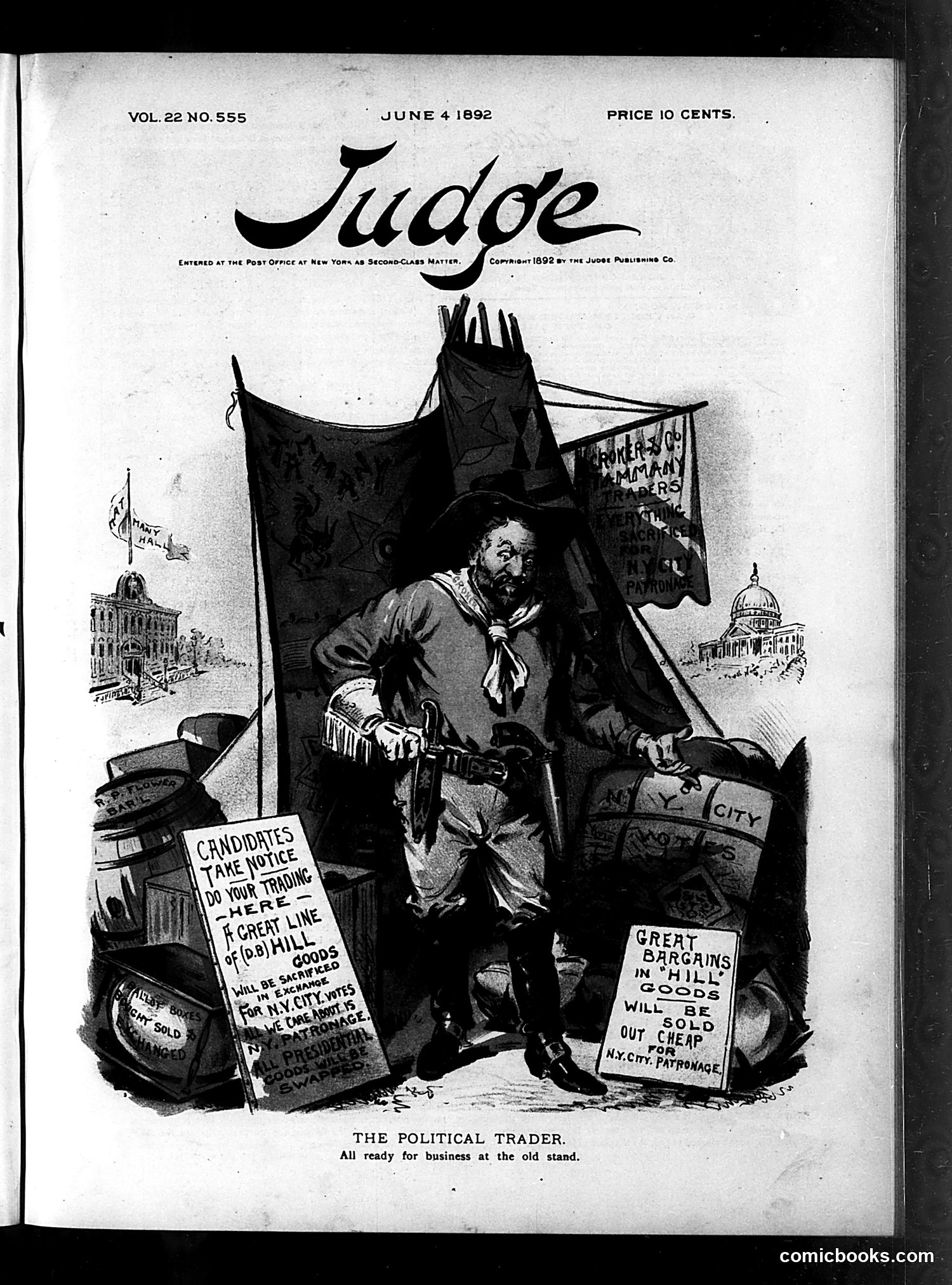
This cartoon satirizes political corruption through the metaphor of a merchant hawking goods. A bearded trader—likely representing a corrupt politician or party operative—stands at a market stall displaying wares labeled with political transgressions: "Candidates Take Here," "Do You Trading Here," and references to "Great Line of [D.P.] Goods" and "N.Y. Patronage." The signs promise "Great Bargains in 'Good' Goods Will Be Sold Out Cheap for N.Y. Patronage," mocking the exchange of political favors and government positions for support. The 1892 date places this during the presidential election year, suggesting criticism of how candidates and parties literally "trade" in political appointments, contracts, and patronage rather than principle. The shabby tent and disreputable setting reinforce the cartoon's message that such dealings are fundamentally corrupt commerce.
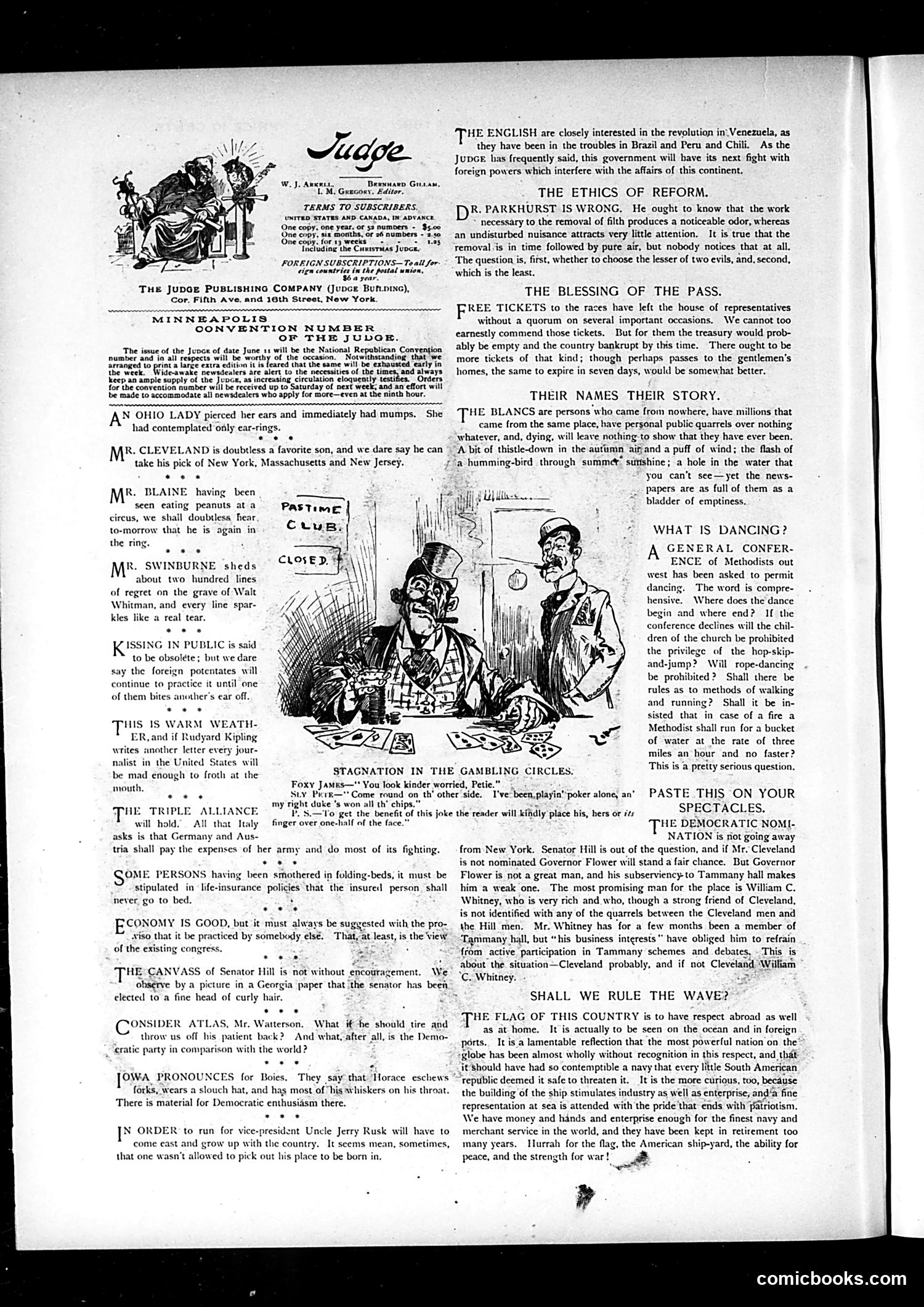
This page contains satirical editorial commentary rather than a political cartoon. The main illustrated piece shows two men at a gambling table labeled "STAGNATION IN THE GAMBLING CIRCLES," depicting financial speculation and market concerns of the era. The text sections target specific political figures and issues: - Cleveland is praised as a favorite son - Senator Hill's political position is criticized - Methodist church debates about dancing are mocked - The Democratic Party nomination process is questioned - Navy strength and American maritime power are defended The overall tone critiques Democratic leadership (particularly around Cleveland vs. Hill), ecclesiastical restrictions on entertainment, and advocates for stronger American naval capabilities. Without clearer date information visible, the specific election or events referenced remain uncertain, though references suggest late 1880s-1890s American politics.
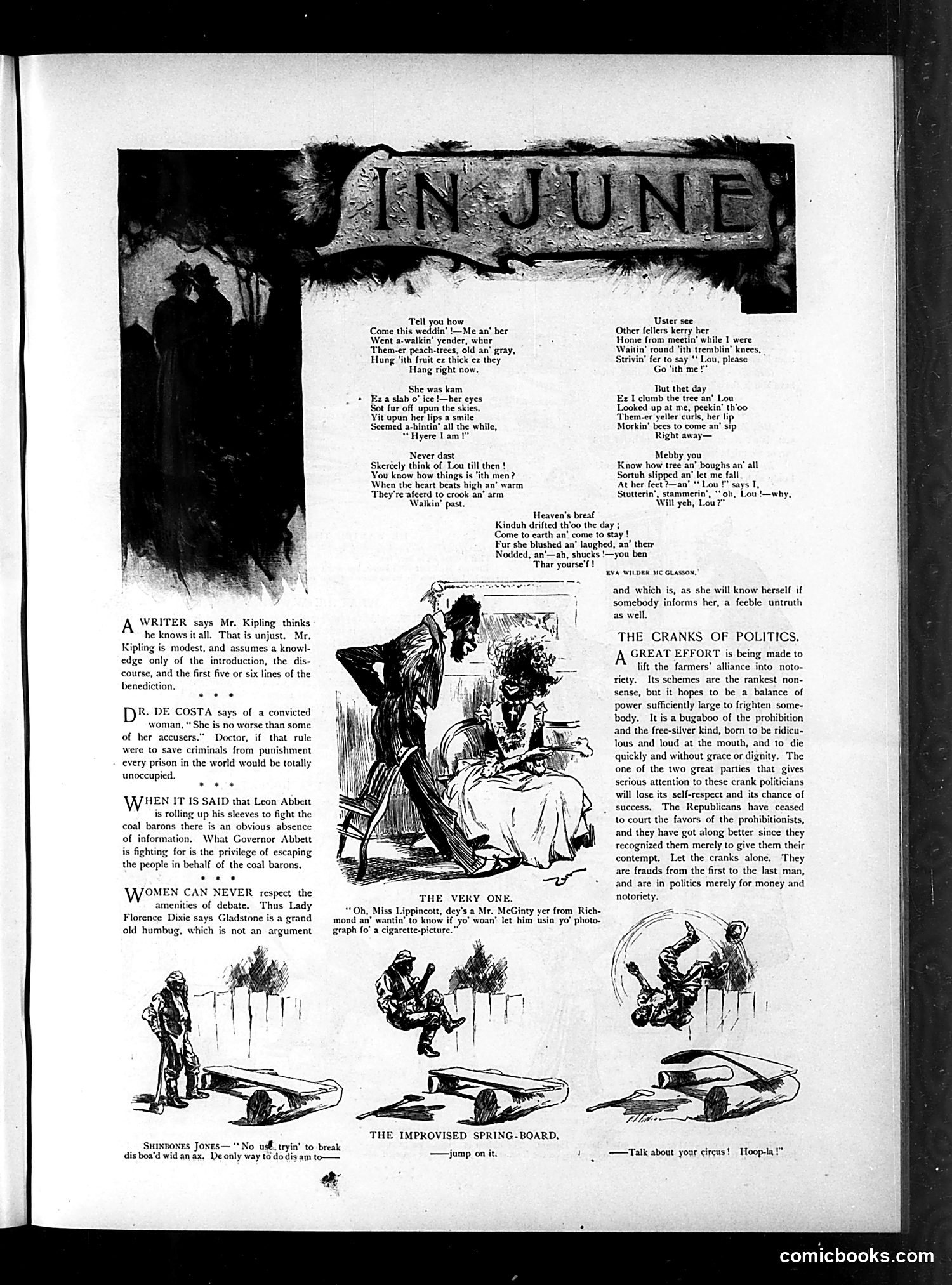
This page contains satirical poetry and commentary on early 1900s political figures and social issues. **"The Cranks of Politics"** section criticizes efforts to form a "Farmers' Alliance" into a third political party, dismissing the scheme as nonsensical. It mocks both major parties—Republicans and Democrats—as fraudulent, claiming they court prohibitionists and free-silver advocates only for votes, then abandon them. **"The Very One"** cartoon satirizes a woman asking a photographer to use a cigarette picture rather than her actual photograph, mocking vanity culture. **"The Improvised Spring-Board"** depicts physical slapstick humor of someone attempting circus tricks on a makeshift board, typical of Judge's lighter comedic content. The page blends political commentary critiquing third-party movements with period humor and social satire.
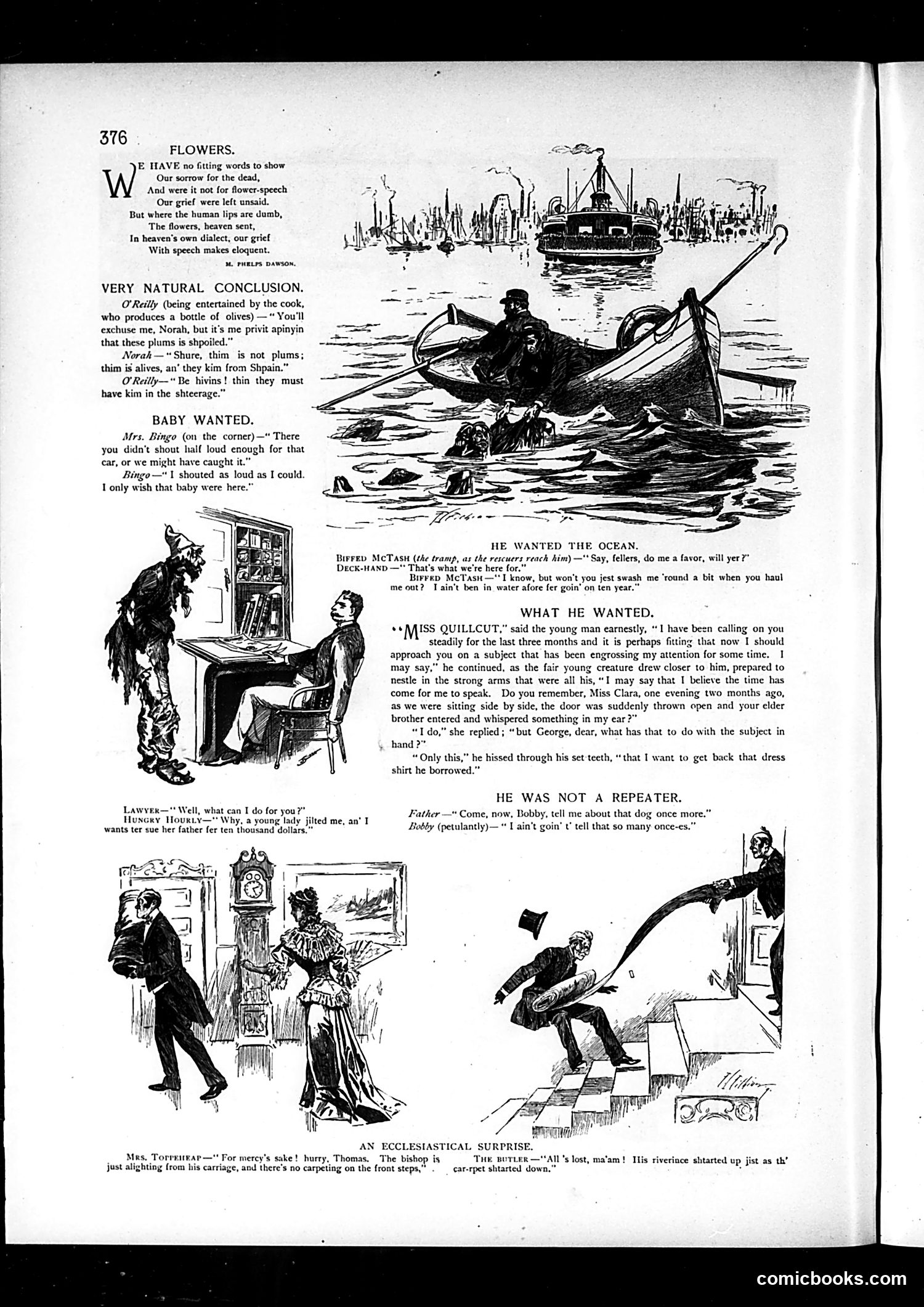
This page contains several humor pieces typical of late 19th-century American satire, mixing social commentary with ethnic stereotyping. **"Very Natural Conclusion"** mocks Irish immigrants through dialect humor—O'Reilly mistakes olives for plums and assumes anything from Spain must have traveled in steerage (the cheapest ship accommodations), implying poor Irish passengers were unsophisticated. **"Baby Wanted"** jokes about using a baby's crying to hail a streetcar—dark humor about urban life and noise pollution. **"What He Wanted"** subverts romantic expectations: after three months of courtship and an emotional confession scene, the young man merely wants his borrowed dress shirt back—satirizing shallow materialism masquerading as sentiment. **"He Was Not a Repeater"** presents a child refusing to retell a dog story multiple times, playing on the phrase "repeater" (someone who repeats experiences). The remaining pieces use Irish-dialect humor and working-class scenarios for comedic effect, reflecting period attitudes toward immigrant communities.
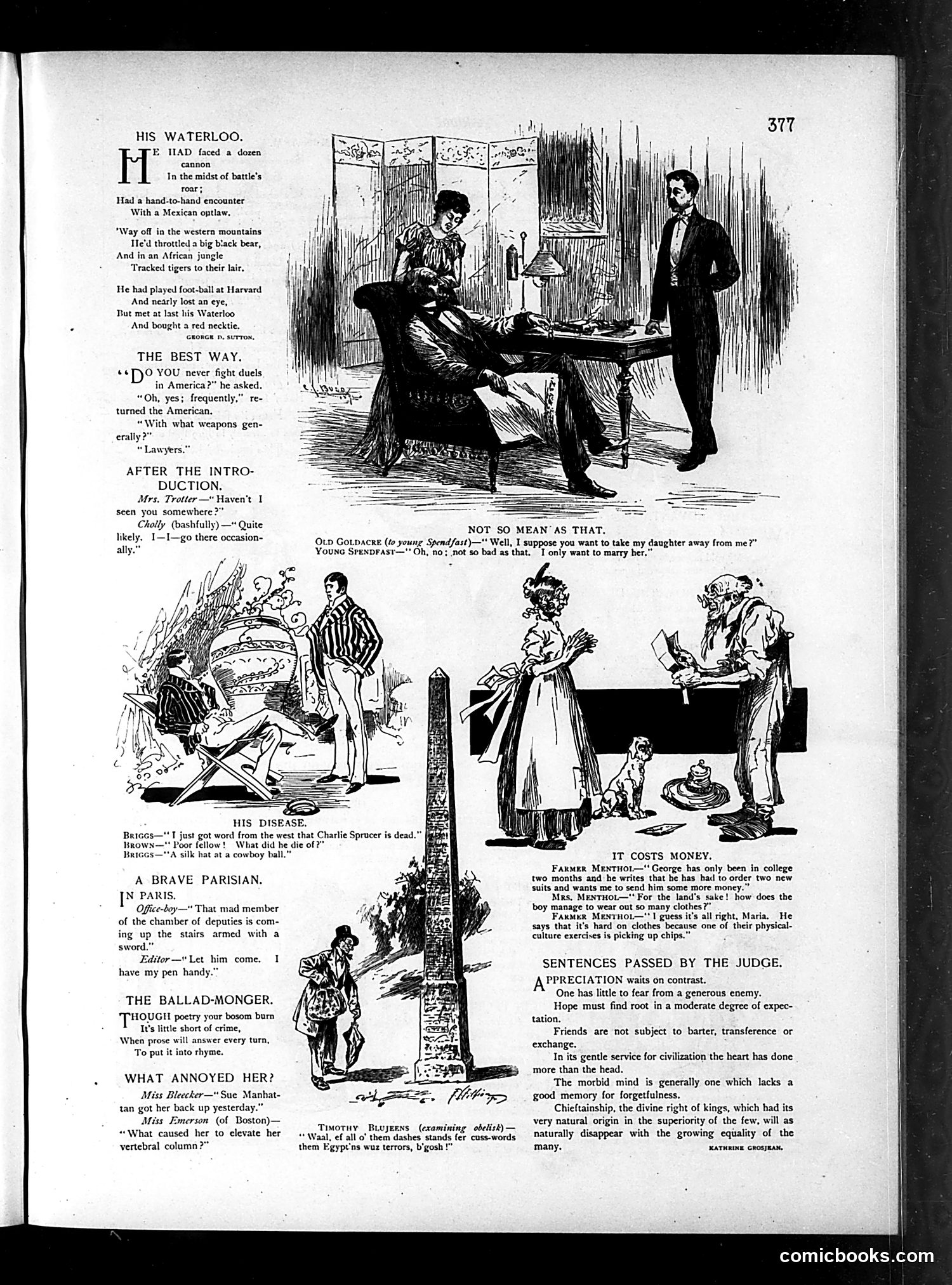
This page contains several satirical sketches and humorous anecdotes typical of Judge's content. The cartoons mock social pretension and American manners: **"His Waterloo"** mocks a tough adventurer (implied to be Theodore Roosevelt-type figure, given Harvard and big-game hunting references) undone by fashion—buying a red necktie at a "cowboy ball" proves his ultimate defeat. **"The Best Way"** jokes about American dueling customs through a foreigner's amazement that Americans "duel" with lawyers rather than swords. **"His Disease"** darkly humors that wearing formal dress to a Western event is literally fatal. **"It Costs Money"** satirizes wealthy parents' complaints about college expenses, with a father misunderstanding his son's "physical-culture" exercise damages clothes. The page also includes aphoristic "Sentences Passed by the Judge"—moralizing observations on human nature and civilization, a recurring Judge feature providing gentle social commentary. The overall tone is lighthearted mockery of American social climbing, pretension, and generational conflict.
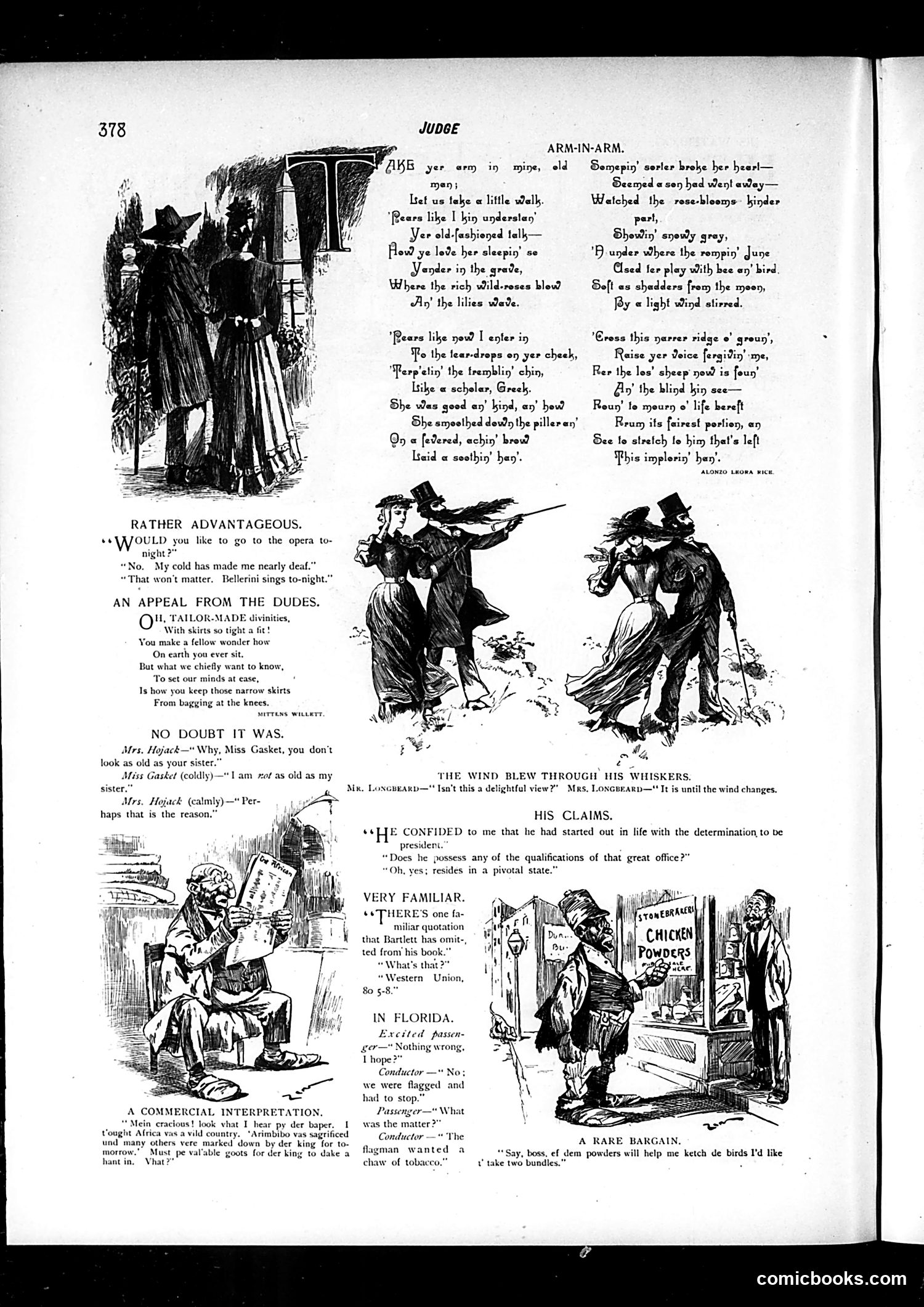
This page contains multiple brief satirical jokes typical of Judge's style, rather than a single unified cartoon. **Key items:** - **"Arm-in-Arm"**: A sentimental poem about an elderly couple reminiscing, likely satirizing overly romantic Victorian verse. - **"Rather Advantageous"**: A joke mocking deaf opera-goers—the humor being that deafness becomes an advantage when forced to attend bad opera. - **"Appeal from the Dudes"**: Men complaining about women's excessively tight-fitting skirts, particularly asking how women keep them from sagging at the knees—satirizing both women's fashion constraints and male fashion commentary. - **"No Doubt It Was"**: A pun about appearing younger, suggesting the reason one woman looks older is simply that she *is* older. - **Various one-liners** about opera, pivotal states, railroad conductors, and African colonial exploitation—the latter appearing to mock newspaper sensationalism about Africa. The page is primarily humor and light social satire rather than serious political commentary.
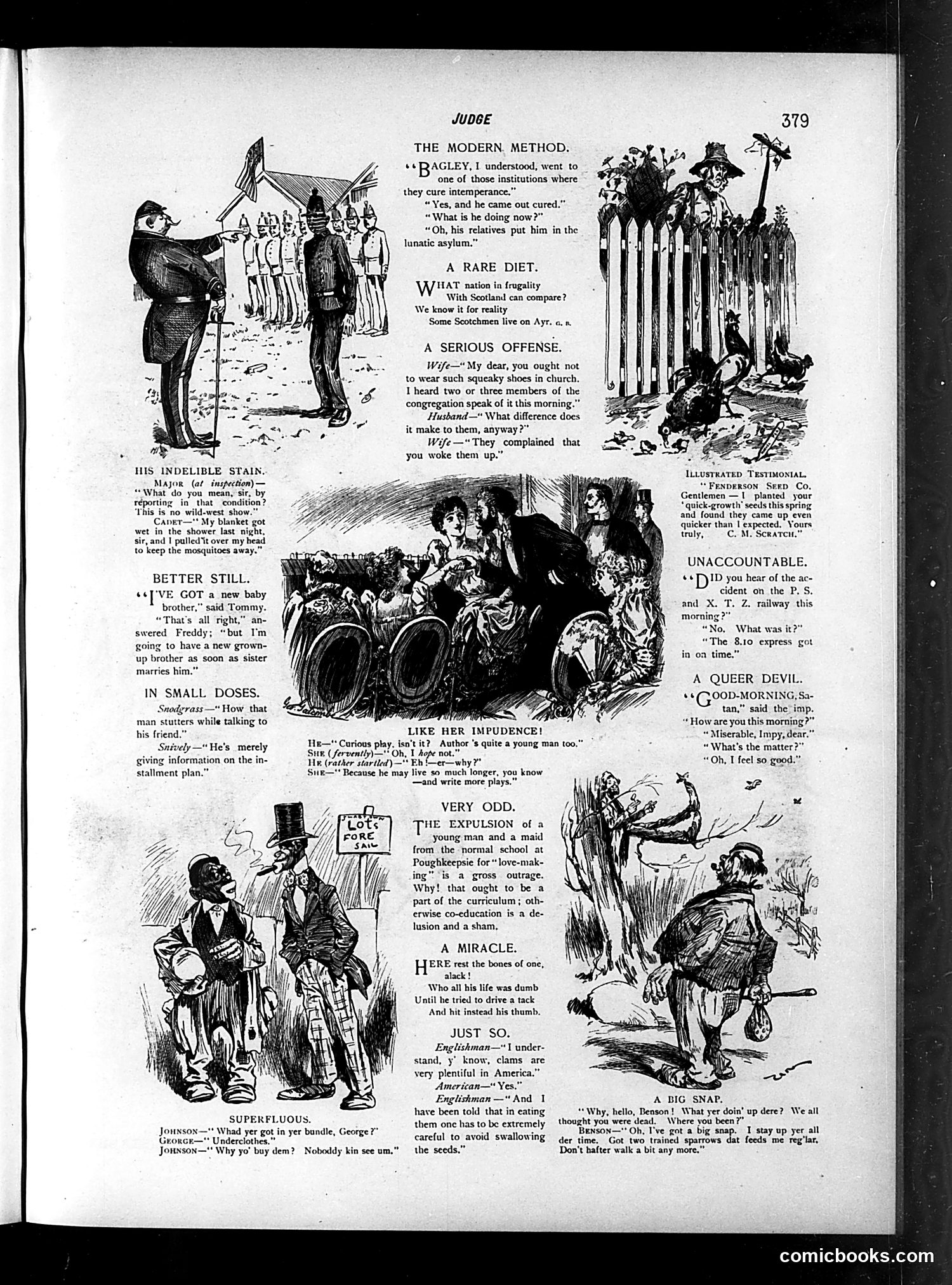
This page contains multiple brief satirical jokes typical of Judge magazine's humor style, rather than unified political cartoons. Key content includes: **"The Modern Method"**: Jokes about treating alcoholism by institutionalizing the patient in a lunatic asylum instead—satirizing the era's ineffective rehabilitation approaches. **"A Serious Offense"**: Mocks church decorum by having a wife complain her husband's squeaky shoes disturb sleeping congregants during service. **"Very Odd"**: Criticizes Poughkeepsie's normal school for expelling young couples for "love-making," sarcastically suggesting romance should be curriculum in co-educational institutions. **"Unaccountable"**: Treats a railroad's on-time performance as miraculous, satirizing chronic American rail delays. **Various other jokes** mock Scottish frugality, stuttering, clams requiring careful eating to avoid seeds, and similar everyday absurdities. The humor reflects turn-of-century American life: institutional failures, social propriety anxieties, transportation complaints, and ethnic stereotyping. No specific political figures are identifiable.
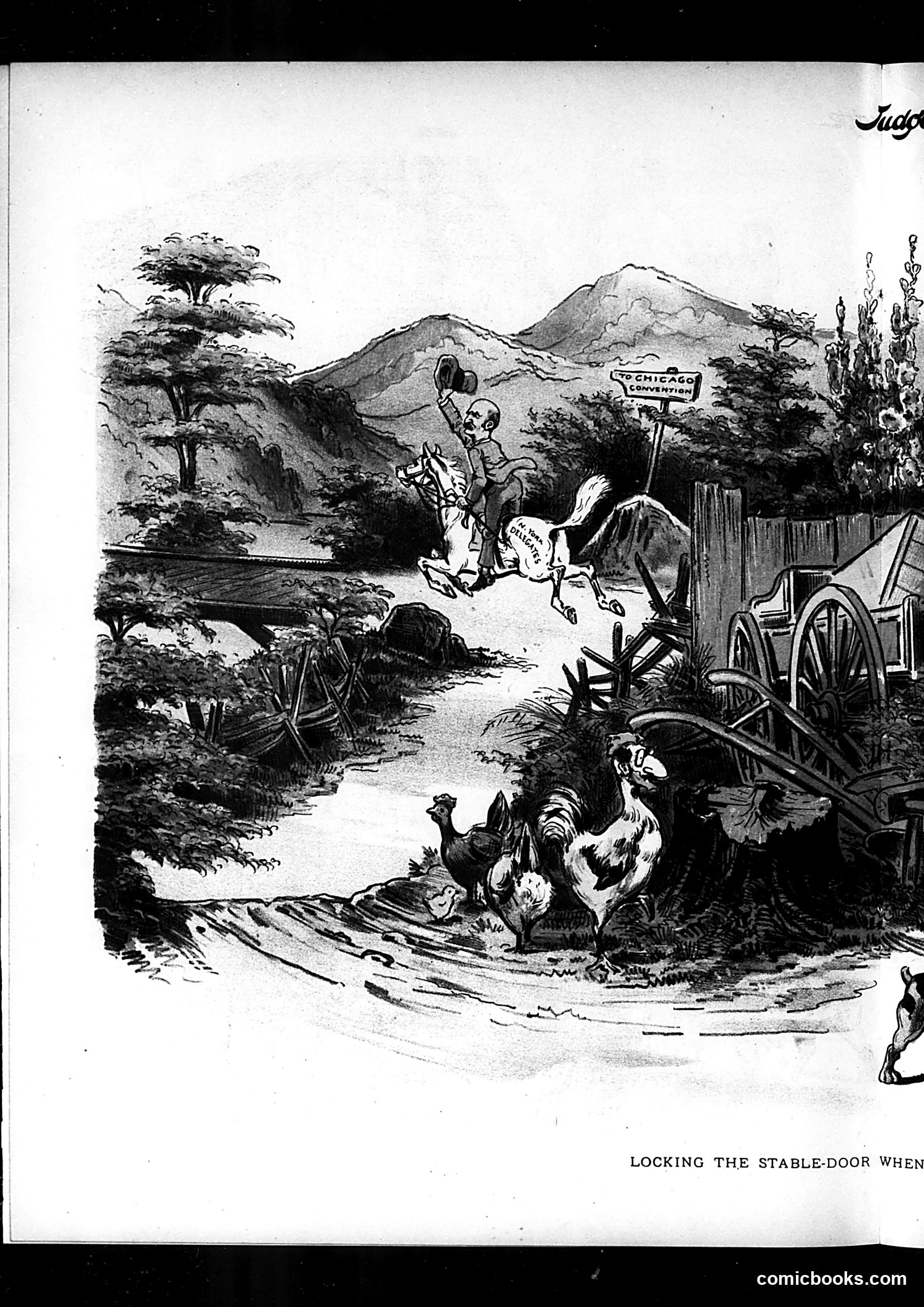
This is a political cartoon illustrating the proverb "locking the stable door after the horse has bolted"—meaning taking precautions too late. The image shows a skeleton (representing Death or a grim figure) pointing toward Chicago on a signpost, having already departed on horseback. In the foreground, a farmer-like character locks a stable door, but the horse is already gone. Farm animals (chickens, roosters) remain nearby. The cartoon satirizes some policy response as futile or belated. Without the complete caption and date, the specific political reference is unclear—likely criticizing Chicago-related problems (disease outbreak, crime, or industrial disaster) where preventative measures came after damage was done. The skeleton suggests the issue involved significant loss of life.
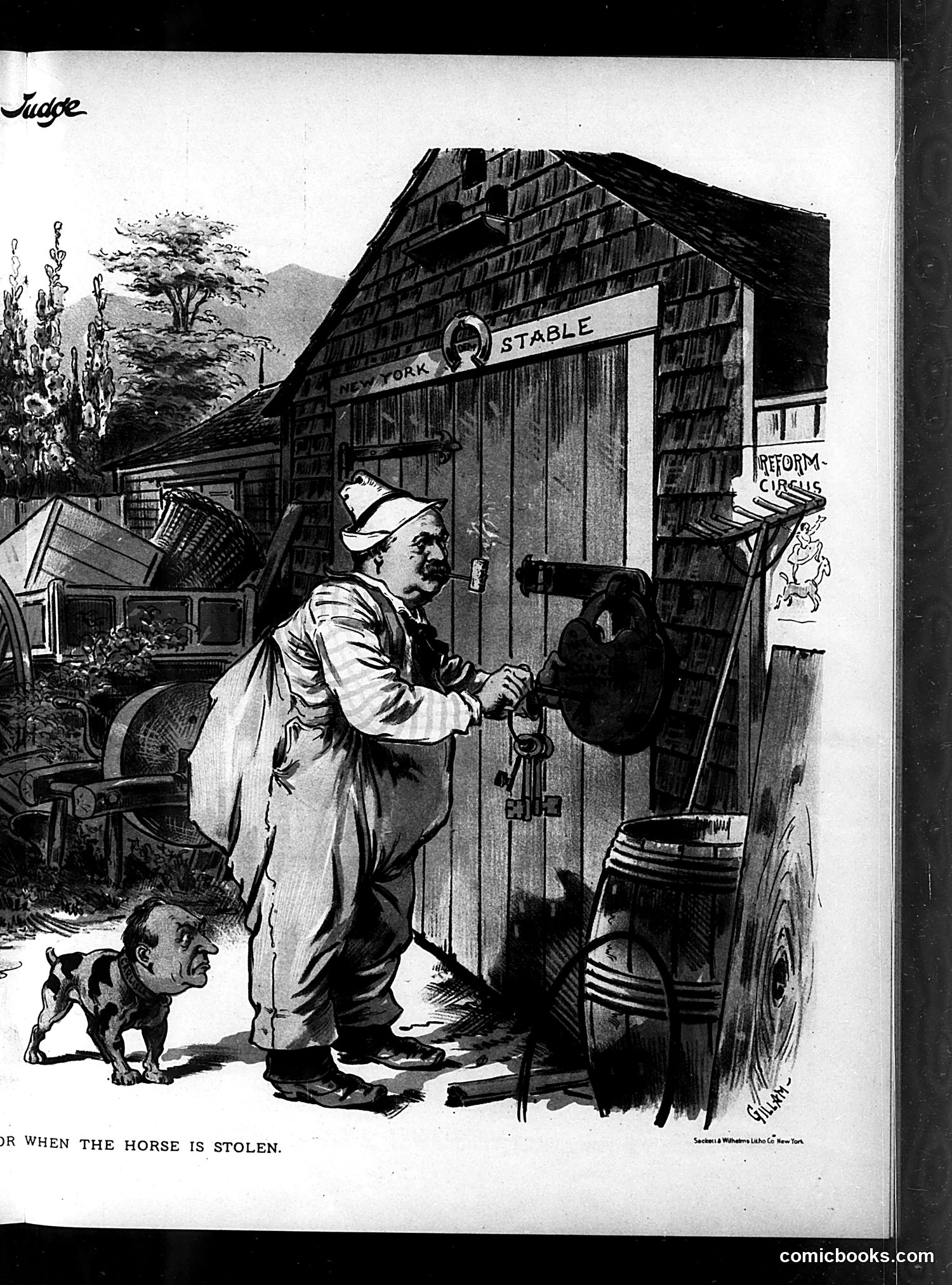
This Judge cartoon satirizes poor security or management practices. A man at a "New York Stable" discovers his horse missing and appears to be locking the barn door after the theft has already occurred—hence the caption's proverb about closing the door "when the horse is stolen." A small dog stands nearby, and a "Reform Circus" poster hangs on the stable wall, suggesting this may be political satire about ineffective reform efforts or government responses to problems. The cartoon likely criticizes either delayed corrective action or reforms implemented only after damage is done. The specific political targets remain unclear without additional context about Judge's contemporary concerns.
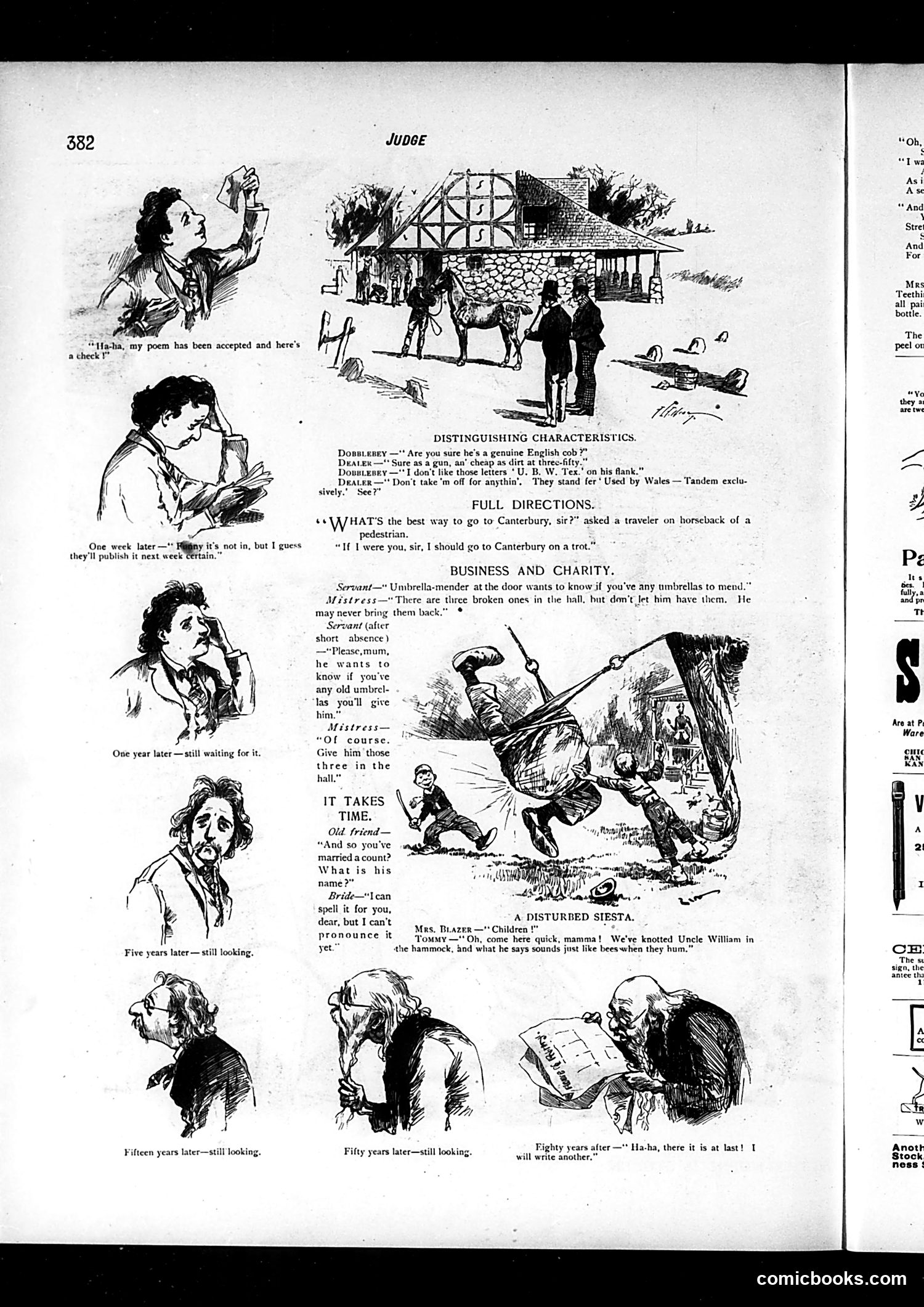
This page from *Judge* magazine contains multiple unrelated comic sketches typical of the publication's format: **"Ha-ha, my poem has been accepted"**: Mocks struggling writers' desperate hope for publication—the poet celebrates a check, but the subsequent panels show him still waiting years later, suggesting his literary ambitions never materialize. **Horse trading dialogue**: Satirizes dishonest salesmanship; the dealer defends shabby horses by claiming mysterious markings ("U.B.W. Tex.") indicate they're "Used by Wales," implying authenticity through false authority. **Canterbury directions**: A simple joke about misdirection—the pedestrian's advice to travel "on a trot" is humorous misdirection. **Business and Charity**: Mocks hypocrisy; the mistress won't give broken umbrellas to a repairman (fearing he'll keep them), but gladly gives them away as charity—revealing her true motivation is cheapness, not kindness. **"A Disturbed Siesta"**: Family humor about children tying Uncle William in a hammock, with his complaints humorously compared to bee sounds. The page showcases period satire targeting pretension, dishonesty, and social absurdity.
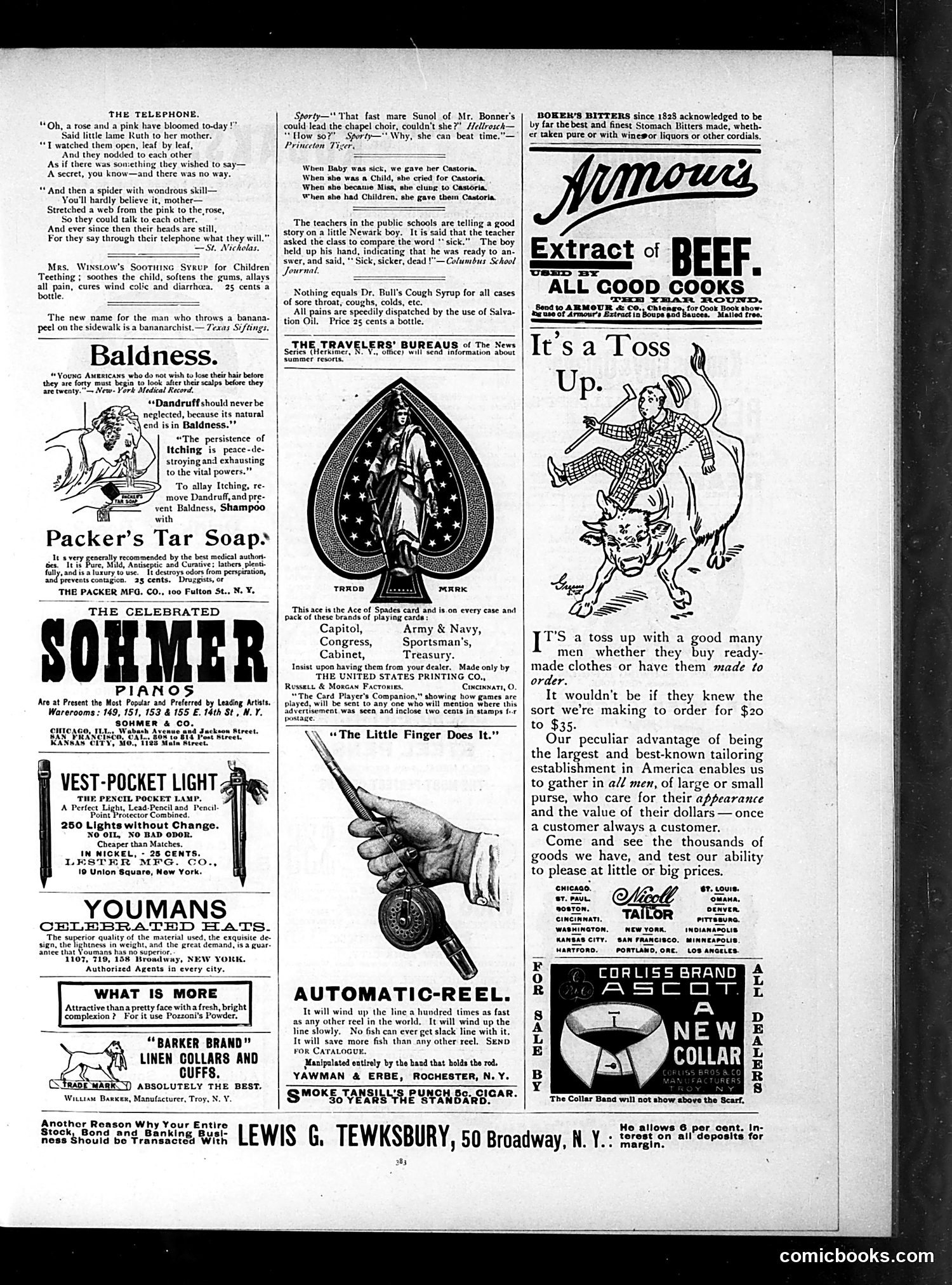
This page is primarily **advertising**, with small humorous filler items. The main illustrated cartoon shows a man being tossed in the air by a cow, captioned "It's a Toss Up." The accompanying text is an advertisement for **Strobl Tailors** (Chicago-based), a large American tailoring establishment. The joke equates the uncertainty of a literal toss-up with the uncertainty customers might feel ordering clothes by mail for $20 to $25 — a significant sum in this era. The ad's pitch: Strobl's advantage as "the largest and best-known tailoring establishment in America" is that they gather "all men, of large or small purse" and guarantee customer satisfaction. The visual pun (literal toss-up) humorously reinforces the commercial message: don't gamble on unknown tailors; trust the established name. The cow adds absurdist humor typical of Judge magazine's style.
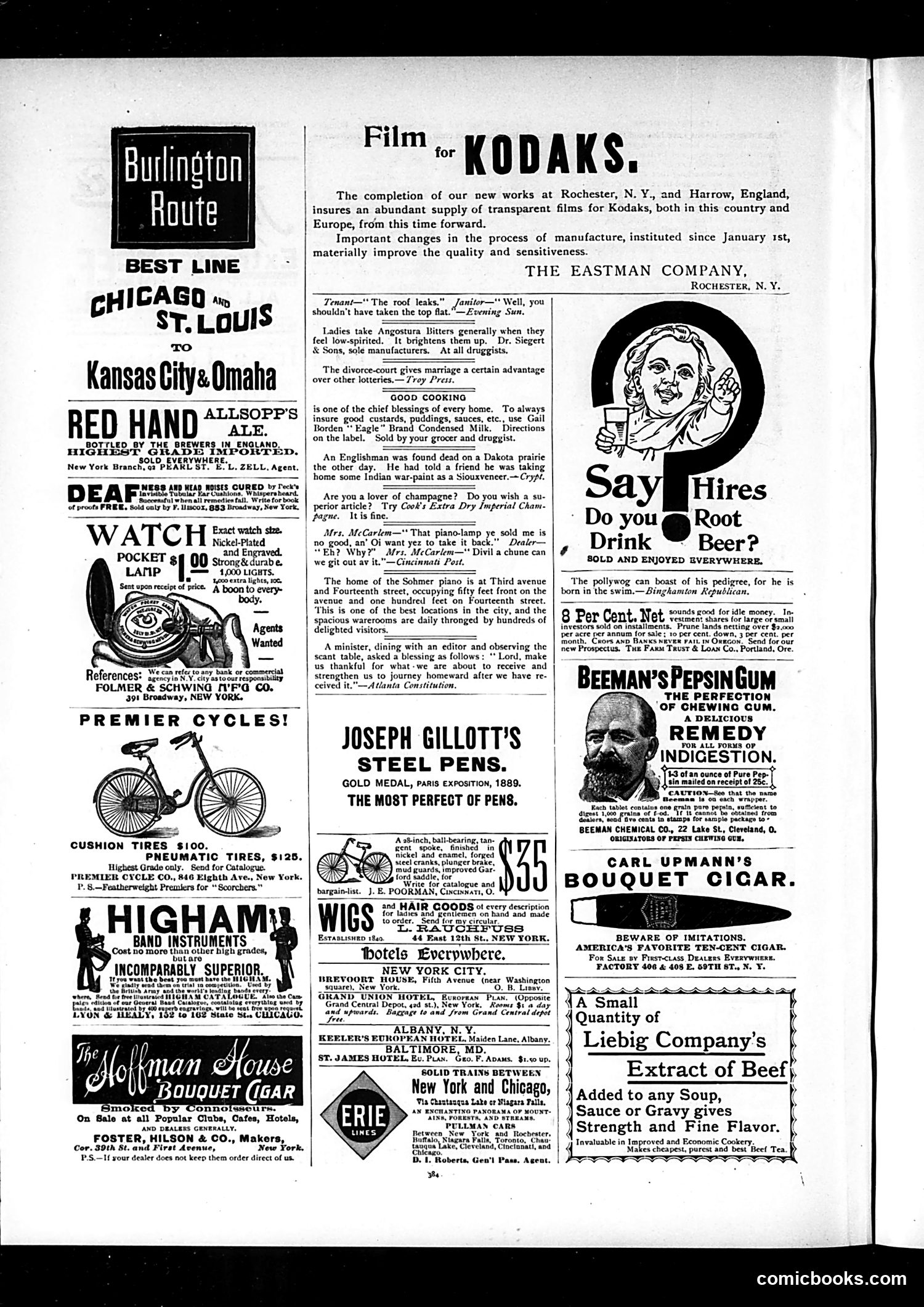
This page is primarily **advertising**, not satirical cartoons. It's a collection of late 19th-century print ads for products ranging from railroad routes to steel pens, along with one small joke (about a tenant and a leaky roof) that's incidental to the commercial content. The most notable feature is ads for emerging technologies: Kodak film (highlighting new Rochester and Harrow factories), Premier bicycles with pneumatic tires, and a pocket lamp—all representing modern conveniences of the 1890s era. There are also traditional products advertised: Allsopp's ale, condensed milk, pianos, and hair goods. The page contains no political satire or caricatured figures—it's simply a **page of commercial announcements** typical of Judge magazine's revenue model, interspersed with brief, lightweight jokes rather than editorial commentary.
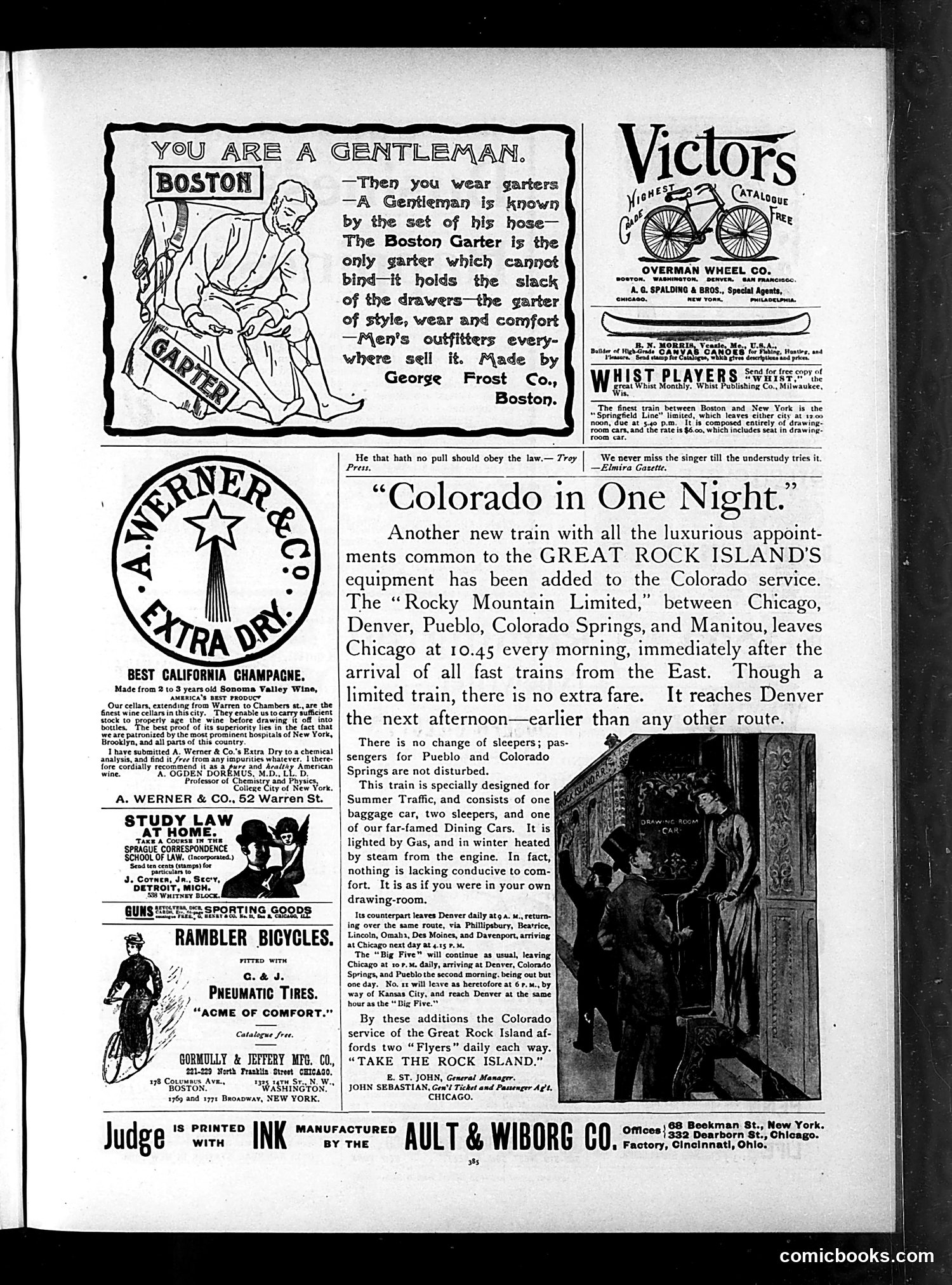
This page is primarily **advertisements** with minimal editorial content. The central humor appears in the caption: **"He that hath no pull should obey the law"**—a cynical observation referencing "pull" (political connections/nepotism). The opposing motto **"We never miss the singer till the understudy tries it"** suggests incompetence becomes evident only through absence. The pictorial advertisements include: - **Boston Garters**: marketed to gentlemen concerned with propriety and grooming - **Rambler Bicycles**: appealing to active consumers - **Victor bicycles** and railroad services The main article describes the new "Rocky Mountain Limited" train, celebrating transportation innovation and luxury travel accommodations. The accompanying photograph shows an ornate railroad car interior. The page reflects late-19th/early-20th-century American consumer culture and technological advancement, with light political cynicism about corruption embedded within commercial messaging.
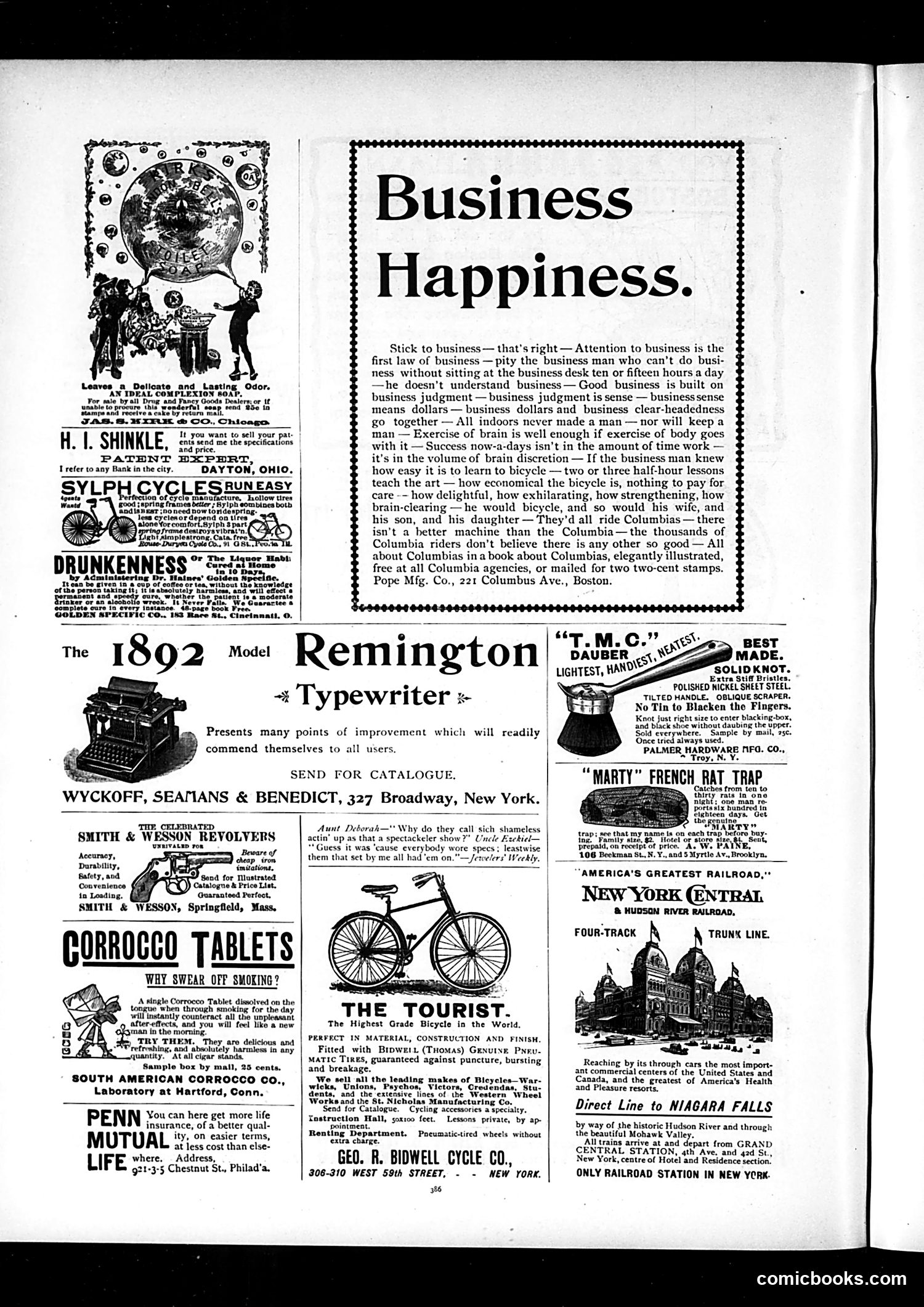
This page is primarily **advertising**, with one notable editorial section. The main content is a lengthy **advertorial essay** titled "Business Happiness" (top right), promoting the Columbia bicycle as an essential tool for businessmen. The piece argues that successful business requires physical exercise and mental clarity—benefits the bicycle supposedly provides. It's satirical in tone, mocking overly-serious workaholics who sit at desks for 15 hours daily, suggesting they lack the sense to recognize the bicycle's practical and health benefits. The page is otherwise filled with period advertisements for typewriters (Remington 1892 Model), revolvers (Smith & Wesson), bicycles (The Tourist, Sylph Cycles), anti-smoking tablets, and life insurance—typical late-19th-century products. **Notable detail**: A small joke appears mid-page: Uncle Ezekiel quips that "spectackeler" shows were named because everyone wore spectacles watching them—a mild pun on "spectacle." The overall message reflects Gilded Age attitudes promoting bicycles as modern, health-conscious alternatives to sedentary office work.
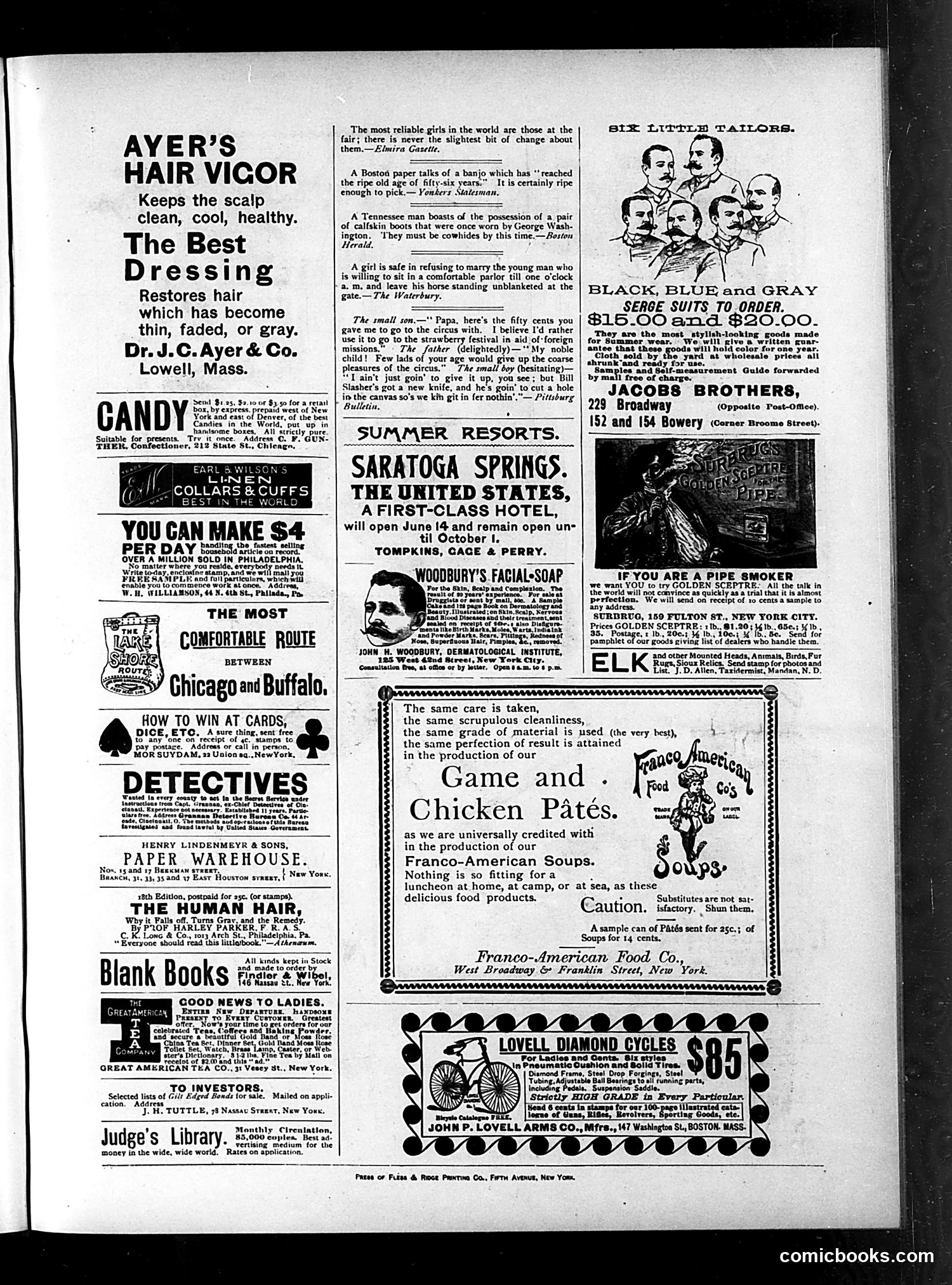
This page is primarily **advertisements with minimal editorial content**. The small jokes scattered throughout are typical filler material for late 19th-century publications. The notable editorial content includes brief, light satirical quips on everyday topics: - A pun about a 56-year-old banjo being "ripe enough to pick" - A joke about George Washington's boots becoming "cowhides" with age - A commentary on reliable girls at fairs (wordplay on "change") - A longer anecdote about a boy who'd rather attend a strawberry festival than the circus, but plans to sneak in by cutting through the tent canvas The cartoons labeled **"Six Little Tailors"** at top right shows six men's heads, likely promoting Jacobs Brothers' tailoring services. Otherwise, the page consists of period advertisements for hair vigor, candy, collars, detective services, blank books, bicycles, and various patent medicines—typical commercial content from Judge's advertising sections.
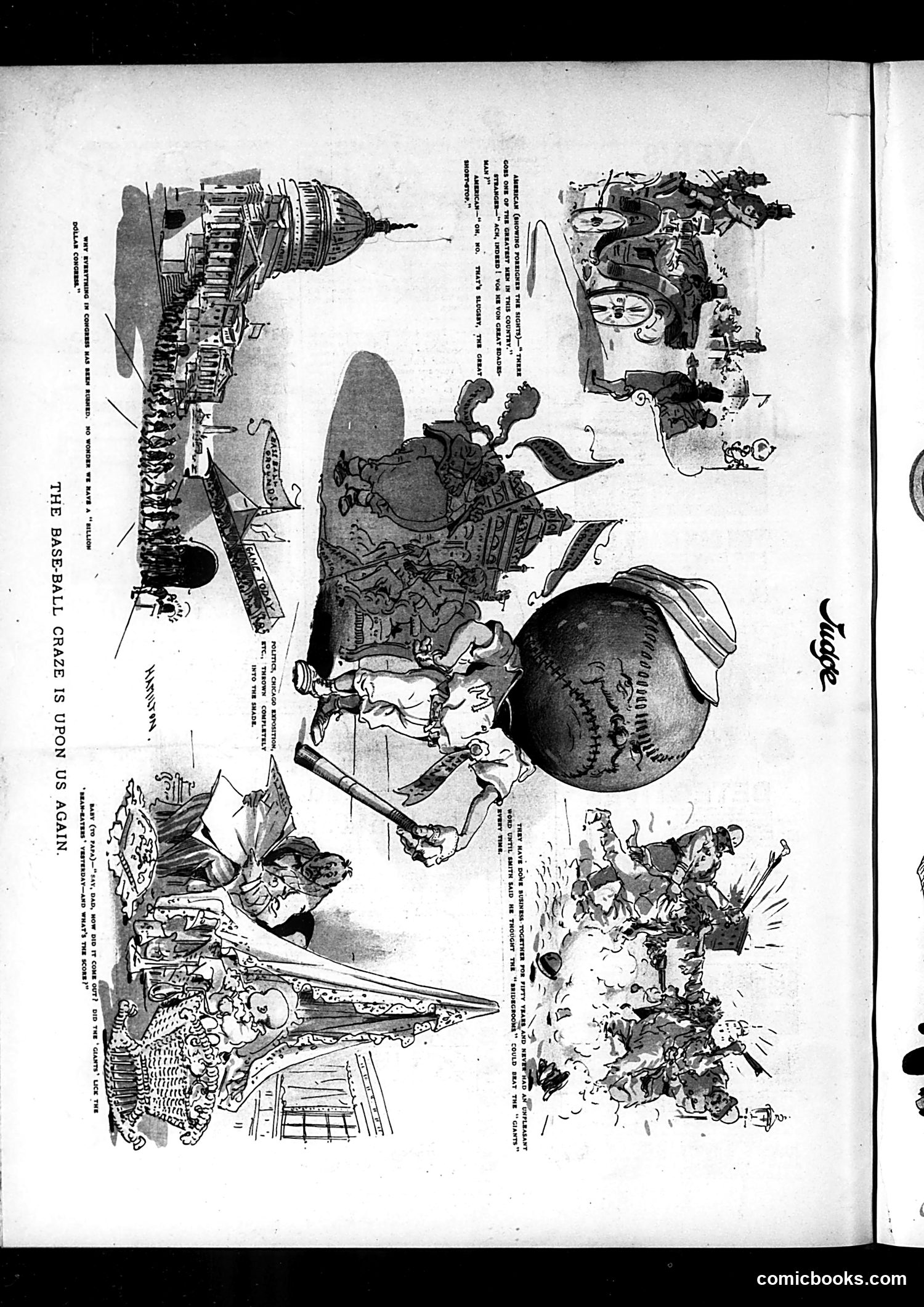
This Judge cartoon satirizes America's obsession with baseball during the Gilded Age. The page features multiple baseball-themed illustrations, with the main joke involving an American showing a foreign visitor around, claiming to identify "one of the greatest men in this country." The foreigner assumes he means a political or business leader, but the American reveals it's actually "Slugsby, the great" baseball player—a fictional character representing a professional athlete. The satire mocks how Americans prioritize baseball celebrities over actual statesmen and business figures. The text references Congress rushing through legislation and a "billion dollar" scandal, implying that while serious governmental issues go unattended, the public is distracted by the "baseball craze." This reflects turn-of-century anxieties about America's misplaced values and national priorities.