
A complete issue · 16 pages · 1892
Judge — May 21, 1892
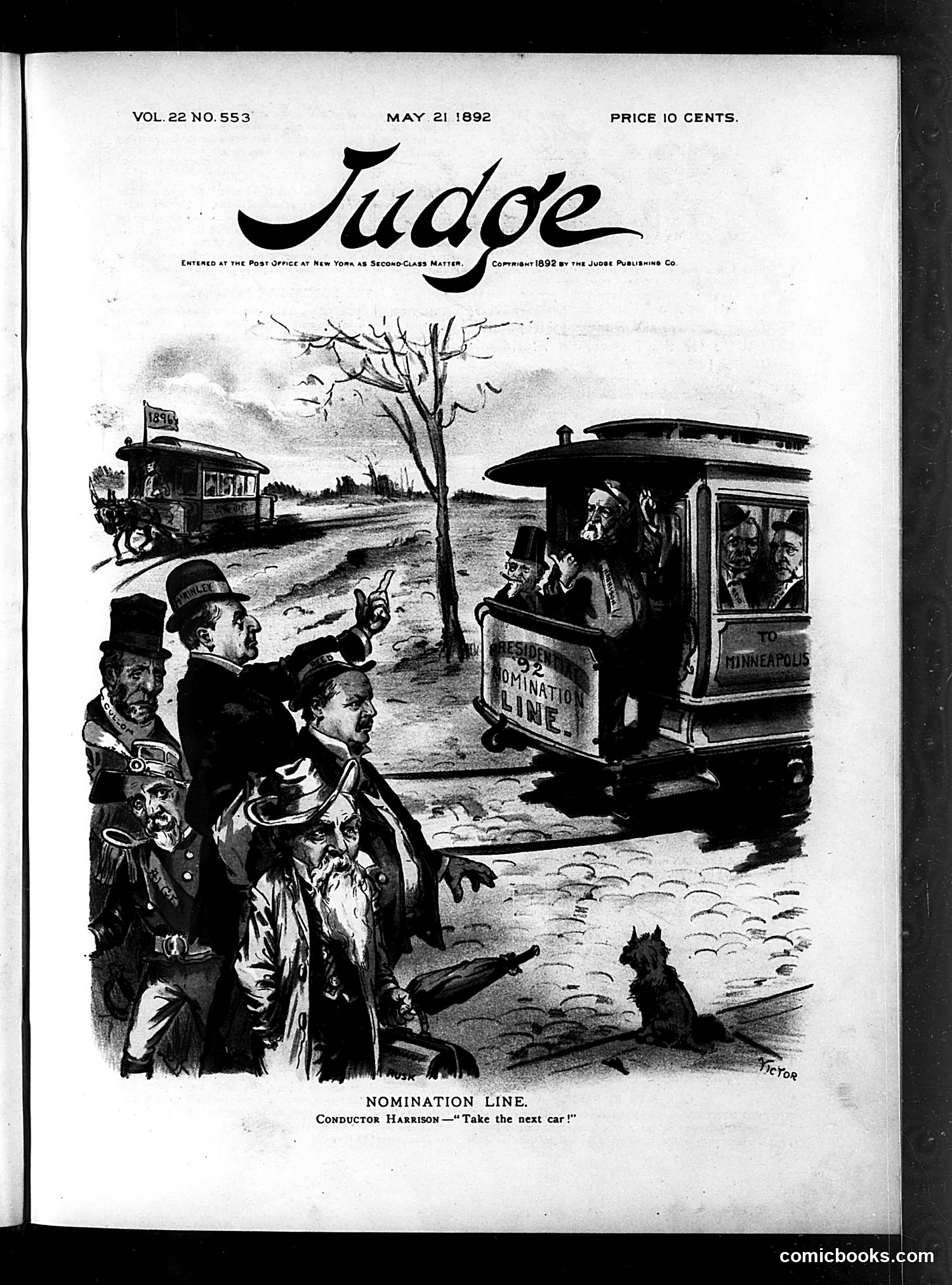
This political cartoon satirizes the 1892 presidential nomination process. Conductor Harrison directs political figures toward "the next car" on the "Nomination Line"—a streetcar bound for Minneapolis, where the Republican National Convention was held that year. The cartoon mocks how candidates and political machines queue up mechanically for the nomination, treating it as a predetermined transit system rather than a genuine democratic contest. The figures on the left appear to be political operatives or candidates waiting their turn, while those in the car represent the party establishment controlling the process. The bare tree and desolate landscape suggest barrenness or decay in the political system. The satire critiques how nominations were orchestrated by party bosses rather than emerging organically from voter preference.
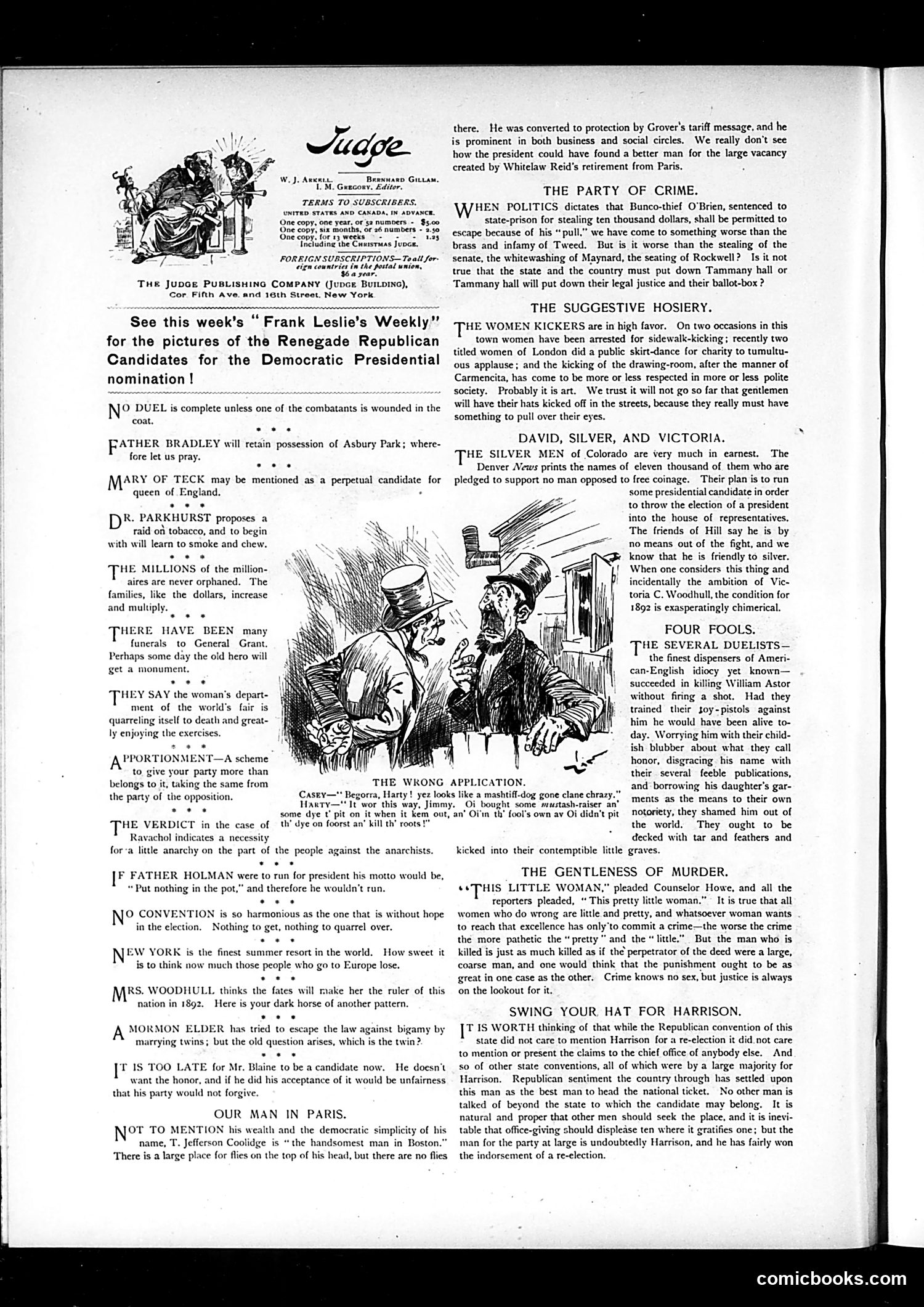
This page contains multiple brief political commentaries rather than a single cartoon. The main illustration depicts two men in conversation, with one appearing to be a con artist or schemer addressing the other. The text references several 1892 political figures and controversies: Bunco-thief O'Brien's state prison sentence, General Grant's funeral, and debates over free coinage of silver. "David, Silver, and Victoria" mocks Colorado's "Silver Men" pledging support for presidential candidates opposing free coinage. "Four Fools" satirizes American dualists who killed in honor disputes, suggesting they "ought to be decked with tar and feathers." "The Gentleness of Murder" and "Swing Your Hat for Harrison" discuss crime and the Republican presidential campaign, respectively. The overall tone is sharply critical of political corruption, violence, and electoral manipulation of the 1892 period.
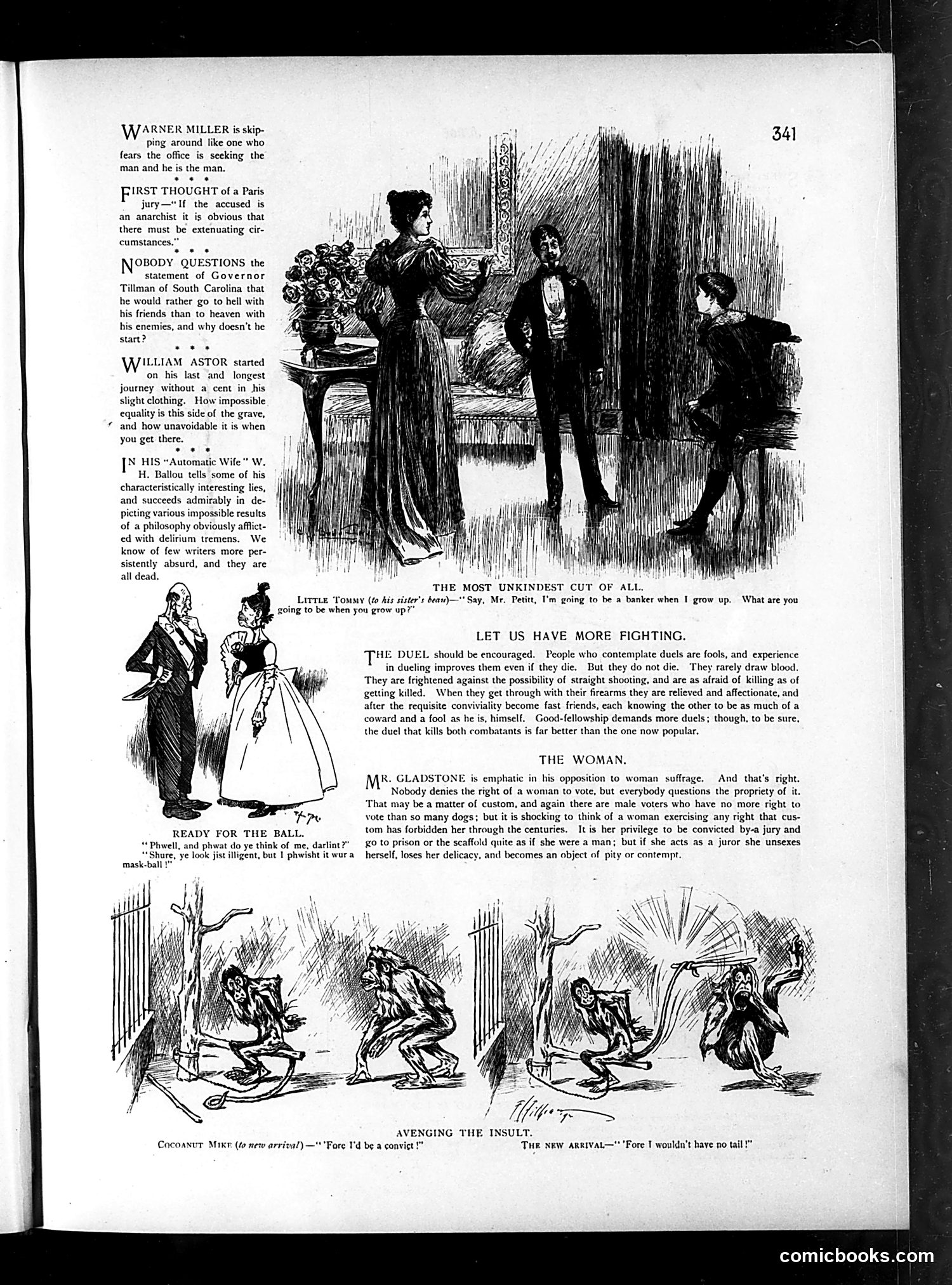
This page contains several satirical pieces critiquing social and political issues of the era: **Warner Miller** section discusses accusations against him, suggesting extenuating circumstances exist. **Governor Tilman** (likely Benjamin Tillman of South Carolina) is mocked for his contradictory positions on heaven/hell and enemies. **"The Most Unkindest Cut"** cartoon depicts a child expressing ambitions, satirizing parental expectations. **"Let Us Have More Fighting"** argues duels should be encouraged, using ironic logic that dueling improves society—clear satire of violent culture. **"The Woman"** section opposes women's suffrage, arguing women lack the right to vote despite custom. The cartoons below ("Avenging the Insult") appear to mock masculine honor codes through exaggerated fighting scenes. The page satirizes Victorian-era attitudes toward violence, gender roles, and political hypocrisy.
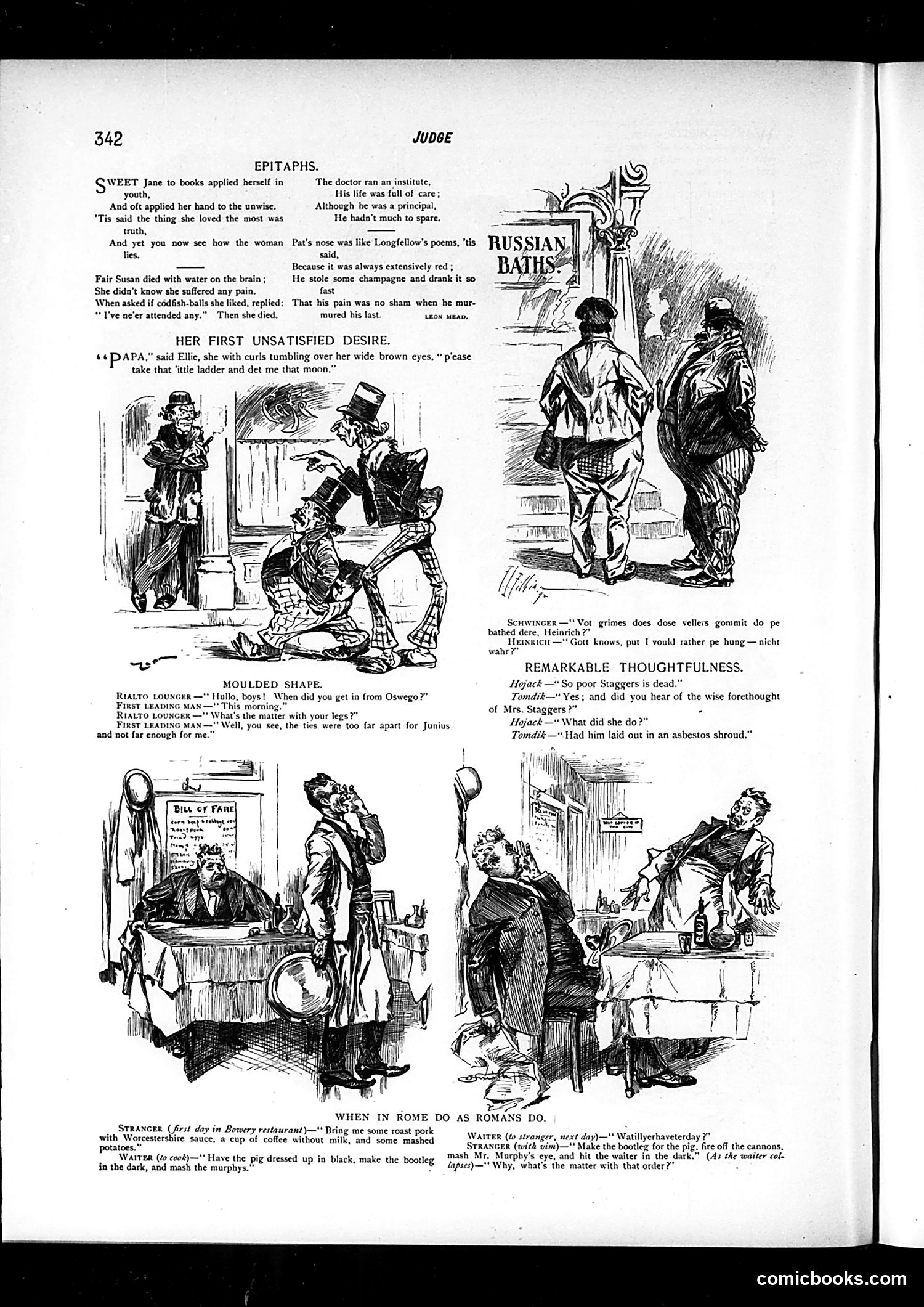
This page contains multiple satirical vignettes typical of late-19th-century American humor magazines. **"Her First Unsatisfied Desire"**: A child asks her father for the moon—simple domestic humor playing on childish impossibility. **"Moulded Shape"**: A man's legs are bent from railroad ties placed too far apart, likely satirizing poor working conditions or railroad infrastructure. **"When in Rome Do As Romans Do"**: A newcomer to a Bowery (immigrant neighborhood) restaurant orders pork with Worcestershire sauce and coffee "without milk"—the waiter's confused response ("make the bootleg," "mash the murphys") mocks both immigrant accents and the absurdity of fancy orders in a rough establishment. This ridicules class pretension colliding with working-class settings. **"Remarkable Thoughtfulness"**: Dark humor about a widow laying out her dead husband in asbestos—presumably because she either dislikes him or expects him to be cremated. The page satirizes class differences, immigrant dialect humor (common but offensive by modern standards), and domestic absurdities—typical Judge content targeting middle-class American readers.
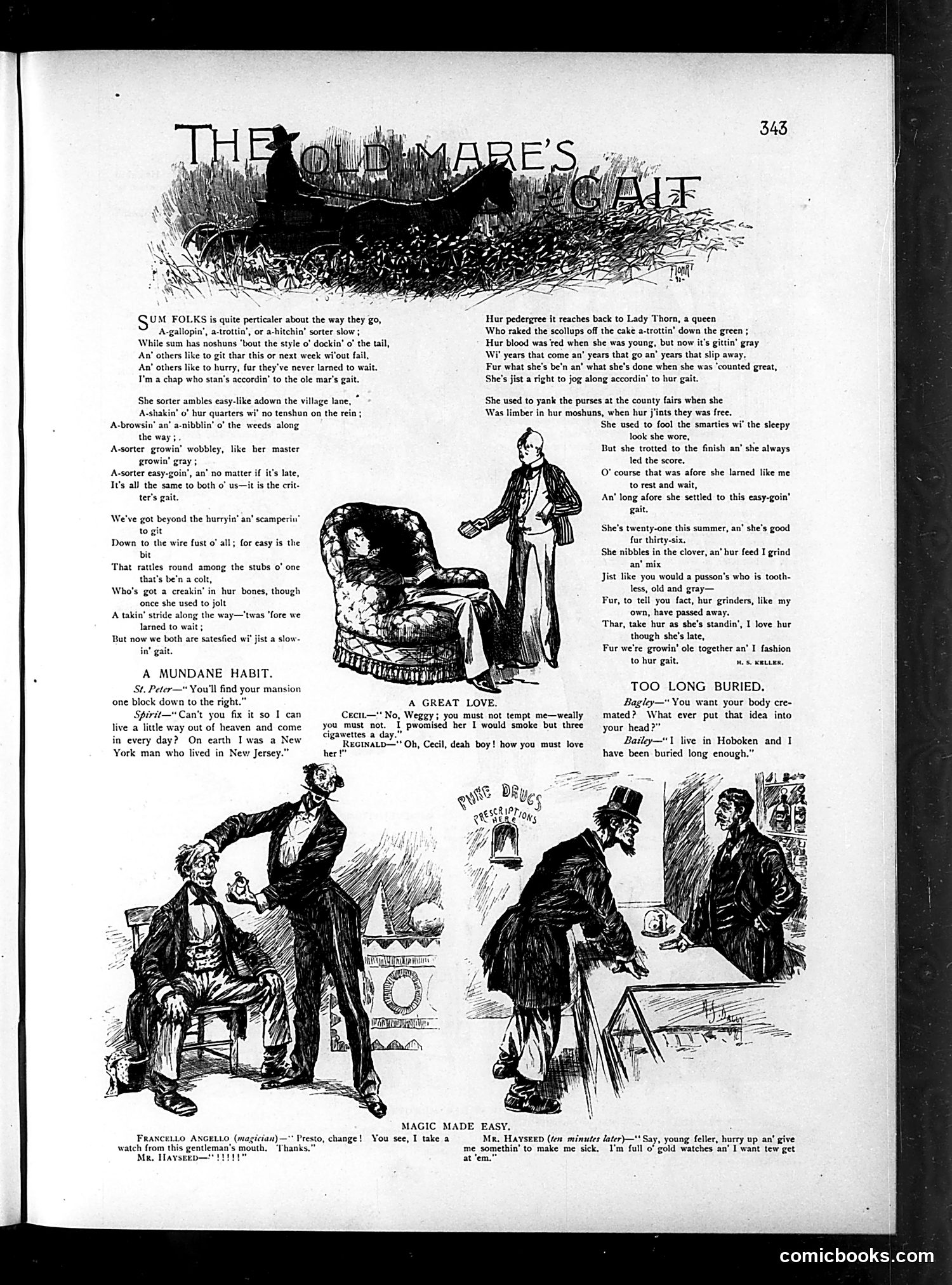
This page contains three satirical pieces reflecting early 20th-century American life: **"The Old Mare's Gait"** (main poem): A sentimental rural narrative about an aging horse and her owner, both past their prime but content with a slow, steady pace. The poem celebrates accepting age and decline gracefully—resonant with themes of mortality and dignity that appealed to Judge's readers. **"A Mundane Habit"**: A New York commuter joke. The spirit wants to live in New Jersey (then a rural area) but commute daily to heaven—satirizing the then-common practice of wealthy New Yorkers living in Jersey to avoid city taxes while working in Manhattan. The humor targets both the absurdity of tax avoidance and the New York mindset. **"A Great Love"** and **"Magic Made Easy"**: Brief gag cartoons about romantic restraint and a magician's trick backfiring, typical of Judge's short-form humor. **"Too Long Buried"**: A Hoboken reference joke—apparently Hoboken had an unflattering reputation as dreary or lifeless, making the pun about being "buried" work as social commentary. The page reflects Judge's mix of rural nostalgia, urban social satire, and vaudeville-style gags.
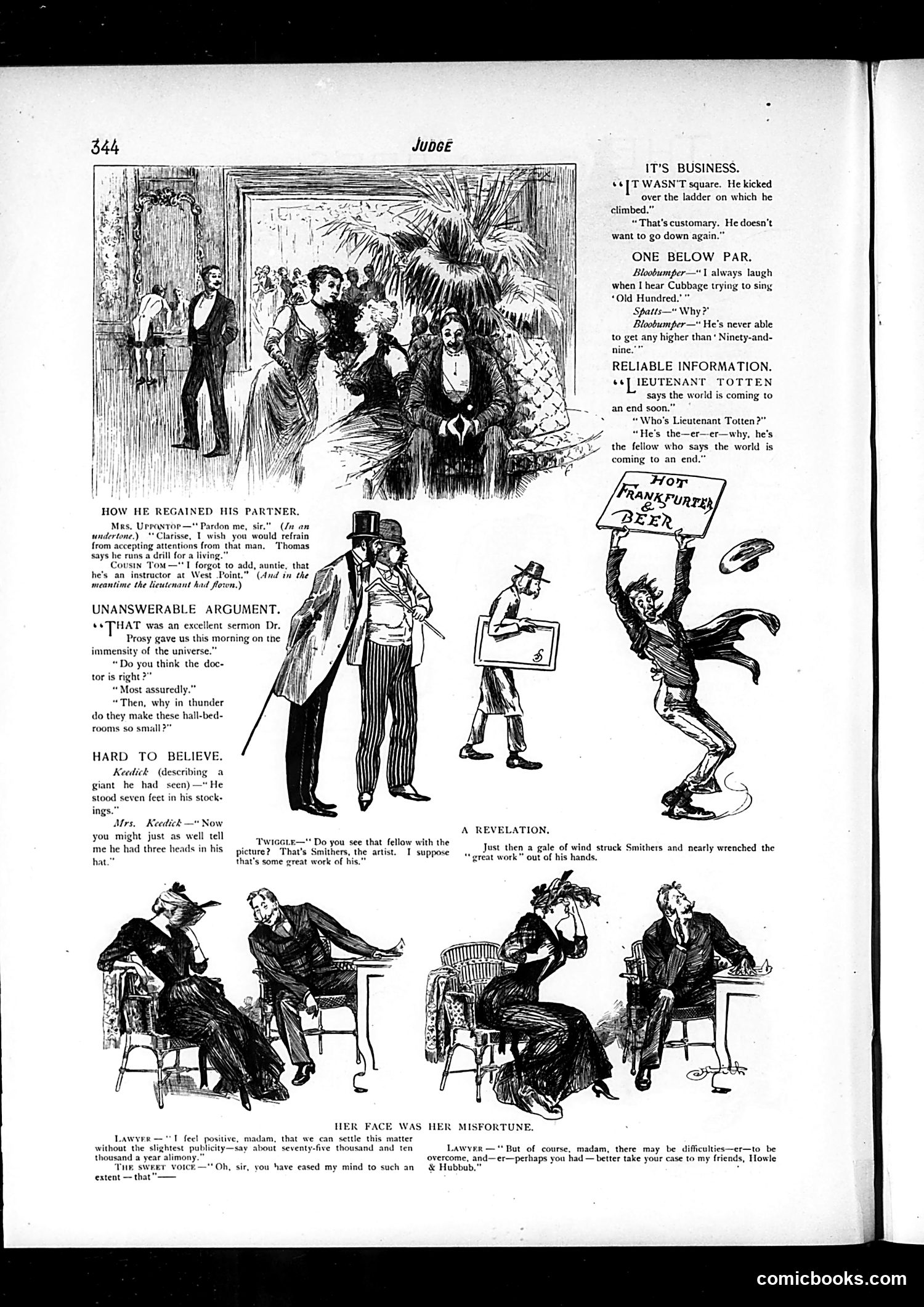
This page contains multiple satirical vignettes mocking social pretensions and absurdities. "It's Business" ridicules a man refusing to descend a ladder—his excuse being it's "customary" not to go down again, suggesting commentary on social climbing and rigid class behavior. "One Below Par" jokes about Cabbage (likely a character or real person) being unable to sing above "Ninety-and-nine," a reference to the popular hymn. "A Revelation" shows a wind gust nearly destroying someone's "great work," implying artistic pretension. The bottom section, "Her Face Was Her Misfortune," depicts a lawyer-client scene discussing financial settlement, likely satirizing either divorce proceedings or legal exploitation of women's circumstances. The humor targets social hypocrisy and financial manipulation.
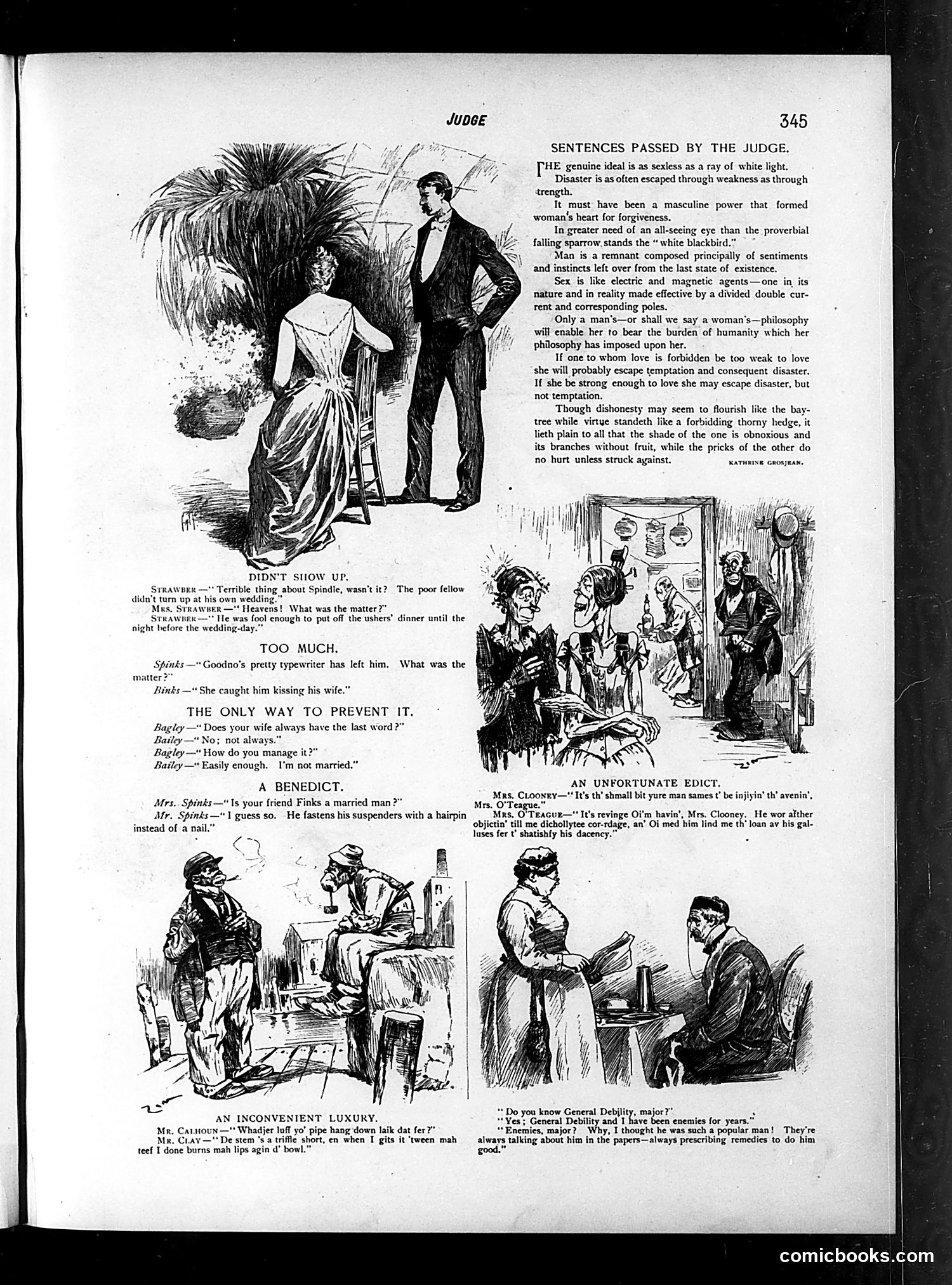
This page from *Judge* magazine contains multiple short humorous sketches mocking marriage, courtship, and social conventions of the era (appears to be late 19th century). **Main sections:** - **"Sentences Passed by the Judge"**: Philosophical musings on gender, love, and morality—satirizing Victorian moral platitudes by presenting them as paradoxical or self-defeating. - **"Didn't Show Up"**: Mocks a groom who postpones his wedding dinner, suggesting bachelor frivolity. - **"Too Much"** and **"The Only Way to Prevent It"**: Joke about marital jealousy and control—the wife's power in marriage. - **"A Benedict"**: Humorously describes a married man using a hairpin as a suspender fastener, implying matrimonial poverty or ridicule. - **"An Unfortunate Edict"** and **"An Inconvenient Luxury"**: Use Irish dialect humor (common in period satire) about domestic disputes and petty grievances. The overall theme satirizes marriage as a state of compromise, complaint, and domestic tension—a recurring target of period humor.
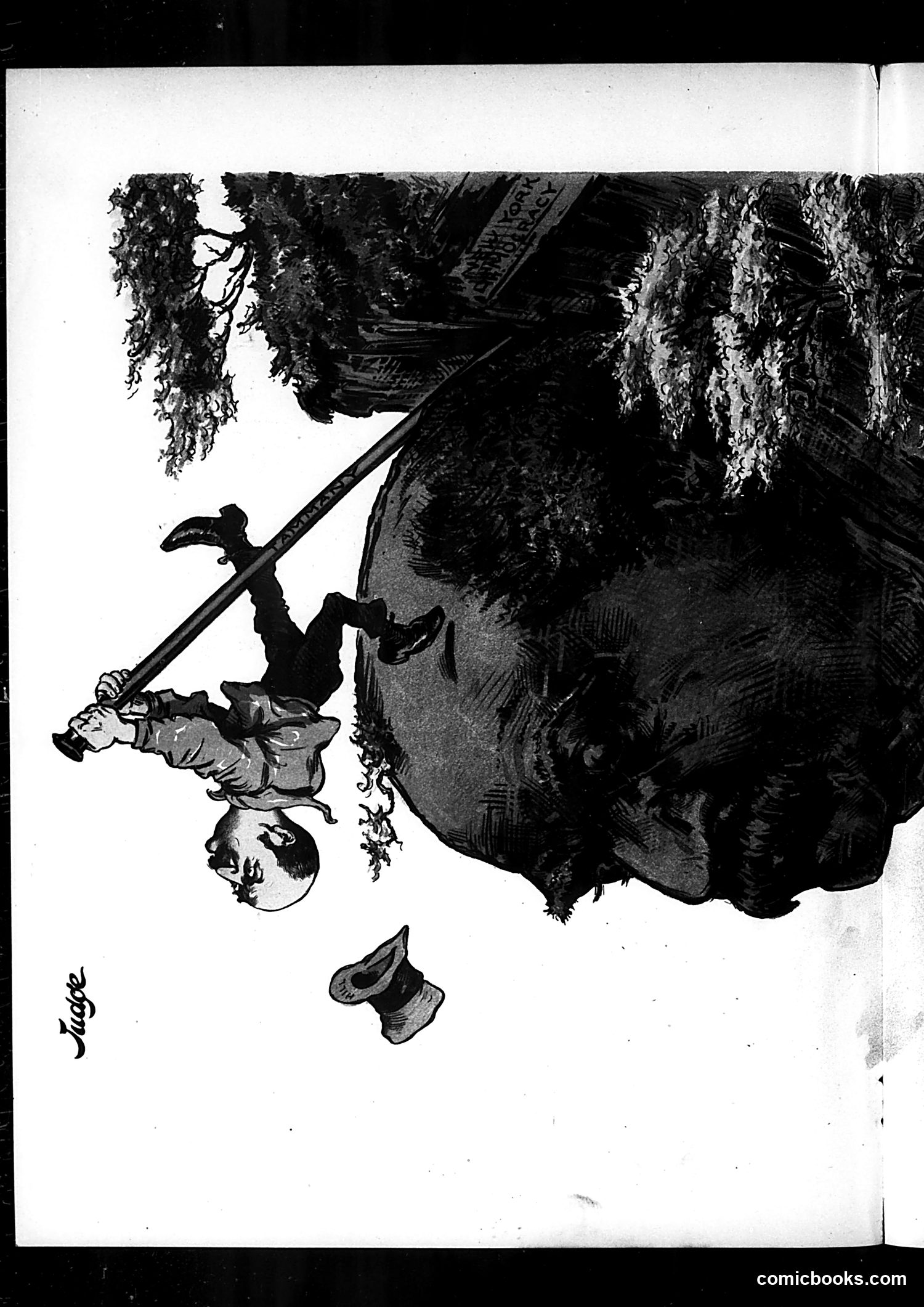
This appears to be a single satirical cartoon from *Judge* magazine, though the OCR text provides no substantive content beyond the source attribution. The image shows a figure in period clothing wielding what appears to be a large pole or staff, positioned near a large spherical object (possibly representing Earth or a globe). There is also a hat visible at the bottom of the composition. Lichen or moss hangs from above, suggesting an aged or deteriorated setting. Without legible text or captions identifying the specific figures, political figures, or historical event being satirized, I cannot reliably explain the cartoon's meaning or its satirical intent. The artistic style suggests late 19th or early 20th-century production, but the specific political or social commentary remains unclear from this image alone.
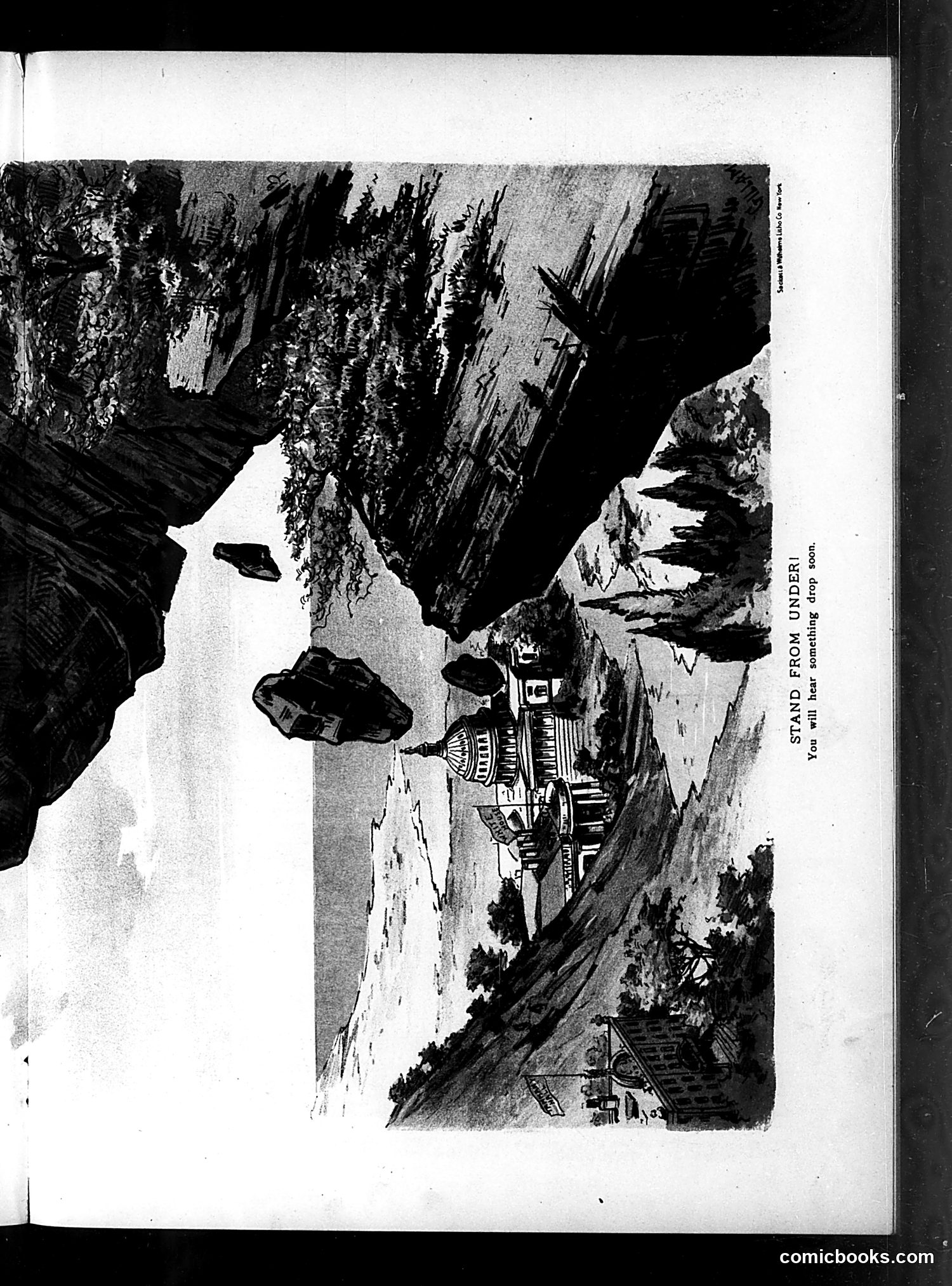
The OCR text is too corrupted to read reliably. However, the visible image shows a landscape scene with dramatic rocky cliffs or mountainous terrain. There appears to be a building or structure in a valley below, with what looks like a horse-drawn vehicle or carriage on a road. The caption reads "STAND FROM UNDER" and "You will hear something drop soon," suggesting this is a *Judge* magazine satirical cartoon warning of danger or consequences about to fall—likely social, political, or economic in nature. Without clearer text or context identifying specific figures or contemporary events, I cannot confidently explain which political situation or public figures this references. The humor appears to rest on an imminent threat or collapse viewers would recognize from 1890s-1900s American affairs.
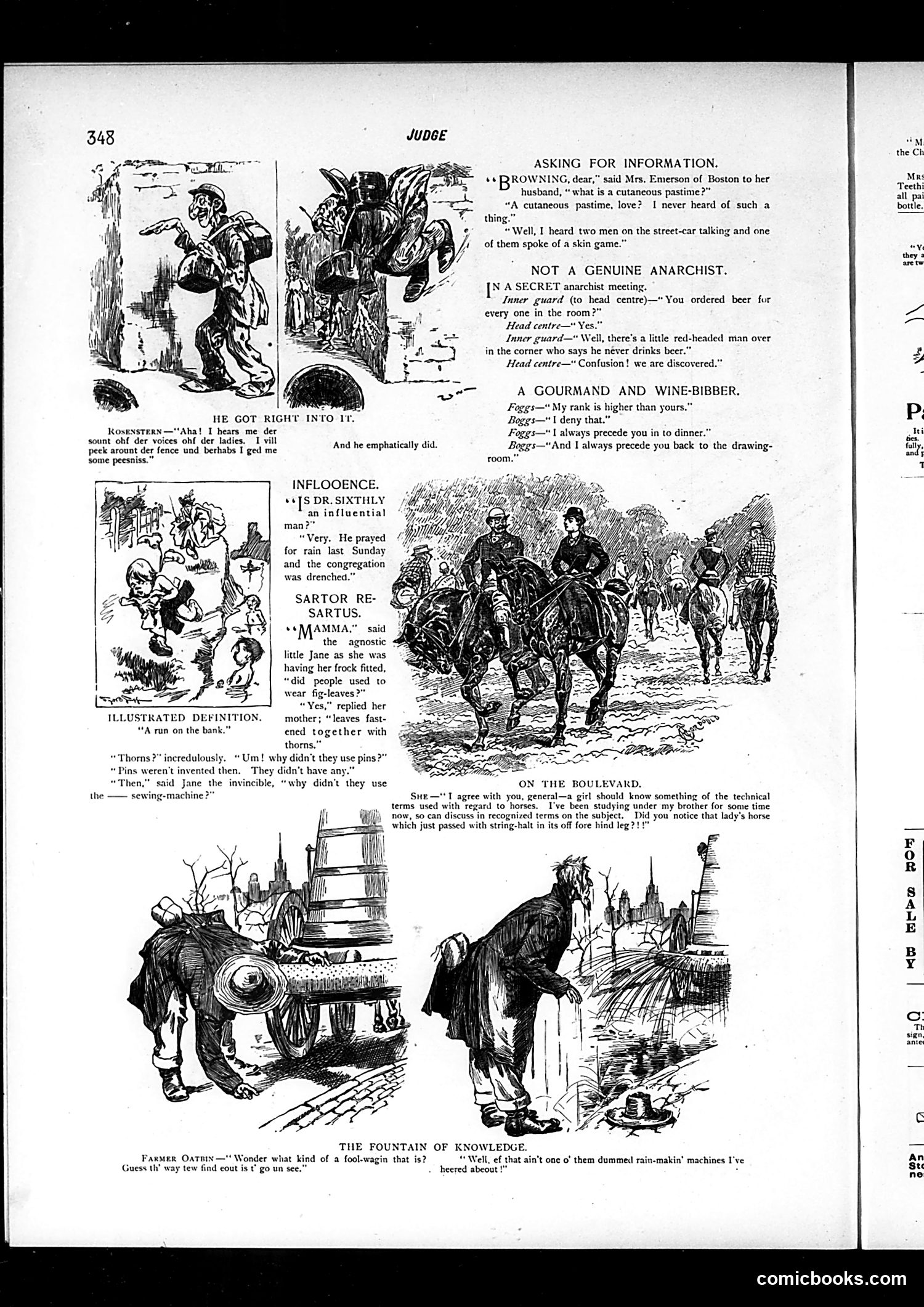
This page contains multiple short satirical pieces typical of Judge's humor circa late 19th/early 20th century: **"He Got Right Into It"** mocks a stereotypical German immigrant ("Kosexsters") attempting to peek at women—crude ethnic humor common to the era. **"Inflooence"** jokes about a man's prayer causing rain—satire on false claims of influence or power. **"Sartor Resartus"** features a child asking why ancient people didn't use pins or sewing machines instead of fig leaves—humor from anachronistic innocence. **"Not a Genuine Anarchist"** satirizes anarchists as hypocrites: they claim revolutionary principles but one refuses to drink beer, exposing their "discovery." **"The Fountain of Knowledge"** shows a farmer observing what he assumes is a rain-making machine (likely a water fountain or similar device)—humor from rural ignorance of city technology. **"A Gourmand and Wine-Bibber"** plays on social rank: two men debate whose status is higher, measured by dinner precedence. The humor relies heavily on ethnic stereotypes, class distinctions, and period-specific references now requiring context.
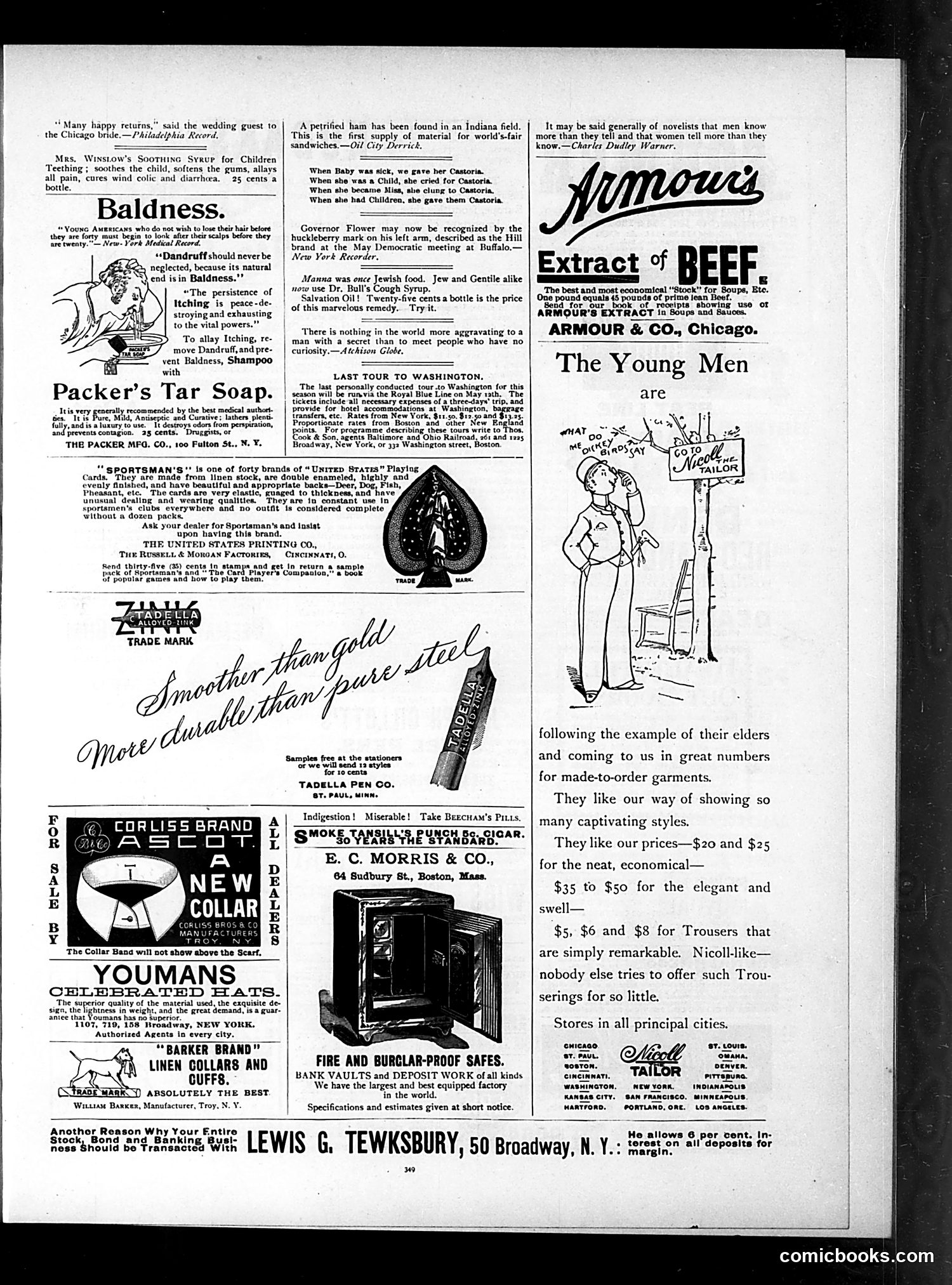
This page is primarily **advertising with minimal editorial content**. The few cartoons/jokes present are brief: 1. **"Many happy returns"** joke: A play on words where a Chicago bride receives wedding congratulations, but "returns" suggests merchandise being sent back—likely satirizing either hasty marriages or the commercialization of weddings. 2. **Petrified ham quip**: References the 1893 World's Columbian Exposition in Chicago, joking that a petrified ham from Indiana could supply "material for world's-fair sandwiches"—mocking either the fair's food quality or Indiana's agricultural reputation. 3. **Governor Flower reference**: Alludes to a Democratic meeting where Governor Flower received a "huckleberry mark" (bruise), treating political conflict as livestock branding—satire of rough political tactics. The page is overwhelmingly devoted to patent medicines, grooming products, and services (Castoria, cough syrup, hair treatments, collars, safes), typical of late-19th-century Judge advertising. The actual editorial satire is minimal.
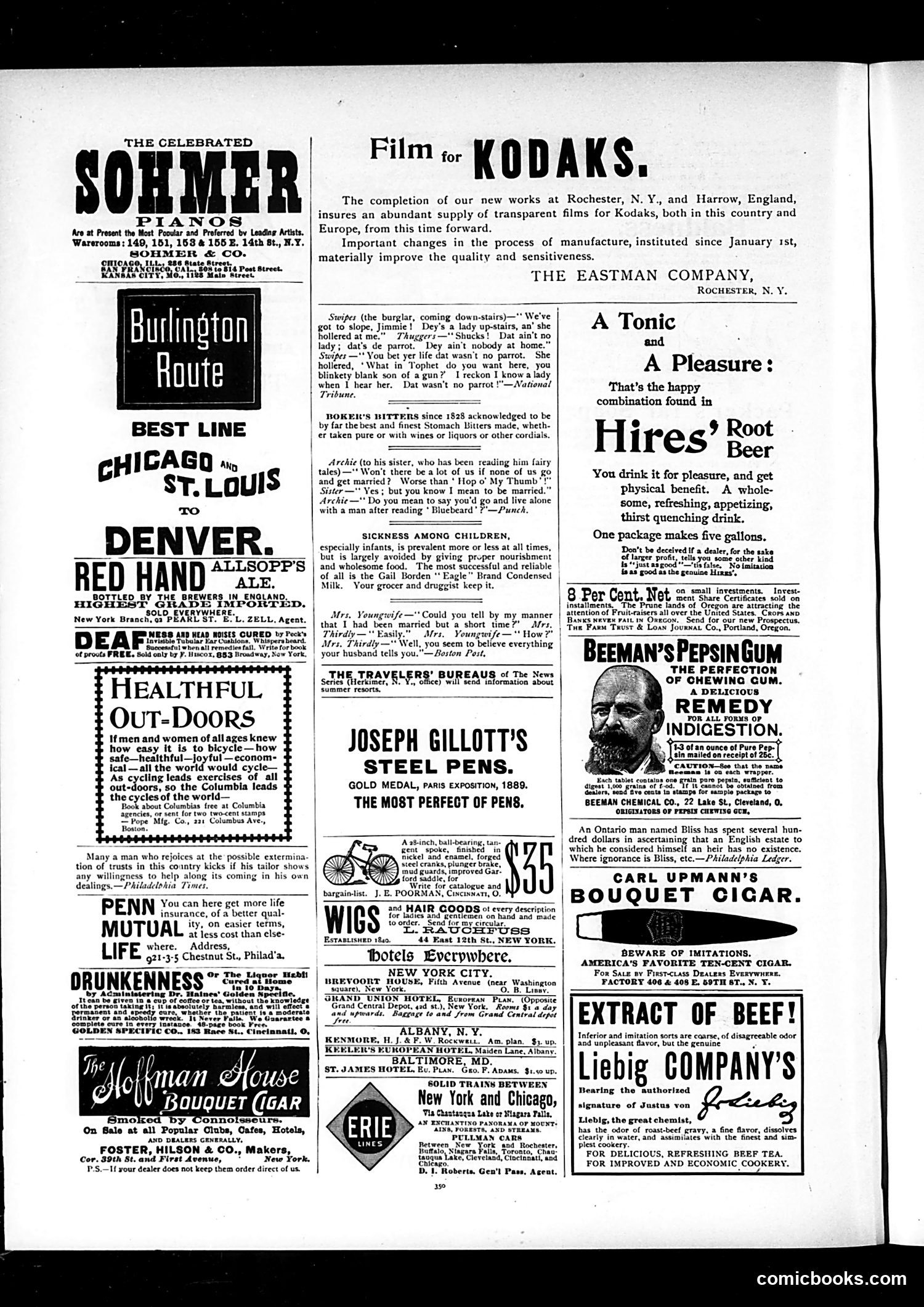
This is primarily an **advertising page** from Judge magazine, not a satirical cartoon section. It contains roughly 20 different advertisements for products ranging from pianos and bicycles to patent medicines and cigars. The small **joke** embedded among the ads depicts burglars interrupted by what they assume is a parrot but turns out to be an angry woman—a simple domestic humor gag with no political content. The ads themselves reveal late-19th-century consumer culture: Kodak film, Sohmer pianos, Columbia bicycles, Allsopp's beer, and notably several **dubious medical products** ("Golden Specific" for curing alcoholism, "Bokem's Bitters" as stomach cure, Liebig's beef extract). These reflect an era before FDA regulation when patent medicines made unverified health claims freely. The page offers no political satire—it's a commercial document showing what companies advertised to Judge's middle-class readership around the 1890s, capturing period attitudes toward technology, health, and consumer goods.
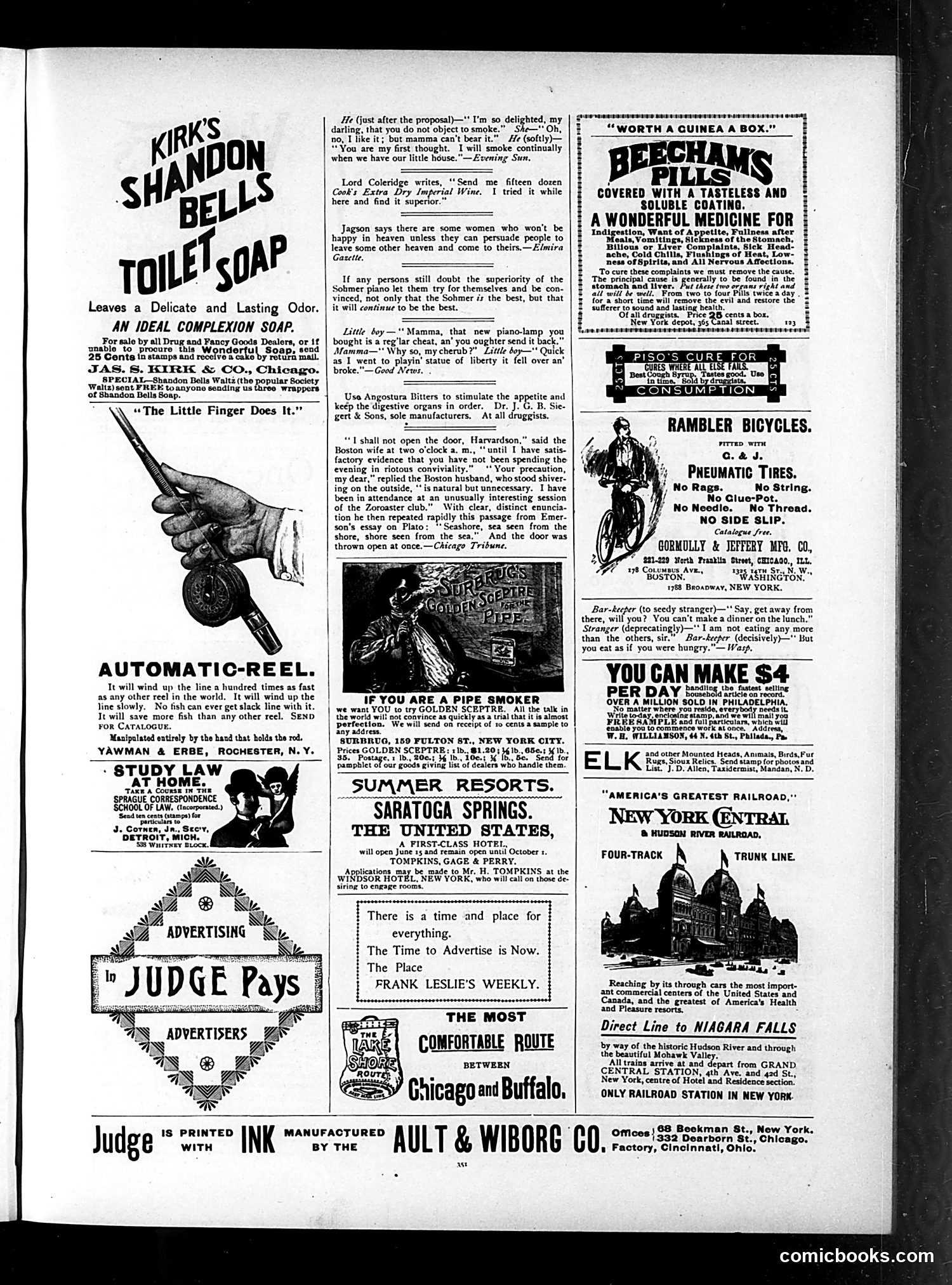
This is primarily an **advertising page** from Judge magazine, with minimal editorial content beyond brief humorous anecdotes. The few **jokes/cartoons** present are genteel domestic humor typical of the era: - A newlywed husband promises not to smoke after marriage, then immediately plans to smoke constantly—satirizing insincere romantic pledges. - A Boston husband recites Emerson rapidly to prove he wasn't carousing at his club, fooling his suspicious wife—mocking both Boston's reputation for intellectual pretension and marital distrust. - A child complains a new piano lamp is defective because it "fell over" while she played statue of liberty—simple children's logic humor. The **advertisements** dominate, hawking period products: Kirk's soap, fishing reels, correspondence law school, pianos, bitters, cigars, and resort hotels. The page reflects Judge's primary revenue model: selling ad space to manufacturers. There is no political satire or social commentary of note.
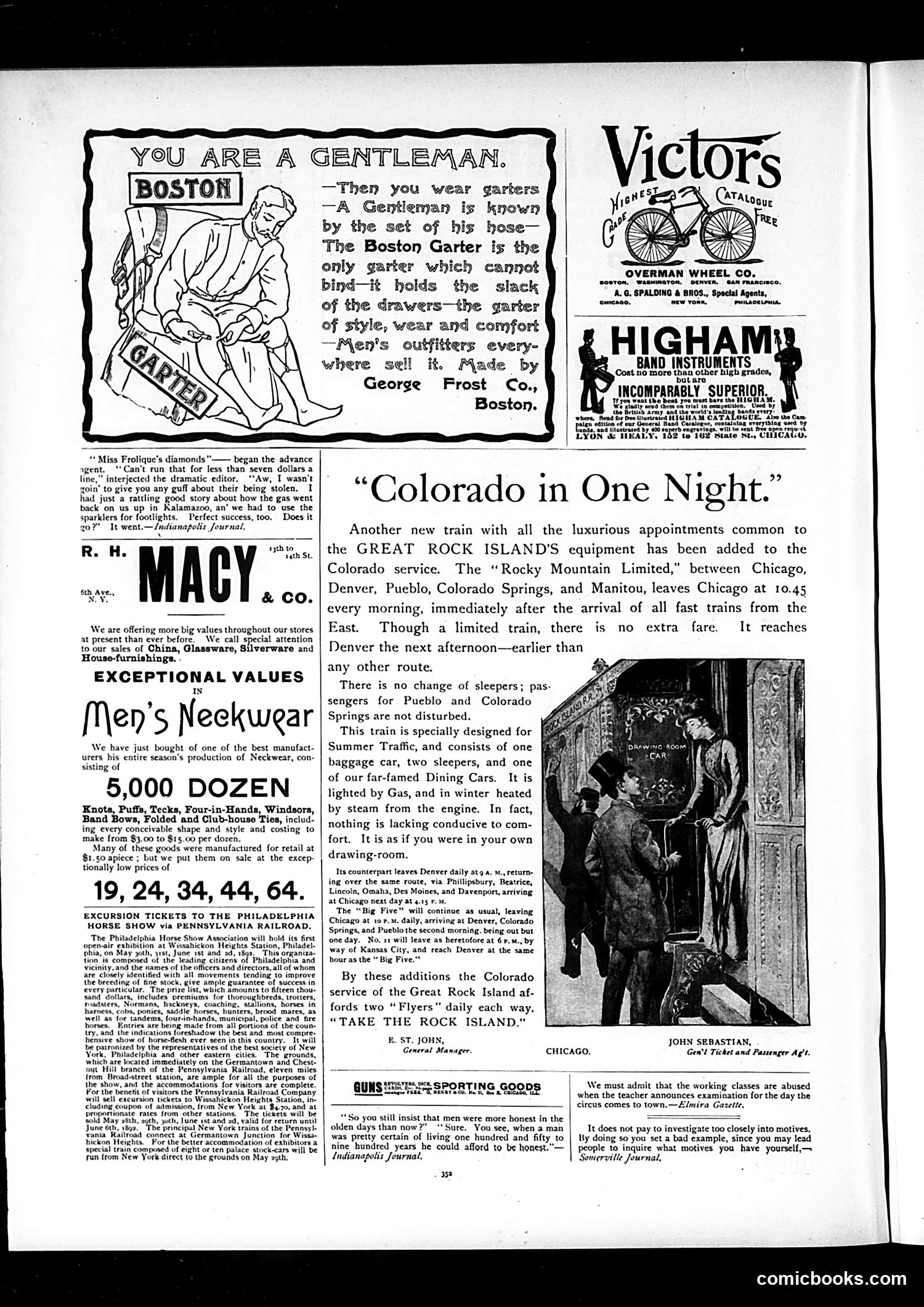
This page primarily features **advertisements** mixed with small editorial items, rather than political cartoons requiring historical analysis. The main content is a railroad advertisement for the "Rocky Mountain Limited" train between Chicago and Denver/Colorado Springs. It promotes luxurious accommodations—sleeping cars, dining cars, gas lighting, steam heating—emphasizing speed (reaching Denver the next afternoon) and comfort ("as if you were in your own drawing-room"). The top-left cartoon is a **commercial advertisement** for Boston Garters, using a gentleman figure to pitch hosiery products. It's not satirical—just product marketing. Other items are straightforward ads: Macy & Co. selling neckwear, a Philadelphia Horse Show promotion, and Higham Band Instruments. The small editorial snippets (diamonds anecdote, working-class examination joke) are humorous observations but lack political content. This appears to be a **typical late-19th-century magazine page** blending advertising with light entertainment—not a platform for political satire.
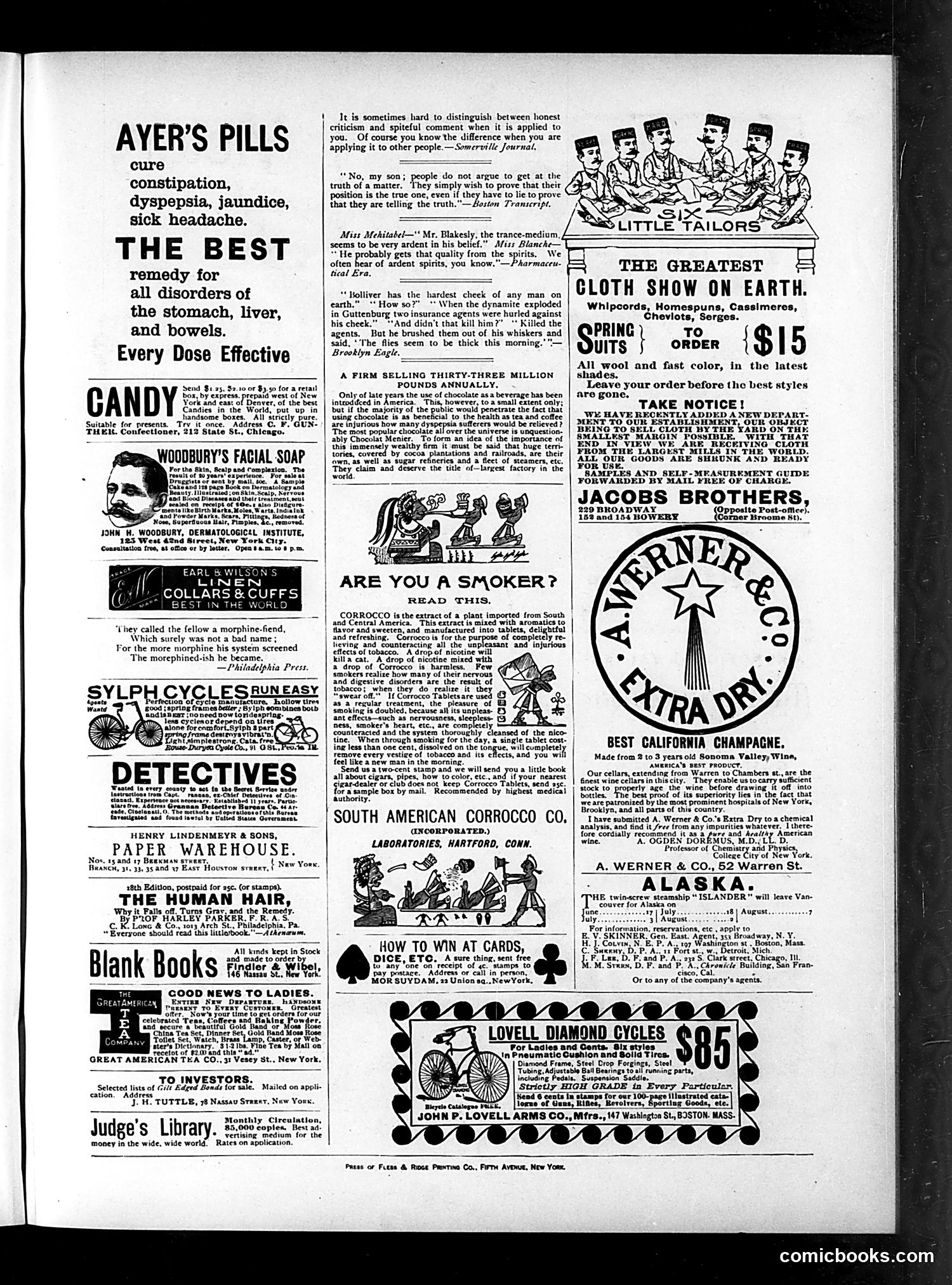
This page is primarily **advertising**, typical of late 19th-century American magazines. However, it contains several short humorous items: **The Jokes:** - A quip about "morphine-fiends" becoming "morephined-ish"—wordplay mocking drug addiction - A trance-medium joke: Miss Blanche puns that the spiritualist's "ardent belief" comes from "ardent spirits" (alcohol) - A dark humor piece about "Bolliver," whose face is so hard that dynamite explosions and flying insurance agents don't harm him—absurdist exaggeration **The "Little Tailors" cartoon** shows tailors working, likely satirizing their craft or working conditions, though specifics are unclear from the image alone. **Context:** These brief jokes reflect Judge's satirical style—poking fun at contemporary fads (spiritualism, drug use) and exaggerating character traits for comedic effect. The page otherwise showcases patent medicines, bicycles, and consumer goods typical of the Gilded Age market.
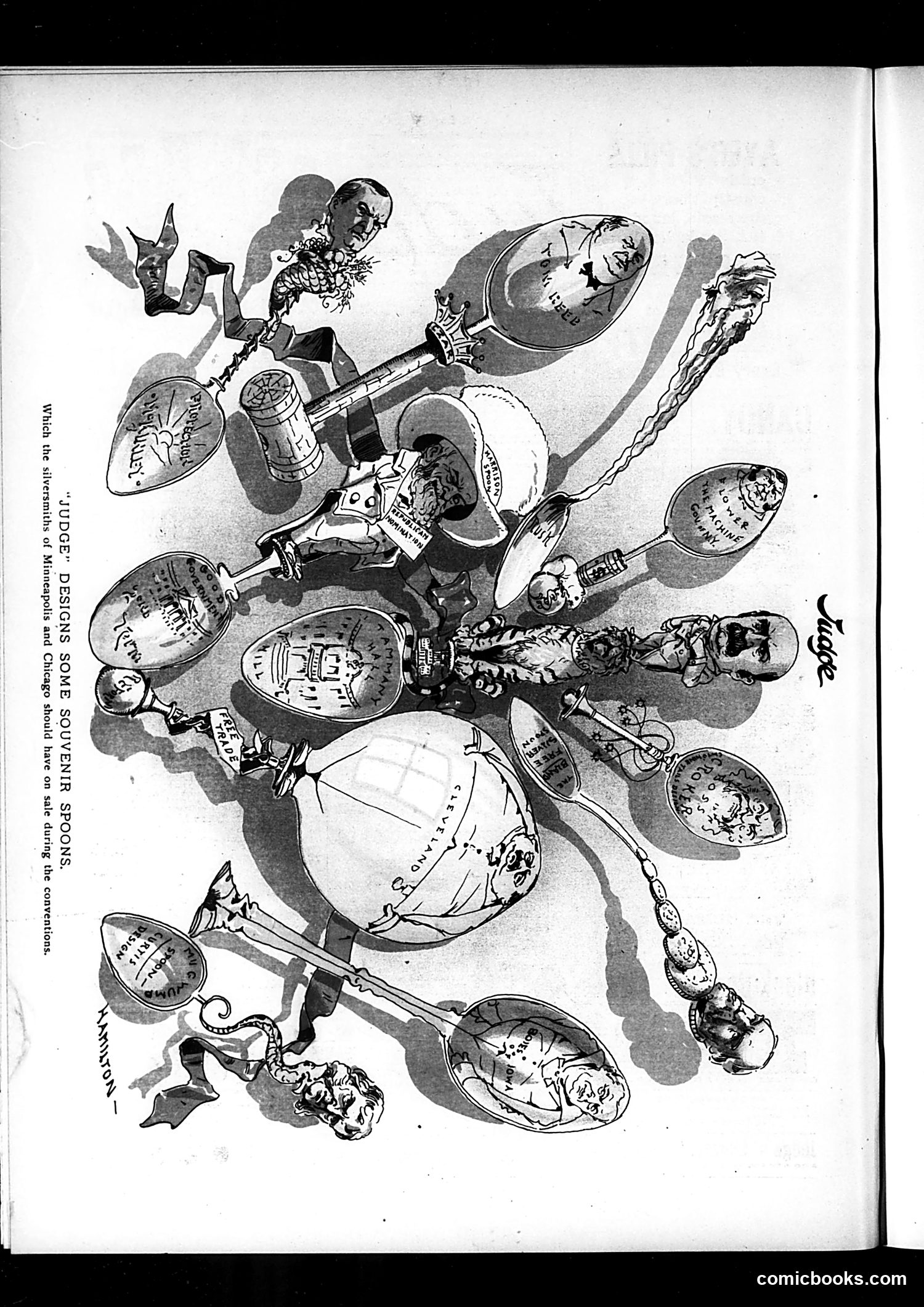
This satirical cartoon mocks the 1892 presidential conventions in Minneapolis and Chicago by depicting various political figures as ornamental souvenir spoons—a popular Victorian keepsake item. The spoon handles feature caricatured heads of prominent politicians of the era, likely including presidential candidates and party leaders. The cartoon's humor lies in reducing these serious political figures to mere decorative objects—suggesting they're interchangeable commodities rather than statesmen of substance. The satire critiques how conventions had become spectacles more concerned with merchandise and tourism than meaningful political discourse. By presenting politicians as mass-produced souvenirs, *Judge* magazine ridicules both the figures themselves and the commercialization of American democracy during this period.