
A complete issue · 16 pages · 1892
Judge — March 26, 1892
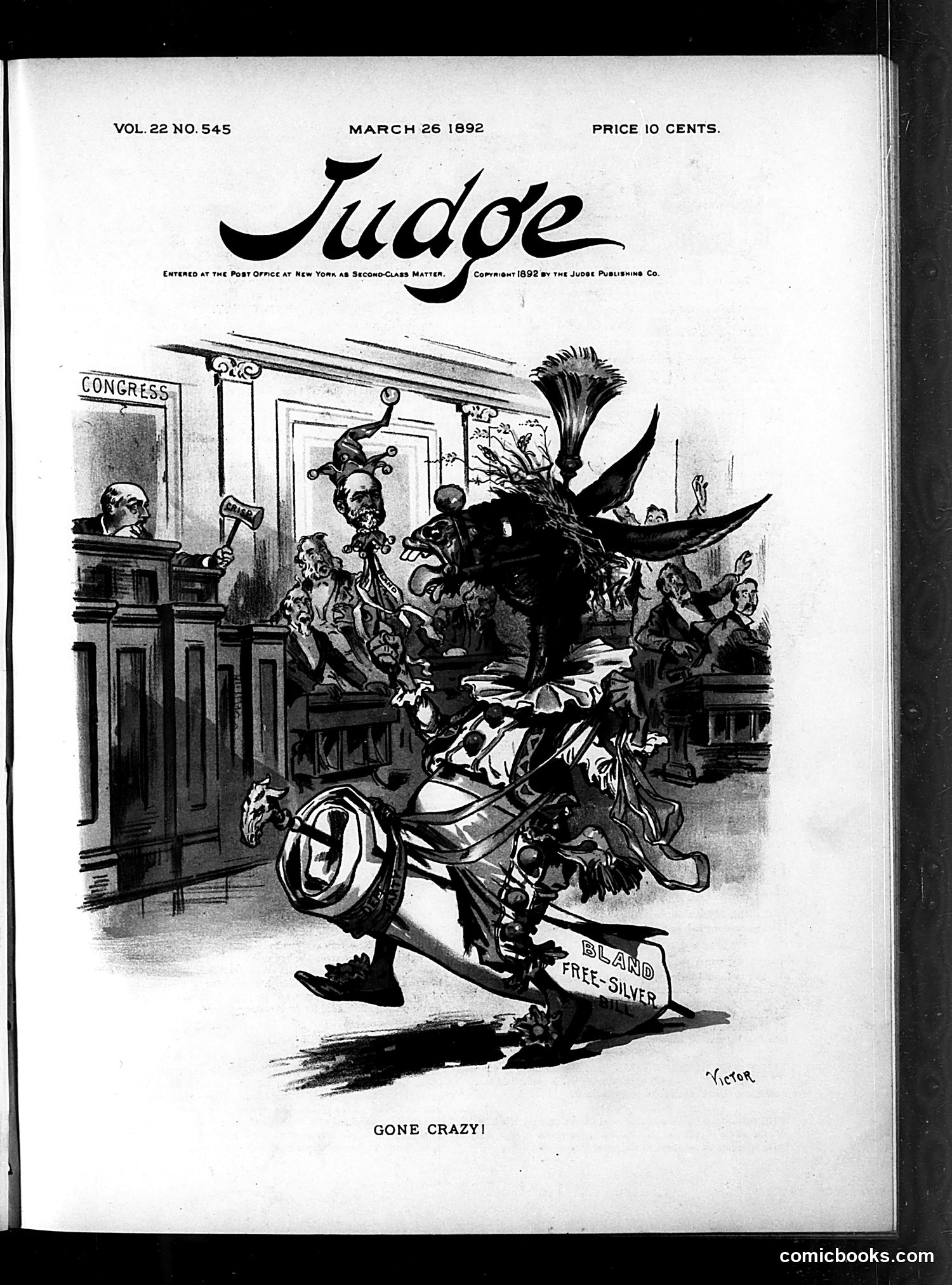
This political cartoon satirizes the free-silver debate, a major 1892 issue. A grotesque jester figure (likely representing the free-silver movement or its proponents) rides wildly through Congress on a donkey labeled "BLAND FREE-SILVER," causing chaos. Congressional figures scatter in alarm from the gallery on the left. The "gone crazy" caption suggests the artist views free-silver advocates as reckless or insane. The jester imagery implies they're making a mockery of serious governance. The wild, chaotic composition emphasizes the perceived danger this monetary policy posed to Congress and the nation's stability. This reflects Judge's editorial stance opposing unlimited silver coinage, which many wealthy interests feared would cause inflation and economic instability.
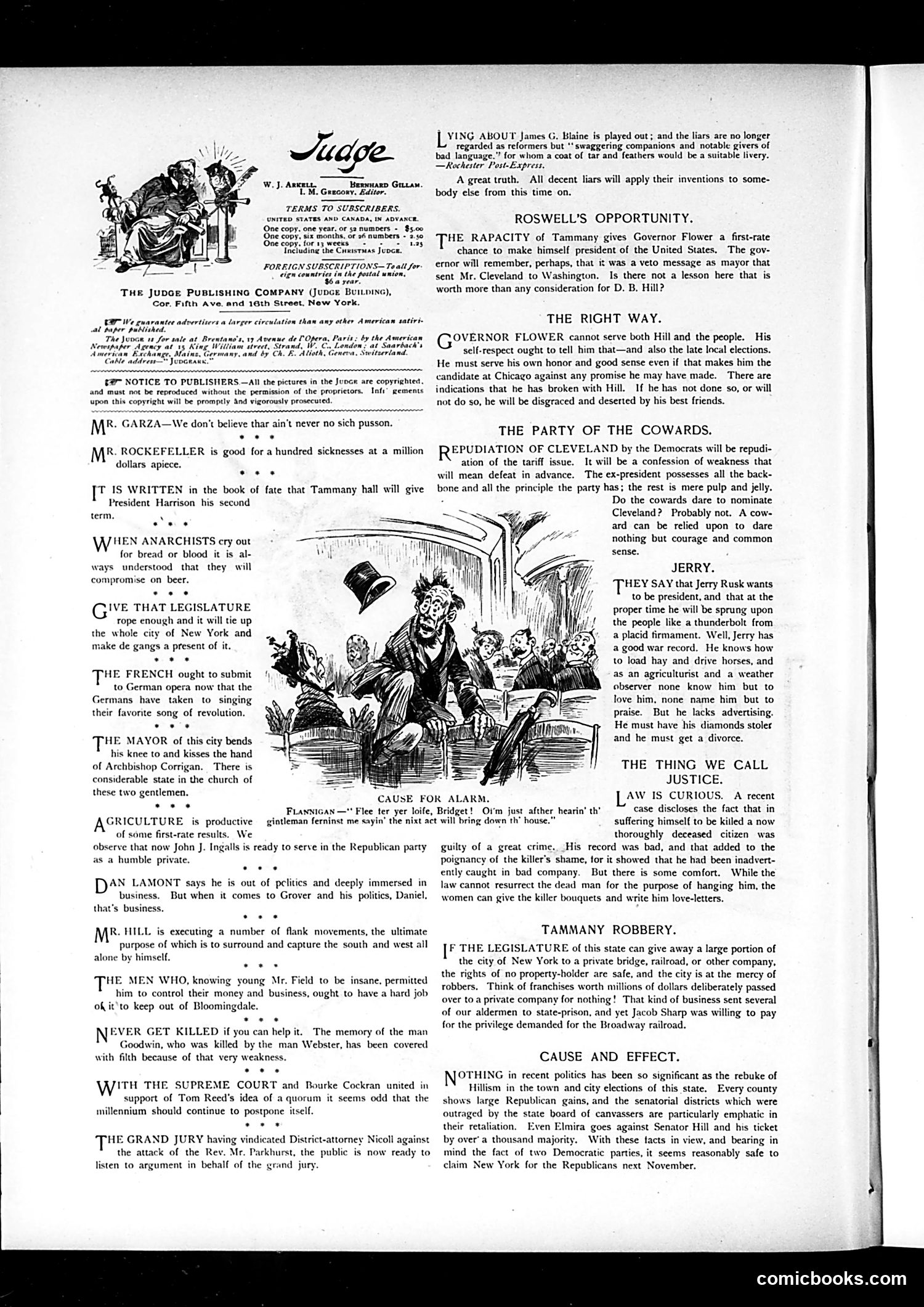
The central cartoon titled "CAUSE FOR ALARM" depicts a disheveled man surrounded by angry women wielding what appear to be weapons or clubs. The caption references "Flannigan" and "Bridget," suggesting working-class Irish characters typical of period stereotypes. The surrounding editorial content addresses contemporary political figures: Governor Flower, D.B. Hill, Cleveland, and Jerry (likely Vice President Adlai Stevenson). The articles discuss Republican versus Democratic party politics, tariff issues, and upcoming elections. The cartoon likely satirizes labor unrest or domestic conflict, with the armed women representing either wives of workers or suffragists—reflecting anxieties about social disorder during the 1890s economic and political turmoil. The overall page blends visual satire with political commentary on current events.
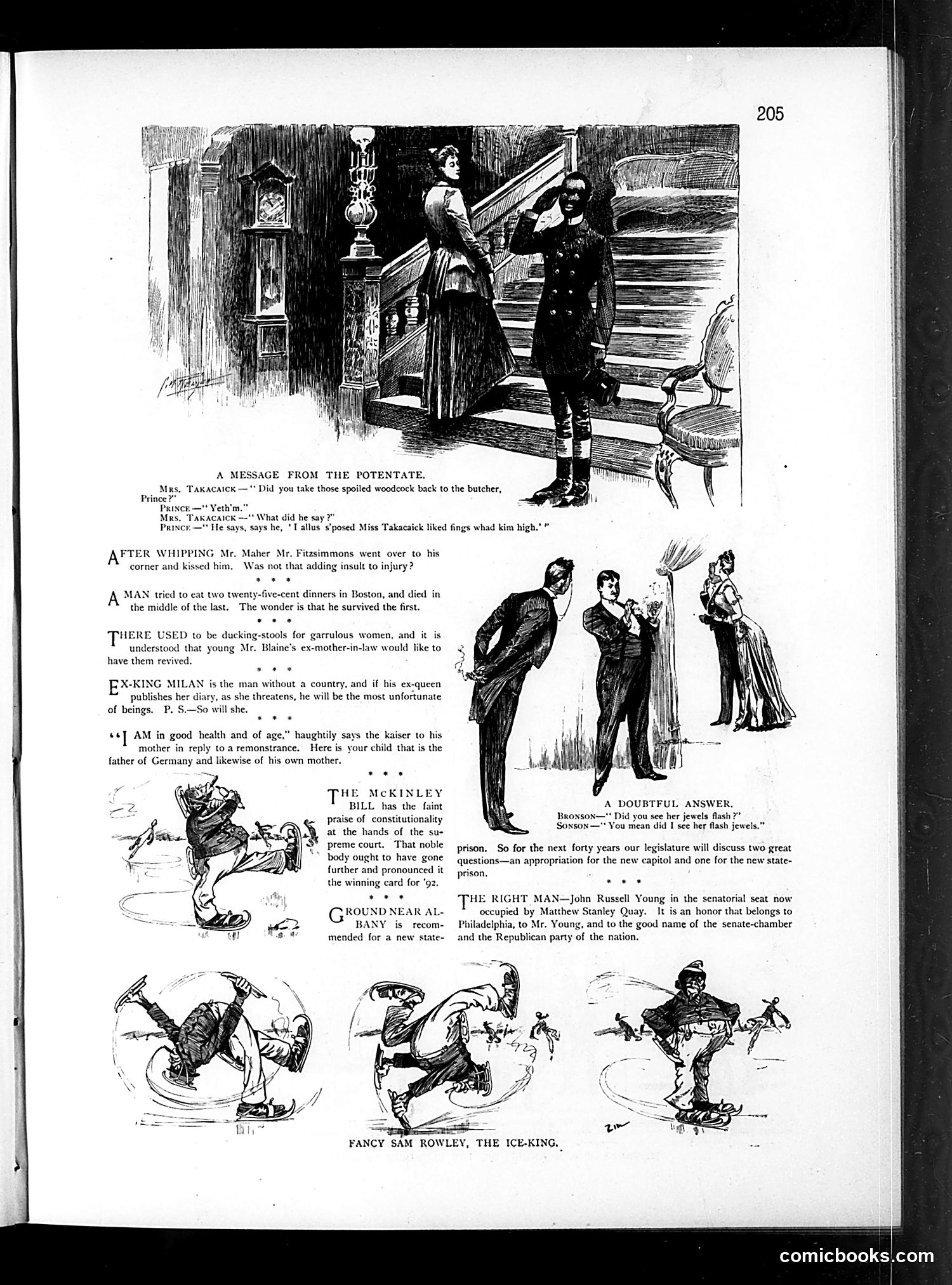
This page contains several brief political satires and jokes typical of early 20th-century American humor: **"A Message from the Potentate"** depicts a social exchange about returning spoiled woodcock to a butcher—satirizing upper-class pretension. **Notable items referenced:** - "After Whipping Mr. Maher Mr. Fitzsimmons went over and kissed him"—likely referencing a boxing match, sarcastically questioning whether adding insult to injury was appropriate. - Ex-King Milan of Serbia appears in a joke about his unfortunate status as "a man without a country." - The McKinley Bill receives praise regarding constitutional supremacy. - "Fancy Sam Rowley, the Ice-King" shows skating caricatures. The page blends political commentary with social satire and crude humor typical of 1890s Judge magazine, targeting contemporary politicians, recent events, and upper-class behavior.
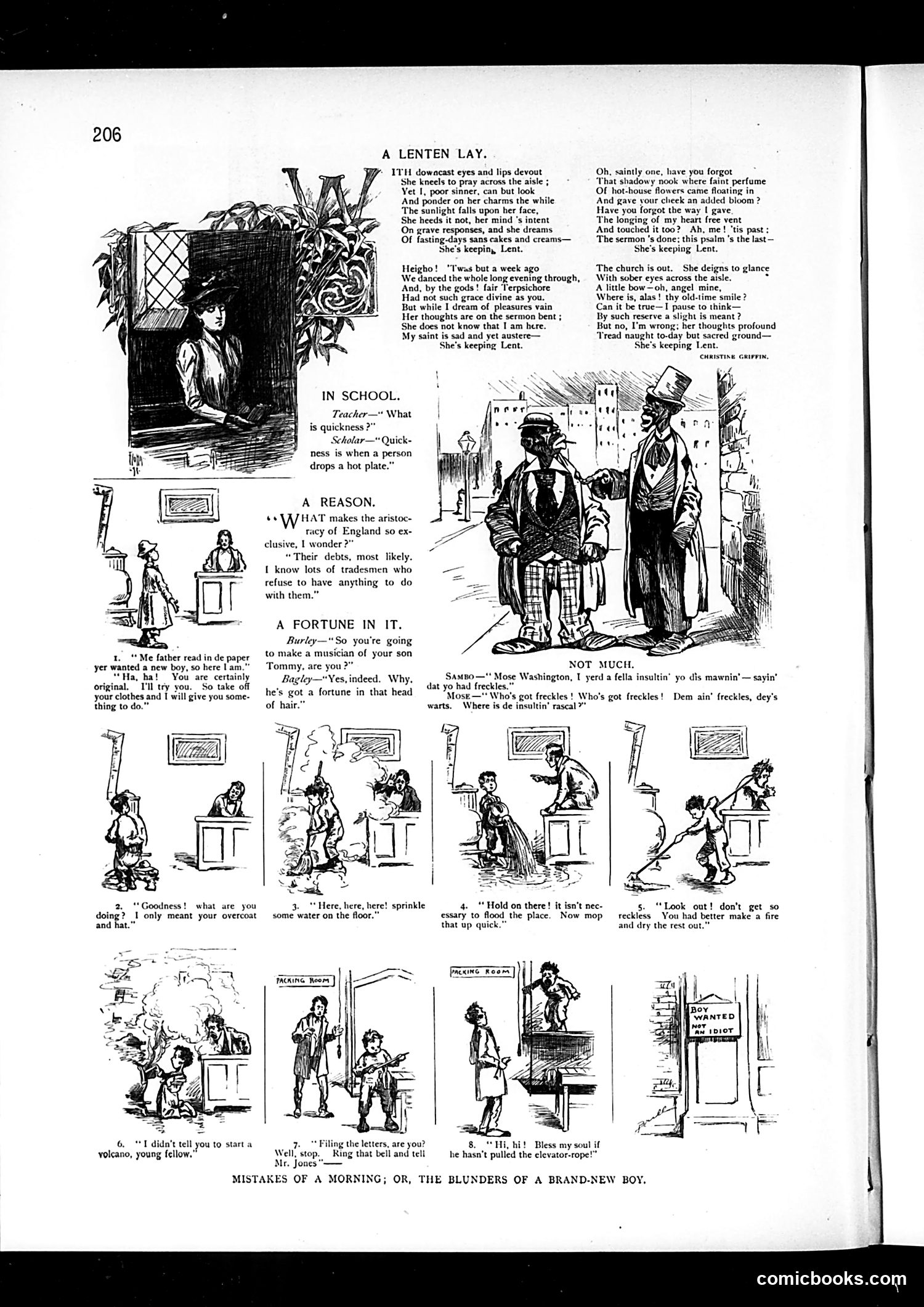
This page contains three separate humor pieces from *Judge* magazine: **"A Lenten Lay"** is a romantic poem about a man pining for a woman who's observing Lenten fasting (the Catholic pre-Easter period). She's pious and austere at church, contrasting with her lively dancing from the previous week. The satire gently mocks both religious devotion and male romantic frustration. **"In School"** presents quick comedic exchanges between teachers and students—basic joke-book material about misunderstood definitions and a new boy's mishaps (removing clothes when told to remove his overcoat, etc.). The humor relies on literal interpretation and physical comedy. **"Not Much"** is a racist dialect joke featuring two Black characters (labeled "Sambo" and "Mose") discussing freckles and insults, using offensive phonetic spelling. This represents the casual racial mockery common in period humor magazines. The bottom strip, **"Mistakes of a Morning,"** shows an office boy's various blunders on his first day—starting fires, flooding floors, pulling elevator ropes—slapstick humor typical of early-20th-century comic strips.
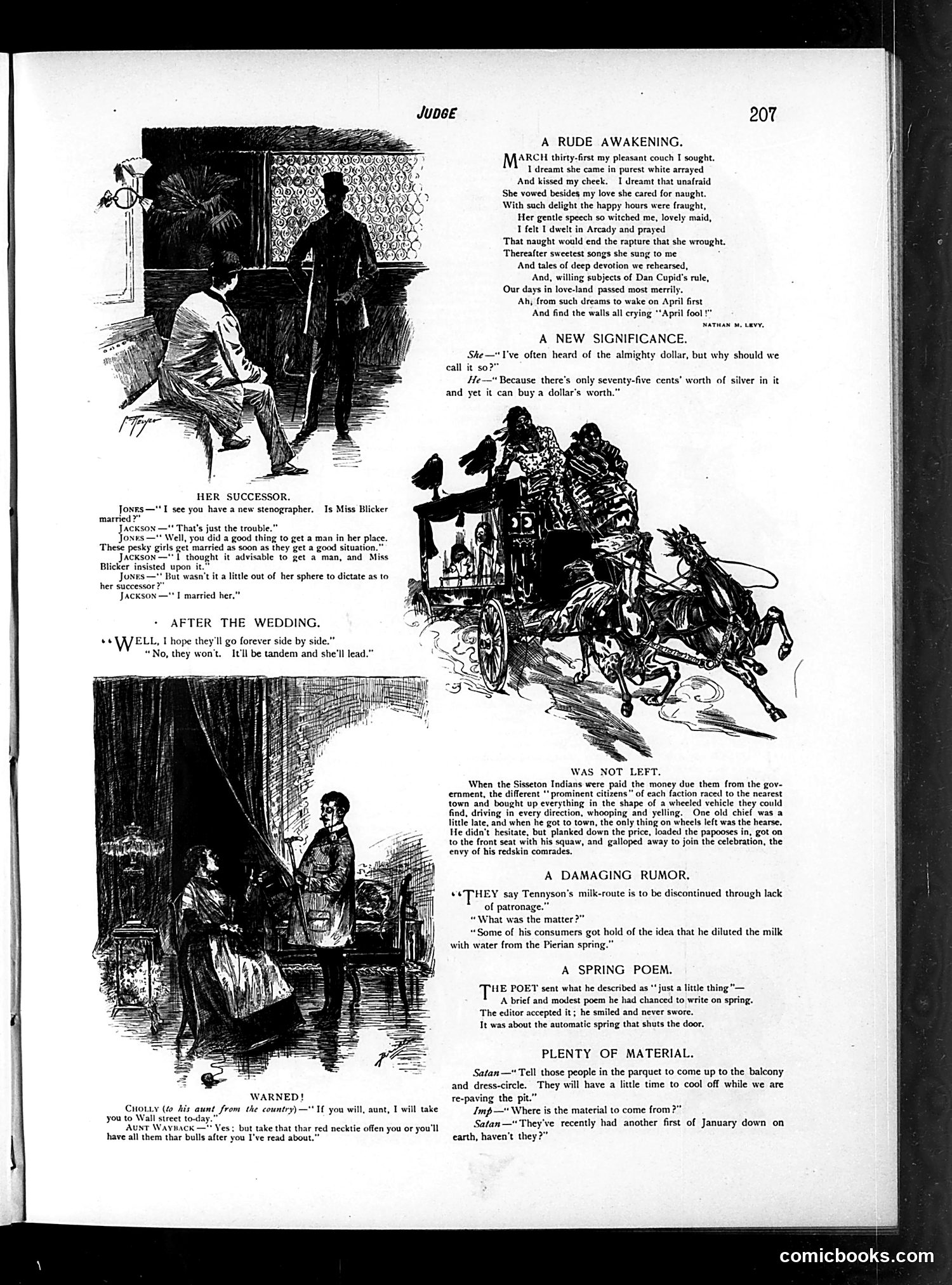
This page contains multiple satirical pieces targeting late 19th-century American society: **"A Rude Awakening"** mocks romantic dreamers—a man dreams of love on March 31st, only to wake April 1st to "April fool!" jokes, suggesting the foolishness of idealistic romance. **"A New Significance"** jokes about currency devaluation: the "almighty dollar" contains only seventy-five cents of silver yet retains its nominal value—commentary on inflated currency or economic policy debates of the era. **"Her Successor"** satirizes workplace dynamics: a businessman hires a male stenographer because female employees marry quickly and leave. The punchline—he then marries *his* stenographer—mocks the hypocrisy. **"Sisseton Indians"** contains period-typical racist humor about Native Americans, describing their spending spree after government payment, including an old chief purchasing a hearse for transport. **Minor pieces** include jokes about door springs, Tennyson's poetry ("Pierian spring" pun), and theater/architectural renovation. The overall tone reflects Judge's satirical approach to contemporary social absurdities, workplace culture, and economics.
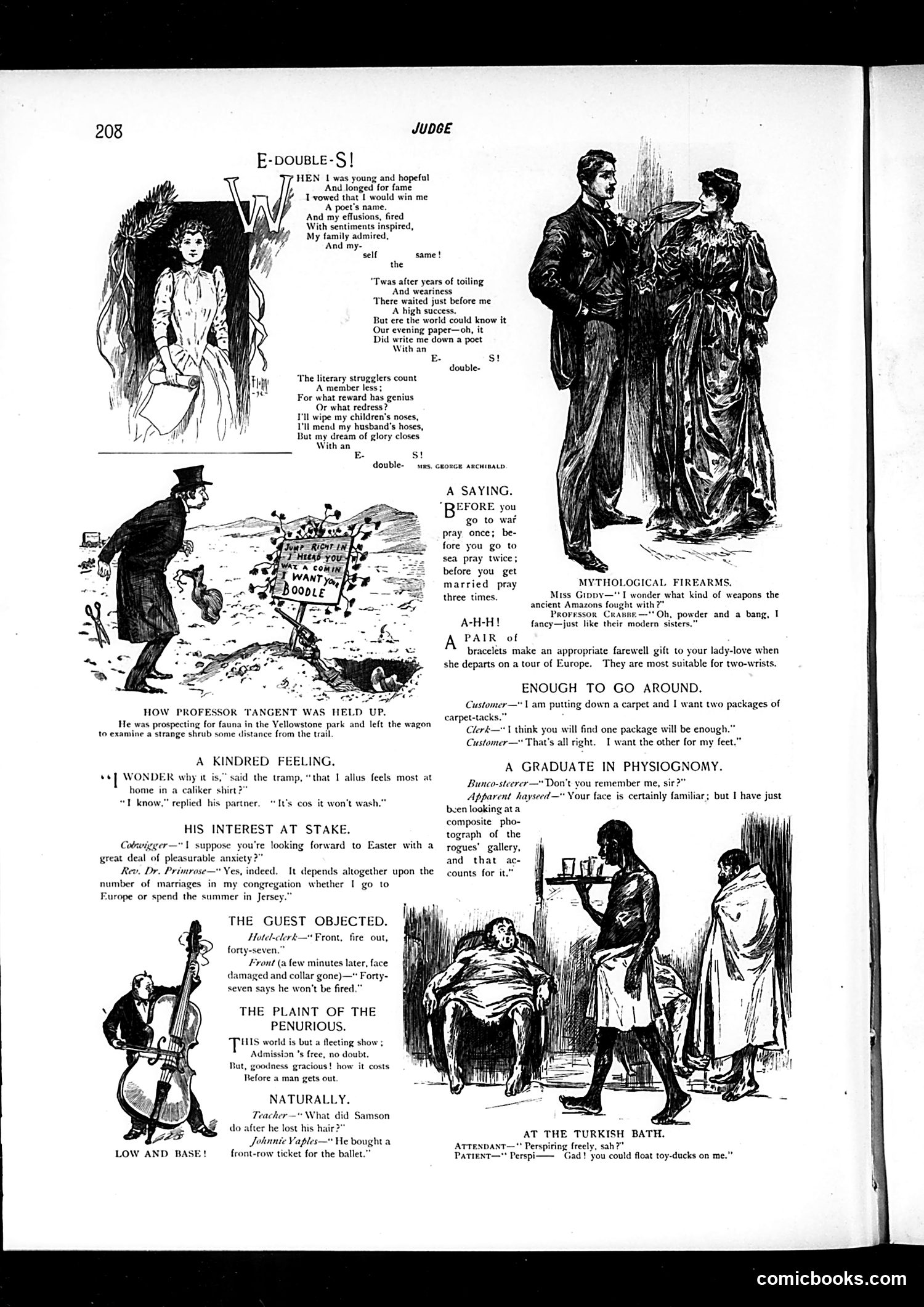
This page contains multiple short satirical pieces typical of Judge's humor: **"E-Double-S!"** (top): A poem mocking aspiring female poets whose dreams of literary fame are dashed. The punchline—they become domestic drudges (mending husbands' hoses, wiping children's noses)—satirizes the limited prospects for women writers and the assumption that marriage ends ambition. **"Mythological Firearms"**: A brief joke playing on "Amazons" (ancient warrior women) versus modern women, suggesting modern women are similarly armed with "powder and a bang"—cosmetics and gossip, trivializing female power. **Scattered one-liners** include jokes about carpets, tramps, physiognomy (judging character by appearance), Easter expenses, hotel complaints, and Turkish baths—typical period humor about everyday life and social types. **"How Professor Tangent Was Held Up"**: A crude visual joke about a naturalist robbed while examining shrubs. The page reflects Judge's editorial perspective: mildly misogynistic humor, class-based jokes about working people and immigrants, and gentle mockery of middle-class anxieties.
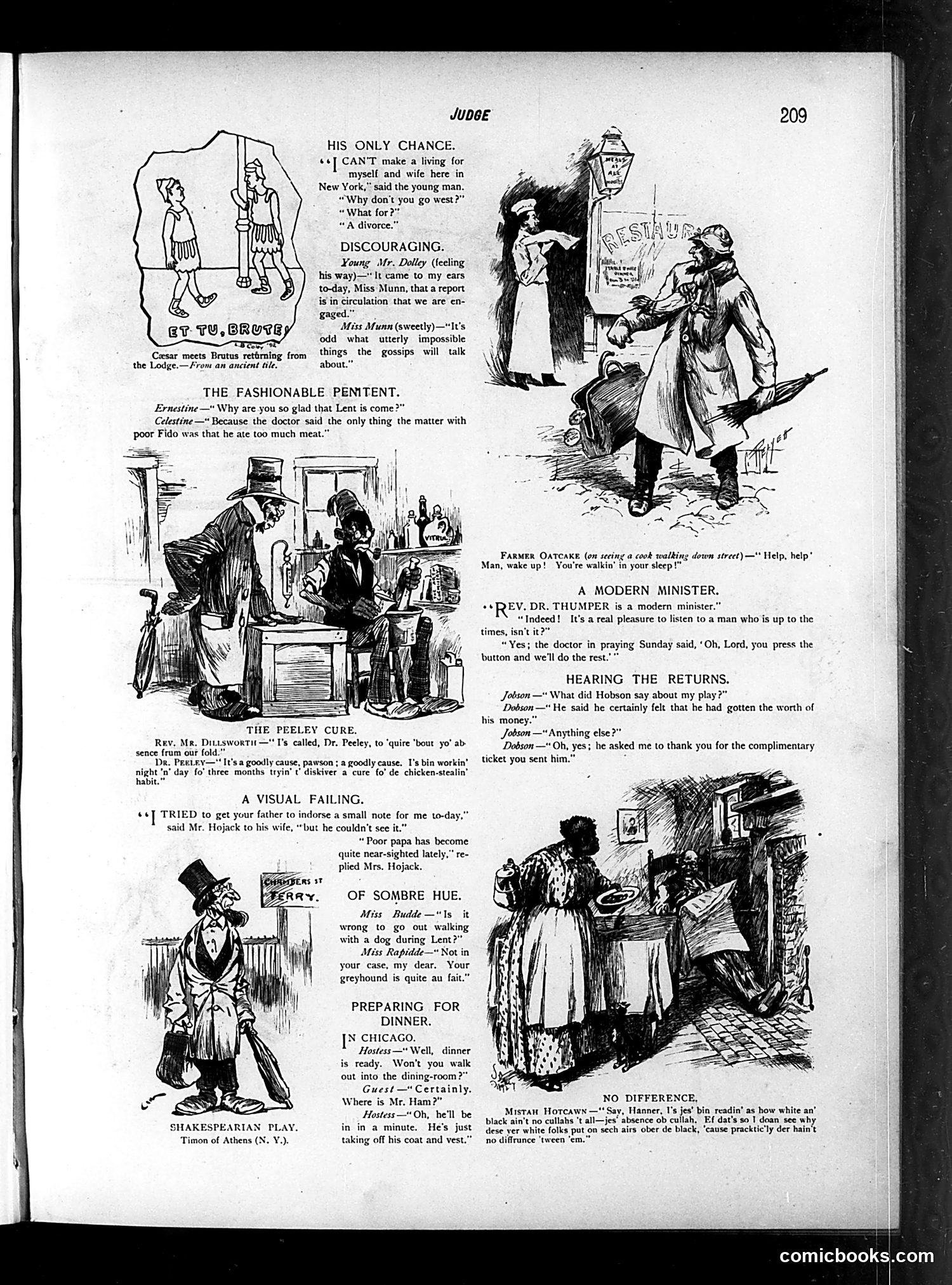
This page contains multiple satirical vignettes typical of Judge's humor: **"His Only Chance"** mocks divorce as a quick solution to financial problems—the young man must go west to obtain one, reflecting how western states had easier divorce laws than New York. **"The Fashionable Penitent"** satirizes wealthy women's superficial Lenten observance—Celestine's only sacrifice is her dog's diet, not genuine penance. **"The Peeley Cure"** uses dialect humor (common in period satire) to mock a clergyman's dubious claim of discovering a cure for "chicken-stealing"—likely referring to theft among poor Black communities. **"A Visual Failing"** is a pun: the father can't "see" endorsing a note, claimed as near-sightedness. **"Of Sombre Hue"** jokes that a greyhound—a hunting dog—appropriately ignores Lenten restrictions. The final vignette uses heavy Black dialect to present an ironic argument about racial equality, reflecting the magazine's period attitudes. Overall, the page emphasizes class pretension, religious hypocrisy, and contemporary social foibles.
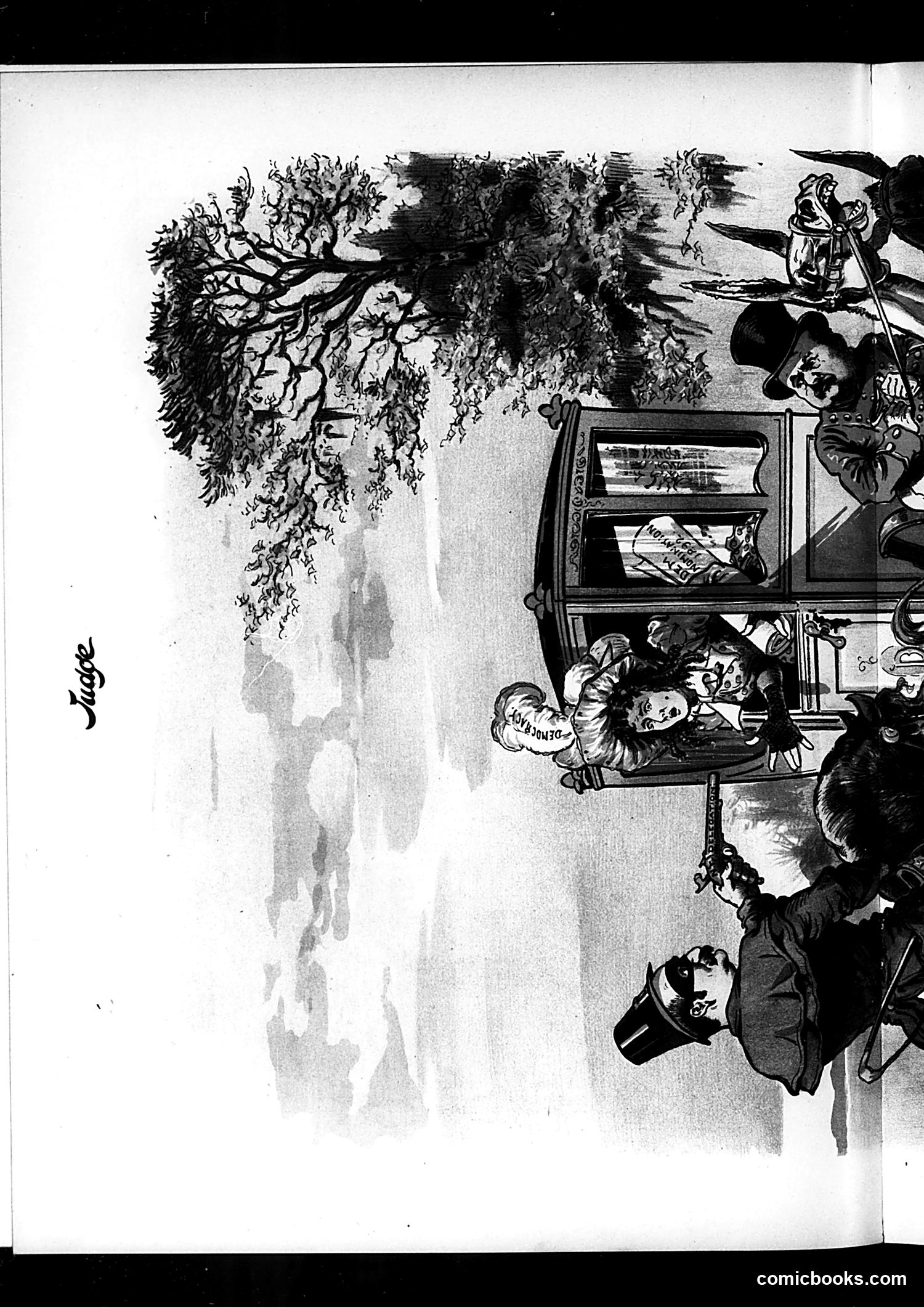
This appears to be a page from *Judge* magazine showing an illustration that's been rotated 90 degrees. The image depicts what seems to be a domestic or social scene with multiple figures gathered around a window or display case. A gnarled, bare tree with drooping branches hangs from above, creating a somewhat Gothic or melancholic atmosphere. The signature "Judge" appears on the left side. However, without clearer text or visible captions identifying the specific figures, political figures, or the occasion being satirized, I cannot confidently identify the cartoon's subject matter or intended commentary. The scene suggests social satire typical of *Judge*'s style, but the exact target and meaning remain unclear from this image alone.
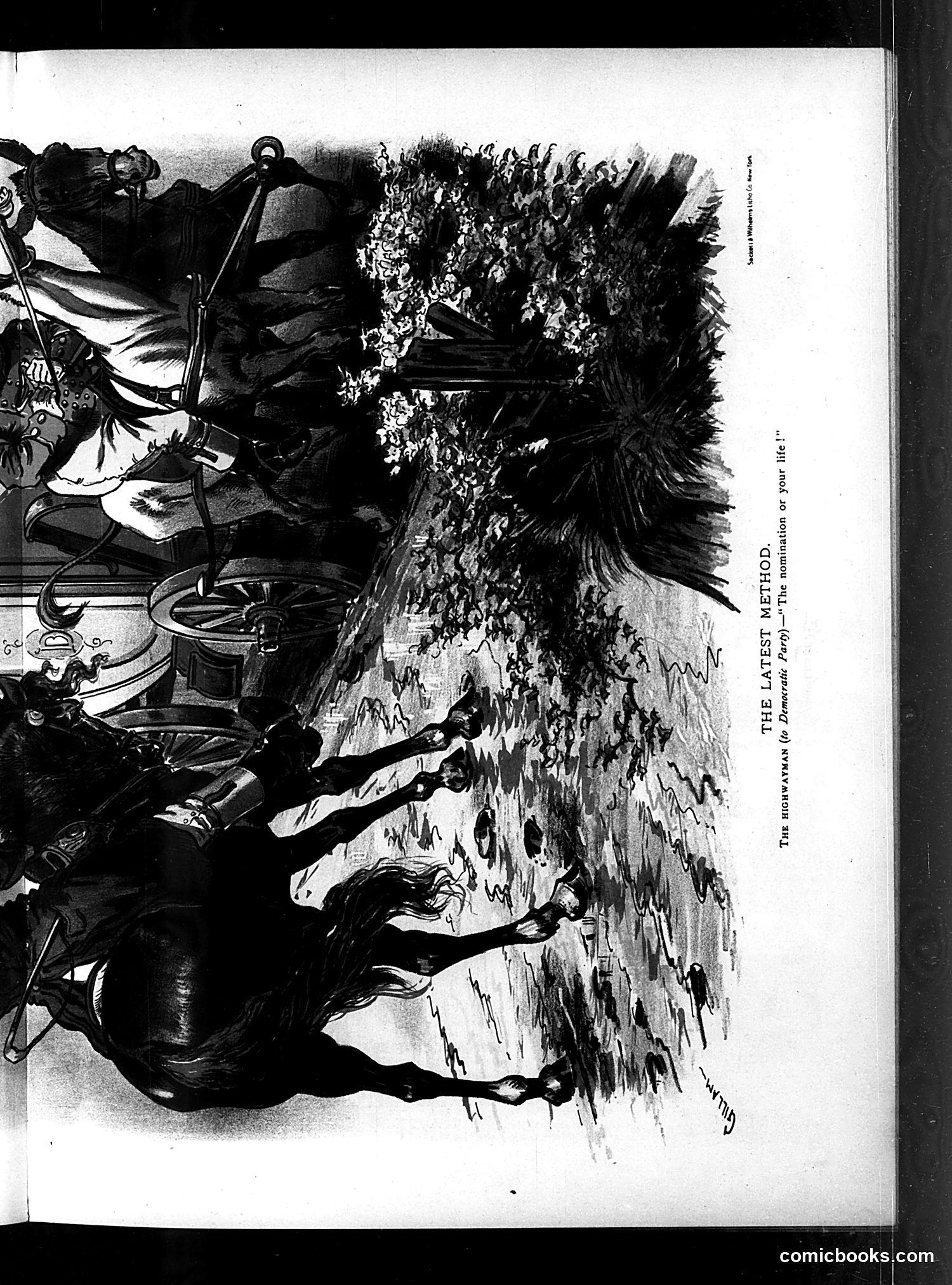
I cannot reliably read the OCR text provided—it appears corrupted or reversed. The image itself, while clearly a political cartoon from *Judge* magazine, is printed sideways, making it difficult to discern specific details of the caricatures or action depicted. What is visible: The cartoon appears to show multiple figures in a dramatic scene, with one figure prominently positioned and others in various poses. The style is consistent with late 19th or early 20th-century American satirical illustration. **I cannot confidently identify the specific political figures, events, or satirical point without legible text or context.** To provide accurate analysis per your rules, I would need either clearer OCR text or the image rotated to proper orientation.
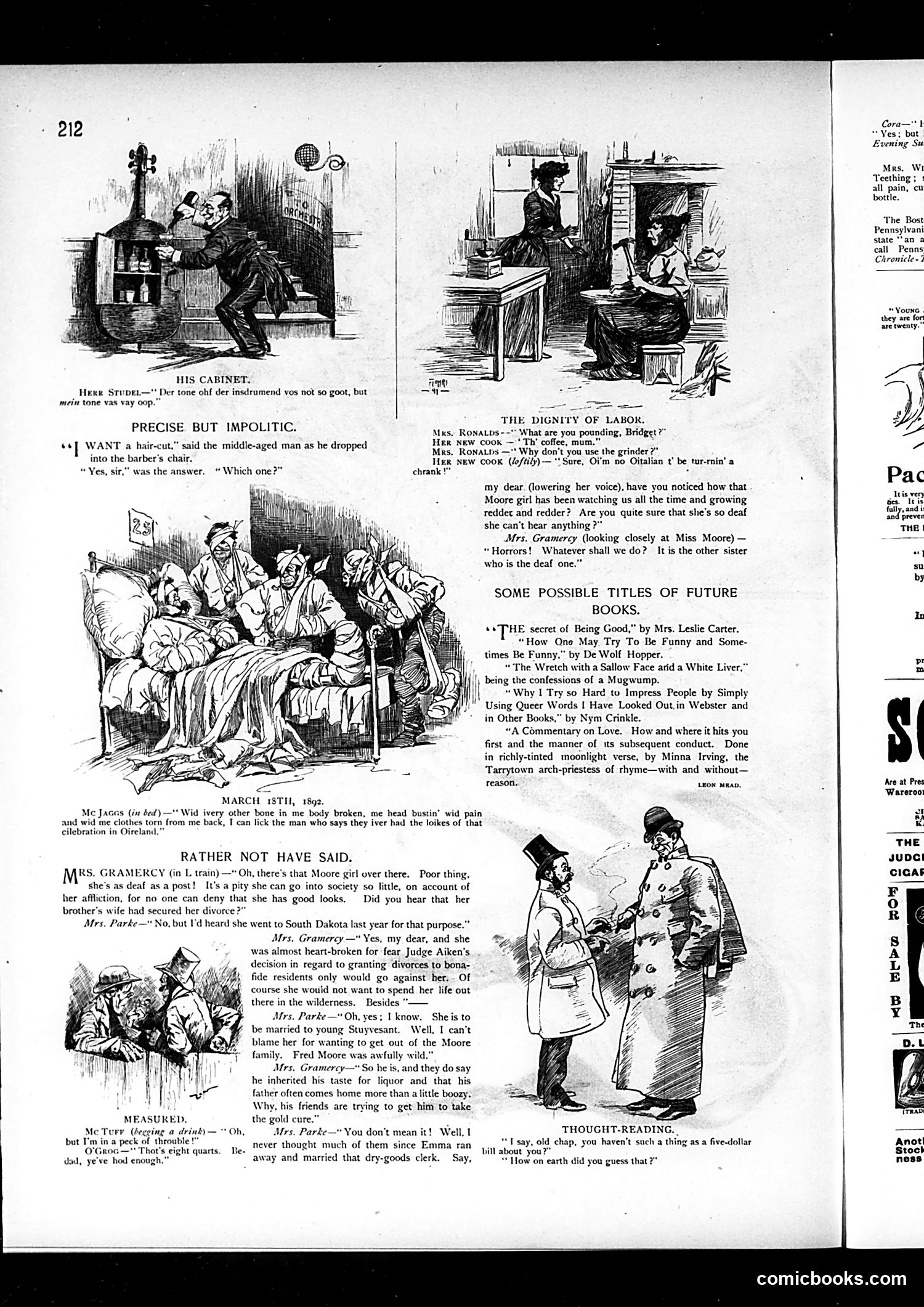
This page contains multiple satirical pieces reflecting 1890s American social anxieties: **"His Cabinet"** depicts a German-accented figure (likely representing German immigrants or labor concerns), with the caption mocking both his accent and the quality of his work—reflecting period xenophobia toward non-English speakers. **"Precise but Impolitic"** jokes about a barber's tactless honesty when asked "which haircut," implying multiple poor options. **"Rather Not Have Said"** satirizes gossip-mongering society women discussing divorce (South Dakota was noted for lenient divorce laws), family scandals, and alcoholism among the wealthy. The humor depends on the women's obliviousness to hypocrisy. **"Dignity of Labor"** shows an Irish maid's defensive pride—she refuses to use a grinder, insisting she's "no Italian." This reflects period class/ethnic tensions and servant resistance to mechanization. **"Some Possible Titles of Future Books"** parodies contemporary authors and literary pretension, likely mocking figures like actress Mrs. Leslie Carter and theater personalities. The overall tone mocks nouveau riche manners, immigrant laborers, gossip culture, and literary affectation.
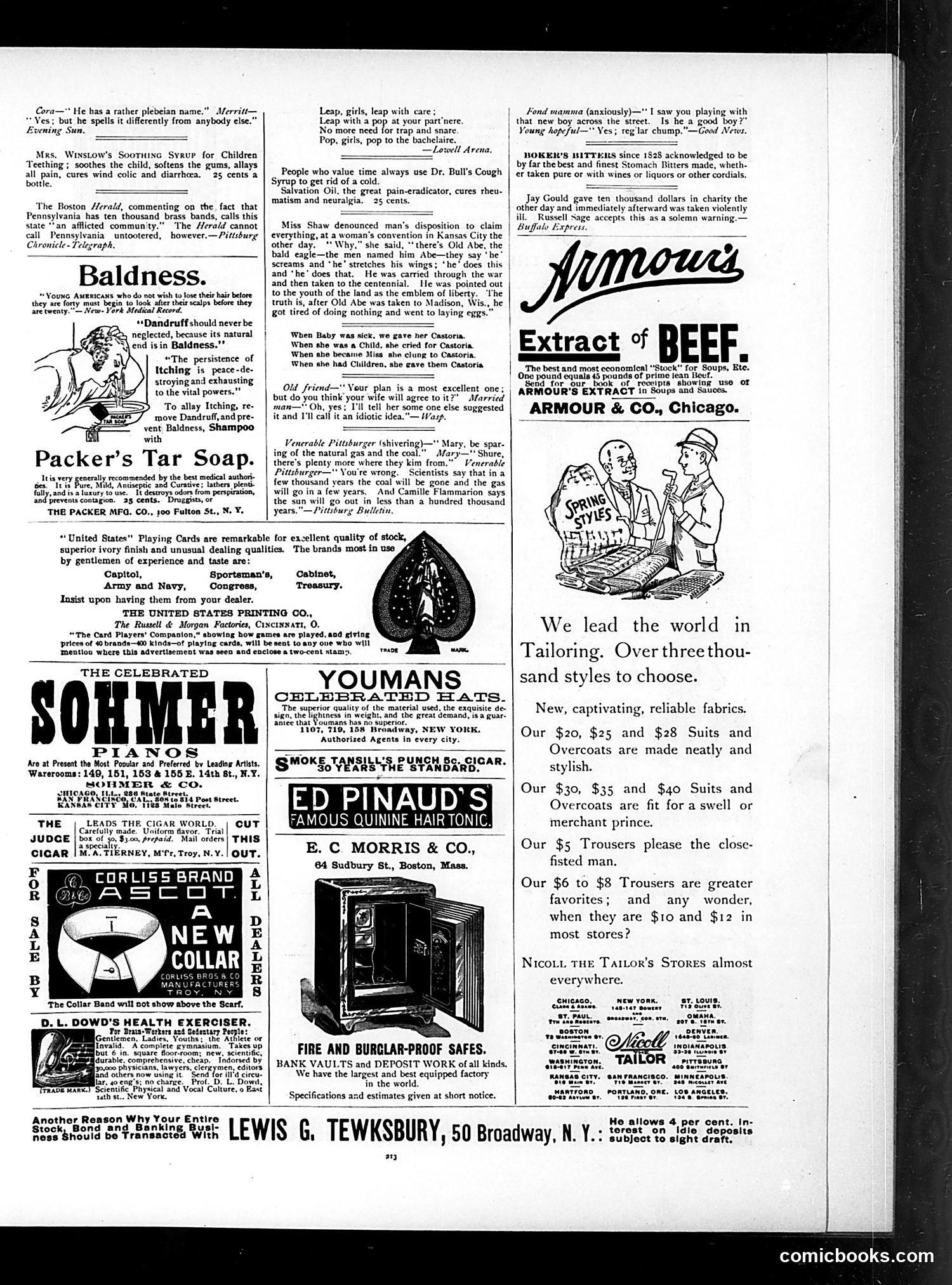
This page is primarily **advertisements** with small satirical snippets interspersed—typical of Judge's format. The notable cartoon element is the **"Baldness" section** with Packer's Tar Soap advertising, featuring a caricatured bald man. The accompanying jokes reference contemporary concerns about hair loss and dandruff as serious medical issues. A key satirical piece involves **Miss Shaw's speech at a Kansas City women's convention**, mocking men's tendency to claim ownership of everything—even naming the bald eagle "Abe" and attributing male pronouns to it. Her absurdist punchline (the eagle "went to laying eggs") ridicules how men monopolize credit and agency. The remaining content consists largely of **product advertisements** (Soothing Syrup, Cough Syrup, playing cards, pianos, safes) with small joke fillers about courtship, baldness, and natural resources. The page reflects Judge's satirical voice through brief social commentary on gender relations and male vanity, wrapped within commercial messaging typical of late 19th/early 20th-century magazines.
This page is primarily **advertising**, not political satire or editorial cartoons. Judge magazine here functions as a vehicle for period product advertisements (Kodak cameras, Liebig Extract of Beef, Joseph Gillott's pens, whisky, cigars, and patent medicines). The minimal editorial content consists of short humorous quotes and anecdotes scattered among ads—brief observations about laziness, manners, and domestic life typical of era humor. There are no identifiable political cartoons or caricatures of named figures on this page. One brief item notes a cycling record on a steep hill using pneumatic tires, presented as a novelty feat. The rest is commercial messaging, reflective of Judge's 1890s business model where ads subsidized publication. Modern readers would recognize this as a **period artifact showing how magazines blended editorial content with aggressive advertising** before modern content separation standards.
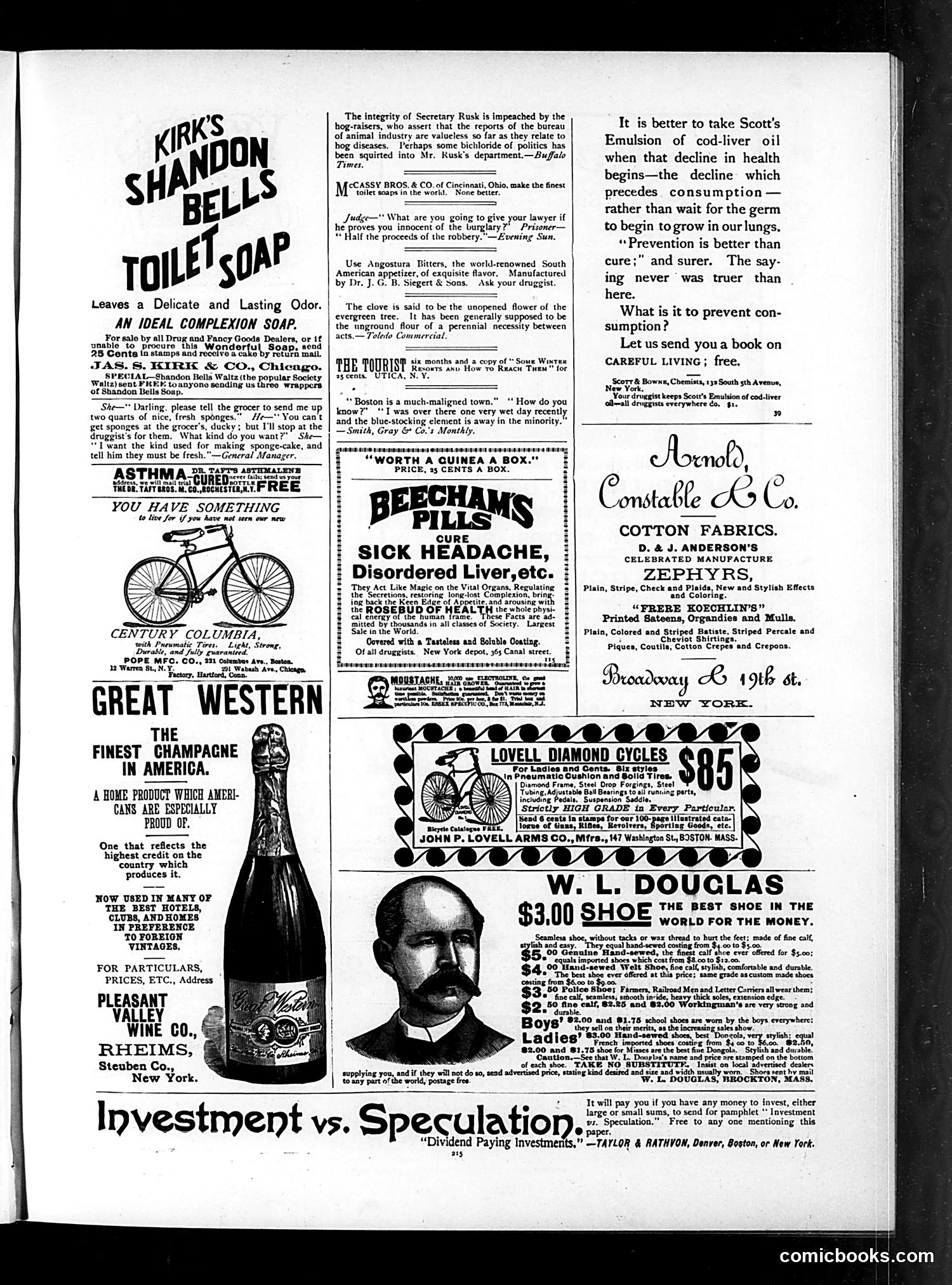
This page is primarily **advertising**, with minimal editorial or satirical content. The brief satirical items include: 1. **Secretary Rusk critique**: A short editorial note mocking Secretary of Agriculture James Wilson (identified as "Secretary Rusk" in text) for allegedly allowing "bichloride of politics" to compromise the bureau of animal industry's reports on hog diseases—suggesting political corruption affects scientific credibility. 2. **Boston society joke**: A quip that Boston's "blue-stocking element" (intellectual/educated women) must be away, given the wet weather and poor disposition of the town—poking fun at Boston's reputation for snobbish intellectualism. 3. **Lawyer/burglar exchange**: A cynical joke about a prisoner offering his lawyer "half the proceeds of the robbery" as payment—satirizing both criminal opportunism and mercenary legal practice. The remainder consists of period product advertisements: soaps, bicycles, champagne, pills, shoes, and fabric manufacturers—typical of Judge's revenue model.
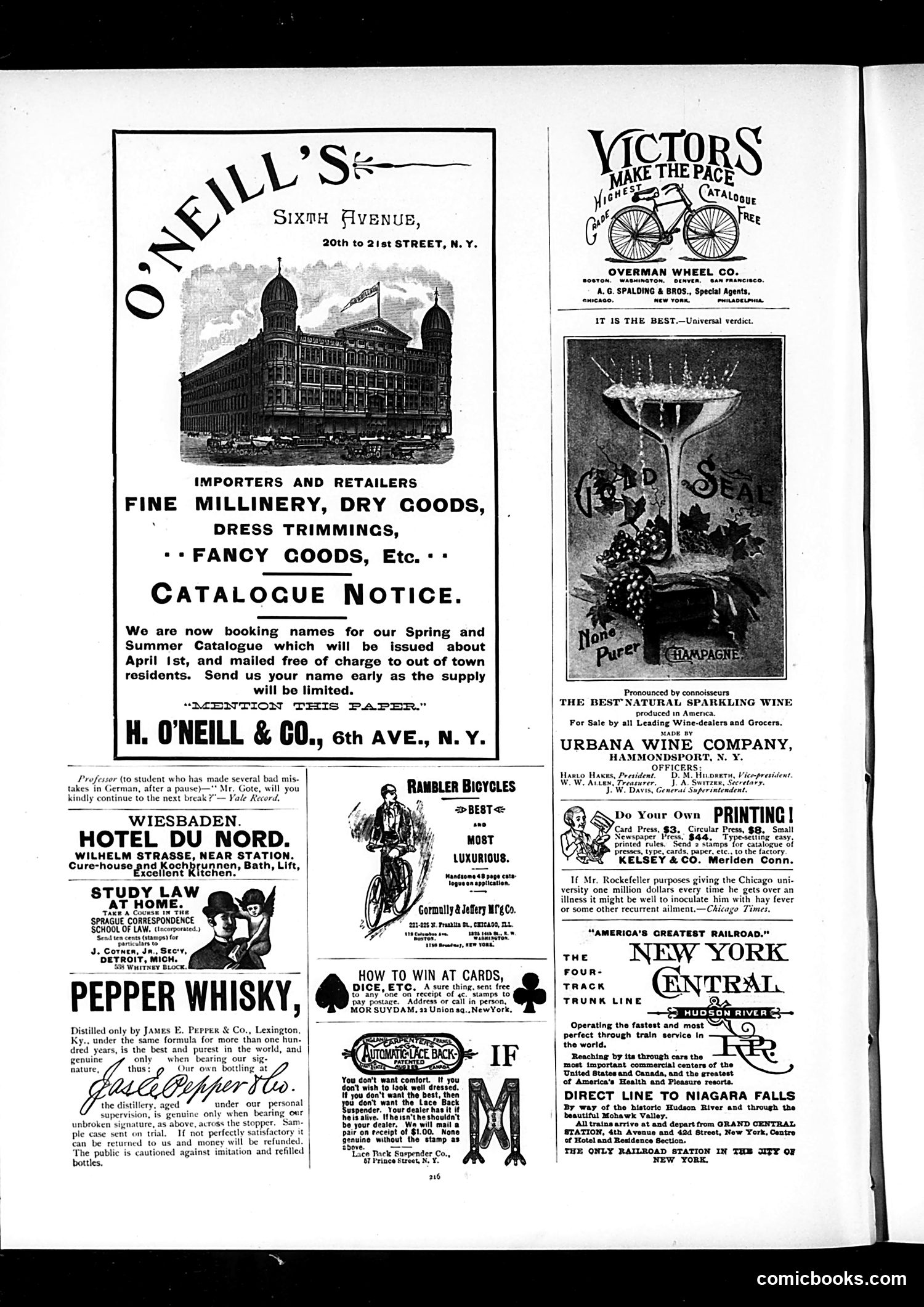
This page is primarily **advertising**, not political satire or comics. It contains multiple commercial advertisements from late 19th-century businesses: The main content includes ads for O'Neill's department store, Hotel du Nord in Wiesbaden, Pepper Whisky, Rambler Bicycles, Urbana Wine Company, the New York Central Railroad, and various other products and services. There is one brief **joke** at the top: a Yale Record humor piece about a German language professor telling a struggling student to continue to the next break—a mild jab at academic instruction. There is also a **social commentary** item about Mr. Rockefeller: a satirical note suggesting that if Rockefeller plans to donate a million dollars to the University of Chicago for each illness he recovers from, perhaps infecting him with hay fever would be worthwhile—dark humor about wealth and philanthropy. The page primarily reflects the commercial culture and advertising practices of its era rather than political satire.
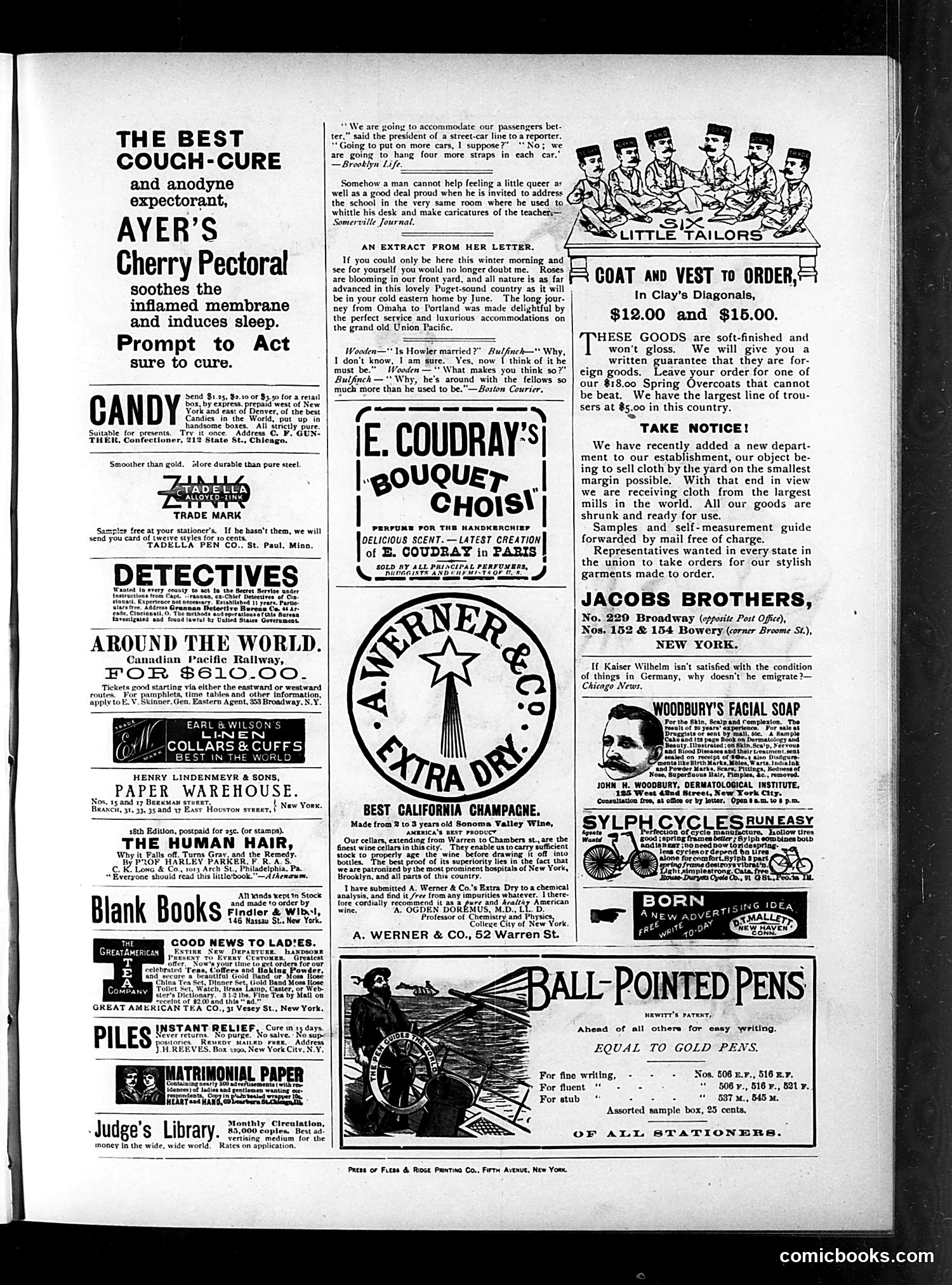
This is **primarily an advertisement page** from Judge magazine, containing no significant political cartoons or satirical content requiring historical context. The page features **one minor comic element**: a dialogue joke about a man's marital status, where someone assumes a man must be married because he's spending less time with "the fellows." This reflects common early-20th-century social stereotypes about bachelor behavior changing after marriage. The bulk of the page consists of period advertisements for various products: patent medicines (Ayer's Cherry Pectoral for coughs), luxury goods (linen collars, champagne, perfume), personal services (hair treatment, detective agencies), and stationery. These ads reflect what wealthy readers of Judge magazine—a publication for educated, affluent audiences—would purchase. The "Little Tailors" illustration advertising children's clothing is the only substantial visual element beyond text-based ads.
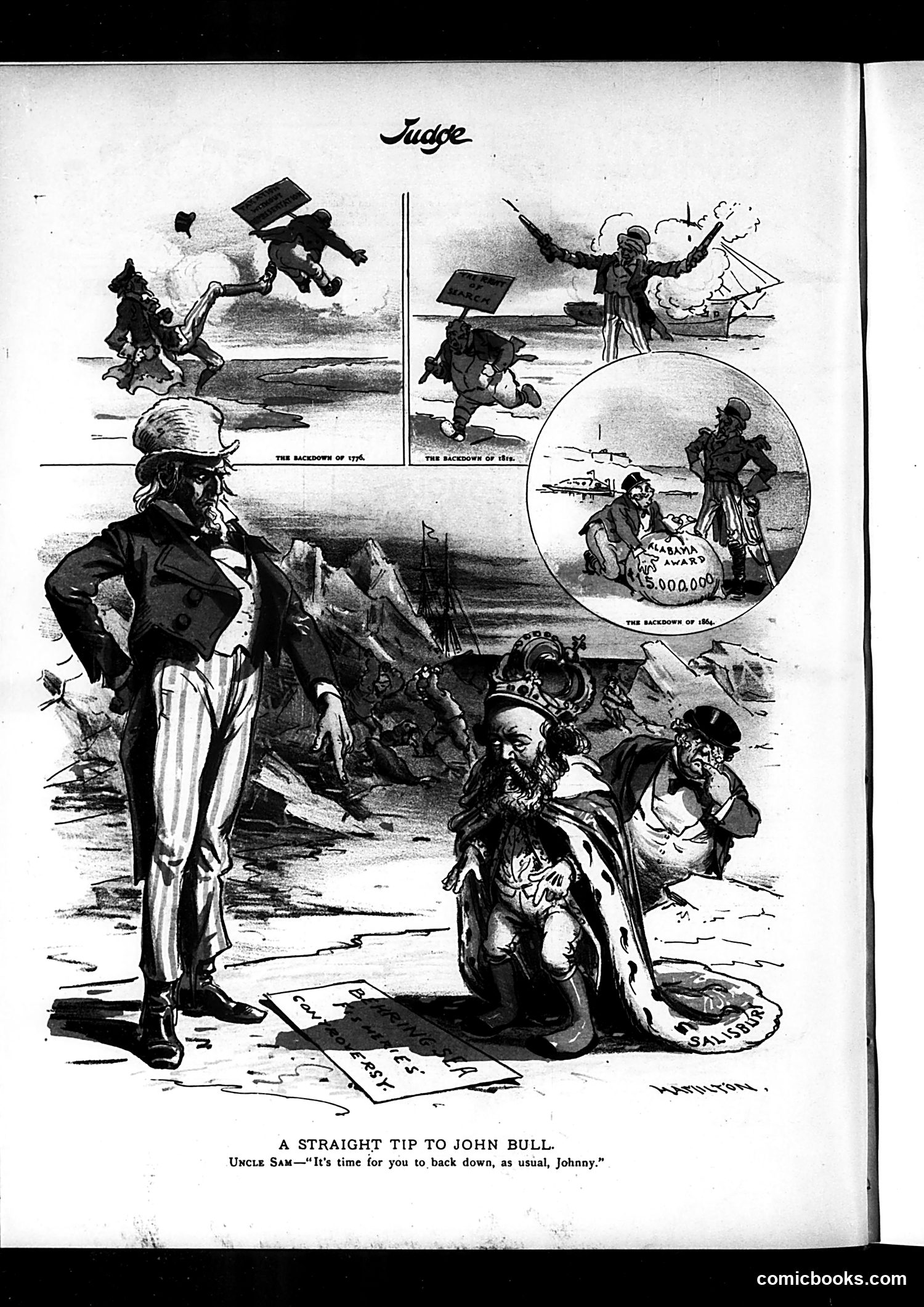
This political cartoon satirizes Anglo-American relations, personifying the nations as characters: Uncle Sam (representing the United States) and John Bull (Britain). The caption shows Uncle Sam advising John Bull to "back down, as usual," implying Britain habitually concedes to American pressure. The upper panels labeled "The Backdown of 1776," "1812," and "1864" appear to reference historical conflicts—the American Revolution, War of 1812, and Civil War era—suggesting a pattern of British retreats. The circular inset mentioning "Alabama Award" likely references the 1872 Alabama Claims dispute, a post-Civil War compensation case where Britain paid the U.S. The cartoon mocks British pride while celebrating American assertiveness in international disputes during the late 19th century.