
A complete issue · 18 pages · 1892
Judge — January 23, 1892
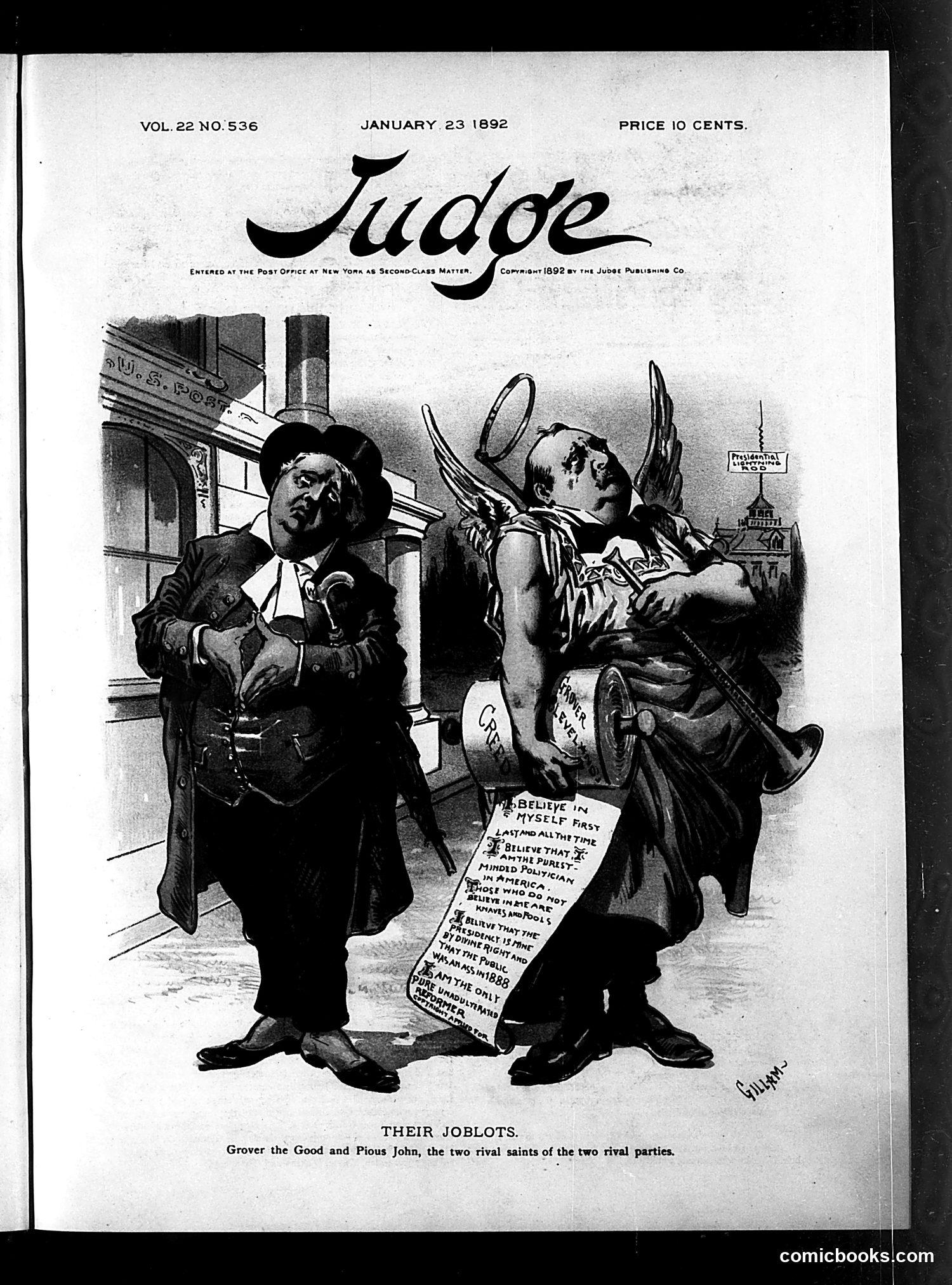
This political cartoon satirizes two rival political figures as "Grover the Good and Pious John, the two rival saints of the two rival parties." The left figure, dressed formally and appearing stern, represents one party's leader, while the right figure—depicted with devil horns and a mischievous expression—represents the opposing party's leader, holding a scroll listing various political positions and patronage appointments ("joblots"). The satire mocks how both parties justify their political appointments and favor-trading through self-righteous rhetoric. The horns and contrasting characterizations suggest the cartoon questions whether either side's moral superiority claims hold merit, implying both parties engage in the same corrupt practice of distributing government jobs as political rewards regardless of qualifications.
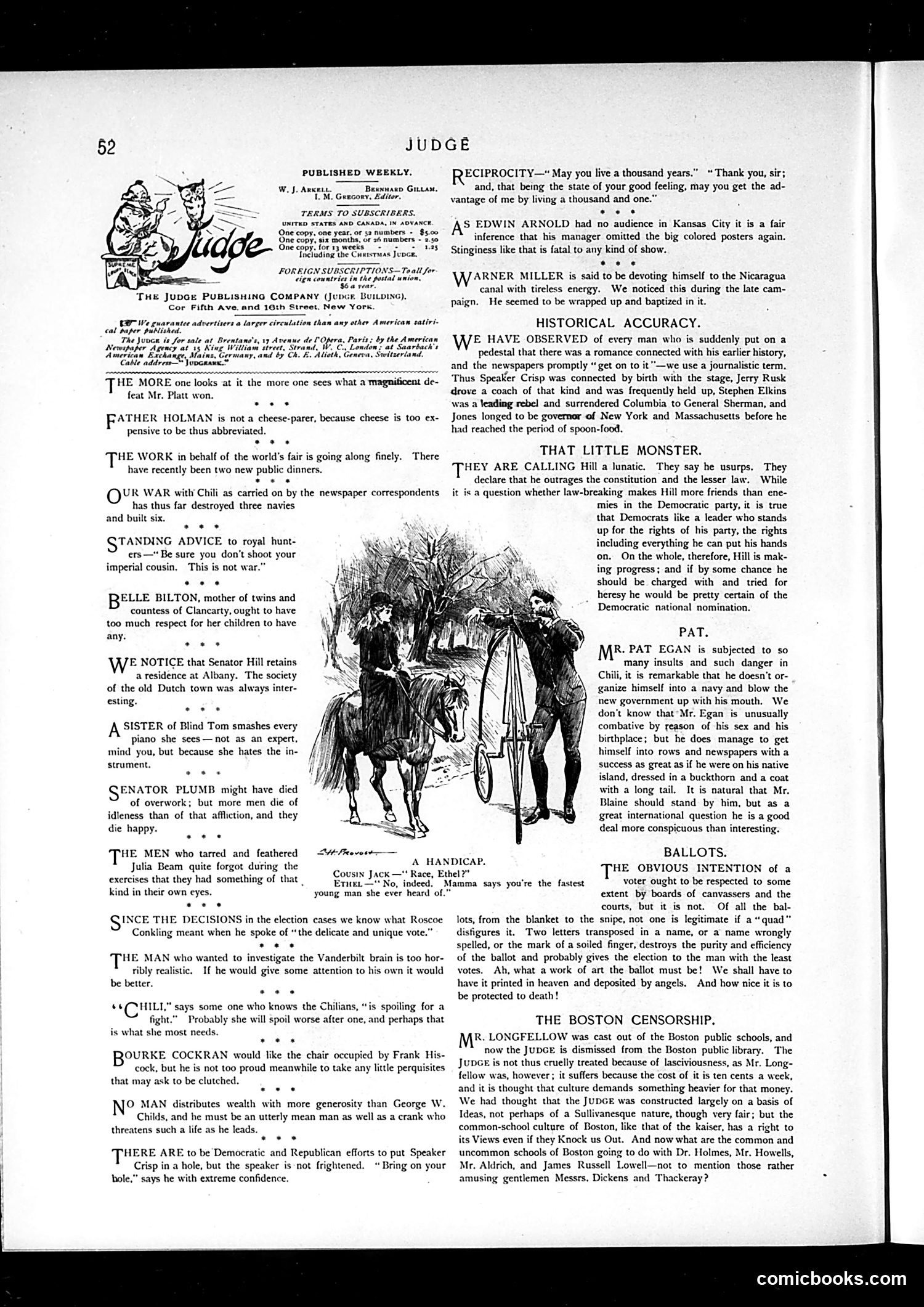
This page contains editorial commentary rather than political cartoons. The main illustration depicts a horse-drawn carriage scene labeled "A Handicap," likely satirizing political competition or obstacles. The text includes several brief critiques: one mocks Edwin Arnold's lack of Kansas City audience; another criticizes Warner Miller's "tireless energy" regarding the Nicaragua canal; and a section titled "That Little Monster" attacks Hill (unclear which Hill) for allegedly breaking constitutional law while leading Democrats, suggesting he's unfit for nomination. The "Ballots" section satirizes election fraud through mail tampering—a common late-19th-century corruption concern. The final piece criticizes Boston's censorship of the Judge magazine itself, noting the irony that a publication advocating free speech is censored by Boston schools. The commentary reflects Progressive-era concerns about political corruption and free speech.
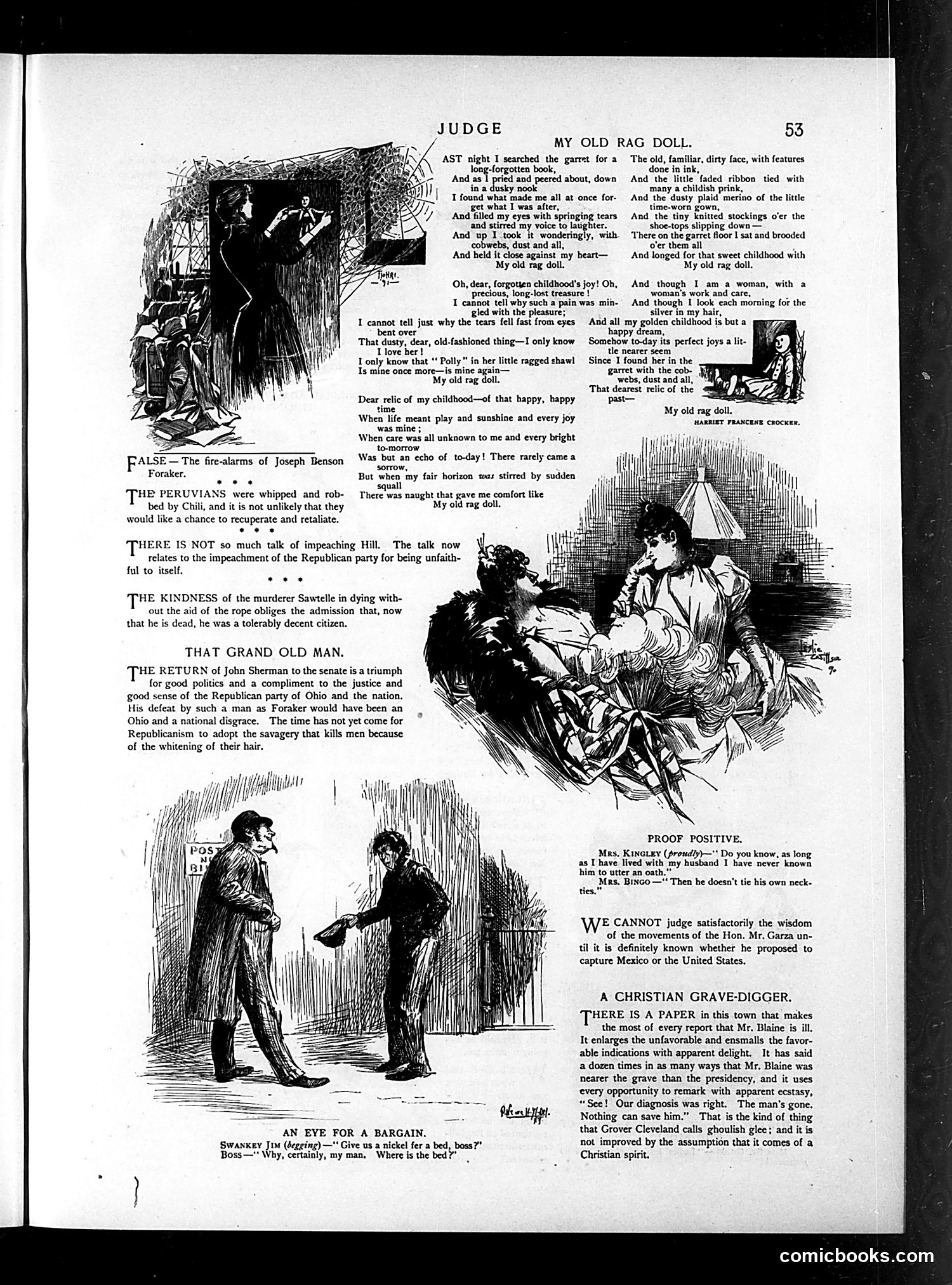
This page contains several distinct political commentaries from the 1880s-1890s era: **"My Old Rag Doll"** (poem with illustration): A nostalgic piece about childhood memories, likely sentimental rather than satirical. **Political commentary sections** reference Republican politics and figures like Joseph Benson Foraker (Ohio politician) and Grover Cleveland. The text criticizes Republican party tactics and discusses political strategy regarding Mexico. **"An Eye for a Bargain"** (cartoon, bottom): Shows two men negotiating over property, with one asking about "the body"—likely satirizing grave-robbing or unethical business practices. **"A Christian Grave-Digger"**: Criticizes a newspaper's coverage of Blaine (likely James G. Blaine, prominent Republican), sarcastically contrasting his proximity to the presidency with grave-digging, suggesting moral corruption. The page targets Republican politicians and press sensationalism of the era.
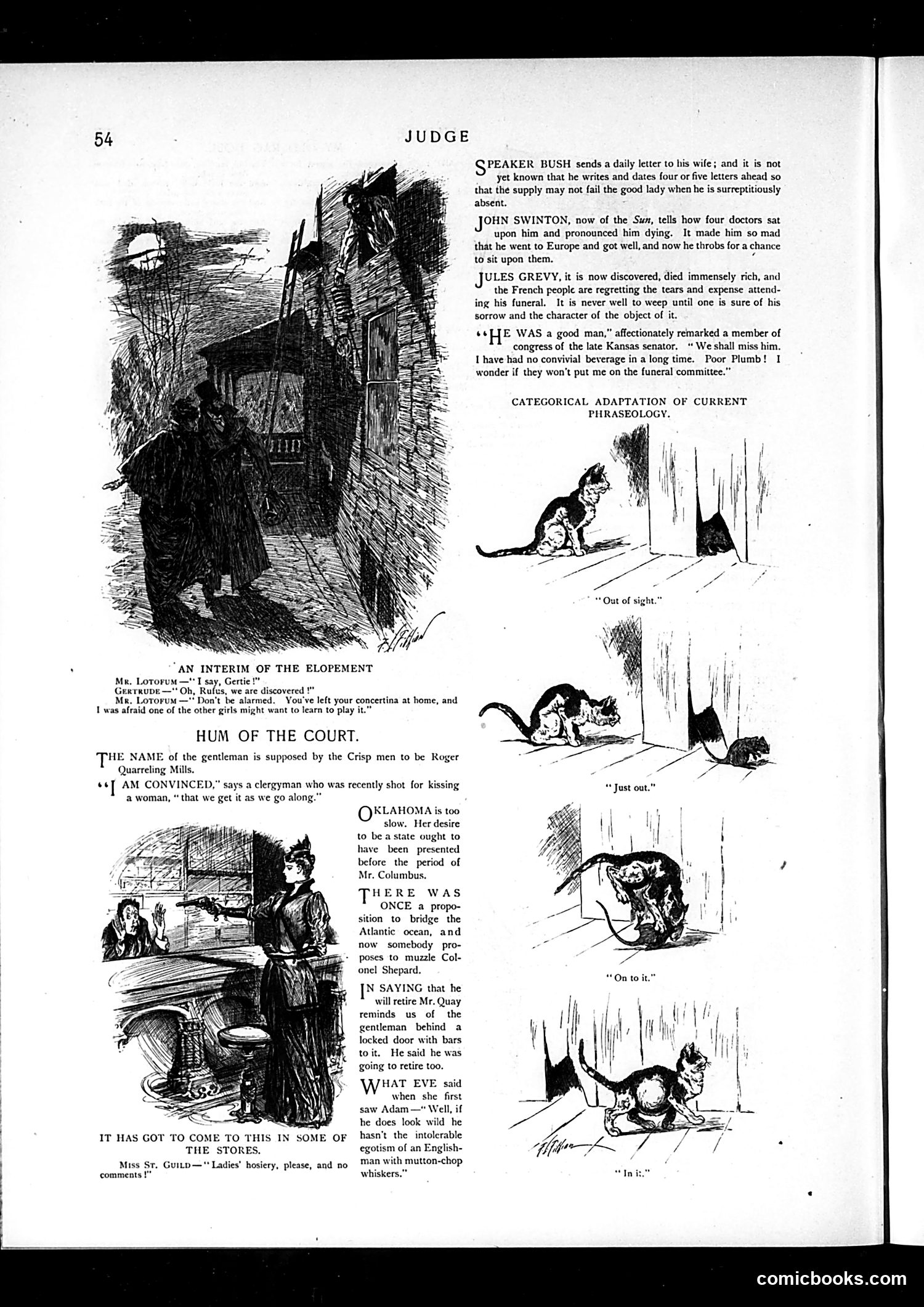
This page from *Judge* (circa 1890s) contains satirical commentary on American politics and society through brief anecdotes and wordplay: **Key Targets:** - **Speaker Bush**: Mocked for writing letters ahead to his wife while absent—implying hypocrisy or infidelity - **Political figures**: References to "Roger Quarreling Mills" (likely Congressman), Kansas Senator Plumb, and Colonel Shepard suggest criticism of political corruption or incompetence - **Social Hypocrisy**: A clergyman shot for kissing a woman quips about "getting what we deserve"—satirizing moral double standards - **Funeral Fraud**: Jules Grévy (French president) died wealthy; the satire suggests people mourned him falsely, only to regret expenses—critiquing insincere grief **The Visual Cartoon** ("Categorical Adaptation") shows a cat and mouse playing with distance—metaphorically illustrating the phrase "out of sight, out of mind," adapting current colloquialisms. The humor relies on readers recognizing contemporary political figures and scandals. The overall tone satirizes political corruption, hypocrisy, and social pretense.
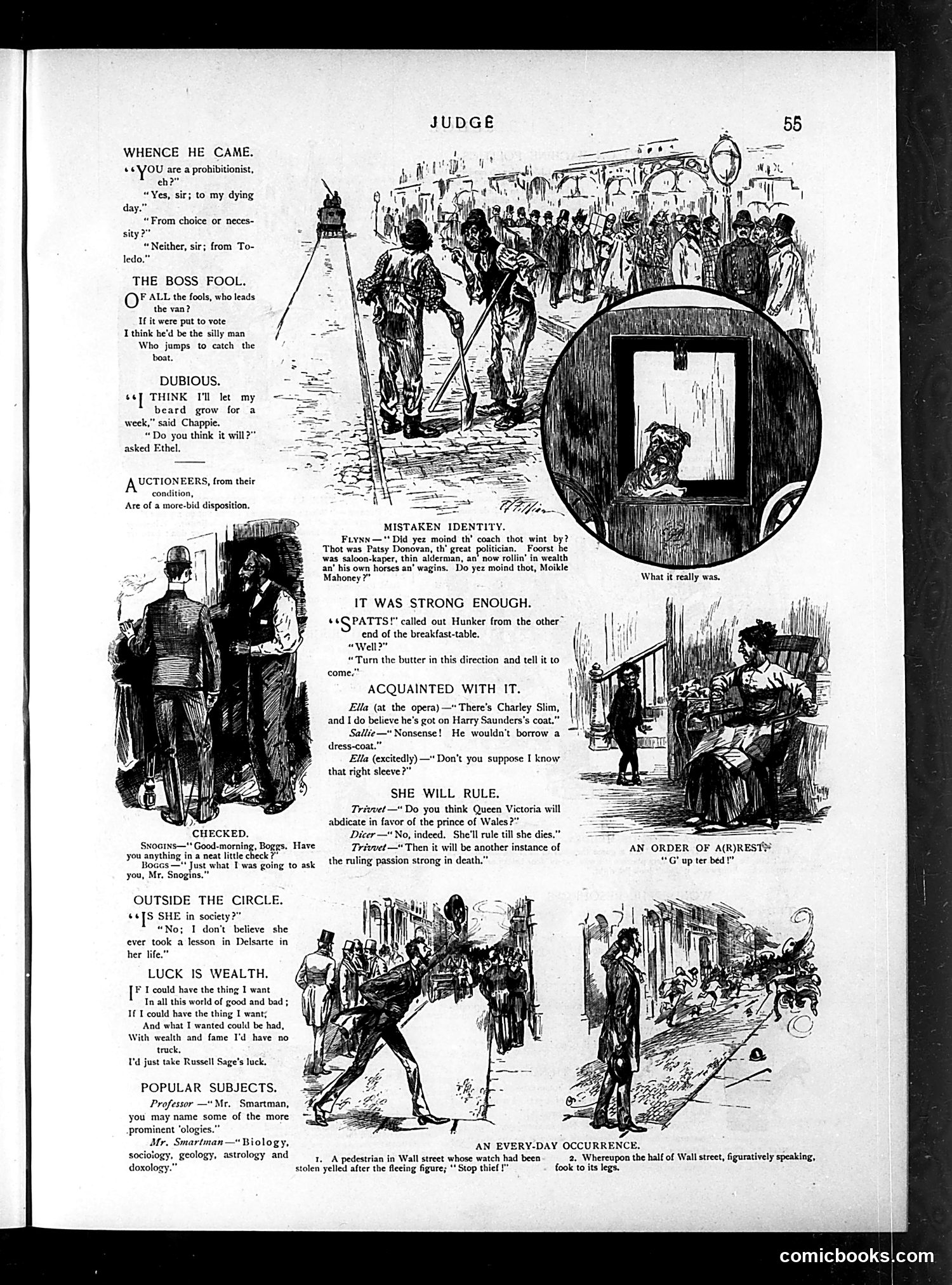
This page contains multiple satirical vignettes typical of late-19th-century Judge magazine humor: **"Whence He Came"**: A joke about a prohibitionist from Toledo, suggesting prohibition supporters came from necessity rather than genuine conviction—implying Toledo had drinking problems. **"Mistaken Identity"**: Irish characters (indicated by dialect) discuss Patsy Donovan's rise from saloon-keeper to alderman to wealthy man with his own horses and wagons—satirizing political corruption and the lucrative path through machine politics. **"She Will Rule"**: A conversation about Queen Victoria suggests the monarchy's enduring power despite aging leadership. **"An Everyday Occurrence"**: A two-panel cartoon about a Wall Street theft where a pickpocket steals a watch and half the street flees in panic—satirizing New York's crime problem and the chaos it causes. Various short jokes mock social pretension, Victorian courtship customs, and wordplay. The overall tone reflects Judge's satirical coverage of American politics, urban life, and social affectation in the Gilded Age.
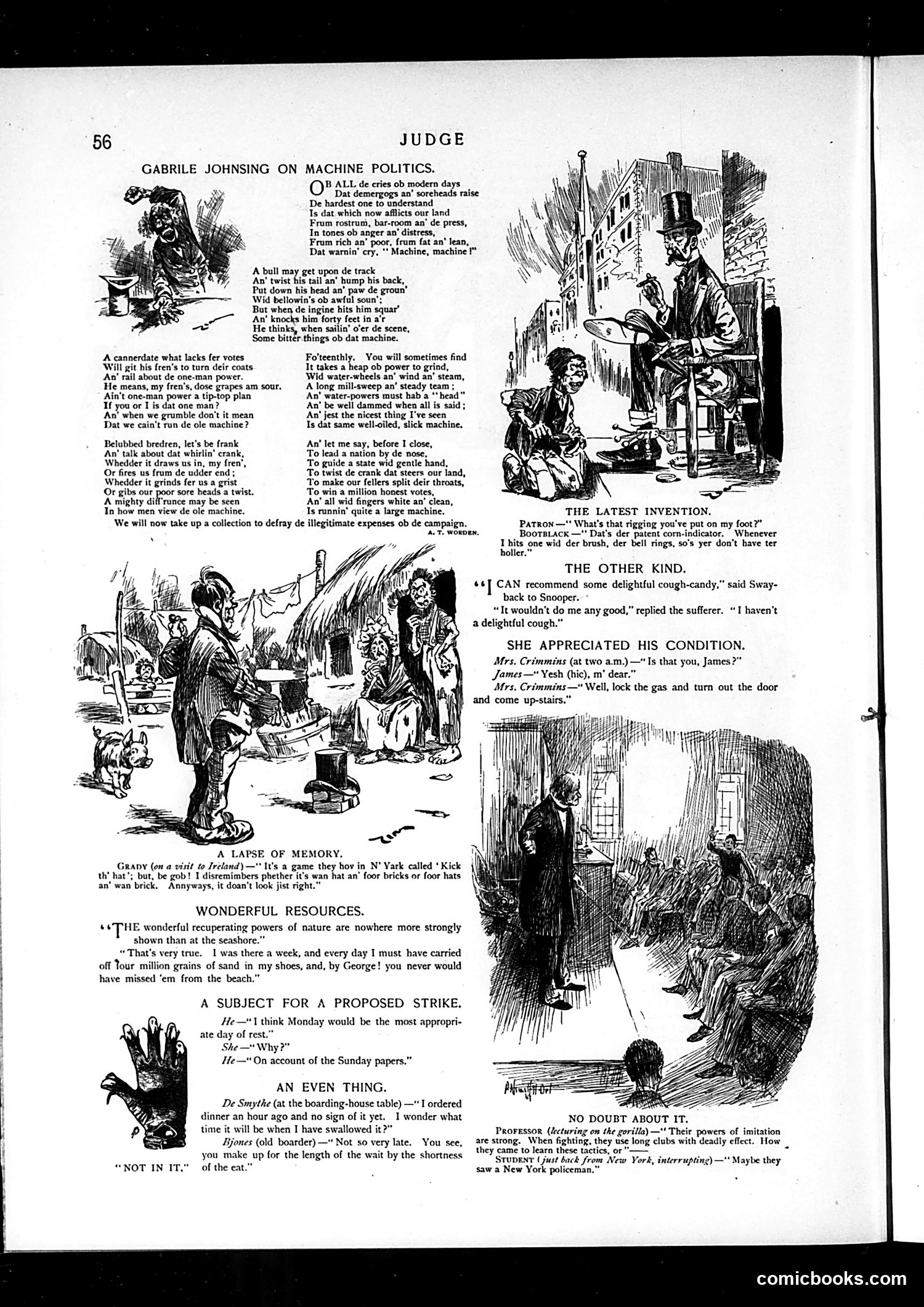
This satirical page critiques "machine politics"—the corrupt political systems dominated by party bosses and backroom dealing that emerged in late 19th-century American cities. **Main Content: "Gabrile Johnsing on Machine Politics"** The featured poem, written in exaggerated dialect (likely mocking Irish-American voters), uses extended metaphors comparing political machines to physical engines. The speaker acknowledges machines' power while expressing frustration that candidates complain about "machine" control when *they* benefit from it. The satire suggests politicians hypocritically rail against corruption and centralized power, yet exploit these same systems for votes and influence. **Minor Jokes:** - "The Latest Invention": A bootblack's patent corn-indicator—satirizing excessive commercialism - "She Appreciated His Condition": A drunk husband's confusion (slapstick humor) - Various brief quips mocking boarding-house life and Irish-American accents The page reflects Gilded Age anxieties about urban political corruption and the dominance of party machinery over democratic ideals.
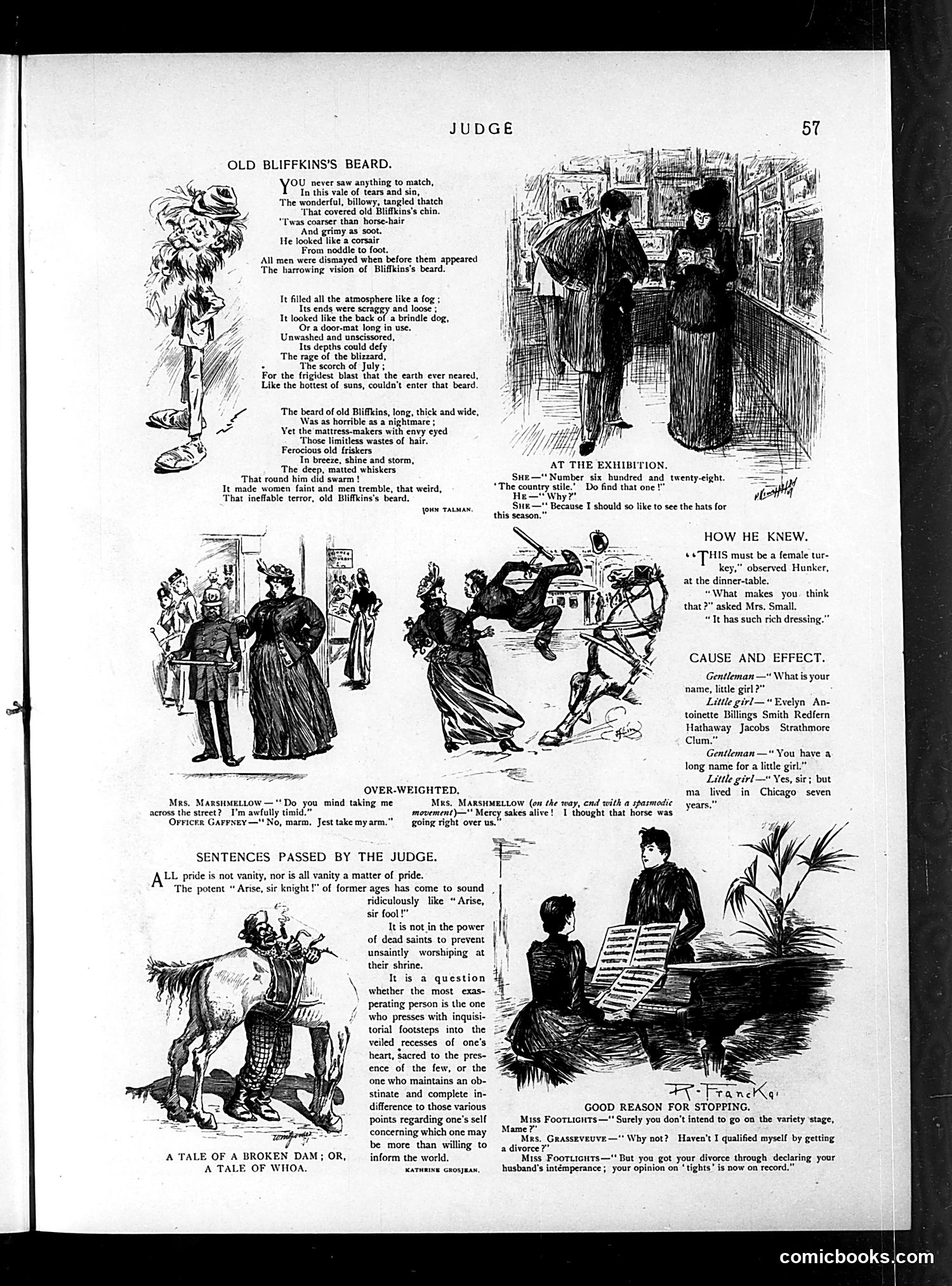
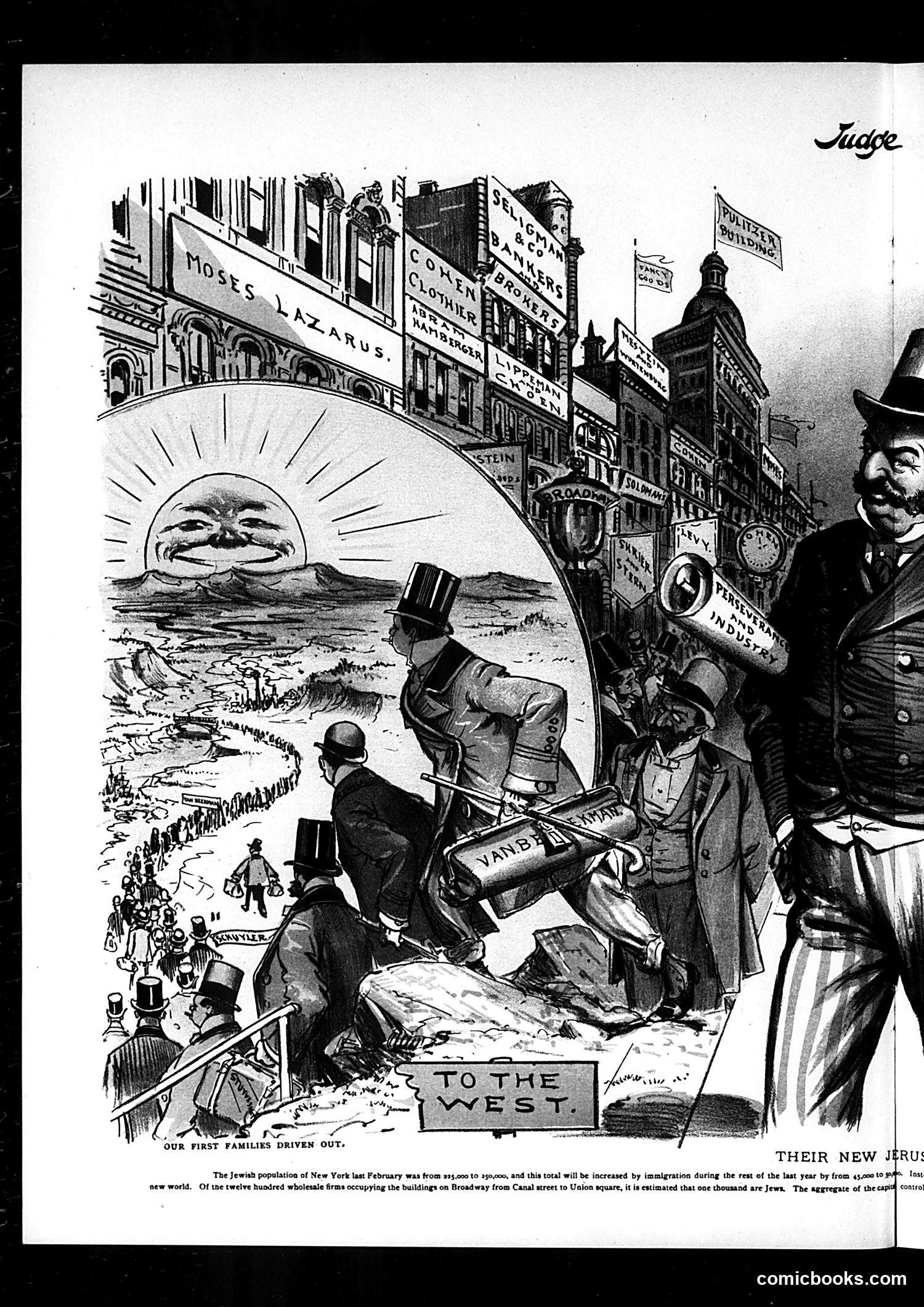
This is an antisemitic cartoon titled "Our First Families Driven Out," depicting Jewish immigration to New York City as an invasion or displacement of established residents. **What it shows:** Wealthy gentile businessmen are being driven westward by Jewish immigrants and merchants. The rising sun with a grotesque face represents Jewish commercial expansion. Store signs visible in the cityscape include Jewish-owned businesses ("Moses Lazarus," "Seligman & Co."). **The satire's "point":** The cartoon expresses nativist anxiety about Jewish immigration and economic success, particularly in the wholesale clothing trade on Broadway. The text notes that by February, New York's Jewish population was 225,000-250,000, with approximately 1,000 of 1,200 wholesale firms on Broadway being Jewish-owned. **Modern context:** This reflects 1880s-1890s anti-Jewish sentiment framing immigration as threatening American commerce and social hierarchy. Judge magazine regularly published such content, treating demographic change and Jewish economic achievement as problems warranting mockery and alarm.
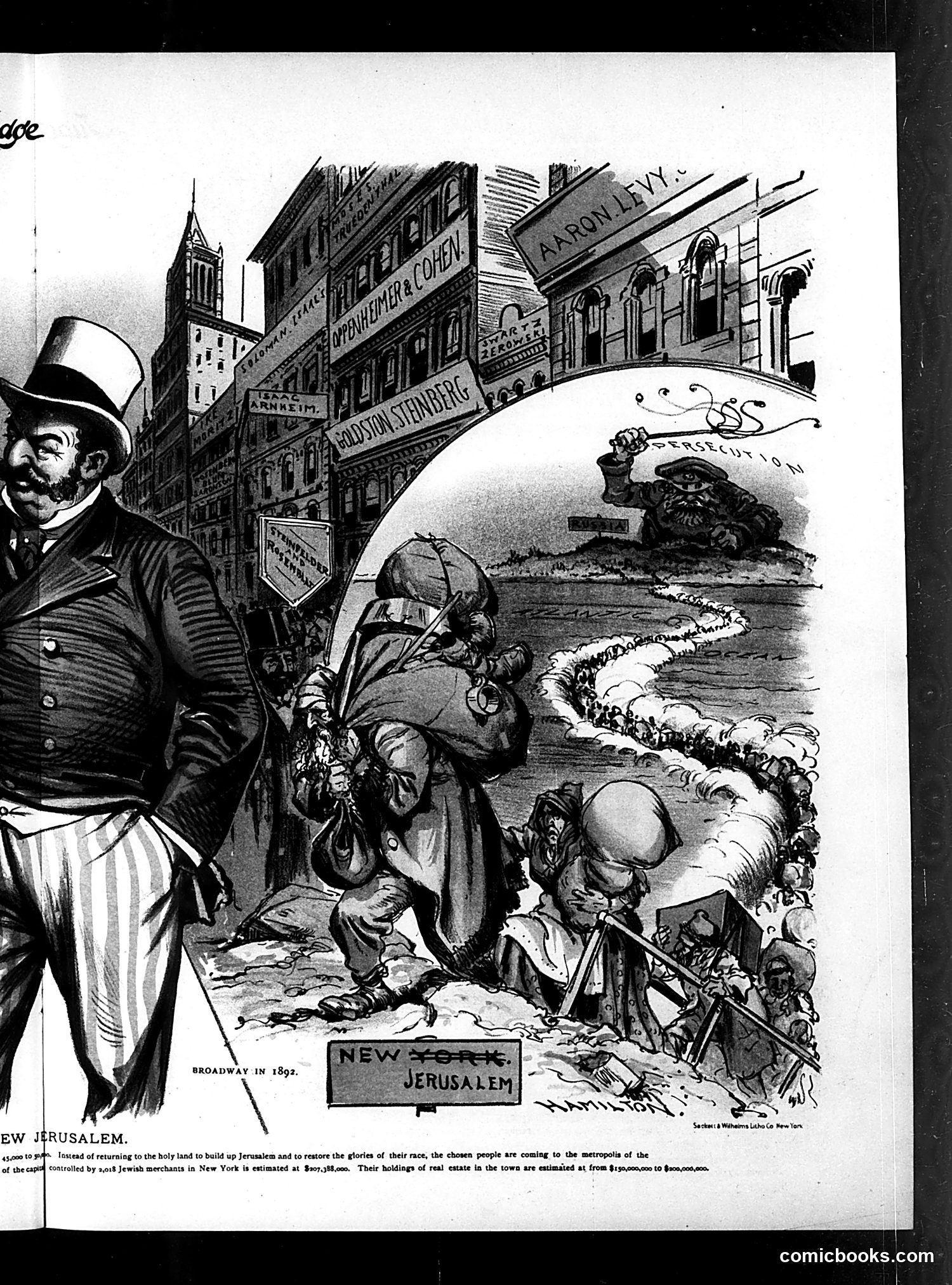
This antisemitic cartoon satirizes Jewish immigration and economic success in New York City. The left panel shows a wealthy Jewish businessman in top hat surveying Broadway's commercial district, with visible business signs including "Oppenheimer & Cohen" and "Aaron Levy." The right panel contrasts this with an imagined "New Jerusalem"—depicting impoverished Jewish immigrants arriving by ship, suggesting they've abandoned their ancestral homeland for American commerce instead. The caption's sarcasm is hostile: rather than "restoring the glories of their race" in actual Jerusalem, these "chosen people" pursue wealth in New York. The accompanying text emphasizes that Jewish merchants control $207+ million in New York commerce and substantial real estate holdings—presented as a threatening economic concentration. This reflects late-19th-century American antisemitic anxieties about Jewish immigration, economic power, and assimilation, framing Jewish success as exploitative rather than legitimate achievement.
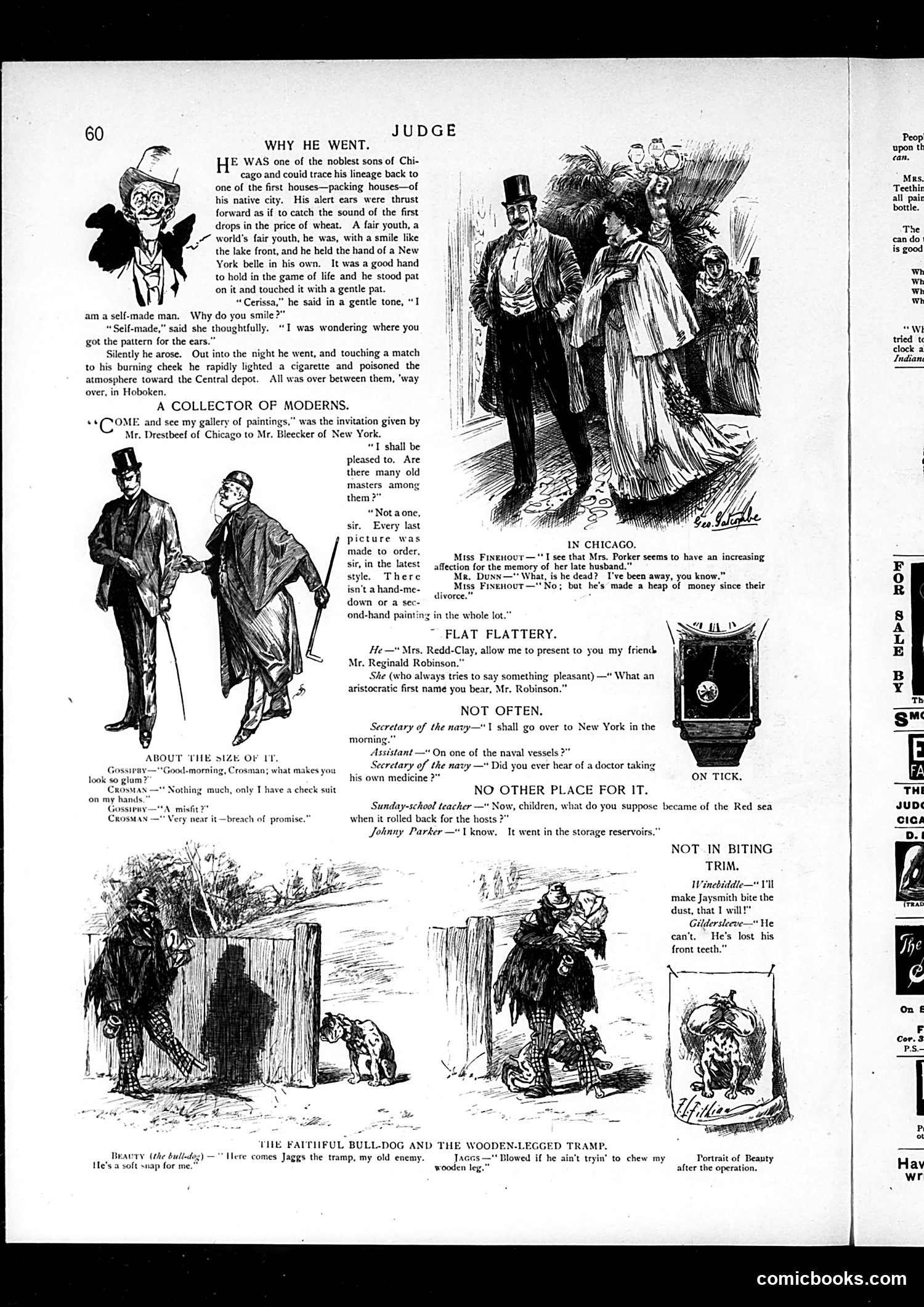
This page contains multiple satirical short pieces typical of Judge's humor circa early 1900s: **"Why He Went"**: Mocks a wealthy Chicago meatpacking heir (referencing the city's famous stockyards) whose fiancée insults his prominent ears, comparing them to his "pattern"—likely implying they're pig-like, a crude reference to his family's pork industry wealth. Humiliated, he flees. **"A Collector of Moderns"**: Satirizes nouveau-riche Chicago businessman Drestbeef who boasts his art gallery contains only modern commissioned works, no "old masters," reflecting the era's tension between established European art traditions and American commercial taste. **Minor pieces** include: a joke about a "check suit" (checkered pattern) creating a "breach of promise"; mockery of a Navy Secretary avoiding naval vessels; social climbing through affected names; and a widow's renewed affection for her ex-husband now that he's wealthy post-divorce. The humor reflects Gilded Age anxieties about wealth, class mobility, artistic pretension, and the perceived crassness of Chicago industrialists.
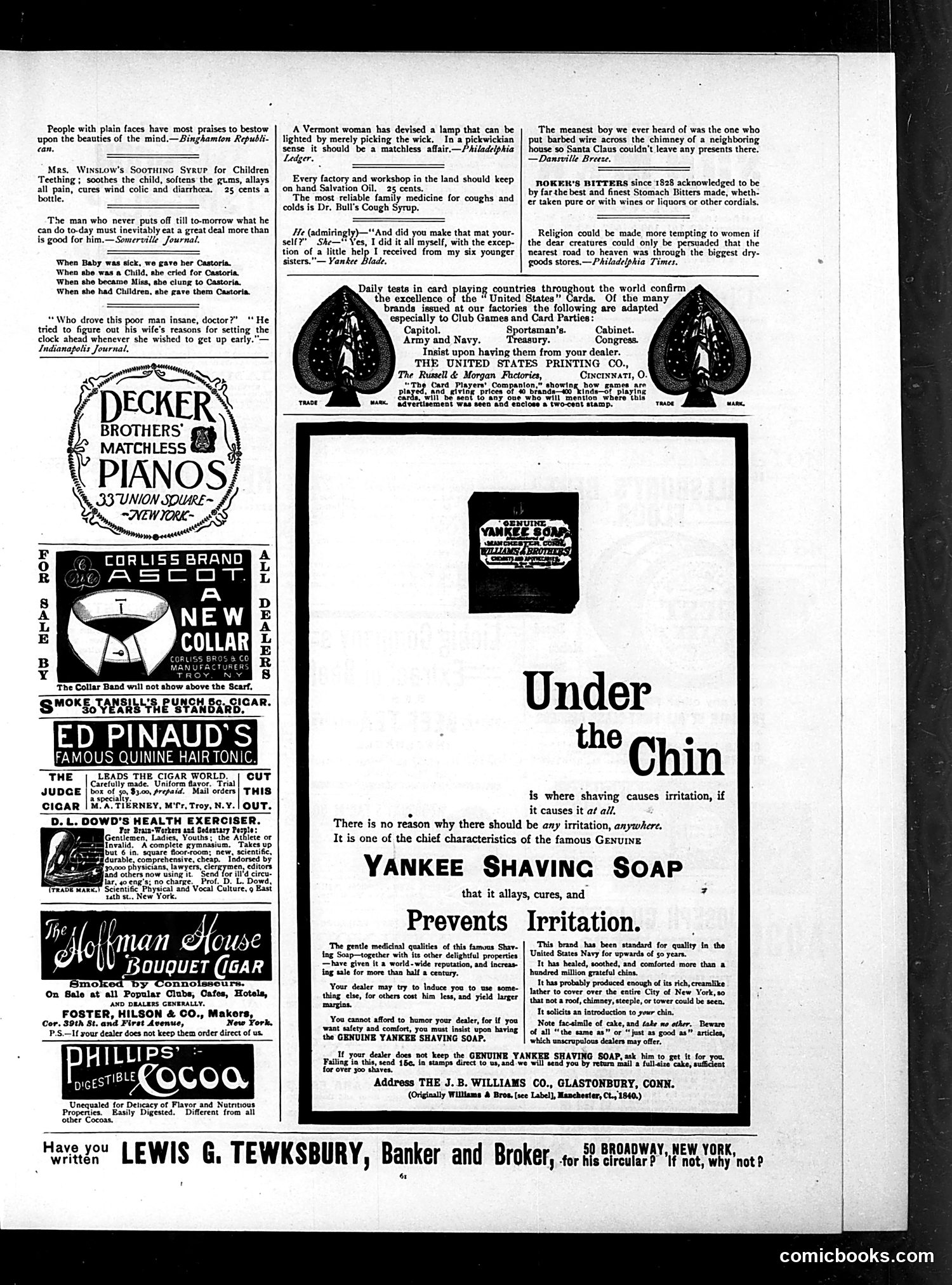
This page is primarily **advertising**, with scattered brief humorous quotes typical of Judge's format. The main content is a large advertisement for **Yankee Shaving Soap**, occupying the center-right portion. The ad addresses a practical concern: shaving irritation "under the chin." It promotes the soap's ability to prevent irritation—a genuine consumer problem in the era before modern shaving technology. The advertisement emphasizes the product's medical qualities and reliability, claiming it's been trusted for quality in the U.S. Navy for years. The surrounding small ads and jokes are typical Judge filler: product endorsements (hair tonic, pianos, cigars, cocoa) and one-liner humor about everyday life—wives adjusting clocks, children's medicines, and Valentine's Day card games. **No political satire or caricature appears on this page.** It's a straightforward commercial publication page, reflecting how 19th-century magazines subsidized content through extensive advertising.
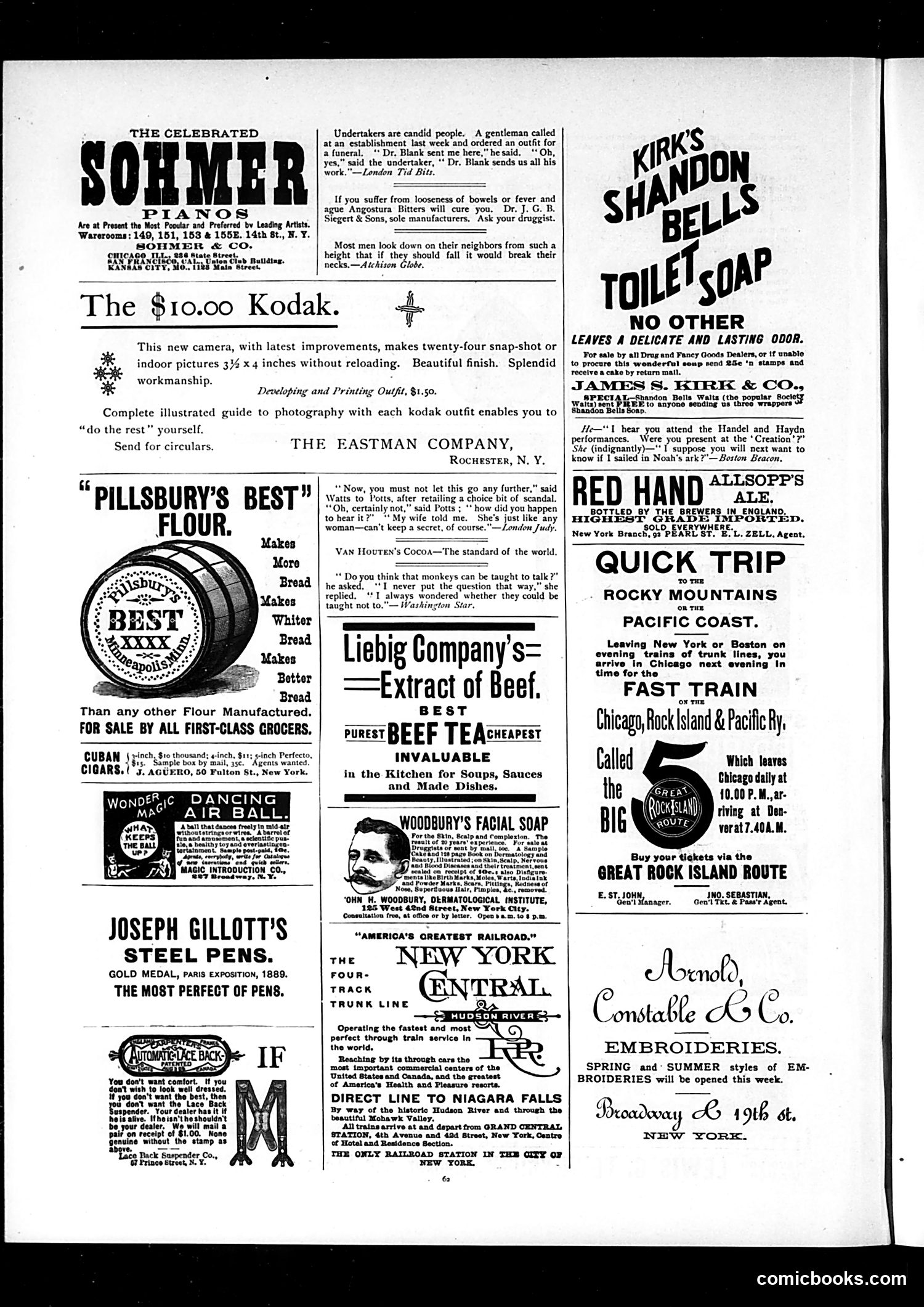
This page is primarily **advertising**, typical of Judge magazine's revenue model. The content consists of product advertisements interspersed with brief satirical jokes—a common format for the era. **The humor** reflects late 19th-century social attitudes: jokes about wives being gossips unable to keep secrets, undertakers' cynical relationships with doctors, and whether monkeys could be taught to talk. These reveal period assumptions about gender and class. **Notable advertisements** include early photography (Kodak's $10 camera—remarkably affordable), patent medicines (Angostura Bitters for "loose bowels"), and the New York Central Railroad promoting Niagara Falls tourism. The **"Creation" joke** at bottom references Handel's famous oratorio; the woman's indignation suggests offense at being questioned about her cultural attendance—poking fun at both pretension and gender dynamics of the era. The page captures turn-of-the-century American consumer culture and contemporary prejudices now unacceptable.
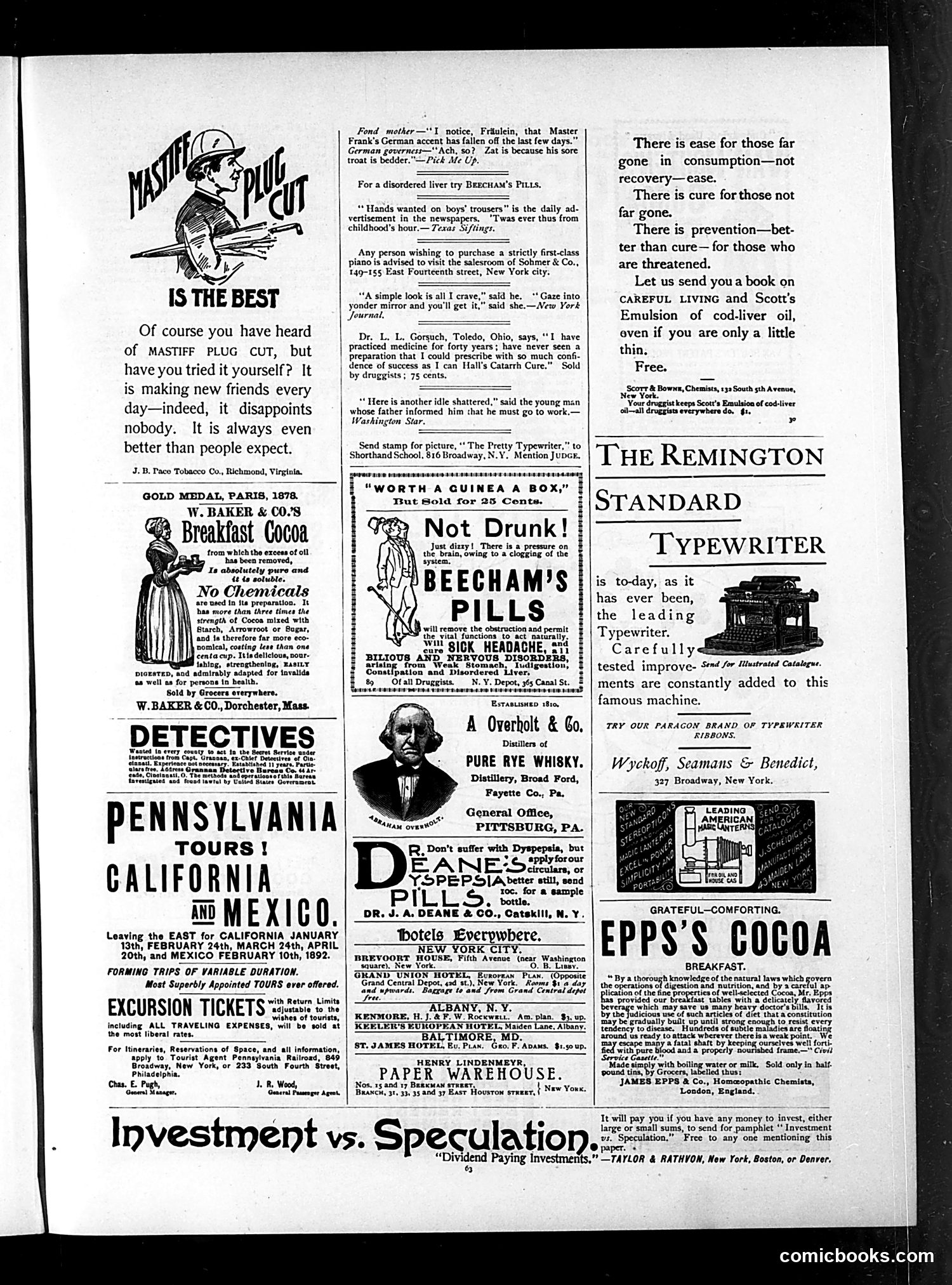
This is **primarily an advertising page** from *Judge* magazine, featuring vintage patent medicines, travel tours, and business services typical of the 1890s era. The few **jokes/satirical snippets** include: - A brief dialogue mocking a German governess's accent improving suspiciously when her "sore throat" heals - A quip about newspaper job postings requesting "hands on boys' trousers" (appearing to offer sewing work), with commentary that this has "always" been the case since childhood The page is otherwise **dominated by commercial advertisements**: for plug tobacco, breakfast cocoa, detectives, California/Mexico tours, typewriter schools, and numerous patent medicines (Beecham's Pills, Dr. Deane's pills for dyspepsia). Hotels and whiskey distilleries are also advertised. The satirical content is minimal and light—the page functions mainly as a revenue-generating vehicle for *Judge*'s publisher through advertising, which was standard practice for magazines of this period.
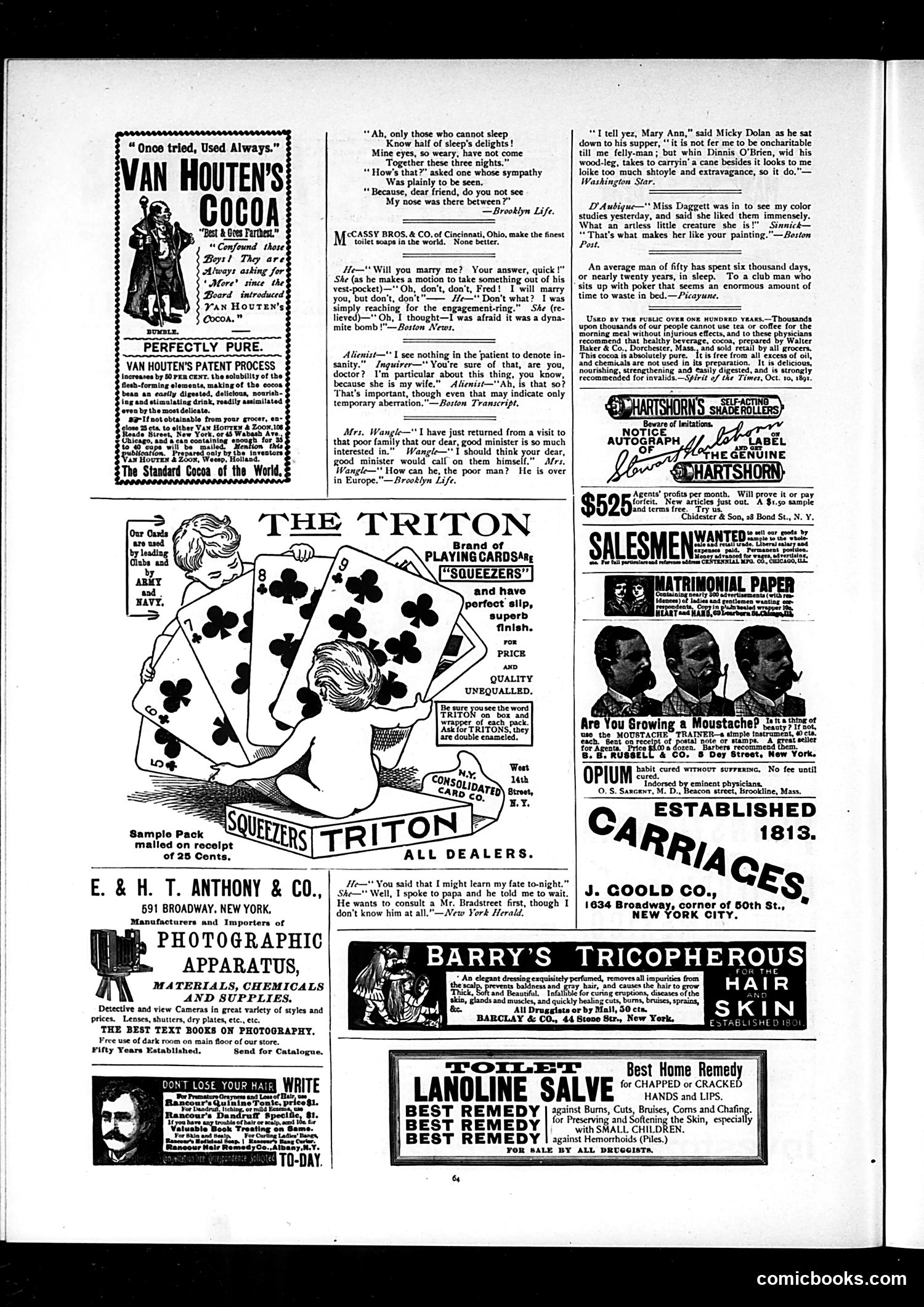
This page from *Judge* magazine consists primarily of **advertisements and brief humorous anecdotes**, not political cartoons. The jokes reflect early 1900s social attitudes: a woman mistakenly thinks her fiancé is proposing with a bomb rather than a ring (anxieties about labor unrest); an Irish laborer mocks a coworker's pretension for carrying a cane alongside a wooden leg (class/ethnic humor); and a doctor assures a husband his wife shows no signs of insanity—"though even that may indicate only temporary aberration" (misogynistic humor about women's supposed instability). The dominant content is **product advertisements** for cocoa, playing cards, photographic equipment, hair treatments, and carriages—typical of *Judge*'s revenue model. One notable ad warns against hair loss with the phrase "DON'T LOSE YOUR HAIR," reflecting period anxieties about masculinity. The satire here is genteel and domestic rather than political.
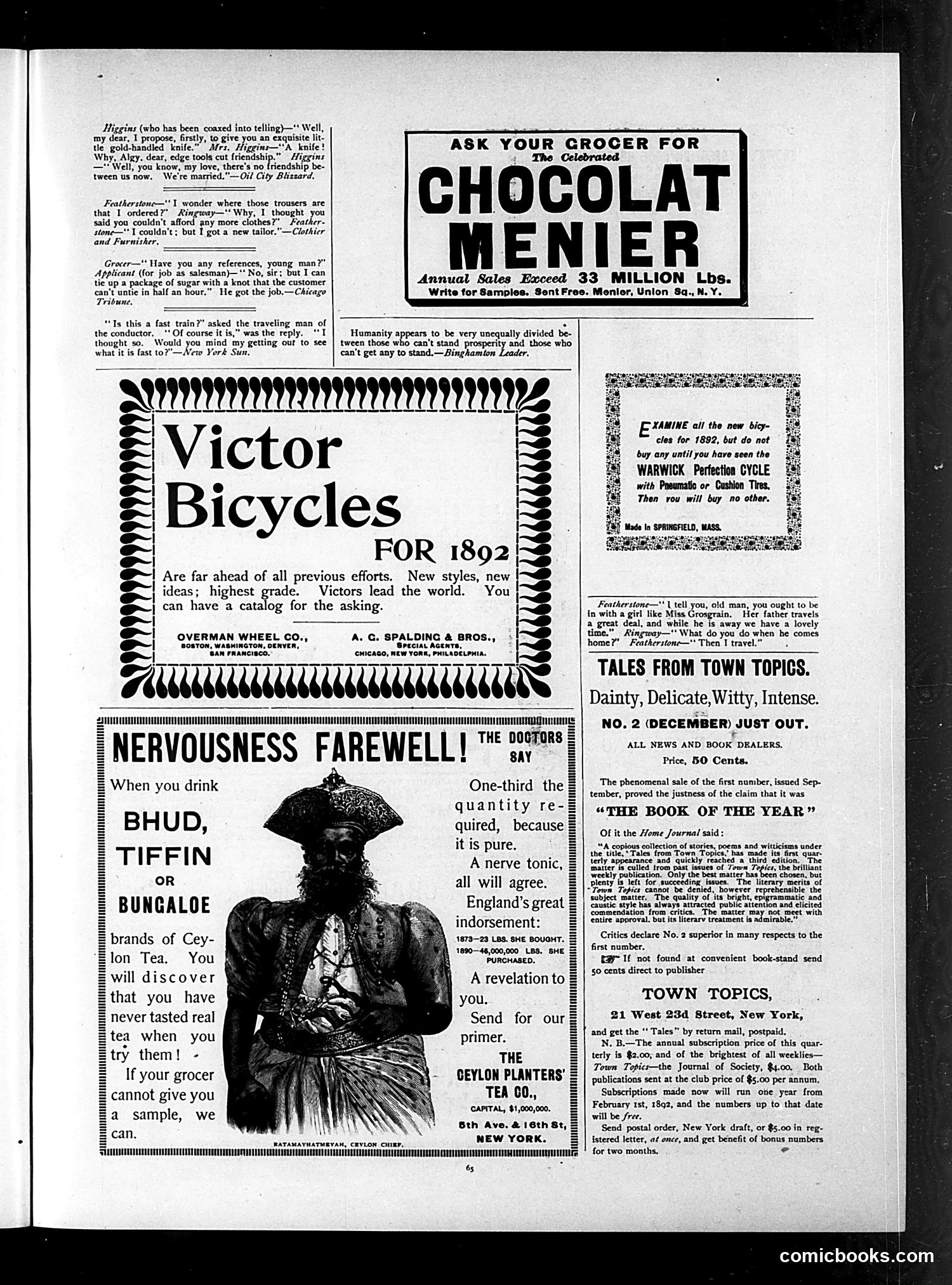
This page from *Judge* (circa 1892) consists primarily of **advertisements and reprinted humor snippets**, not political cartoons. The humor pieces are brief, cynical jokes about marriage, employment, and social manners—typical of 1890s magazine filler. Notable: one joke about a newlywed husband giving his wife a knife because "there's no friendship between us now. We're married" reflects period attitudes about marriage as a loss of independence. **Advertisements include:** - Victor Bicycles (1892 models) - Chocolate Menier (claiming 33 million lbs. annual sales) - Ceylon tea brands (Bhud, Tiffin, Bungaloe) marketed as nerve tonics - *Tales from Town Topics* (a quarterly anthology) - Warwick Perfection bicycles with pneumatic tires The large illustration shows a **Ceylon tea planter in colonial dress**—representing the exotic imperial product being sold to American consumers. The page reflects 1890s consumer culture and emerging technologies (pneumatic bicycle tires, mass-produced chocolate), rather than political satire.
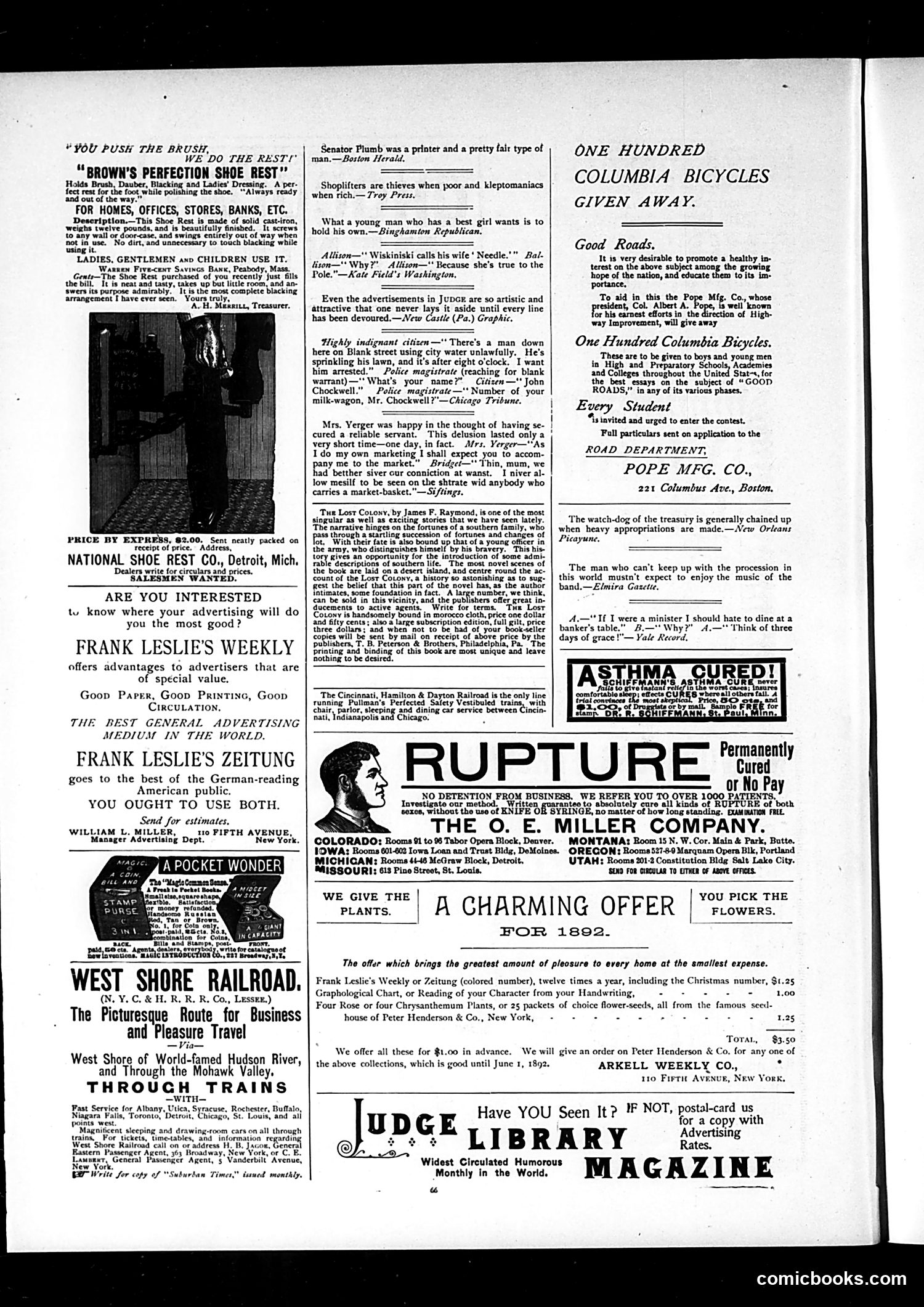
This page is primarily **advertising and promotional content** rather than political satire. The main elements include: **Advertisements:** - Brown's Perfection Shoe Rest (cast-iron foot holder for shoe polishing) - National Shoe Rest Company - Frank Leslie's Weekly and Zeitung (competing publications) - West Shore Railroad - O.E. Miller Company (rupture cure) - Pope Manufacturing Company (Columbia Bicycles giveaway) - Judge Library Magazine **Brief Humorous Items:** Scattered between ads are short quips about contemporary life—a senator described as "a pretty fair type of man," commentary on class differences ("shoplifters are thieves when poor and kleptomaniacs when rich"), and anecdotes about servant relations and city water usage. **The Bicycles Giveaway:** Pope Mfg. Co. advertises giving away 100 Columbia bicycles to students who write essays on "Good Roads"—reflecting late-19th-century interest in improved road infrastructure. The page reflects Judge's business model: mixing satirical humor with lucrative advertising to reach middle and upper-class readers.
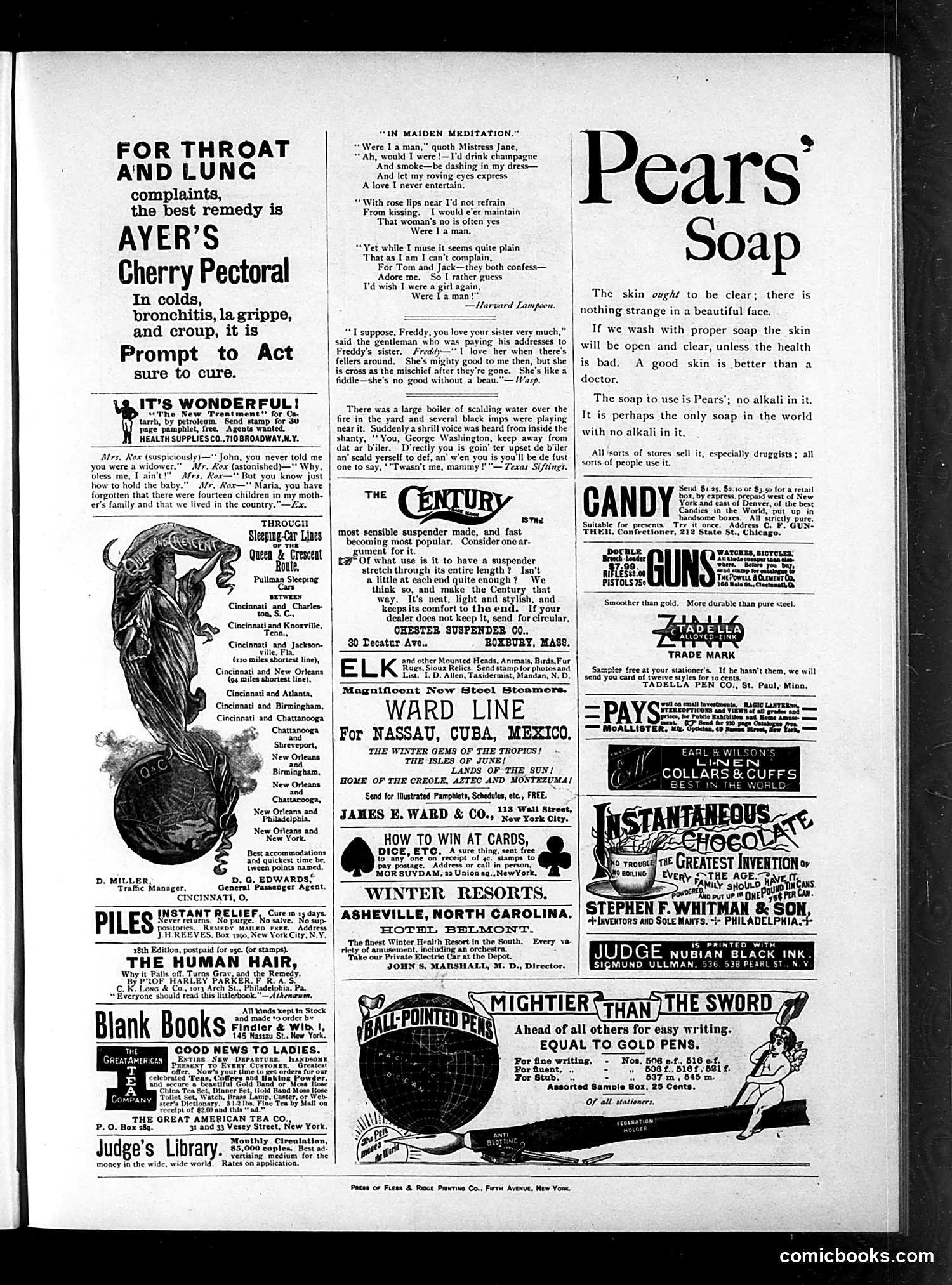
This is primarily an **advertising page** from Judge magazine, with minimal editorial cartoon content. The page consists almost entirely of period advertisements for patent medicines, travel services, and consumer products typical of late 19th/early 20th-century America. The one notable editorial piece is a poem titled "In Maiden Meditation" (credited to Harvard Lampoon), presenting a young woman's fantasy about being a man—imagining freedom to drink champagne, smoke, and flirt—before concluding she's actually content as a woman since men admire her. This reflects period attitudes about gender roles and courtship conventions. The ads themselves reveal era-specific concerns: Ayer's Cherry Pectoral for respiratory ailments, treatments for piles and catarh, and gambling instruction guides. The Ward Line travel advertisements promote tropical destinations as fashionable winter retreats. There are no significant political cartoons or satirical commentary visible on this page—it functions primarily as a commercial revenue source for the magazine.
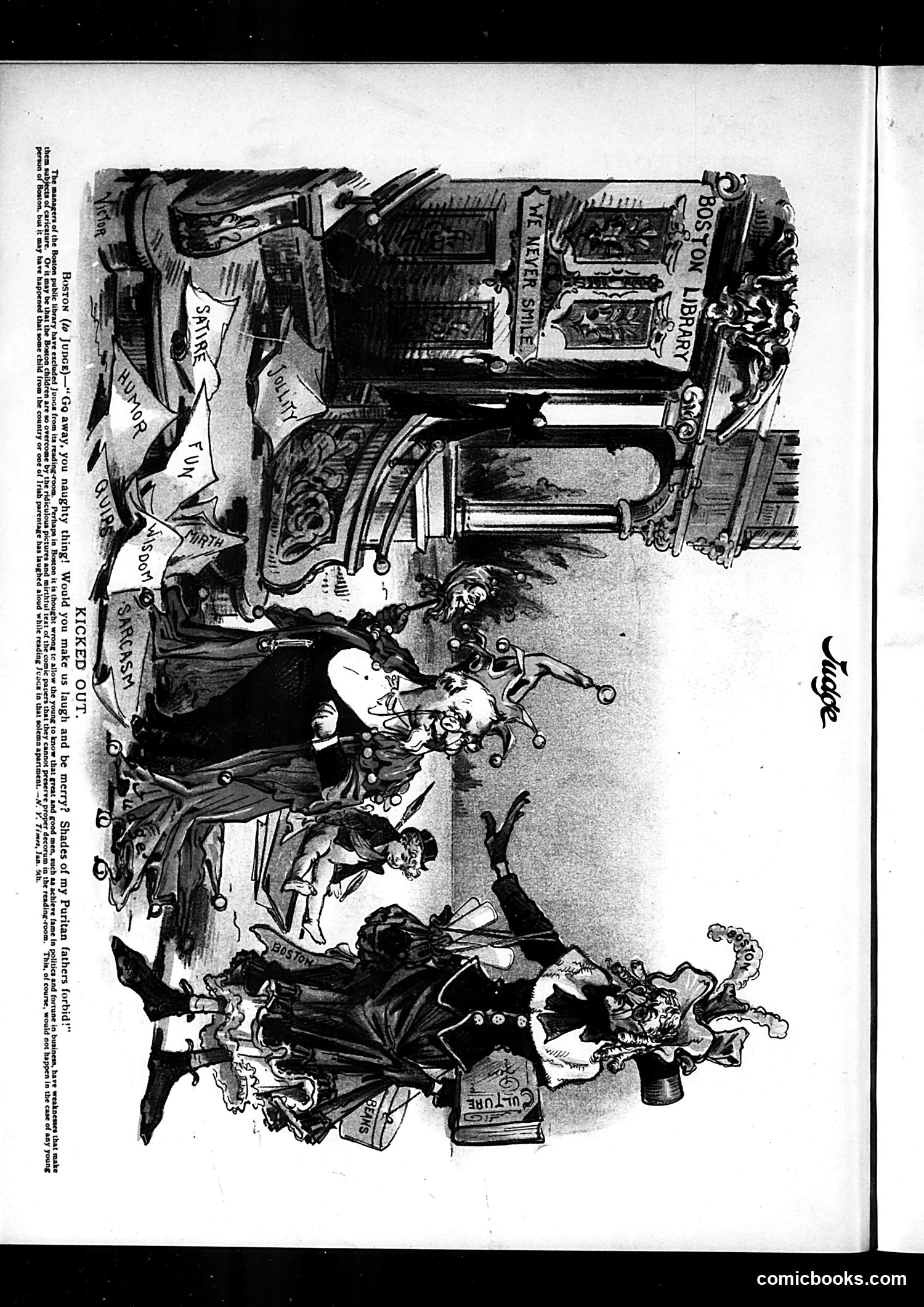
This cartoon satirizes Boston's Puritan cultural reputation and prudishness. The image shows Boston (personified as a stern figure) rejecting *Judge* magazine from its public library reading room, claiming the satirical publication is too frivolous and morally corrupting. The satire targets Boston's self-righteous gatekeeping of morality—the fear that exposure to humor and satire might corrupt young people or those deemed socially inferior ("children from the country" or "Irish parentage"). The accompanying text mocks this anxiety as hypocritical, suggesting Boston's concern about "decorum" reveals discomfort with acknowledging that prominent men have human weaknesses. Judge's point: Boston's cultural elite uses moral superiority to suppress popular entertainment while simultaneously engaging in the very human flaws they claim to forbid others from knowing about.