
A complete issue · 17 pages · 1892
Judge — January 9, 1892
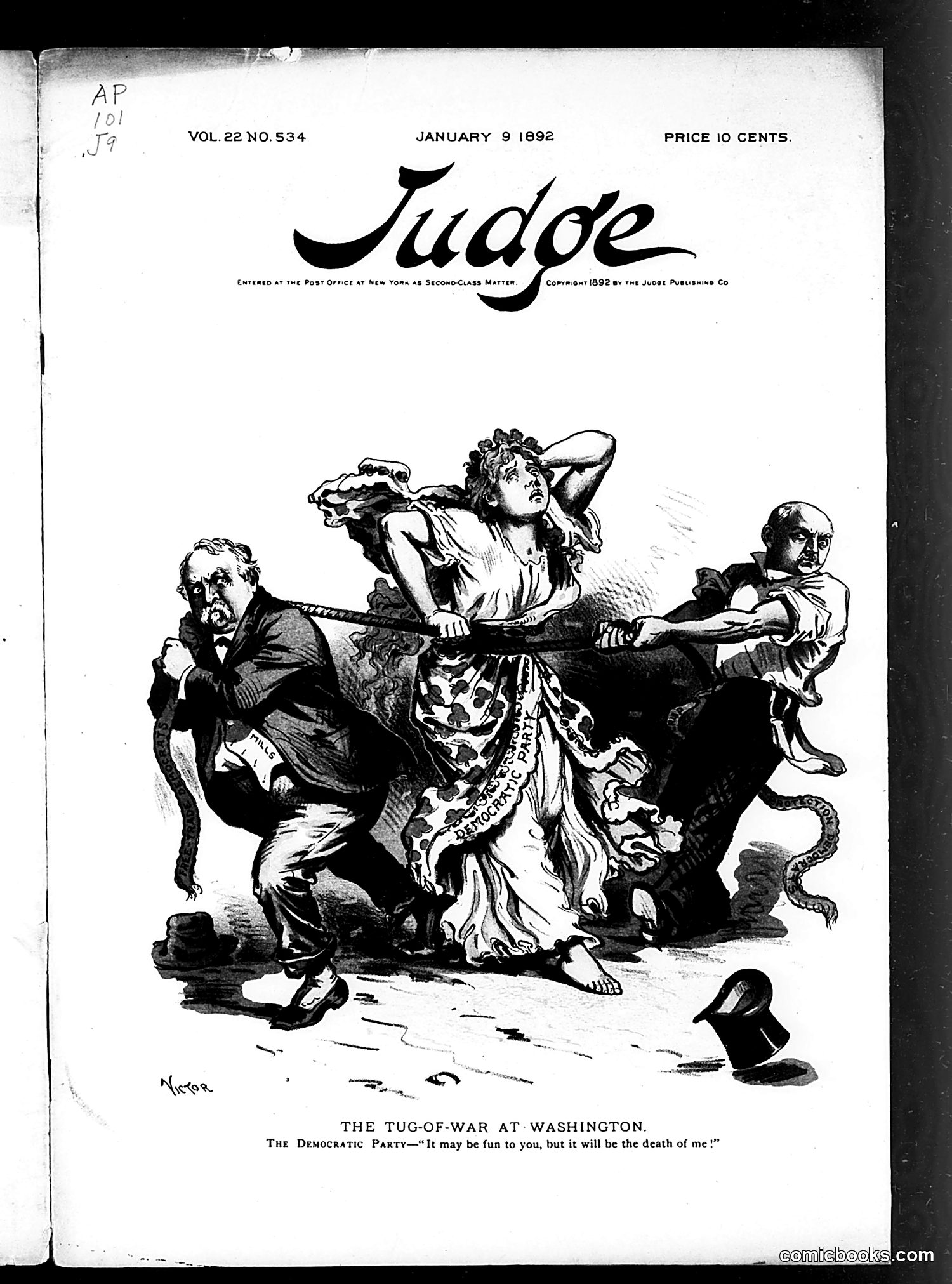
This January 1892 *Judge* cartoon depicts the Democratic Party as a woman being pulled apart by two men, with the caption: "It may be fun to you, but it will be the death of me!" The image represents internal Democratic Party conflict during this period. The two men appear to represent competing factions within the party—likely relating to the bitter split between President Grover Cleveland and the populist/silver wing of Democrats that would culminate in the 1896 election. The "tug-of-war" metaphor suggests the party is being torn apart by ideological divisions, particularly over monetary policy (gold versus silver). The woman personifying the Democratic Party suggests her destruction through internal strife. This captures real historical tensions that plagued Democrats in the 1890s.
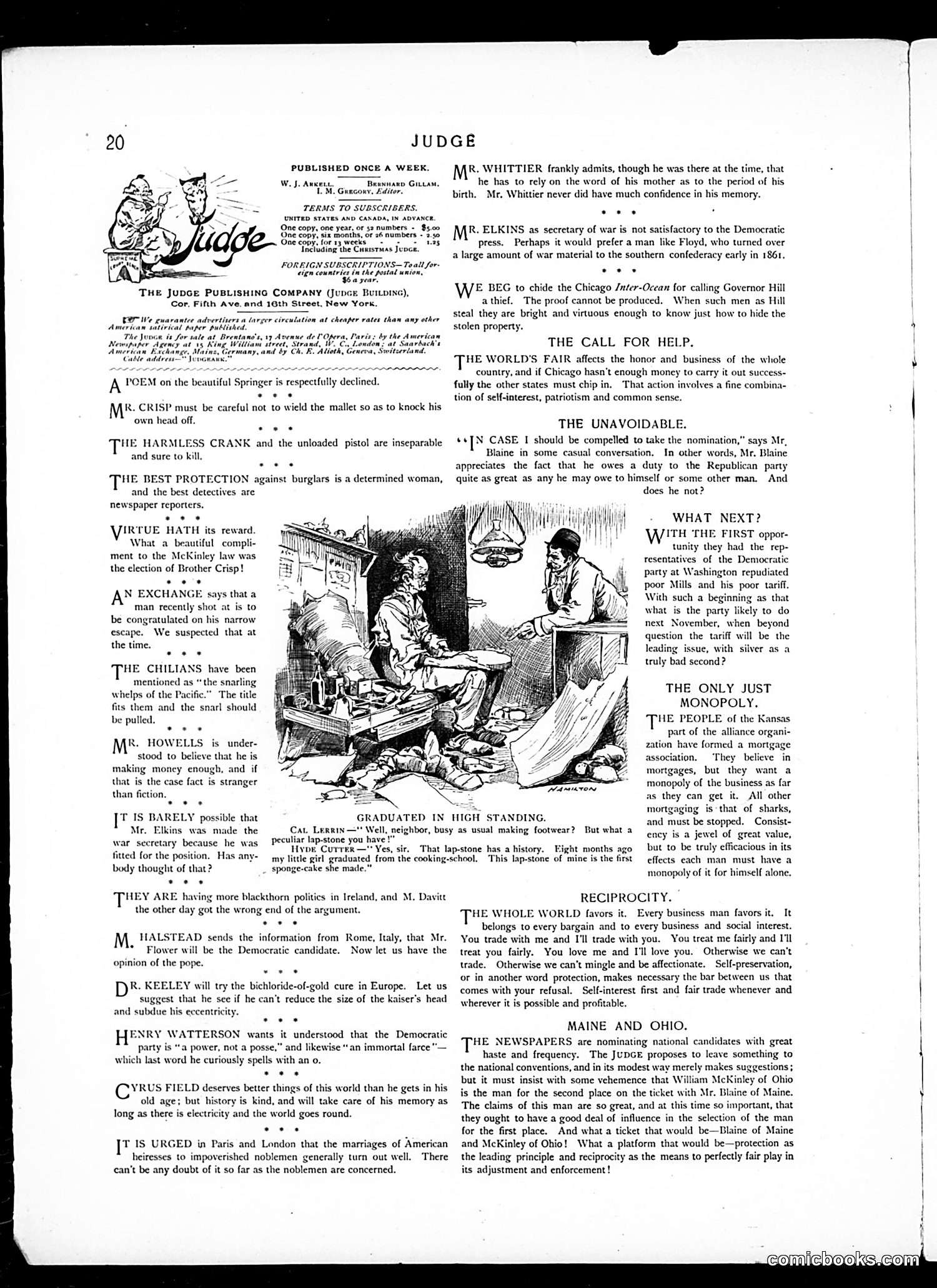
The main cartoon, titled "Graduated in High Standing," depicts two figures (labeled "Cal. Lebris" and "Hypo Cutter") discussing a third person's "tap-stone" (likely a misprint for "tap-stone" or similar). One character claims the subject "got graduated from the cooking-school," suggesting someone recently finished a disreputable educational institution. The cartoon appears to satirize political incompetence or corruption—someone being "graduated" into a position despite dubious qualifications. The surrounding text discusses Democratic party politics, electoral candidates, and reciprocal trade policies. Without clearer figure identification or specific historical context, the exact political targets remain unclear, though the satire targets what Judge deemed inadequate or corrupt political appointments or practices of its era.
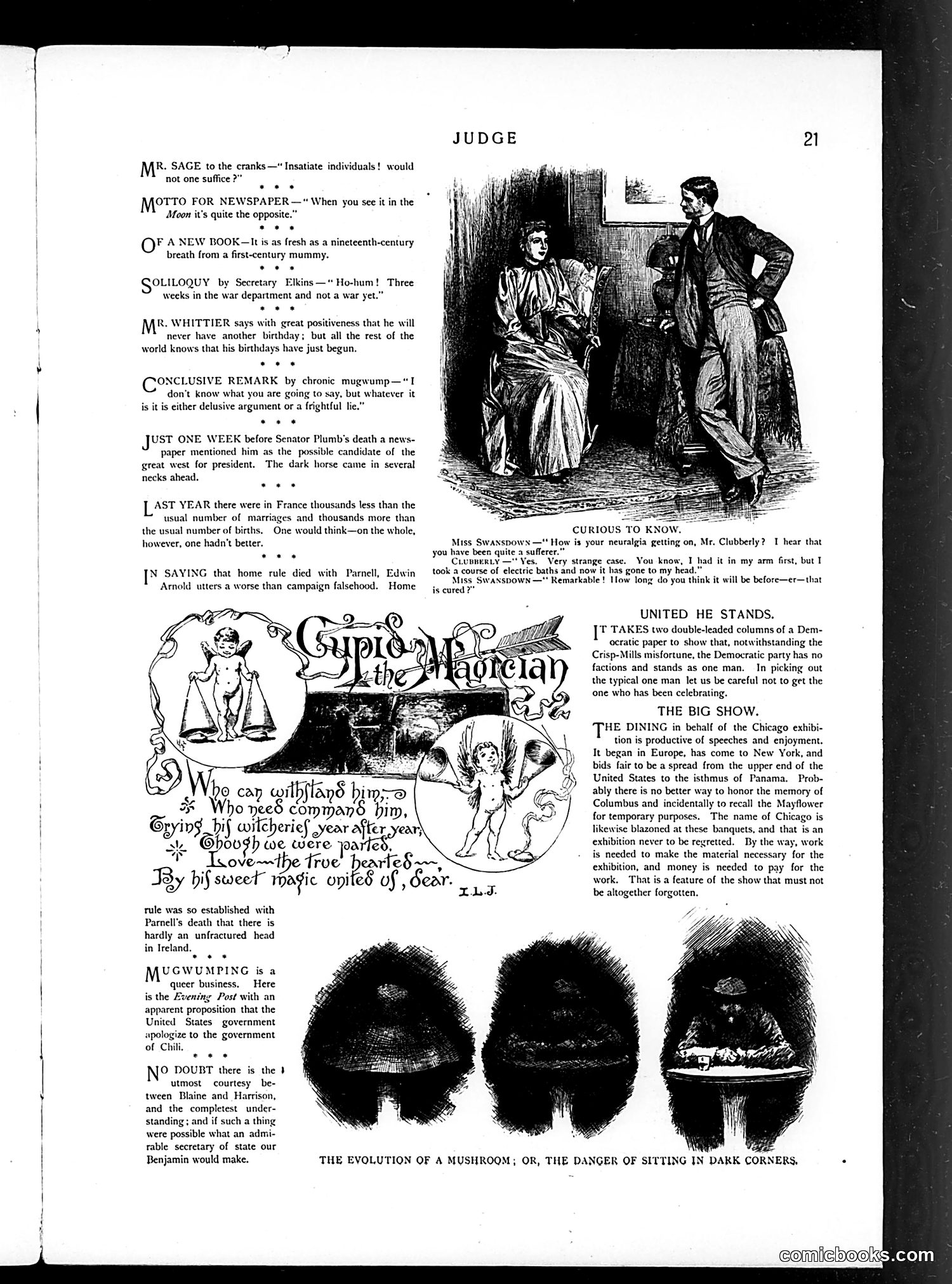
This page contains political commentary and humor from an early 20th-century American satirical magazine. The main cartoon "Cupid the Magician" uses classical imagery to mock political faction-building, while smaller satirical items critique contemporary politicians and social issues. The "Curious to Know" dialogue appears to joke about electric baths and medical treatments. "United He Stands" references Democratic Party disunity—a common theme in Gilded Age politics when factional disputes threatened party cohesion. "The Big Show" sarcastically discusses a Chicago exhibition honoring Columbus, suggesting the event is merely spectacle covering financial impropriety. The bottom illustration, "The Evolution of a Mushroom," appears to be a visual pun about dark corners—likely social or political corruption growing in obscurity. The specific political figures and events referenced are unclear from the OCR text alone.
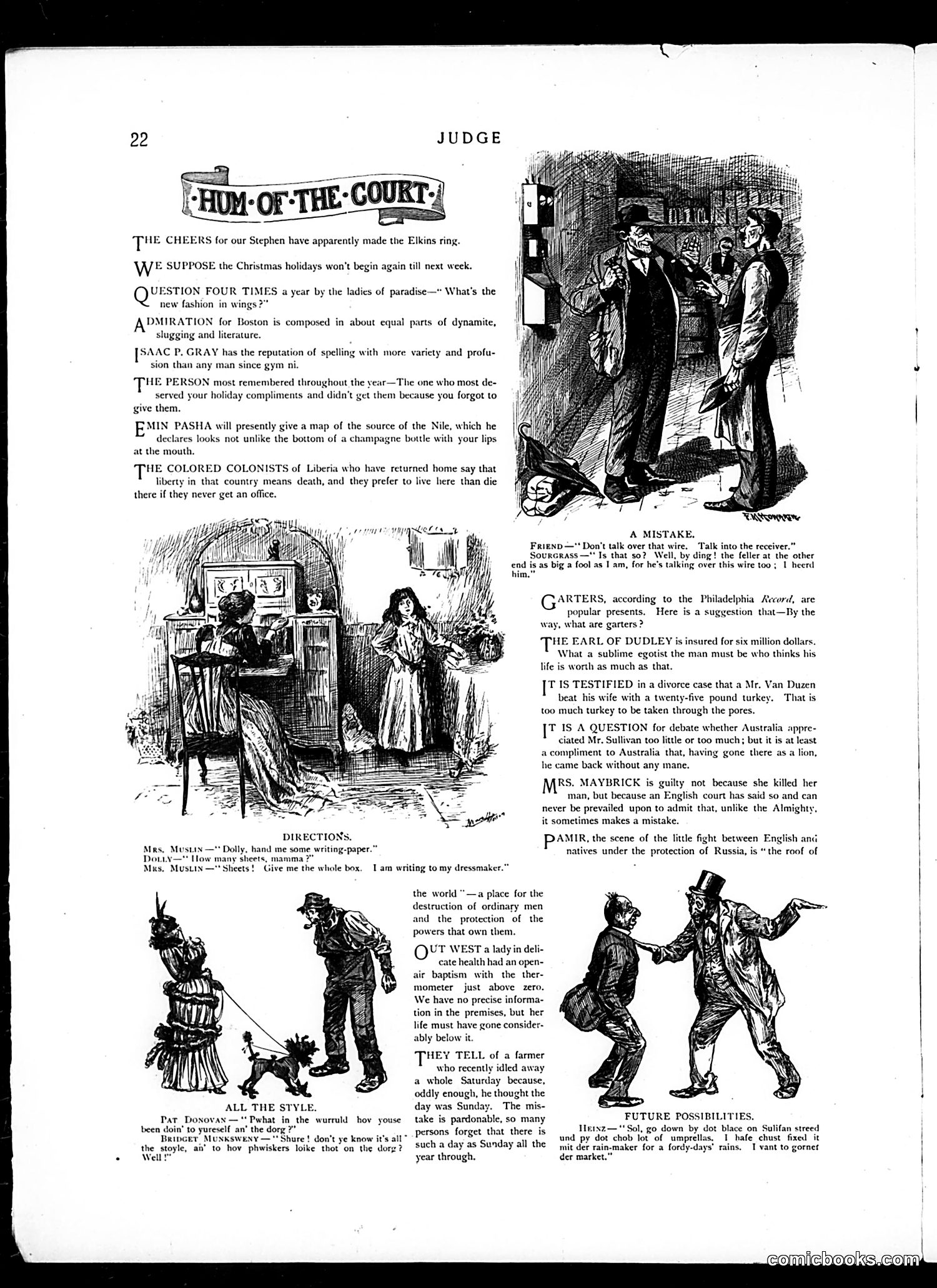
This page contains miscellaneous satirical commentary typical of Judge's format. Key items include: **"Hum of the Court"** section offers brief social jabs: mocking Boston's "dynamite, slugging and literature"; noting that people forget holiday compliments; observing that Liberian colonists prefer America to their homeland despite promises of freedom. **"A Mistake"** cartoon depicts two men arguing over a telephone wire—a joke about telephone etiquette, with the punchline that both are equally foolish for misusing the technology. Several other items satirize contemporary figures and events: the Mayrick divorce case (appears British); references to boxer Sullivan in Australia; garter garters as Christmas gifts; and the Pamir region conflict between imperial powers. **"All the Style"** shows an Irish immigrant character (indicated by dialect) discussing grooming, reflecting period stereotyping of Irish-Americans. **"Future Possibilities"** depicts a German-accented immigrant discussing umbrellas and rain-making, another ethnic stereotype common to era. The page blends topical political commentary with everyday humor and ethnic caricature typical of 1880s-90s American satirical magazines.
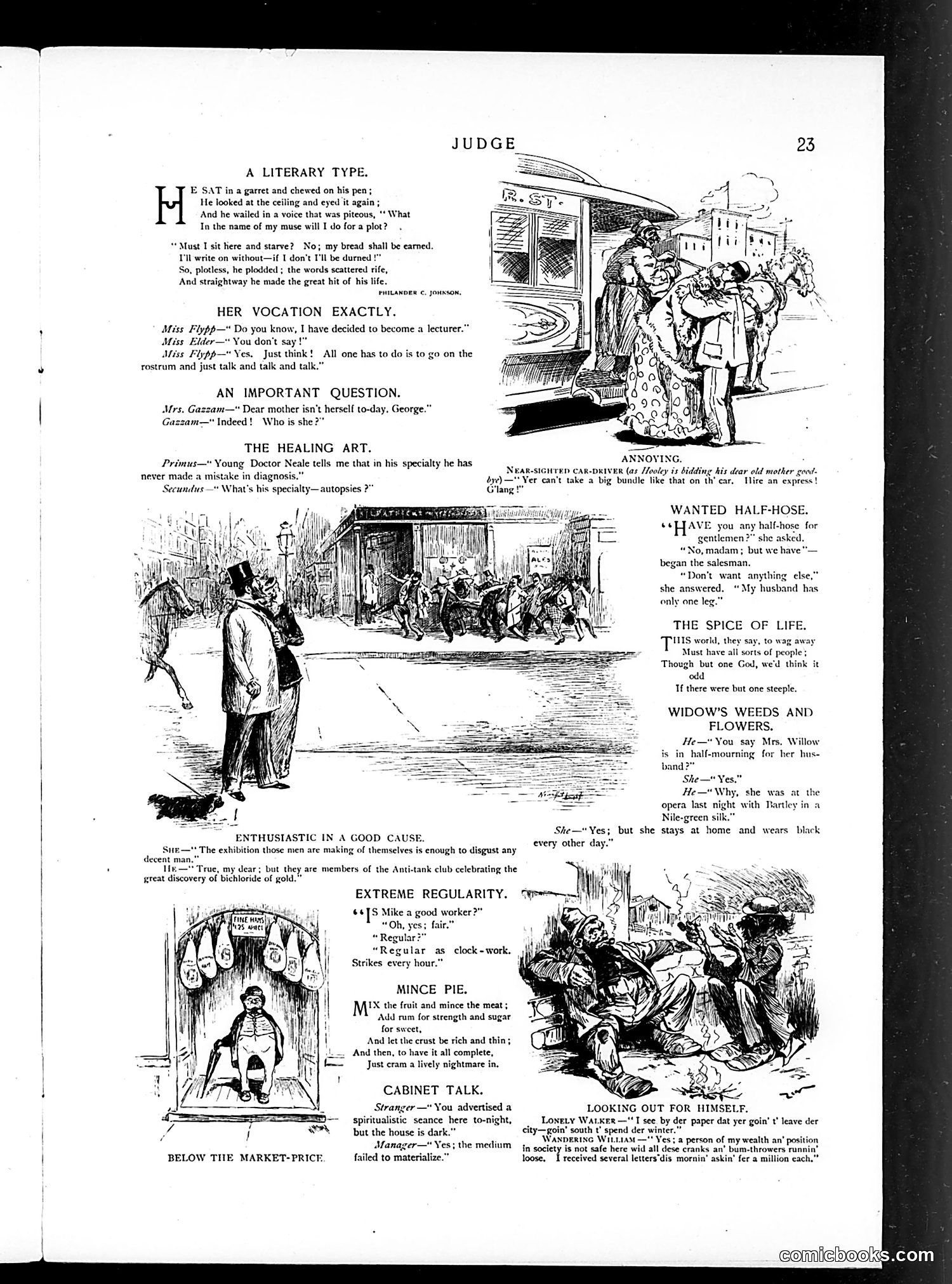
This page contains multiple short satirical vignettes typical of Judge magazine's humor style: **"A Literary Type"** mocks struggling writers—a garret-dwelling poet who fears starvation but paradoxically succeeds by writing without a plot, satirizing both artistic pretension and commercial success. **"Her Vocation Exactly"** ridicules women lecturers, suggesting they succeed merely by talking continuously without substance—a gendered jab at female public speakers. **"The Healing Art"** jokes about a doctor whose specialty is autopsies (diagnosing only dead patients). **"Wanted Half-Hose"** presents a dark humor joke: a woman seeking half-hose for her one-legged husband. **Other items** include humor about spiritualist séances failing, anti-tank club celebrations, and a wealthy man fleeing the city to avoid being targeted for ransom by "cranks and bum-throwers." The cartoons reflect late Victorian/Edwardian social anxieties about modern institutions, professions, and urban crime, while employing period-typical satirical stereotypes.
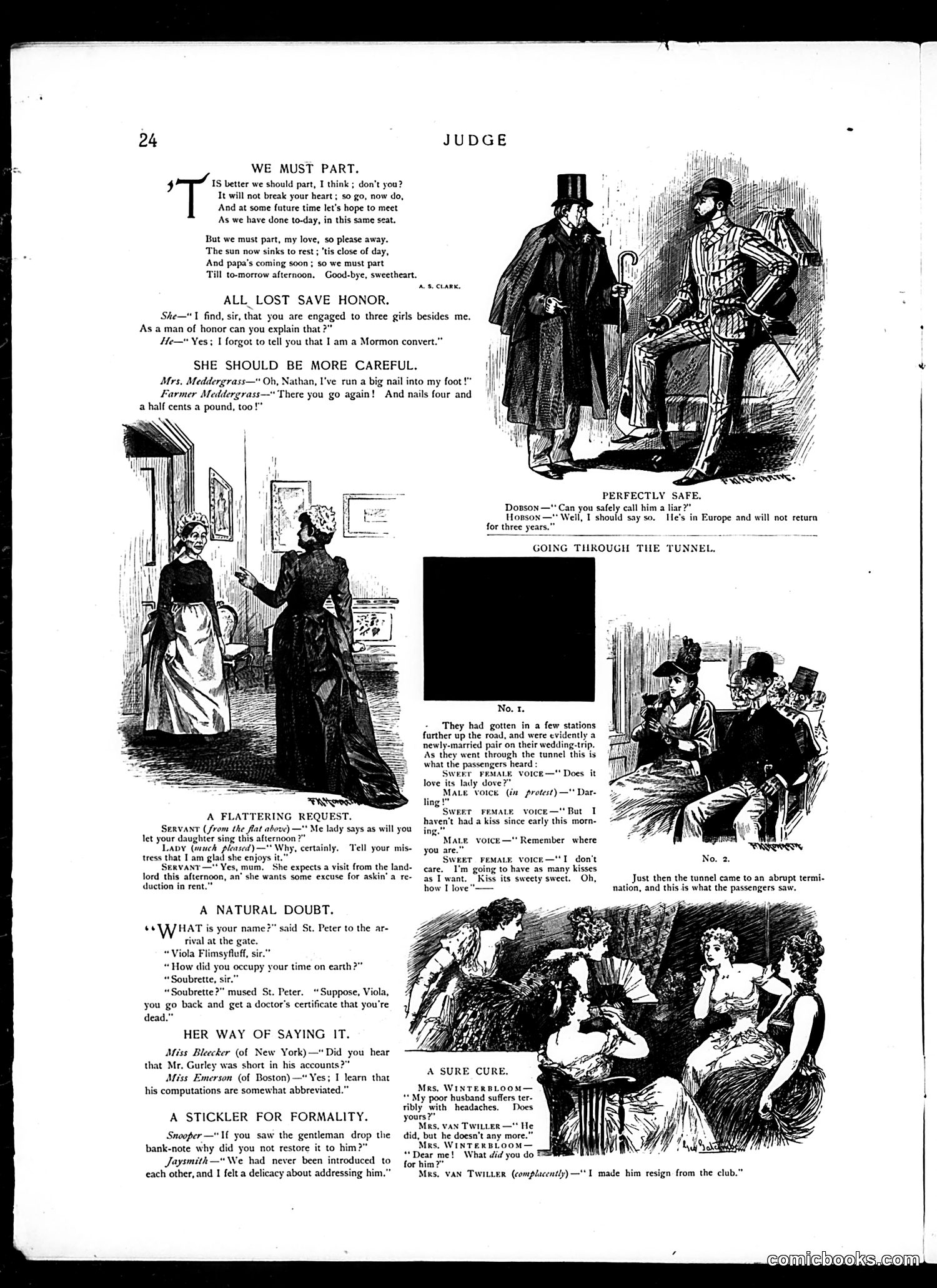
This page from *Judge* contains multiple brief satirical sketches mocking Victorian courtship, marriage, and social conventions: **"We Must Part"** and **"All Lost Save Honor"**: Mock romantic drama and marital infidelity. The latter jokes about a man engaged to multiple women by claiming Mormon conversion—likely referencing contemporary anti-Mormon sentiment and polygamy anxieties. **"Going Through the Tunnel"**: A suggestive sketch about newlyweds' behavior during a train tunnel, implying they kiss in darkness. The humor relies on Victorian prudishness about public displays of affection. **"Perfectly Safe"**: A cynical joke about calling someone a liar when they're unavailable to retaliate. **"A Natural Doubt"**: St. Peter at heaven's gates demands a "doctor's certificate" that a soubrette (theater performer) is actually dead—mocking actresses' reputations and uncertain morality. **"A Sure Cure"** and other sketches: Mock domestic complaints and social pretension. Overall, the page satirizes Victorian courtship rituals, marital dynamics, and class-consciousness through exaggeration and wordplay.
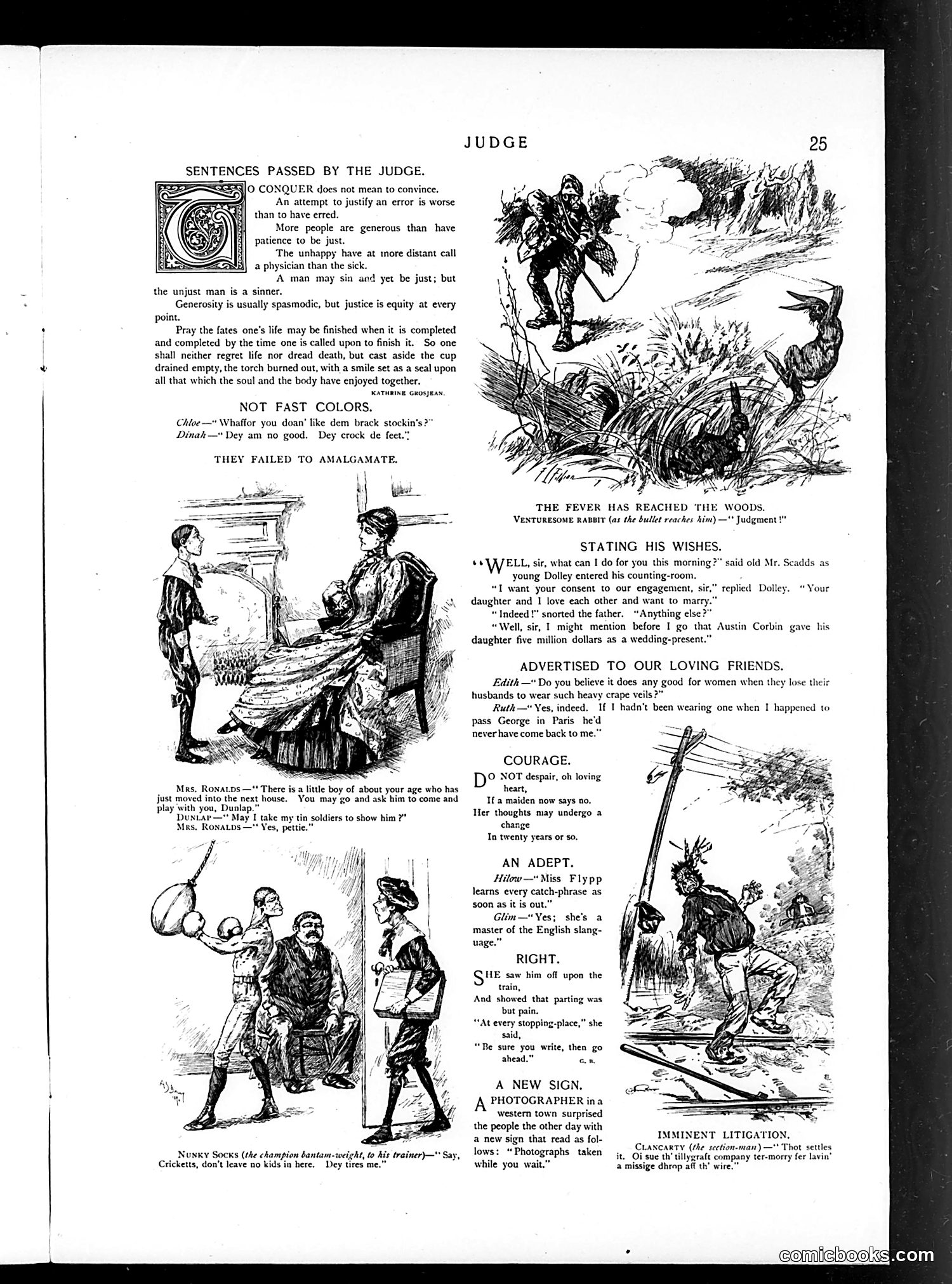
This page from the satirical magazine *Judge* consists primarily of **short humor pieces and aphorisms** rather than political cartoons. The top section presents philosophical "sentences" about justice, generosity, and mortality—moral observations typical of the era's genteel humor. The remaining content comprises brief comic vignettes mocking everyday situations: - **"Not Fast Colors"**: A racist dialect joke about Black people and clothing - **"They Failed to Amalgamate"**: Appears to reference interracial relationships (unclear without fuller context) - **"Stating His Wishes"**: A young man seeking a father's consent to marry, mentioning Austin Corbin's million-dollar wedding gift as leverage—satirizing mercenary marriage practices among the wealthy - **"Advertised to Our Loving Friends"**: A woman credits mourning veils for winning back her straying husband - Various other brief jokes about children, photography, and telegraphs The cartoons illustrate these jokes with period-appropriate line drawings. The humor is primarily domestic and social rather than explicitly political, reflecting *Judge*'s focus on satirizing middle and upper-class American manners and morals.
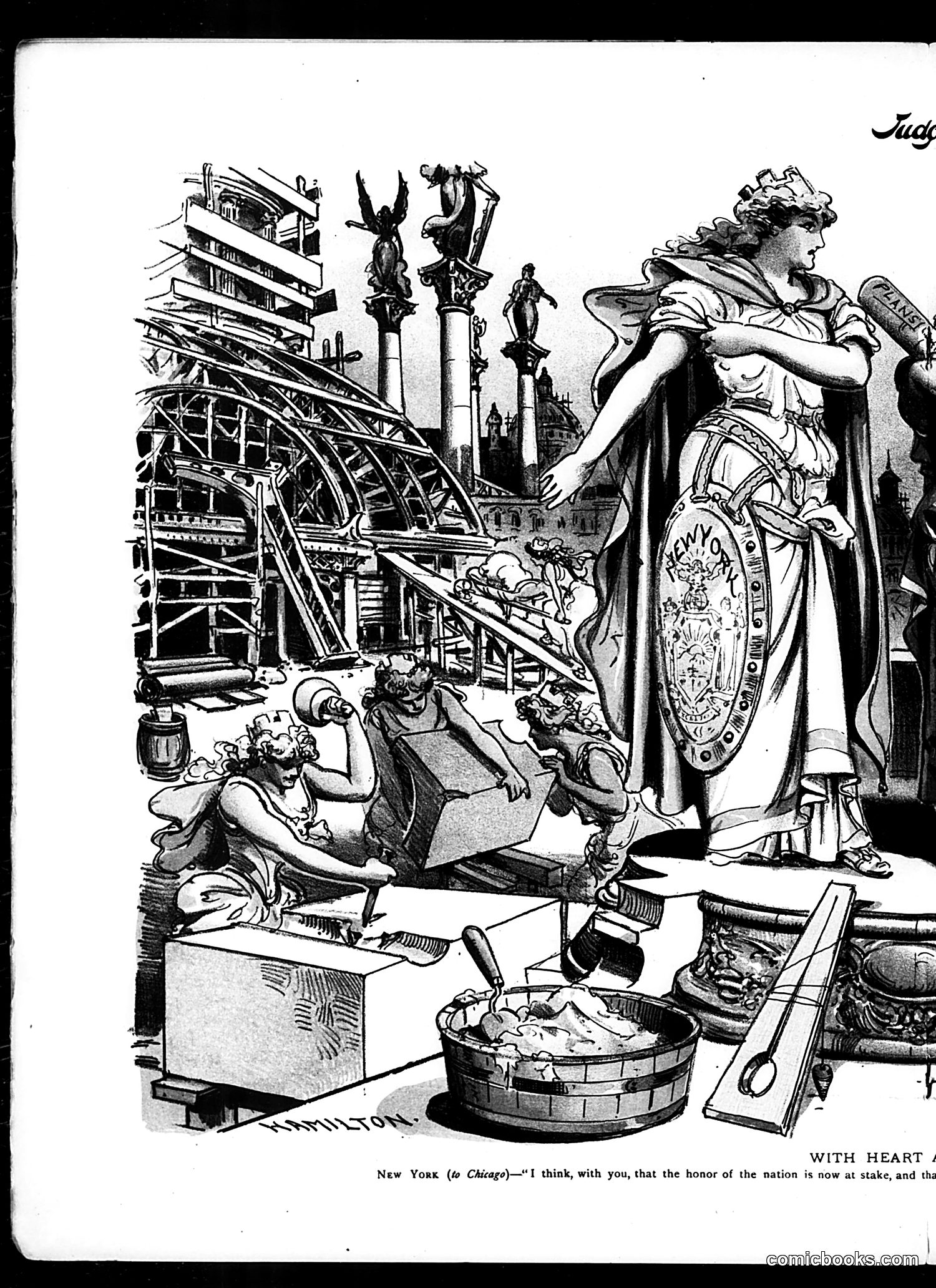
This Judge magazine cartoon depicts an allegorical figure (likely representing the nation or civic virtue) gesturing toward industrial/amusement park imagery while addressing concerns about national honor. The figure wears classical robes and a laurel crown, suggesting themes of patriotism and duty. The setting juxtaposes entertainment infrastructure (roller coaster, carnival elements) with classical symbols of governance, creating satirical tension. Cherubs or putti figures appear in the foreground, emphasizing innocence or vulnerability. The incomplete caption—"I think, with you, that the honor of the nation is now at stake"—suggests commentary on a specific political or social crisis, though the exact event remains unclear without additional context. The dialogue format ("New York to Chicago") implies regional or national debate about patriotic responsibility during an uncertain moment.
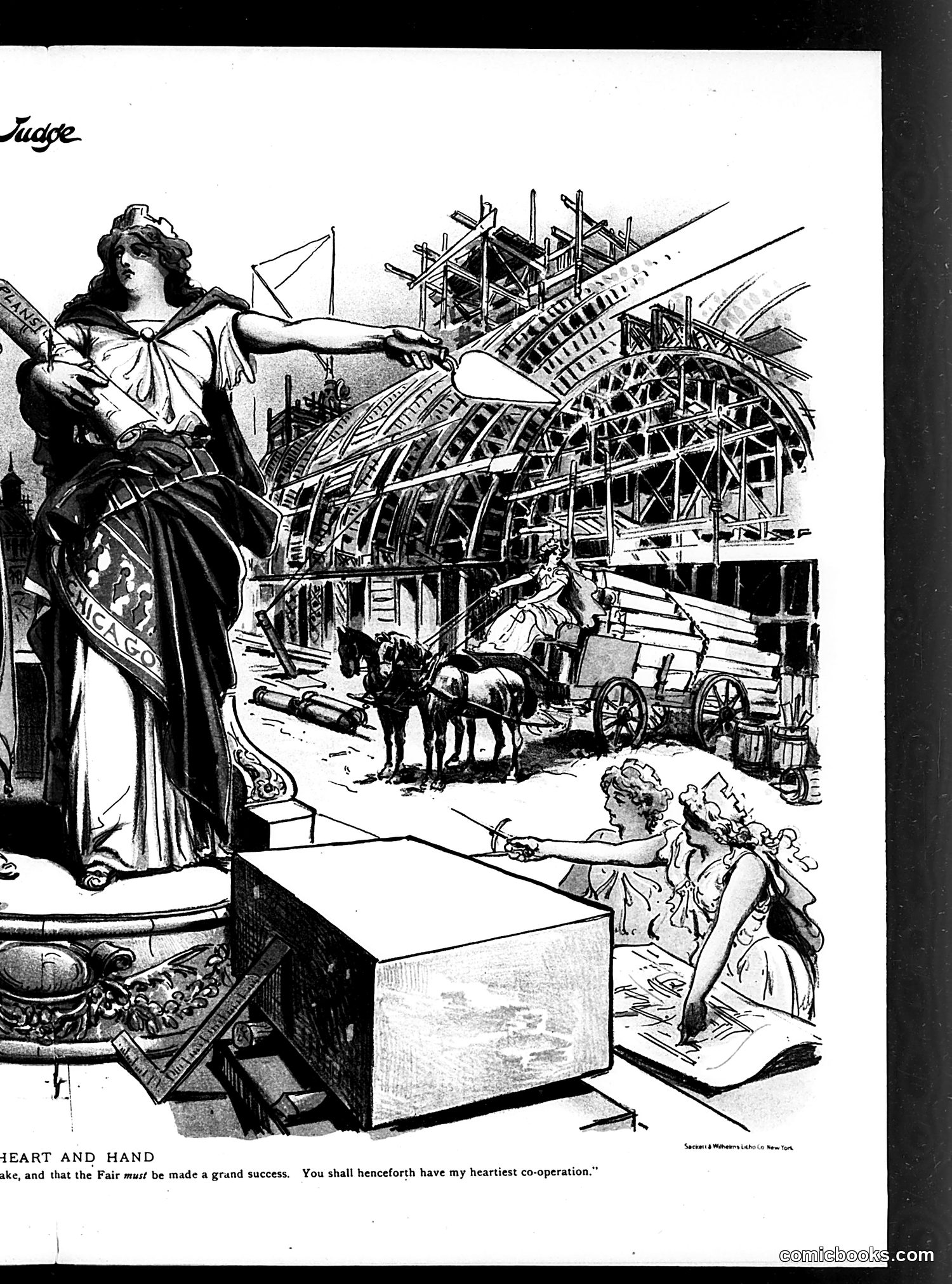
This appears to be a Judge magazine political cartoon titled "Heart and Hand," likely from the early 1900s based on the art style. The image depicts a classical female allegorical figure (representing Chicago or a civic virtue) making a grand gesture toward an elaborate fair or exposition under construction. Two women below appear to be pledging cooperation or support. The partial text quote about "heartiest co-operation" and making "the Fair...a grand success" suggests this cartoon comments on support for a major public exposition—likely the 1893 World's Columbian Exposition in Chicago. The satirical point appears to involve securing cooperation and resources from prominent figures or institutions for the fair's completion, though without the full caption and date, the specific targets of the satire remain unclear.
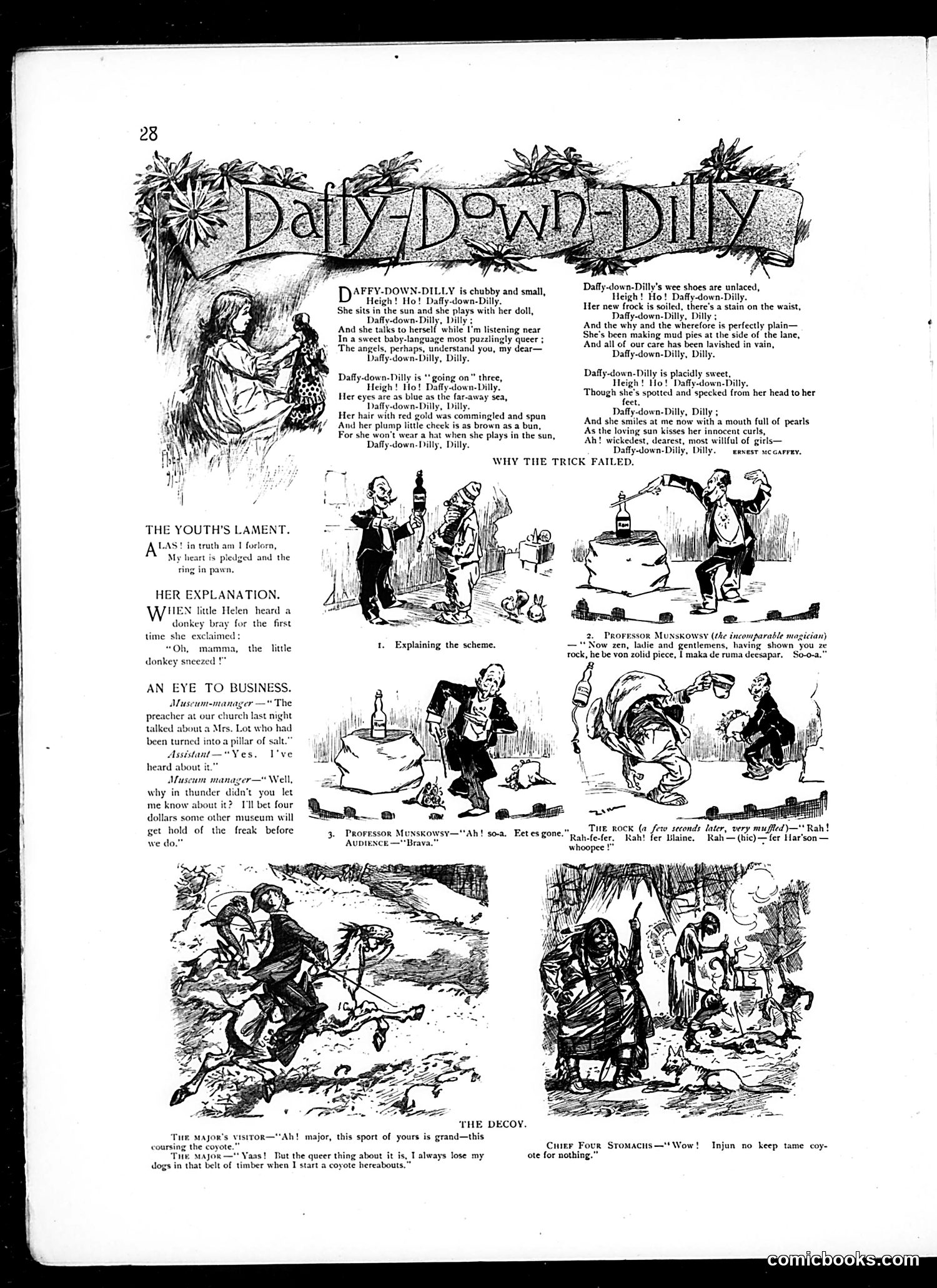
This page from *Judge* magazine contains light satirical pieces rather than serious political commentary: **"Daffy-down-Dilly"** is a sentimental poem about an unkempt toddler—a parody of nursery rhymes. The satire gently mocks parents' efforts to keep small children clean and properly dressed, as the child inevitably gets dirty playing outdoors. **"Why the Trick Failed"** depicts Professor Munskowsky, a magician attempting to make a rock disappear for an audience. The joke: he succeeds too well—the rock vanishes and never returns, revealed to be stuck inside him (indicated by muffled sounds). It's absurdist humor about a magic trick gone hilariously wrong. **Minor pieces** include "The Youth's Lament" (romantic disappointment), "Her Explanation" (a child mishearing a donkey's bray as a sneeze), "An Eye to Business" (a museum manager regretting missing out on acquiring a biblical "freak"), and anecdotes about a major losing hunting dogs and someone with stomach troubles. These are primarily humorous filler content rather than political satire.
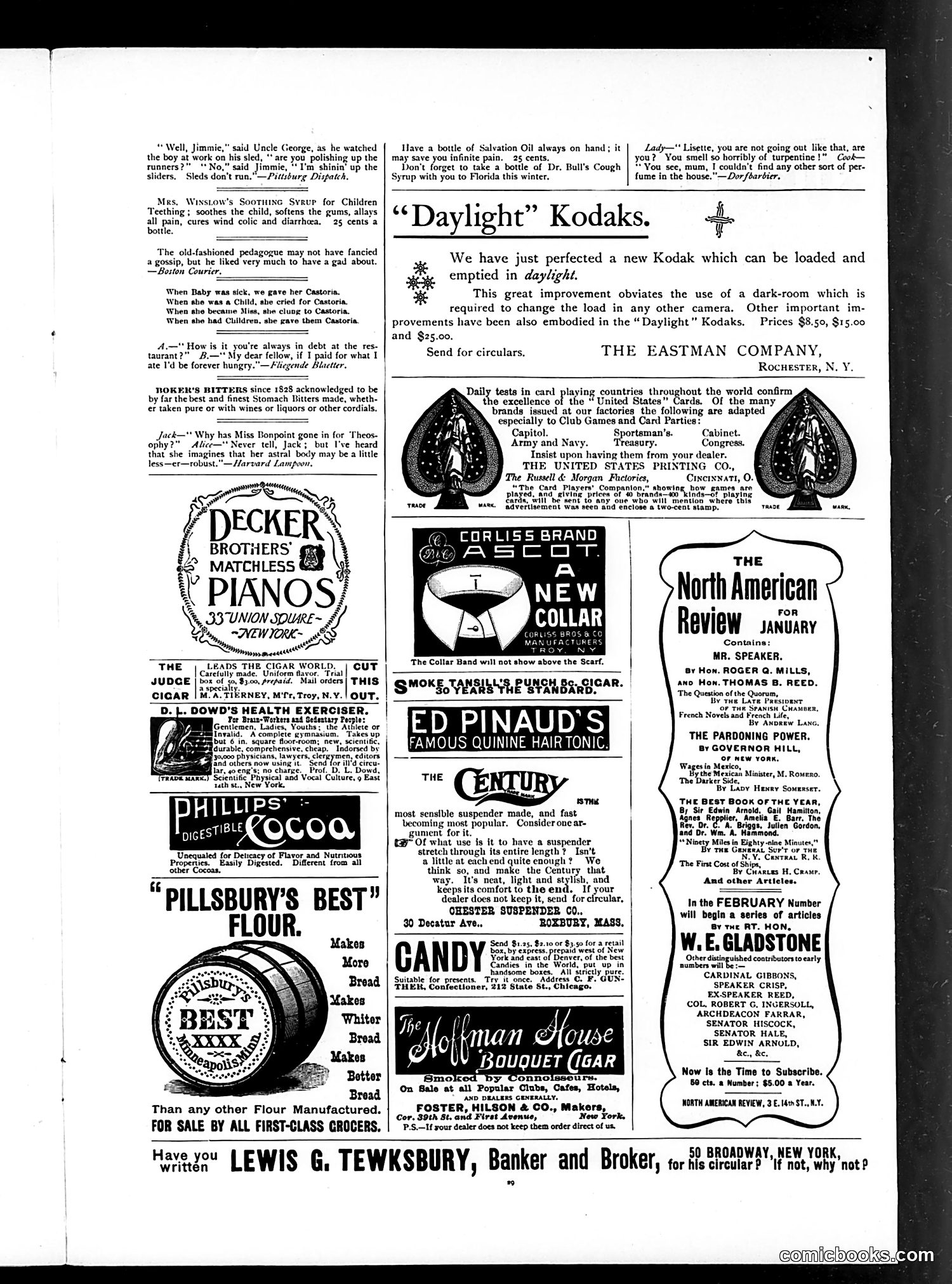
This is primarily a **page of advertisements** from *Judge* magazine, with some scattered **humorous anecdotes** at the top. The humorous jokes include light mockery of: - Patent medicine advertising (Mrs. Winslow's Soothing Syrup, Castoria) - A diner chronically in debt at restaurants - A woman interested in Theosophy (mocked as absurdly concerned with her "astral body") The bulk of the page features **period product ads** (flour, cocoa, pianos, cigars, health equipment, playing cards) and a notable ad for **Kodak's new "Daylight" camera**—which eliminated the need for darkroom film-loading, presented as a major innovation. A **North American Review advertisement** promotes the January issue, highlighting articles by congressman Roger Q. Mills and Thomas B. Reed on political topics like "The Question of the Quorum." The page reflects **1890s consumer culture** and the obsession with patent medicines, but contains no significant political satire—it's primarily commercial.
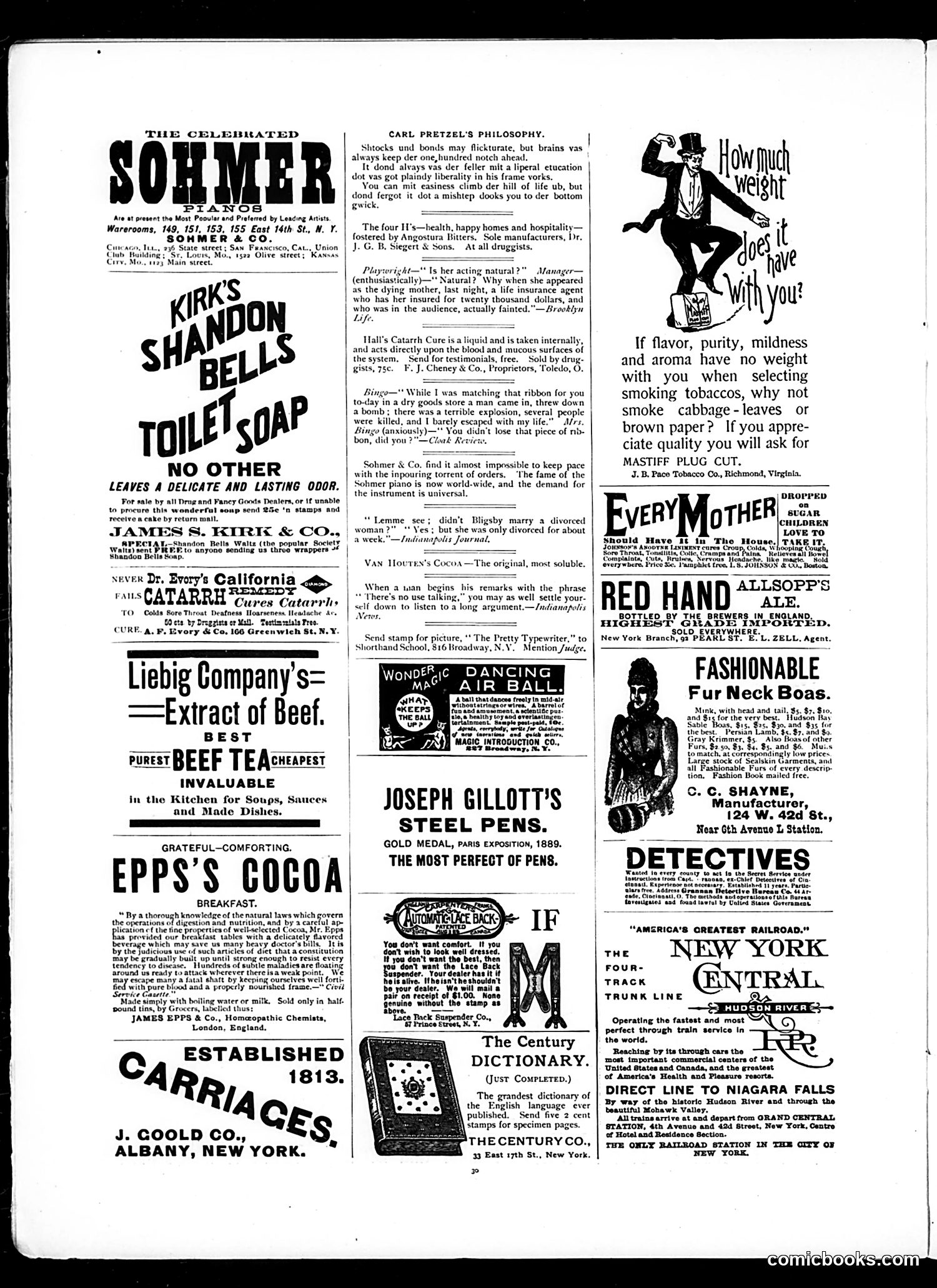
This page is primarily **advertising**, typical of late 19th-century American magazines. However, it contains one notable satirical element: **"Carl Pretzel's Philosophy"** - A recurring humor column featuring a German-accented character offering folksy observations. The visible quotes mock pretentiousness ("brains vas always keep der one hundred notch ahead") and use heavy ethnic dialect for comedic effect. This reflects the period's common practice of ethnic humor based on German immigrant caricatures. **The Other Content:** The page is dominated by product advertisements (pianos, soap, cocoa, beef extract, patent medicines) interspersed with brief jokes about theater, marriage, and office life. Most humor derives from situational comedy rather than political satire. **For Modern Readers:** The "Carl Pretzel" segments exemplify how mainstream publications casually deployed ethnic stereotypes for entertainment. The heavy dialect spelling and "foolish foreigner" premise would be considered offensive today, though it was standard Judge magazine fare of this era.
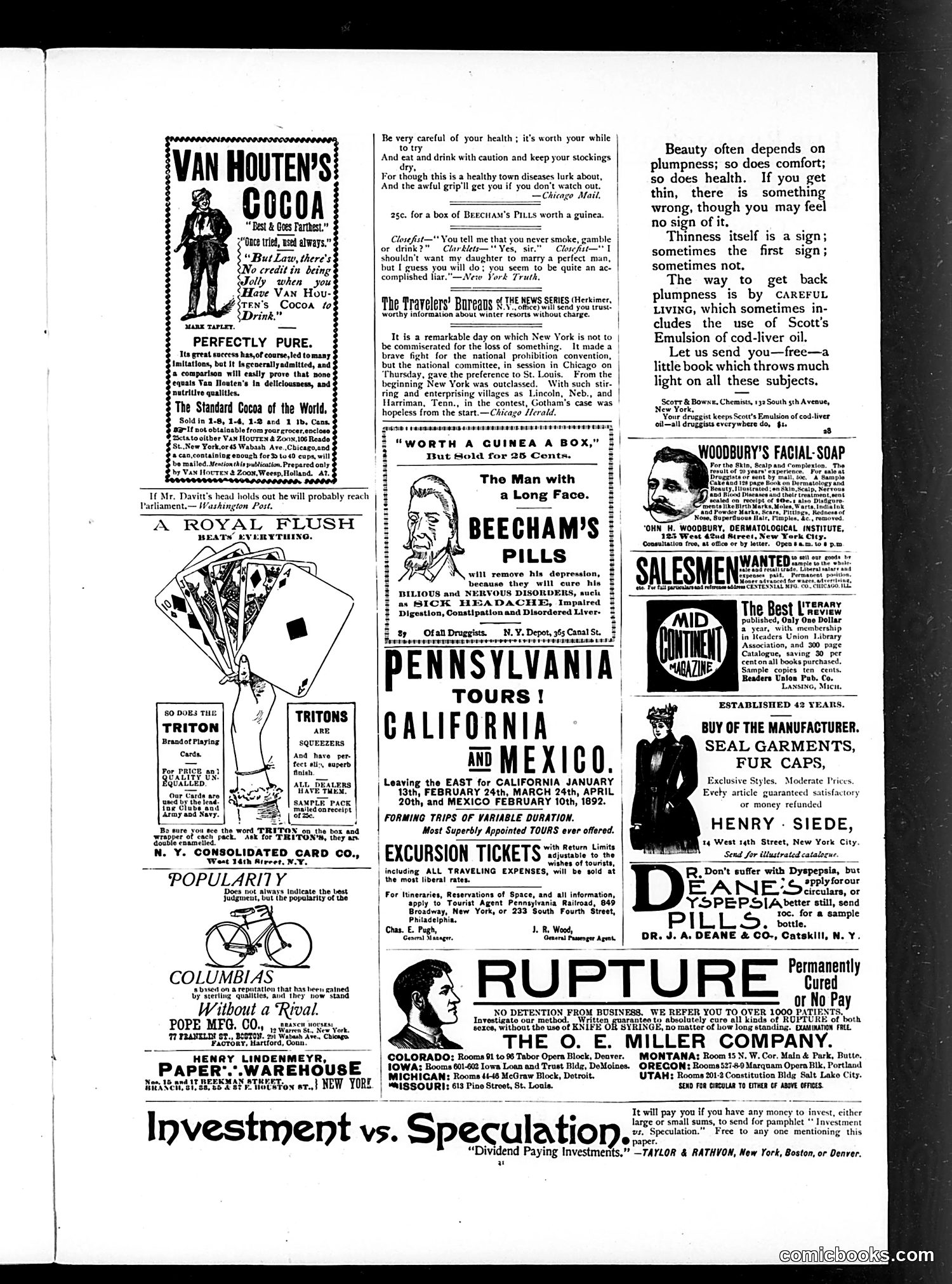
This is primarily an **advertising page** from Judge magazine, not a political cartoon. The page consists almost entirely of product advertisements from the 1890s-early 1900s, including cocoa, playing cards, bicycles, cocoa pills, and patent medicines. The few editorial items are minor: - A brief joke about Mr. Davis's head holding out to reach Parliament (unclear reference without date) - A short humorous dialogue mocking a hypocritical man who claims virtue while being "quite an accomplished liar" - A news item about New York losing a prohibition convention bid to St. Louis, described with mock disappointment The substantive content reflects **period attitudes**: heavy promotion of patent medicines (Beecham's Pills, Scott's Emulsion) claiming to cure vague ailments like "bilious disorders" and thinness—products we'd now recognize as largely ineffective or even harmful. The advertising reflects the era's lack of FDA regulation and the prevalence of medicinal quackery.
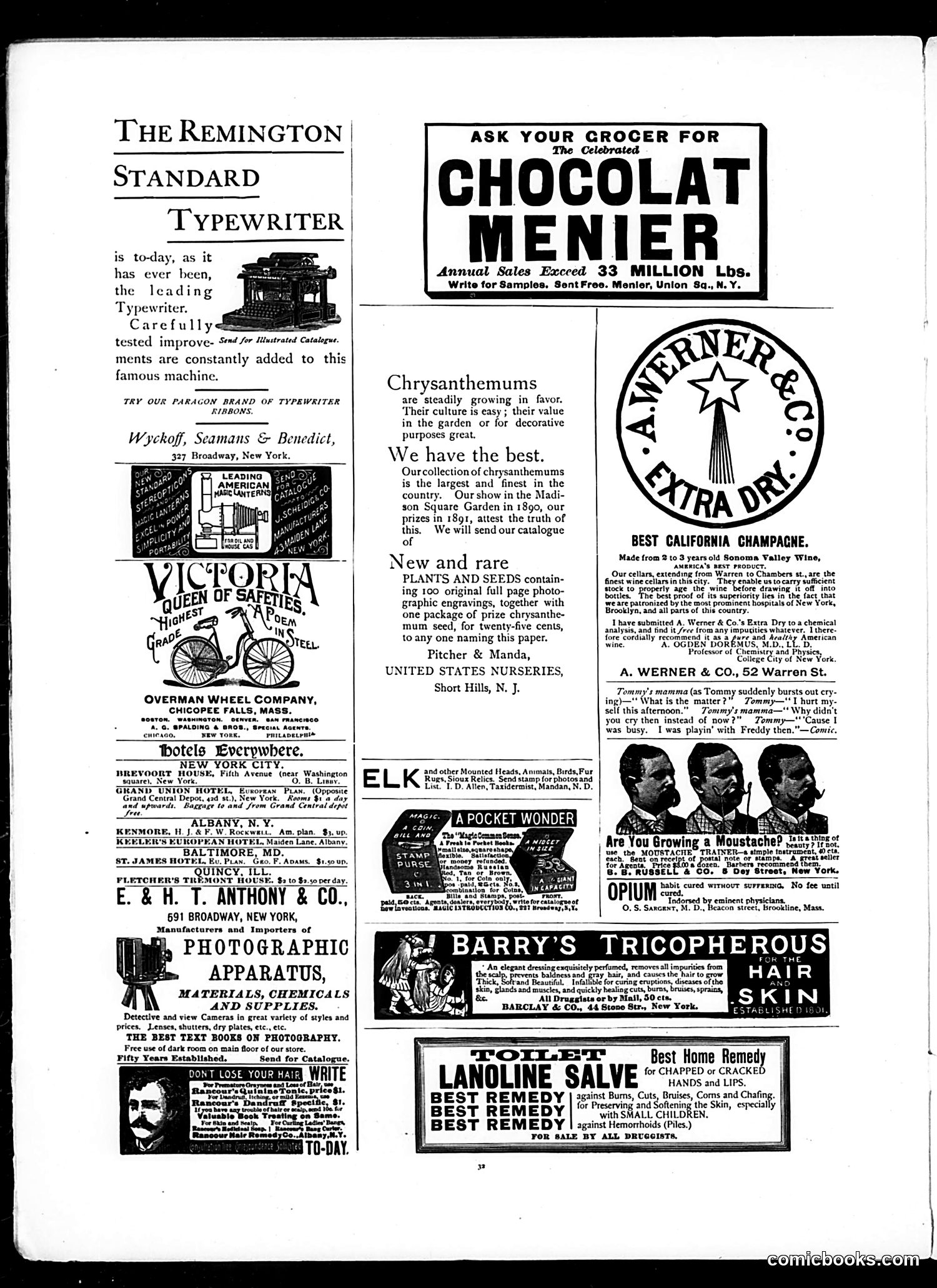
This page is **primarily advertising** with no significant political cartoons or satirical content requiring historical context. The layout contains various commercial advertisements typical of the 1890s era: typewriters (Remington), chocolates (Menier), chrysanthemums and seeds, hotels, photographic equipment, and personal grooming products (hair remedies, moustache growth aids, lanoline salve). The only narrative content is a brief joke at bottom center about a child named Tommy who injures himself but continues playing rather than cry—a mild domestic humor piece with no political significance. The page demonstrates Judge's dual function as both satirical magazine and advertising vehicle. No identifiable political figures, caricatures, or social commentary appear on this particular page. The content is straightforwardly commercial rather than satirical.
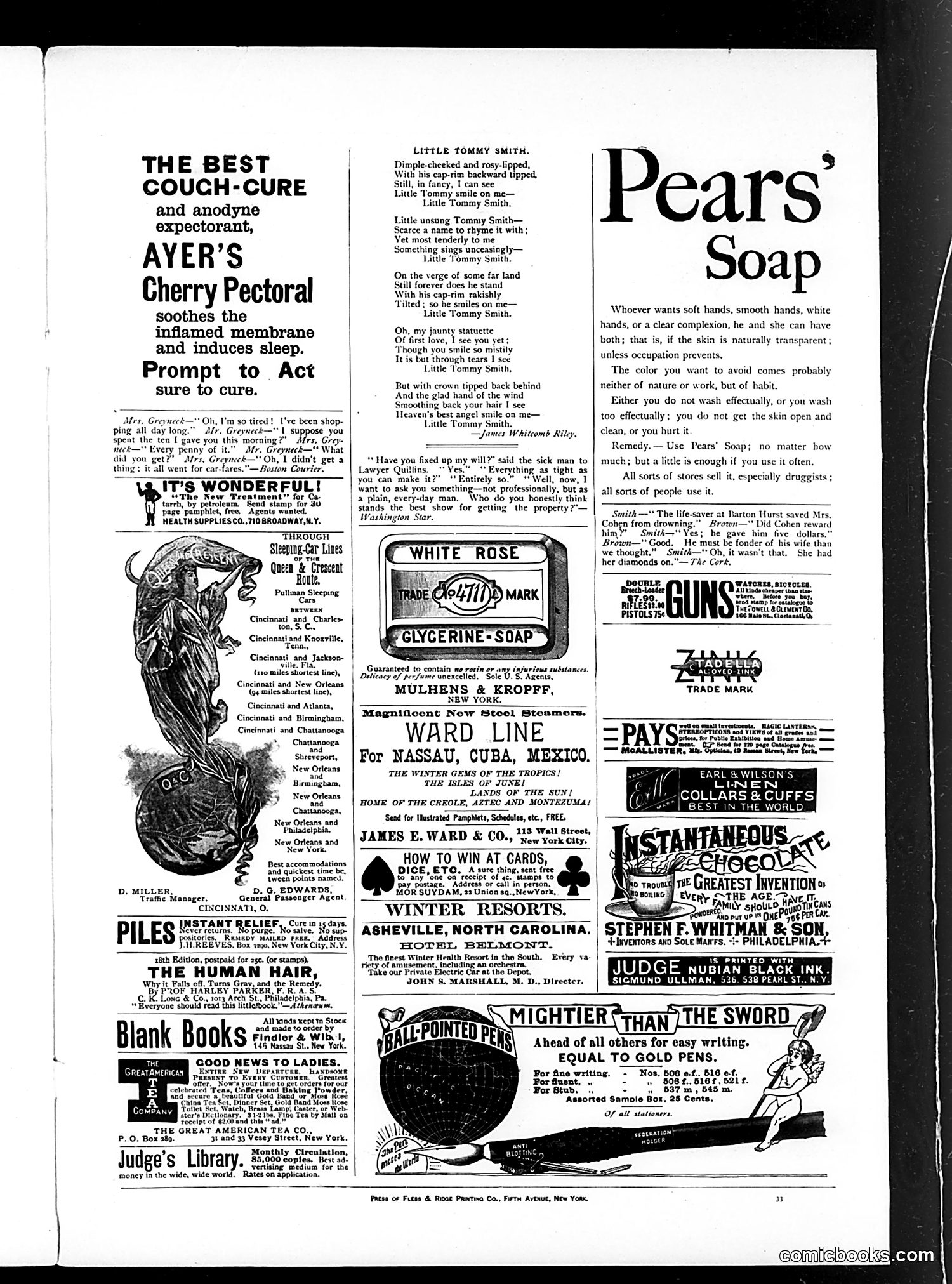
This page is primarily **advertisements and light verse**, not political cartoons requiring historical context. The main content is a sentimental poem by James Whitcomb Riley titled "Little Tommy Smith"—about nostalgic memory of childhood love, a common literary theme of the era. The repeated refrain creates melancholy reflection on lost innocence. The single comic dialogue depicts a domestic squabble: Mrs. Greyneck spent an entire day's shopping allowance on streetcar fare alone, buying nothing. The joke mocks both urban transportation costs and female shopping habits—a period stereotype about women's frivolous spending. The remainder consists of patent medicine ads (Ayer's Cherry Pectoral, hair treatments, hemorrhoid cures), travel promotions (Ward Line steamships to tropical destinations), and miscellaneous products typical of late-19th-century magazine advertising. **No significant political satire or caricature appears on this page.**
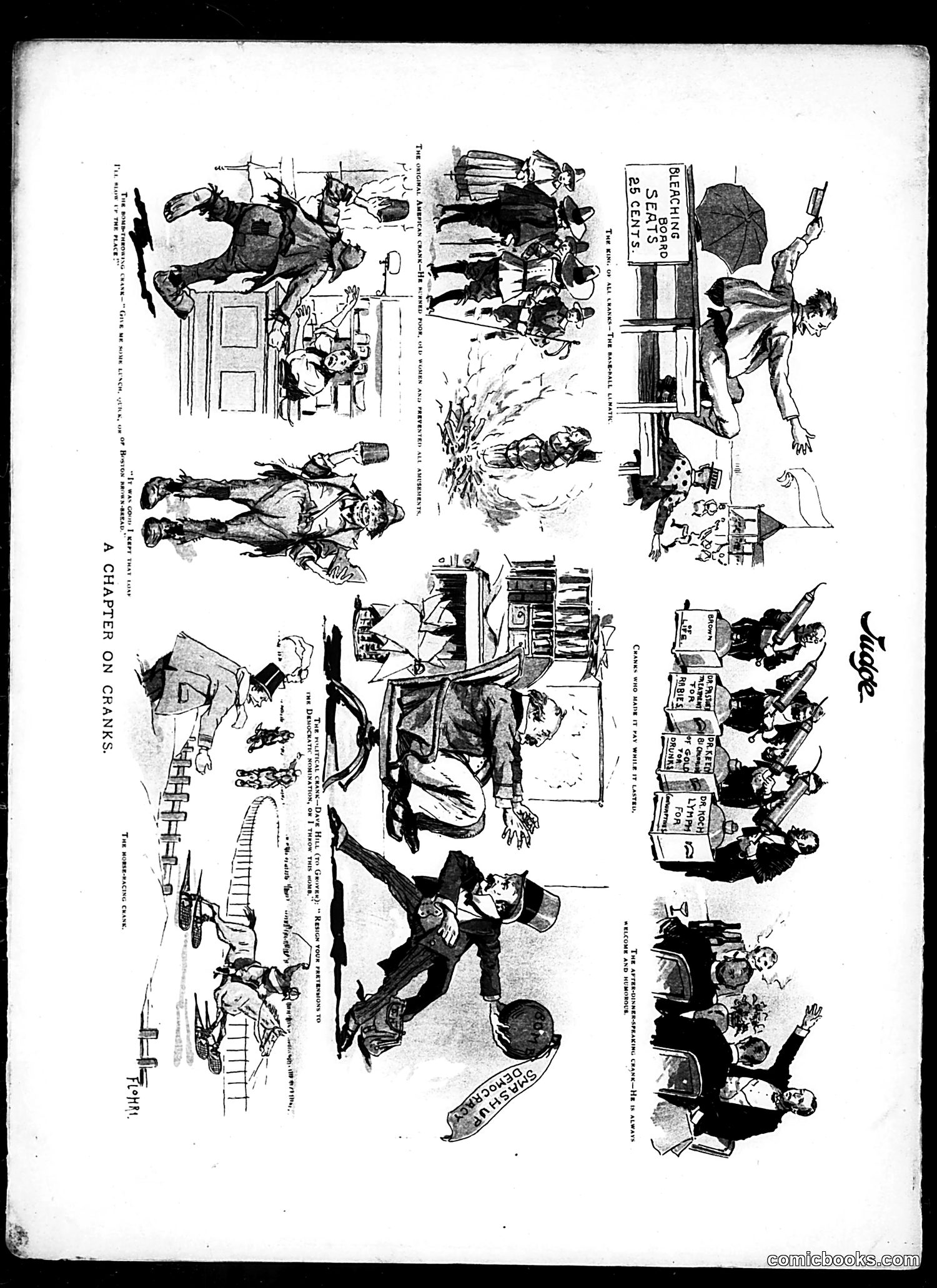
This page appears to be largely **advertising and promotional content** rather than political cartoons. The OCR'd text is severely corrupted and unreadable, consisting mainly of formatting characters and symbols. Visually, the page contains multiple illustrated vignettes in black and white, appearing to show various scenes with figures in period dress (likely early 20th century). There are several text boxes and what appears to be promotional or commercial material scattered throughout. **Without legible text, I cannot reliably identify specific political figures, events, or satirical targets.** To accurately explain the satire and context to modern readers would require either clearer OCR results or direct legibility of the original captions and headlines on this page.
I'm unable to provide a meaningful analysis of this page. The image is almost entirely black with only a thin white vertical strip visible on the left edge and a watermark "comicbooks.com" in the lower right. The OCR text appears corrupted or incomplete, containing only a website URL and fragmentary characters. To properly analyze this as a Judge magazine page and explain its political or social satire to modern readers, I would need a legible image showing the actual cartoon(s), illustrations, and readable text content. If you have a clearer version of this page, I'd be happy to help identify the figures, references, and satirical intent.