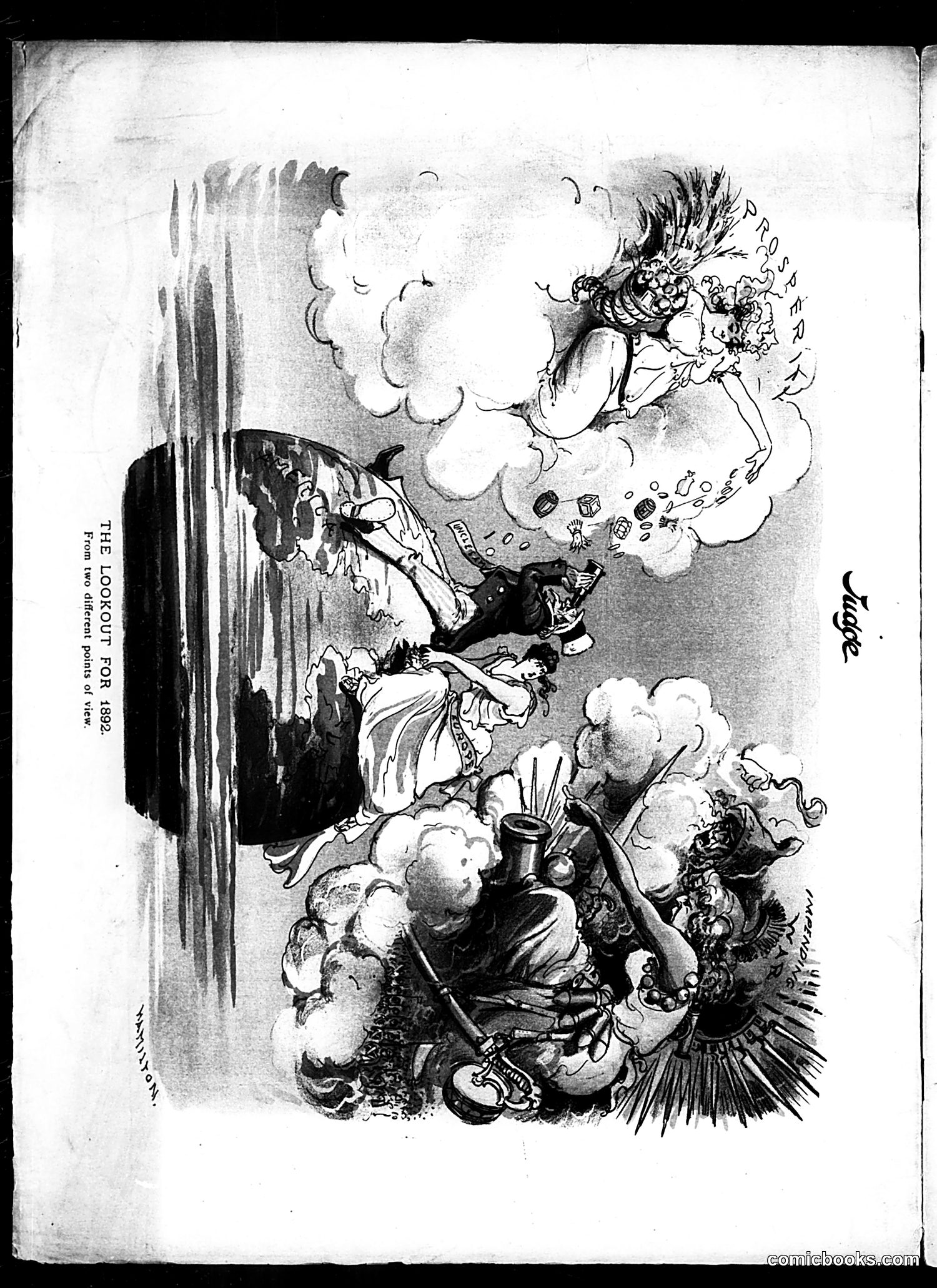
A complete issue · 18 pages · 1892
Judge — January 2, 1892
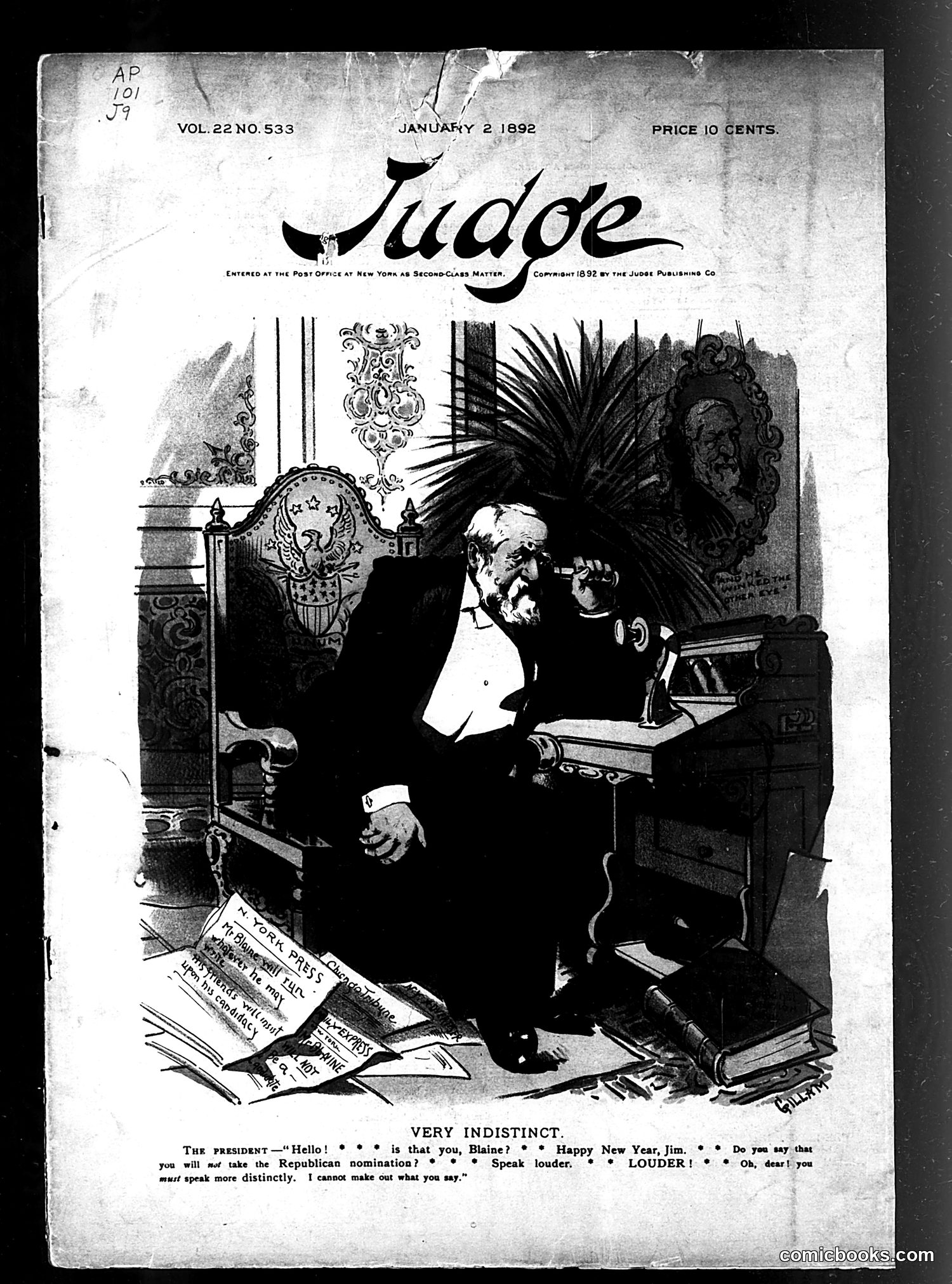
This cartoon satirizes President Benjamin Harrison's difficulty communicating with James G. Blaine (his Secretary of State). The scene shows Harrison at a telephone, struggling to hear Blaine on the other end, with the caption capturing their attempted conversation about Republican nomination prospects. The joke targets Harrison's allegedly weak or unclear speaking voice and communication style. The ornate office setting and scattered newspapers emphasize the presidential context. The cartoon suggests political discord or miscommunication within the Republican administration during an election year, mocking Harrison's ability to conduct important affairs of state when he cannot even communicate clearly over modern technology (the telephone).
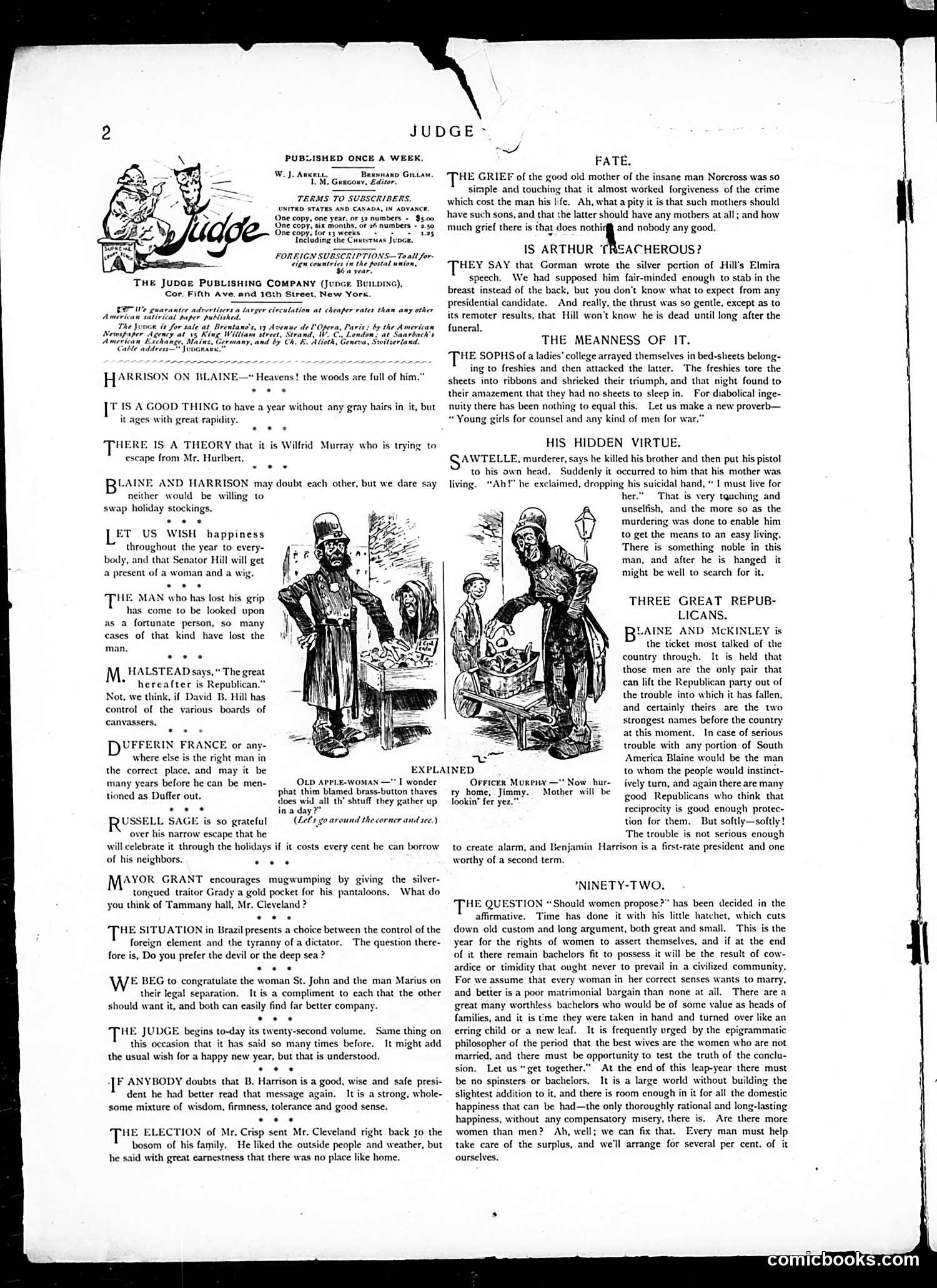
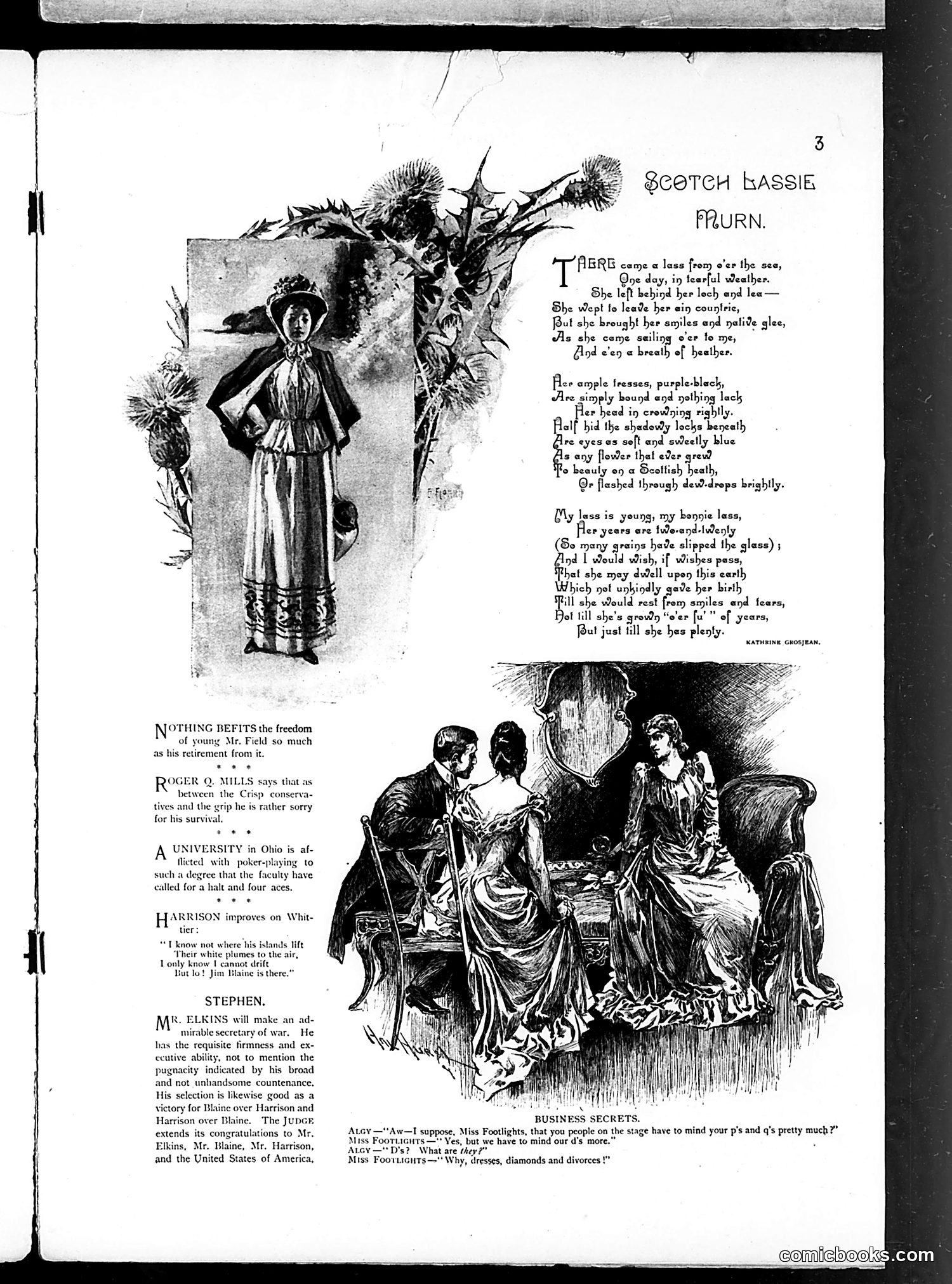
This page contains a poem titled "Scotch Lassie Friurn" by Katherine Coughlan, accompanied by illustrations of a Scottish woman in traditional dress surrounded by thistles. Below are brief prose sections praising various public figures: Field (appears to be about retirement), a note on Crop conservation and the Coop, a University of Ohio subscription degree, and commentary on Harrison's poetry about "white planes" and islands. The bottom section features a sketch of people in classical dress with dialogue from "Stephen" and commentary on Mr. Elkins's suitability for some unspecified position, mentioning "Harrison" and extending congratulations. **Without publication date or clearer context, the specific political references remain unclear.** The page appears to mix literary content with oblique commentary on late 19th or early 20th-century political figures and positions.
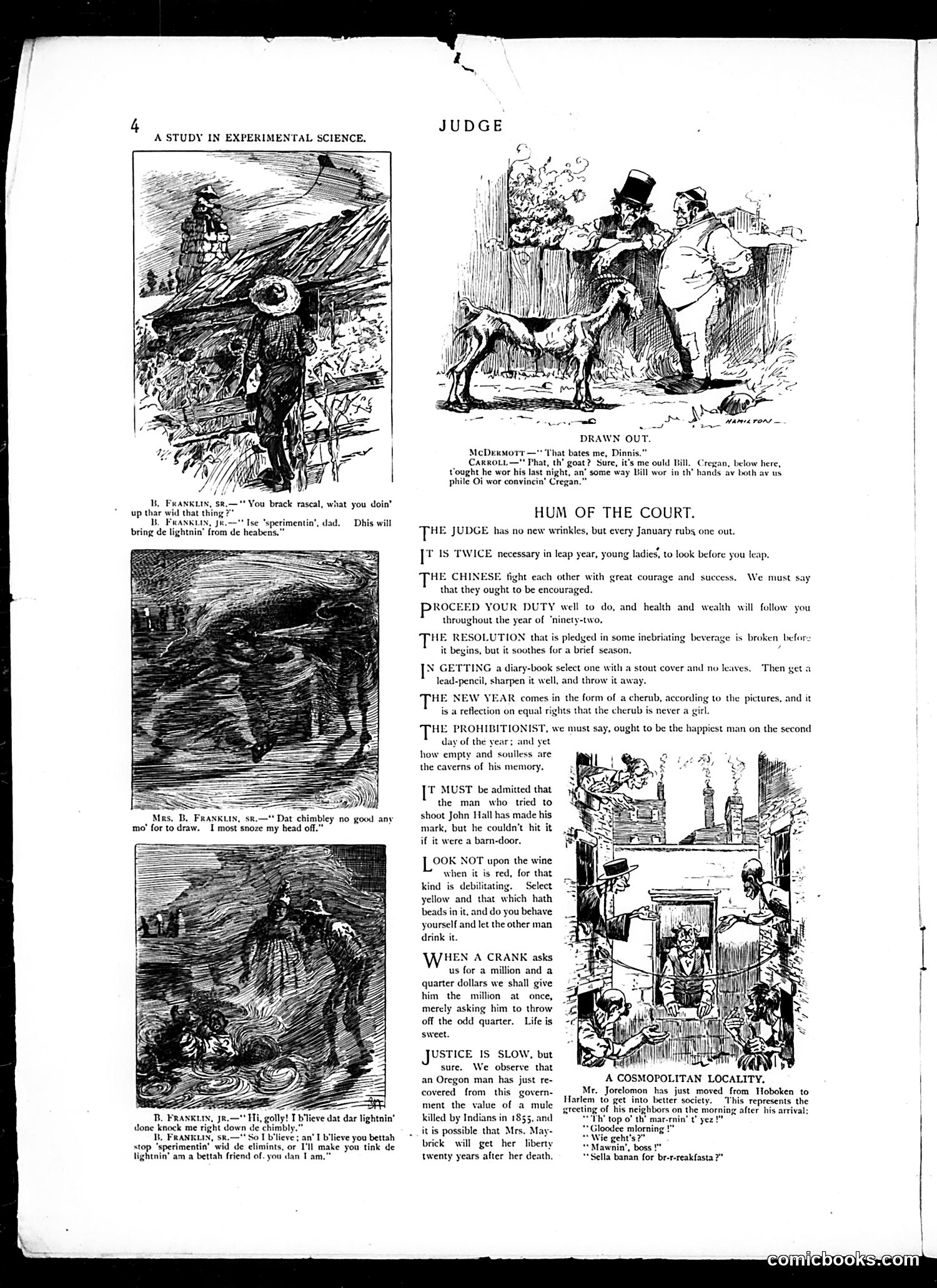
This page combines multiple satirical pieces typical of 1890s American humor: **"A Study in Experimental Science"** (left): A racist caricature depicting Black characters in dialect, playing on Benjamin Franklin's famous kite-lightning experiment. The "humor" relies on stereotypical speech patterns and the premise of Black people as ignorant experimenters—reflecting the casual racism endemic to period publications. **"Drawn Out"** (top right): Mocks Irish and German immigrants through exaggerated accents, suggesting social tension and ethnic prejudice common in the era. **"Hum of the Court"** (right): Miscellaneous satirical observations on New Year's resolutions, Chinese conflicts, prohibition, and legal delays—standard editorial commentary. The reference to Mayrick (likely Florence Maybrick, a real 1890s criminal case) suggests topical relevance. **"A Cosmopolitan Locality"** (bottom): Again mocks Irish and Italian immigrants moving to Harlem, using stereotypical dialect humor about bananas and morning greetings. The overall page reflects *Judge*'s characteristic ethnic and racial satire, standard for wealthy American publications of this period.
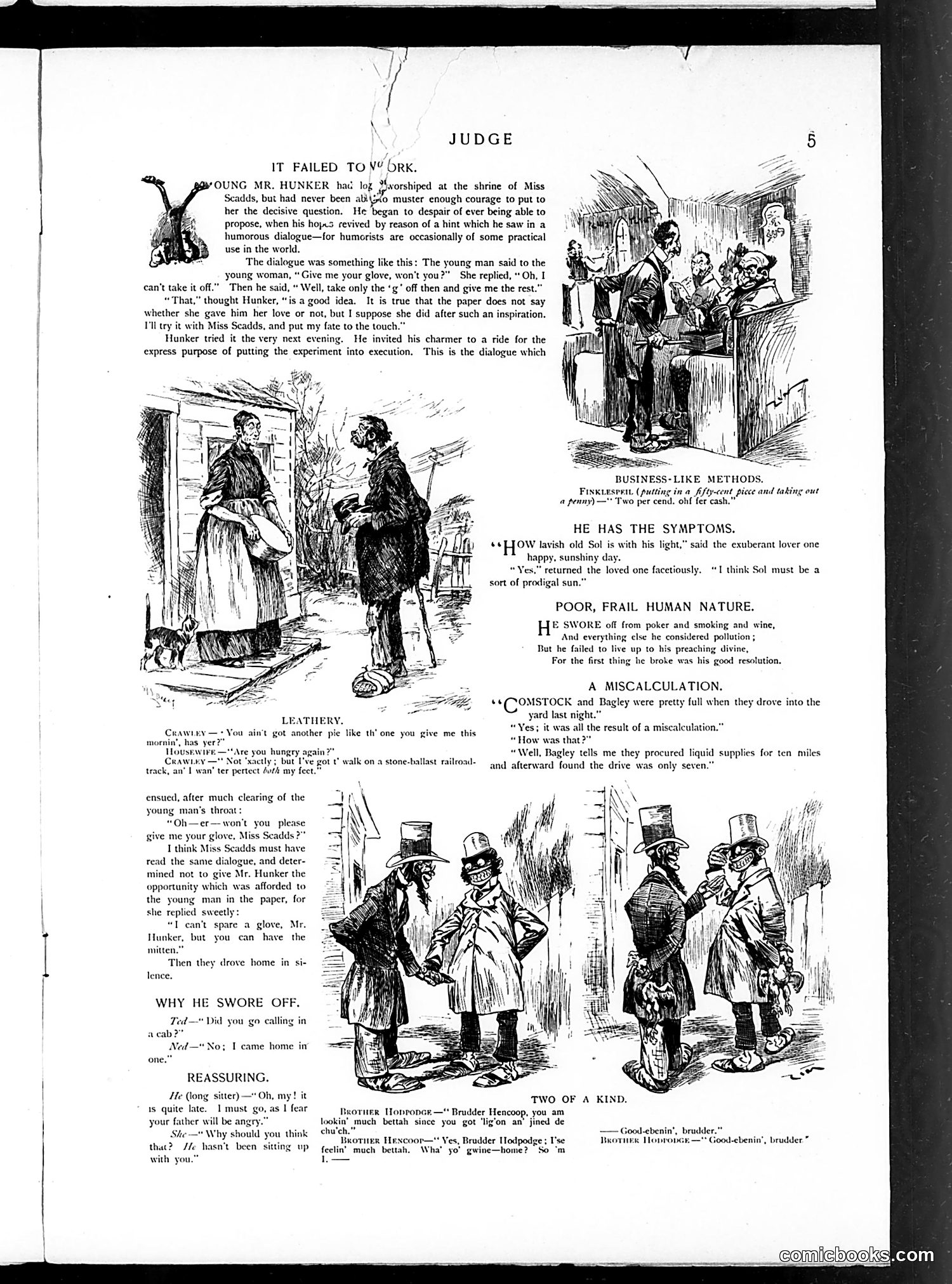
This page contains several satirical vignettes typical of late-19th-century American humor: **"It Failed to Work"** mocks a young man (Hunker) who attempts a wordplay proposal trick. He tries asking his romantic interest Miss Scadds for her "glove" with a pun ("give me your glove"/"give me your love"), but she rebuffs him with "I can't spare a glove...you can have the mitten"—rejection disguised as wit. **"Poor, Frail Human Nature"** satirizes hypocrisy: a man swears off vices but immediately breaks his resolution. **"A Miscalculation"** jokes about two drunk men who miscalculated distance: they obtained liquor supplies for ten miles but the actual drive was only seven. **"Two of a Kind"** depicts two African American men in dialect, discussing religion's effects—period-typical minstrelsy humor. The cartoons collectively target human folly: failed romance schemes, moral weakness, poor planning, and social pretense—staples of Judge's satirical approach to American life.
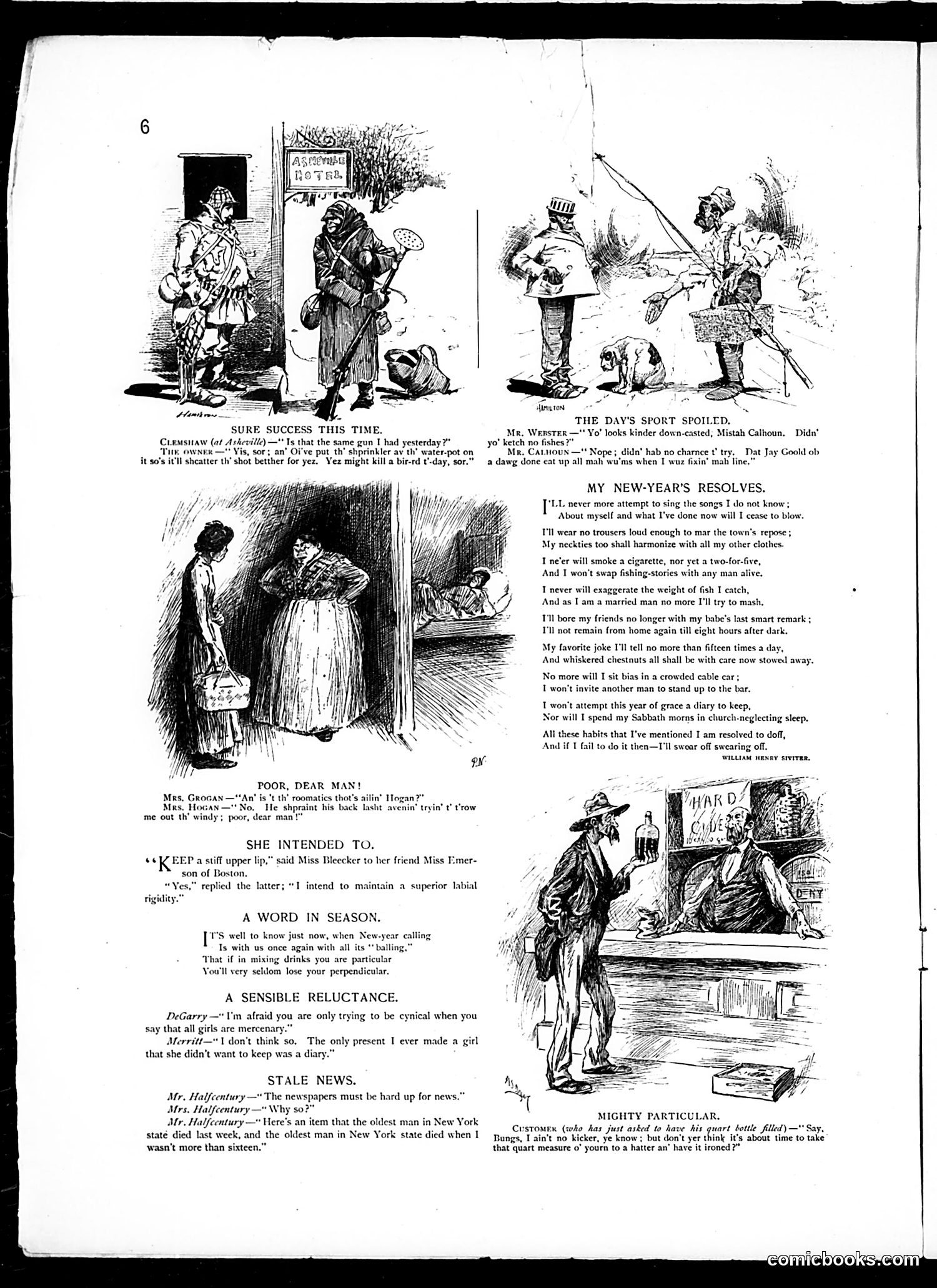
This page of satirical humor from Judge magazine (likely early 1900s) contains multiple short comedic pieces typical of the era: **"Sure Success This Time"** mocks incompetent hunting, with an Irish servant ("shprinkler," "shatter") reassuring his employer the gun now works better—yet they'll likely still fail to kill anything substantial. **"Poor, Dear Man!"** jokes about marital discord; Mrs. Hogan's husband injured his back trying to throw her out a window—dark domestic violence presented as comedy. **"The Day's Sport Spoiled"** depicts two Black men (rendered in period dialect) fishing, where one's bait got eaten by a dog instead of fish, spoiling the outing. This reflects the casual racism common in period publications. **"My New-Year's Resolves"** is a humorous poem about self-improvement—avoiding singing badly, loud clothes, exaggeration, boring friends with baby stories, sitting awkwardly on cable cars, and swearing off swearing off. **"Mighty Particular"** features a customer complaining a barkeeper's quart measure is undersized—suggesting he's being cheated on liquor purchases. The page emphasizes class-based humor, ethnic caricature, and domestic/social observation typical of Gilded Age American satire.
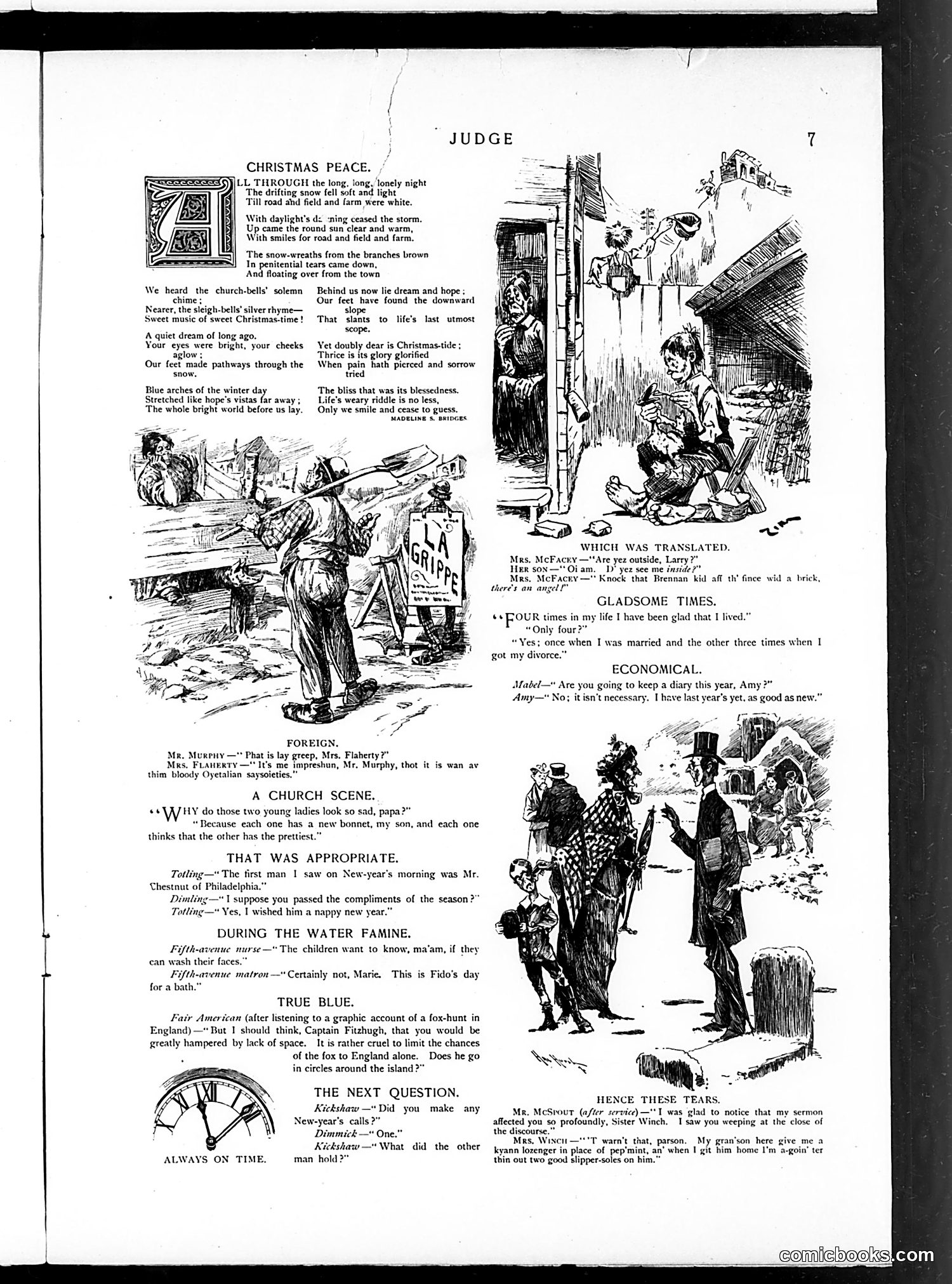
This page from the satirical magazine *Judge* contains multiple short humorous pieces typical of late 19th/early 20th-century American humor: **"Christmas Peace"** is a sentimental poem about the holiday season, contrasting peaceful winter imagery with life's hardships—not satirical. **The cartoons and brief jokes mock everyday social pretenses**: ladies jealous of each other's new bonnets; an Irish immigrant woman's malapropism calling Italian organizations "bloody Oyetalian saysoieties"; a woman prioritizing her dog's bath over her children's hygiene during a water shortage; a man misunderstanding an American woman's question about fox-hunting space in England. **"Gladsome Times"** sarcastically presents a woman grateful for marriage and *three divorces*—mocking both marital instability and changing divorce laws of the era. The humor consistently targets **class pretension, immigrant stereotypes, gender dynamics, and domestic absurdities** of the period. The Irish and "Fifth Avenue" wealthy characters appear regularly, reflecting Judge's audience and satirical focus on American social hierarchies and manners.
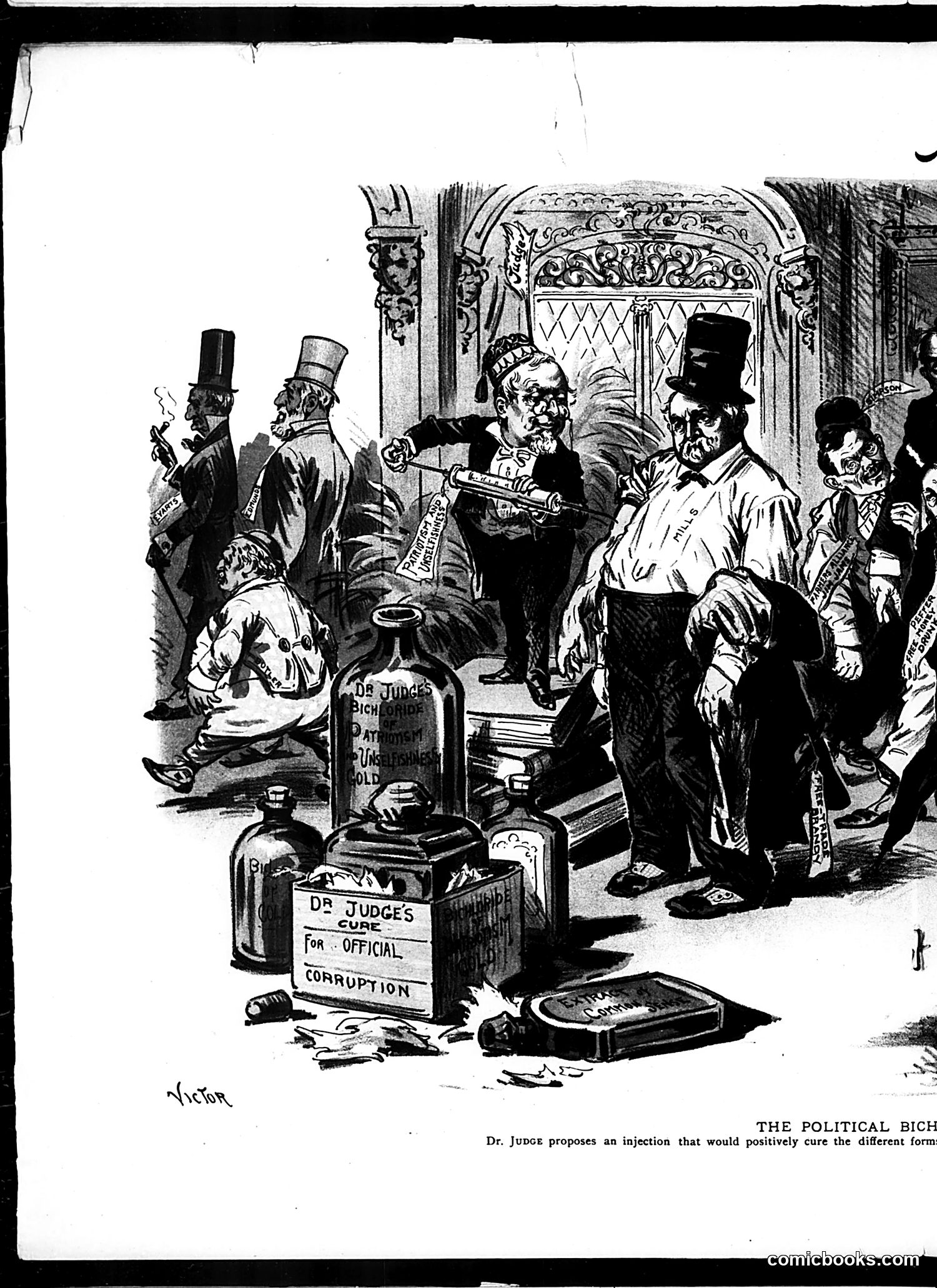
This satirical cartoon depicts "Dr. Judge" (the magazine's persona) proposing a medicinal "cure for official corruption" to a gathering of well-dressed politicians and officials. The bottles labeled "Dr. Judge's Cure" sit prominently in the foreground alongside a book titled "Corruption." The satire works on multiple levels: Judge magazine positions itself as a diagnostic authority offering remedy to systemic political corruption plaguing American government. The caricatured officials—portrayed as diseased patients requiring treatment—represent the corrupt establishment Judge sought to expose and ridicule. The cartoon's title, "The Political Bitch," uses crude language to emphasize the severity of corruption as an intractable problem. By framing corruption as a medical malady requiring "injection," the artist suggests both the pervasiveness of the problem and Judge's role as moral physician diagnosing society's ills.
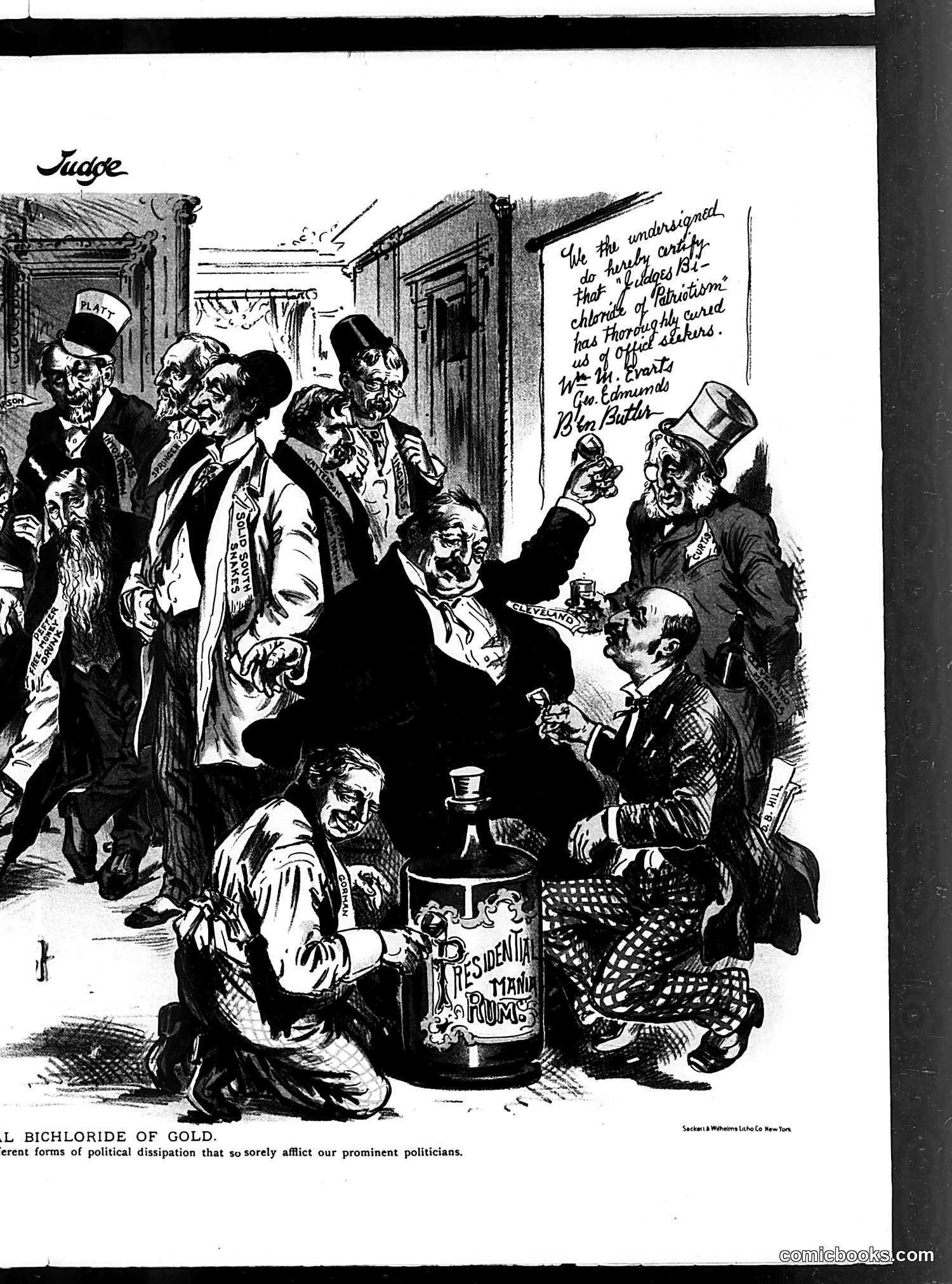
This political cartoon satirizes corruption among prominent politicians through a medical metaphor. "Bichloride of gold" was a mercury-based treatment for syphilis, here representing a "cure" for political corruption ("dissipation"). The cartoon depicts well-dressed politicians gathered around a bottle labeled "Presidential Mum Fumes" or similar, suggesting they're intoxicated or deluded by power and money. The caricatured figures—appearing greedy and grotesque—represent various political figures engaged in corrupt practices. The satire suggests that wealthy interests ("gold") have infected the political establishment like a disease, and that politicians are either complicit in or victims of this systemic corruption. The crude, exaggerated features typical of Gilded Age political cartooning emphasize the moral degeneracy Judge attributed to such figures. The specific politicians remain unclear without additional context or caption information.
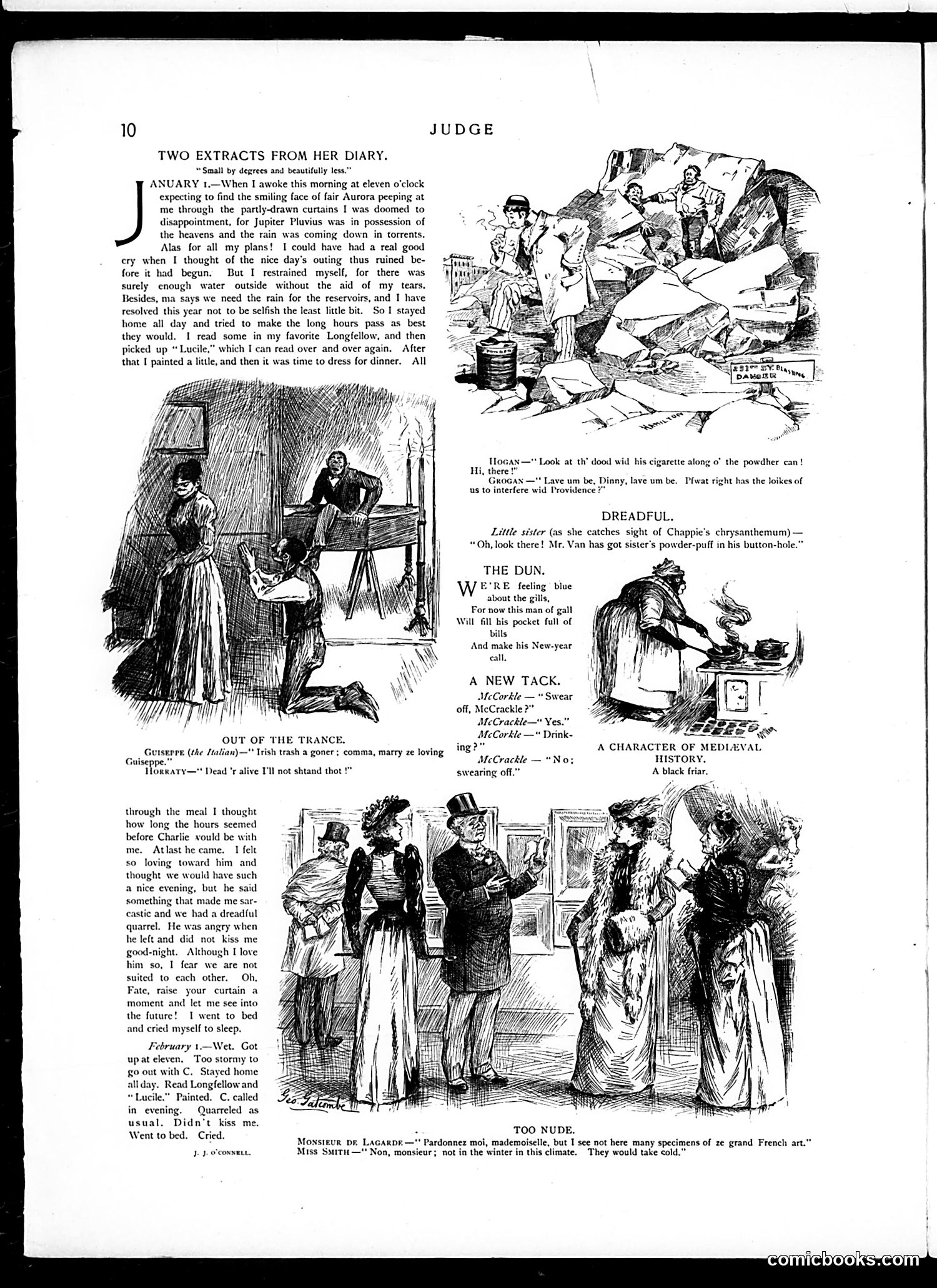
This page contains diary extracts and several satirical cartoons typical of Judge's social humor: **The Diary Extracts** mock a sentimental young woman's melodramatic complaints—a rainy day ruins her plans, she reads Longfellow and "Lucile" (romantic poetry), quarrels with her boyfriend Charlie, and cries herself to sleep. The repetition in the February entry emphasizes her predictable emotional cycles, satirizing Victorian female sentimentality and lack of meaningful activity. **The Cartoons** target various subjects: - "Out of the Trance" appears to mock Irish immigrants (the dialect suggests this) - "Too Nude" shows a Frenchman criticizing American prudishness, likely satirizing both affected European aesthetics and American moral conservatism - "The Dun" and "A New Tack" depict working-class men scheming, using heavy dialect humor - Various vignettes mock pretension, courtship complications, and class differences The overall tone reflects Judge's satirical approach to American society, targeting sentimental femininity, immigrant speech patterns, class pretension, and social hypocrisy through caricature and exaggeration.
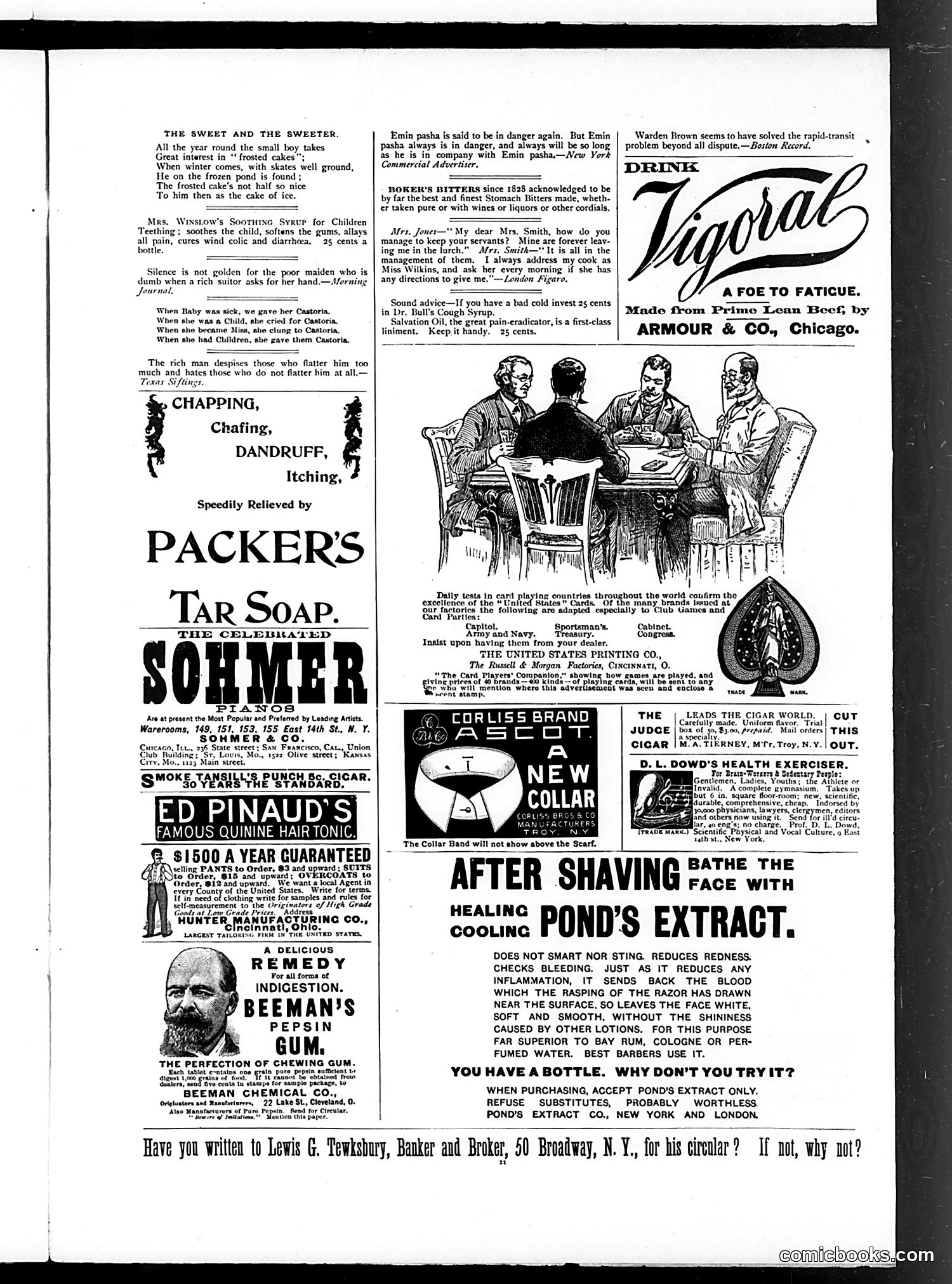
This page consists primarily of **advertisements and short humorous observations** rather than political cartoons. The main elements include period product ads (patent medicines like Castoria, Beeman's Pepsin for indigestion; Packer's Tar Soap; Ed Pinaud's Hair Tonic) typical of late 19th-century magazines, interspersed with brief satirical quips about social behavior. One notable entry references **Emin Pasha**, an Ottoman military commander who became a focus of African exploration narratives in the 1880s-90s, suggesting this issue dates to that era. The humor relies on recognizably Victorian jokes: a boy preferring frozen ponds to cake; unmarried women needing to flatter suitors; wealthy men's paradoxical attitudes toward flattery. A final quip about "Warden Brown" solving transit problems is unclear without additional context—possibly a local reference or inside joke. The page essentially showcases *Judge* magazine's format: mixing commercial advertisements with light social satire rather than pointed political commentary.
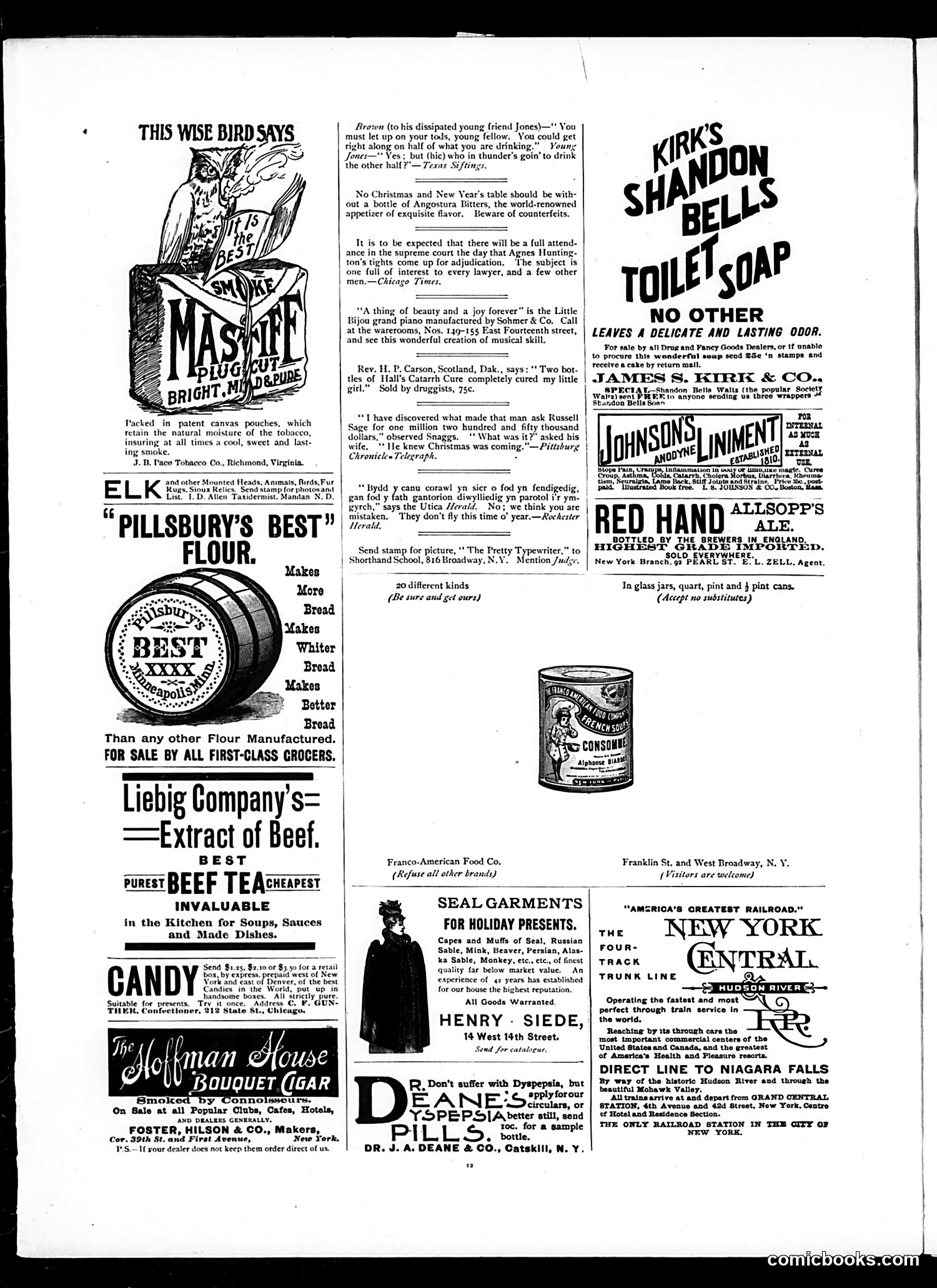
This is primarily an **advertising page** with minor satirical content. The page contains commercial advertisements for products like flour, beef extract, soap, and ale typical of the period. The few satirical jokes included are brief: 1. **Brown and Jones dialogue**: A morality joke where a man lectures his dissipated young friend about drinking less, but the friend quips he can't cut his consumption in half because someone else needs to drink "the other half." 2. **Agnes Huntington reference**: A joke about her "tights" coming before the Supreme Court, implying public interest motivated by viewing her legs rather than legal merit—a reference to the actress and her scandalous theatrical costumes of the era. 3. **Russell Sage joke**: A quip about why a man asked the famous millionaire Russell Sage for $1.25 million—because Christmas was coming. These are light, social humor typical of Judge's satirical tone, poking fun at drinking culture, sexual propriety, and wealth disparities.
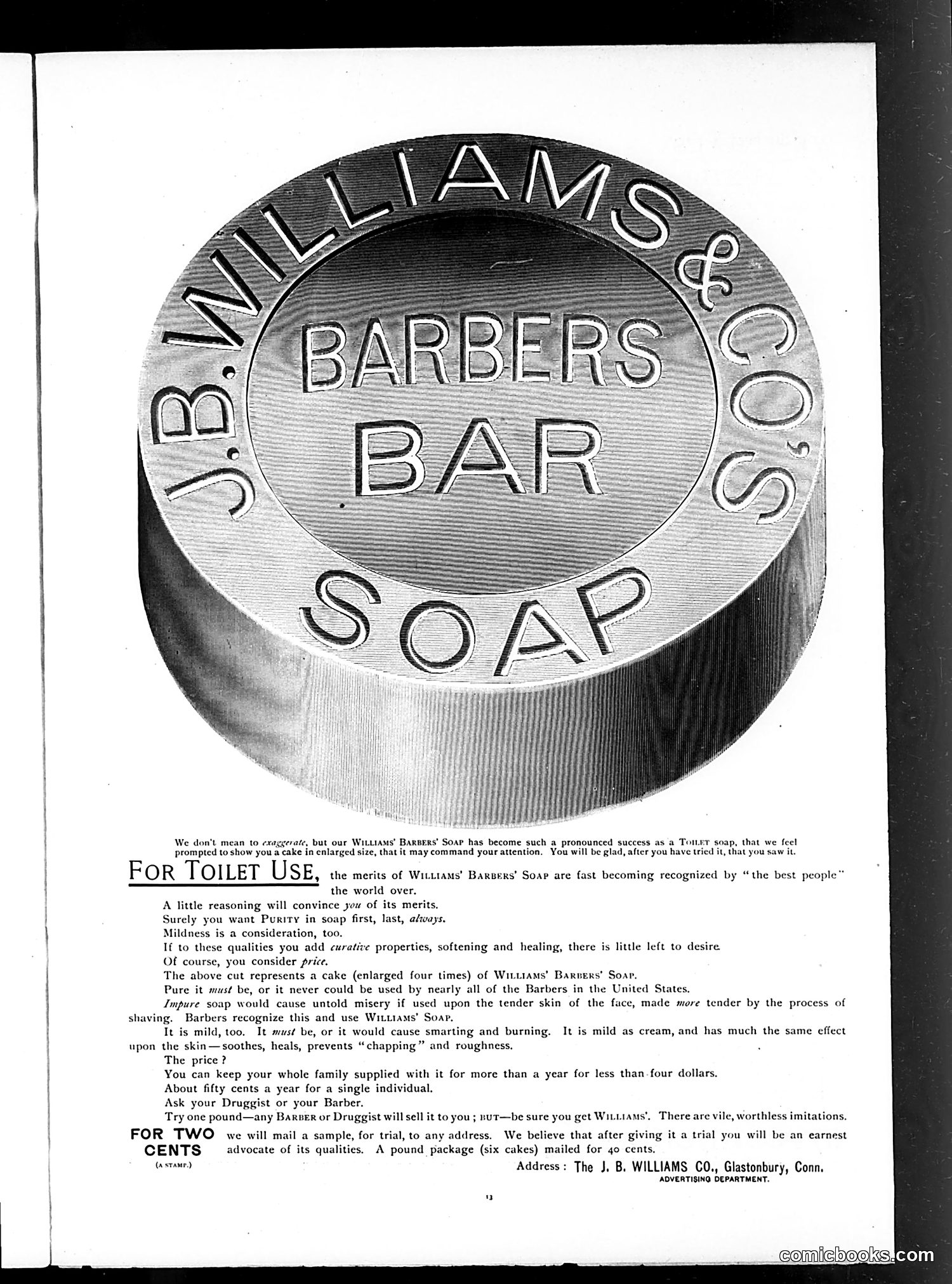
This page is primarily a **product advertisement**, not political satire. It promotes Williams' Barbers' Soap, a toiletry product made by J.B. Williams Co. of Connecticut. The large circular image at top shows an **enlarged cake of soap** (four times actual size) to command attention. The advertisement emphasizes purity, mildness, and curative properties—claiming the soap is used by barbers nationwide and suitable for delicate post-shave skin. The marketing pitch targets both professional barbers and households, highlighting affordability (under four dollars annually for a family) and offering a two-cent sample by mail. The text warns against "vile, worthless imitations," suggesting competitive market concerns. This represents **early 20th-century advertising strategy**: leveraging professional endorsements (barbers), emphasizing product quality and health benefits, and using direct-mail sampling to drive consumer adoption. The inclusion in *Judge* magazine indicates advertisers paid for prominent placement in popular publications.
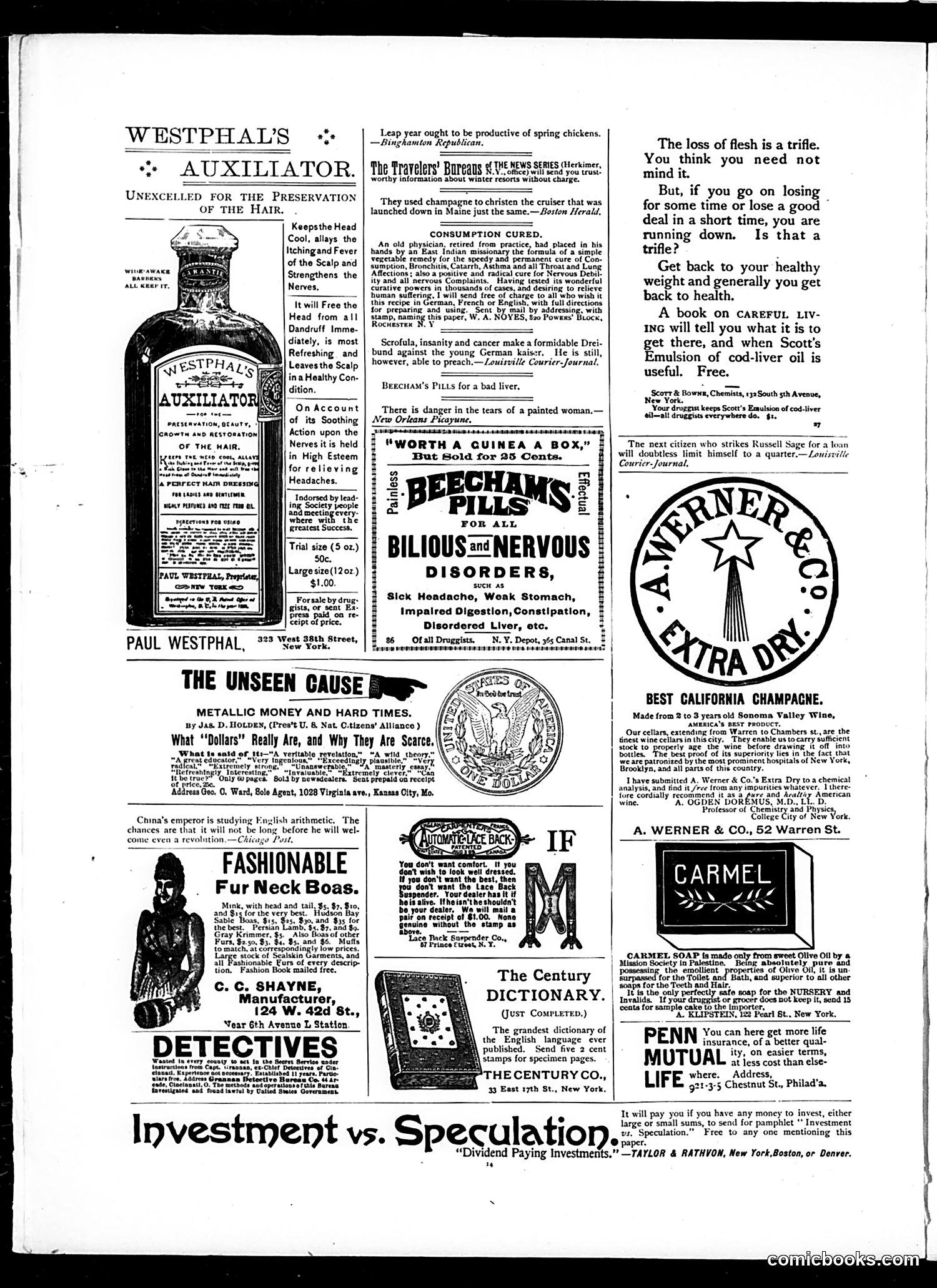
This is primarily a **commercial advertising page** from Judge magazine, not a political cartoon. The page consists almost entirely of period product advertisements (hair products, patent medicines, champagne, clothing) interspersed with brief satirical one-liners typical of Judge's style. The few satirical remarks that appear are short jokes rather than developed cartoons: - A quip about "leap year" producing spring chickens (playing on leap year traditions) - A jab at Germany's Kaiser Wilhelm II suggesting he suffers from multiple serious ailments despite his public persona - A jibe at China's emperor learning English arithmetic, suggesting modernization won't prevent revolution The page's main content—ads for Westphal's hair tonic, Beecham's Pills, fur boas, and other goods—reflects late 19th-century American consumer culture. These ads often made exaggerated medical claims now recognized as fraudulent. The page demonstrates how Judge mixed advertising revenue with satirical content.
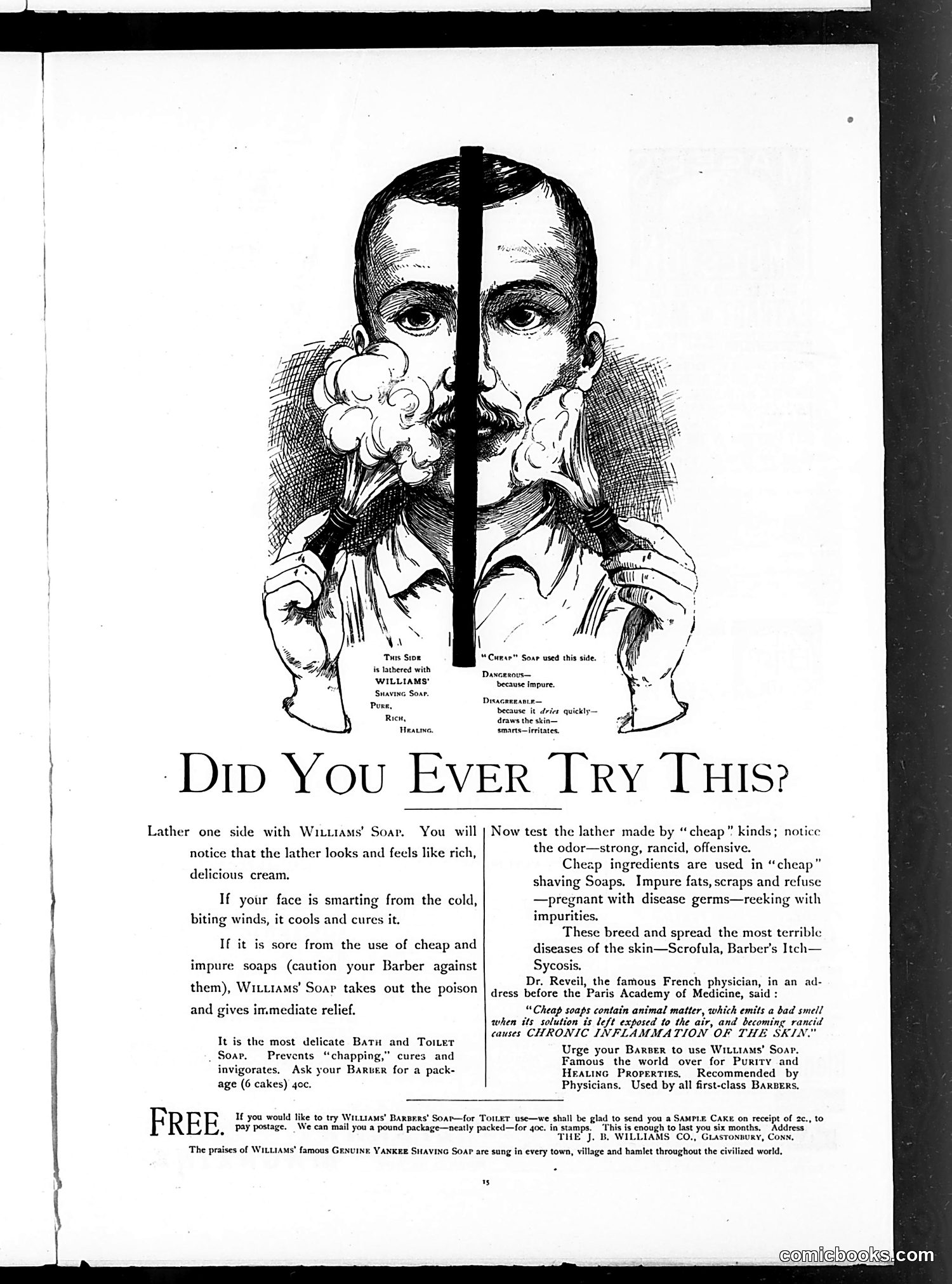
This is primarily a **product advertisement**, not political satire. The page uses a split-face comparison diagram to promote Williams' Shaving Soap against unnamed "cheap" competitors. **The Visual Gimmick:** A man's face is divided vertically—one side lathered with Williams' Soap (labeled with positive attributes: "Pure, Rich, Healing"), the other with generic "cheap soap" (labeled "Dangerous," "Disagreeable," "dries quickly"). **The Sales Pitch:** Williams claims superiority through purity and safety. The ad warns that cheap soaps contain "impure fats, scraps and refuse—pregnant with disease germs" that cause serious skin diseases like scrofula and barber's itch. It even quotes a French physician's authority to legitimize these claims. **Historical Context:** This reflects late 19th/early 20th-century advertising tactics: fearmongering about product quality, medical-sounding claims, and appeals to class consciousness (buying cheap = risking disease). The offer of free samples suggests direct-mail marketing was emerging. There is no political content or identifiable caricatures—this is straightforward competitive advertising.
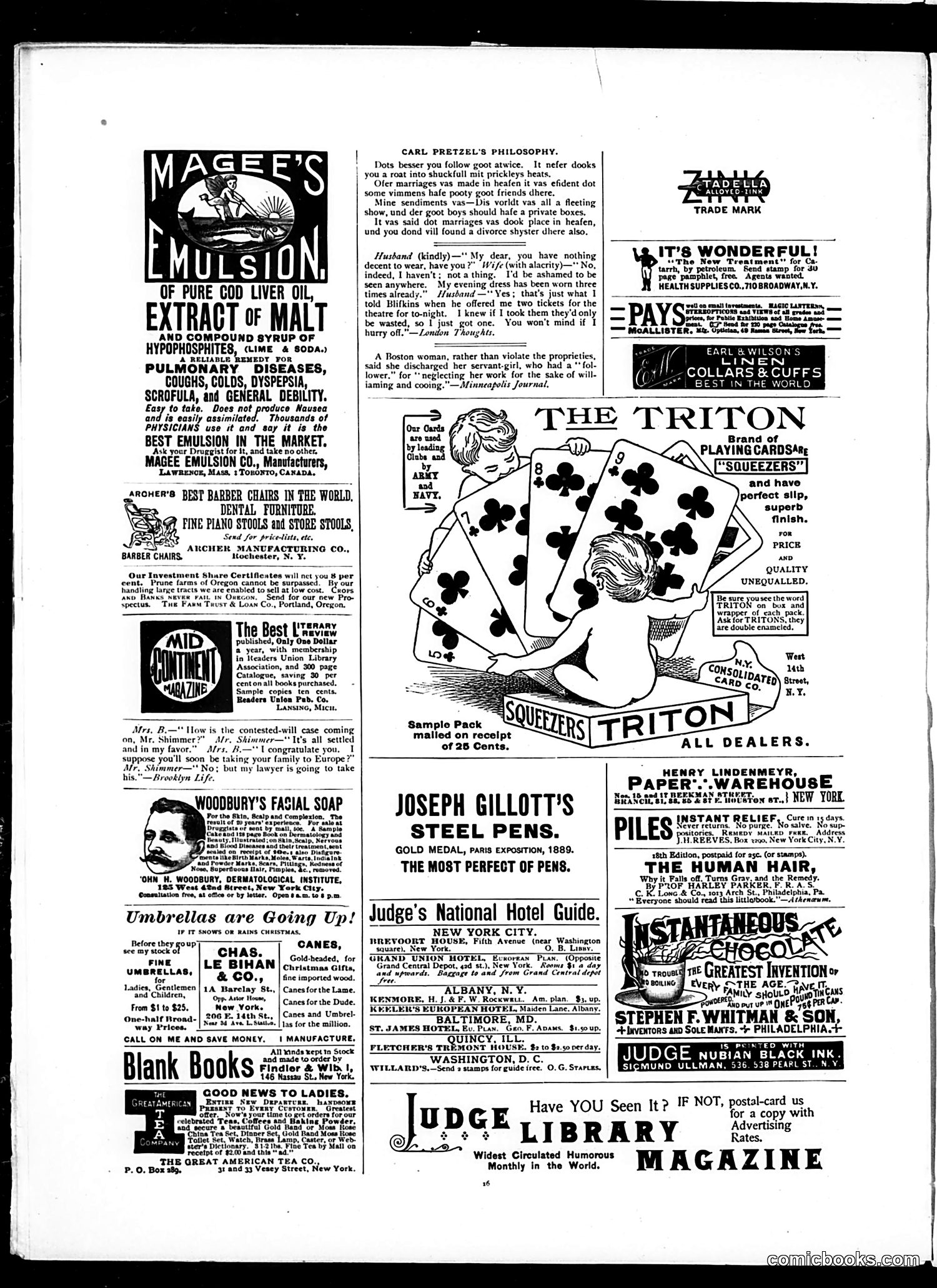
This page is primarily **advertising**, with some editorial humor pieces. The main visual element is an illustrated advertisement for **The Triton brand of playing cards**, prominently featuring a bare-shouldered woman holding oversized cards, marketed for their superior finish and squeezers (compressed-edge design). The smaller text items are comedic observations, likely by a character named **Carl Pretzel** (identifiable by the dialect writing), who offers humorous, broken-English philosophical observations about marriage and relationships—typical of period comic relief. Other significant advertisements include: - **Magee's Emulsion** (cod liver oil tonic) - **Woodbury's Facial Soap** (skin treatment) - **Joseph Gillott's Steel Pens** - Hotel guides and various business services The humor pieces contain mild social commentary: one mocks men's selfishness regarding wives' wardrobes, another criticizes women's concern with propriety. These reflect period attitudes toward gender relations and social pretense rather than satirizing specific political figures or events.
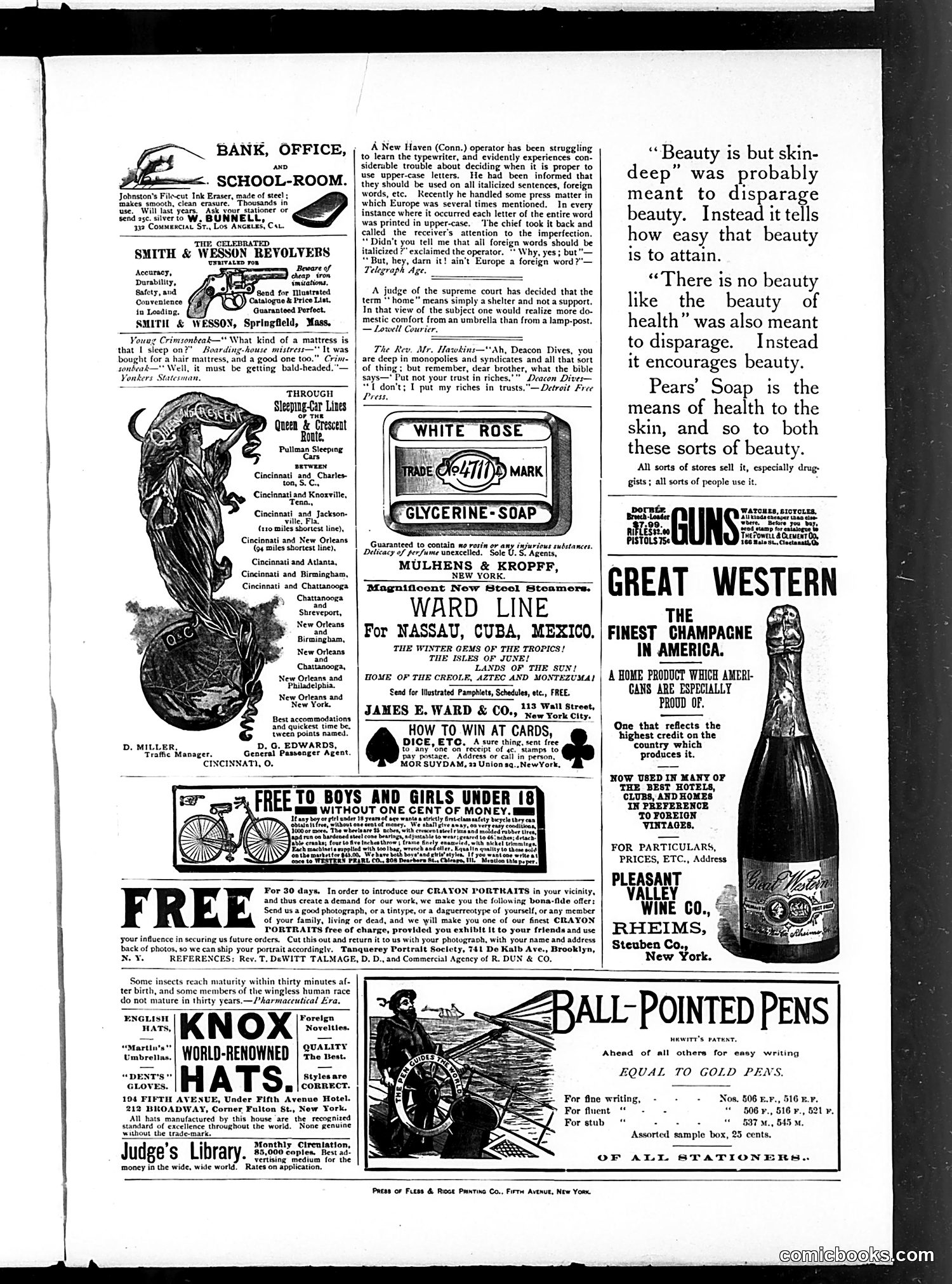
This page is primarily **advertising and light humor**, not political satire. The content includes: **Humorous anecdotes** (not cartoons): - A typewriter operator mistakenly capitalizes every letter of "EUROPE" thinking foreign words require italics - A judge's ruling that "home" means shelter, not support—mocked as absurdly literal - A deacon deflecting biblical warnings about riches by claiming he puts his wealth in "trusts" (corporate trusts, a contemporary business structure) **Advertisements dominate** the page: ink erasers, Smith & Wesson revolvers, sleeping car lines, Pears' Soap (with pseudo-philosophical copy about beauty and health), steamship lines to Cuba and Mexico, and Ball-Pointed Pens. The **Pears' Soap ad** uses clever inversion—turning the saying "beauty is but skin-deep" into an endorsement by arguing this actually makes beauty *easy* to attain through soap. The humor is gentle wordplay and irony rather than sharp political commentary. This appears to be a typical Judge page mixing light comedy with revenue-generating advertisements.