
Judge, 1892-01-02 · page 7 of 18
Judge — January 2, 1892 — page 7: what you’re looking at
What you’re looking at
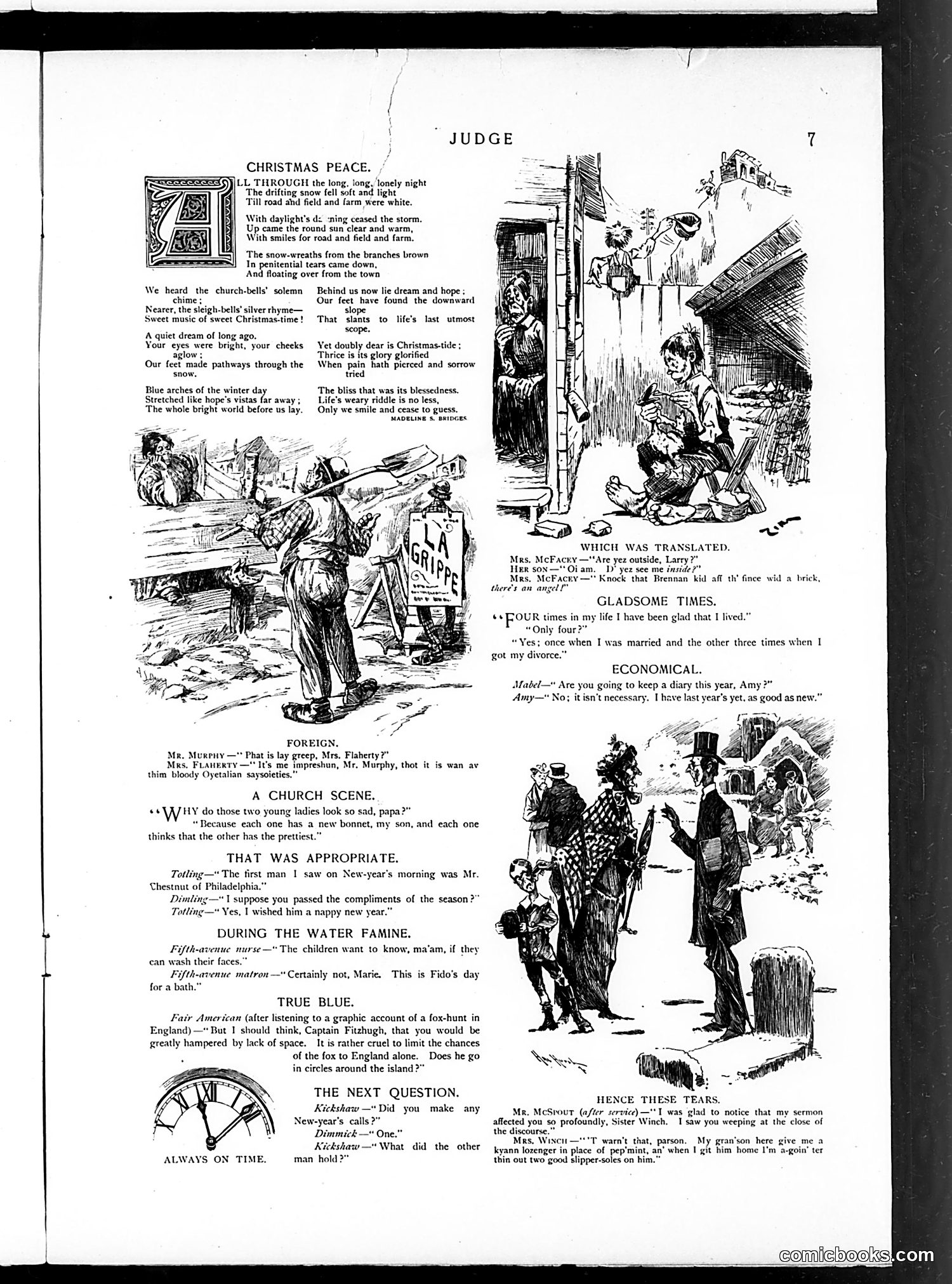
This page from the satirical magazine *Judge* contains multiple short humorous pieces typical of late 19th/early 20th-century American humor: **"Christmas Peace"** is a sentimental poem about the holiday season, contrasting peaceful winter imagery with life's hardships—not satirical. **The cartoons and brief jokes mock everyday social pretenses**: ladies jealous of each other's new bonnets; an Irish immigrant woman's malapropism calling Italian organizations "bloody Oyetalian saysoieties"; a woman prioritizing her dog's bath over her children's hygiene during a water shortage; a man misunderstanding an American woman's question about fox-hunting space in England. **"Gladsome Times"** sarcastically presents a woman grateful for marriage and *three divorces*—mocking both marital instability and changing divorce laws of the era. The humor consistently targets **class pretension, immigrant stereotypes, gender dynamics, and domestic absurdities** of the period. The Irish and "Fifth Avenue" wealthy characters appear regularly, reflecting Judge's audience and satirical focus on American social hierarchies and manners.
📄 Transcribed text from this page (OCR, searchable)
Machine-transcribed from the original scan — historical spelling and the odd misread are preserved.
CHRISTMAS PEACE. LL THROUGH the long, long, ‘lonely night ‘The drifting snow fell soft and light Till road ahd field and farm were white. With daylight’s d= -ning ceased the storm. Up came the round sun clear and warm, With smiles for road and field and farm, ‘The snow-wreaths from the branches brown In penitential tears came down, And floating over from the town | We heard the church-bells’ solemn i] chime ; i} Nearer, the sleigh-bells’ silver rhyme— Sweet music of sweet Christmas-time ! Behind us now lie dream and hope ; Our feet have found the downward slope That slants to life's last utmost scope. A quiet dream of long ago. ere Your eyes were bright, your cheeks aglow ; | Our feet made pathways through the snow. Blue arches of the winter day Stretched like hope’s vistas far away ; ‘The whole bright world before us lay. Yet doubly dear is Christmas-tide ; ice is its glory glorified When pain hath pierced and sorrow tried The bliss that was its blessedness. Life's weary riddle is no less, Only we smile and cease to gues MADELINE S. BRIDGES FOREIGN, Mr, Mugeny —" Phat is lay greep, Mrs. Flaherty?” Mrs. FLanexty—"'It's me impreshun, Mr, Murphy, thot it is wan av thim bloody Oyetalian saysoieties.” A CHURCH SCENE, + © WHY do those two young ladies look so sad, papa?” “Because each one has a new bonnet, my son, and each one thinks that the other has the prettiest.” THAT WAS APPROPRIATE. Tolling—“ The first man I saw on New-year's morning was Mr. Thestnut of Philadelphia.” Dimling—"1 suppose you passed the compliments of the season ?” Totling—" Yes, 1 wished him a nappy new year.” DURING THE WATER FAMINE. Fiftheavenue nurse—"The children want to know, ma'am, if they can wash their faces.” Fifth-avenue matron — Certainly not, Marie, This is Fido's day for a bath.” TRUE BLUE. Fair American (alter listening to a graphic account of a fox-hunt in England) —But I should think, Captain Fitzhugh, that you would be greatly hampered by lack of space. It is rather cruel to limit the chances of the fox to England alone. Does he go in circles around the island?" THE NEXT QUESTION. Kickshaw —" Did you make New-year's calls?” Dimmick —" One.” Kickshaw —" What did the other man hold >” any ALWAYS ON TIME. WHICH WAS TRANSLATED. Mrs, McFacky —"‘Are yez outside, Larry?" am. D° yez see me inside?” Mrs. McFacry—** Knock that Brennan kid aff th’ fince wid a brick, there's an angel!” GLADSOME TIMES. 4+ FOUR times in my life T have been glad that I lived.” “Only four?” “Yes; once when I was married and the other three times when I got my divorce.” ECONOMICAL. Mabel— Are you going to keep a diary this year, Amy?” Amy—* No; it isn’t necessary. I have last year's yet, as good as new.” HEN E THESE TEARS. Mr, McSrout (after service) —'* 1 was glad to notice that my sermon affected you so profoundly, Sister Winch, the discourse.” Mrs, Wincit—""'T warn't that, parson. My gran'son here give me a kyann lozenger in place of pep'mint, an’ when I git him home I’m a-goin’ ter thin out two good slipper-soles on him.” T saw you weeping at the close of _ comichooks