
A complete issue · 19 pages · 1891
Judge — December 26, 1891
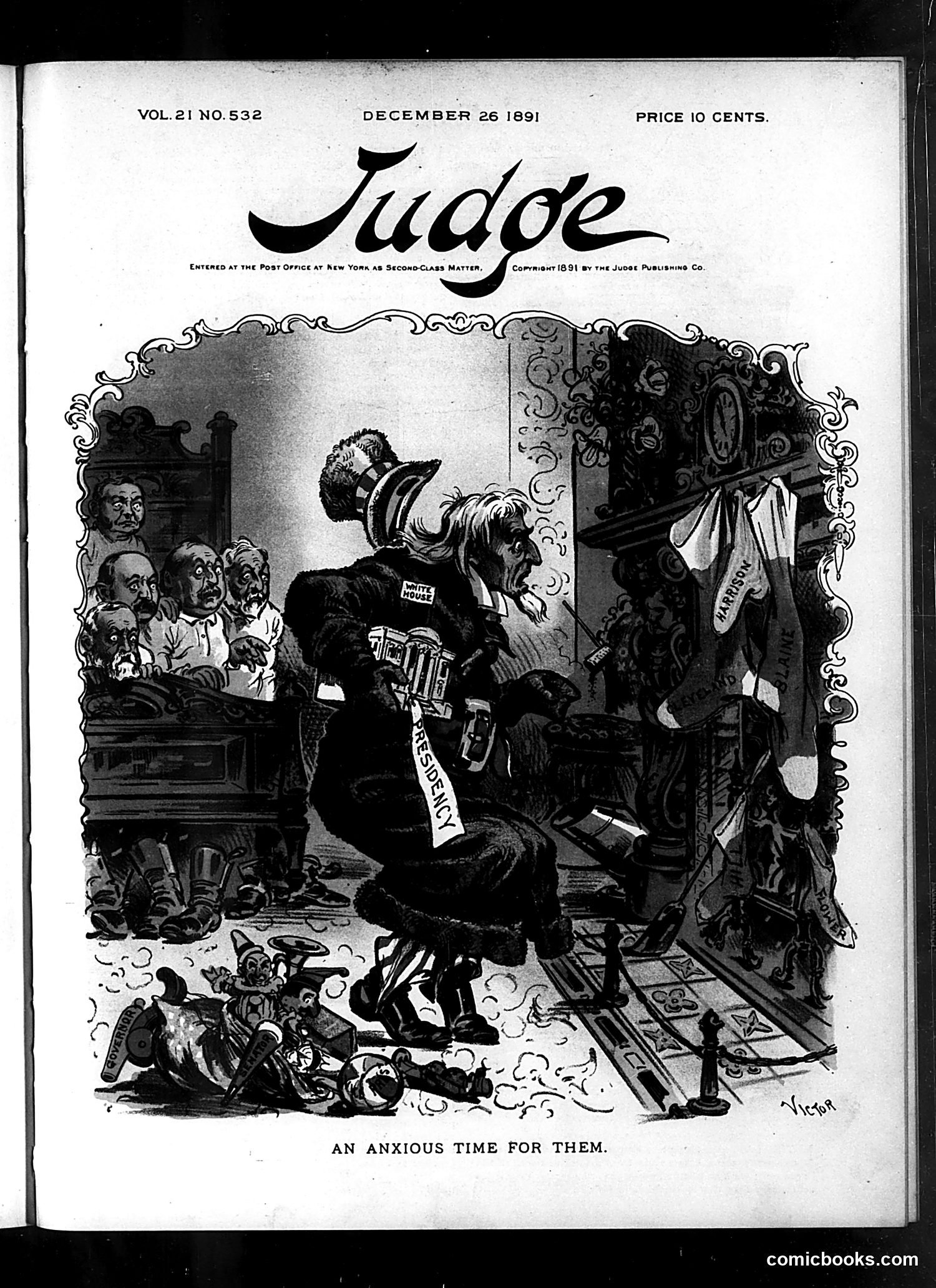
This political cartoon depicts a bearded military or political figure (identifiable by medals and sash) seated in what appears to be a courtroom or official chamber, visibly anxious or distressed. He's surrounded by concerned onlookers in the background. The caption "An Anxious Time for Them" suggests this depicts someone awaiting judgment or trial during a turbulent political period. The formal setting and the figure's military regalia indicate this likely satirizes a high-ranking official facing serious consequences—possibly removal from office or legal proceedings. Without clearer identification markers visible in the image, the specific political scandal or event referenced remains unclear, though the tone suggests public anxiety about an official's fate during this 1891 period.
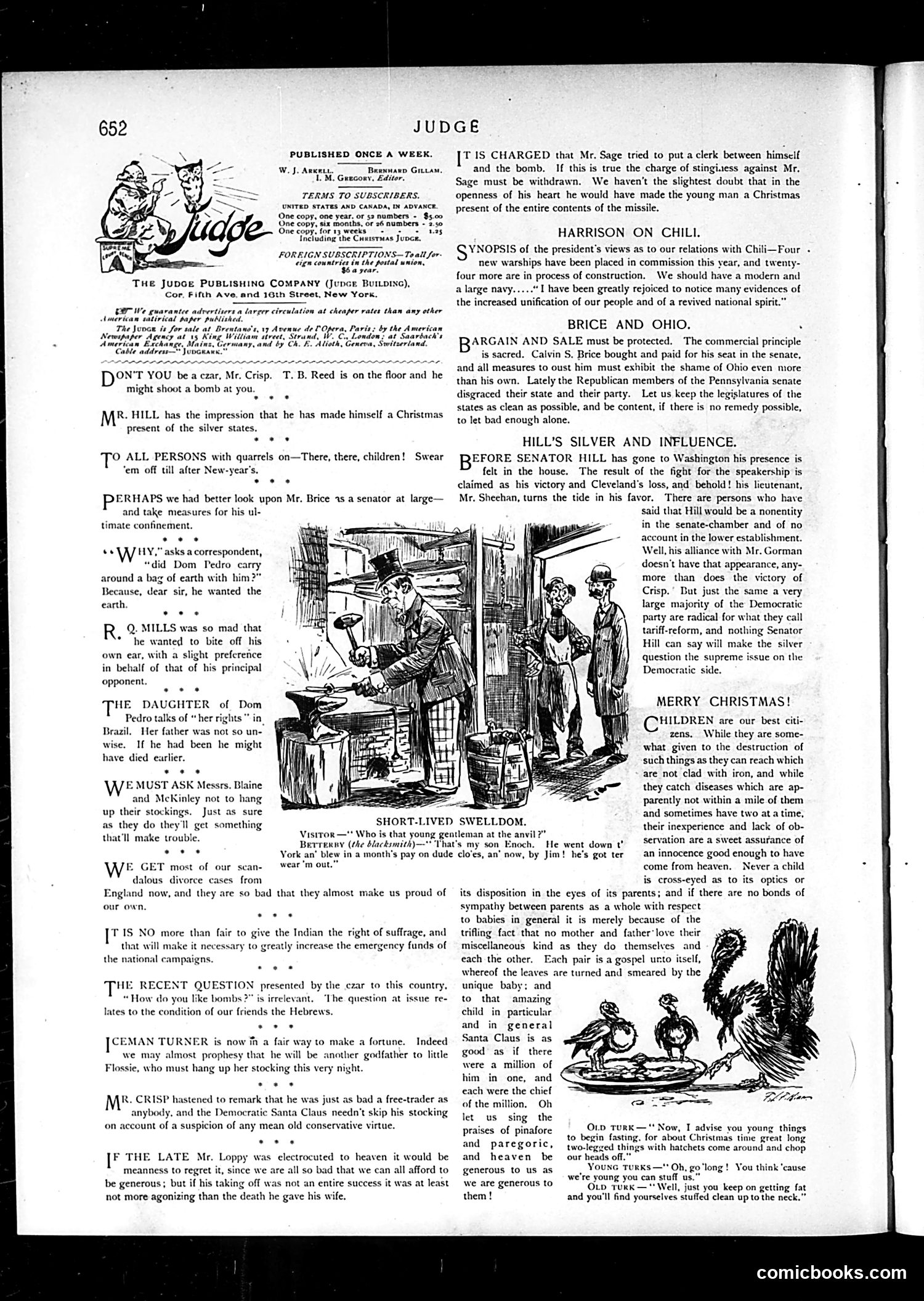
This page contains political commentary and satirical pieces rather than a single unified cartoon. Key sections include: **"Harrison of Chilli"**: References Senator Harrison's naval policy and twenty-four new warships, celebrating "unification of our people and a revived national spirit." **"Bruce and Ohio"**: Criticizes commercial protection, mentioning Calvin S. Brice (an Ohio Republican senator) and Ohio's Republican leadership, accusing them of disgracing their state and party. **"Hill's Silver and Influence"**: Discusses Senator David B. Hill's Washington presence and Democratic tariff-reform politics, suggesting his alliance with Cleveland affects Democratic strategy. The illustrations show period scenes of urban life and character interactions. The overall tone satirizes contemporary Republican and Democratic political maneuvering, likely from the 1890s based on the tariff and silver currency references.
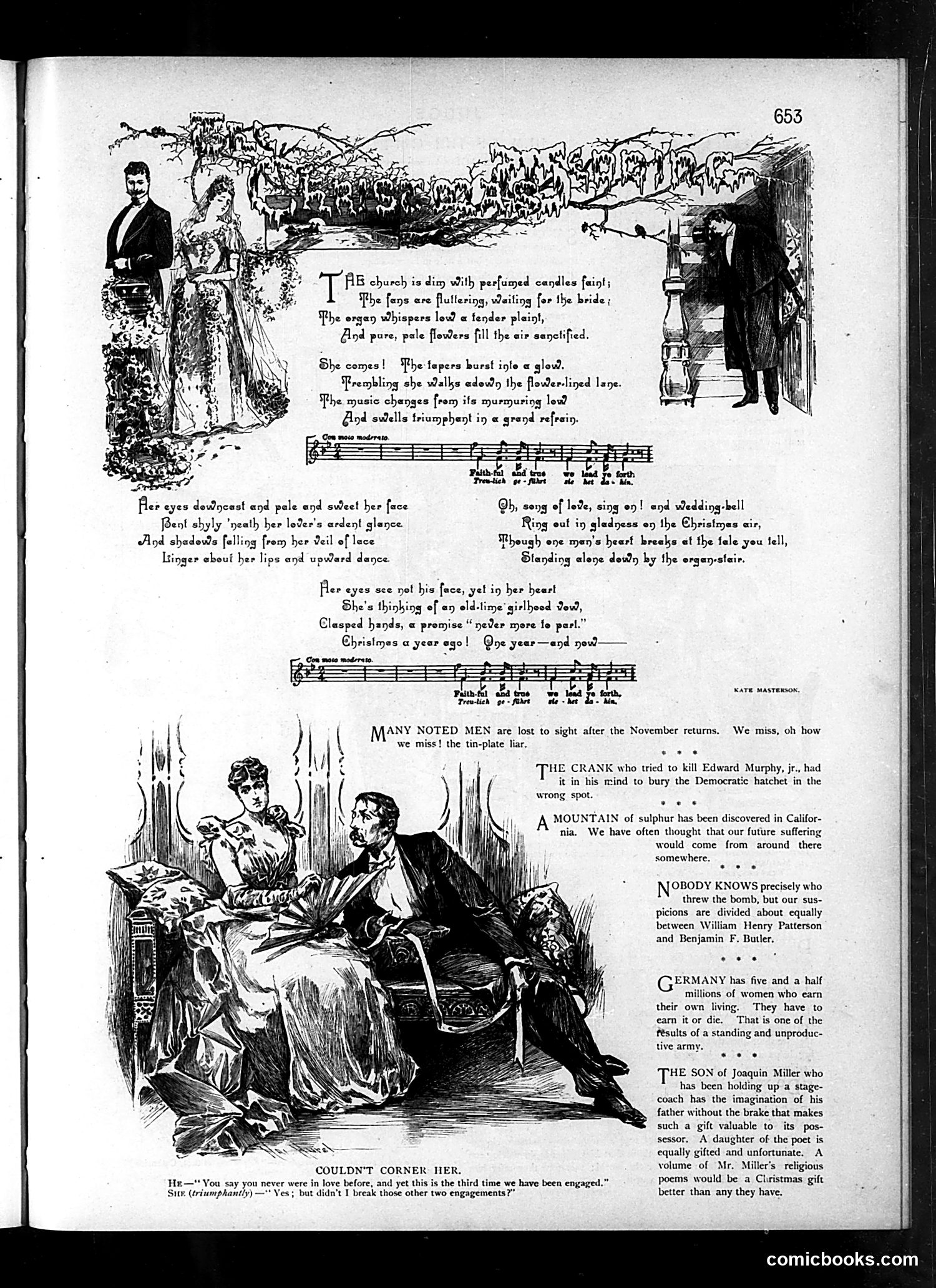
This page contains a poem titled "The Church is Airy with Perfumed Candles" (with musical notation) by Kate Masterson, describing a wedding scene. The poem depicts a bride entering church with detailed descriptions of her appearance and emotional state, referencing "Christmas a year ago" and lost love. Below is an illustration captioned "Couldn't Corner Her," showing a woman and man in conversation. The dialogue suggests romantic complications: the man references three engagements, implying the woman has a pattern of broken engagements. The right column contains several brief news items and gossip, discussing topics like Edward Murphy Jr., California sulphur, bomb-throwing suspects, and notable figures' families. This appears to be primarily literary content and society gossip rather than political satire.
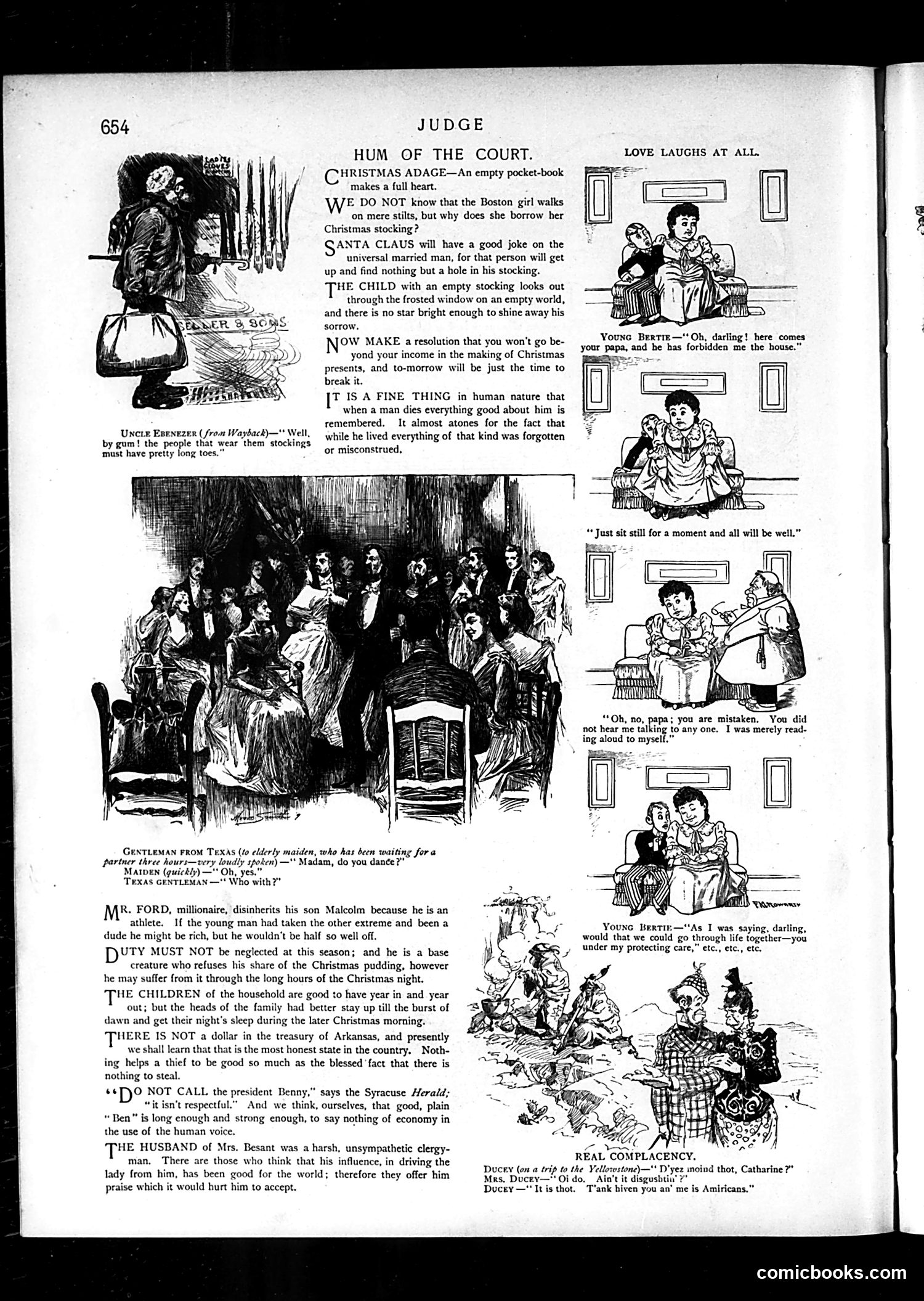
This page from Judge (a late 19th-century satirical magazine) contains holiday-themed humor and social commentary typical of the era. **Main Content:** The "Hum of the Court" section offers cynical Christmas observations: mocking empty pocketbooks, critiquing lavish gift-giving beyond one's means, and satirizing hypocrisy (how people romanticize the dead while forgetting their faults in life). **Specific Jokes:** - A Texas gentleman's awkward courtship approach - A father (Mr. Ford) disinheriting his athletic son, suggesting the wealthy often harm their children through neglect - Commentary on Arkansas's empty treasury as evidence of honesty (sardonic commentary on state finances/corruption) - A couple from "the Yellowstone" speaking in exaggerated dialect, complacently praising American identity **The cartoons** illustrate domestic scenes—children disappointed by empty stockings, young lovers, and family interactions—reinforcing the text's themes about Christmas commercialism, class tensions, and marital dynamics. The overall tone is satirical toward wealth inequality, consumer culture, and social pretense.
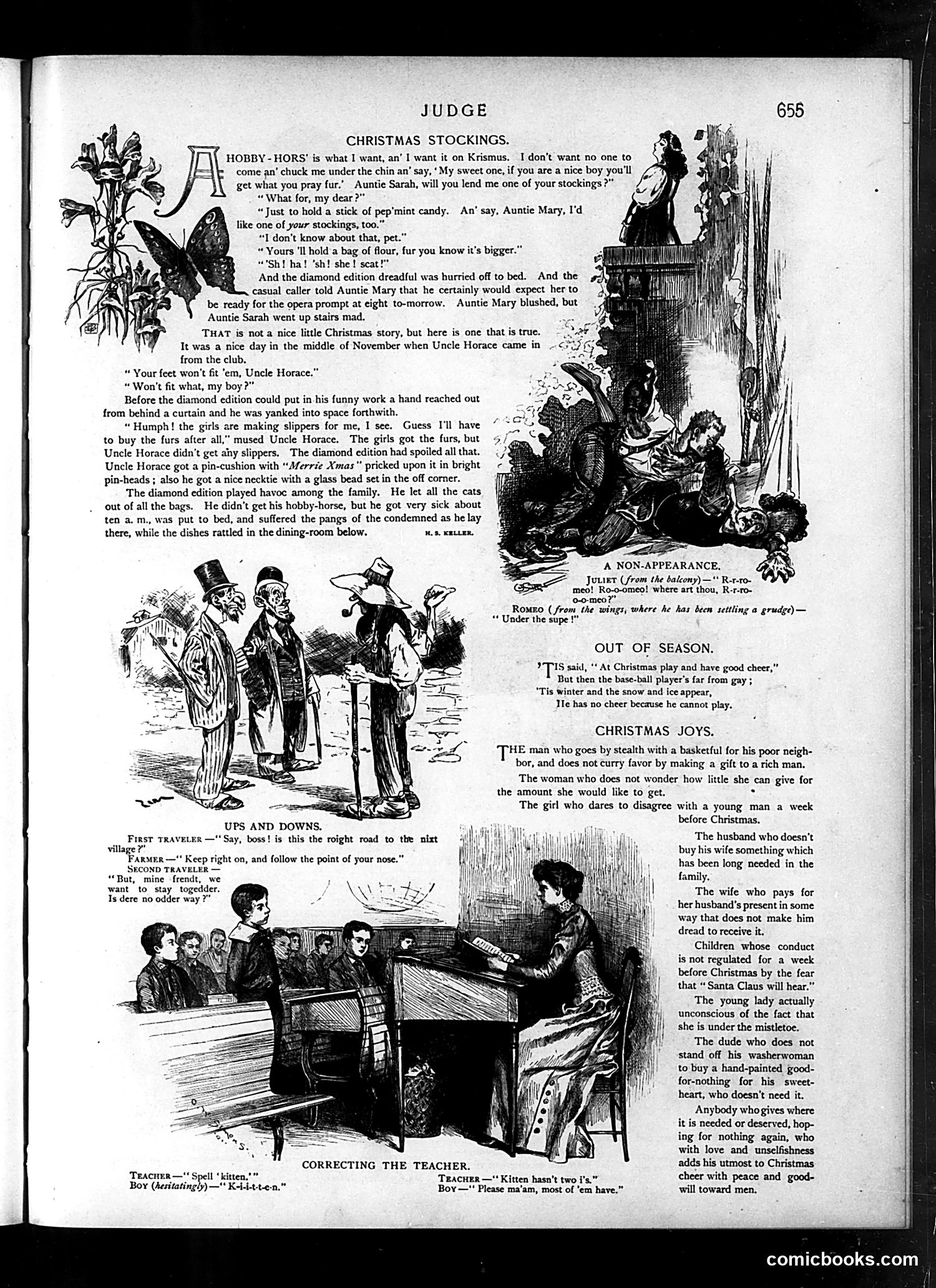
This page from *Judge* (a late 19th-century American satirical weekly) contains several unrelated humorous pieces typical of the magazine's format. **"Christmas Stockings"** is a domestic comedy contrasting a spoiled child's materialistic demands with a heartwarming family story about Uncle Horace. The humor mocks both the bratty "diamond edition" (likely Victorian slang for a precocious child) and sentimental Christmas narratives. **"A Non-Appearance"** is a brief theatrical joke: Romeo fails to appear for his famous balcony scene because he's offstage "settling a grudge"—absurdist humor deflating romantic drama. **"Out of Season"** sympathizes with baseball players during winter when they cannot play—mild sports commentary. **"Christmas Joys"** and related sections offer sentimental yet gently satirical observations about genuine Christmas virtue versus materialism and pretense. **"Ups and Downs"** presents a dialect humor piece about confused travelers, reflecting the era's common use of broken English for comedy. **"Correcting the Teacher"** shows children catching a spelling error—a simple joke about role reversal. Overall, the page blends sentimentality with gentle social satire typical of Gilded Age humor magazines.
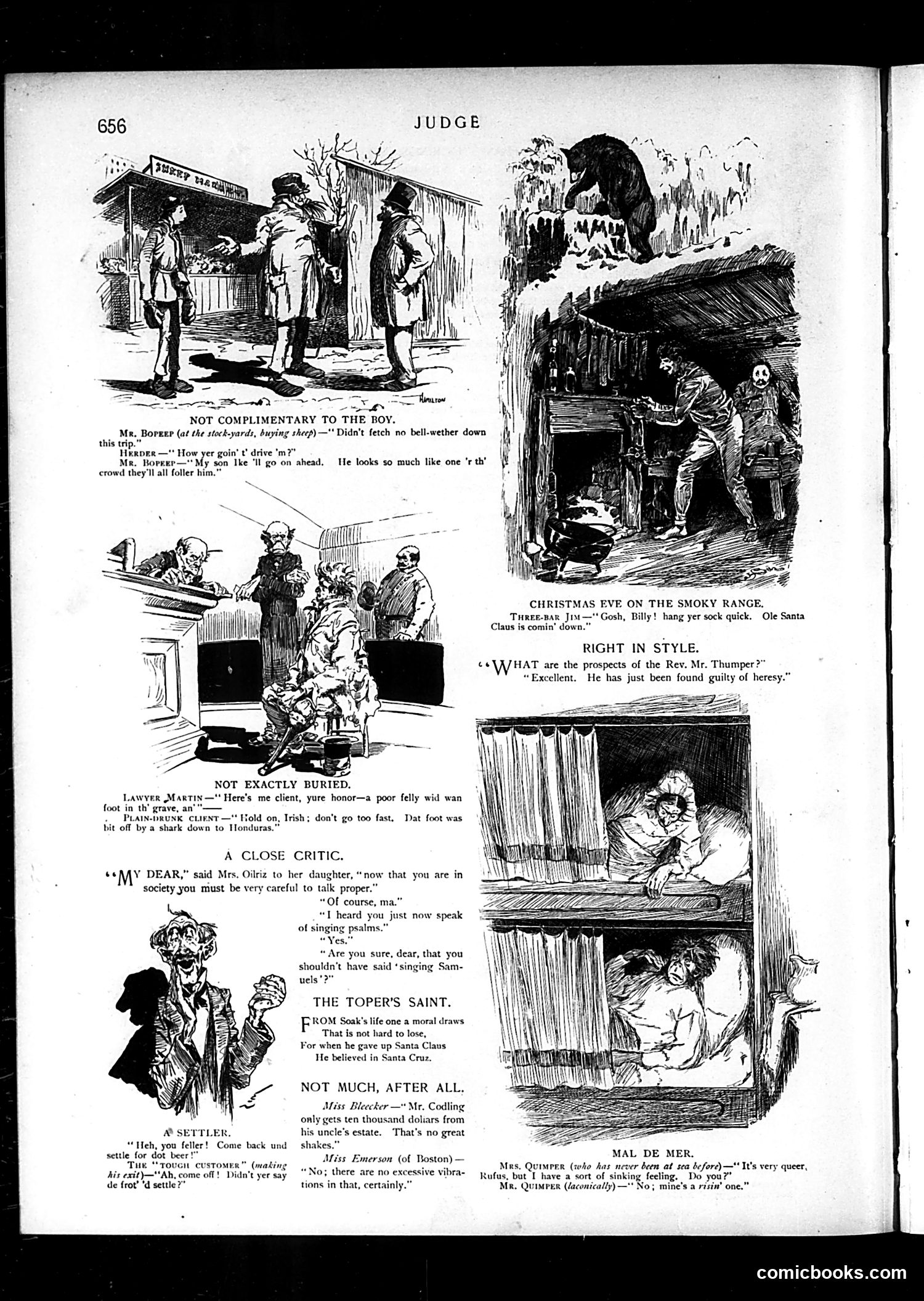
This page contains multiple brief satirical jokes typical of late 19th-century American humor: **"Not Complimentary to the Boy"**: A farmer plans to drive sheep by having his son lead them, implying the boy resembles sheep so closely the animals will follow him—mocking the son's appearance or intelligence. **"Right in Style"**: A clergyman (Rev. Thumper) is praised for being "found guilty of heresy," inverting expectations—what should be shameful becomes fashionable in elite circles. **"Close Critic"**: A social-climbing mother corrects her daughter's grammar, insisting "singing Samuels" is more proper than "singing psalms"—satirizing pretentious new money attempting to adopt refined speech. **"The Toper's Saint"**: A drunk (a "soak") gave up belief in Santa Claus but believes in "Santa Cruz" (likely a rum brand)—mocking alcoholics' misplaced faith. **Various one-liners** mock Irish immigrants, social climbers, and marital dynamics. The humor relies on class anxieties, ethnic stereotypes, and period-specific references now requiring historical context.
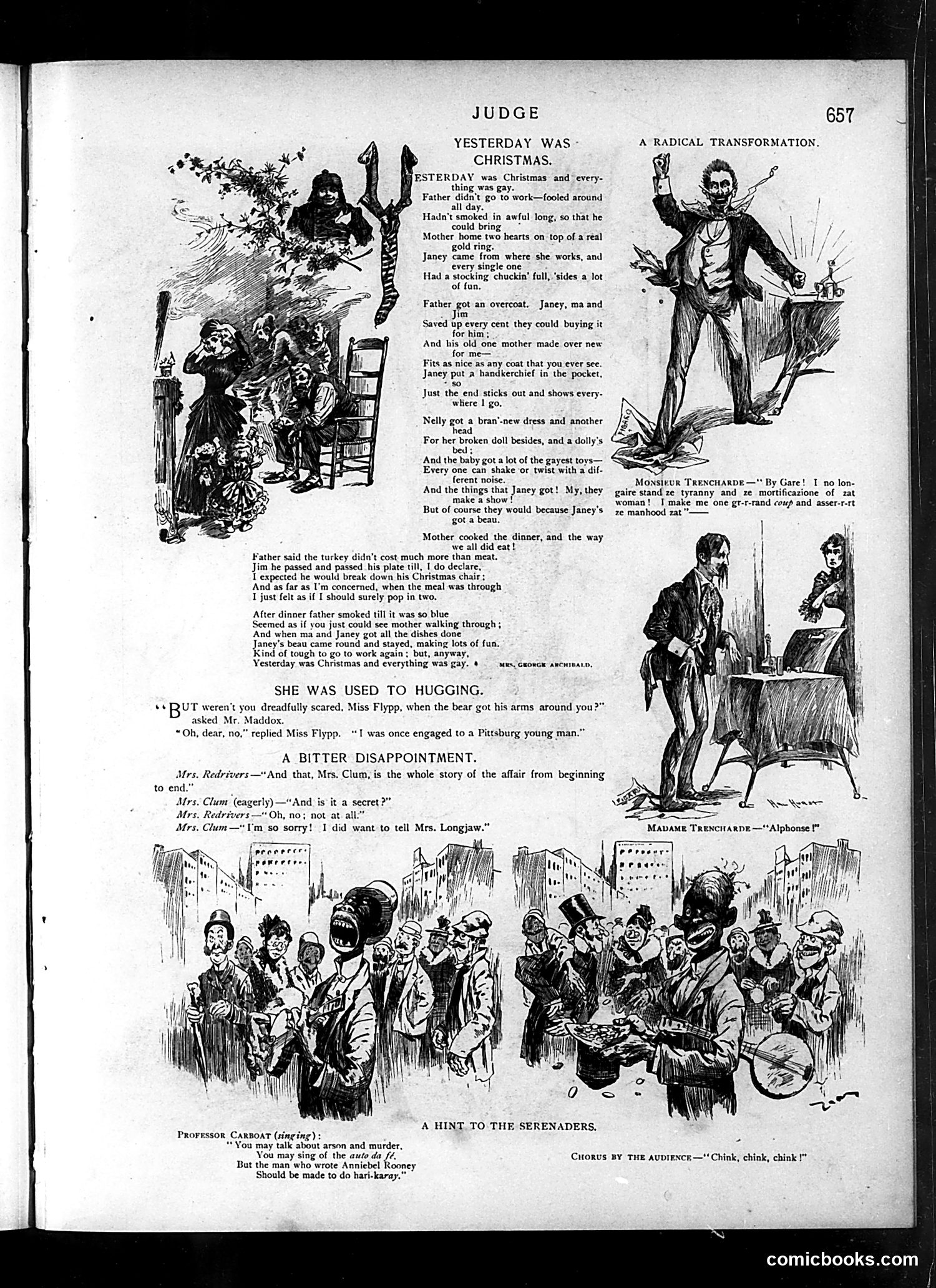
This page contains several unrelated humorous pieces typical of Judge's satirical format: **"Yesterday Was Christmas"** depicts a working-class family's modest but joyful Christmas celebration. The narrator describes receiving hand-me-down clothing while siblings get new gifts, emphasizing the family's financial constraints and the father's sacrifice (saving for an overcoat). The satire appears gentle—celebrating honest working people's modest happiness rather than mocking them. **"She Was Used to Hugging"** is a brief joke playing on a woman's casual attitude toward a bear's embrace, revealed to stem from an unpleasant Pittsburgh engagement. **"A Bitter Disappointment"** satirizes gossip culture: Mrs. Redrivers disappoints Mrs. Clum by revealing a scandal isn't secret, thus eliminating the pleasure of spreading it. **"A Hint to the Serenaders"** mocks Professor Carboat for romanticizing serious crimes (arson, murder, auto-da-fé executions) while endorsing ritual suicide (hari-kari) for the composer of "Annabel Lee"—absurdist humor criticizing overwrought sentimentality in popular songs. The page emphasizes domestic scenes and social humor rather than political satire.
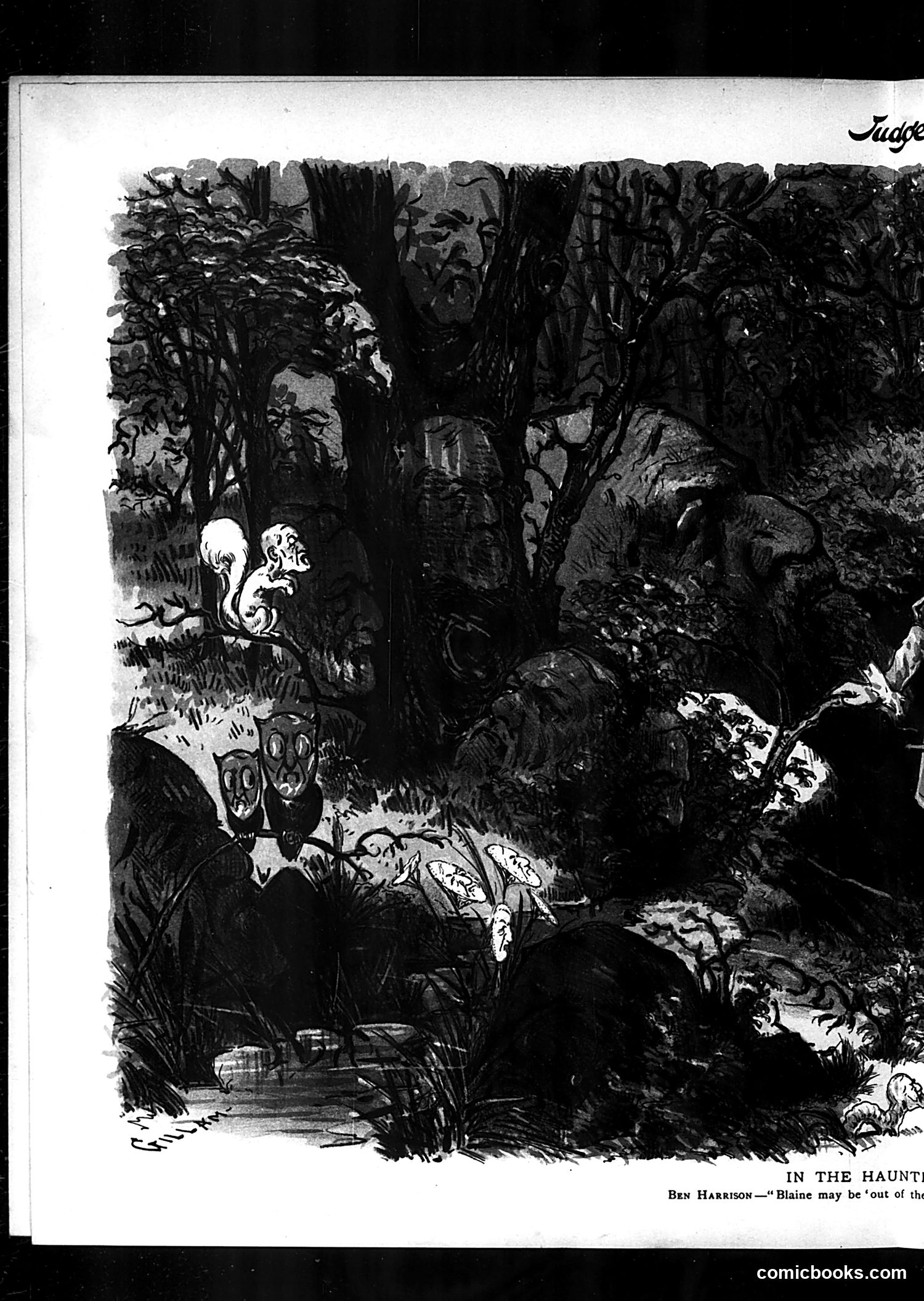
This appears to be a political cartoon from *Judge* magazine titled "In the Haunt," credited to Ben Harrison. The caption references "Blaine may be 'out of the..." — likely referring to James G. Blaine, a prominent 19th-century politician. The dark, gothic imagery with ghostly figures in a haunted forest setting suggests supernatural or ominous themes. The heavily shadowed woodland scene with skeletal trees and ethereal forms implies this is political commentary using horror metaphor — possibly suggesting Blaine's political fortunes are "haunting" someone, or that he remains a troubling political presence despite being politically sidelined ("out of the"). Without the complete caption, the exact satirical point remains unclear, but the gothic aesthetic suggests criticism or mockery of Blaine's continued political relevance.
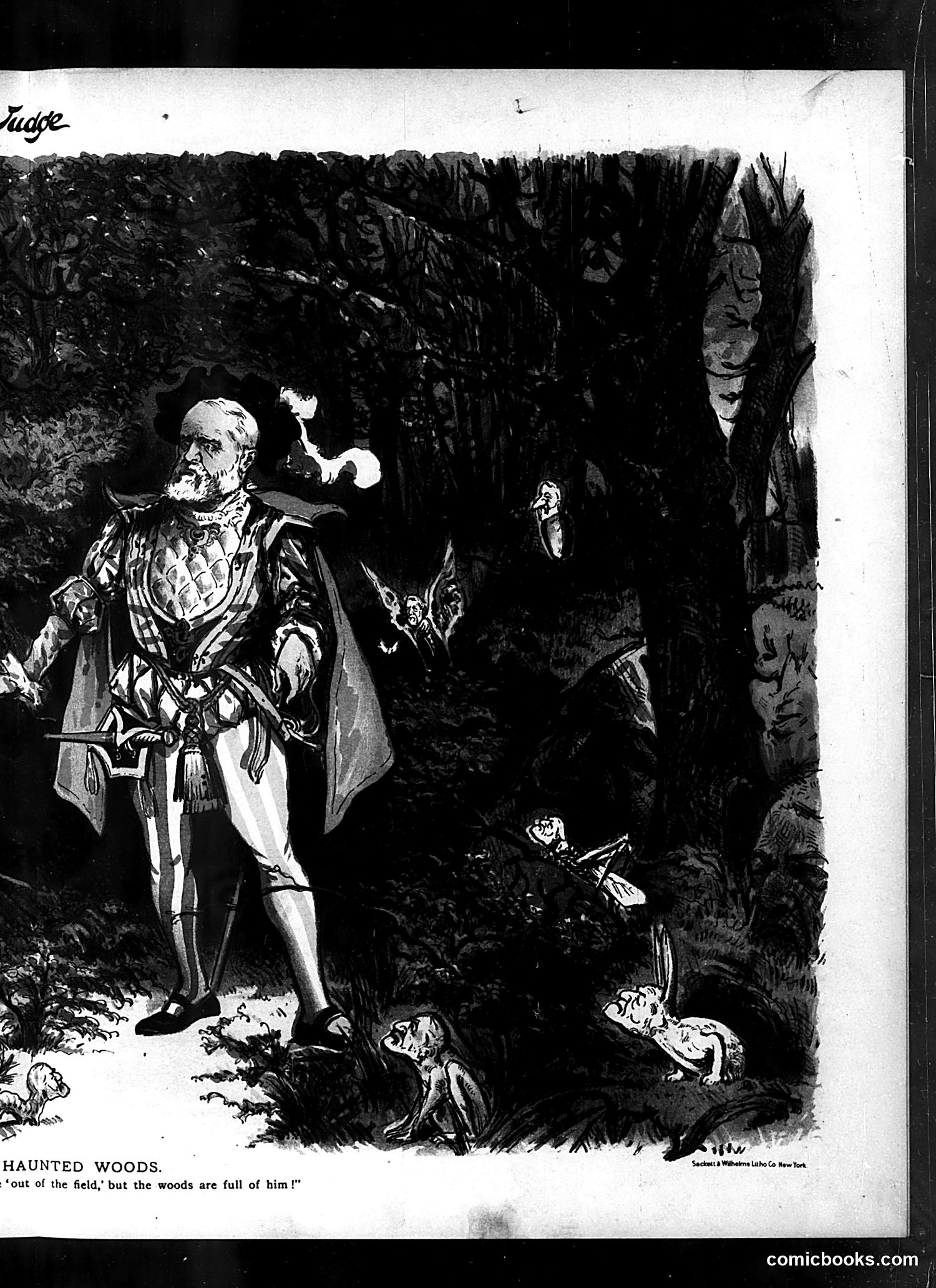
This Judge cartoon depicts a military officer in ornate uniform standing in a dark forest, with ghostly or skeletal figures visible among the trees and ground. The caption—"'out of the field,' but the woods are full of him!'"—suggests someone has been removed from active command ("out of the field") yet their presence or influence remains pervasive and haunting. Without the publication date visible, the specific political figure is unclear, though the style suggests late 19th or early 20th century. The satire appears to critique a military or political leader whose removal from office hasn't eliminated their troubling influence. The haunted-woods imagery implies lasting damage or continued threat despite their nominal departure from power.
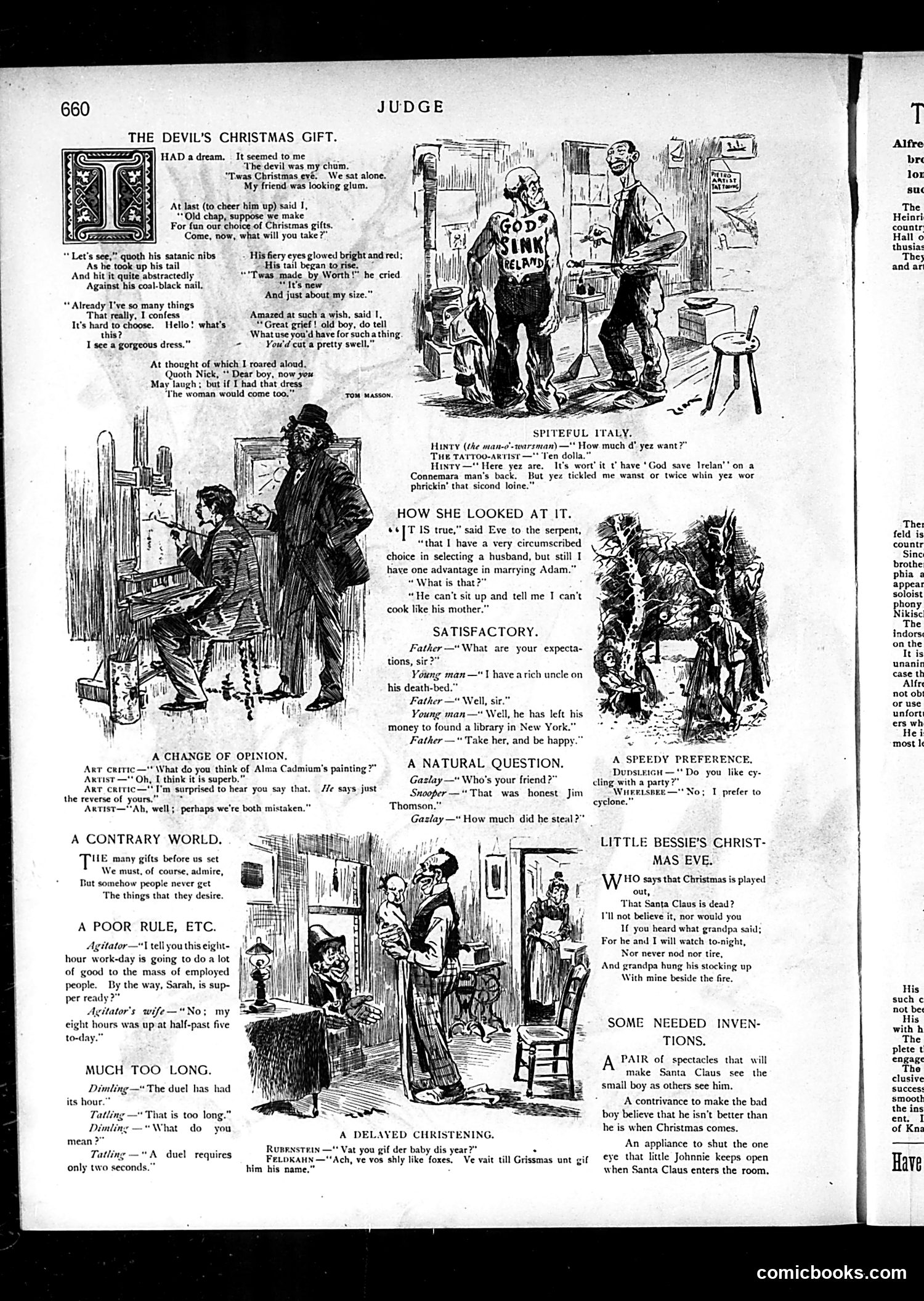
This page collects Christmas-themed humorous verses and cartoons from what appears to be a late-19th-century issue. The satire targets social conventions and gender dynamics of the era. **Key pieces:** "The Devil's Christmas Gift" mocks the speaker's fantasy of giving Satan a woman's dress, implying women are troublesome companions—crude misogyny played for laughs. "How She Looked at It" presents Eve arguing that marrying Adam has one advantage: he can't criticize her cooking like "his mother" would. The joke relies on stereotypes about women's domestic failures and maternal-in-law conflicts. Multiple cartoons satirize class anxiety and social climbing: a father accepting a poor suitor because his uncle funds libraries; immigrants delaying baptism to claim Christmas gifts as "new" babies. "Little Bessie's Christmas Eve" sentimentalizes childhood innocence and intergenerational bonding, contrasting with the cruder adult humor elsewhere. The overall tone reflects Judge's satirical approach to contemporary American life—poking fun at pretension, marital discord, immigrant stereotypes, and the commercialization of Christmas, all through period-appropriate caricature.
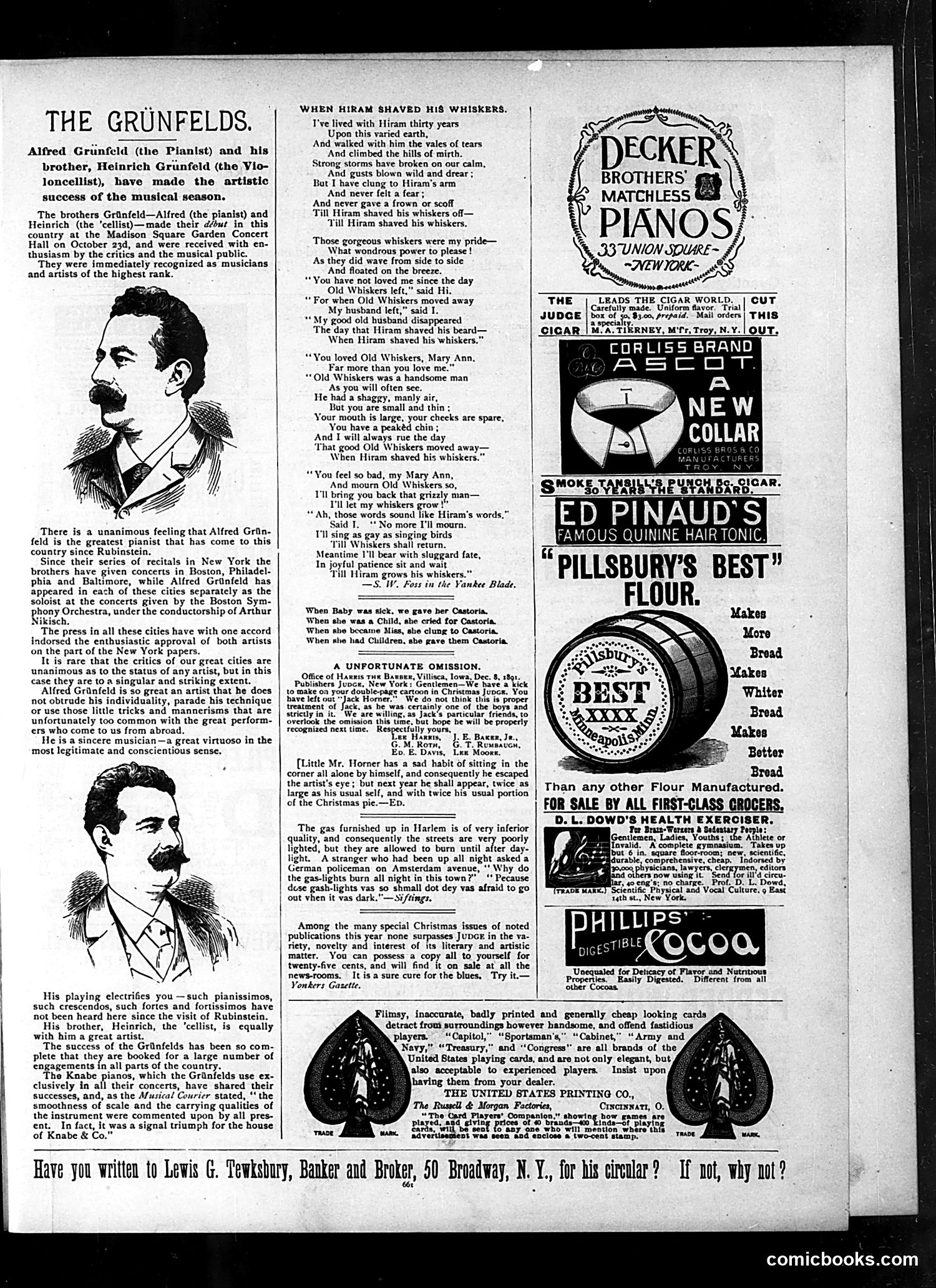
This page primarily features **promotional content and advertising** rather than political satire. The main article celebrates the **Grunfeld brothers** (Alfred on piano, Heinrich on cello)—European musicians who recently debuted in America and received unanimous critical praise. The text emphasizes their artistic legitimacy and technical mastery, distinguishing them from performers who rely on "tricks and mannerisms." This serves as both cultural endorsement and advertisement for their concert tours. A secondary piece, "When Hiram Shaved His Whiskers," is sentimental verse about a wife's attachment to her husband's facial hair—a lighthearted domestic scenario rather than satire. The **surrounding advertisements** (Decker pianos, Pillsbury flour, hair tonic, etc.) dominate the page visually, reflecting Judge's primary revenue model. There is **no clear political cartoon or social satire** on this particular page—it represents the magazine's mixed content of arts coverage and commercial advertising typical of late 19th/early 20th-century publications.
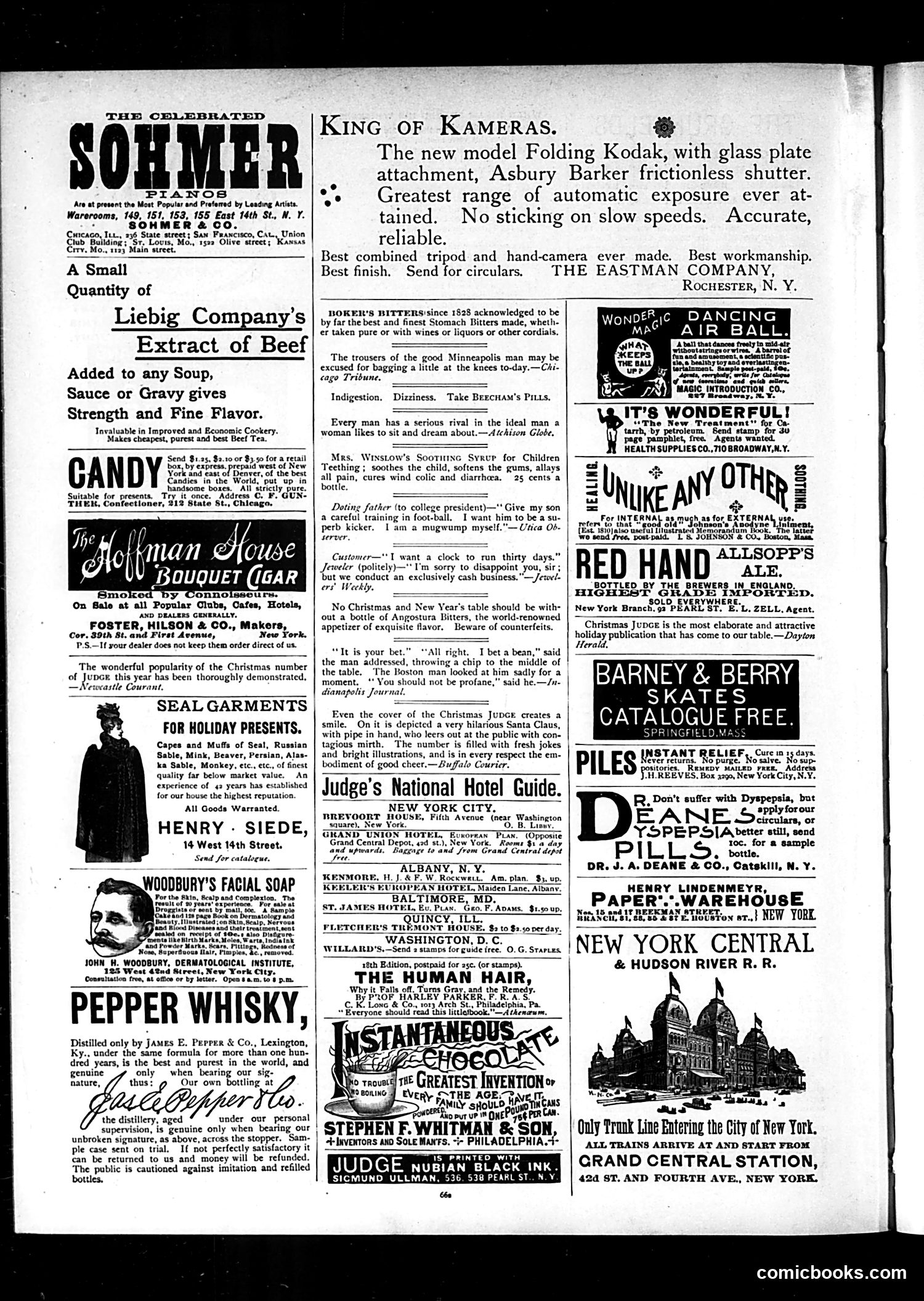
This page is primarily **advertisements** for period products (Kodak cameras, Pepper Whisky, Liebig's Beef Extract, seal garments, soap) interspersed with brief **humorous one-liners** typical of Judge magazine's format. The jokes are simple social observations: a Minneapolis man's trousers bag at the knees (unclear reference); a father wants his college son trained as a football kicker because he himself is a "mugwump" (independent voter—a contemporary political term); a customer asks a jeweler for a clock running thirty days, the jeweler jokes they only do cash business. These micro-jokes rely on contemporary assumptions about masculinity, business practices, and politics that a modern reader would need historical context to fully appreciate. The page reflects Judge's mix of advertising revenue and satirical content aimed at educated, middle-class readers.
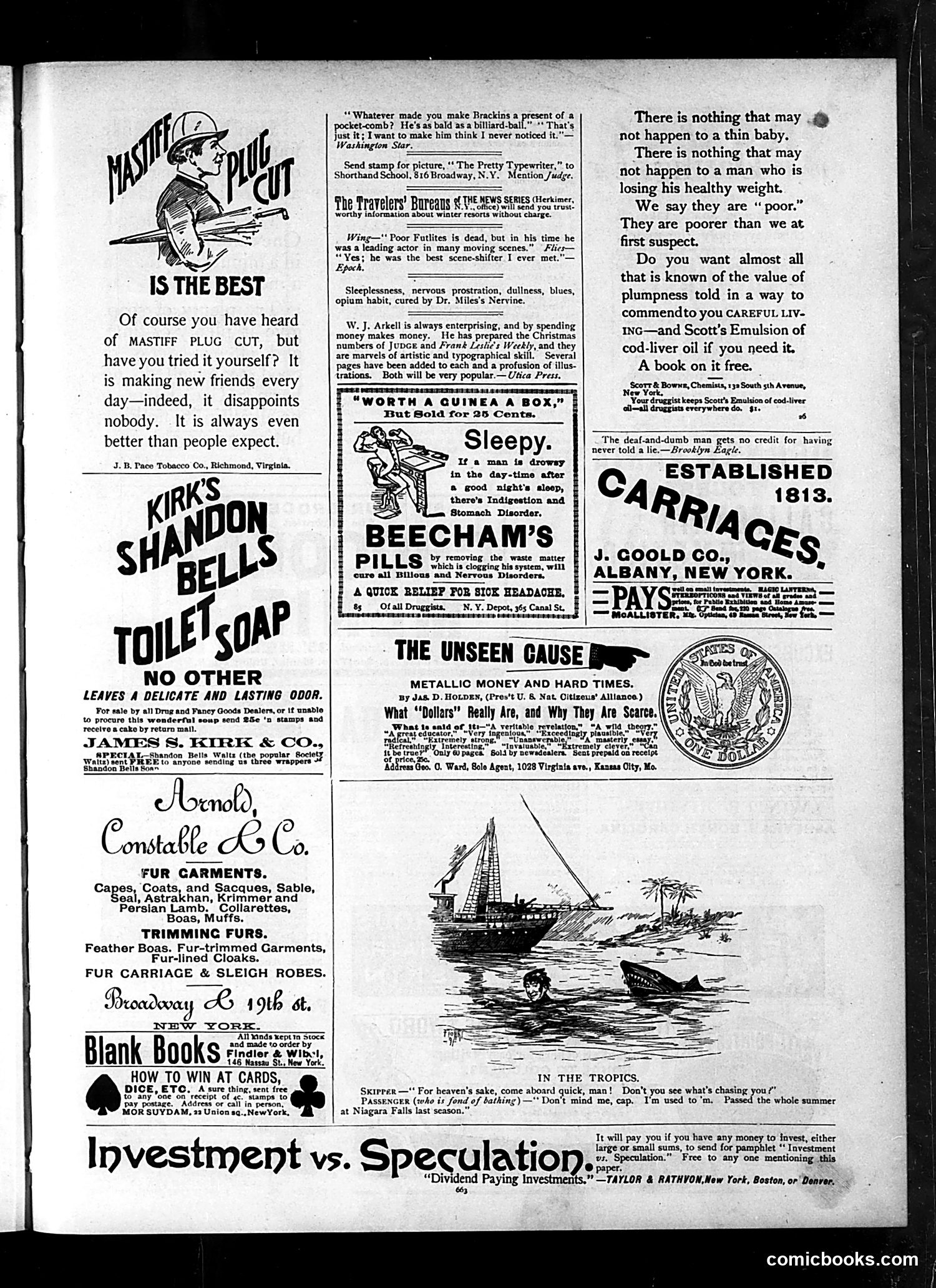
This page is primarily **advertisements and filler content** rather than political cartoons. However, it contains two notable illustrated jokes: 1. **"In the Tropics" cartoon**: Shows a shark chasing a swimming passenger near a boat. The joke plays on the passenger's casual attitude—he claims he's "used to" sharks from bathing at Niagara Falls last season. This is absurdist humor: the passenger is comically oblivious to actual danger, conflating a minor summer resort with tropical waters inhabited by predatory sharks. 2. **The page's dominant content** consists of period advertisements for patent medicines (Beecham's Pills, Scott's Emulsion cod-liver oil), tobacco, toiletries, fur garments, and financial services—typical of Judge's revenue model. The text snippets are brief jokes about baldness, acting, and insomnia, unrelated to major political events. The page reflects early 1900s consumer culture more than satire of current affairs.
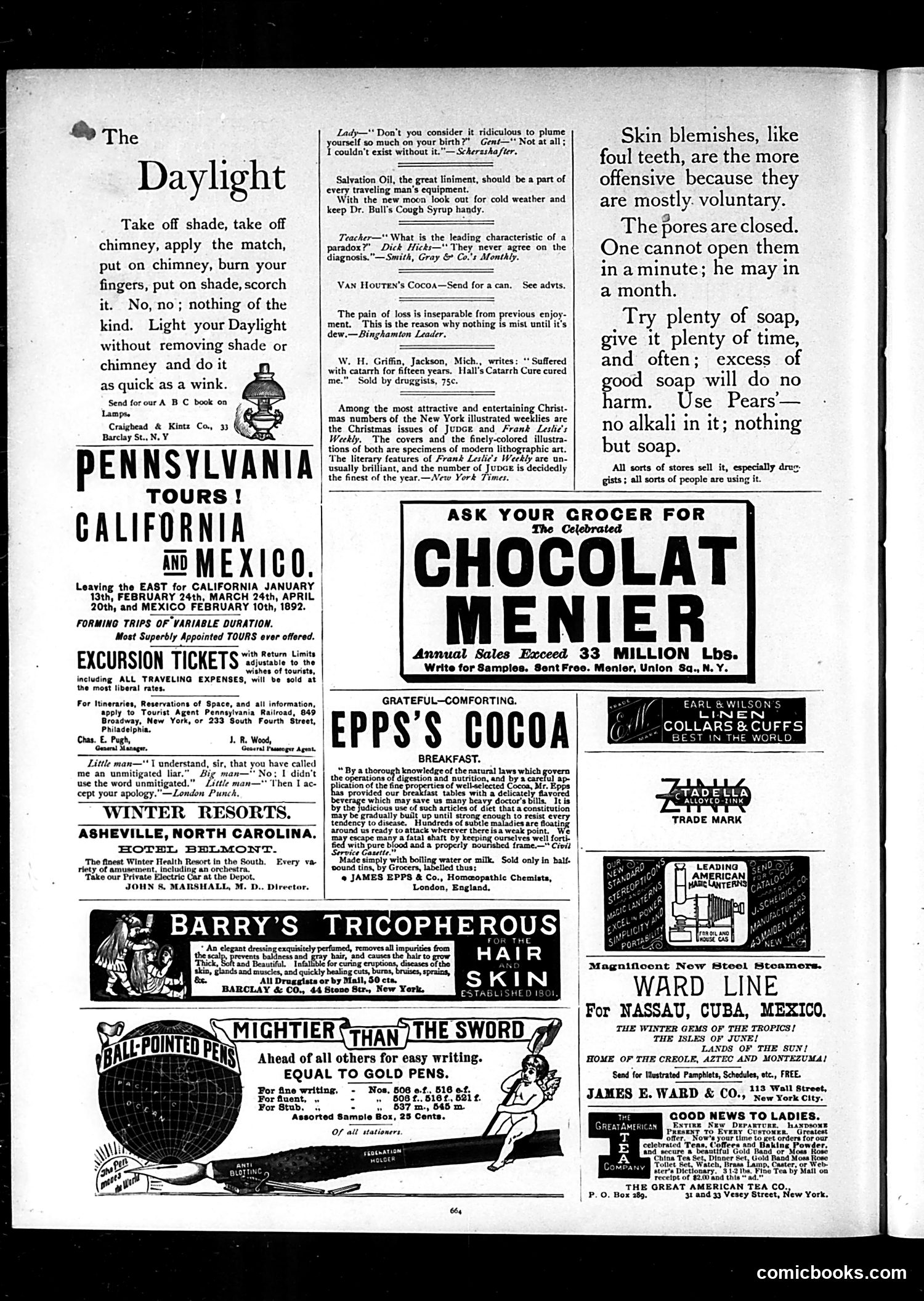
This page is primarily **advertising with minimal editorial content**. The layout includes various commercial advertisements for travel, household products, and patent medicines typical of the 1890s. The brief editorial pieces are social humor rather than political satire: - **"The Daylight"** advertises an innovative lamp design - A **dialogue joke** about the word "unmitigated" (from London Punch) - **Advertisements for dubious remedies**: Salvation Oil liniment, Dr. Bull's Cough Syrup, Hall's Catarrh Cure—products making exaggerated health claims common to the era The **substantive content** discusses skin care advice (advocating soap and patience for blemishes) and promotes quality publications like *Frank Leslie's Weekly* and *Judge* itself. Notable: The prominent **Chocolat Menier ad** claims 33 million pounds in annual sales, reflecting chocolate's growing popularity as a commercial product in the 1890s. This is a **commercial publication page**, not a political cartoon issue.
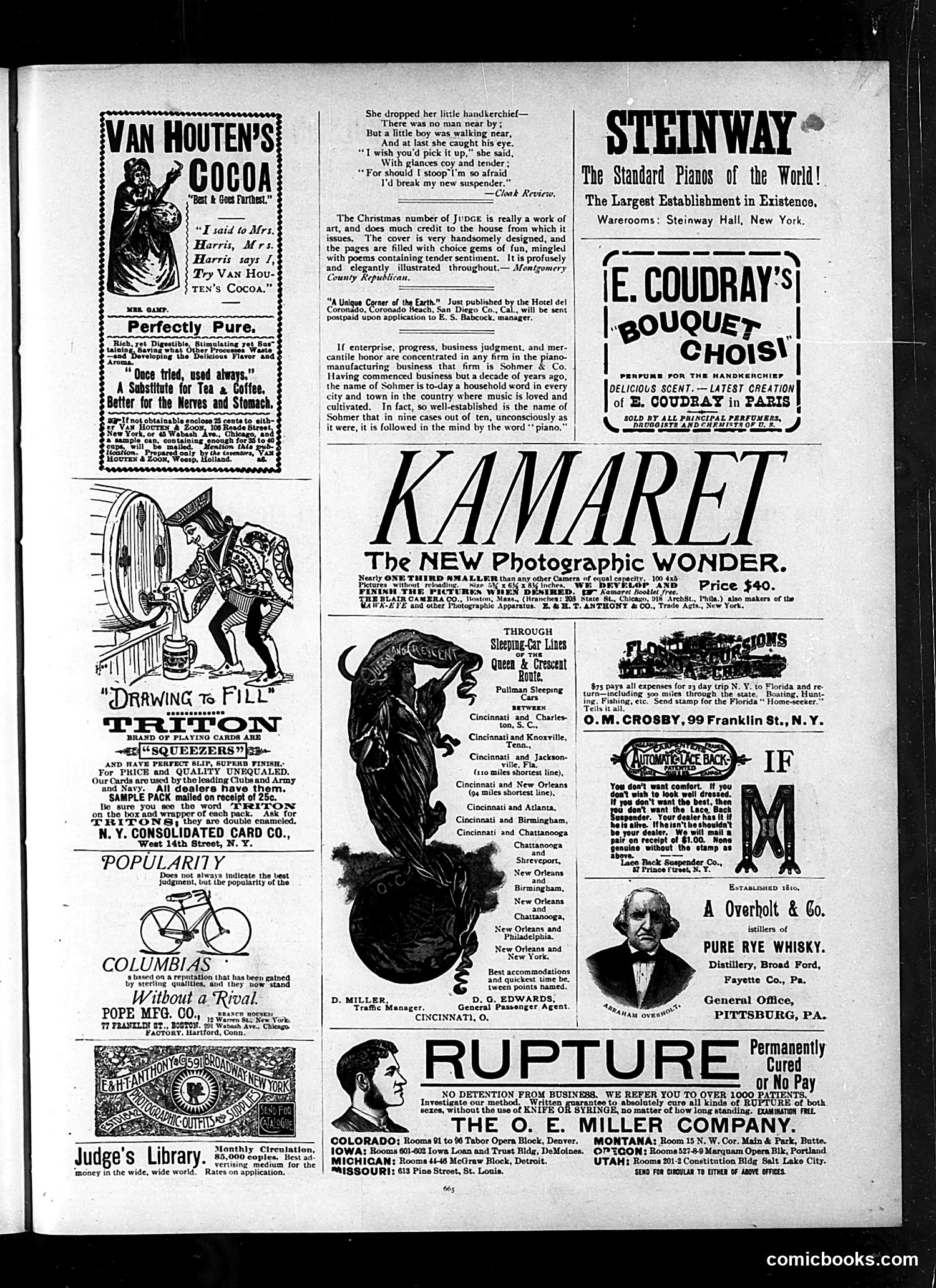
This page is primarily **advertising**, with one small humorous anecdote. The main cartoon/joke concerns a woman who drops her handkerchief and asks a boy to retrieve it—claiming she can't bend down because she'll "break my new suspender." The humor relies on the Victorian-era absurdity: she's using a flimsy excuse (suspenders don't break that easily) as a pretense to get male attention while maintaining modest propriety. It's gentle satire on courtship rituals and feminine coquetry of the period. The rest of the page features **product advertisements**: Van Houten's Cocoa, Steinway Pianos, playing cards, bicycles, perfume, a photographic device called "Kamarel," railroad sleeping-car services, and remedies for various ailments. These ads reflect late 19th-century consumer goods and were common revenue sources for satirical magazines like *Judge*.
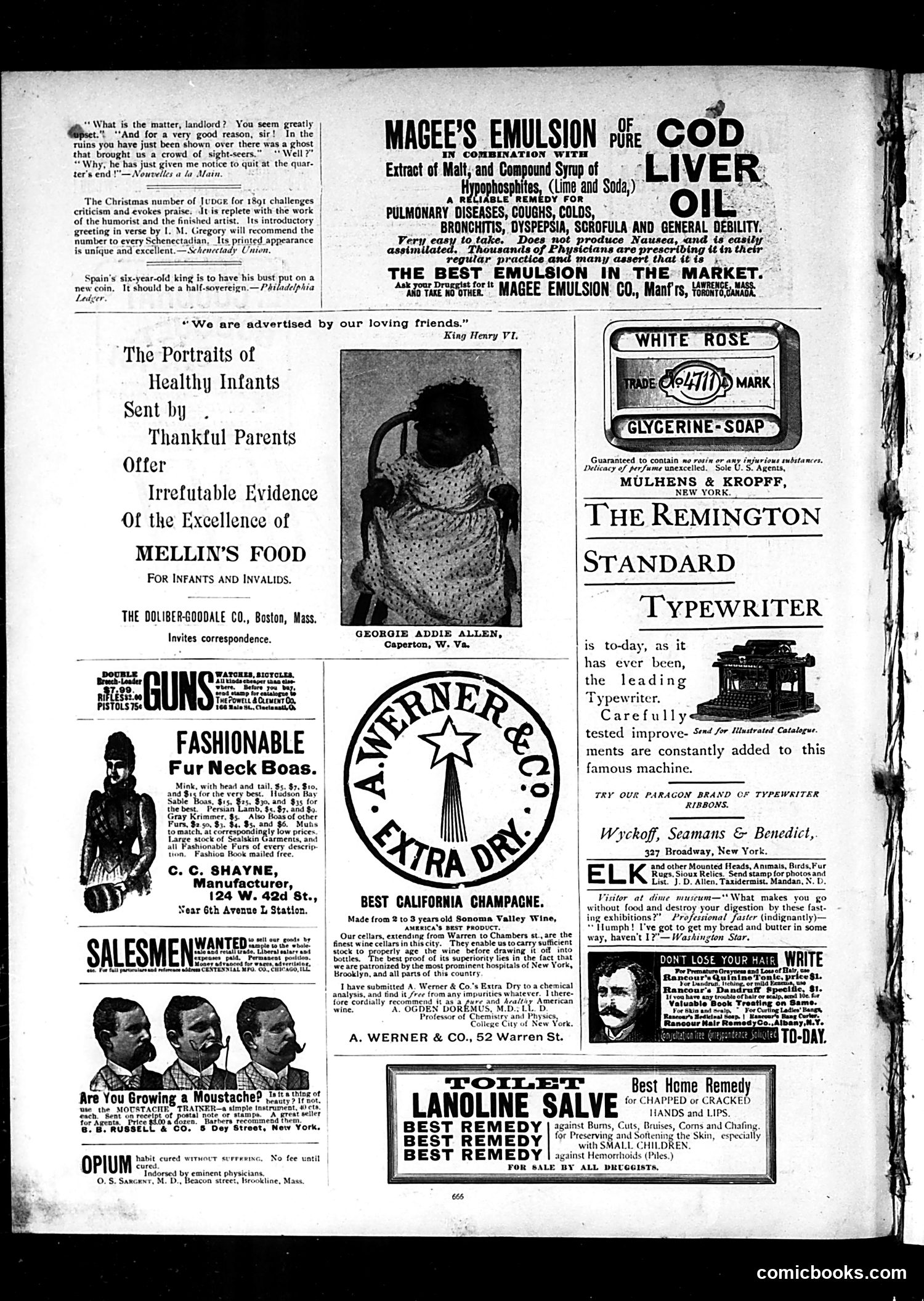
This is primarily an **advertising page** from Judge magazine (circa 1891), not a political cartoon. The page contains dozens of patent medicine and consumer product advertisements typical of the era. The small joke at the top is a pun: A landlord complains that a ghost in nearby ruins attracted sightseers, but now the ghost has given notice to quit—meaning the landlord loses his tourist draw. **Notable ads include:** - **Magee's Emulsion** (cod liver oil): marketed for respiratory diseases and "general debility" - **Mellin's Food**: infant formula - **Remington Typewriter**: claims it's the leading model - **Lanoline Salve**: for skin conditions - **Moustache Trainer**: a device to shape facial hair **Historical context for modern readers:** These ads reflect 1890s medicine and commerce before FDA regulation. Many products (opium, unproven tonics) would be illegal today. The emphasis on "scientific" testimonials and photographs of healthy infants was common marketing despite lack of actual efficacy testing. This page illustrates how unregulated advertising shaped consumer behavior in the Gilded Age.
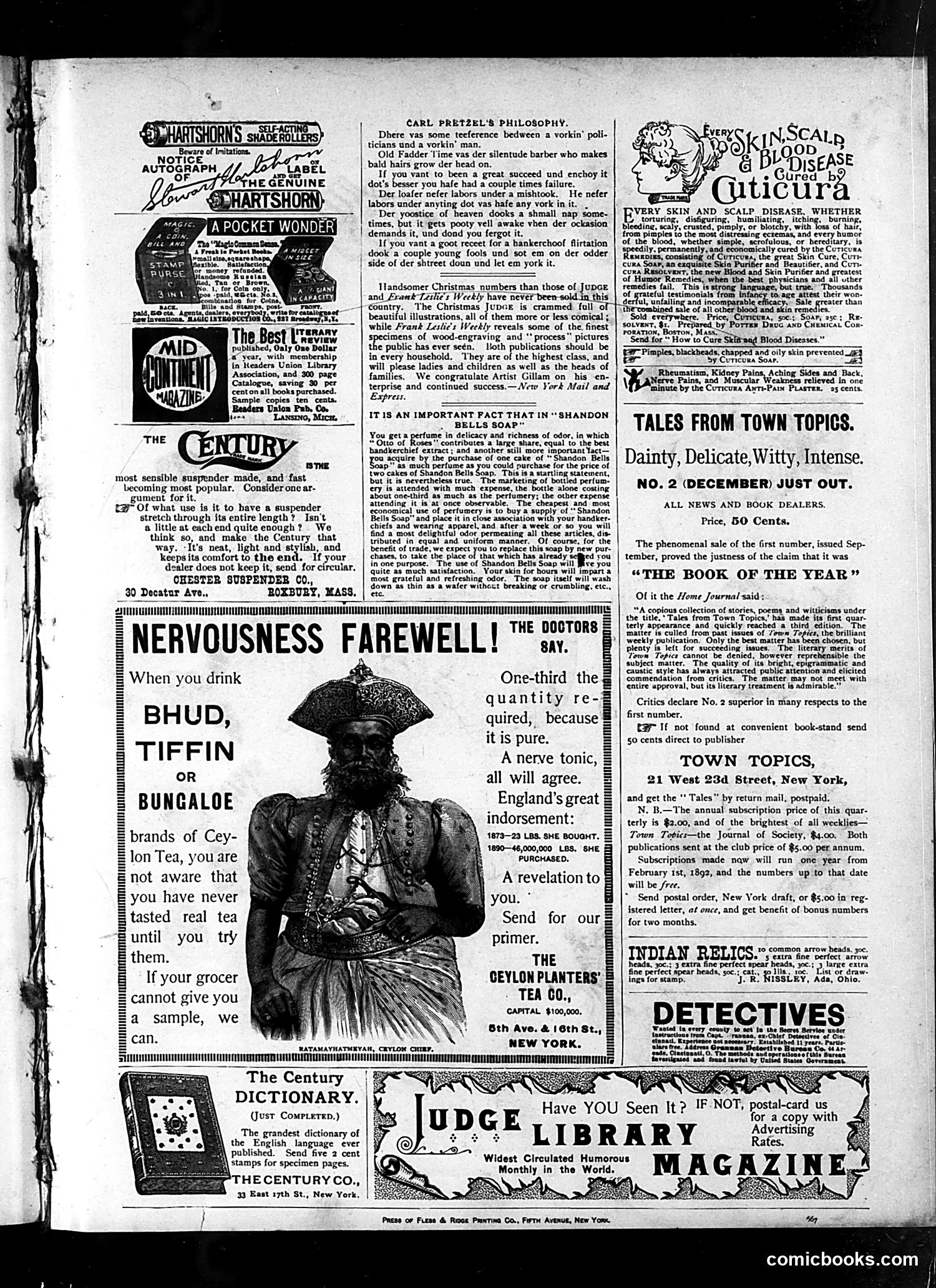
This page is primarily **advertising and filler content** rather than political satire. The notable text element is **"Carl Pretzel's Philosophy,"** a humorous column written in exaggerated German-immigrant dialect. Pretzel appears to be a recurring character offering aphorisms about work, laziness, justice, and flirtation—the humor derives from both the folksy wisdom and the heavily stereotyped ethnic speech pattern ("vorkin'," "dook's," "York it"). The rest of the page consists of product advertisements for suspenders, tea brands, soap, and dictionaries—typical period magazine filler. One ad features a colonial-era figure labeled as a "Tamarashtyhan, Ceylon Crepe," though his significance is unclear from context alone. There is **no discernible political cartoon** on this page. The "satire" is limited to Pretzel's gentle social commentary presented through an ethnic caricature—a common but dated approach to humor in late-19th-century American magazines.
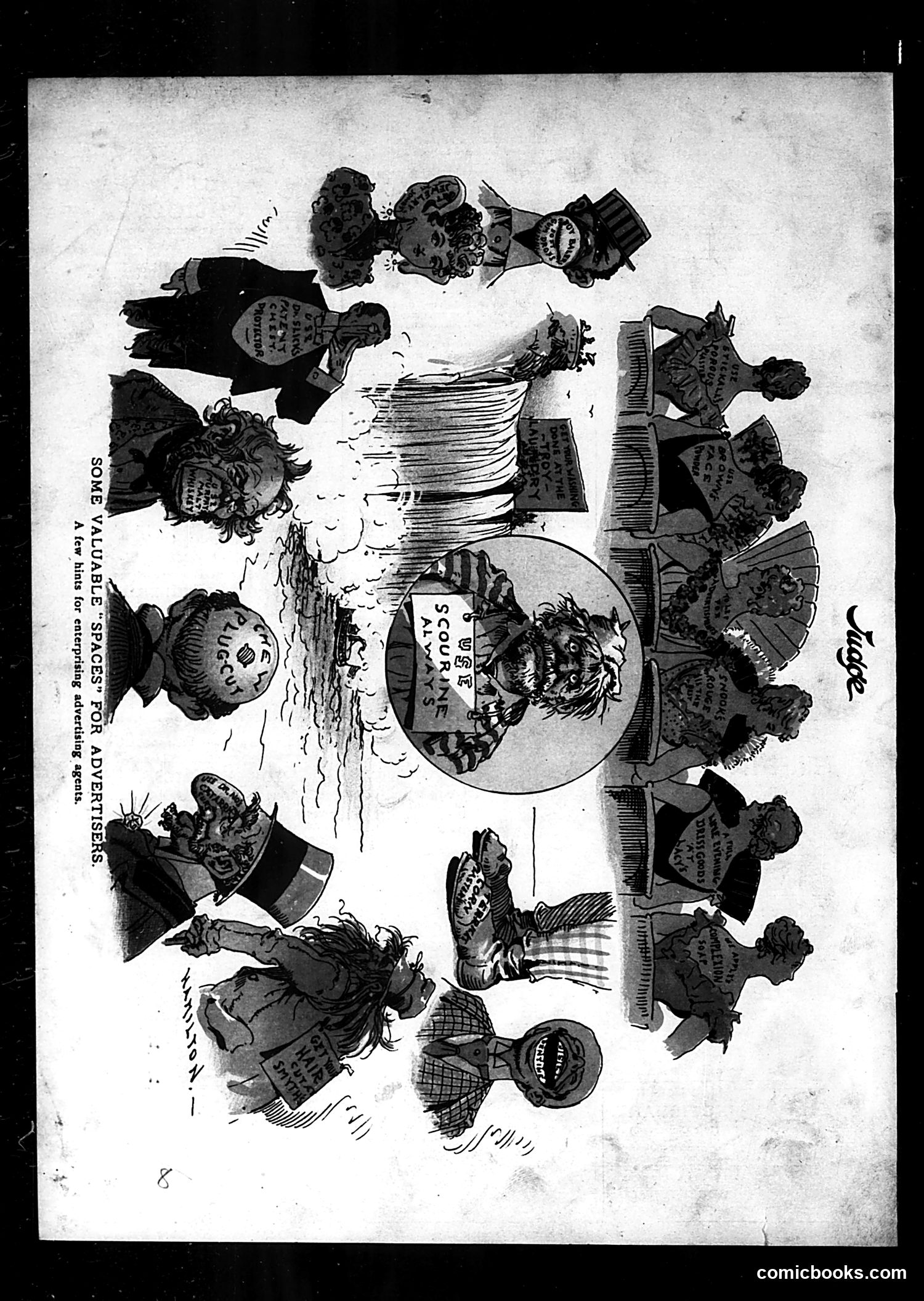
This **Judge** magazine satire mocks the proliferation of advertising in public spaces. The central circular image shows a crowded scene—likely a public gathering or transportation hub—surrounded by caricatured figures representing "enterprising advertising agents." The cartoon's title, "Some Valuable 'Spaces' for Advertisers," sarcastically suggests absurd locations where ads could be placed: on people's bodies, clothing, hats, and even faces. Each surrounding figure appears to display advertisements on their person, satirizing the era's aggressive commercialism. The joke targets late 19th/early 20th-century advertising's invasive expansion into every aspect of public life—a concern that would resonate with modern audiences witnessing similar commercial saturation today. The cartoonist criticizes how advertisers seek to colonize any available surface for profit.

I can see this is a page from *Judge* magazine, but the image is almost entirely black with very poor visibility. Only the white left margin and "comicbooks.com" watermark at the bottom are clearly visible. The OCR text provides no substantive content to analyze—just the website URL. Without being able to discern the actual cartoon, text, illustrations, or captions on the page itself, I cannot identify the figures, political references, or satirical intent. To provide accurate historical analysis per your instructions, I would need a clearer image where the actual content is legible. If you have a higher-contrast or clearer version of this page, I'd be happy to analyze it properly.