
A complete issue · 16 pages · 1891
Judge — December 19, 1891
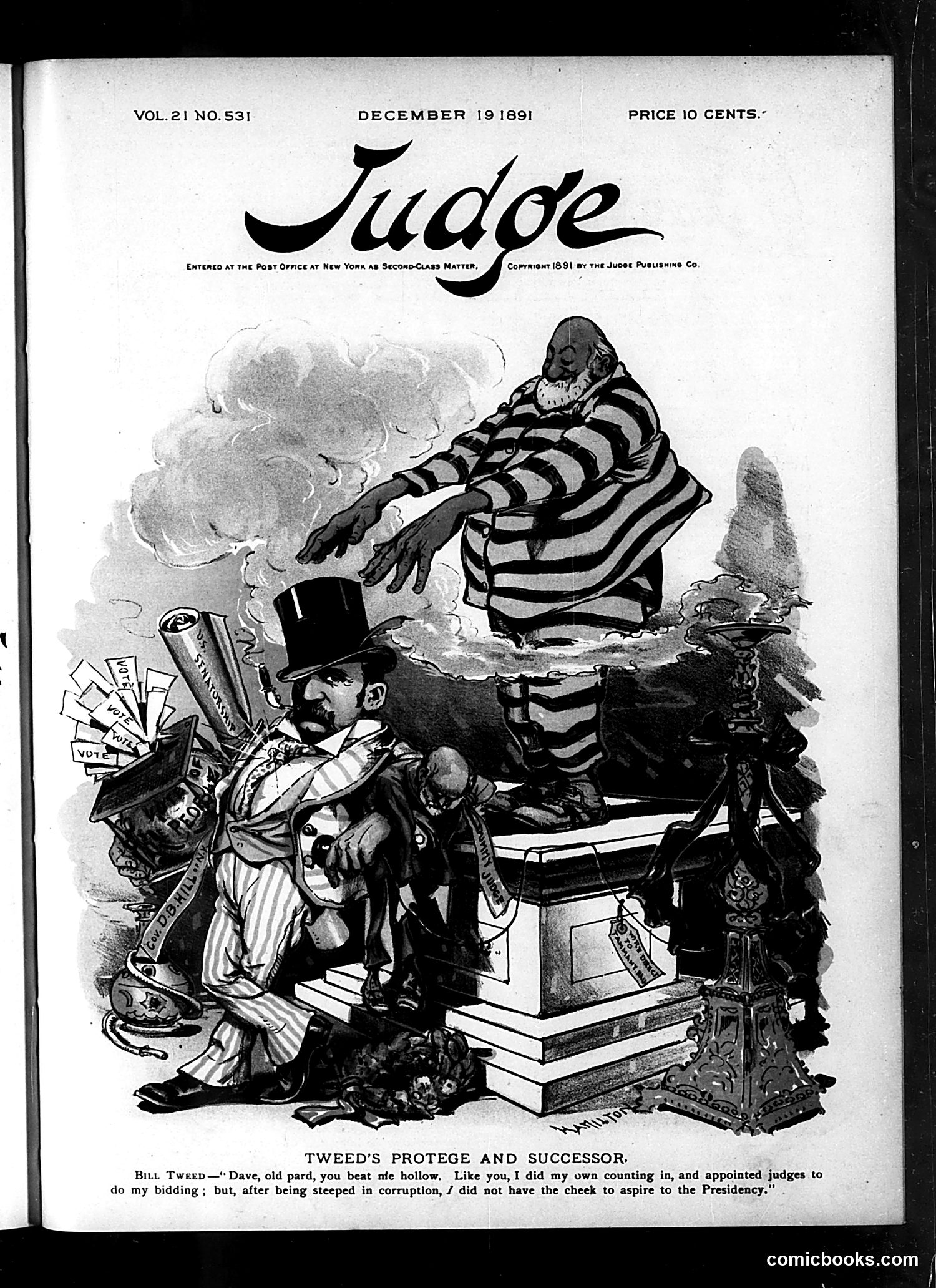
This 1891 Judge cartoon satirizes political corruption through the figure of "Bill Tweed" (likely referencing William "Boss" Tweed, the infamously corrupt Tammany Hall leader). The skeleton in striped prison garb represents Tweed himself, now deceased or imprisoned. The living politician in the top hat kneels before Tweed's ghost, confessing he's following Tweed's corrupt methods: appointing judges to do his bidding and accepting bribes ("being steeped in corruption"). However, he claims superiority—he had "the check to aspire to the Presidency," implying ambitions beyond Tweed's reach. The satire condemns the persistence of Tammany Hall-style political corruption into the 1890s, suggesting the system survived even after Tweed's downfall.
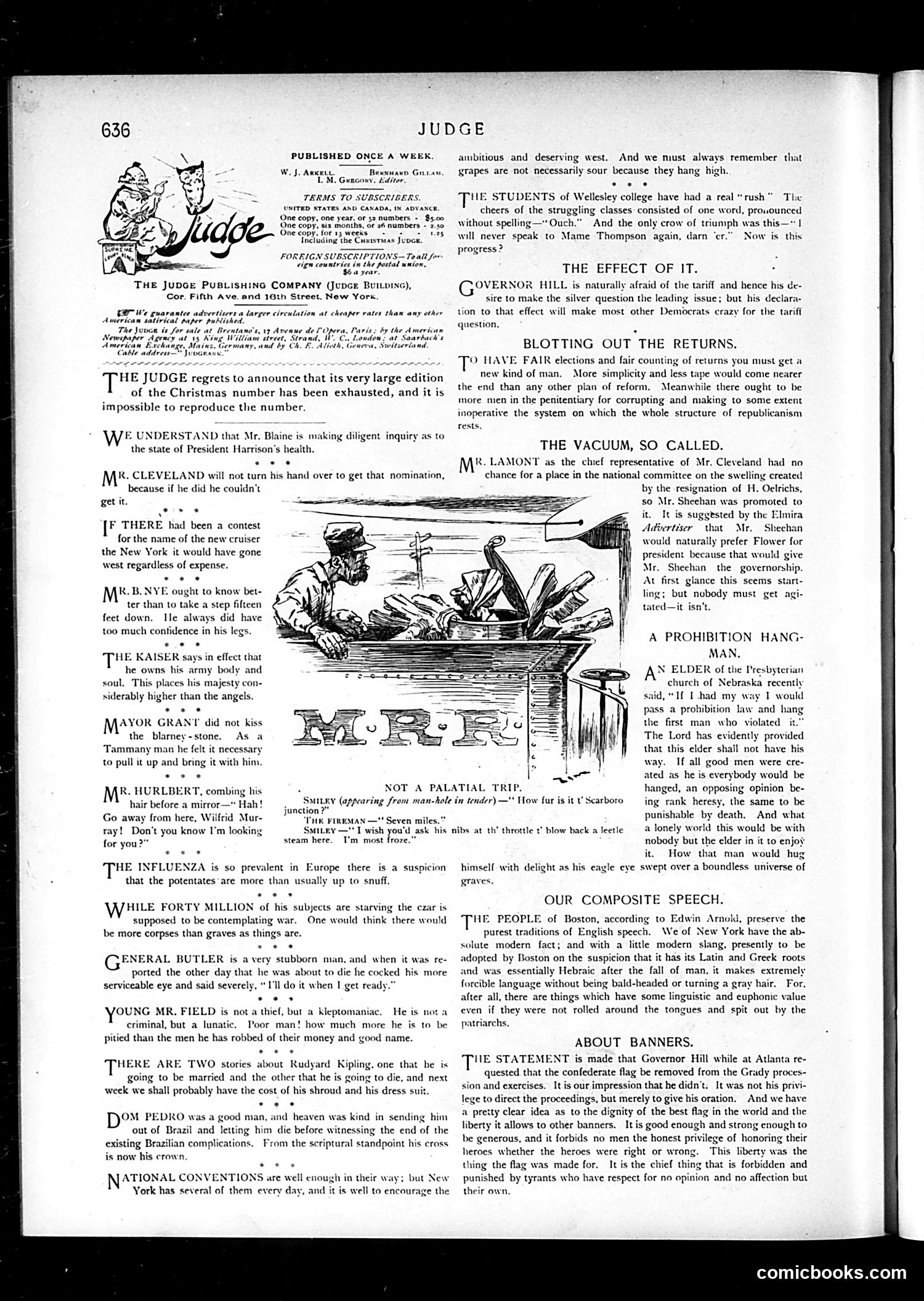
This page contains political commentary and brief satirical notes rather than a single cartoon. Key items include: **"The Effect of It"** critiques Governor Hill's tariff stance, predicting it will drive Democrats toward protectionism. **"Blotting Out the Returns"** suggests fair elections require a "new kind of man" — implying current politicians manipulate vote counts. **"The Vacuum, So Called"** discusses Cleveland's absence from a national committee created by H. Gould's resignation, speculating whether Flower or Sheahan might assume the governorship. **"A Prohibition Hangman"** references a Nebraska church elder's support for executing those who violate prohibition laws. The illustrations are small and support these brief political notes. The content reflects late-19th-century Democratic Party internal disputes, tariff debates, and Prohibition-era tensions.
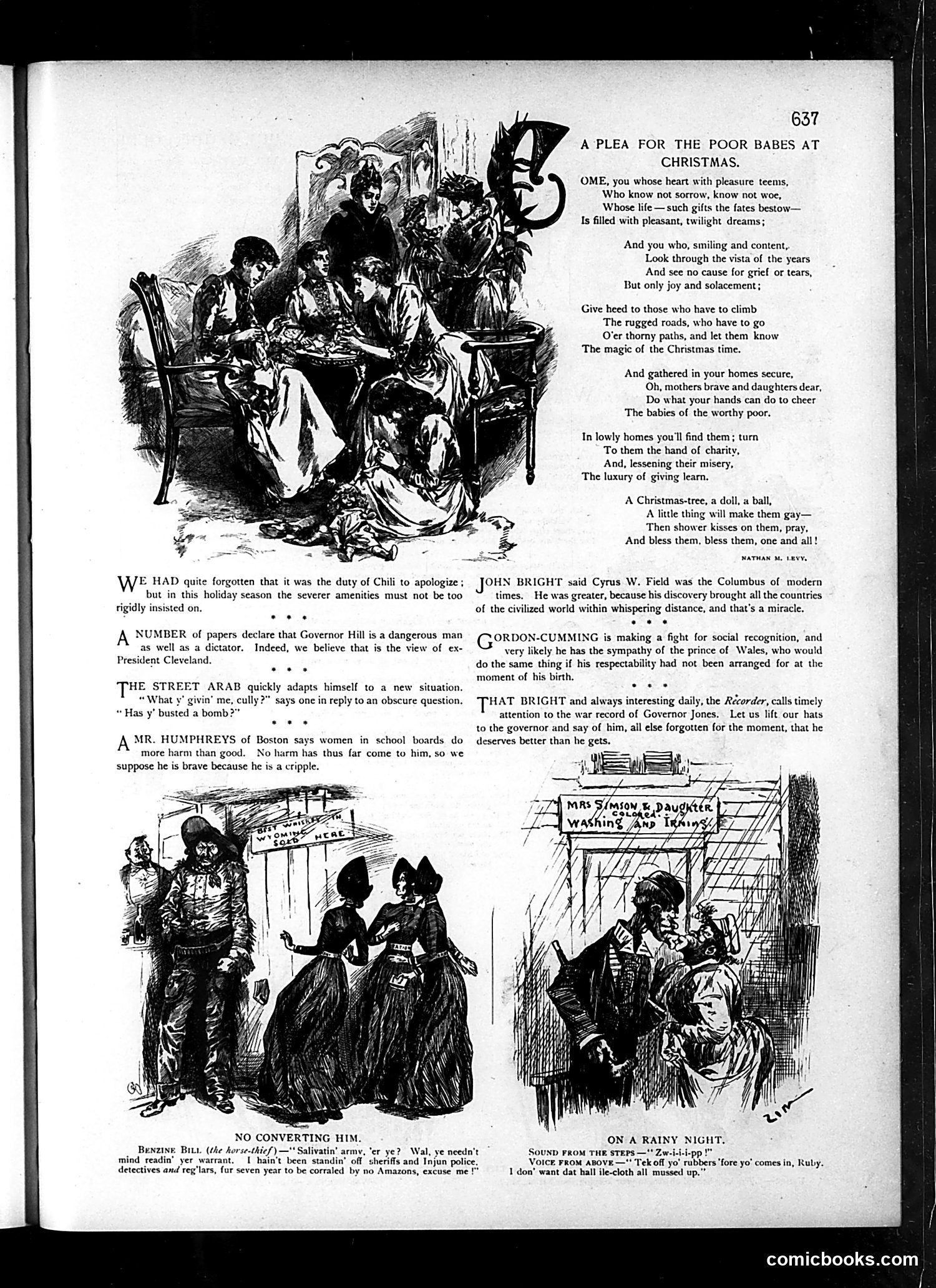
This page combines poetry and social commentary typical of Judge's satirical approach. "A Plea for the Poor Babes at Christmas" is a sentimental poem urging wealthy readers to aid poor children during the holidays. The illustrated vignettes satirize contemporary figures and situations: **"No Converting Him"** mocks "Beezer Bill" (an apparent stock character), suggesting even religious "Salvation Army" efforts cannot reform certain hardened individuals. **"On a Rainy Night"** depicts street life, with references to Italian immigrants ("Zé-Li-up," "fore'yo comes in, Italy"), likely satirizing both poverty and xenophobic attitudes toward recent immigration. The page reflects Judge's dual purpose: moral commentary on social inequality alongside mockery of marginalized groups and outsiders.
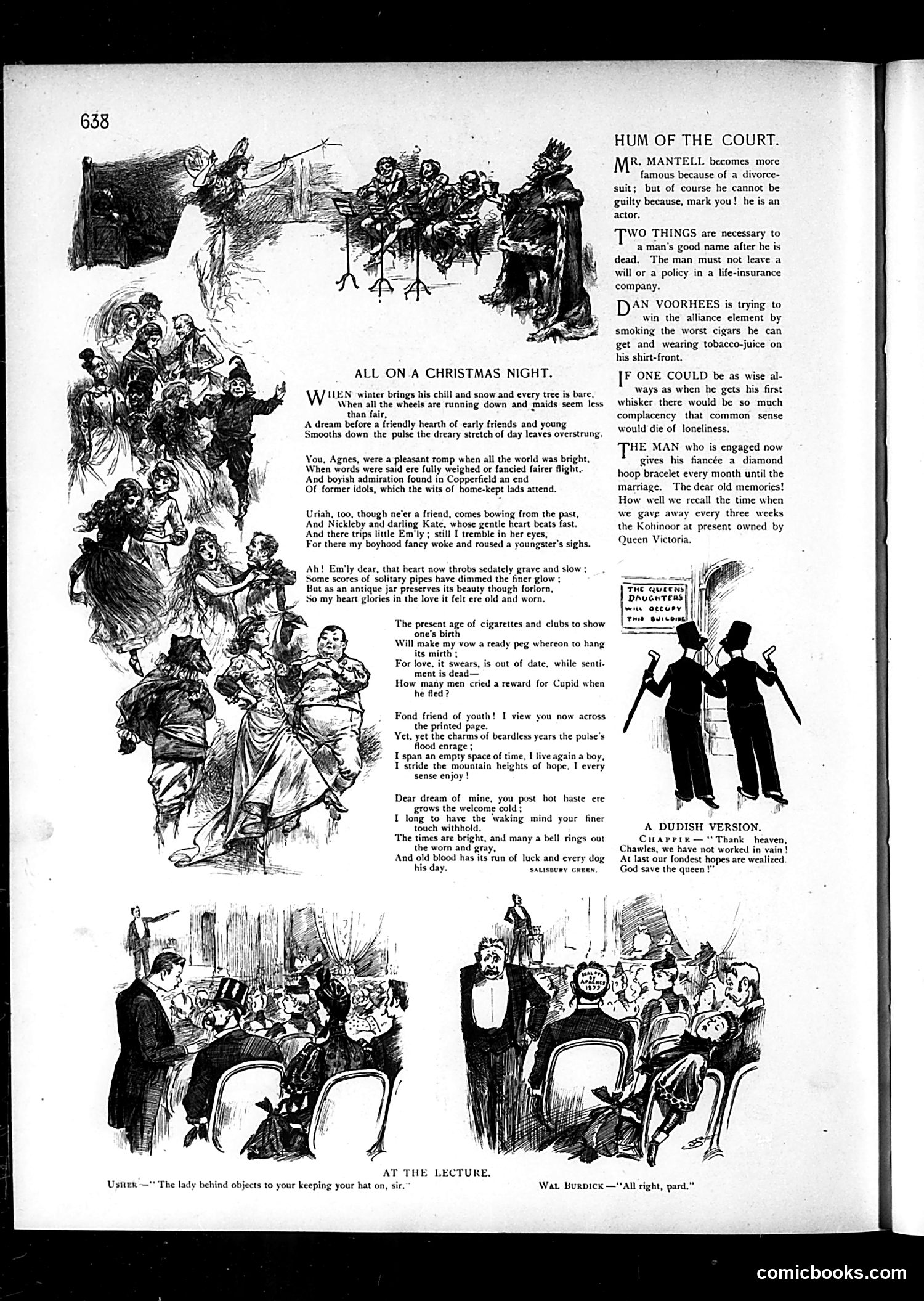
This page contains political and social satire typical of late 19th-century American humor. The main content includes: **"All on a Christmas Night"** — A sentimental poem (attributed to Salisbury Green) nostalgically recalling characters from Dickens novels, contrasting youthful romance with worldly cynicism in the modern age. **Satirical Quips** target contemporary figures and attitudes: - **R. Mantell**: A divorce scandal involving an actor, mocking how celebrity status shields public figures from judgment - **Dan Voorhees**: A politician (appears to be a senator) caricatured as affectedly affecting working-class mannerisms by smoking cheap cigars - Social commentary on materialism: mocking modern engagement customs (diamond bracelets) and life insurance obsessions **"A Dudish Version"** — A cartoon mocking affected, snobbish dandies ("Chawles" and "pard") celebrating some patriotic moment with exaggerated theatrical speech. **"At the Lecture"** — Cartoons depicting social awkwardness at public events. The page blends nostalgic sentimentality with sharp critique of Gilded Age pretension, materialism, and celebrity culture.
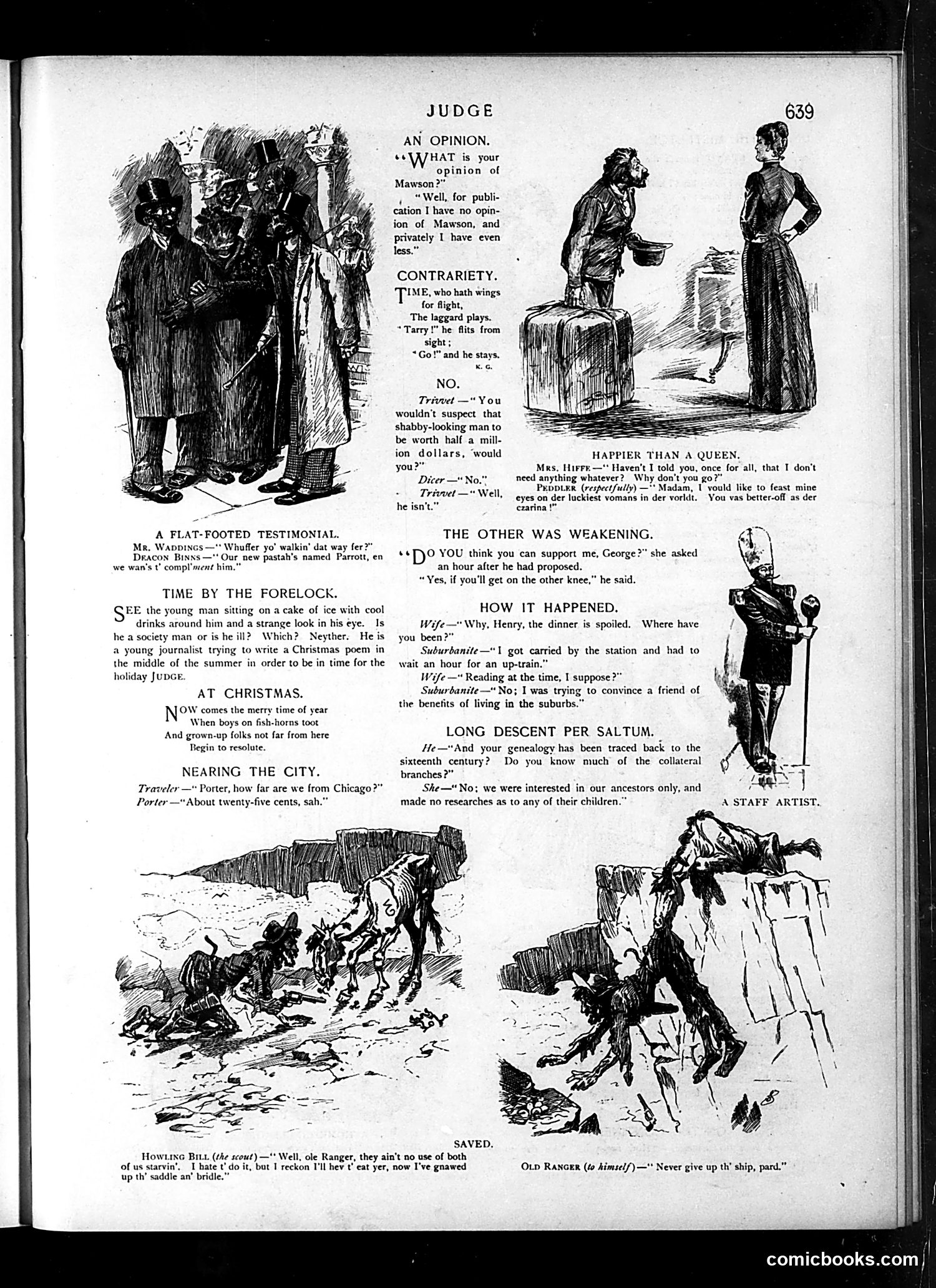
This page from *Judge* contains several brief satirical sketches and humorous dialogues rather than a single unified political cartoon. The sketches target social pretension and marital discord. "A Flat-Footed Testimonial" mocks someone's shabby appearance contrasted with claimed wealth. "The Other Was Weakening" depicts a woman leveraging a marriage proposal threat. "How It Happened" satirizes suburban life and domesticity. "Long Descent per Saltum" ridicules genealogical snobbery—someone boasting of sixteenth-century ancestry while knowing nothing of their heritage. The dialogue fragments use humor to critique class aspiration, marital manipulation, and the gap between social pretense and reality. The accompanying illustrations are generic character sketches rather than caricatures of specific public figures, suggesting these represent universal social types rather than particular political targets.
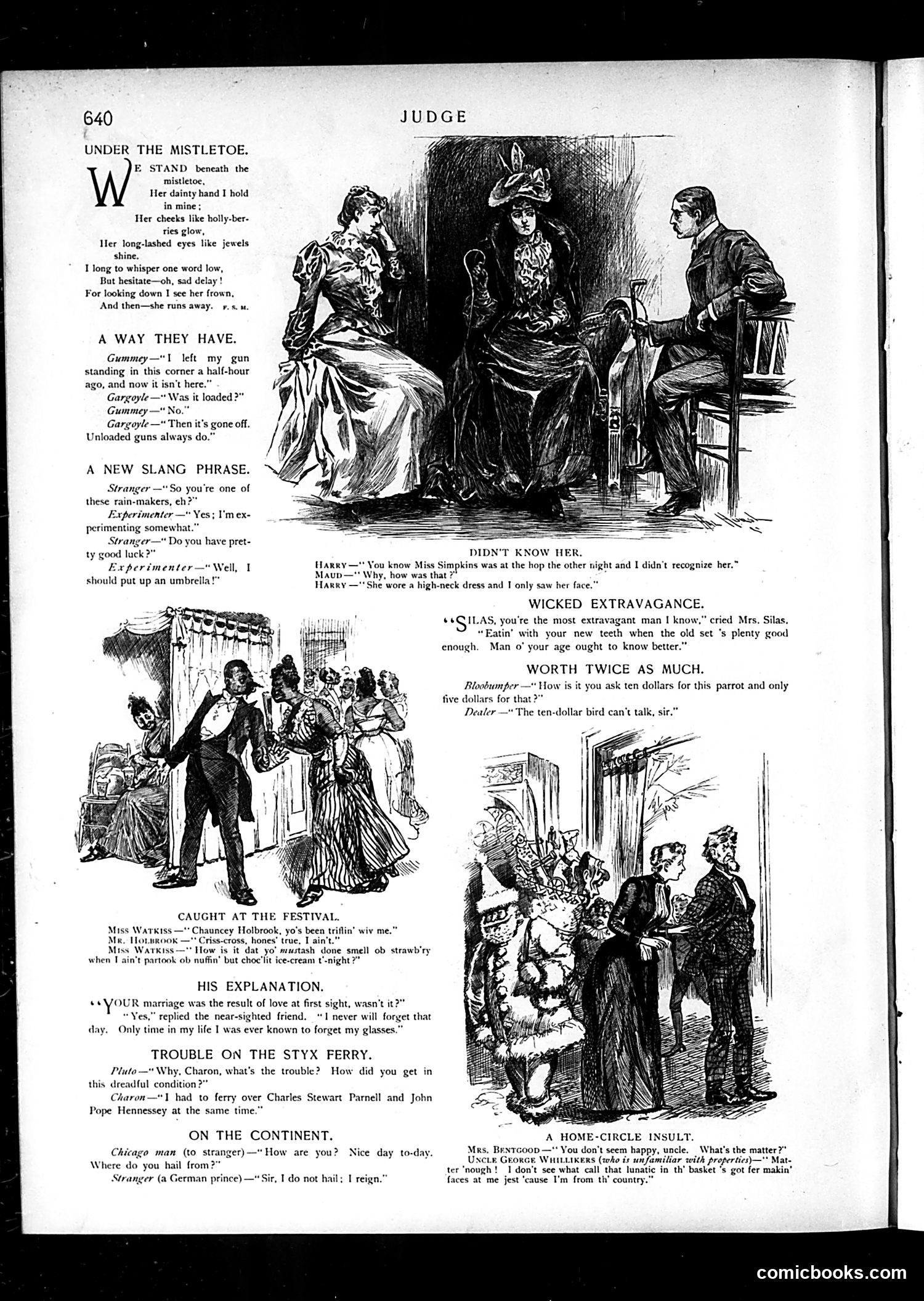
This page collects brief comedic sketches typical of late-19th-century American humor. Most jokes rely on wordplay and social observation rather than political satire. **Notable items:** - **"Under the Mistletoe"**: A romantic verse about a man hesitating to propose, only to have the woman flee—playing on Victorian courtship anxieties. - **"Wicked Extravagance"**: Mrs. Silas scolds her husband for using new false teeth instead of old ones—mocking conspicuous consumption and waste. - **"Worth Twice as Much"**: A parrot dealer explains a silent bird costs double—absurdist humor about paradoxical value. - **"Trouble on the Styx Ferry"**: References Charles Stewart Parnell and John Pope Hennessey (Irish political figures), suggesting their conflict caused chaos even in the afterlife—likely contemporary political commentary. The page emphasizes domestic life, courtship mishaps, and class-conscious humor typical of Judge's middle-class audience.
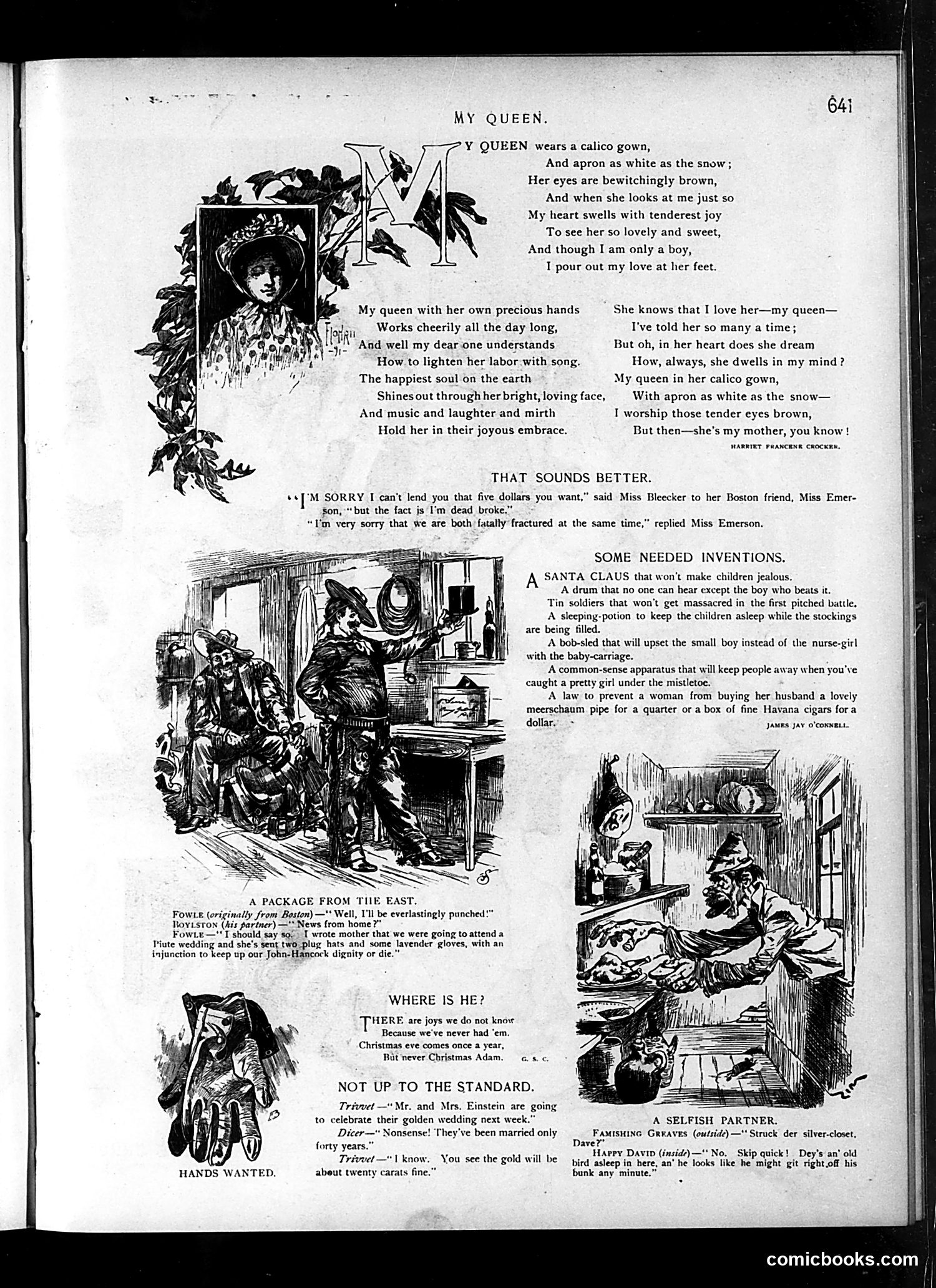
This page contains primarily **humorous short pieces and jokes** rather than political cartoons, typical of Judge's satirical format. **Key Content:** - **"My Queen"** (top): A sentimental poem revealing the speaker's "queen" is actually his *mother*—a gentle joke about filial devotion masquerading as romance. - **"That Sounds Better"**: A quip where two broke women use financial jargon ("fatally fractured") to describe being broke—humor through pretentious language. - **"Some Needed Inventions"**: Satirical wish-list of impractical holiday and domestic solutions (silent drums, sleeping potions for children during gift-filling, etc.)—mocking both consumerism and parenting challenges. - **Various brief sketches** including a mother sending her son fancy clothes for a Native American wedding, and wordplay about "Christmas Adam" (the day before Christmas Eve). The humor targets middle-class anxieties: finances, courtship, child-rearing, and social pretension. No major political figures appear—this represents Judge's lighter, domestic satire rather than topical commentary.
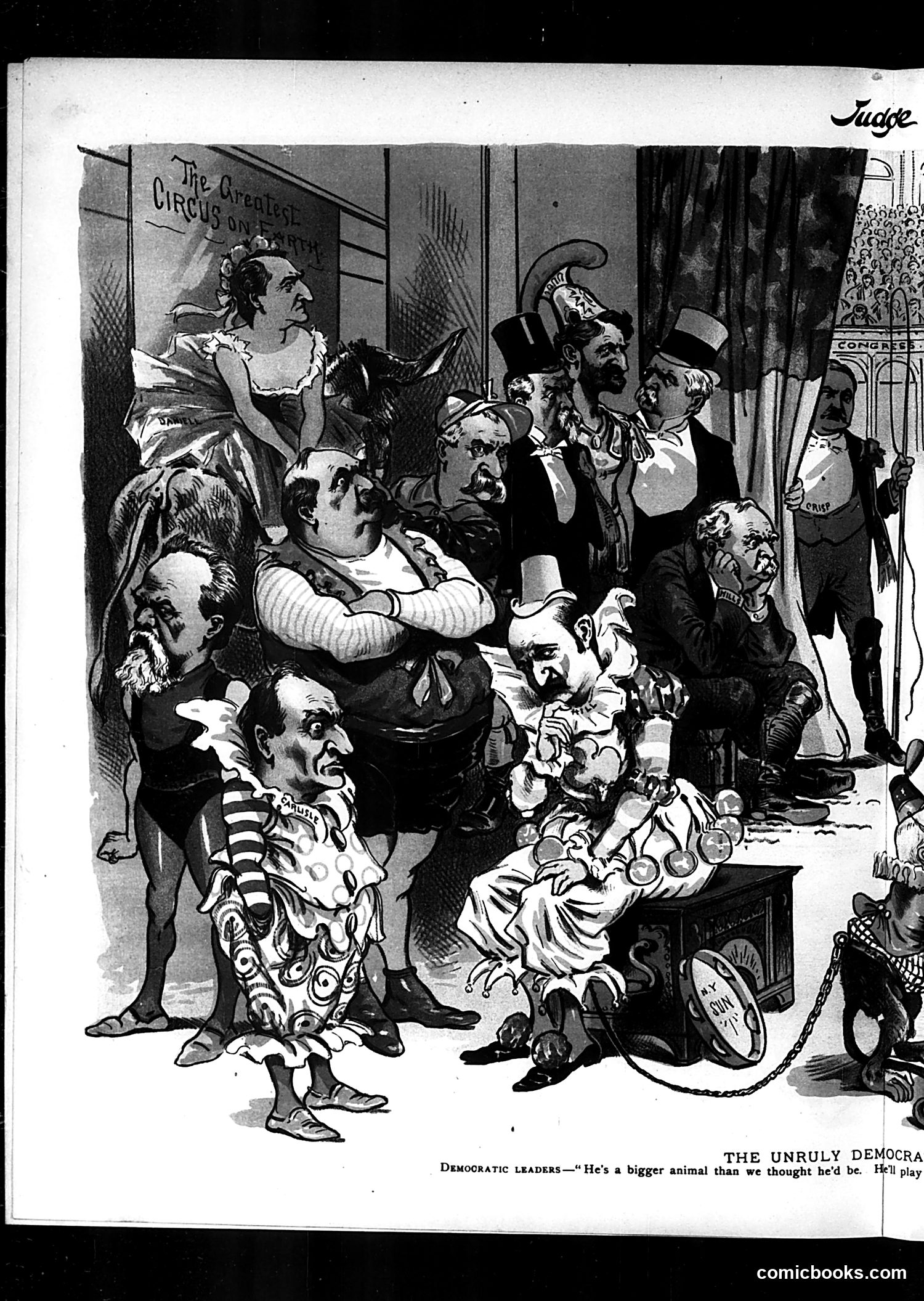
This political cartoon depicts Democratic Party leaders struggling to control a large, wild beast labeled "Democrat" — portrayed as a circus animal that's bigger and more unmanageable than expected. The caption quotes the leaders saying "He's a bigger animal than we thought he'd be. He'll play," suggesting anxiety about controlling the party's base or direction. The figures appear to be party bosses or politicians (shown in formal dress with top hats) attempting to manage an unruly force. The circus setting implies the Democratic Party is portrayed as chaotic and difficult to govern. This satirizes internal Democratic tensions — likely referencing factional disputes or difficulty maintaining party discipline during this era. The "Judge" magazine, Republican-leaning, uses the metaphor to mock Democratic disunity and suggest their leadership cannot control their own party effectively.
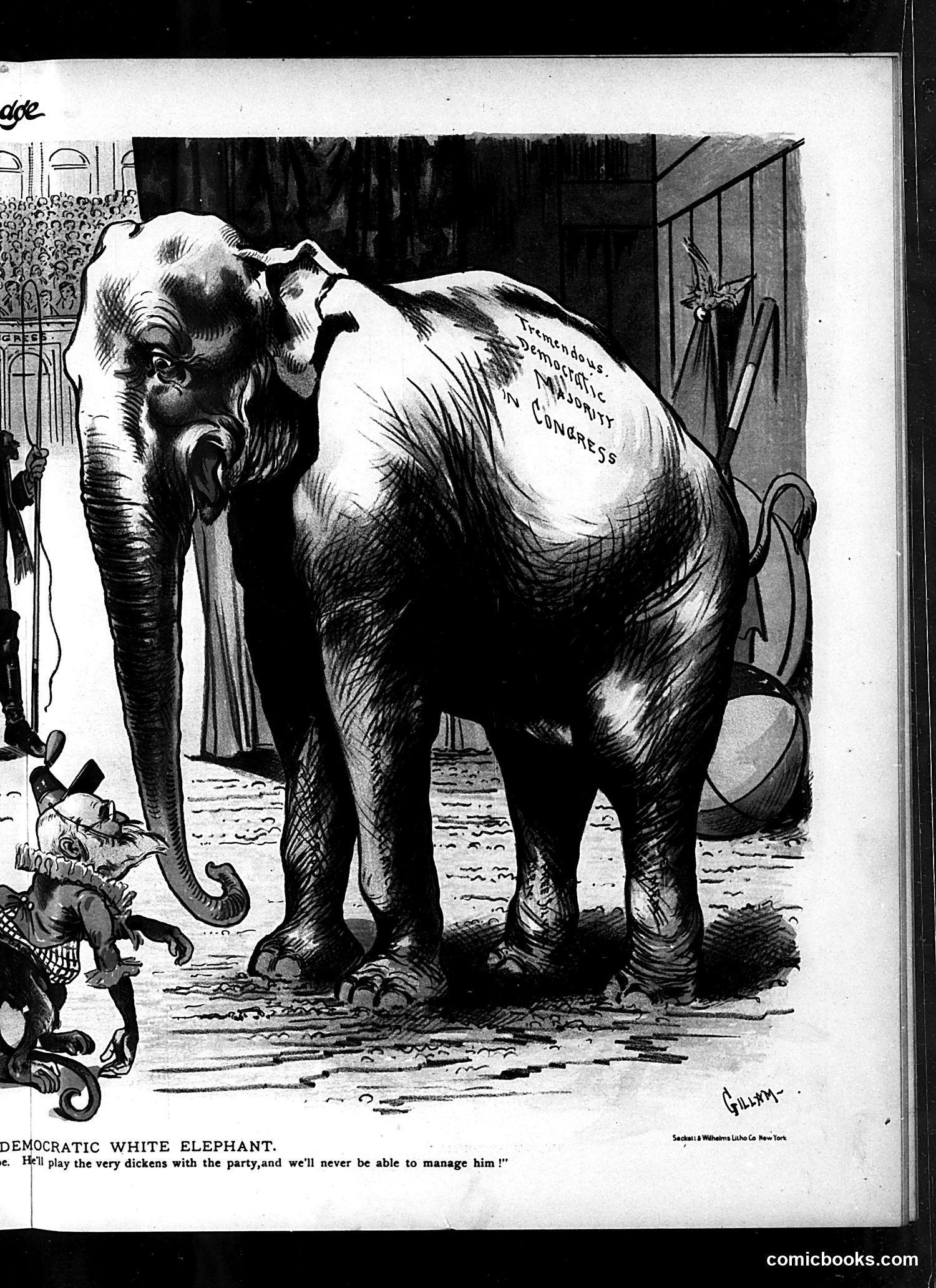
This political cartoon depicts a large elephant labeled "Democratic Majority in Congress" carrying text on its body. The elephant is a "white elephant"—a proverbial burden that's costly and difficult to manage. A small figure (likely representing Democratic Party leadership) expresses concern that this congressional majority will cause trouble and prove uncontrollable. The satire suggests that winning a congressional majority, rather than being an asset, has become a liability for the Democratic Party—unwieldy, expensive to maintain, and problematic to govern with. The cartoon critiques internal Democratic Party dysfunction, implying that their own political power has become a hindrance rather than an advantage. The "white elephant" metaphor was commonly used in American political satire to represent burdensome possessions or situations.
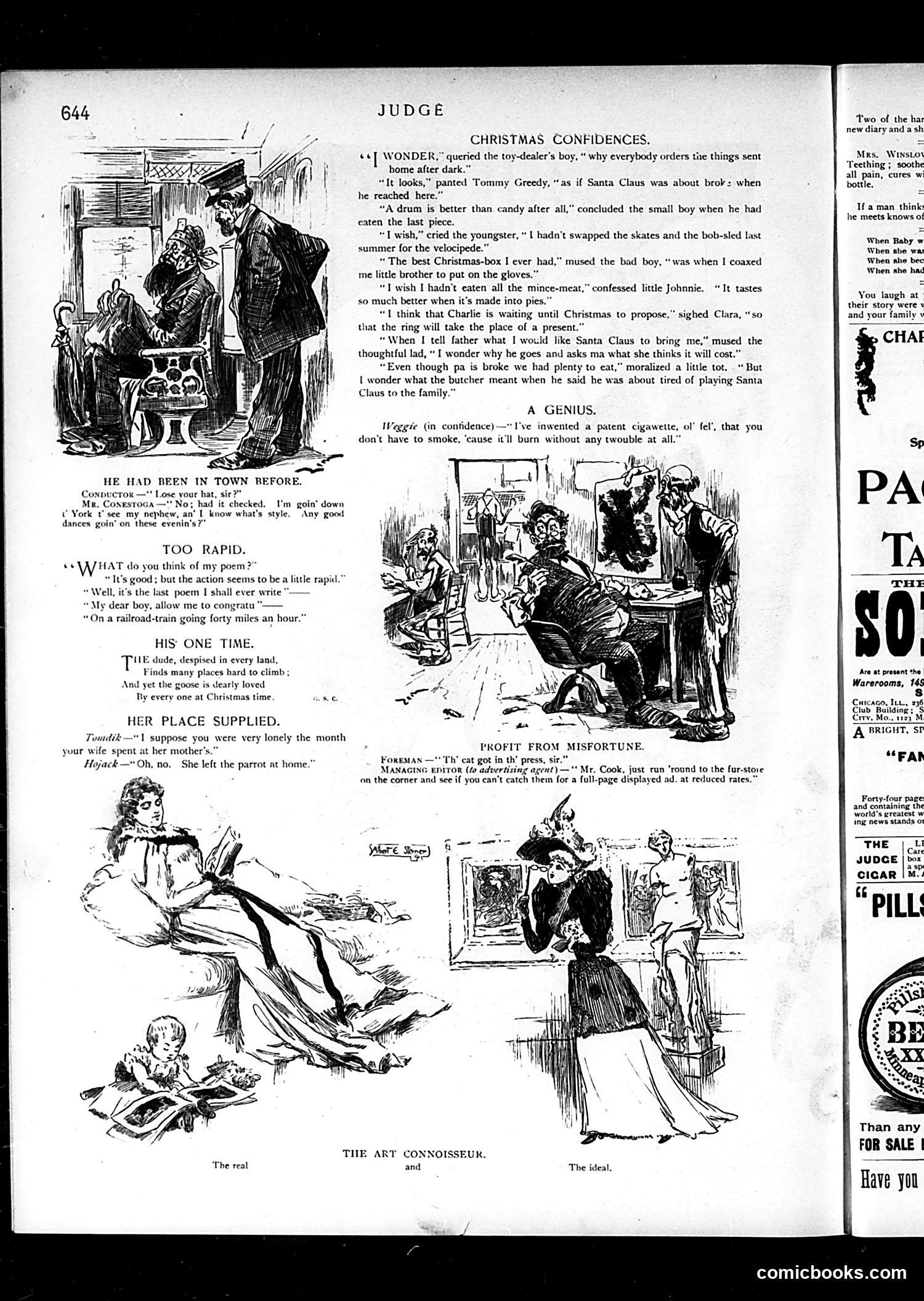
This page from *Judge* contains several short satirical pieces mocking Victorian social conventions and human foibles: **"Christmas Confidences"** presents children's innocent observations about gift-giving, revealing adults' financial struggles and hypocrisy—parents pretend generosity while secretly worried about costs. **"Too Rapid"** jokes about a poet whose suicide plan makes his last poem literally "rapid" (ending quickly on a fast train)—dark humor about suicidal ideation. **"Her Place Supplied"** presents a husband claiming he wasn't lonely during his wife's absence because the parrot kept him company—satirizing marriage and companionship. **"A Genius"** features a character inventing a cigarette that doesn't require smoking, mocking both patent absurdity and the era's cigarette culture. **"Profit from Misfortune"** depicts a managing editor seeing a cat accident in the printing press as an advertising opportunity—cynical satire of commercialism. **"The Art Connoisseur"** contrasts the "real" and "ideal" versions of art appreciation (bottom illustrations, now faded). The page is primarily satirical humor targeting middle-class pretension, financial anxiety, and commercial opportunism.
This is primarily an **advertising page** from Judge magazine, typical of late 19th-century periodicals. The page contains minimal editorial content—mostly product advertisements for patent medicines, household goods, and consumer products common to the era. The few textual items present are short **humorous quotations** rather than political commentary. These include jokes about diary-keeping, a child's misunderstanding of "artificial rain" making artificial flowers grow, and a quip about a defeated political candidate's campaign manager being "active" by consuming alcohol ("about a gallon a day"). The advertisements themselves—for remedies like Salvation Oil, Mrs. Winslow's Soothing Syrup, and Beeman's Pepsin Gum—reflect contemporary attitudes toward patent medicine marketing, before FDA regulation. **No significant political cartoons or social satire appear on this page.** It represents Judge's revenue model: satirical editorial content mixed with profitable advertisements targeting middle-class consumers.
This page is primarily **advertising**, with limited editorial content. The main feature is a humorous poem in the upper center—a brief, cynical commentary on how truth takes time to emerge, illustrated with a boxing metaphor (the "referee count ten" and "knock-out blow"). This reflects popular skepticism about delayed justice or vindication. The rest consists of period advertisements for consumer goods: tobacco, soup extract, candy, cigars, soap, furs, and medicines. A small section includes Samuel Small (an Atlanta reformer attempting to shut down saloons) and praise for Judge magazine's holiday issues. The "Judge's National Hotel Guide" lists New York accommodations. **No clear political satire or caricature is evident**—this appears to be a standard Judge advertising page with minimal editorial cartoons, typical of magazines' revenue-dependent layout in the early 1900s.
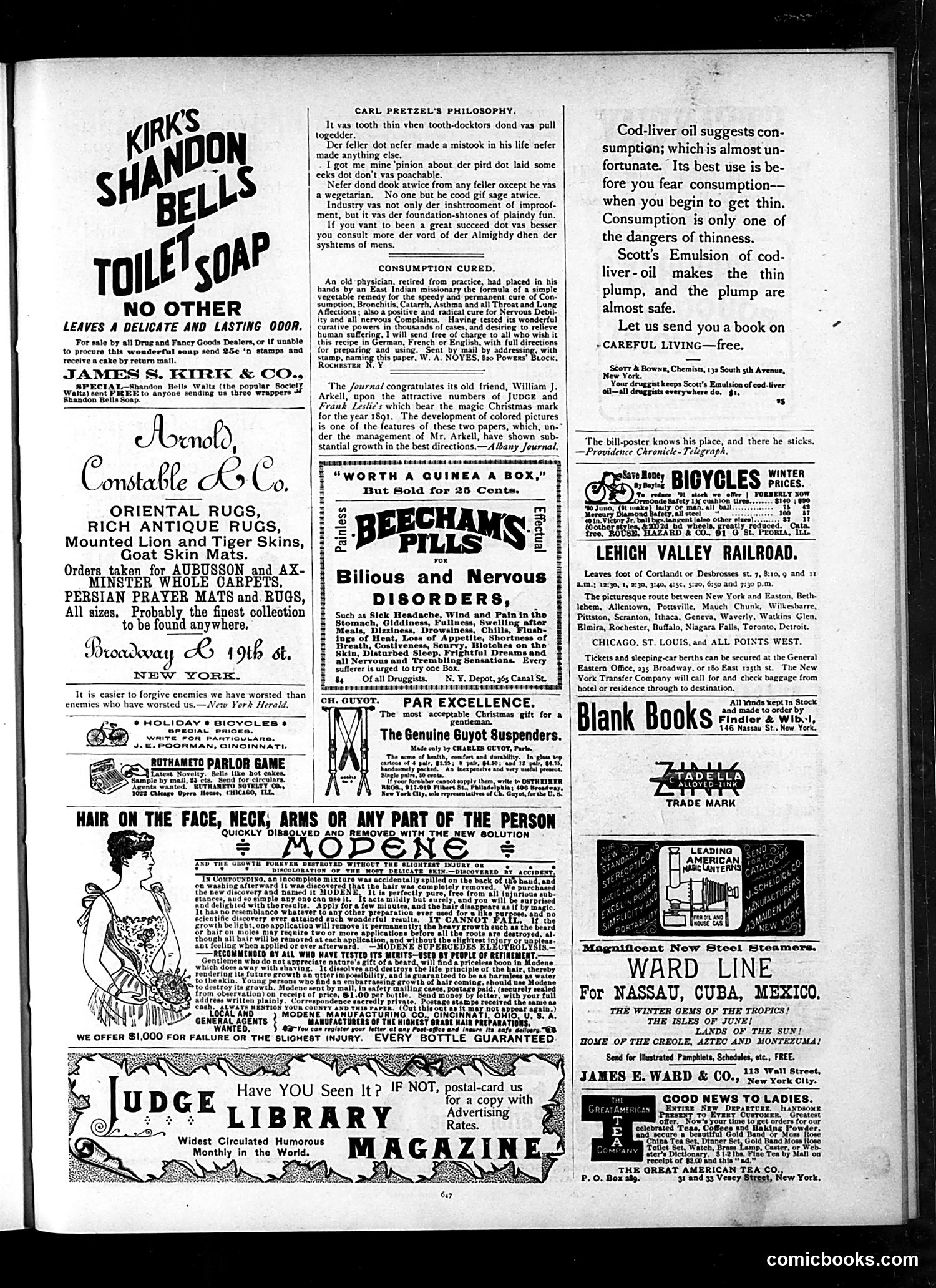
This is primarily an **advertising page** from Judge magazine, with one notable satirical element: **"Carl Pretzel's Philosophy"** — a humor column featuring a character with a thick German accent dispensing folk wisdom ("It vas tooth thin vhen tooth-docktors dond vas pull togedder"). The page is dominated by period advertisements for remedies and goods typical of the 1890s: Kirk's Shandon Bells soap, Beecham's Pills (for "bilious and nervous disorders"), Scott's Emulsion cod-liver oil, hair removal cream ("Modene"), and various luxury imports (Oriental rugs, bicycles, railroad travel). The Pretzel character appears to be ethnic humor—common in Judge—using malapropisms and German-inflected English for comedic effect, though the philosophy offered ("nefer dond dook atwice") aims at gentle, universal wisdom rather than harsh mockery. At the bottom, a brief congratulatory note mentions William J. Arkell and colored Christmas illustrations in Judge and Frank Leslie's magazines, reflecting pride in the publication's technical advances.
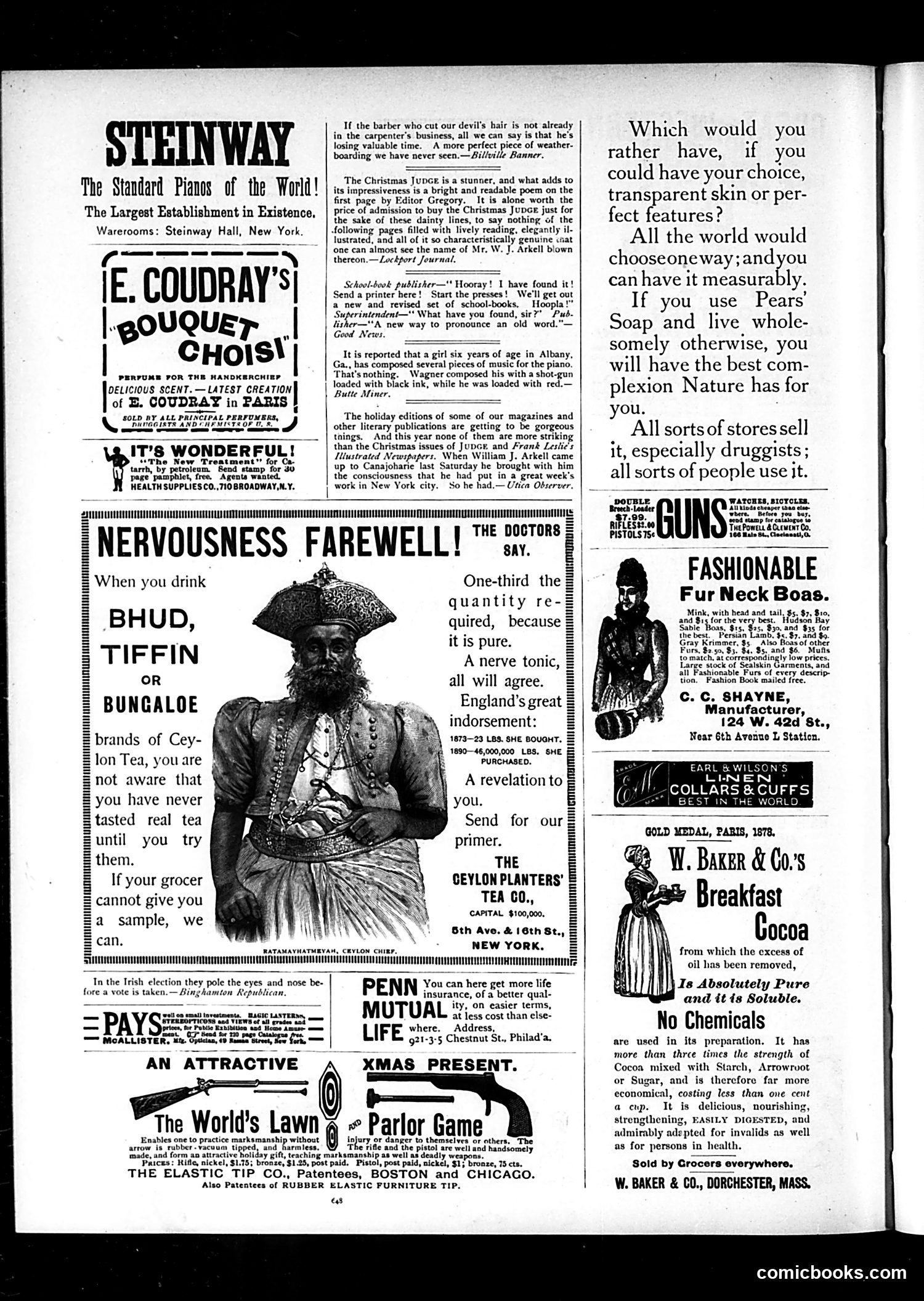
This page is primarily **advertising and brief editorial notes** rather than substantive satire or political cartooning. The main content includes: **Editorial snippets**: Brief, light commentary on various topics—a local barber's poor haircut job, praise for *Judge* magazine's Christmas issue, a girl composer in Albany (with a joke about Wagner's creative process), and the quality of holiday magazine editions. **Large illustrated advertisement**: A central image of a Victorian-era woman in elaborate dress promotes Ceylon Planters' Tea Co., claiming England endorsed it (supposedly purchasing 46 million pounds). The ad emphasizes purity and nerve-tonic properties—typical health claims of the era. **Surrounding ads**: Products ranging from perfume and cocoa to insurance, firearms toys, and other goods. **Historical context**: The page reflects late-19th-century consumer culture and advertising practices, with emphasis on imperial commerce (Ceylon tea) and dubious medicinal claims common to the period. The page contains **no coherent political cartoon or sustained satirical commentary**—just scattered light humor and commercial promotion typical of general-interest magazines from this era.
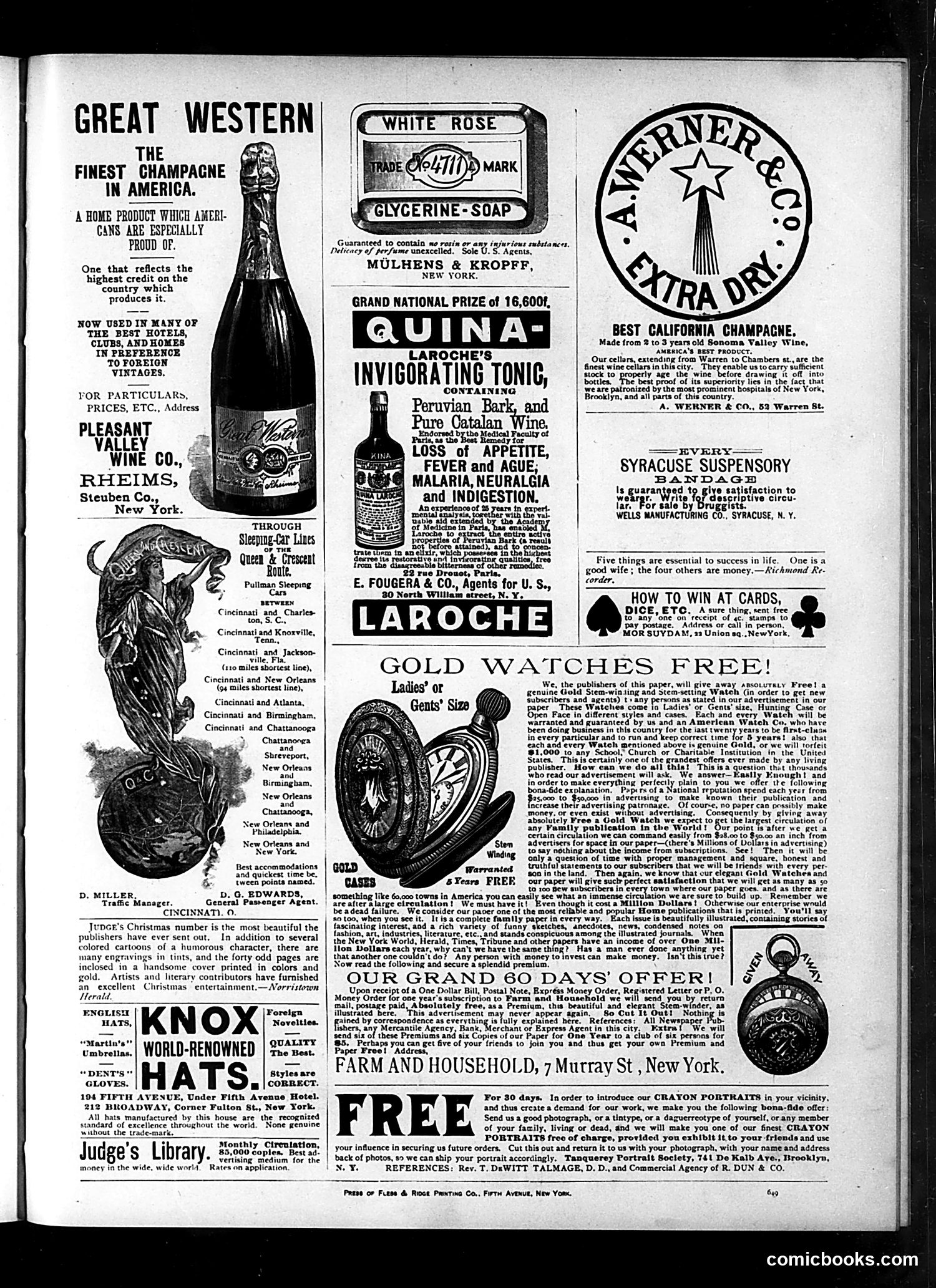
This is primarily an **advertising page** with minimal editorial content. The page showcases patent medicines, luxury goods, and services typical of late 19th-century American commerce. **Key advertisements include:** - **Champagne and wine promotions** (Great Western, Laroche's Tonic) — expensive status symbols marketed to wealthy Americans - **Laroche's Invigorating Tonic** — a patent medicine claiming to cure malaria, fever, neuralgia, and indigestion (typical of era's unregulated medical claims) - **Gold Watch Giveaway** — a circulation-building scheme offering free watches to attract subscribers - **Knox Hats** — quality headwear for gentlemen - **Crayon portraits** — affordable portraiture service The small editorial item at bottom left ("Five things essential to success in life...") is a brief satirical quip typical of Judge's humorous filler content, making a cynical joke about money and marriage. **Overall context:** This reflects Gilded Age consumer culture, when magazines relied heavily on advertising revenue and promoted luxury goods to affluent readers. Patent medicines with dubious claims were widespread and largely unregulated.
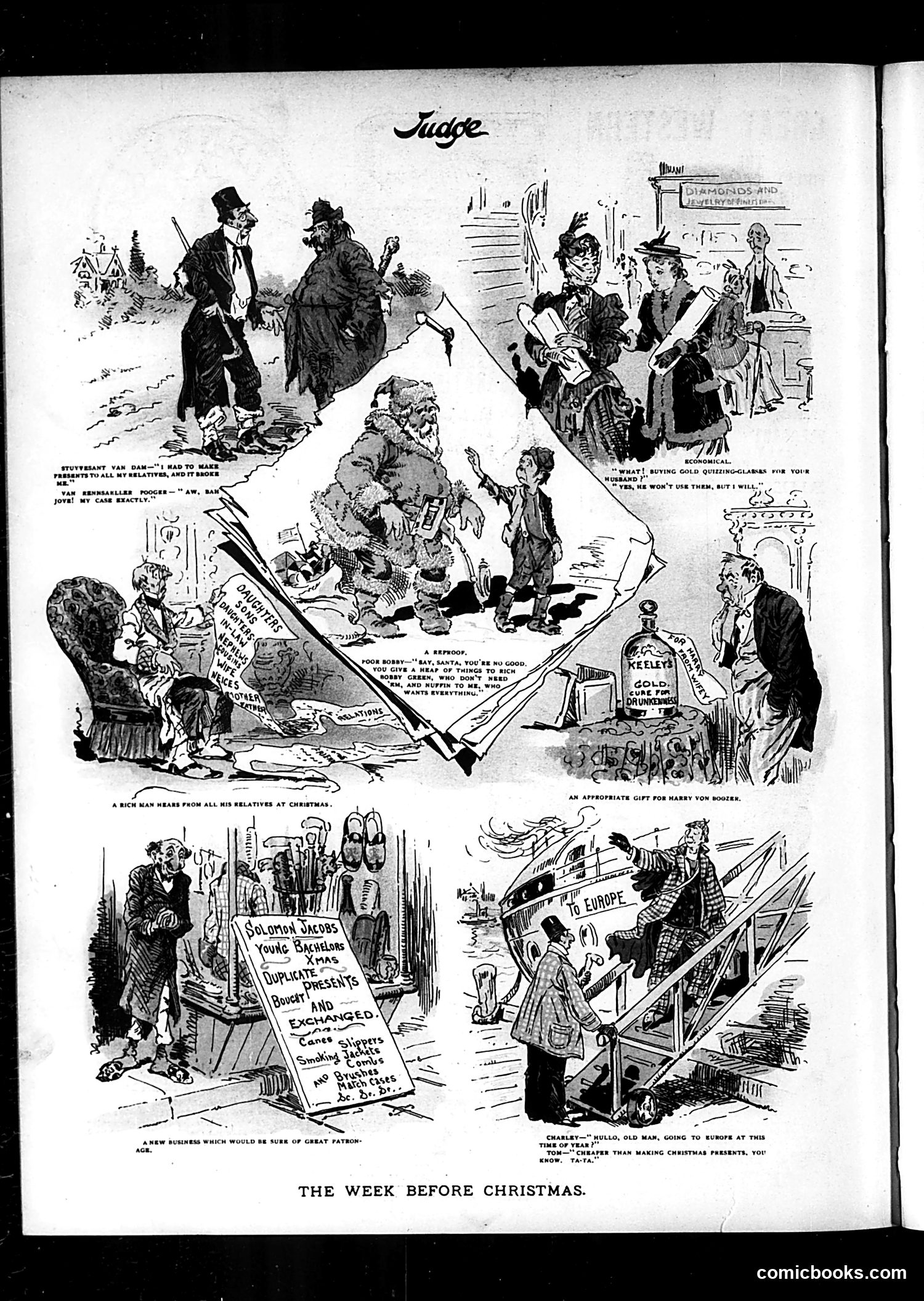
This satirical page depicts the chaos of Christmas shopping and gift-giving in late 19th/early 20th-century America. The comic panels show various social types—wealthy gentlemen, working-class people, and merchants—struggling with holiday obligations. Key scenes include wealthy figures debating expensive gifts, someone offering cheap "exchanges" as presents, and a character named "Charley" complaining that taking a trip to Europe is "cheaper than making Christmas presents." The satire mocks the commercialization of Christmas, the pressure to give costly gifts, and the irony that elaborate gift-giving has become a financial burden rather than a meaningful tradition. The overall joke: Christmas has become so expensive and obligatory that even foreign travel seems like a bargain alternative to the expected gift-giving ritual.