
A complete issue · 20 pages · 1891
Judge — November 28, 1891
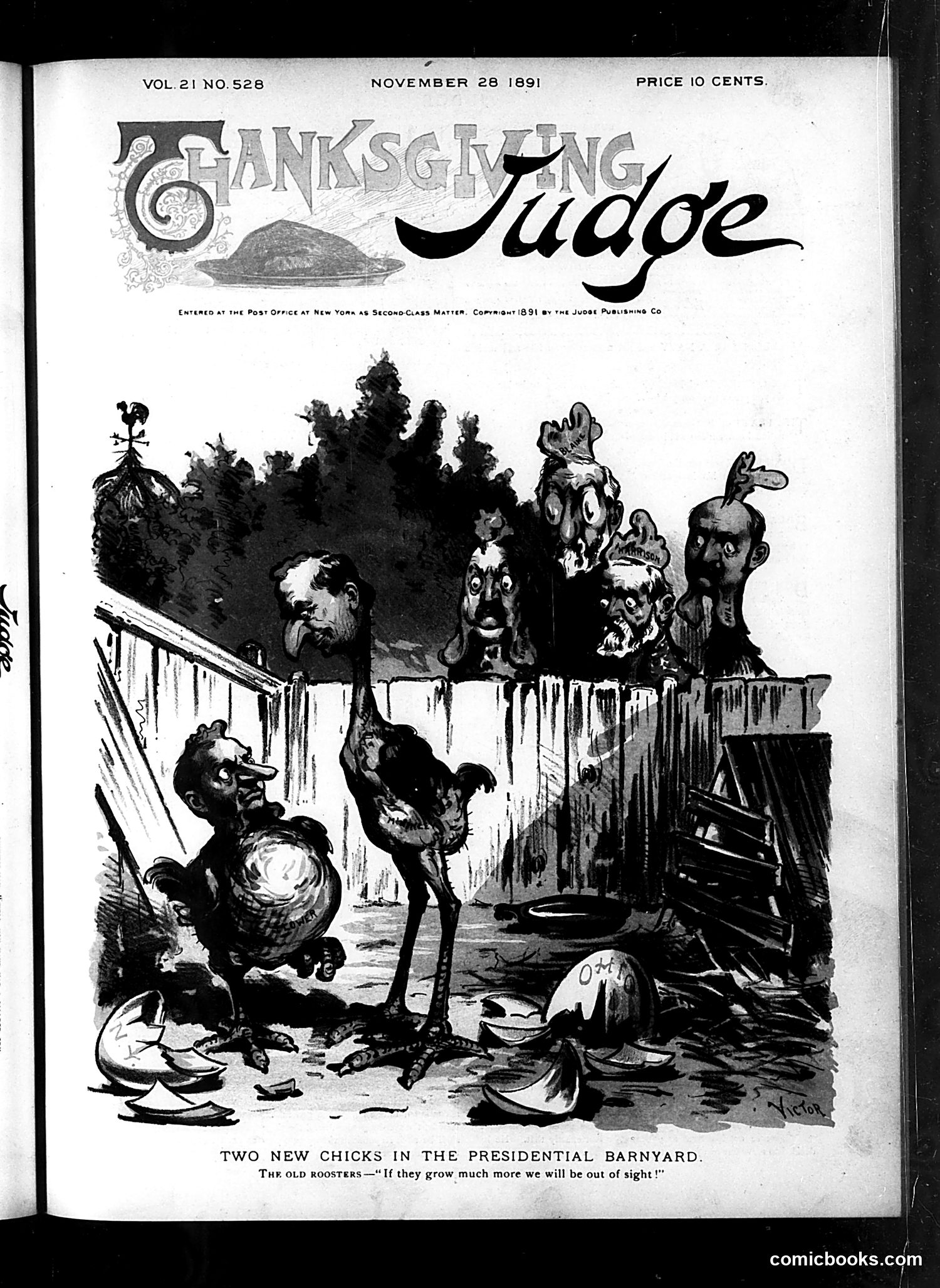
This is a political cartoon from *Judge* magazine (November 28, 1891) satirizing the U.S. presidency. The title and caption—"If they grow much more we will be out of sight!"—suggest commentary on newcomers or challengers to established political power. The cartoon depicts caricatured figures in a barnyard setting. The "old roosters" (established political figures) worry about "two new chicks" (likely rising political rivals or third-party candidates) becoming too prominent and overshadowing them. Without specific context about 1891 politics, the exact identities remain unclear, but the agricultural metaphor critiques how the political establishment fears competition from emerging forces that could disrupt the existing power structure.
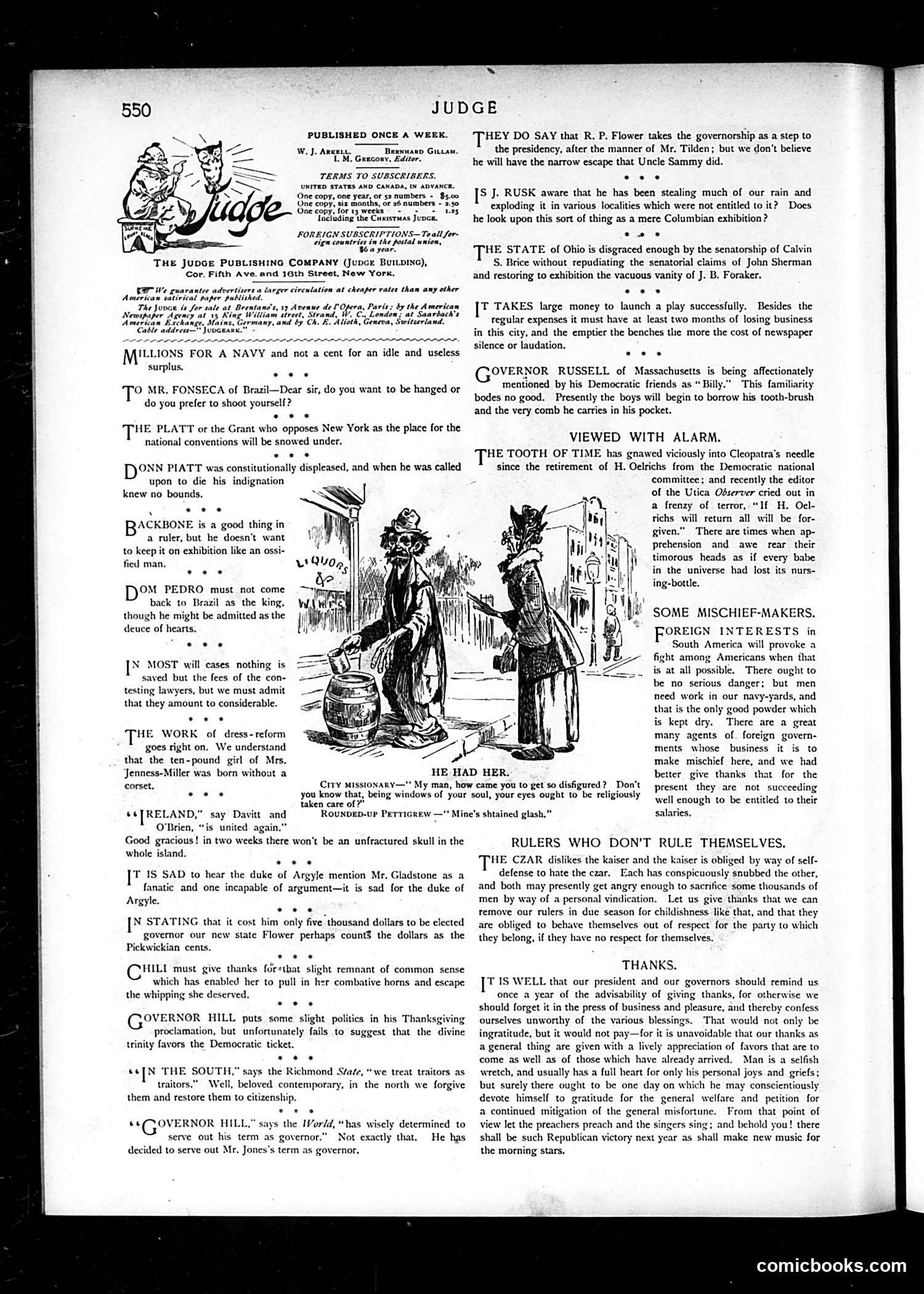
This page from *Judge* magazine contains political commentary rather than a cohesive cartoon. The snippets target various figures and issues: **Identifiable references:** - R.P. Flower's gubernatorial ambitions - Calvin S. Brice and John Sherman (Ohio politics) - Governor Russell of Massachusetts - Various unnamed political figures critiqued for specific behaviors **Main satirical points:** The text mocks politicians for hypocrisy and self-serving ambition—Flower treating the governorship as a stepping stone, Russell's patronizing treatment, and officials failing to govern responsibly. One section criticizes foreign governments' agents making mischief in America. **The central cartoon** (captioned "HE HAD HER") appears to depict a liquor-related confrontation, likely satirizing temperance debates or alcohol policy. The page is primarily *editorial commentary* rather than visual satire, using sharp wit to critique political opportunism and negligent leadership.
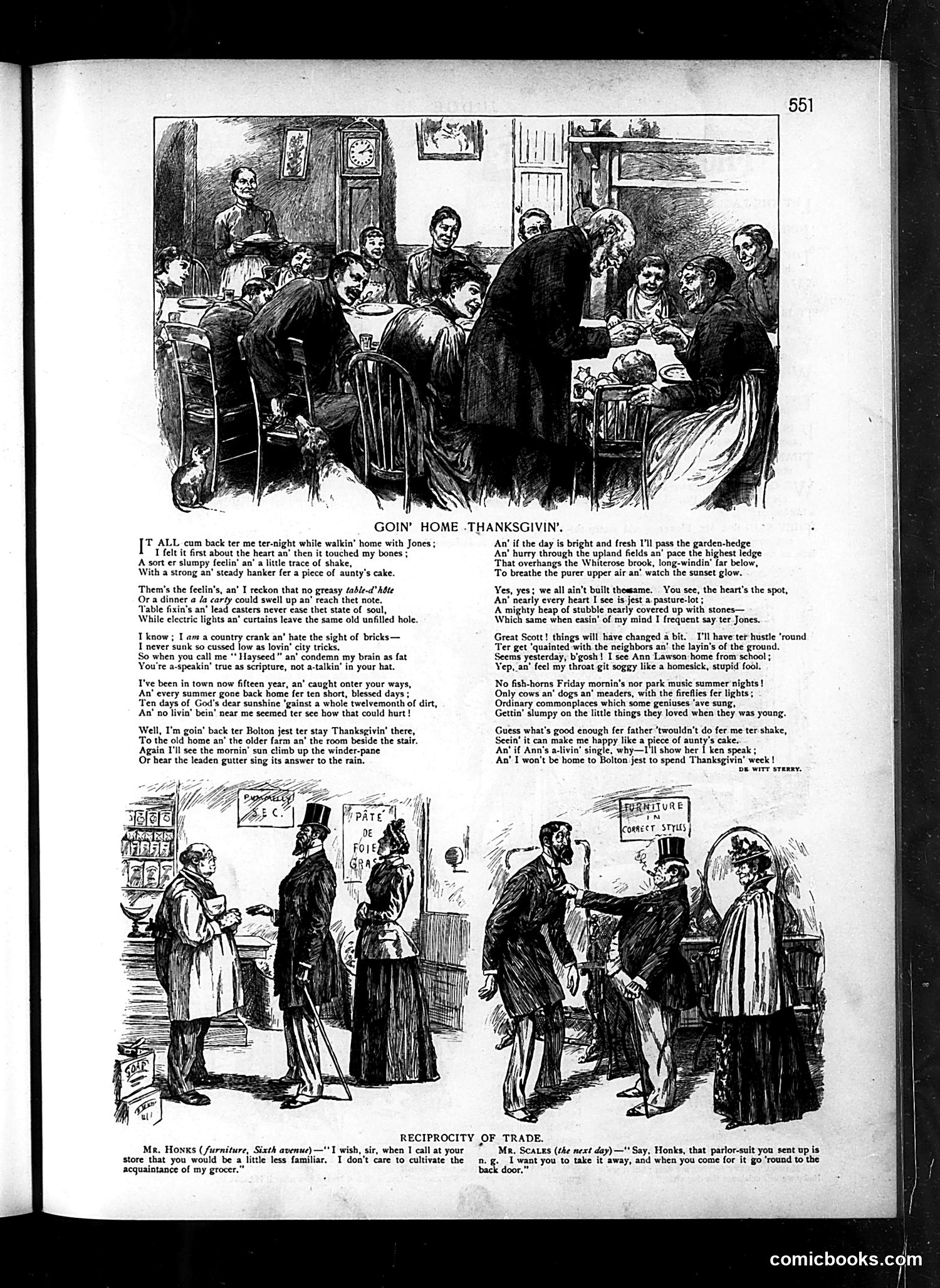
**Top Cartoon: "Goin' Home - Thanksgivin'"** This depicts a crowded holiday train scene with working-class passengers returning home for Thanksgiving. The poem expresses nostalgic longing for humble domestic comforts—mother's cooking, familiar surroundings, simple pleasures—contrasted with the speaker's current urban poverty ("I been in town now fifteen year"). The satire gently mocks the idealization of rural/small-town life while acknowledging genuine hardship in city living. **Bottom Cartoon: "Reciprocity of Trade"** Shows street vendors or merchants in what appears to be a reciprocal business arrangement. The dialogue suggests one party offering goods or services with expectation of return favor. This likely satirizes contemporary trade disputes or commercial practices, though the specific political context remains unclear without additional historical reference. Both pieces reflect turn-of-century American working-class experiences and economic anxieties.
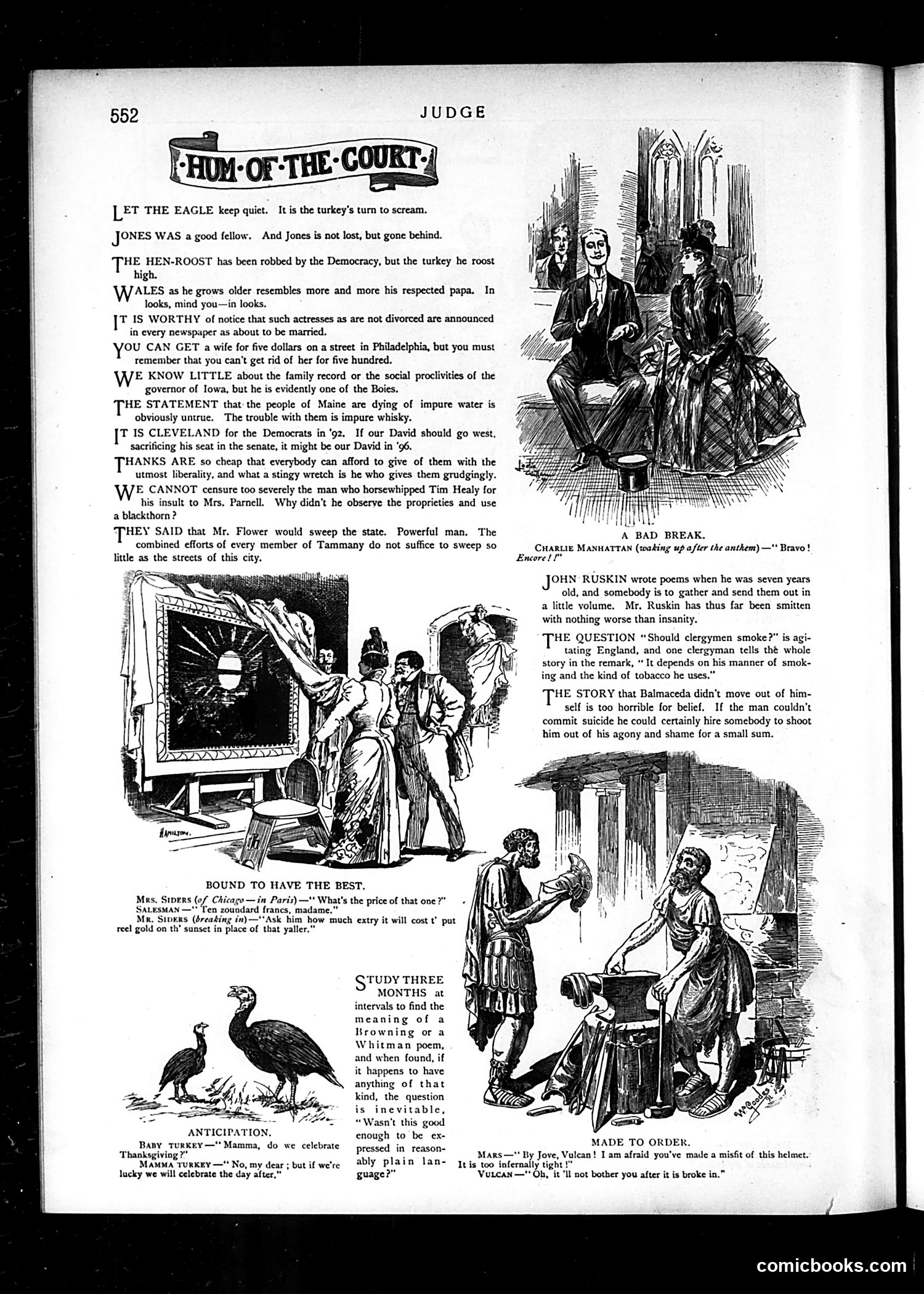
This page contains **political commentary and social satire** typical of 1880s-90s American humor. Key references include: **Political jabs**: References to Cleveland (Democratic presidential candidate for 1892), Tammany Hall (NYC political machine), and Iowa's governor "Boies" mock contemporary politics and corruption. **Social commentary**: Quips about Philadelphia wives, Maine's "impure whisky," and actresses mock class pretensions and hypocrisy of the era. **Specific incidents**: The reference to Tim Healy and Mrs. Parnell alludes to Irish political scandal; Balmaceda likely refers to Chilean political turmoil. **The cartoons** satirize: - Upper-class pretension (Chicago tourists demanding "real gold" sunsets in Paris paintings) - Roman mythology (Mars/Vulcan struggling with ill-fitting armor) - Class absurdities (turkeys discussing Thanksgiving) The overall tone is **cynical, irreverent commentary** on politics, society, and human nature—characteristic of Judge's satirical mission targeting the wealthy and politically connected.
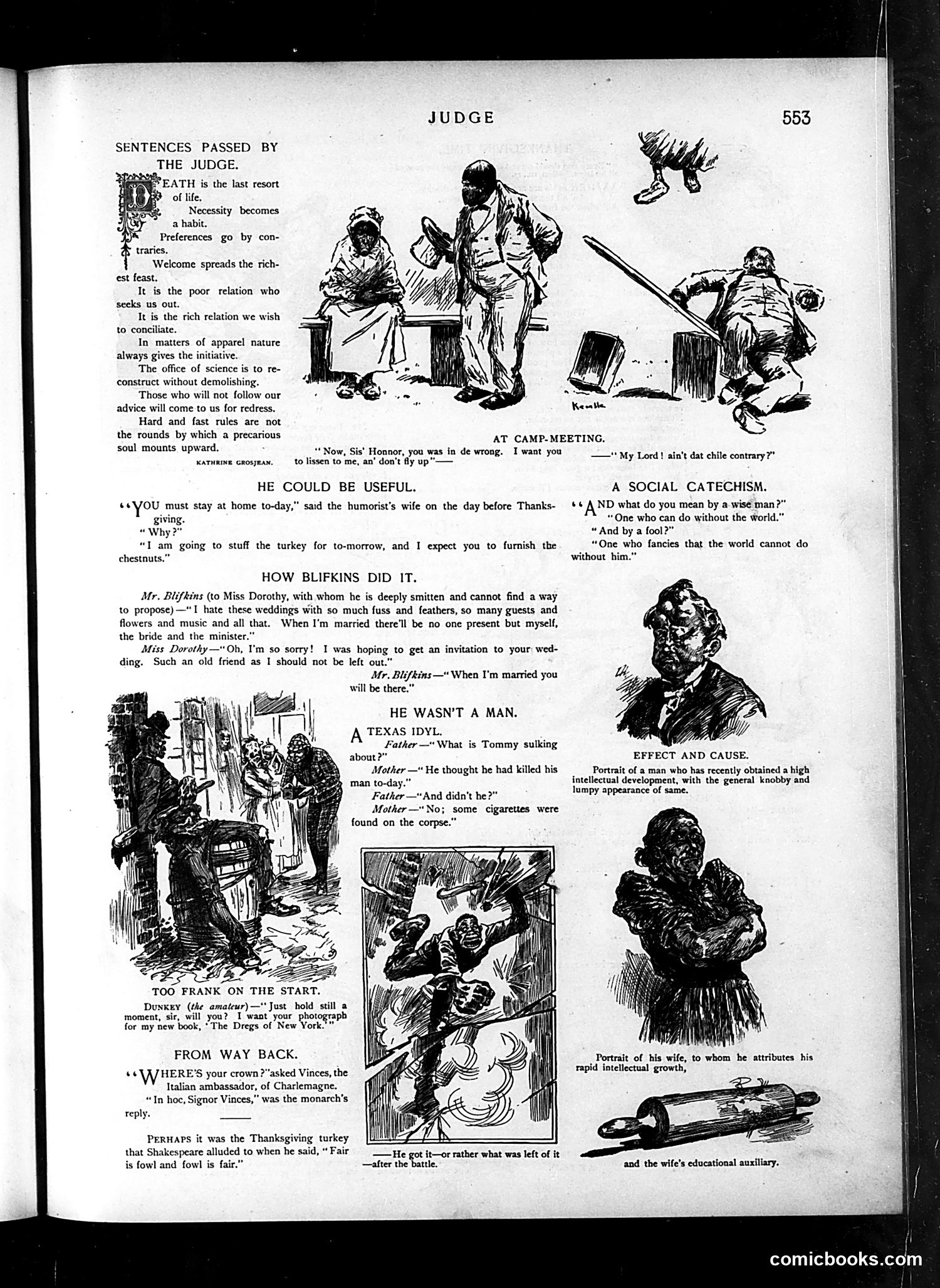
This page contains multiple satirical short pieces and cartoons typical of Judge's humor. Key content includes: **"How Blifkins Did It"**: A bachelor proposes to Miss Dorothy by claiming his future wedding will have no guests—then awkwardly admits she'll be there, inadvertently proposing to her. **"He Wasn't a Man"**: A Texas frontier joke where a boy thought he killed someone, but cigarettes found on the "corpse" prove it was a woman—period satire about gender and frontier violence. **"A Texas Idyl"**: Rural dialect humor contrasting frontier assumptions with civilized expectations. **"A Social Catechism"**: A Q&A mocking wisdom, defining wise men as self-sufficient and fools as self-important. **Portraits labeled "Effect and Cause"**: Caricatures showing an intellectually "developed" man attributing his growth to his wife's "educational auxiliary"—satirizing marital dynamics and pretentious self-improvement. The illustrations are caricatures in Judge's typical style. The overall tone is gentle mockery of middle-class social pretension, courtship rituals, and gender relations.
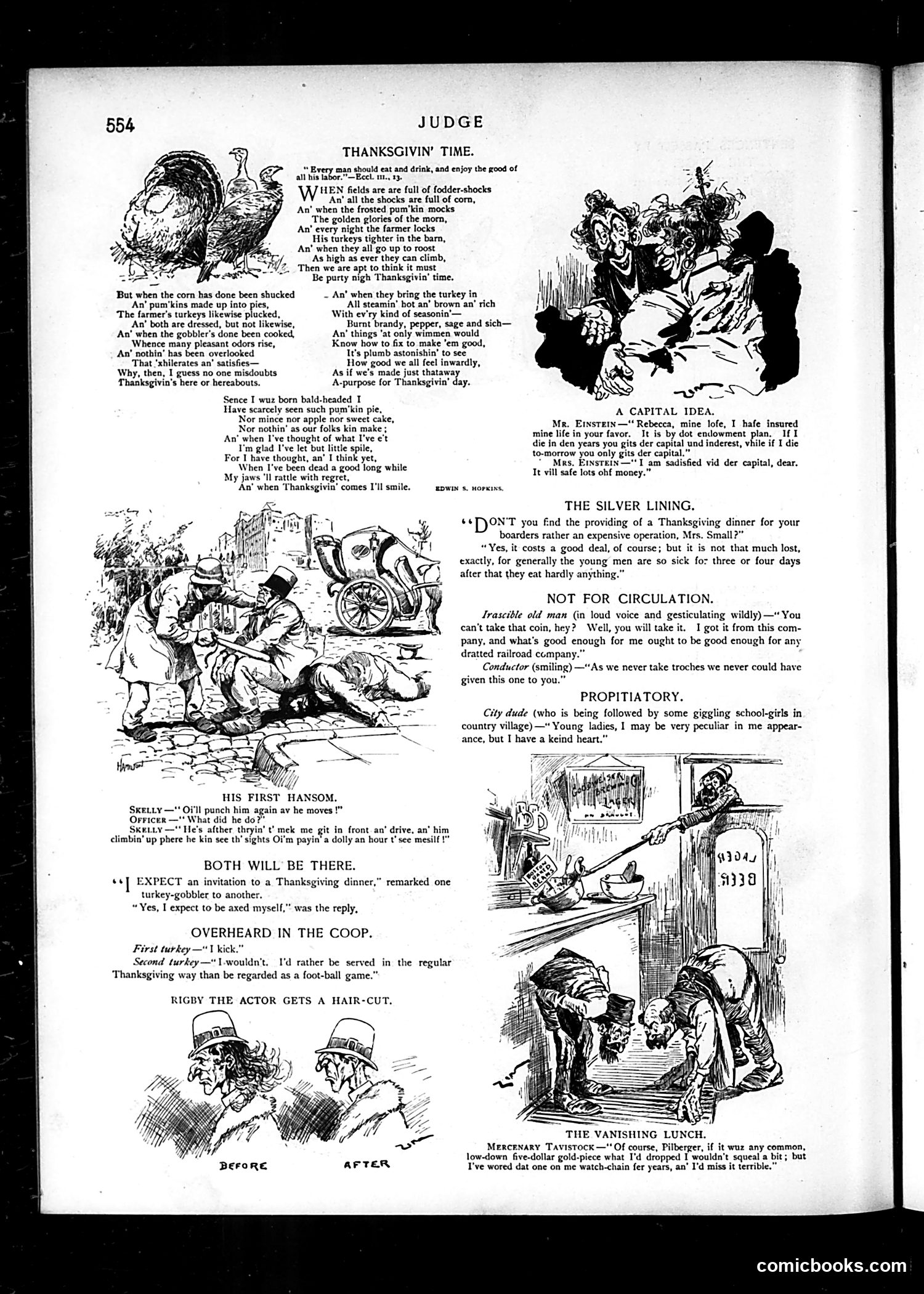
This page comprises **multiple short humorous pieces** celebrating Thanksgiving, a major American holiday. The content includes: **"Thanksgivin' Time"** (top left): A dialect poem romanticizing rural Thanksgiving preparations—corn shocks, pumpkins, turkeys—capturing nostalgic agrarian abundance. **Social satire cartoons:** - **"A Capital Idea"**: Mocks Jewish immigrants (depicted with Yiddish accent) discussing life insurance endowments—satirizing both new immigrant financial schemes and middle-class insurance marketing. - **"The Silver Lining"**: A landlady explains her Thanksgiving dinner losses offset by boarders being ill afterward—dark humor about working-class economics. - **"Not for Circulation"**: An elderly man argues with a railroad conductor about accepting a coin—likely satirizing both curmudgeonly passengers and corporate rigidity. - **"Overheard in the Coop"**: Turkeys joking about their fate—darkly humorous personification. The overall tone blends sentimental rural imagery with satirical jabs at immigrants, working-class struggles, and corporate indifference. The cartoons use exaggerated dialect and caricature typical of the era's casual bigotry.
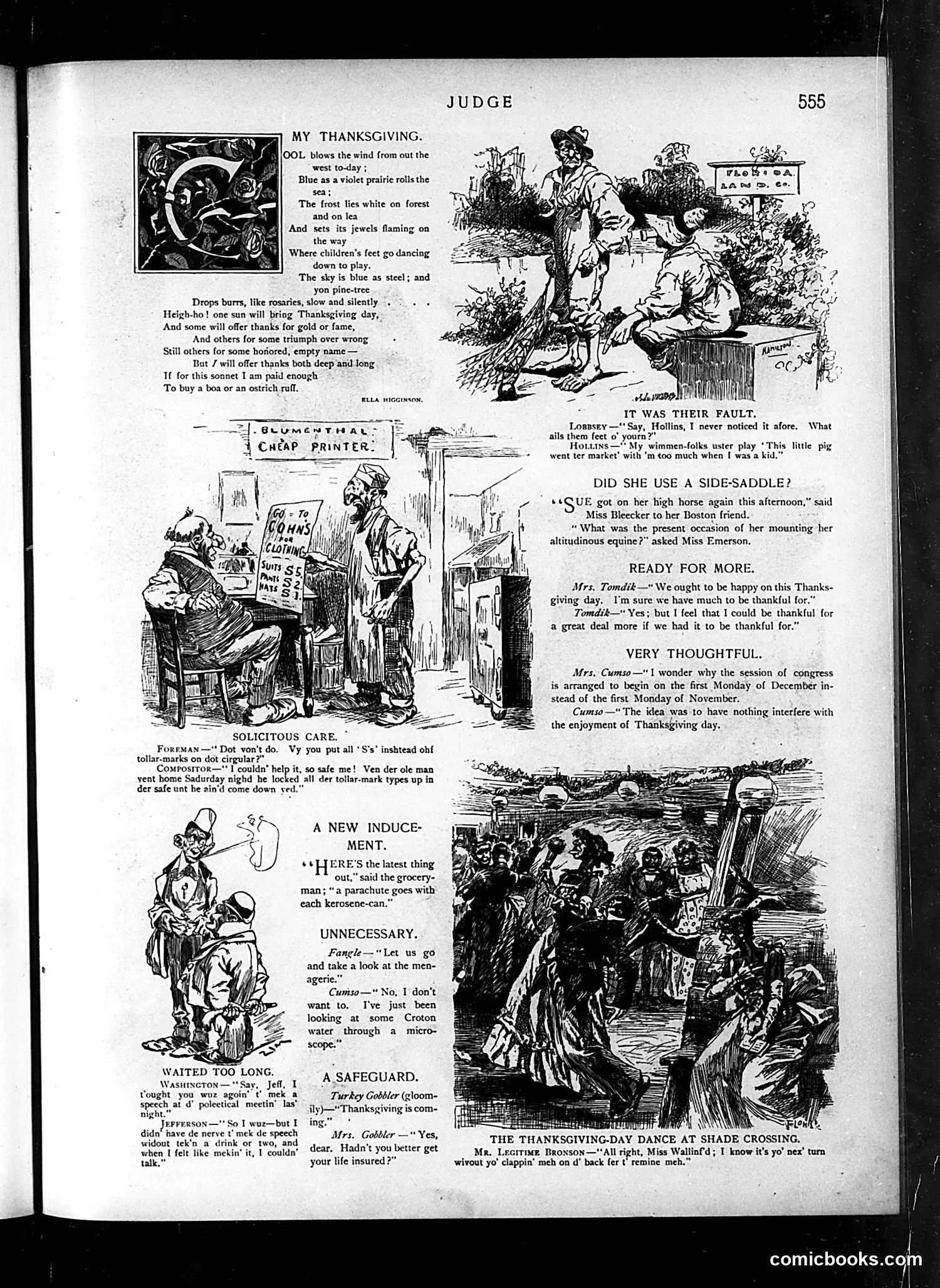
This page contains multiple short humorous pieces typical of late-19th-century American satirical magazines. **"My Thanksgiving"** is a poem by Ella Higginson that humorously subverts sentimental Thanksgiving gratitude. While others thank God for noble things (triumph, honor), the speaker admits she's thankful only if paid enough for her sonnet to buy luxury items—a boa or ostrich feathers. It satirizes both pretentious poetry and materialism. **The remaining items** are brief comedic dialogues exploiting ethnic stereotypes and period humor: misused grammar ("Blumenthal's Cheap Printer"), puns on "high horse," marital grumbling, and a joke about Congress timing avoiding Thanksgiving interference. The cartoons illustrate these jokes with period-appropriate illustrations. **Context for moderns:** This reflects Gilded Age attitudes—ethnic caricature was standard entertainment, consumer materialism was emerging as a satirical target, and Thanksgiving was already becoming a family obligation rather than spiritual observance. The page is primarily **humorous filler content**, not political commentary.
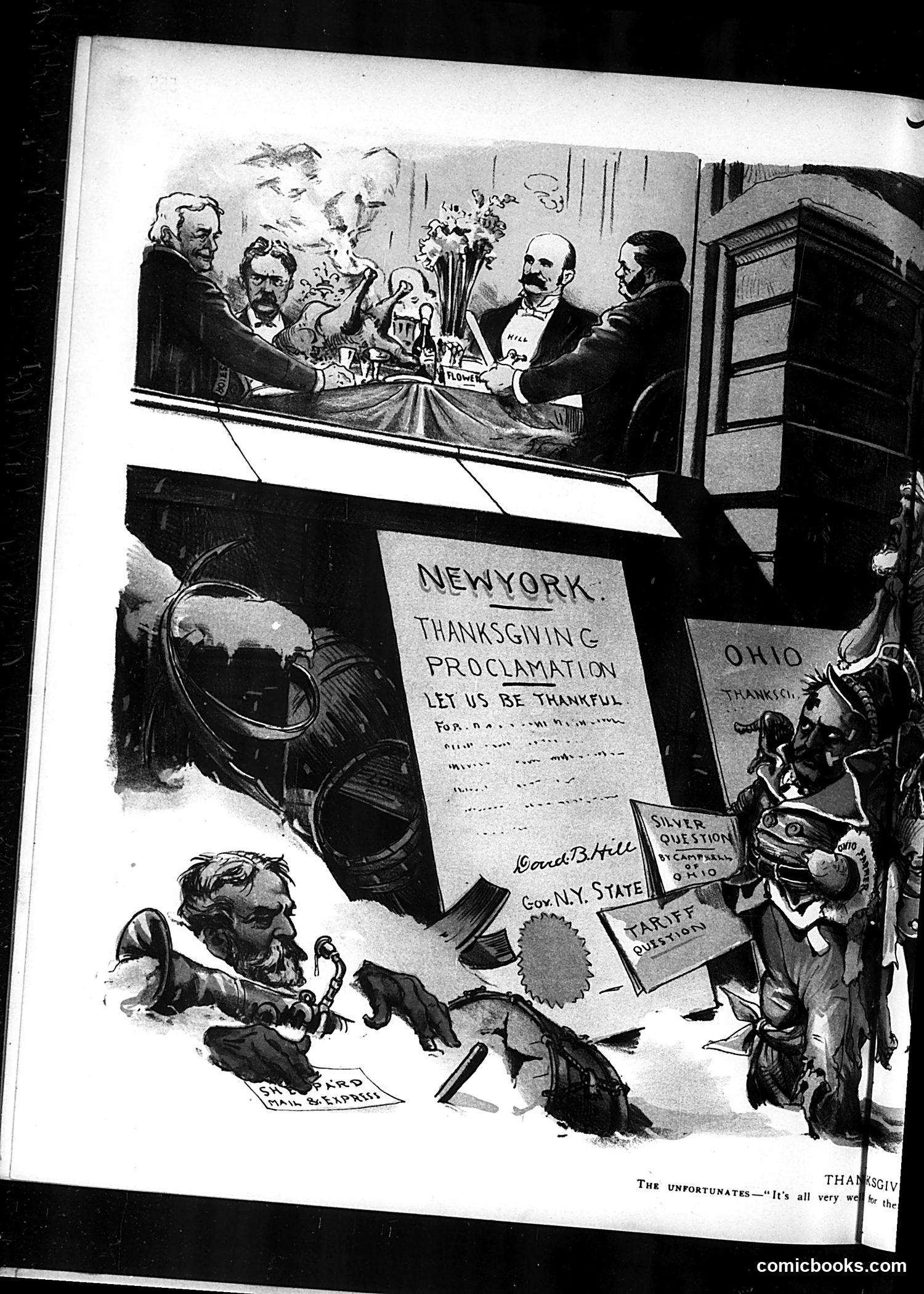
This is a satirical cartoon about a New York Thanksgiving Proclamation. The upper panel shows well-dressed men at a formal dinner table, appearing to celebrate prosperity. Below, the "unfortunates"—depicted as poor, ragged figures—sit among discarded items and broken vessels, unable to participate in the abundance above them. The satire contrasts the official proclamation urging citizens to "be thankful" with the harsh reality of economic inequality. References to "Gov. N.Y. State," "Ohio," and various political labels suggest this addresses Gilded Age wealth disparity and the gap between official rhetoric and ordinary citizens' lived experience. The cartoon critiques the hypocrisy of elite thanksgiving while the poor struggle, a common Progressive Era theme in *Judge* magazine.
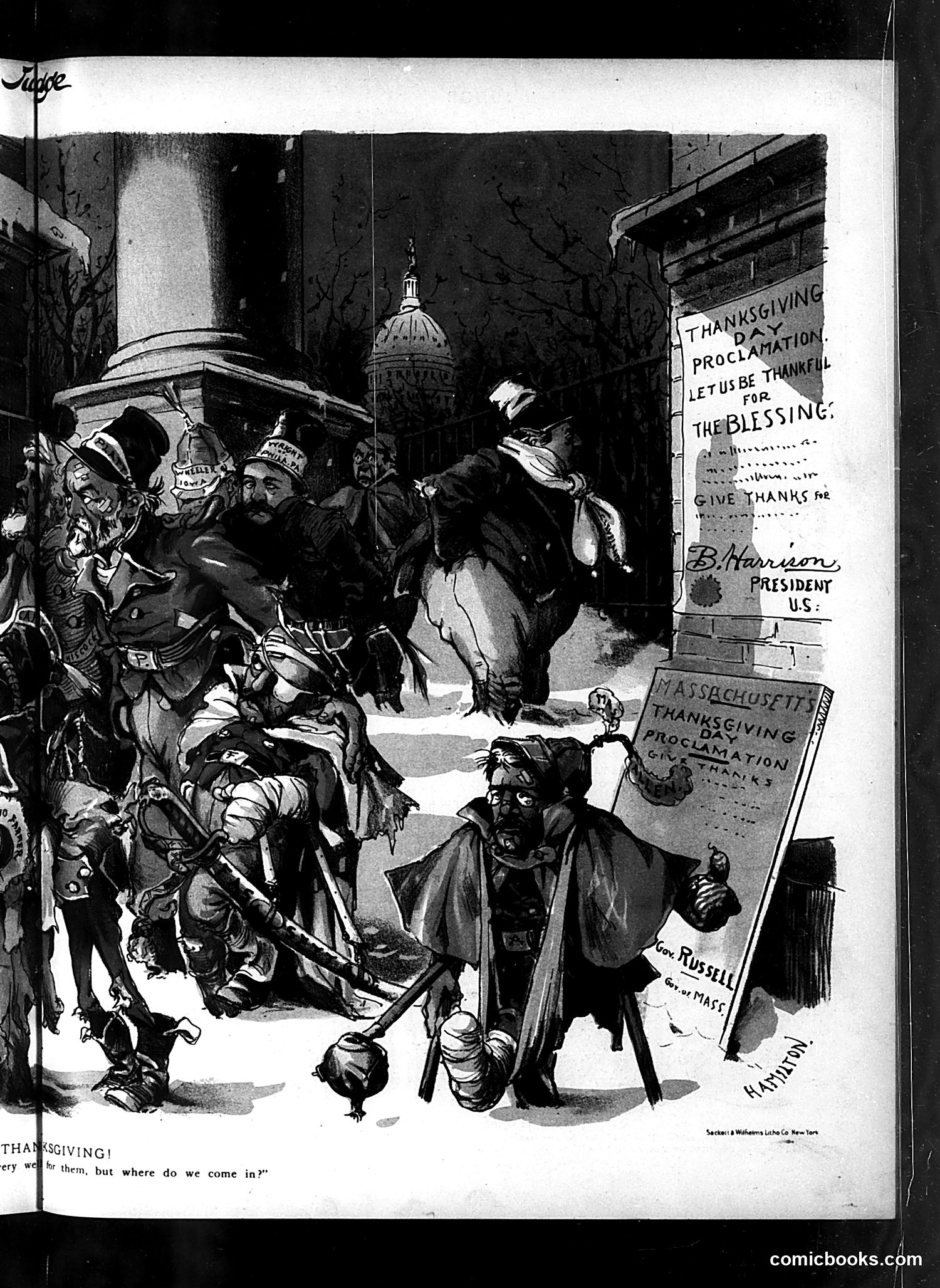
This Judge magazine cartoon satirizes Thanksgiving proclamations by President B. Harrison and Massachusetts Governor Russell Ames Forbes. The image depicts various caricatured figures—appearing to represent corrupt politicians or wealthy interests—crowding around the Capitol building. Two proclamation signs are visible, calling Americans to give thanks for "blessings." The caption's bitter question—"we're told to be thankful for them, but where do we come in?"—expresses working-class resentment. The satire suggests that while political leaders issue pious Thanksgiving proclamations, ordinary citizens see no actual benefits or blessings in their own lives. The crowded, chaotic composition reinforces the sense of common people being excluded from whatever prosperity the government celebrates. This reflects late 19th-century tensions between labor and political/corporate elites during economic inequality.
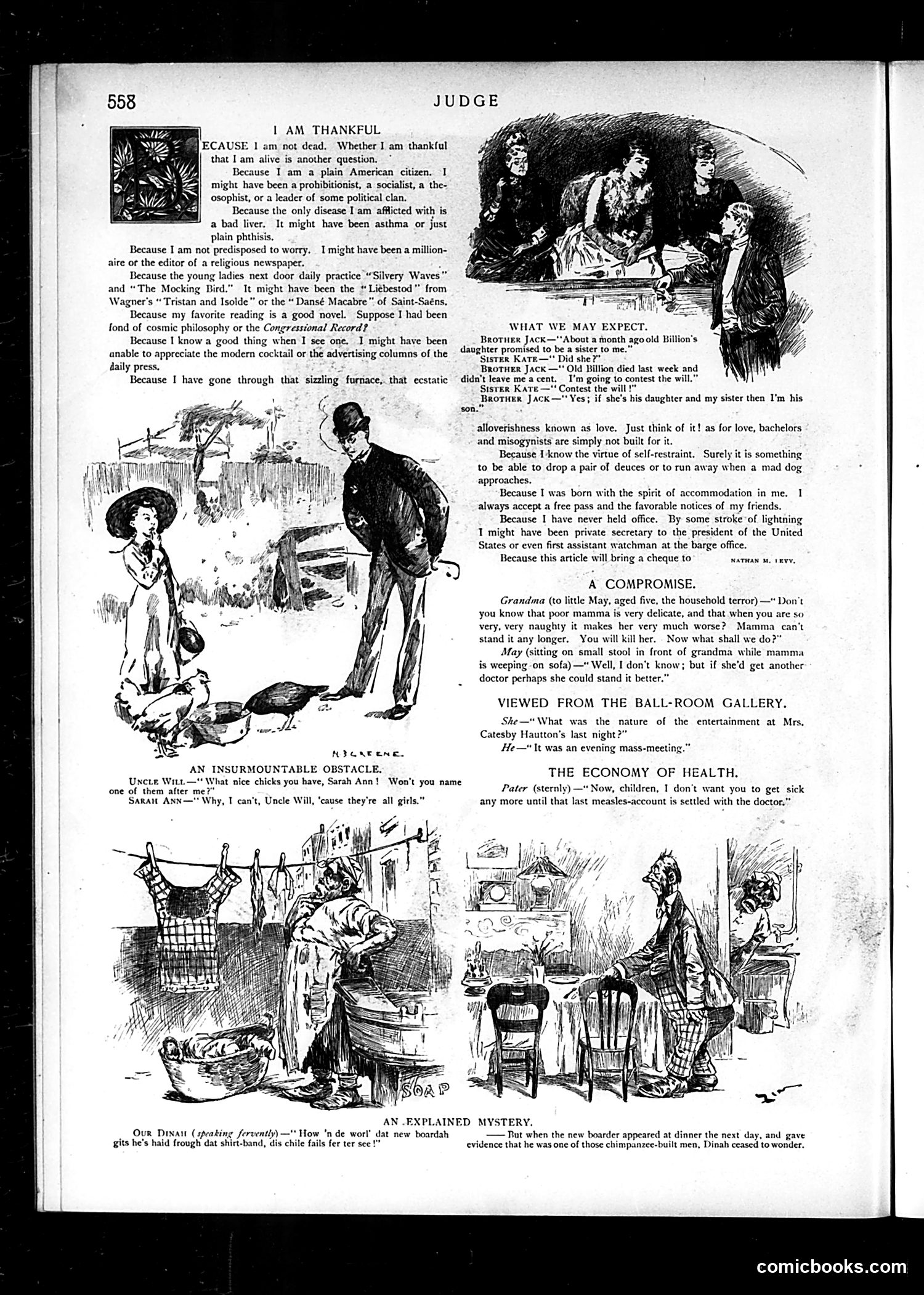
This page contains multiple brief satirical pieces typical of early-20th-century American humor magazines: **"I Am Thankful"** — A tongue-in-cheek essay expressing gratitude for mediocrity: being alive but not necessarily happy, a "plain American citizen" rather than an ideologue, having only a bad liver instead of worse diseases, and lacking ambition. The satire mocks both complacency and the desperate striving for status. **"An Insurmountable Obstacle"** — A pun-based joke about Uncle Wilt requesting a chicken be named after him, only to learn all the chickens are female. **"What We May Expect"** — Dark humor about a young man contesting a will on technicalities after his prospective sister's wealthy father dies. **"The Economy of Health"** — A child's practical suggestion that her mother hire another doctor to handle medical bills more easily. **"An Explained Mystery"** — A racist caricature where a Black servant wonders how a boarder fits through his shirt collar—the "explanation" being he's built like a chimpanzee. The cartoons use exaggerated drawings typical of period satirical journalism, targeting American social pretensions and class anxieties.
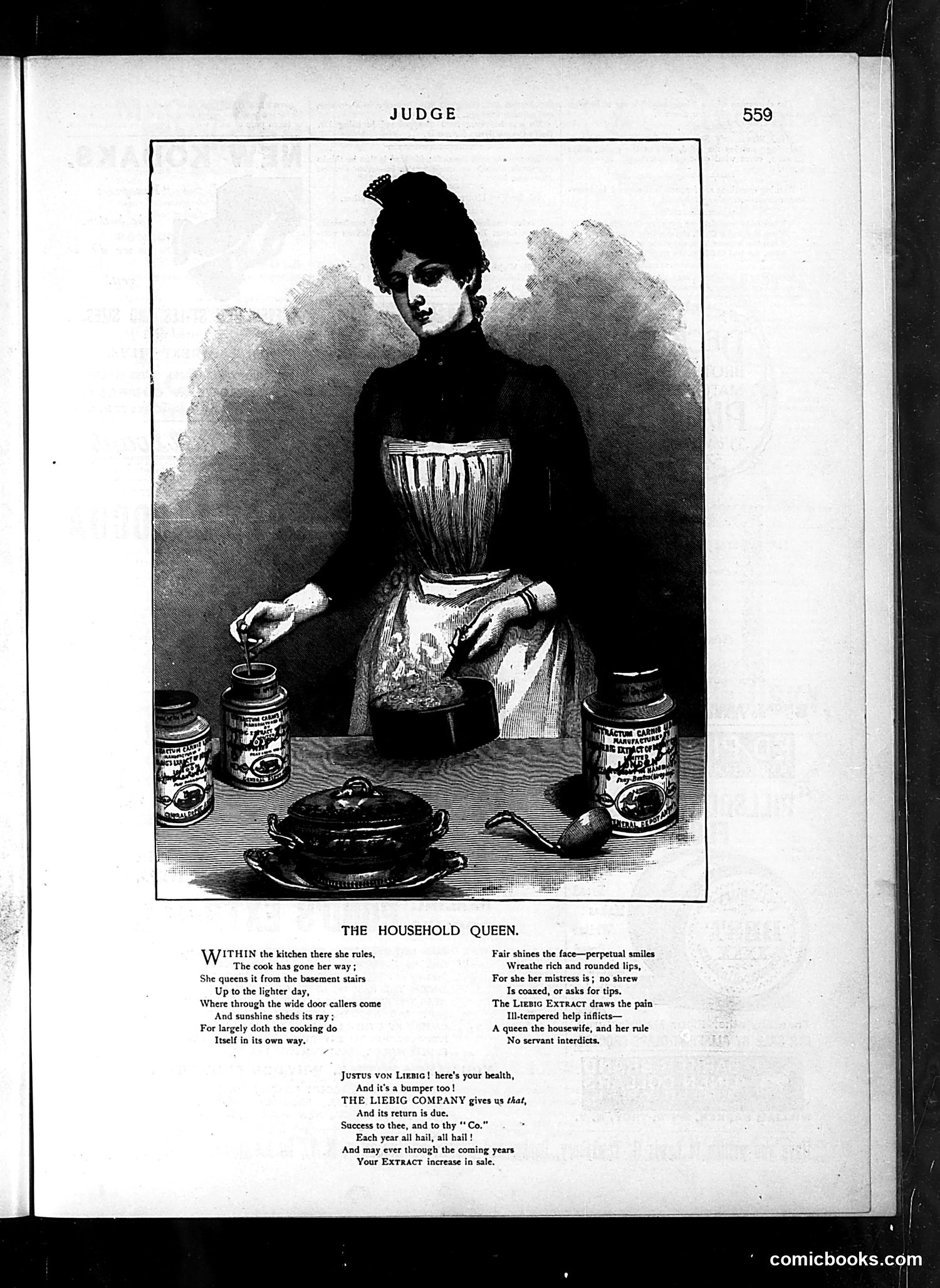
This is primarily a **product advertisement** disguised as satirical verse, not political commentary. It promotes Liebig Extract, a beef extract product popular in the late 19th century. The "satire" mocks the Victorian ideal of the perfect housewife: the image shows a well-dressed woman presiding over her kitchen domain with various Liebig Extract bottles displayed. The poem humorously suggests that using this product makes cooking so effortless that a housewife becomes a "queen" ruling her kitchen without actual labor or servant trouble. The advertisement's joke targets middle-class aspirations—implying the extract is so effective it eliminates the need for skilled cooks or troublesome domestic help. The final stanza is a mock-toast celebrating the Liebig Company's product and sales success. This reflects late-Victorian marketing tactics: wrapping product promotion in entertaining verse to appear as editorial content rather than obvious advertising.
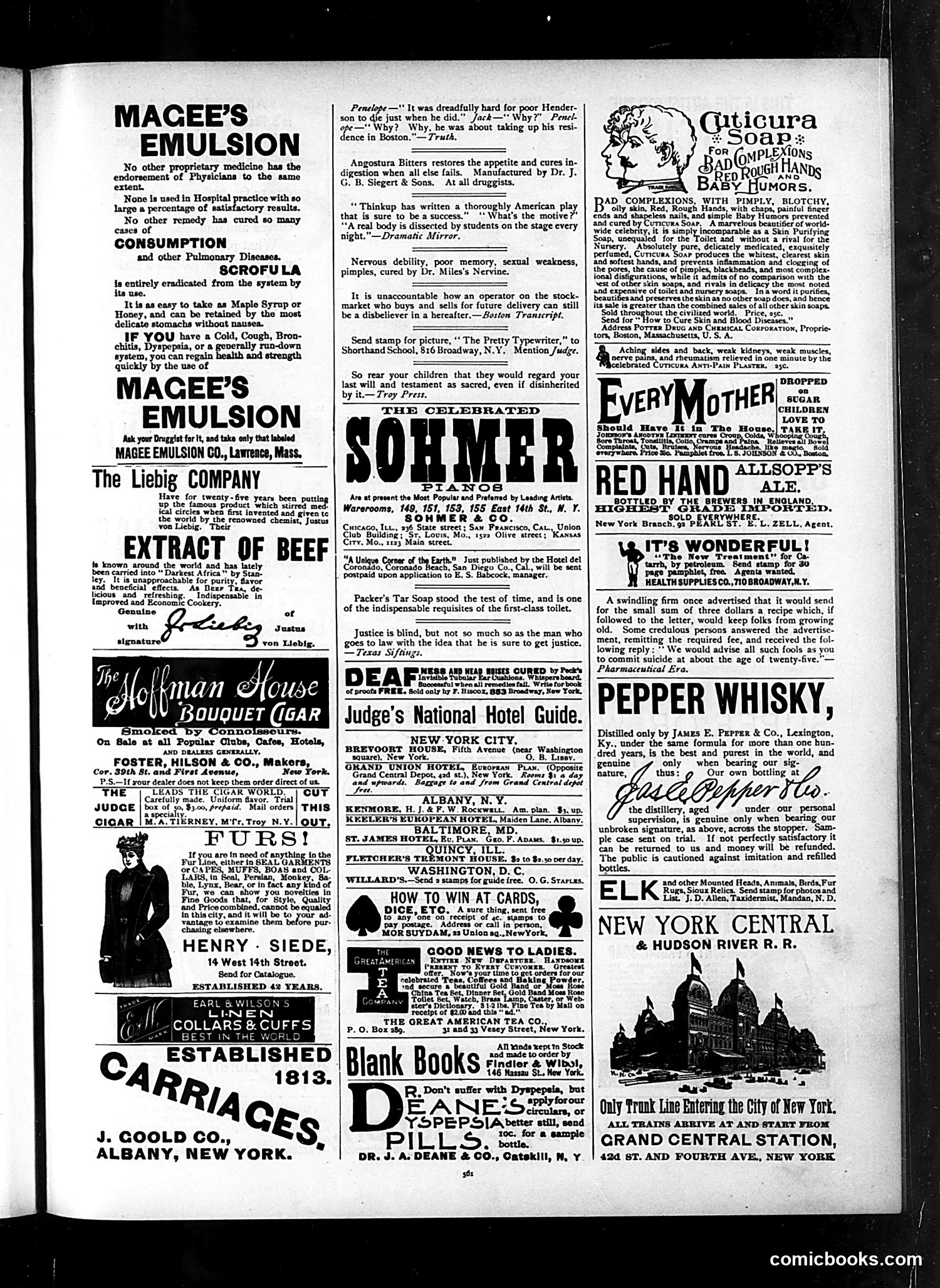
This page is predominantly **advertisements** with small humorous snippets interspersed—it is not primarily a political cartoon page. The visible content includes: **Advertisements** for patent medicines (Magee's Emulsion for consumption), Liebig's Extract of Beef, Sohmer Pianos, Cuticura Soap, and various other consumer goods and services typical of the late 19th century. **Brief humorous snippets** (jokes/quips) scattered among ads, such as: - A joke about a man dying before moving to Boston (mocking Boston as undesirable) - Commentary on stock market operators not believing in the afterlife (ironic commentary on materialism) - A quip about teaching children to respect wills even if disinherited These snippets appear to be **general social satire** rather than specific political commentary—poking fun at contemporary attitudes toward death, relocation, materialism, and parenting. The page reflects Judge magazine's mix of advertising revenue and light satirical humor rather than focused political cartooning.
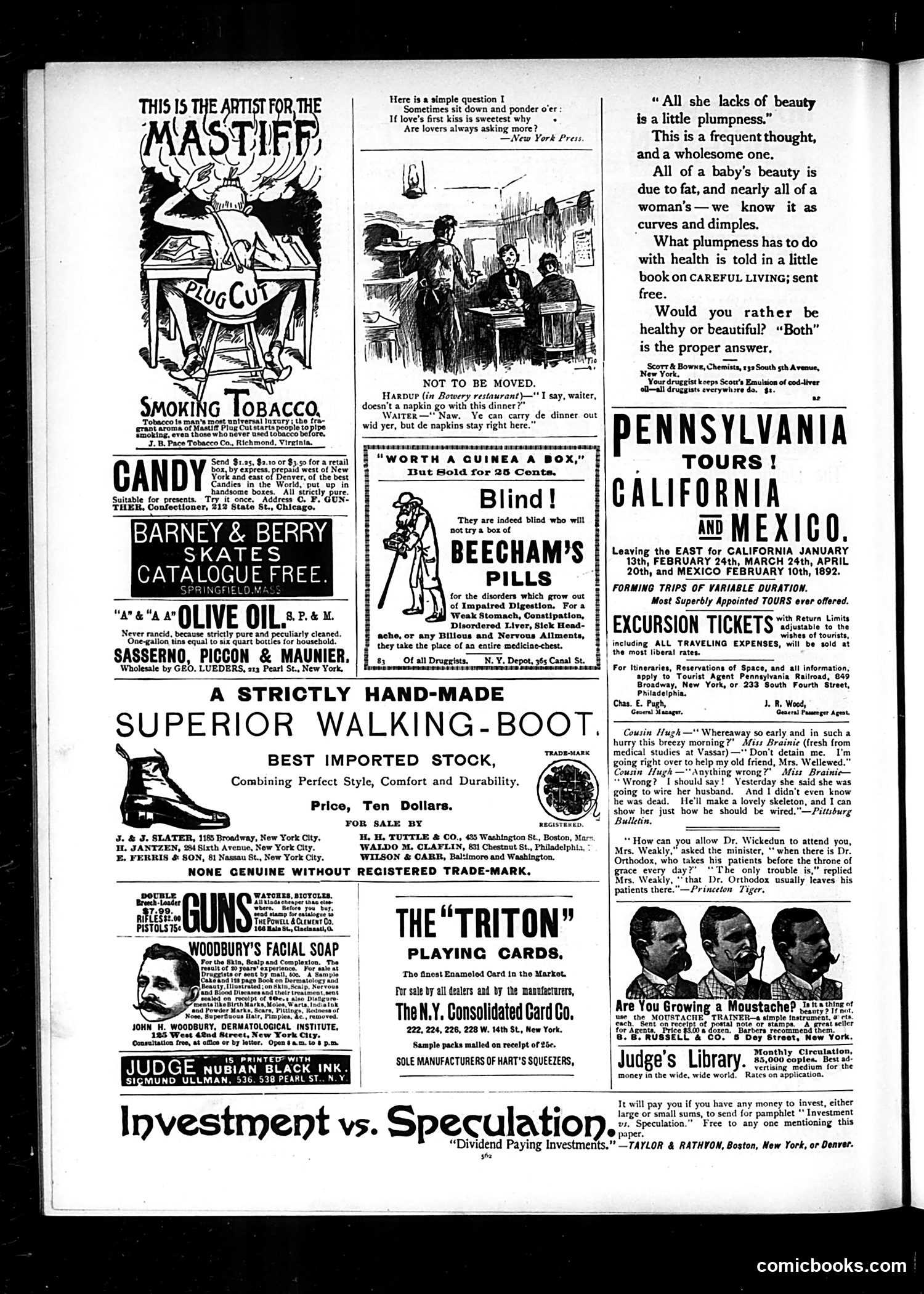
This is primarily an **advertising page** from Judge magazine (appears to be early 1890s based on content). While it contains several small satirical cartoons and jokes, the page is dominated by product advertisements. ## Notable Content: **"Not to be Moved"** cartoon depicts a working-class Bowery restaurant scene where a waiter refuses to provide napkins with dinner, claiming "napkins stay right here" — a joke about penny-pinching establishments serving poor clientele. **Medical/anatomical humor** includes jokes about women's beauty and plumpness, reflecting period anxieties about female body standards, and a Vassar medical student making gallows humor about skeletal anatomy. **"Growing a Moustache"** advertisement shows three male profile heads, apparently promoting a grooming product. The advertisements reflect late-Victorian consumer goods: tobacco, candy, olive oil, walking boots, playing cards, facial soap, and firearms. The **Pennsylvania Tours to California and Mexico** ad indicates leisure travel was becoming commercialized. The overall tone mixes class-conscious humor with period-typical attitudes toward gender, medicine, and consumption.
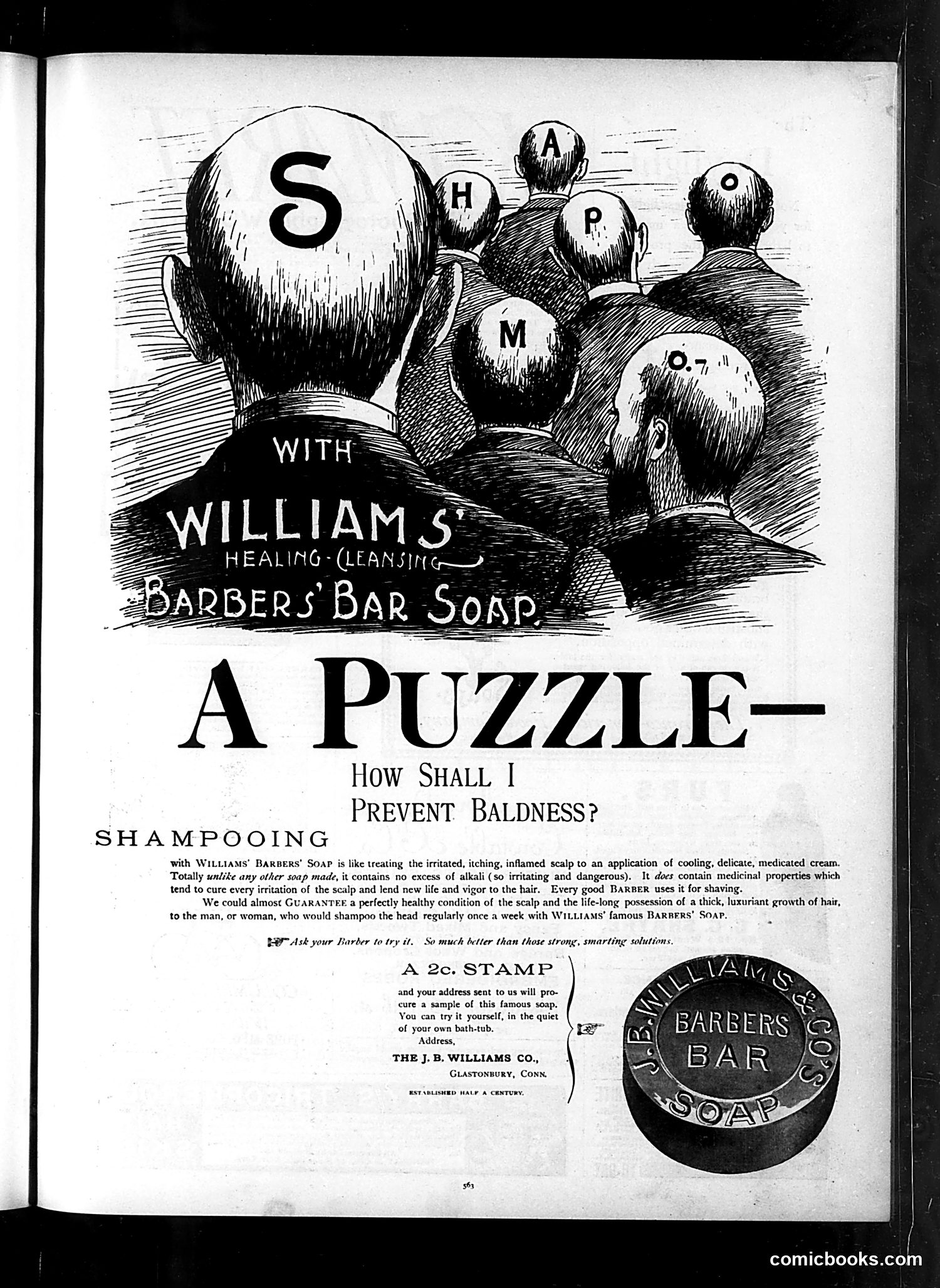
This is primarily a **product advertisement**, not political satire. The page promotes Williams' Barbers' Bar Soap as a baldness prevention treatment through shampooing. The illustration shows five bald or balding men viewed from behind, labeled with letters (S, H, A, P, M, O) spelling "SHAMPOO"—a visual pun on the product's use. The advertisement claims the soap differs from competitors by containing no excess alkali (which irritates scalps) while providing medicinal properties to cure scalp irritation and promote hair growth. It promises "almost" guaranteed results if used weekly. The ad offers a free sample for 2 cents postage, encouraging at-home trial. The company, J.B. Williams Co. of Glastonbury, Connecticut, was "established half a century" prior to publication. The appeal targets contemporary male anxieties about hair loss—a timeless commercial concern.
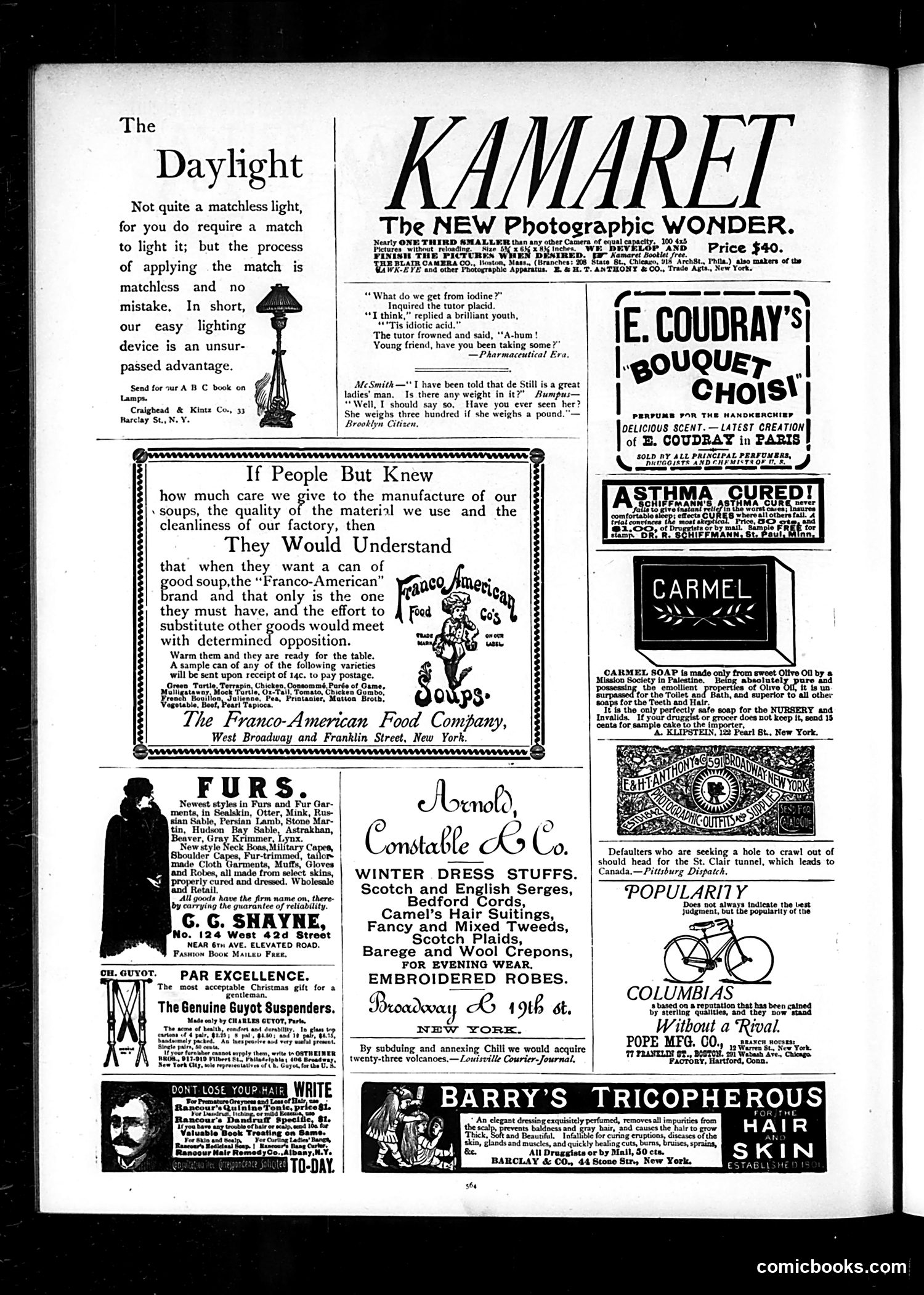
This is primarily an **advertising page** from Judge magazine, with minimal editorial cartoon content. The page showcases consumer products typical of the late 19th/early 20th century. The few satirical elements are brief: 1. **"The Daylight" lamp advertisement** - plays on the irony that a "matchless light" still requires matches to ignite it—a gentle jab at marketing language. 2. **School humor dialogue** - A tutor asks what iodine produces; a student puns "idiotic acid," with the tutor implying the student is himself an idiot. This is mild pedagogical satire common to the era. 3. **Geopolitical joke** - A single line quips that annexing Chile would acquire "twenty-three volcanoes," satirizing American imperial ambitions of the period. The rest comprises period advertisements for furs, soups, perfumes, hair treatments, bicycles, and dress goods—reflecting the consumer culture Judge's wealthy readership represented. The page offers little political commentary beyond this single imperialist jab.
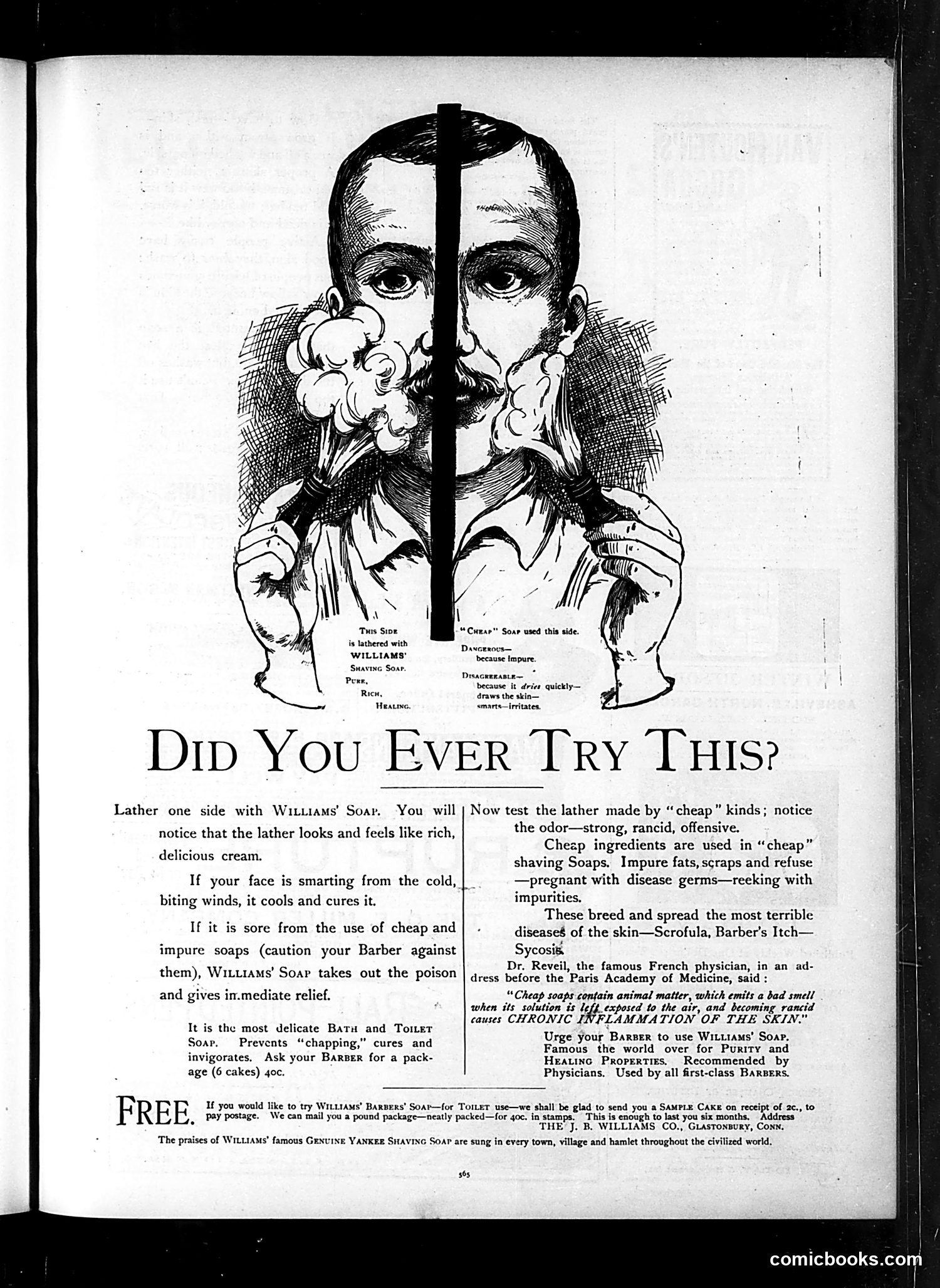
This is primarily a **product advertisement** rather than political satire, though it uses comparative marketing tactics common to the era. The page shows a split-face illustration demonstrating the contrast between using Williams' Soap (left side) versus cheap, impure soaps (right side). The advertisement claims Williams' produces superior lather and prevents skin conditions like "Barber's Itch" and scrofula—serious dermatological concerns of the period. The copy employs scare tactics typical of early 20th-century advertising, citing a French physician (Dr. Reveil) to claim cheap soaps contain animal matter that causes "chronic inflammation." It positions Williams' as medically superior and recommended by physicians and barbers. The "FREE" section offers a sample cake for 2 cents postage—a common direct-mail marketing technique of the era. This reflects both period anxieties about hygiene and disease, and aggressive competitive advertising before modern regulatory standards.
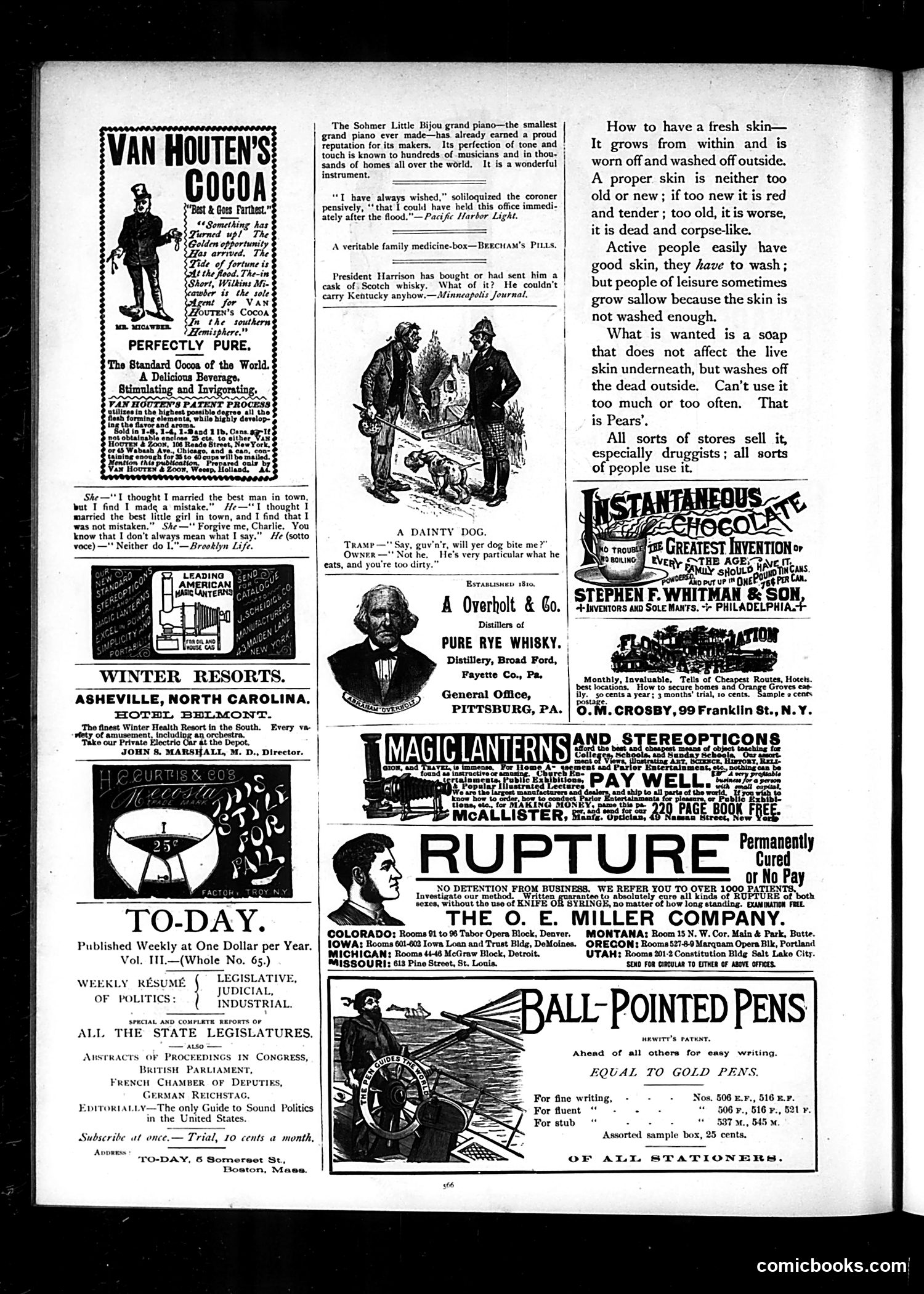
This page is primarily **advertising**, with a small joke and minimal satirical content. The main notable cartoon is "A Dainty Dog," showing an exchange between a tramp and homeowner: when the tramp asks if the dog bites, the homeowner responds the dog is "very particular" about what it eats—the implication being the tramp is too filthy even for the dog. The humor targets class prejudice and vagrant stereotypes common to the era. The bulk of the page contains period advertisements: Cohmer pianos, Van Houten's cocoa, Beecher's Pills, Pears' soap, Overholt whiskey, and various medical/scientific devices (magic lanterns, rupture cures, ball-pointed pens). The editorial note describes *Judge*'s coverage of legislative and political proceedings. The "A Dainty Dog" sketch represents typical gilded-age humor mocking the poor rather than critiquing social systems.
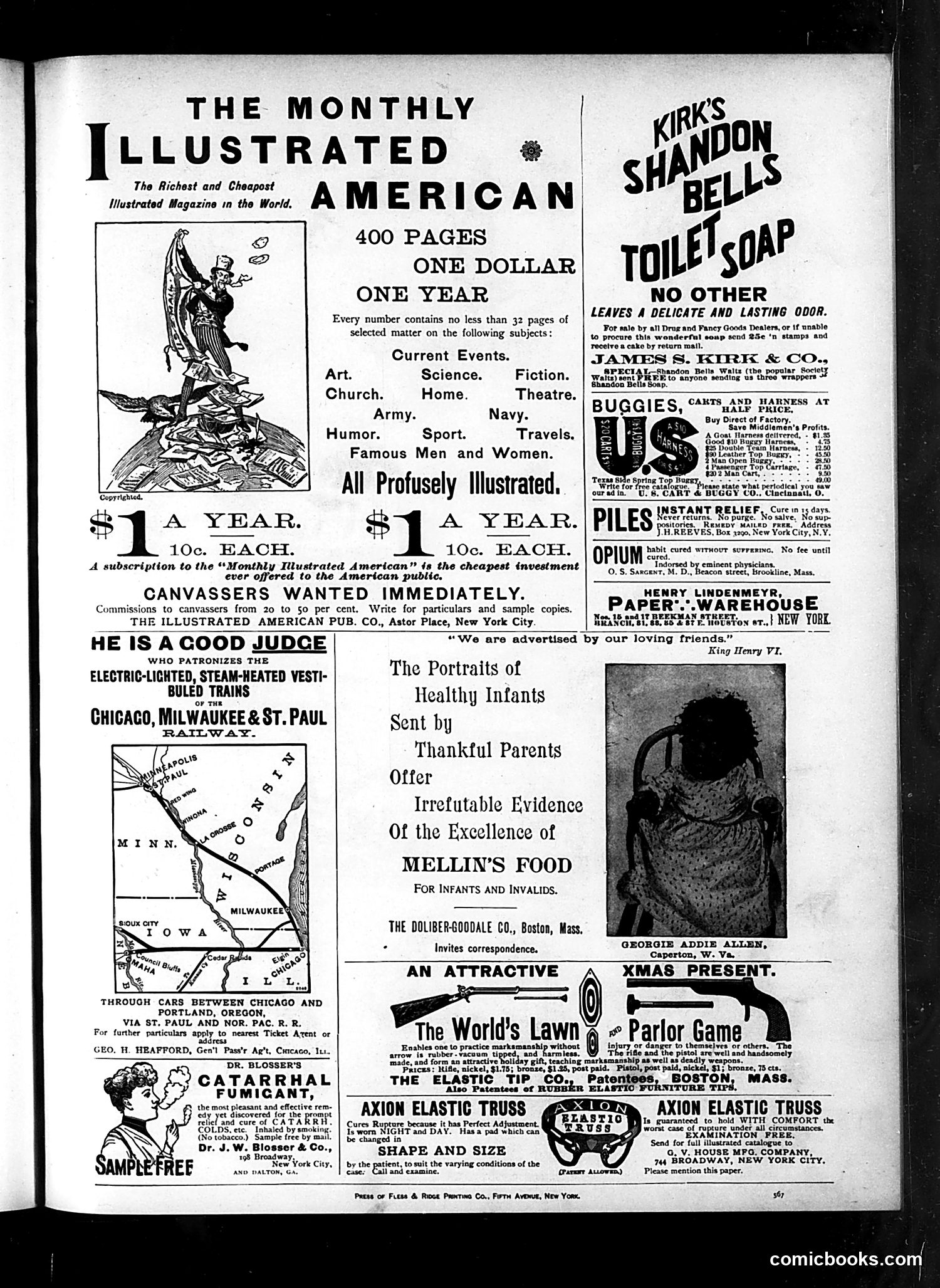
This is primarily an **advertising page** from Judge magazine, not a satirical cartoon page. The layout showcases the magazine itself and various commercial advertisements typical of the era. The main content includes: **Magazine Promotion**: The top advertises Judge's competitor, "The Monthly Illustrated American"—a $1/year magazine claiming 400+ pages covering current events, science, fiction, art, church matters, humor, sports, and famous figures. This represents competitive magazine marketing of the period. **Period Advertisements**: The page is filled with late-19th/early-20th century product ads, including: - Kirk's Shandon Bells toilet soap - Mellin's Food for infants (using baby testimonials) - Medical "cures" (piles treatment, opium addiction remedies, catarrhal fumigants) - Elastic trusses for rupture - Railroad services - Lawn games and sporting equipment **Notable**: The ads reflect period attitudes—particularly the medical advertisements promoting treatments we'd now recognize as dubious or harmful, revealing what consumers were marketed in this era.
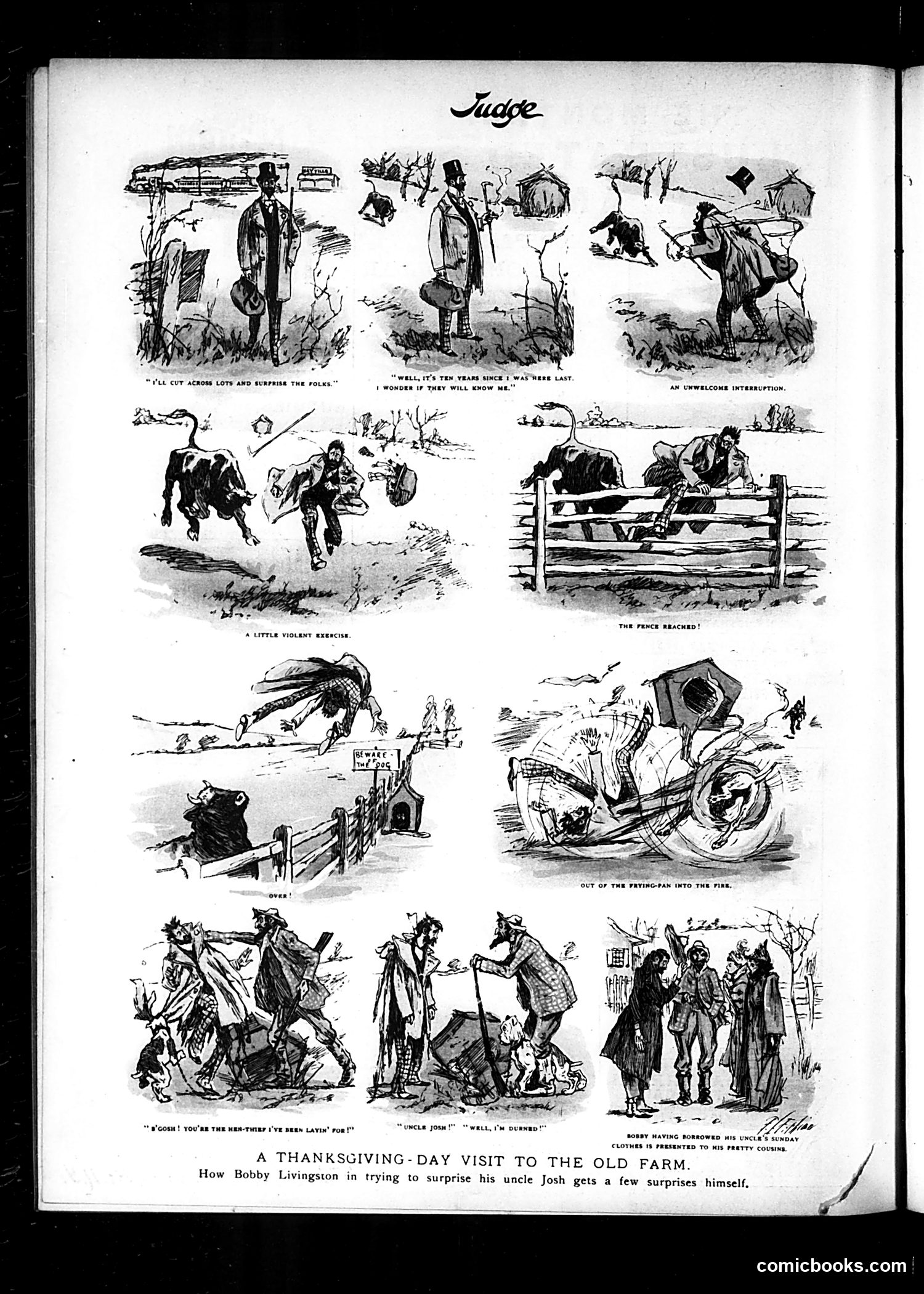
This is a humorous narrative comic strip (not political satire) depicting a young man named Bobby Livingston attempting to surprise his Uncle Josh by visiting the family farm after a ten-year absence. The joke unfolds through misadventures: Bobby tries taking shortcuts ("cut across lots") to surprise them, but instead encounters various farm hazards and obstacles—an aggressive bull, a fence, muddy terrain, and other rural mishaps—that repeatedly foil his surprise plan. The satire targets the contrast between urban sophistication and rural realities. Bobby, dressed in city clothes he borrowed to impress his "pretty cousins," gets progressively disheveled and humbled by farm life's dangers and messiness. The humor derives from slapstick physical comedy: the supposedly civilized visitor repeatedly defeated by barnyard chaos, ultimately arriving at the farm in comedic disarray rather than the dignified surprise he intended.