
A complete issue · 16 pages · 1891
Judge — October 31, 1891
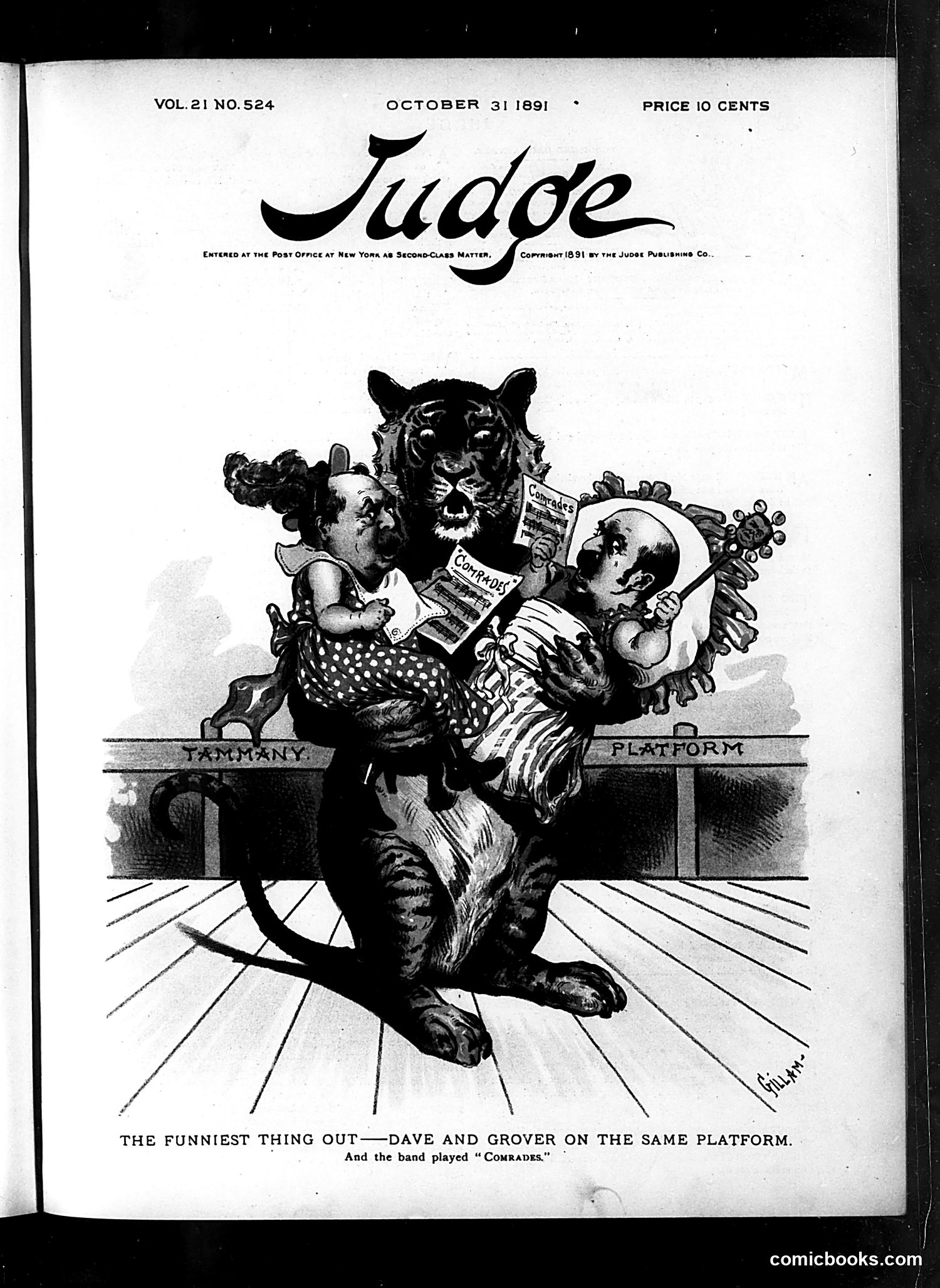
This 1891 Judge magazine cover depicts a tiger holding two men on a train platform labeled "Tammany" and "Platform." The caption reads: "The Funniest Thing Out—Dave and Grover on the Same Platform. And the band played 'Comrades.'" The cartoon satirizes an uncomfortable political alliance between two figures—likely referring to Democratic politicians David B. Hill and Grover Cleveland, who were rivals but apparently appeared together at a Tammany Hall event (New York's powerful Democratic machine). The tiger represents the predatory nature of Tammany politics, while the "Comrades" reference mocks their forced unity despite personal antagonism. The satire suggests their public collaboration was absurdly incongruous and dangerous—"the funniest thing out."
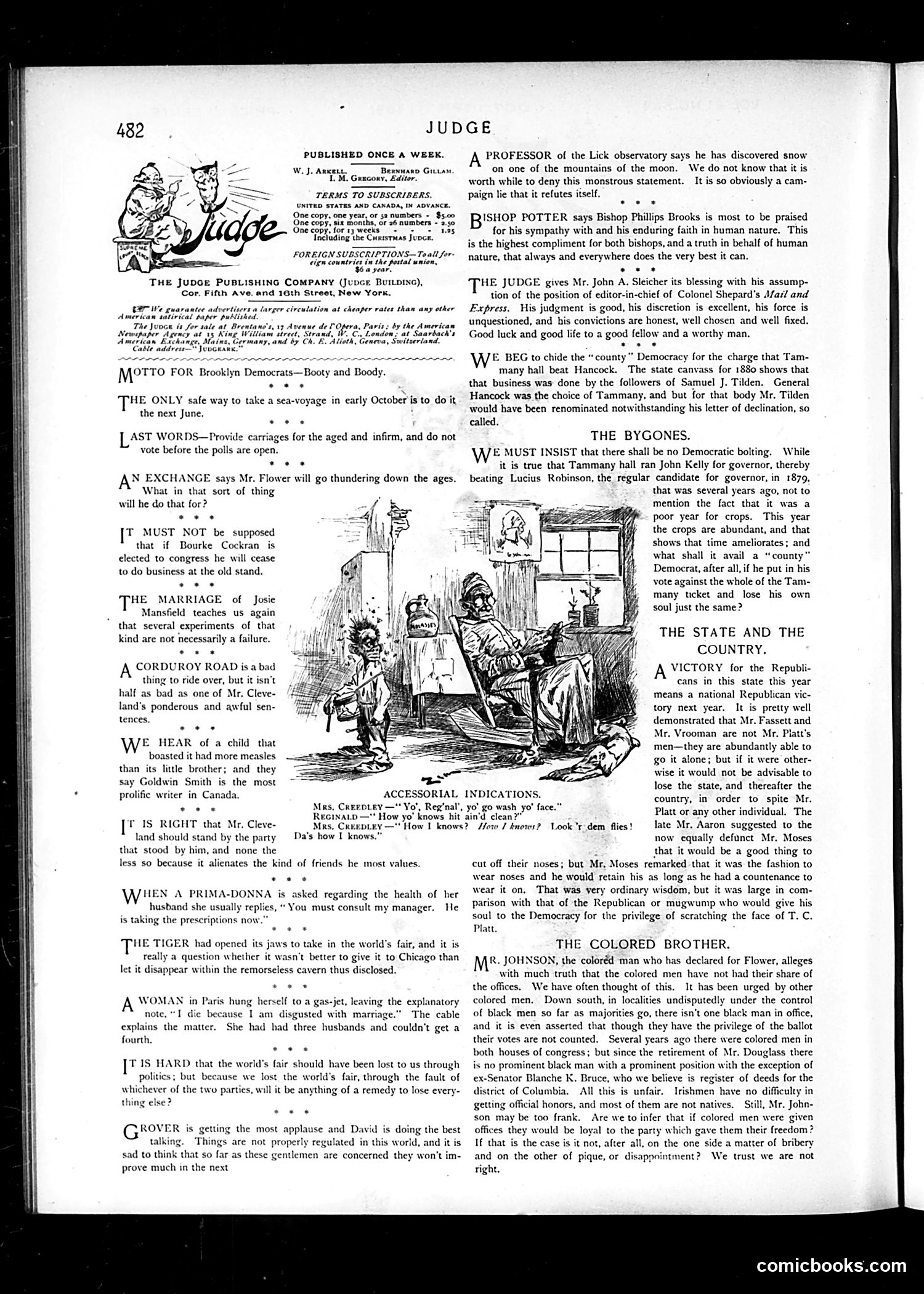
This page contains several short political commentaries rather than a single cartoon. The main illustrated piece, "Accessorial Indications," depicts what appears to be a domestic scene with working-class figures, likely satirizing social pretensions or hygiene standards—Mrs. Cerepelli boasts her nose is "clean" while Mrs. Carducci skeptically observes dirt remains visible. The text sections address 1880s Brooklyn Democratic politics, referencing Tammany Hall's control and candidate selection processes. "The Colored Brother" section discusses racial discrimination in political patronage, noting the difficulty Black men face obtaining official positions despite their votes supporting the party. Overall, the page satirizes both urban class dynamics and Democratic Party hypocrisy regarding Black political inclusion—promising votes while denying meaningful positions.
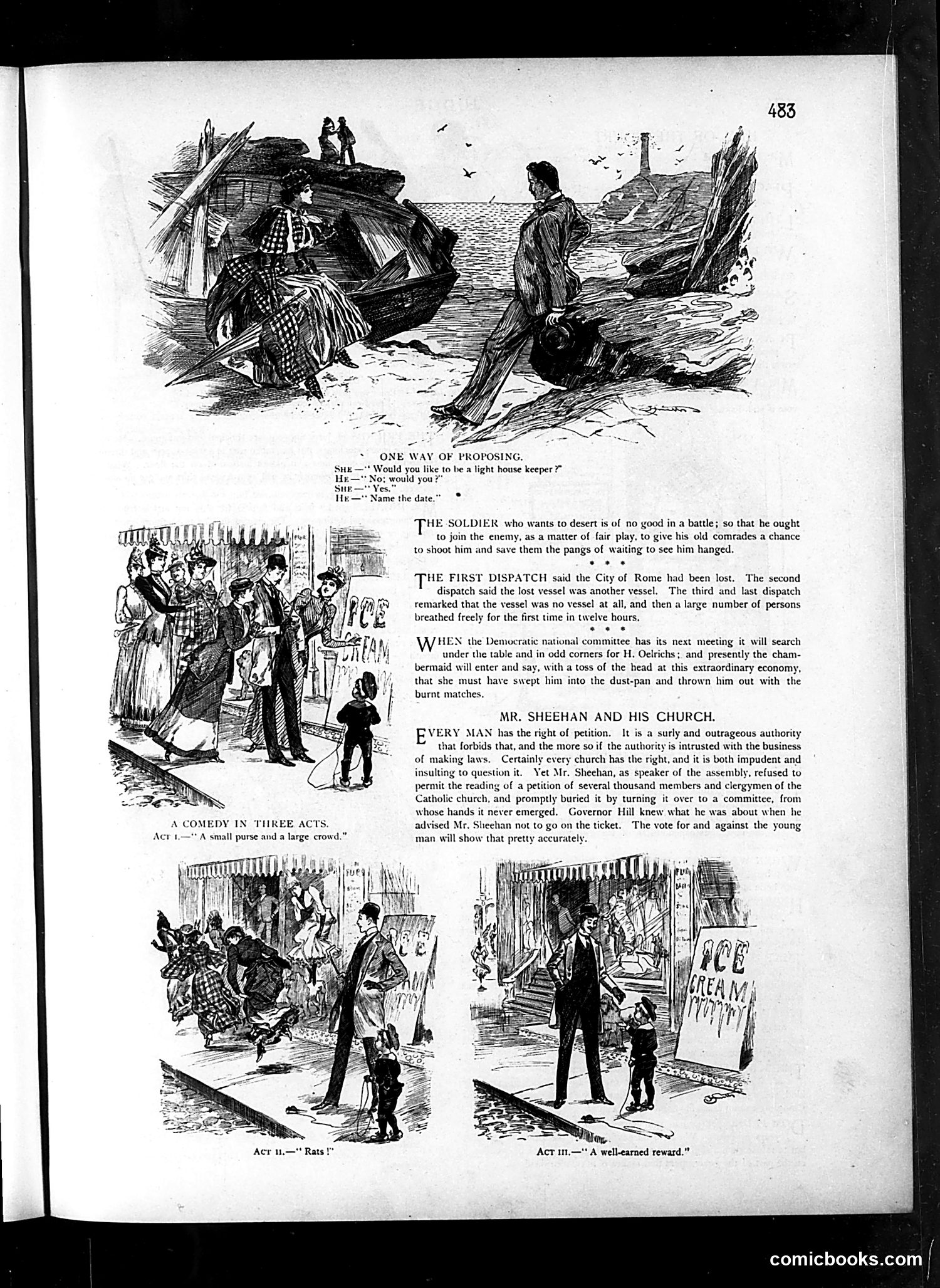
This page contains three distinct pieces of satirical content: 1. **"One Way of Proposing"** (top): A seaside sketch mocking romantic proposals, with dialogue suggesting a woman asks a man to be a "light house keeper"—a crude visual pun on courtship and domestic servitude. 2. **"A Comedy in Three Acts"** (middle): A three-panel satirical sequence showing a small purse and crowd interaction, likely commenting on urban poverty or panhandling, with acts titled "Rats," and "A well-earned reward." 3. **"Mr. Sheehan and His Church"** (right): Commentary on a religious/political figure (appears to be related to church authority conflicts), discussing petitions, Governor Hill, and voting rights—likely referencing late-19th-century disputes over institutional power and democratic representation. The satirical tone targets social pretensions, urban conditions, and institutional authority.
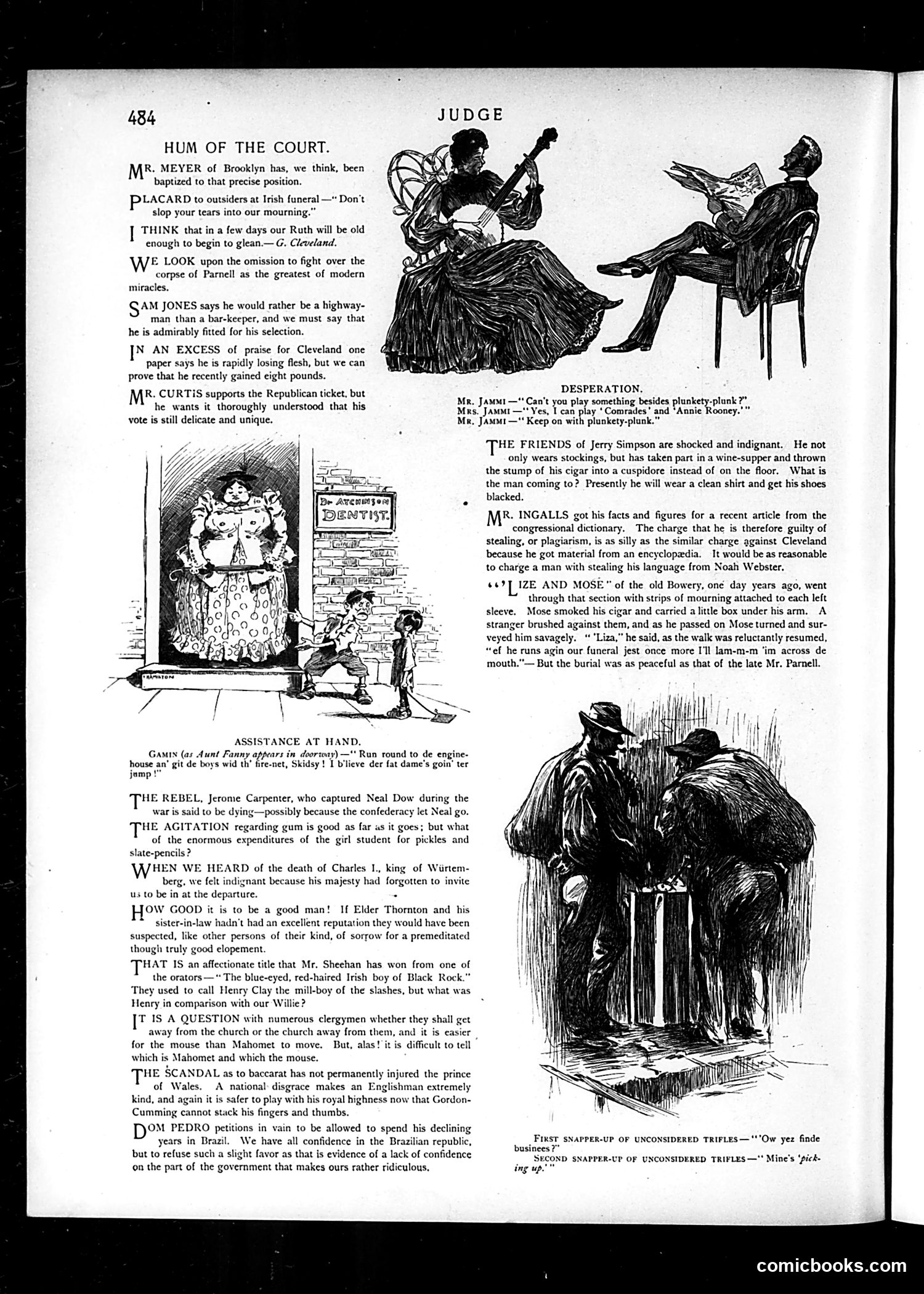
This page from Judge magazine contains political and social satire typical of the 1890s. Key references include: **Political figures**: References to Cleveland (likely President Grover Cleveland), Jerry Simpson (a Populist congressman), and Curtis (supporting the Republican ticket). **Main cartoons**: "Assistance at Hand" depicts a comedic rescue scene; "Desperation" shows a musician playing unwanted "plunkety-plunk" music. **Satirical targets**: The "Hum of the Court" section mocks various public figures—Cleveland's weight, Simpson's uncouth behavior (wearing stockings, improper cigar disposal), and the congressman Ingalls for plagiarism. References to Parnell's funeral and the Irish political situation appear throughout. **Social commentary**: Several items critique modern manners, student spending habits, and religious hypocrisy. The humor relies heavily on period-specific political knowledge and social conventions now obscure to modern readers. The tone is distinctly partisan and aimed at educated readers familiar with contemporary scandals.
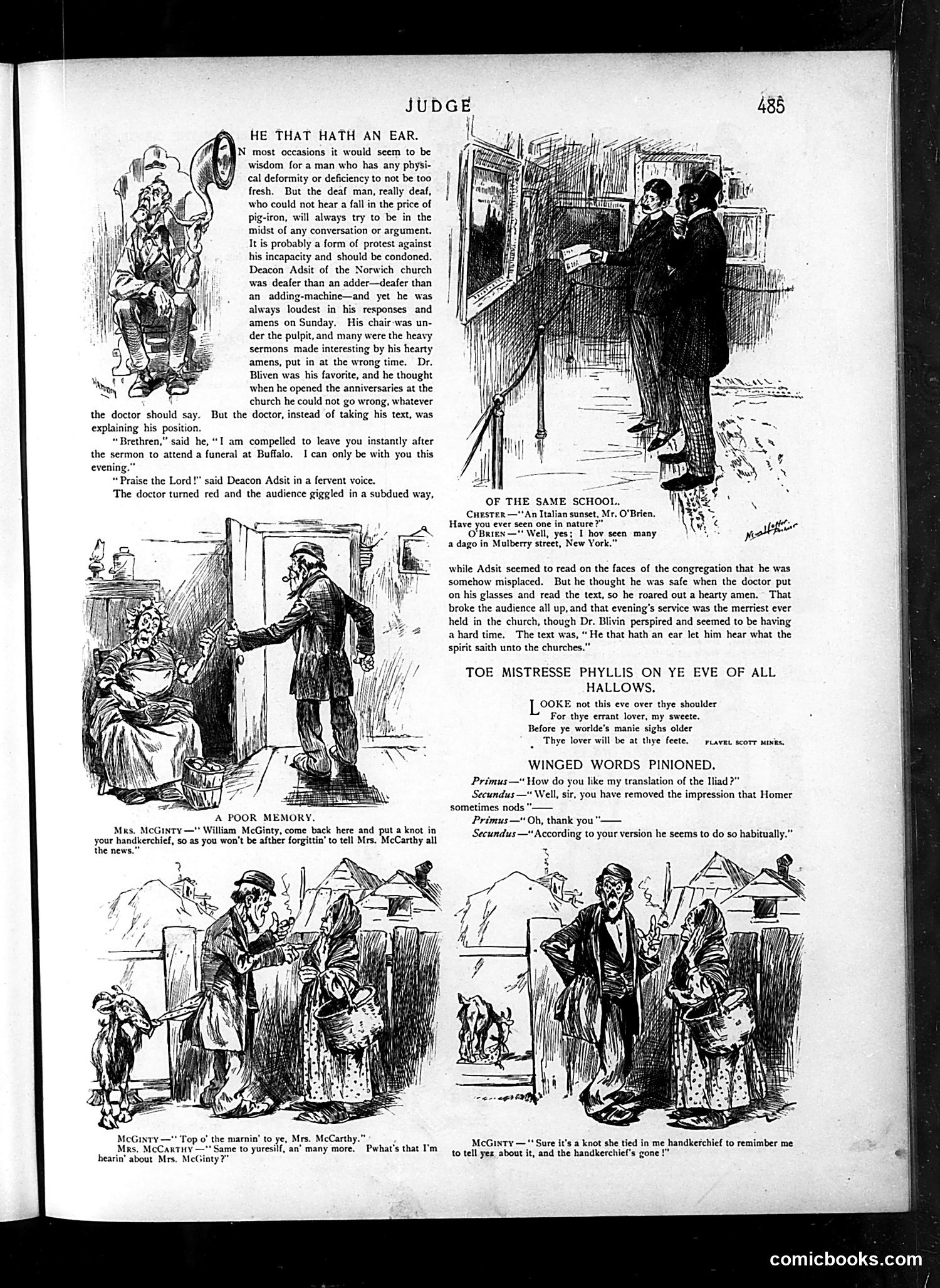
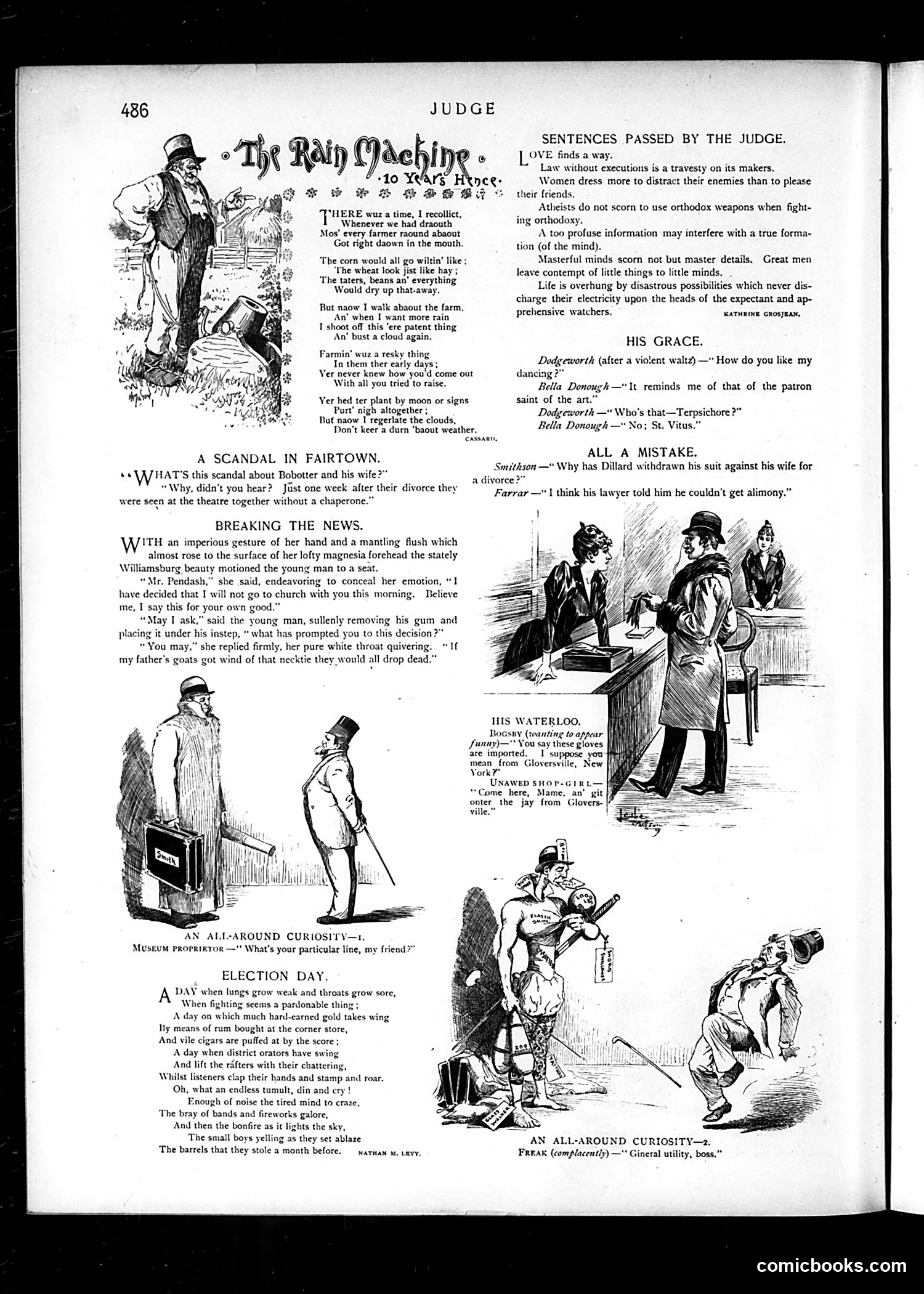
This page from Judge contains several satirical pieces typical of late-19th-century American humor: **"The Rain Machine"** (top left): A poem mocking farmers' historical dependence on weather and superstition. It celebrates modern invention allowing humans to "regulate the clouds"—satirizing contemporary faith in technological progress to solve agricultural problems. **"A Scandal in Fairtown"**: Brief joke about social hypocrisy—a divorced couple seen together "without a chaperone" is scandalous, suggesting the absurdity of rigid Victorian propriety rules. **"Breaking the News"** and other brief anecdotes: Light domestic humor about courtship and fashion choices. **"Election Day"**: A poem satirizing American election day as chaotic and raucous—characterized by drunkenness, noise, corruption ("hard-earned gold takes wing"), and general disorder. The tone is critical of democratic electoral practices. The cartoons throughout use caricature and exaggeration typical of Judge's visual style. The page mixes social satire with topical commentary on American democracy, technology, and manners.
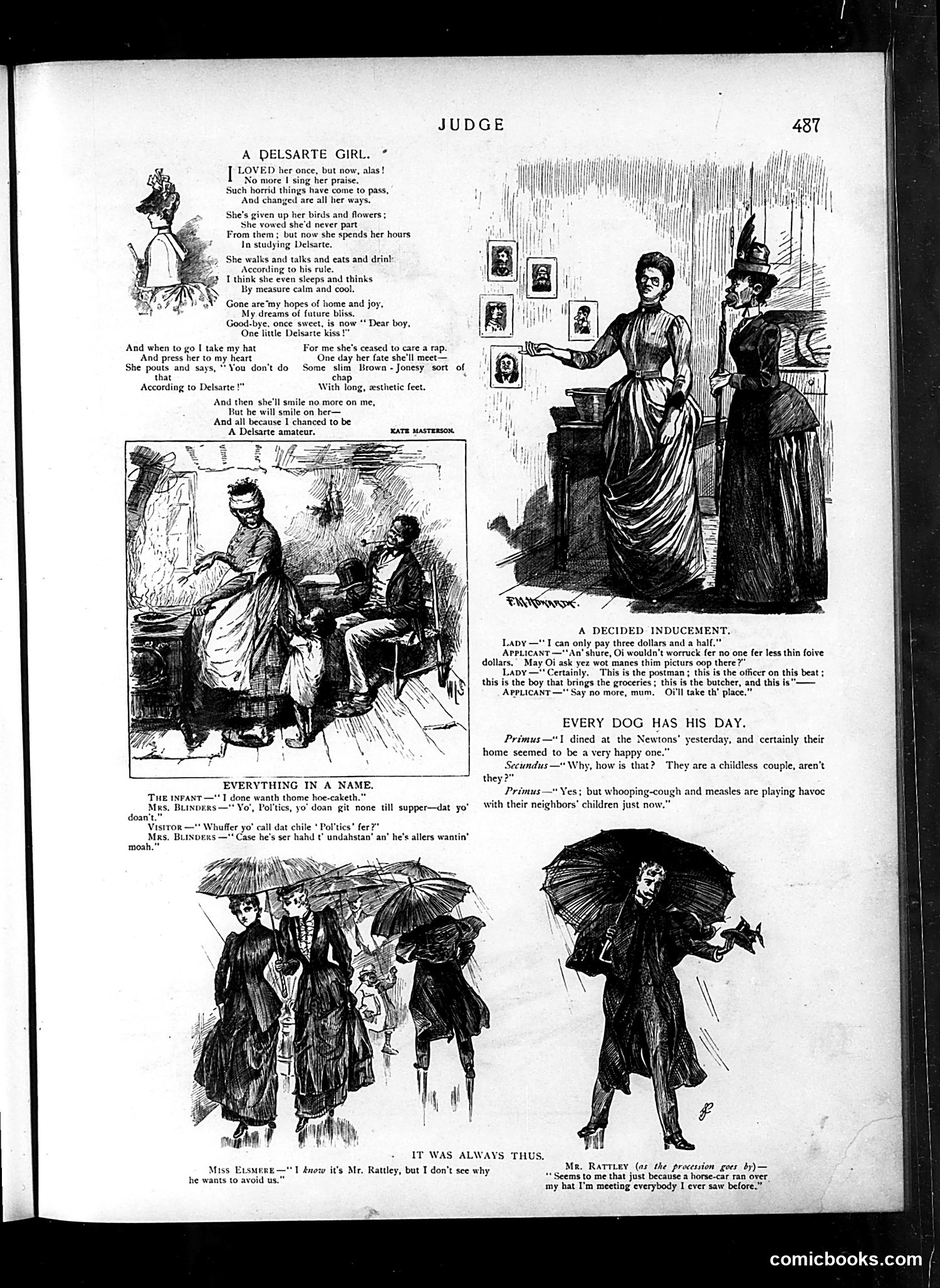
This page contains Victorian-era satirical humor targeting fashionable affectations and social pretension. **"A Delsarte Girl"** mocks the Delsarte movement—a theatrical movement emphasizing stylized, aesthetic body movements and poses. The satire portrays a woman who adopts these affected mannerisms so completely that she becomes emotionally distant, measuring even her kisses by "Delsarte" rules, driving away her suitor. **"Everything in a Name"** appears to be dialect humor (common for the era), using phonetic speech patterns for comedic effect. **"A Decided Inducement"** jokes about a landlady listing her neighborhood's professional contacts (postman, officer, grocer, butcher) as selling points for a domestic servant position—implying the servant could exploit these connections for personal gain. The applicant immediately accepts upon understanding. **"Every Dog Has His Day"** presents ironic humor: neighbors with no children of their own are happy because their *neighbors'* children's illnesses mean fewer playmates for them. **"It Was Always Thus"** uses coincidence humor: someone avoids a person by not being seen, but after getting hit by a streetcar, suddenly encounters them constantly.
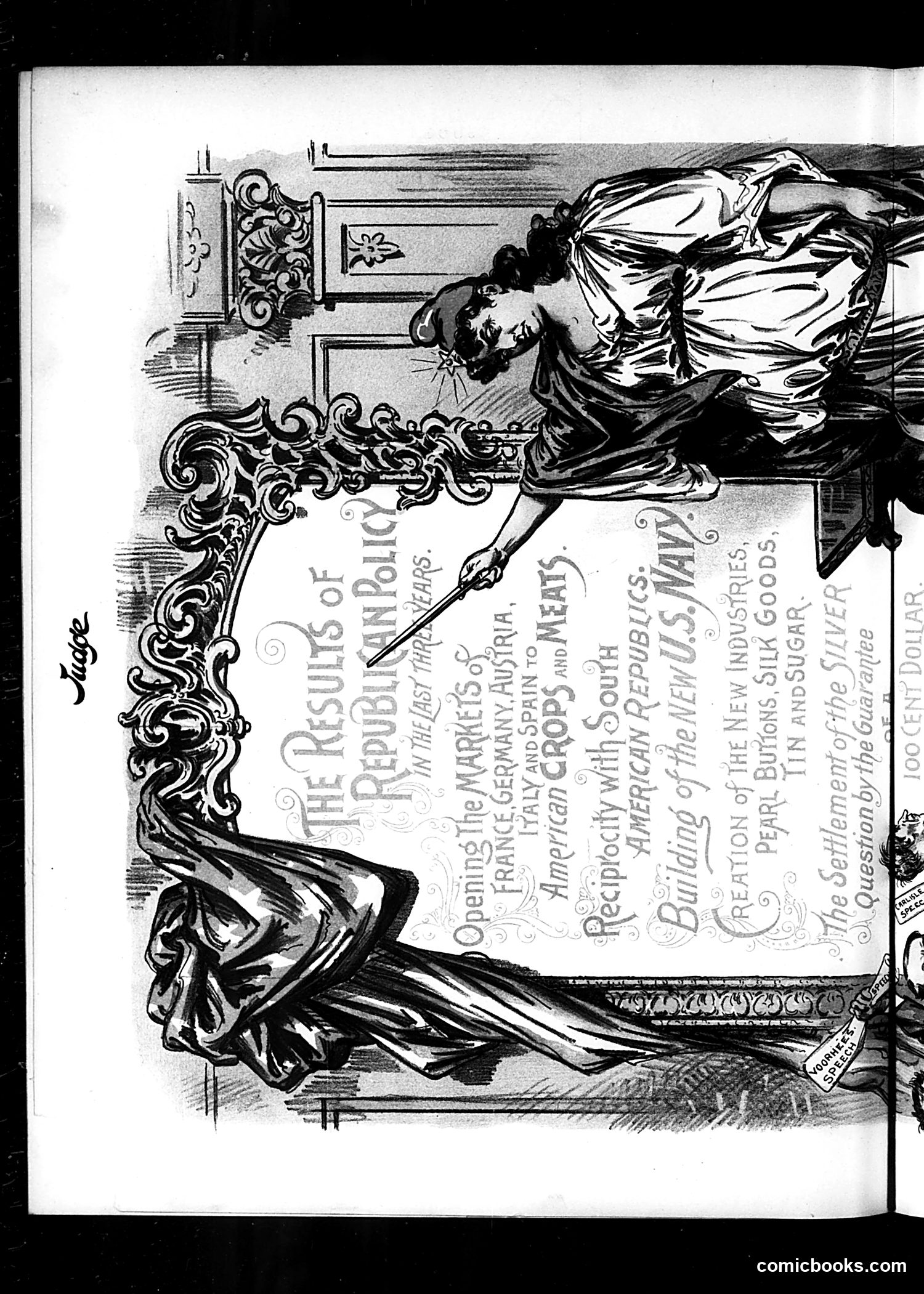
This appears to be a **title page or advertisement** for Judge magazine rather than a political cartoon. The ornate decorative border frames text announcing "The Results of Public Building" with references to "Opening the [Franchises]" and "Republican Serenity [during Spring to Autumn]." The illustrated female figure in classical dress appears to represent **Liberty or Civic Virtue**, a common allegorical figure in Gilded Age satire. The elaborate Art Nouveau styling and formal presentation suggest this is either a **masthead design or promotional content** rather than satirical commentary. Without clearer context about the specific date and political situation referenced, the exact satirical target remains unclear, though it likely critiques Republican-era public infrastructure or franchise policies.
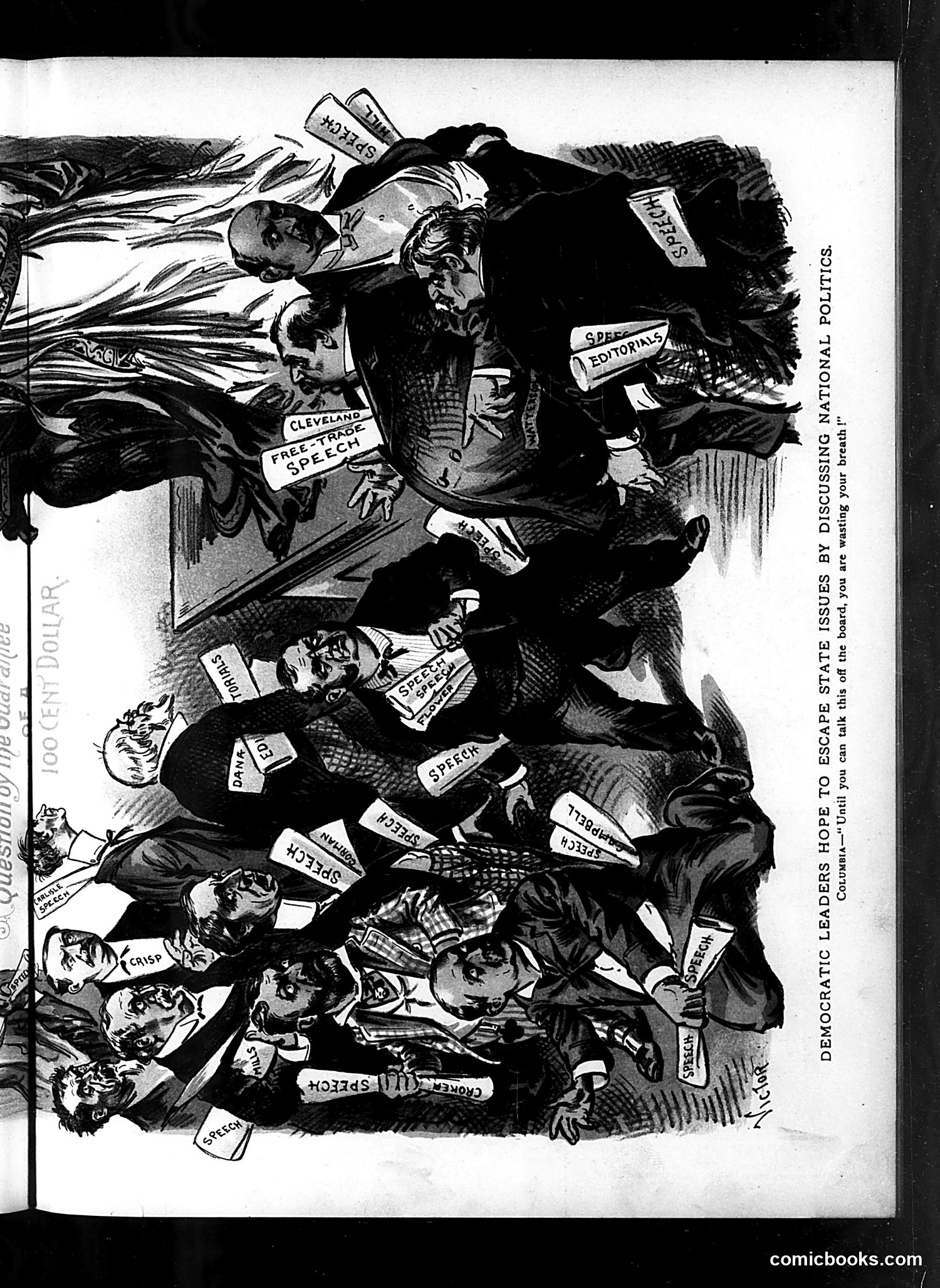
This appears to be a Gilded Age satirical cartoon criticizing Democratic Party leadership and internal conflict. The cartoon depicts Democratic figures being overwhelmed by competing "speech" labels—representing contradictory party positions on issues like "Free Speech" (Cleveland reference), "Tariff," and "Editorials." The composition shows party leaders struggling under the weight of conflicting rhetoric and policy demands. Multiple figures labeled "Speech" suggest the party cannot maintain a coherent message. The chaotic pile-up of politicians likely represents factional infighting between conservative and progressive Democrats. The satire mocks the Democratic Party's inability to present unified leadership during what appears to be a period of internal ideological conflict, possibly relating to Cleveland's presidency or a contentious election cycle. The visual metaphor—leaders buried under their own contradictory statements—conveys that the party's divisions undermine its political viability.
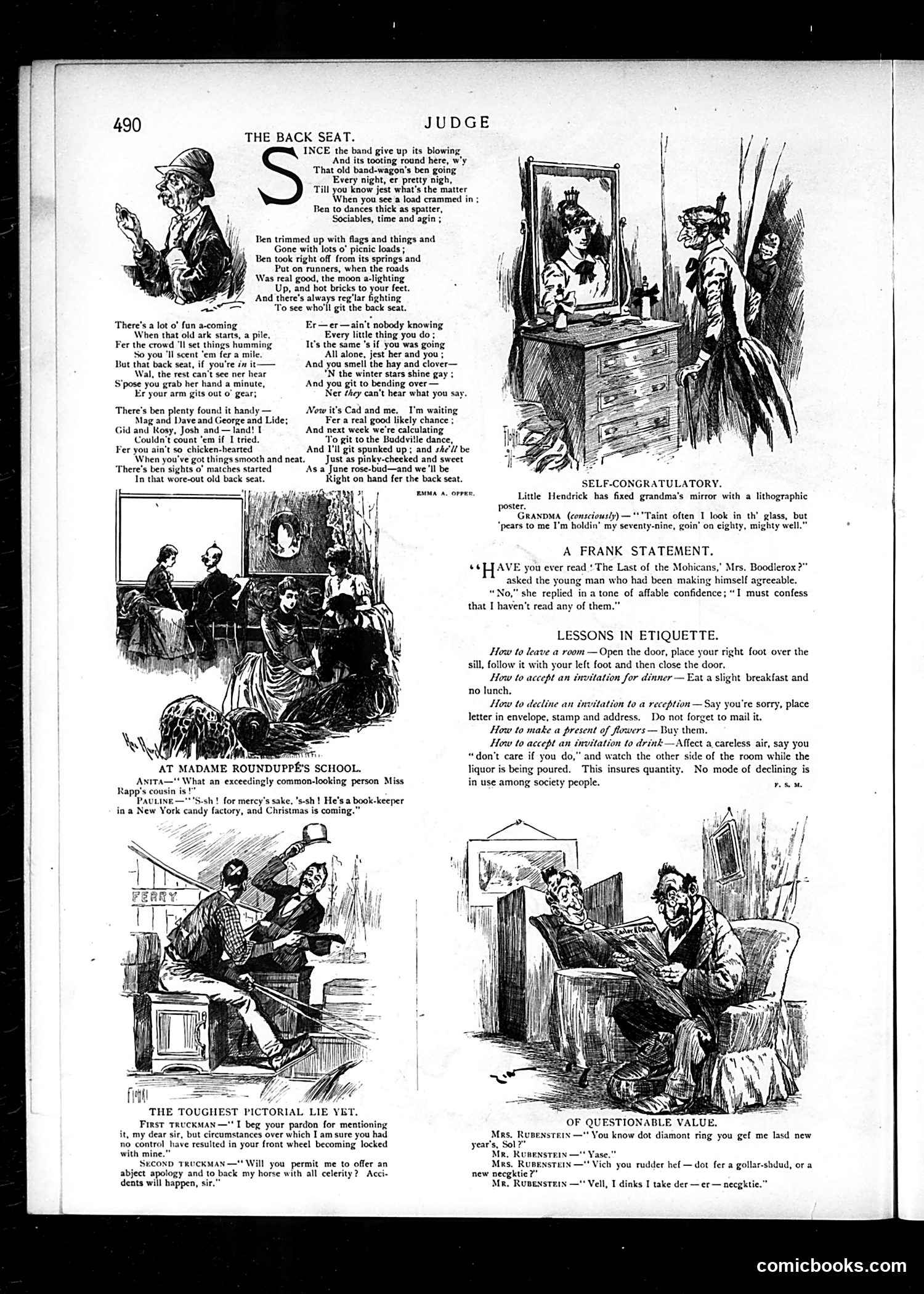
This page contains multiple humorous pieces targeting social behaviors and courtship customs of the era. **"The Back Seat"** is a dialect poem celebrating the courting ritual of young couples riding in wagons/carriages—the back seat being the most private, romantic spot. The humor lies in its earnest celebration of this universal courting tradition, with characters like "Cad and me" anticipating the Buddville dance where they'll "be right on hand fer the back seat." **"Self-Congratulatory"** mocks vanity: a grandmother admires herself in a mirror decorated with a lithograph poster, convinced she looks youthful. **"A Frank Statement"** satirizes literary pretension: a woman admits she hasn't read "The Last of the Mohicans" or any classics, yet society accepts her ignorance. **"Lessons in Etiquette"** offers mock-serious, absurdist instructions on proper behavior—the humor derives from impractical or obvious advice presented as wisdom. Lower cartoons satirize other social situations: pretentious street encounters and a Yiddish-accented couple discussing jewelry values. The page broadly mocks emerging middle-class manners and pretensions.
This is primarily an **advertising page** with minimal editorial content. The few jokes and political references scattered throughout are brief filler items typical of late 19th-century magazines: **Political Reference:** One opening line mentions "the political situation in New York seems to be largely a question between Fassett and Bung"—likely referencing contemporary New York politicians, though the names are unclear without additional context. **Humor/Satire:** The page includes light puns ("stocking up" for a hosiery dealer) and absurdist jokes ("every Day has his dog" in an Ohio family named Day with 13 sons and 13 dogs). **No Political Cartoons:** Despite the instruction framework, there are **no actual political cartoons on this page**—only product advertisements with decorative illustrations (pianos, cocoa, writing pens, flour barrels). The page reflects Judge's mixed format: satirical magazine content subsidized by patent medicines and consumer goods advertising typical of the era.
This page is primarily **advertising**, with scattered brief editorial jokes interspersed. The cartoons are minimal; instead, there are extensive print ads for consumer products (soap, beef extract, hotels, medicines) and announcements. The few textual jokes mock: - The absurdity of claiming to be the "oldest inhabitant" given Earth's supposed age - A college professor's suspicion that students skipping prayers portend trouble - Petty domestic complaints (mosquitoes, banjo noise) - Financial frustration (waiting to make stove jokes until paying off the stove) The advertising emphasizes **patent medicines and proprietary remedies** (Angostura Bitters, Dr. Miles' Nervine, Barry's Tricopherous Hair Treatment)—typical of the era's largely unregulated pharmaceutical industry. The **hotel guide** reflects Judge's audience: affluent travelers needing accommodations in major cities. Overall, this is a commercial publication page with light, genteel humor rather than serious political satire.
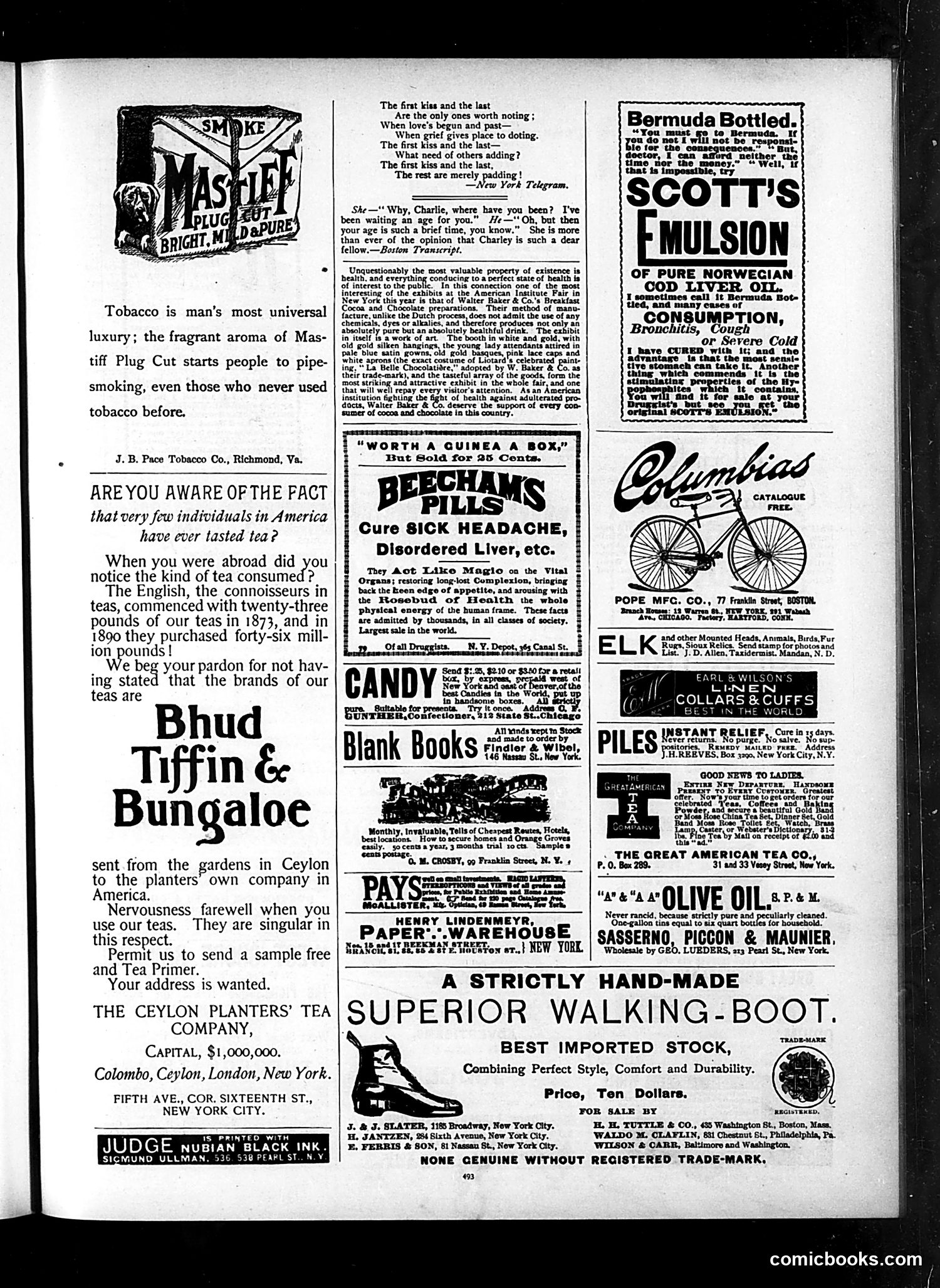
This is primarily an **advertising page** from Judge magazine, not a political cartoon page. It contains numerous late 19th-century product advertisements with minimal satirical content. The only notable satirical element is a brief **exchange between "Charlie" and "She"** (attributed to Boston Transcript): When a woman complains about waiting "an age" for Charlie, he responds that her age is "such a brief time," implying she's young. The joke satirizes **male flattery and female vanity**—Charlie's transparent compliment works despite its obvious insincerity. The remaining content consists of straightforward advertisements for products like tobacco, tea from Ceylon, cocoa, pills, bicycles, walking boots, and various patent medicines. These ads reflect period concerns: **tea consumption, cocoa purity, health remedies**, and imported luxury goods. There is no significant political satire or cartooning on this page—it functions as a commercial product catalog rather than satirical commentary.
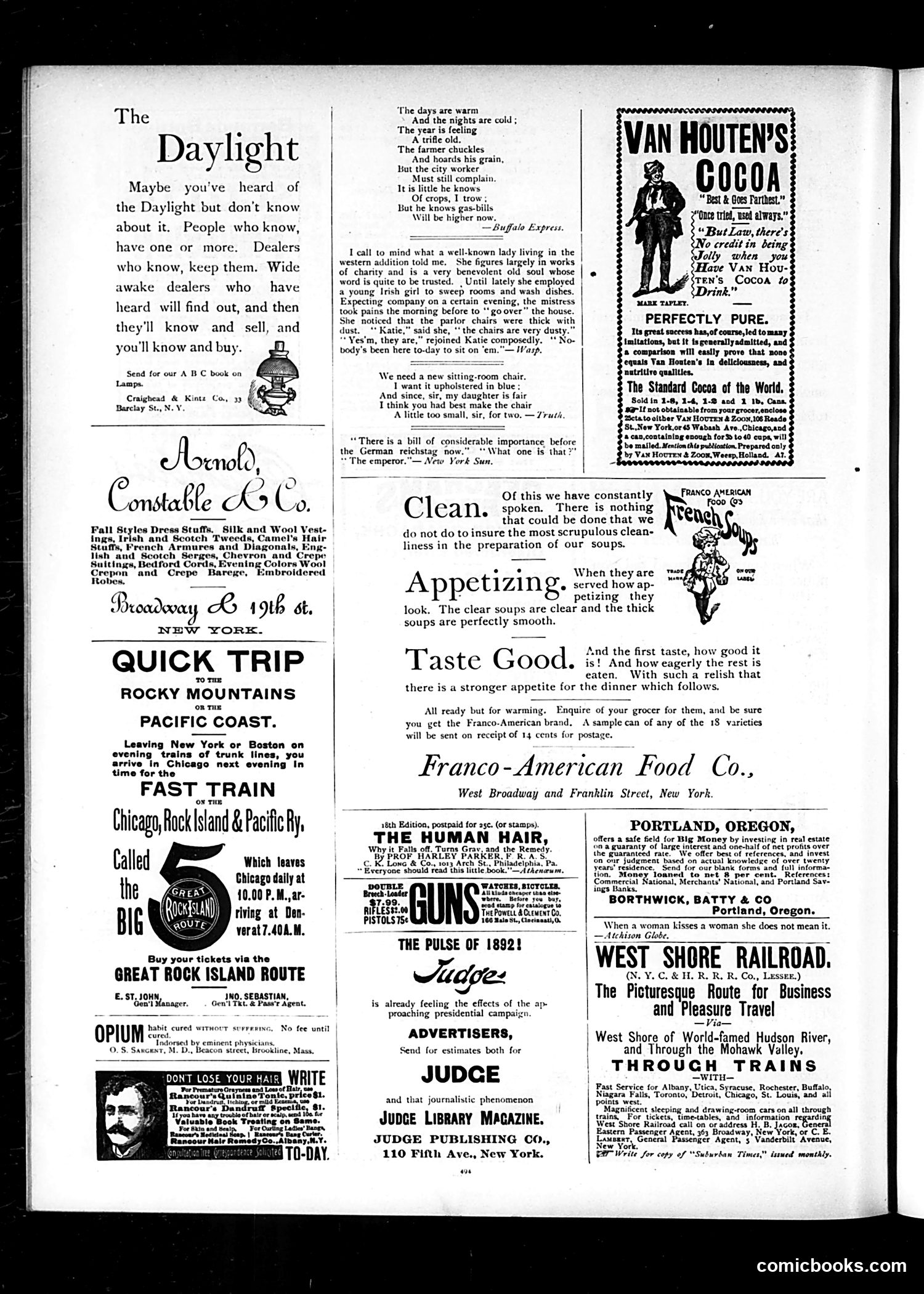
This page from *Judge* magazine consists primarily of **advertisements and light humor pieces** rather than political cartoons. The few humorous items present are simple comic anecdotes with no clear caricatures: - A poem about seasonal changes and urban workers' gas bills (from *Buffalo Express*) - An exchange between a lady and her Irish servant "Katie" about dusty furniture—a gentle ethnic joke playing on Irish domestics' literal-minded speech - A quip about the German Reichstag wherein "the emperor" is joked to be an important "bill"—likely a mild political jab at German imperial authority, though it's unclear which emperor or when **No clear political figures or cartoons are visible.** The dominant content consists of period advertisements for Van Houten's cocoa, Franco-American soups, trains, fabrics, and various products. The page exemplifies *Judge*'s blend of light satirical humor and commercial advertising typical of early-20th-century American magazines.
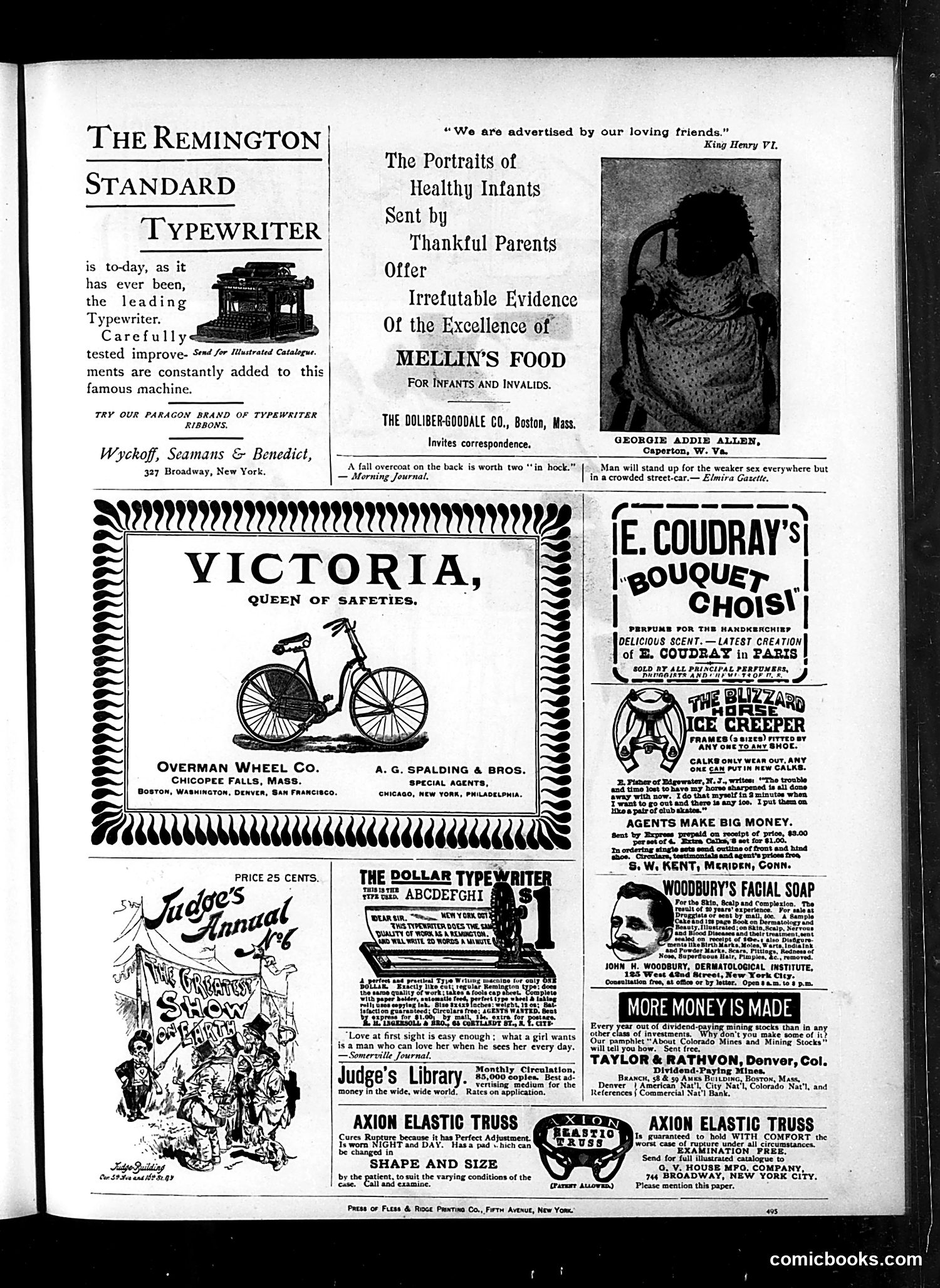
This is primarily an **advertising page** with minimal editorial content. The few satirical elements present are brief, cynical observations about modern life: Two small quotations offer social commentary: One suggests a woman's overcoat is "worth two in hock" (pawned), implying financial hardship. Another mocks chivalry, noting men champion women's rights everywhere except in crowded streetcars—where they abandon courtesy. The page is otherwise dominated by period advertisements: typewriters (Remington, Dollar Typewriter), bicycles (Victoria brand), infant formula (Mellin's Food), medical devices (elastic trusses), beauty products (Woodbury's Facial Soap, E. Coudray perfume), and investment schemes (Colorado mining stocks). Judge's Library and Judge's Annual are promoted as popular publications. The satirical content is minimal—this appears to be a standard advertising-heavy magazine page from the late 19th century, where social barbs were brief asides rather than developed cartoons.
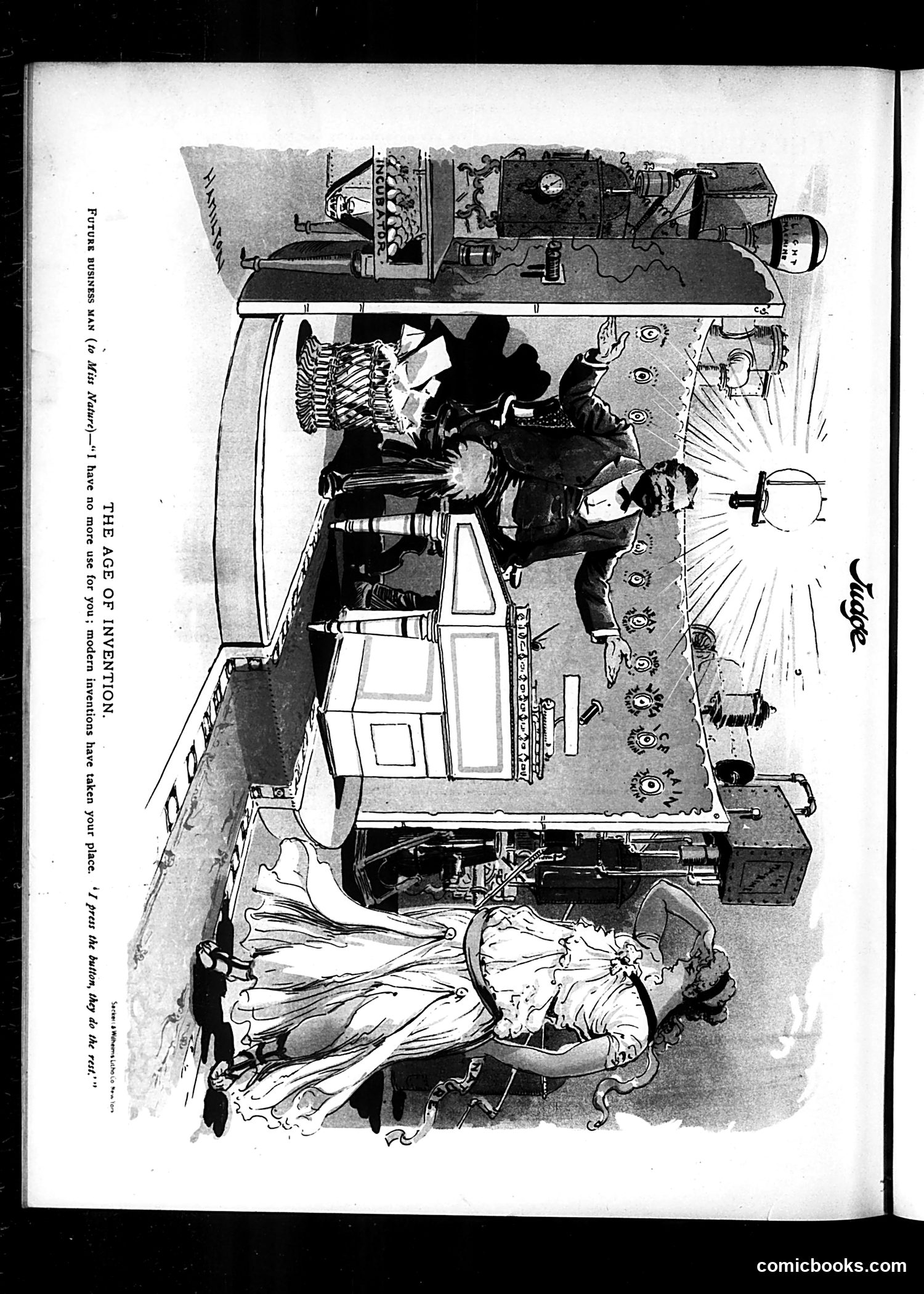
I cannot reliably identify the specific cartoon(s) or satire on this page. While the image shows what appears to be a Victorian-era mechanical or scientific invention scene with figures examining machinery, the OCR text is almost entirely corrupted or reversed, making it impossible to determine: - The cartoon's title or subject - Which political or social figures are caricatured - What event or issue is being satirized - The intended joke or message The visual composition suggests this might be satirizing technological innovation or industrial progress (common Judge magazine themes), but without legible text or clear context, any specific interpretation would be speculation. A clearer source image or readable OCR would be needed for accurate analysis.