
A complete issue · 16 pages · 1891
Judge — September 26, 1891
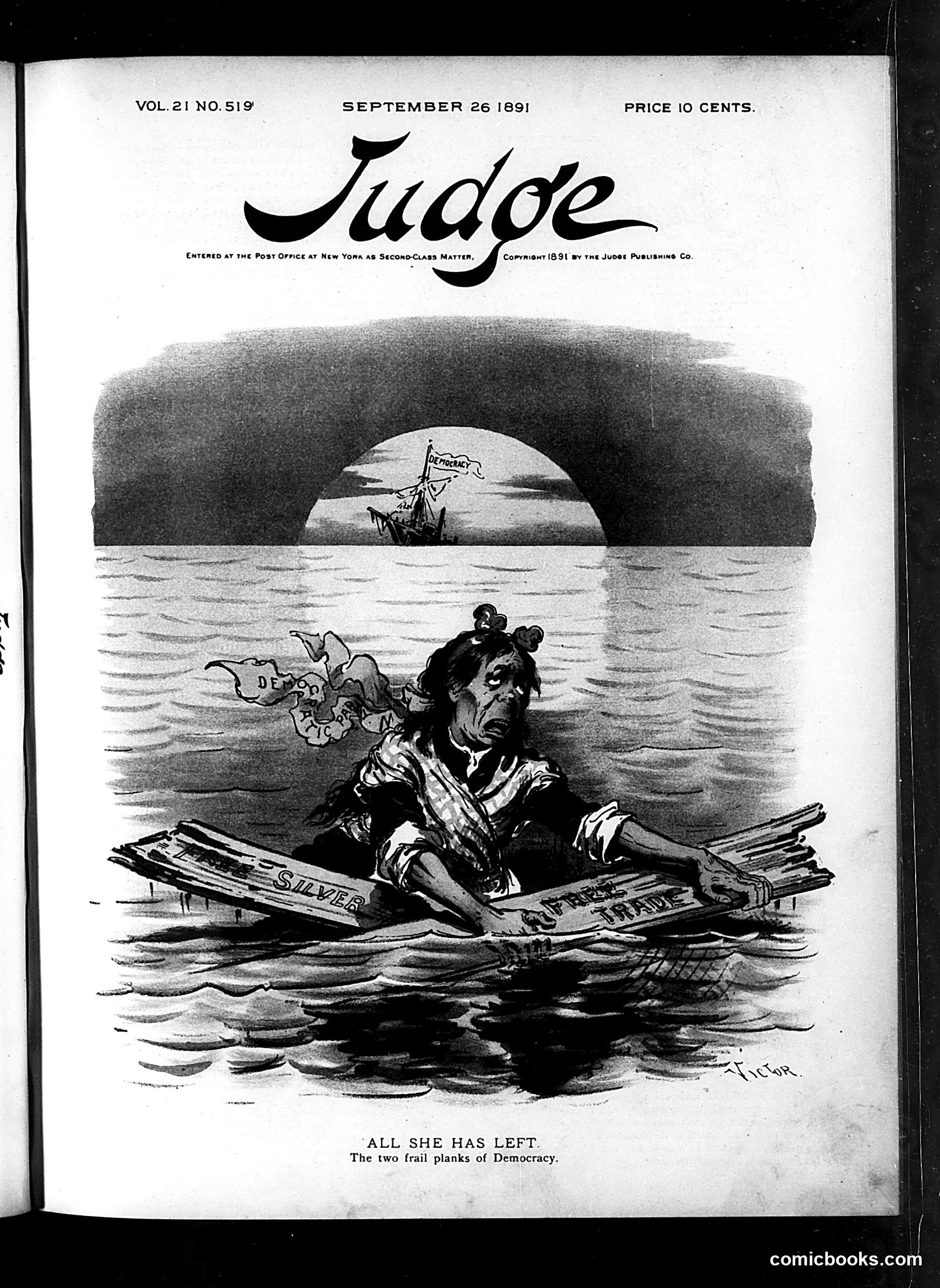
This *Judge* magazine cover from September 26, 1891 depicts a woman (representing Democracy or the Democratic Party) drowning or sinking in water, clinging to two wooden planks labeled "Silver" and "Free Trade." In the background, a ship labeled "Despair" appears to be departing. The cartoon satirizes the Democratic Party's weakened political position, suggesting that only these two economic policies—free trade and silver coinage—remain as their platform. The departing ship likely represents hope or support leaving the party. The overall message critiques the Democrats as struggling and abandoned, reduced to clinging to narrow policy positions rather than presenting a broader vision.
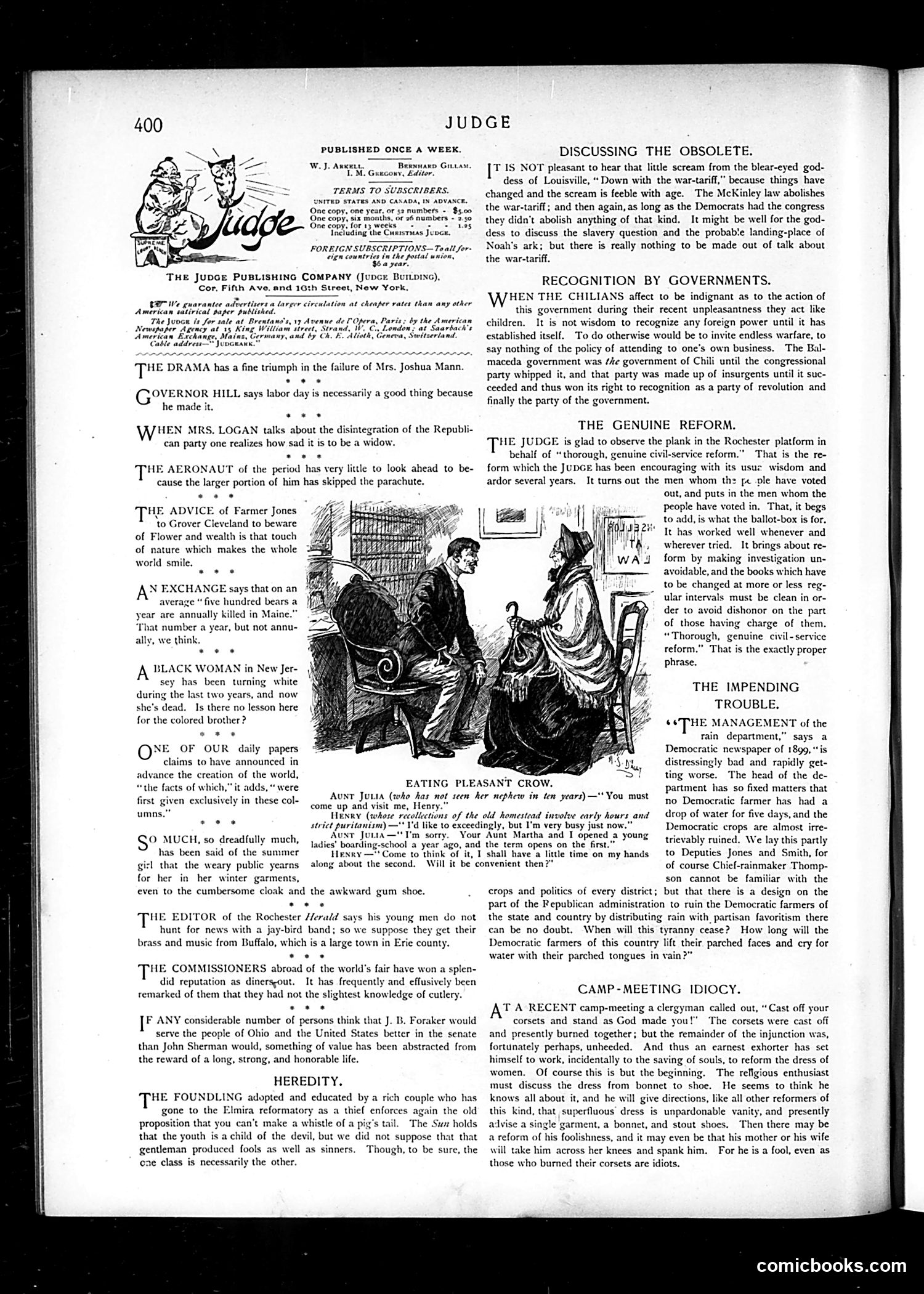
The central cartoon depicts "A PLEASANT CROW" featuring two figures in conversation—apparently Aunt Julia and Henry discussing domestic matters. The satire appears to concern women's fashion and social expectations, with Henry commenting on ladies' boarding-school costs and his wife's wardrobe expenses. The page's political commentary focuses on civil-service reform (praised as "genuine reform"), Democratic party management of rain departments (criticizing their ineffectiveness), and religious camp-meeting hypocrisy regarding dress codes. The text references various contemporary political figures and issues including tariff debates and labor policy, though specific names remain unclear without additional historical context. The overall tone is characteristic of Judge's late-19th-century satirical approach to social and political commentary.
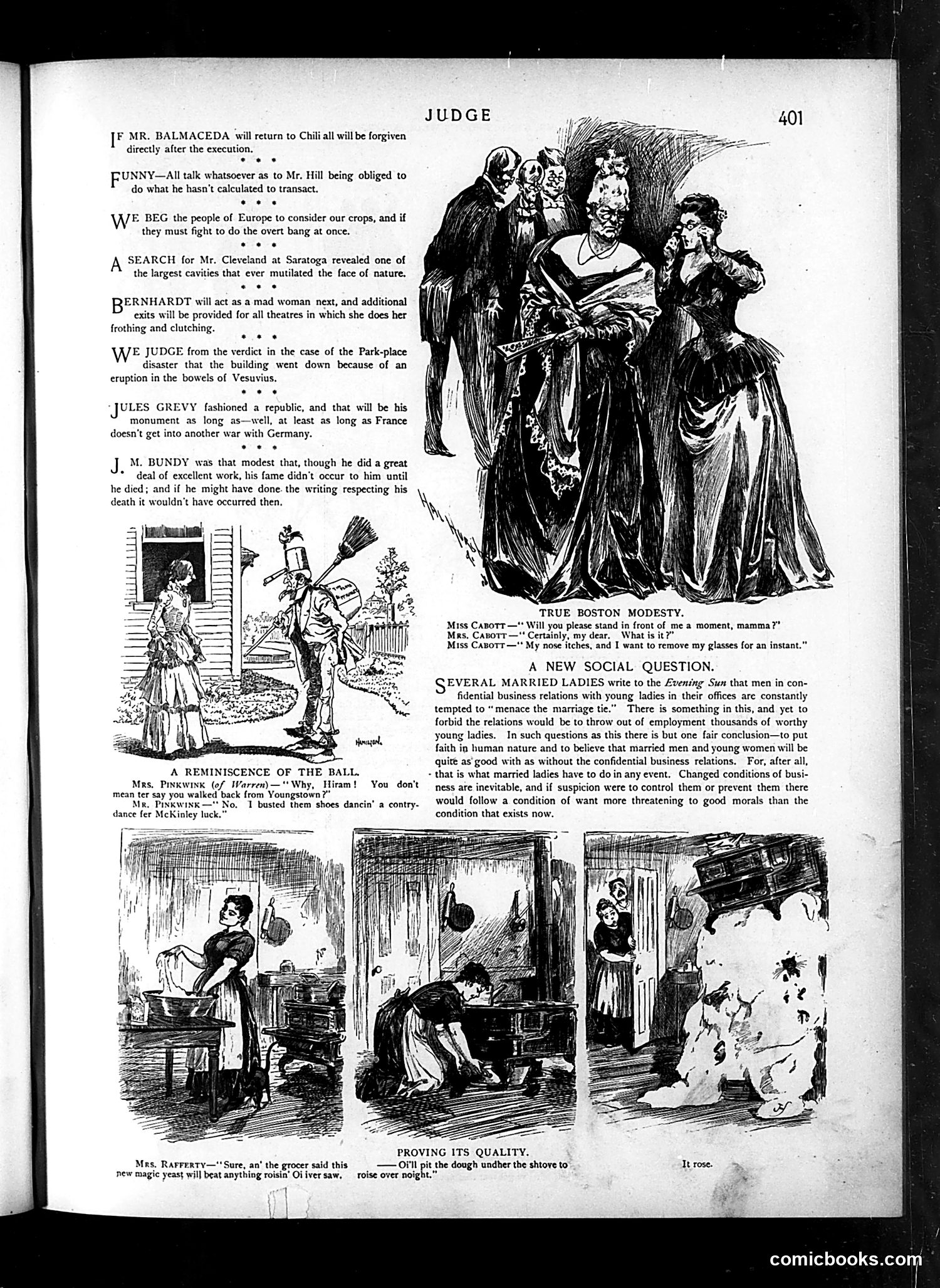
This page contains several satirical items and illustrations typical of Judge's social commentary: **"True Boston Modesty"** depicts Miss Carott requesting her mother remove her glasses so she can admire her own reflection—mocking Boston society's perceived vanity disguised as propriety. **"A New Social Question"** addresses married women corresponding confidentially with young men in business, debating whether this threatens marriages. The satire questions whether suspicion or trust better maintains relationships. **"A Reminiscence of the Ball"** jokes about someone named Hiram not understanding a dance reference to "McKinley's luck." **"Proving Its Quality"** shows a three-panel sequence about dough and a rolling pin—likely a domestic humor piece. The illustrations use exaggerated character types common to Gilded Age satire, targeting middle-class social anxieties and gender relations of the era.
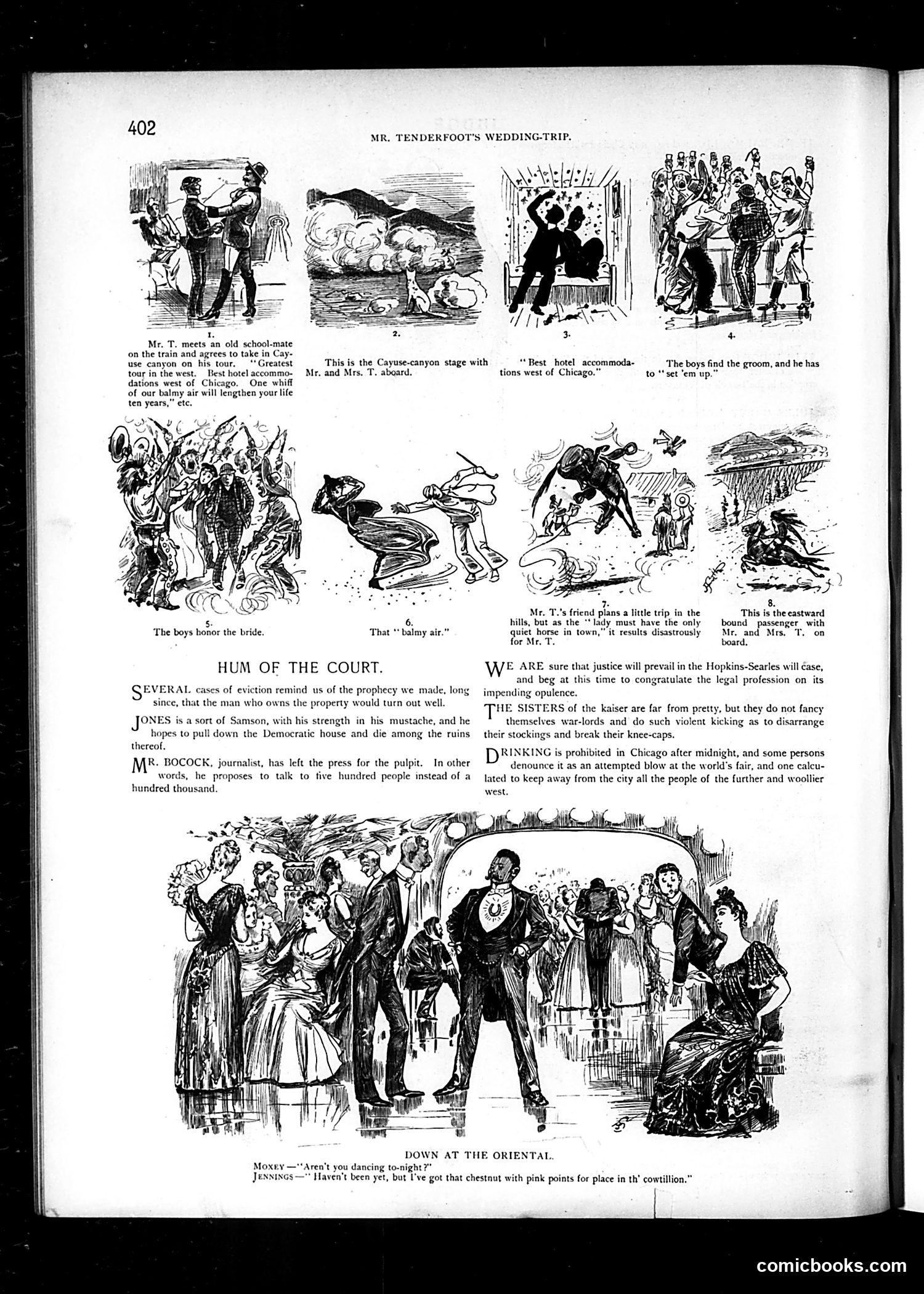
This is a satirical comic strip mocking an inexperienced city dweller ("Mr. T.") taking a Western honeymoon. The narrative follows him from a train meeting through various mishaps in "Cayuse canyon"—a remote location promoted with exaggerated claims about health benefits. The humor derives from the collision between Eastern civility and rough Western realities: the groom gets pressured into buying drinks for rowdy locals, his bride experiences dangerous horseback riding complications, and he encounters the rough terrain advertised as therapeutic. The accompanying "Hum of the Court" section contains brief satirical notes on contemporary figures and events—a journalist (Bocock) leaving journalism for preaching, eviction cases, and prohibitions in Chicago during the World's Fair era. The final vignette at the Oriental mocks pretentious social dancing with cowboy dialect ("cowtillion"), contrasting Eastern sophistication with Western vernacular.
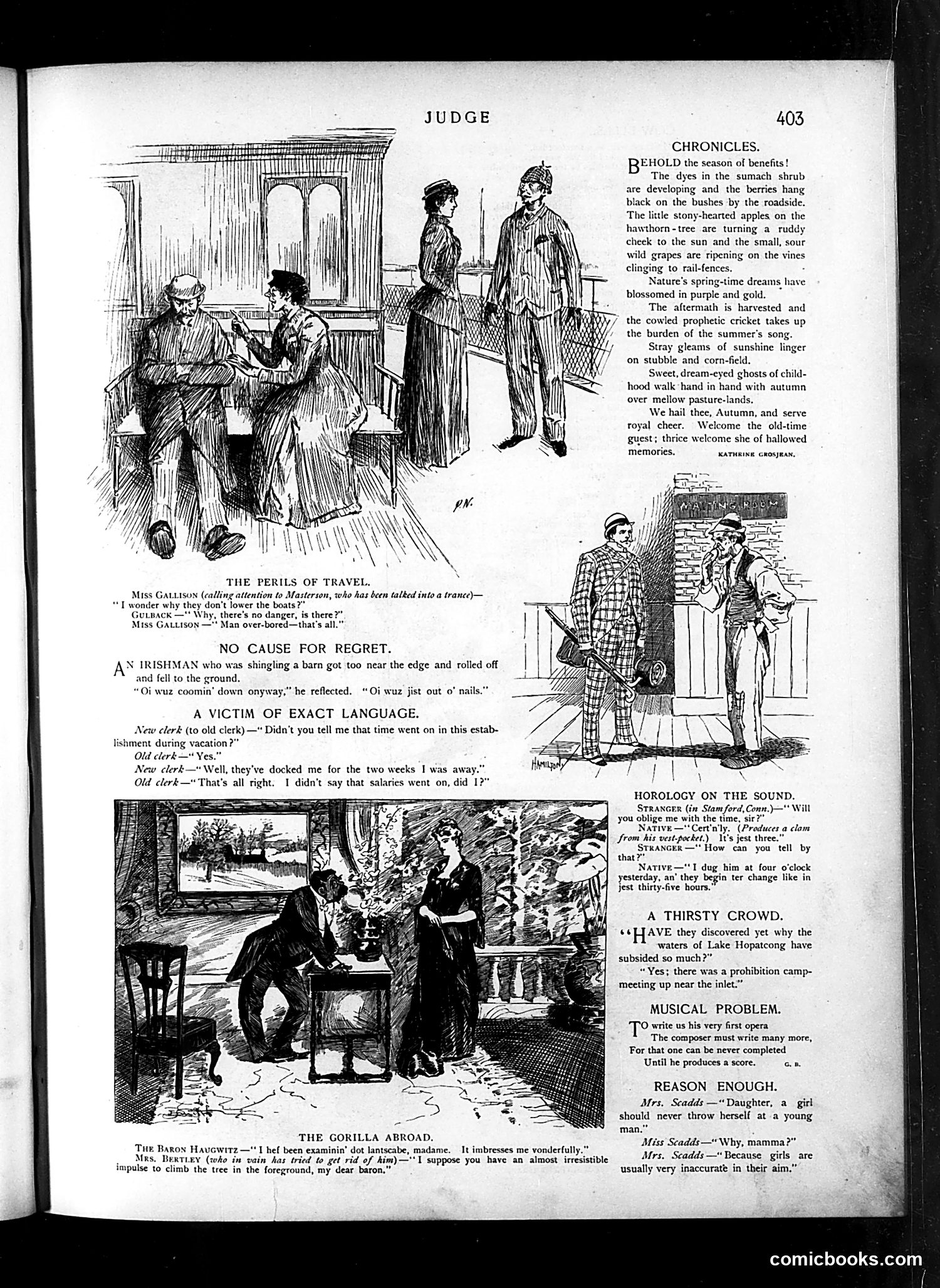
This page contains several brief satirical items typical of Judge's humor: **"The Perils of Travel"** mocks hypochondriacs—a woman worries about nonexistent boat danger while a man beside her has been bored into a trance by her talking. **"No Cause for Regret"** jokes about Irish immigrant dialect and practicality: a man falls off a barn but isn't upset since he'd run out of nails anyway. **"A Victim of Exact Language"** satirizes workplace semantics—an employee gets docked pay during vacation because the boss only said "time went on," not "salaries went on." The remaining items are lightweight humor: a Native American reading a clamshell as a clock; a prohibition joke about depleted lake water; a pun about composers needing to "produce a score"; and gender-based advice about women's romantic behavior. **"The Gorilla Abroad"** appears to mock a foreign nobleman (the "Baron") making awkward observations about American landscapes—a common stereotype of European visitors. These are genteel, pun-heavy jokes reflecting early-20th-century Judge sensibilities—mostly harmless domestic humor with occasional immigrant and class-based mockery.
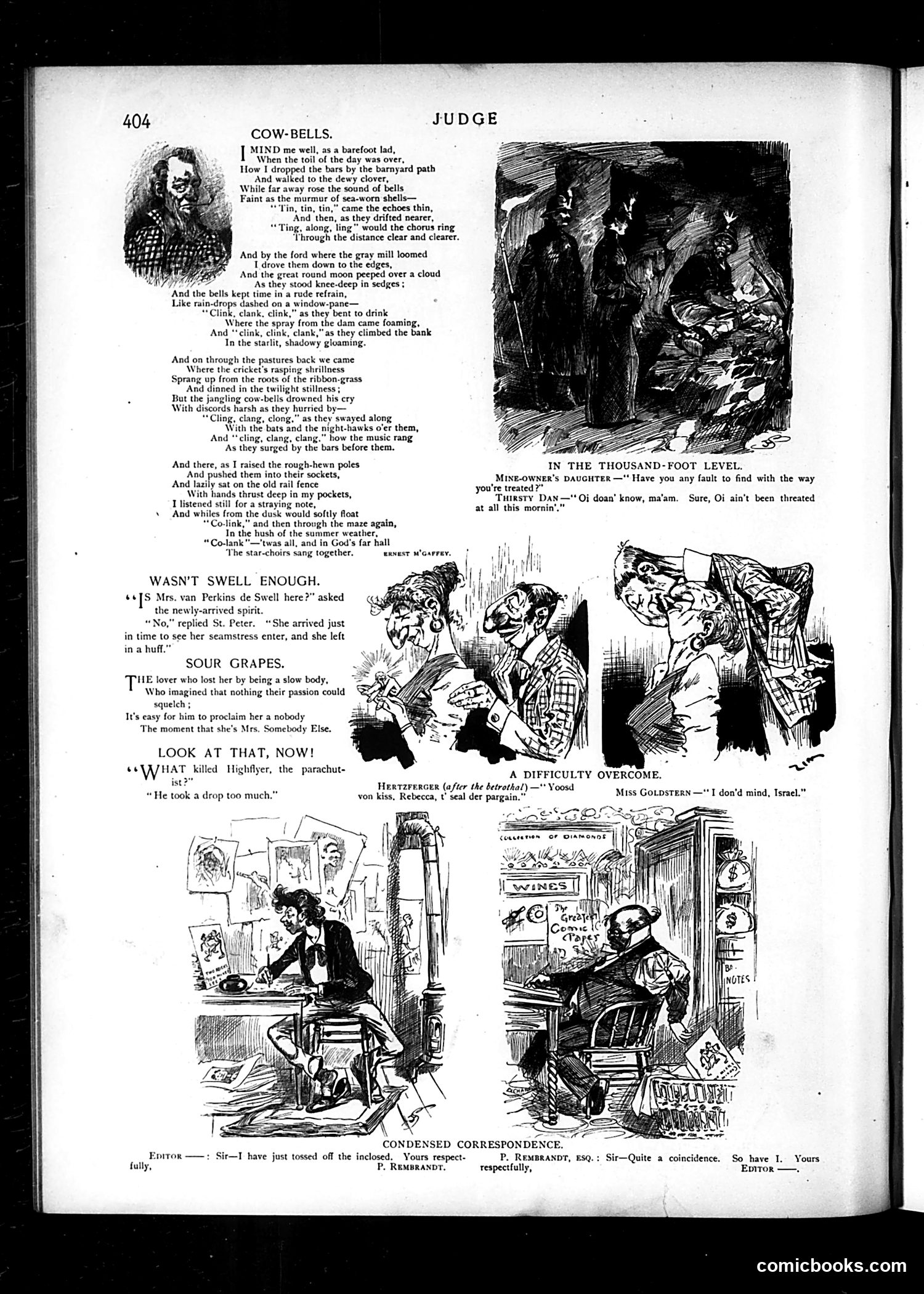
This page contains several unrelated comic items typical of Judge's format: **"Cow-Bells"** is a nostalgic poem about rural childhood, illustrated with period woodcuts—not political satire, but sentimental verse. **Short jokes** mock social pretension: "Wasn't Swell Enough" ridicules a snobbish woman (Mrs. van Perkins de Swell) so concerned with status she leaves heaven rather than encounter her seamstress. "Sour Grapes" mocks a spurned lover's bitter rationalization. **"Look at That, Now!"** is a pun: a horse named "Highflyer" died from taking "a drop too much"—wordplay on falling and drinking. **"A Difficulty Overcome"** depicts mine workers; the humor is unclear from OCR text. **"Condensed Correspondence"** shows two writers coincidentally tossing off the same manuscript—a meta-joke about editorial rejection. No major political figures appear. The page emphasizes sentimental poetry and light social satire typical of early 20th-century humor magazines.
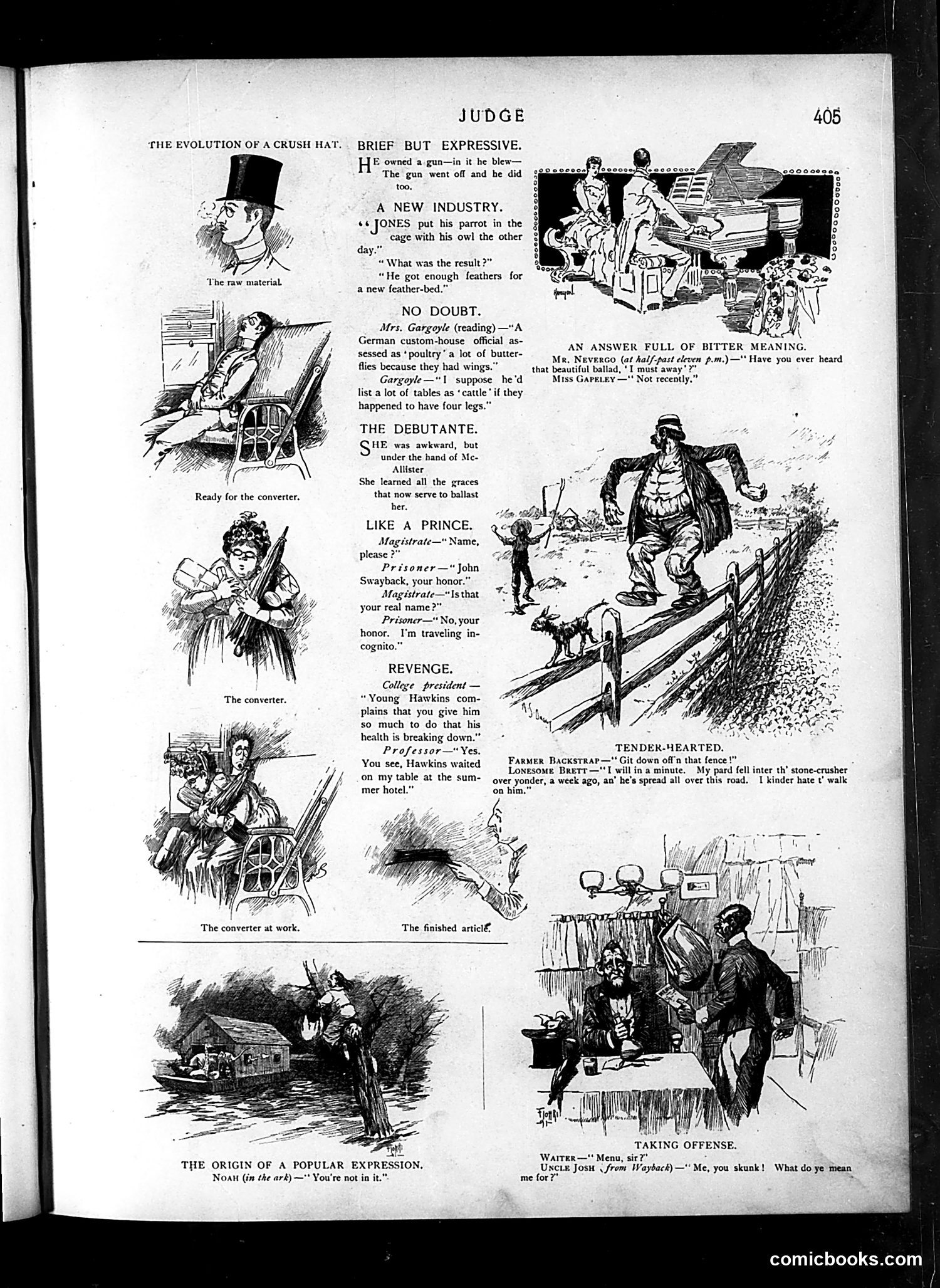
This *Judge* magazine page contains multiple brief satirical cartoons typical of early 20th-century American humor: **"Evolution of a Crush Hat"** jokes about a man shooting himself with a gun hidden in his hat—dark humor about accidental suicide. **"New Industry"** satirizes absurd business logic: mixing a parrot and owl produces feathers for a feather-bed, mocking nonsensical entrepreneurship. **"The Debutante"** references McAllister (likely Ward McAllister, a famous society arbiter), suggesting wealthy young women learn only superficial social graces. **"Like a Prince"** shows a prisoner claiming to travel "incognito"—mocking criminals' delusions of dignity. **"Revenge"** satirizes a professor punishing a complaining student by overworking him. **"Tender-Hearted"** and other sections use rural dialect characters ("Farmer Backstrap," "Uncle Josh") for slapstick humor about country folk's crude attitudes toward death and social offense. The page exemplifies *Judge's* mix of social satire, dark humor, and class-based comedy targeting both wealthy pretension and rural vulgarity.
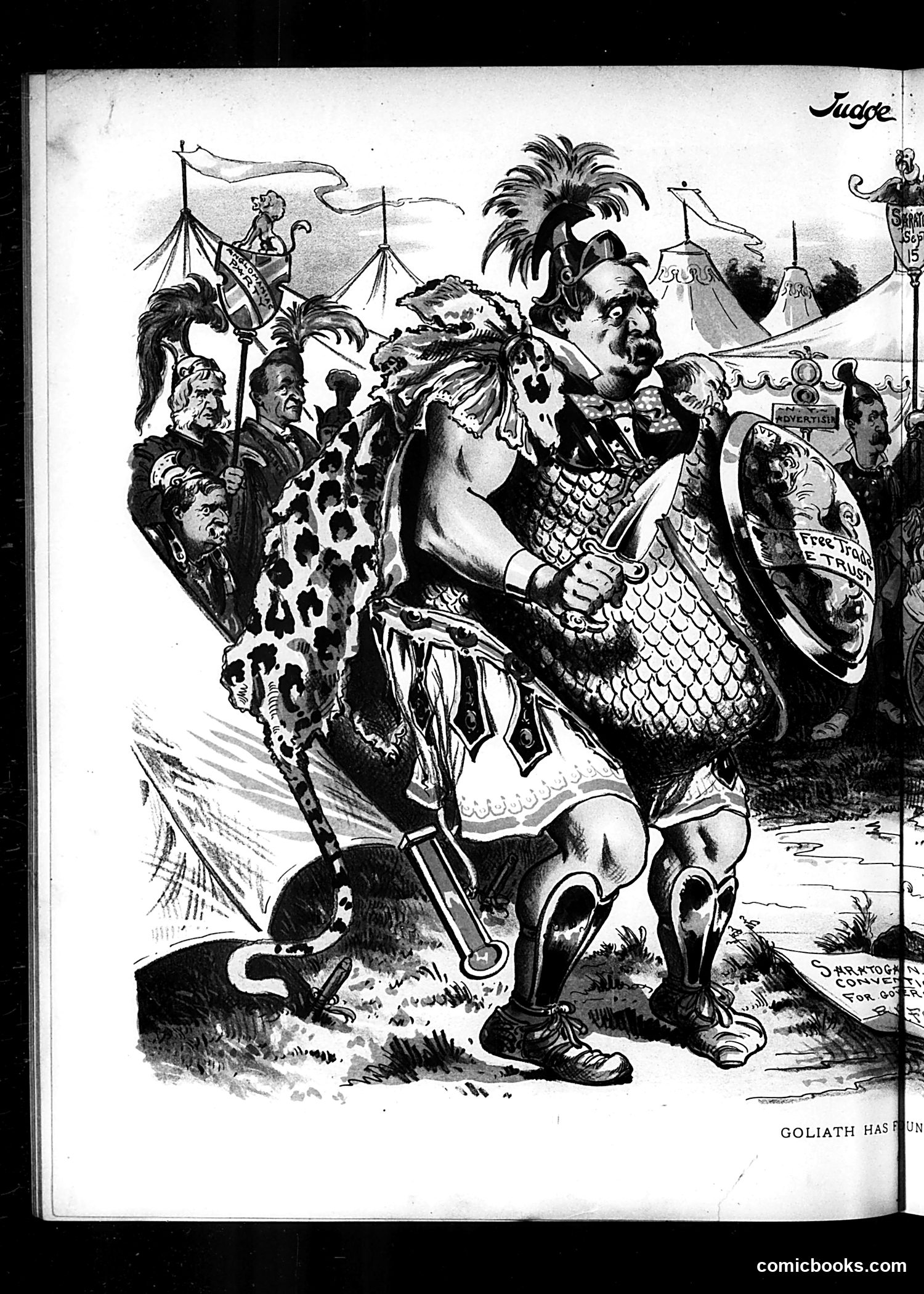
This political cartoon from *Judge* magazine depicts a biblical David-and-Goliath scenario. A large, heavily-armored warrior figure (Goliath, likely representing a powerful political or industrial opponent) stands prominently in the center, wielding a sword. Surrounding him are smaller figures in period costume, appearing to be various political actors or common people (David's forces). The incomplete caption "GOLIATH HAS fi[t]" suggests this cartoon comments on an ongoing conflict or confrontation between a dominant power and opposing forces. Without the full date or caption, the specific political references remain unclear, but the classical allusion suggests commentary on an apparent mismatch in power where underdogs challenge an established giant—a common *Judge* trope for labor disputes, corporate power, or political struggles.
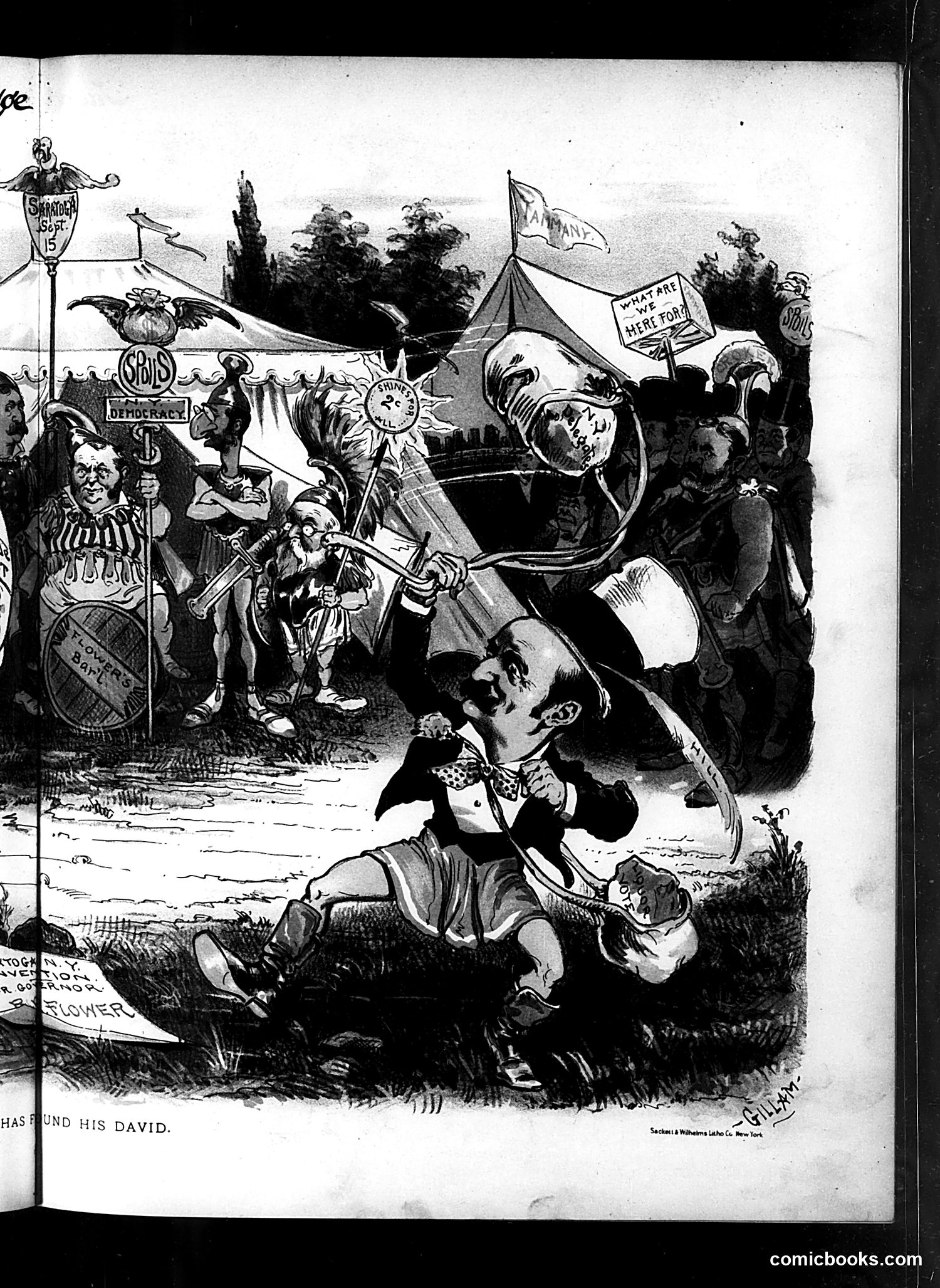
This appears to be a satirical cartoon from *Judge* magazine depicting a figure in formal dress (center, lying down) who has apparently found his "David"—referencing the Biblical story of David and Goliath. The figure seems to represent a political or public figure being overwhelmed or defeated. Behind him stands a carnival or circus tent with various symbolic figures and banners, including references to "Democracy" and what appear to be political forces or movements. The setting suggests chaos or political turmoil. Without clearer identification of the specific figure or visible date, the exact historical reference remains unclear. However, the "found his David" caption suggests the cartoon depicts someone powerful being unexpectedly defeated by a smaller or underestimated opponent—a common satirical trope in American political cartooning of the late 19th/early 20th century.
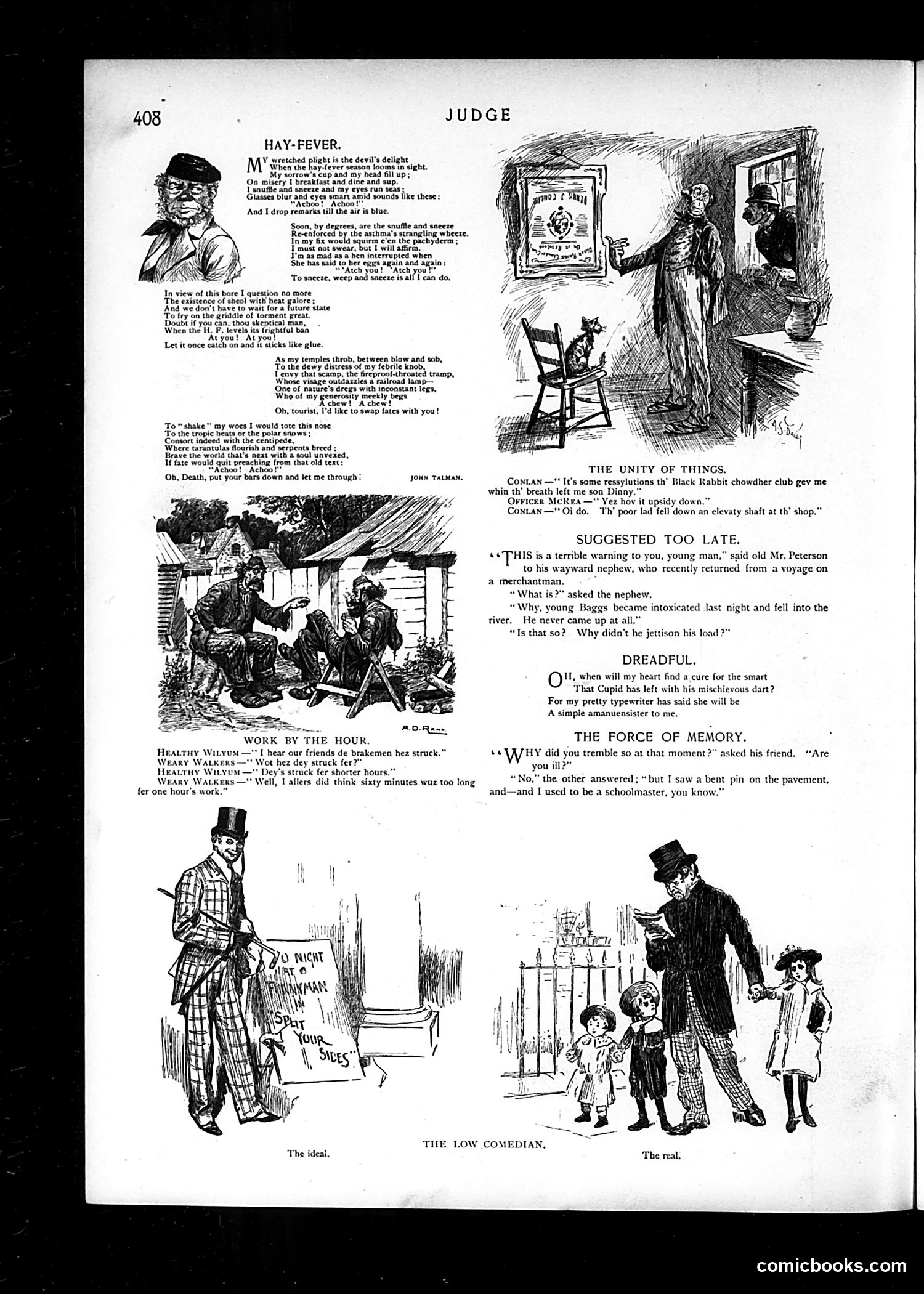
This page contains humor pieces typical of early 20th-century American satire. The main content includes: **"Hay-Fever"** — A lengthy comic poem by John Talmage describing the misery of seasonal allergies through exaggerated complaints: sneezing, watery eyes, and general suffering. The humor relies on contemporary readers' familiarity with this common ailment and sympathizing with the protagonist's dramatic despair. **Comic vignettes** scattered throughout satirize working-class life and social situations: - "Work by the Hour" mocks laborers' disputes over contracted time - "The Unity of Things" plays on Irish-accented dialogue about a workplace accident - "Suggested Too Late" uses dark humor about a drowning victim - "The Force of Memory" contrasts a man's emotional reaction to a bent pin with his past as a schoolmaster **"The Low Comedian"** compares idealized versus realistic depictions of comedians—the "ideal" shows a well-dressed performer; "the real" shows a shabby man with children, satirizing the gap between performance and actual lives. The satire targets class differences, workplace conditions, and everyday frustrations familiar to Judge's middle-class readership.
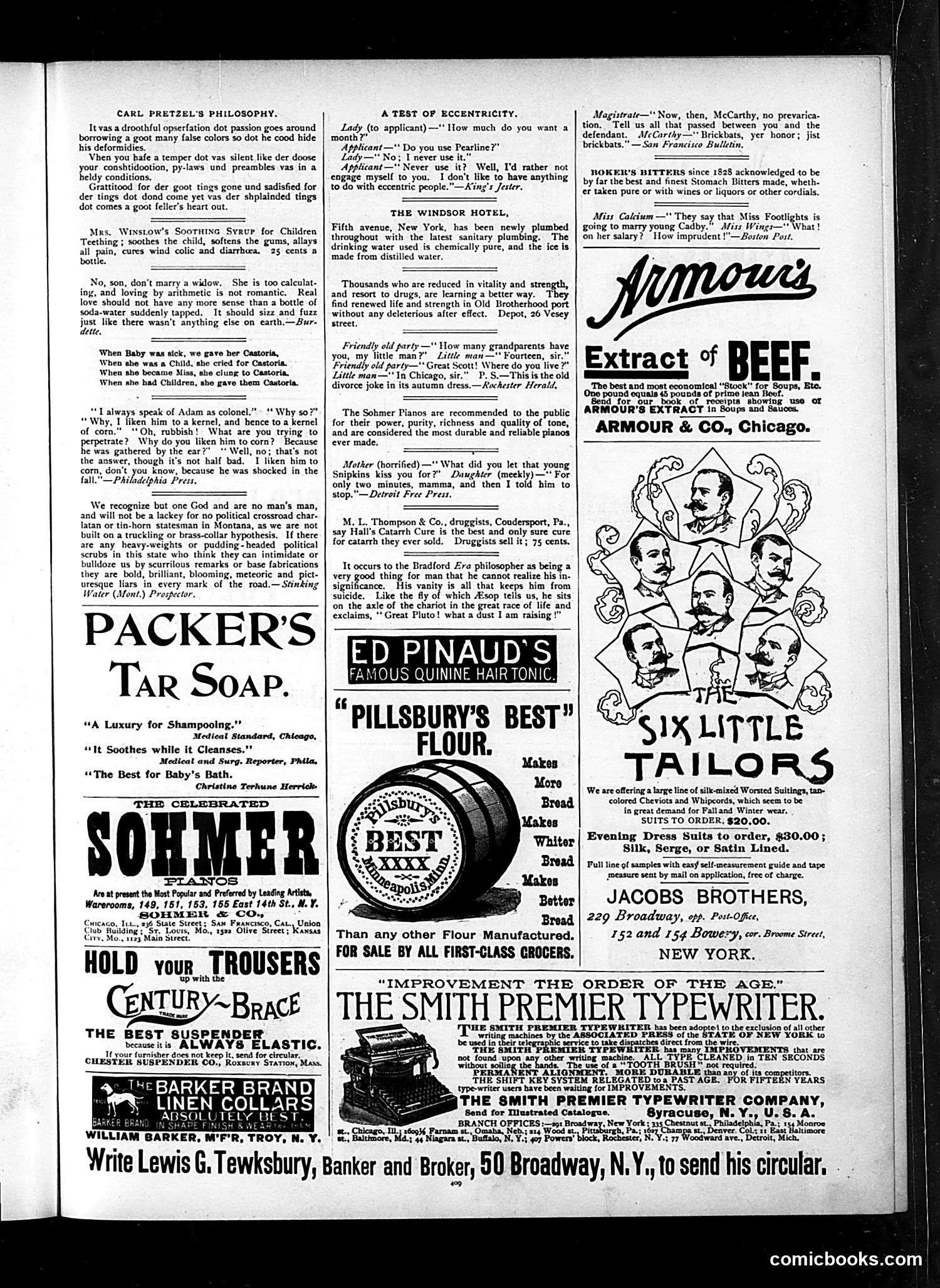
This page is primarily **advertising**, with brief comedic snippets interspersed. The main content includes: **"Carl Pretzel's Philosophy"**: A German-accented immigrant character dispensing folksy wisdom (identifiable by his dialect: "dot," "vas," "goot"). This was a recurring Judge feature satirizing German-American immigrant culture through malapropisms and broken English. **Comedy snippets** mock eccentricity ("How much do you want a month?" / "I never use it") and play on contemporary concerns—the "old divorce joke" references Chicago's reputation for easy divorces, a 1890s-1900s social scandal. **Advertisements** dominate: Armour's Extract of Beef, Pillsbury Flour, Smith Premier Typewriter, Sohmer Pianos, and various patent medicines. These reflect Judge's commercial model and era's product pitches. The page lacks prominent political cartoons—it's representative of Judge's mixed satirical-commercial format rather than focused political commentary.
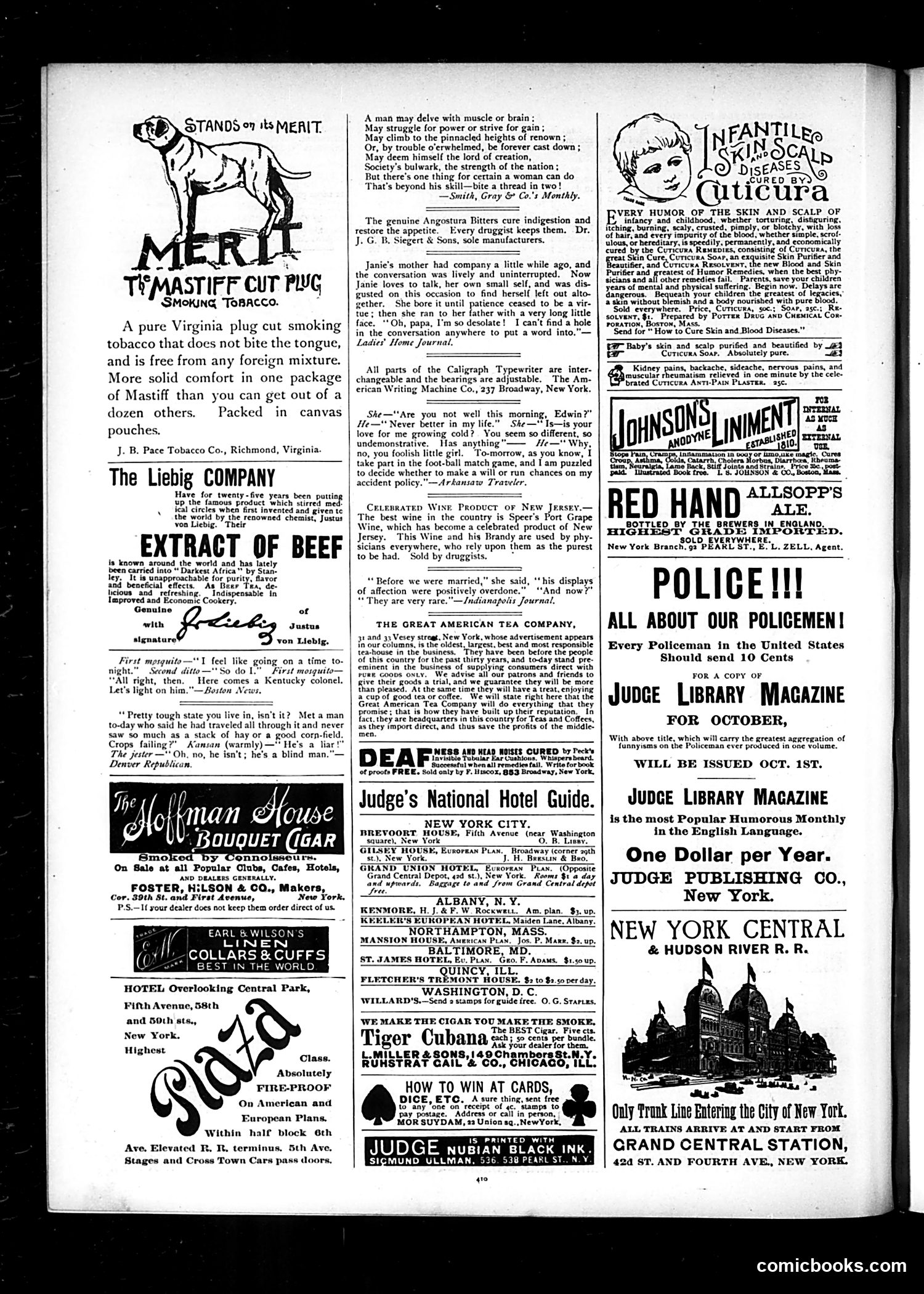
This page is primarily **advertising and notices** rather than political satire. The dominant content includes: - **Product advertisements** for tobacco (Merle Mastiff Cut Plug), beef extract, cigars, and patent medicines - **Hotel guides** and travel advertisements for New York Central Railroad and Grand Central Station - **Magazine promotions** for Judge Library Magazine The only cartoon visible is at top-left: a **dog labeled "Merle"** advertising the tobacco brand, a simple commercial illustration rather than political satire. The page reflects **late 19th/early 20th-century commercial culture**—when satirical magazines relied heavily on advertising revenue. While Judge was known for political humor, this particular page showcases the era's patent medicines, luxury goods, and travel services marketed to affluent readers, with minimal satirical content.
This page is **primarily advertisements** with minimal editorial content. The few jokes/cartoons present are brief: **"The Portraits of Healthy Infants"** section uses a quoted epigraph from King Henry VI ("We are advertised by our loving friends") as setup for advertising Mellin's Food for infants—a common Victorian marketing strategy where testimonial photos of healthy babies supposedly proved product efficacy. **A political joke** appears mid-page: a Philadelphia Press poem suggesting if Europe starves due to crop failures, she should appeal to "Uncle Samuel" (the U.S.), find money in his Sunday vest pocket, and Americans will solve the problem. This reflects 1890s-era American confidence about agricultural surplus and emerging global economic power. **Smaller gags** include a watchmaker joke about cheap watches mimicking expensive ones, and a marital joke about whisky and cramps—typical period humor. The page is overwhelmingly **commercial**, featuring patent medicines, furniture, soap, insurance, and paper warehouses—characteristic of Judge's revenue model.
This page is primarily **advertising** rather than editorial satire. However, it contains several brief humorous anecdotes: **The Irish Timepiece Joke**: A Pat character claims time was "invented in Ireland" because it would be called "O'Clock" otherwise—a pun on Irish naming conventions (O'Brien, O'Malley, etc.). This reflects period ethnic stereotyping of Irish immigrants. **The Washerwoman Anecdote**: A man removes his hat to a washerwoman, explaining she's his landlord. The joke plays on class inversion—showing deference to someone in a lowly occupation due to economic necessity rather than social standing. **The Intoxication Joke**: An employer confronts an employee about appearing drunk on Sunday, which the employee admits to. The employer's "that's all right" twist suggests he's less concerned with morality than with where the man found alcohol (likely relating to Prohibition debates of the era). These reflect common Judge magazine humor: ethnic caricature, class commentary, and social observation typical of 1890s American satire.
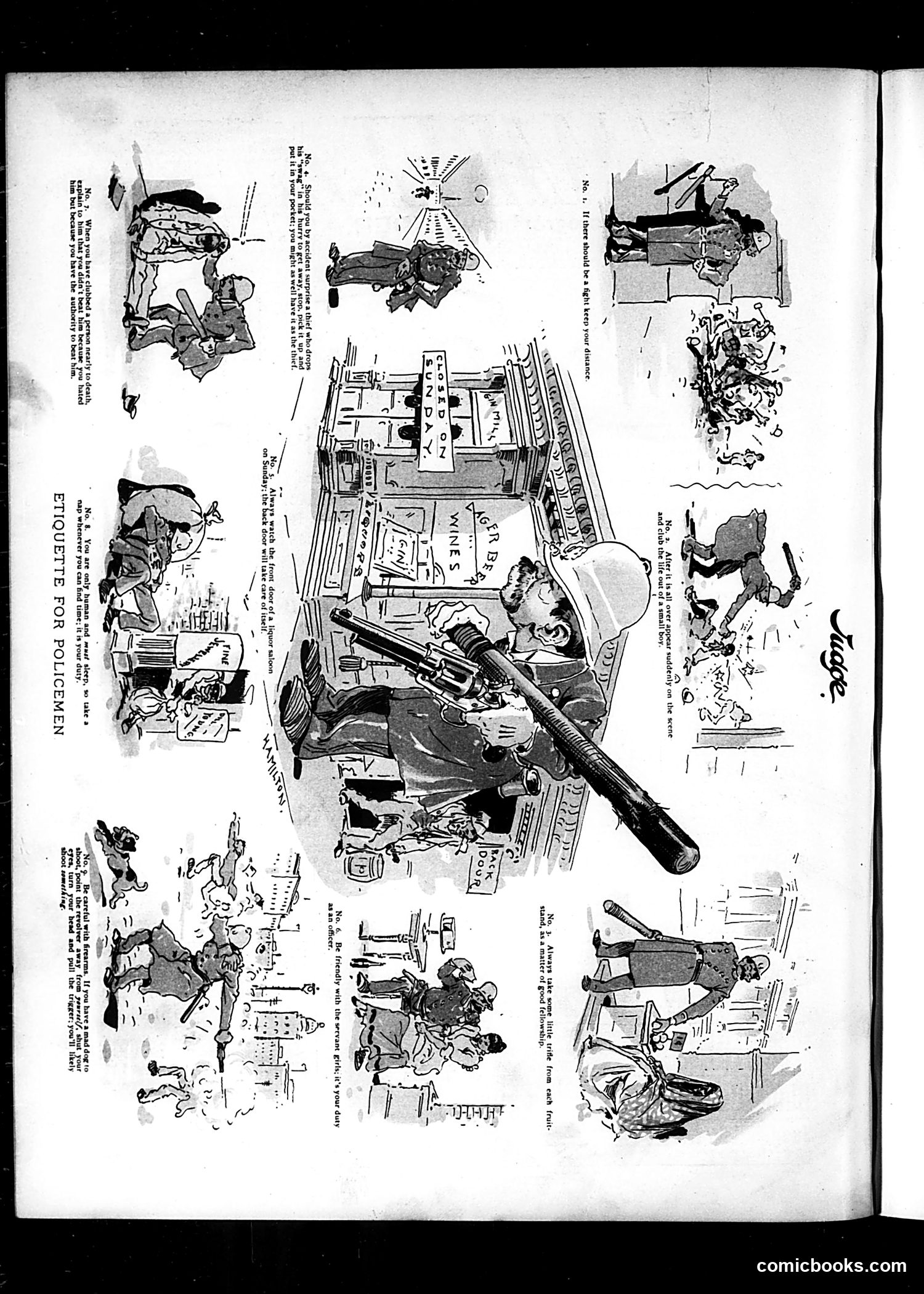
This satirical cartoon mocks police corruption and misconduct in what appears to be the late 19th or early 20th century. The "etiquette" rules depicted include taking bribes from fruit stands, fraternizing improperly with servants, monitoring saloon back doors (implying collusion with illegal alcohol sales), and sleeping on duty. The humor is darkly ironic—presenting blatant corruption as proper "etiquette" for officers. This reflects historical realities of police graft and negligence during the period. The various vignettes show officers engaged in theft, questionable relationships, and dereliction of duty. The cartoon criticizes systemic corruption within urban police forces, exposing how misconduct was normalized and tolerated as standard practice rather than condemned as criminal behavior.