
A complete issue · 18 pages · 1891
Judge — September 5, 1891
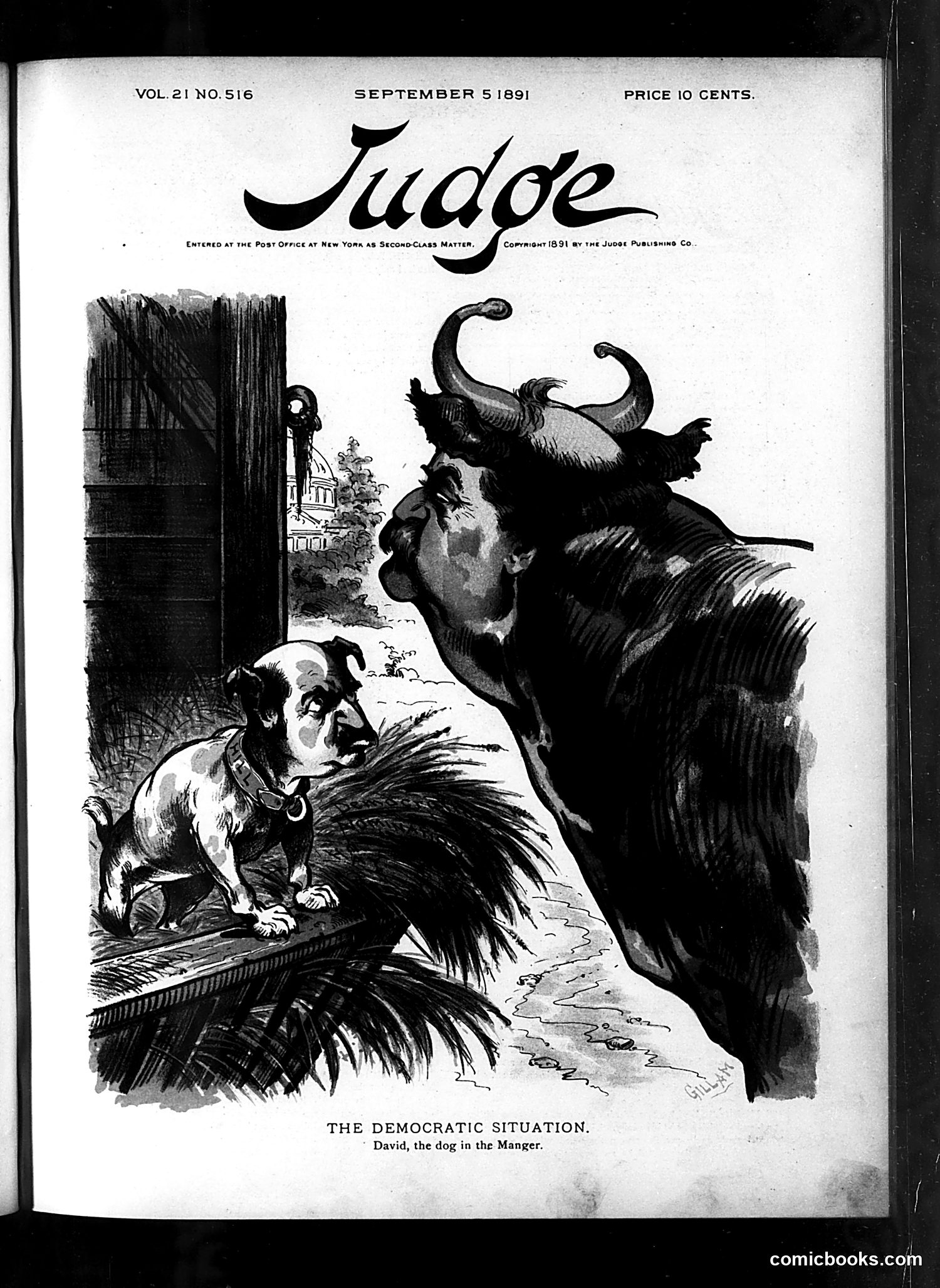
This 1891 *Judge* cartoon uses the biblical allusion to Aesop's fable about a dog preventing others from accessing food it won't eat itself. The large demonic figure with horns represents the Democratic Party, while the small dog represents the Democratic rank-and-file. The satire suggests Democrats are obstructing progress or preventing Republicans from governing effectively—acting spitefully rather than constructively. The "manger" reference invokes the Christmas nativity scene, possibly suggesting Democrats are preventing beneficial policies from being implemented for the nation's benefit. The cartoon reflects Republican frustration with Democratic opposition during a period of divided governance in the early 1890s.
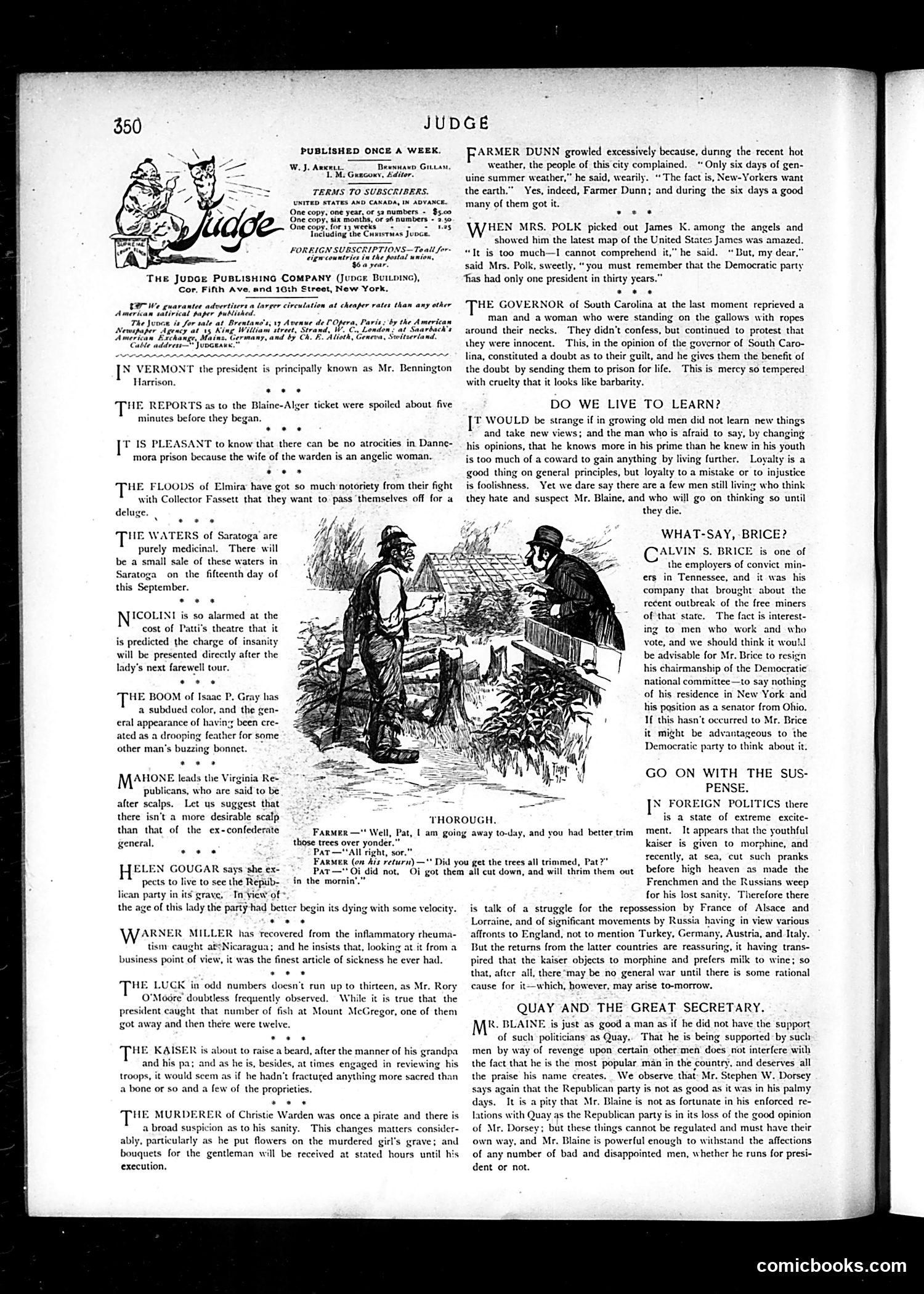
The central cartoon titled "THOROUGH" depicts two farmers discussing tree-trimming. One says he's going away and needs trees trimmed; the other promises to "trim those trees over yonder" and cut them all down, will "thin them out in the meantime." The satire critiques overzealous or destructive approaches to a task—the farmer's interpretation of "trimming" means complete removal rather than selective pruning. This likely functions as political commentary on aggressive policies or reforms that destroy rather than improve their target, though the specific political reference remains unclear from this page alone. The surrounding text discusses various political figures and controversies of the era, including Senator Brice and foreign policy matters, but lacks direct connection to the cartoon's humor.
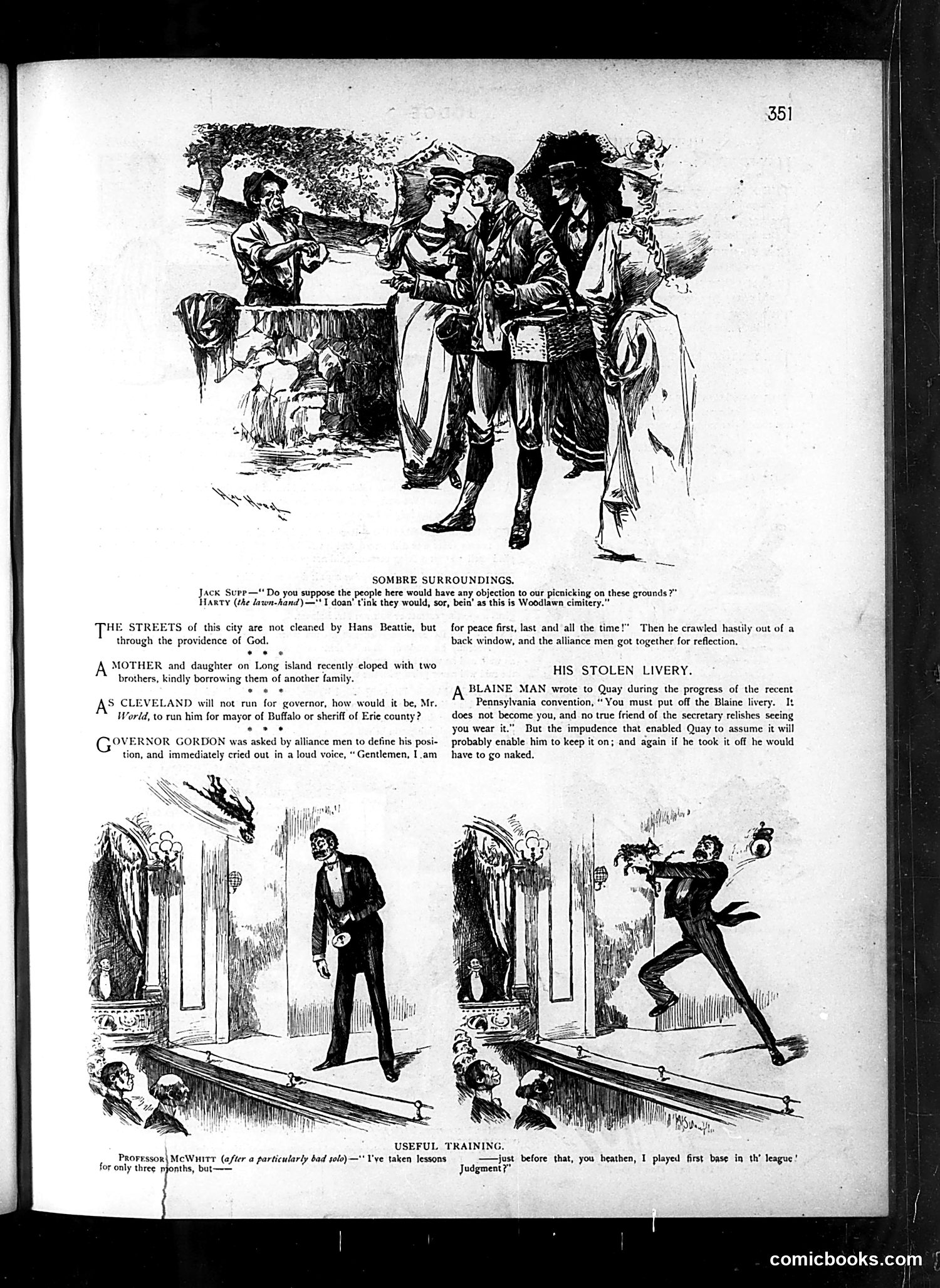
**Top Cartoon - "Sombre Surroundings":** This depicts a picnic scene where Jack Suff asks whether people would object to picnicking on cemetery grounds. The joke satirizes either insensitive behavior or morbid humor about choosing inappropriate locations for social gatherings—likely commentary on poor judgment or tastelessness in public behavior. **Middle Section:** Brief political items mention Cleveland declining a gubernatorial run and Governor Gordon being asked to define his position. These reflect late 19th-century political gossip. **"His Stolen Livery":** References a Blaine man's letter about the Blaine livery incident during the Pennsylvania convention, appearing to mock political hypocrisy regarding borrowed respectability or false claims to authority. **Bottom - "Useful Training":** Shows a man avoiding thrown objects, with a joke about baseball training. The humor contrasts athletic preparation with real-world survival skills.
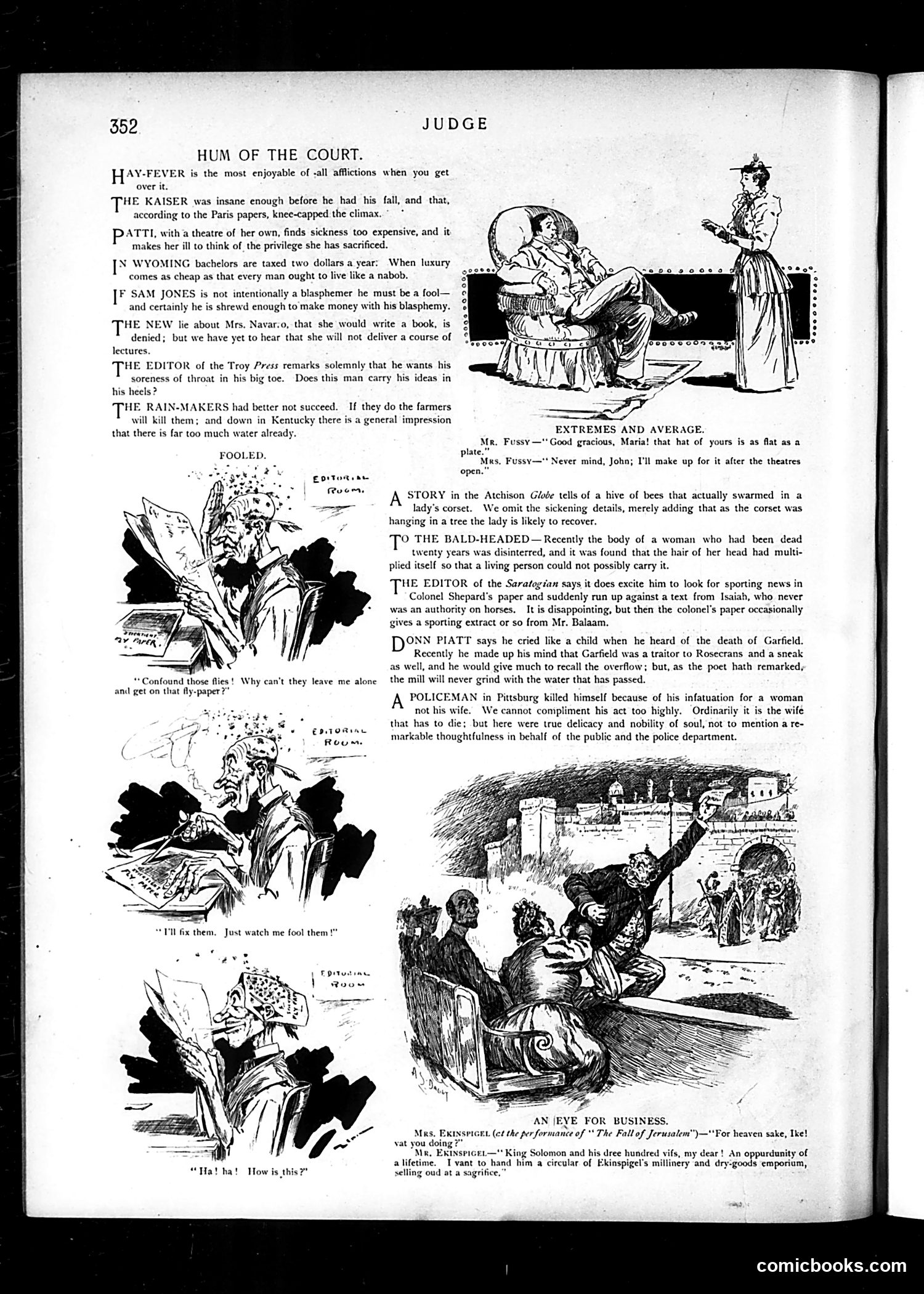
This is a **humor column** with brief satirical jabs at contemporary figures and events, plus standalone jokes. Key references include: **The Kaiser**: Mocks Germany's kaiser (likely Wilhelm II post-WWI) as mentally unstable, with a crude pun about his "fall" and "knee-capped" (injured legs). **Mrs. Navarro**: A society woman supposedly denying she'll write a book but will give lectures—satirizing wealthy women's pretensions to intellectual pursuits. **Rain-makers**: References actual con-artists of the era who claimed to create rain; the joke mocks farmers' perpetual complaints about weather. **Garfield reference**: Likely James A. Garfield (president assassinated 1881) and Don Piatt's changing political opinions. **The cartoons** show Victorian-era domestic scenes and social absurdities. The bottom illustration depicts "An Eye for Business"—a man trying to sell millinery to King Solomon, satirizing aggressive salesmanship and Jewish stereotypes typical of the period. Overall: **lighthearted social commentary** on vanity, hypocrisy, and commercial excess.
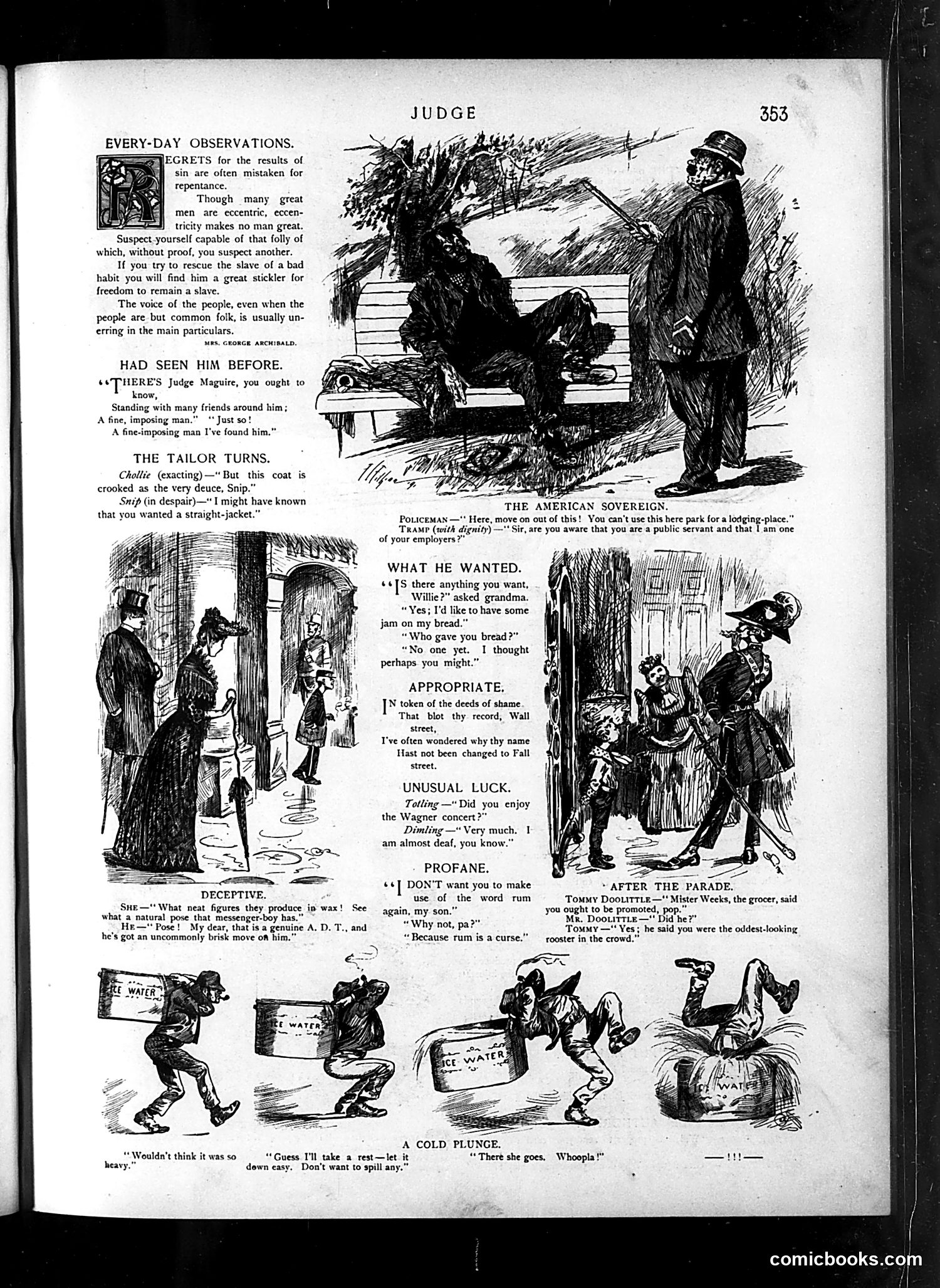
This page contains multiple short satirical observations and comic vignettes typical of Judge magazine's style. The "Every-Day Observations" column offers philosophical quips about human nature—particularly about hypocrisy, eccentricity, and self-deception. The individual cartoons mock various social types: a tailor who blames his customer for wanting proper tailoring; a tramp arguing he's an "employer" of the policeman; a child trying to manipulate his grandmother; and Wall Street corruption (suggesting it should be renamed "Fall street" after financial crashes). Several jokes target class anxieties: wax figures mistaken for servants, a deaf man enjoying Wagner (implying he couldn't hear it anyway), and children's behavior. "A Cold Plunge" depicts men with water buckets—likely referencing an old endurance stunt or cleanliness practice. The humor relies on observational comedy about Victorian-era social pretension, moral hypocrisy, and urban working-class life rather than specific political events.
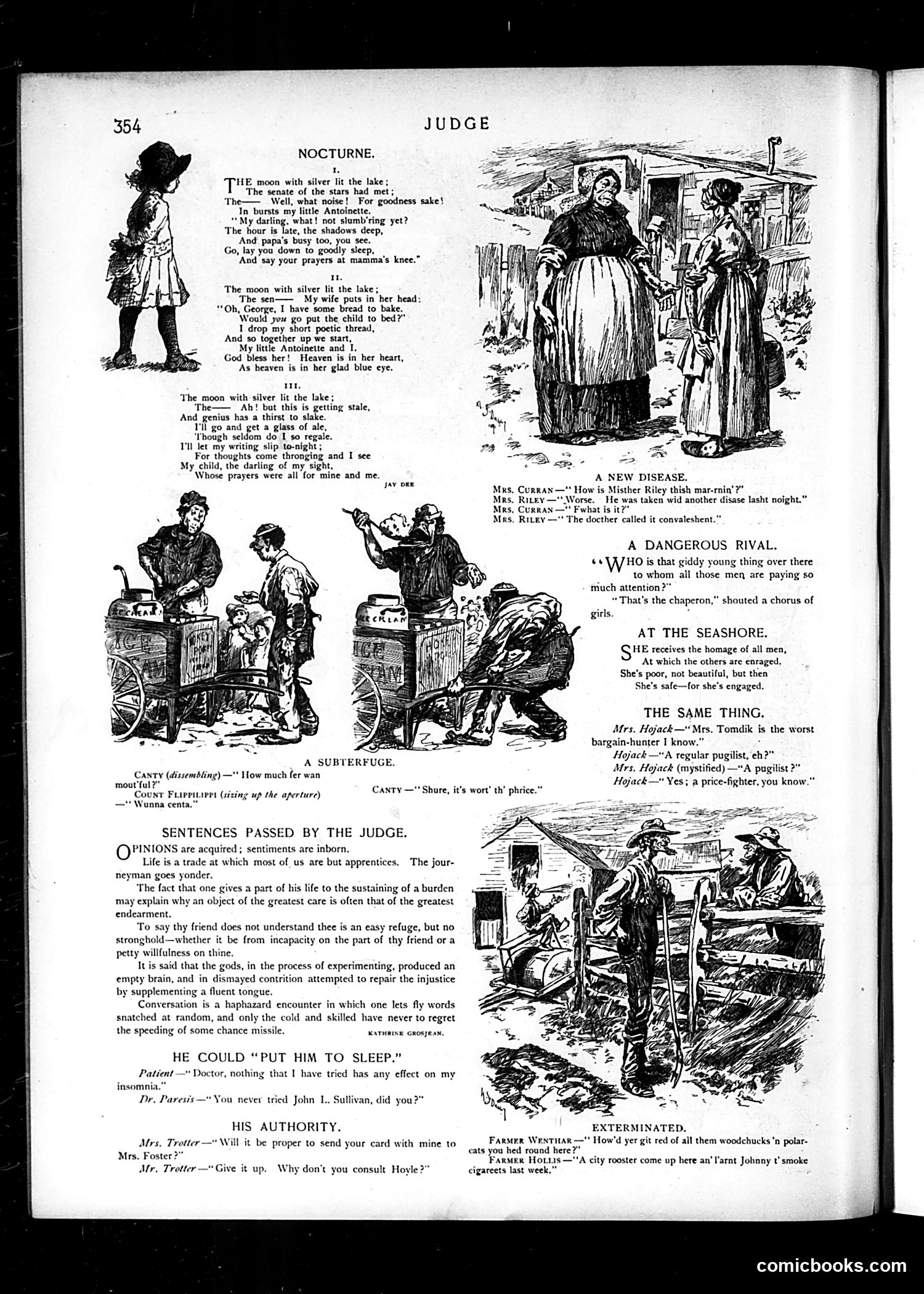
This page from *Judge* collects short humorous pieces and cartoons typical of late 19th-century American satire. **"Nocturne"** is a poem mocking the Romantic ideal of poetic inspiration—a father attempts to compose verse under moonlight but is repeatedly interrupted by domestic duties (his daughter, wife's baking), finally abandoning art for ale. The satire targets both pretentious poets and the gulf between artistic ambition and mundane family life. **The dialect jokes** ("A New Disease," "The Same Thing," "A Subterfuge") rely on exaggerated Irish and working-class accents for humor—a common if crude comedic device of the era. Mrs. Riley's doctor says "convaleshent" (convalescent), the "price-fighter" pun plays on "pugilist," and the final exchange jokes about mouth size and pricing. **"Sentences Passed by the Judge"** presents philosophical observations in aphoristic form—commentary on human nature, friendship, and conversation—likely from a recurring column. **"He Could Put Him to Sleep"** references boxer John L. Sullivan as a cure for insomnia, exploiting his celebrity status for a joke. The page reflects period preoccupations: domesticity versus artistic aspiration, class comedy through dialect, and celebrity culture.
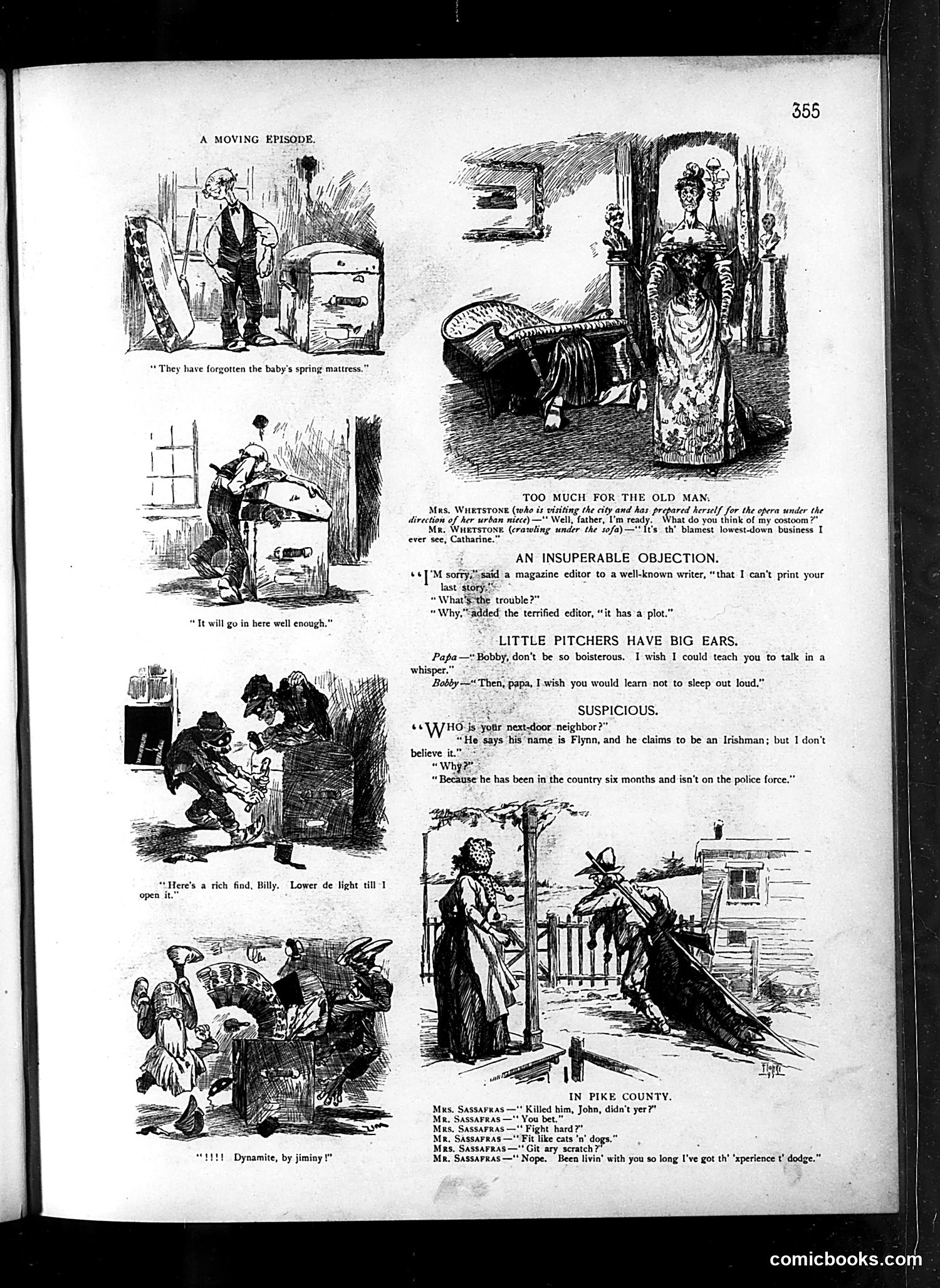
This page contains several brief satirical sketches typical of Judge's humor: **"A Moving Episode"** mocks Victorian propriety: a rural father is scandalized by his city-visiting daughter's opera costume, finding it immodestly revealing. **"Too Much for the Old Man"** continues this theme—the daughter's elaborate dress overwhelms the conservative father. **"An Insuperable Objection"** jokes about magazine editing: a writer's story is rejected specifically *because* it has a coherent plot, suggesting editorial preferences for sensationalism over substance. **"Little Pitchers Have Big Ears"** uses the proverb about children overhearing secrets for a domestic humor reversal: the father's loud snoring is the real problem. **"Suspicious"** stereotypes Irish immigrants as inevitably becoming police officers, so a six-month resident who *isn't* on the force seems suspicious. **"In Pike County"** depicts rural frontier violence as casual—a wife matter-of-factly describes her husband's murder attempt, having developed immunity to his aggression through long experience. The humor is genteel, domestic, and relies on class/ethnic stereotypes typical of 1890s American satire.
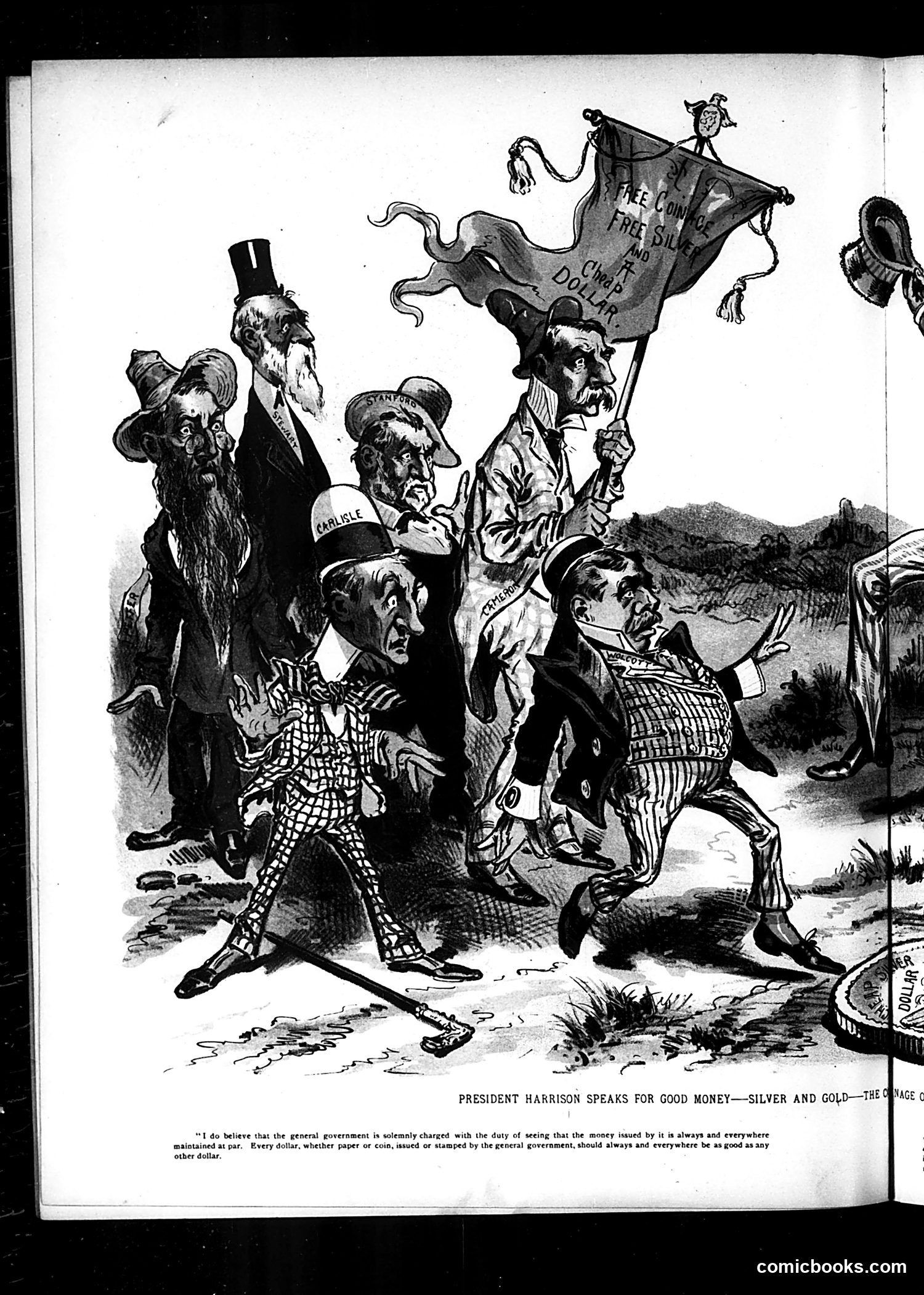
This Judge magazine cartoon satirizes President Harrison's monetary policy stance during the currency debate of the 1890s. Harrison is depicted addressing a group of caricatured figures representing different political and economic interests—likely silverites (silver advocates), gold standard supporters, and other currency factions. The banner they hold references "Free Coinage" and related monetary issues that deeply divided American politics. The cartoon's satire lies in the contrast between Harrison's noble-sounding rhetoric about maintaining monetary integrity (quoted below) and the chaotic reality of competing monetary interests fighting for control. The exaggerated, almost demonic caricatures suggest Judge's skepticism toward the various factions exploiting currency issues for political gain, rather than pursuing genuine monetary stability.
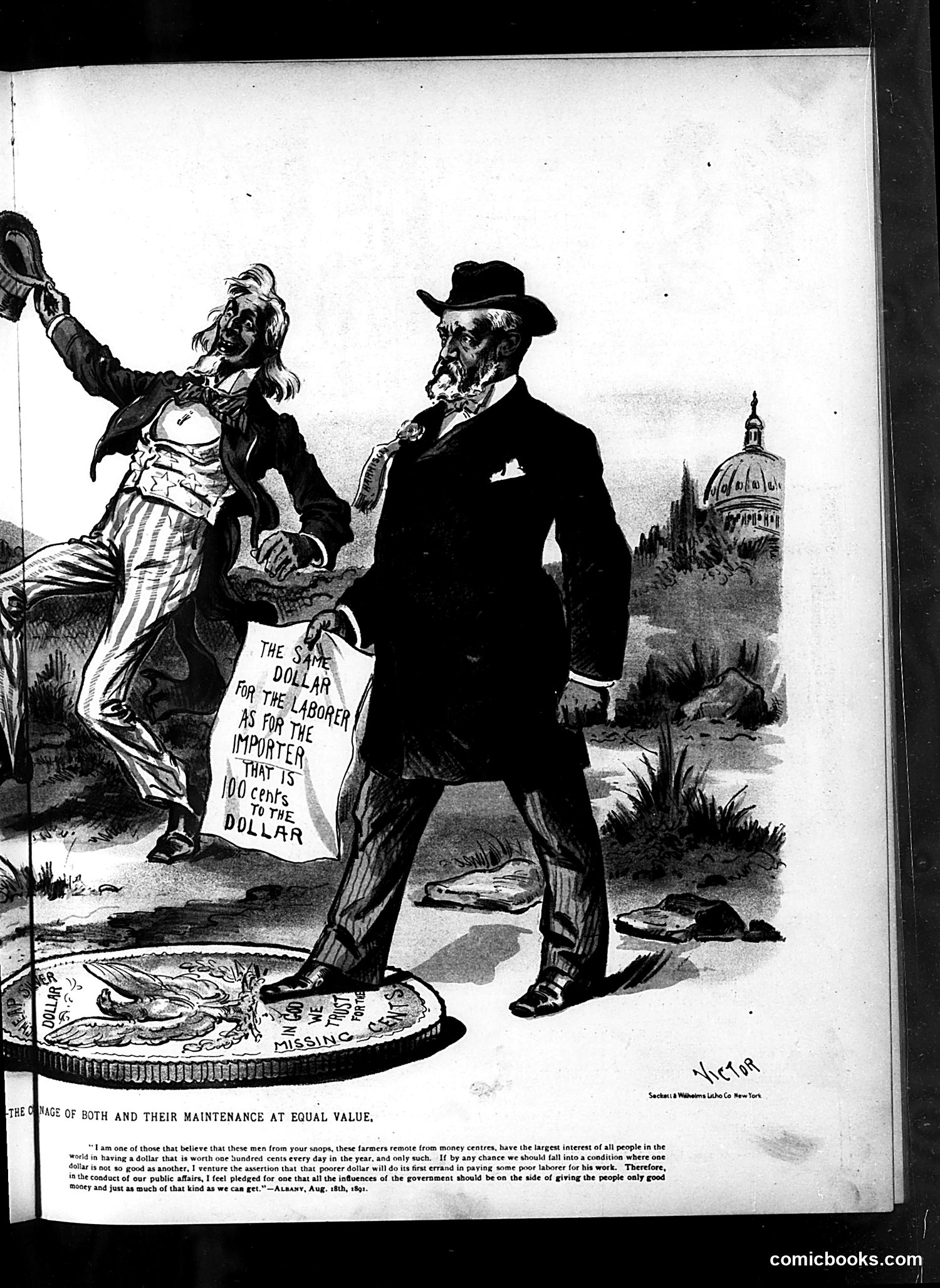
This 1891 *Judge* cartoon satirizes currency policy debates of the Gilded Age. A well-dressed gentleman (likely representing a politician or banker) stands before Lady Liberty, who holds a sign stating "THE SAME DOLLAR FOR THE LABORER AS FOR THE IMPORTER—THAT IS 100 CENT'S TO THE DOLLAR." A coin beneath them appears "MISSING." The cartoon criticizes the speaker's claim that government should ensure stable currency value for working people. The satire suggests his rhetoric about protecting "poor laborers" is hollow—the missing coin implies the promised stability doesn't actually exist. The Capitol building in the background emphasizes this is about government policy. The quoted text (attributed to Albany, August 1891) advocates for sound money benefiting workers, but the cartoon implies such promises are empty political posturing during debates over currency standards and monetary policy that divided America in the 1890s.
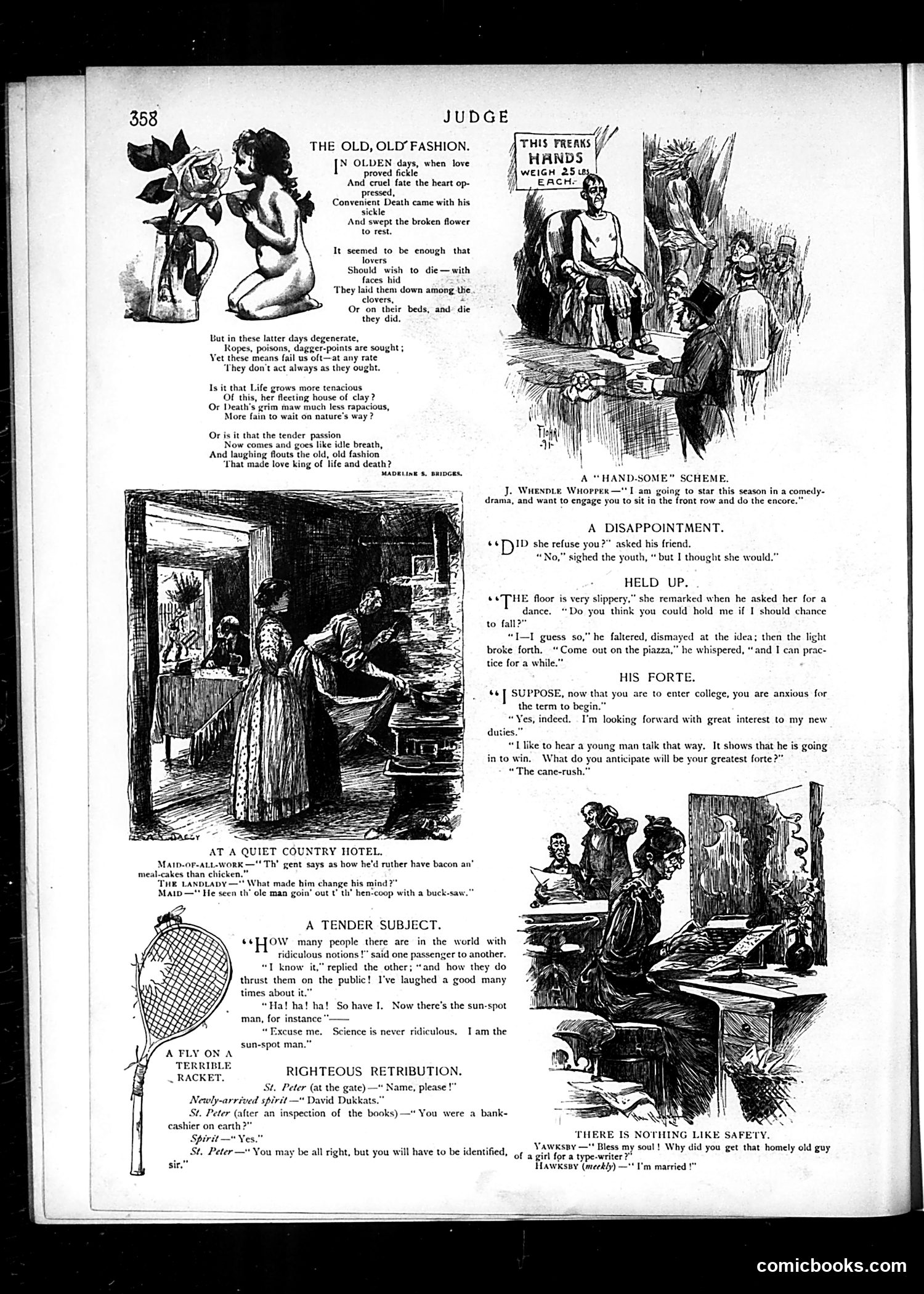
This page contains multiple brief satirical pieces typical of Judge's humor: **"The Old, Old Fashion"** uses a poem to mock the decline of romantic death—the piece observes that lovesick people in earlier times simply died conveniently, while modern suitors bungle suicide attempts with ropes and poison. The satire critiques both sentimental romanticism and contemporary life's messy complications. **The short comic sketches** below mock social pretension and courtship awkwardness: a theater performer's shameless request for an encore-plant; a youth disappointed that his romantic rejection wasn't rejected (expecting refusal); a flirtation misunderstanding about a slippery dance floor; a college student's anticipated "forte" being the cane-rush (a violent hazing tradition); workplace miscommunication; and a bank cashier arriving at heaven requiring identification—suggesting his dishonesty haunts even the afterlife. The recurring theme is human folly—vanity, failed romance, social climbing, and moral consequences—rendered through gentle, punning humor rather than sharp political critique.
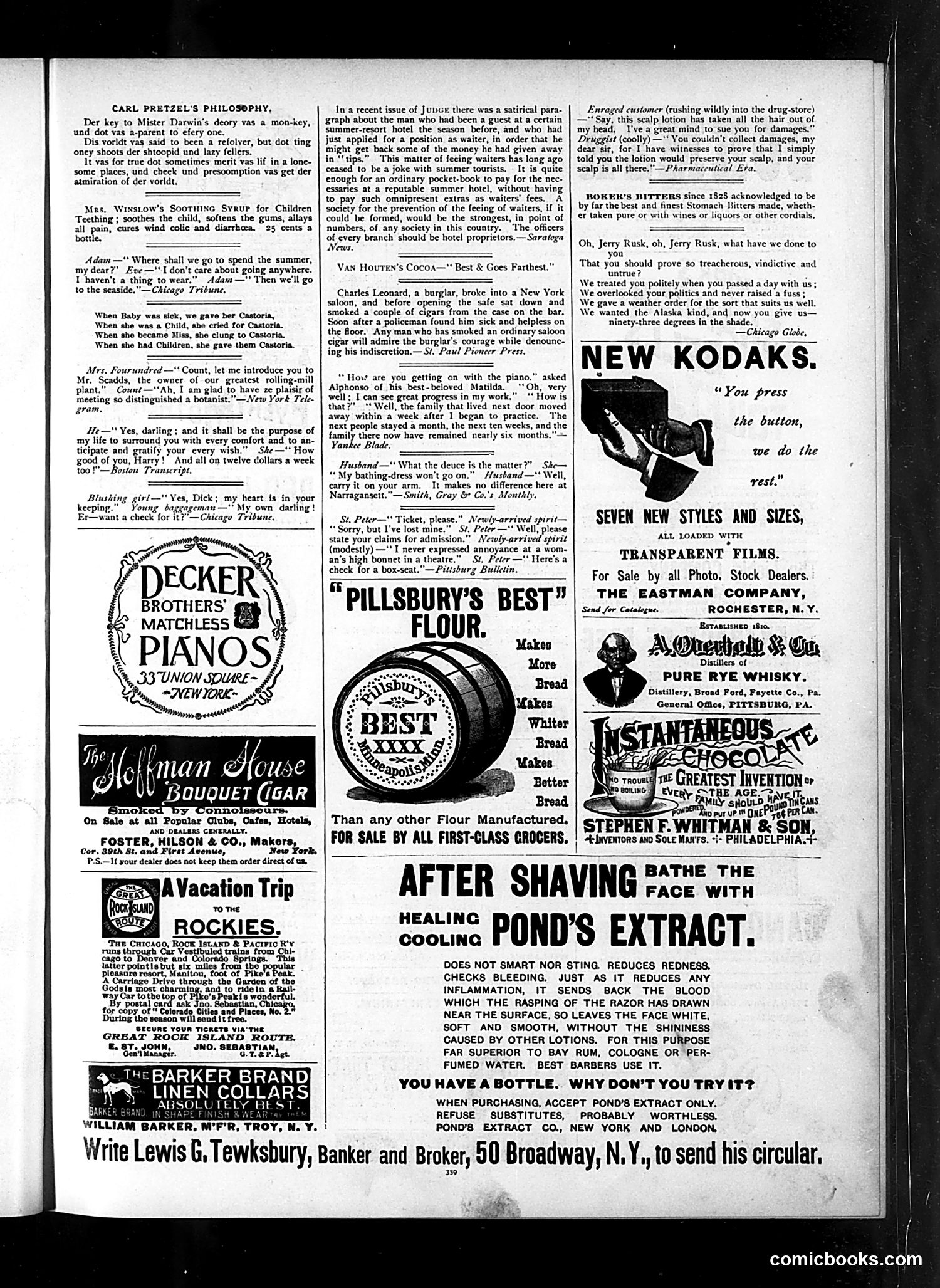
This page is primarily **advertising** with scattered humorous filler items rather than political cartoons. The advertisements dominate—for pianos, flour, Kodak cameras, whiskey, and other products typical of the era. The few editorial pieces are short jokes exploiting ethnic stereotypes and period humor: - **"Carl Pretzel's Philosophy"** features a German-accented character (indicated by phonetic spelling: "vorldt," "efery") discussing Darwin, making crude jokes about evolution and merit. - Several brief anecdotes mock social pretension (a count mistaking an industrialist for a botanist) and consumer culture (the Adam and Eve joke about having "nothing to wear"). - The **waiter-tipping satire** criticizes summer resort guests' excessive gratuities—a genuine period complaint about hospitality costs. The page reflects Judge's blend of **product promotion and light satire**, with humor relying on ethnic caricature and genteel social observation rather than political commentary. No specific political figures or events are referenced.
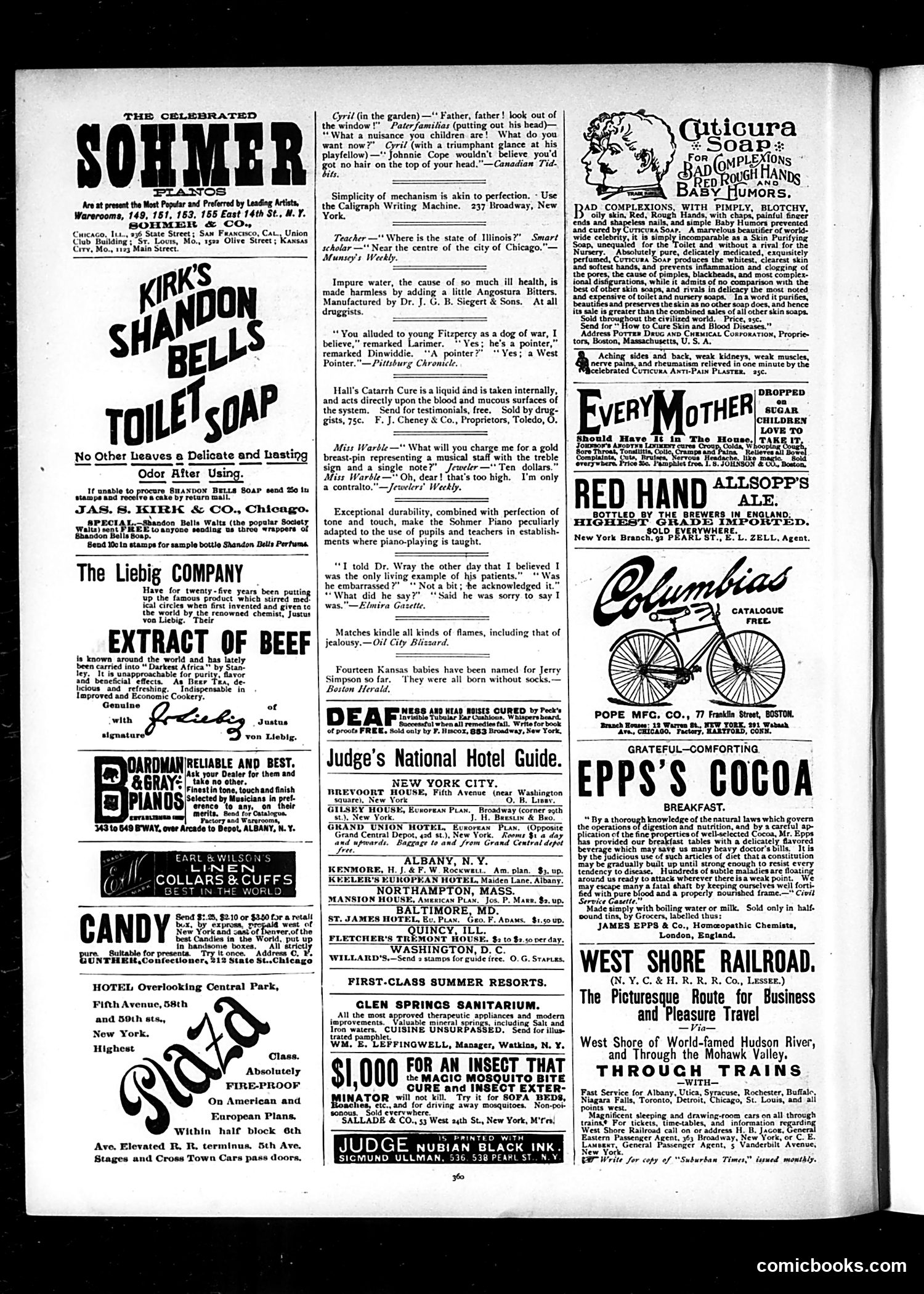
This page is primarily **advertising**, a common format for Judge magazine. The few small joke items scattered among ads are typical of the era's brief comic fillers. The one substantive cartoon ("Cyril in the garden") depicts a father humiliated by his bald head when a child points it out to a playmate—a simple joke about adult vanity and childhood candor, with no political content. Most other items are one-liners in similar vein: a schoolboy confusing Illinois with Chicago, a pun about a military graduate ("pointer"), a woman negotiating piano price. These are mild social humor reflecting Victorian-era preoccupations. The ads themselves—for pianos, soaps, beef extract, and patent medicines—reveal period consumer culture and advertising strategies common to late-19th-century magazines.
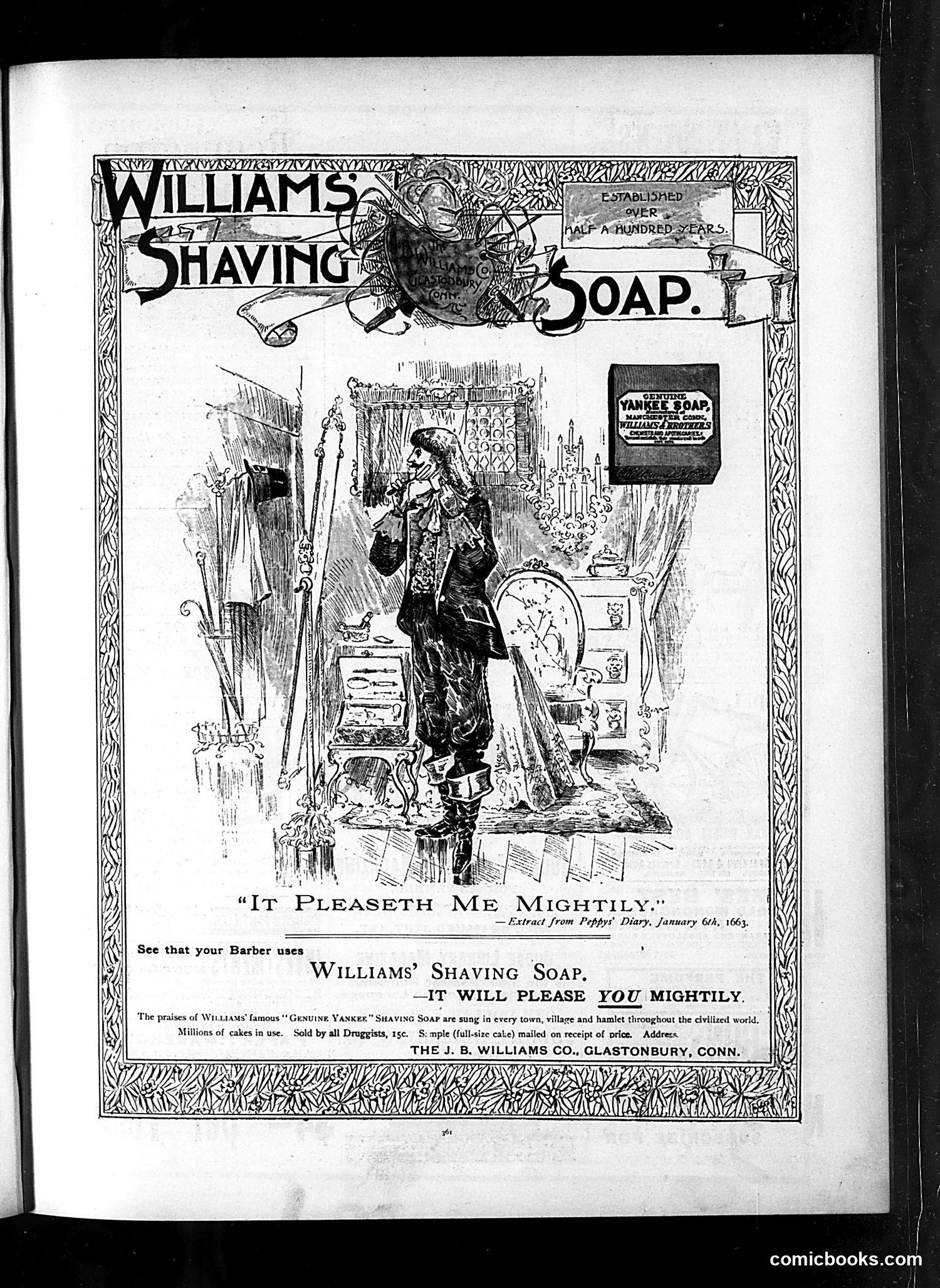
This is a **product advertisement**, not political satire. It promotes Williams' Shaving Soap by invoking a historical reference: a quote attributed to Samuel Pepys' diary from January 6, 1663 ("It pleaseth me mightily"). The illustration depicts a figure in 17th-century costume examining shaving supplies in an ornate period interior, creating a humorous anachronism—suggesting the product's quality is so timeless that even Pepys himself would have approved. The ad's humor relies on the incongruity of applying a 1600s-era endorsement to a modern American product. The tagline promises the soap will "please you mightily," echoing Pepys' language. This appears in **Judge magazine** as a straightforward commercial advertisement using historical wit rather than political commentary.
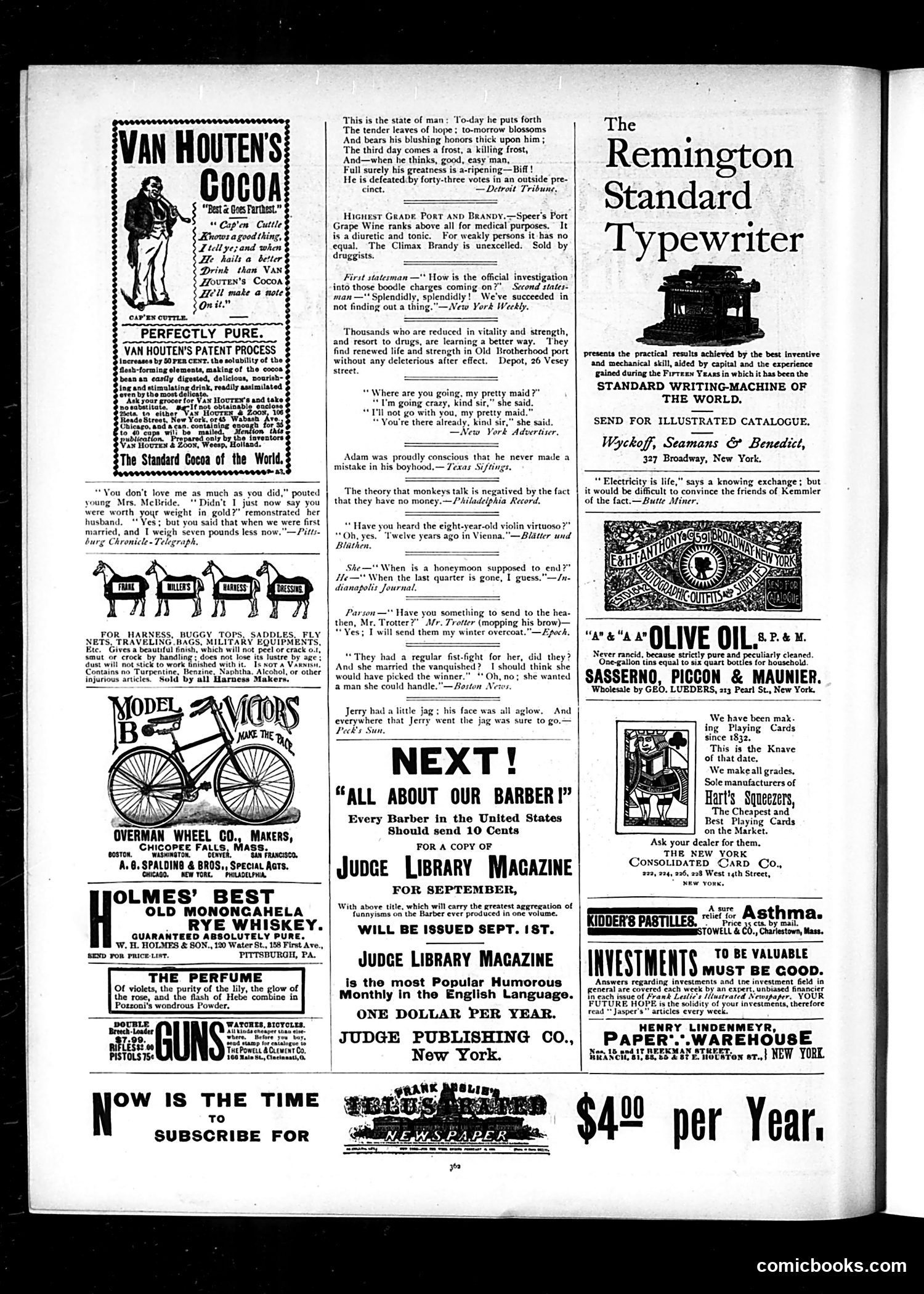
This page is primarily **advertising and filler content**, typical of late-19th-century magazine layouts. The image contains no significant political cartoons requiring historical explanation. The page showcases various product advertisements (Van Houten's Cocoa, whiskey, harnesses, bicycles) interspersed with brief humorous anecdotes and jokes—a common format for Judge magazine. These short quips satirize everyday domestic life: a husband's diminished affection as his wife loses weight, a woman admitting she's "going crazy," a man unwilling to send possessions to missionaries. The only potentially satirical content is a brief exchange between two politicians about a "boodle charges investigation" where they've "succeeded in not finding out a thing"—mocking government corruption inquiries as performative failures. Otherwise, this is a typical magazine page mixing advertising revenue with light humor rather than substantive political commentary.
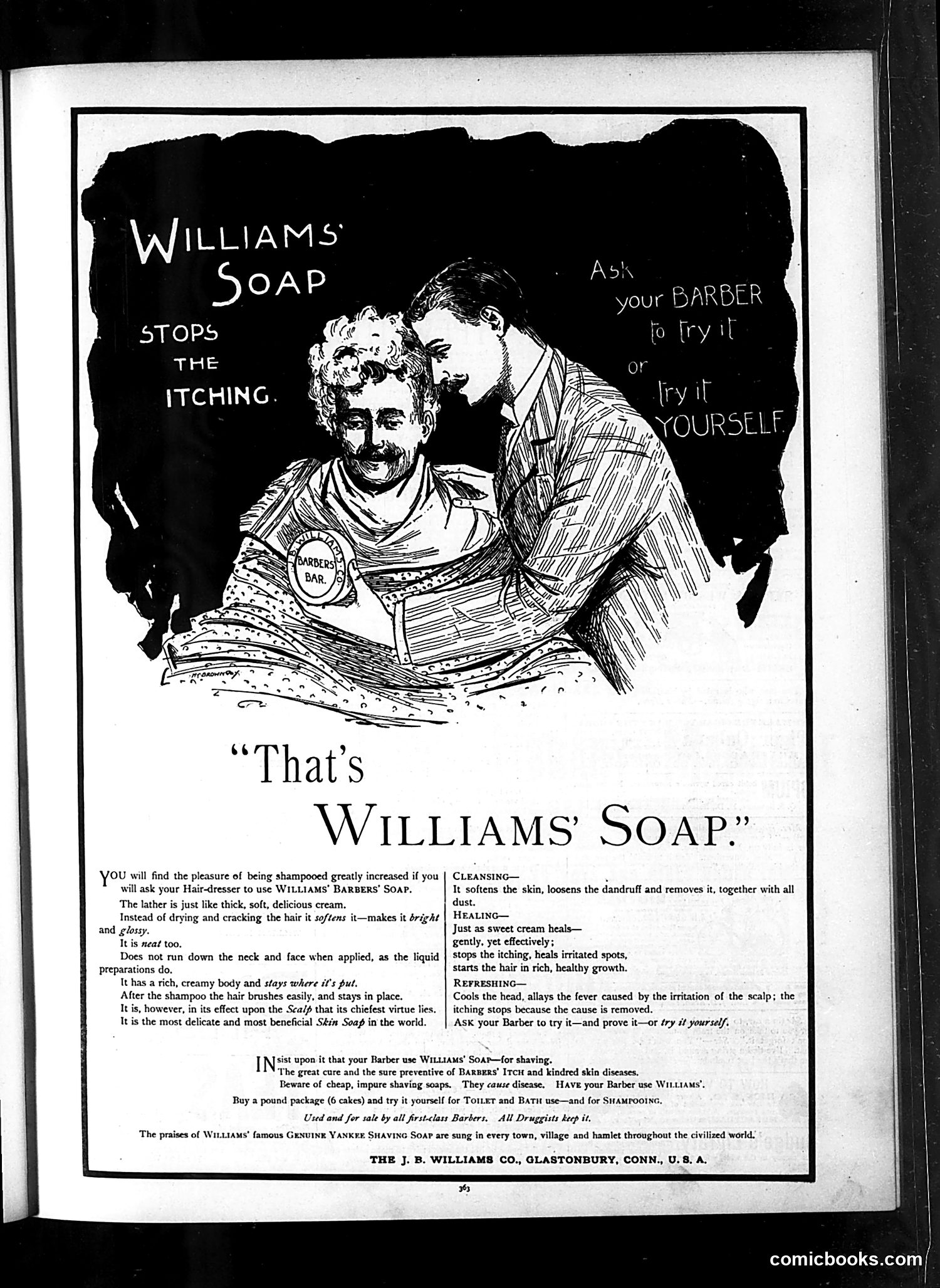
This is **not political satire but a commercial advertisement** for Williams' Barbers' Soap, published in *Judge* magazine. The illustration shows a barber applying soap to a customer's head and face. The ad promotes the product's benefits for scalp health, particularly emphasizing its ability to stop itching and treat dandruff—common grooming problems of the era. The text stresses the soap's superior lather, its gentle formulation (compared to liquid preparations), and its healing properties for irritated skin. The phrase "Ask your Barber to try it—or try it yourself" encourages both professional and personal use. The ad concludes by warning against cheap, inferior shaving soaps, positioning Williams' as a premium, genuine product. This represents typical early 20th-century advertising strategy: endorsement through trusted professionals (barbers, druggists) and emphasis on scientific benefits for common ailments.
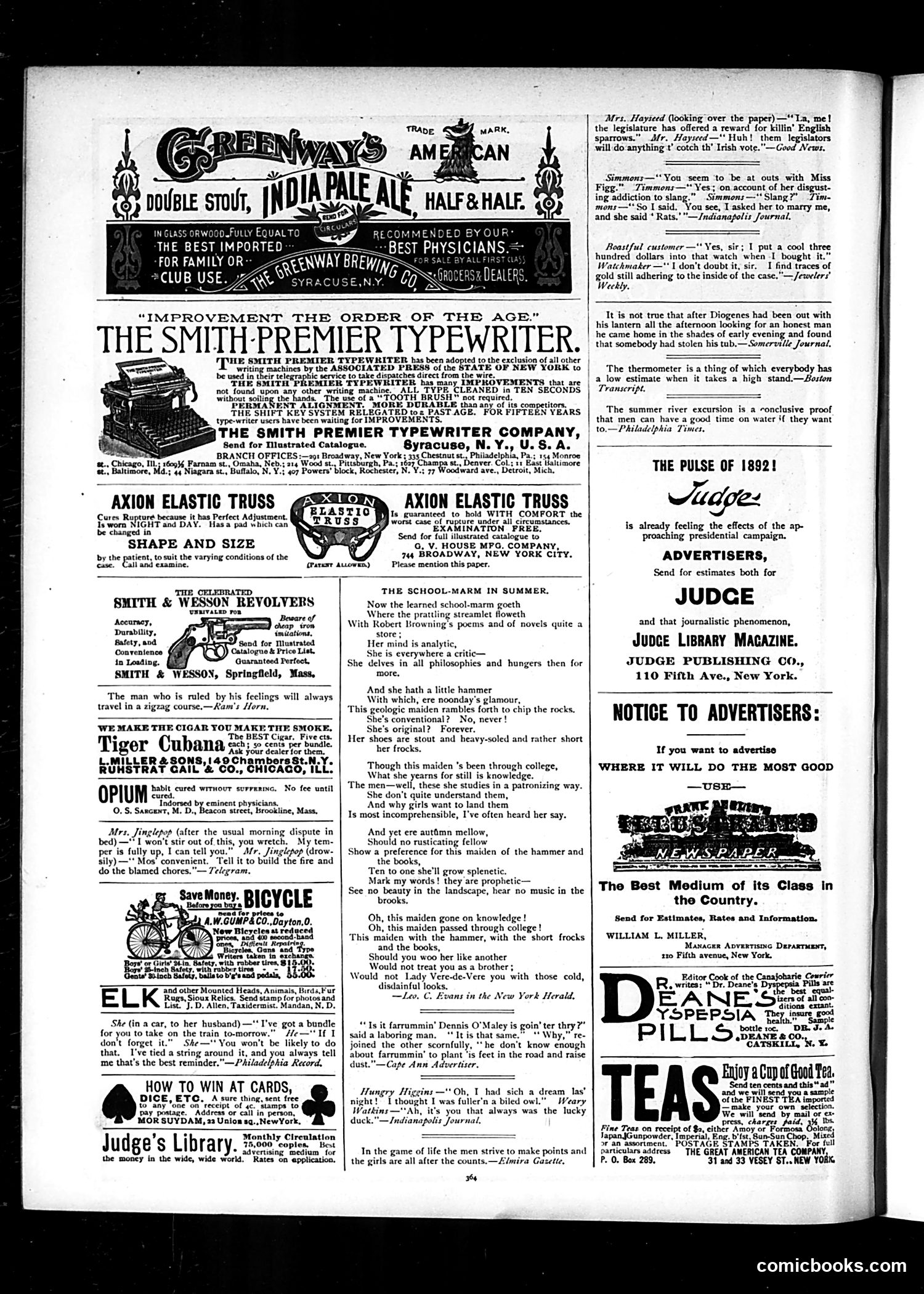
This page is primarily **advertising**, typical of late-19th-century publications. Key advertisers include the Smith-Premier Typewriter, Smith & Wesson revolvers, and patent medicines. The few **satirical items** are brief comic snippets: 1. **"Hayseed" cartoon**: A rural couple jokes about legislators offering bounties for killing English sparrows, with the husband quipping they'll "do anything t' cotch th' Irish vote"—mocking politicians' pandering to Irish-American voters. 2. **Slang joke**: Two men discuss romantic misunderstandings caused by a woman's use of contemporary slang ("Rats"). 3. **"School-Marm" poem**: A playful, incomplete verse about a schoolteacher's summer vacation activities. The page's main purpose is commercial, showcasing products marketed to the era's middle class while interspersing light humor typical of Judge magazine's satirical approach.
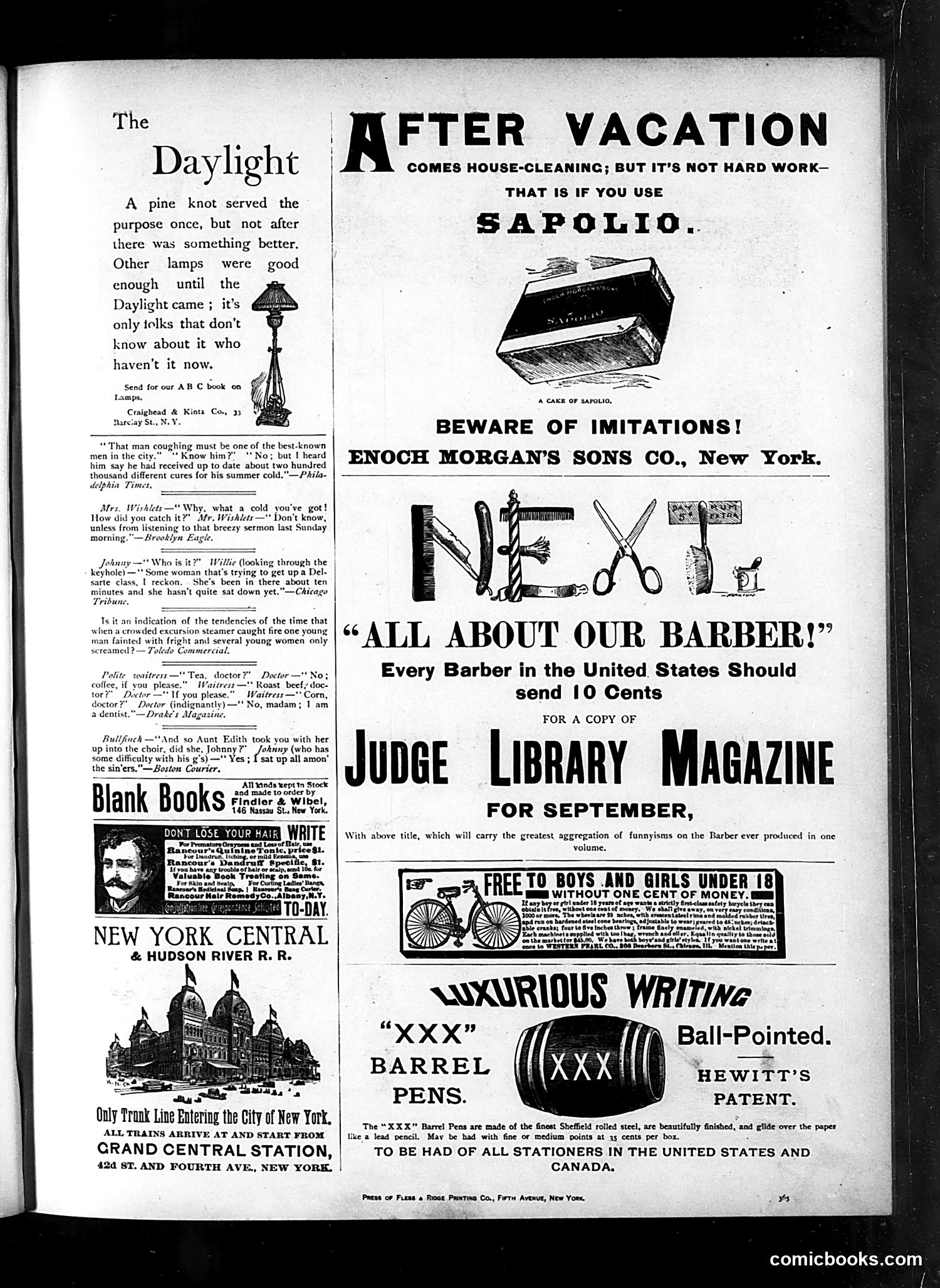
This is primarily an **advertising page** from Judge magazine, not a political cartoon. The page contains multiple product advertisements typical of early 1900s print media: **Main advertisements:** - **Sapolio** cleaning product (top): warns against imitations, emphasizing the genuine brand by Enoch Morgan's Sons - **Judge Library Magazine** (center): promotes a September issue focused on barber humor - **XXX Barrel Pens** (bottom): luxury writing instruments by Hewitt's Patent - **New York Central & Hudson River Railroad** (left): promoting Grand Central Station - **Blank Books** and hair remedies (left column) **The small text items** are brief humorous anecdotes—typical Judge filler content about everyday life (colds, excursions, doctor visits, children's malapropisms). **Historical context:** This reflects turn-of-the-century consumer culture, where Judge served as both satire magazine and advertising vehicle. The emphasis on "beware of imitations" indicates brand competition was already significant in this era.
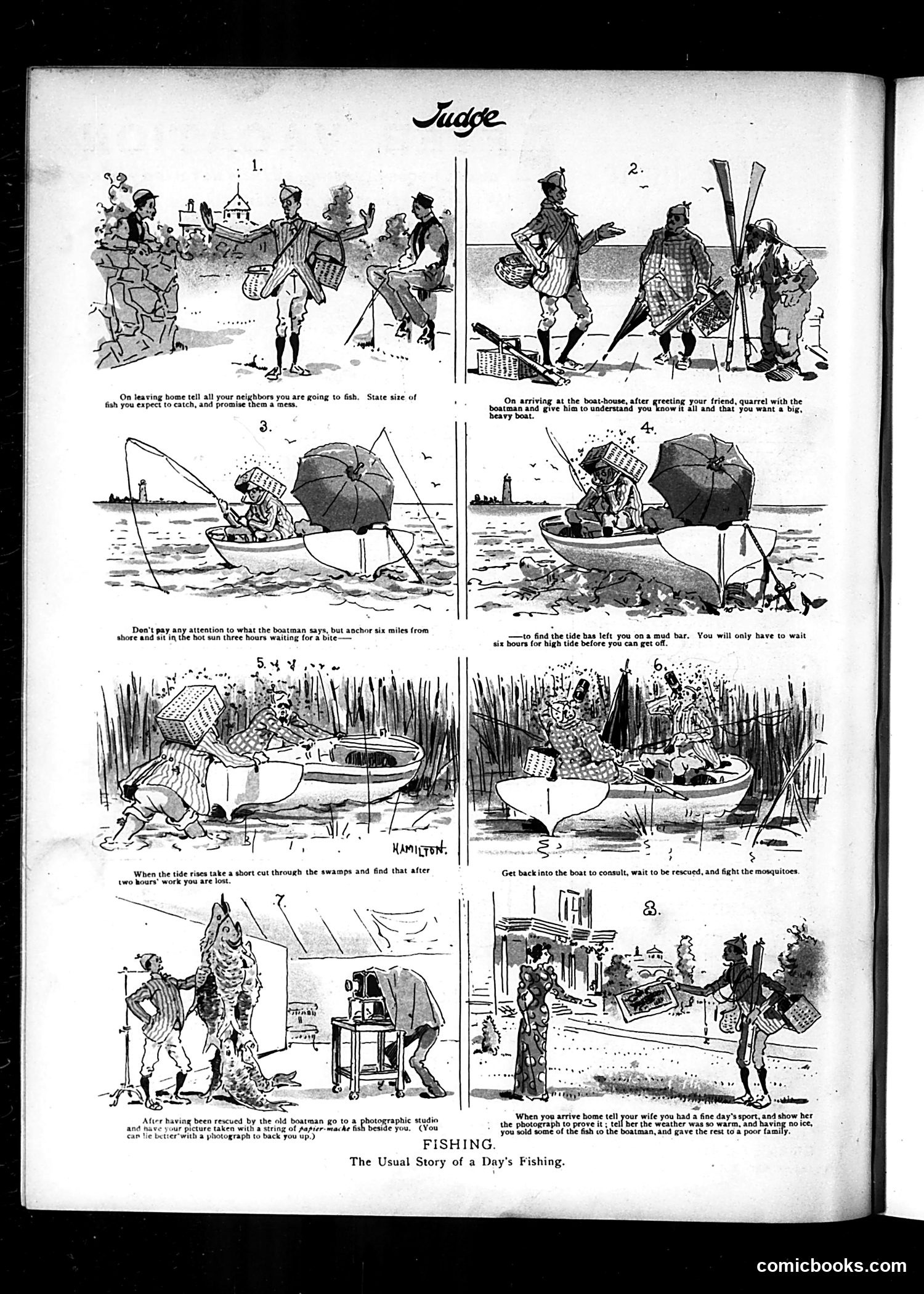
This Judge satirical comic documents the humorous gap between a fisherman's boasts and reality. The narrative follows a predictable pattern: a man announces an ambitious fishing trip to neighbors, then experiences a comedic series of failures—arguing with the boatman, anchoring in wrong spots, sitting in the hot sun fruitlessly, getting stranded on a mudbar, becoming lost in swamps. The satire targets masculine vanity and social pretense. Rather than admit failure, the fisherman returns home fabricating success: he claims fine sport, uses a photograph as "proof," blames weather, and claims he generously distributed catches to the poor and boatman. The joke reflects late 19th/early 20th-century attitudes about men's leisure activities and the gap between public boasting and private embarrassment—a timeless theme about how people construct narratives to save face.