
A complete issue · 18 pages · 1891
Judge — July 4, 1891
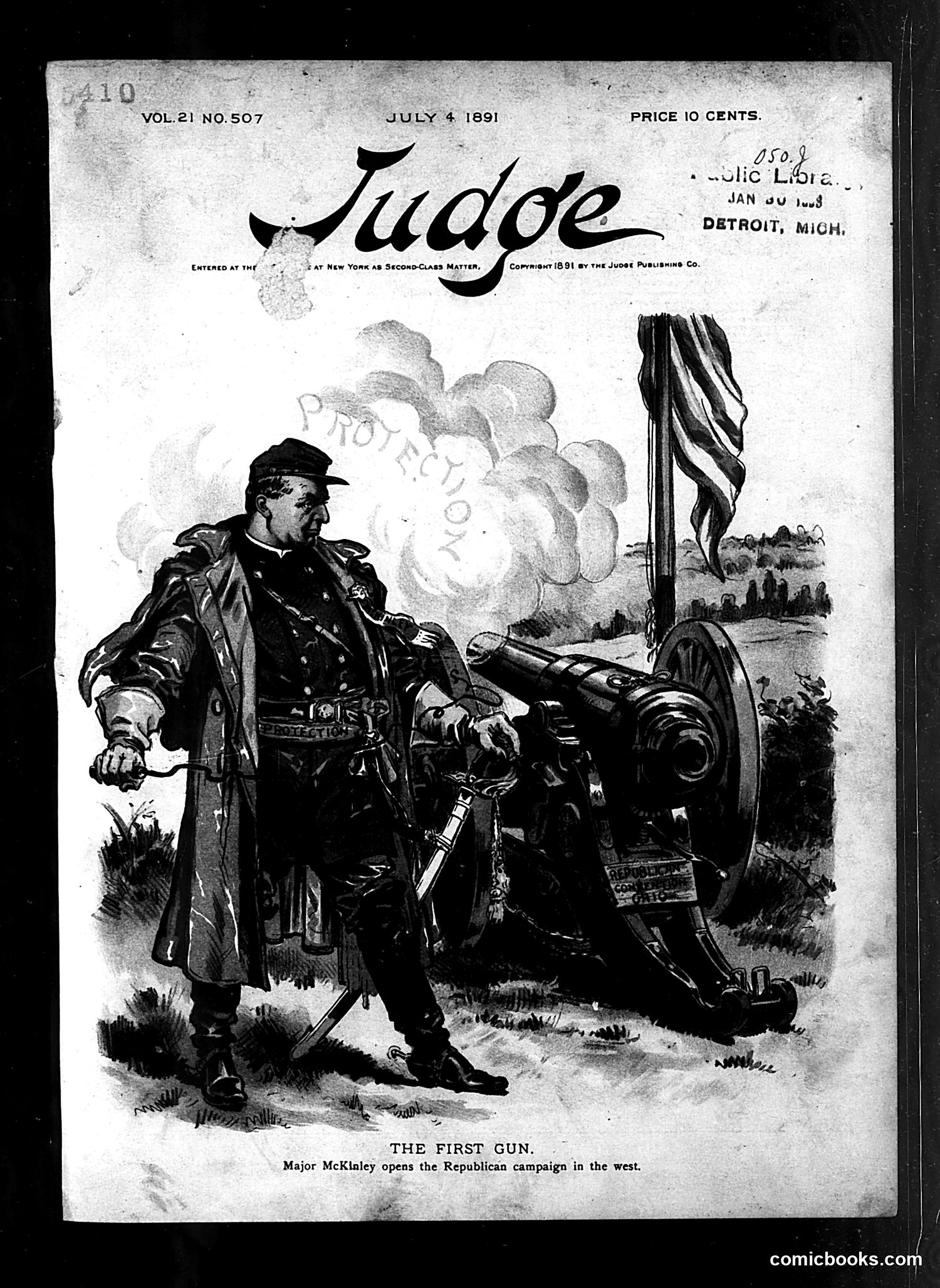
**"The First Gun: Major McKinley opens the Republican campaign in the west"** This political cartoon depicts Major William McKinley, a prominent Republican politician, as a military figure firing a cannon. The "first gun" metaphor represents the opening salvo of the Republican Party's campaign strategy heading into the 1892 election cycle. The military imagery—McKinley in uniform beside an artillery piece with smoke billowing—satirizes the aggressive, combative nature of political campaigns by comparing them to warfare. The caption's reference to "the west" suggests McKinley was launching campaign efforts in that region. This uses martial language common to 1890s political discourse, treating electoral contests as battles requiring ammunition and strategy rather than reasoned debate.
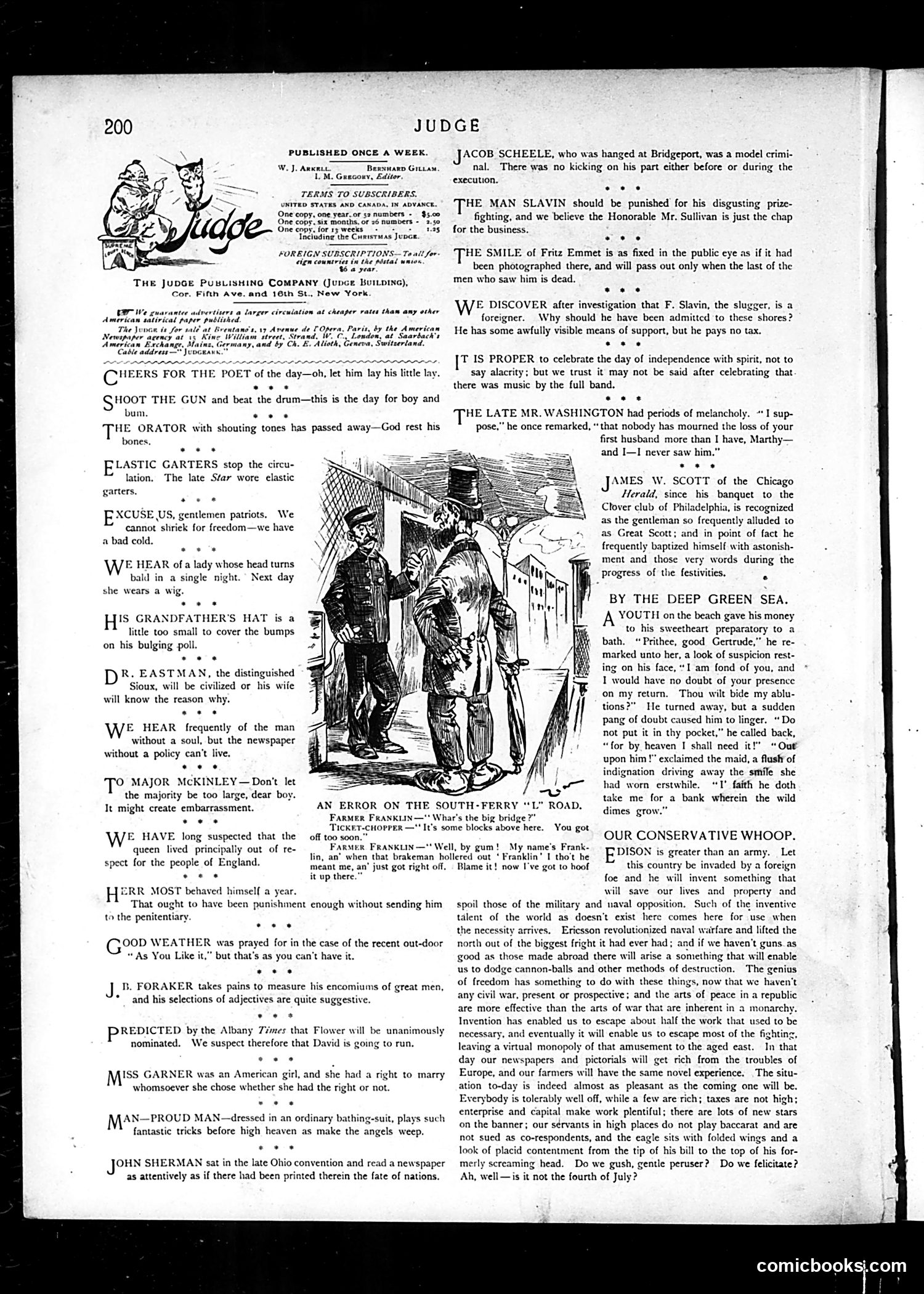
This page contains miscellaneous editorial commentary and humor rather than a cohesive political cartoon. The central illustration depicts two figures on what appears to be a South Ferry road—one identified as "Farmer Franklin" asking about a bridge. The surrounding text consists of short satirical observations on contemporary issues: Jacob Scheele's execution, prize-fighting, Fritz Emmet, and various social commentary. Notable items include criticism of celebrating Independence Day "with spirit, not to say sacrilety," and a substantial piece praising Edison's inventive genius as superior to military innovation. The content suggests this is from the late 1800s, addressing typical period concerns about crime, public morality, and American progress. Without clearer identification of specific political figures or dated references, precise interpretation of individual items remains uncertain.
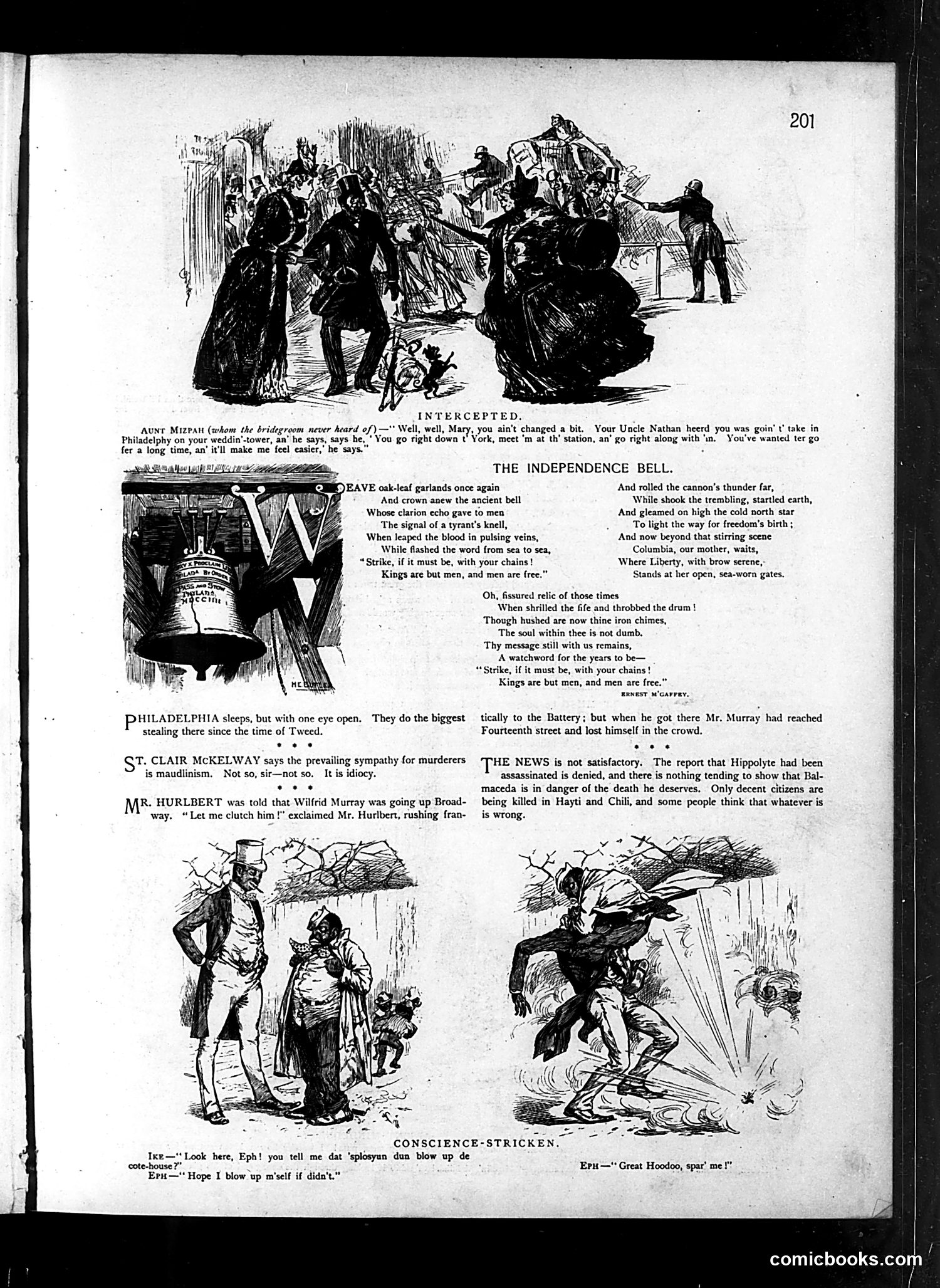
This page contains satirical commentary on Philadelphia politics and American independence themes. **"Intercepted"** (top): A domestic scene where Aunt Mizpah scolds "Mary" about Uncle Nathan's movements in Philadelphia, referencing political intrigue during what appears to be the Revolutionary era. **"The Independence Bell"**: A patriotic poem celebrating the Liberty Bell and American freedom, featuring the line "Kings are but men, and men are free." **Lower sections** include brief political notes: St. Clair McKelway comments on sympathy for murderers in Philadelphia, while another item discusses an assassination denial and rumors about figures named Hippolyte and Maceda facing execution—likely contemporary scandal reporting. **"Conscience-Stricken"** (bottom): A two-panel comic showing characters debating moral responsibility, with dialect humor typical of the era's satirical style.
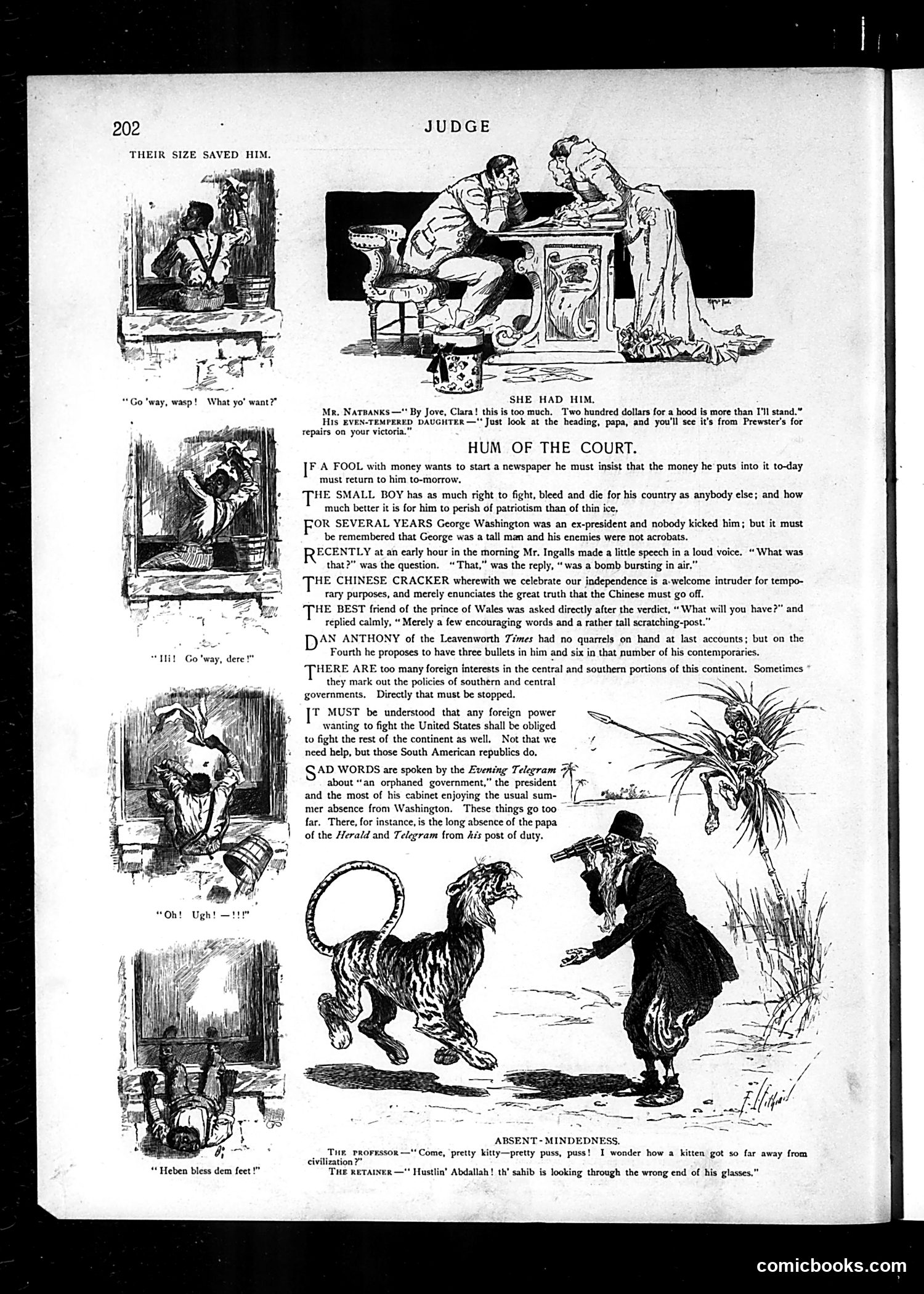
This page contains multiple political cartoons and satirical commentary from Judge magazine, likely from the 1880s-1890s. **Main cartoons:** - "Their Size Saved Him" and "She Had Him": Domestic humor about a husband confronted over expensive carriage repairs - "Absent-Mindedness": A professor trying to coax a kitten, unaware he's looking through binoculars backward **"Hum of the Court" section:** Satirical one-liners on current issues, including: - Criticism of foolish newspaper ventures - Commentary on George Washington as ex-president - References to Mr. Ingalls (likely Senator John J. Ingalls) making an early morning speech - Anti-Chinese sentiment regarding Independence Day firecrackers ("the Chinese must go off") - Foreign policy concerns about European interests in Central/South America - Criticism of the Evening Telegram and Herald newspapers for absent leadership The page reflects Gilded Age concerns: partisan politics, nativist attitudes, American hemispheric dominance, and satirical jabs at contemporary public figures and newspapers.
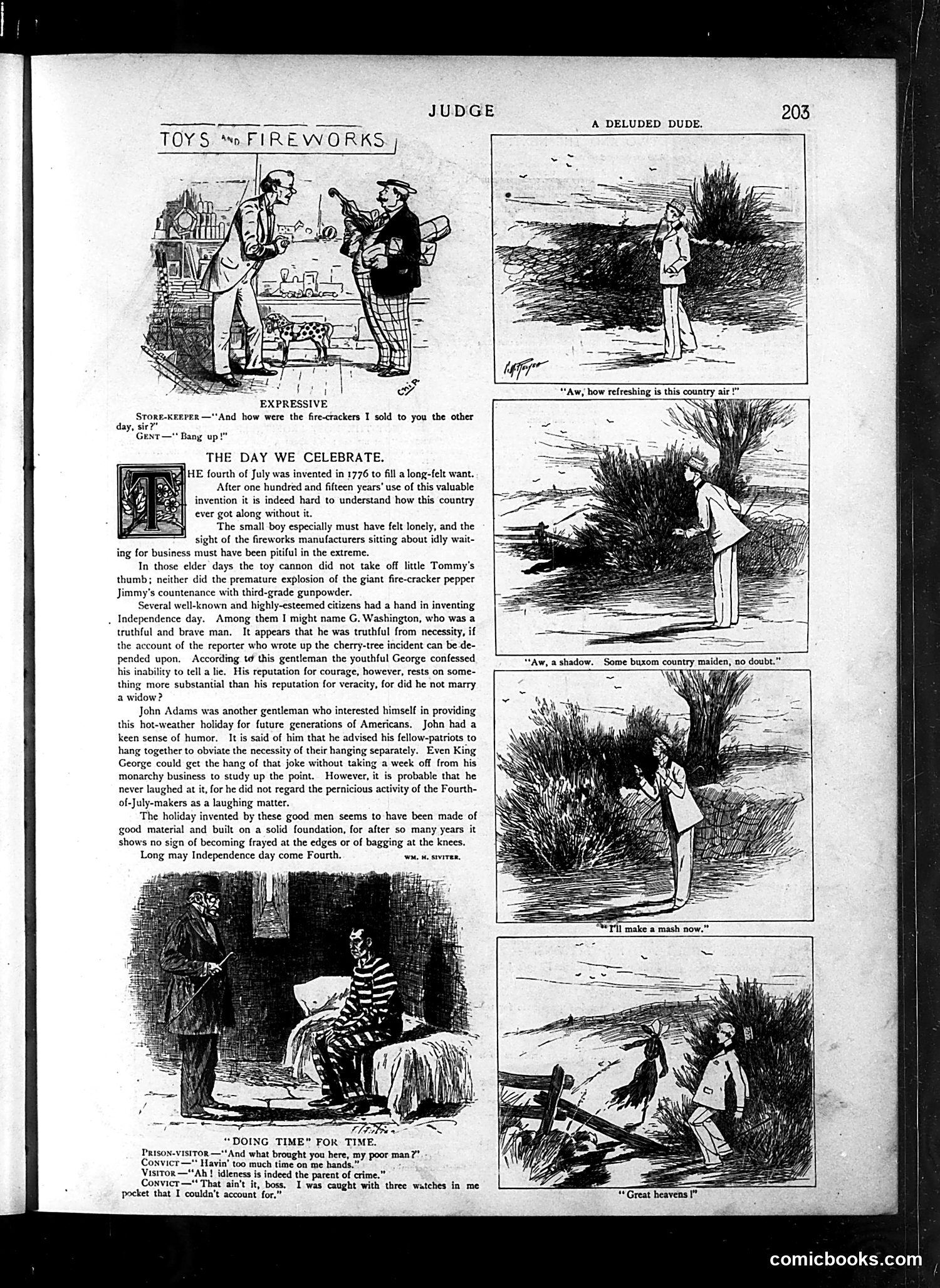
This page satirizes American Independence Day and contains unrelated cartoons. The main text humorously credits the Fourth of July's invention to 1776, mock-praising figures like George Washington and John Adams while making light jokes (Washington's cherry-tree story, Adams's quip about hanging together). The right-side comic strip titled "A Deluded Dude" depicts a foolish young man at the seaside who repeatedly mistakes natural phenomena for supernatural events. Each panel shows him misinterpreting ordinary sights—likely rustling reeds or shadows—as "ghosts" or omens, with his increasingly panicked reactions providing the humor. The joke targets naive urban dandies unfamiliar with rural/coastal settings, mocking their gullibility and overactive imaginations. The "deluded dude" appears to be a stock character type representing pretentious city sophistication undone by simple country life.
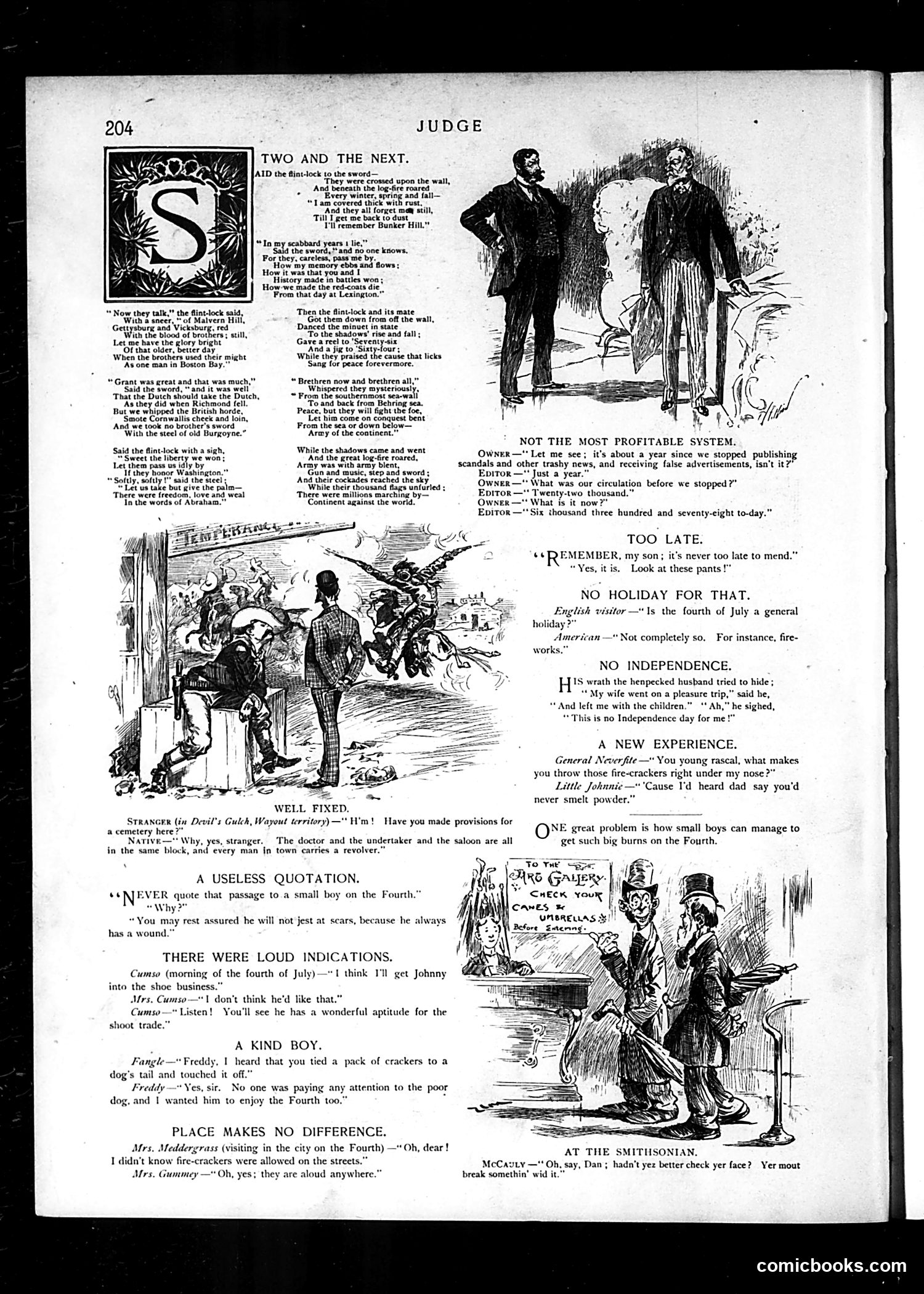
This page from *Judge* magazine contains multiple short satirical pieces about Fourth of July celebrations and American life, likely from the late 19th century. The main poem "Two and the Next" contrasts old Revolutionary War muskets with Civil War-era weapons, celebrating American unity and victory. The weapons discuss past glories—the Revolution, the Civil War—before pledging brotherhood against future enemies. Below are numerous brief jokes exploiting Fourth of July themes: a newspaper editor losing circulation after stopping sensationalism; a henpecked husband finding no "independence"; a general (likely a military figure) insulted as never having "smelt powder"; and boys' dangerous firecracker accidents. The humor relies on wordplay ("Independence Day" vs. marital dependence), puns about powder and gunpowder, and social commentary on American journalism's reliance on scandal. The "kind boy" anecdote mocks childhood recklessness with fireworks—a recurring Fourth of July danger that *Judge* treats as darkly comic.
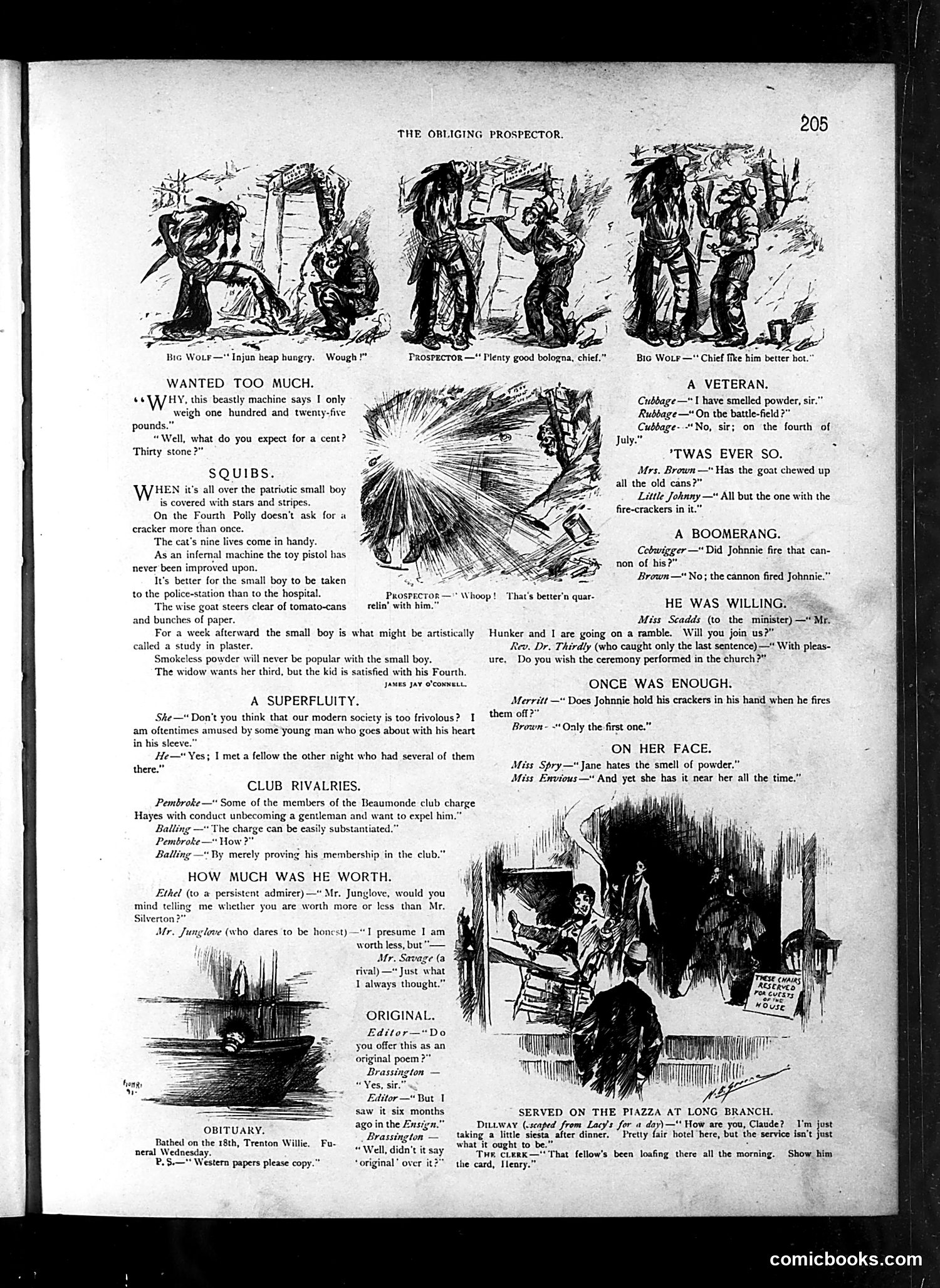
This page contains humorous short jokes and cartoon vignettes typical of late 19th-century American satire. The content targets everyday social absurdities rather than specific political figures. **Key sections:** - **"The Obliging Prospector"**: Stereotypical caricatures of Native Americans and prospectors (the "Big Wolf" and "Wough" speech patterns reflect period racial stereotyping). - **"Wanted Too Much"**: Commentary on penny-scale weight machines—mocking both their inaccuracy and false economy. - **"Squibs"**: Brief observational jokes about Fourth of July celebrations, children's fireworks mishaps, and pet behavior—typical domestic humor. - **"Served on the Piazza at Long Branch"**: References Long Branch, New Jersey, a fashionable seaside resort, mocking lazy vacationers and poor service. - **Various other jokes**: Address courtship, club membership standards, plagiarism in poetry submission, and social pretension. The humor relies on familiar situations, wordplay, and gentle mockery of class distinctions and social conventions rather than political commentary.
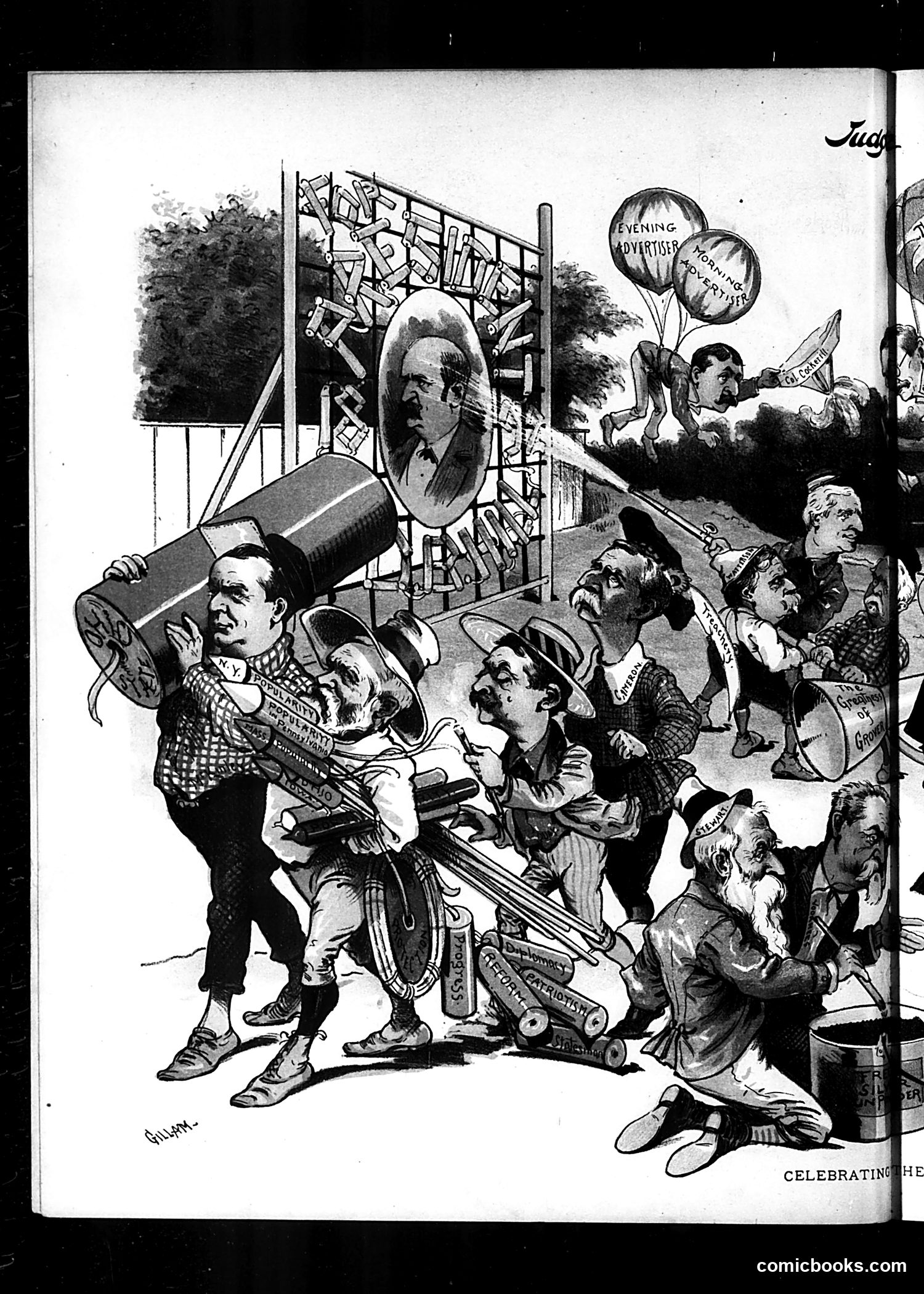
This appears to be a satirical cartoon from *Judge* magazine depicting advertising and promotional excess. The central figure carries a large megaphone or speaker, surrounded by men holding various advertising instruments (telescopes, horns, placards). Balloons labeled "Evening Advertiser" and other publications float above, while a portrait of an important figure is displayed prominently in the background structure. The satire targets the aggressive, cacophonous nature of late 19th/early 20th-century advertising and media promotion. The crowded scene of promoters using increasingly elaborate tools suggests how advertisers were becoming intrusive and overwhelming in public spaces. The cartoon mocks both the newspaper industry's competitive self-promotion and the general chaos of commercial advertising culture invading everyday life. Without clearer OCR text identifying specific publications or figures, the exact targets remain somewhat unclear, though the general critique of advertising excess is evident.
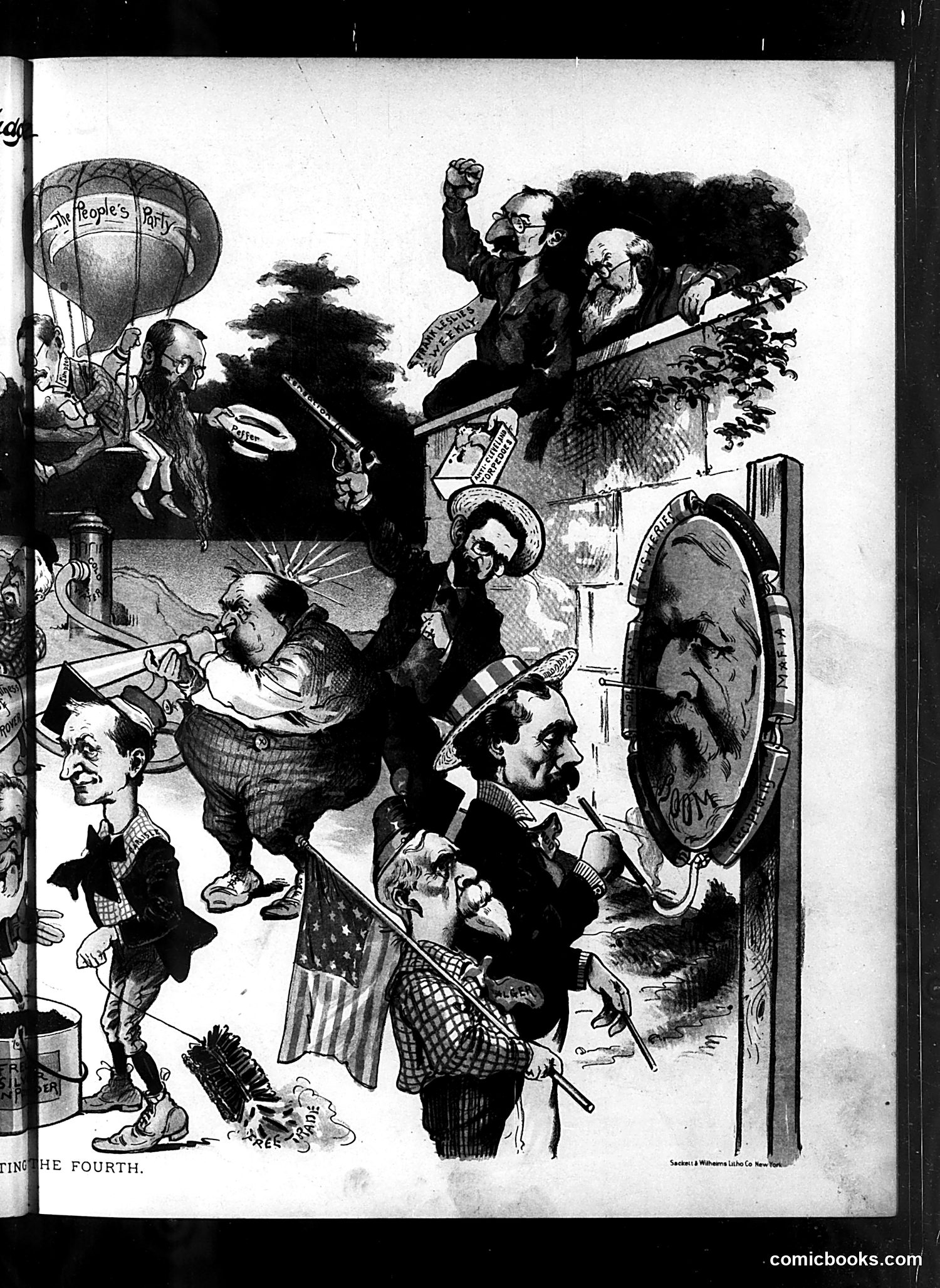
This appears to be a satirical cartoon titled "The Fourth" (likely referencing Independence Day), from the satirical magazine *Judge*. The cartoon depicts a chaotic political scene with multiple caricatured figures gathered around what appears to be a portrait or mirror on the right side. The imagery suggests commentary on American political turbulence or partisan conflict. The "People's Party" balloon visible on the left indicates commentary on populist politics. Various figures wear hats suggesting different political factions or nations, and the overall composition conveys disorder and competing interests. Without clearer text or date identification, the specific politicians or events referenced remain unclear, but the scene evidently satirizes political dysfunction or ideological fragmentation in late 19th-century American politics.
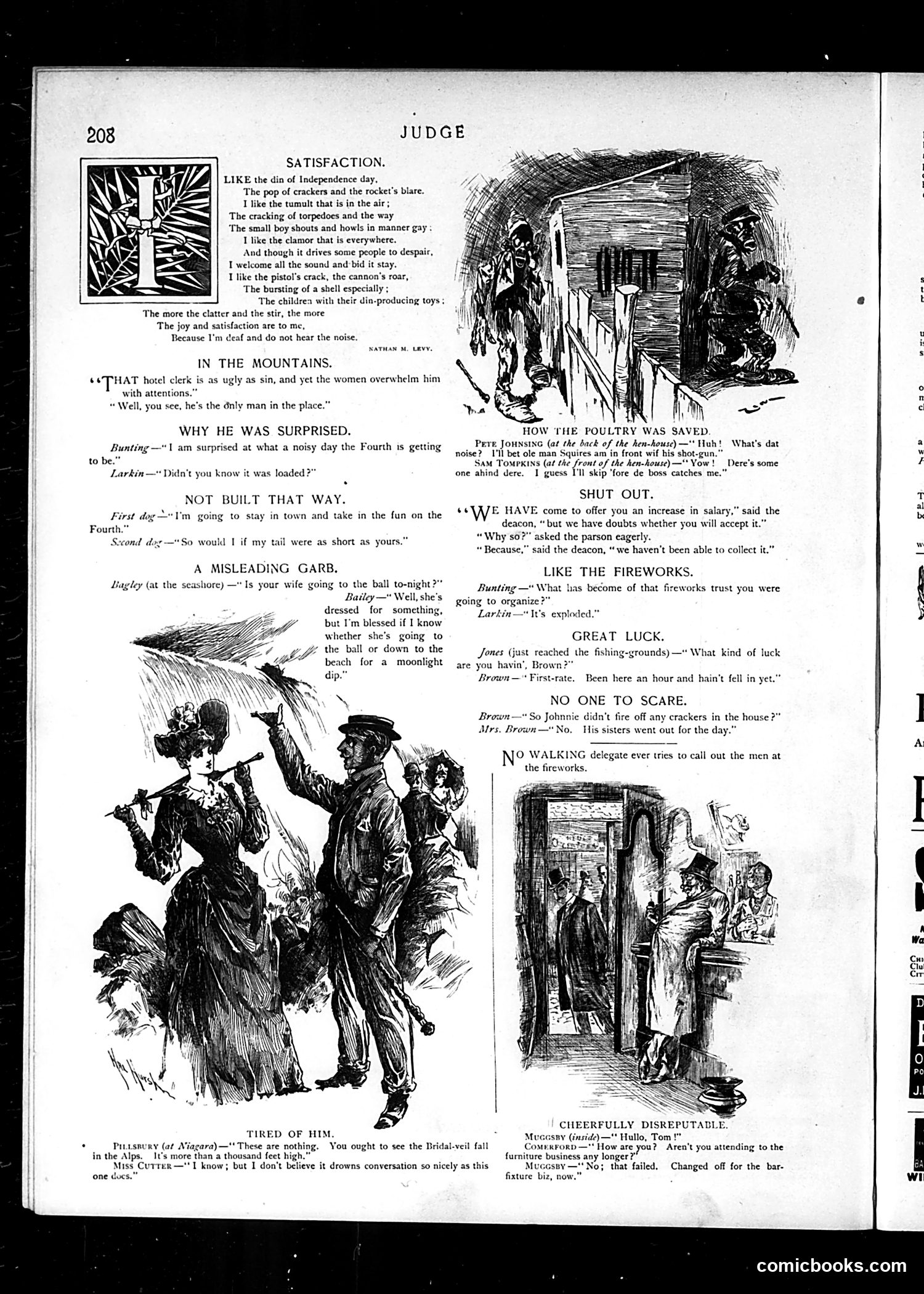
This page contains multiple short jokes and cartoons typical of late 19th-century American humor. Key pieces: **"Satisfaction"** by Nathan St. Levy is a poem celebrating Independence Day noise—but the twist is the speaker is *deaf*, so they enjoy the chaos precisely because they can't hear it. This is gentle irony about finding unexpected pleasure in circumstances others find intolerable. **Social/situational jokes** include: a homely hotel clerk attracting women because he's the only man available; a wife dressed ambiguously for either a formal ball or beach; and a man tired of his companion's boasting about Niagara Falls. **Racial humor** appears in "How the Poultry Was Saved," featuring dialect-speaking Black characters (Pete Jounsing and Sam Tompkins) worried about a farmer's shotgun—reflecting period stereotypes. **The cartoons** depict Victorian-era leisure scenes with pen-and-ink illustrations showing couples and social situations, typical of Judge's satirical commentary on contemporary manners and domestic life. The page reflects Judge's mix of wordplay, observational humor about social conventions, and period-typical racial caricature.
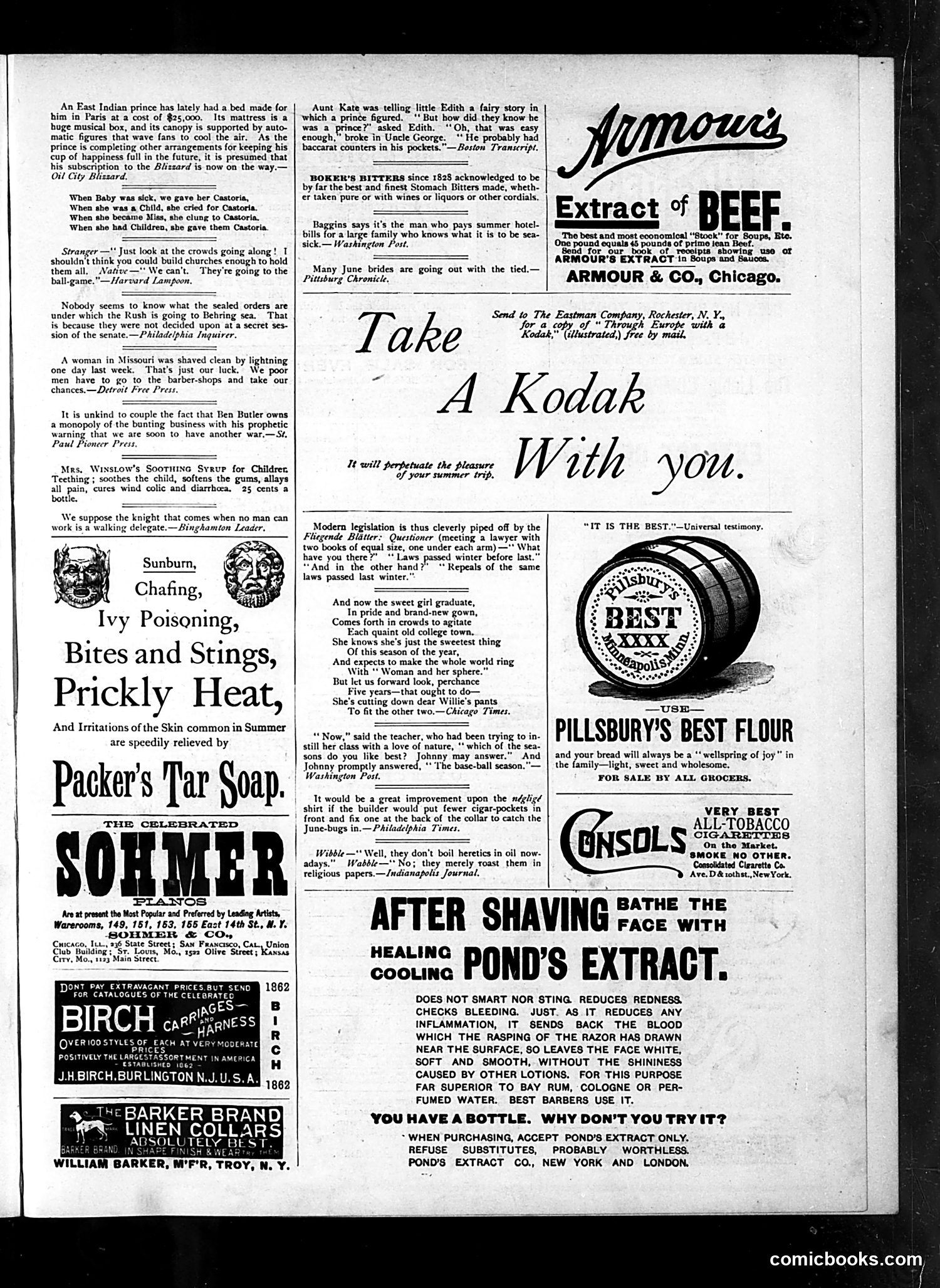
This page is primarily **advertising with brief satirical commentary**, typical of Judge magazine's format. ## The Satirical Bits: The short humor pieces mock contemporary society: an East Indian prince's extravagant Paris bed; Americans prioritizing baseball over church attendance; a man suffering seasickness from paying hotel bills for a large family; and Ben Butler (a controversial Reconstruction-era general) being sarcastically linked to war-mongering. The most substantial cartoon-style item criticizes **modern legislation** through a visual joke: a lawyer carries two identical books—one containing "laws passed winter before last," the other containing "repeals of the same laws passed last winter." This satirizes the inefficiency and contradictory nature of recent legislative sessions, suggesting laws are rapidly undone, making them pointless. ## Advertising Focus: The page is dominated by period product ads: Castoria (children's medicine), Armour's Beef Extract, Pillsbury flour, Consols tobacco, Pond's Extract (post-shaving treatment), Sohmer pianos, and Birch carriages. These reflect 1880s consumer goods and marketing strategies.
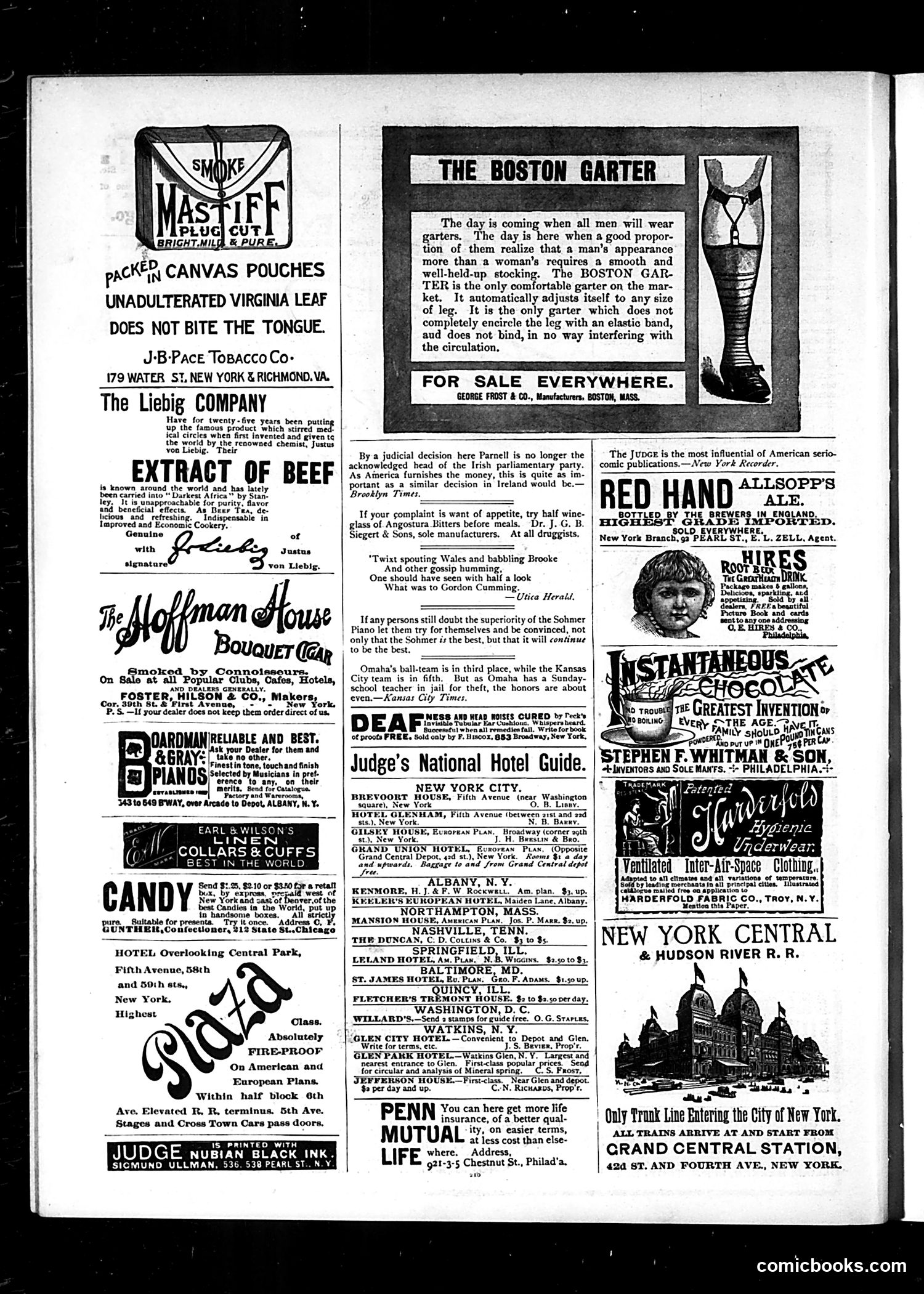
This page from **Judge** magazine (a leading American satirical publication) consists primarily of **period advertisements** with a few embedded jokes typical of the era. The most identifiable satirical content is a brief **political reference to Charles Stewart Parnell**, the Irish nationalist leader. The text notes that an American judicial decision removed Parnell as head of the Irish parliamentary party, sarcastically observing that since "America furnishes the money," this American decision matters as much as an Irish one would. Other jokes are localized social commentary: one compares Omaha's baseball team unfavorably to Kansas City's, sardonically noting Omaha's "Sunday-school teacher in jail for theft" balances the sporting competition. The remainder consists of **advertisements for consumer goods** typical of the Gilded Age: tobacco, beef extract, pianos, collars, garters, candy, hotels, and medicines. The "Boston Garter" ad features a leg illustration—notable for its relatively frank display of a man's leg in undergarments, which the advertiser emphasizes as a modern development in male fashion and grooming. **No political cartoon is visible** on this page; it's primarily an advertising section with minor satirical commentary.
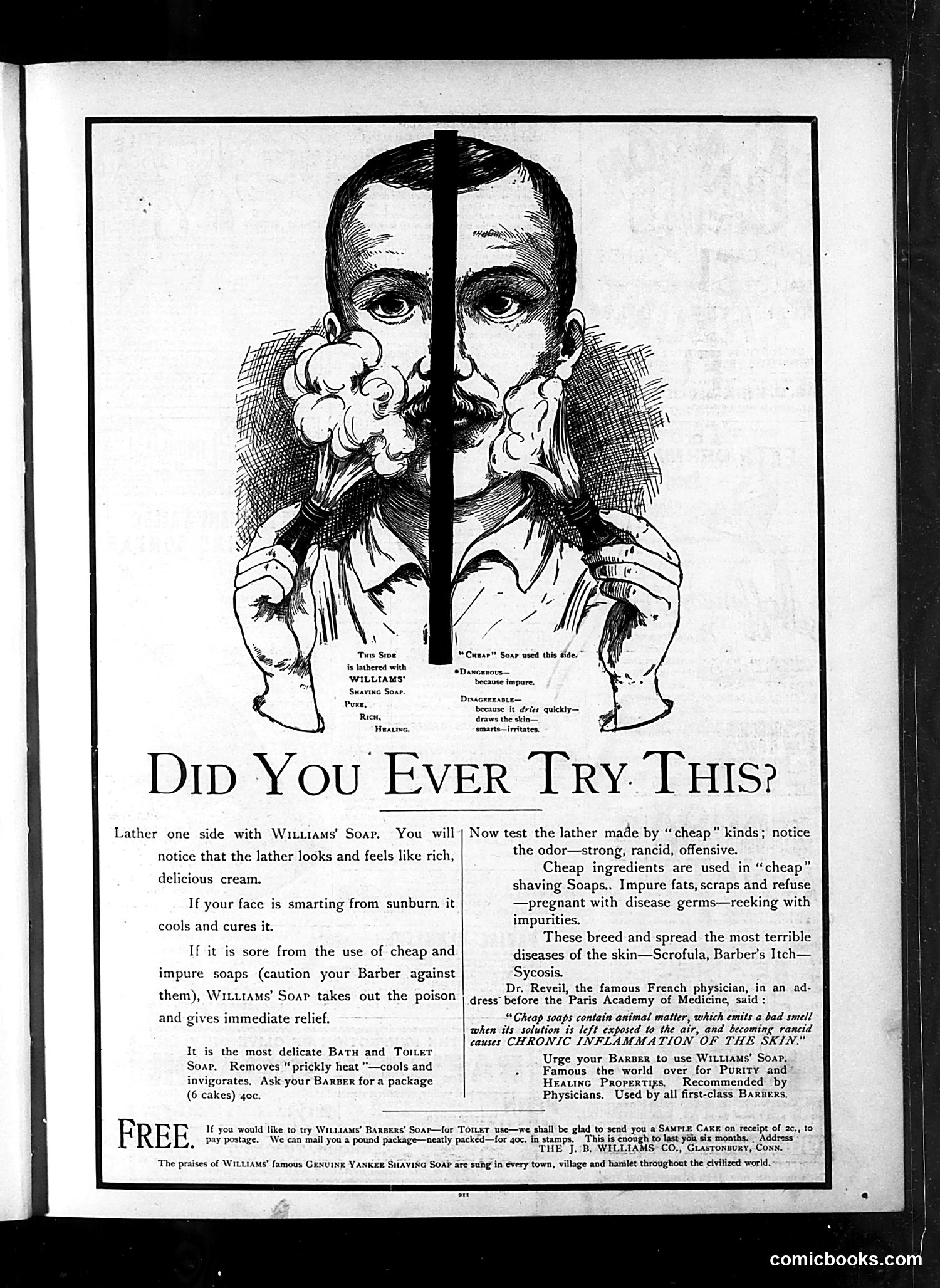
This is primarily a **product advertisement**, not political satire. It promotes Williams' Shaving Soap by contrasting it with cheap competitors. The illustration shows a split face—one side lathered with Williams' soap (described as pure, rich, healing) and the other with cheap soap (dangerous, impure, disease-causing). The visual comparison drives home the marketing message. The text makes dramatic health claims: cheap soaps allegedly contain diseased animal matter and impure fats that cause skin conditions like scrofula and barber's itch. It cites a French physician (Dr. Reveil) to add authority. The ad positions Williams' as the premium choice, "famous the world over" and used by "first-class barbers" and physicians. This reflects late-19th/early-20th-century advertising tactics—fear-based marketing that exaggerates competitor dangers while promising safety and purity for the advertised product.
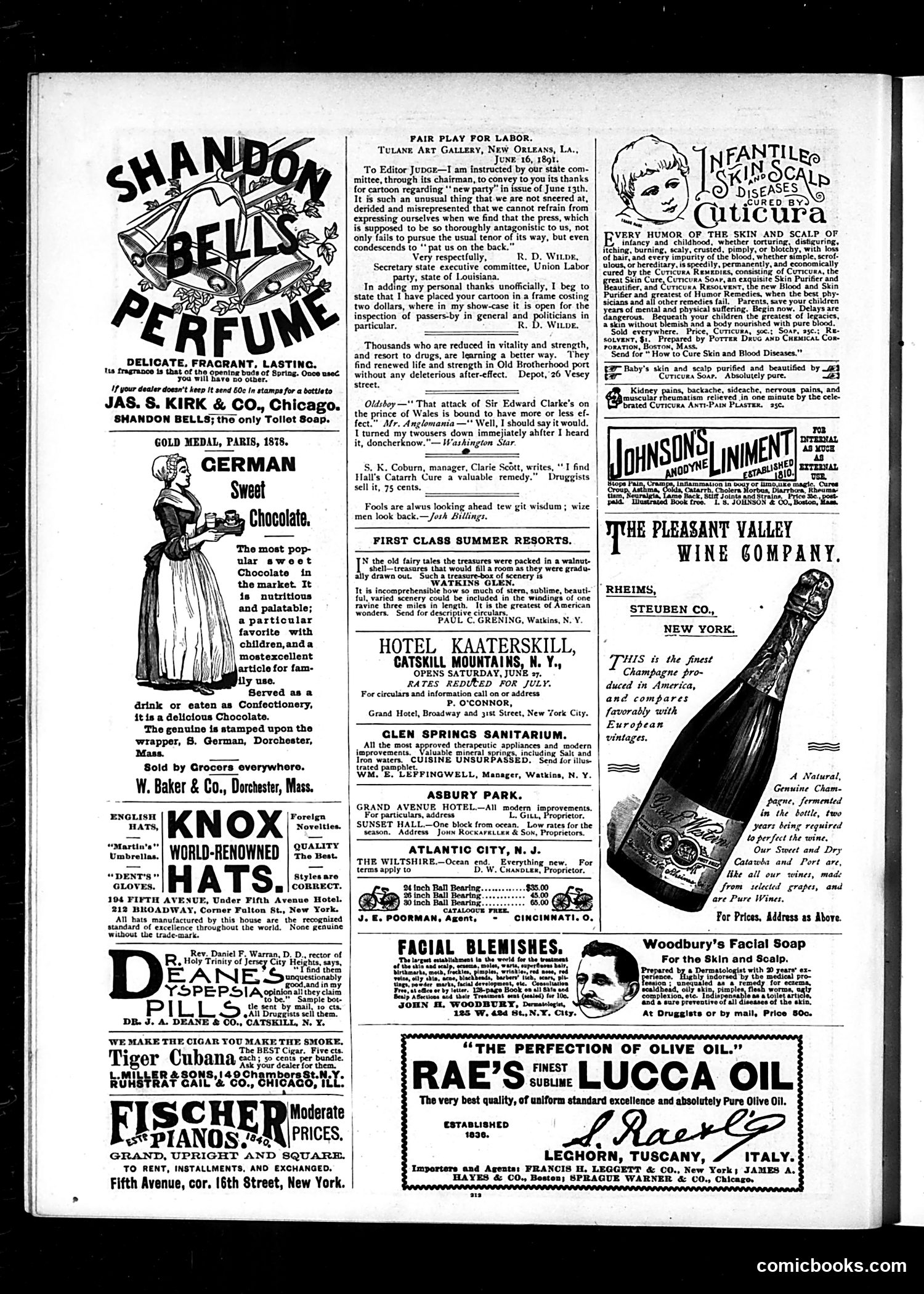
This page is primarily **advertising**, not editorial content. It's a typical Judge magazine page from June 1891 featuring commercial advertisements for period products: Shandon Bells toilet soap, chocolate, Knox hats, cigars, pianos, and various remedies. The only notable editorial content appears at the top: **letters to the editor** praising Judge for a cartoon about a "new party" (the Populist Party movement of the 1890s). Louisiana Democratic officials thank the magazine for fairly representing labor interests rather than deriding them—unusual because mainstream press typically mocked the Populist cause. The remaining content is standard late-19th-century advertising copy for consumer goods, hotels, and patent medicines, reflecting the magazine's commercial operation rather than satirical commentary.
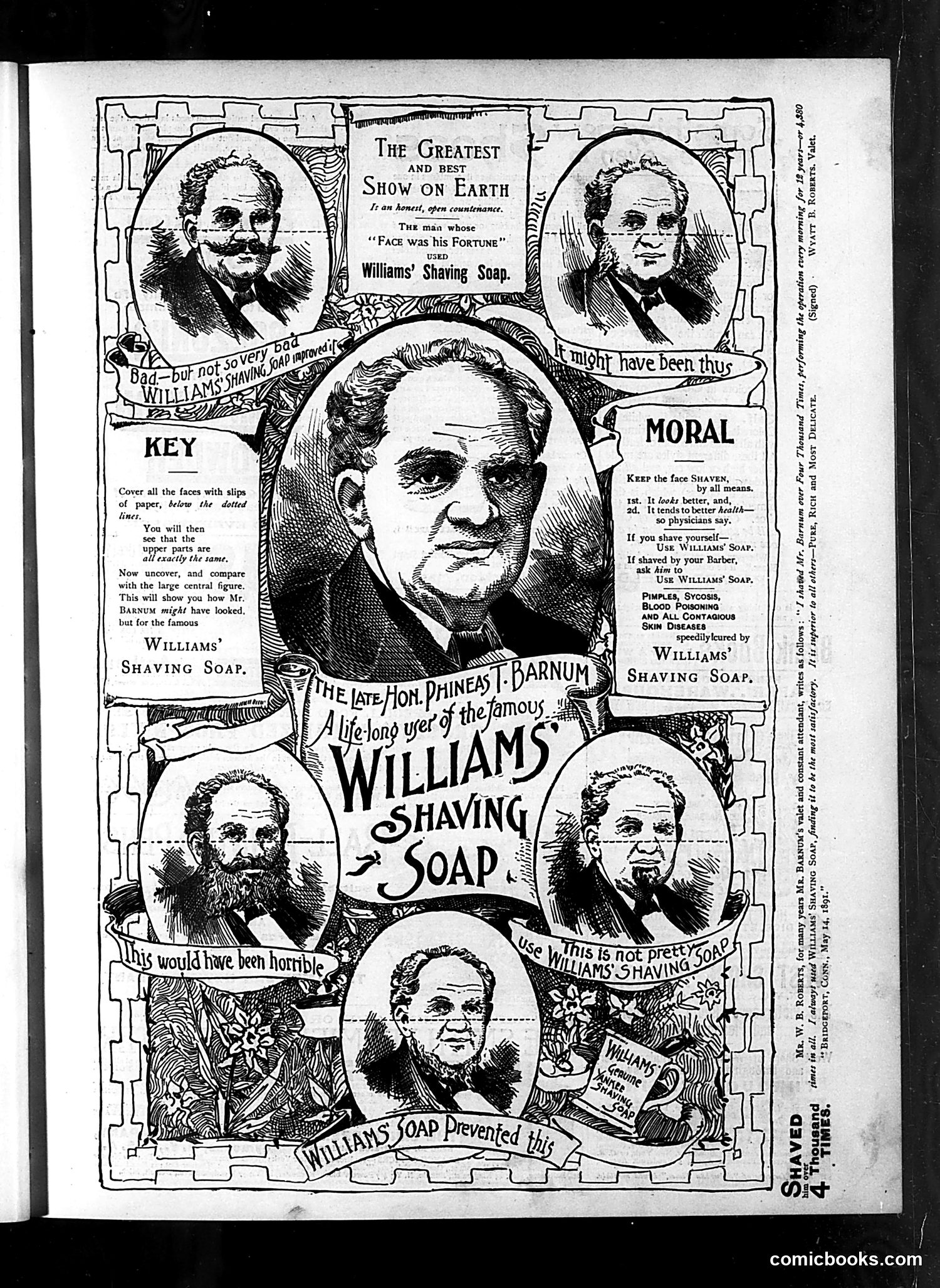
This is a **disguised advertisement for Williams' Shaving Soap** masquerading as a satirical cartoon in Judge magazine. The central figure is **P.T. Barnum**, the famous 19th-century showman and circus impresario. The joke plays on Barnum's well-known appearance and his famous phrase "a face was his fortune" — suggesting his distinctive look contributed to his celebrity. The gimmick: readers are instructed to cover the surrounding smaller faces with paper slips. When covered, they theoretically all look identical. Once uncovered and compared to the large central Barnum portrait, the ad claims this reveals "how Mr. Barnum might have looked" without Williams' Soap — implying the product's superiority transformed his appearance. The testimonial from W.B. Roberts, Barnum's actual valet who shaved him 4,880 times over 12 years, lends false credibility to the otherwise absurd comparison. This is essentially **fake advertising posing as editorial content** — a common deceptive practice of the era.
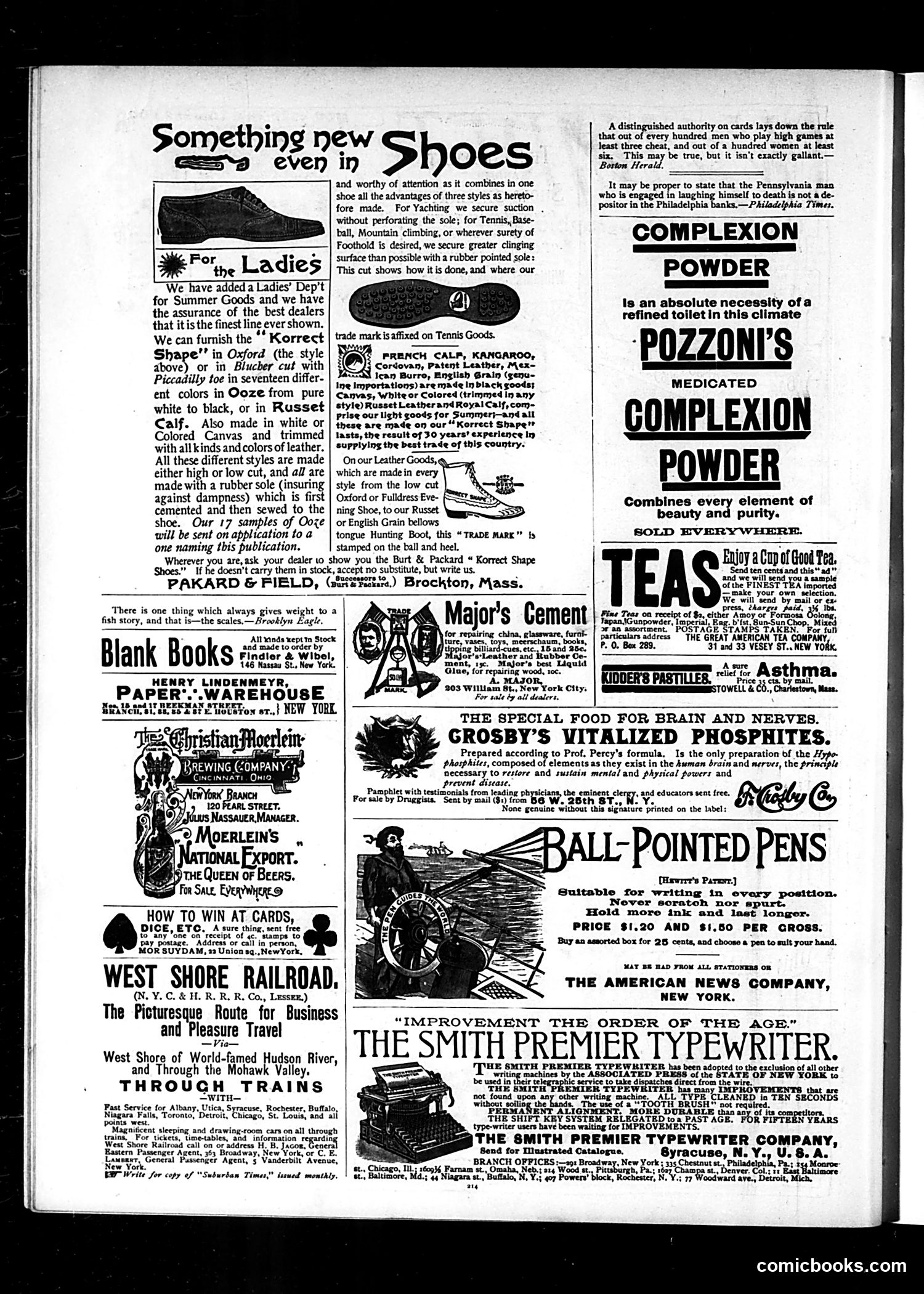
This page is primarily **advertising**, not satire or political cartoons. It contains mostly period commercial advertisements for shoes, cosmetics, writing instruments, food supplements, and railroad services typical of late 19th-century publications. The small editorial snippets scattered among ads offer mild social commentary rather than satire: one quotes a Boston Herald remark about cheating at card games between men and women; another from the Philadelphia Times jokes about a man laughing himself to death over bank failures. The shoe advertisements dominate, promoting "Korrect Shape" footwear by emphasizing technical innovations like rubber-pointed soles for different activities (yachting, tennis, mountain climbing). No identifiable caricatured figures or political references appear. The page reflects Judge magazine's revenue model of mixing light satirical commentary with commercial content for a middle-class audience concerned with fashion, propriety, and modern consumer goods.
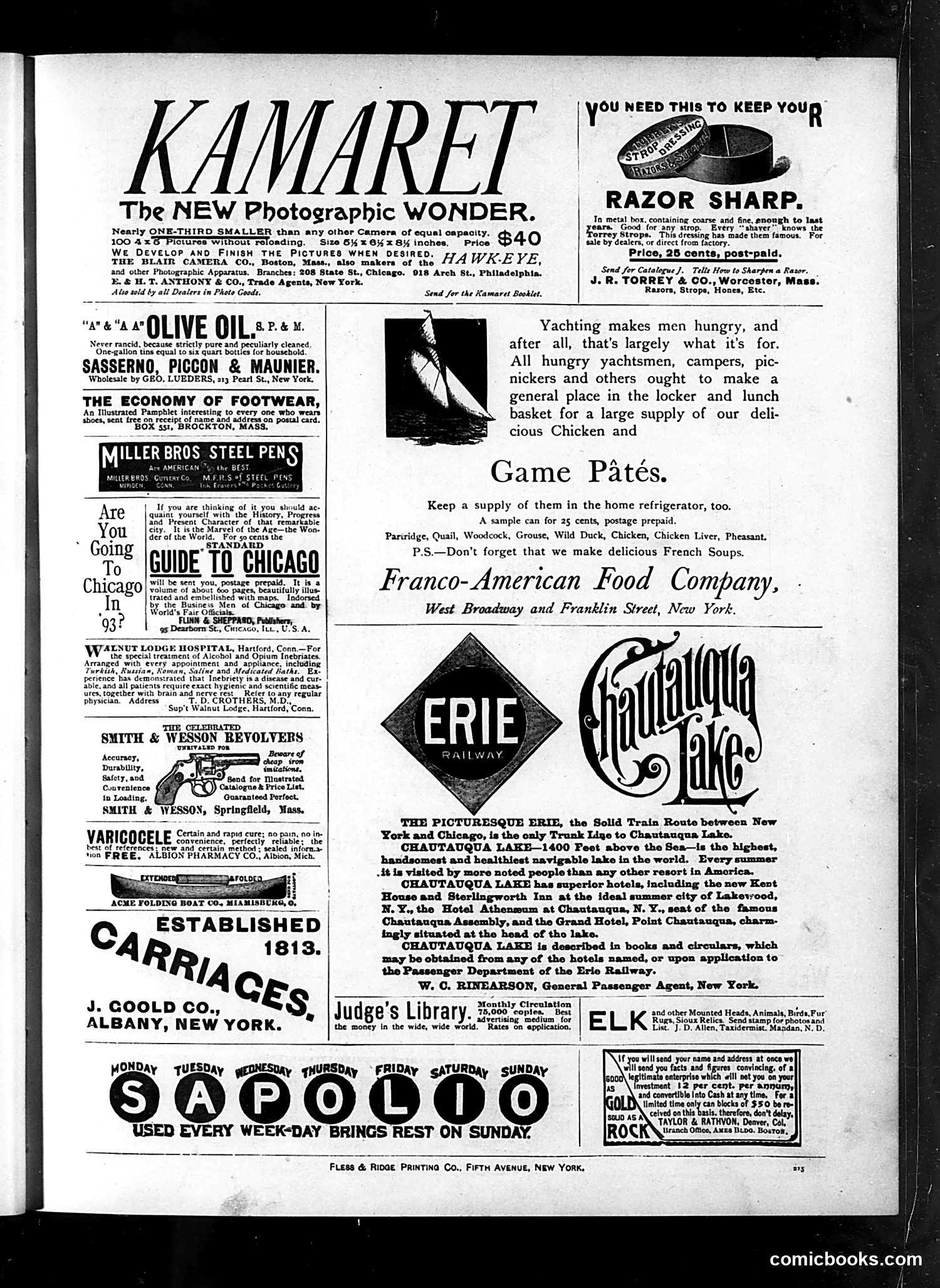
This page is primarily a **collection of advertisements** with little to no editorial cartooning. Key advertising content includes: - **Kamaret camera** and photographic equipment - **Razor sharpening** products and stropping services - **Olive oil** (Sasserno brand) - **Game pâtés** from Franco-American Food Company - **Erie Railway** promoting leisure travel to Chautauqua Lake, Ohio - **Smith & Wesson revolvers** - **Carriages** from J. Goold Co. - **Sapolio soap** (with days-of-week branding) The only editorial content is a brief humorous caption about **yachting and hunger**, suggesting yachtsmen keep canned chicken and pâtés onboard—a light joke about appetite and leisure travel. No political satire or caricature is present on this page. It represents typical late 19th-century Judge magazine layout, mixing light humor with commercial advertising aimed at middle-class recreational consumers.
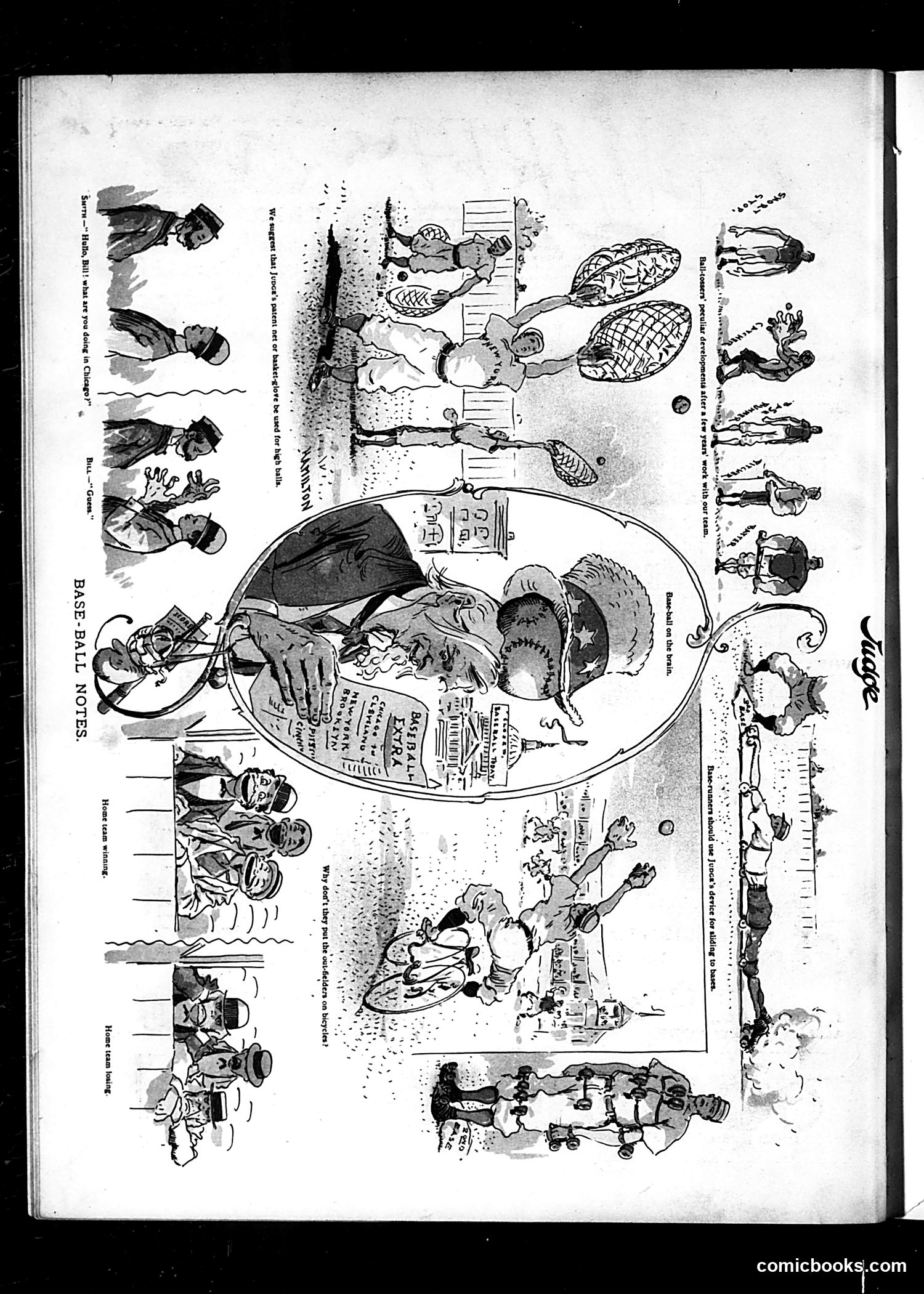
I can see this is a page from *Judge* magazine featuring satirical illustrations arranged around a central circular diagram. The image shows multiple caricatured figures in period dress, what appears to be social commentary through exaggerated features and poses, and some kind of anatomical or organizational chart in the center. However, the OCR text provided ("somichooks.com") is clearly an error and provides no actual magazine content. Without legible text identifying the specific figures, political figures referenced, historical events, or the cartoon's title/caption, I cannot reliably explain what satire or social critique this page presents. To properly analyze this, I would need readable OCR text from the actual magazine content on this page.