
Judge, 1891-07-04 · page 5 of 18
Judge — July 4, 1891 — page 5: what you’re looking at
What you’re looking at
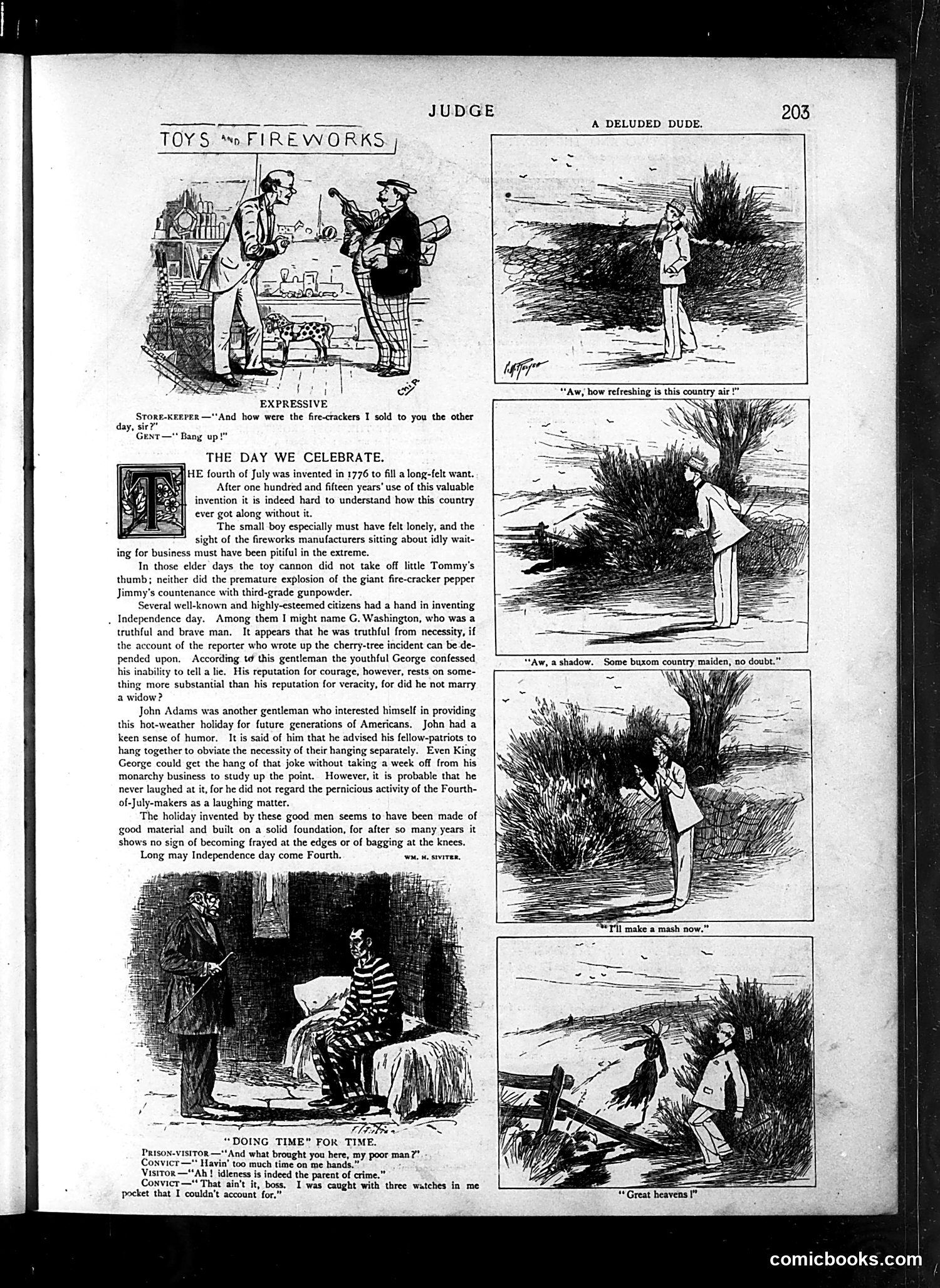
This page satirizes American Independence Day and contains unrelated cartoons. The main text humorously credits the Fourth of July's invention to 1776, mock-praising figures like George Washington and John Adams while making light jokes (Washington's cherry-tree story, Adams's quip about hanging together). The right-side comic strip titled "A Deluded Dude" depicts a foolish young man at the seaside who repeatedly mistakes natural phenomena for supernatural events. Each panel shows him misinterpreting ordinary sights—likely rustling reeds or shadows—as "ghosts" or omens, with his increasingly panicked reactions providing the humor. The joke targets naive urban dandies unfamiliar with rural/coastal settings, mocking their gullibility and overactive imaginations. The "deluded dude" appears to be a stock character type representing pretentious city sophistication undone by simple country life.
📄 Transcribed text from this page (OCR, searchable)
Machine-transcribed from the original scan — historical spelling and the odd misread are preserved.
TOYS ‘FIREWORKS EXPRESSIVE Srore-KEEPeR—‘‘And how were the fire-crackers I sold to you the other day, sir?” Gext—"' Bang up!" THE DAY WE CELEBRATE. JHE fourth of July was invented in 1776 to fill a long-felt want. After one hundred and fifteen years’ use of this valuable invention it is indeed hard to understand how this country ever got along without it. The small boy especially must have felt lonely, and the sight of the fireworks manufacturers sitting about idly wait- ing for business must have been pitiful in the extreme. In those elder days the toy cannon did not take off little Tommy's thumb; neither did the premature explosion of the giant fire-cracker pepper Jimmy's countenance with third-grade gunpowder. Several well-known and highly-esteemed citizens had a hand in inventing . Independence day. Among them I might name G. Washington, who was a truthful and brave man. It appears that he was truthful from necessity, if the account of the reporter who wrote up the cherry-tree incident can be-de- pended upon. According to this gentleman the youthful George confessed his inability to tell a lie. His reputation for courage, however, rests on some- thing more substantial than his reputation for veracity, for did he not marry a widow? John Adams was another gentleman who interested himself in providing this hot-weather holiday for future generations of Americans. John had a keen sense of humor. It is said of him that he advised his fellow-patriots to hang together to obviate the necessity of their hanging separately. Even King George could get the hang of that joke without taking a week off from his monarchy business to study up the point. However, it is probable that he never laughed at it, for he did not regard the pernicious activity of the Fourth- of-July-makers as a laughing matter. The holiday invented by these good men seems to have been made of good material and built on a solid foundation, for after so many years it shows no sign of becoming frayed at the edges or of bagging at the knees. Long may Independence day come Fourth. woe w, sive, —= TOR—"And what brought you here, my poor man?” - Convict —** Havin’ too much time on me hands.” Visitor —“‘Ah ! idleness is indeed the parent of crime.” Convict —' That ain’t it, boss. I was caught with three watches in me pocket that I couldn't account’ for.”” A DELUDED DUDE. comicbooks.co m