
A complete issue · 17 pages · 1891
Judge — June 27, 1891
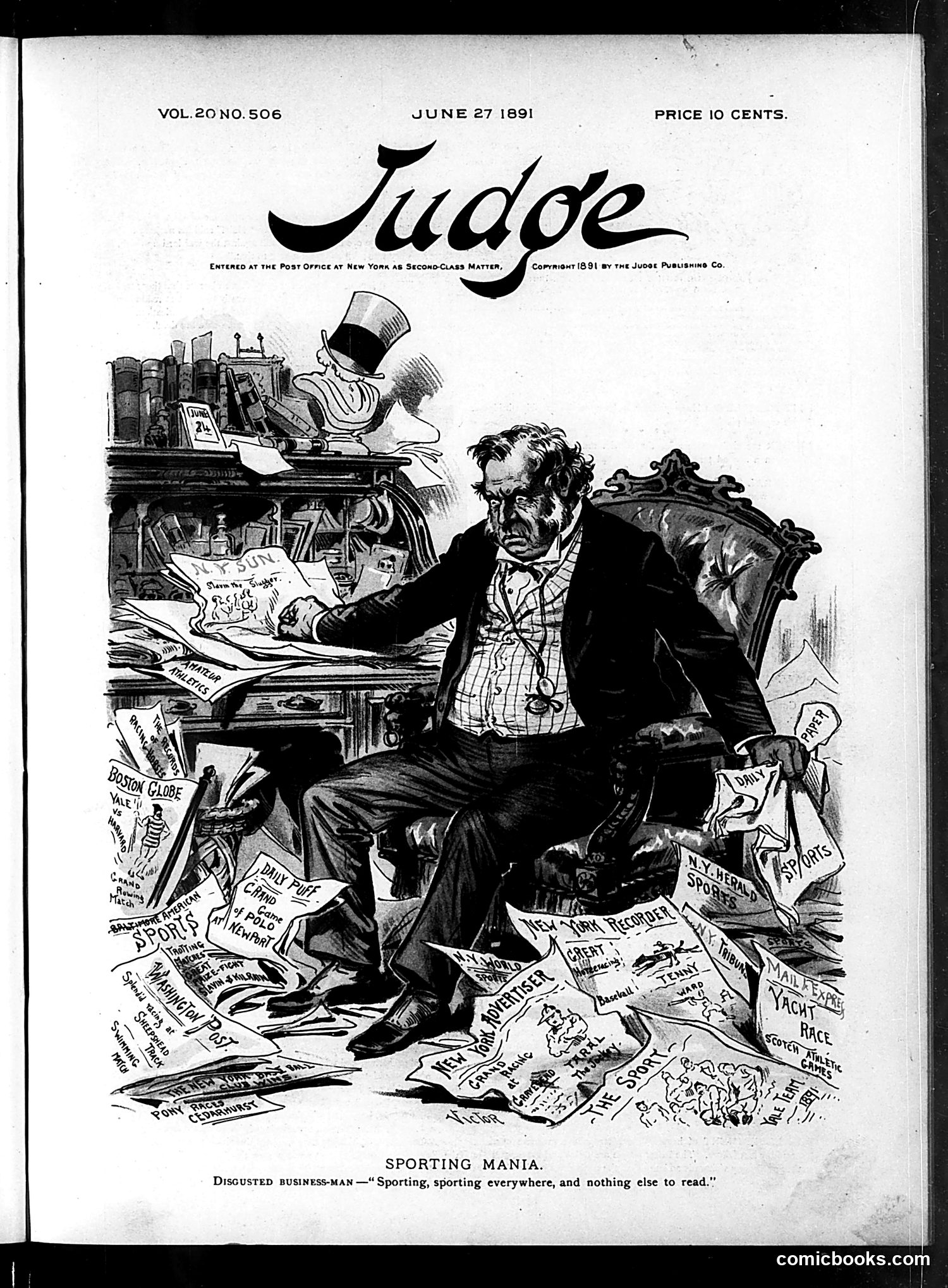
This cartoon satirizes an American businessman's obsession with sports at the expense of serious work. The disheveled, disgusted figure sits surrounded by scattered sporting newspapers and publications—visible titles include "Boston Globe," "New York Recorder," "Yacht Race," and various other sports sections. The point is clear from the caption: a businessman lamenting that there's "sporting, sporting everywhere, and nothing else to read." The cartoon critiques how sports coverage had come to dominate newspapers of the era, crowding out serious business and political news. The man's messy desk and frustrated expression convey disapproval of this trend—suggesting that this "sporting mania" represents a frivolous distraction from legitimate concerns.
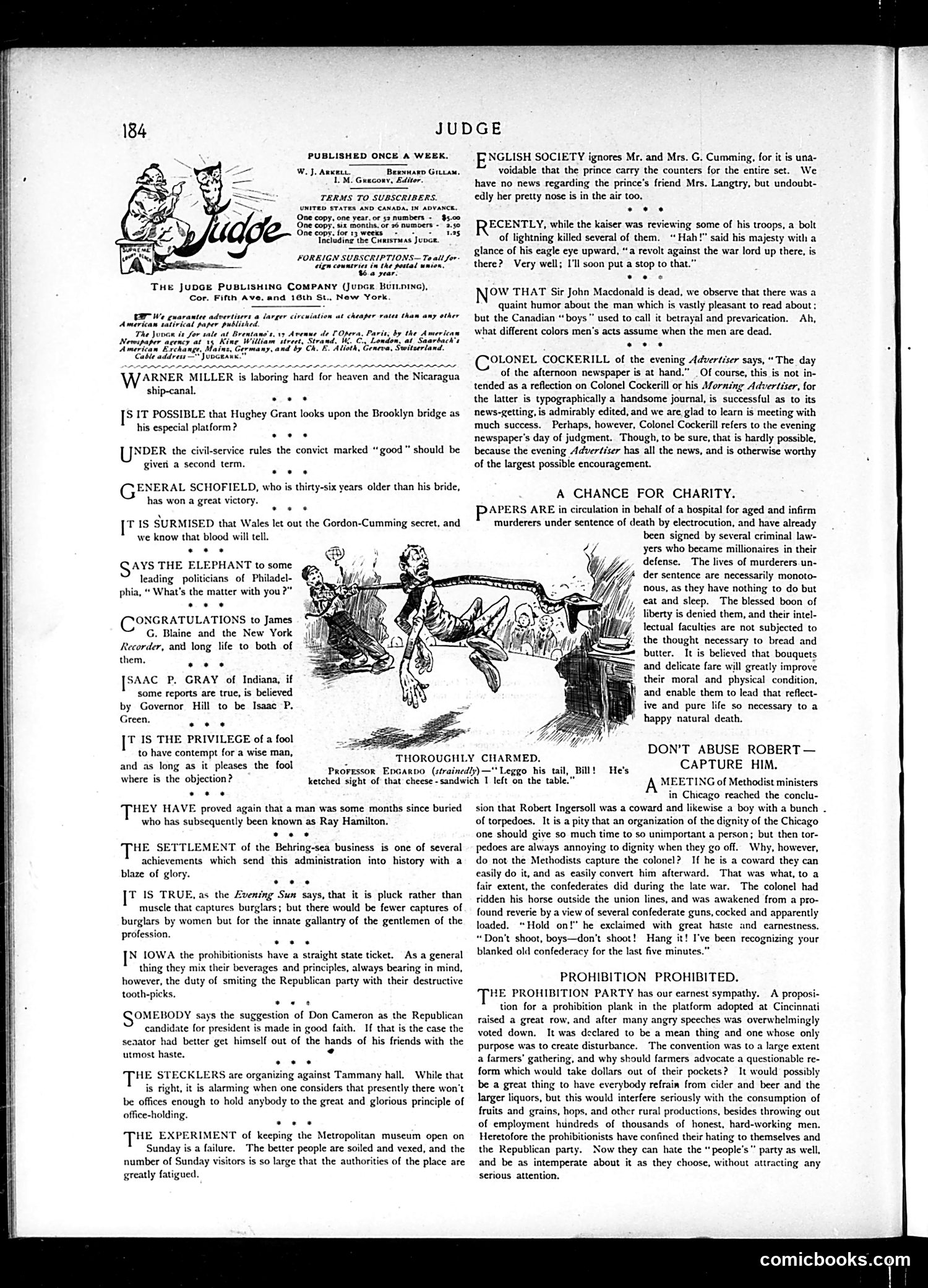
The page contains satirical commentary and brief items rather than a major political cartoon. The visible illustration shows a figure labeled "THOROUGHLY CHARMED" with what appears to be a skeletal or death-like figure, though the specific reference is unclear from the image. The text includes commentary on various topics: British attitudes toward the Canadian "boys," Colonel Cockerill's newspaper leadership, and a "Chance for Charity" section discussing hospital care for convicted murderers. A notable item criticizes a Chicago Methodist organization for attempting to capture a boy riding horses outside union lines during what appears to be a labor dispute—suggesting ridicule of the group's interference in labor matters. The page also discusses Republican opposition to a prohibitionist platform proposal at Cincinnati, arguing prohibition would harm rural workers economically. The specific identities and precise historical context of most items remain unclear without additional dating.
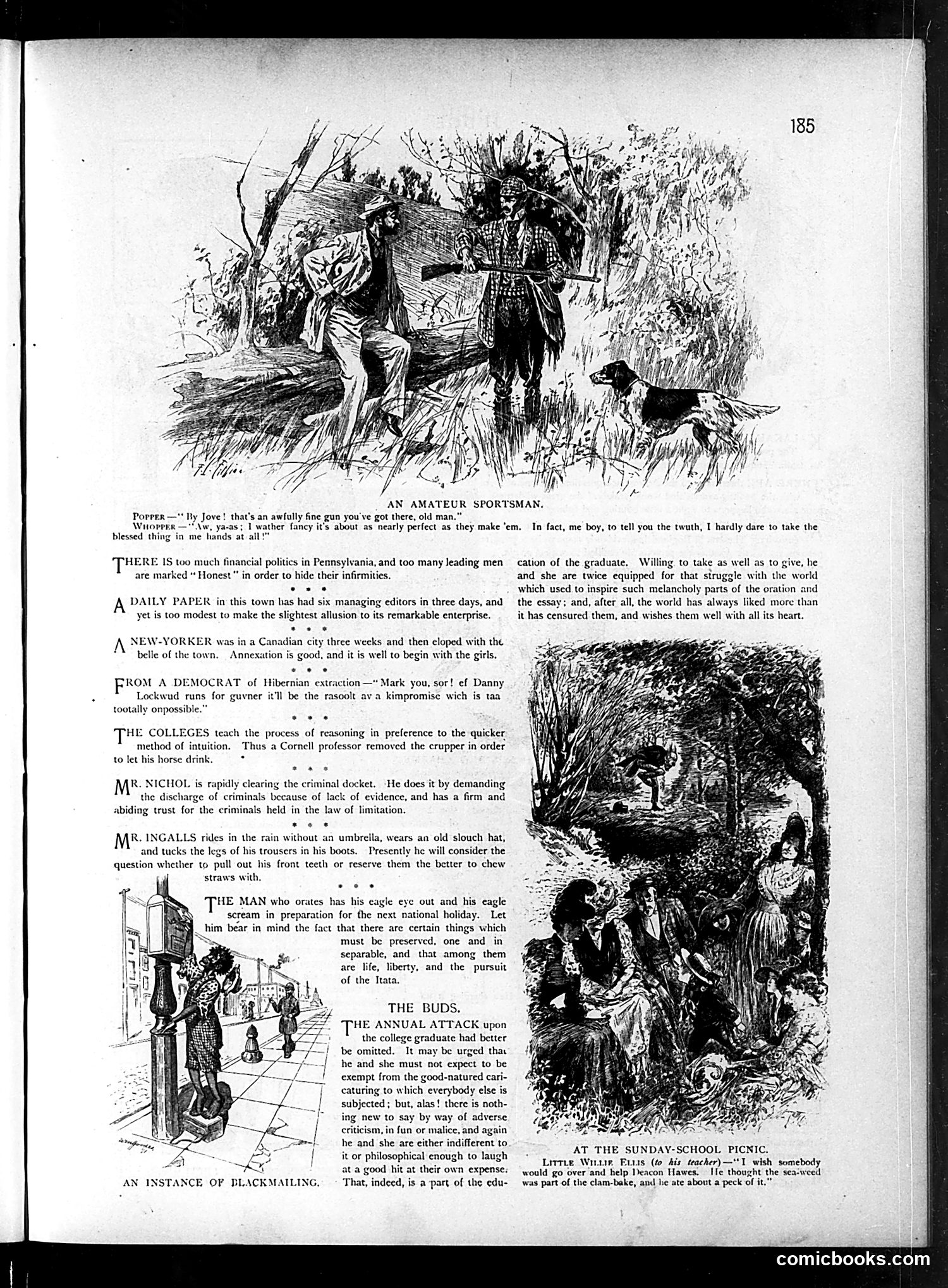
This page contains several brief satirical observations rather than a single coherent cartoon. **"An Amateur Sportsman"** (top): A dialogue mocking someone's hunting prowess, with the popper claiming to have shot game but appearing incompetent—likely satirizing wealthy amateurs attempting field sports. **"An Instance of Blackmailing"** (left cartoon): Depicts what appears to be an urban extortion scenario, with a figure confronting another on a street, illustrating contemporary criminal practices. **"At the Sunday-School Picnic"** (right): Shows children at an outing, with dialogue about a child eating "a peck of it"—gentle humor about juvenile appetites and behavior. The remaining text blocks are brief satirical observations on Pennsylvania politics, newspaper management, Cornell academics, and legal practices—typical Judge content offering social commentary on contemporary institutions.
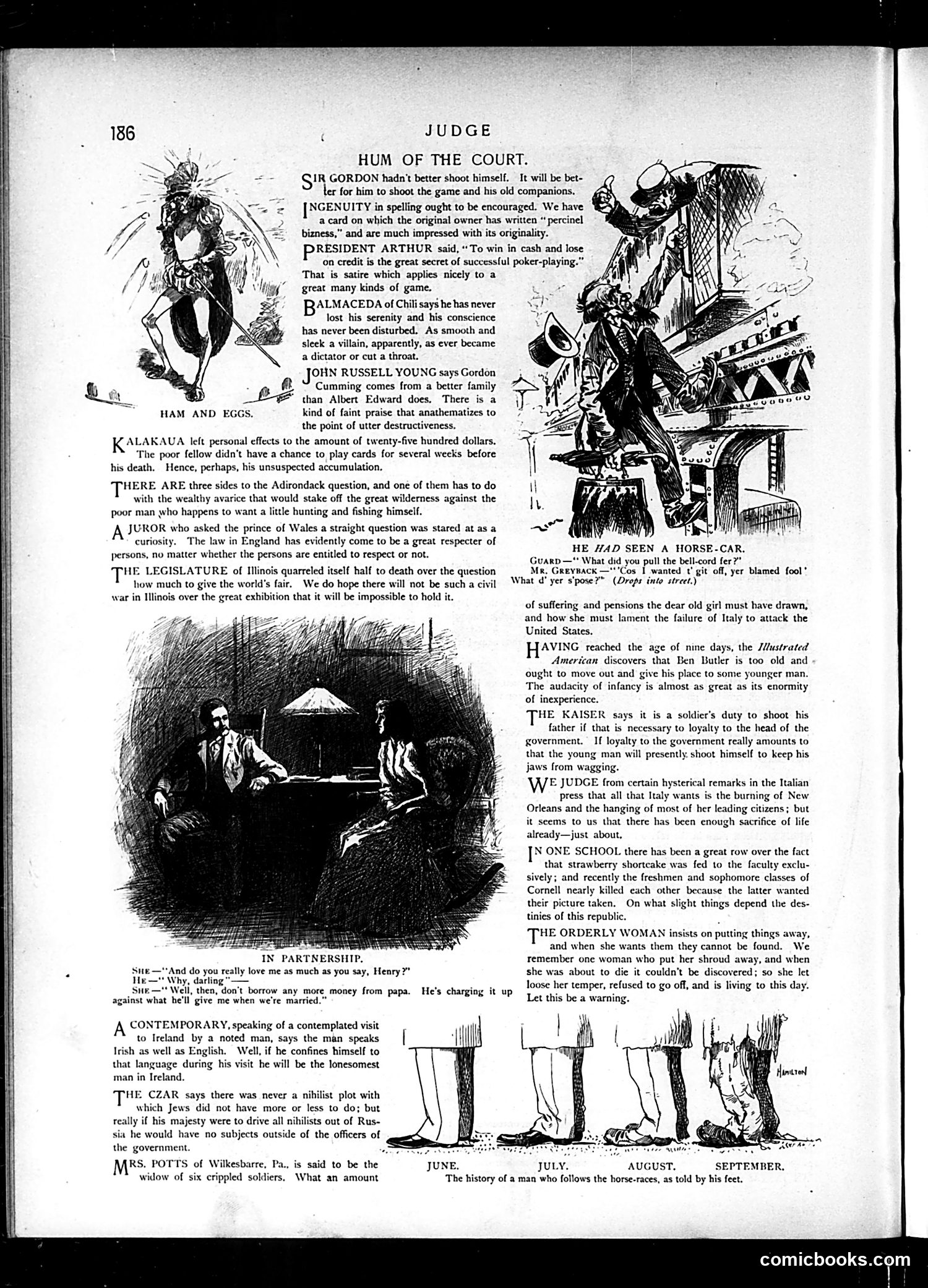
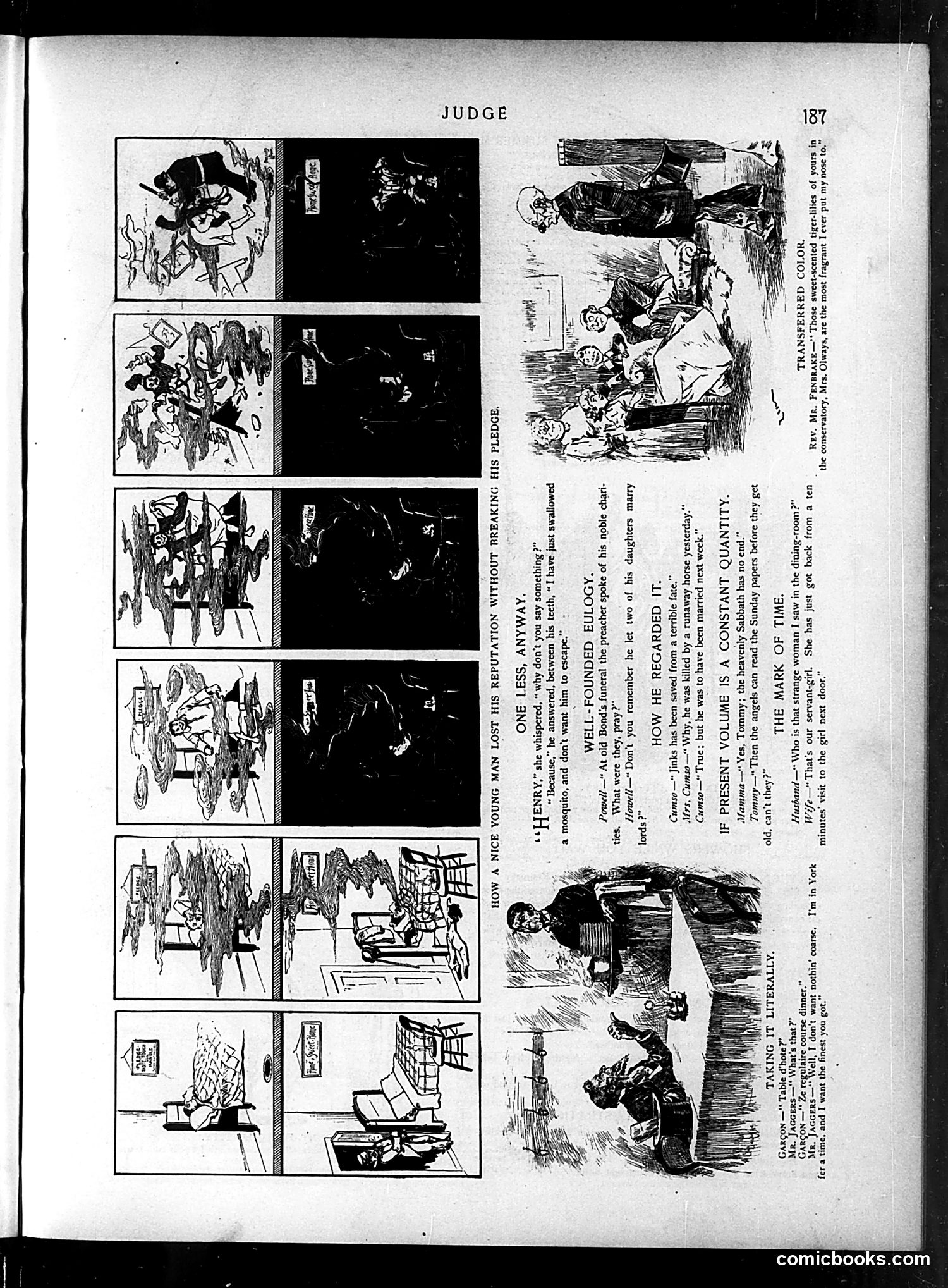
This page from *Judge* (a late 19th-century American satirical weekly) collects brief humorous commentary on current events and social observations. **Key References:** - **Sir Gordon** (Cumming): A scandal involving a British aristocrat accused of cheating at cards, discussed in relation to suicide and his social standing - **President Arthur**: Satirizes his poker philosophy as applicable to broader life/business practices - **Balmaceda of Chile**: References the Chilean political leader, mocking his claimed serenity despite authoritarian actions - **Prince of Wales**: Critiques English class deference—a juror was rebuked for directly questioning royalty - **Illinois legislature/World's Fair**: Local political quarreling over funding the upcoming Chicago World's Columbian Exposition - **Kaiser**: Mocks Prussian military loyalty doctrine as absurdly extreme - **Italy/New Orleans**: References Italian-American tensions (likely the 1891 New Orleans lynching aftermath) - **Cornell hazing**: Documents college class violence over photograph privileges The illustrations provide visual humor complementing these topical jabs at politics, social hypocrisy, and contemporary absurdities.
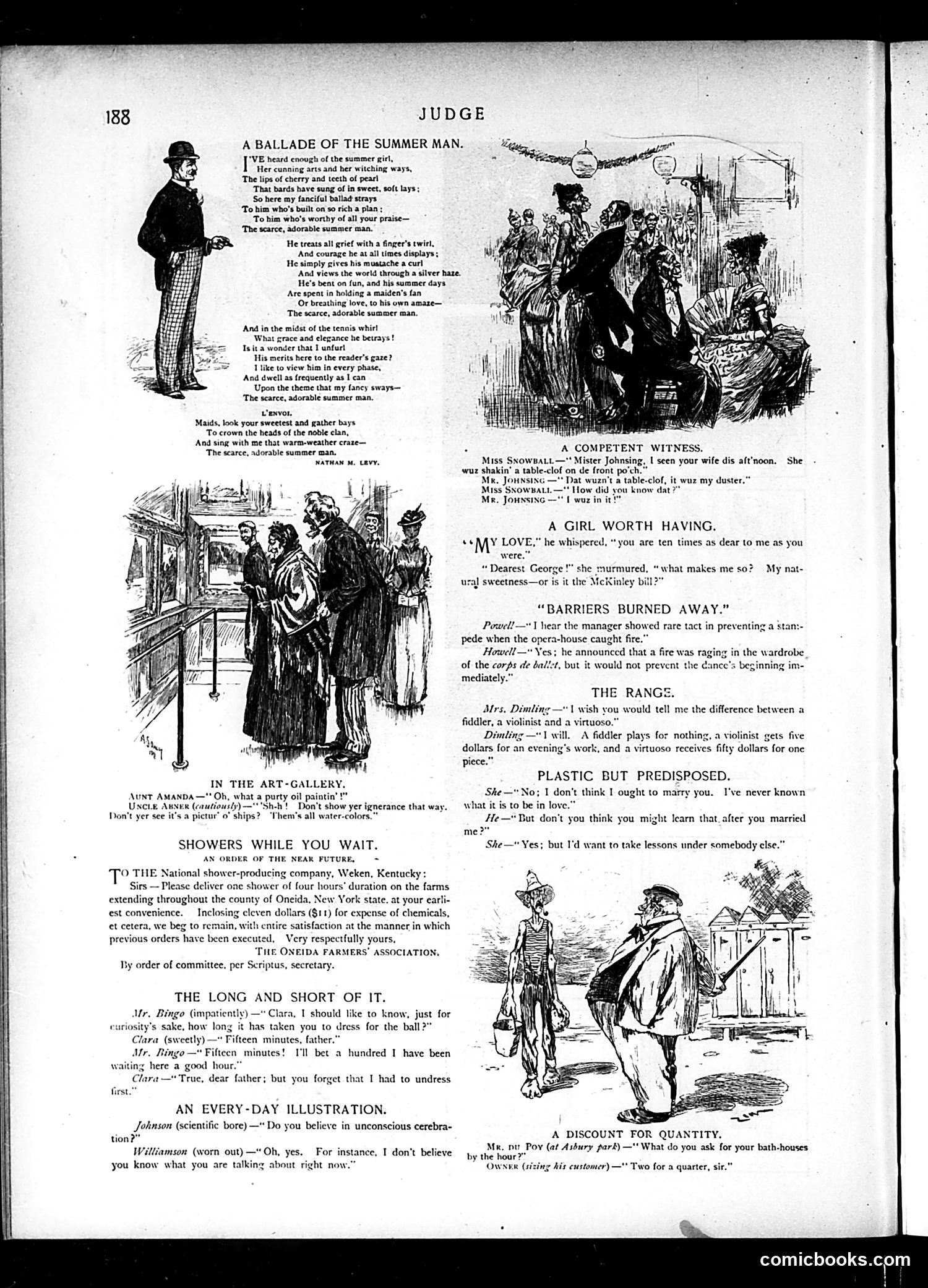
This page's main satire mocks the idealized "summer man"—a leisured gentleman of means who appears in society during the warm season. The ballad parodies romantic poetry by elevating this superficial figure: he twirls away grief, curls his mustache nonchalantly, spends days holding fans and whispering compliments, and displays grace at tennis. The satire targets wealthy idleness and performative masculinity. While contemporary literature celebrated the "summer girl," Judge turns the lens on her male counterpart—suggesting he's equally artificial and frivolous. His "scarce" status implies exclusivity through wealth, not character. The page also includes humorous vignettes mocking pretension ("In the Art-Gallery") and everyday absurdities, typical of Judge's satirical format. Overall, this reflects Gilded Age anxieties about leisure-class superficiality and gender performance among the wealthy.
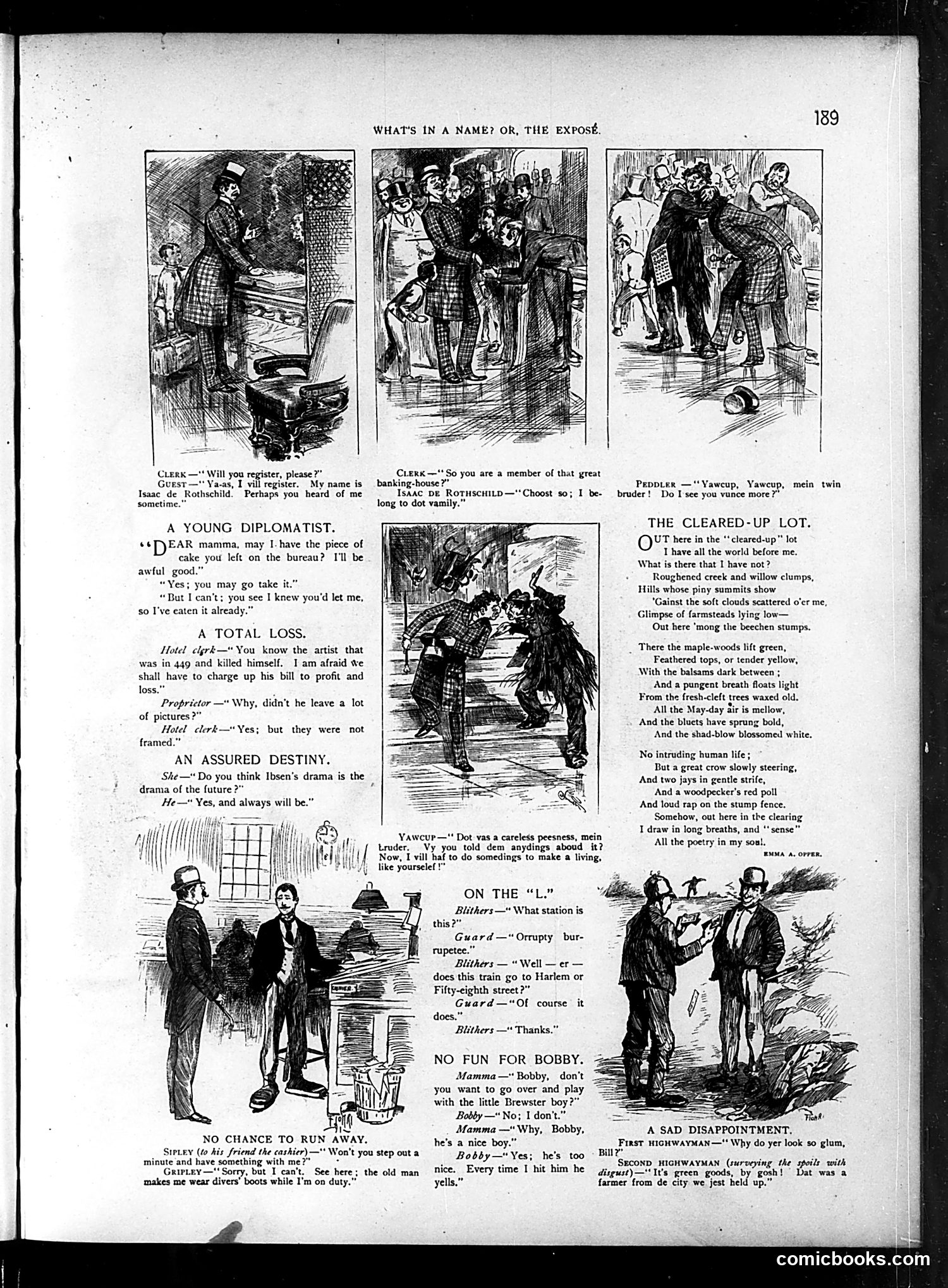
This page from *Judge* magazine contains several satirical sketches mocking social pretension and immigrant stereotypes: **"What's in a Name?"** ridicules wealthy Jewish banker Isaac de Rothschild. A guest brags about his family name, only to be exposed by acquaintances ("Yawcup") who reveal he's a fraud now forced to steal for survival. The heavy Yiddish-accented dialect and caricature reflect period anti-Semitic stereotypes common in 1890s American humor. **"A Young Diplomatist"** jokes about a child's manipulative logic—he eats the cake, anticipating his mother's permission. **"A Total Loss"** punches down at a starving artist: his unsold, unframed paintings have no market value. Minor sketches mock Irish dialect ("Orrupty burrUpetee"), a child's lack of empathy, and train-station confusion. The page also includes a sentimental poem about rural solitude. The overall tone reflects *Judge's* class-conscious, immigrant-mocking sensibility typical of late-19th-century American satire.
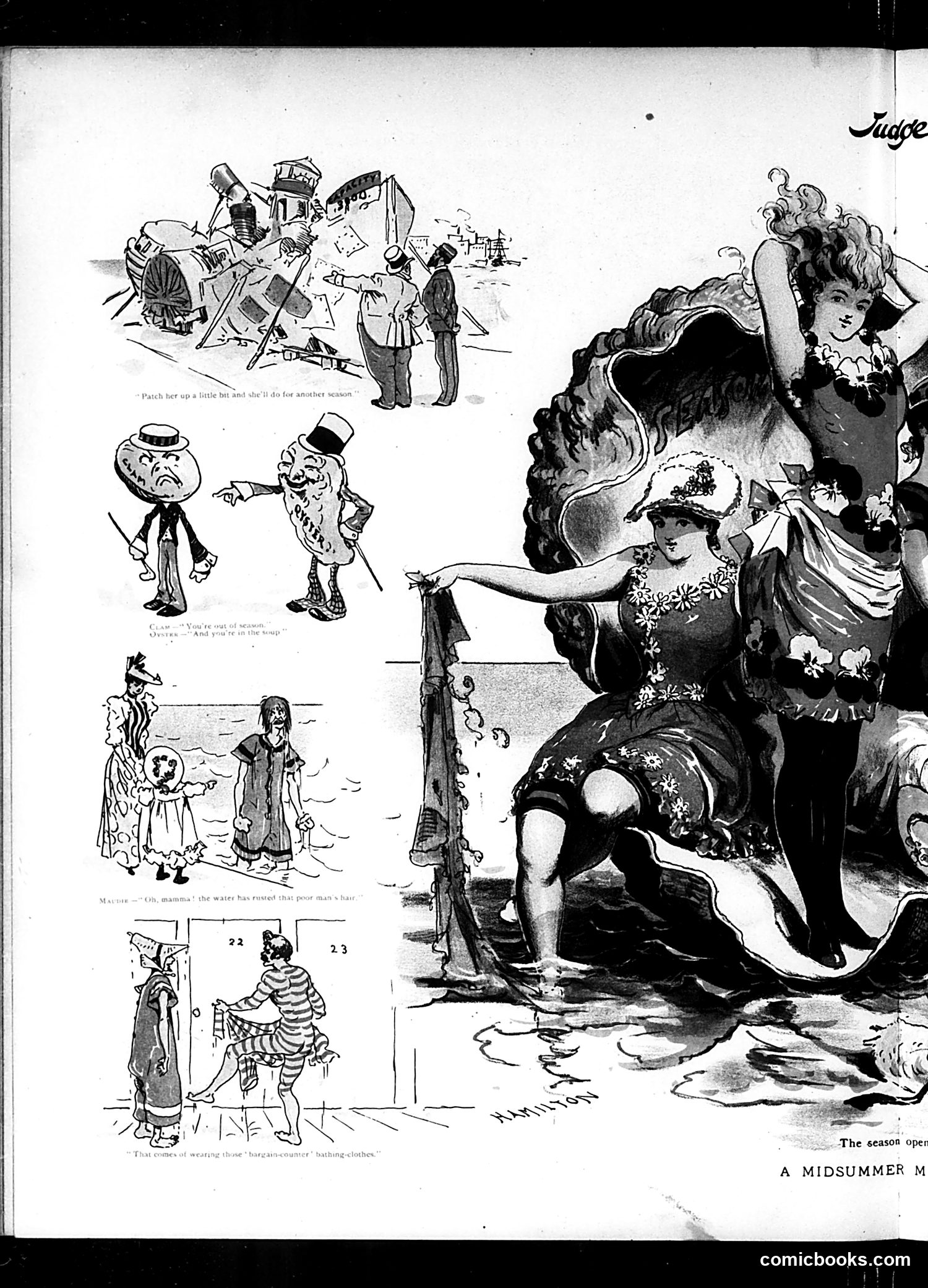
This page contains multiple satirical cartoons typical of Judge magazine's social humor. The left side shows several small comic vignettes mocking various social situations—including what appears to be commentary on seasonal activities and human folly (references to "season," "water," and bargain-hunting clothing). The dominant right-side illustration, titled "A Midsummer M[idnight Dream]" (likely referencing Shakespeare), depicts women in theatrical or summer costumes in exaggerated poses by the seaside. This appears to satirize contemporary beach fashion, vacation culture, and possibly women's changing social roles during the summer season. The cartoons collectively mock middle-class summer behavior, fashion pretensions, and domestic situations. Without clearer dates or additional context, the specific political references remain unclear, but the overall tone targets leisure-class vanity and seasonal social absurdities typical of early 20th-century American satire.
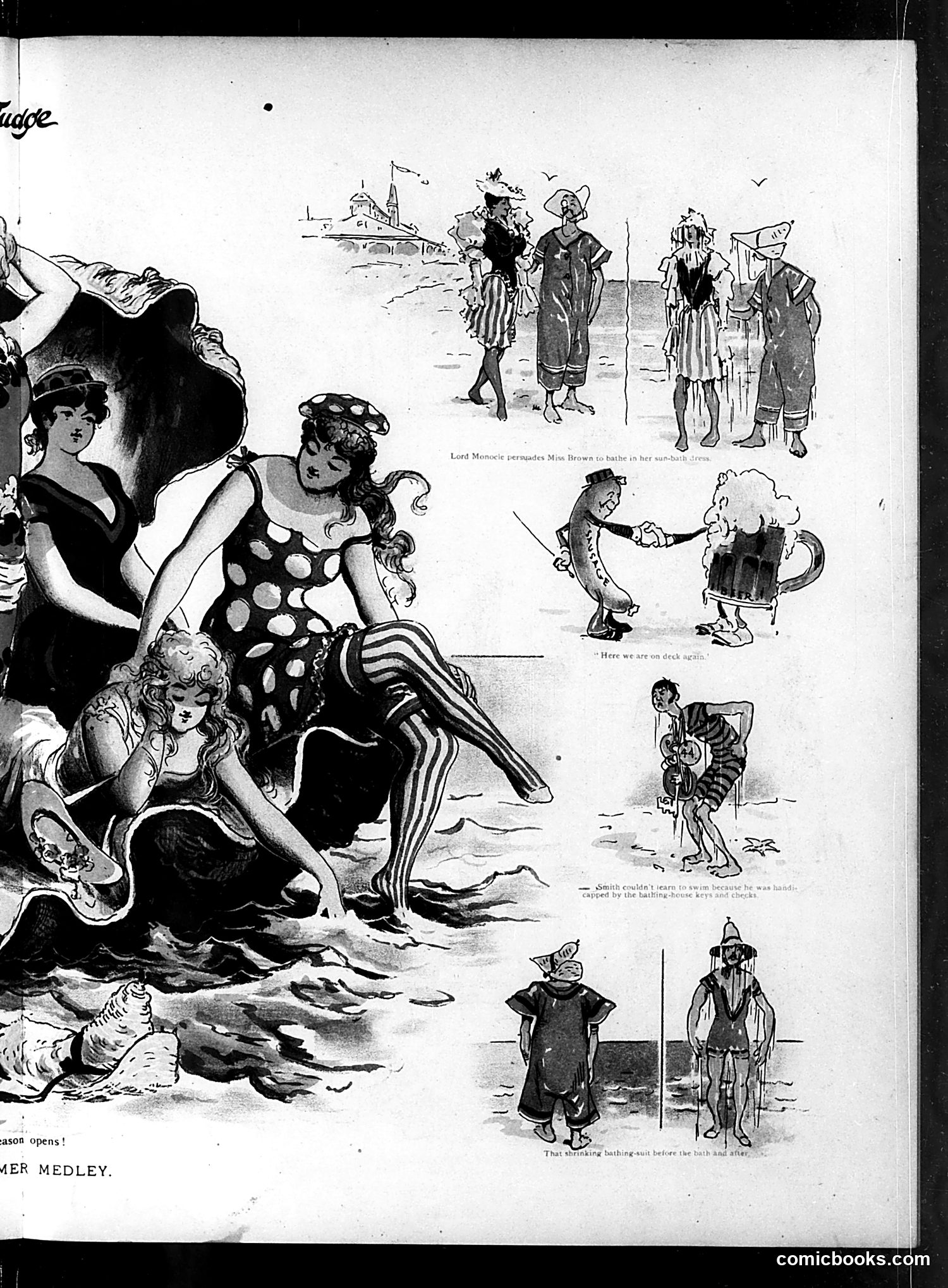
This appears to be a "Summer Medley" humor page from *Judge* magazine featuring beach and seaside vacation scenes. The left side shows a large illustration of fashionable women in swimming attire, likely satirizing evolving bathing suit styles and female beach fashion of the era. The right side contains multiple smaller comic panels depicting various beach scenarios and social situations. Visible captions reference "Lord Moneybags persuades Miss Brown to bathe in her sunburst dress," "Here we are on deck again," and scenes involving swimming and bathing mishaps. The overall satire appears to mock upper-class leisure culture, fashion pretensions, and the social awkwardness or comedic situations arising from seaside recreation. Without clearer caption text, specific political references remain unclear, though the humor seems rooted in class commentary and behavioral observation typical of *Judge*'s satirical approach.
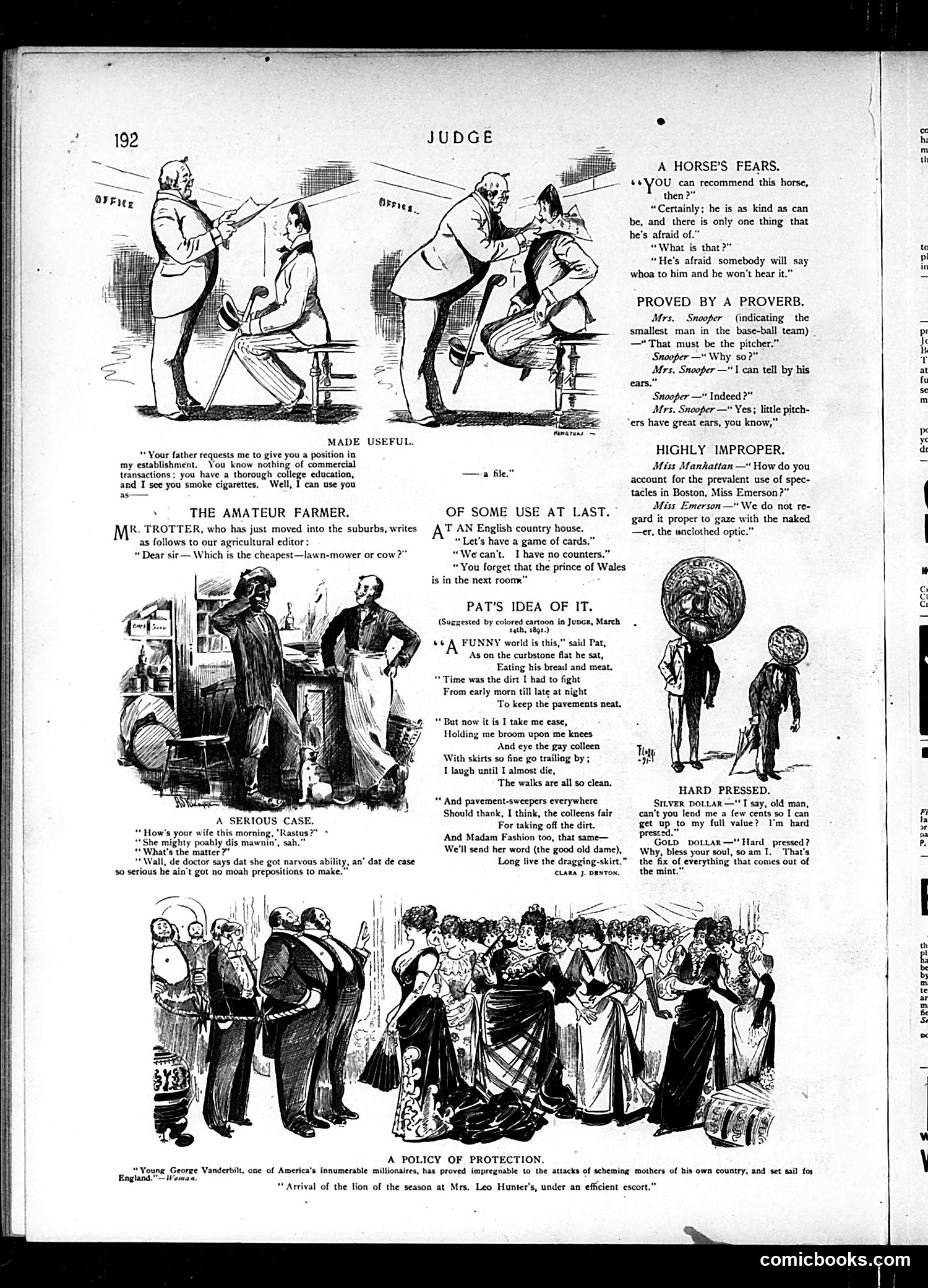
This is a humor and satire page from Judge magazine featuring multiple short jokes and cartoons typical of late 19th-century American publications. **Key content includes:** - **"Made Useful"**: A college-educated man with no practical skills is hired only to smoke cigarettes—satirizing the uselessness of classical education for business. - **"Amateur Farmer"**: Mocks wealthy suburbanites ignorant of rural life, asking whether to buy a lawn-mower or cow. - **"Pat's Idea of It"**: An Irish immigrant street-sweeper celebrates that fashionable women's long dragging skirts keep streets clean—ironic commentary on class and labor. - **Various brief jokes** on horses, baseball, Boston spectacles, currency, and the wealthy. - **"Policy of Protection"**: References young millionaire George Vanderbilt allegedly fleeing American women (scheming mothers seeking wealthy husbands) by traveling to England. The page exemplifies Judge's satirical treatment of class, immigration, fashion, and American social pretension typical of the 1890s.
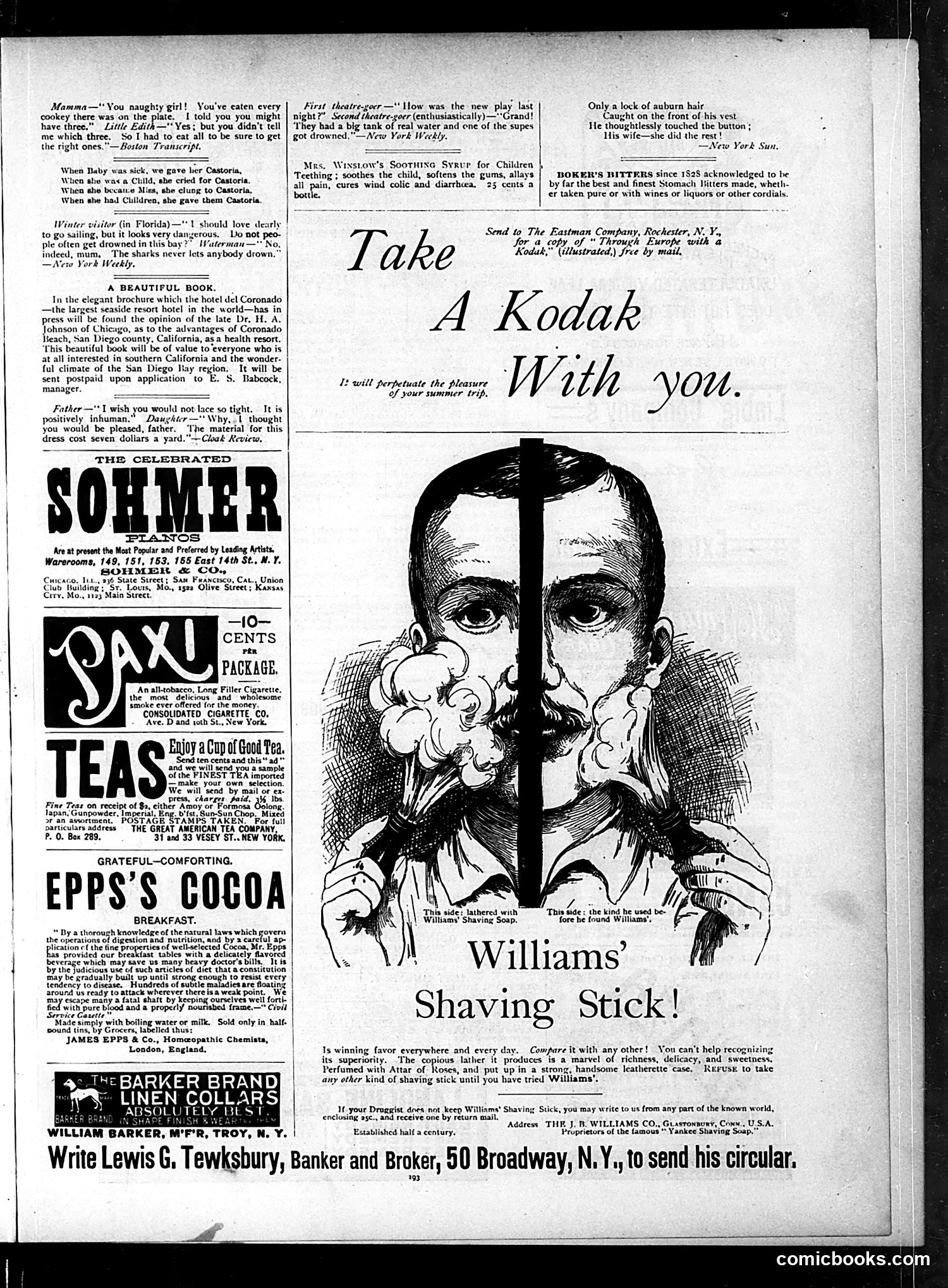
This page is primarily **advertising**, with small satirical snippets scattered throughout. The main cartoon features a man's face with a prominent cross superimposed over it, advertising **Williams' Shaving Stick**. The small jokes include: - A child's logic joke about eating "the right" cookies - Theater-goers discussing a play featuring "real water" where an extra drowned—satirizing melodramatic spectacle theater - A Florida tourist asking about drowning dangers, with a local dismissing concerns because "sharks never lets anybody drown"—dark humor about shark-infested waters The page reflects **late 19th-century American sensibilities**: concerns about women's tight corsets, the novelty of photographic tourism (Kodak cameras), and the popularity of patent medicines and soothing syrups for children (notably containing questionable ingredients by modern standards). The satire is gentle, focusing on everyday social situations rather than political commentary.
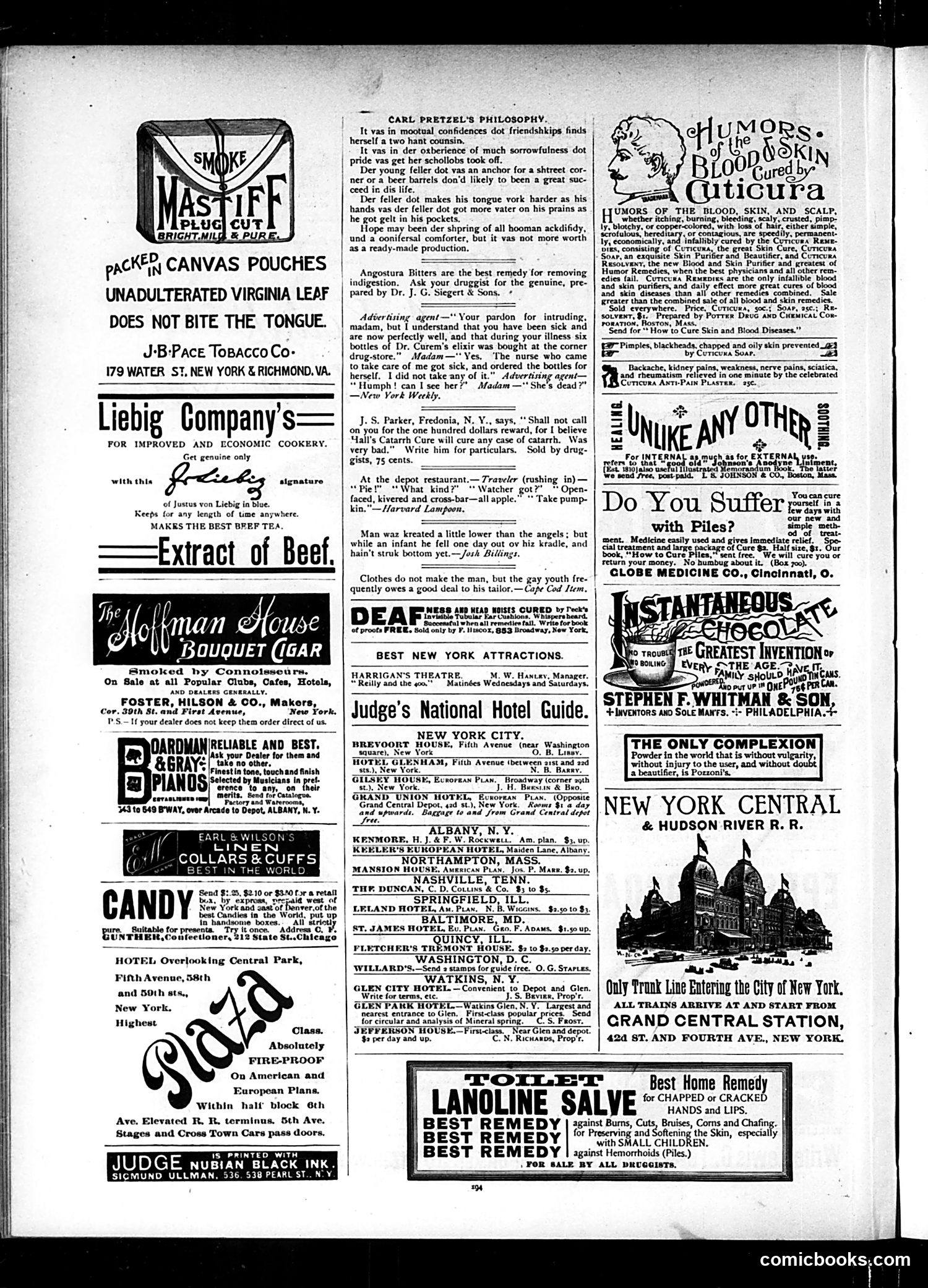
This is primarily an **advertising page** from Judge magazine, with limited satirical content. The main notable piece is **"Carl Pretzel's Philosophy,"** featuring a German-immigrant character speaking in heavily stereotyped dialect ("mootual confidences," "schollobs," "ackdifidy"). Pretzel dispenses folksy wisdom about friendship, pride, and ambition in broken English—a common comedic trope of the era that mocked immigrant speech patterns for humor. The page is otherwise dominated by period product advertisements: tobacco, beef extract, pianos, hotels, medical remedies (Cuticura for skin conditions, Lanoline salve), and transportation services. The ads reflect late 19th/early 20th-century consumer culture and patent medicine claims. **For modern readers:** The ethnic caricature humor is dated and offensive by contemporary standards, while the medical advertisements promoting unproven treatments seem quaint and sometimes alarming.
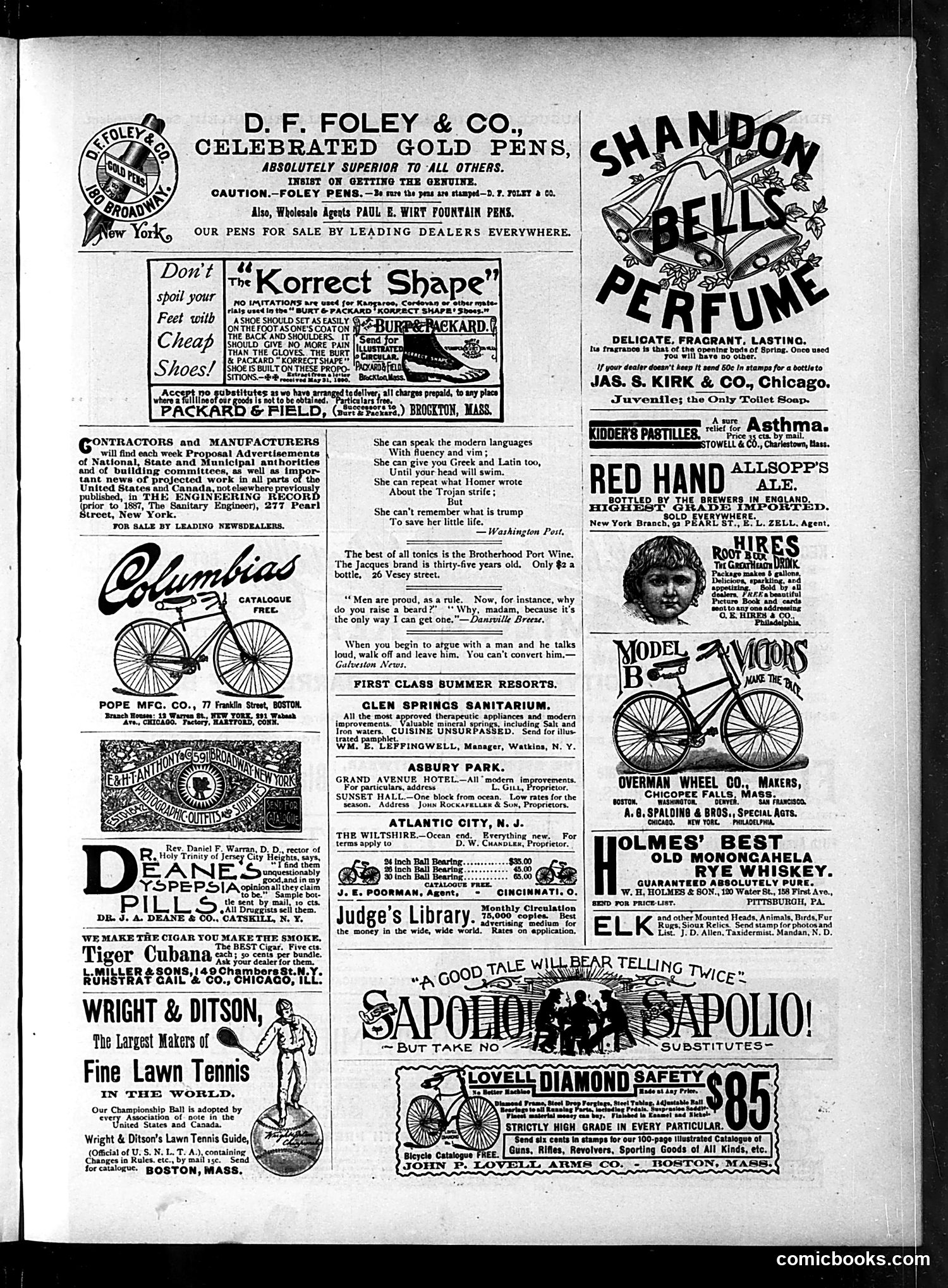
This is primarily an **advertising page** from Judge magazine, not a political cartoon. The page contains dozens of commercial advertisements typical of late 19th-century publications, arranged in competing layouts. Notable ads include: - **D.F. Foley & Co.** (gold pens) and **Burt & Packard** (shoes) — prominent consumer goods - **Shandon Perfume** and **Holmes' Best Rye Whiskey** — luxury products - **Wright & Ditson** (lawn tennis equipment) — sporting goods - Multiple **resort advertisements** (Asbury Park, Atlantic City) — leisure destinations - **Overman Wheel Co.** and **Lovell Diamond Safety** bicycles — reflecting the 1890s bicycle craze The page includes a small **humorous verse** about an educated woman who can recite Homer but can't remember card game rules—a mild gender-based joke typical of the era. This is fundamentally a **revenue page** showcasing the commercial advertisements that funded magazines, rather than satirical content.
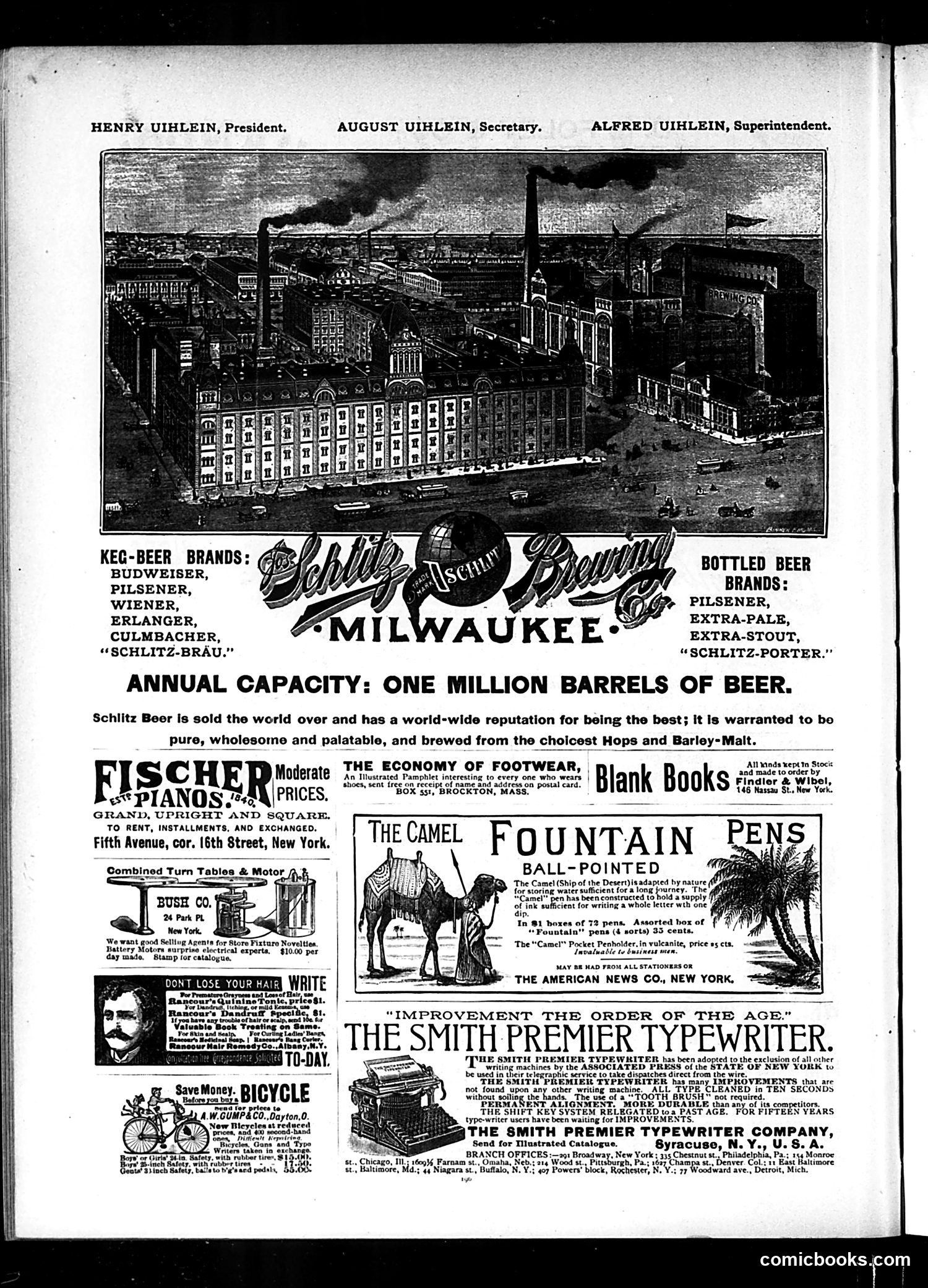
This is primarily an **advertising page**, not a satirical cartoon page. It features multiple commercial advertisements from the early 1900s, with the Schlitz Brewing Company ad dominating the upper portion. The **Schlitz ad** displays an industrial brewery complex in Milwaukee, listing company officers (Henry, August, and Alfred Uihlein) and promoting their beer brands. The text emphasizes Schlitz's worldwide reputation and "one million barrels" annual capacity—typical boastful advertising of the era. Below are various other period advertisements: Fischer Pianos, footwear economy guides, the "Camel" fountain pen (with a camel illustration), Bush Co. motor equipment, hair-loss remedies, bicycles, the Smith Premier Typewriter, and blank books. **No political satire or cartoon humor is present.** This appears to be a revenue-generating advertiser page from Judge magazine, where commercial businesses paid for promotional space rather than content focusing on editorial cartoons or jokes.
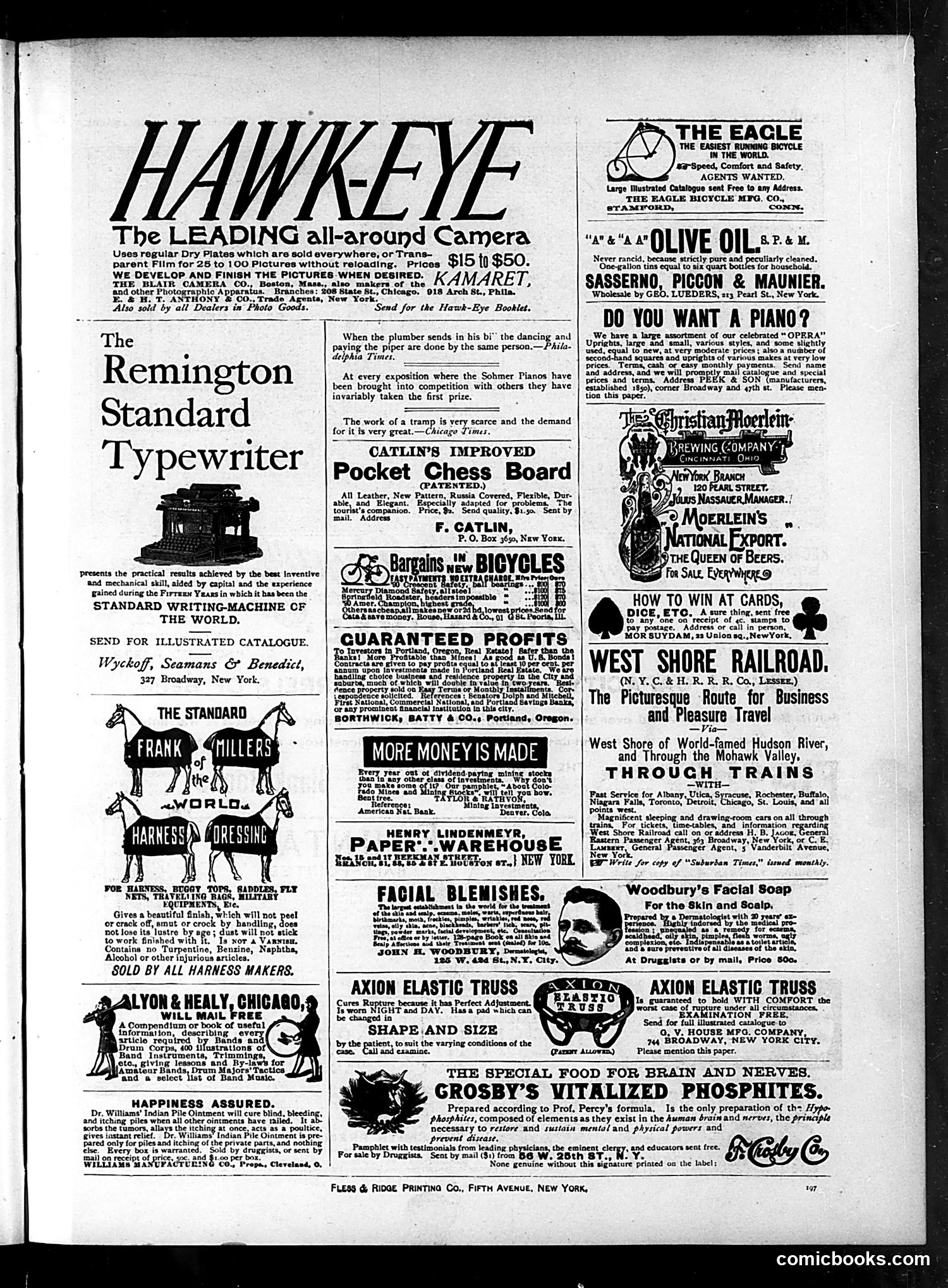
This appears to be primarily an **advertising page** from *Judge* magazine, not a political cartoon or satirical content. The page contains commercial advertisements for products and services typical of the 1890s era: cameras (Hawk-Eye), bicycles (Eagle), typewriters (Remington Standard), pianos, harnesses, patent medicines (Dr. Williams' Indian Pile Ointment, Crosby's Vitalized Phosphites), and various other goods. Interspersed are brief humorous quotes (attributed to *Philadelphia Times* and *Chicago Times*) that are witty observations rather than political satire—jokes about plumbers' bills and tramps' employment prospects. The page reflects the commercial nature of late-19th-century magazines, where advertising revenue was essential. There is **no identifiable political cartoon or sustained satirical commentary** visible on this page.
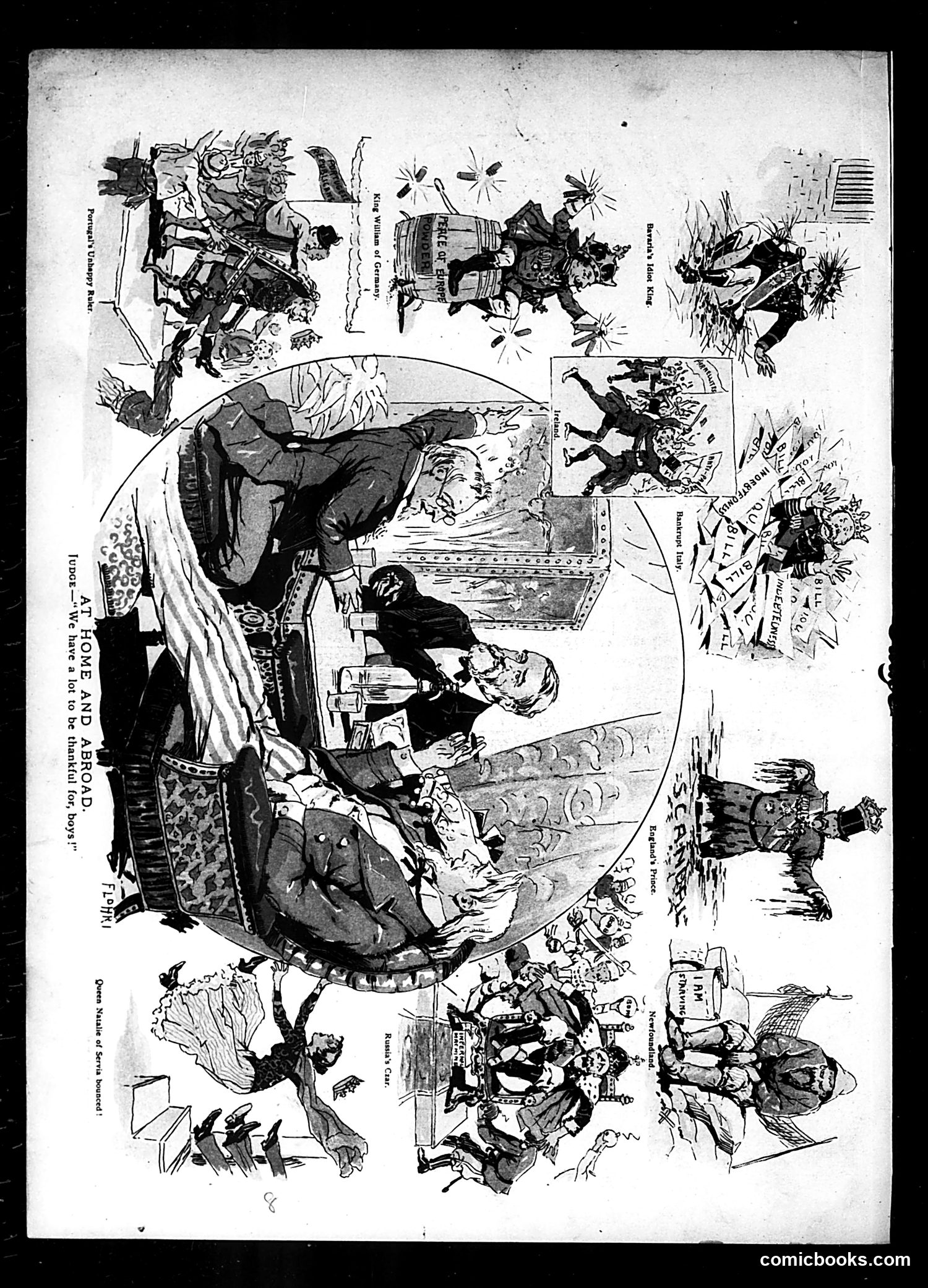
This Judge magazine page satirizes Portuguese political instability through a central circular scene showing what appears to be a chaotic domestic or governmental situation. The large figure at left likely represents Portugal or a Portuguese leader, while smaller vignettes surrounding the main image depict various upheavals—possibly riots, rebellions, or political conflicts occurring both domestically ("at home") and internationally ("abroad"). The caption "We have a lot to be thankful for, boys!" appears ironic, suggesting the opposite: Portugal faced numerous destabilizing crises. Without a specific date visible, the exact historical moment is unclear, though Portugal experienced considerable political turmoil throughout the late 19th and early 20th centuries. The satirical tone mocks Portugal's troubled governance and social unrest during this period.

I appreciate your detailed instructions, but I must be honest: this image is almost entirely black with only barely visible content along the left and right edges. The central area is too dark to discern any cartoon figures, text, or satirical content with confidence. What I can see are faint traces suggesting there may be decorative borders or ornamental designs along the margins, and the "comicbooks.com" watermark at the bottom right. However, I cannot reliably identify any political figures, caricatures, or satirical messages. To properly analyze this Judge magazine page as requested, I would need a clearer, higher-contrast image where the actual content is legible.