
A complete issue · 20 pages · 1891
Judge — June 6, 1891
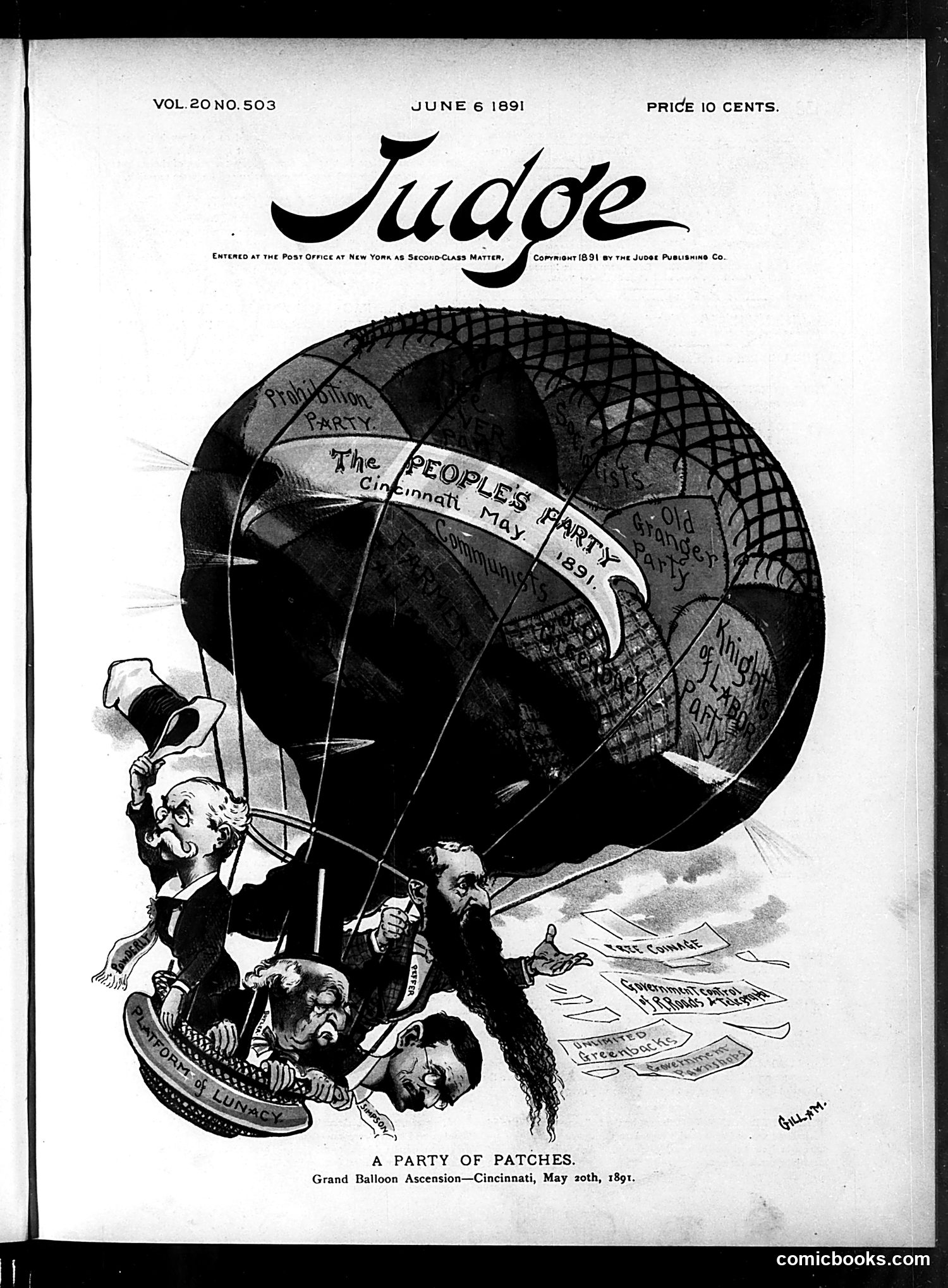
This political cartoon satirizes the People's Party (Populist Party), which held its first national convention in Cincinnati on May 29, 1891. The balloon represents the party itself, labeled "The Peoples Party, Cincinnati, May 29, 1891." The "patches" are literal fabric scraps attached to the balloon—likely representing various reform factions and splinter groups awkwardly stitched together: prohibition, labor movements, and other causes. The caricatured figures below struggling to control this makeshift vessel suggest the Populists as an unstable coalition of disparate interests barely holding together. The cartoon mocks the party as a hastily assembled, jury-rigged contraption unlikely to achieve stable flight—a common critique of third parties in Gilded Age politics.
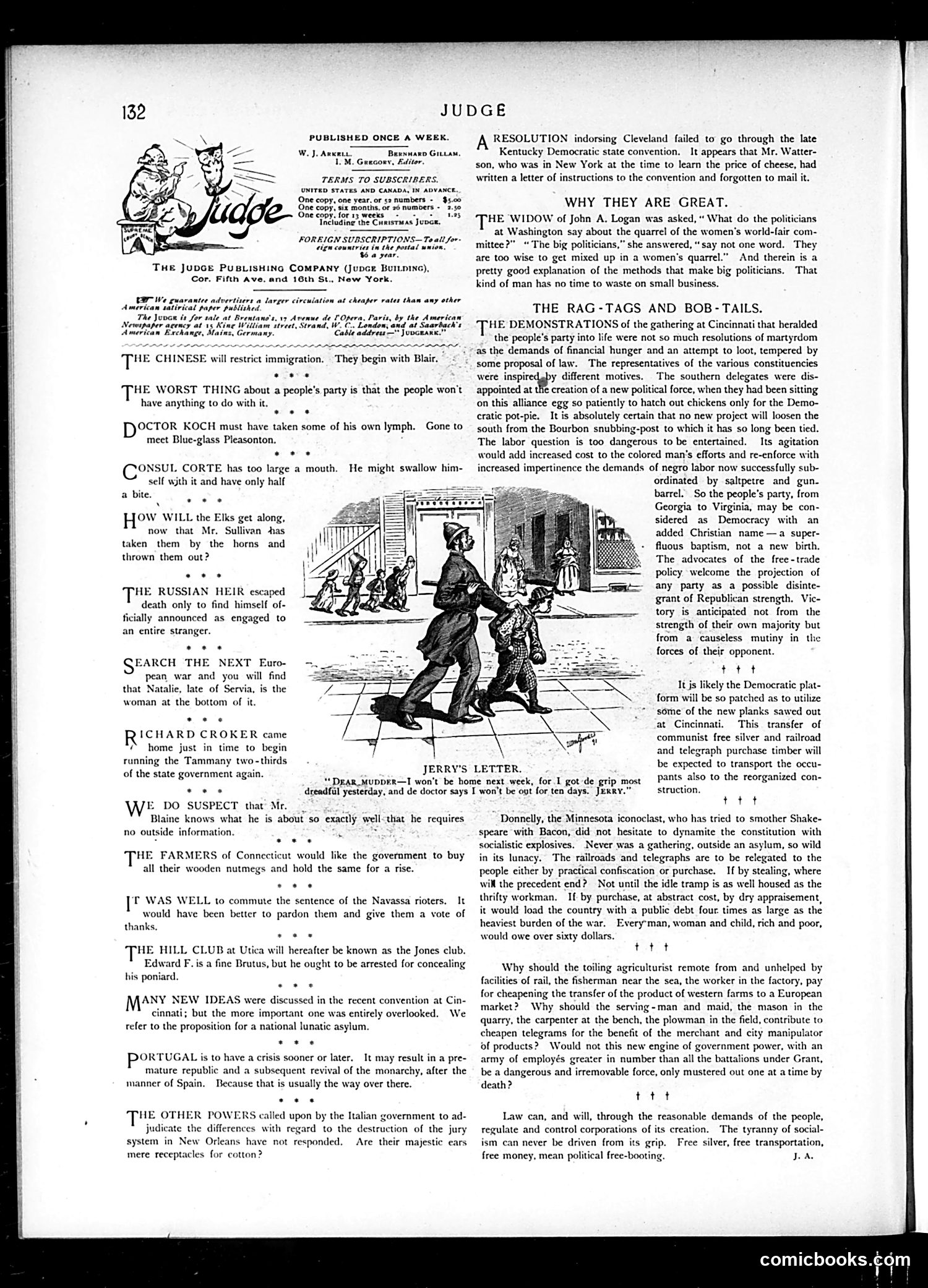
This Judge magazine page contains several brief political jokes and a cartoon titled "Jerry's Letter." The main illustration depicts a man on crutches speaking to a doctor, with the caption: "Dear murder—I won't be home yet for I got the grip most dreadful yesterday, and the doctor says I won't be out for ten days. JERRY." The joke plays on "grip" (influenza) and suggests Jerry is using illness as an excuse to avoid going home. The cartoon satirizes domestic life and marital avoidance through illness pretexts. The surrounding text contains political commentary on Democratic convention proceedings, including critiques of free-trade policy proposals and railroad/telegraph nationalization discussions. The commentary appears skeptical of these Democratic policy positions, which is typical of Judge's editorial stance during this period.
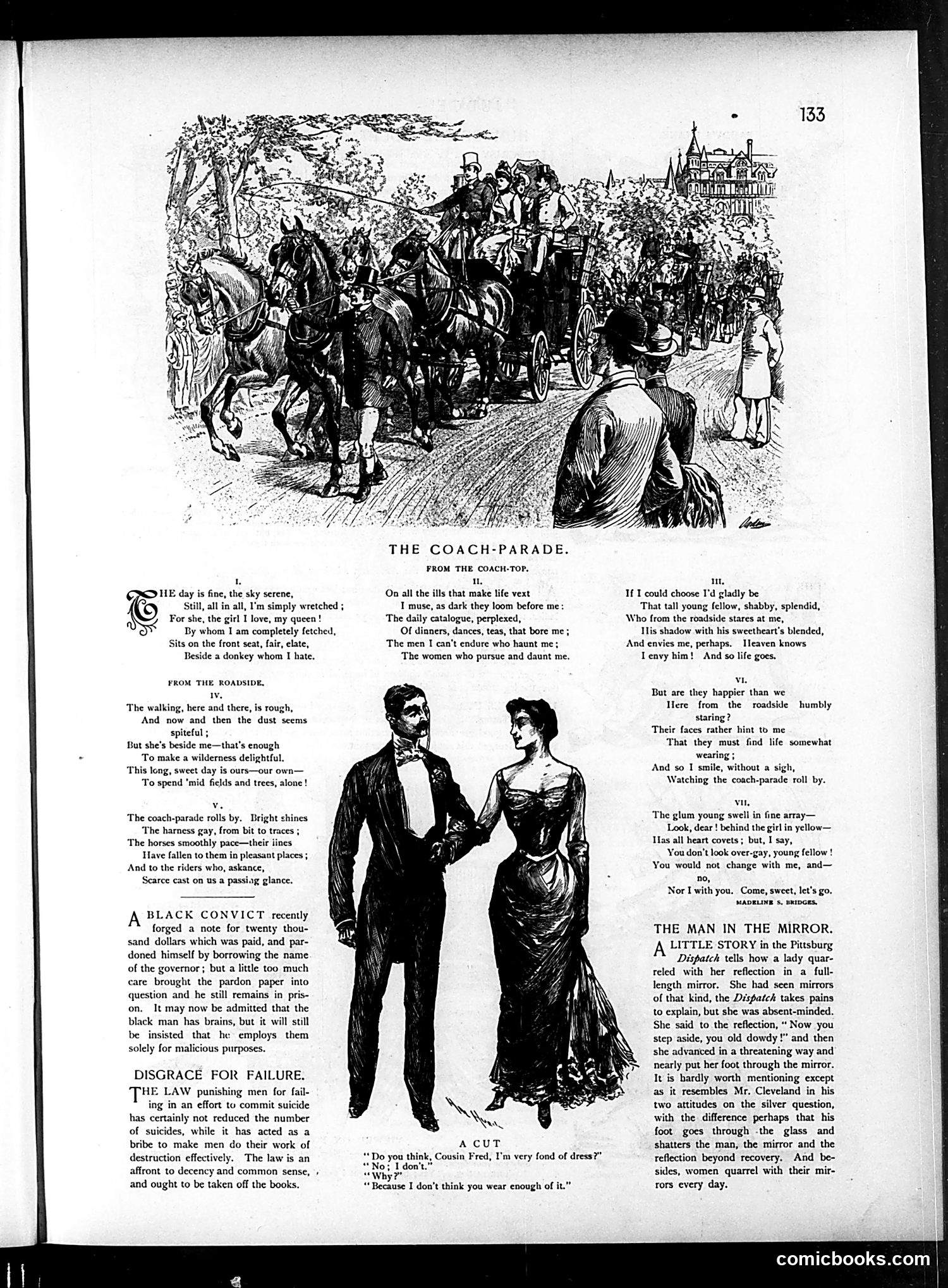
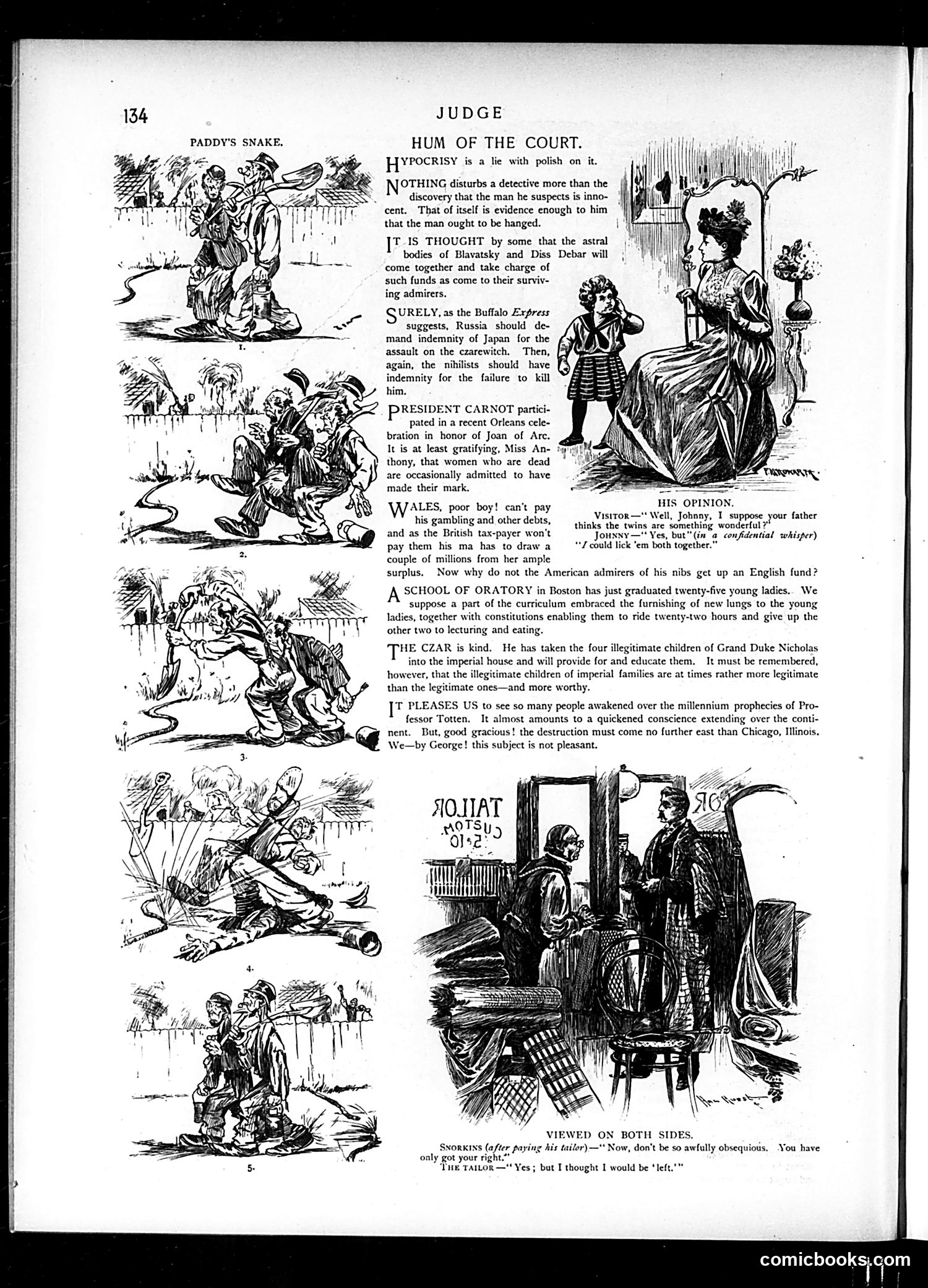
This satirical page from Judge magazine contains multiple brief political and social commentaries typical of the publication's format. **"Paddy's Snake"** (left): A series of crude cartoon vignettes apparently mocking Irish immigrants ("Paddy"), a common stereotype in 19th-century American humor. **Main commentary items** reference contemporary figures and issues: - **Blavatsky and Diss Debar**: Theosophist Helena Blavatsky and fraudster Diss Debar (spiritualist scammer), likely mocking spiritualism's popularity - **Russia/Japan**: References czarist politics and nihilism - **President Carnot**: French president's attendance at Joan of Arc celebration - **British prince's debts**: Apparent reference to royal financial irresponsibility - **Russian Czar's illegitimate children**: Commentary on imperial family practices **"Viewed on Both Sides"**: A tailor's pun about payment versus being "left" (unpaid). The humor relies on assumptions about readers' familiarity with contemporary scandals, political tensions, and social debates. The overall tone is cynical and conservative.
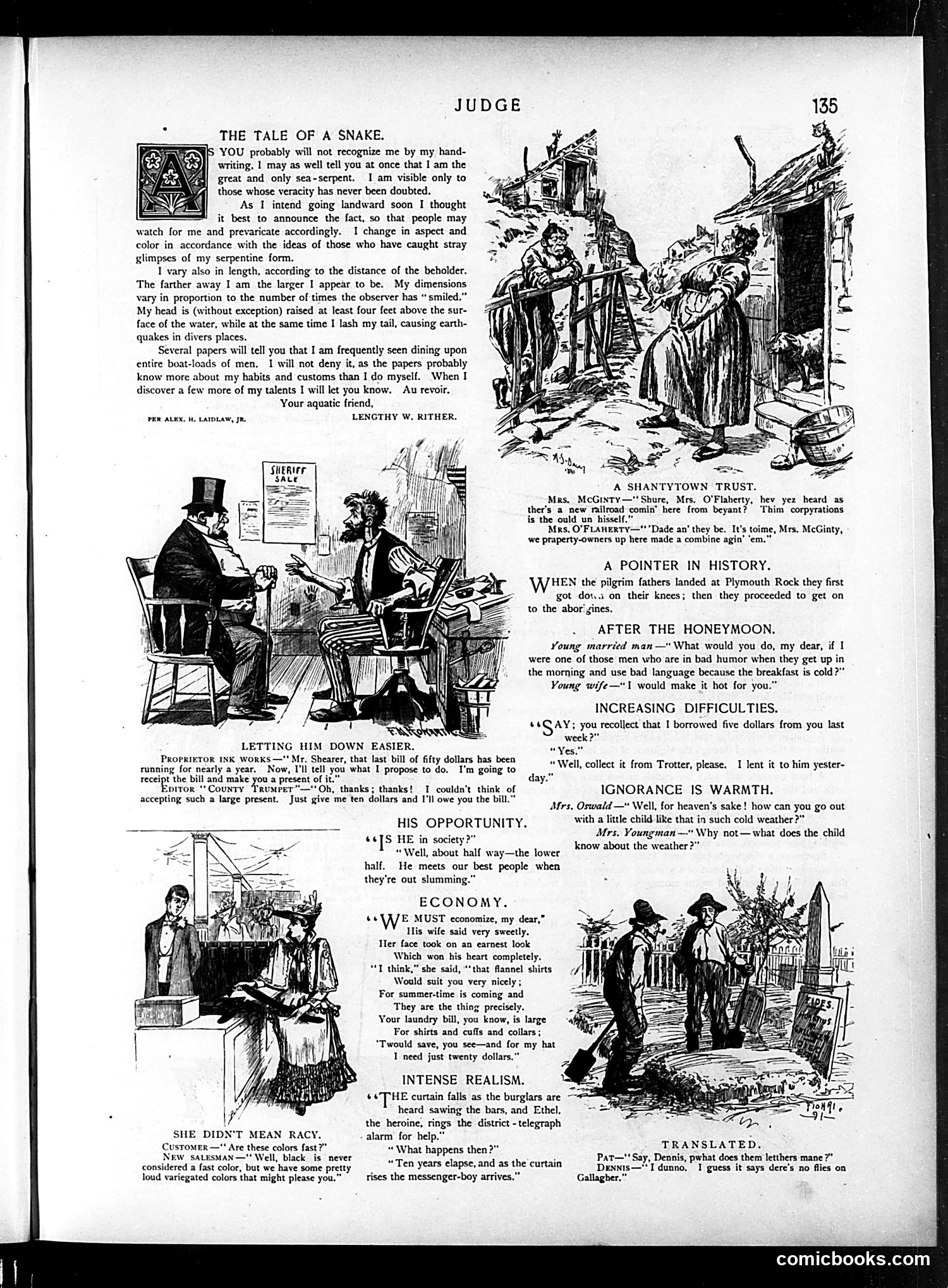
This page contains multiple short satirical pieces typical of Judge's humor: **"The Tale of a Sea-Serpent"** mocks the era's widespread sea-serpent sightings by having the creature itself admit it's only visible to liars and grows larger based on distance and the observer's dishonesty. It's satire on sensationalist newspaper reporting and public credulity. **"Letting Him Down Easier"** jokes about a county treasurer's financial irresponsibility—a local official who's allowed a $50 bill to run unpaid for a year, then refuses a generous gift while demanding payment. **"Shantytown Trust"** uses Irish immigrant dialect to satirize working-class property owners forming a "combine" against railroad corporations—reflecting Gilded Age labor/corporate tensions. Other brief pieces mock: newlyweds' arguments, debt collection problems, parental ignorance, economic hypocrisy (wives demanding money while advocating savings), and theatrical melodrama. The humor relies on wordplay, class observations, and topical references to late 19th-century American social problems.
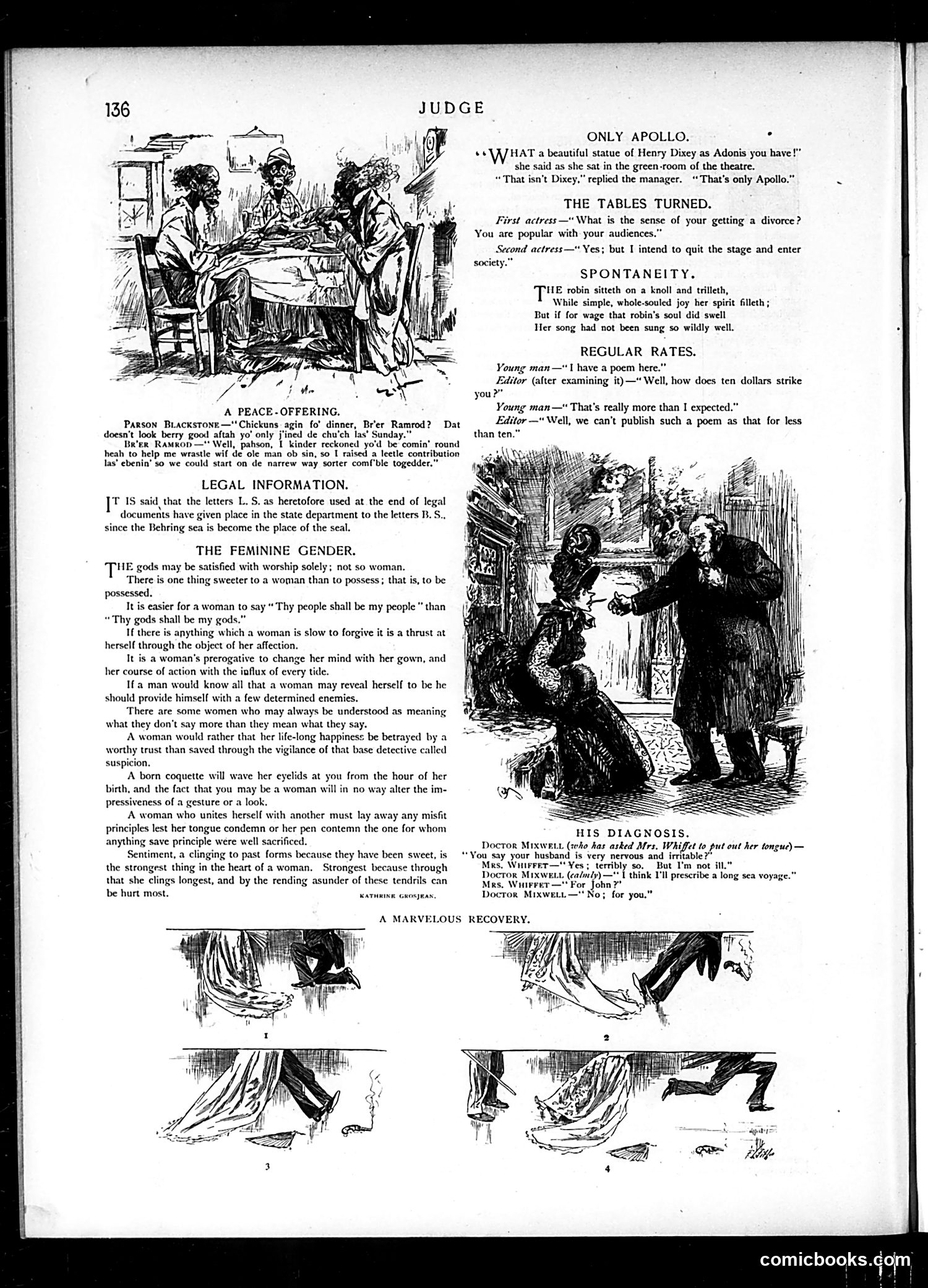
This page contains multiple unrelated satirical pieces typical of Judge magazine's format: **"A Peace-Offering"** depicts a dialect-heavy exchange between "Parson Blackstone" and "Br'er Ramrod"—African American characters using exaggerated speech patterns common in period humor. The joke plays on the contradiction between religious conversion and practical morality (the character brings chickens as a "contribution" rather than genuine spiritual reform). **"Legal Information"** is a brief pun: "L.S." (Latin abbreviation) has been replaced by "B.S." in state documents since the Behring Sea became legally significant—a wordplay suggesting bureaucratic nonsense. **"The Feminine Gender"** is a prose essay offering sarcastic observations about women's character—typical Victorian-era "humorous" misogyny treating women as inherently contradictory, manipulative, and emotionally unstable. The remaining pieces—"Only Apollo," "The Tables Turned," "Regular Rates," and "His Diagnosis"—are brief gags about theater, publishing rates, and marriage. The page reflects Judge's characteristic blend of social commentary, period prejudices, and wordplay humor.
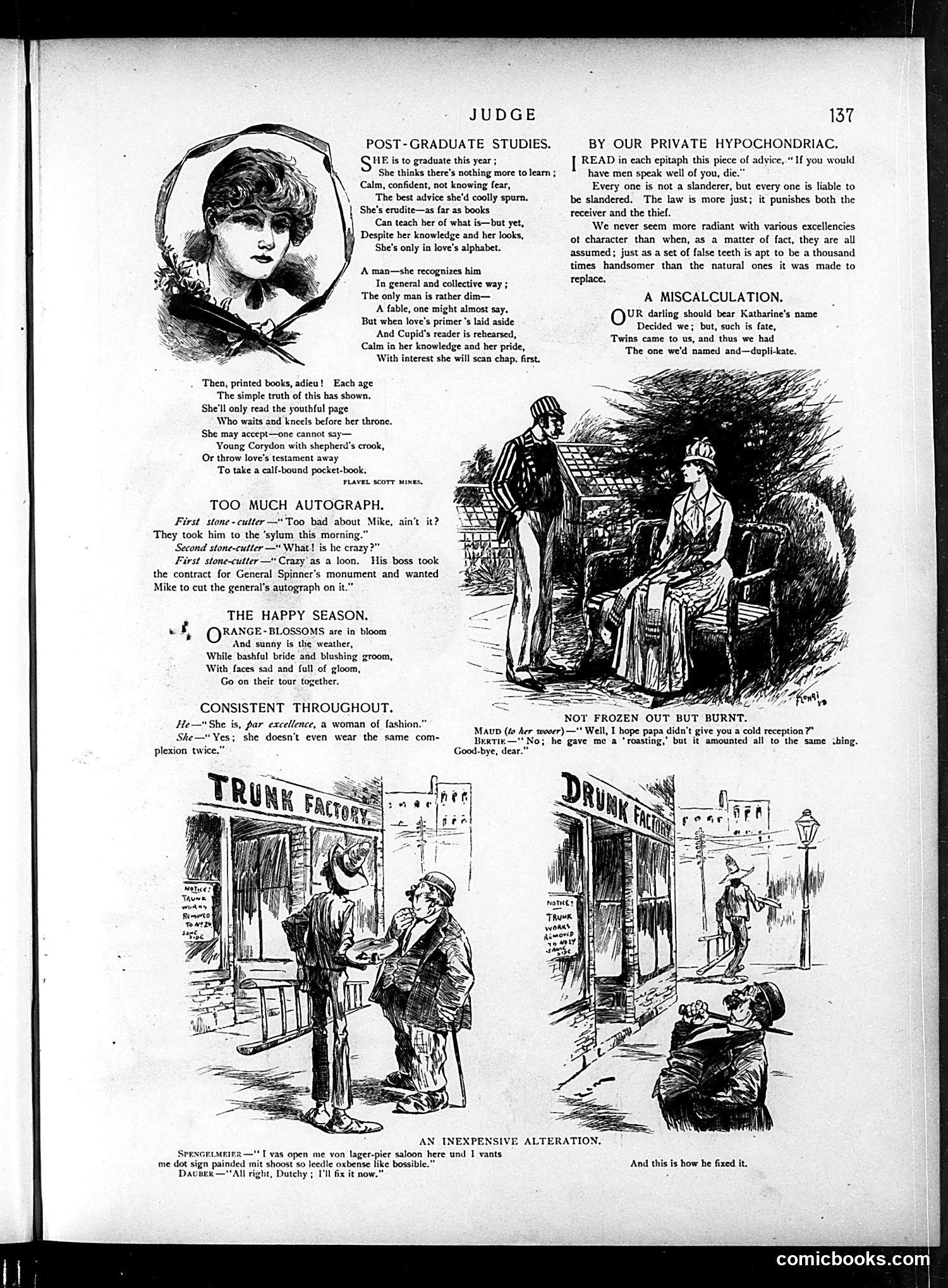
This page from *Judge* magazine contains several humorous pieces mocking social conventions and human folly: **"Post-Graduate Studies"** satirizes educated women who, despite intellectual knowledge, remain naive about love—the real education they lack. **"Too Much Autograph"** jokes about a stonecutter driven mad by the absurd task of carving General Spinner's autograph onto a monument, suggesting the request itself is ridiculous enough to cause insanity. **"The Happy Season"** ironically contrasts orange blossoms (wedding symbol) with newlyweds' sad, gloomy faces—mocking the gap between romantic expectation and marital reality. The **Trunk Factory cartoons** show a humorous before-and-after: a customer requests an "inexpensive alteration" to a saloon sign, and the painter simply removes letters, transforming "TRUNK FACTORY" into "DRUNK FACTORY"—a pun on penny-pinching solutions. Overall, the page combines romantic disillusionment, professional absurdity, and wordplay typical of *Judge*'s genteel satirical humor.
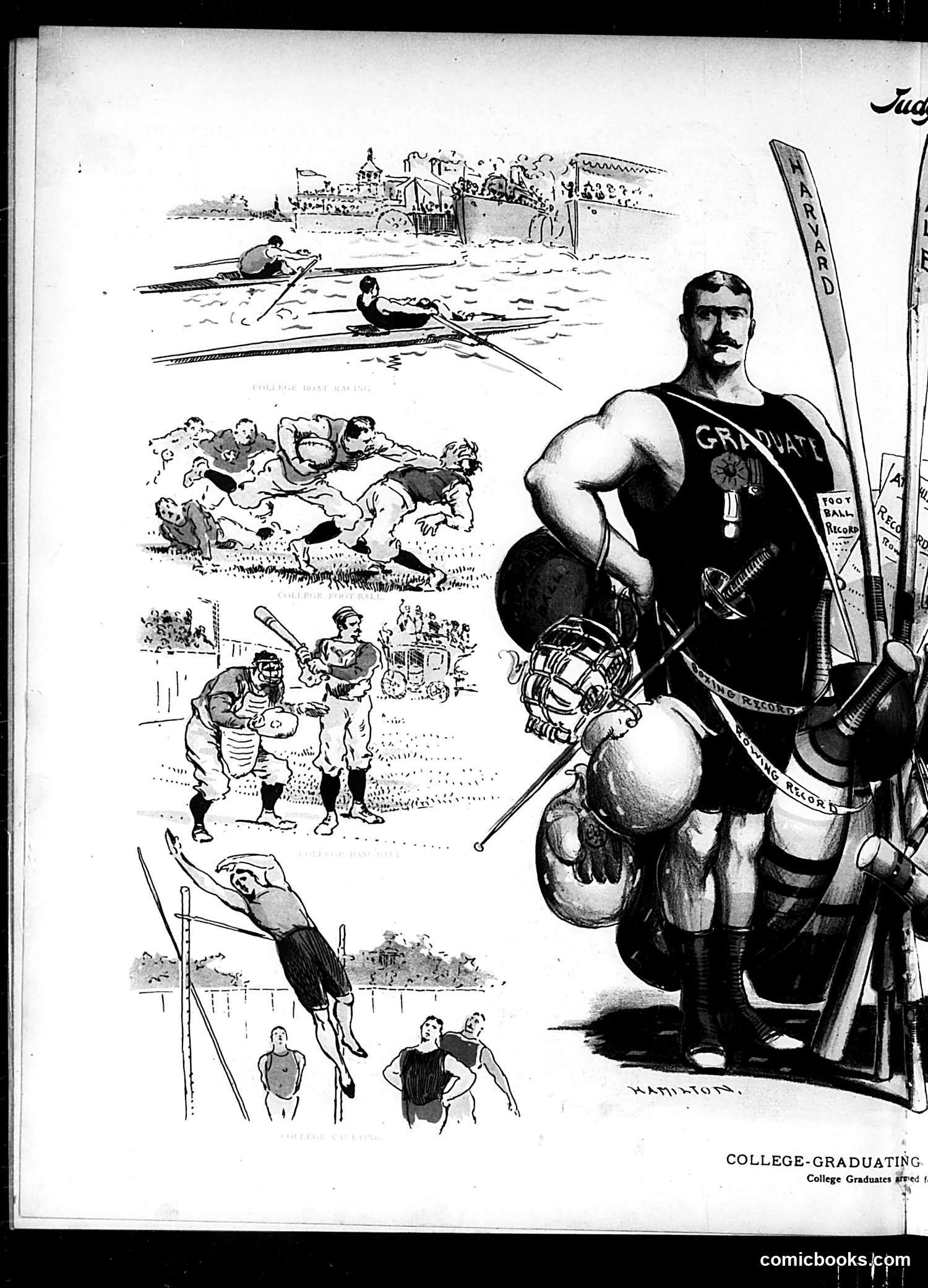
This satirical page from *Judge* magazine contrasts collegiate athletic prowess with academic pursuits. The left side depicts various college sports—rowing, football, baseball, and high jump—showing students engaged in athletic competition. The right side features a muscular athlete in a "GRADUATE" sleeveless shirt, displaying sports equipment and medals. The satire targets how American colleges prioritized athletics over education. The juxtaposition suggests that college "graduation" had become synonymous with athletic achievement rather than scholarly accomplishment. The imposing physique and prominent display of athletic gear imply that physical development eclipsed intellectual development in college curricula—a common critique of late 19th/early 20th-century American higher education, when intercollegiate sports were becoming increasingly commercialized and dominant.
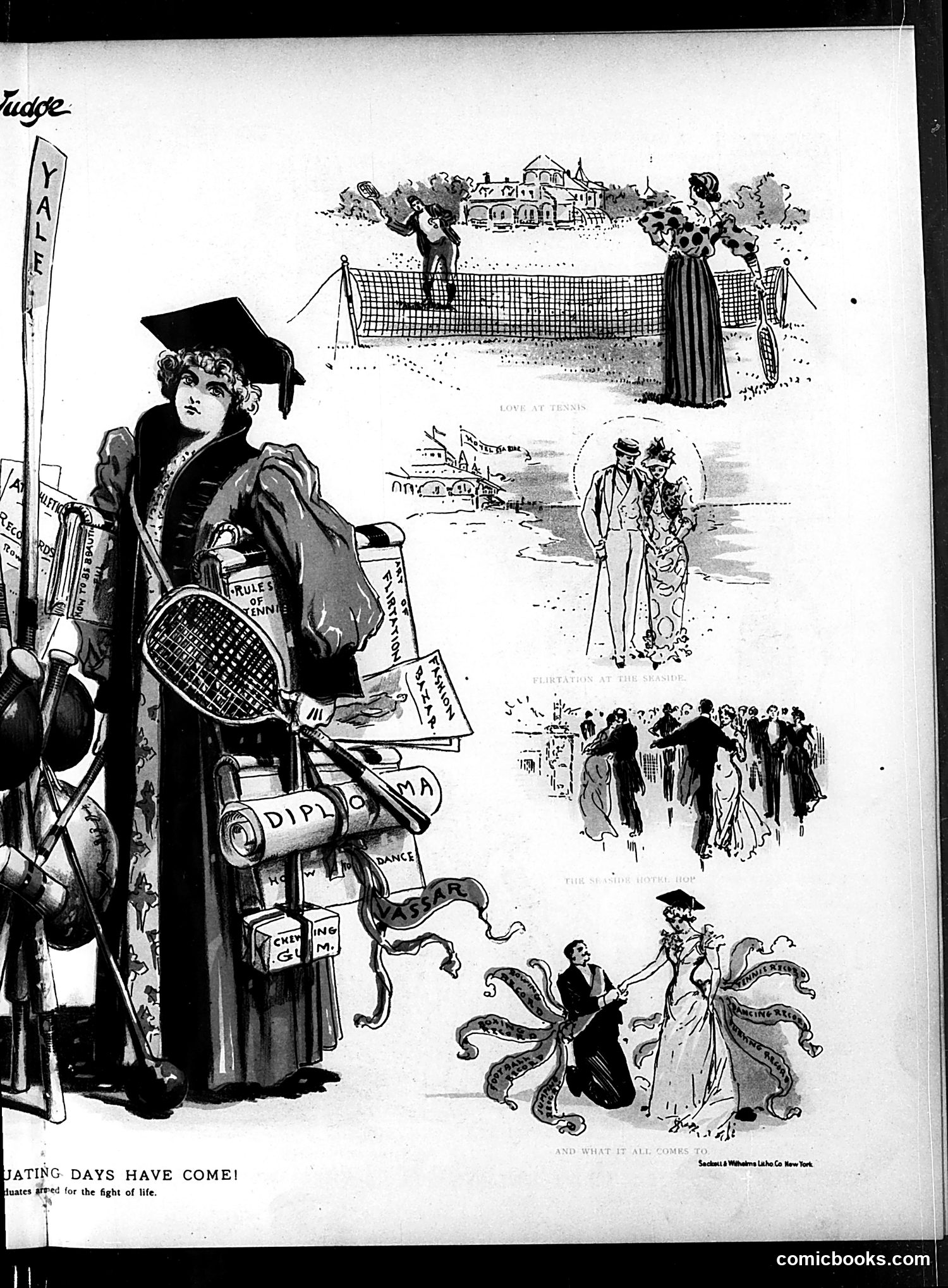
This Judge magazine page satirizes the emerging "modern woman" of the early 20th century. The large left figure shows a young woman in academic regalia (mortarboard and gown) equipped like a soldier for "the fight of life"—surrounded by tennis rackets, sports equipment, diplomas, and other symbols of female independence and education. The smaller vignettes on the right depict romantic and social scenarios: tennis matches, seaside flirtations, and social gatherings. The octopus-like creature at bottom suggests the complications of modern courtship and dating. The satire critiques women's increasing educational access and athletic participation as fundamentally altering traditional gender roles and romantic customs. The "fight of life" phrase implies women now compete in spheres previously male-dominated. For contemporary readers, this reflected anxieties about suffrage, education, and women's liberation movements gaining momentum in that era.
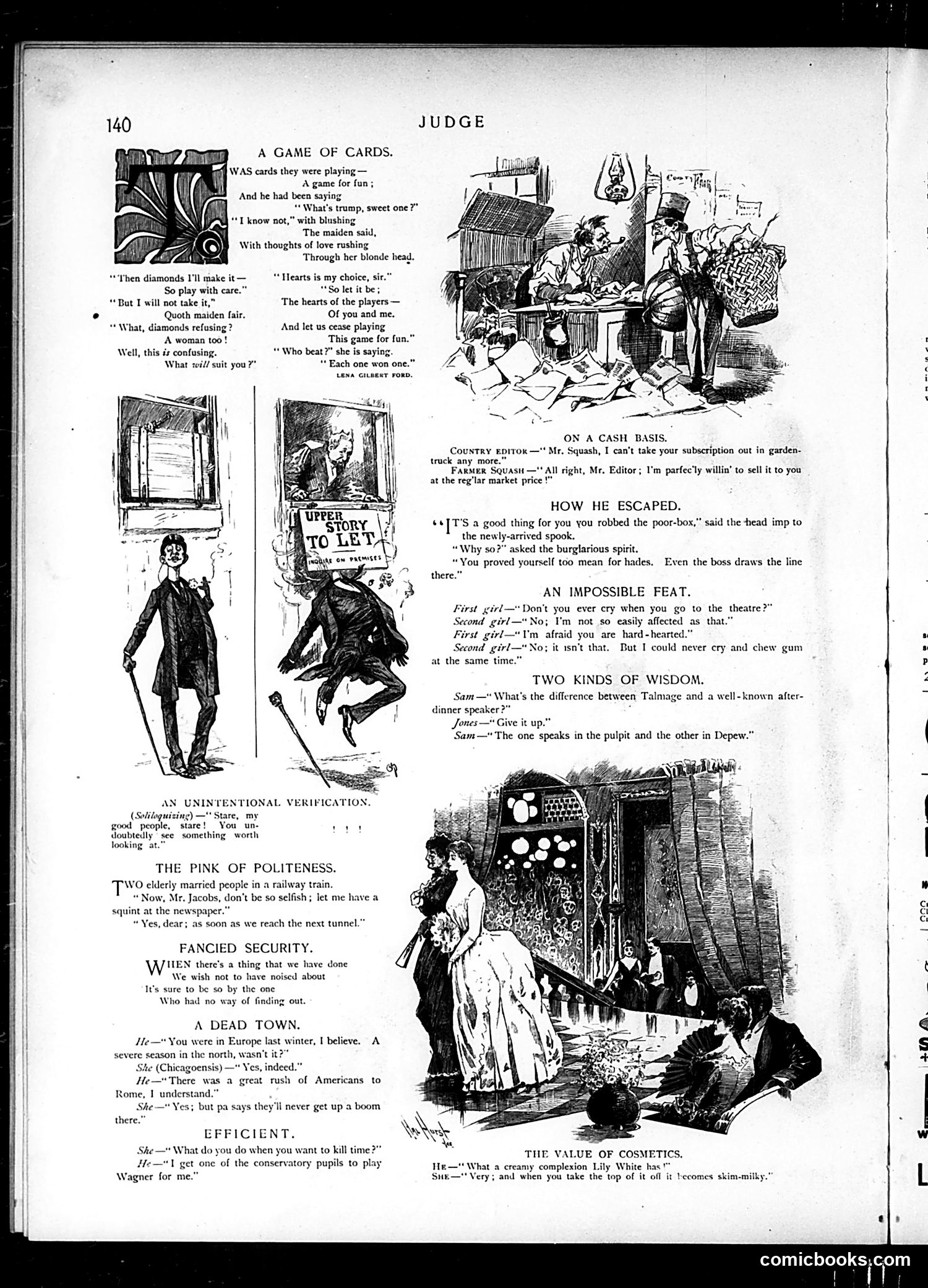
This page contains multiple short humor pieces typical of Judge's satirical format: **"A Game of Cards"** presents a flirtation between a young couple playing cards, with double entendre about "hearts" and romantic feelings replacing the card game itself. **"The Pink of Politeness"** jokes about marital dynamics—an elderly husband refuses to share a newspaper until they reach a tunnel, presumably so his wife can't see him reading in the dark, a humorous dig at male selfishness. **"A Dead Town"** satirizes Chicago's reputation and boosterism. A woman mentions her father says Americans visiting Rome won't generate business there—an insult suggesting even American tourism can't help certain places. **"Efficient"** is a joke about Wagner's music being tediously long—asking someone to play it is an effective way to "kill time." The remaining pieces are light social satire about subscription payments, moral comeuppance, cosmetics advertising, and romantic situations. Overall, the page reflects period concerns about courtship, marriage, American tourism, and consumer culture.
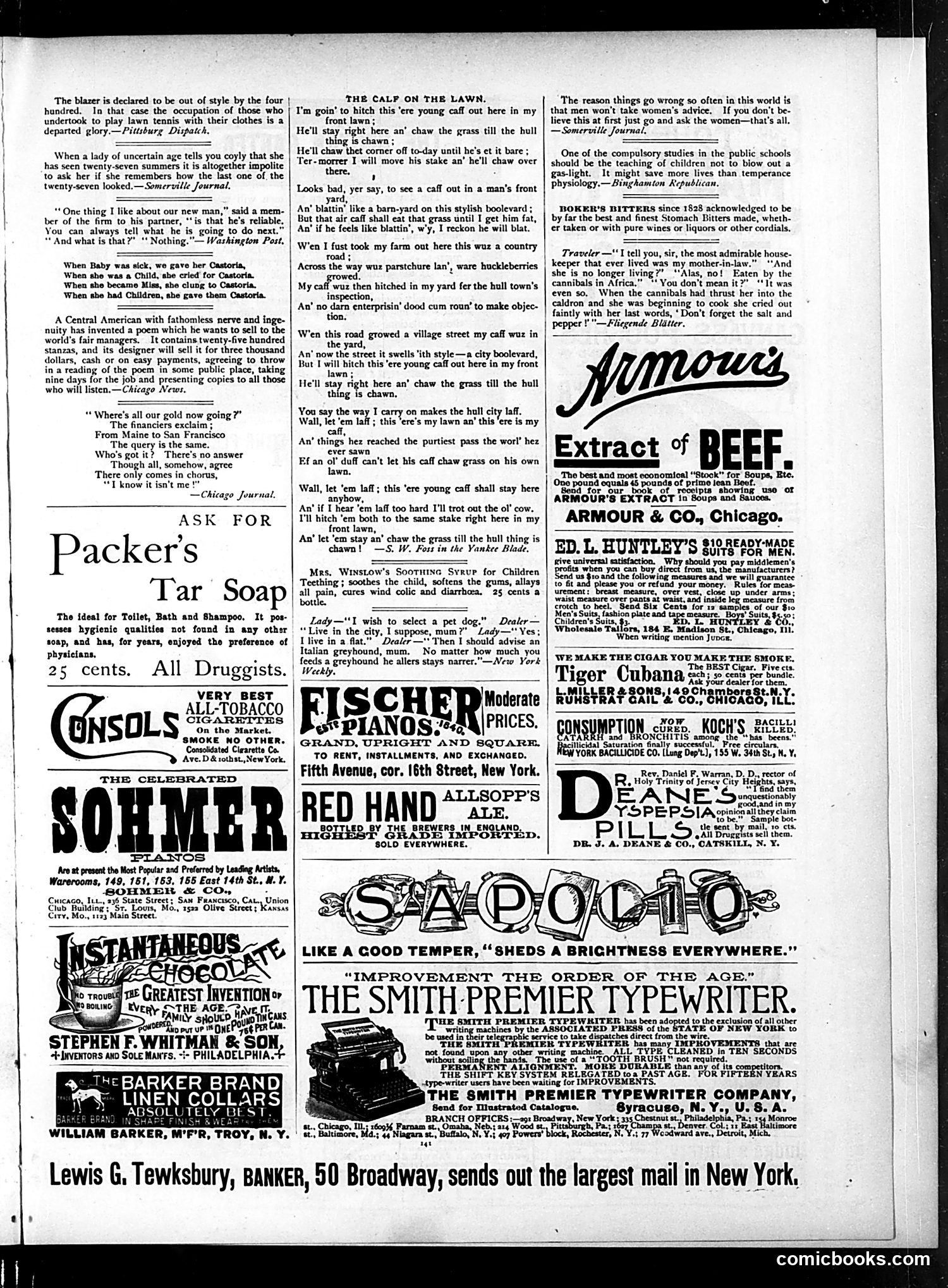
This poem satirizes the clash between rural tradition and urban development. An old farmer insists on keeping his calf tethered on his front lawn in what has become a fashionable city boulevard, allowing it to graze and bleat loudly despite neighbors' objections. The satire targets stubborn resistance to social progress: the farmer represents old-fashioned countryside ways being displaced by urbanization and genteel city standards. His defiant monologue—"this ere is my lawn"—mocks those clinging to outdated practices while their surroundings modernize. The poem also hints at class tension: the "stylish boolevard" and criticism from city dwellers contrast with the farmer's practical, agricultural mindset. His indignation at being told what he can do on his own property reflects broader anxieties about changing neighborhoods and whose values dictate acceptable behavior as rural areas become suburbs.
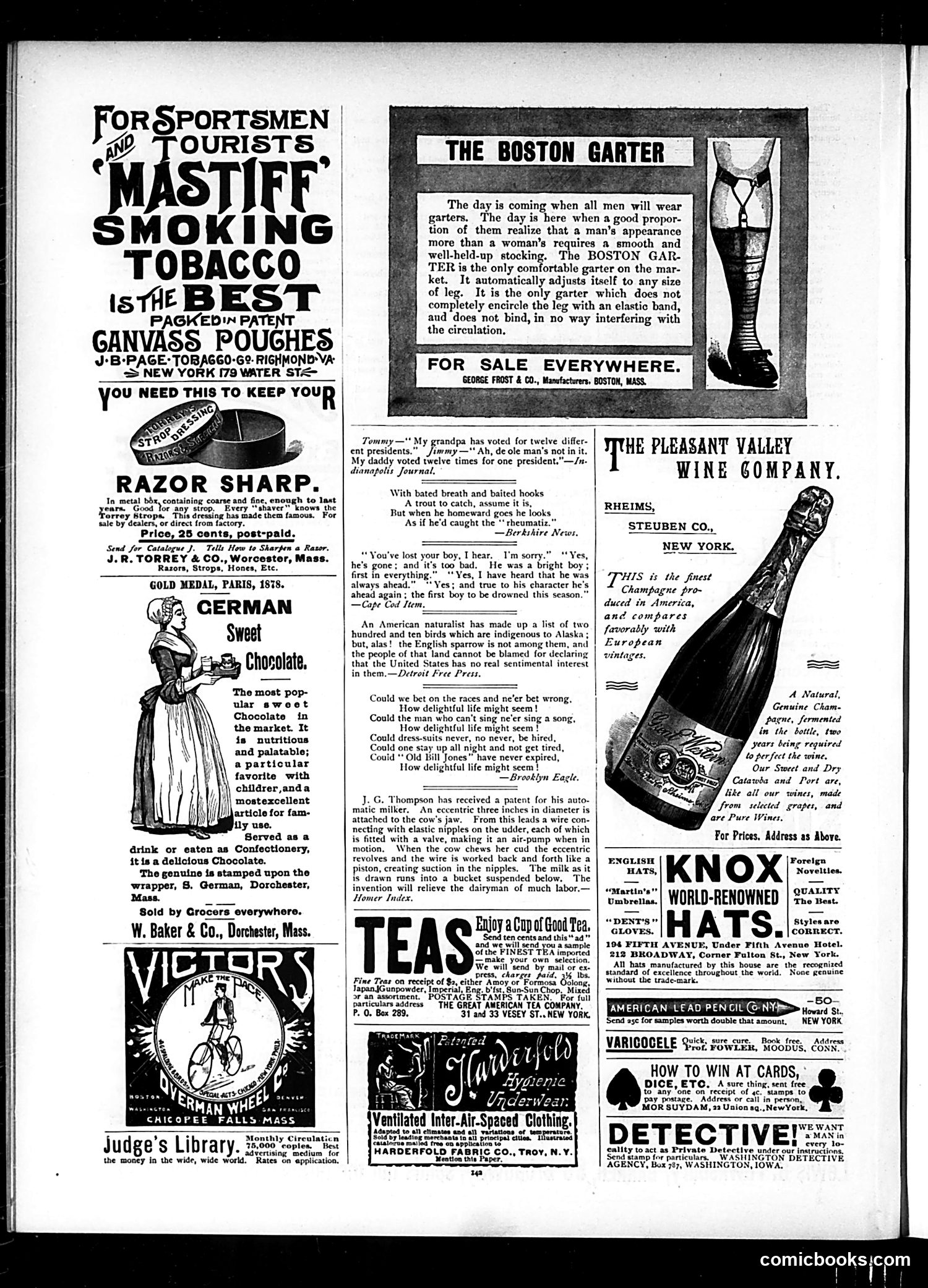
This is primarily an **advertising page** from Judge magazine, with a few scattered jokes interspersed between ads. The main content includes advertisements for consumer goods: Mastiff smoking tobacco, Boston Garters (men's hosiery), razors, German sweet chocolate, tea, champagne, hats, and other products typical of the late 19th/early 20th century. The jokes are brief, conventional humor: - A joke about voting frequency (comparing a grandfather's vs. father's voting history) - A fishing anecdote about catching "rheumatiz" instead of trout - A dark joke about a boy drowning (consistent with period newspapers' morbid humor) - Whimsical "how delightful life might seem if..." verses **No political cartoons or caricatures appear on this page.** The Boston Garter ad includes an illustration of a leg in a garter—straightforward product advertising rather than satire. The page is essentially a commercial vehicle, reflecting Judge's reliance on advertising revenue rather than political commentary.
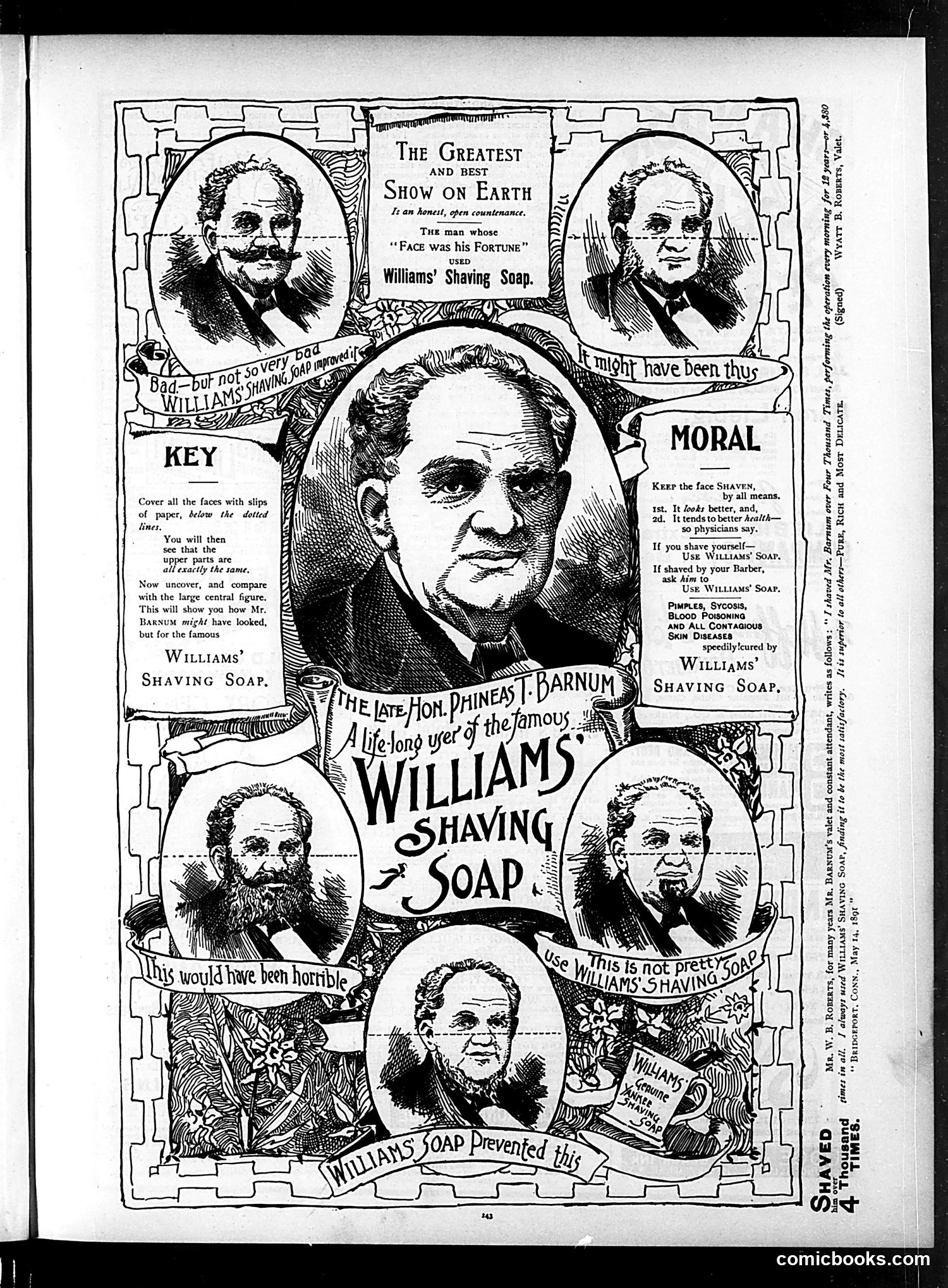
This is primarily a **product advertisement**, not political satire. It promotes Williams' Shaving Soap using P.T. Barnum, the famous 19th-century showman and circus impresario, as its celebrity endorser. The central conceit is a puzzle: covering the faces of smaller portrait sketches reveals they resemble Barnum's central large portrait—the visual joke being that Barnum's distinguished appearance depends entirely on being clean-shaven with the soap. The caption suggests Barnum "might have looked" worse without it. The advertisement includes testimonial from W.B. Roberts, Barnum's valet, claiming he shaved Barnum over 4,000 times across 12 years using this soap exclusively. The "moral" section lists claimed medical benefits (curing pimples, sycosis, blood poisoning, and contagious skin diseases). This leverages Barnum's celebrity status and reputation for honesty ("an honest, open countenance") to sell grooming products—a common marketing tactic of the period.
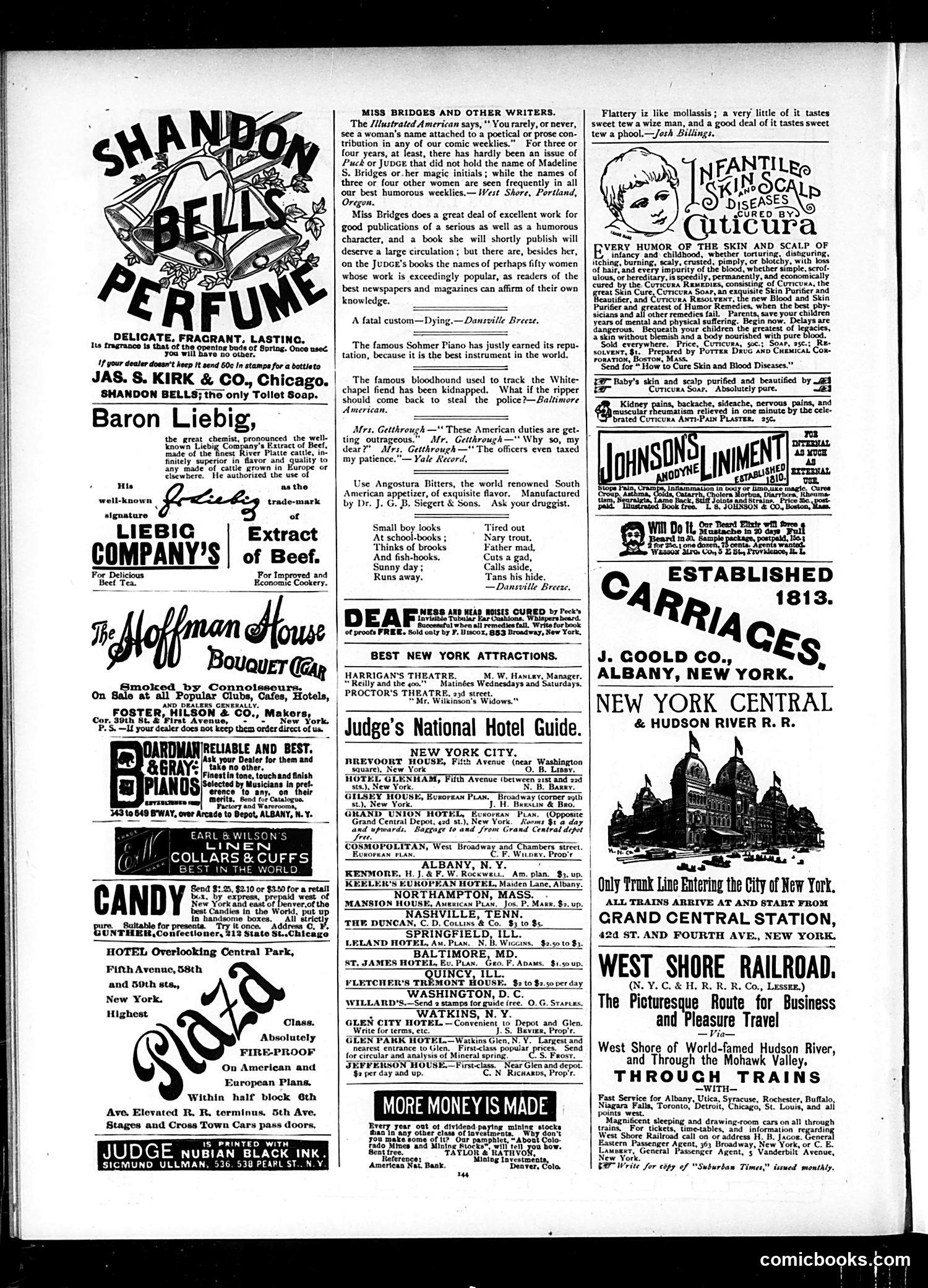
This page is primarily **advertising and listings**, not political satire. The dominant content includes: **Notable advertisements:** - Shandon Bells perfume and toilet soap - Liebig's Extract of Beef (with Baron Liebig's endorsement) - Earl & Wilson linen collars and cuffs - Hotels and railroads **Editorial content:** A brief defense of women writers in comic weeklies, noting that *Judge* and *Puck* regularly publish work by Madeline S. Bridges and approximately fifty other women contributors—countering a claim that women's names rarely appear in such publications. **Miscellaneous items:** - Brief humorous anecdotes and quips (a boy cutting school to fish, complaints about American tariffs) - Hotel guides for New York City and Albany - Theater listings There are **no significant political cartoons or social satire** visible on this page. It functions primarily as a revenue-generating advertising section typical of late-19th-century magazines.
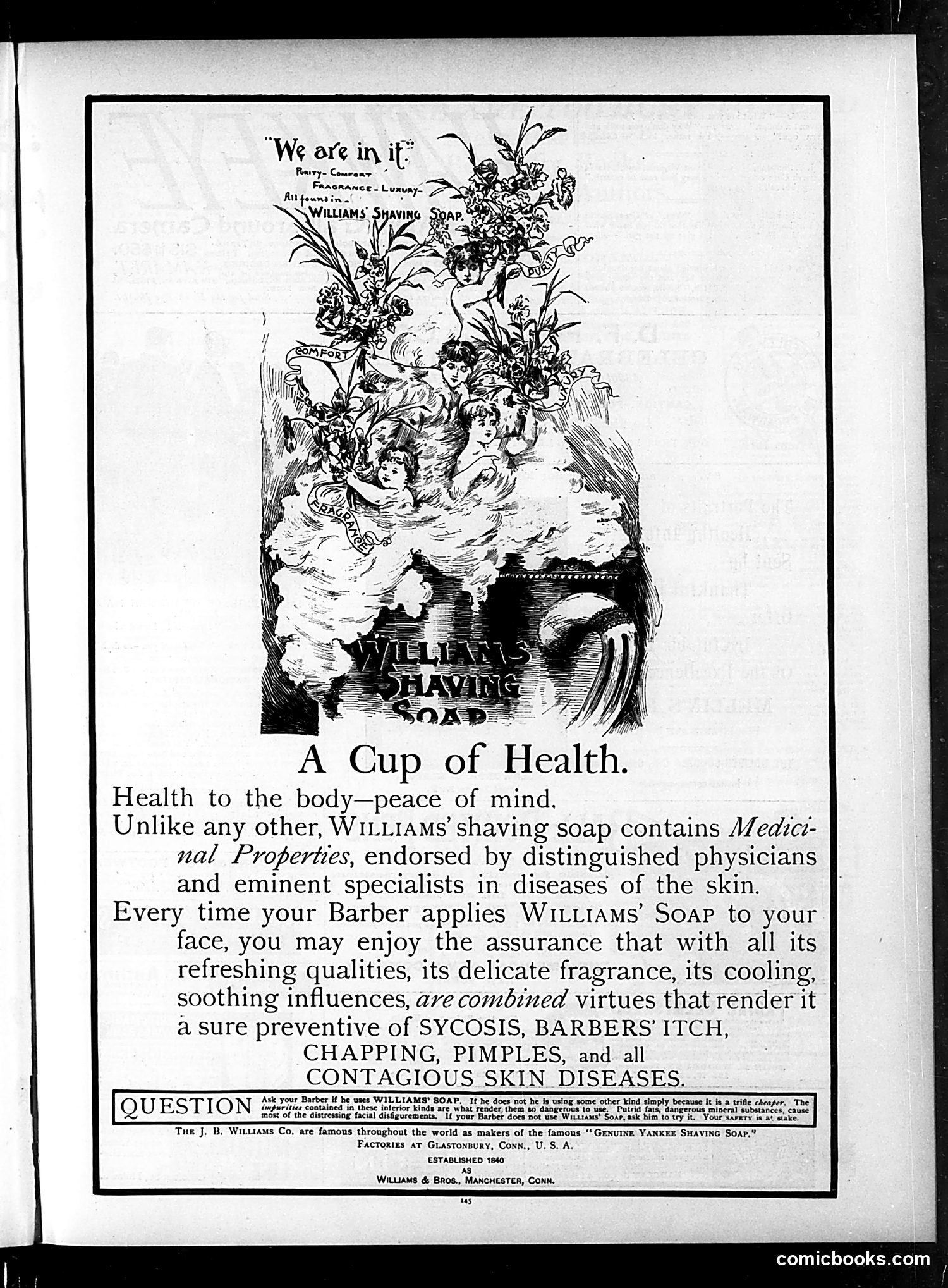
This is a **product advertisement**, not political satire. It promotes Williams' Shaving Soap in Judge magazine. The illustration depicts cherubs and classical figures emerging from a shaving mug labeled "Williams Shaving Soap," surrounding flowering plants—imagery suggesting luxury, refinement, and health benefits. The tagline "We are in it" uses colloquial language to create familiarity. The ad claims the soap contains "Medicinal Properties" endorsed by physicians and prevents skin conditions common to barber work: sycosis (a fungal infection), barber's itch, chapping, pimples, and "contagious skin diseases." A question box encourages customers to ask their barber if he uses Williams' brand, implying competitive advantage. This represents **late 19th/early 20th-century advertising conventions**: associating products with health authority, classical aesthetics, and social status—typical of Judge's mixed content of humor and paid advertisements.
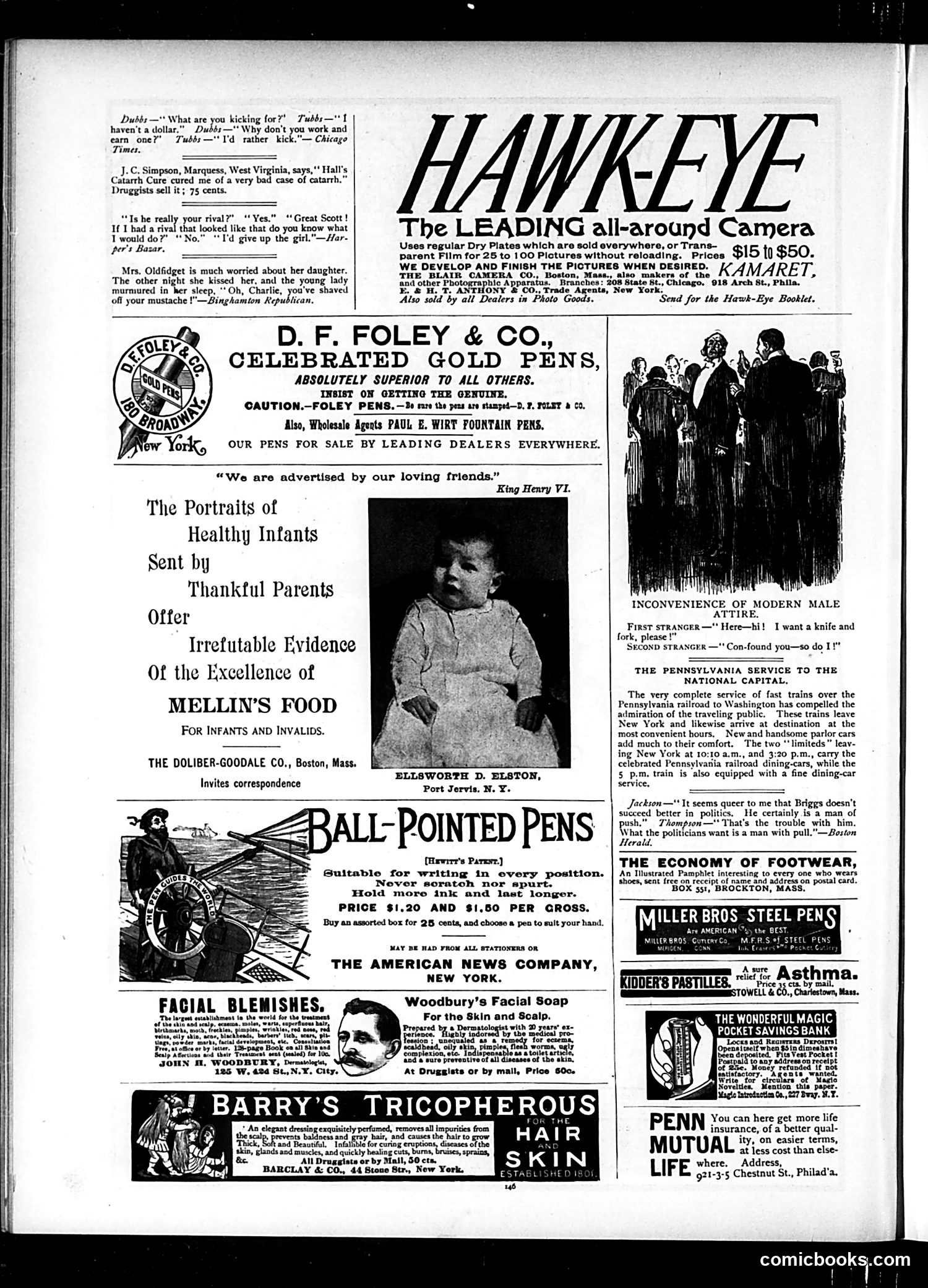
This page is primarily **advertisements** interspersed with brief humorous quotes and one cartoon. The main cartoon appears in the upper right: titled "INCONVENIENCE OF MODERN MALE ATTIRE," it depicts two formally dressed men at what seems to be a formal dinner. The first stranger requests "a knife and fork, please," and the second responds "Con-found you—so do I!" **The joke:** The satire mocks formal Victorian evening wear (likely white-tie dress) where the tight clothing makes it difficult to handle dining utensils comfortably. It's social commentary on the impracticality of restrictive gentlemen's formal dress codes—a complaint that would resonate with Judge's affluent male readership who endured these conventions. The page also includes unrelated brief comedic exchanges about a man preferring to "kick" rather than work, and romantic rivalries—typical light social humor of the period. The bulk of the page comprises period advertisements for cameras, fountain pens, infant formula, soap, and hair treatments, reflecting late 19th/early 20th-century consumer goods.
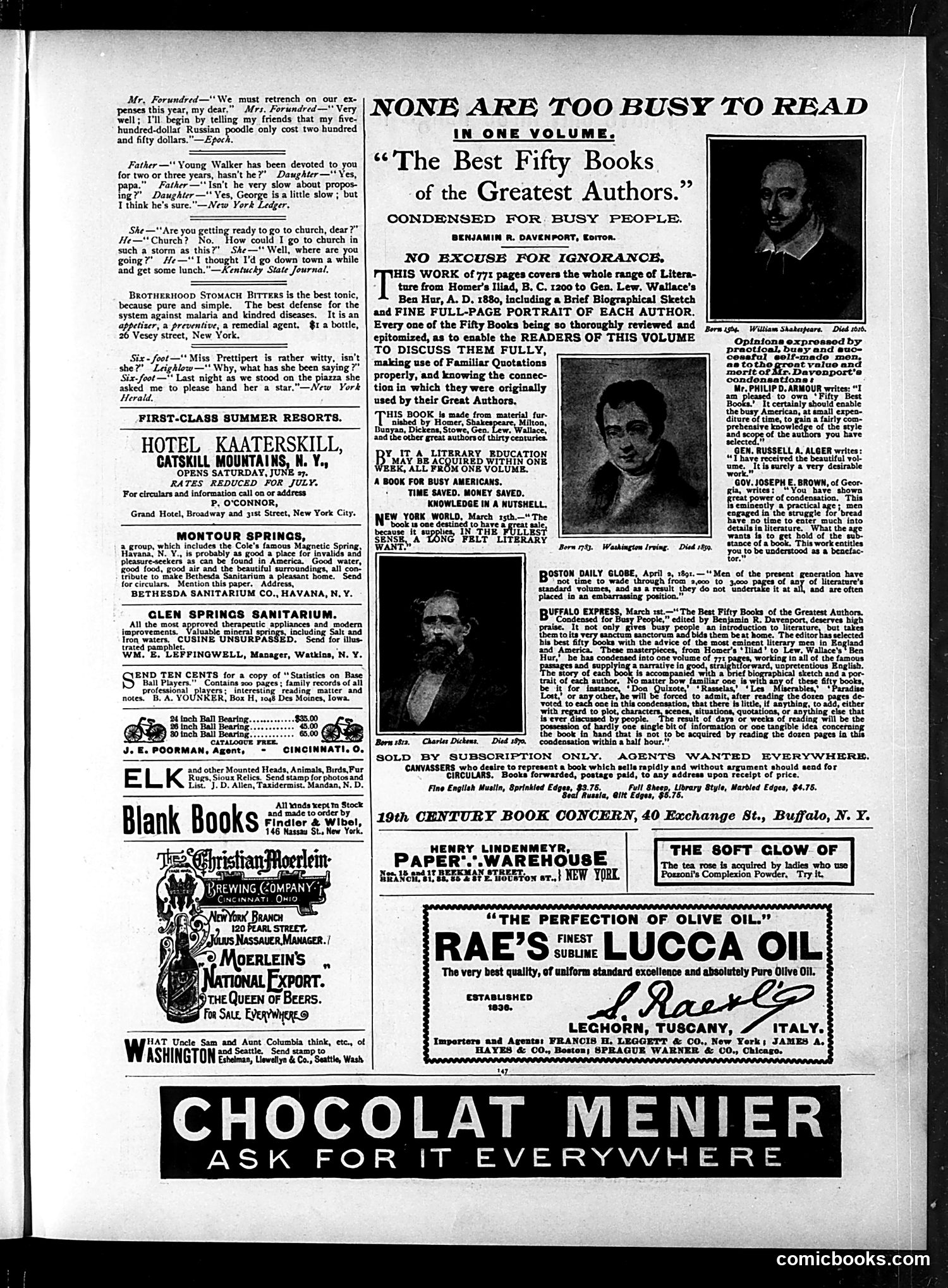
This page is primarily **advertising and book promotion**, not political satire. The dominant feature is a large advertisement for "The Best Fifty Books of the Greatest Authors," edited by Benjamin R. Davenport—a condensed literature anthology marketed to busy Americans. The small comic vignettes at the top are typical Judge humor but unrelated to the main content: - A wife planning to lie about her Russian coat's cost - A daughter reassuring her father that her slow suitor will eventually propose - A man choosing lunch over church during a storm - A woman asking a man to hand her a star (a flirtation) These jokes satirize **domestic life and courtship customs** of the era—marital dishonesty, delayed marriage proposals, male laziness, and feminine coquetry—rather than political issues. The page reflects late 19th-century marketing: selling "self-improvement" literature to busy professionals who lack time for complete works, positioning education as achievable within a week.
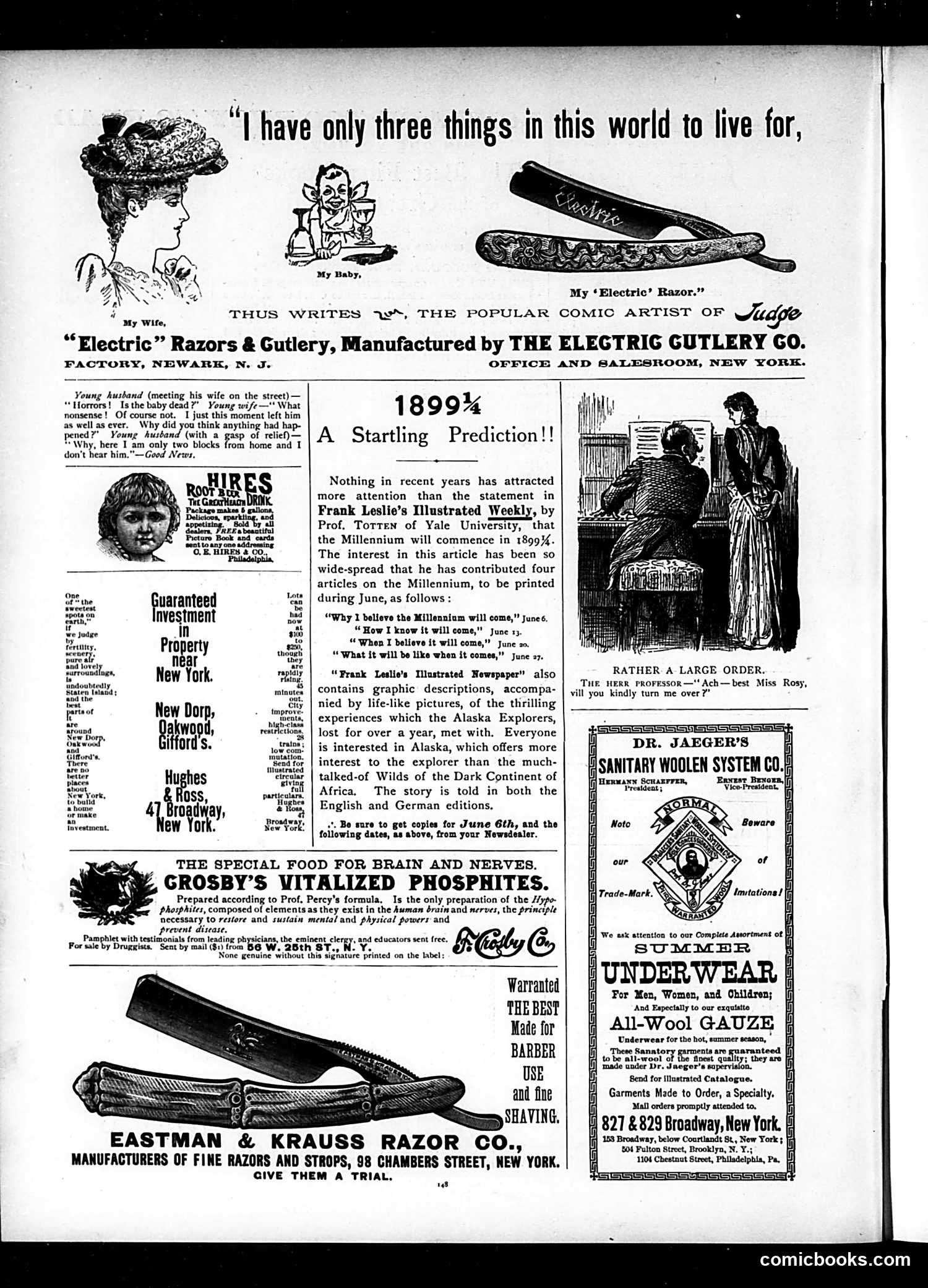
This page is primarily **advertising with embedded humor**, typical of Judge's format. **Main cartoon:** A domestic joke about a husband relieved he can't hear his baby crying from two blocks away—playing on the stereotype of annoyed fathers. **The "Three Things" advertisement** for Electric Razors uses a quote attributed to "Sudge," Judge's popular comic artist, claiming he lives for: his wife, his baby, and his electric razor. This is standard advertising humor, inflating product importance through celebrity endorsement. **"A Startling Prediction"** section references **Professor Totten of Yale's millennial predictions** (the year 1899½ suggesting the imminent end-times or major change expected around 1900—anxiety typical of fin-de-siècle America). The text promotes Frank Leslie's serialized articles on this topic. **"Rather a Large Order" cartoon** shows a German professor asking to be turned over—likely a visual pun playing on ethnic stereotypes common to the era's humor. The page is dominated by **product advertisements** (razors, health tonics, underwear) interspersed with light satirical content—Judge's standard revenue model.
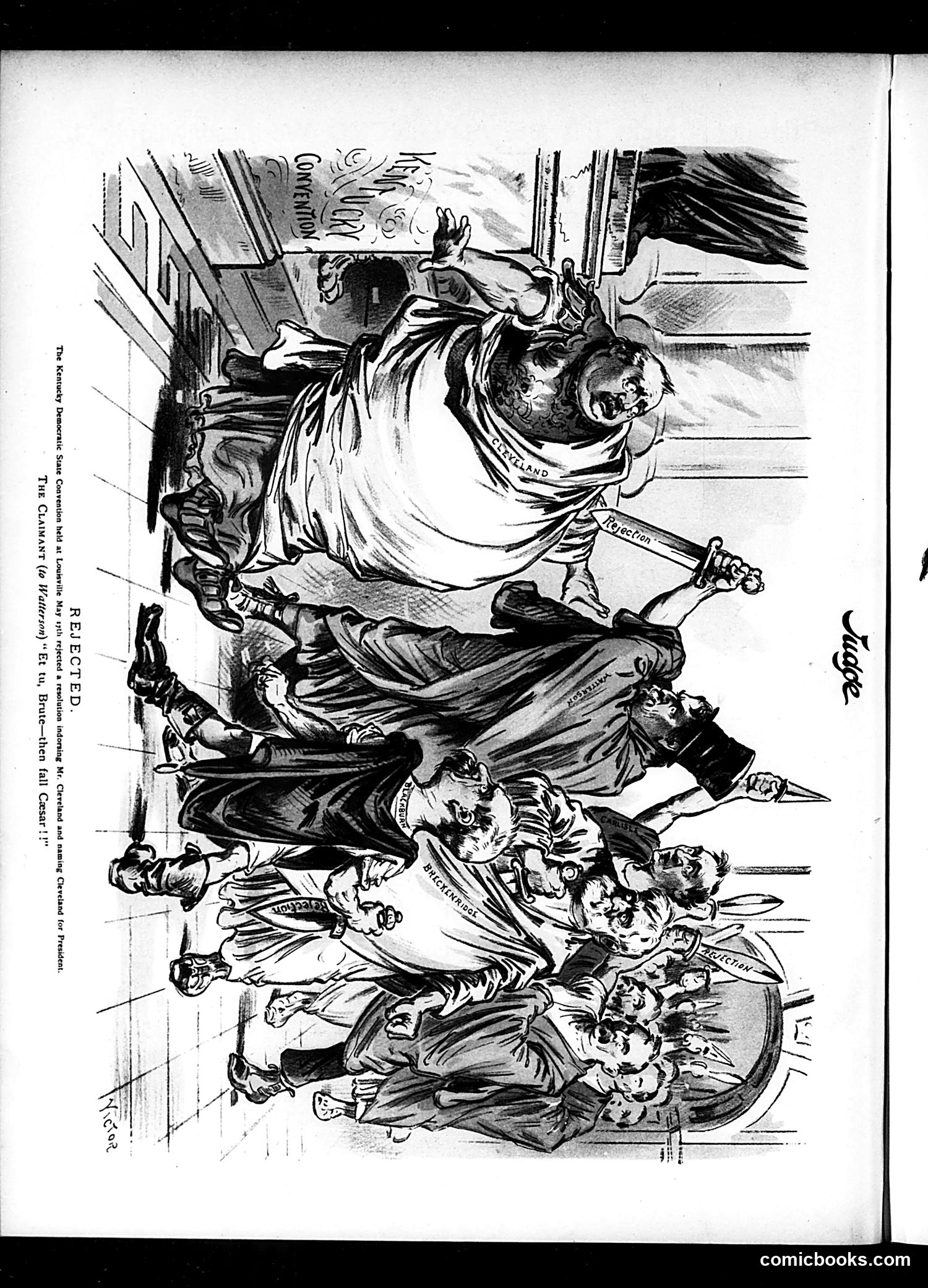
This political cartoon satirizes the **1884 Democratic Party split over President Cleveland's nomination**. The central figure labeled "CLEVELAND" is depicted as a falling Caesar, stabbed by supporters including what appears to be **Henry Watterson** (Kentucky Democratic leader), who rejected Cleveland's renomination at the May 17th Louisville convention. The surrounding figures represent **Democratic Party factions**—some labeled with state/regional identifiers—attacking or abandoning Cleveland. The classical allusion to Caesar's assassination ("Et tu, Brute") suggests Cleveland felt betrayed by his own party. **The satire's point**: Despite being an incumbent president, Cleveland faced significant Democratic opposition to his renomination, portrayed here as a dramatic political betrayal and collapse of support from within his own party ranks.