
A complete issue · 20 pages · 1891
Judge — May 9, 1891
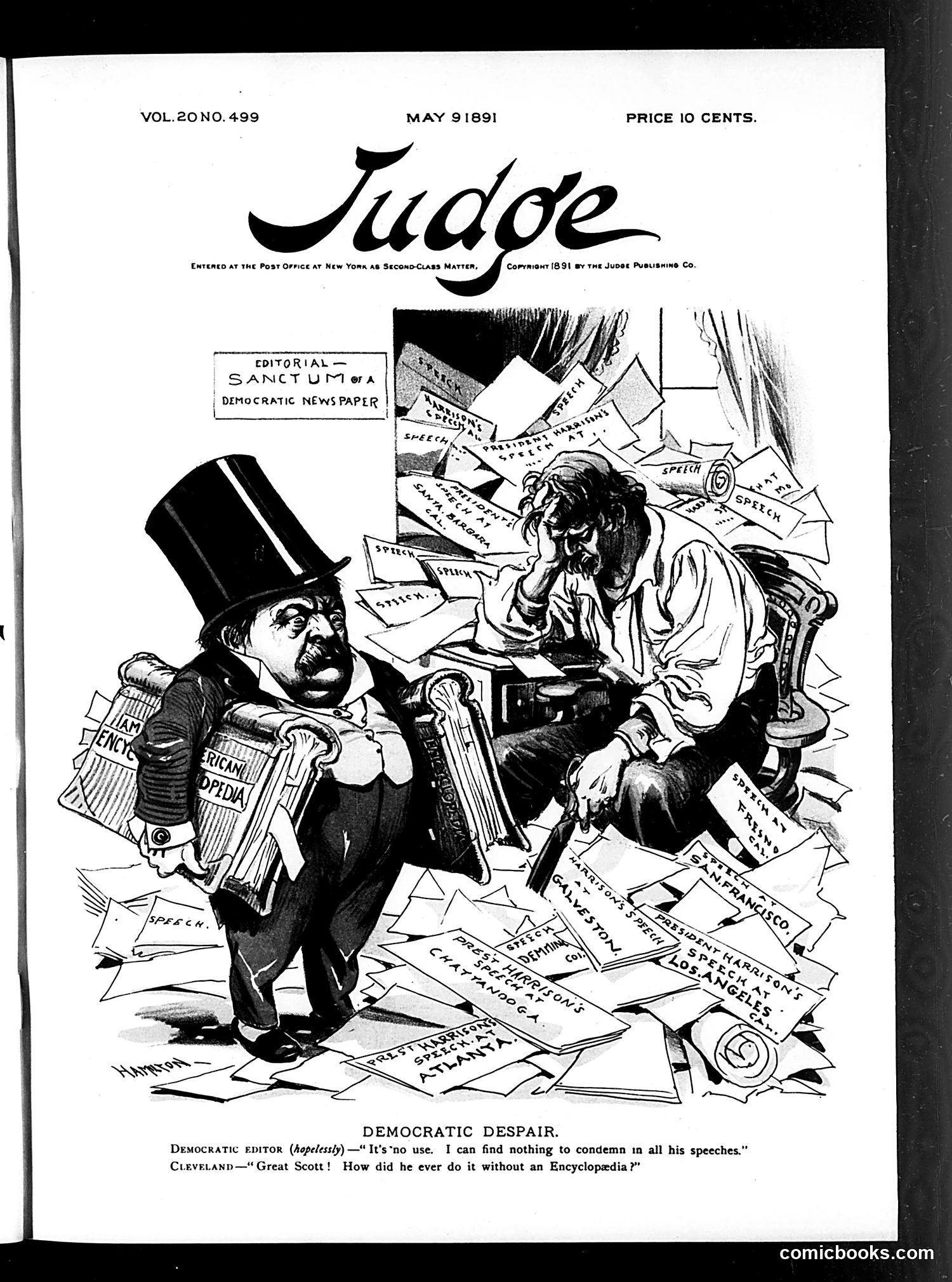
This political cartoon satirizes Democratic Party confusion during the early 1890s. The figure on the left, labeled as a "Democratic editor," wears a top hat and formal dress amid scattered papers labeled with city names (San Francisco, Los Angeles, Chicago, Atlanta) and appears distressed. The caption mocks the editor's claim that he "can find nothing to condemn in all his speeches," while Cleveland (presumably President Grover Cleveland, who served 1885-1889 and 1893-1897) supposedly accomplished major acts "without an Encyclopedia." The satire suggests Democratic leadership was intellectually incoherent or hypocritical—unable to coherently criticize or explain their own positions. The scattered papers symbolize the party's disorganization and lack of unified messaging.
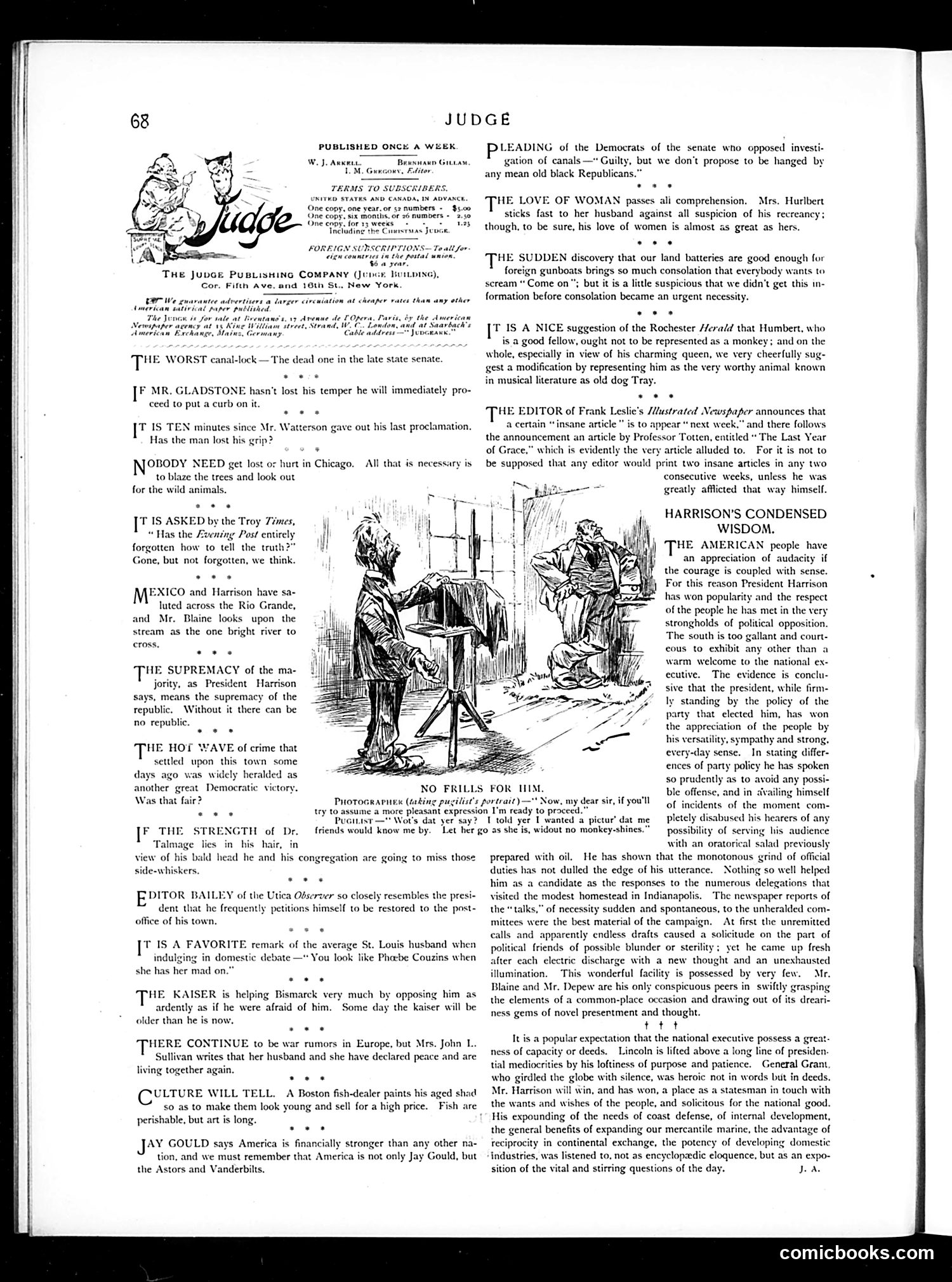
The main cartoon, "NO FRILLS FOR HIM," depicts a confrontation between two figures—likely a photographer and a subject—over a portrait sitting. The dialogue ("Now, my dear sir, if you'll try to look pleasant—" / "Politician"—"We'd dat ye say?") suggests satire about political vanity and self-presentation. The accompanying text snippets are brief political commentary typical of Judge's format. References include President Harrison, Democratic senators opposing canal investigation, and various public figures. The overall tone is conservative Republican, mocking Democratic opposition and praising Harrison's presidency. Without clearer identification of specific individuals in the cartoon, the precise satirical target remains somewhat unclear, though it appears to mock political pretension and the artificial nature of political image-making.
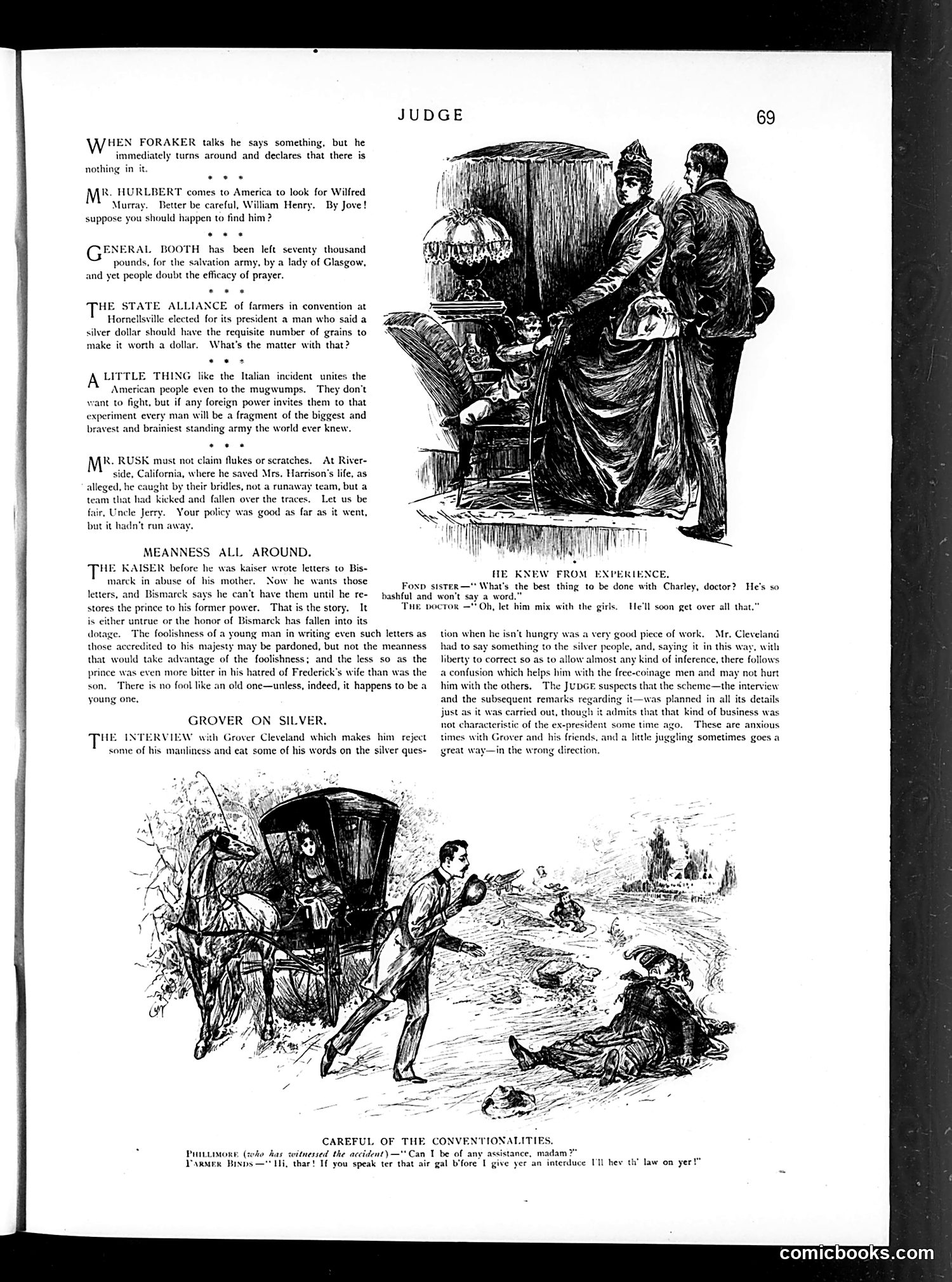
This page contains political commentary and satirical illustrations from Judge magazine. The upper cartoon, titled "He Knew From Experience," depicts what appears to be a medical consultation—a doctor and patient with a third figure, likely discussing treatment options. The satire suggests skepticism about medical expertise or advice-giving. The lower cartoon, "Careful of the Conventionalities," shows a man helping an injured woman from a carriage while a farmer objects, saying he cannot offer assistance without a proper introduction. The satire mocks rigid social conventions that would prevent basic human compassion in an emergency. The text sections critique various contemporary issues including military fundraising, political candidates, and foreign policy matters, though specific references are unclear without additional historical context.
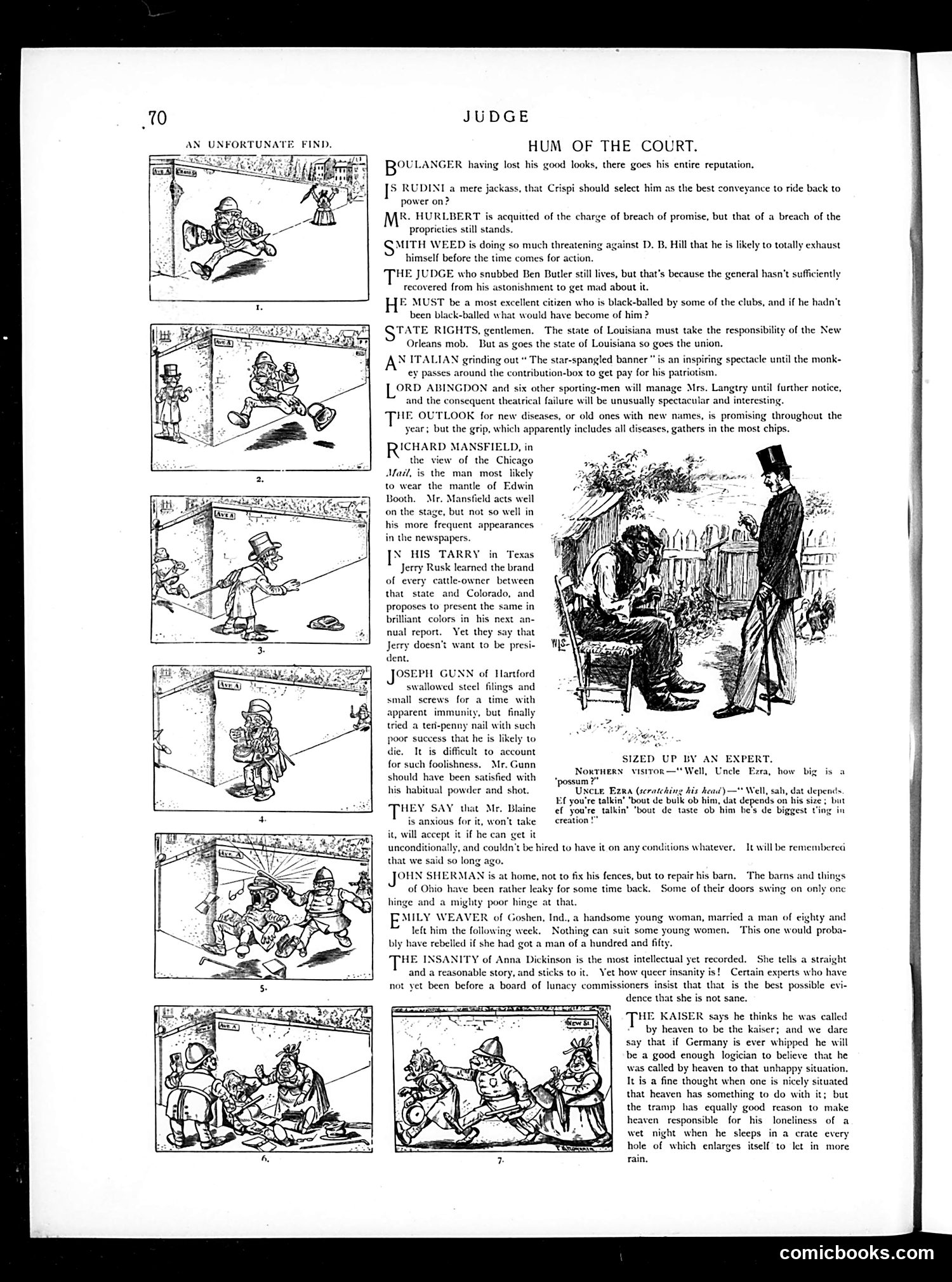
This is a collection of brief satirical comments on contemporary figures and events, typical of Judge's "Hum of the Court" gossip column. **Key references:** - **Boulanger**: French general whose political ambitions apparently depended on his appearance - **Crispi/Rudini**: Italian political figures (Crispi trying to use Rudini as a political vehicle) - **Ben Butler**: American general/politician whom a judge snubbed - **D.B. Hill**: Likely David B. Hill, New York politician - **New Orleans mob**: References ongoing post-Reconstruction racial violence in Louisiana - **Mrs. Langtry**: Famous actress being managed by British aristocrats - **Richard Mansfield**: Actor compared unfavorably to Edwin Booth - **Jerry Rusk**: Secretary of Agriculture planning to document cattle brands - **Blaine**: James G. Blaine, presidential aspirant - **The Kaiser**: German Emperor Wilhelm II The page mixes political commentary with humorous personal attacks on public figures' character, appearance, and ambitions. The bottom cartoon shows a dialect humor exchange about measuring something's size.
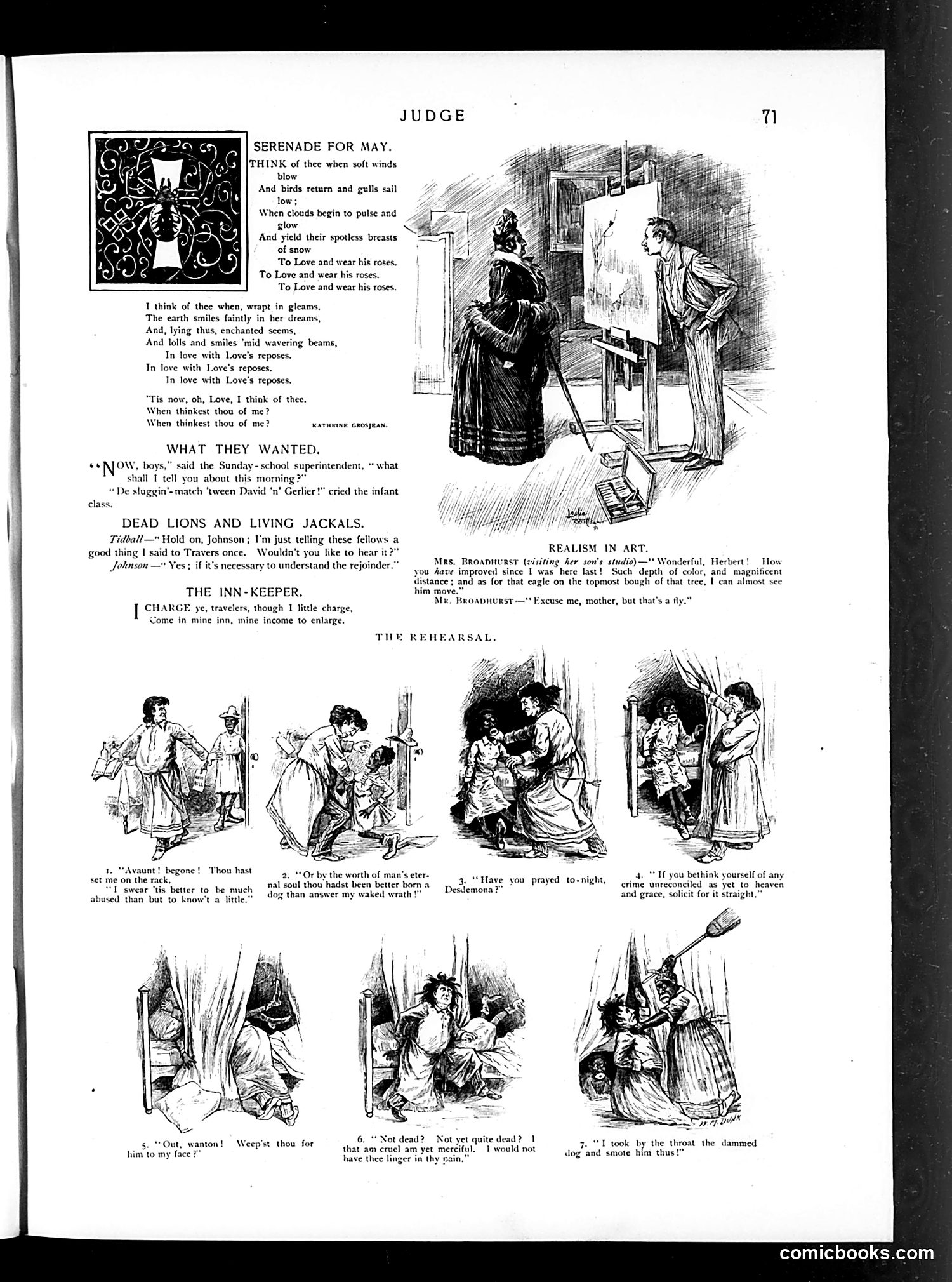
This page contains literary and theatrical humor rather than political satire. **Content includes:** - "Serenade for May": A romantic poem about thinking of one's beloved, credited to Katherine Grosjean - "What They Wanted": A joke about Sunday school children requesting a lesson on a boxing match ("sluggin' match") between David and Goliath, misunderstanding the biblical reference - "Dead Lions and Living Jackals": A brief exchange mocking someone repeatedly telling the same anecdote - "Realism in Art": A visual gag where a mother visiting her son's studio mistakes a painted fly for a real insect - "The Inn-Keeper": A brief couplet about innkeepers profiting from travelers - "The Rehearsal": A seven-panel comic strip showing theatrical actors rehearsing dramatic scenes, depicting exaggerated period acting styles The page showcases Judge's mix of sentimental verse, wordplay, visual humor, and theatrical mockery typical of late 19th-century American humor magazines.
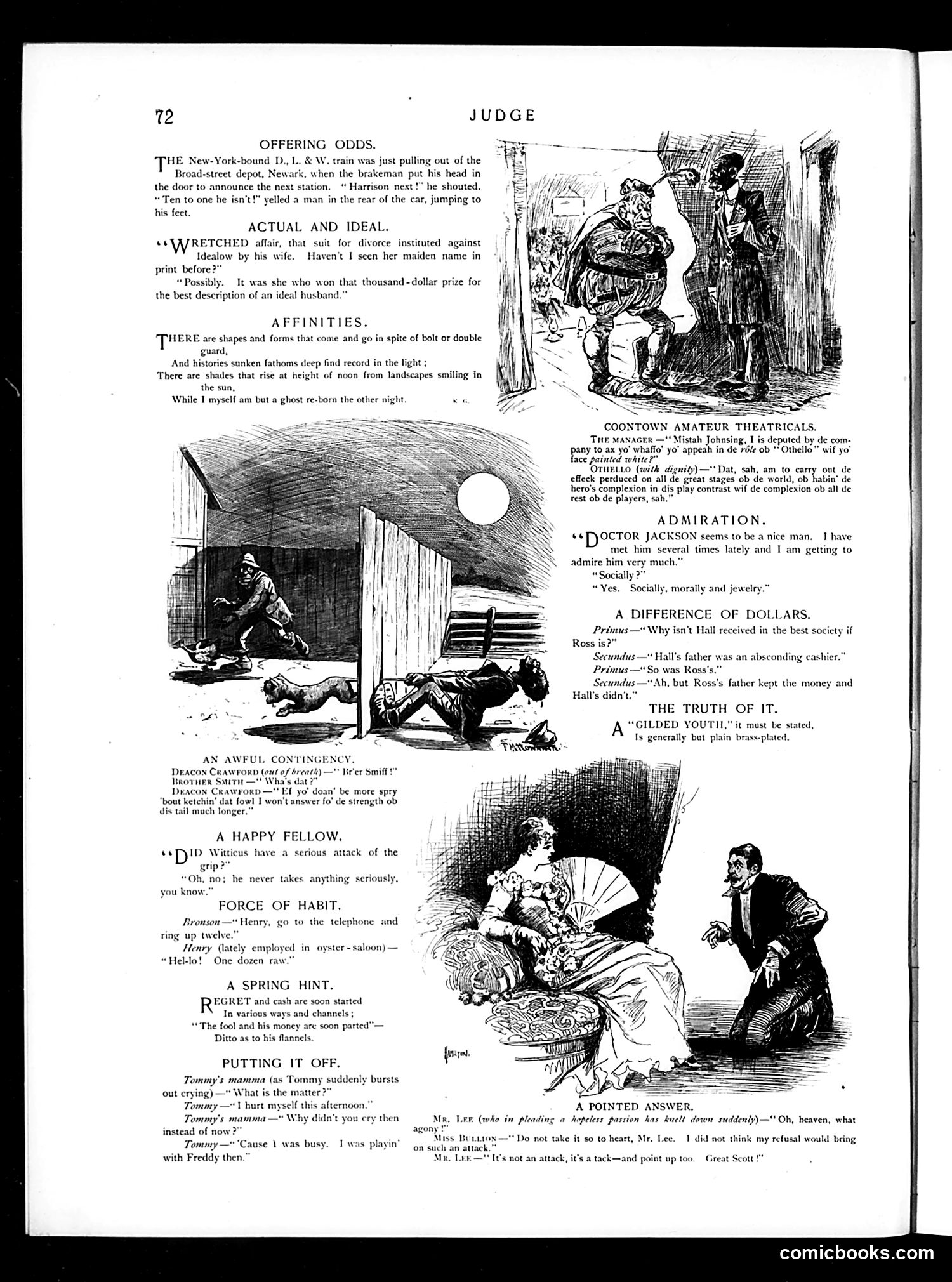
This page contains multiple brief satirical pieces typical of Judge's humor: **"Offering Odds"** jokes about a train passenger betting against the brakeman's announcement of "Harrison next"—likely referencing President William Henry Harrison or the Harrison political name, suggesting skepticism about the announcement's accuracy. **"Actual and Ideal"** satirizes the gap between romantic fantasy and reality: a woman won a prize for describing an "ideal husband," then sued for divorce—the irony being her theoretical perfection versus actual marriage failure. **"Coontown Amateur Theatricals"** uses racist caricature and dialect humor (common to the era) about a Black theater company debating whether to blackface an actor playing Othello—mocking both theatrical conventions and racial attitudes. Other pieces mock social pretension, class distinctions, and domestic absurdities typical of Judge's working-class and middle-class audience humor. The illustrations use Victorian-era cartooning styles to accompany these brief comic scenarios.
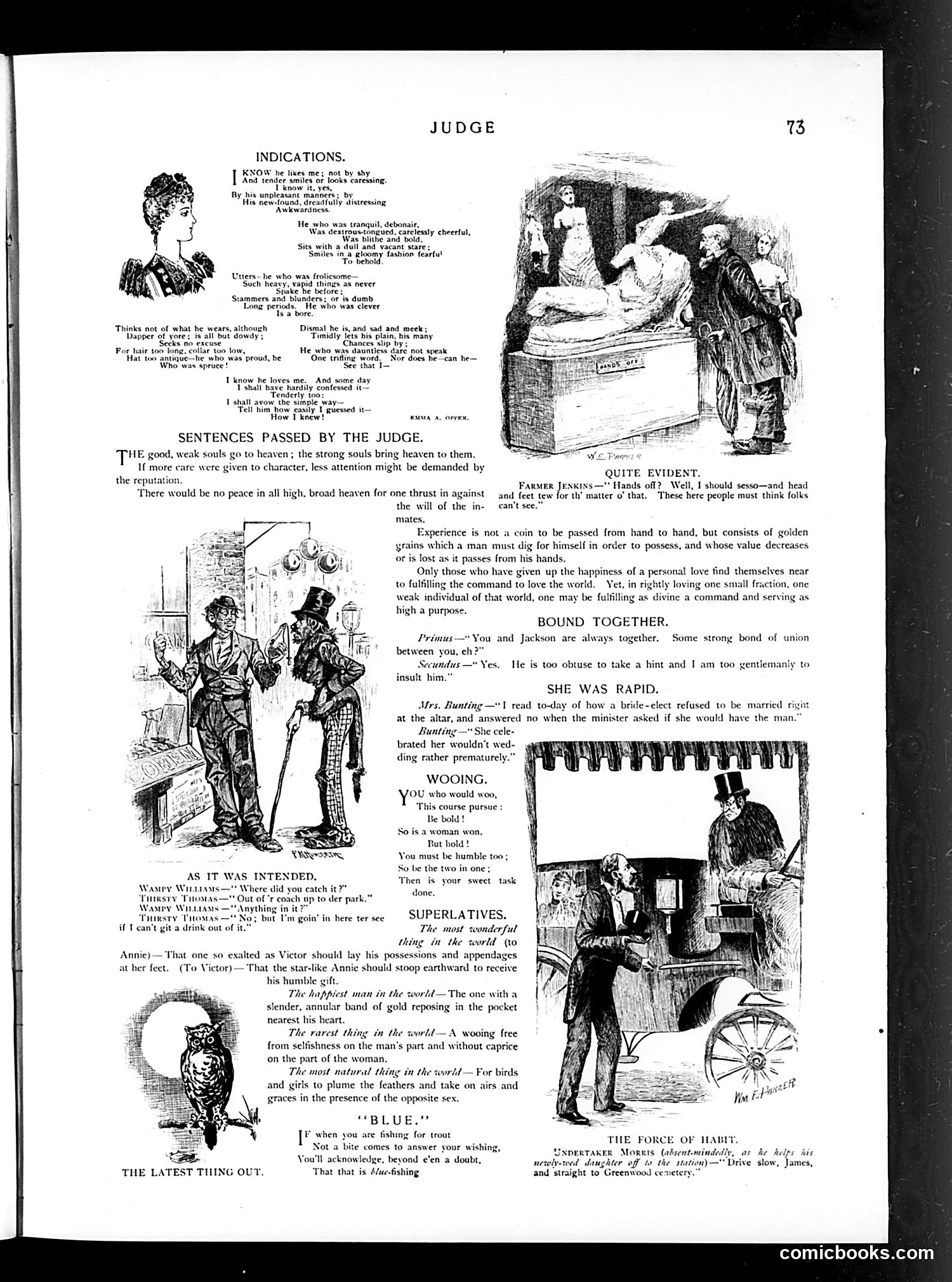
This page from the satirical magazine *Judge* contains several pieces of social commentary on courtship and relationships, typical of late 19th/early 20th-century humor. The main poem "Indications" satirizes how a man in love betrays himself—not through romantic gestures, but through awkwardness, stammering, and behavioral changes. The satire mocks the contradiction that genuine emotion manifests as incompetence rather than charm. "Sentences Passed by the Judge" offers philosophical observations on morality and love, contrasting weak versus strong souls and critiquing how personal love can fulfill divine purpose. The scattered jokes mock courtship conventions: a bride refusing marriage at the altar, the absurd rules of wooing (be bold yet humble), and various observations on engagement and romance. The cartoons appear to illustrate these domestic scenarios with period-appropriate Victorian imagery. The overall message ridicules both romantic pretense and the messy reality of human relationships—a common *Judge* theme targeting middle-class social conventions.
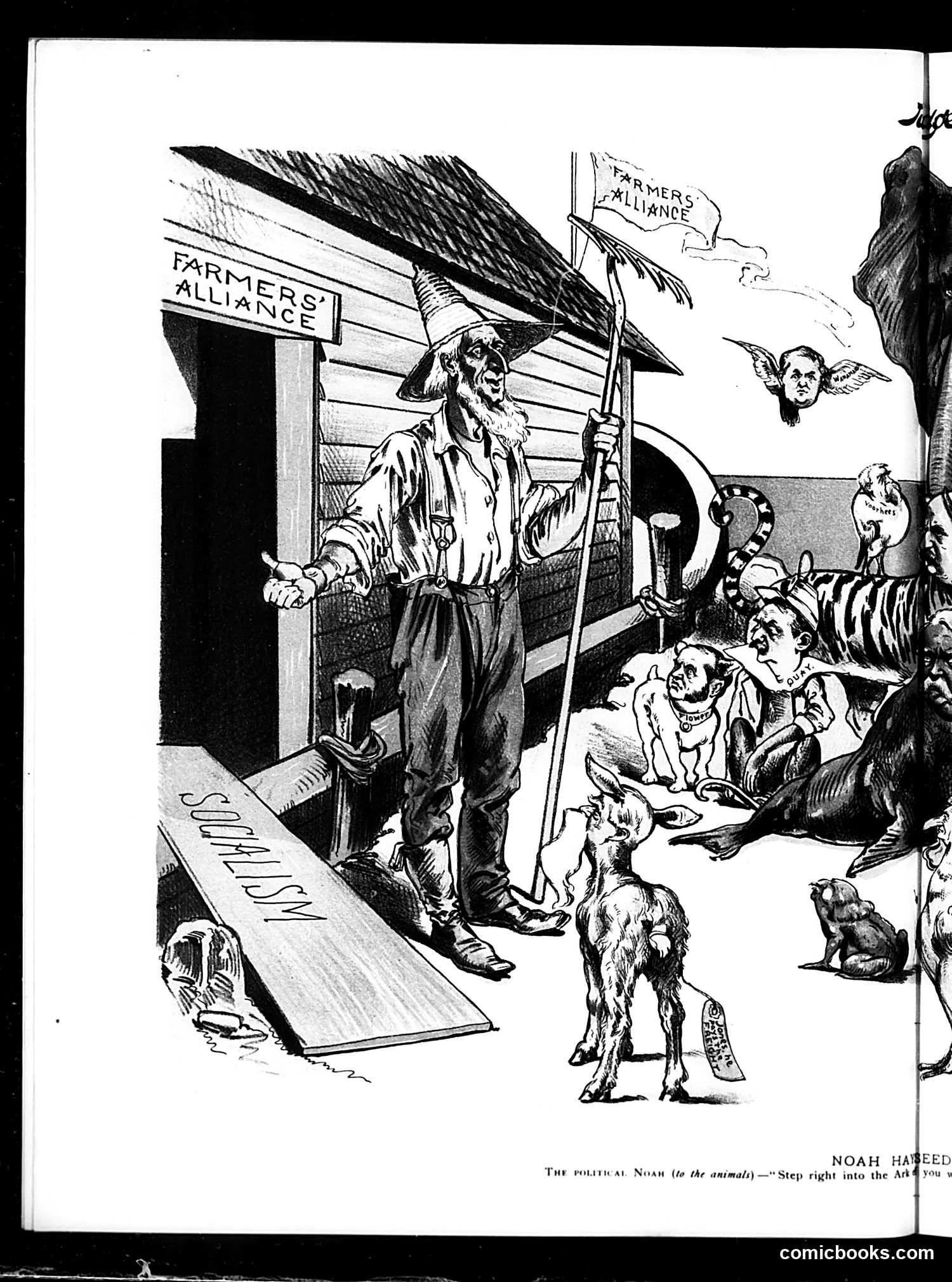
This appears to be a satirical cartoon titled "The Political Noah (to the animals)" credited to Noah Ha'Seed. The central figure is an older farmer or rural figure standing at a "Farmers' Alliance" building, gesturing welcomingly to various animals—likely representing different political or social groups. The "Ark" reference suggests this is allegorical commentary on a political movement or coalition. The Farmers' Alliance was a real 19th-century agrarian political organization, so this cartoon likely satirizes either the organization's recruitment efforts or its composition. The animals entering the "ark" probably represent different constituencies or politicians being brought into the movement. The overall tone appears mocking, suggesting skepticism about the alliance's appeal or legitimacy. Without more context about the publication date, the specific satire's target remains unclear.
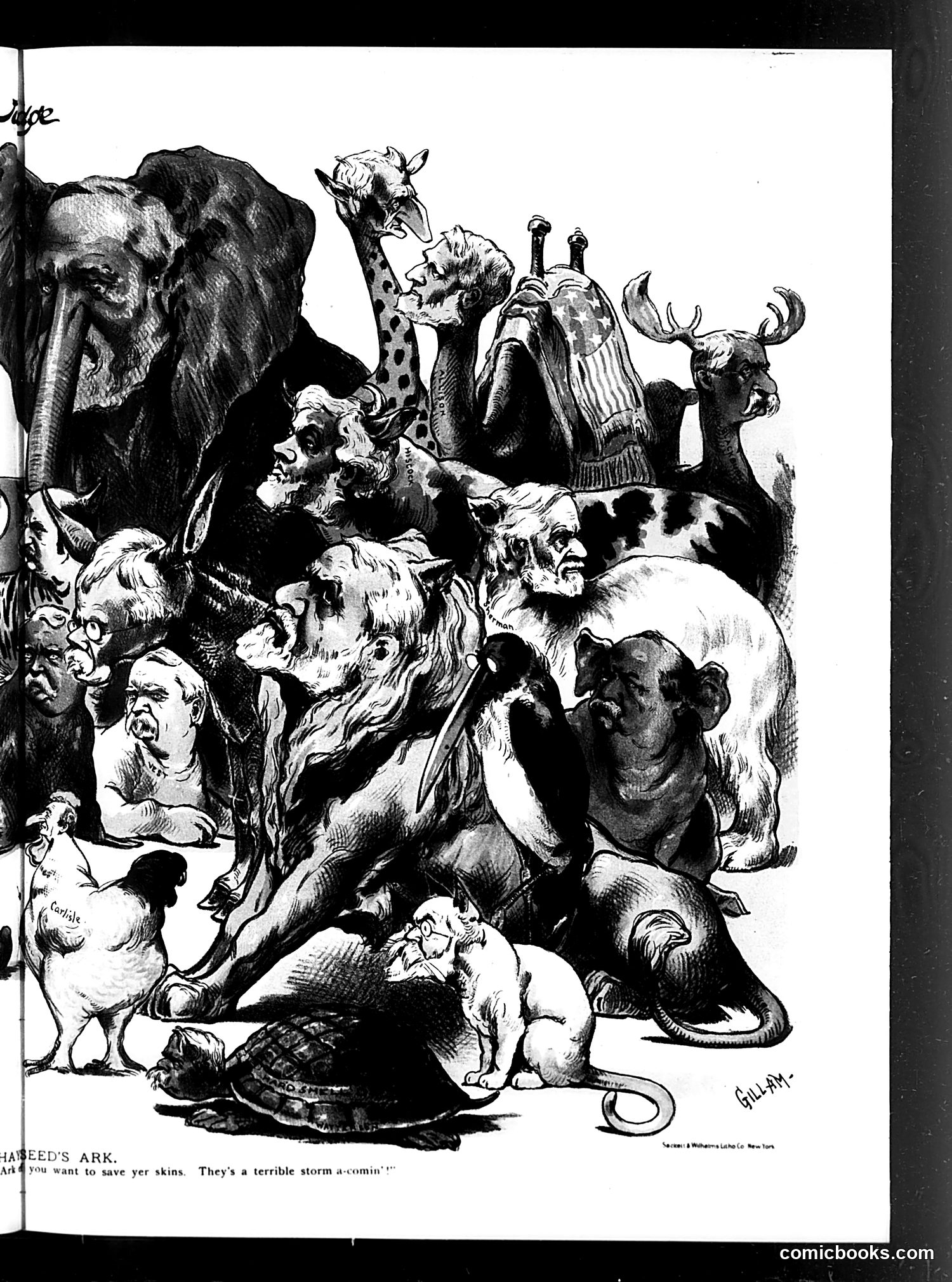
This cartoon satirizes Noah's Ark through a contemporary political lens. The title "Maybeed's Ark" (possibly "Maybe's Ark") suggests uncertainty about salvation or protection. The image depicts various animals and human figures crowded together, with the caption warning of an approaching "terrible storm." The style and composition parody the biblical narrative of preservation during catastrophe. Without clearer identification of specific figures or knowing the exact publication date, the precise political targets remain unclear. However, the satire likely comments on either: - Political leadership's ability (or inability) to protect the nation during crisis - Questions about who deserves "saving" during national emergency - Social anxieties about impending disaster The ark metaphor suggests themes of refuge, selection, and survival during turbulent times typical of Judge magazine's political commentary.
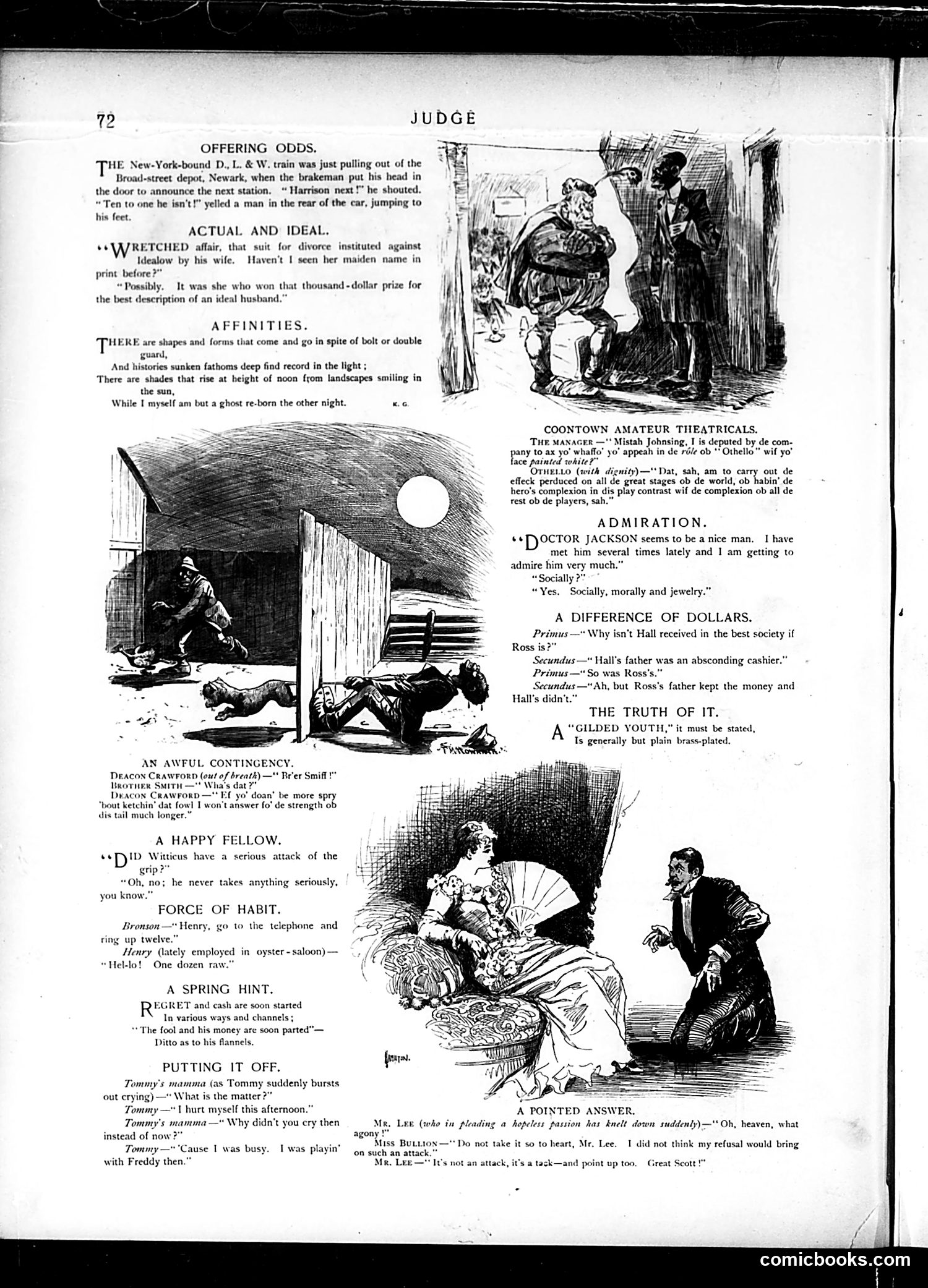
This page from Judge contains multiple satirical vignettes typical of late 19th-century American humor: **"Offering Odds"**: A betting joke about a train announcement—someone bets against the brakeman's station call, implying unreliable railroad service. **"Actual and Ideal"**: Satire on marriage expectations. A woman won a prize describing the "ideal husband," then divorced the real one—mocking the gap between romantic fantasy and reality. **"Coontown Amateur Theatricals"**: A racist sketch using dialect and caricature. An African American actor argues for playing Othello in blackface for "authenticity"—offensive even by period standards, reflecting prevalent racial stereotypes in entertainment. **"Admiration"**: A brief joke about a man admired for being "socially, morally and jewelry"—suggesting material wealth passes for virtue. Other items include wordplay ("A Pointed Answer" puns on "tack"), domestic humor (children's logic), and social observations about class and manners. The illustrations accompany these brief comedic scenarios typical of Judge's satirical format.
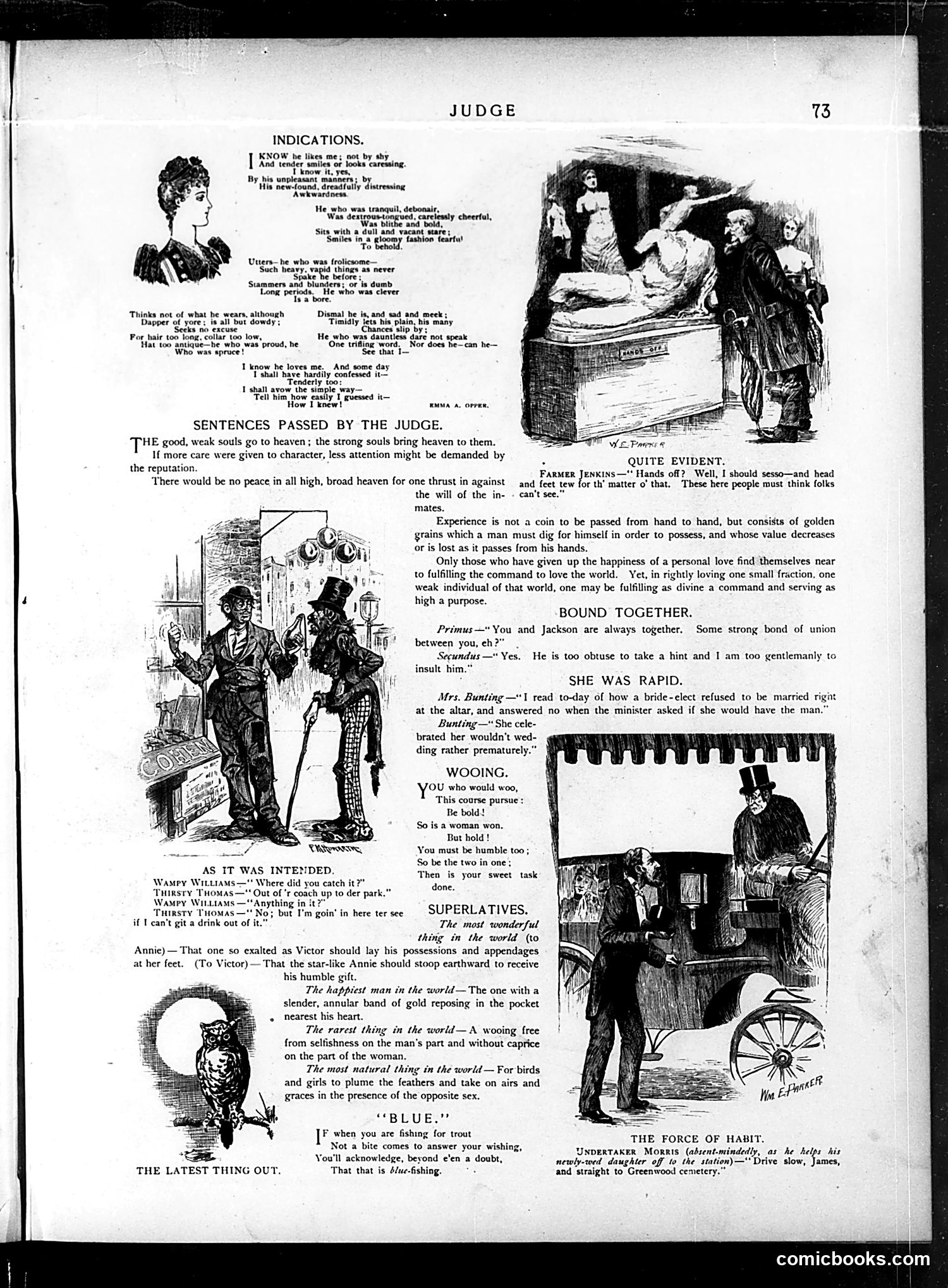
This page from Judge presents satirical commentary on romantic and social behavior typical of late 19th or early 20th-century America. The central illustration "Indications" mocks sentimental courtship narratives—the poem humorously describes how a woman recognizes a man's love through his sudden incompetence: he becomes tranquil, clumsy, and tongue-tied, reversing his normal personality. "Bound Together" satirizes male friendship, suggesting two men remain inseparable not from genuine bond but because one is too obtuse to take hints. "She Was Rapid" jokes about a bride's cold feet—refusing marriage at the altar. "Wooing" prescribes contradictory advice (be bold *and* humble), mocking the impossibility of courtship rules. The lower pieces define romantic "superlatives" with dry wit—the happiest man merely has an engagement ring in his pocket; true wooing is virtually impossible. Overall, the page satirizes the gap between romantic ideals and messy reality—how genuine human behavior contradicts sentimental conventions of the era.
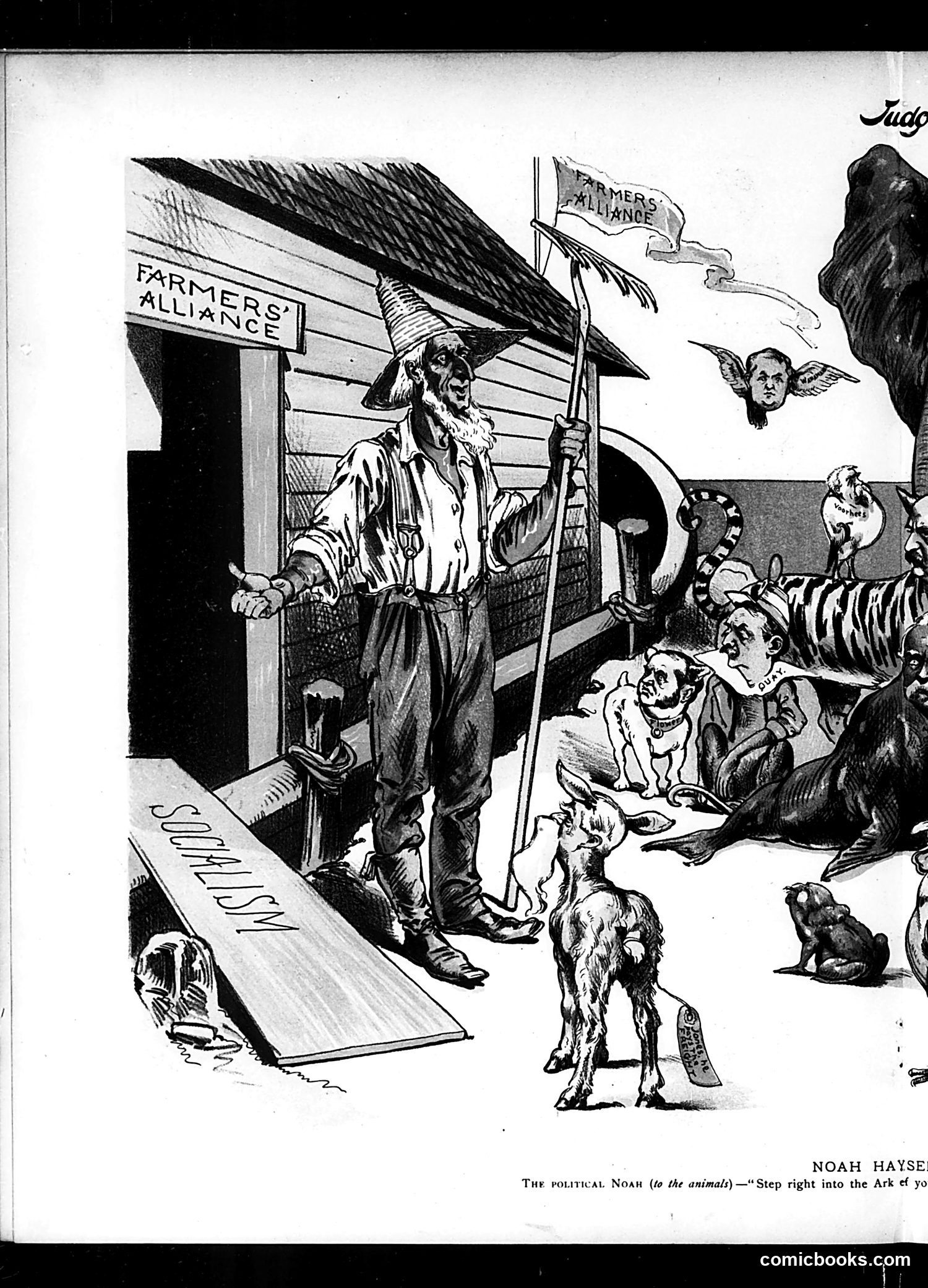
This cartoon by Noah Hayse depicts a biblical allegory: a figure representing "Political Noah" stands at the entrance to an "Ark" (labeled "Farmers' Alliance"), inviting various animals inside. The satirical point appears to critique the Farmers' Alliance—a late-19th-century agrarian political movement—by comparing it to Noah's Ark. The animals likely represent different social groups or political interests being gathered into the Alliance. Demonic or supernatural figures hovering above (including what appears to be a devil) suggest the cartoonist views the organization with suspicion or moral disapproval. Without the complete caption, the exact political target remains unclear, but the satire evidently mocks the Farmers' Alliance as either spiritually questionable or as gathering together incompatible groups under false pretenses.
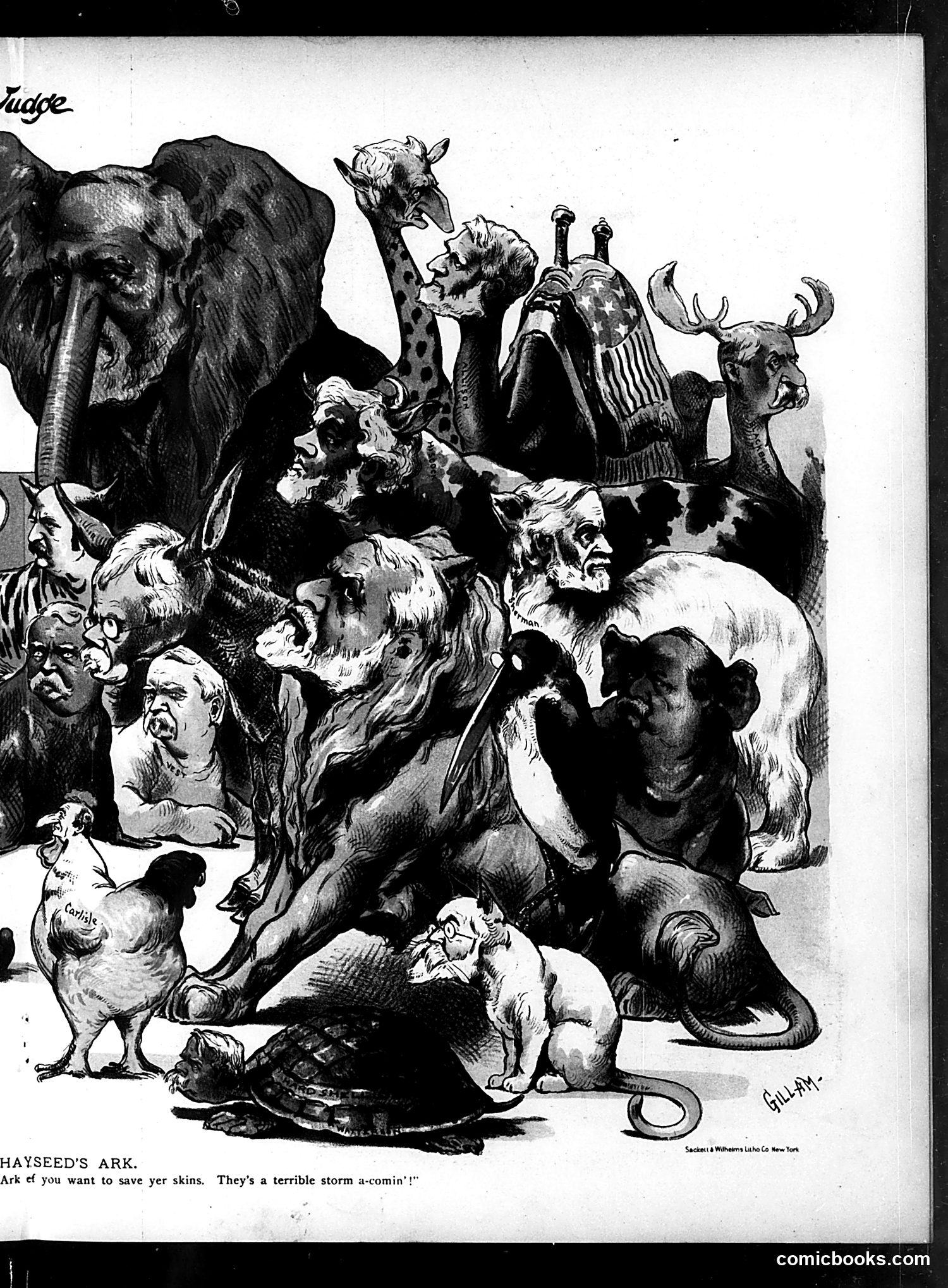
This is a satirical cartoon titled "Hayseed's Ark," playing on the Biblical Noah's Ark story. A rural figure (the "hayseed") warns of an incoming storm while animals and caricatured human figures crowd together seeking shelter. The cartoon appears to be political commentary using the ark metaphor—the gathering suggests imminent crisis or danger requiring collective action. The mixed crowd of animals and grotesquely caricatured people likely represents diverse political figures or social groups. The rural speaker's dialect ("ef," "yer," "a-comin'") positions him as a common-sense voice warning elites of approaching trouble. Without the magazine's date, the specific "storm" referenced remains unclear—it could address an impending political crisis, economic collapse, or social upheaval from Judge magazine's era. The satire mocks both the warning messenger and those ignoring him.
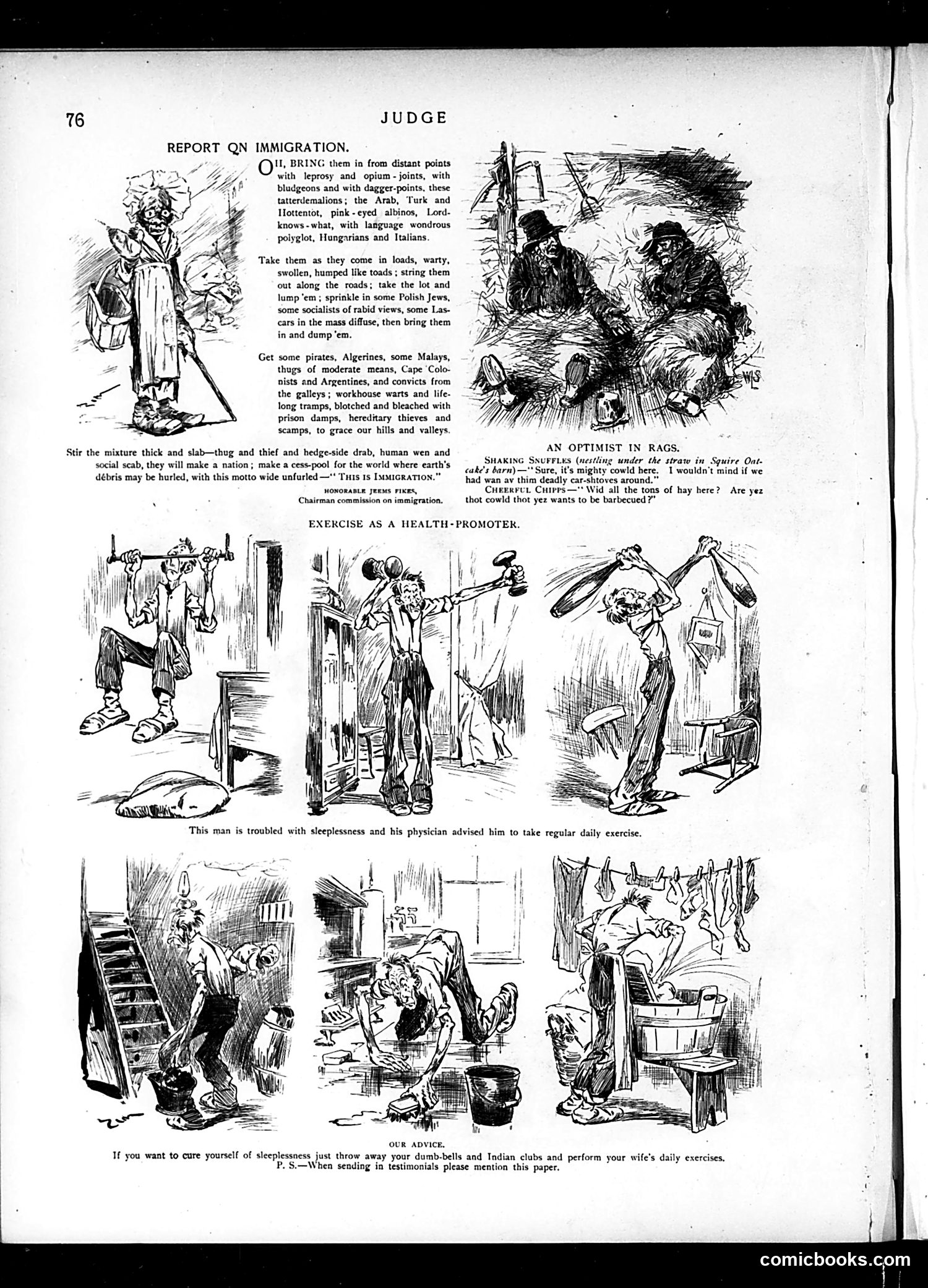
This page satirizes late 19th/early 20th-century American immigration anxieties through two distinct pieces: **"Report on Immigration"** mocks nativist fears by listing immigrants in grotesque, dehumanizing terms—describing arrivals as diseased, criminal, and ethnically "undesirable" (Arabs, Turks, Italians, Polish Jews, "Lascars," etc.). The poem's deliberately crude language and violent imagery ("thug and thief," "social scab") exaggerates anti-immigrant rhetoric to absurd levels, clearly intending to ridicule such prejudices rather than endorse them. **"An Optimist in Rags"** shows a homeless Irish immigrant humorously complaining about cold weather while surrounded by hay—a gentler jab suggesting that even impoverished immigrants maintain resilient humor. The bottom section, "Exercise as a Health-Promoter," shifts tone entirely with domestic humor about exercise curing insomnia, unrelated to immigration. The page criticizes xenophobic attitudes by presenting them as laughably extreme, while acknowledging the real hardships facing immigrants of the era.
This page is primarily **advertisements and filler content**, not political cartoons. Judge was a satirical humor magazine, but this particular page contains mostly commercial ads (pianos, carriages, soap, hair treatments, olive oil) interspersed with brief humorous observations and product testimonials. The few actual jokes present are lightweight social commentary: - A quip about people complaining about "them" causing their own troubles - Observations about urban loneliness and noisy babies - A mild joke about a museum curio dealer selling "skeletons" of George Washington's cat at different sizes (implying he's a fraud or con artist) The **political reference** appears minimal—a single mention questioning whether Italy should pay for warships, with a quip suggesting Uncle Sam should buy up builders' liens instead. This likely refers to contemporary debates about naval spending and foreign policy. Overall, this is a **commercial/advertising page** rather than a satirical commentary page, representing how Judge monetized itself through patent medicine and consumer product ads typical of early-20th-century magazines.
This is primarily an **advertising page** from Judge magazine, with minimal editorial content. The main elements are: **The Cartoons/Jokes:** A small joke appears mid-page: a stout woman at a theater box office asks for two seats. The ticket seller asks, "For yourself, ma'am?"—implying she takes up two seats. This is a **body-shaming gag** common to the period, relying on crude humor about a woman's weight. Another brief item mocks Italian street musicians, using exaggerated dialect ("Signor Tunituppi," "Vea vill") to satirize immigrant musicians threatening "revenge" by playing sentimental songs louder. **Advertisements:** The page is dominated by period product ads: Shandon Bells perfume, German Sweet Chocolate, German Saat chocolate, piano manufacturers (Sohmer), railroads (New York Central), insurance (Penn Mutual Life), and medical remedies (Cuticura for skin conditions, anti-pain plasters). These reflect late-19th-century consumer goods and health product marketing, including unregulated patent medicine claims. The content is culturally dated rather than politically satirical.
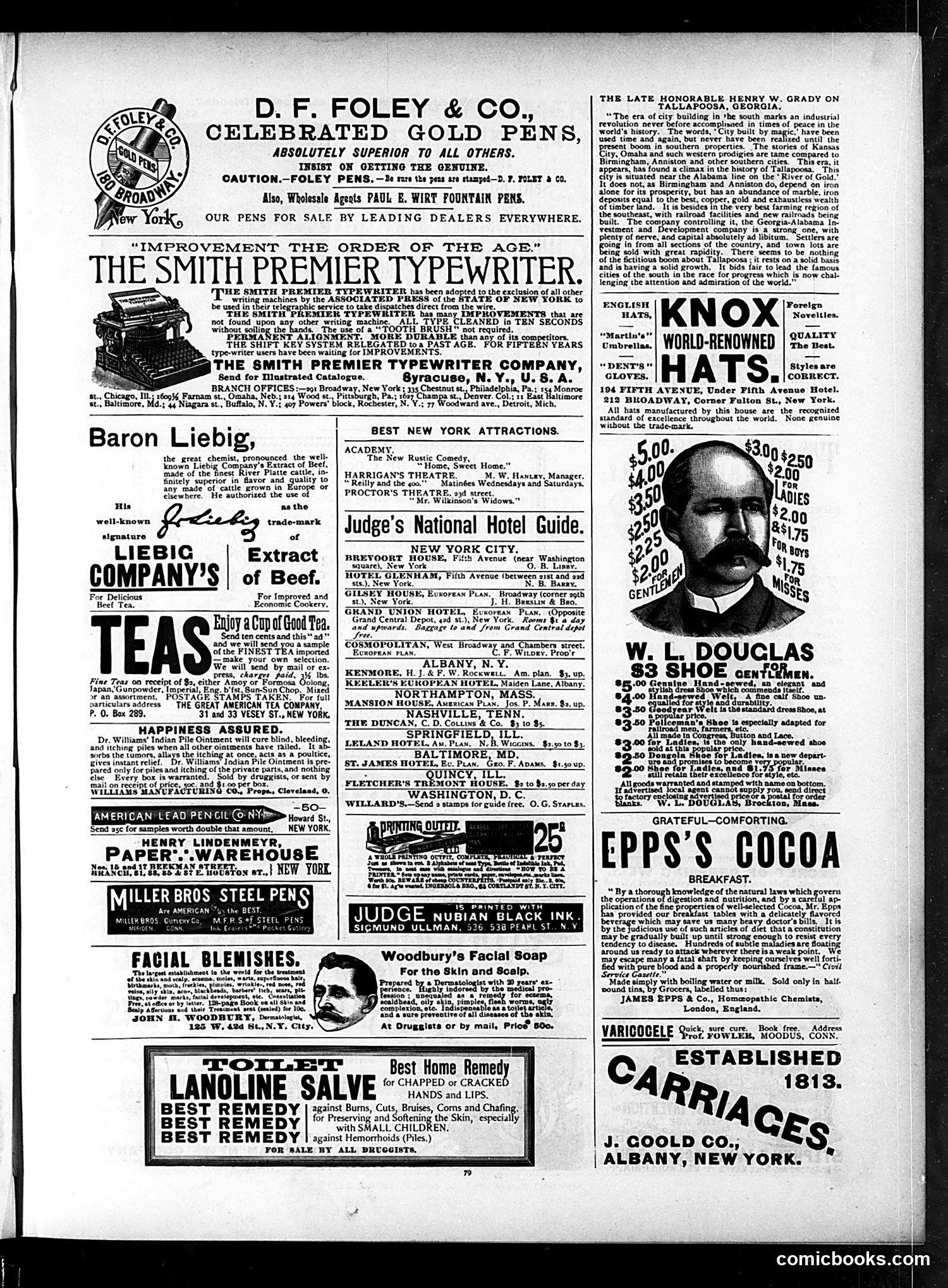
This page is primarily **advertising**—a typical example of a turn-of-the-century trade publication mixing commerce with editorial content. The notable editorial element is a long quotation from "The Late Honorable Henry W. Grady," celebrating rapid industrial development in the American South, particularly the boom city of Tallapoosa, Alabama. This represents optimistic, uncritical boosterism of Southern industrial expansion—a standard journalistic mode of the era. The advertisements showcase era-specific products: fountain pens, typewriters (the Smith Premier), medicinal remedies (Liebig's Extract, facial salves), tea, and carriages. Many ads made dubious health or superiority claims—accepted journalistic practice then. The *Judge* Magazine itself targeted urban, educated readers through these professional product endorsements. No obvious political cartoons or satire appears on this particular page—it's essentially a commercial/editorial hybrid that reveals the monetization of publishing and the unquestioned promotion of economic development circa 1900s America.
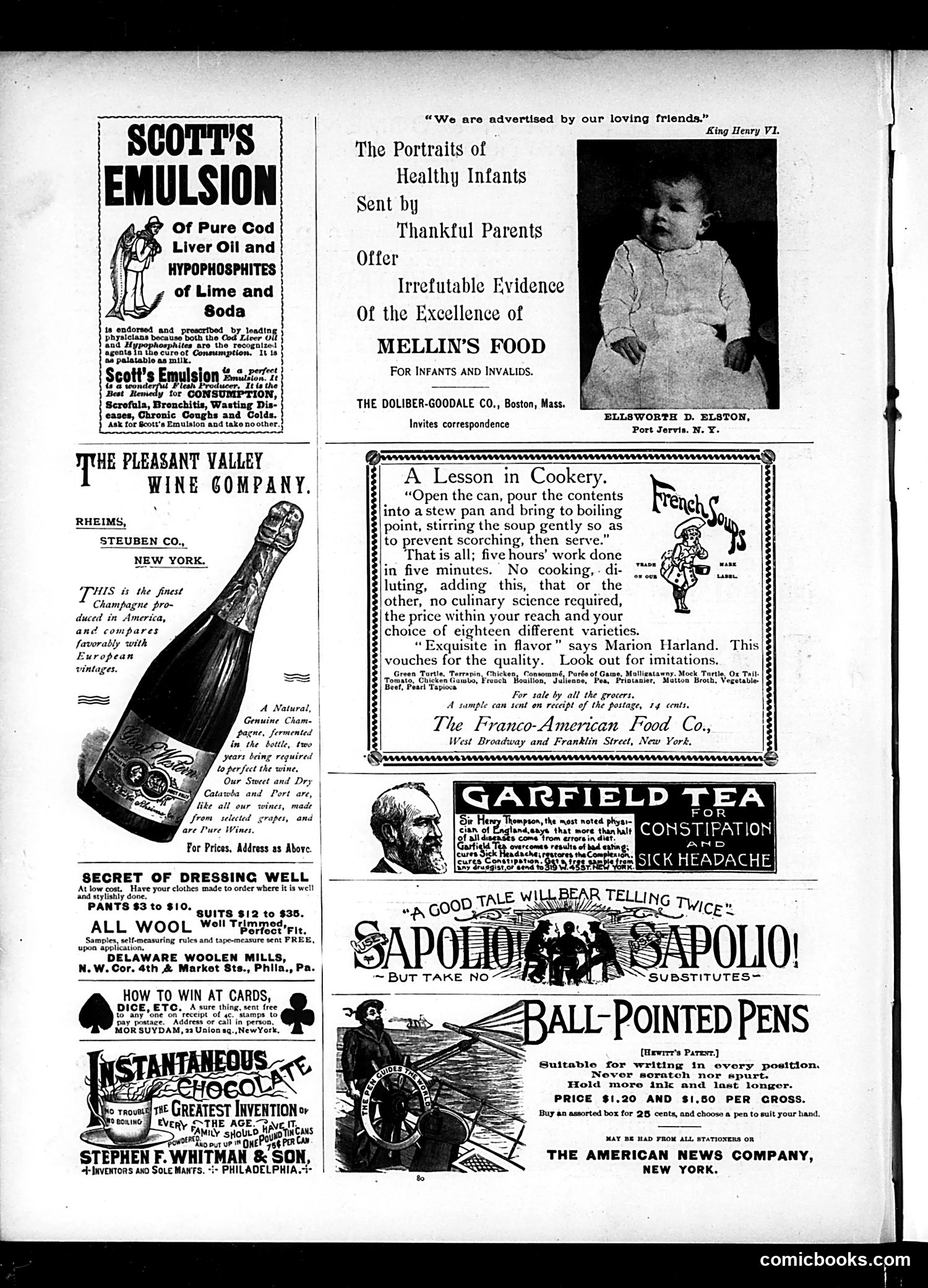
This page is primarily **advertisements** with no political cartoons or satire. It's a typical late-19th-century magazine advertising spread. The ads promote patent medicines and consumer goods common to the era: - **Scott's Emulsion** and **Mellin's Food** advertise remedies for consumption (tuberculosis) and infant nutrition, endorsed by "leading physicians"—typical claims of unregulated patent medicine marketing - **Pleasant Valley Wine** promotes American-made champagne - **Garfield Tea** advertises constipation and headache relief - Other ads hawk clothing, chocolate, pens, and card-game cheating guides The quote attributing advertising to "loving friends" (King Henry VI) is ironic—acknowledging that testimonials drive sales. Notable: Several ads target infant/child health, reflecting high mortality rates. The "Portraits of Healthy Infants" sent by parents is a testimonial marketing tactic. Card-cheating and chocolate ads show the era's unregulated commerce. **No satire or political content is evident**—this is straightforward commercial advertising typical of Judge's revenue model.
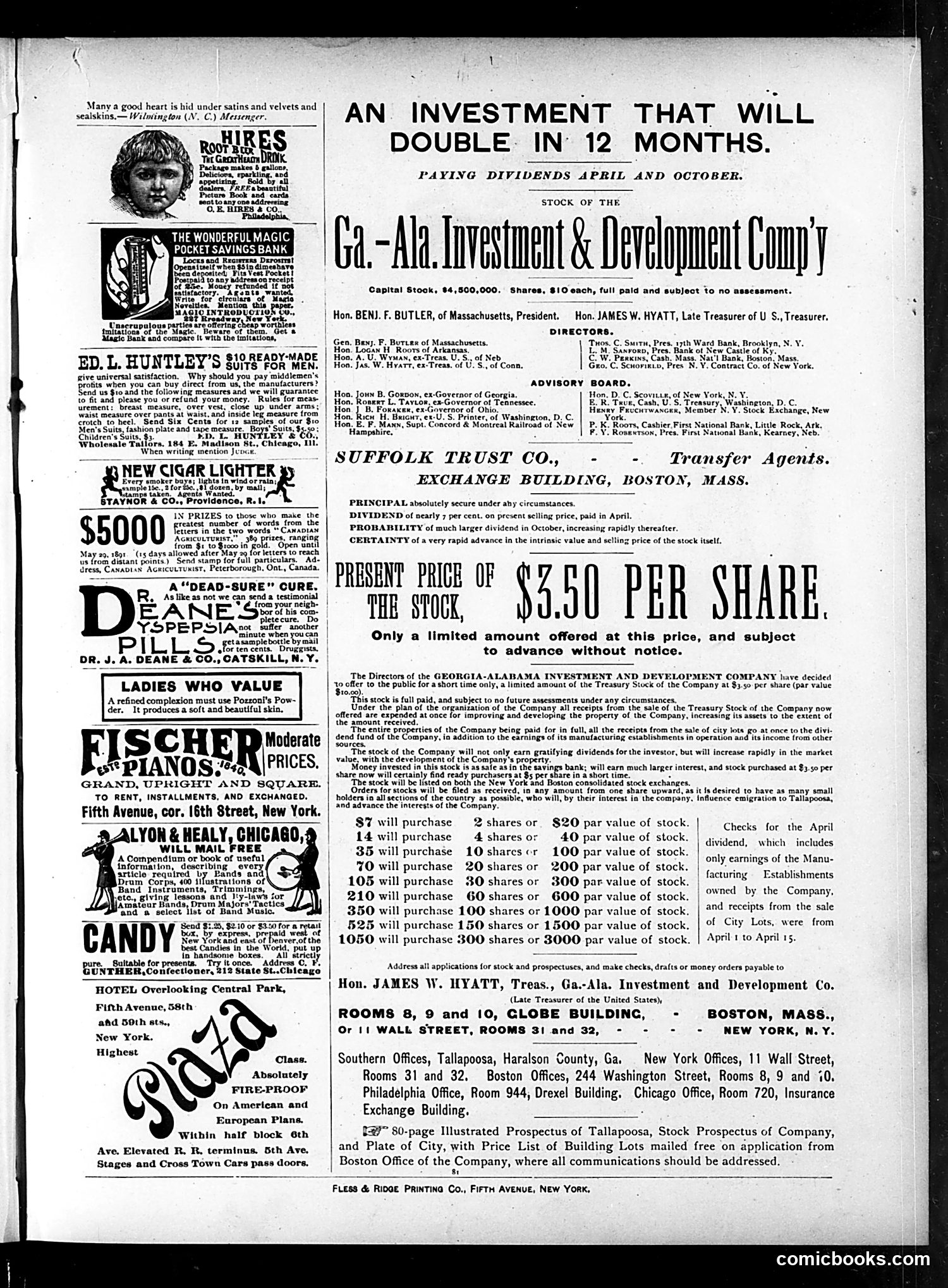
This page is predominantly **commercial advertising**, primarily for the Georgia-Alabama Investment & Development Company stock offering. The central promotion claims an "investment that will double in 12 months" with dividends paid in April and October. Stock is priced at $3.50 per share. The company lists as treasurer James W. Hyatt, described as "Late Treasurer of U.S." and includes on its advisory board several ex-governors and prominent financiers, lending apparent legitimacy. **This appears to be a speculative or fraudulent investment scheme**—precisely the type of dubious financial proposition that would have circulated in the 1880s-90s. The boasts of guaranteed doubling and rapid appreciation, combined with the name-dropping of political figures, are classic red flags. Modern readers should recognize this as snake-oil capitalism. The surrounding advertisements (magic banks, mail-order suits, dyspepsia pills, "dead-sure" cures) reinforce the page's character as a grab-bag of dubious commercial claims typical of period advertising.
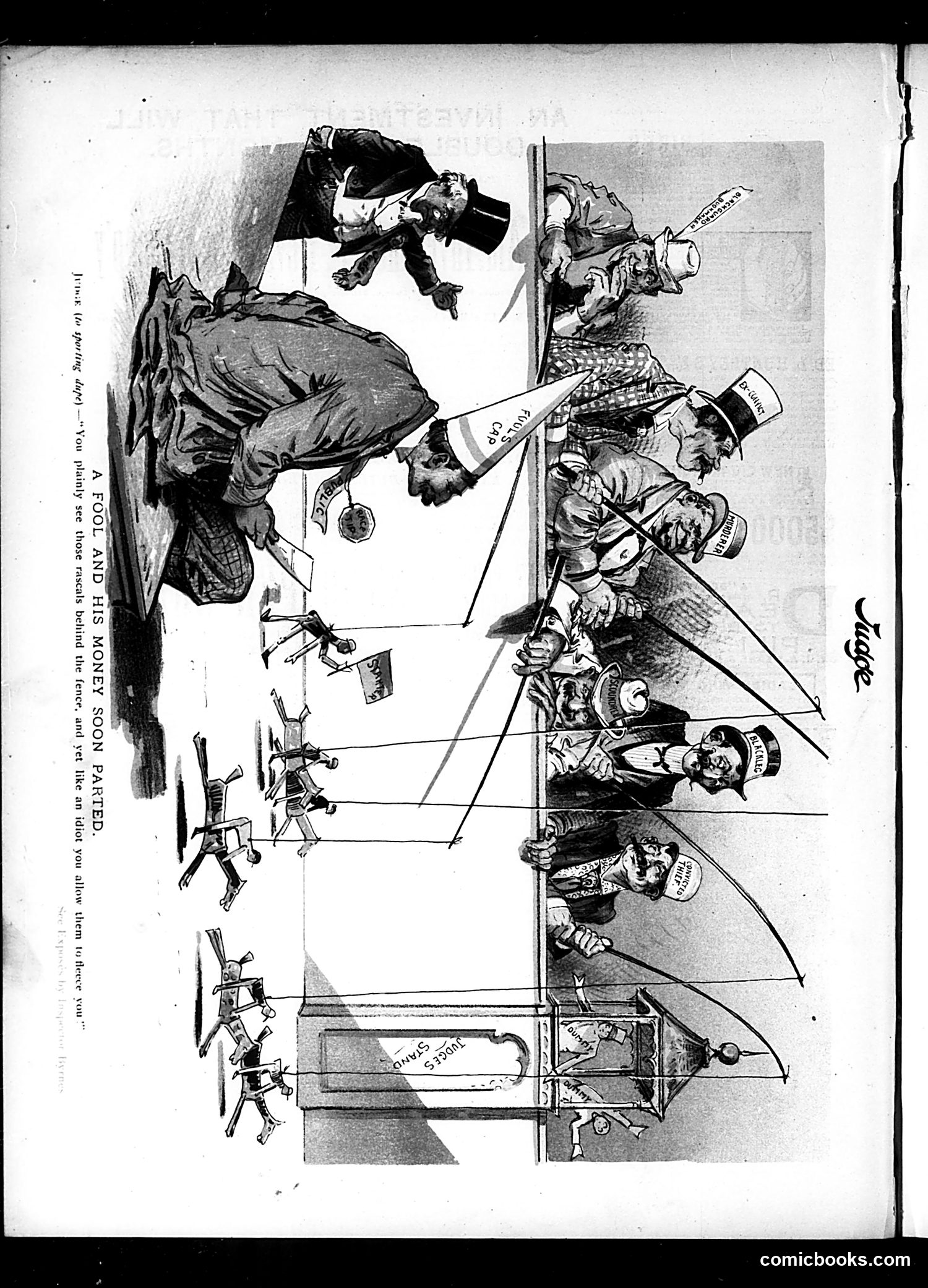
This is a political cartoon titled "A Fool and His Money Soon Parted." The image depicts a large, well-dressed man (likely representing a wealthy or gullible person) on the left, being manipulated by a group of con artists on the right who are positioned behind a fence or barrier. The visible OCR text suggests the cartoon is addressing him directly as a "sporting dupe," calling him an idiot for not recognizing obvious deception. The satire appears to target financial fraud or swindling schemes—specifically mocking someone who continues enabling scammers despite their obvious presence and duplicitous activity. The cartoon uses the proverb "a fool and his money are soon parted" to criticize either wealthy naïveté or deliberate complicity in fraudulent dealings. The exact historical context requires additional information about Judge magazine's publication date.