
A complete issue · 22 pages · 1891
Judge — March 28, 1891
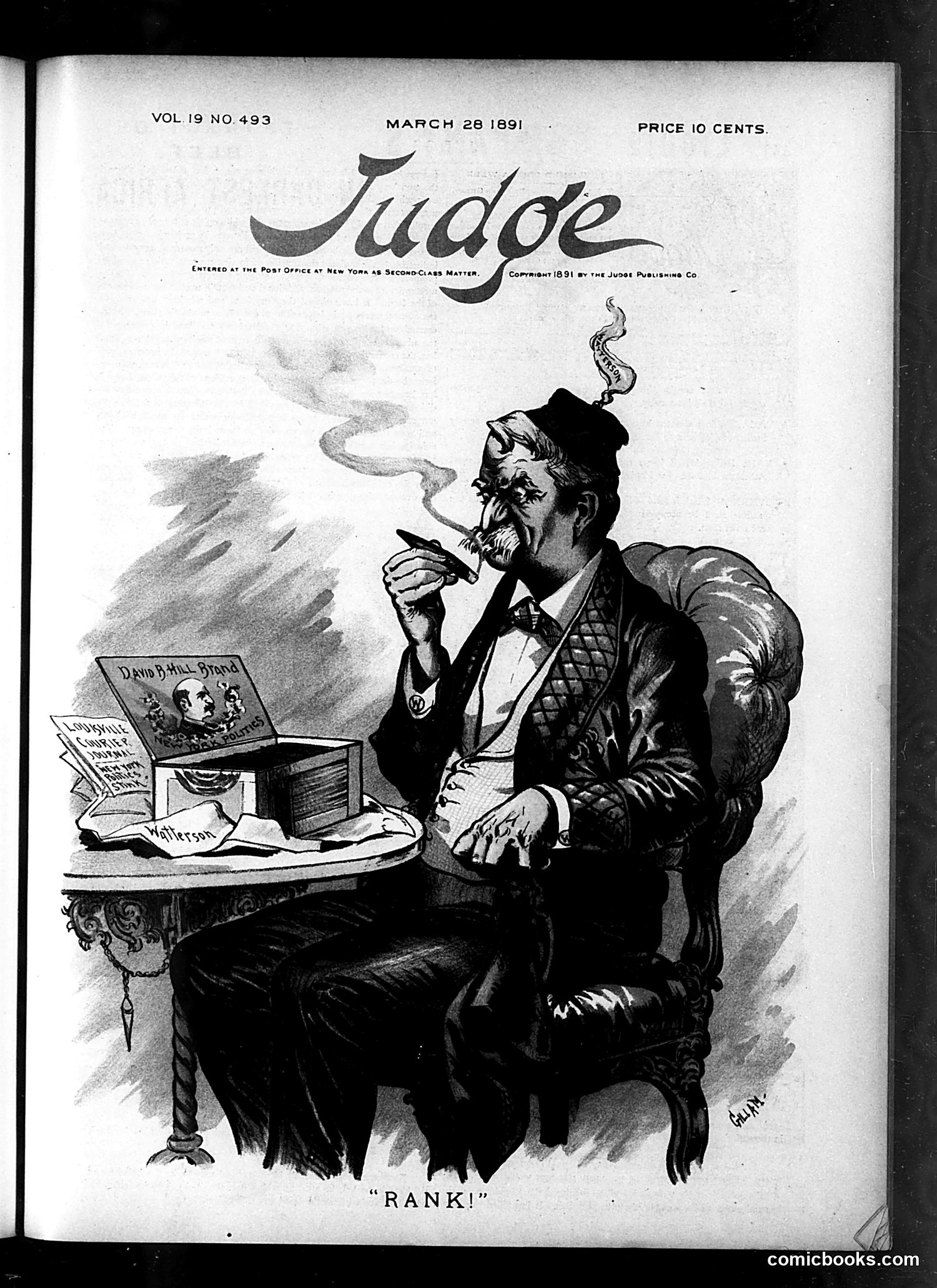
This satirical cartoon depicts a man—likely a politician or public figure of the era—smoking a cigar at a desk, appearing satisfied or self-congratulatory. The caption "RANK!" suggests mockery of his pretensions or inflated status. On the desk sits what appears to be a "David B. Hill Brand" box (visible text), indicating this may reference David B. Hill, a prominent New York politician of the 1880s-90s. The scattered papers and cigar smoke suggest arrogance or corruption. The cartoon's point appears to be satirizing either Hill's political ambitions, his self-importance, or possibly a scandal—a common Judge target. Without additional context about March 1891 events, the specific grievance remains unclear, though the "rank" caption suggests the cartoonist viewed him as undeservedly elevated or offensive.
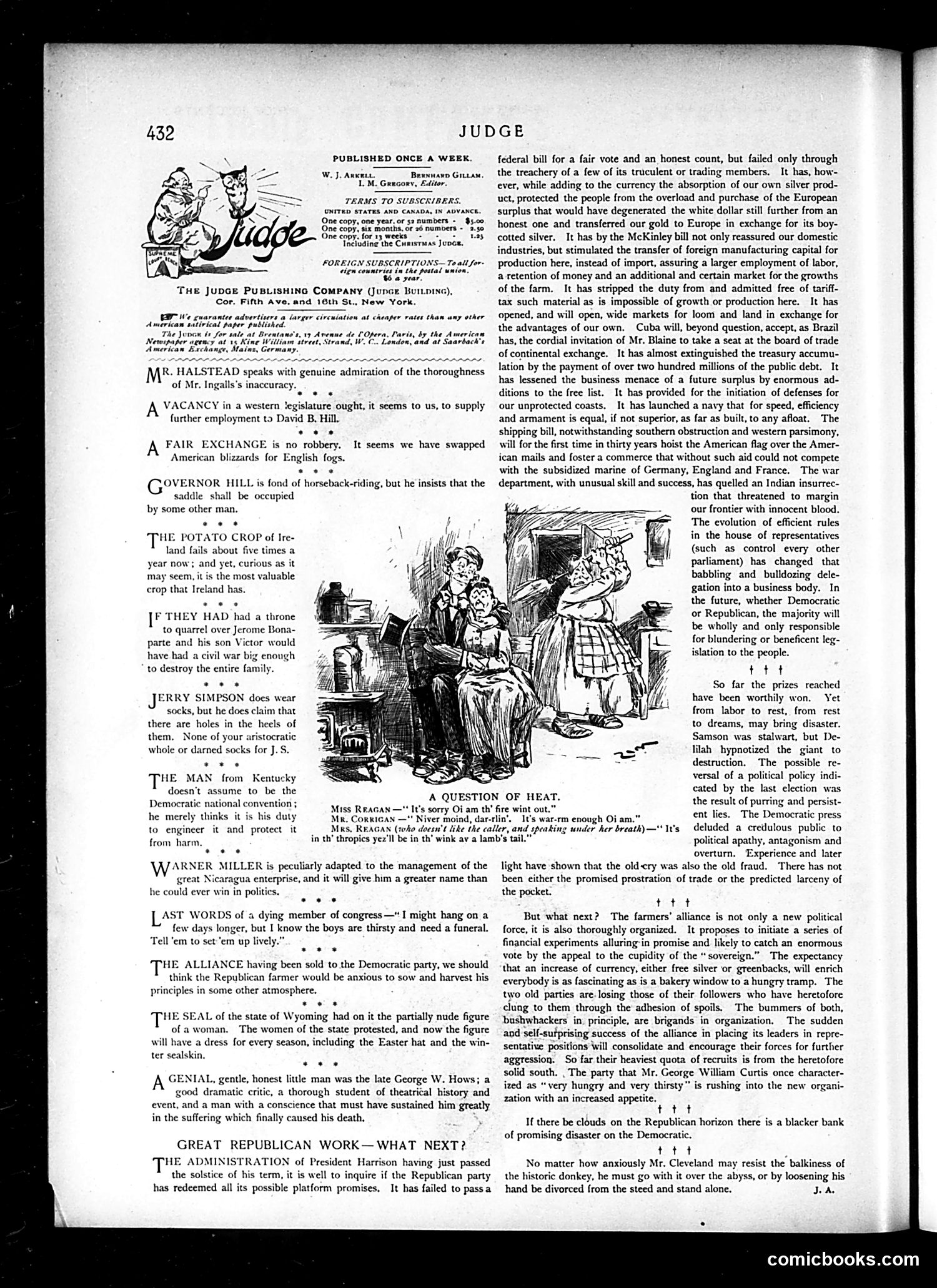
The central cartoon depicts a domestic scene with a woman (labeled "Miss Reagan") confronting a man (labeled "Mr. Corrigan") about heating their home. The woman complains: "It's awfully cold, and speaking under her breath—'It's in th' cheapest yet he is in it' wink as a lamb's tail." This appears to satirize a real heating or fuel shortage affecting American households, likely from the late 19th or early 20th century. The cartoon mocks either inadequate heating solutions or the disparity between what people pay for heat versus what they receive. The intimate domestic setting uses marital tension to highlight public frustration with a practical utility problem affecting everyday life.
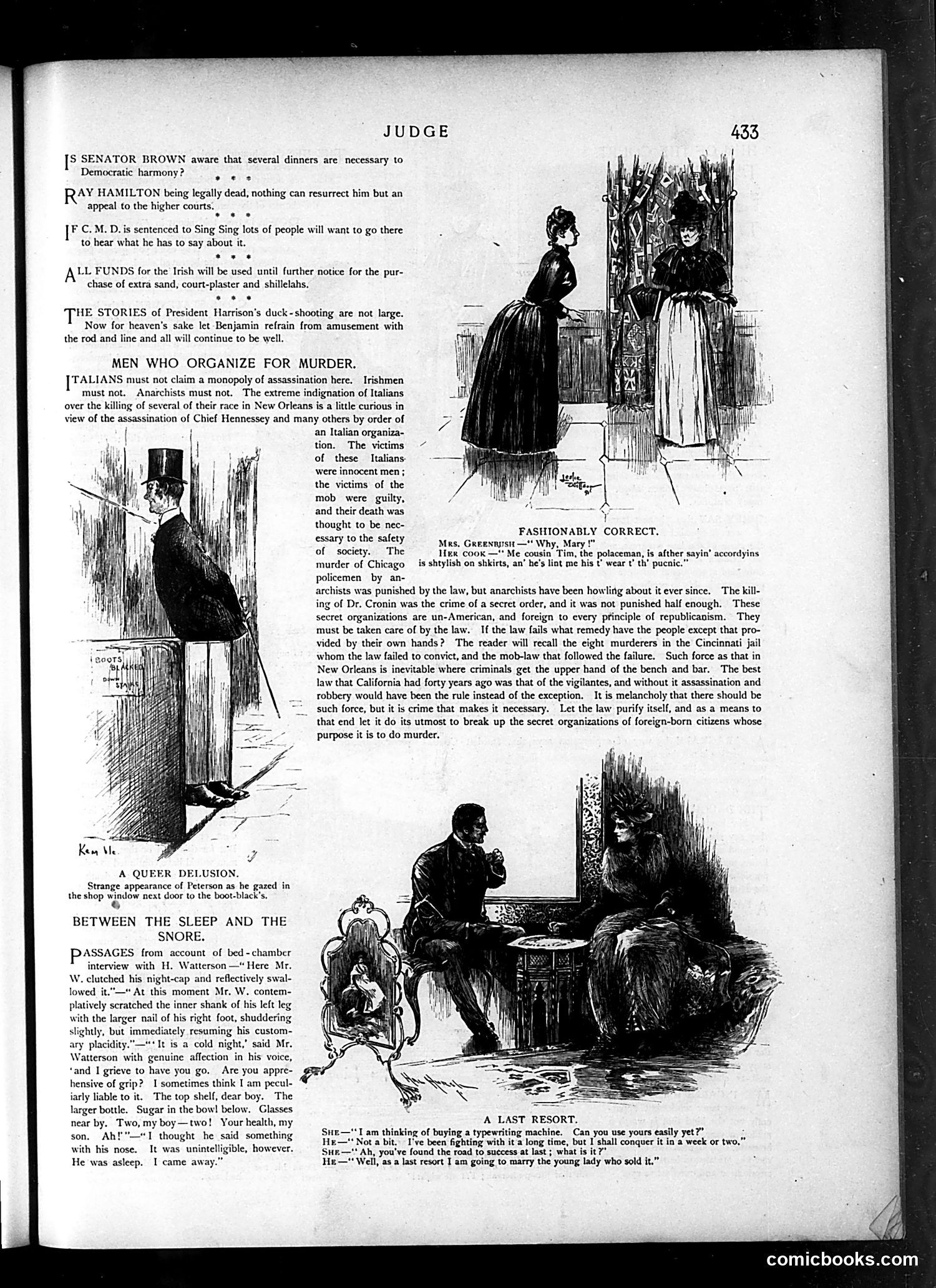
This page contains several satirical pieces. The main article "Men Who Organize for Murder" discusses Italian organized crime, specifically referencing the assassination of Chicago police Chief Hennesley and the killing of Dr. Cronin, linking these to secret Italian criminal organizations. The piece argues such violence justifies law enforcement action against foreign-born criminals. The cartoon "A Queer Delusion" depicts a man peering into a shop window, apparently seeing something unusual. "Between the Sleep and the Snore" presents a bed-chamber dialogue where a man describes waking with inexplicable physical symptoms—a hangover-like condition he cannot explain, suggesting humorous social commentary about drinking or excess. The final cartoon "A Last Resort" shows figures in conversation, likely satirizing romantic or social entanglements of the era.
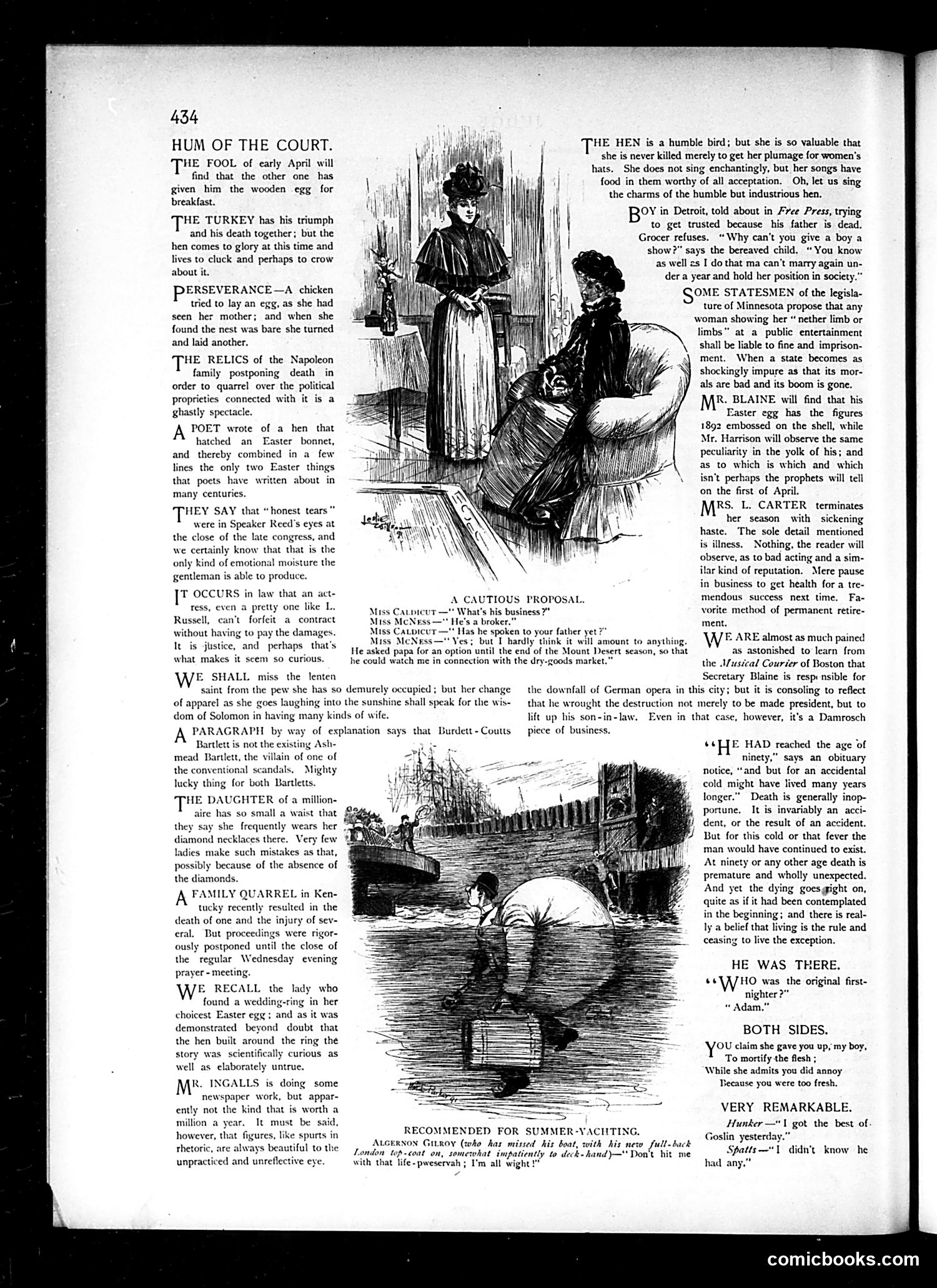
This page contains miscellaneous satirical commentary rather than a unified political cartoon. The pieces mock various American social types and behaviors circa the 1890s: **Key references include:** - **Speaker Reed**: A politician mocked for emotional insincerity - **L. Russell**: Likely actress Lillian Russell, referenced in a legal joke about contract forfeitures - **Burdett-Coutts**: Appears to reference a wealthy English family's domestic disputes - **German opera**: A jab at its declining popularity in an American city **Social satire targets:** - Wealthy heiresses with absurdly tiny waists (fashion excess) - A millionaire's daughter who frequents yachting clubs - Brokers and financial speculation - Rural/working-class behavior (Kentucky family quarrels) The humor relies on period-specific knowledge: fashion anxieties, class distinctions, and public figures. The repeated hen/Easter imagery appears to be recurring Judge magazine motifs rather than unified commentary.
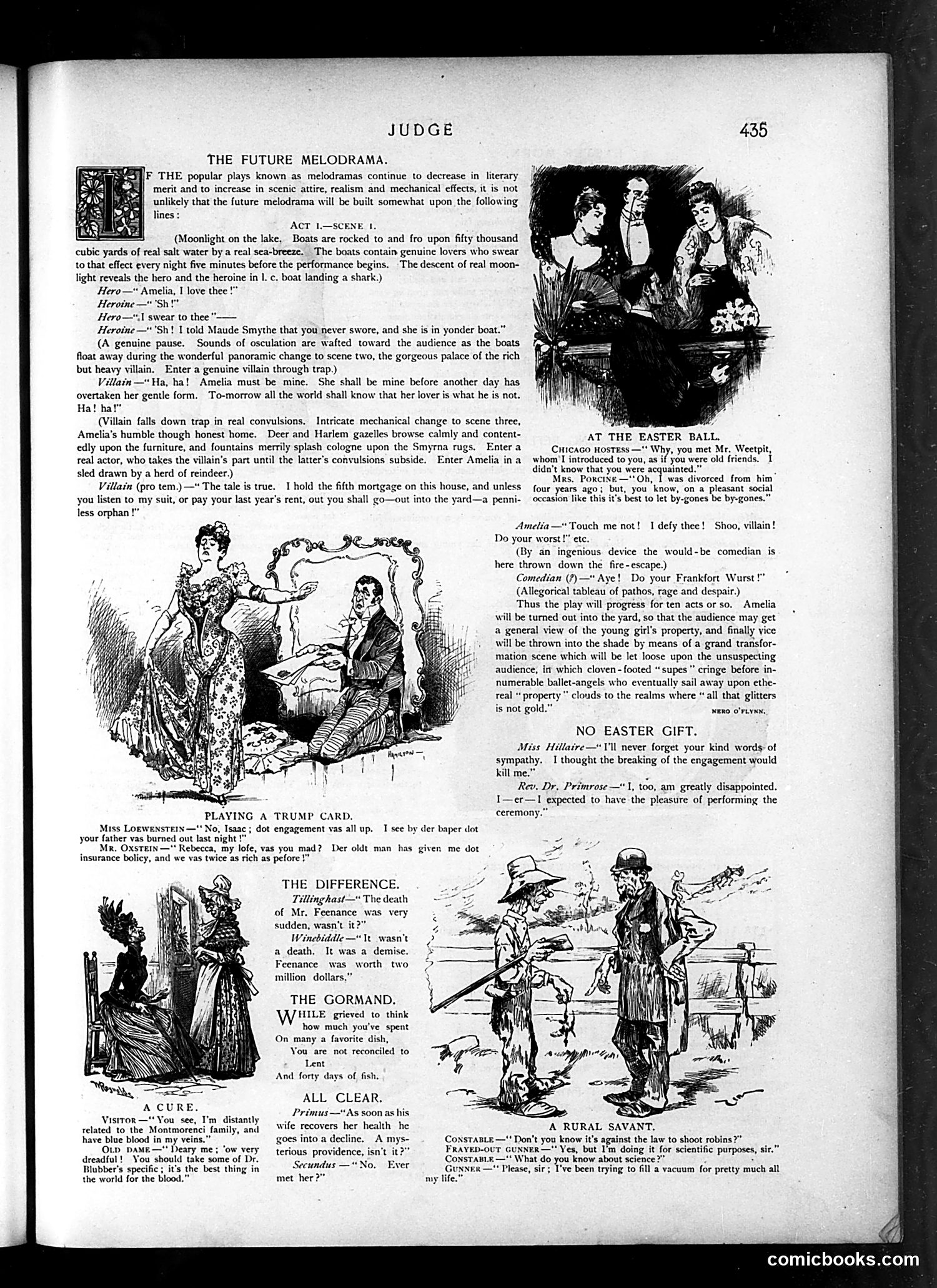
This page satirizes the declining quality of American melodrama theater. The main article mockingly predicts that if melodramas continue prioritizing spectacular staging over literary merit, future productions will become absurdly over-mechanized—featuring real salt water, genuine moonlight, live animals, and elaborate trap doors—while maintaining thin, predictable plots. The satire targets both playwrights who rely on technical effects rather than storytelling, and audiences who prefer spectacle to substance. The detailed "script" parodies typical melodramatic clichés: the virtuous heroine, villainous landlord, and overwrought dialogue ("Amelia, I love thee!"). The accompanying comic vignettes mock various social pretenses: Jewish characters' malapropisms in "Playing a Trump Card," and the linguistic distinction between "death" and "demise" based on wealth in "The Difference." The humor relies on readers recognizing contemporary theater conventions and appreciating the exaggeration of trends Judge's editors found absurd.
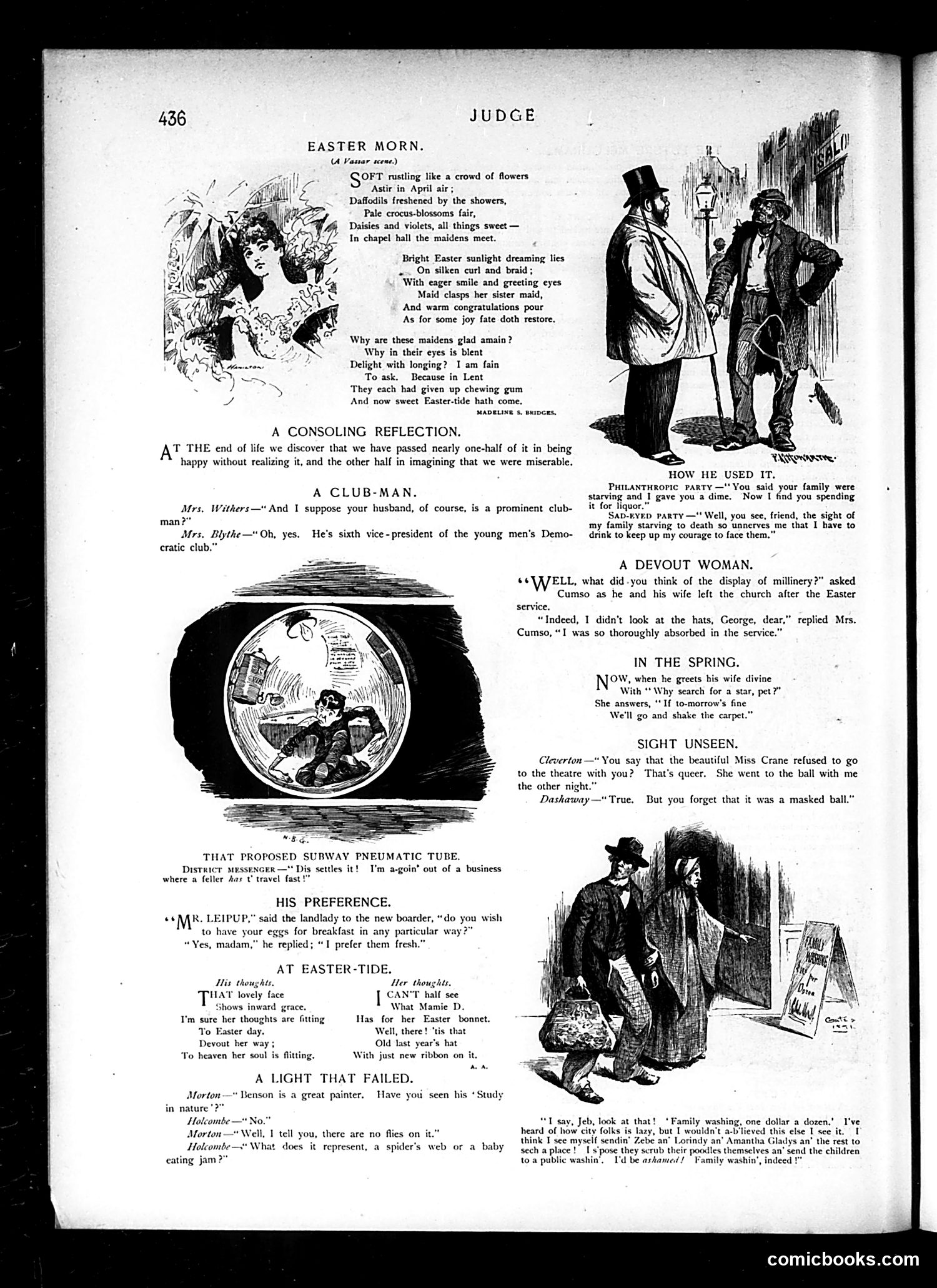
This Easter-themed page from Judge magazine contains multiple brief satirical sketches typical of late 19th/early 20th-century humor. **Main items:** **"Easter Morn"** — A poem mocking Vassar College women, joking that their Easter joy stems solely from ending their Lenten sacrifice of chewing gum—presenting privileged young women as superficial. **"A Club-Man"** — Satirizes a wife claiming her husband is a "sixth vice-president" of a Democratic club, mocking the proliferation of minor titles in fraternal organizations. **"How He Used It"** — Dark satire: a philanthropist gives money to a "starving" man, who admits he's spending it on liquor to cope with his family's hardship—critiquing both poverty and charity's ineffectiveness. **"A Devout Woman"** — Ironic: a woman claims she ignored millinery displays during Easter service, supposedly absorbed in worship, when the implied joke is she's lying about her piety. The remaining sketches offer light domestic humor about marriage, spring, theater, and literal-minded replies. The overall tone reflects Judge's satirical approach to social pretense, class anxiety, and human foibles.
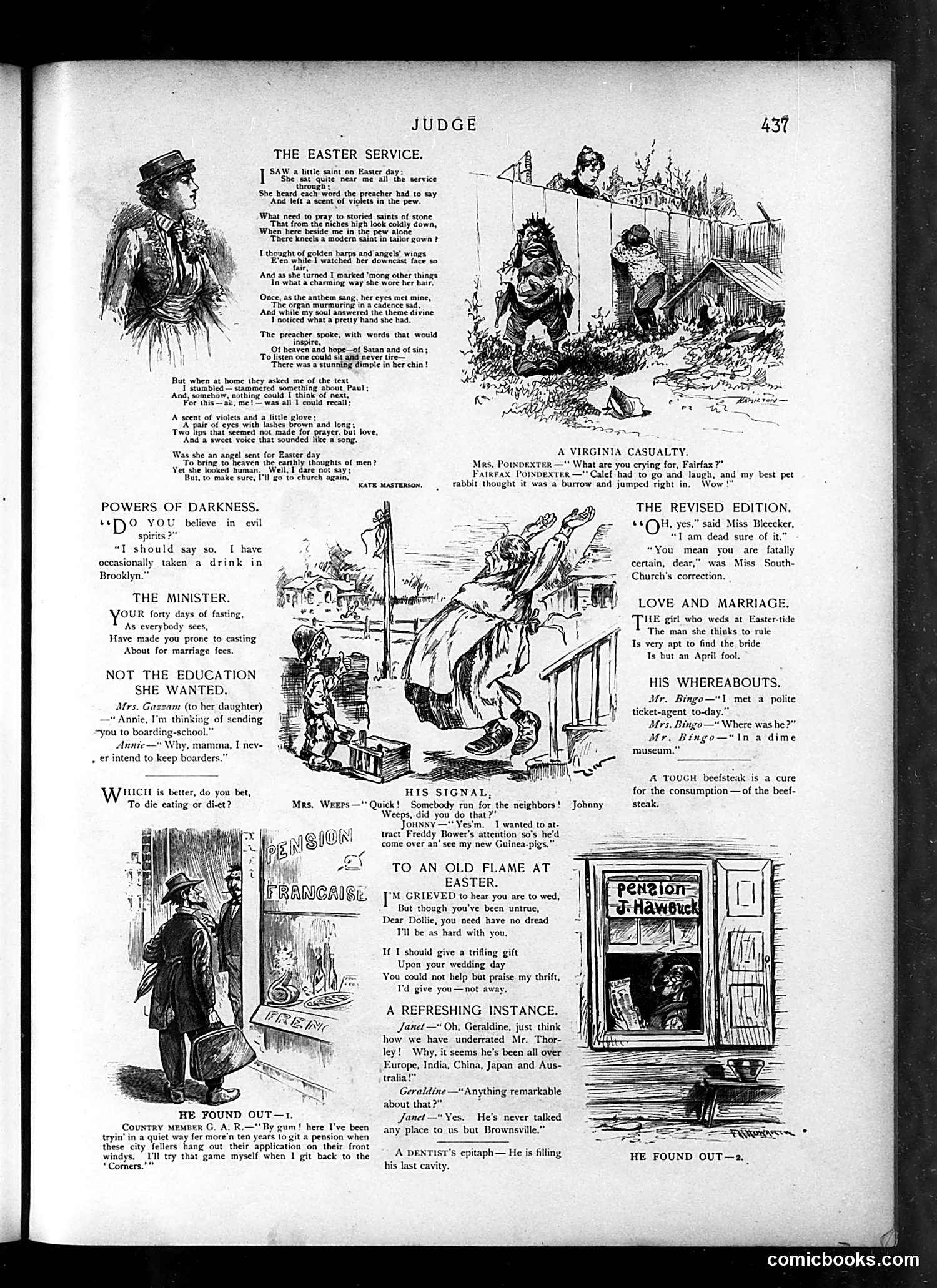
This is a page from Judge magazine containing Easter-themed humor and satire. The dominant piece, "The Easter Service," satirizes male distraction during church—a man notices a young woman's physical attributes (eyes, hair, dimples, gloved hand) while completely missing the sermon's content about sin and heaven. The joke is on masculine weakness and the gap between spiritual intention and actual behavior. Other items include brief jokes mocking various social types: a pompous minister, boarding school, social pretension, and marriage. "A Virginia Casualty" humorously depicts a child's accident involving a pet rabbit. The scattered advertisements and one-liners suggest typical Judge content targeting educated, upper-middle-class readers with gentle mockery of contemporary manners, courtship, and social conventions. The satire assumes readers share values about religious propriety and gender relations typical of late 19th/early 20th-century America.
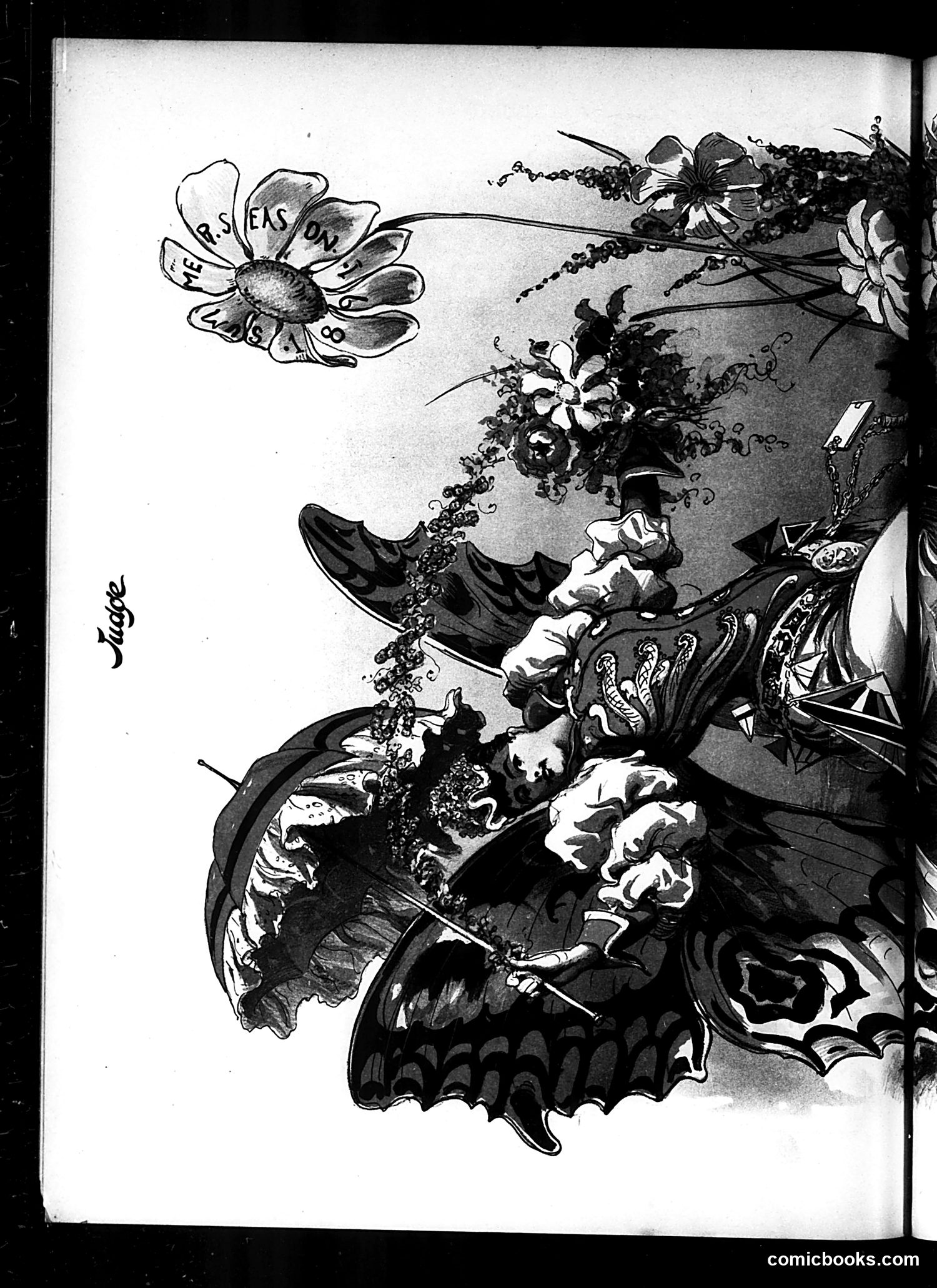
This appears to be a satirical illustration from *Judge* magazine featuring a decorative composition built around a large butterfly or moth. The image uses the insect as a central motif, with ornamental flourishes, flowers, and curling botanical elements arranged around it. Text visible on the flower petals reads "SEAS ON" (likely "SEASON"), suggesting this may be seasonal commentary. The artistic style—detailed line work, dramatic shading, and decorative framing—is typical of *Judge's* aesthetic during the late 19th or early 20th century. Without clearer OCR text or additional context clues, the specific political or social satire being targeted remains unclear. The piece appears primarily decorative or possibly comments on fashion, nature themes, or seasonal topics popular in the era, but the precise satirical point cannot be definitively determined from the visible elements.
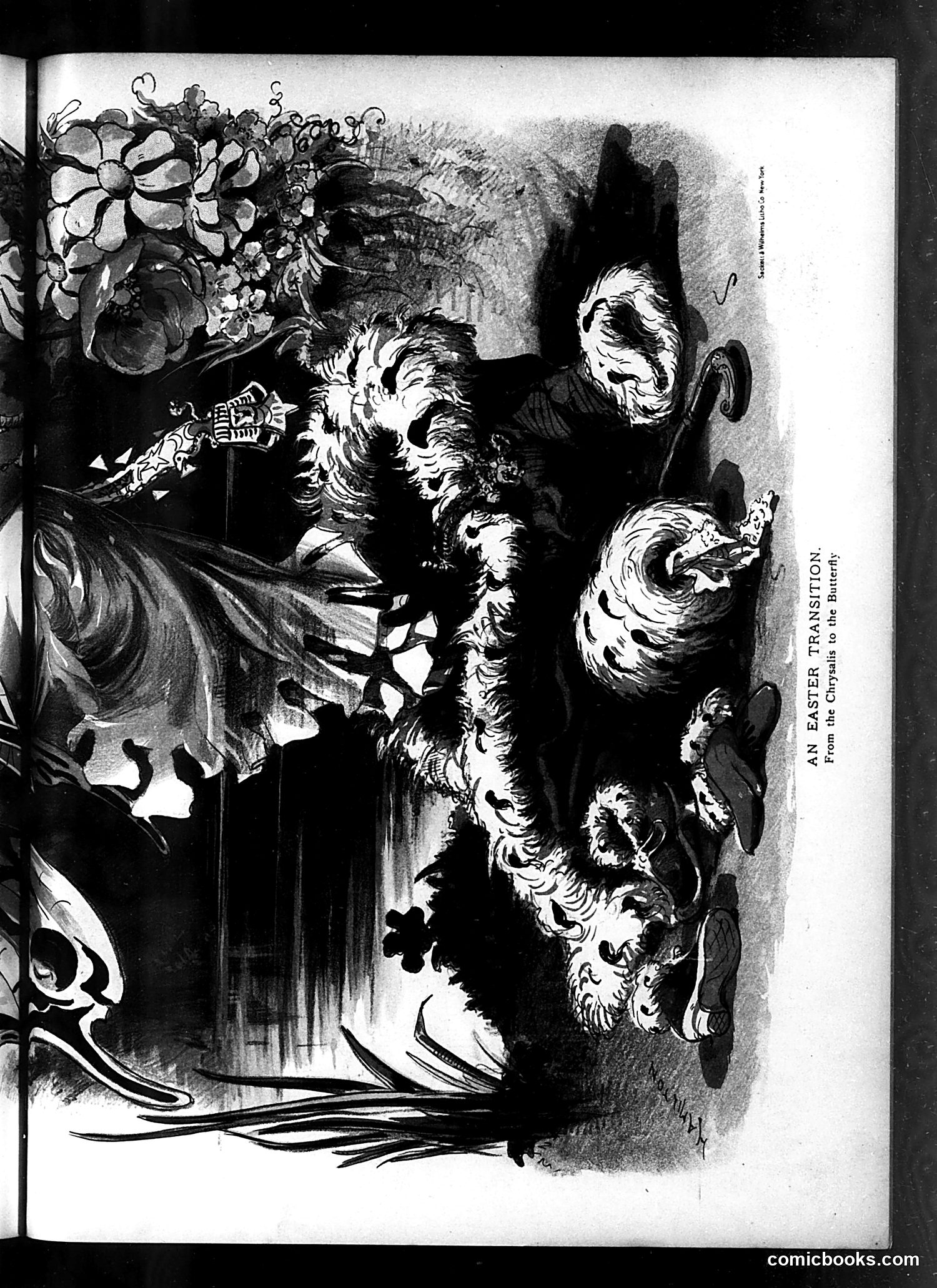
The title reads "AN EASTER TRANSITION" and credits "From a Chrysalis to the Butterfly." This appears to be an Easter-themed cartoon depicting anthropomorphized animals (possibly dogs or similar creatures with fur) emerging from or transforming, with flowers visible in the upper left. The chrysalis-to-butterfly metaphor suggests a springtime renewal or transformation. Without clearer OCR text or visible date, I cannot identify specific political figures or events this may satirize. The ornate decorative elements and formal clothing suggest this likely contains social commentary typical of Judge magazine's satirical style, but the exact target of the satire remains unclear from the image alone.
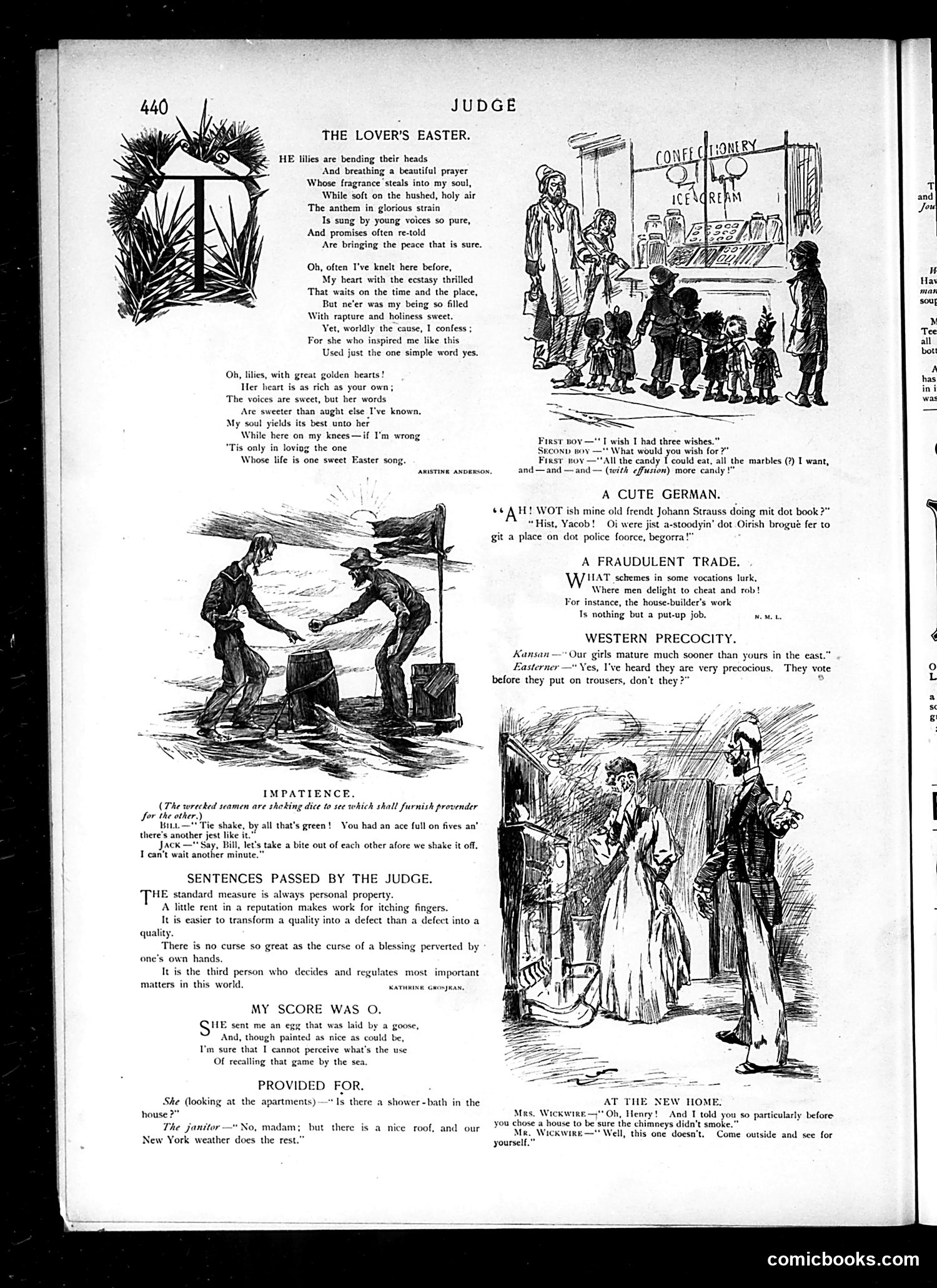
This page contains several short satirical pieces typical of late 19th-century American humor: **"The Lover's Easter"** is sentimental verse about a man in church whose religious devotion is actually romantic—his beloved said "yes" to his proposal. **"A Cute German"** mocks German-Irish immigrant accents through dialogue where a character claims to study Irish brogue to join the police force, playing on contemporary stereotypes about immigrants and their speech patterns. **"Western Precocity"** jokes about Kansas girls' early maturity, with an Easterner sarcastically suggesting they vote before wearing trousers—likely referencing women's suffrage debates and Western progressivism. **"Impatience"** shows shipwrecked sailors so hungry they consider cannibalism. **"At the New Home"** presents a domestic comedy where a wife complains about chimney smoke, while the janitor dismisses the problem, attributing it to New York weather. These pieces reflect turn-of-the-century American concerns: immigration, regional differences, gender roles, and urban life.
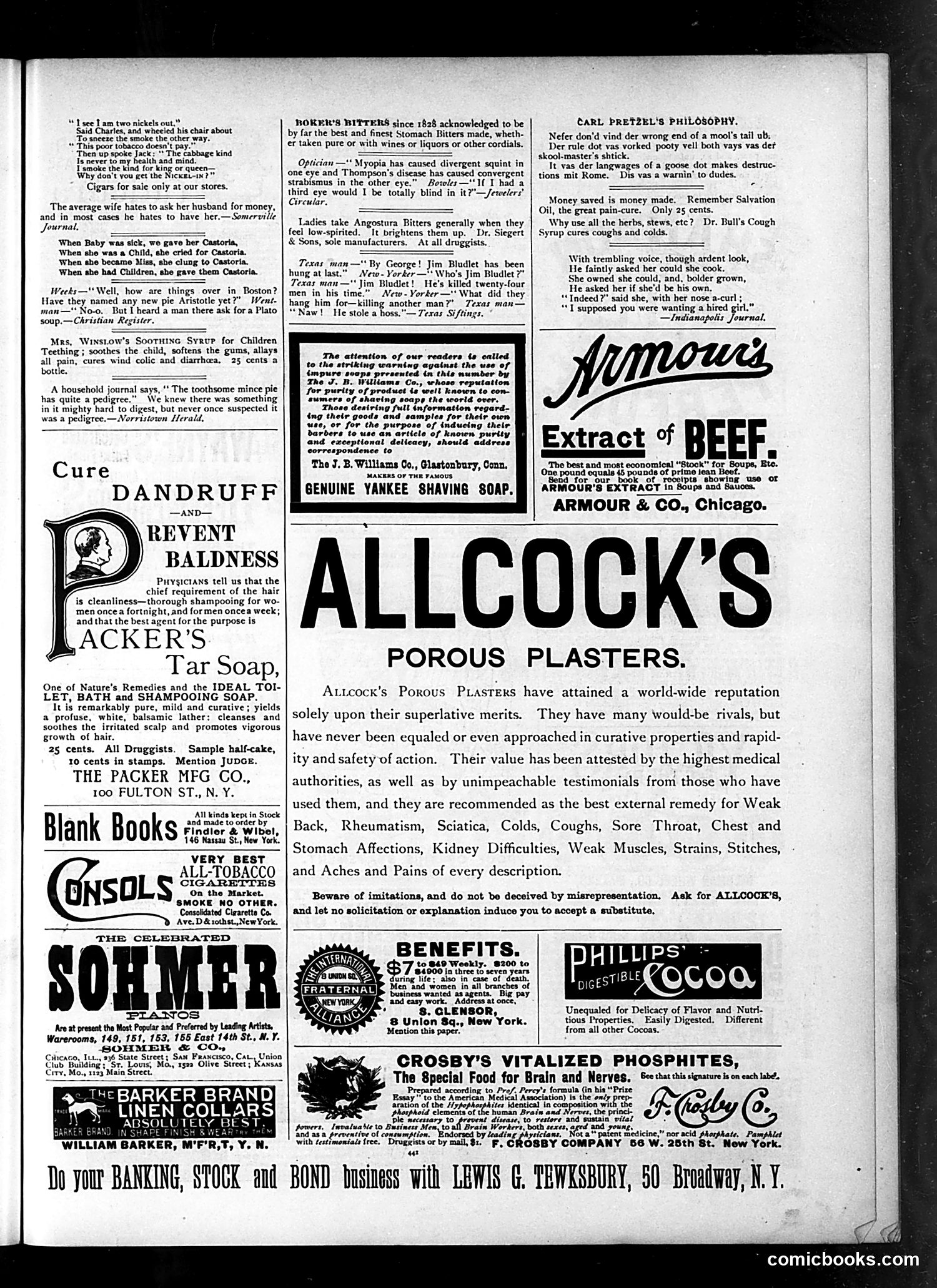
This page is primarily **advertising**, with only brief comedic vignettes at the top. The cartoons and jokes are minimal: ## The Jokes: The opening satirical piece features characters debating cheap cigars ("two nickels out"), poking fun at low-quality tobacco products. This reflects late-19th-century consumer culture mockery. A "Carl Pretzel" philosophy column offers pseudo-German dialect humor—popular period comedy mocking German immigrants' speech patterns. Brief exchanges include Boston vs. New York stereotyping (the "Aristotle pie" joke) and a courtship scene with romantic clichés. ## The Advertisements: The bulk of the page advertises **patent medicines and remedies** (Castoria, Broker's Bitters, Acker's Tar Soap, Allcock's Porous Plasters, etc.)—many of dubious efficacy. This reflects the era's largely unregulated medical industry. The ads target typical period concerns: dandruff, baldness, pain relief, digestive issues. **Overall**: This represents Judge's mixed content model: satirical social commentary paired with lucrative patent medicine advertising.
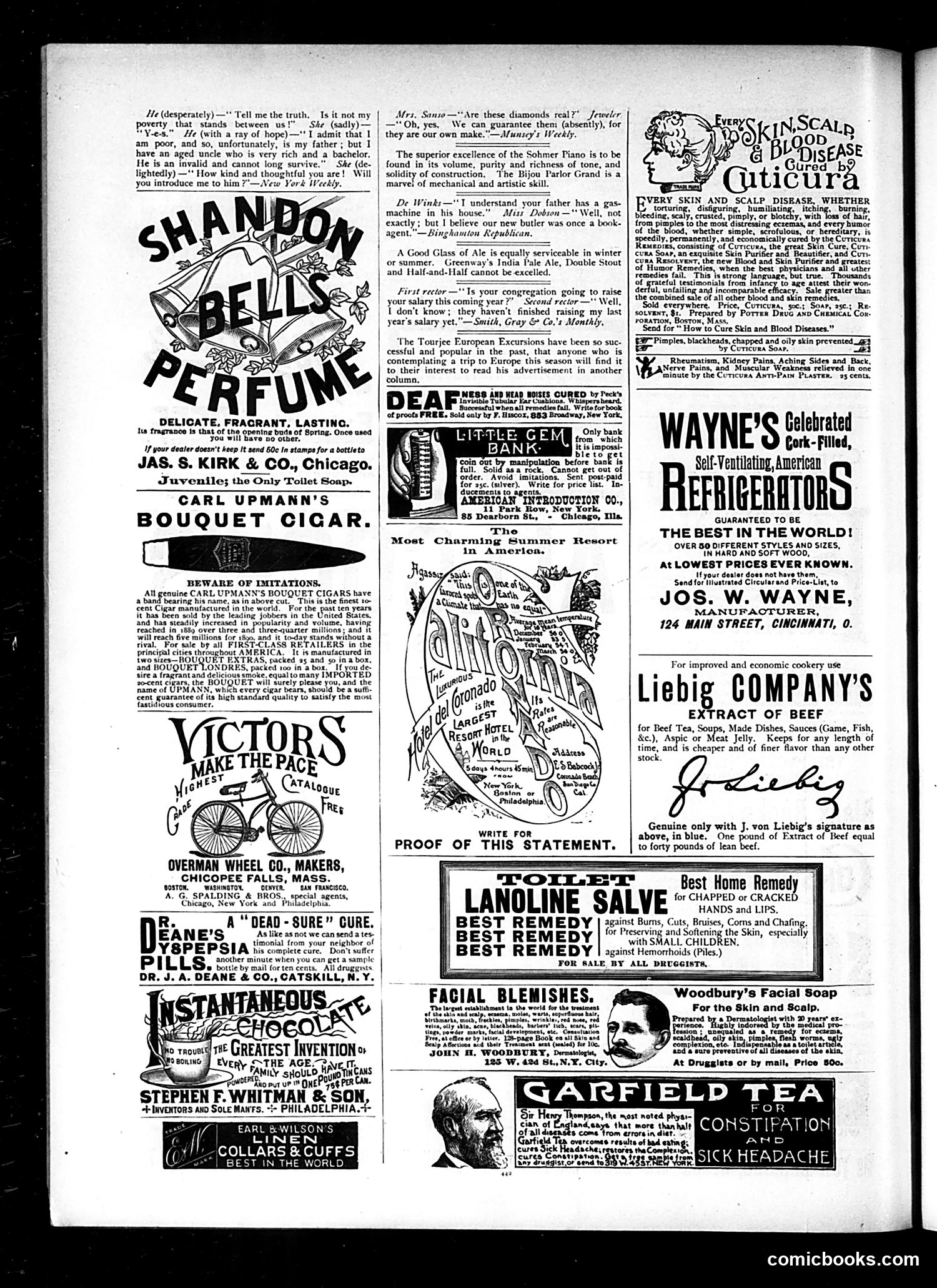
This page is **primarily advertisements** with one small cartoon at the top. The cartoon depicts a courtship scene: a poor man confesses his poverty to a woman, expecting rejection. She sadly confirms money matters between them. But when he mentions his wealthy, invalid uncle who "cannot long survive," she becomes delighted and asks to meet him—revealing her mercenary nature. The joke satirizes **gold-digging women** who prioritize wealth over character. The surrounding ads promote consumer goods typical of the 1890s: cigars, soap, pianos, refrigerators, beef extract, and patent medicines (including a "cure" for deafness and dyspepsia). The ads reflect period anxieties about product authenticity—"beware of imitations" warnings appear multiple times. Overall, this is a commercial page showcasing both Judge's satirical humor and its reliance on advertising revenue.
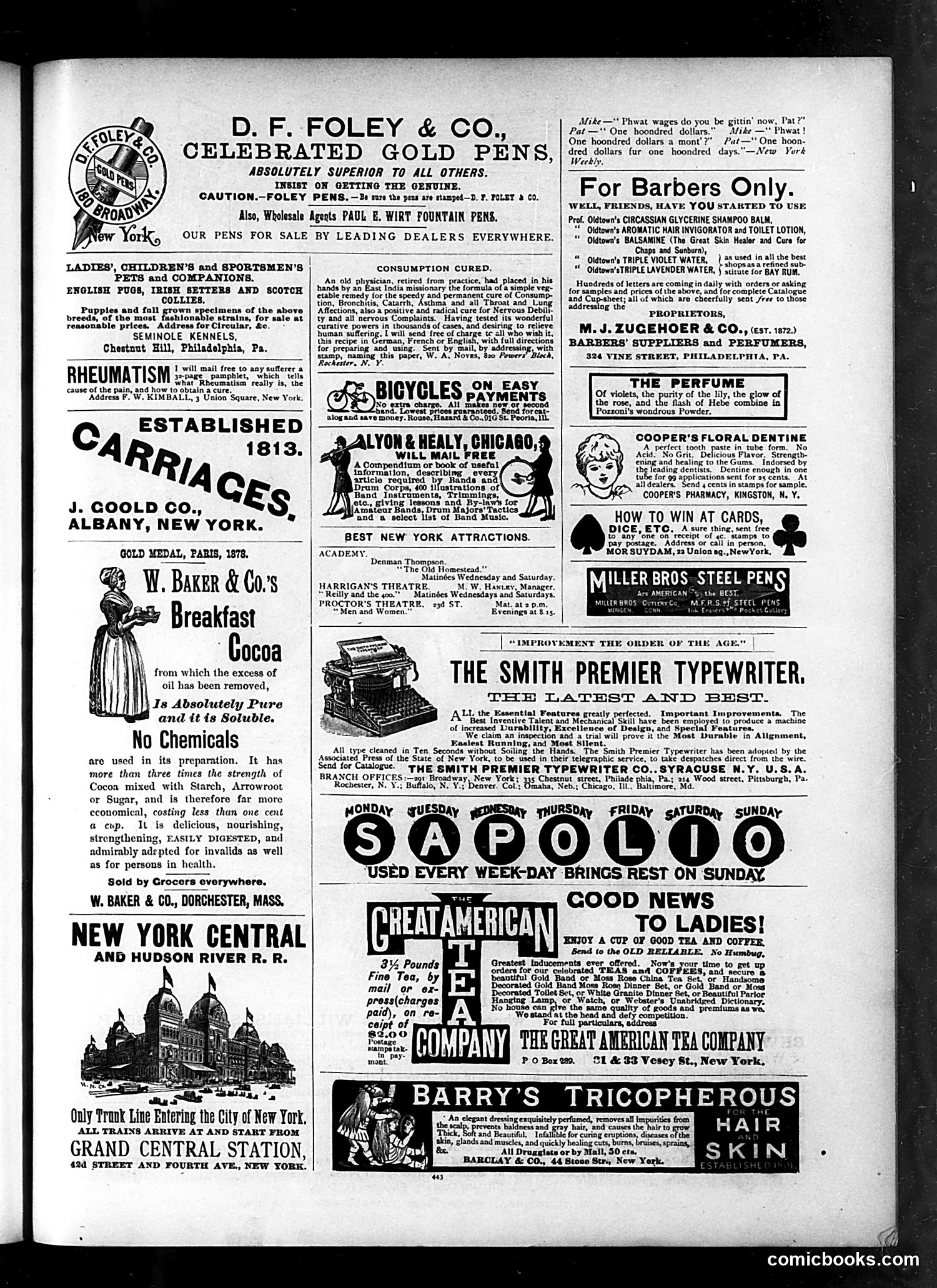
This is primarily an **advertising page** with one brief joke. The single comic content is the "Mike and Pat" exchange at the top, depicting Irish immigrant workers in heavy dialect. The joke plays on a language/cultural misunderstanding: Pat claims to earn "one hundred dollars for one hundred days," which Mike initially misinterprets as monthly wages. The humor relies on period stereotypes about Irish immigrants and their speech patterns. The remainder of the page is filled with commercial advertisements for products including pens, carriages, breakfast cocoa, railroad service, and patent medicines—typical of Judge magazine's era. Notable is an advertisement claiming to cure consumption (tuberculosis), reflecting 19th-century medical quackery. The "For Barbers Only" section advertises hair and grooming products. The page contains no political cartoons or sophisticated satire—it's a commercial product of the magazine's advertising revenue model.
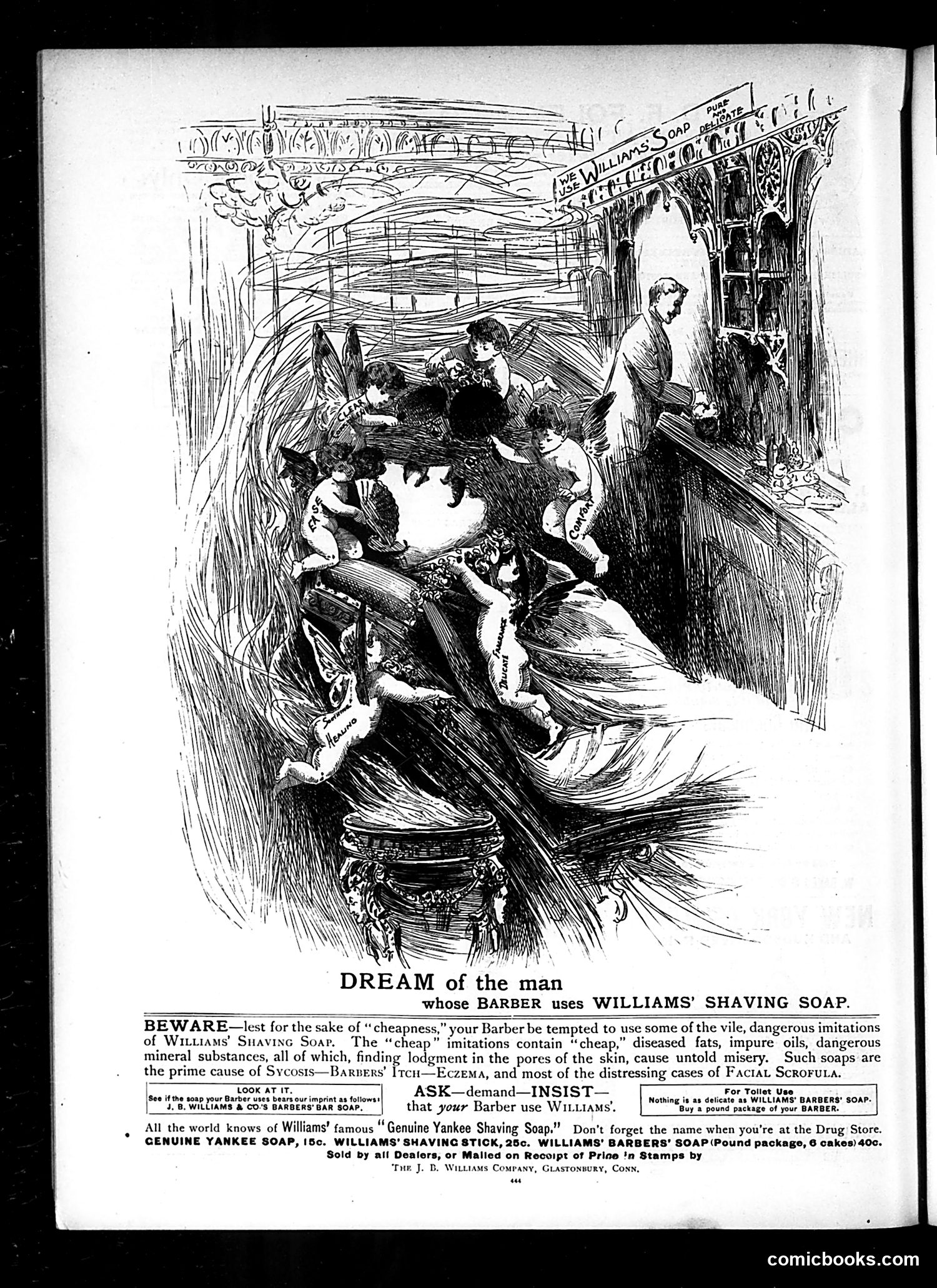
This is a **Williams' Shaving Soap advertisement** disguised as editorial content in *Judge* magazine. It uses a satirical "dream sequence" format to sell premium soap by warning against cheaper imitations. **The "Dream":** Shows an elegantly dressed woman surrounded by cherubs/putti, apparently representing the luxurious result of using genuine Williams' soap at a quality barber. **The Satire/Sales Pitch:** The accompanying text feigns concern for consumer safety, claiming cheap soap imitations contain "diseased fats, impure oils, dangerous mineral substances" that cause serious skin conditions like eczema and "Barbers' Itch" (a real fungal infection). **Historical Context:** This reflects late 19th/early 20th-century advertising practices—using fear-based marketing about product quality and purity. The warning against counterfeits suggests Williams was a premium, well-known brand competing against knockoffs. The reference to barbers underscores that professional endorsement was valuable marketing. The advertisement essentially weaponizes health anxiety to justify premium pricing.
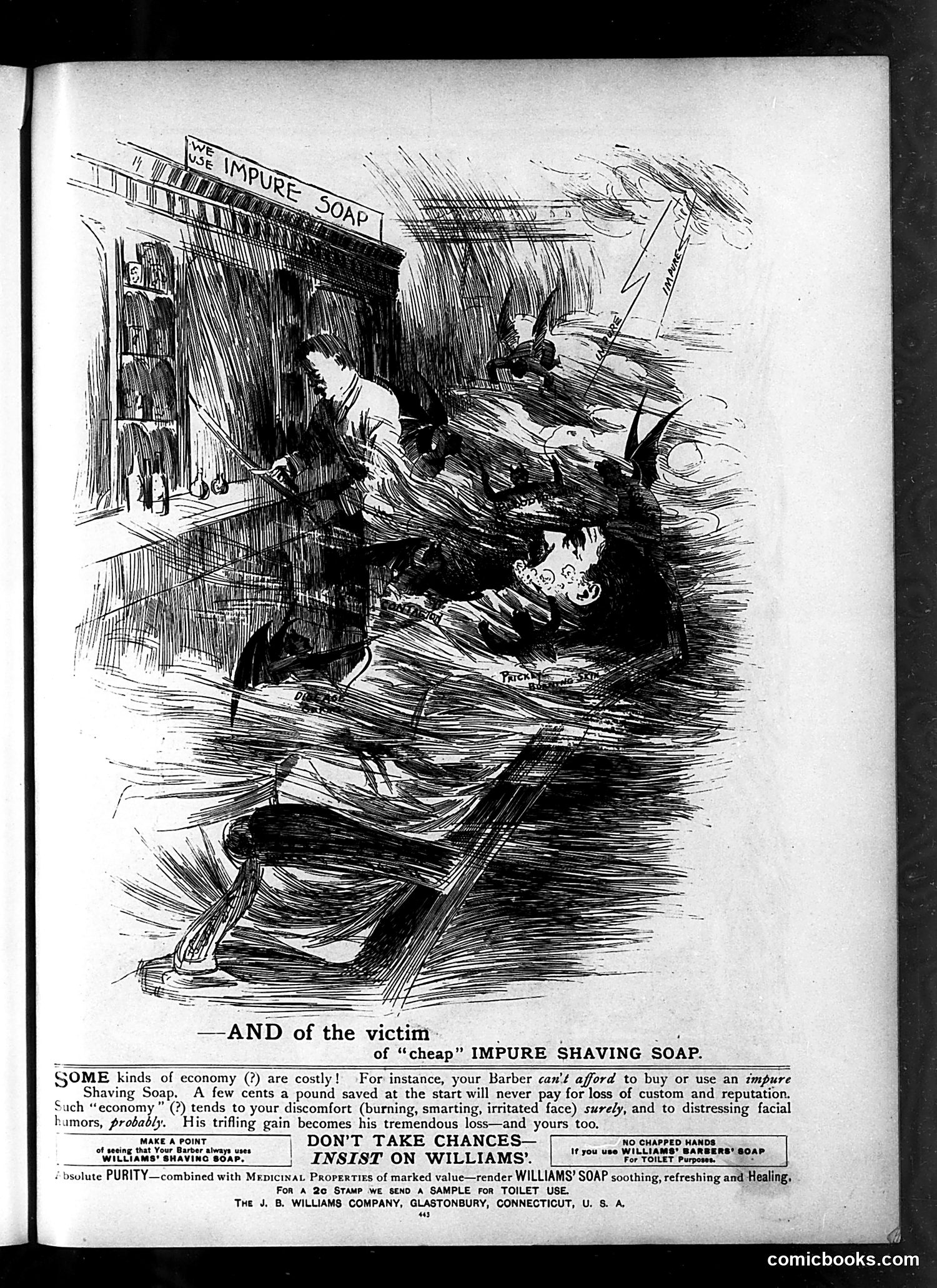
This is primarily **advertising content** disguised as satirical editorial. The "cartoon" depicts a barber suffering grotesque facial afflictions—labeled "the victim of 'cheap' IMPURE SHAVING SOAP"—with exaggerated sores and disfigurement. The satire targets barbers who buy cheap soap to save costs. The argument: penny-pinching on inferior products backfires through lost customers and reputation damage, plus causes clients painful skin conditions (burning, smarting, "distressing facial humors"). The visual exaggeration mocks this false economy. The real message is an advertisement for **Williams' Shaving Soap**, which claims "absolute PURITY" combined with medicinal properties, positioned as the superior choice. The pitch warns: don't gamble with cheap alternatives—insist on Williams for "soothing, refreshing and Healing" results. This reflects early 20th-century advertising strategy: use satirical humor and health warnings to sell branded products as safe alternatives to generic competitors.
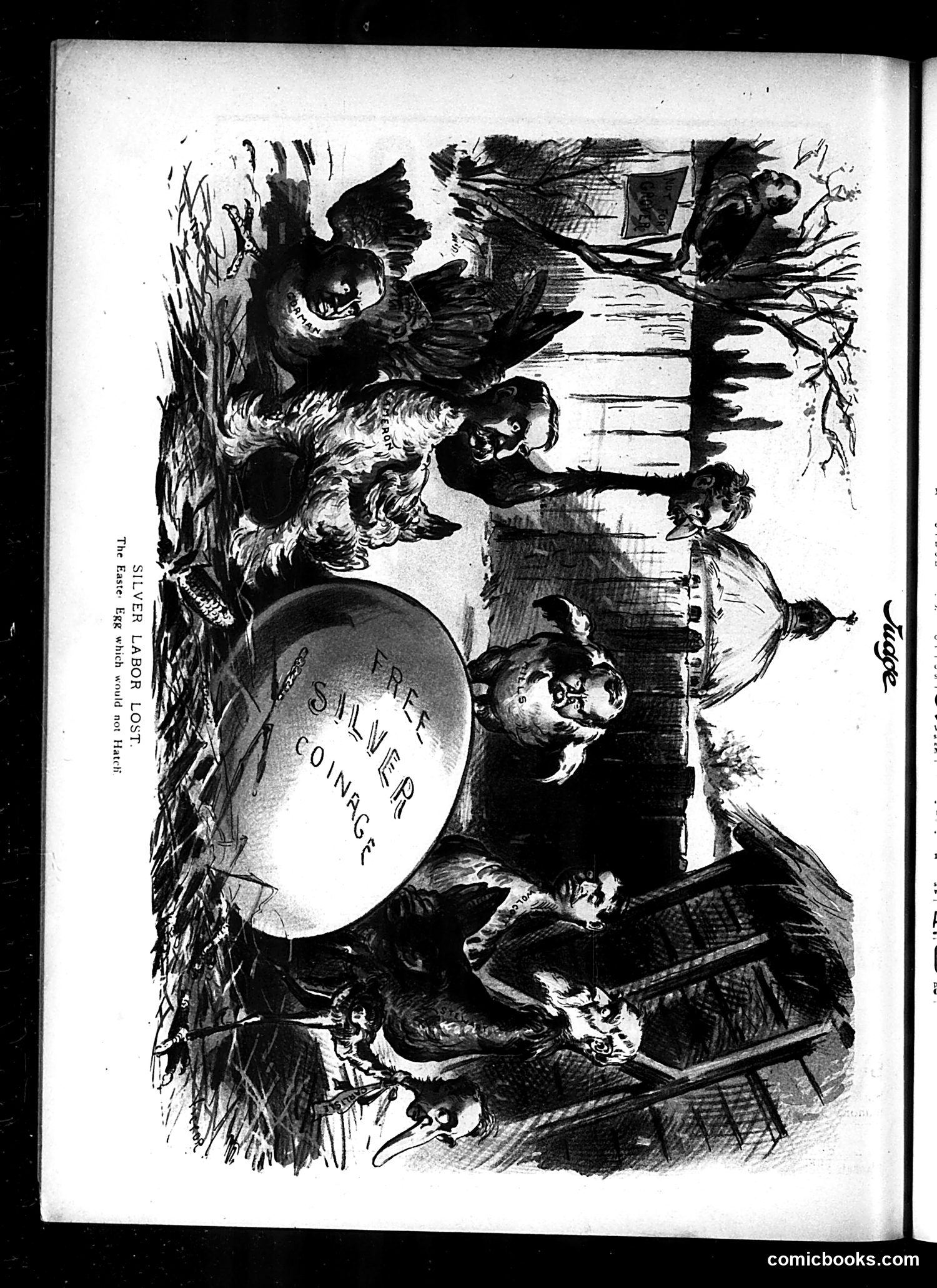
The image shows a political cartoon titled "The Silver Labor Lost," though the exact date and artist remain unclear from this page. The scene depicts what appears to be a labor dispute or strike situation, with multiple working-class figures gathered around a large circular object labeled "FREE SILVER COINAGE." The cartoon likely satirizes late 19th-century American debates over monetary policy—specifically the "free silver" movement that advocated unlimited coinage of silver. The "lost" labor reference suggests the cartoon criticizes workers or labor activists who supported this economic policy, implying their cause was misguided or doomed to failure. The gathering of figures suggests competing interests or confusion among laborers regarding this monetary issue, which was a significant political dividing point of that era.
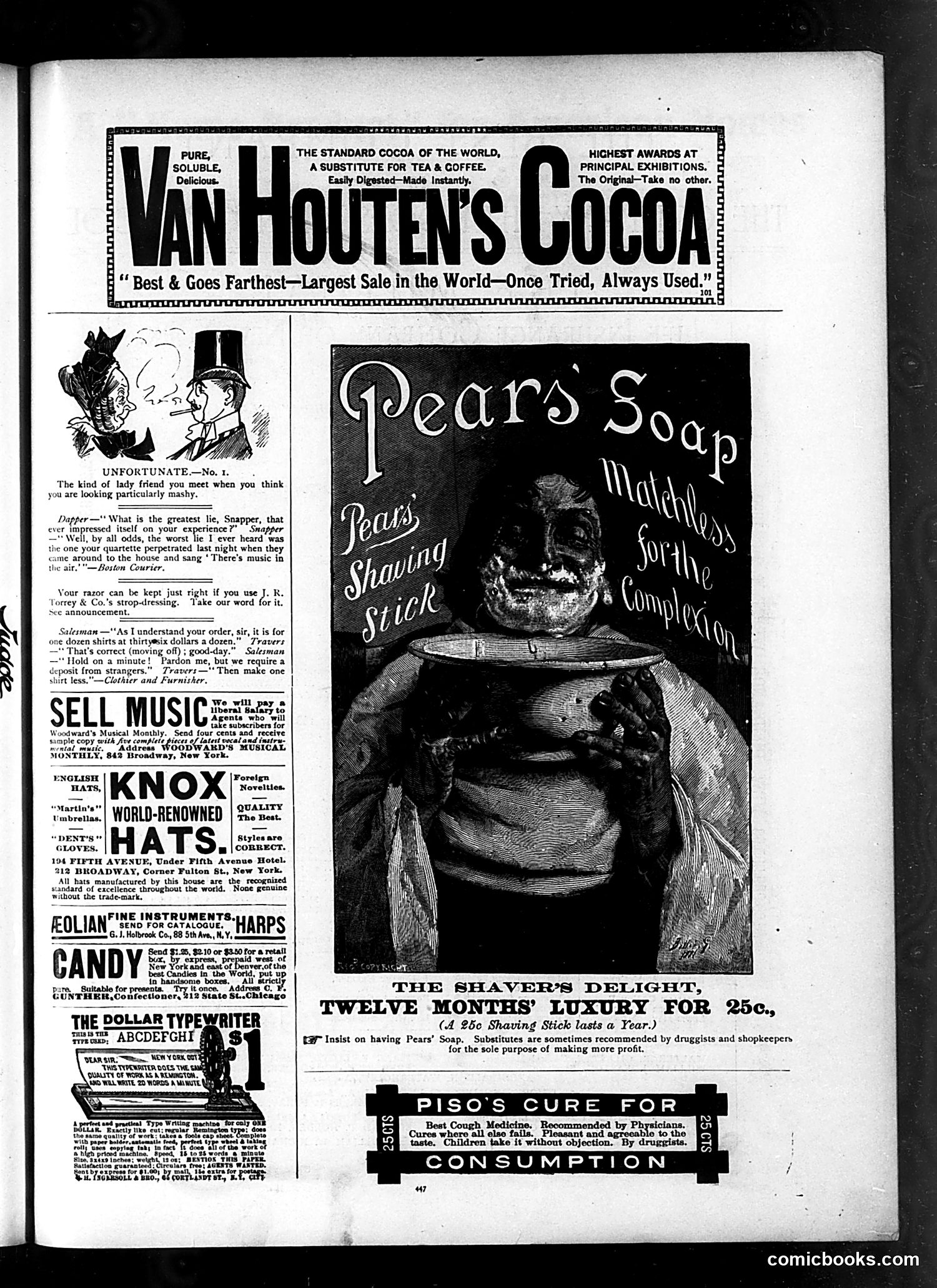
This page is primarily **advertising**, not political satire. It contains several small humorous anecdotes ("Unfortunate," "Dapper," "Salesman") that are typical Judge filler—brief, mild jokes about social etiquette and mishaps rather than political commentary. The dominant content comprises advertisements for consumer products: Van Houten's Cocoa, Pears' Soap, Knox Hats, candy, typewriters, and patent medicines like Piso's Cure for Consumption. The Pears' Soap ad features a prominent illustration of a woman's face. The small cartoons mock genteel social pretense—a lady who isn't as attractive as hoped, exaggerated politeness, and a salesman's caution with customers. These reflect Victorian-era humor about manners and class rather than political critique. The page reflects **Gilded Age consumer culture** and the prevalence of medical claims and product testimonials typical of early 1900s advertising. No specific political figures or events are referenced.
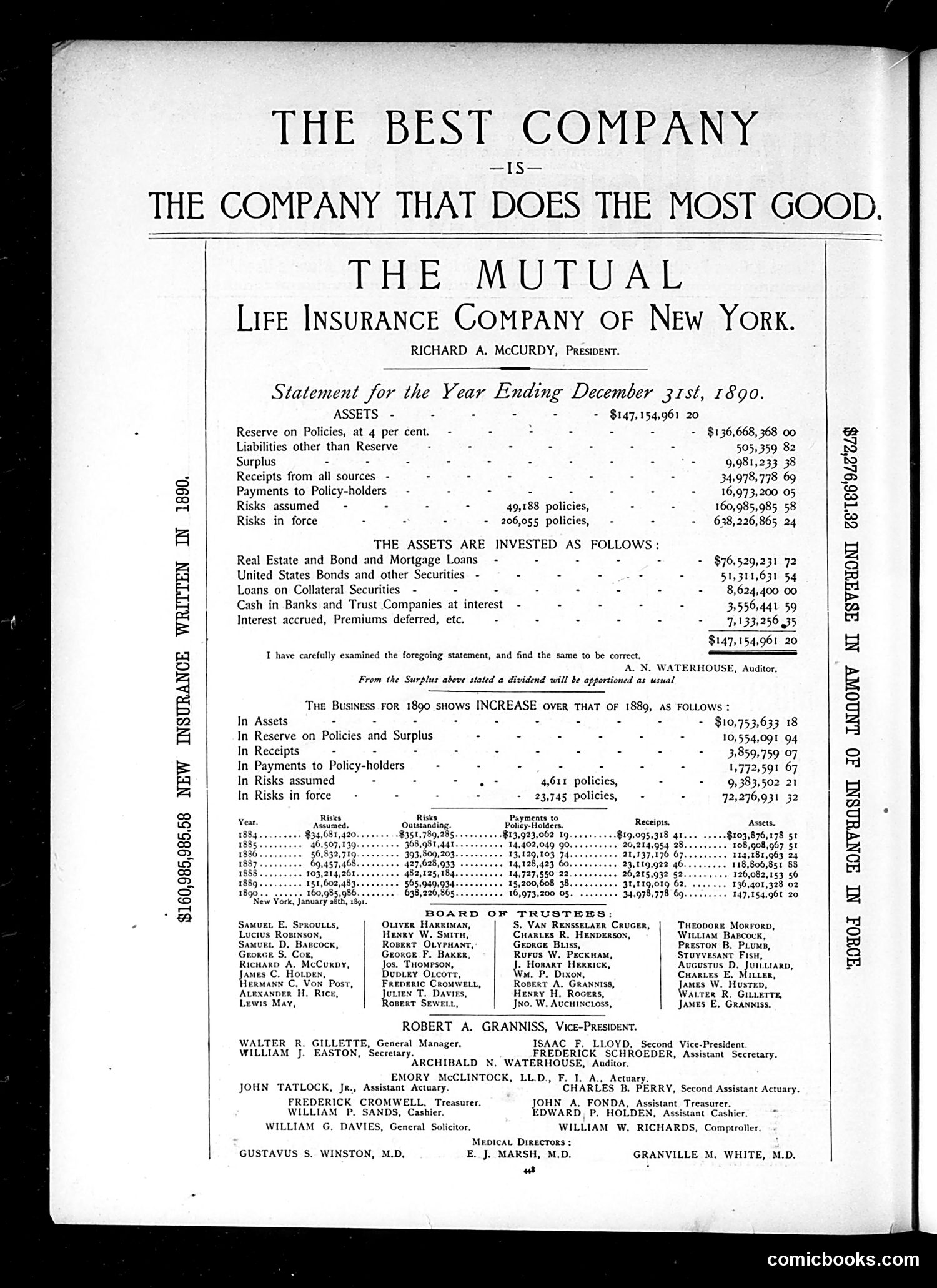
This page is not a cartoon or satirical content—it's a full-page advertisement for The Mutual Life Insurance Company of New York, presenting their 1890 financial statement. The headline "THE BEST COMPANY IS THE COMPANY THAT DOES THE MOST GOOD" frames the company's self-promotion with moral rhetoric typical of the era. The page displays detailed assets ($147 million+), investment breakdowns, and a lengthy board of trustees, establishing legitimacy through comprehensive financial disclosure and prominent names. This represents early corporate advertising using Judge magazine's pages to reach affluent readers. There is no political satire or caricature present—it's purely commercial content showcasing a major financial institution's fiscal health.
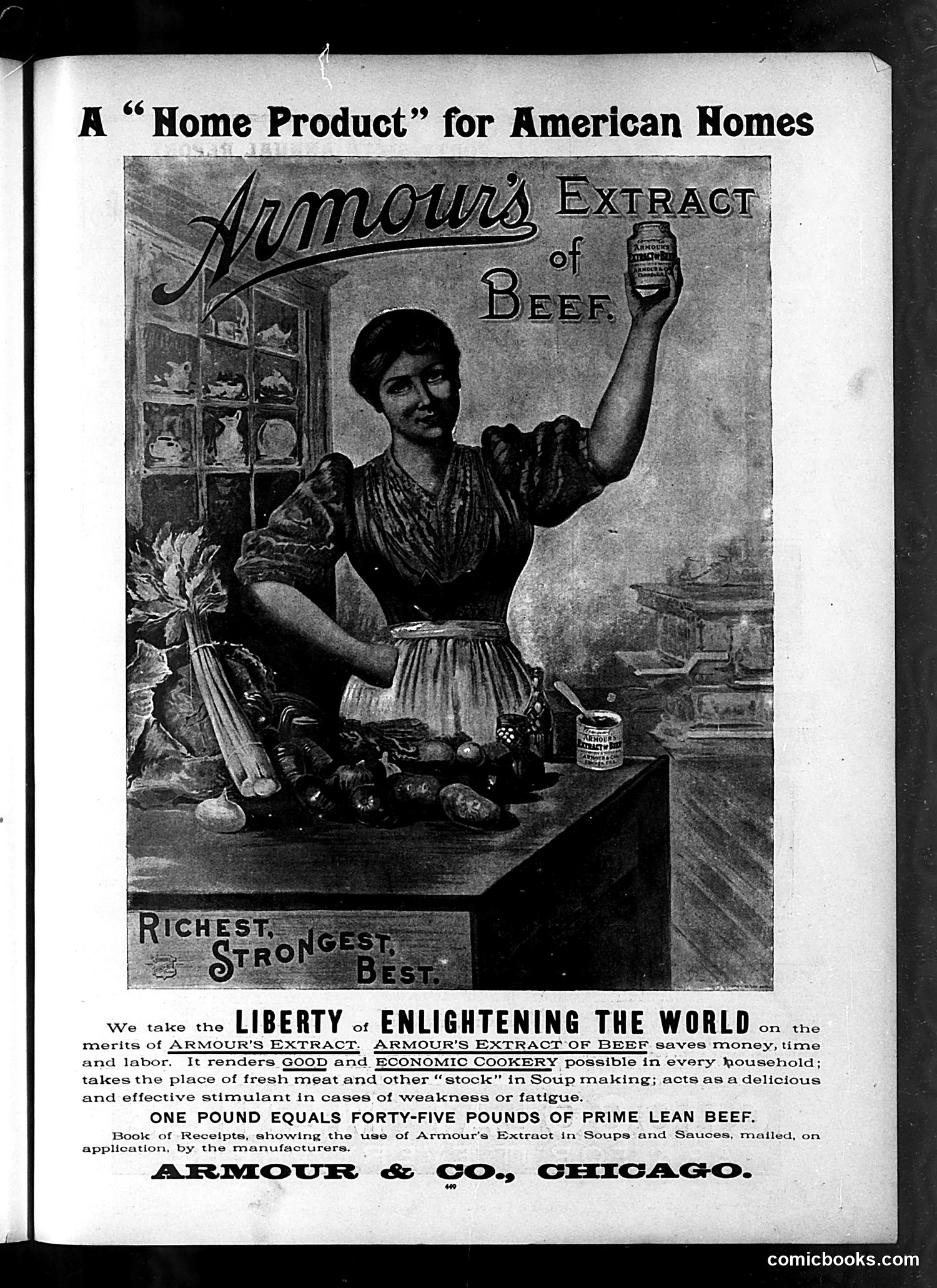
This is a **full-page advertisement**, not satire or political commentary. The heading "Home Product for American Homes" frames Armour's Extract of Beef as patriotic American manufacturing. The illustration shows a woman in a kitchen holding up a bottle of the product, surrounded by fresh vegetables and produce. The tagline "Richest, Strongest, Best" emphasizes product quality. The ad's text claims the extract saves "money, time and labor" and enables "good and economic cookery" in every household. It makes an extravagant claim: one pound equals forty-five pounds of prime beef. The phrase "Liberty of Enlightening the World" (alluding to the Statue of Liberty) suggests American industrial progress and superiority. This reflects early-1900s American confidence in manufactured food products as modern, efficient alternatives to fresh ingredients—positioning convenience and economy as patriotic virtues for American homemakers.
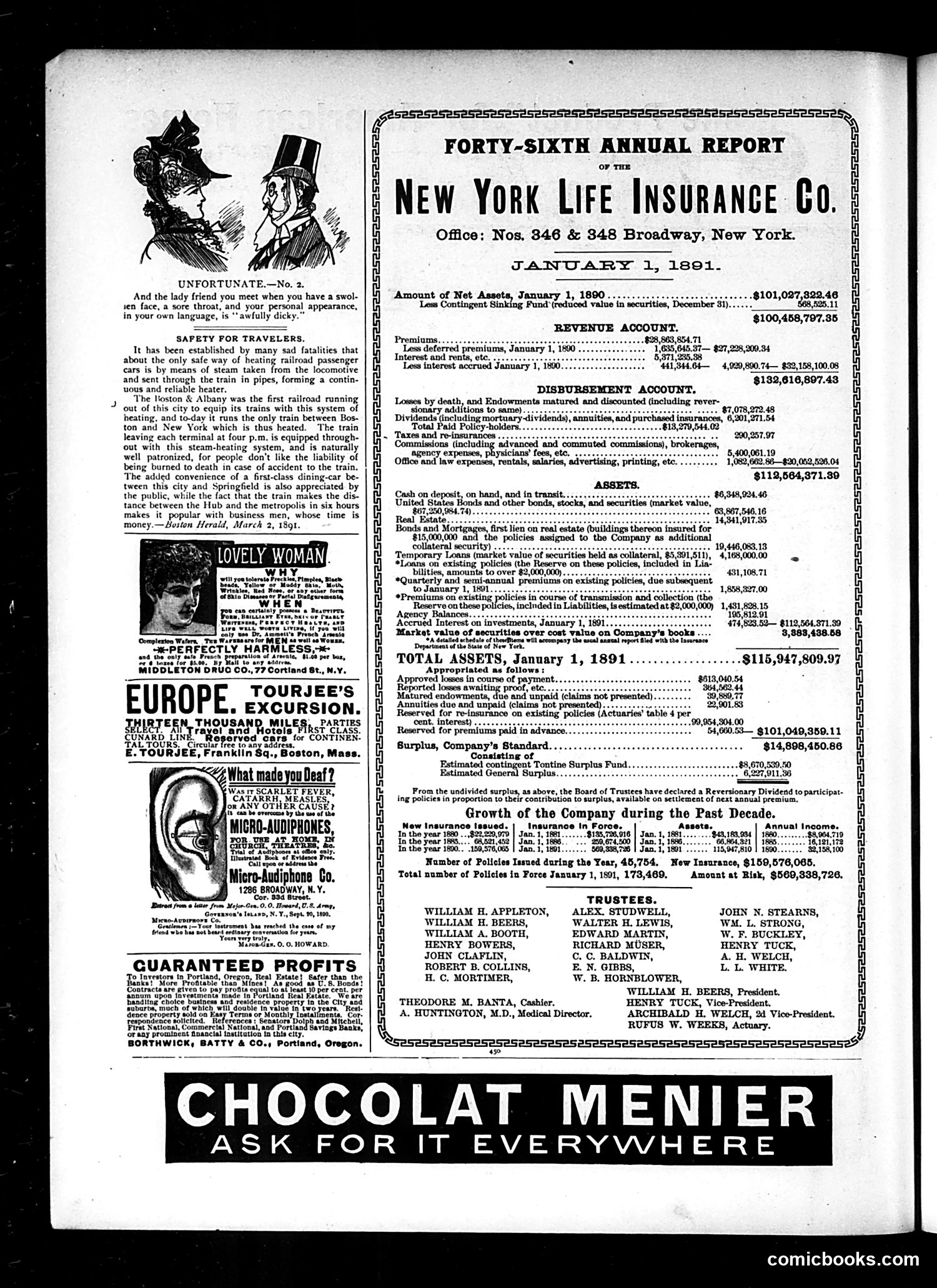
This is primarily a **title/advertising page** rather than a satirical cartoon issue. The main content is the New York Life Insurance Company's 46th annual financial report, positioned prominently. The two small cartoons at top left appear to be unrelated filler: - "UNFORTUNATE—No. 2" depicts a gentleman with a swollen face meeting a lady friend, joking that his appearance is "awfully dicky" (British slang: unwell). This is mild social humor about embarrassing encounters while ill. - The second cartoon about railroad heating safety is presented as factual editorial content, not satire. The surrounding advertisements (complexion wafers, European tours, "micro-audiphones" for deafness, real estate investments) were typical Judge revenue sources. The page functions as a business/financial document wrapped in advertising, with minimal satirical content—unusual for the magazine's typical format.
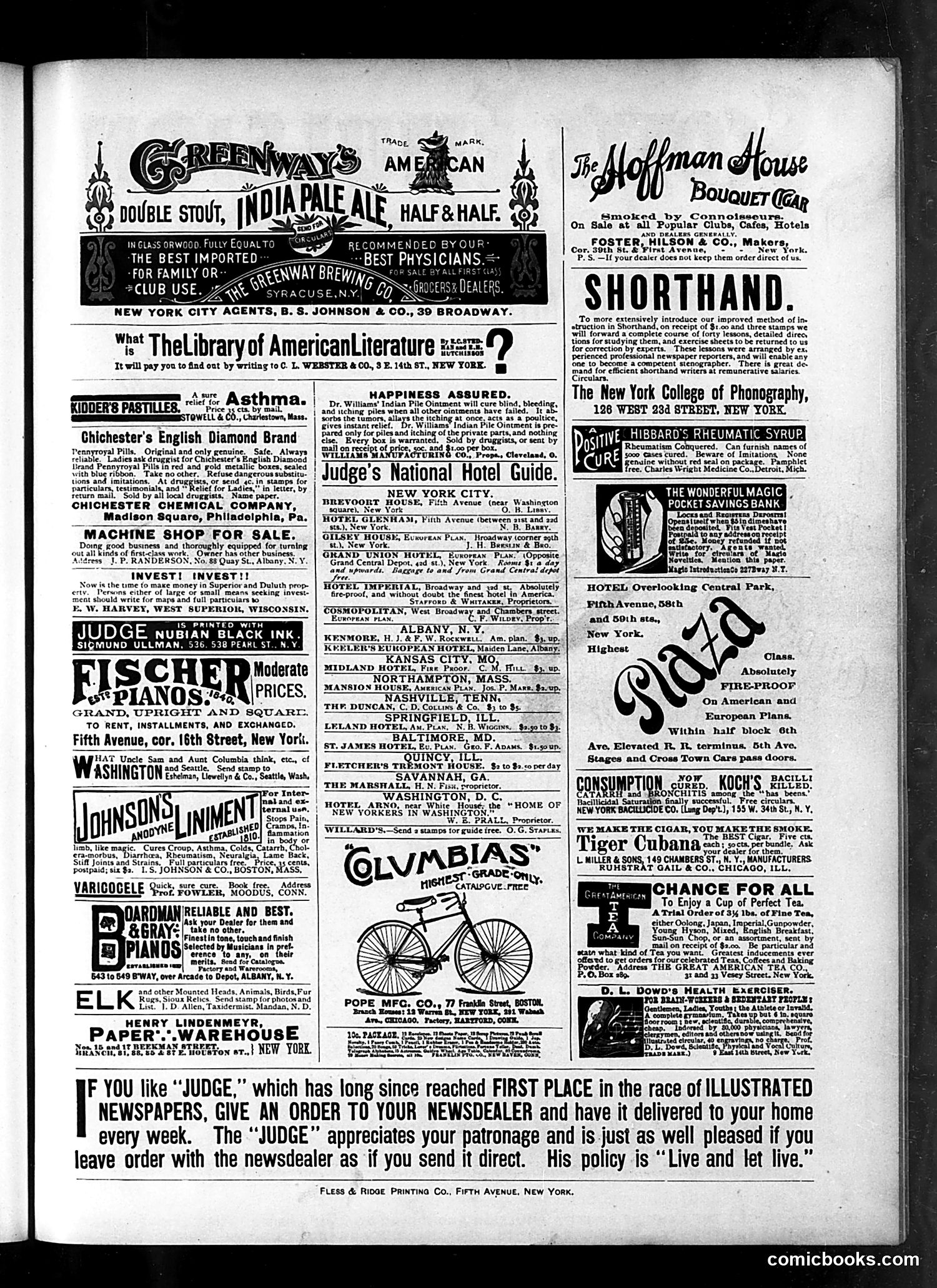
This page is **primarily advertising**, not political cartoons. It's a typical late 19th or early 20th-century magazine layout mixing patent medicines, real estate, pianos, hotels, and other commercial products with classified ads. Notable elements include: - **Chichester's English Diamond Brand** pills (an advertisement for contraceptives, euphemistically marketed) - **Dr. Williams' Indian Pile Ointment** (hemorrhoid treatment—common period advertising) - **Judge's National Hotel Guide** listing accommodations across American cities - A **Columbias bicycle advertisement** (the vehicle brand, not political symbolism here) - Various other services: machine shops, shorthand instruction, pianos The page header references **Judge magazine's own promotional material** encouraging subscription. There are **no identifiable political cartoons or satirical commentary** visible on this page—it appears to be a back section devoted entirely to commercial advertisements, typical of how magazines sustained themselves financially during this era.
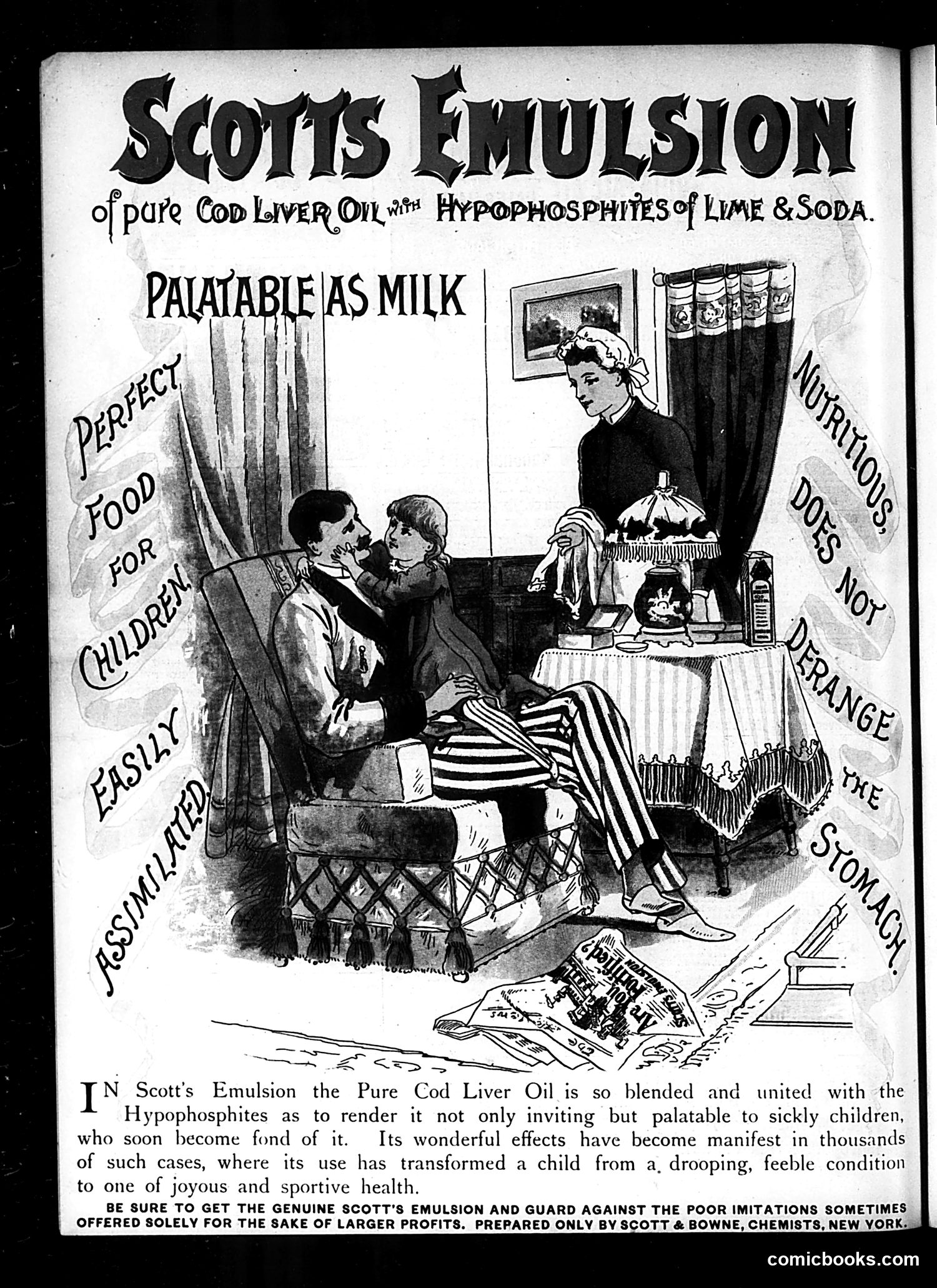
This is a full-page advertisement, not satire. It promotes Scott's Emulsion, a cod liver oil supplement marketed to make sickly children healthy. The image shows a domestic scene: a well-dressed woman serves the product to two children while their father watches approvingly. The ad claims the emulsion is "palatable as milk" and promises to transform "drooping, feeble" children into healthy ones. Text emphasizes it's "easily assimilated" and provides "nutritious doses." The warning against "poor imitations" reflects genuine concern about patent medicine fraud in this era—unregulated supplements were commonly counterfeited. Scott & Bowne was a real New York pharmaceutical company. This represents typical late 19th/early 20th-century advertising that made broad health claims now considered misleading, targeting parental anxieties about child welfare.