
Judge, 1891-03-28 · page 2 of 22
Judge — March 28, 1891 — page 2: what you’re looking at
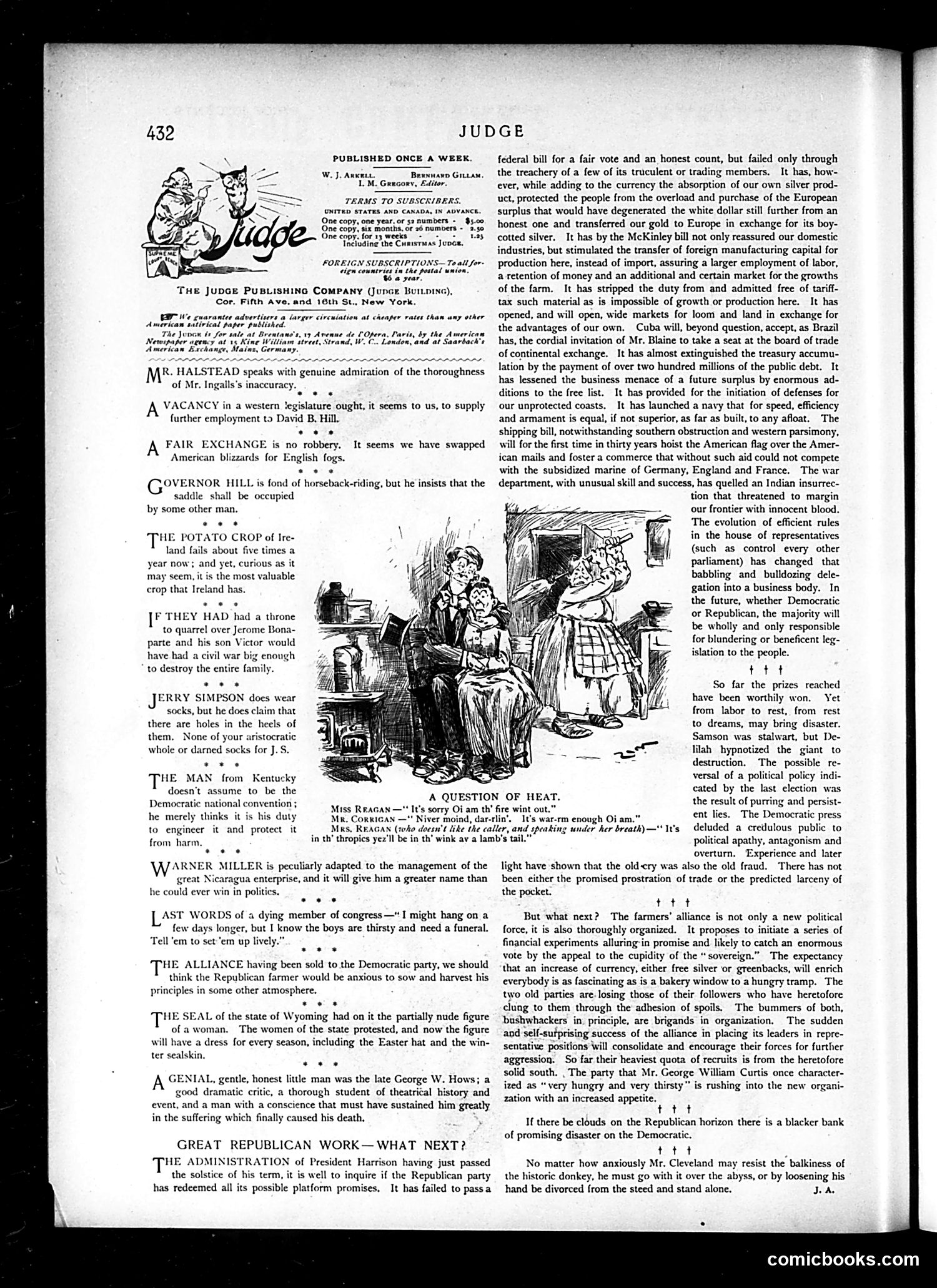
What you’re looking at
The central cartoon depicts a domestic scene with a woman (labeled "Miss Reagan") confronting a man (labeled "Mr. Corrigan") about heating their home. The woman complains: "It's awfully cold, and speaking under her breath—'It's in th' cheapest yet he is in it' wink as a lamb's tail." This appears to satirize a real heating or fuel shortage affecting American households, likely from the late 19th or early 20th century. The cartoon mocks either inadequate heating solutions or the disparity between what people pay for heat versus what they receive. The intimate domestic setting uses marital tension to highlight public frustration with a practical utility problem affecting everyday life.
📄 Transcribed text from this page (OCR, searchable)
Machine-transcribed from the original scan — historical spelling and the odd misread are preserved.
JUDGE PUBLISHED ONCE A WEEK. W. J. Anweit. Brennano Gras. 1M. Gi TERMS TO SUBSCKIBERS. UNITED STATES AND CANADA, IN) ADVANCE, FOREIGN SUBSCRIPTIONS—Toall for- dign countries in the postal union @ year THE JUDGE PUBLISHING Company (Junce Buiininc), Cor. Fifth Ave. and 16th St., New York. (BW guarantee advertisers a larger circulation at cheaper rates than any other American satirical paper published. The Jwoan ts for sale at Brent Arenue de LOpera Neveipaper ueemcy at 5 Kine William street, Strand, W. Co L American Exchange, Mains, Germ . by the American ‘and at Saarbach's MB. HALSTEAD speaks with genuine admiration of the thoroughness of Mr. Ingalls’s inaccuracy. A VACANCY in a western tegislature ought, it seems to us, to supply further employment to David B, Hill. tee A FAIR EXCHANGE is no robbery. It seems we have swapped American blizzards for English fogs. see Gov! ERNOR HILL is fond of horseback-riding, but he insists that the saddle shall be occupied by some other man. eee THE POTATO CROP of Ire- land fails about five times a year now; and yet, curious as it may seem, it is the most valuable crop that Ireland has. F THEY HAD had a throne to quarrel over Jerome Bona- a Victor would enough to destroy the entire fa JERRY SIMPSON does wear socks, but he does claim that there are holes in the heels of them. None of your aristocratic whole or darned socks for J. $. Aire THE MAN from Kentucky doesn’t assume to be the Democratic national convention ; he merely thinks it is his duty to engineer it and protect it from harm. | Mr. CoRkIGAN Mas, REAGAN WARNER MILLER is peculiarly adapted to the management of the great Nicaragua enterprise, and it will give him a greater name than he could ever win in politic: LAST WORDS of a dying member of congress—" I might hang on a few days longer, but I know the boys are thirsty and need a funeral. Tell ‘em to set‘em up lively.” HE ALLIANCE having been sold to the Democratic party, we should think the Republican farmer would be anxious to sow and harvest his principles in some other atmosphere. THE SEAL of the state of Wyoming had on it the partially nude figure of a woman, The women of the state protested, and now the figure will have a dress for every season, including the Easter hat and the win- ter sealskin. RED 8 A NIAL, gentle, honest little man was the late George W. Hows; a good dramatic critic, a thorough student of theatrical history and event, and a man with a conscience that must have sustained him greatly in the suffering which finally caused his death. GREAT REPUBLICAN WORK— WHAT NEXT? HE ADMINISTRATION of President Harrison having just passed the solstice of his term, it is well to inquire if the Republican party has redeemed all its possible platform promises. It has failed to pass a A QUESTION OF HEAT. Miss RRAGAN —"* It's sorry Oi am th’ fire wint out.” Niver moind, dar-rlin’, (who doesn't like the caller, and speaking under her breath) —"' W's in th’ thropics yez'll be in th’ wink av a lamb’s tail.” federal bill for a fair vote and an honest count, but failed only through the treachery of a few of its truculent or trading members. It has, how- ever, while adding to the currency the absorption of our own silver prod- uct, protected the people from the overload and purchase of the European surplus that would have degenerated the white dollar still further from an honest one and transferred our gold to Europe in exchange for its boy- cotted silver. It has by the McKinley bill not only reassured our domestic industries, but stimulated the transfer of foreign manufacturing capital for production here, instead of import, assuring a larger employment of labor, a retention of money and an additional and certain market for the growths of the farm. It has stripped the duty from and admitted free of tariff- tax such material as is impossible of growth or production here. It has opened, and will open, wide markets for loom and land in exchange for the advantages of our own, Cuba will, beyond question, accept, as Brazil has, the cordial invitation of Mr. Blaine to take a seat at the board of trade of continental exchange. It has almost extinguished the treasury accumu- lation by the payment of over two hundred millions of the public debt. It has lessened the business menace of a future surplus by enormous ad- ditions to the free list. It has provided for the initiation of defenses for our unprotected coasts. It has launched a navy that for speed, efficiency and armament is equal, if not superior, as far as built, to any afloat. The shipping bill, notwithstanding southern obstruction and western parsimony, will for the first time in thirty years hoist the American flag over the Amer- ican mails and foster a commerce that without such aid could not compete with the subsidized marine of Germany, England and France. The war department, with unusual skill and success, has quelled an Indian insurrec- tion that threatened to margin our frontier with innocent blood. The evolution of efficient rules in the house of representatives (such as control every other parliament) has changed that babbling and bulldozing dele- gation into a business body. In the future, whether Democratic or Republican, the majority will be wholly and only responsible for blundering or beneficent leg- islation to the people. tetet So far the prizes reached have been worthily won. Yet from labor to rest, from rest to dreams, may bring disaster. Samson was stalwart, but De- lilah hypnotized the giant to destruction. The possible re- versal of a political policy indi- cated by the last election was the result of purring and persist- ent lies. The Democratic press deluded a credulous public to political apathy, antagonism and overturn. ‘Experience and later light have shown that the old-cry was also the old fraud. There has not been cither the promised prostration of trade or the predicted larceny of the pocket. It's war-rm enough Oi am.” tite t But what next? The farmers’ alliance is not only a new political force, it is also thoroughly organized. It proposes to initiate a series of financial experiments alluring-in promise and likely to catch an enormous vote by the appeal to the cupidity of the “sovereign.” The expectancy that an increase of currency, either free silver or greenbacks, will enrich everybody is as fascinating as is a bakery window to a hungry tramp. The two old parties are:losing those of their followers who have heretofore clung to them through the adhesion of spoils. The bummers of both, bushwhackers in. principle, are brigands in organization. The sudden and self-sufprising success of the alliance in placing its leaders in repre- sentative positions Will consolidate and encourage their forces for further aggression. So far their heaviest quota of recruits is from the heretofore solid south. , The party that Mr. George William Curtis once character- ized as “very hungry and very thirsty” is rushing into the new organi- zation with an increased appetite. If there be clouds on the Republican horizon there is a blacker bank of promising disaster on the Democratic. tet 3 No matter how anxiously Mr. Cleveland may resist the’ balkiness of the historic donkey, he must go with it over the abyss, or by loosening his hand be divorced from the steed and stand alone. JA. comicbooks.com