
Judge, 1891-03-28 · page 5 of 22
Judge — March 28, 1891 — page 5: what you’re looking at
What you’re looking at
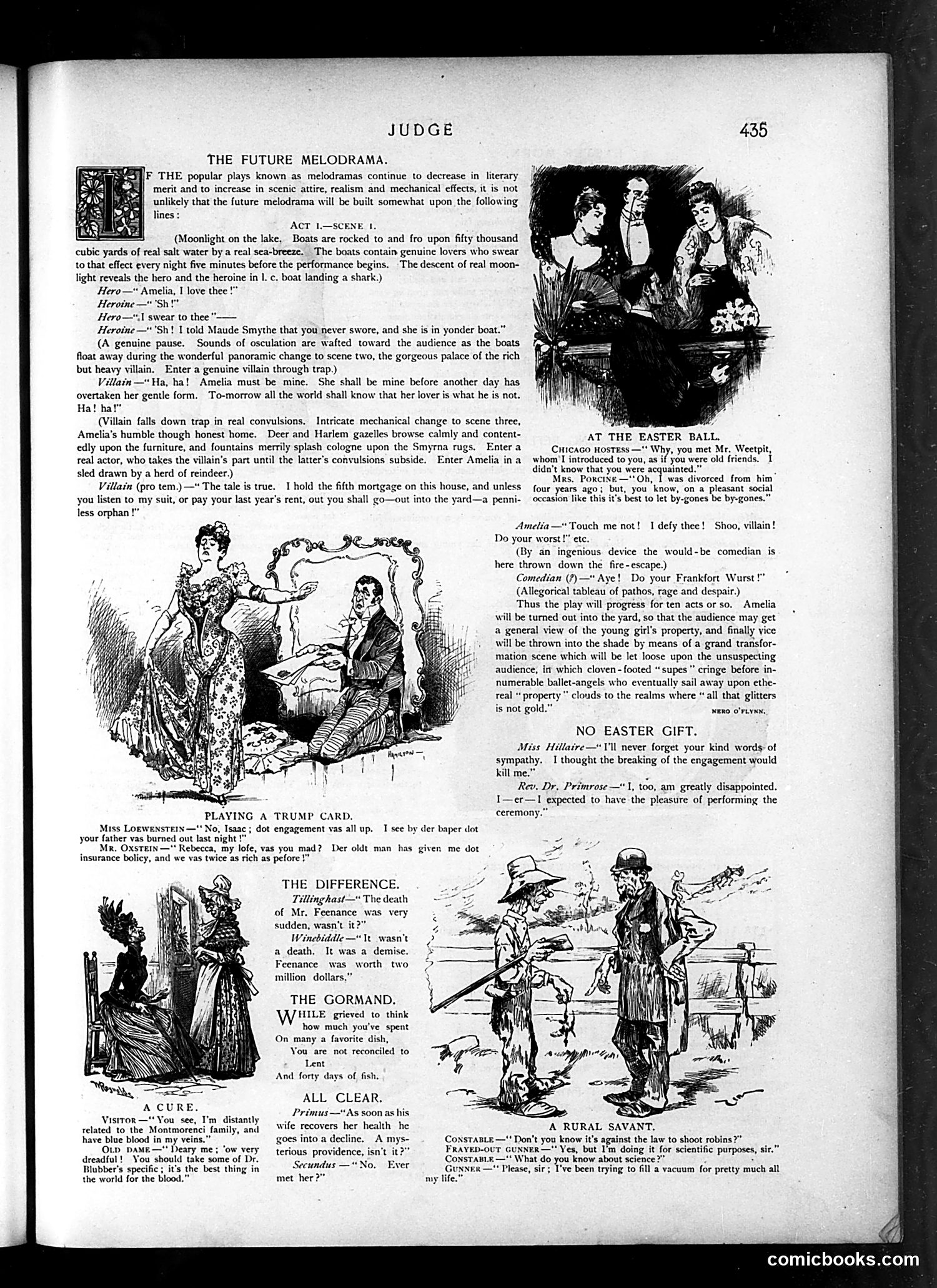
This page satirizes the declining quality of American melodrama theater. The main article mockingly predicts that if melodramas continue prioritizing spectacular staging over literary merit, future productions will become absurdly over-mechanized—featuring real salt water, genuine moonlight, live animals, and elaborate trap doors—while maintaining thin, predictable plots. The satire targets both playwrights who rely on technical effects rather than storytelling, and audiences who prefer spectacle to substance. The detailed "script" parodies typical melodramatic clichés: the virtuous heroine, villainous landlord, and overwrought dialogue ("Amelia, I love thee!"). The accompanying comic vignettes mock various social pretenses: Jewish characters' malapropisms in "Playing a Trump Card," and the linguistic distinction between "death" and "demise" based on wealth in "The Difference." The humor relies on readers recognizing contemporary theater conventions and appreciating the exaggeration of trends Judge's editors found absurd.
📄 Transcribed text from this page (OCR, searchable)
Machine-transcribed from the original scan — historical spelling and the odd misread are preserved.
JUDGE THE FUTURE MELODRAMA. y4\F THE popular plays known as melodramas continue to decrease in literary merit and to increase in scenic attire, realism and mechanical effects, it is not unlikely that the future melodrama will be built somewhat upon the following ACT 1,—SCENE 1. =a (Moonlight on the lake, Boats are rocked to and fro upon fifty thousand cubic yards of real salt water by a real sea-breeze. The boats contain genuine lovers who swear to that effect every night five minutes before the performance begins. ‘The descent of real moon- light reveals the hero and the heroine in I. c, boat landing a shark.) Hero —“ Amelia, | love thee !” Heroine—*'Sh!" Hero—".| swear to thee "—— Heroine —"’Sh! 1 told Maude Smythe that you never swore, and she is in yonder boat.” (A genuine pause. Sounds of osculation are wafted toward the audience as the boats float away during the wonderful panoramic change to scene two, the gorgeous palace of the rich but heavy villain. Enter a genuine villain through trap.) Villain —" Ha, ha! Amelia must be mine. She shall be mine before another day has overtaken her gentle form. ‘To-morrow all the world shall know that her lover is what he is not. Ha! ha!" (Villain falls down trap in real convulsions. Intricate mechanical change to scene three, q " a Amelia’s humble though honest home. Deer and Harlem gazelles browse calmly and content- AT THE EASTER BALL. edly upon the furniture, and fountains merrily splash cologne upon the Smyrna rugs. Enter a Ciicaco Hostess —"" Why, you met Mr, Weetpit, real actor, who takes the villain’s part until the latter's convulsions subside. Enter Amelia ina whom'l introduced to you, as if you were old friends. I Villain (pro tem.) —" The tale is true. I hold the fifth mortgage on this house, and unless four years ago: but, you know, on a pleasant social you listen to my suit, or pay your last year’s rent, out you shall go—out into the yard—a penni- occasion like this it's best to let by-gones be by-gone: less orphan !” Amelia —* Touch me not! I defy thee! Shoo, villain! Do your worst!” etc. (By an ingenious device the would-be comedian is here thrown down the fire-escape.) Comedian (?)—" Aye! Do your Frankfort Wurst !” (Allegorical tableau of pathos, rage and despair.) Thus the play will progress for ten acts or so. Amelia will be turned out into the yard, so that the audience may get a general view of the young girl’s property, and finally vice will be thrown into the shade by means of a grand transfor- mation scene which will be let loose upon the unsuspecting audience, in which cloven-footed “supes” cringe before in- numerable ballet-angels who eventually sail away upon ethe- real “ property” clouds to the realms where “all that glitters is not gold.” ano o'rivxx, NO EASTER GIFT. Miss Hillatre—V'l never forget your kind words: of sympathy. I thought the breaking of the engagement would kill me.” ‘ Rev. Dr, Primrose —1, too, am greatly disappointed. = 1—er—I expected to have the pleasure of performing the PLAYING A TRUMP CARD. ceremony.” Miss Loewenstein —'' No, Isaac; dot engagement vas all up. I see by der baper dot your father vas burned out last night !" Mr. Oxstein—" Rebecca, my lofe, vas you mad? Der oldt man has given me dot insurance bolicy, and we vas twice as rich as pefore !” THE DIFFERENCE. Tillinghast—* The death of Mr. Feenance was very sudden, wasn’t it Winebiddle—" Wt wasn't a death, It was a demise. Feenance was worth two million dollars.” THE GORMAND. WHILE grieved to think how much you've spent On many a favorite dish, You are not reconciled to Lent And forty days of fish. ALL CLEAR. e SY, Tavaweau Primus—As soon as his 1siTOR—"'You see, I'm distantly related to the Moatmoreac! family, and Wife recovers her health he A RURAL SAVANT. have blue blood in my veins.” goes into a decline. A my: Coxstante—'* Don't ‘ow it's against the law to shoot robins?” OLD paME—" Deary me; ‘ow very terious providence, isn't i Fravep-our ‘es, but I'm doing it for scientific purposes, sir.” dreadful! You should take some of Dr. eee Con What do you know about science?” : Blubber's specific ; it's the best thing in Clete rR —"' Please, sir; I've been trying to fill a vacuum for pretty much all the world for the blood.” met her?” A comicbooks.com