
A complete issue · 16 pages · 1890
Judge — December 27, 1890
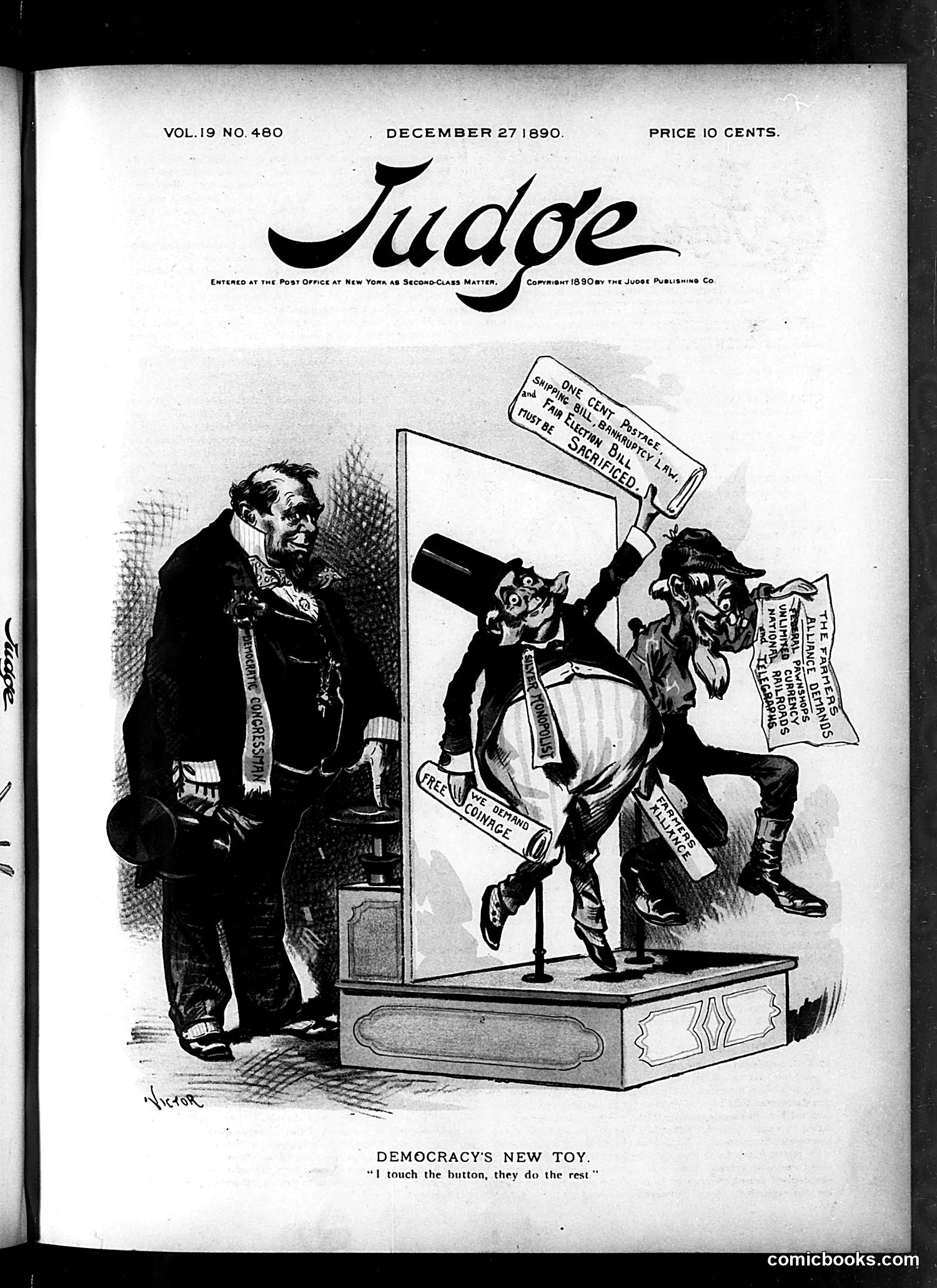
This political cartoon satirizes what the artist sees as the mechanical manipulation of democratic processes. A man in formal dress (likely representing a political boss or party operative) operates a jack-in-the-box mechanism labeled with various political slogans and promises. Two caricatured figures emerge from the box, appearing to be puppet-like political candidates or representatives performing as directed. The caption—"I touch the button, they do the rest"—suggests that democracy has become mere theater, where political elites control outcomes by pulling strings. The figures' exaggerated features and puppet-like poses emphasize the artist's critique that candidates and elected officials are mere tools of hidden power brokers rather than genuine representatives of popular will.
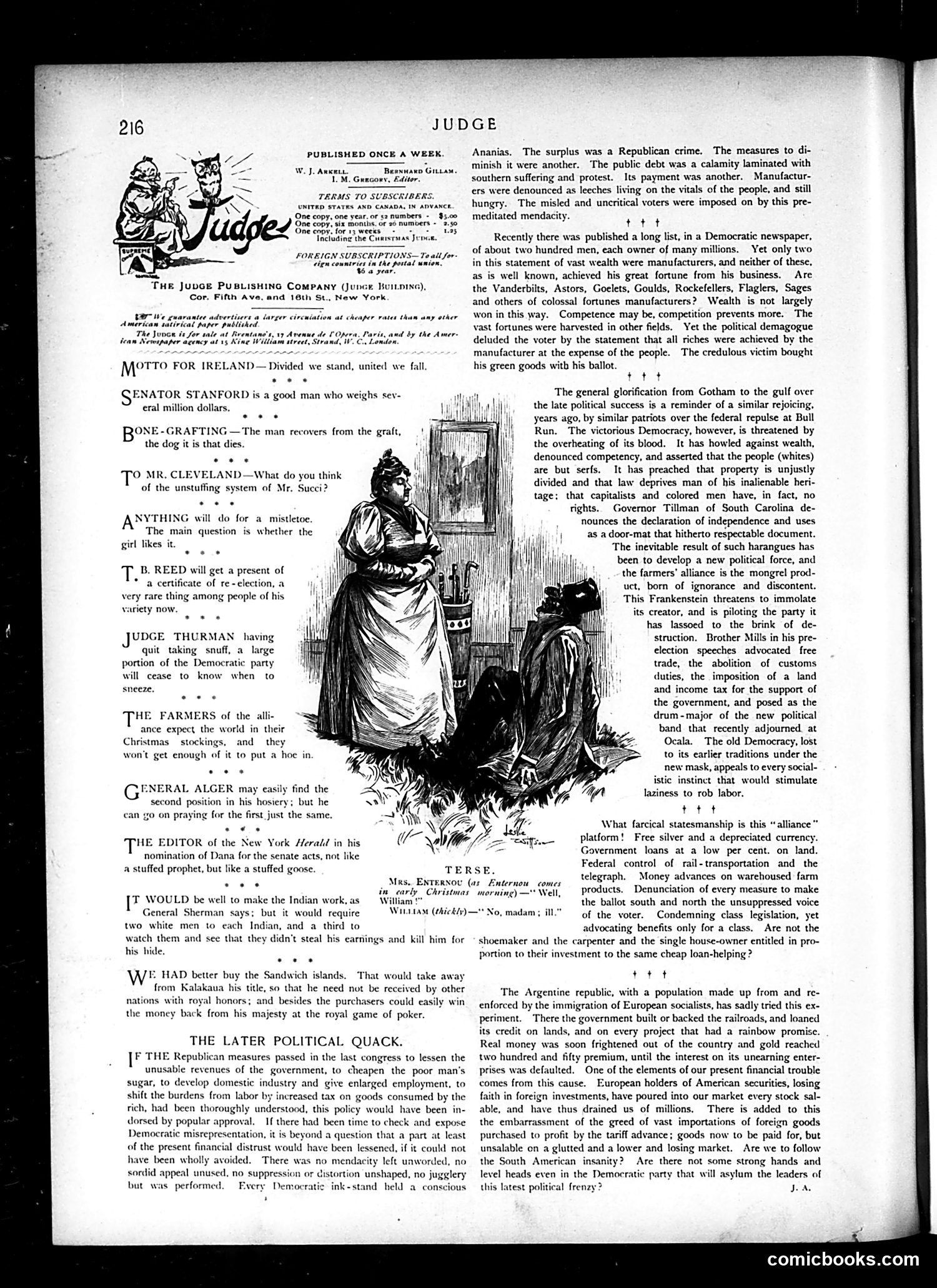
The central illustration depicts a woman (labeled "Mrs. Esterhazy") speaking with a young boy (labeled "William"), with a caption reading "Well, William (to his mamma)—'No, madam; ill—'" This appears to be satirizing wealth inequality and class politics of the era. The woman represents European aristocratic privilege, while the boy represents common working-class youth. The implied joke suggests the boy refuses her charity or condescension, asserting dignity despite poverty. The surrounding text discusses Democratic political failures, Republican wealth accumulation, and critiques of industrial monopolists (Vanderbilts, Astors, Rockefellers). The cartoon likely mocks wealthy elites' patronizing attitudes toward the poor while politicians debate economic policy. The satire targets Gilded Age income disparity and the perceived indifference of the wealthy class.
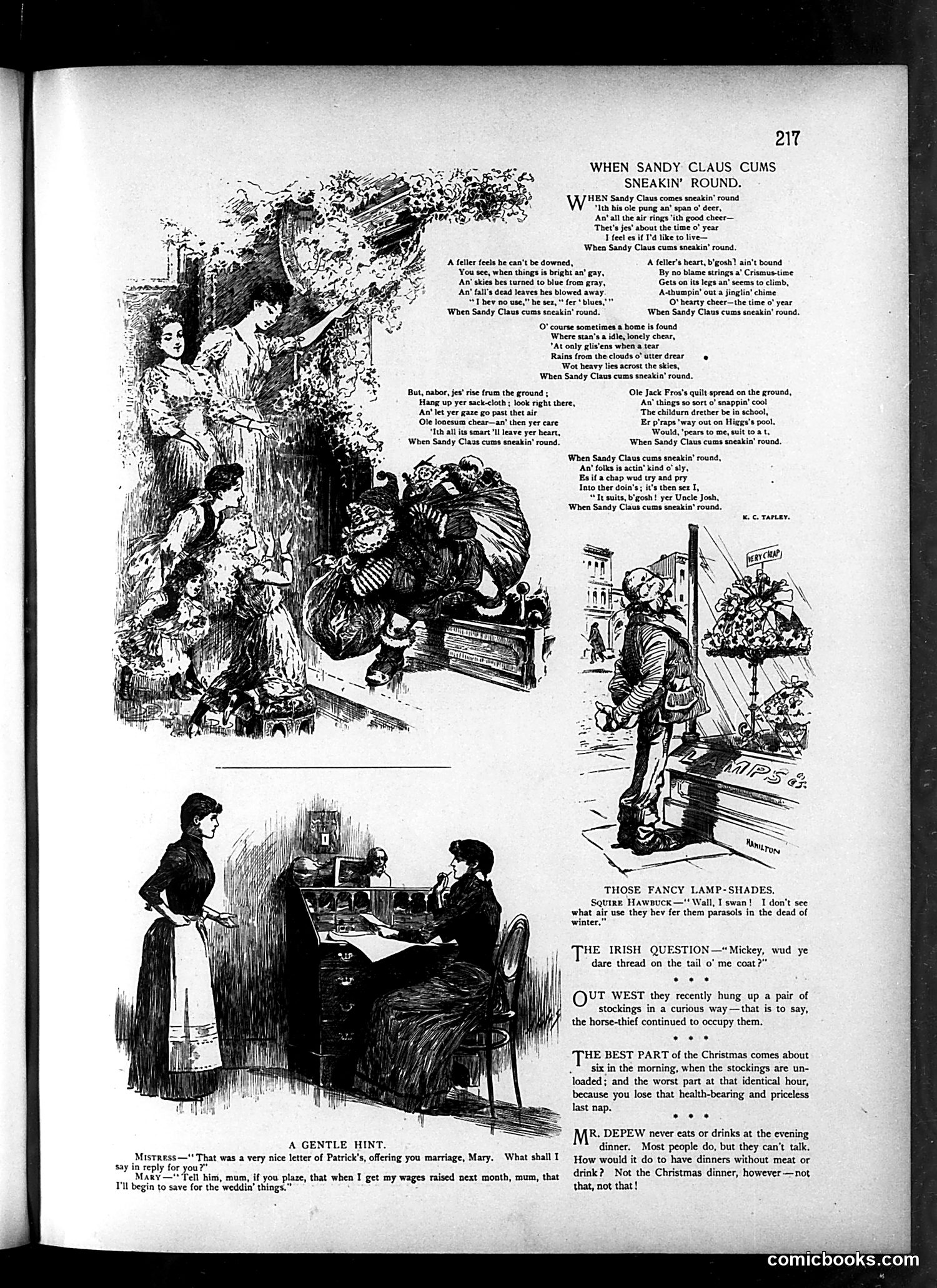
This page contains several distinct items: **"When Sandy Claus Cums Sneakin' Round"** (top): A long humorous poem about Christmas, featuring Santa Claus visiting children. The accompanying illustration shows Santa with children and a Christmas tree—standard festive content with no apparent political satire. **"Those Fancy Lamp-Shades"** and **"A Gentle Hint"** (bottom sections): Brief comedic sketches about domestic life—one about lamp-shades, another showing a conversation between a mistress, Mary, and Patrick about marriage and wages. These are lighthearted domestic humor rather than political commentary. **"The Irish Question," "Out West," and other brief items**: Short humorous quips on various topics including Irish stereotypes and frontier life. The page is primarily festive and domestic humor rather than political satire, typical of Judge magazine's mixed entertainment content during the holiday season.
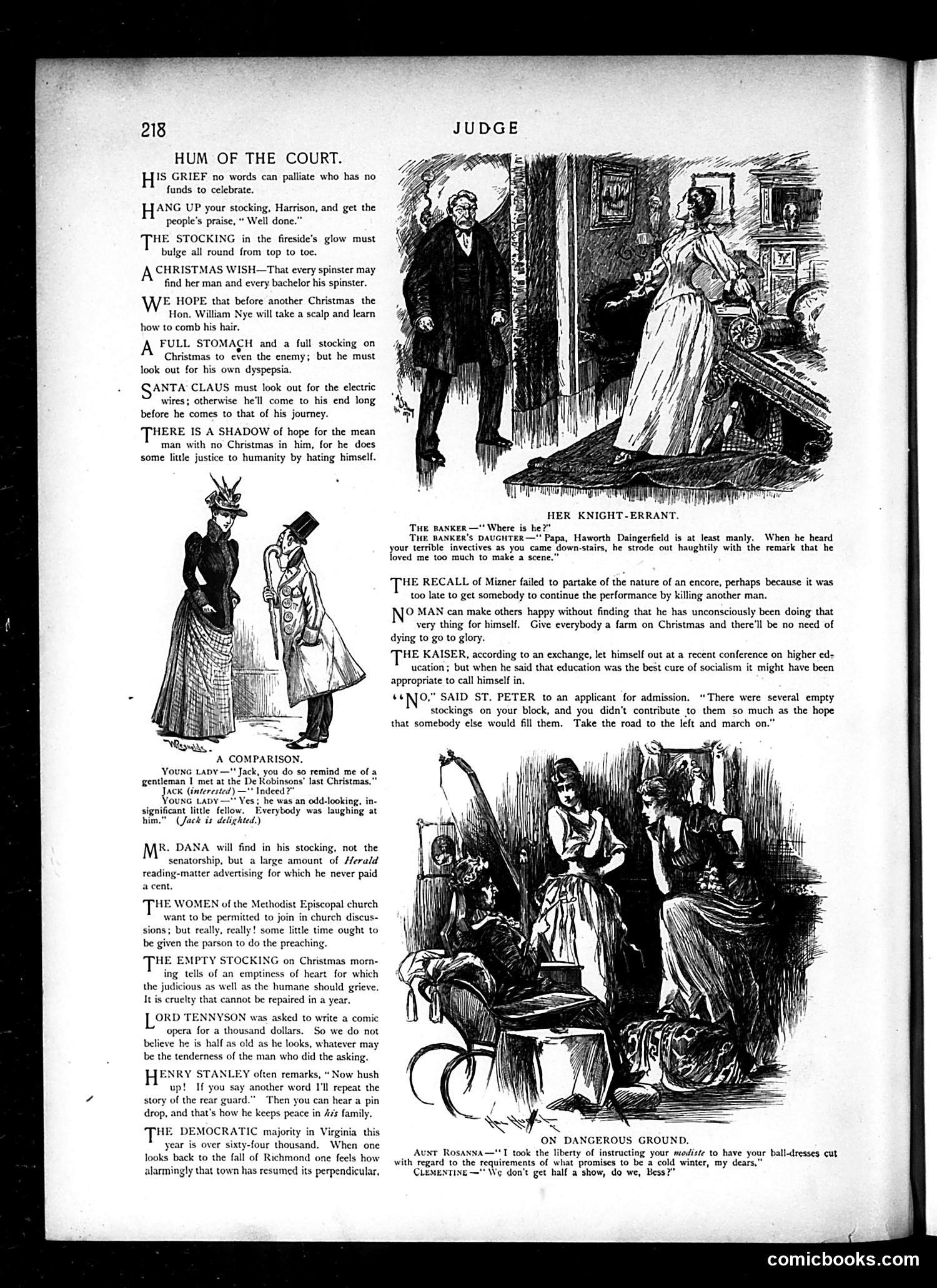
This page collects brief Christmas-themed satirical commentary typical of Judge's "Hum of the Court" section. Key targets include: **Political/Social Figures:** - **Harrison** (likely President Benjamin Harrison): mocked for lacking Christmas funds - **William Nye**: criticized for poor grooming and lack of scalp-taking (unclear reference, possibly an eccentric public figure) - **Mizner**: referenced for a failed "recall"—apparently someone whose removal from office didn't generate public enthusiasm - **The Kaiser**: satirized for claiming education cures socialism - **Lord Tennyson**: joked about for his age and alleged unwillingness to write cheap comic opera **Satirical Points:** The humor operates on class anxiety (bankers' daughters, Methodist women seeking church participation), gender dynamics (spinsters finding husbands), and social hypocrisy (the mean man gaining redemption through self-hatred). Modern readers should note the assumption that "farms for Christmas" would solve poverty—reflecting 1880s-90s agrarian ideology. The overall tone is lighthearted rather than biting social critique.
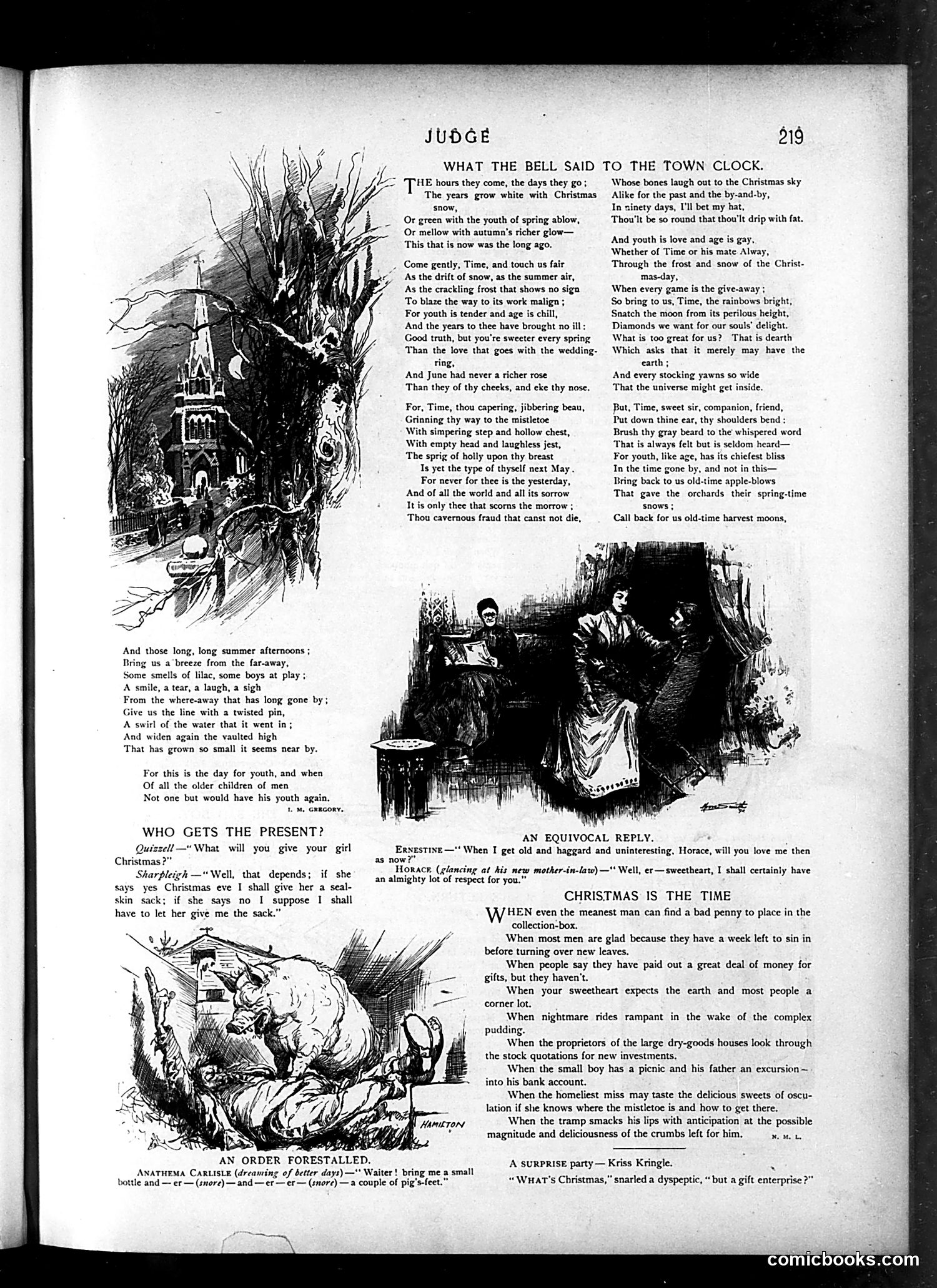
This page contains several satirical pieces reflecting late-19th/early-20th-century American life: **"What the Bell Said to the Town Clock"** is a lengthy poem personifying Time as a "capering, jibbering beau"—mocking Time's frivolousness while addressing Christmas themes of mortality and nostalgia. The bell urges Time to grant wishes and restore youthful memories. **"Who Gets the Present?"** jokes about Christmas gift-giving expectations versus reality, with a character named Sharpleigh quipping that his gift to his girlfriend depends on whether she accepts his marriage proposal. **"An Equivocal Reply"** shows a woman (Ernestine) anxiously asking if her husband will love her when old; he responds he'll have "respect"—implying he won't, a cutting commentary on conditional marital affection. **"An Order Forestalled"** depicts a hungover man (labeled "Anathema Carlisle") dreamily ordering pig's feet and liquor—satirizing excessive Christmas indulgence. The final section cynically catalogs Christmas hypocrisy: people claiming generosity while being stingy, using the season to postpone moral improvement.
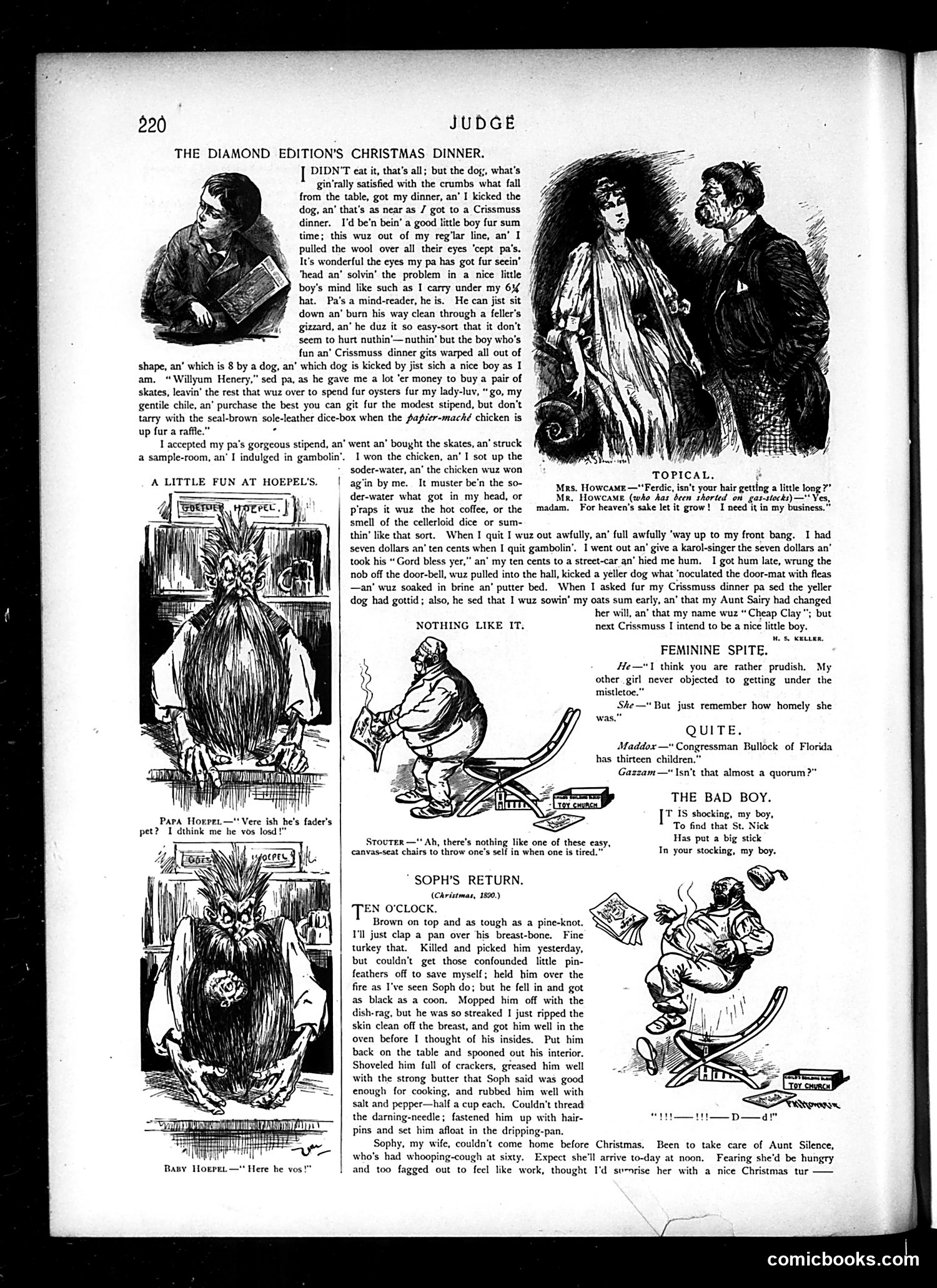
This page satirizes working-class Christmas disappointment through a boy's first-person narrative. "Willum Henry," trying to be good to earn a holiday reward, receives money from his father ("pa") for skates. Instead, he gambles it away at a sample room (a bar where drinks were given free with purchases), winning a papier-mâché chicken in a raffle. His father—depicted as a stern mind-reader—sees through the deception and punishes him by denying Christmas dinner, kicking the family dog instead. The humor targets both the boy's failed scheme and parental discipline's harsh reality. Secondary jokes mock contemporary figures like "Congressman Bullock of Florida" (unclear which one) and social pretensions about mistletoe etiquette. "Soph's Return" humorously describes preparing a tough turkey—likely a running domestic character. The overall tone reflects Gilded Age class attitudes and satirizes urban working-class life's grim realities masked by holiday sentiment.
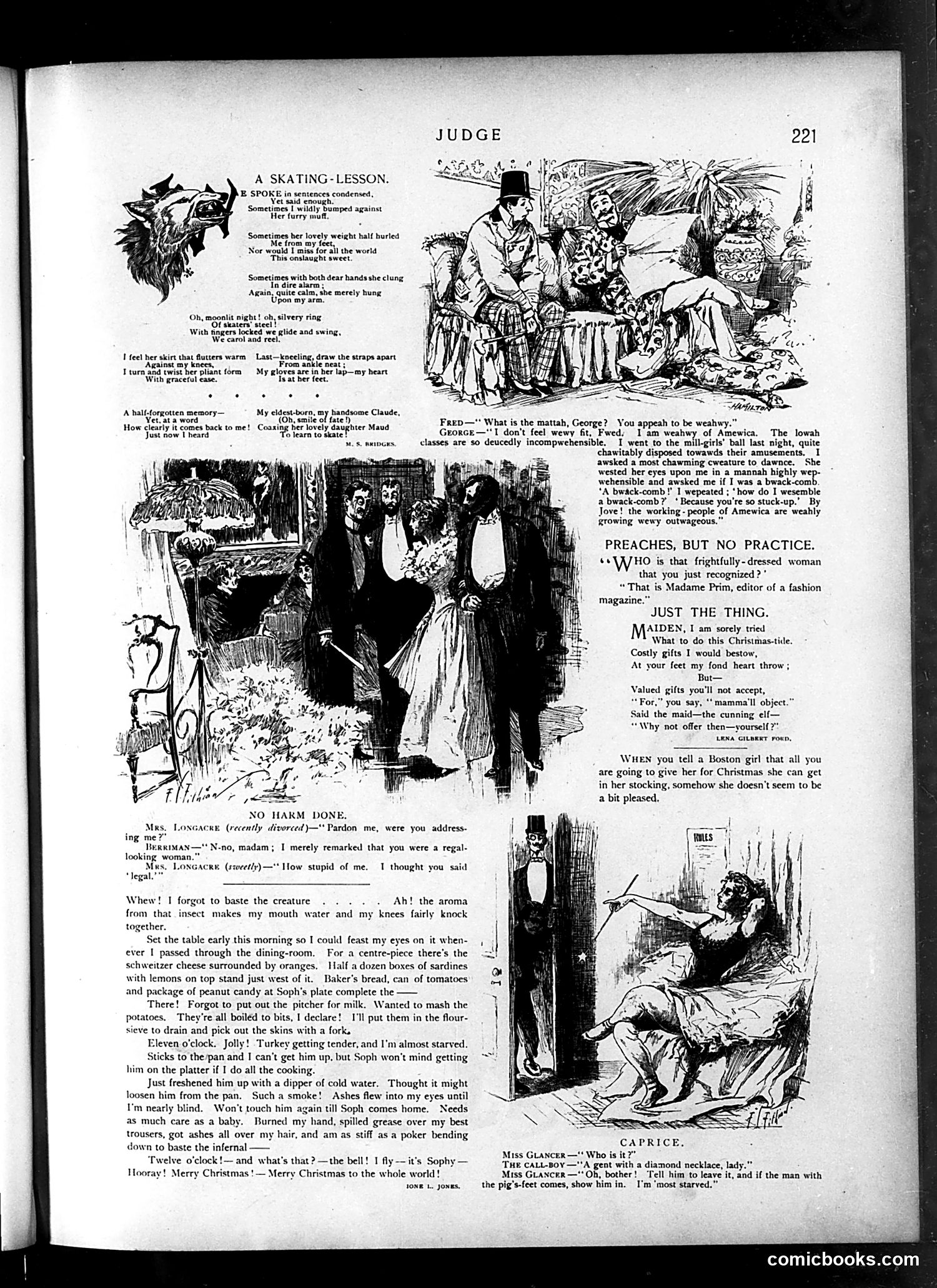
This page contains several humorous sketches typical of Judge's satirical content: **"A Skating-Lesson"** depicts romantic flirtation during winter courtship—a popular theme. The sentimental poem celebrates physical closeness on ice skates. **"No Harm Done"** shows a recently divorced woman misunderstanding a compliment as "legal" rather than "regal"—implying her divorce was scandalous or morally questionable, playing on period attitudes toward divorcées. **The cooking scene** satirizes a harried housewife's chaotic Christmas dinner preparation, reflecting broader anxieties about domestic competence. **The dialogue between Fred and George** mocks an affected British aristocrat's affected speech patterns ("weahwy," "bwack-comb") who patronizingly attends working-class American dances, only to be insulted. It satirizes class pretension and Anglo-American cultural snobbery. **"Preaches But No Practice"** ridicules fashion magazine editors as poorly dressed—a common hypocrisy joke. **"Just the Thing"** plays on courtship conventions where young women refuse expensive gifts but accept marriage proposals. These are typical Judge humor: romantic, domestic, and class-based satire aimed at middle-class American readers.
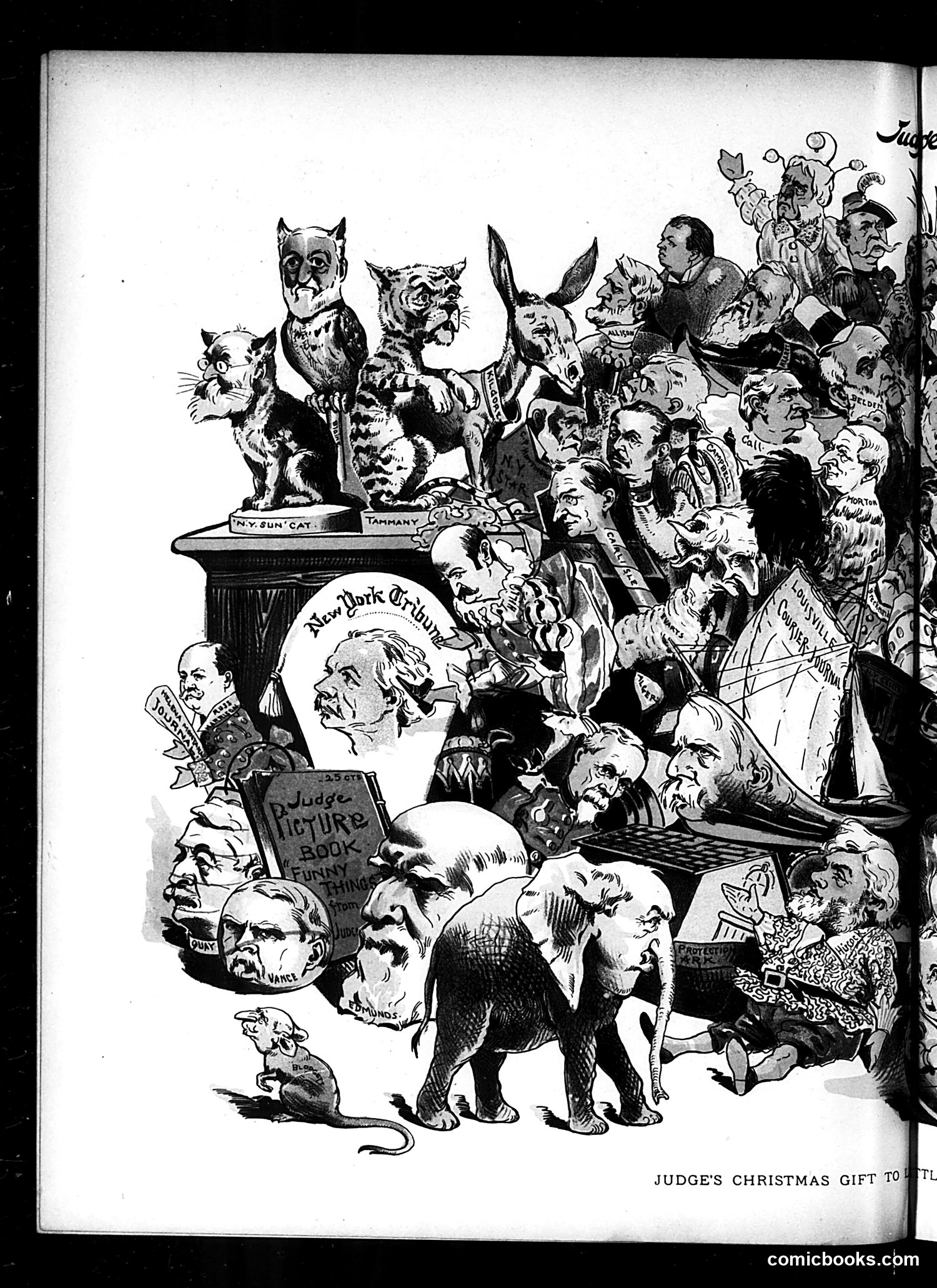
This is a satirical political cartoon titled "Judge's Christmas Gift to [the] Public" (text cut off). The illustration depicts a chaotic scene crowded with caricatured figures—politicians, judges, and public personalities—surrounding a pedestal displaying cats labeled "New Sun Cat," "Tammany," and other entities. A bear stands prominently in the lower center, while a book titled "Judge's Picture Book" is visible. The cartoon appears to mock prominent figures and institutions of its era, particularly Tammany Hall (New York's powerful Democratic political machine). The animal symbolism—cats, bear, donkey—was common in Gilded Age political satire to represent different political factions or entities. The crowded, chaotic composition suggests corruption or absurdity within government and public institutions. Without a visible date, the specific political moment remains unclear, though the style suggests late 19th or early 20th century.
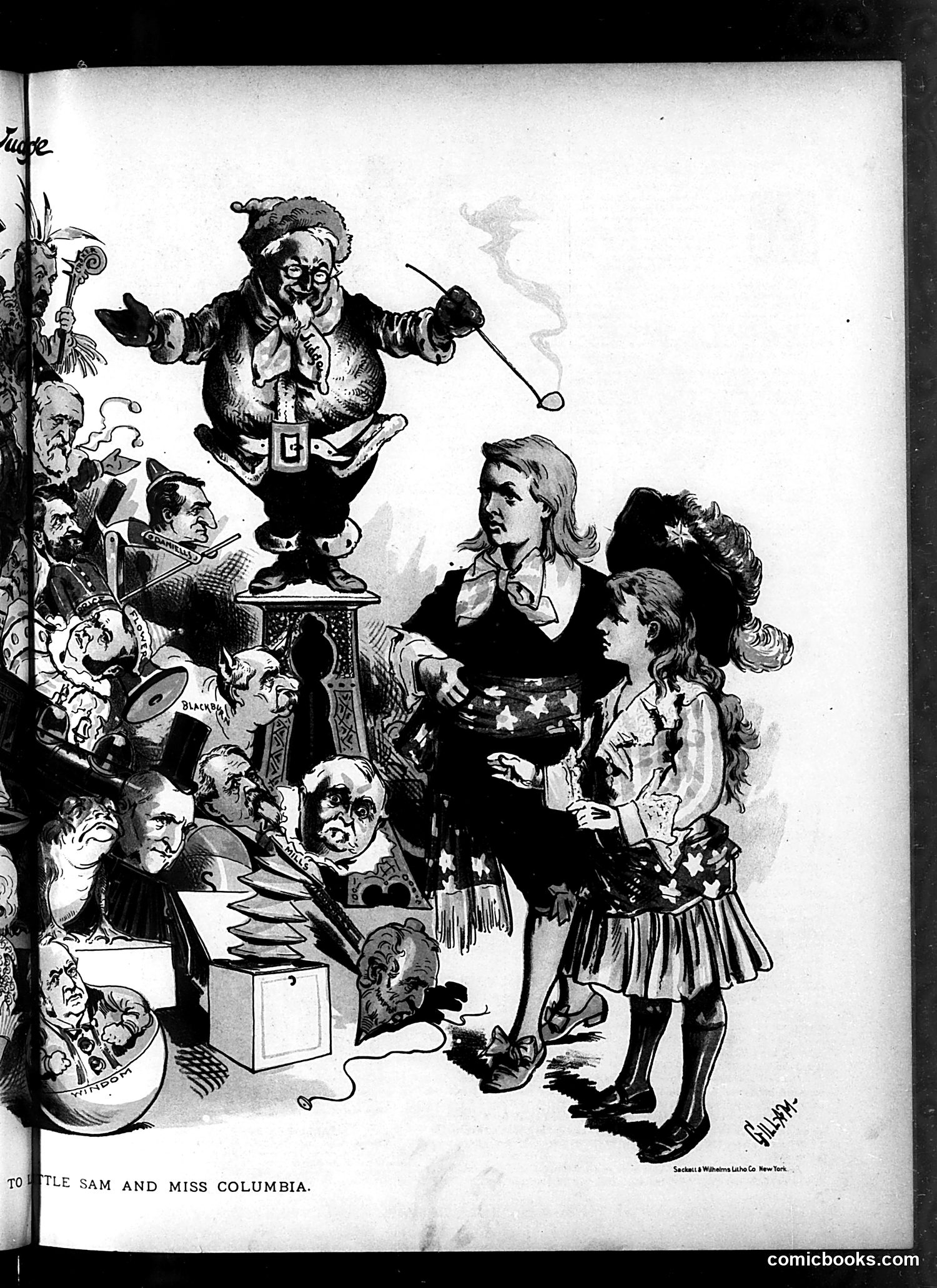
This political cartoon depicts **Uncle Sam** (the portly figure on the pedestal, representing the U.S. government) as a manipulative puppeteer controlling **Miss Columbia** (the female figure, a traditional personification of America). The caricatured crowd on the left appears to represent various political or social factions. The satire critiques governmental control and manipulation of the nation—suggesting Uncle Sam pulls strings to direct Columbia and public opinion. The magician-like pose with his wand emphasizes deception and illusion in politics. Without the publication date visible, the specific historical context remains unclear, but the imagery reflects common Progressive-era critiques of political manipulation and corporate/governmental control of American institutions and public will.
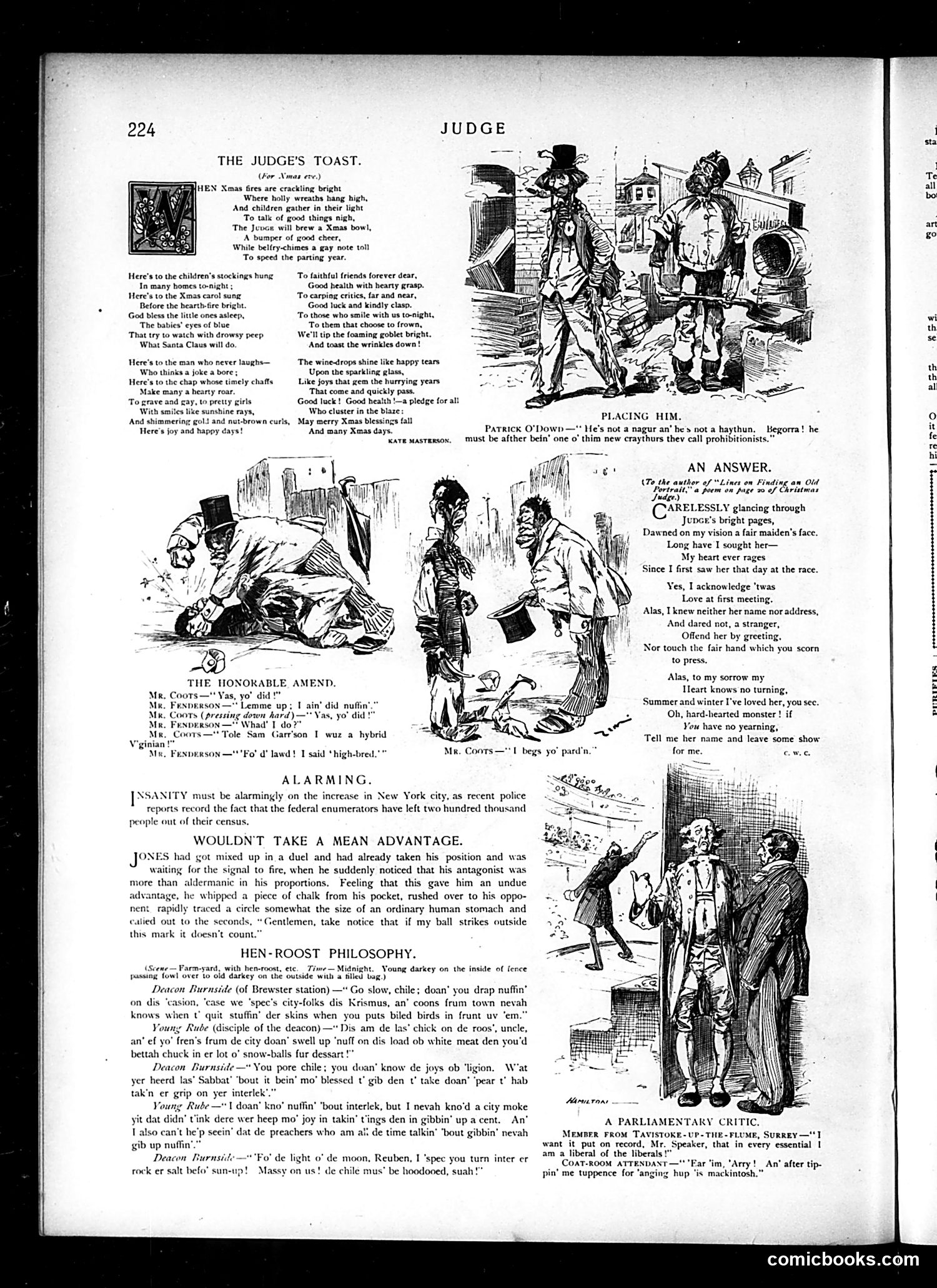
This page from Judge magazine contains multiple satirical pieces typical of late-19th-century American humor: **"The Judge's Toast"** is a sentimental Christmas poem celebrating hearth, family, and goodwill—standard holiday fare. **"The Honorable Amend"** satirizes a Black man (depicted in period racist caricature) misunderstanding "high-bred" as "hybrid," suggesting intellectual inferiority through dialect humor. **"Wouldn't Take a Mean Advantage"** mocks a duelist who, noticing his opponent is obese, draws a chalk outline around the larger man's body to establish a "fair" target area—absurdist humor about proportionality in conflict. **"Hen-Roost Philosophy"** depicts enslaved or rural Black characters (using heavy dialect) stealing chickens for Christmas, with crude humor about their appetites and supposed theological hypocrisy regarding generosity. The "philosophy" is ironic commentary on their logic. Overall, the page reflects Judge's reliance on ethnic caricature, class mockery, and crude stereotypes as its primary comedic vehicle.
This page is primarily **advertising**, with some humorous filler material typical of Judge magazine's format. The brief jokes and anecdotes scattered throughout address period concerns: a Russian immigrant's violent death from "pulling out a revolver" in an altercation; Southern poverty and disease ("malaria," with locals dying untreated); domestic employment anxieties (an umbrella-mender's dishonesty; a man joking about hanging his children to secure a housekeeper). The "Tourist" and "Citizen" dialogues mock rural ignorance and immigrant English (the umbrella-mender's accent). There's no coherent political cartoon visible—rather, these are scattered one-liners reflecting late-19th-century urban anxieties about immigration, rural poverty, domestic help, and class difference. The bulk of the page showcases luxury goods (pianos, hotels, beauty creams), positioning Judge's readership as urban, affluent, and sophisticated—above the rural and immigrant types mocked in the filler text.
This page is primarily **advertising with minimal original content**. The single cartoon-joke appears at the top: a "Benevolent individual" gives "Uncle Ebony" (a racist caricature of a Black man, typical of the era) a dollar for help, but Uncle Ebony responds that he isn't afraid of wolves because he keeps dogs—a play on "keeping the wolf from the door" (avoiding poverty). The remainder is filled with period advertisements for Pears' Soap, pianos, cigars, calendars, furs, and questionable patent medicines. The "Carl Pretzel's Philosophy" section contains ethnic dialect humor common to the era. The page reflects late-19th-century *Judge* magazine's mix of mild satire and commercial promotion, with racist stereotypes presented as standard comedic material for contemporary audiences.
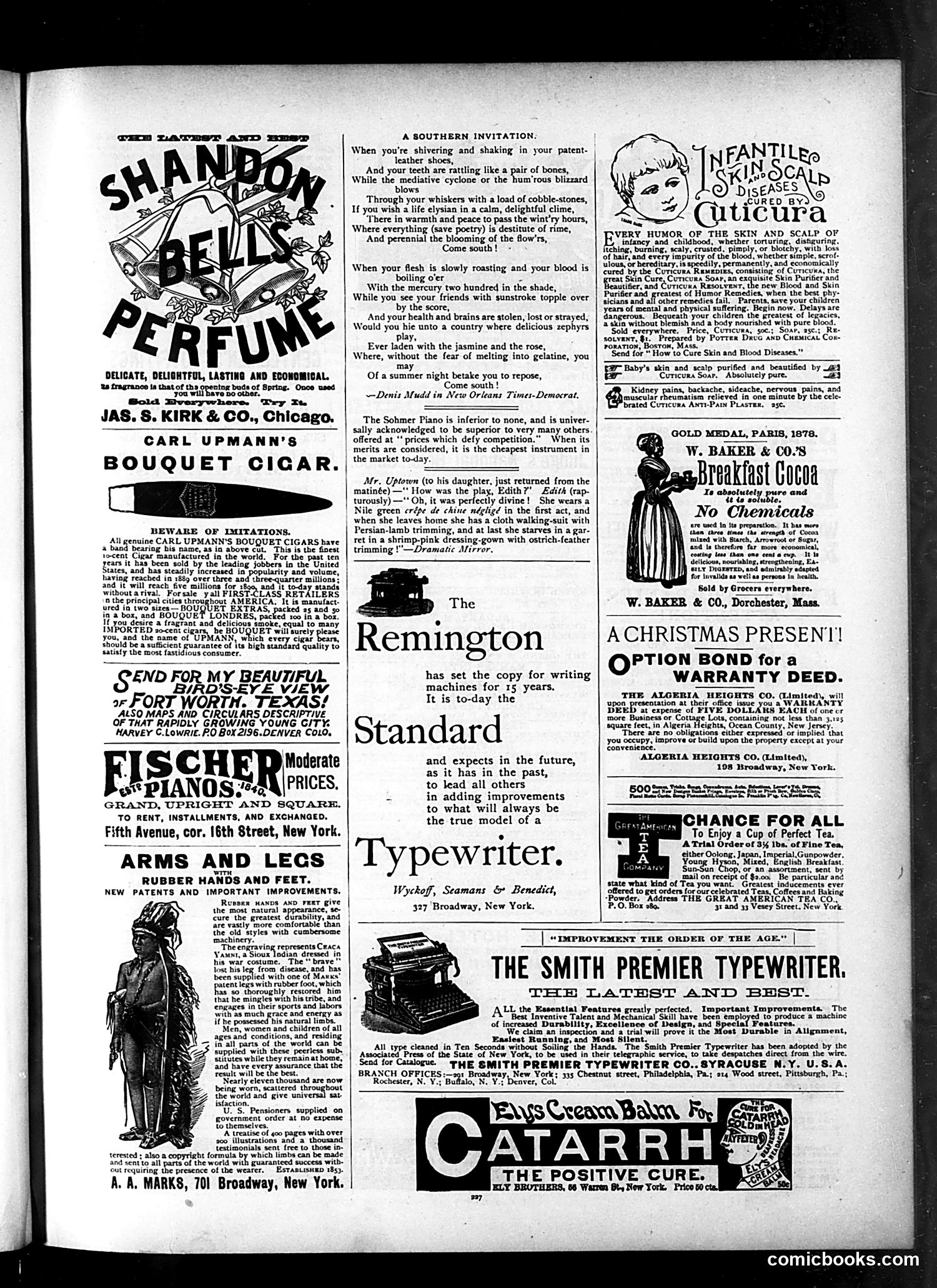
This page is **primarily advertisements**, not a political cartoon. The main content includes ads for perfume, cigars, pianos, prosthetic limbs, typewriters, cocoa, and patent medicines. The only satirical content is a brief poem titled "A Southern Invitation" (center-right). It's a gentle mock-invitation to northern readers suffering through harsh winters—"shivering and shaking," experiencing blizzards and "mercury two hundred in the shade"—to relocate south where the climate is mild and flowers bloom year-round. The satire works by exaggerating both the northern winter's misery and the southern paradise's perfection, ending with the simple plea "Come south!" This reflects late-19th-century sectional humor about climate differences, likely aimed at northern readers of *Judge* magazine. The poem attributes to "Denis Madd in New Orleans Times-Democrat," suggesting it's reprinted from a southern publication.
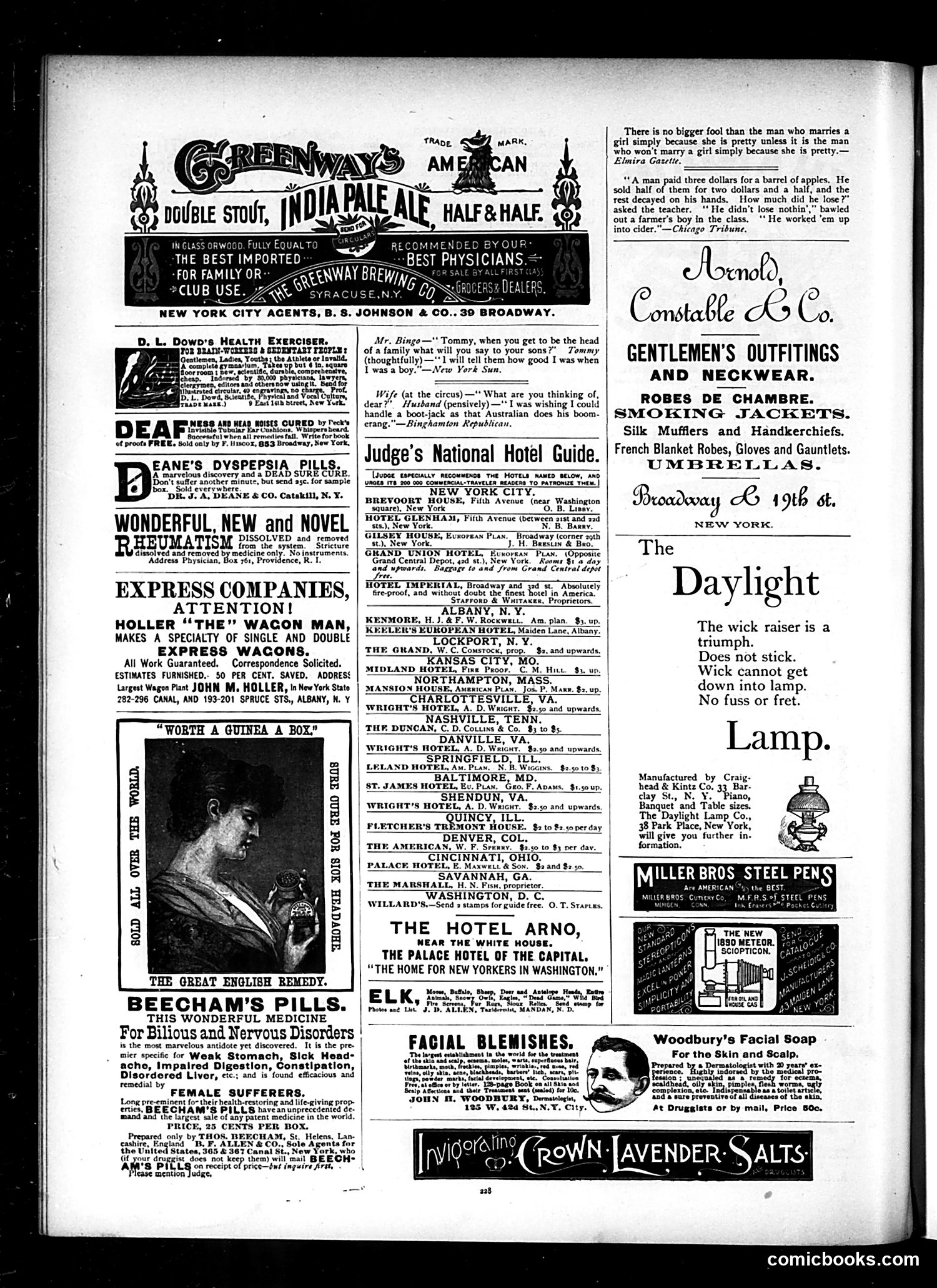
This is primarily a **commercial advertising page** with minimal political satire. The page features: **Advertisements:** - Patent medicines (Beecham's Pills, Fane's Dyspepsia Pills, deafness cures) - Greenway's American ales and beers - Health devices and exercise equipment - Hotel guides across American cities - Gentlemen's clothing and accessories **Satirical Content:** Two brief, mild humor pieces appear: 1. A "Mr. Bingo" joke about a boy promising to be good like his youth 2. A circus joke about a husband wishing he could handle a boot-jack **Historical Context for Modern Readers:** These represent typical late-19th-century **patent medicine advertising**—largely unregulated nostrums claiming to cure everything from deafness to constipation. The hotel guide reflects the commercial travel industry. The humor is gentle domestic comedy rather than sharp political satire, suggesting this page prioritizes revenue from advertisers over editorial content.
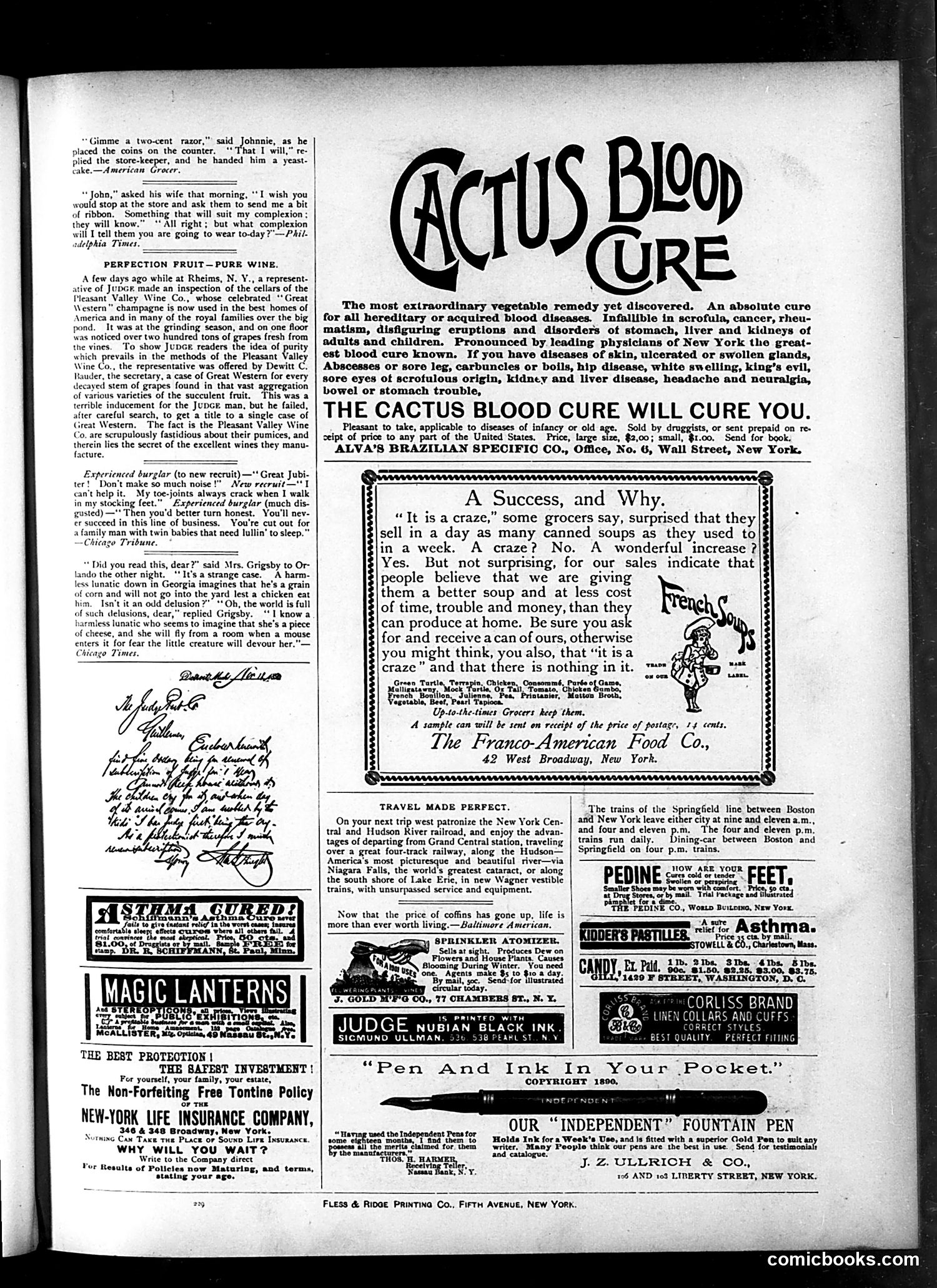
This page from Judge magazine (circa 1900, based on copyright notice) is primarily **advertising**, not political satire. The dominant feature is a large advertisement for "Cactus Blood Cure," a patent medicine claiming to cure scrofula, cancer, rheumatism, and various blood diseases—typical of fraudulent medical advertisements from this era. The page includes several brief humorous anecdotes in the margins (jokes about misheard requests, burglars, and marital delusions), plus advertisements for other products: French soup, Magic Lanterns, Asthma remedies, fountain pens, and insurance. The "Cactus Blood Cure" ad exemplifies the predatory medical quackery that plagued late-19th/early-20th-century America—promising miraculous cures for serious diseases with no scientific basis. Modern readers should recognize this as snake oil marketing, not legitimate medicine.
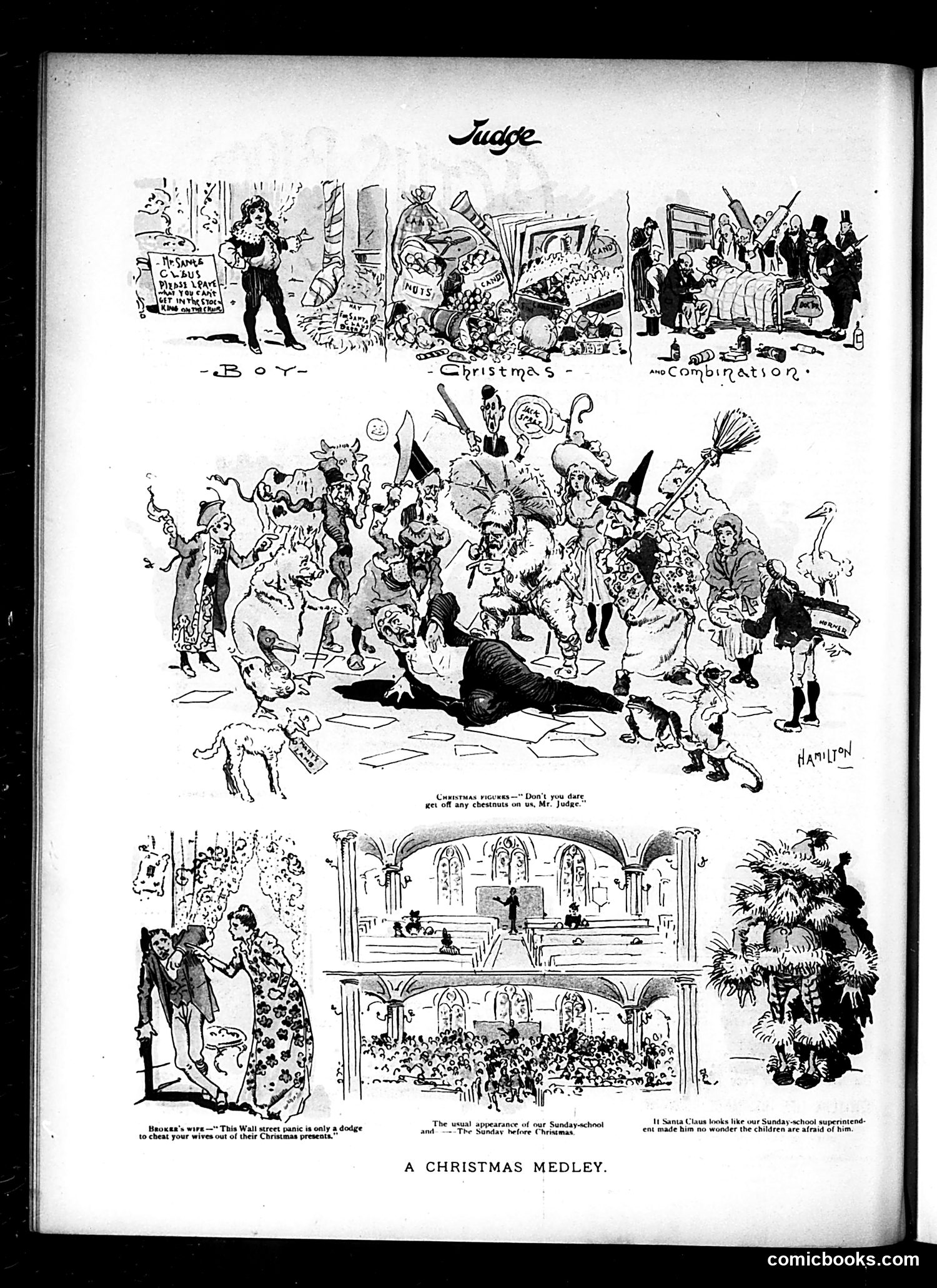
This page presents multiple Christmas-themed satirical sketches. The top panels ("Boy," "Christmas," "and Combination") depict holiday chaos and excess. The large central cartoon shows a chaotic Christmas party where a figure lies prostrate amid revelers—likely satirizing overindulgence or social disorder during the season. The bottom panels include social commentary: one references the "Wall Street panic" as husbands' excuse to avoid buying wives Christmas presents; another mocks how a disheveled Santa Claus frightens children; and a third shows a crowded Sunday school or church scene. The overall satire targets holiday hypocrisy—the gap between Christmas's spiritual ideals and actual behavior involving financial stress, parental deception, commercialism, and social anxiety. The crude, chaotic drawing style emphasizes the disorder beneath Christmas's veneer.