
Judge, 1890-12-27 · page 5 of 16
Judge — December 27, 1890 — page 5: what you’re looking at
What you’re looking at
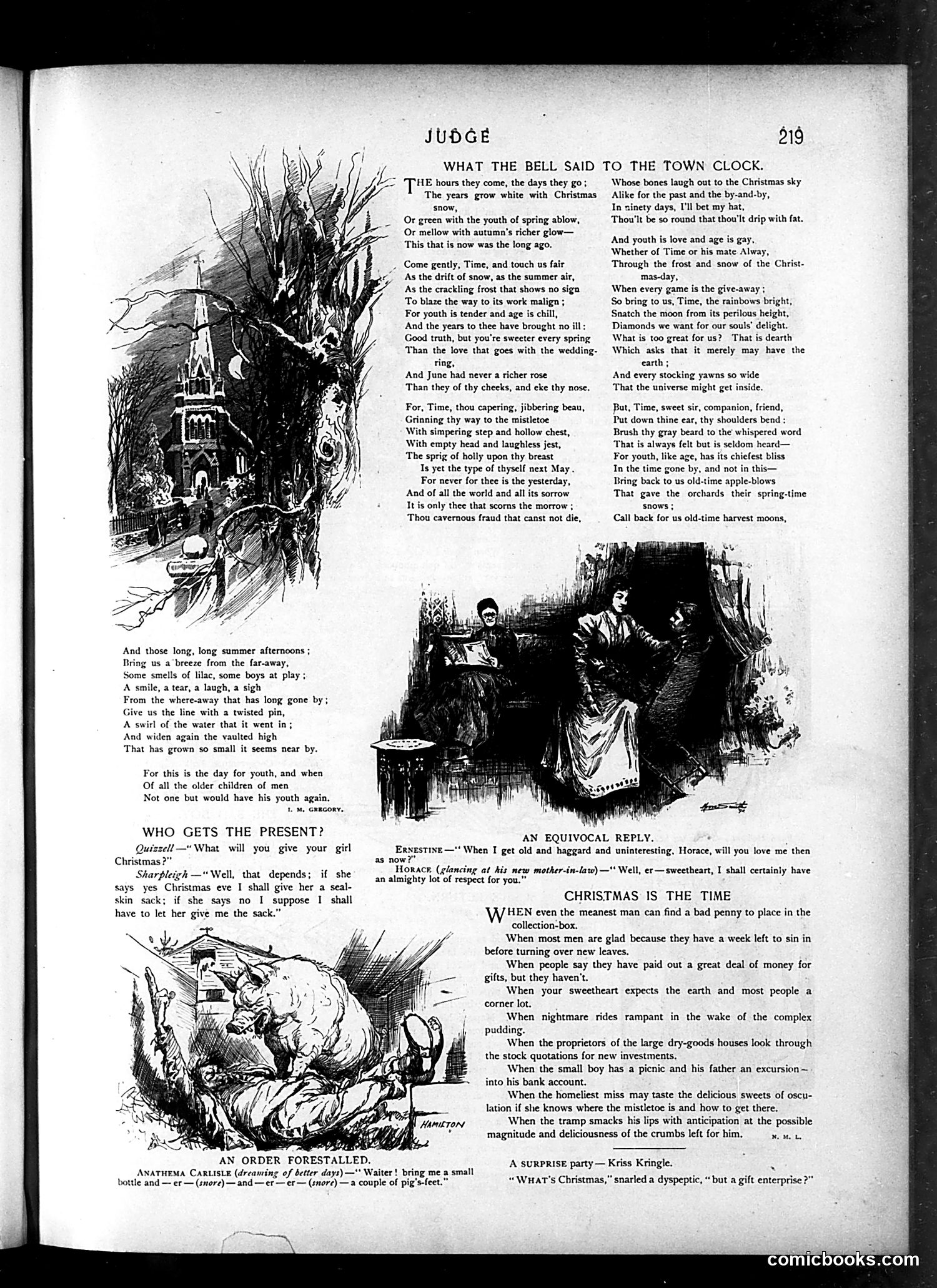
This page contains several satirical pieces reflecting late-19th/early-20th-century American life: **"What the Bell Said to the Town Clock"** is a lengthy poem personifying Time as a "capering, jibbering beau"—mocking Time's frivolousness while addressing Christmas themes of mortality and nostalgia. The bell urges Time to grant wishes and restore youthful memories. **"Who Gets the Present?"** jokes about Christmas gift-giving expectations versus reality, with a character named Sharpleigh quipping that his gift to his girlfriend depends on whether she accepts his marriage proposal. **"An Equivocal Reply"** shows a woman (Ernestine) anxiously asking if her husband will love her when old; he responds he'll have "respect"—implying he won't, a cutting commentary on conditional marital affection. **"An Order Forestalled"** depicts a hungover man (labeled "Anathema Carlisle") dreamily ordering pig's feet and liquor—satirizing excessive Christmas indulgence. The final section cynically catalogs Christmas hypocrisy: people claiming generosity while being stingy, using the season to postpone moral improvement.
📄 Transcribed text from this page (OCR, searchable)
Machine-transcribed from the original scan — historical spelling and the odd misread are preserved.
And those long, long summer afternoons ; Bring us abreeze from the far-away, Some smells of lilac, some boys at play ; A smile, a tear, a laugh, a sigh From the where-away that has long gone by; Give us the line with a twisted pin, A swirl of the water that it went in; And widen again the vaulted high ‘That has grown so small it seems near by. For this is the day for youth, and when Of all the older children of men Not one but would have his youth again, 1. M, Gxecory. WHO GETS THE PRESENT? JUDGE WHAT THE BELL SAID TO THE TOWN CLOCK. “THE hours they come, the days they go; The years grow white with Christmas snow, Or green with the youth of spring ablow, Or mellow with autumn’s richer glow— This that is now was the long ago. , Come gently, Time, and touch us fair As the drift of snow, as the summer air, As the crackling frost that shows no sign To blaze the way to its work malign ; For youth is tender and age is chill, And the years to thee have brought no ill : Good truth, but you're sweeter every spring Than the love that goes with the wedding- ring, ‘And June had never a richer rose ‘Than they of thy cheeks, and eke thy nose. For, Time, thou capering, jibbering beau, Grinning thy way to the mistletoe With simpering step and hollow chest, With empty head and laughless jest, The sprig of holly upon thy breast Is yet the type of thyself next May. For never for thee is the yesterday, And of all the world and all its sorrow It is only thee that scorns the morrow ; ‘Thou cavernous fraud that canst not di Whose bones laugh out to the Christmas sky Alike for the past and the by-and-by, In ninety days, I'll bet my hat, Thou'lt be so round that thou'lt drip with fat. And youth is love and age is gay, Whether of Time or his mate Alway, Through the frost and snow of the Christ- mas-day, When every game is the give-away ; So bring to us, Time, the rainbows bright, Snatch the moon from its perilous height, Diamonds we want for our souls’ delight. What is too great for us? That is dearth Which asks that it merely may have the earth ; And every stocking yawns so wide That the universe might get inside. But, Time, sweet sir, companion, friend, Put down thine ear, thy shoulders bend: Brush thy gray beard to the whispered word ‘That is always felt but is seldom heard— For youth, like age, has its chiefest bliss In the time gone by, and not in this— Bring back to us old-time apple-blows That gave the orchards their spring-time snows ; Call back for us old-time harvest moons, AN EQUIVOCAL REPLY. Quiszell "What will you give your girl Christmas Sharpleigh —"Well, that depends; if she says yes Christmas eve I shall give her a seal- skin sack; if she says no I suppose I shall have to let her give me the sack.” as now?” AN ORDER FORESTALLED. ANATHEMA CARLISLE (dreaming of better days)—"* Waiter! bring me a small bottle and — er — (snore) — and —er — er— (snore) —a couple of pig’s-feet.” Ernestinz—" When I get old and haggard and uninteresting, Horace, will you love me then Horace. (glancing at his new mother-in-law) —"' Well, er —sweetheart, I shall certainly have an almighty lot of respect for you." CHRISTMAS IS THE TIME HEN even the meanest man can find a bad penny to place in the collection-box. When most men are glad because they have a week left to sin in before turning over new leaves. When people say they have paid out a great deal of money for gifts, but they haven't. When your sweetheart expects the earth and most people a corner lot. When nightmare rides rampant in the wake of the complex pudding. When the proprietors of the large dry-goods houses look through the stock quotations for new investments. When the small boy has a picnic and his father an excursion ~ into his bank account. When the homeliest miss may taste the delicious sweets of oscu- lation if she knows where the mistletoe is and how to get there. When the tramp smacks his lips with anticipation at the possible magnitude and deliciousness of the crumbs left for him. x, ant. A SURPRISE party — Kriss Kringle. “WHat’s Christmas,” snarled a dyspeptic, “but a gift enterprise ?” comicbooks.com