
A complete issue · 16 pages · 1890
Judge — December 20, 1890
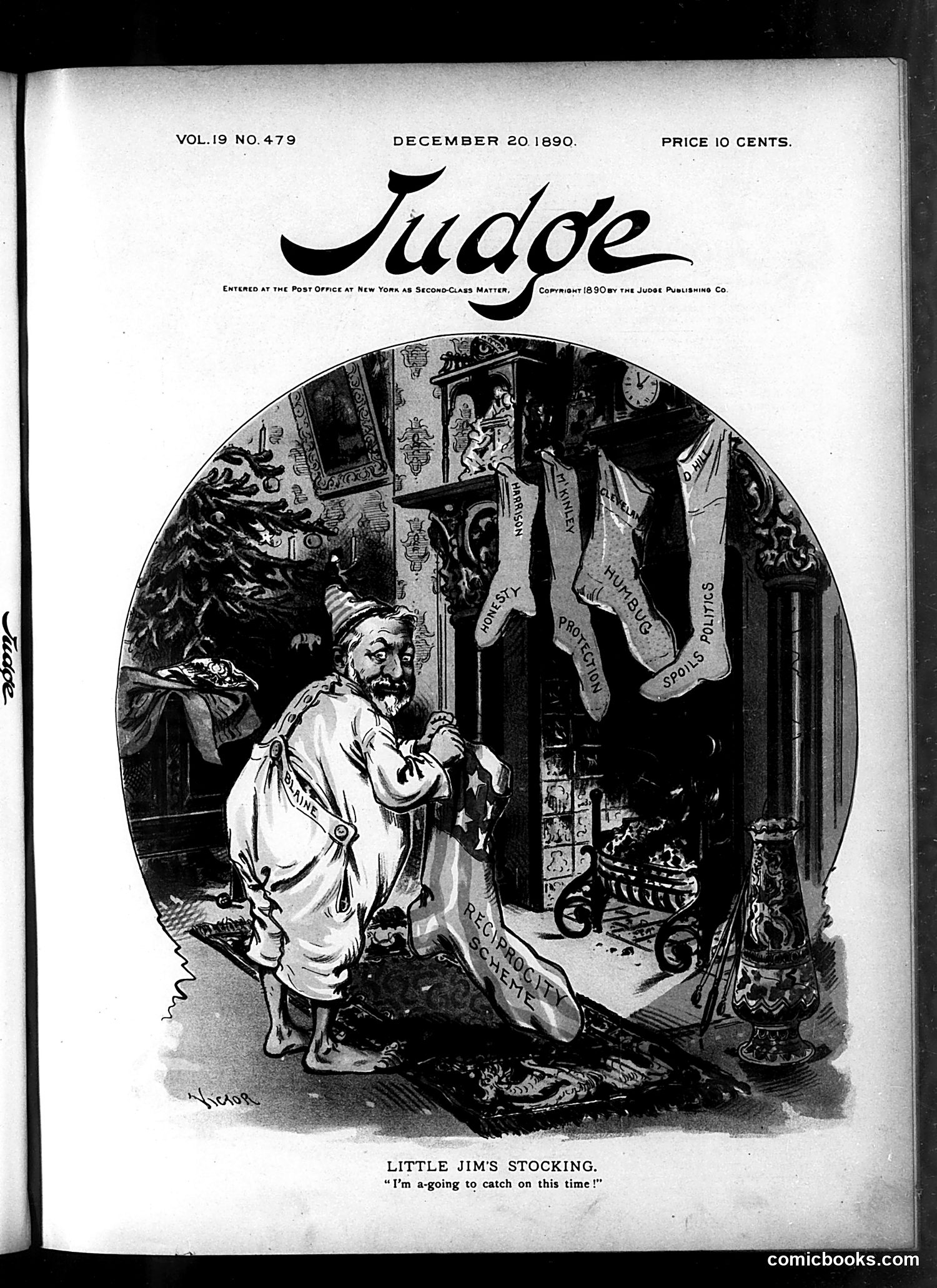
This satirical cartoon from *Judge* (December 20, 1890) depicts Santa Claus examining an oversized stocking hung by a fireplace. The stocking is labeled with various social problems: "DISHONESTY," "POVERTY," "DRUNKENNESS," "CRIME," "SPOTS POULTRICES" (likely referring to social ailments), and others. Santa's quote—"I'm a-going to catch on this time!"—suggests he's attempting to address or remedy these societal ills through his annual gift-giving. The cartoon satirizes the notion that charitable acts or government intervention can solve deep-seated social problems. The ironic title "Little Jim's Stocking" references both the Christmas tradition and likely Dickens's *A Christmas Carol*, implying skepticism about whether goodwill alone can cure society's endemic troubles.
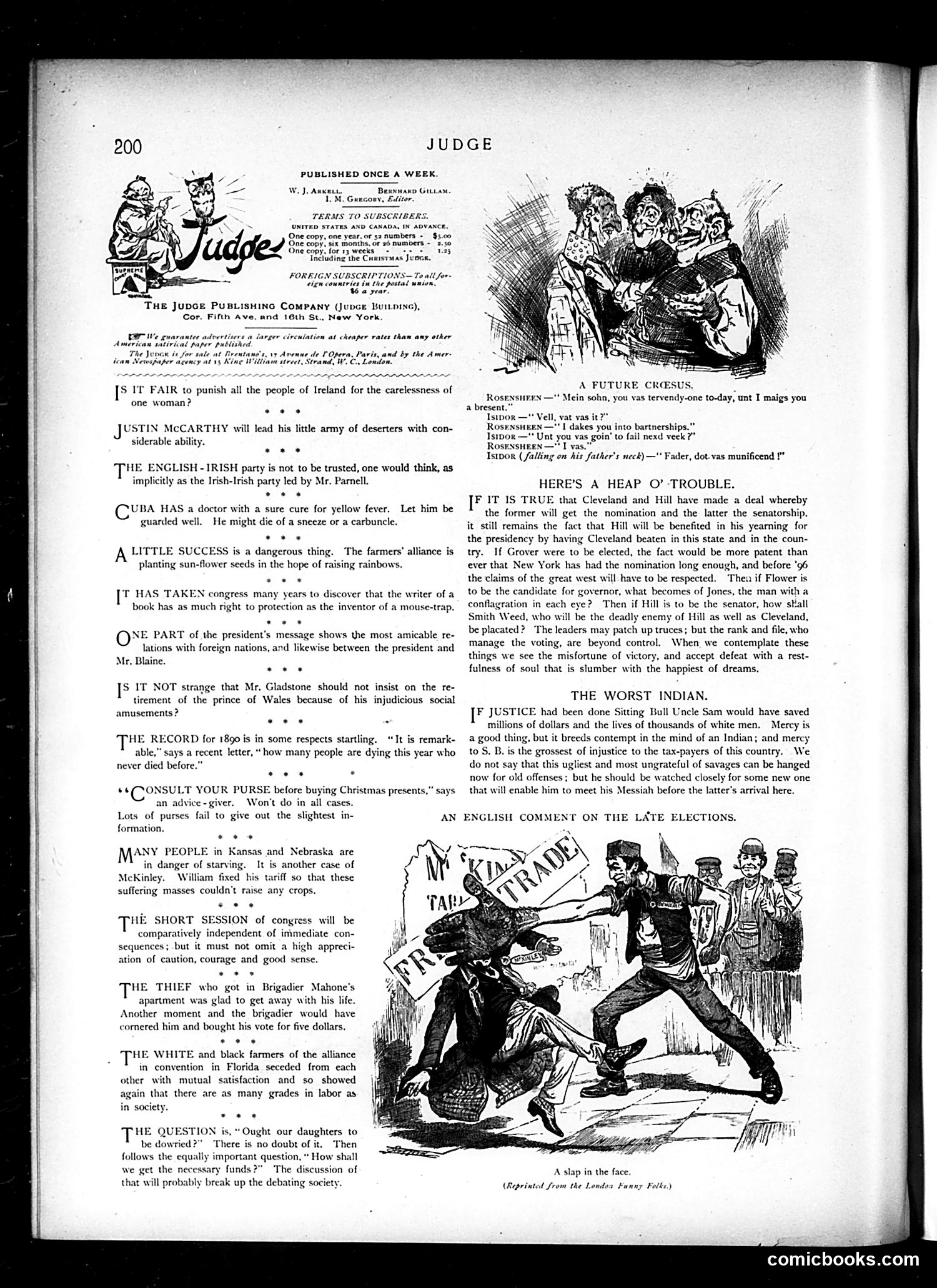
This page contains multiple brief political commentaries and two cartoons. **"A Future Census"** (top right): A satirical dialogue mocking Irish immigration and assimilation, suggesting stereotyped concerns about Irish-Catholic reproduction and integration into American society. **"Here's a Heap o' Trouble"** (center): Discusses the 1892 presidential election, referencing Cleveland, Hill, and the New York nomination contest. The commentary expresses concern about factional infighting within the Democratic Party. **"An English Comment on the Late Elections"** (bottom): The cartoon depicts a British observer, labeled "Free Trade," being kicked by an American figure representing protectionist tariff policy. This satirizes the tension between free-trade advocacy and American protectionism during the election period. The page reflects late-19th-century American anxieties about immigration, party politics, and trade policy.
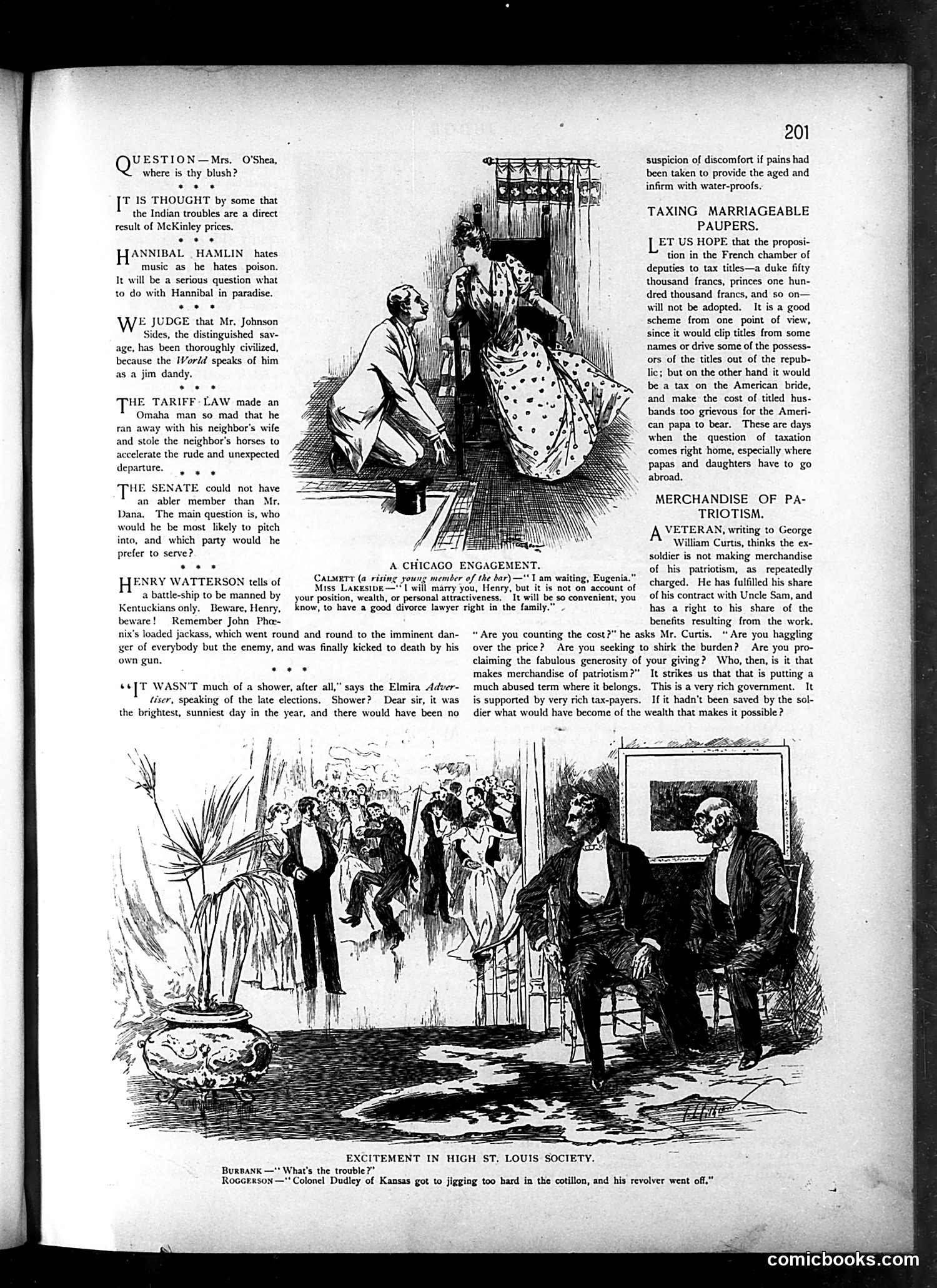
This page contains two distinct cartoons satirizing late 19th-century American politics and society. **Top cartoon** ("A Chicago Engagement"): Depicts a man proposing to a woman, with dialogue about wealth and divorce lawyers. This satirizes marriages motivated by financial gain rather than affection—a criticism of wealthy society marriages of the era. **Bottom cartoon** ("Excitement in High St. Louis Society"): Shows a social gathering disrupted by Colonel Dudley of Kansas, whose revolver "went off" during the cotillion (formal dance). This appears to mock both Kansas's rough reputation and elite St. Louis social pretension, suggesting even refined society can't escape frontier violence. Both pieces criticize American social classes: the wealthy's mercenary attitudes and regional stereotypes about Western coarseness.
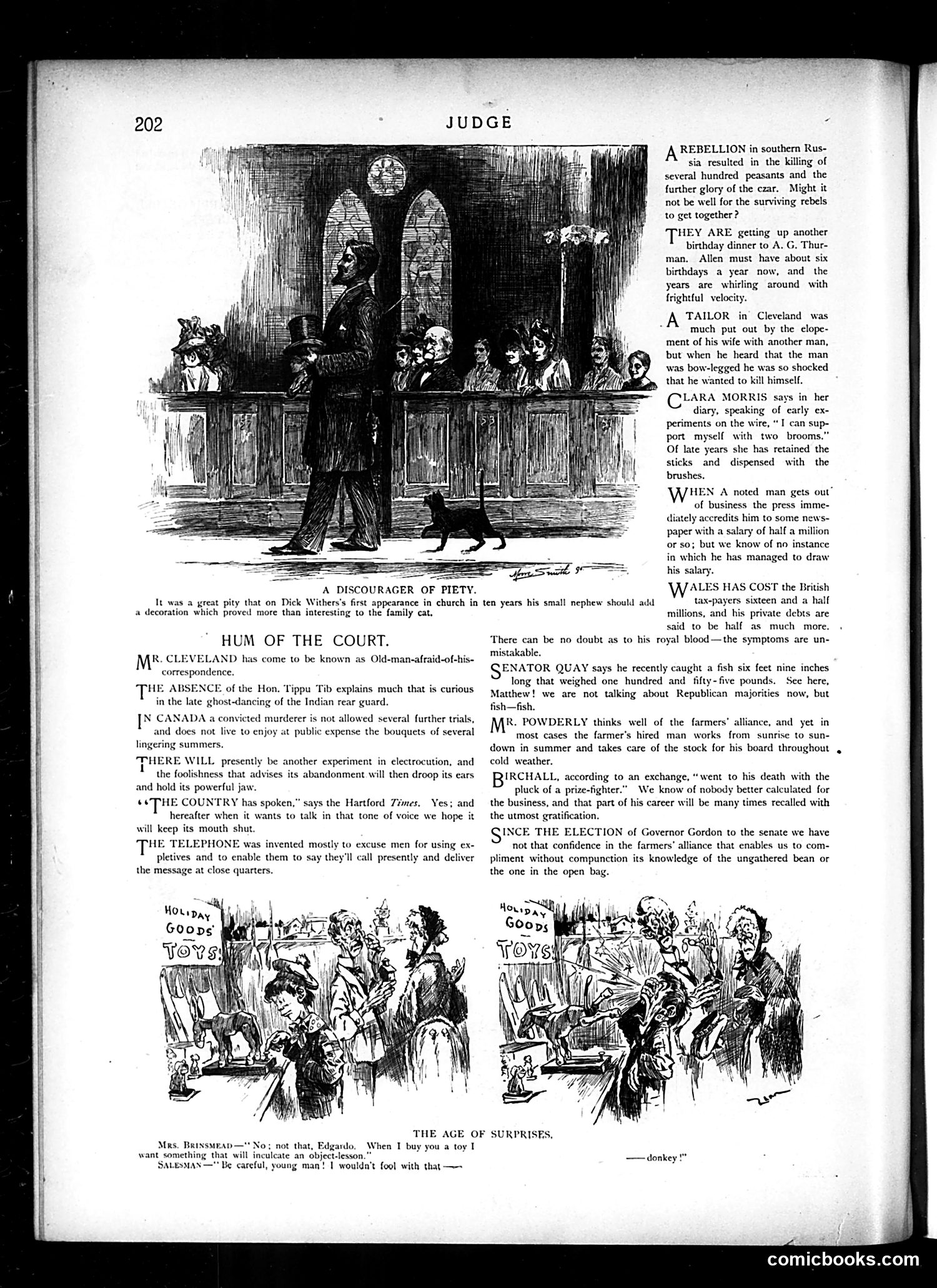
This page from Judge satirizes contemporary American political and social figures through brief, barbed commentary. Key targets include: **"Hum of the Court"** attacks President Cleveland as cowardly regarding correspondence; mocks the "ghost-dancing of the Indian rear guard" (likely the 1890 Ghost Dance movement); and criticizes American legal leniency compared to Canadian justice. **Individual jabs** include ridicule of Senator Quay's fish-story exaggeration (implying dishonesty), criticism of the British royals' financial irresponsibility, and mockery of A.G. Thurman's frequent birthday celebrations (suggesting vanity or age). The Russian rebellion item sarcastically notes peasant deaths boosted the czar's "glory." **Bottom cartoons** ("Age of Surprises") show holiday toy shopping, where a mother seeks a toy teaching "object-lessons" but rejects the salesman's suggestion—revealed as a donkey—as too literal-minded. The humor relies on topical knowledge of 1890s politics, scandals, and public figures now largely forgotten.
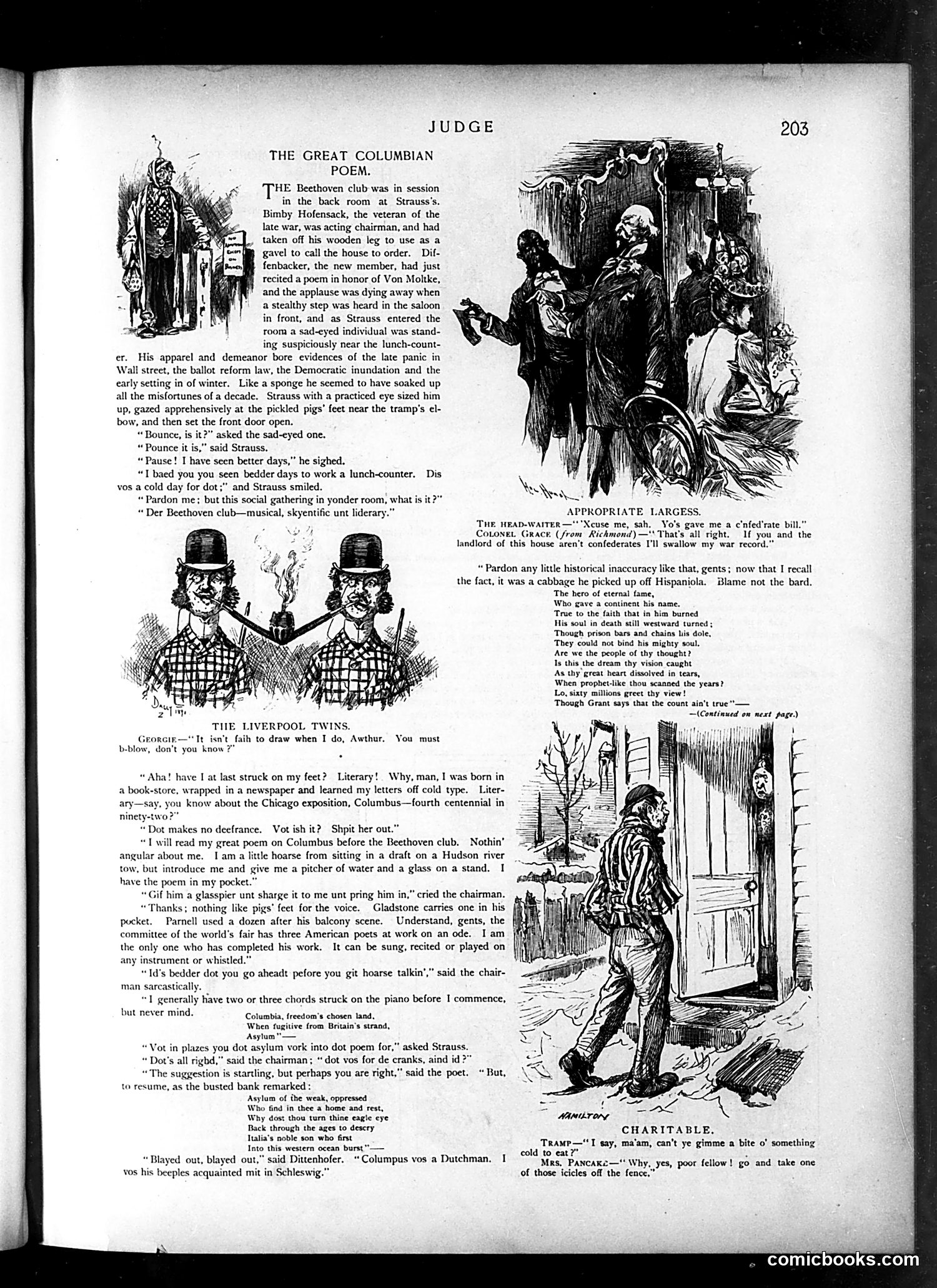
This satirical piece mocks pretentious literary culture and immigrant characters through exaggerated dialect humor. The central joke involves a destitute man attempting to recite an elaborate poem about Columbus before a "Beethoven club"—a self-important amateur arts society meeting in a saloon back room. The humor relies on: 1. **Class contrast**: A starving vagrant (described as bearing "evidences of the late panic in Wall street") seeks acceptance among would-be intellectuals. 2. **Ethnic caricature**: German-accented characters (Strauss, the chairman) speak in heavy dialect ("Vot ish it?" "Bedder dot you go aheadt"), a common Judge satirical device. 3. **Pomposity deflated**: The poem's grandiose subject matter—Columbus and American destiny—is undermined by its recitation in a shabby saloon while the narrator discusses practical matters like pickled pig's feet and voices. The sidebar cartoon "Charitable" shows similar class-based humor about economic hardship during what appears to be the 1890s recession period referenced in the text.
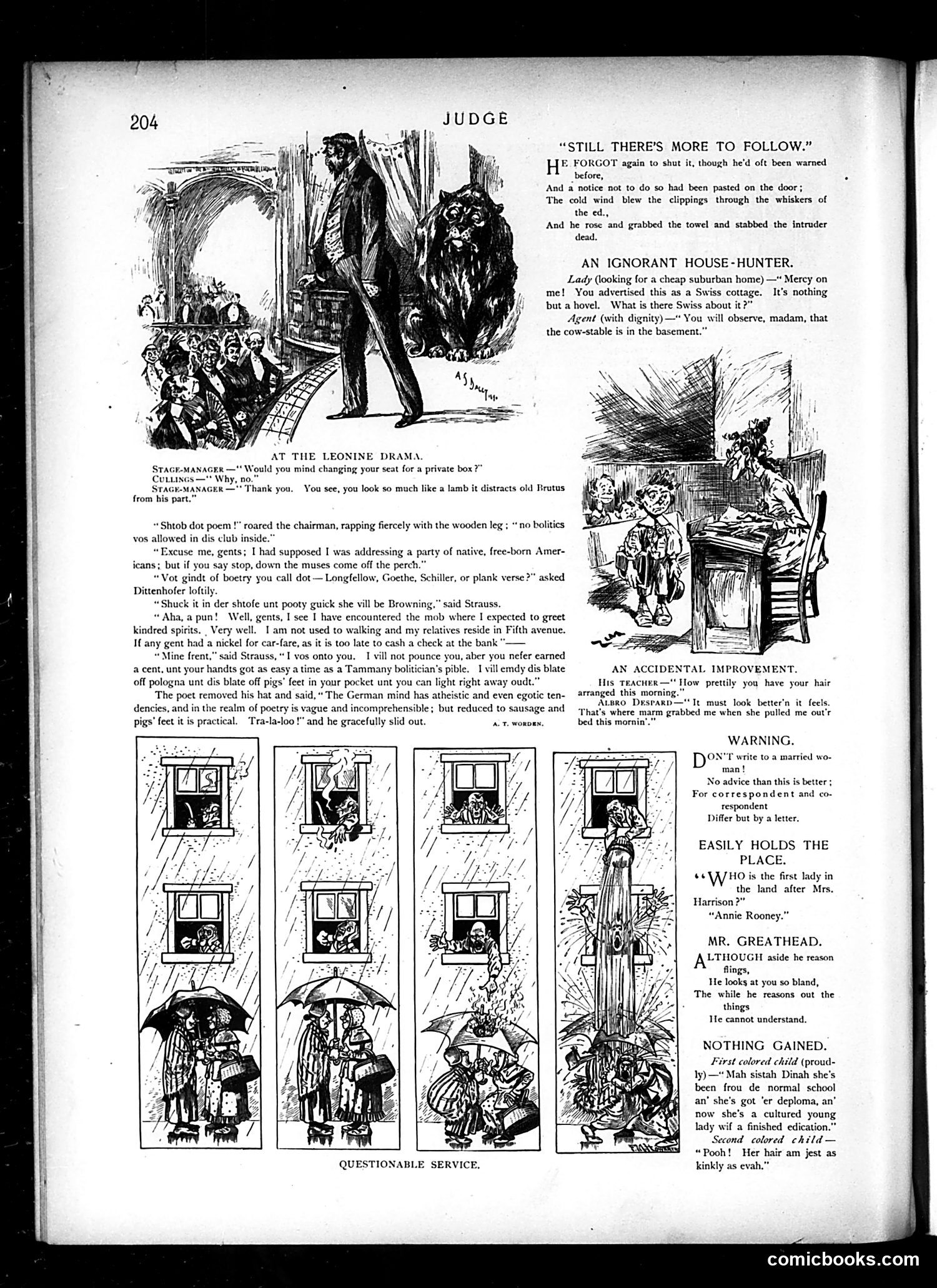
This page contains multiple satirical pieces typical of late 19th-century American humor: **"An Ignorant House-Hunter"** mocks real estate deception—a woman complains a "Swiss cottage" is actually a hovel, and the agent defensively claims the cow-stable in the basement makes it authentically Swiss. **"Questionable Service"** is a four-panel comic strip showing a doorman repeatedly failing to provide adequate shelter to clients in the rain, depicted through increasingly absurd situations. **The poetry club dialogue** satirizes German immigrants' pretentious cultural claims while speaking broken English. A poet is literally silenced and ejected by club members who ridicule his verses as incomprehensible, reducing his philosophical arguments to crude practicality (sausage and pig's feet). **"Nothing Gained"** jokes that a Black girl's education at normal school hasn't improved her appearance—her hair remains "kinky"—mocking both education's limitations and perpetuating racist stereotypes about Black hair. The page reflects period attitudes toward immigrants, gender, race, and class through crude humor now considered offensive.
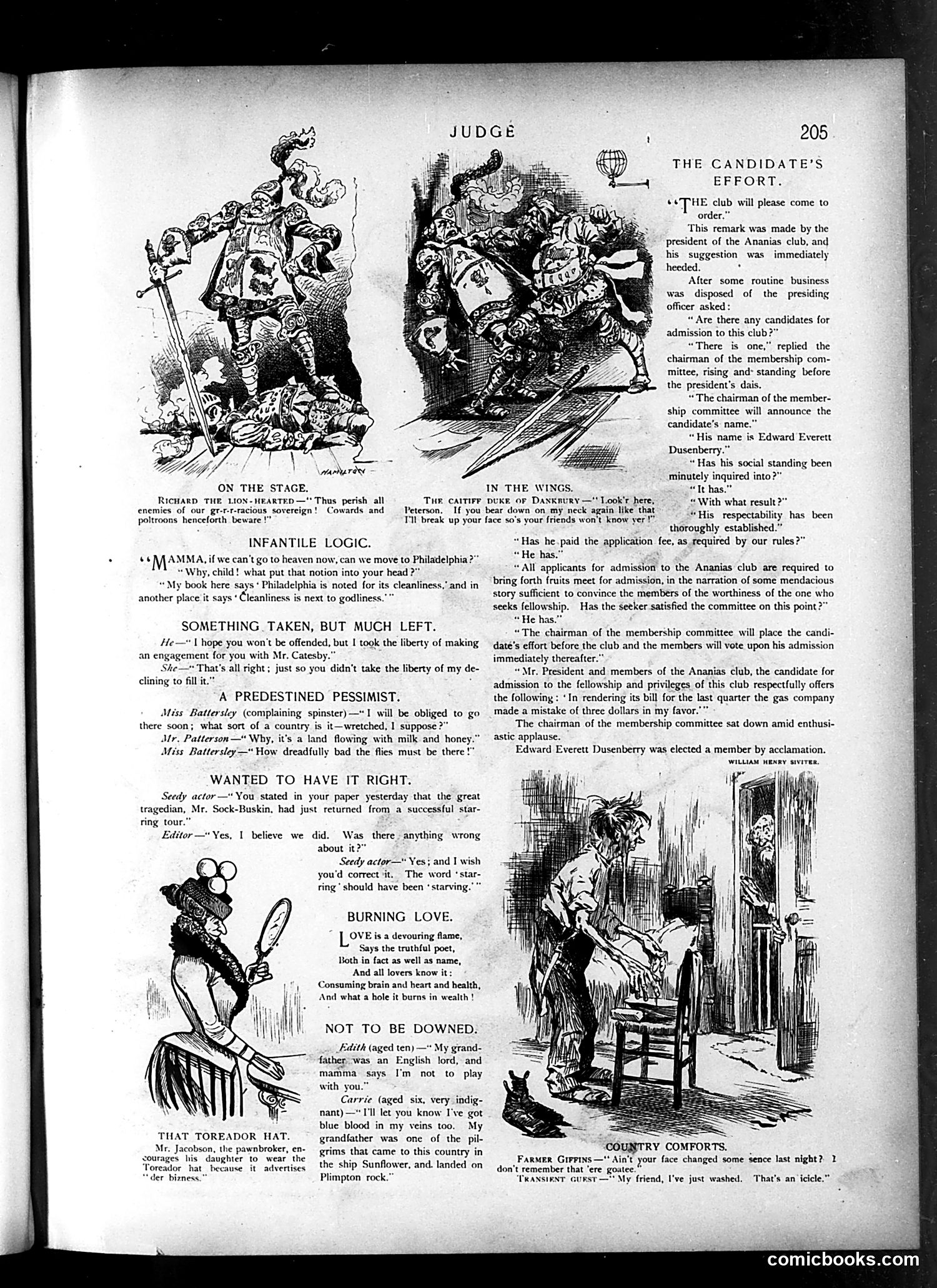
This page from *Judge* magazine presents multiple satirical sketches mocking various social types and situations of the era. **The Ananias Club sketch** (main story, center-right) is the most substantial piece. The "Ananias Club" references the biblical Ananias, who lied to the apostles—so this is a club *for liars*. The satire mocks how membership requires candidates to demonstrate their ability to tell convincing false stories. Edward Everett Dusenberry seeks admission and must prove his "respectability" through a mendacious narrative about a gas company billing error. This satirizes both social clubs' arbitrary admission standards and perhaps broader dishonesty in business dealings. **Other sketches** target: children's naive logic, pessimistic spinsters, struggling actors misrepresented in newspapers, and class pretension (two girls comparing grandfathers' social rank). The cartoons mock social hypocrisy, rigid class consciousness, and everyday human folly rather than specific political figures or events.
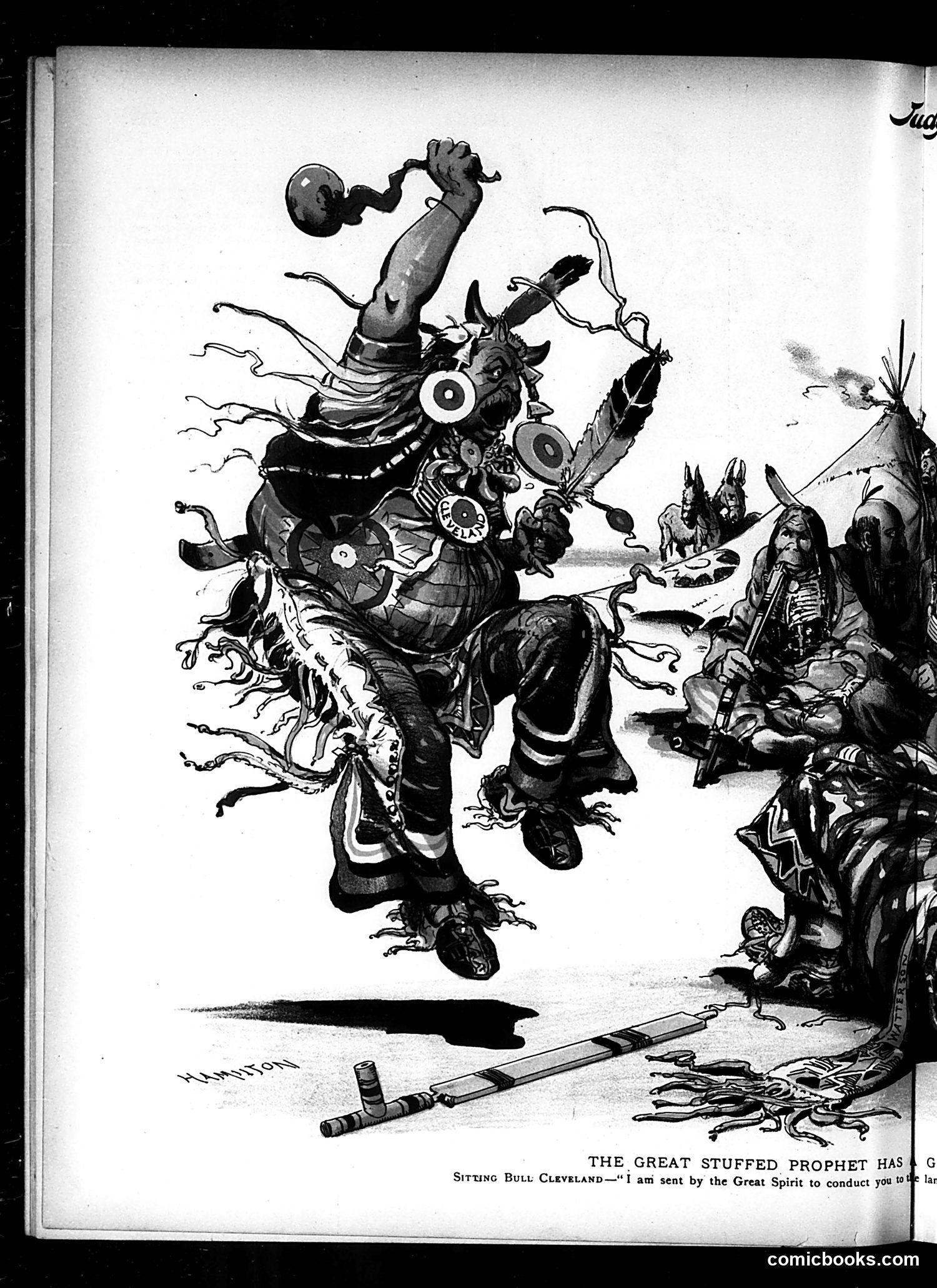
This satirical Judge magazine cartoon depicts **Sitting Bull** (labeled "Sitting Bull Cleveland") as a grotesque, mechanized figure—a "stuffed prophet" operated by gears and pulleys. The caricature appears designed to ridicule Native American spiritual authority and practices. The caption references the "Great Spirit," suggesting mockery of Indigenous religious beliefs. The figure's exaggerated, mechanical nature implies artificiality and fraudulence. Figures on the right appear to be other Indigenous people or shamans observing this spectacle. The cartoon likely satirizes either: - Fraudulent Native American spiritual claims circulating in the era - President Grover Cleveland's (implied by "Cleveland" in the label) Native American policies - General late-19th-century attitudes dismissing Indigenous cultures as primitive or deceptive The crude, dehumanizing caricature reflects the era's prevalent racist attitudes toward Native Americans in mainstream American humor.
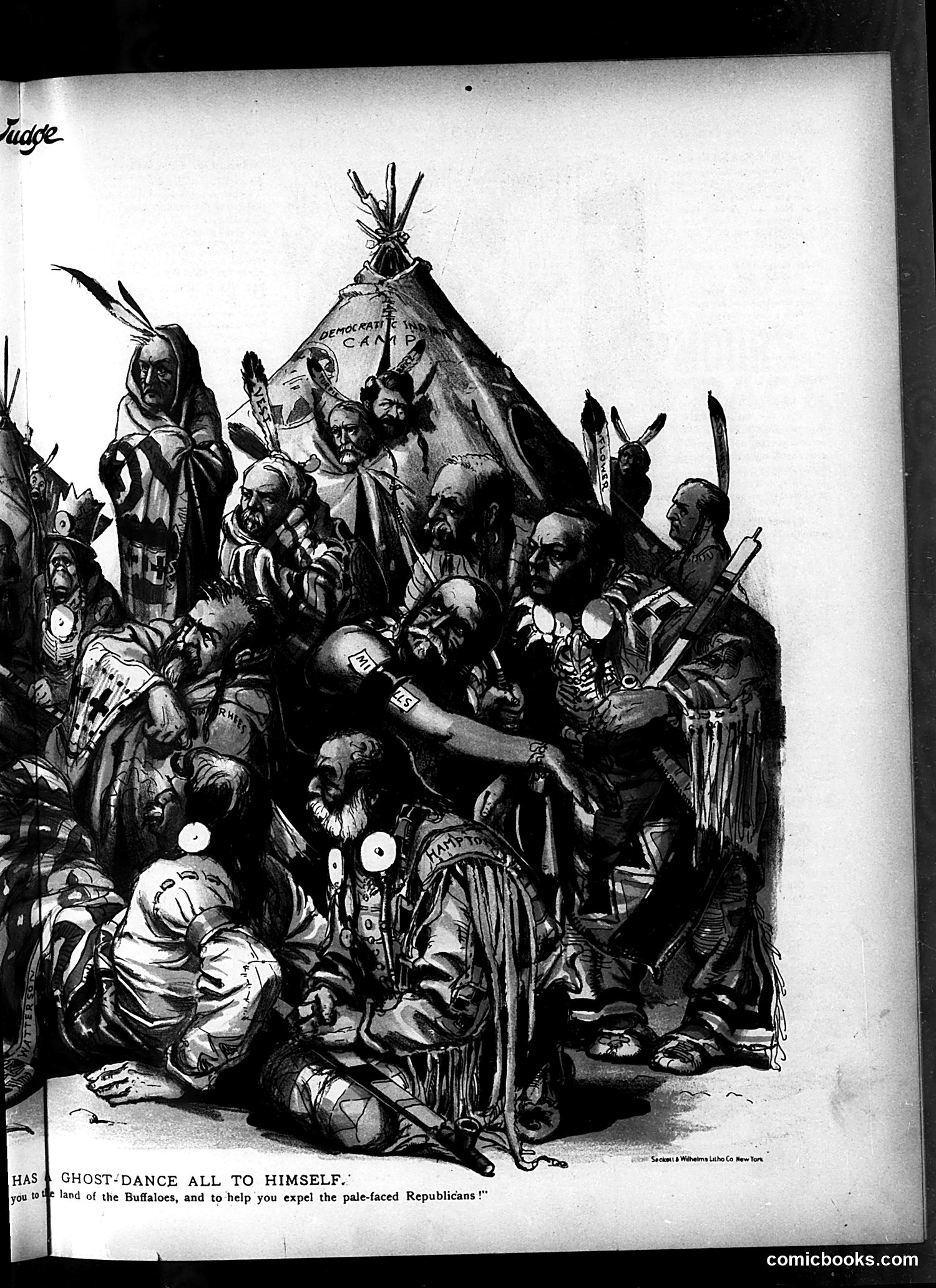
This Judge magazine cartoon satirizes Republican political strategy, likely from the 1890s based on the Ghost Dance reference. The image depicts Native Americans gathered around a teepee labeled "Democratic Camp," seemingly performing a Ghost Dance—a historical Native American spiritual movement. The caption suggests Republicans are invoking Native American imagery and grievances ("expel the pale-faced Republicans") to gain Democratic support, portraying this as absurd political manipulation. The satire mocks Republicans for cynically appropriating Native American causes or imagery for electoral gain, while the "ghost dance" metaphor implies this strategy is futile or delusional. The cartoon criticizes what it presents as hollow political pandering to marginalized groups during this contentious Gilded Age period.
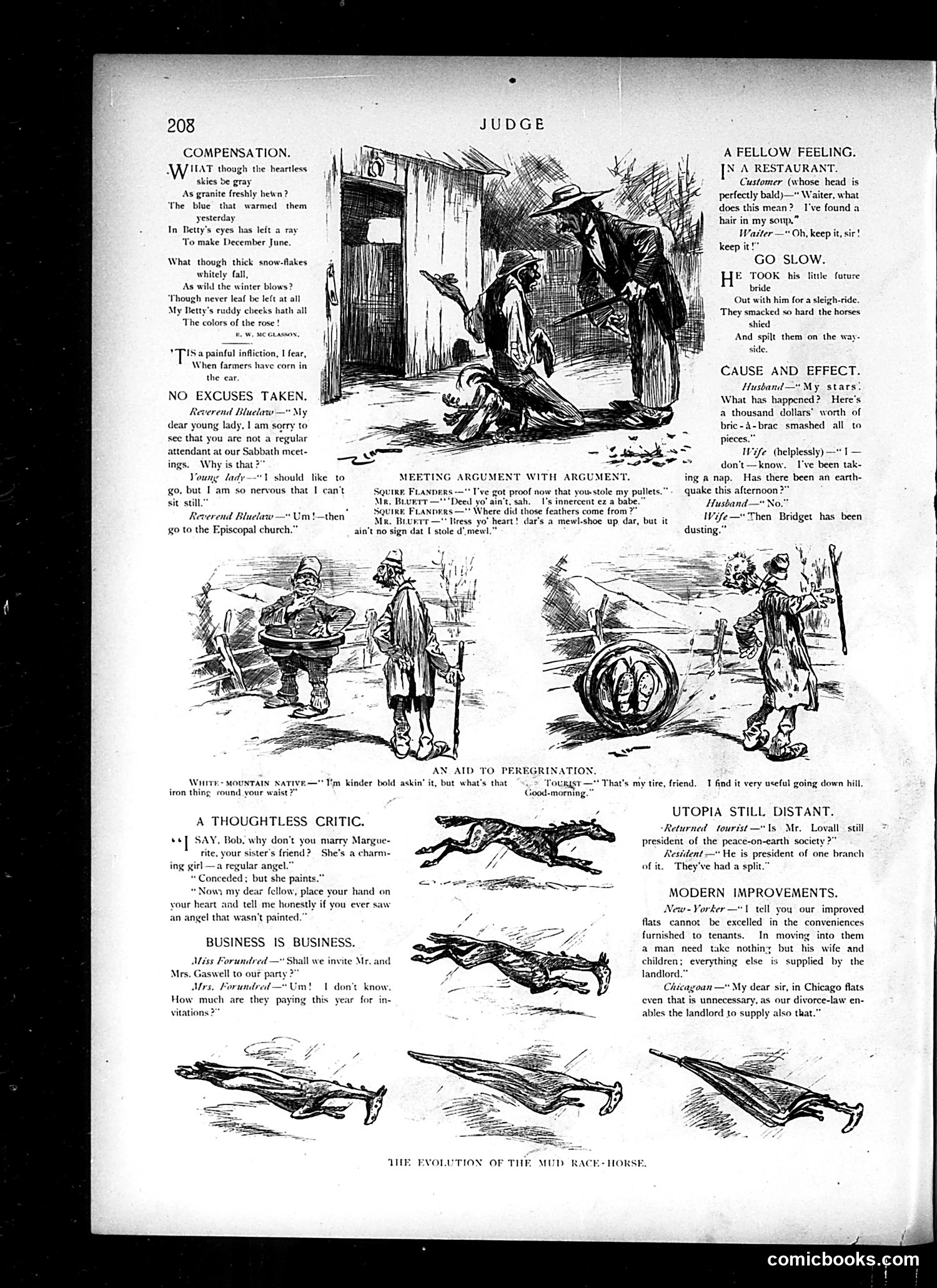
This page from *Judge* contains multiple brief satirical sketches mocking everyday American life and social pretenses of the era. **Key sketches:** - **"Compensation"** and **"A Fellow Feeling"**: Sentimental romantic poetry contrasted with crude restaurant humor (bald customer finding hair in soup) - **"Meeting Argument with Argument"**: A farmer accuses a Black man of stealing chickens; the defendant denies it while feathers are literally visible in a tree above—satirizing absurd racial accusations and transparent excuses - **"Business is Business"**: Mocks the commercialization of social rituals by implying wealthy families now charge fees for party invitations - **"Modern Improvements"**: Compares New York and Chicago apartment buildings, with a dark joke that Chicago's divorce laws mean landlords can supply everything—including replacing the wife - **"Utopia Still Distant"**: A peace society president has split his organization, mocking idealistic reformers The bottom illustration shows horses progressively deteriorating into mud, likely satirizing urban decay or declining social standards. The humor relies on class commentary, racial stereotypes typical of the period, and cynical observations about commercialism and social hypocrisy.
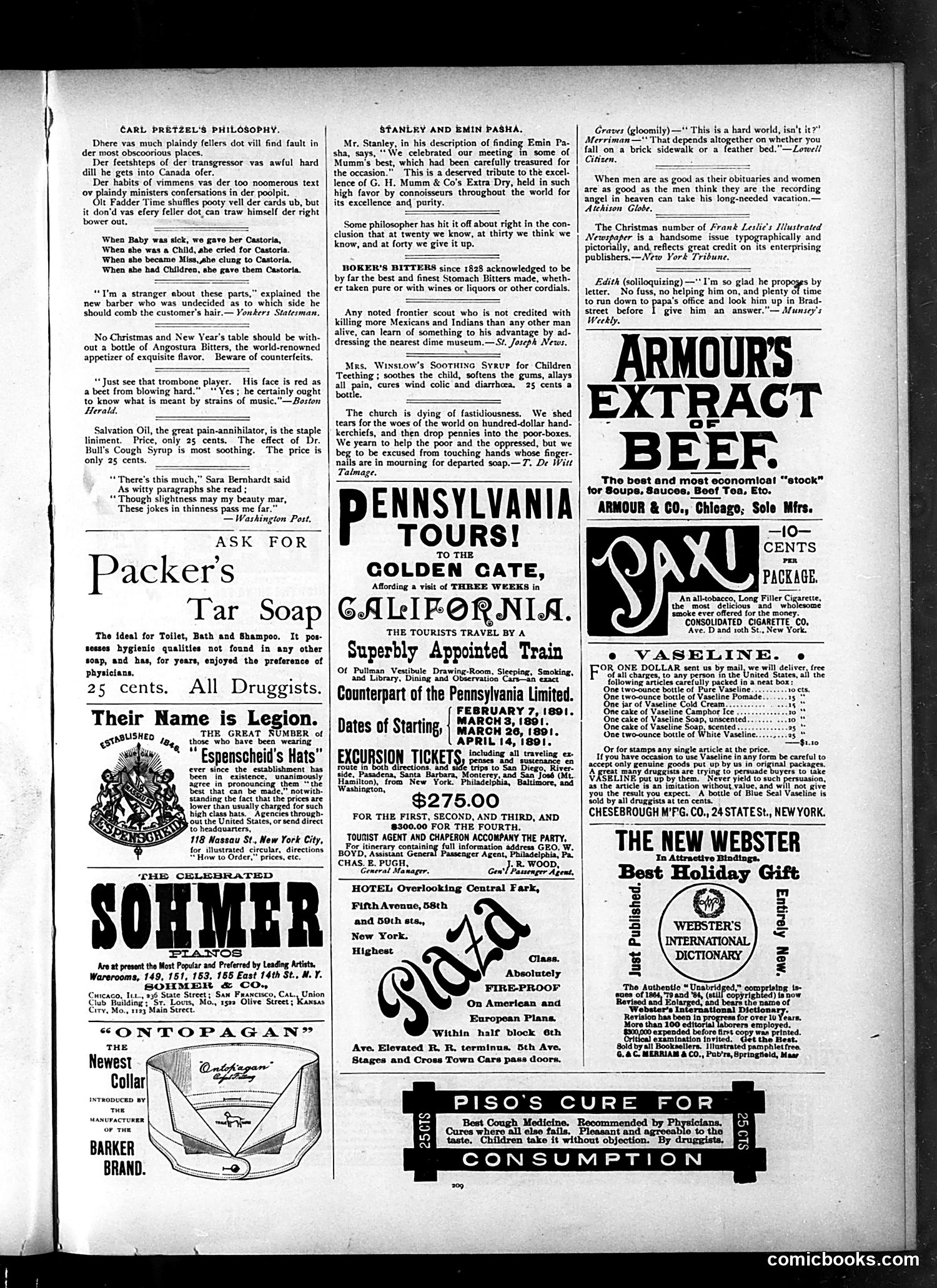
This page is primarily **advertising**, not political cartoons. However, it contains one notable satirical reference: **"Stanley and Emin Pasha"** references explorer Henry Morton Stanley's 1889 expedition to "rescue" Emin Pasha, a colonial administrator in Sudan. The text humorously suggests Stanley celebrated their meeting with champagne—a jab at Victorian imperial pretension. The satire mocks how explorers theatricalized their "discoveries" and self-promotion. **"Carl Pretzel's Philosophy"** features a German-accented character offering folksy observations about morality and human nature—typical ethnic humor of the 1890s. The "stranger barber" joke plays on similar immigrant dialect comedy. The remainder consists of period **patent medicine and product advertisements** (Castoria, Angostura Bitters, Packer's Soap, etc.)—many for treatments we'd now recognize as ineffective or dangerous, reflecting Judge magazine's commercial function alongside satire.
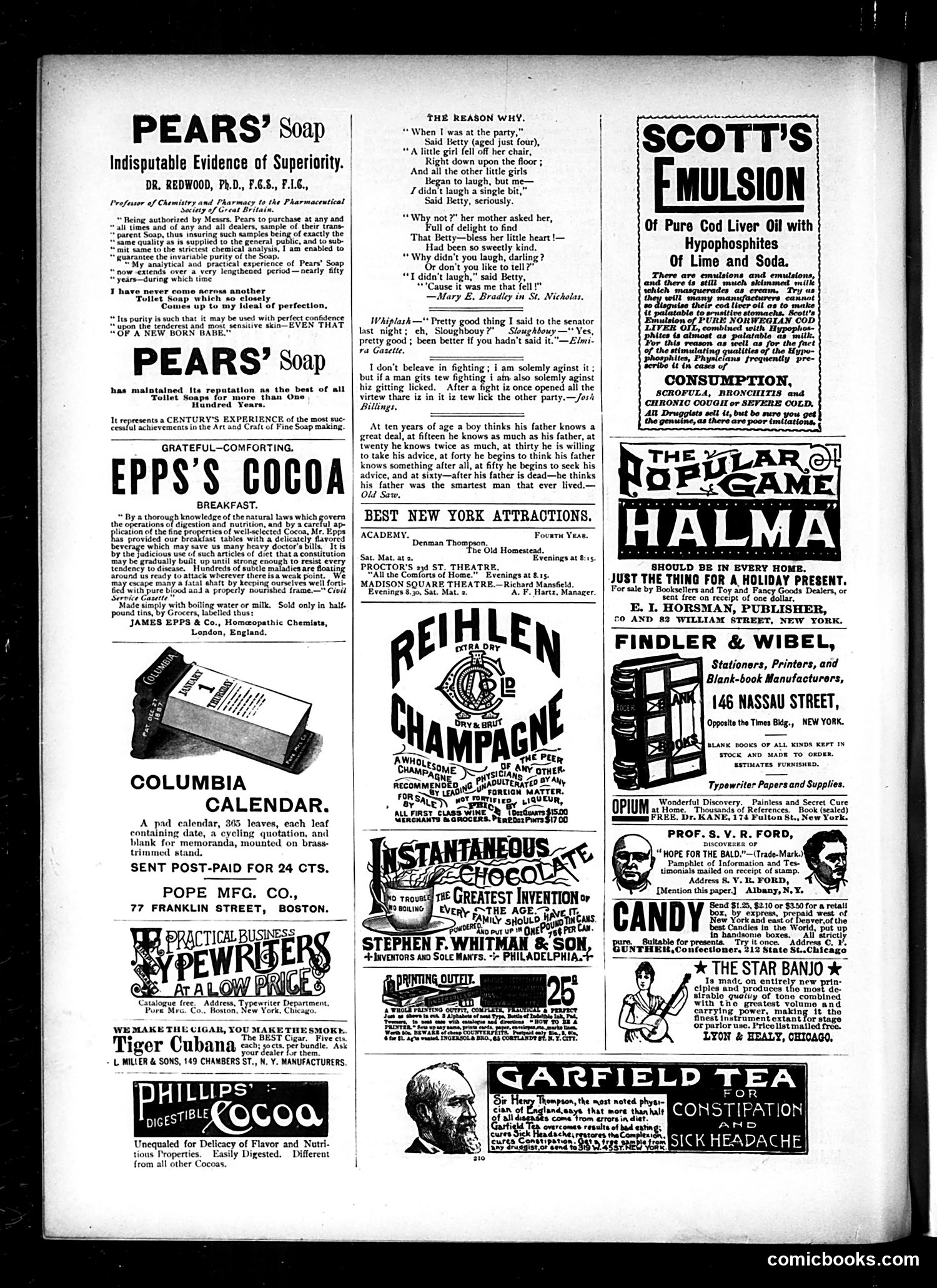
This is primarily an **advertising page** from Judge magazine, not a satirical cartoon page. It contains product advertisements for late 19th-century goods: Pears' Soap, Epps's Cocoa, Columbia Calendars, Tiger Cubana cigars, and Phillips's Cocoa. The page includes three **humorous pieces** embedded among ads: 1. **"The Reason Why"**: A sentimental poem about young Betty who didn't laugh when another girl fell at a party—because Betty herself had been the one who fell. It's gentle humor about childhood selfishness. 2. **Two brief jokes** about conversation and fighting, attributed to publications like the *Gazette* and *Josh Billings*, representing common newspaper humor of the era. These are filler content typical of magazines, offering light entertainment between advertisements. The page demonstrates how Judge blended advertising revenue with editorial humor—the jokes are inoffensive, family-friendly, and designed not to distract from the commercial messages.
This page is primarily **advertising**, not political satire. It contains no discernible political cartoons or commentary. The page features period product advertisements (cigars, pianos, skates, typewriters, medicinal extracts) typical of Judge magazine's revenue model. There are brief, scattered humorous anecdotes—a joke about a vain woman breaking mirrors, lazy Boston workers discussing a water project, and a stereotypical dialect story about an elderly Black man's biblical confusion—but these are generic humor, not political satire. The only editorial content includes praise for *Frank Leslie's Illustrated Newspaper's* Christmas issue. Nothing on this page addresses political figures, events, or social movements requiring historical context to understand. It's a straightforward commercial page from the era.
This page is primarily **advertising**, featuring mostly commercial notices for hotels, medicines, and gentlemen's furnishings from early 20th-century New York. The only satirical content is a brief joke near the top: an **office boy named Keegan** repeatedly claims his grandmother died to justify absences (specifically to attend a baseball game). The trade merchant confronts him, noting the grandmother is "dying altogether too often." This is a simple workplace humor piece satirizing employee excuses—a timeless joke about dishonest workers fabricating reasons to skip work. The specificity of the baseball game suggests sports attendance was a known temptation for shirking duties in that era. The remainder is standard period advertising: Beecham's Pills (patent medicine), roofing materials, hotels nationwide, English furnishings, and various remedies. No political content is evident on this page.
This page is primarily **advertising**, not political satire. It contains several period advertisements and two brief humorous anecdotes. The two jokes are mundane social humor: 1. A man from Oklahoma brags he's heard worse noise than ocean waves—the "breaking of the boomers" (likely referring to the Oklahoma Land Rush of 1889, when settlers rushed to claim land). 2. A racist dialect joke featuring a Black character complaining that farm workers wear no hat during harvest but steal umbrellas when it rains—a crude attempt at humor about perceived hypocrisy. The bulk of the page advertises products including Van Houten's Cocoa, the "Cactus Blood Cure" (a dubious patent medicine claiming to cure blood diseases), Modene (a hair removal product), insurance, pianos, and railroads. There is **no meaningful political cartoon** on this page—just period advertisements and mild social humor typical of Judge magazine's lighter content.
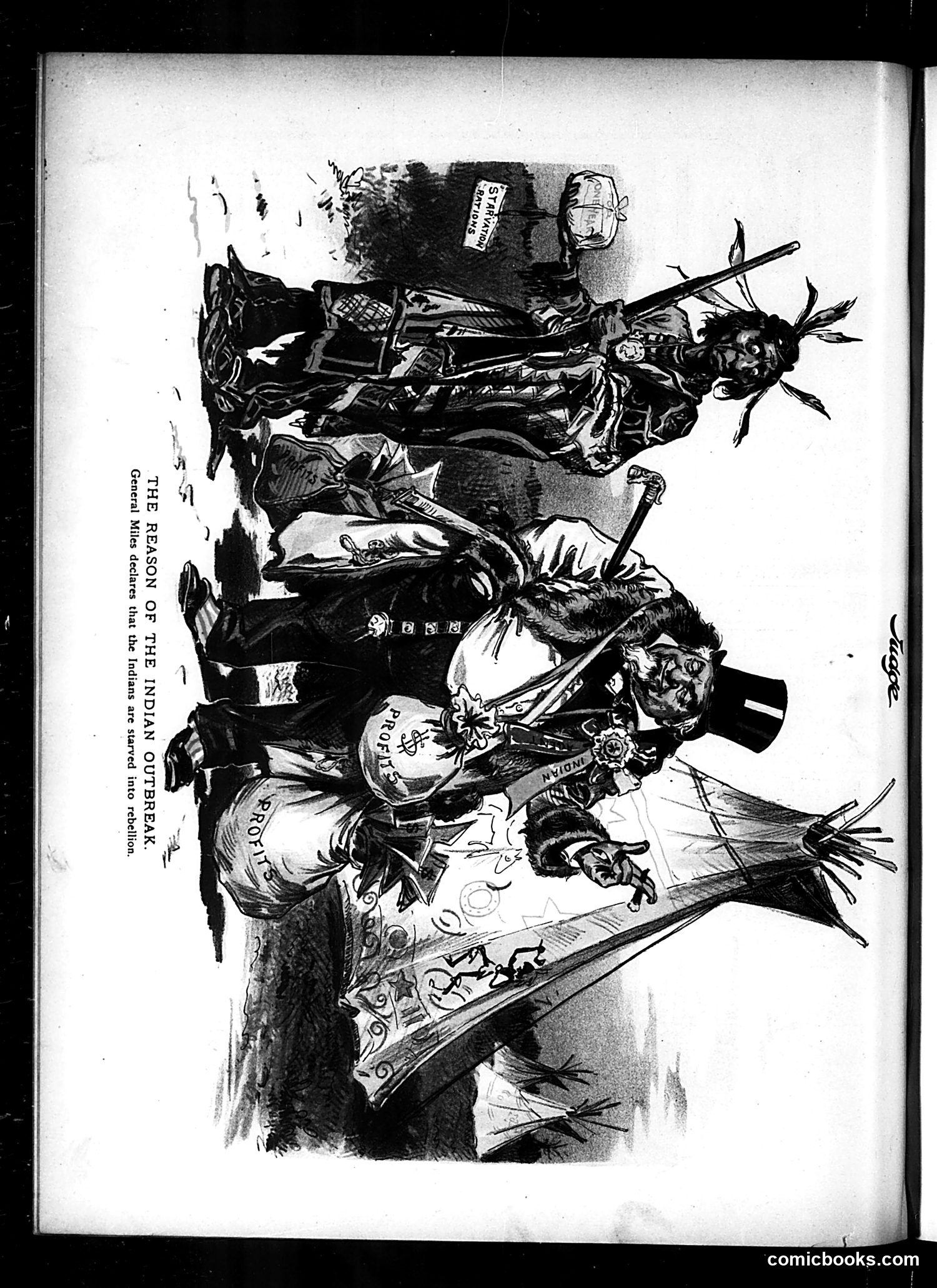
This political cartoon satirizes the causes of Native American resistance in the late 19th century. The image depicts Indigenous people in poverty and deprivation—appearing malnourished and desperate—while the caption references General Miles's claim that "Indians are starved into rebellion." The satire suggests that the U.S. government's failure to provide adequate food and resources to reservation populations directly caused violent conflict. By illustrating the stark conditions of starvation, the cartoon critiques federal Indian policy as fundamentally unjust, implying that rebellion was a rational response to systematic deprivation rather than inherent savagery—a counterpoint to prevailing stereotypes of the era. This likely responds to actual late-1880s/1890s conflicts and government negligence in treaty obligations.