
Judge, 1890-12-20 · page 3 of 16
Judge — December 20, 1890 — page 3: what you’re looking at
What you’re looking at
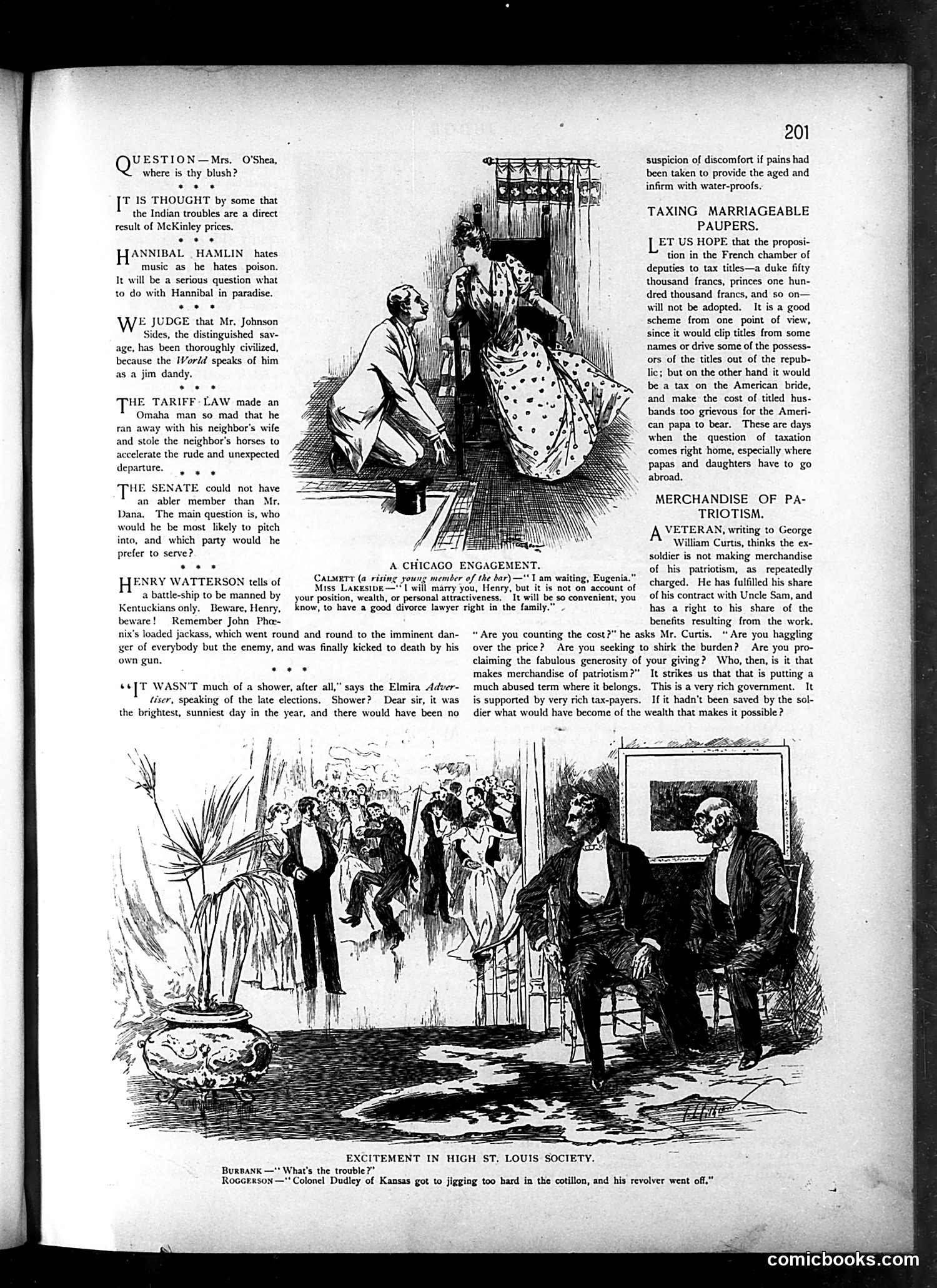
This page contains two distinct cartoons satirizing late 19th-century American politics and society. **Top cartoon** ("A Chicago Engagement"): Depicts a man proposing to a woman, with dialogue about wealth and divorce lawyers. This satirizes marriages motivated by financial gain rather than affection—a criticism of wealthy society marriages of the era. **Bottom cartoon** ("Excitement in High St. Louis Society"): Shows a social gathering disrupted by Colonel Dudley of Kansas, whose revolver "went off" during the cotillion (formal dance). This appears to mock both Kansas's rough reputation and elite St. Louis social pretension, suggesting even refined society can't escape frontier violence. Both pieces criticize American social classes: the wealthy's mercenary attitudes and regional stereotypes about Western coarseness.
📄 Transcribed text from this page (OCR, searchable)
Machine-transcribed from the original scan — historical spelling and the odd misread are preserved.
@BESMIONS ue. O'Shea, where is thy blush? [7 18 THOUGHT by some that the Indian troubles are a direct result of McKinley prices. @ ti HANNIBAL HAMLIN hates music as he hates poison. It will be a serious question what to do with Hannibal in paradise. eee WE JUDGE that Mr. Johnson ides, the distinguished sav- age, has been thoroughly civilized, because the [orld speaks of him as a jim dandy. THE TARIFF LAW made an Omaha man so mad that he ran away with his neighbor's wife and stole the neighbor's horses to accelerate the rude and unexpected departure. . yy THE SENATE could not have an abler member than Mr. Dana, The main question is, who would he be most likely to pitch into, and which party would he prefer to serve? RY WATTERSON tells of a battle-ship to be manned by Kentuckians only. beware! Remember John Pha- nix’s loaded jackass, which went round and round to the imminent dan- ger of everybody but the enemy, and was finally kicked to death by his own gun. rar 46] WASN'T much of a shower, after all,” says the Elmira Adver- tiser, speaking of the late elections. Shower? Dear sir, it was the brightest, sunniest day in the year, and there would have been no A CHICAGO ENGAGEMENT. Cataert (a rising young member of the bar)—* 1 am waiting, Eugenia.” Miss Laxesipe—‘‘I will marry you, Henry, but it is not on’ account of ‘our position, wealth, or personal attractiveness. Beware, Henry, Enow! to have a good divorce lawyer right in the family.” 201 suspicion of discomfort if pains had been taken to provide the aged and infirm with water-proofs. TAXING MARRIAGEABLE PAUPERS. LEt US HOPE that the proposi- tion in the French chamber of deputies to tax titles—a duke fifty thousand francs, princes one hun- dred thousand francs, and so on— will not be adopted. It is a good scheme from one point of view, since it would clip titles from some names or drive some of the possess- ors of the titles out of the repub- lic; but on the other hand it would be a tax on the American bride, and make the cost of titled hus- bands too grievous for the Ameri- can papa to bear. These are days when the question of taxation comes right home, especially where papas and daughters have to go abroad. MERCHANDISE OF PA- TRIOTISM. A VETERAN, writing to George William Curtis, thinks the ex- soldier is not making merchandise of his patriotism, as repeatedly charged. He has fulfilled his share of his contract with Uncle Sam, and has a right to his share of the benefits resulting from the work. “Are you counting the cost?” he asks Mr. Curtis. “Are you haggling over the price? Are you seeking to shirk the burden? Are you pro- claiming the fabulous generosity of your giving? Who, then, is it that makes merchandise of patriotism?” It strikes us that that is putting a much abused term where it belongs. This is a very rich government. It is supported by very rich tax-payers. If it hadn't been saved by the sol- dier what would have become of the wealth that makes it possible ? It will be so convenient, you EXCITEMENT IN HIGH ST, LOUIS SOCIETY. Burpa: Vhat’s the trouble?” RosceRson —"' Colonel Dudley of Kansas got to jigging too hard in the cotillon, and his revolver went off.” comicbooks.com