
A complete issue · 20 pages · 1890
Judge — November 29, 1890
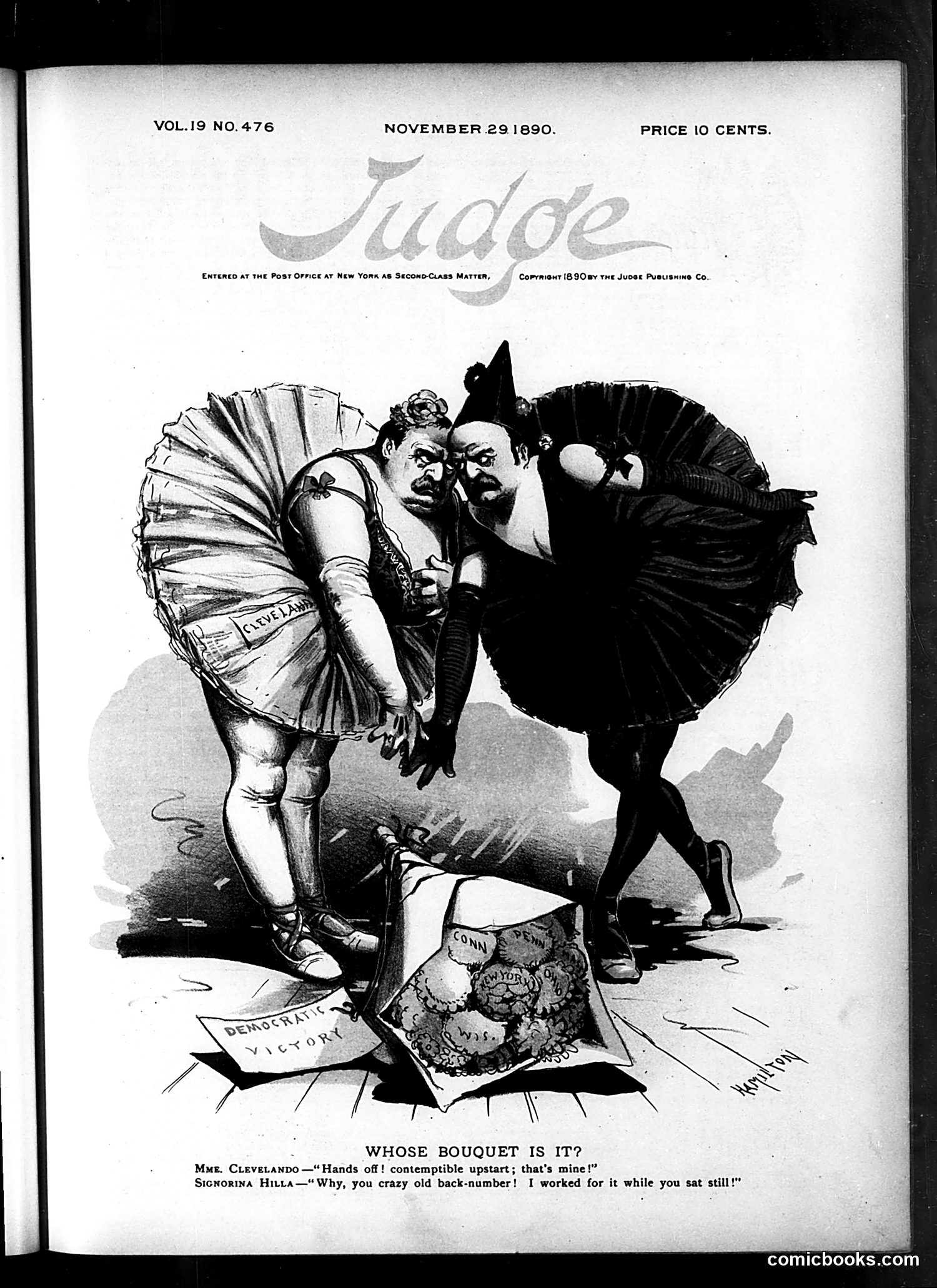
This November 1890 *Judge* cartoon satirizes a political dispute over credit for a Democratic electoral victory. Two caricatured figures—labeled as Mme. Cleveland and Signorina Hilla—quarrel over a bouquet marked "Democratic Victory," which sits atop what appears to be a map showing electoral results. The joke hinges on their competing claims: Mme. Cleveland ("Hands off! I contemptible upstart; that's mine!") and Signorina Hilla ("Why, you crazy old back-number! I worked for it while you sat still!") fight over who deserves credit for the Democrats' success. The cartoon likely references Frances Cleveland (wife of President Grover Cleveland) and another female political figure or symbolic representation, mocking women's involvement in partisan politics—a contentious novelty in 1890.
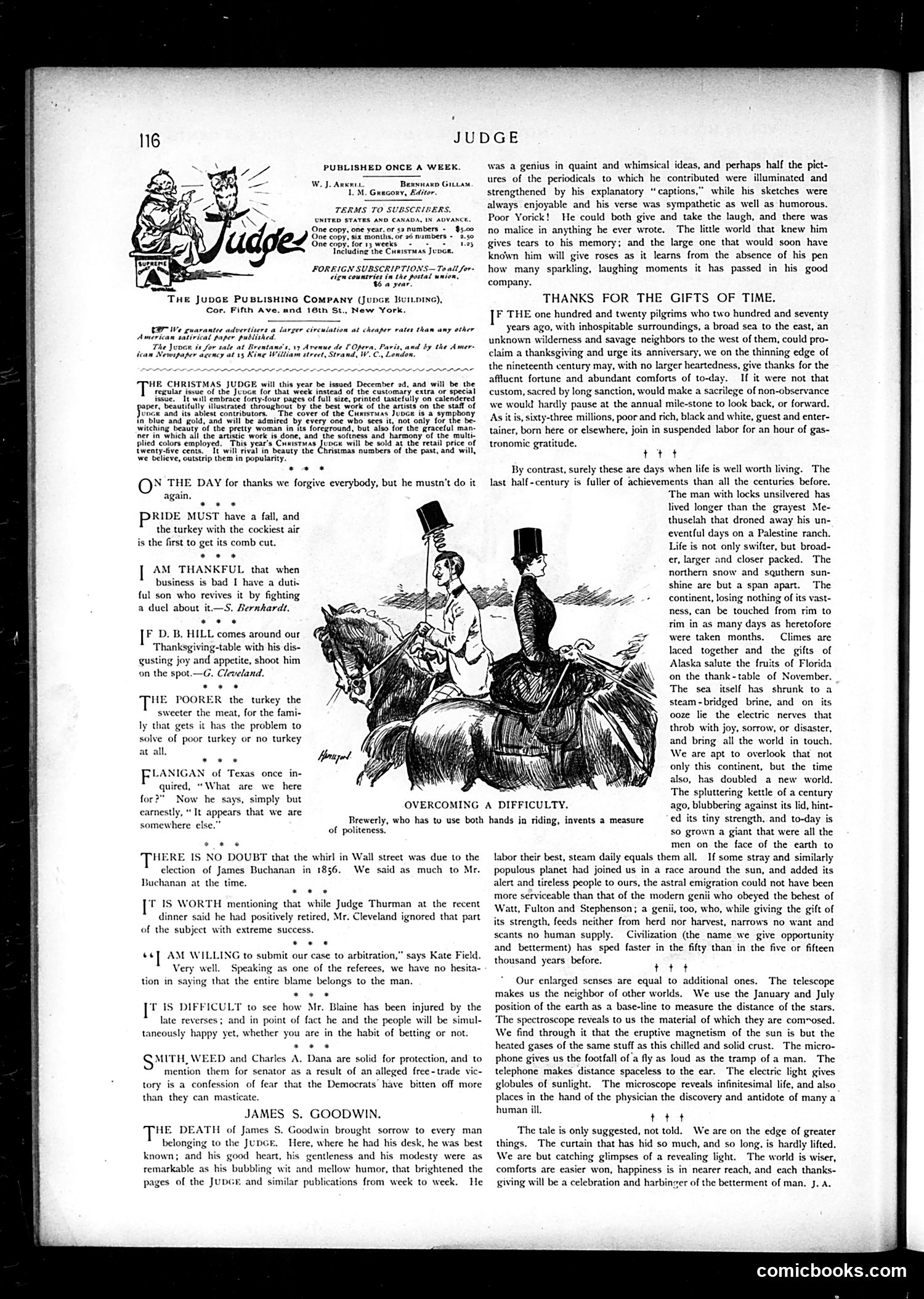
The page contains primarily text columns discussing Thanksgiving gratitude and various social observations, rather than political satire. The one illustration titled "OVERCOMING A DIFFICULTY" depicts two men in top hats on horseback, apparently struggling with riding. The caption suggests this is a humorous commentary on inexperienced horsemen, with text referencing "brewerly" (likely "brewery") workers inventing labor-saving measures. The editorial content includes brief quips about various figures—including references to James Buchanan's 1856 election and mentions of Cleveland and other political figures—but these are scattered observations rather than focused satire. The overall tone is genteel humor about Thanksgiving, technological progress, and general social commentary rather than sharp political critique.
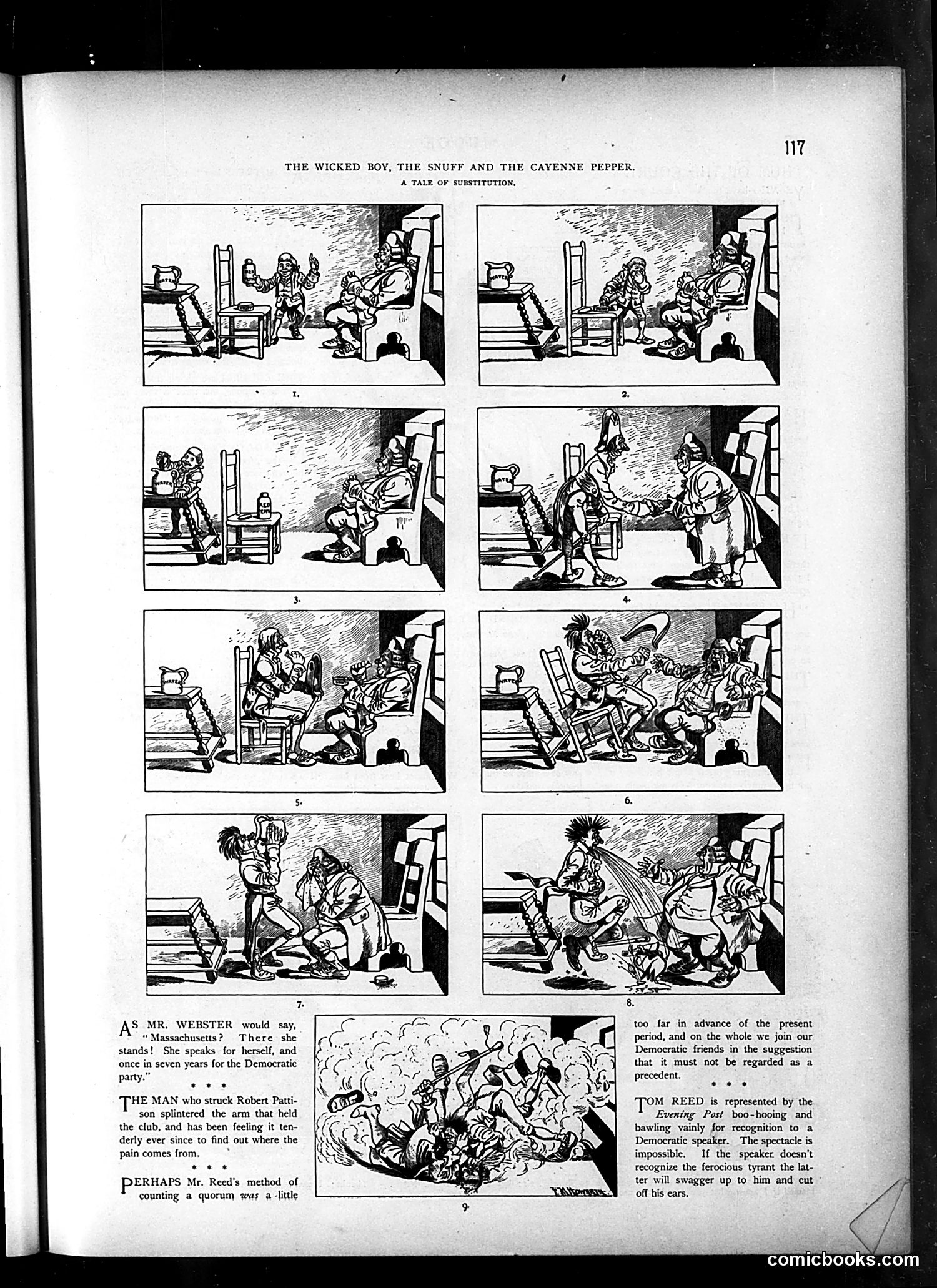
This appears to be a slapstick comic sequence depicting a practical joke involving snuff and cayenne pepper substitution. The narrative panels (1-8) show what seems to be a domestic scene where someone switches snuff powder with hot cayenne pepper, leading to increasingly chaotic consequences as the victim sneezes violently. The accompanying text references Robert Pattison and Tom Reed in a political context, suggesting Democratic Party figures. However, the specific political allegory connecting the snuff/pepper substitution joke to these individuals is unclear from the provided excerpts. The satire likely comments on political deception or betrayal, using the prank as a metaphor for political "tricks."
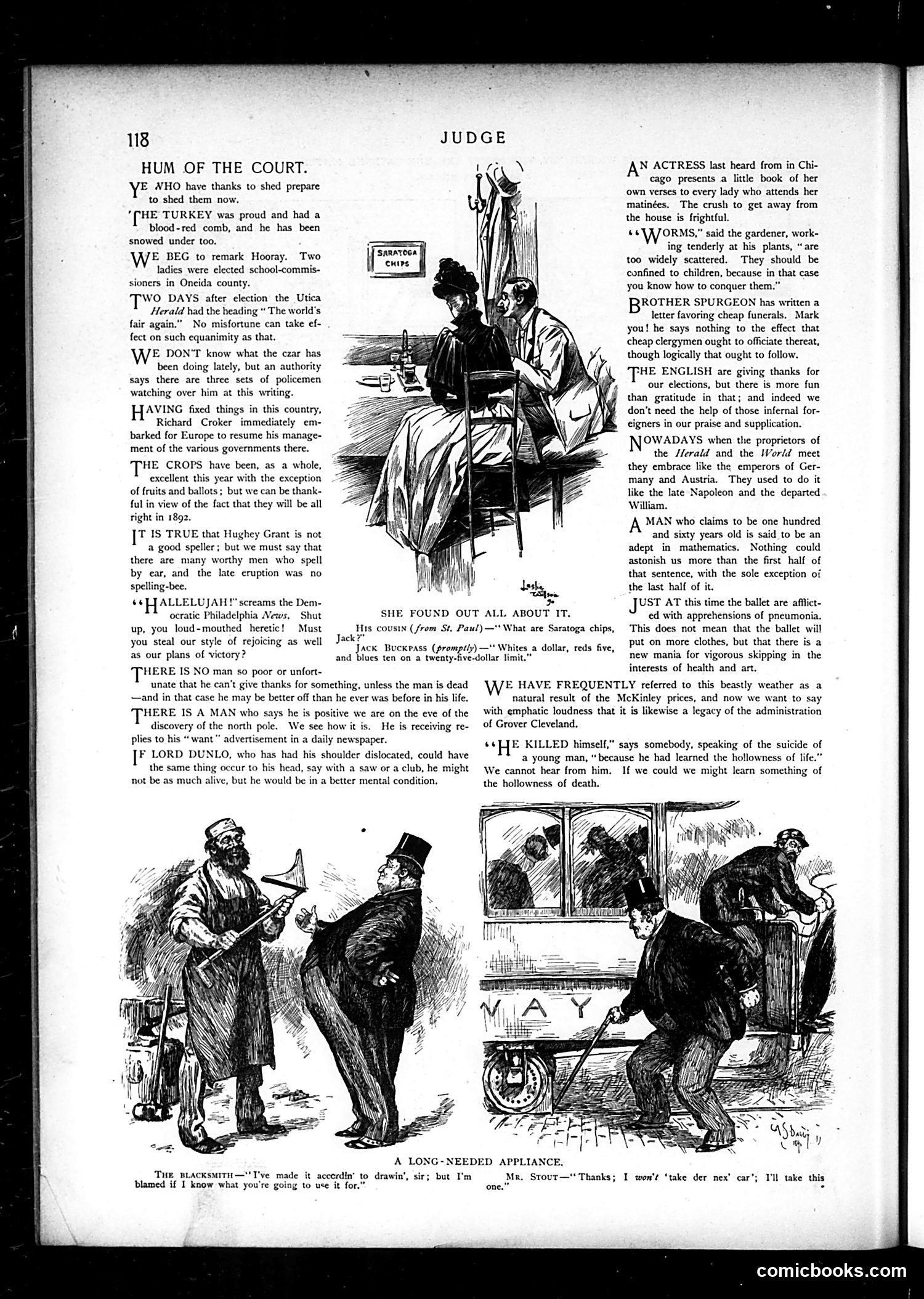
This page from *Judge* contains political commentary and satirical cartoons from the early 1890s. The "Hum of the Court" section comprises brief satirical quips on contemporary issues: **Political references** include Richard Croker (Tammany Hall boss), Hughey Grant (NYC mayor), and debates over the McKinley Tariff versus Grover Cleveland's administration—both blamed humorously for bad weather. **Social commentary** targets: women gaining political positions (two school commissioners elected), the 1892 World's Fair, Russian police surveillance of the Czar, and ballet dancers' health anxieties. The cartoons depict everyday scenes: a blacksmith and gentleman haggling over drawing tools, and a man asking his cousin about "Saratoga chips" (apparently gambling stakes, not food—a clever wordplay joke). The overall tone is irreverent and gossipy, typical of *Judge's* satirical approach to American politics and society of the period.
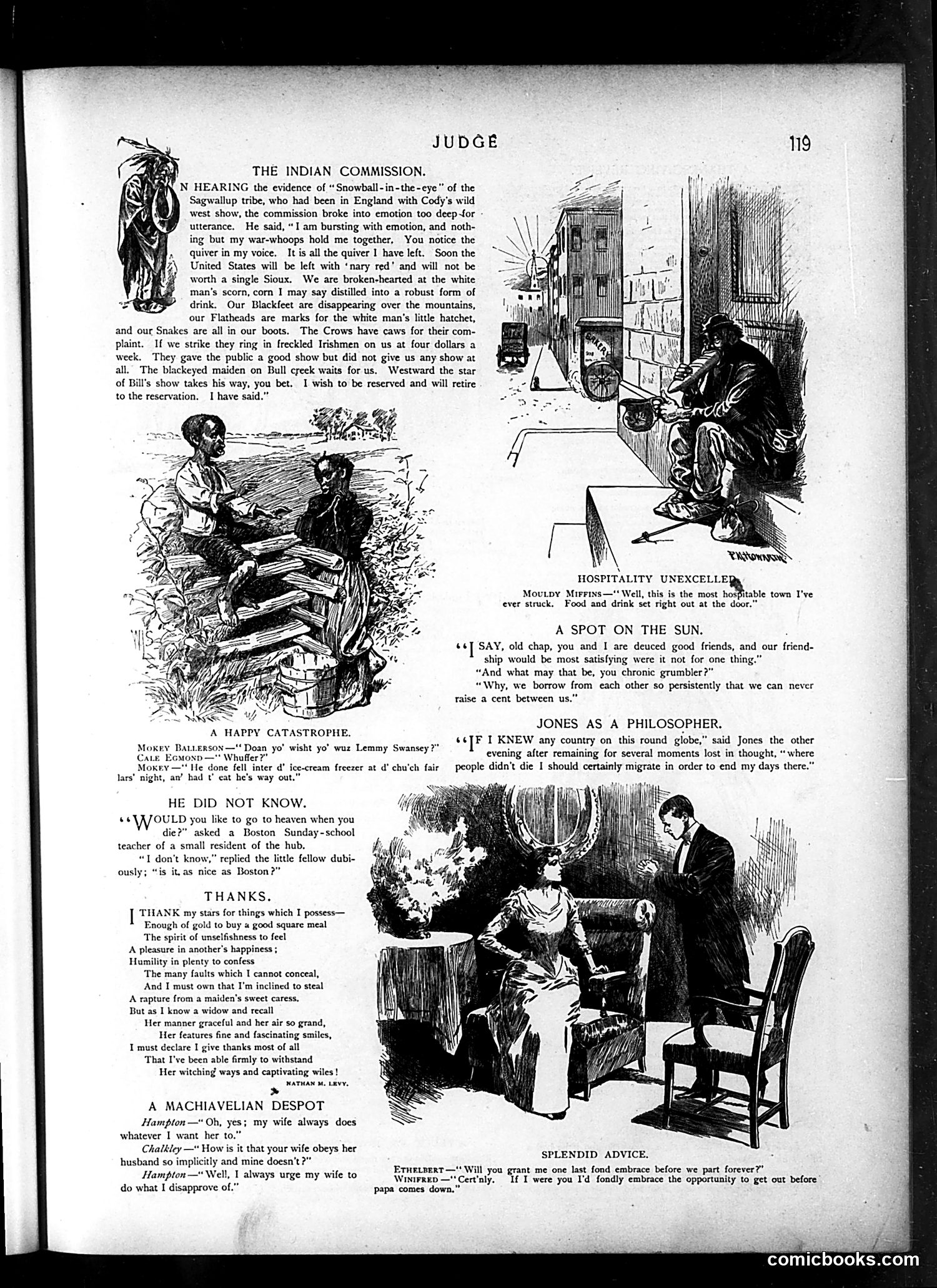
**"The Indian Commission"** (top): This cartoon satirizes a Native American delegation testifying before a government commission about tribal decline. The speaker, "Snowball-in-the-eye" from a tribe that performed in Buffalo Bill's Wild West show, uses broken English and comic dialect to describe how tribes are disappearing through assimilation, alcoholism ("robust form of drink"), and military conflict. The satire mocks both the government's ineffectual response to Native displacement and stereotypical portrayals of Native Americans—treating a serious tragedy of cultural destruction as comedic fodder through exaggerated speech and caricature. The page also contains several unrelated short humor pieces about marriage, friendship, and courtship—typical filler content for this satirical magazine. These offer crude jokes about relationships rather than political commentary. The cartoons reflect late 19th-century attitudes: Native American decline treated as inevitable entertainment rather than systemic injustice.
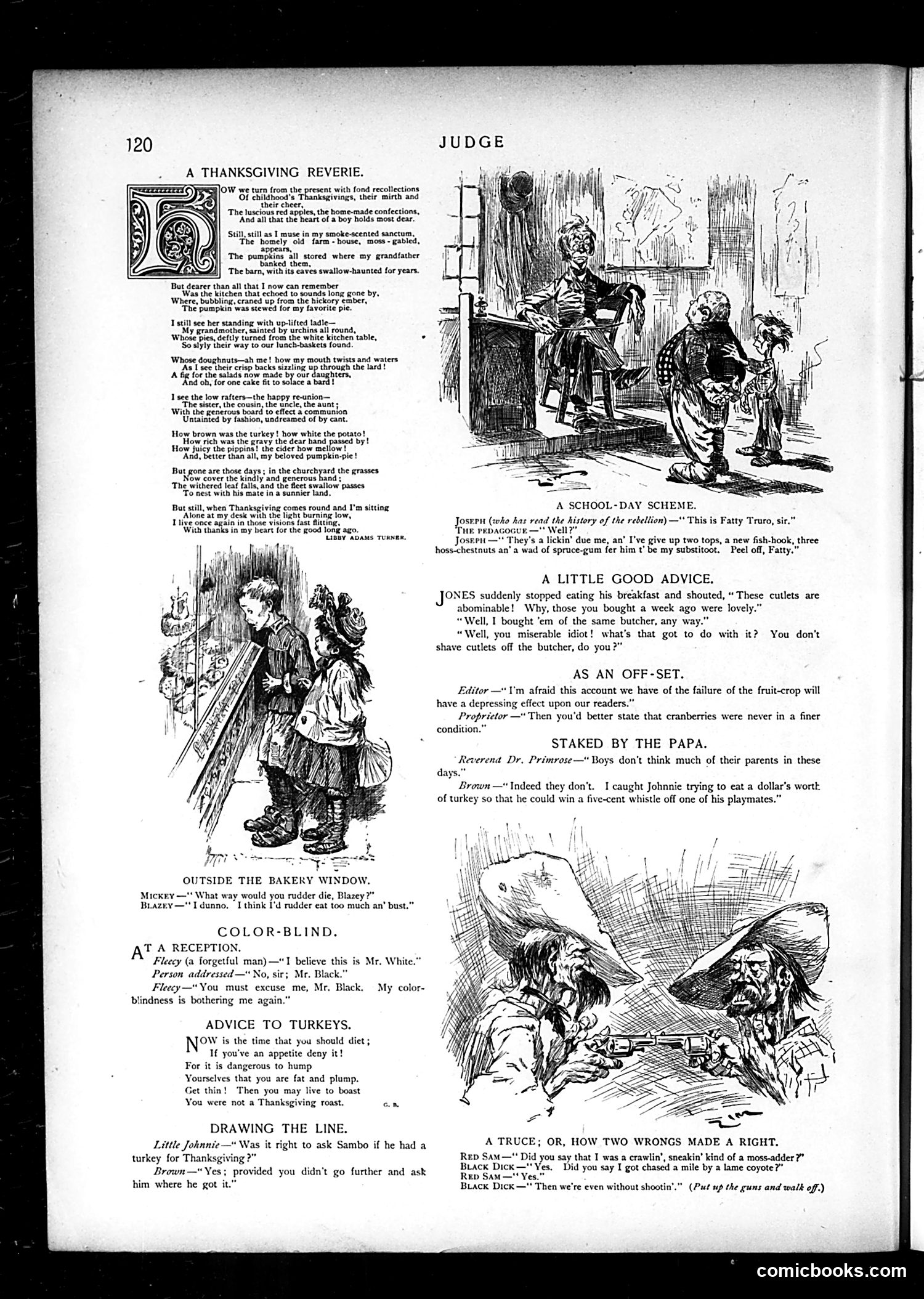
This Thanksgiving-themed page from *Judge* contains several short humorous pieces typical of the magazine's satirical format: **"A Thanksgiving Reverie"** is a nostalgic poem by Lizzy Adams Turner celebrating childhood holiday memories—grandmother's cooking, family gatherings, pumpkin pie—contrasted with present loss and aging. The cartoon vignettes mock everyday social situations: a schoolboy negotiating a substitute to take punishment; a man complaining about butcher quality while the butcher notes he doesn't butcher the cutlets; editorial tension over crop failures versus cranberry abundance; a man's color-blindness causing social embarrassment; and children's humor about turkeys. **"Advice to Turkeys"** offers darkly comic counsel to avoid fattening up before Thanksgiving slaughter. The overall page reflects *Judge's* formula: sentimental poetry mixed with quick comedic sketches lampooning middle-class manners, domestic disputes, and seasonal anxieties—nothing explicitly political, but socially observant humor aimed at educated readers.
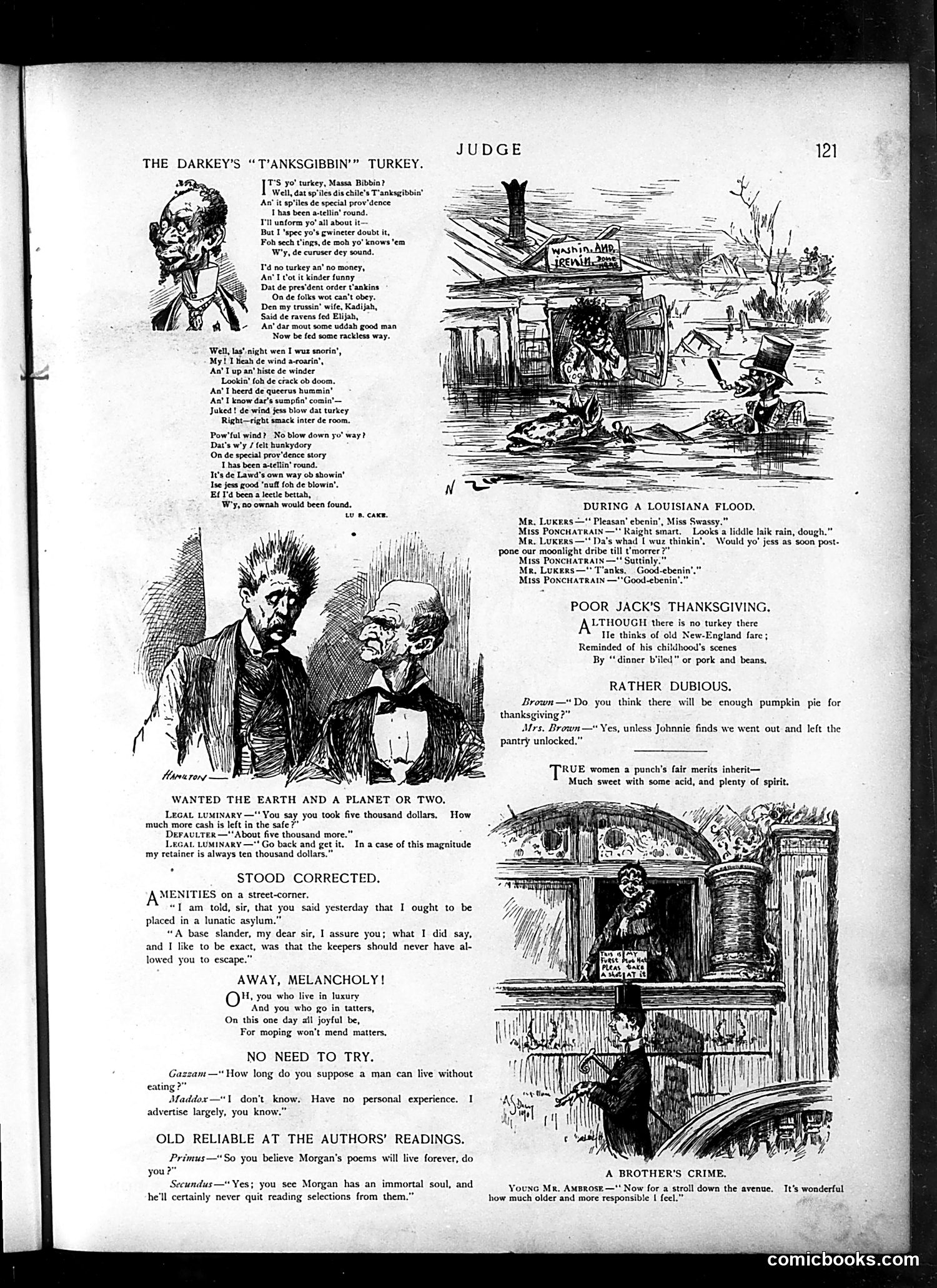
This page contains multiple satirical pieces typical of late 19th-century American humor, including **racist dialect humor** that reflects the era's offensive conventions. **"The Darkey's T'anksgibbiin' Turkey"** uses exaggerated Black dialect to tell a tall tale: a poor enslaved or formerly enslaved man receives a turkey blown through his window by miraculous wind—which he interprets as divine providence. The satire mocks both the character's credulity and, likely, the absurdity of expecting poor people to celebrate Thanksgiving without resources. **Other pieces** include standard Judge fare: a lawyer's greed ("Wanted the Earth"), social correction humor, and observational jokes about Thanksgiving preparations and lawyers. The **Louisiana Flood scene** similarly employs dialect stereotypes while depicting poor Southern life. **Key context for modern readers**: This material reflects Judge's reliance on crude ethnic and racial caricature as entertainment. The "humor" depends entirely on mocking speech patterns and supposed character flaws associated with marginalized groups—conventions acceptable to the magazine's audience but representing deeply embedded bigotry.
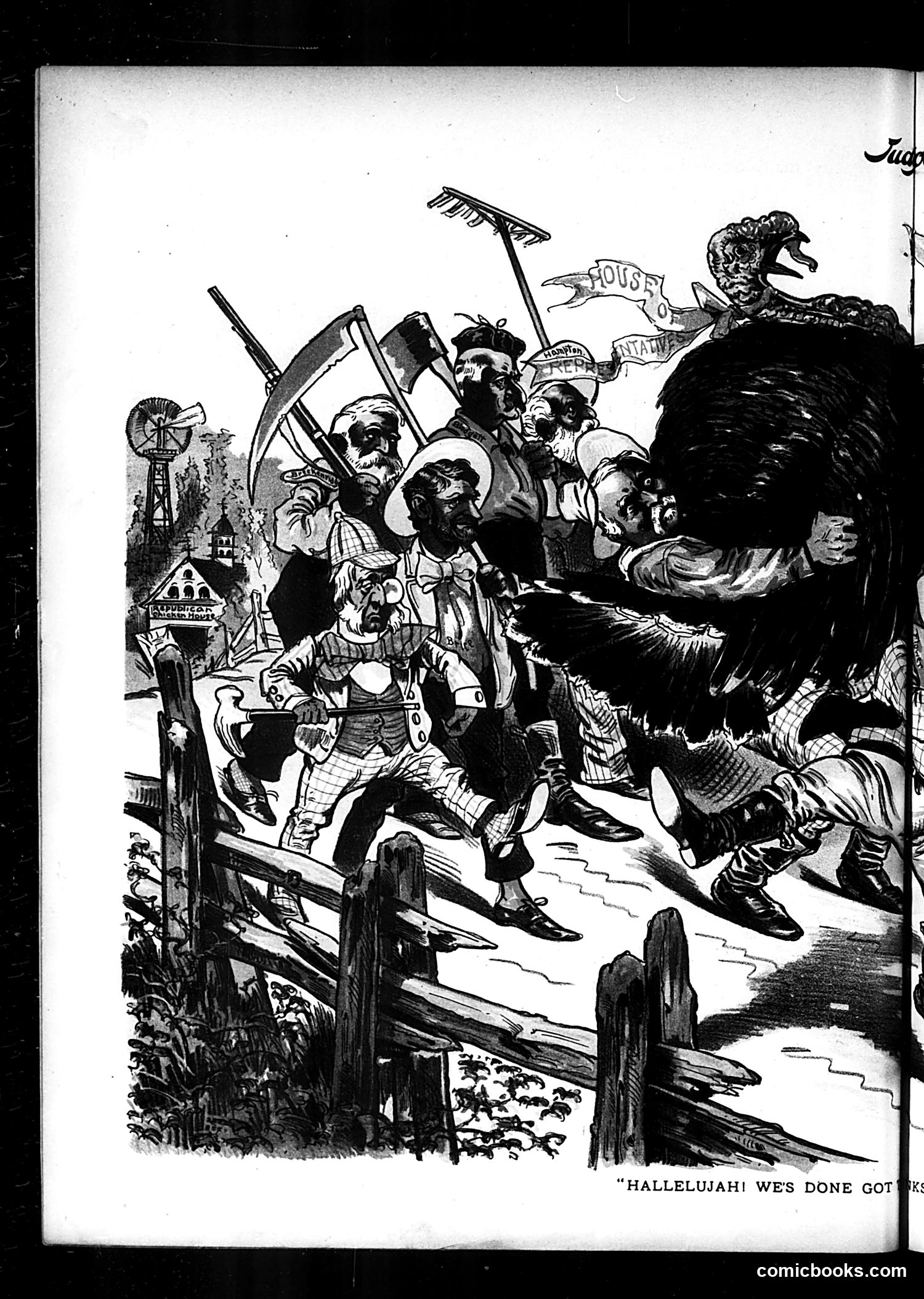
This Judge magazine cartoon depicts a celebratory scene with multiple figures holding farming tools (rakes, hoes) in what appears to be rural agricultural setting. The caption reads "HALLELUJAH! WE'S DONE GOT..." (text cuts off). The cartoon employs racist caricature and dialect typical of late 19th/early 20th-century American satire. The exaggerated features and language suggest commentary on African American agricultural workers, likely referencing either harvest completion or—more probably—political/social developments affecting rural communities. Without the complete caption, the specific satirical target remains unclear, though the celebratory tone suggests either commentary on election results, labor conditions, or agricultural policy of the era. The style reflects Judge magazine's often crude racial stereotyping common to that period.
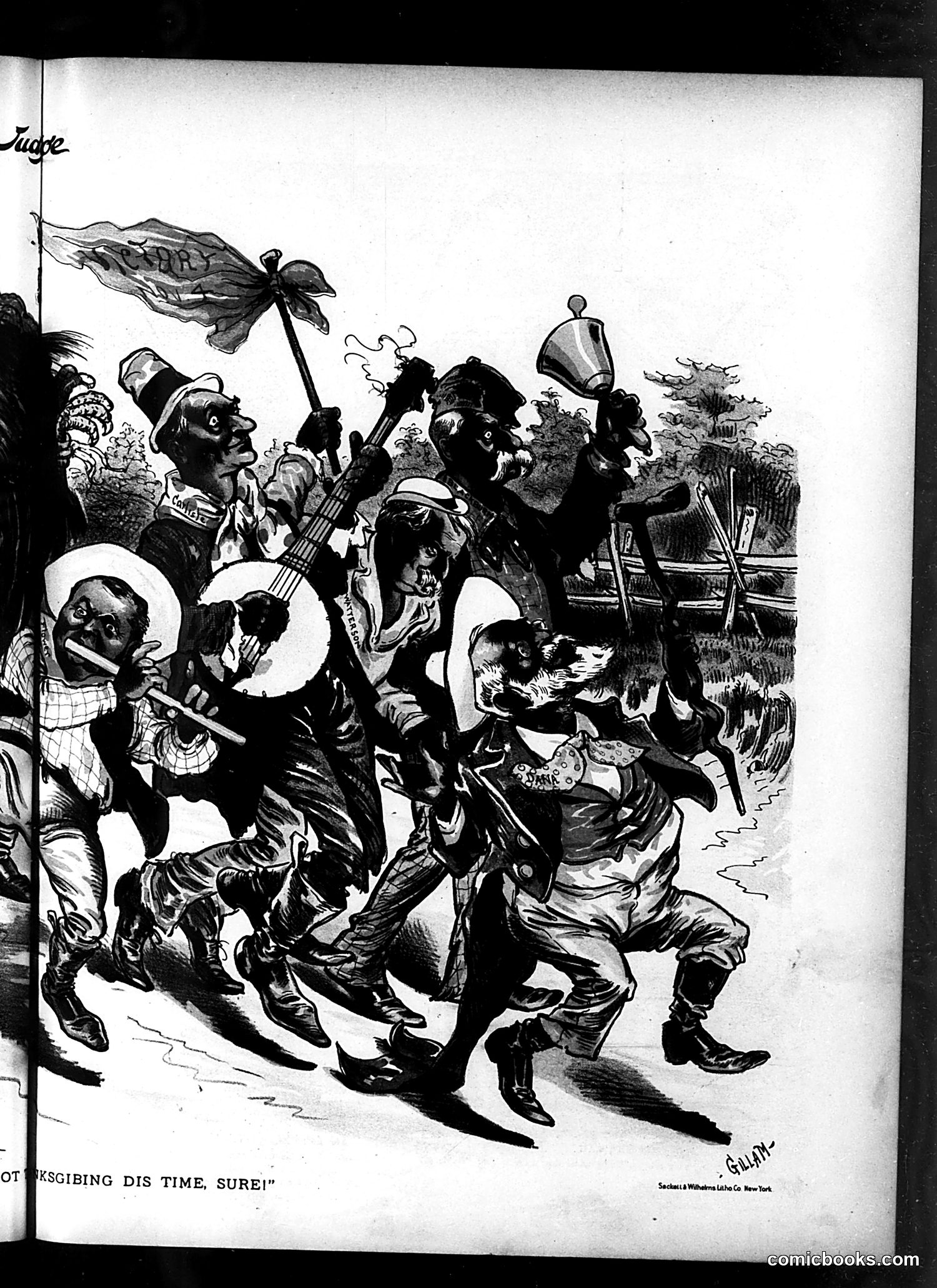
This is a satirical cartoon titled "THANKSGIVING DIS TIME, SURE!" depicting caricatured figures in exaggerated racial stereotypes engaging in a chaotic celebration or procession. The figures appear to be rendered in the offensive blackface/minstrelsy style common to late 19th-century American satire. The cartoon seems to mock Thanksgiving observance, though the exact political target remains unclear from the image alone. The phrase "dis time, sure" suggests commentary on whether a particular group would celebrate the holiday—likely satirizing contemporary racial or immigrant anxieties about American inclusion. The artist signature appears to be "Cesare" or similar. Without additional context about Judge magazine's publication date and political climate, the specific social commentary cannot be definitively determined, though the style and approach suggest commentary on race, immigration, or class dynamics of that era.
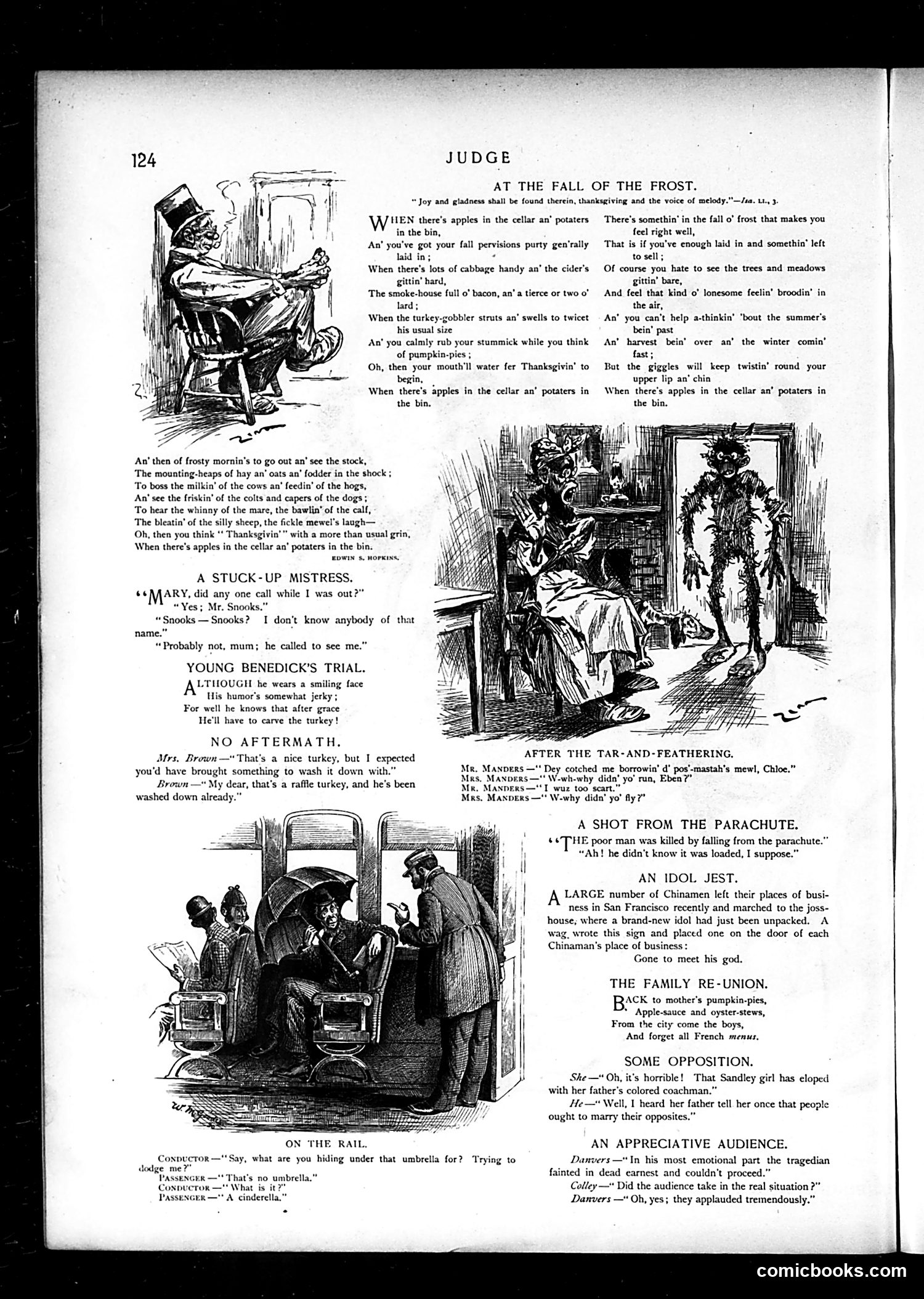
This page from Judge (a 19th-century American satirical magazine) contains multiple short humor pieces typical of the era: **Main Content:** The centerpiece is a sentimental rural poem "At the Fall of the Frost" celebrating autumn harvest abundance and Thanksgiving—celebrating stored provisions, farm animals, and seasonal comfort. **Surrounding Jokes:** Brief, disconnected humor pieces mock contemporary social situations: - A mistress dismissing a suitor's servant visit as unimportant - A newlywed reluctantly facing turkey-carving duty - A racist caricature of an African American man arrested for "borrowing" a postmaster's mule (likely referencing post-Reconstruction era racial violence/tar-and-feathering) - A Chinese immigrant joke mocking religious practices - Domestic humor about city boys missing home cooking **Overall Purpose:** This reflects Judge's formula: sentimental verse paired with topical one-liners satirizing middle-class life, workplace dynamics, and—disturbingly by modern standards—racial stereotypes presented as humor. The page offers nostalgia alongside casual cruelty.
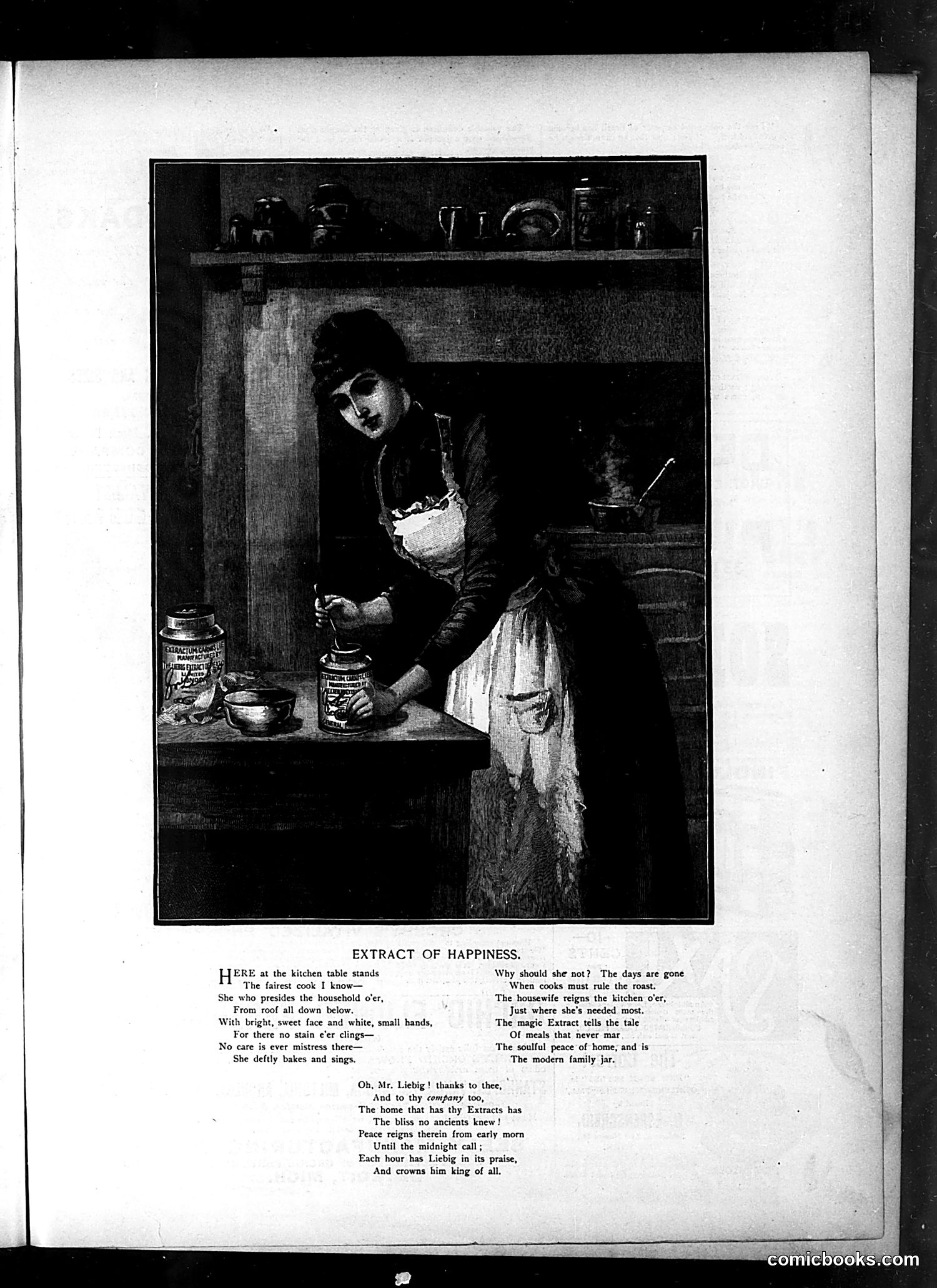
This page is primarily a **product advertisement for Liebig Extract**, a meat extract/bouillon product popular in the late 19th-early 20th century. The image shows a domestic kitchen scene with a woman cooking. The satirical "poem" (typical of Judge's style) praises Liebig Extract as transforming housework into domestic bliss. It celebrates the modern housewife who—thanks to convenient cooking products like Liebig—maintains a spotless kitchen ("no stain e'er clings") while presiding peacefully over her domain. The advertisement's humor and appeal target middle-class aspirations: the product promises to modernize household labor, freeing women from drudgery to be "bright" and cheerful rather than exhausted. The elaborate praise of Liebig ("king of all") is typical of period advertising hyperbole, humorously framed as devotional verse. This reflects contemporary attitudes about domestic convenience products as liberating innovations, though from a modern perspective, it simply reinforces women's domestic confinement.
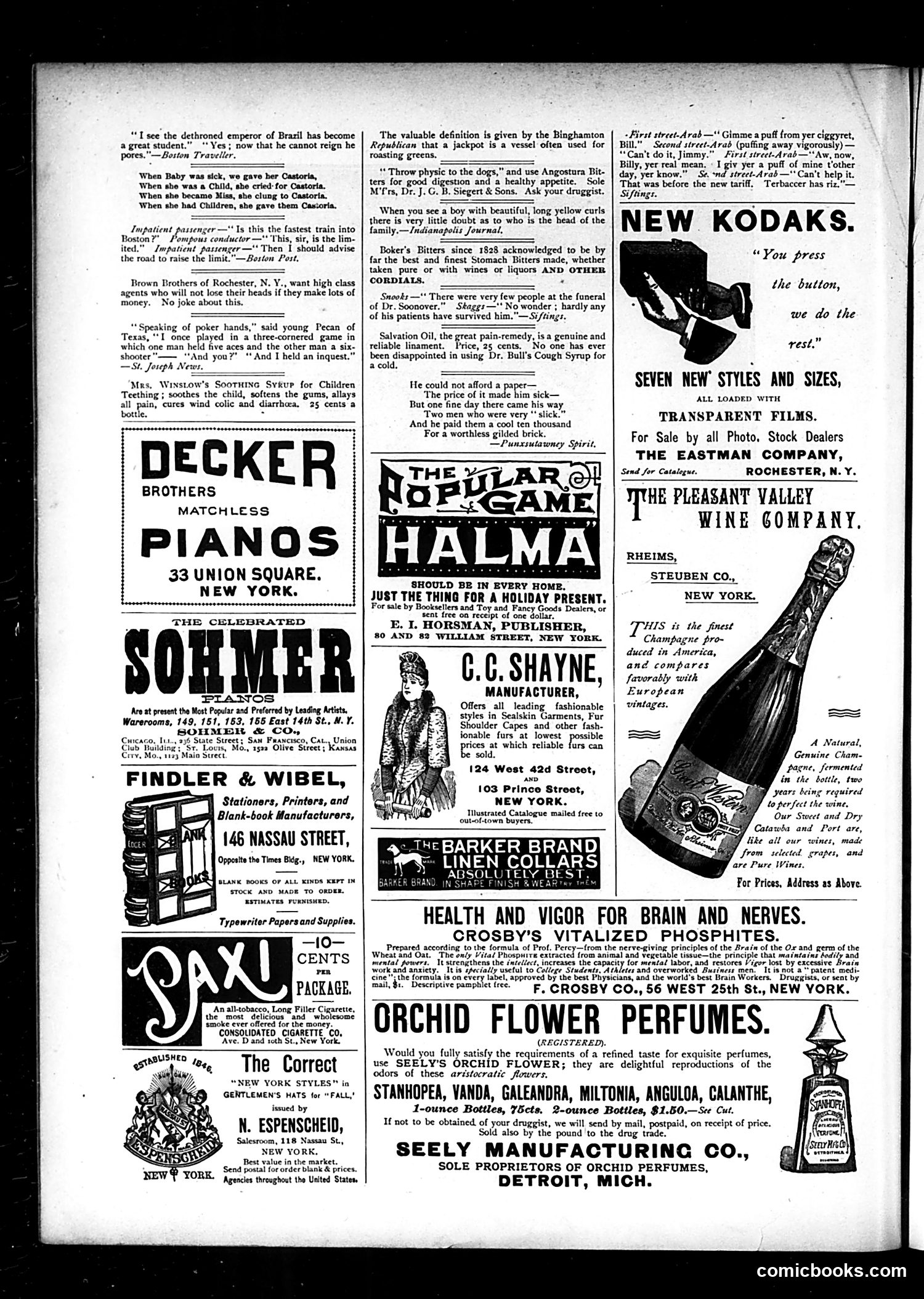
This page is primarily **advertising**, with brief satirical snippets scattered throughout typical of Judge magazine's format. The few actual jokes include: - A pun about Brazil's deposed emperor becoming a "great student" who "pores" (studies intently/grieves) - A conductor joke about a "limited" train that's apparently too slow - A Texas poker anecdote ending in an "inquest" (death/defeat) - A street urchin dialogue about sharing cigarettes The rest consists of patent medicine ads (Castoria, Soothing Syrup, Bitters), piano manufacturers, fur dealers, and perfume companies—typical late-19th century advertising. **Context for modern readers**: These advertisements reveal period concerns (teething remedies, "vitalized phosphites" for brain health) and social details (Sealskin garments as luxury fashion, street children smoking). The satirical snippets are mild observational humor rather than pointed political commentary.
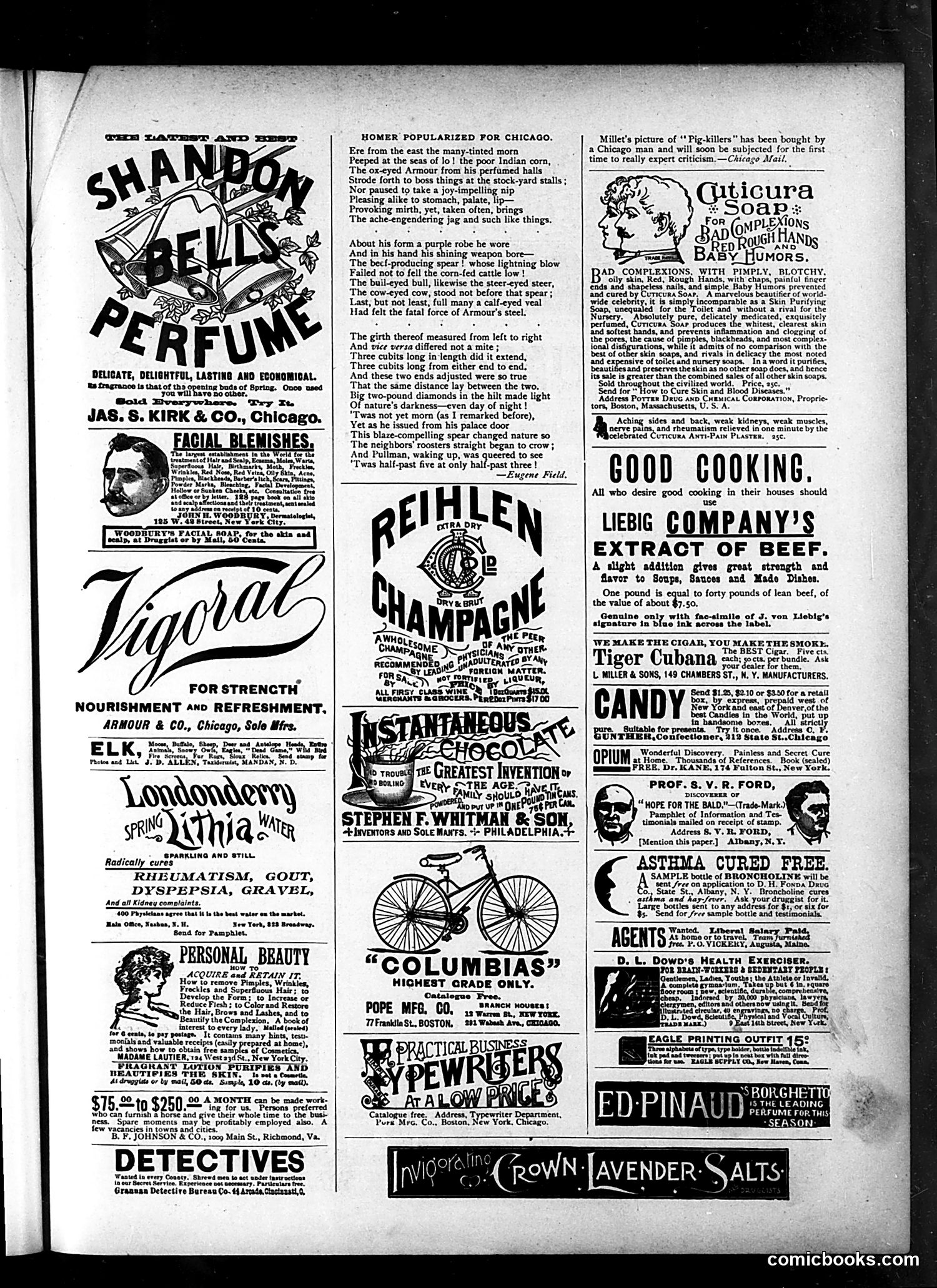
This is primarily an **advertising page** from Judge magazine, with one notable satirical poem at the top. ## The Satire The poem "Homer Popularized for Chicago" is a mock-heroic parody mocking **Philip Armour**, the Chicago meatpacking magnate. It mimics Homer's *Iliad* style, treating Armour as an epic hero "strode forth to boss things at the stock-yard stalls." The joke: elevating a commercial butcher to Homeric grandeur. The poem jokes about his power over cattle and includes a dig at **George Pullman** (the railway car manufacturer), with a whimsical anecdote about Armour's "spear" being so bright it tricks roosters and Pullman about the time. The satirical point: Chicago's industrial tycoons treated as mythological figures—deflating their self-importance through absurdist classical allusion. ## The Rest The page is dominated by period **advertisements**: patent medicines (Cuticura Soap, Londonderry Water), beauty products, bicycles (Columbias), and employment schemes—typical Judge revenue. One small reference jokes that a Millet painting of pig-killers bought by a Chicagoan needs "expert criticism."
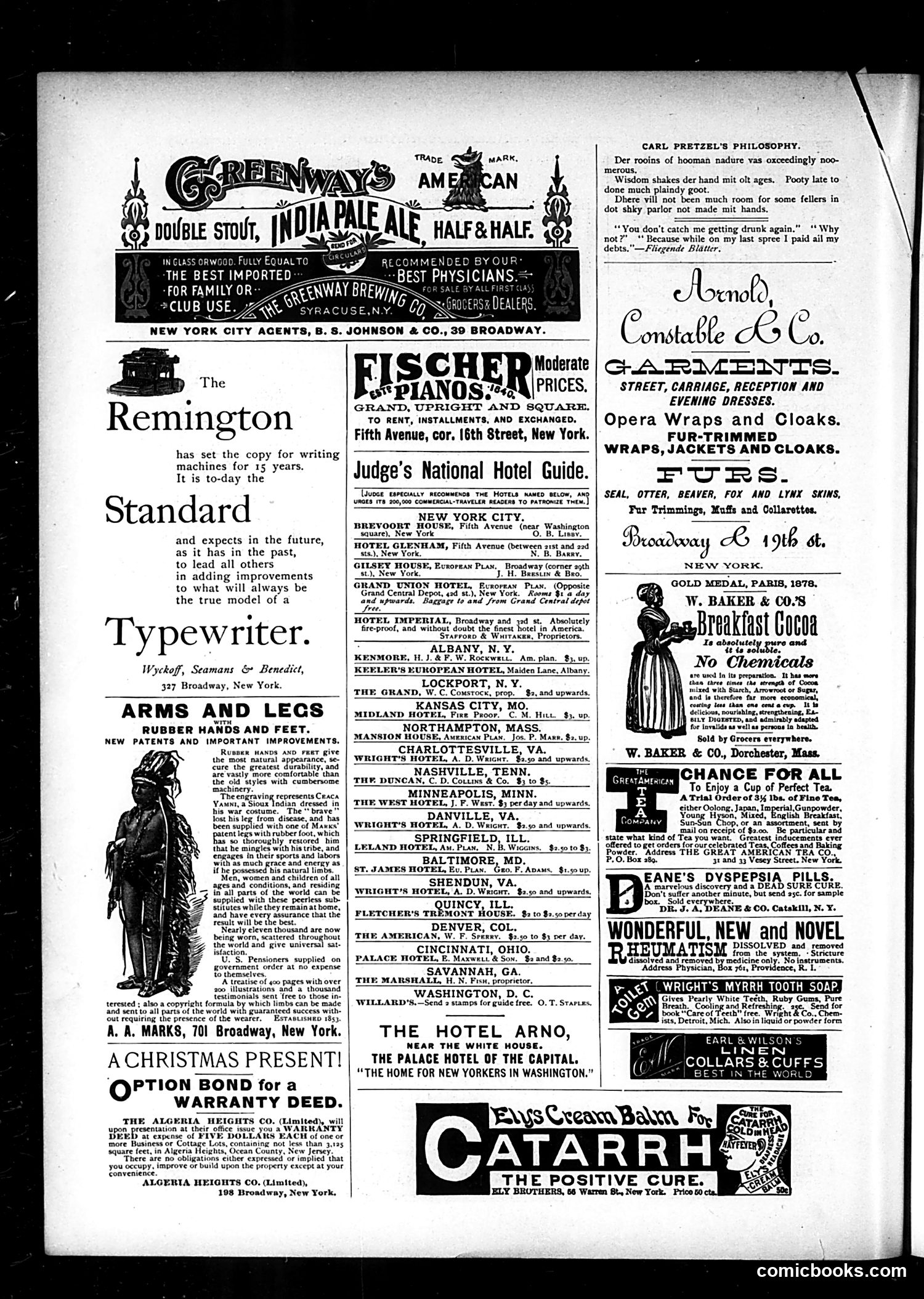
This is primarily an **advertising page** from Judge magazine, not a political cartoon. It contains commercial advertisements for various products and services typical of late 19th-century America. The main content includes ads for: - **Greenway's beer** (top) - **Remington typewriters** - **Fischer pianos** - **A hotel guide** listing establishments across American cities - **A.L. Marks' prosthetic limbs** ("Arms and Legs") — notably featuring an illustration described as a "Sioux Indian" named "Craca Yawnt" who lost his leg and received a rubber replacement - Various patent medicines and personal goods At bottom right is a brief philosophical quote attributed to "Carl Pretzel" about human nature and wisdom. The page offers **no discernible political satire**. It's a commercial compilation reflecting consumer products, services, and advertising conventions of the period, including the casual ethnic stereotyping common to that era.
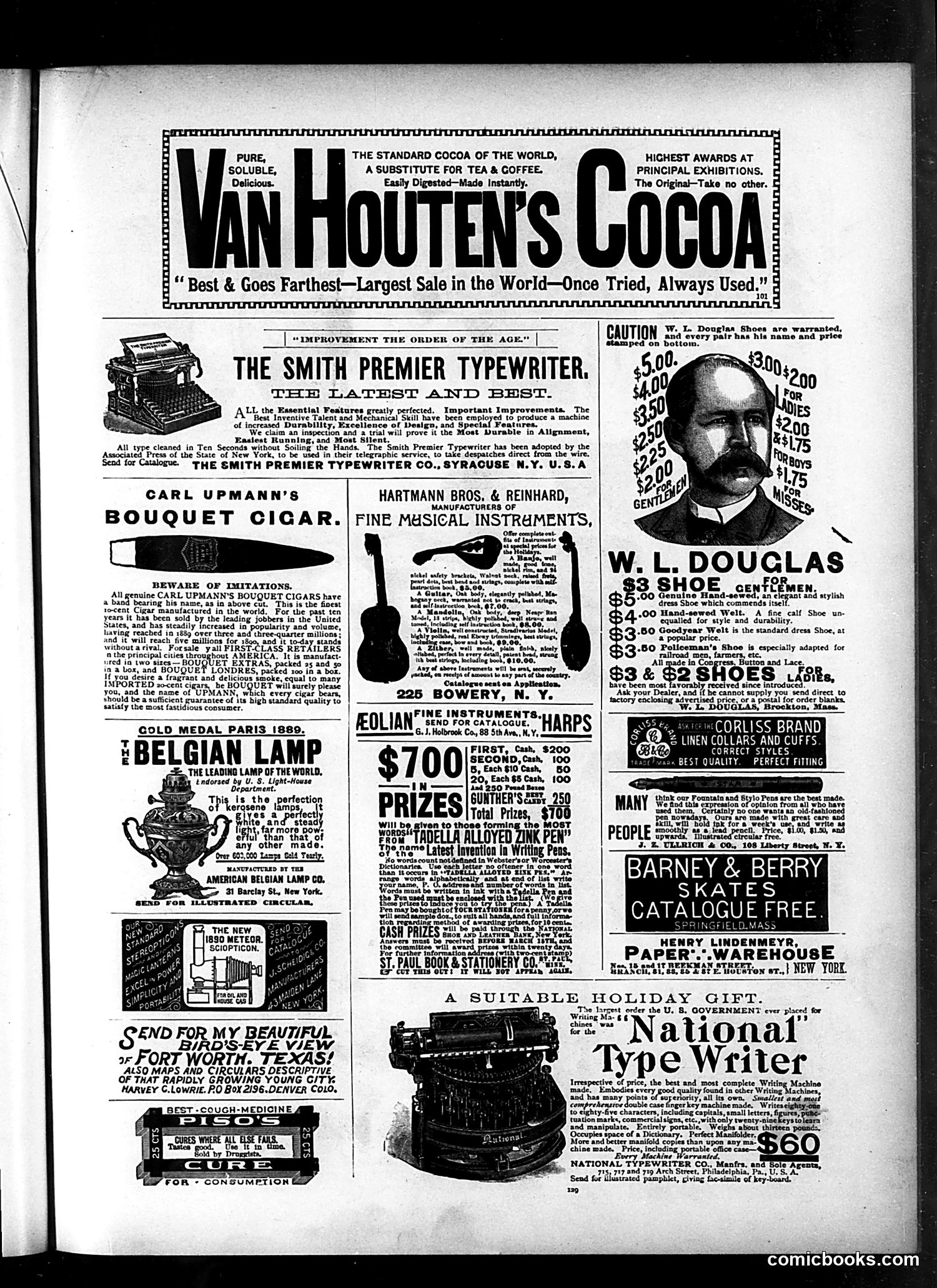
This is primarily an **advertising page** with no discernible political cartoons or satire. It consists entirely of late 19th-century product advertisements. The page showcases period consumer goods: Van Houten's Cocoa, Smith Premier Typewriters, Carl Upmann cigars, W.L. Douglas shoes, musical instruments, Belgian lamps, and writing instruments. These advertisements reflect the commercial culture and technology of the era—typewriters and fountain pens represent "modern" office innovations, while luxury goods like cigars and cocoa signal aspirational consumption for middle-class readers. The repeated emphasis on quality, durability, and "latest improvements" reflects Victorian-era marketing strategies. The National Type Writer advertisement notably references U.S. Government use, a common endorsement tactic. **This is not a satirical or editorial page.** Judge magazine is known for political commentary, but this particular page serves a commercial function—generating revenue through paid advertisements rather than delivering social or political satire.
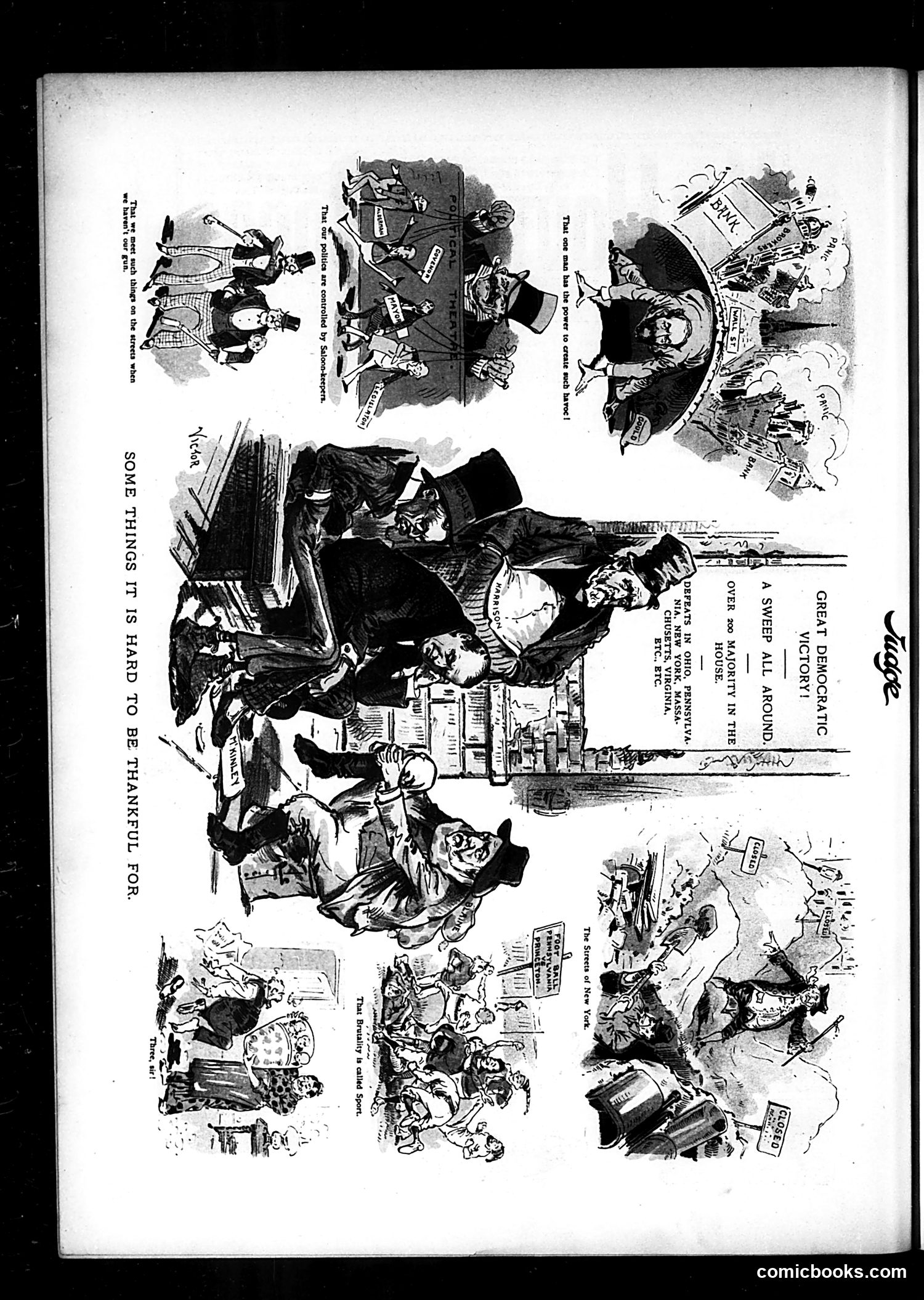
This page satirizes Democratic electoral claims of victory while depicting their actual defeats. The main central cartoon shows a disheveled Democratic politician celebrating a claimed "sweep" and "200 majority in the House," while the surrounding smaller cartoons illustrate their real losses in major states (Ohio, Pennsylvania, New York, Massachusetts, Virginia). The satire's point: Democrats are delusionally declaring victory despite tangible defeats across crucial regions. The bottom caption—"That Our politics are controlled by Saloon-keepers"—suggests the cartoon blames tavern owners' political influence for Democratic failures or corruption. The phrase "Things It Is Hard to Be Thankful For" frames the entire page as ironic criticism of Democratic claims and practices. Without a visible date, the specific election remains unclear, but Judge's reliably Republican perspective is evident in mocking Democratic spin and political influence by working-class establishments.
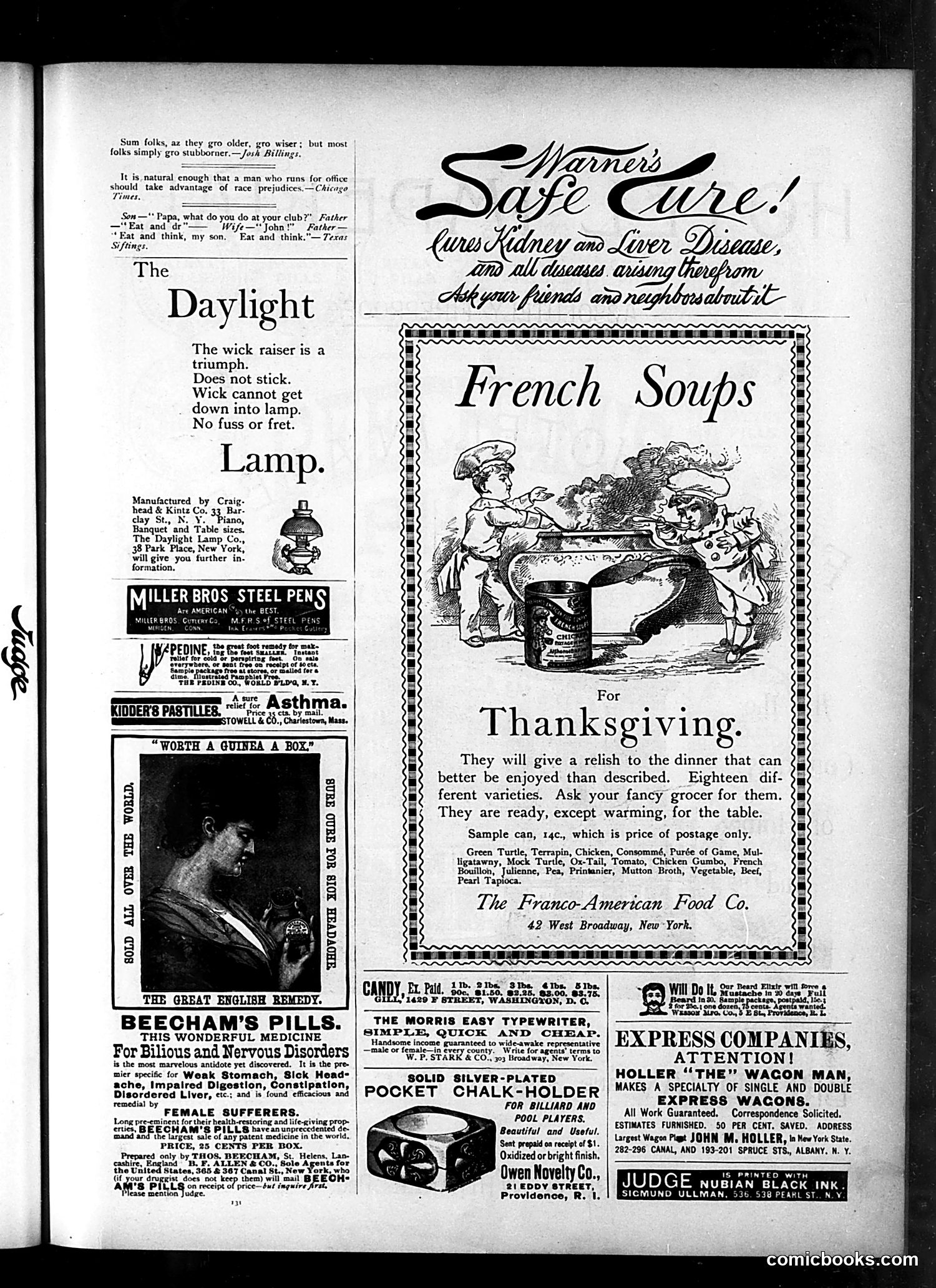
This page contains no significant political cartoons or satirical content. It's primarily an advertising page from Judge magazine featuring: **Jokes/Quotes at top:** - Brief editorial quips about aging ("folks gro stubbor"), political candidates exploiting prejudices, and club etiquette—standard lightweight humor of the era. **Main content:** The page is dominated by commercial advertisements: Daylight lamps, steel pens, patent medicines (Beecham's Pills, asthma remedies), French soups for Thanksgiving, and various business services (typewriters, chalk-holders, wagons, express companies, ink). **No identifiable cartoons or caricatures are present.** The only illustration is a generic Thanksgiving soup advertisement showing cherubs with a pot. This appears to be a typical turn-of-the-century magazine filler page—mixing light humor with paid ads to generate revenue. There's nothing here requiring historical context to understand; it's simply period advertising and mild domestic humor.
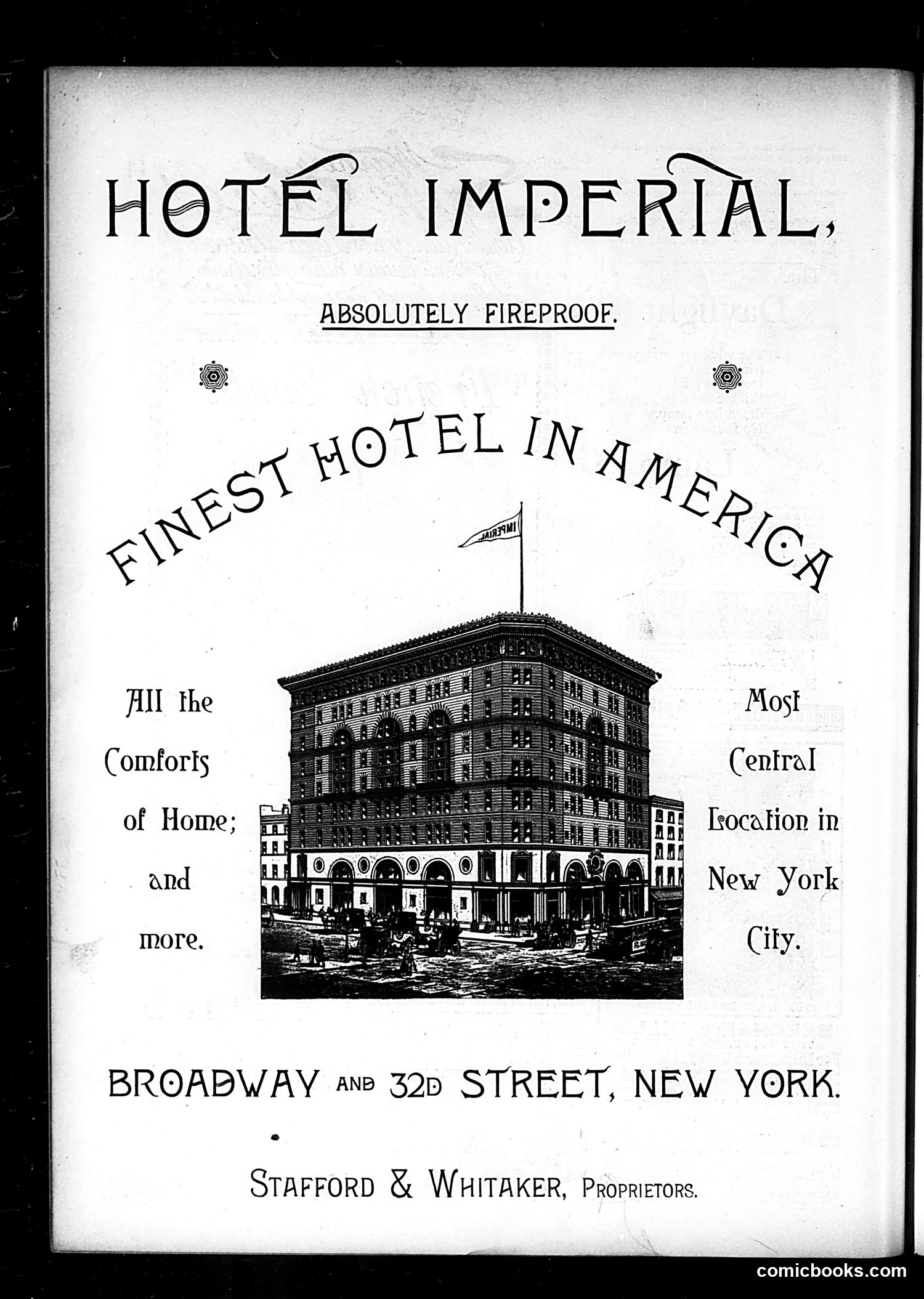
This page is an advertisement rather than satirical content. It promotes the Hotel Imperial, located at Broadway and 32nd Street in New York City, owned by Stafford & Whitaker. The ad emphasizes the hotel's key selling points: it is "absolutely fireproof" and offers "all the comforts of home" in "the most central location in New York City." The fireproof claim was likely a significant marketing advantage during this era, when hotel fires were genuine public safety concerns. The engraved building illustration shows a substantial, multi-story structure typical of late 19th-century commercial hotels. There is no satirical content or political commentary visible on this page.
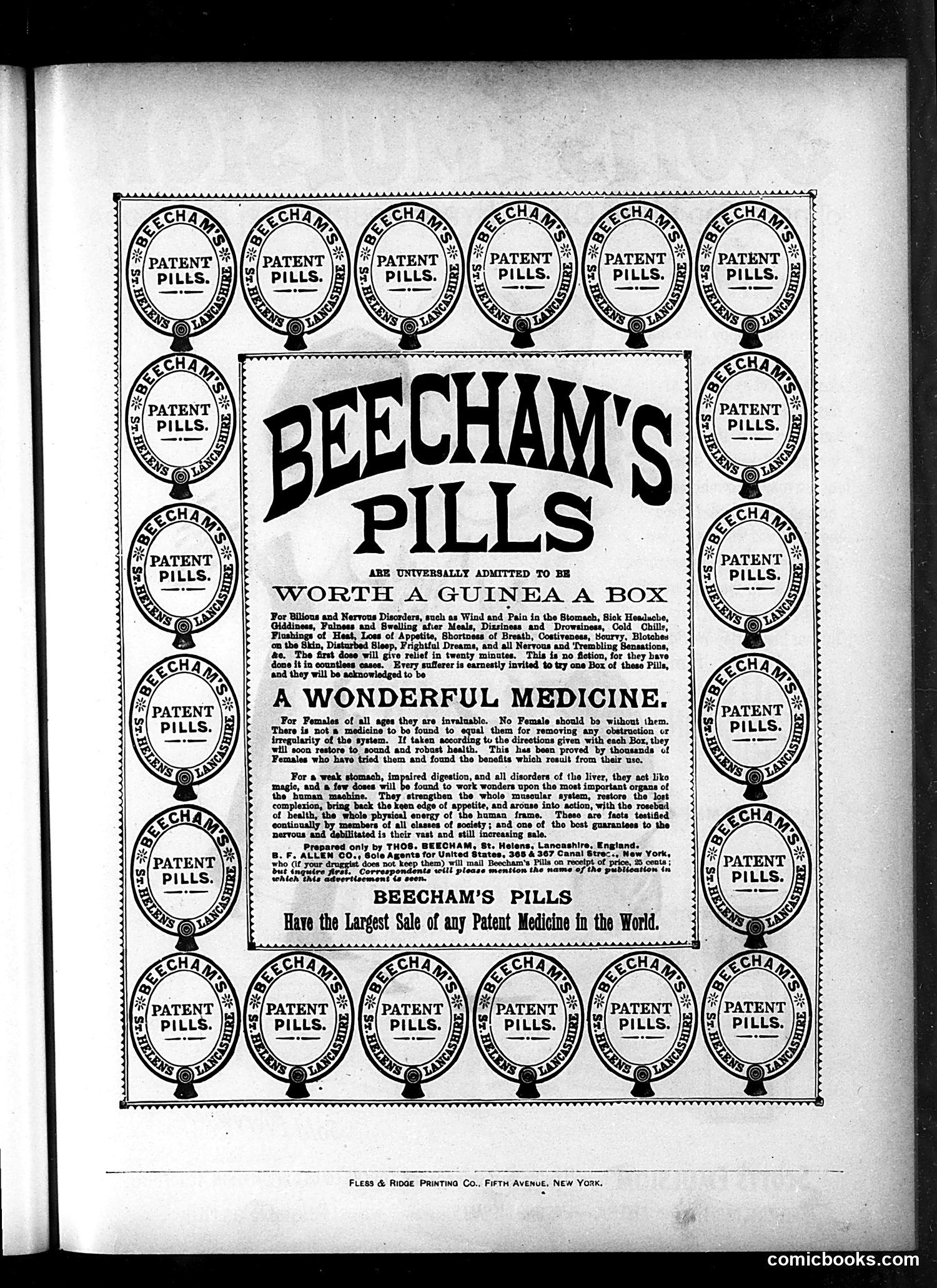
This page is **not a cartoon or satire—it's a straightforward patent medicine advertisement**, likely from the late 19th or early 20th century. The decorative border of pill logos frames promotional text claiming Beecham's Pills cure dozens of ailments: digestive issues, headaches, nervous conditions, and female "irregularities." The ad exemplifies the era's unregulated patent medicine industry. It makes grandiose, unsubstantiated claims ("relief in twenty minutes," "wonders upon the most important organs") with zero scientific evidence. The assertion that pills are "universally admitted to be worth a guinea a box" and have "the largest sale of any patent medicine in the world" uses social proof as marketing. This represents what modern readers would recognize as **predatory medical fraud**—exploiting common ailments and desperation before FDA regulations (1906+) required truthful advertising and actual efficacy.
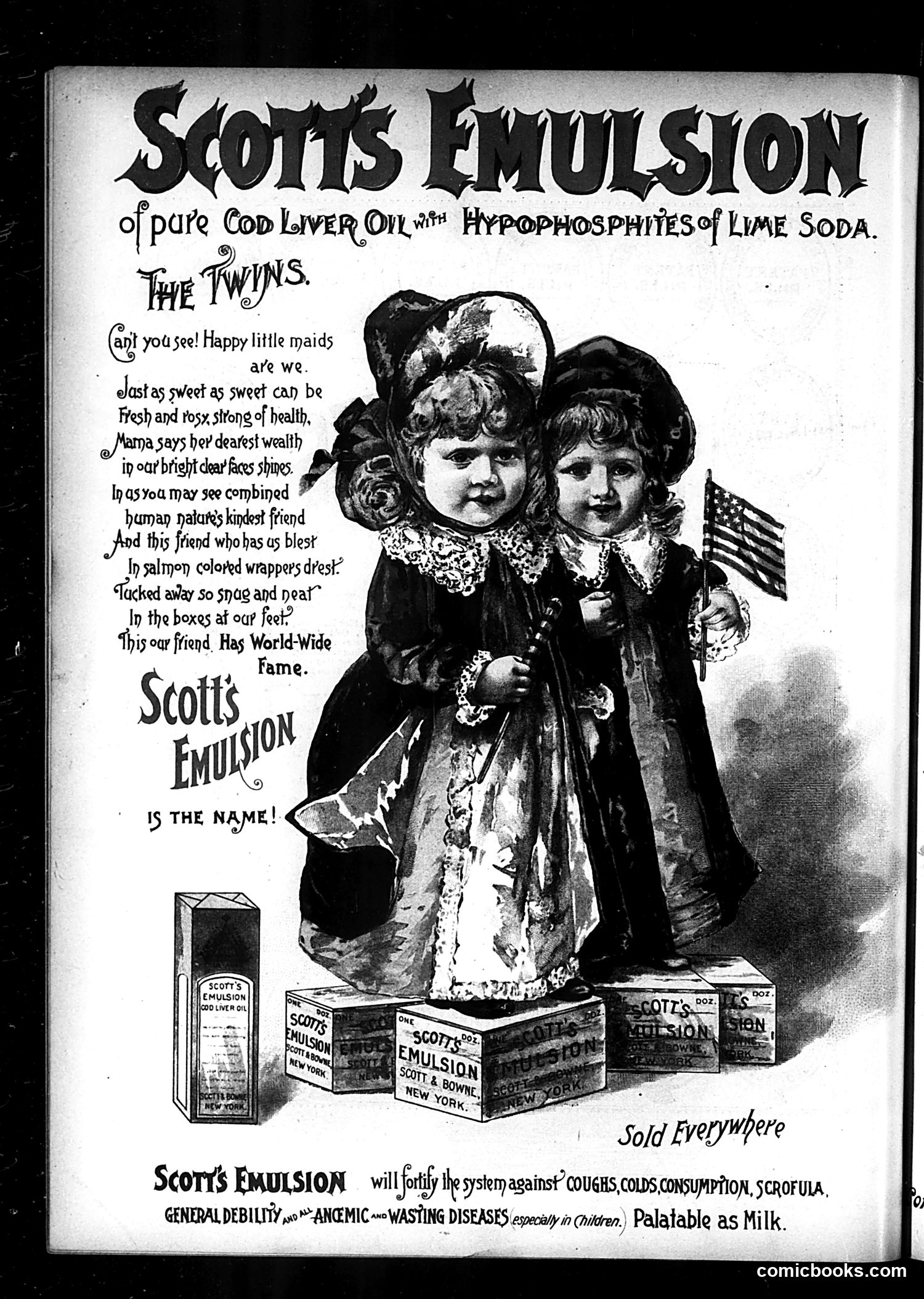
This is a **patent medicine advertisement**, not satire. It depicts two cherubic children ("The Twins") dressed in Victorian clothing, holding an American flag, standing atop boxes of Scott's Emulsion cod liver oil supplement. The text personifies the product as a benevolent "friend" that protects children's health and appearance. The advertisement claims the emulsion combats coughs, colds, consumption (tuberculosis), scrofula, general debility, anemia, and wasting diseases—serious conditions of the era. This represents **pre-FDA regulation marketing**: such products made sweeping health claims without scientific evidence. The imagery exploits parental anxieties about child health and mortality. By modern standards, this constitutes false medical advertising. The "palatable as milk" emphasis suggests the product tasted unpleasant—typical of cod liver oil preparations. This page exemplifies early 20th-century pharmaceutical marketing before government oversight.