
Judge, 1890-11-29 · page 4 of 20
Judge — November 29, 1890 — page 4: what you’re looking at
What you’re looking at
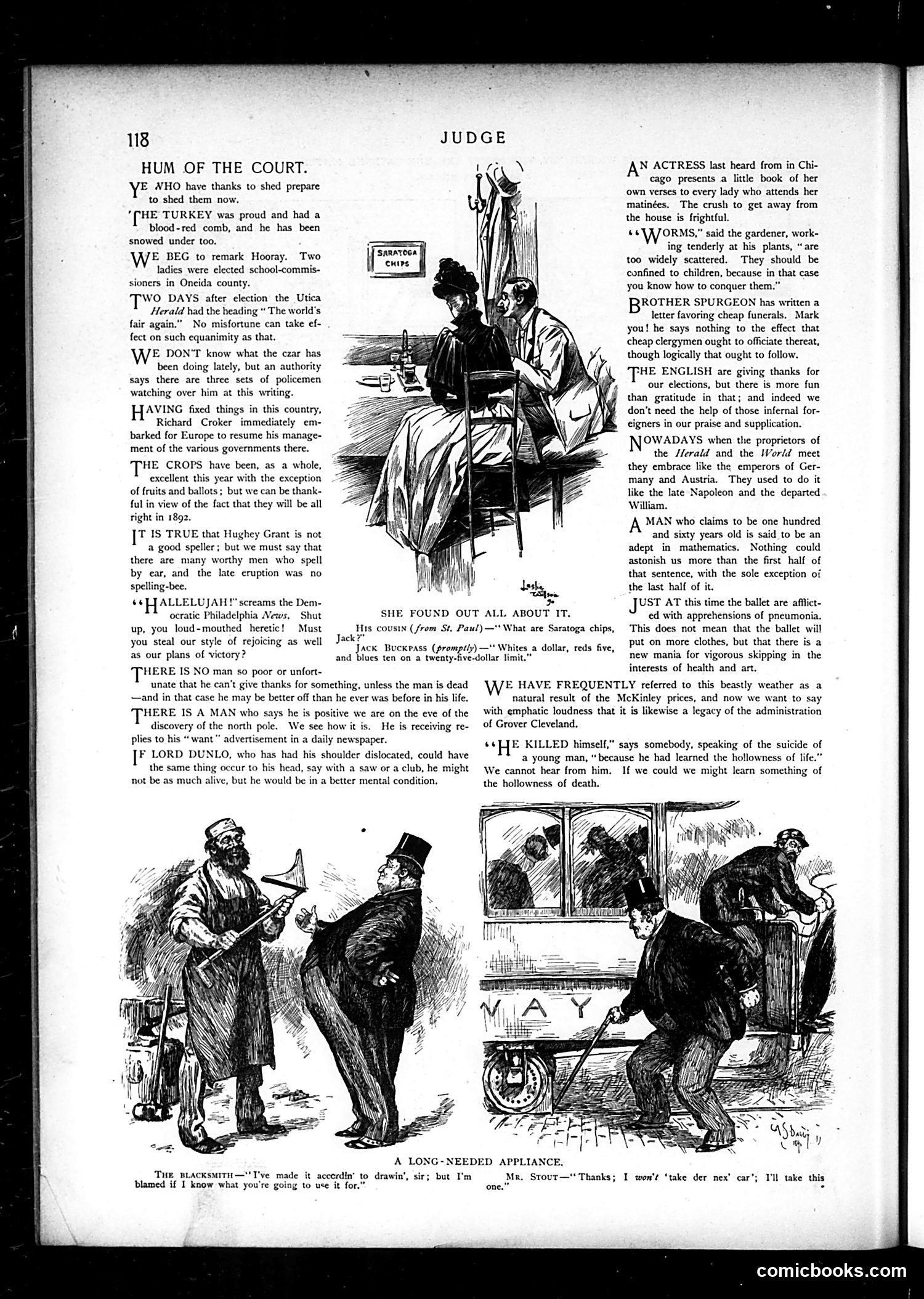
This page from *Judge* contains political commentary and satirical cartoons from the early 1890s. The "Hum of the Court" section comprises brief satirical quips on contemporary issues: **Political references** include Richard Croker (Tammany Hall boss), Hughey Grant (NYC mayor), and debates over the McKinley Tariff versus Grover Cleveland's administration—both blamed humorously for bad weather. **Social commentary** targets: women gaining political positions (two school commissioners elected), the 1892 World's Fair, Russian police surveillance of the Czar, and ballet dancers' health anxieties. The cartoons depict everyday scenes: a blacksmith and gentleman haggling over drawing tools, and a man asking his cousin about "Saratoga chips" (apparently gambling stakes, not food—a clever wordplay joke). The overall tone is irreverent and gossipy, typical of *Judge's* satirical approach to American politics and society of the period.
📄 Transcribed text from this page (OCR, searchable)
Machine-transcribed from the original scan — historical spelling and the odd misread are preserved.
118 HUM OF THE COURT. YE WHO have thanks to shed prepare to shed them now, "THE TURKEY was proud and had a blood-red comb, and he has been snowed under too. WE BEG to remark Hooray. Two | amarocs ladies were elected school-commis- sioners in Oneida county. ‘WO DAYS after election the Utica Herald had the heading “ The world’s fair again.” No misfortune can take ef- fect on such equanimity as that. WE DON'T know what the czar has been doing lately, but an authority says there are three sets of policemen watching over him at this writing. HAVING fixed things in this country, Richard Croker immediately em- barked for Europe to resume his manage- ment of the various governments there. HE CROPS have been, as a whole, excellent this year with the exception of fruits and ballots; but we can be thank- ful in view of the fact that they will be all right in 1892. T IS TRUE that Hughey Grant is not a good speller; but we must say that there are many worthy men who spell by car, and the late eruption was no spelling-bee. ¢¢LJALLELUJAH!" screams the Dem- ocratic Philadelphia News, Shut up, you loud-mouthed heretic! Must you steal our style of rejoicing as well Jae as our plans of victory? THERE IS NO man so poor or unfort- unate that he can’t give thanks for something, unless the man is dead —and in that case he may be better off than he ever was before in his life. SHE HERE IS A MAN who says he is positive we are on the eve of the discovery of the north pole. We see how it is. He is receiving re- plies to his “want” advertisement in a daily newspaper. LO, who has had his shoulder dislocated, could have occur to his head, say with a saw or a club, he might not be as much alive, but he would be in a better mental condition. FOUND OUT ALL ABOUT IT. His cousin (from St, Paul)—" What are Saratoga chips, Kk?" Jack Buckpass (promptly) —“ Whites a dollar, reds five, and blues ten on a twenty-five-dollar limit.” N ACTRESS last heard from in Chi- cago presents a little book of her ‘own verses to every lady who attends her matinées. The crush to get away from the house is frightful. oe ORMS,” said the gardener, work- ing tenderly at his plants, “are too widely scattered. They should be confined to children, because in that case you know how to conquer them.” ROTHER SPURGEON has written a letter favoring cheap funerals. Mark you! he says nothing to the effect that cheap clergymen ought to officiate thereat, though logically that ought to follow. SPRE ENGLISH are giving thanks for our elections, but there is more fun than gratitude in that; and indeed we don’t need the help of those infernal for- cigners in our praise and supplication, NOWADAYS when the proprietors of the /ferald and the World meet they embrace like the emperors of Ger- many and Austria. They used to do it like the late Napoleon and the departed William. MAN who claims to be one hundred and sixty years old is said to be an adept in mathematics. Nothing could astonish us more than the first half of that sentence, with the sole exception of the last half of it. Just AT this time the ballet are afflict- ed with apprehensions of pneumonia. This does not mean that the ballet will put on more clothes, but that there is a new mania for vigorous skipping in the interests of health and art, E HAVE FREQUENTLY referred to this beastly weather as a natural result of the McKinley prices, and now we want to say with emphatic loudness that it is likewise a legacy of the administration of Grover Cleveland. ‘HE KILLED himself,” says somebody, speaking of the suicide of a young man, “because he had learned the hollowness of life.” We cannot hear from him. If we could we might learn something of the hollowness of death. A LONG-NEEDED APPLIANCE. THE BLACKsMITH—"'T've made it accerdin’ to drawin’, sir; but I'm blamed if I know what you're going to use it for.” ‘Mr. Srour—* Thanks; I won't ‘take der nex’ car’; I'll take this one.’ . comicbooks.com