
A complete issue · 16 pages · 1890
Judge — October 18, 1890
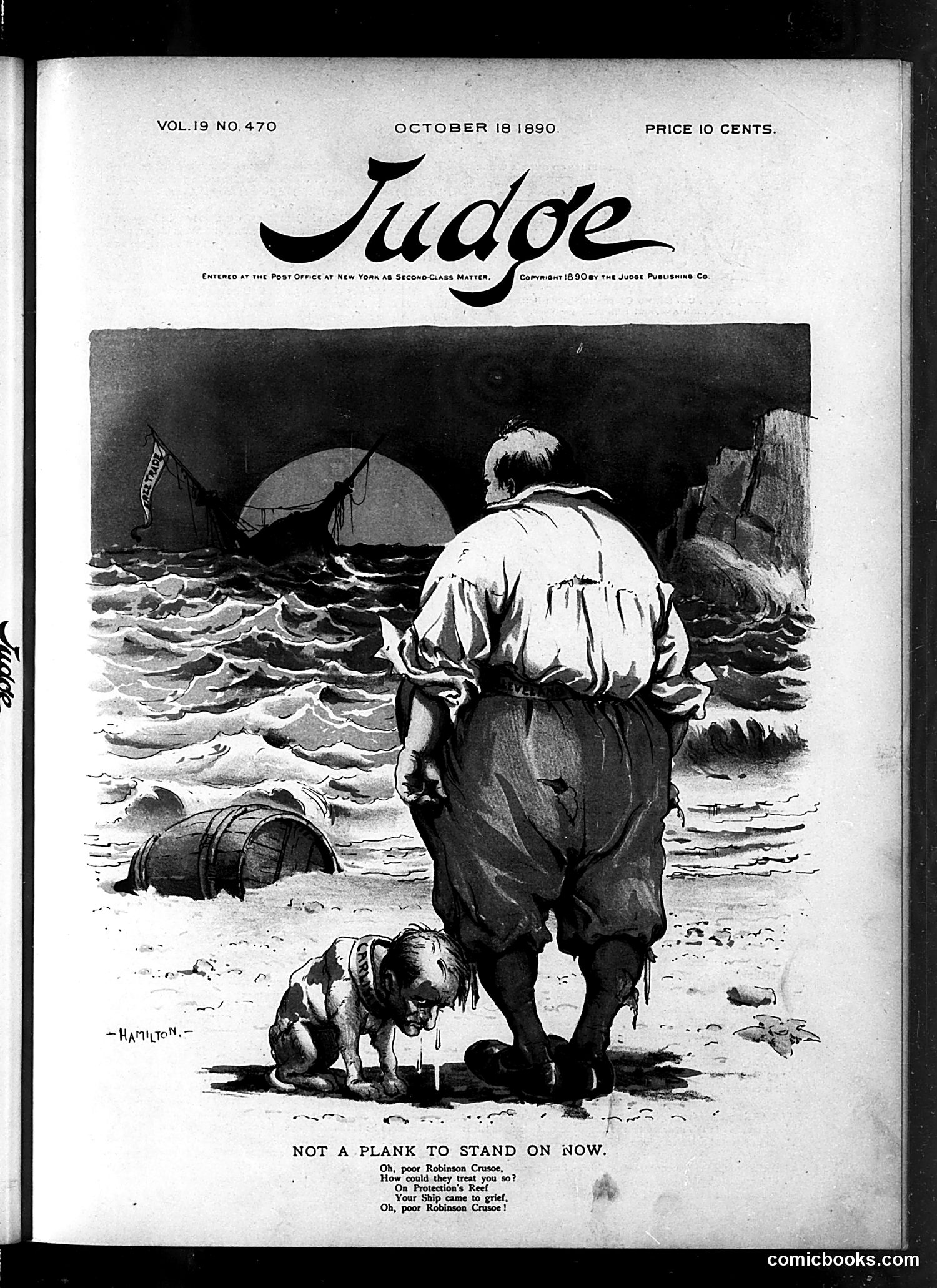
This political cartoon by Hamilton depicts a destitute man and his dog standing on a beach amid shipwreck debris. The title "NOT A PLANK TO STAND ON NOW" references Robinson Crusoe, the famous fictional castaway. The accompanying verse ("Oh, poor Robinson Crusoe! / How could they treat you so? / On Protection's Reef, / You've come to grief, / Oh, poor Robinson Crusoe!") suggests this critiques the political consequences of protective tariff policies. The figure appears to represent someone financially ruined by recent trade legislation—likely connected to 1890s tariff debates. The shipwreck metaphor emphasizes complete economic devastation. Without additional historical context, the specific "Robinson Crusoe" reference remains somewhat unclear, though it likely mocks a political figure or economic policy's disastrous effects.
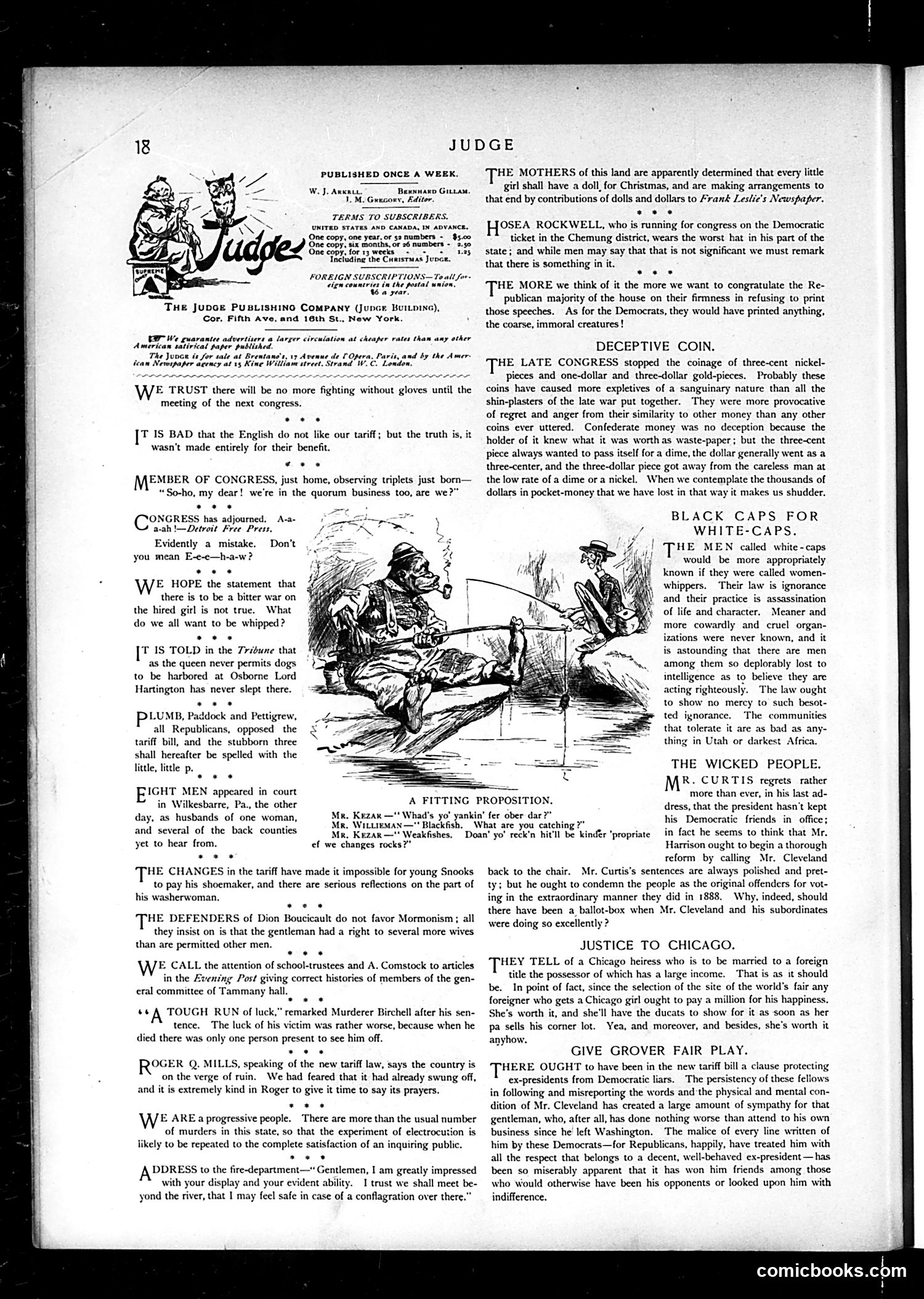
The main cartoon, "A Fitting Proposition," depicts two figures in what appears to be a workplace dispute. Based on the dialogue ("What's ye yankin' fer ober dar?" and references to "catching" something), this seems to satirize labor negotiations or workplace conflicts, likely from the late 19th or early 20th century. The surrounding editorial content addresses contemporary political issues: Republican positions on tariffs, Democratic congressional candidates, and criticism of President Cleveland's administration. References to "white-caps" (vigilante groups) and various social reforms suggest this addresses tensions between labor, capital, and political corruption of the era. The overall page reflects Judge's conservative Republican editorial stance, using humor and caricature to mock Democratic policies and social unrest.
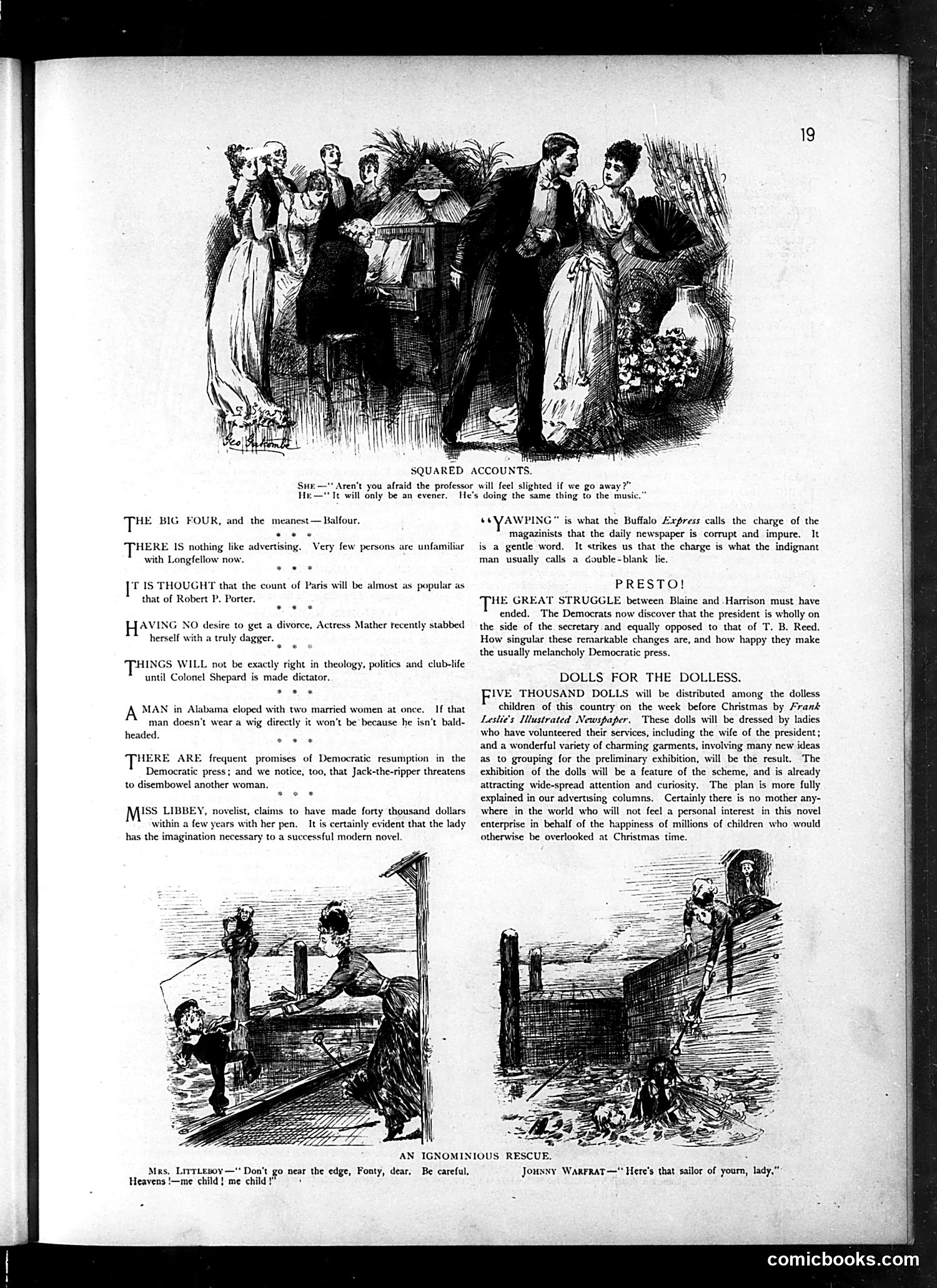
**Top Cartoon: "Squared Accounts"** Shows a social scene where a woman asks a man if he's afraid "the professor will feel slighted if we go away?" He responds it will be "an evener" since "he's doing the same thing to the mistress." The joke satirizes infidelity and hypocrisy among the upper classes—specifically that a professor's own affairs justify the couple's behavior. It's social commentary on Victorian-era moral duplicity. **Bottom Cartoons: "An Ignominious Rescue"** Two water-rescue scenes depicting apparent drowning situations with darkly comedic captions. Mrs. Littleroy warns "Don't go near the edge" while losing children; Johnny Waffrat offers rescue to a young woman. These appear to be humor based on rescue mishaps or ironic reversals of fortune. The page mixes political items with social satire typical of Judge's content.
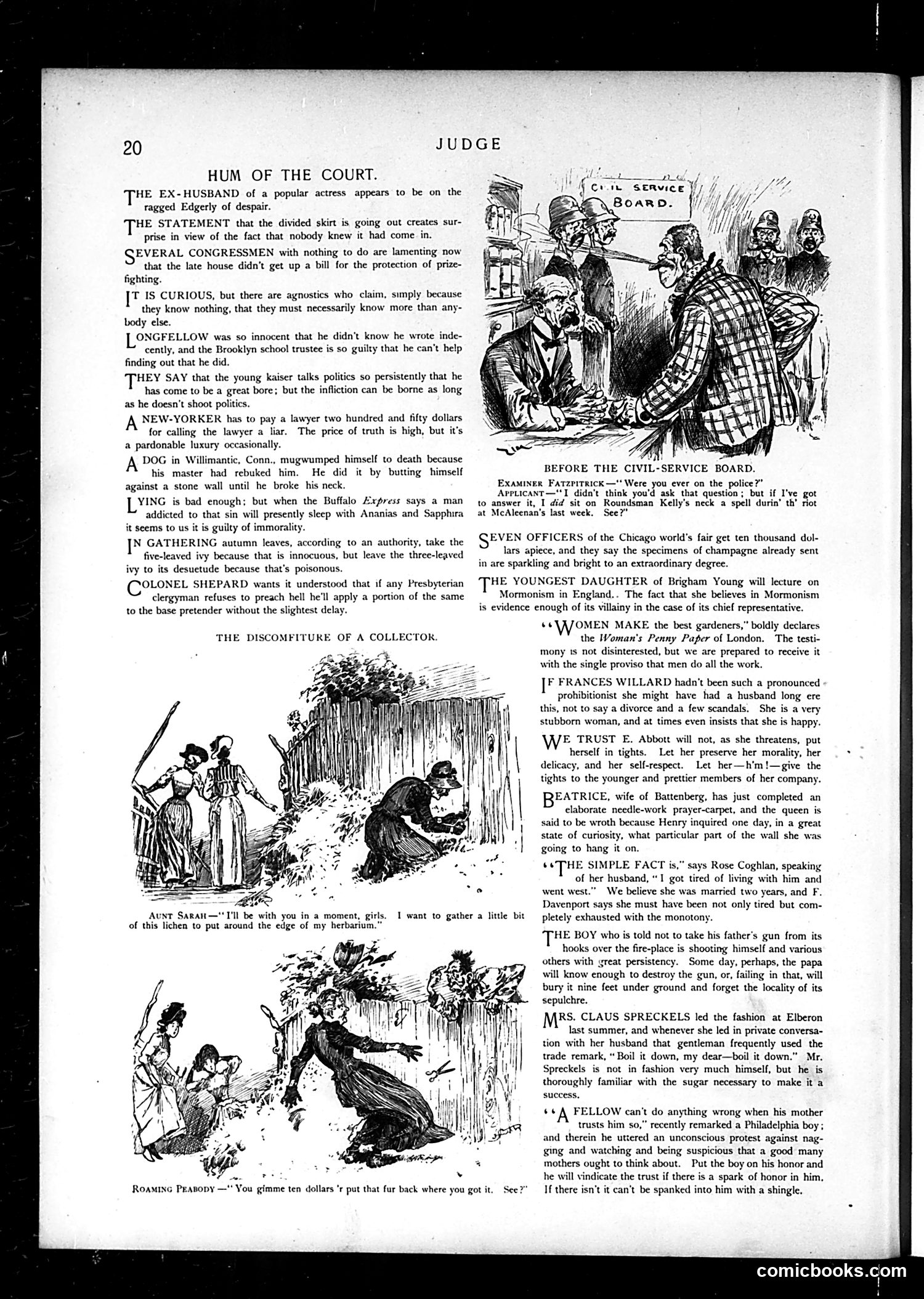
This page from Judge contains brief satirical observations and three illustrated cartoons mocking contemporary social and political figures. **Main Cartoons:** 1. **"Before the Civil-Service Board"**: A police officer admits he sat on another officer's neck during a riot, attempting to justify this violence as qualifying experience. The satire targets civil-service reform—mocking how loosely "qualification" was defined, and police brutality during labor unrest. 2. **"The Discomfiture of a Collector"**: A wealthy woman (Aunt Sarah) collecting lichen for her herbarium is confronted by a homeless man (Roaming Pageboy) demanding compensation for disturbing his shelter. The joke mocks upper-class indifference to the poor's plight. 3. **"Hum of the Court"**: Brief quips targeting Longfellow (alleged indecent writing), the young Kaiser, and Colonel Shepard's Presbyterian preaching standards—typical Judge humor mixing literary, political, and religious criticism.
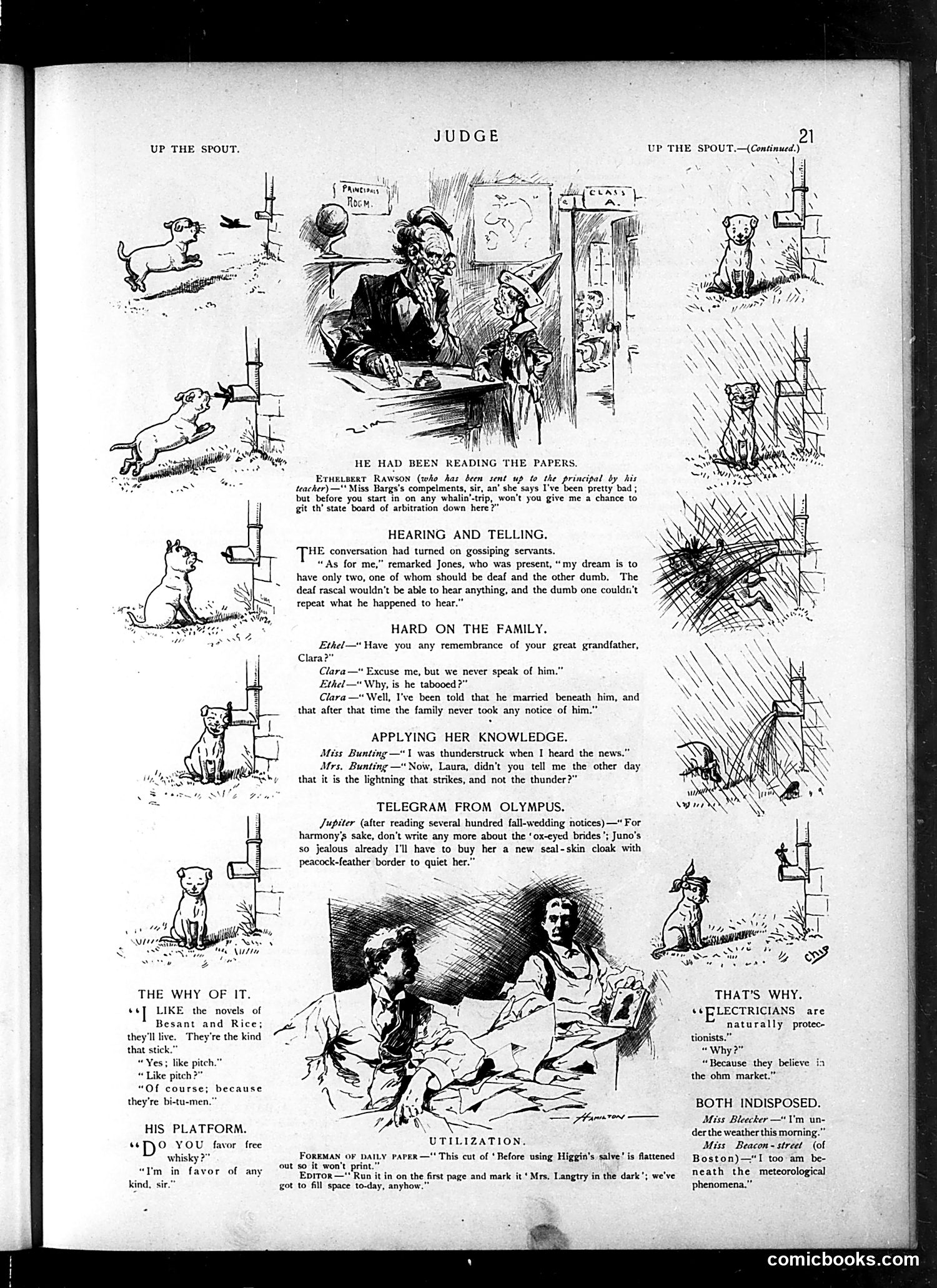
This page from *Judge* contains multiple brief satirical pieces typical of 1880s-90s humor magazines: **Main cartoons feature:** - A schoolboy citing "state board of arbitration" to avoid punishment—satirizing contemporary labor arbitration debates by applying them absurdly to discipline - Domestic servants gossiping—a recurring Victorian anxiety about household staff overhearing secrets - A woman correcting another's grammar about lightning vs. thunder, mocking pedantry - Jupiter jealous of "ox-eyed brides" (referencing Homer's epithets)—classical literary humor - Electricians as "protectionists" believing in the "ohm market"—a pun on economic protectionism and electrical resistance **Overall tone:** Light social satire targeting Victorian pretension, class anxieties, gender dynamics, and contemporary political/scientific terminology. The dogs illustrated throughout serve as visual breaks rather than narrative elements. The humor relies on wordplay, puns, and gentle mockery of everyday life rather than partisan politics.
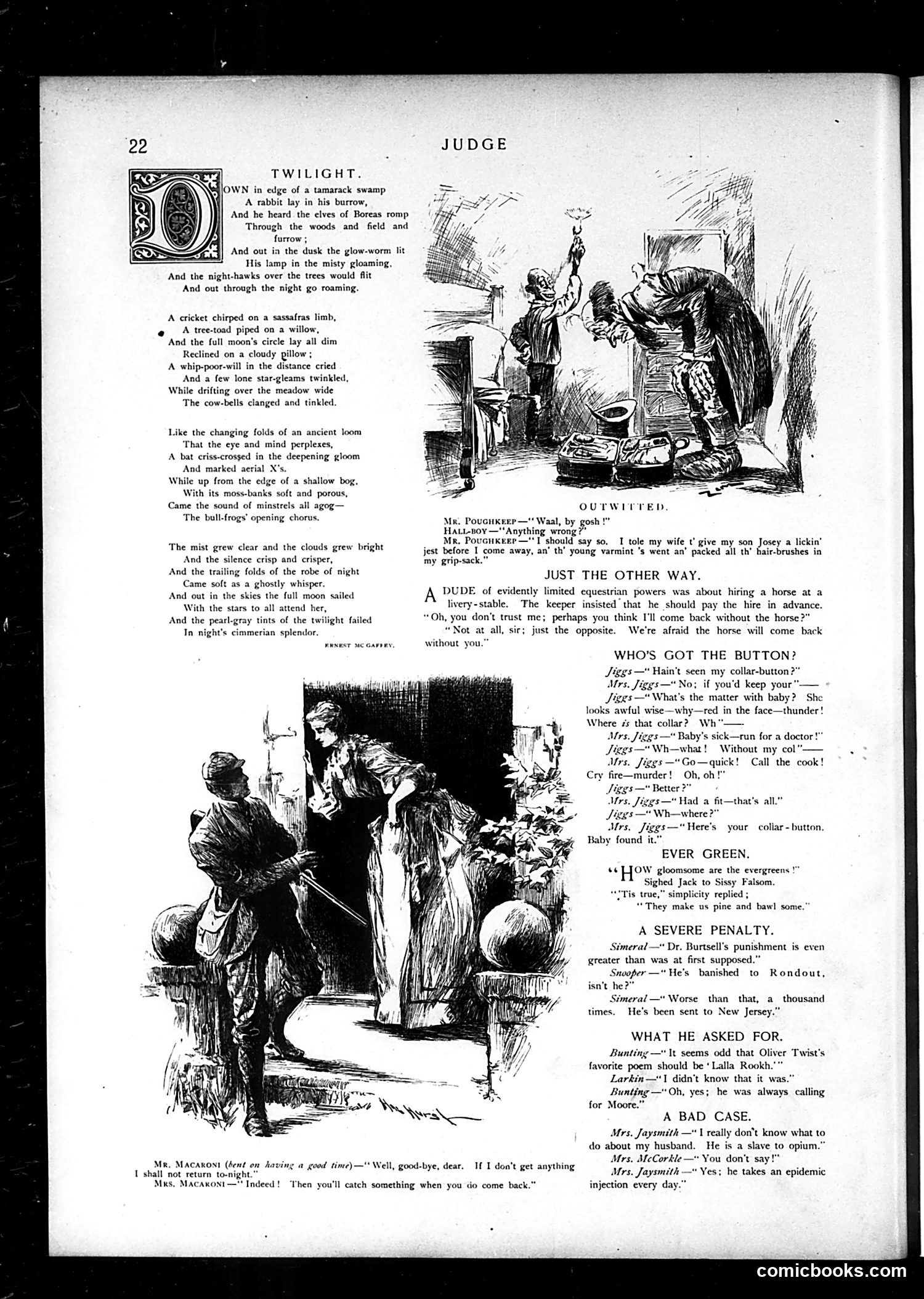
This page contains several short humorous sketches typical of late 19th/early 20th-century American satirical magazines: **"Twilight"** is a romantic poem about evening nature—not satirical content. **The cartoons** are brief domestic and social comedies: - **"Outwitted"**: A rural father's attempt to discipline his son backfires when the boy packs dad's hairbrushes in his grip-sack as revenge. - **"Just the Other Way"**: A livery stable keeper won't trust a well-dressed but incompetent dude with a horse—not because he fears the dude won't return, but that the *horse* won't. - **"Who's Got the Button?"**: A baby swallows a father's lost collar-button, causing a medical emergency that interrupts his domestic complaint. - **"A Severe Penalty"**: Banishment to New Jersey is humorously presented as worse punishment than expected. The humor relies on class stereotypes, domestic conflict, and wordplay rather than political commentary.
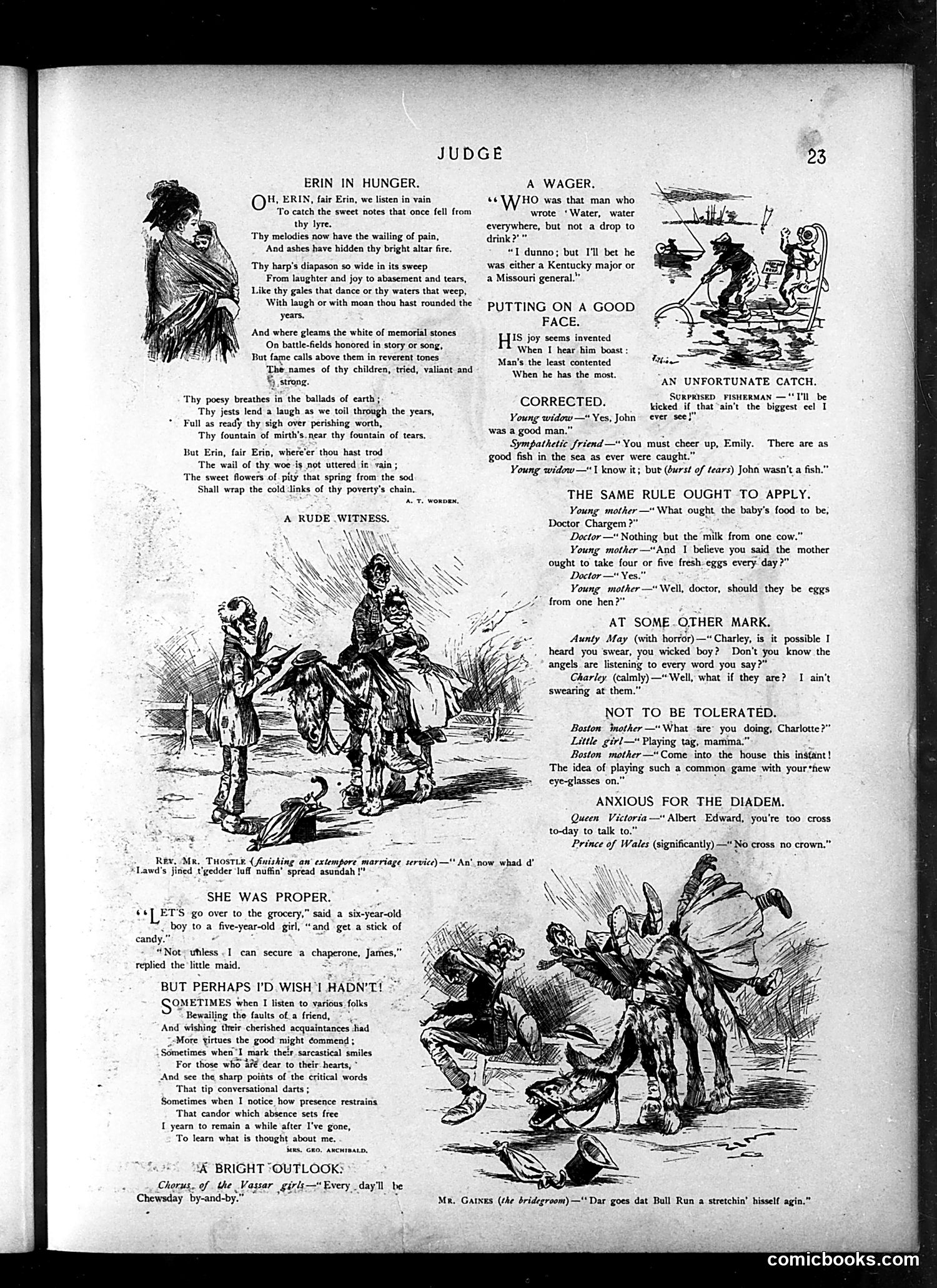
This page contains multiple unrelated satirical pieces typical of Judge's format: **"Erin in Hunger"** — A sentimental poem about Ireland's suffering, likely referencing 19th-century Irish famine and poverty. It romanticizes Irish cultural resilience amid hardship. **"A Wager"** — A brief joke about the Coleridge poem "The Rime of the Ancient Mariner" (water, water everywhere), with the punchline attributing its authorship to a Kentucky or Missouri military officer—mocking American regionalism or ignorance. **Multiple domestic humor sketches** — Including jokes about widows, young mothers consulting doctors, children swearing, and proper Victorian etiquette. These mock contemporary middle-class social conventions and parenting advice. **"Anxious for the Diadem"** — A quip between Queen Victoria and the Prince of Wales about "no cross, no crown"—wordplay on royal symbols and the prince's allegedly difficult temperament. The illustrations depict these everyday domestic and social scenarios. The overall tone is light satirical commentary on American and British society's pretensions and absurdities.
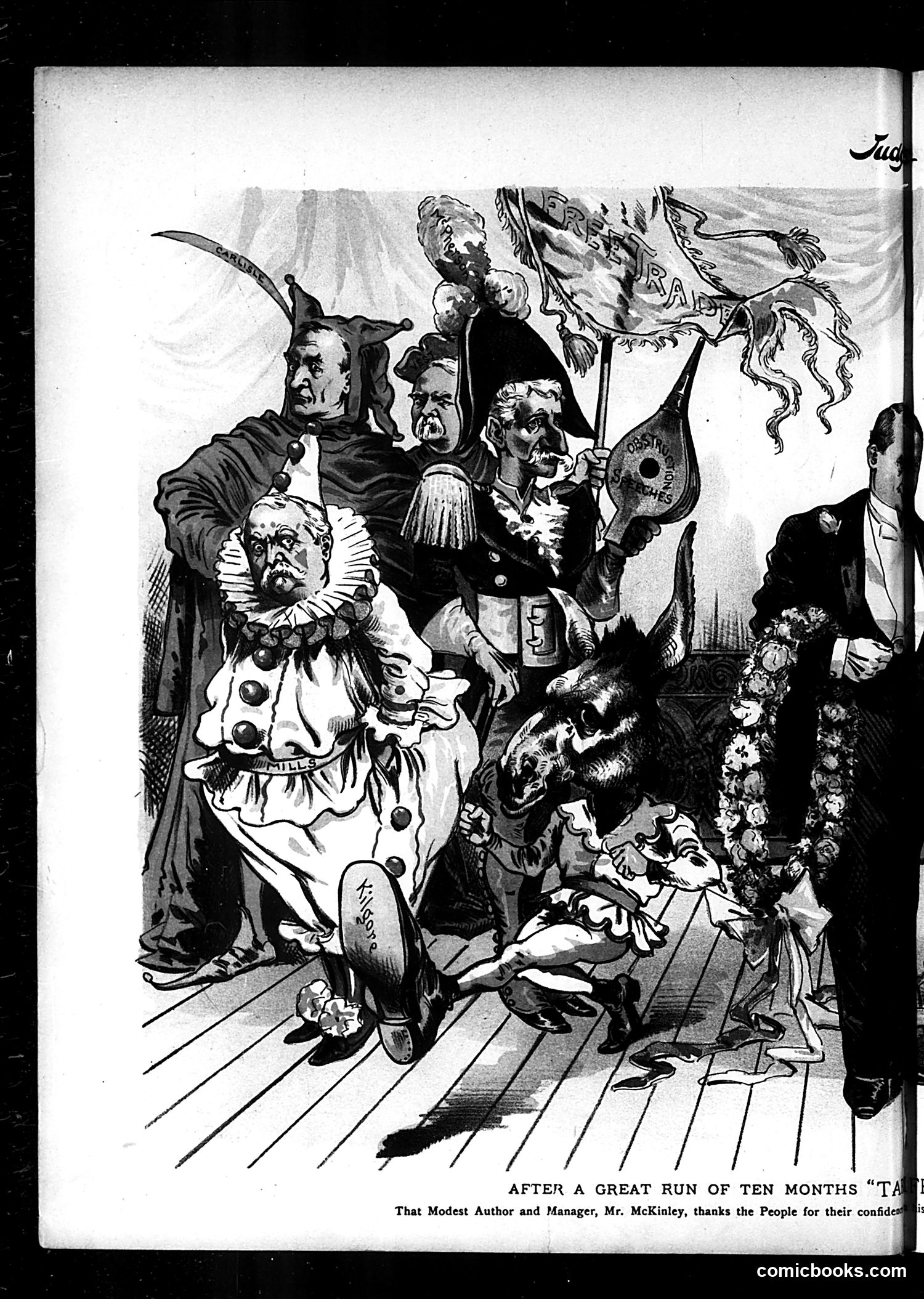
This is a satirical cartoon likely from 1896-1897, referencing President William McKinley's theatrical production (the text mentions a "ten month run"). The caricature shows McKinley as a portly clown or performer surrounded by exaggerated political figures in costume—some wearing devil horns, military dress, and holding flags labeled "EXPANSION" and similar political themes. The satire mocks McKinley's administration as theatrical performance rather than serious governance. The carnival/circus imagery suggests his policies (likely regarding American imperialism and overseas expansion) are being presented as entertainment or spectacle to the public. The "modest author and manager" description is clearly ironic—McKinley is portrayed as orchestrating political theater while claiming humility. The grotesque supporting characters represent his political allies or the distorted consequences of his policies.
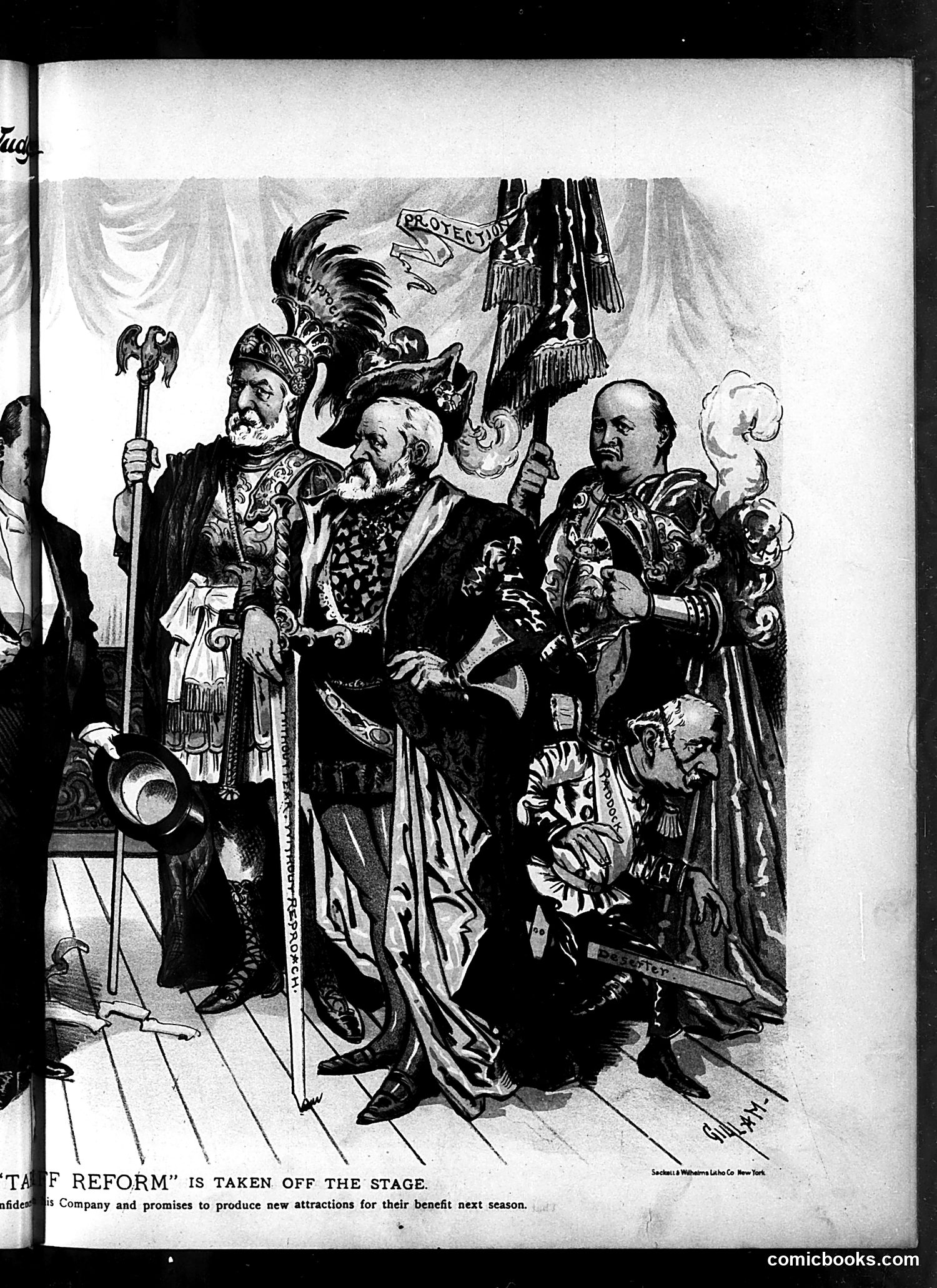
This satirical cartoon depicts "Tariff Reform" as a theatrical production being removed from the stage. The image shows elaborately dressed figures in period costume—appearing to be political leaders or theatrical performers—with one central figure prominently displayed. The satire suggests that tariff reform, a major political issue of the era, is being treated like a failed theatrical show that audiences have rejected. The costume and staging imagery implies political leaders are merely performing rather than genuinely addressing economic policy. The caption's reference to "next season" and "new attractions" mockingly suggests politicians will simply replace this unpopular policy with other crowd-pleasing measures rather than implement substantive reform. The specific historical context—likely late 19th or early 20th century—remains unclear without additional publication information, though tariff reform was contentious during multiple American political periods.
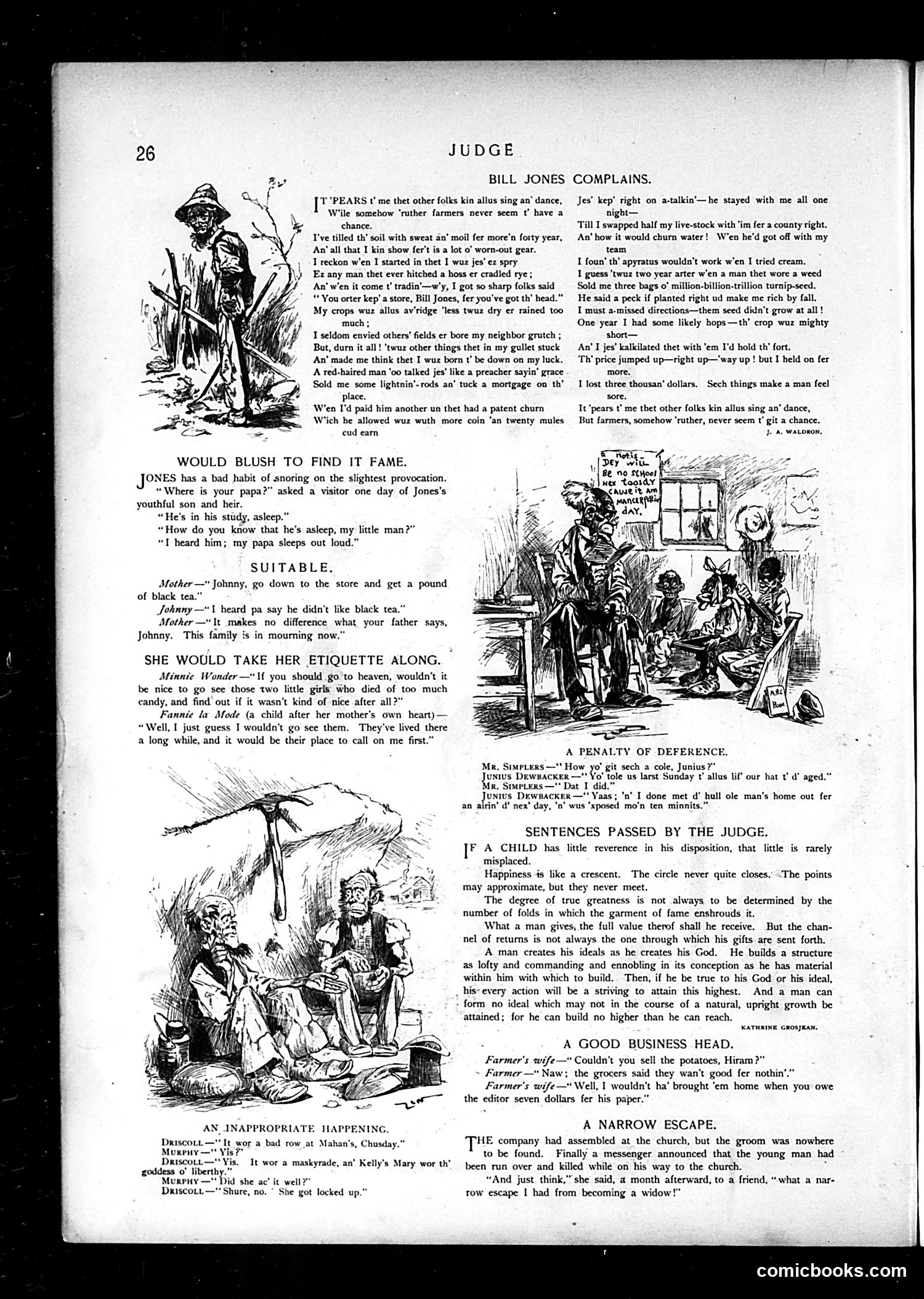
This page from *Judge* presents satirical commentary on rural American life through the character "Bill Jones," a farmer who complains about his persistent bad luck and exploitation. **Main Cartoon/Story**: "Bill Jones Complains" depicts a stereotypical farmer—characterized by rural dialect and dress—lamenting forty years of agricultural struggle. The satire targets con artists and schemes that prey on farmers: a lightning-rod salesman, a patent-churn vendor, and a seed hawker all defraud Jones through smooth talk and false promises, leaving him bankrupt. **Social Context**: This reflects late-19th-century anxieties about rural America's economic vulnerability. Farmers faced actual exploitation from traveling salesmen, patent medicine dealers, and agricultural schemes. Jones's repeated victimization satirizes both farmer naïveté and predatory capitalism. **Additional Humor**: Side pieces mock children's literal-mindedness, loud snoring, and social pretension—typical *Judge* fare mixing domestic comedy with social observation. The page suggests *Judge's* sympathetic but somewhat condescending view of rural America's struggles against modernization and commercial exploitation.
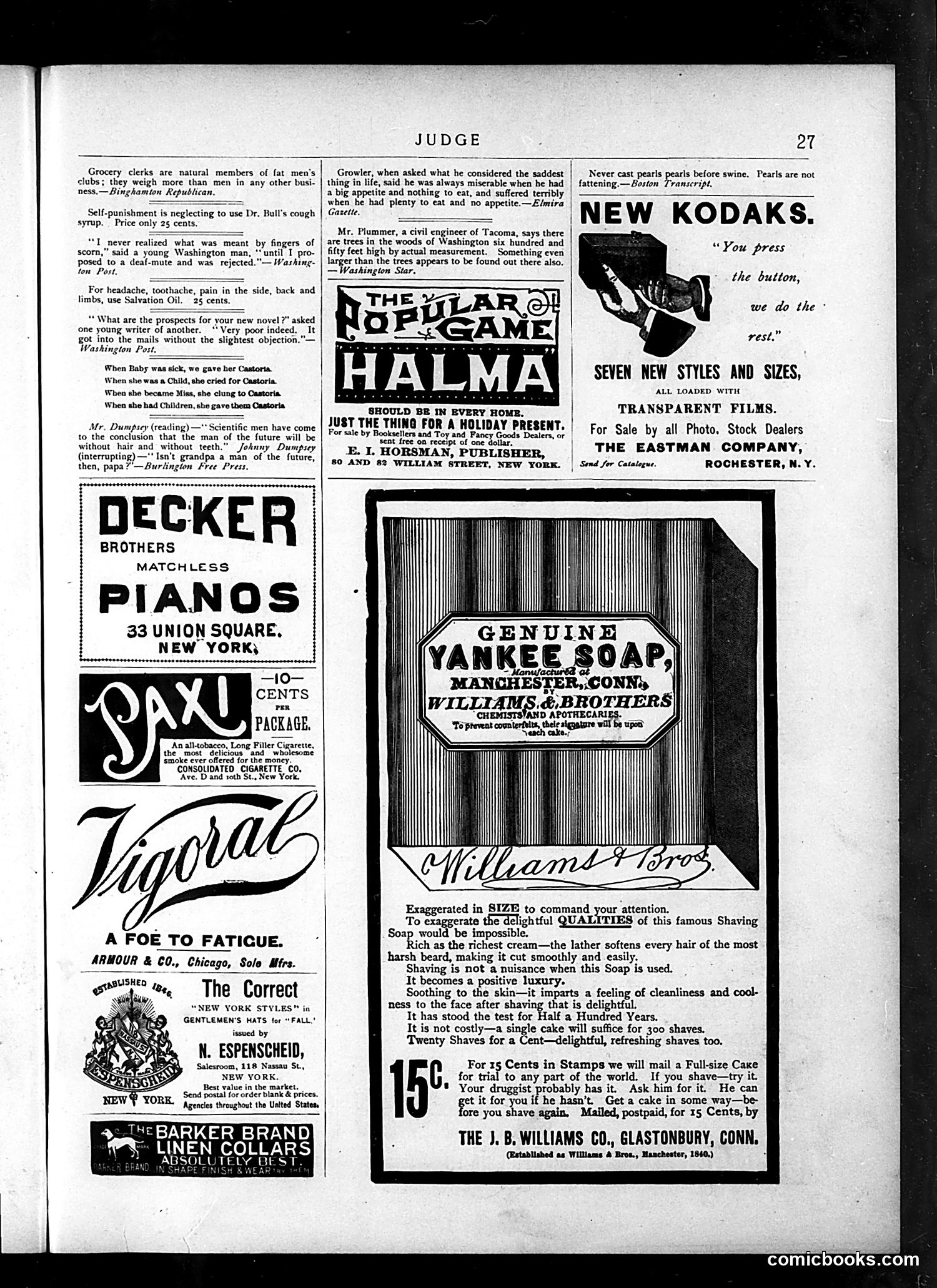
This page is primarily **advertisements with brief humor snippets**, not political cartoons. The ads promote products typical of the 1890s-1900s era: pianos, cigars, soap, and Kodak cameras. The small humorous items are light social observations rather than satire: - A joke about a Washington man proposing to a deaf-mute woman and being rejected (playing on "fingers of scorn") - A comment that grocery clerks are heavier than other workers - An exchange about a novelist whose work "got into the mails without the slightest objection" (implying it was so forgettable it escaped censorship) - A child's logic joke: a father reads that future men will be bald and toothless; the child asks if grandpa is already the "man of the future" The dominant feature is the large **Yankee Soap advertisement** showcasing the product's qualities for shaving. No recognizable political figures or events are referenced. This appears to be a typical Judge issue mixing light humor with commercial content.
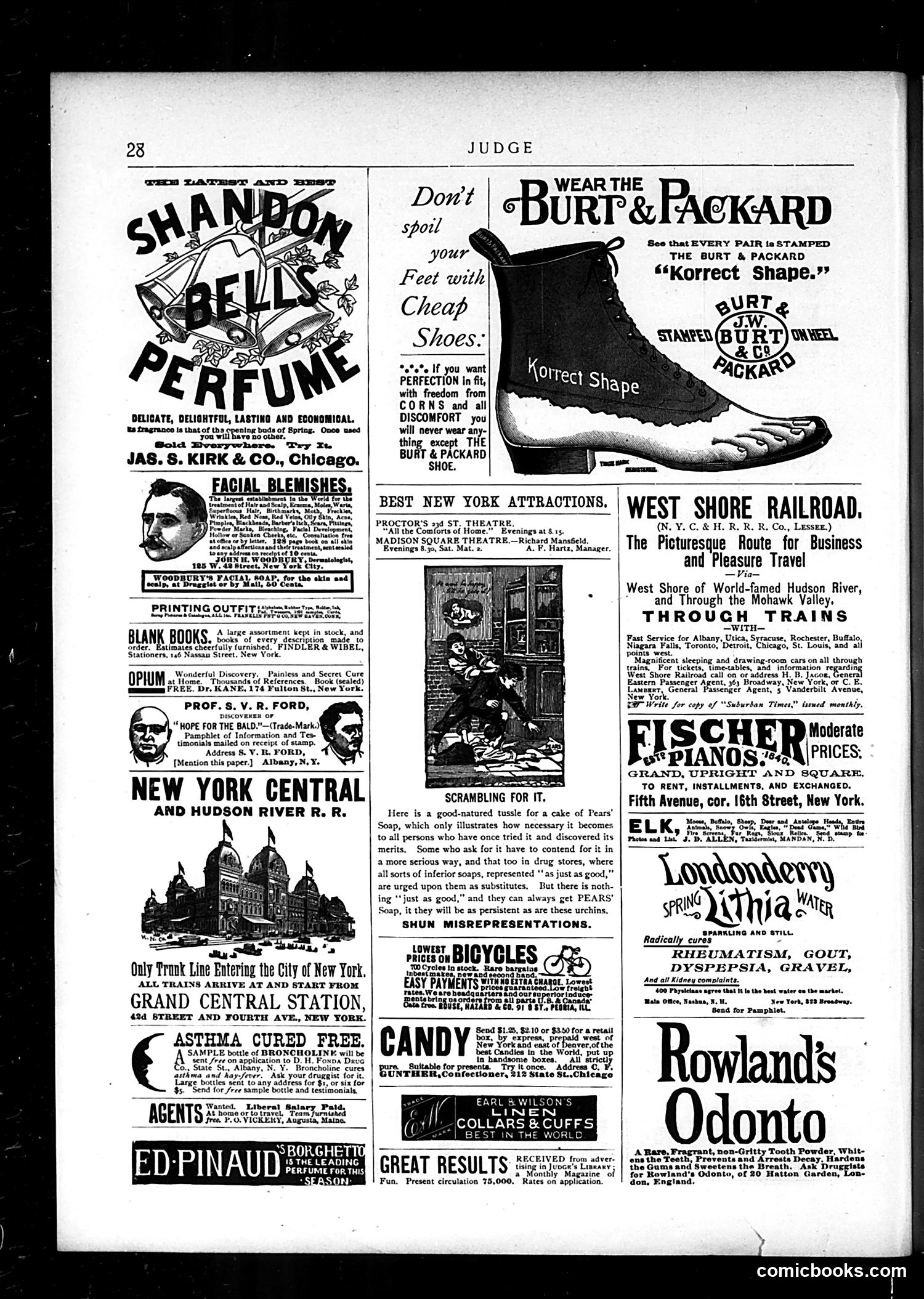
This page is primarily **advertising**, typical of late 19th-century magazine economics. The advertisements target middle and upper-class readers with products addressing contemporary concerns: **Key Product Categories:** - **Personal grooming/medical**: Hair restoration ("Hope for the Bald"), asthma cures, opium addiction treatment, and dermatology services—reflecting period anxieties about appearance and quack remedies - **Transportation**: New York Central Railroad and West Shore Railroad advertisements emphasizing comfort and accessibility - **Consumer goods**: Burt & Packard shoes (with "Korrect Shape"), Pears' Soap, bicycles, and pianos **Notable Satire Element:** The small cartoon "Scrambling for It" depicts children fighting over Pears' Soap, humorously illustrating consumer demand while warning against inferior substitutes—a meta-advertisement about brand loyalty in an era of widespread product counterfeiting. **Historical Context:** The ads collectively reveal 1890s American preoccupations: mobility (railroads), physical self-improvement, and brand-name consumerism as markers of respectability. The emphasis on "patent" solutions suggests both consumer sophistication and widespread skepticism about unproven remedies.
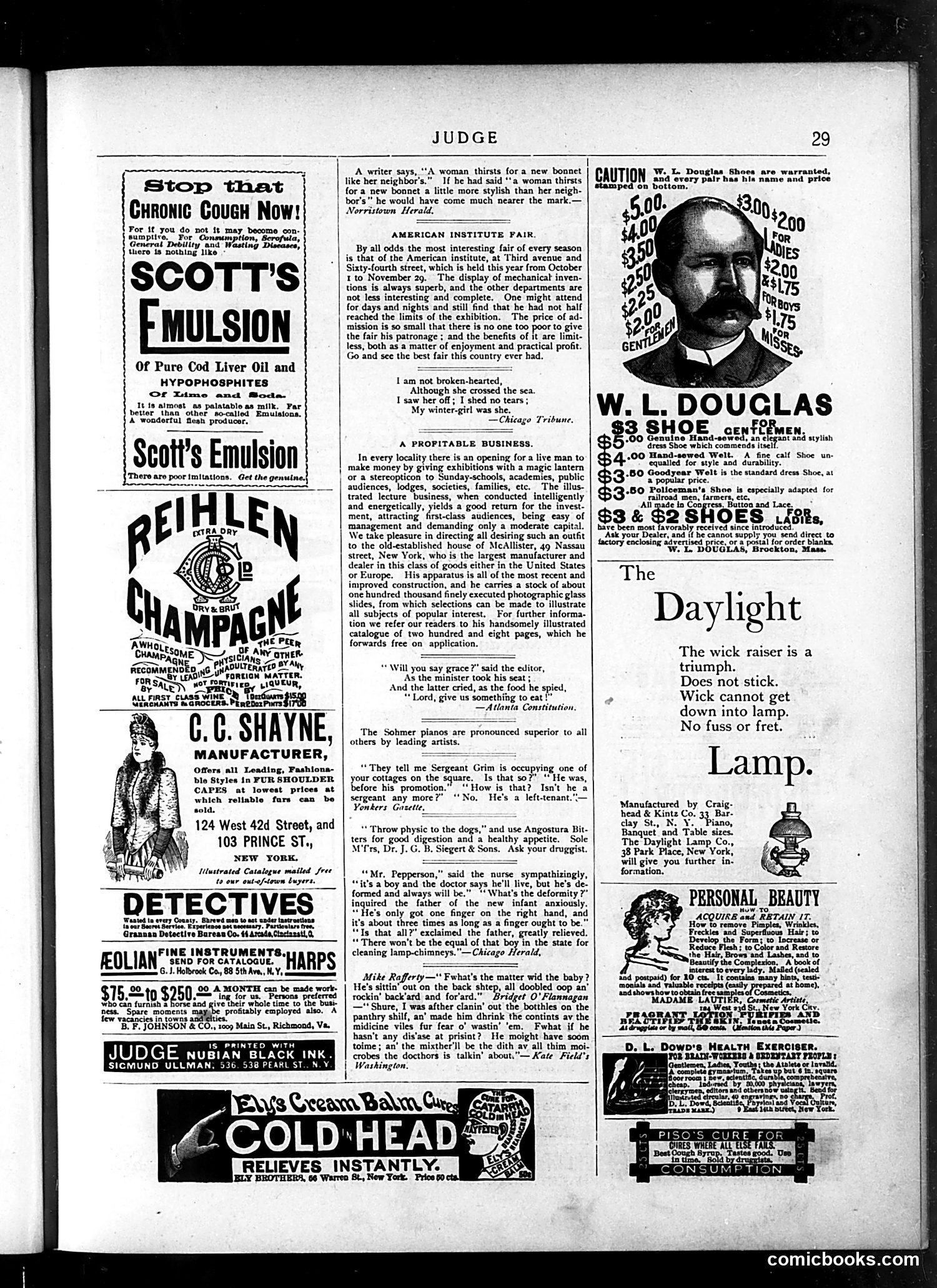
This page is primarily **advertising and editorials**, not political cartoons. The visible advertisements include Scott's Emulsion (cough remedy), fur capes, detectives-for-hire, and a Daylight Lamp. There is also a portrait of W.L. Douglas promoting his shoes. The text contains brief humorous anecdotes and editorial notes rather than satirical cartoons. One joke mocks women's fashion competitiveness (wanting bonnets more stylish than neighbors' rather than merely new). Another comments on a "winter-girl" who departed by sea. A third jokes about a minister asking grace before meals. There's also an editorial promoting the American Institute Fair at Third Avenue and 64th Street (held October-November), describing its mechanical inventions and reasonable admission price. This appears to be a typical page from Judge magazine's late 19th or early 20th-century format: mostly commercial advertisements interspersed with light humor and informational content rather than sharp political satire.
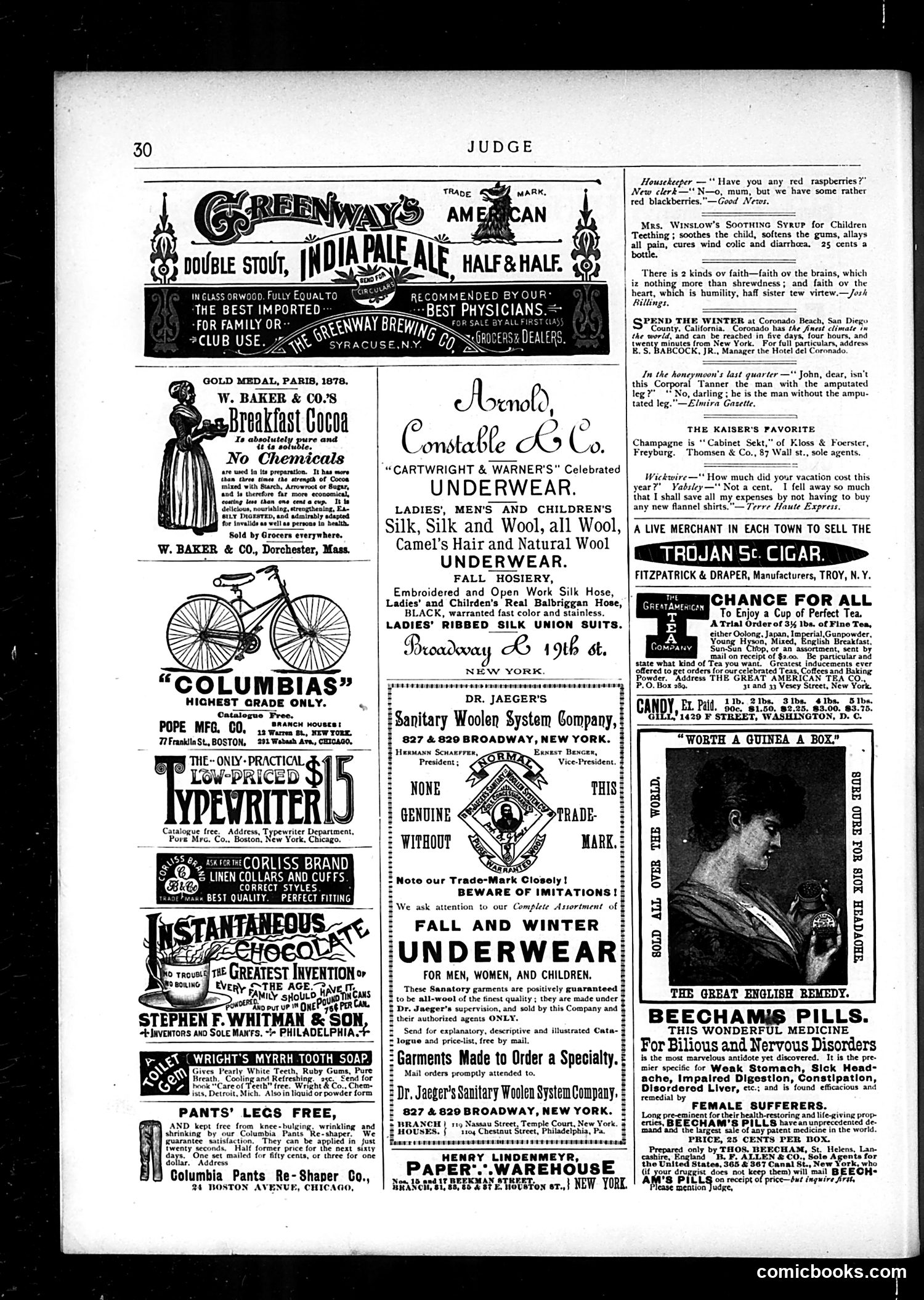
This page is primarily **advertising**, not political satire. It contains commercial advertisements for late 19th-century products: cocoa, bicycles ("Columbias"), typewriters, underwear (including Dr. Jaeger's "Sanitary Woolen System"), tooth soap, chocolate, tea, and pills. The small text items at top and bottom right are brief humorous quips rather than cartoons—jokes about a housewife asking for raspberries, "two kinds of faith," and honeymoon observations. These are generic humor fillers typical of magazine pages, not satirical commentary on specific political figures or events. The page represents Judge's mixed format: primarily a vehicle for advertisements rather than the satirical cartoons the magazine is historically known for.
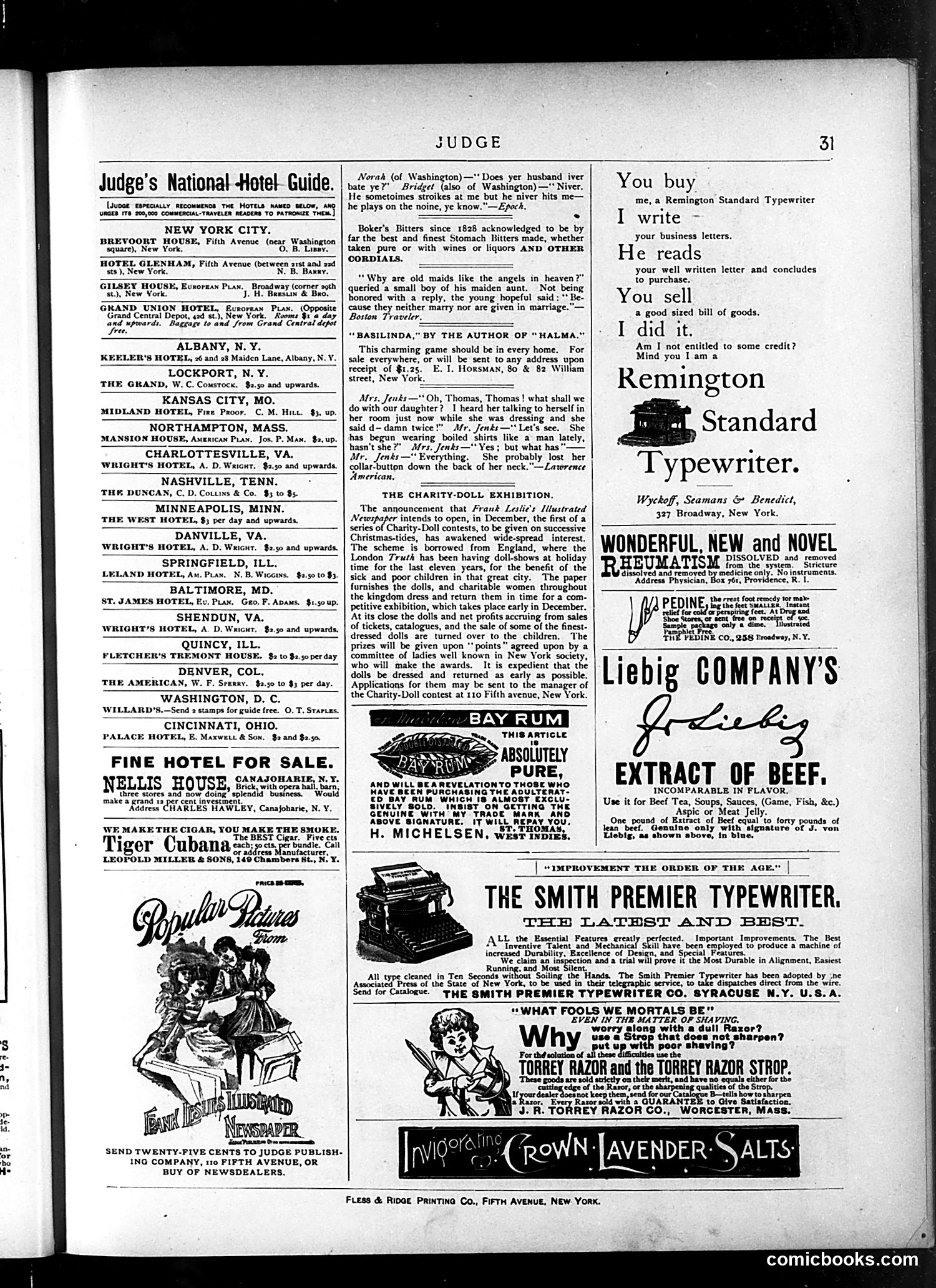
This page is primarily **advertising and hotel listings** with minimal cartoon content. The main satirical elements are brief jokes scattered among advertisements. The most notable humor appears in dialogue snippets: 1. **Irish maid joke**: A brief exchange between two Irish domestic workers ("Norah" and "Bridget") about spousal violence, presenting domestic abuse as humorous fodder—reflecting period attitudes that normalized such violence. 2. **Old maids joke**: A boy asks why old maids resemble angels in heaven, punchline being they "neither marry nor are given in marriage"—satirizing the social anxiety around unmarried women. 3. **The shirt joke**: A husband deduces his daughter has lost her morals because she's wearing men's shirts, implying that adopting masculine clothing signals moral degradation—commentary on 1890s gender anxieties about women's changing roles. The page is dominated by hotel advertisements targeting commercial travelers (salesmen) and product ads (typewriters, bitters, razors, cigars). The satirical content is secondary—brief, mild social commentary reflecting Victorian-era prejudices about gender, class, and Irish immigrants.
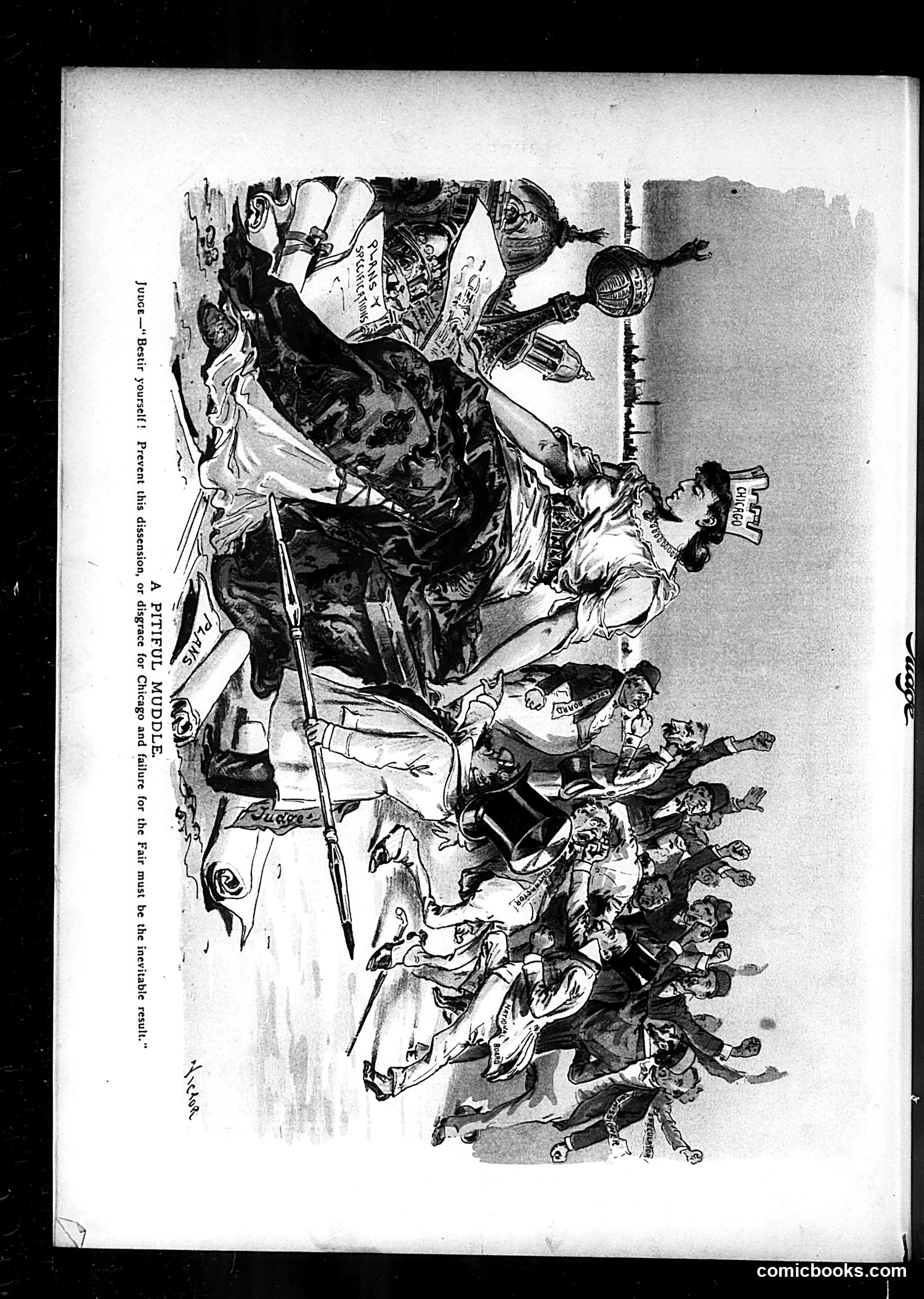
This is a political cartoon titled "A Pitiful Muddle" criticizing mismanagement of Chicago's World's Fair (likely the 1893 World's Columbian Exposition). The image depicts multiple figures in chaotic conflict—appearing to represent competing interests or factions involved in the Fair's organization. The caption shows "Judge" (the magazine's voice) demanding that someone take charge and prevent internal conflict, warning that continued "dissension" will result in "disgrace for Chicago and failure for the Fair." The satire targets the organizational incompetence and political infighting surrounding the Fair's planning and execution. The "muddle" suggests bureaucratic confusion, rival power-brokers, or factional disputes undermining what was meant to be a prestigious civic achievement. Without clearer labels on the figures, the specific individuals involved remain unclear, but the cartoon clearly mocks Chicago's failure to manage the project competently.