
Judge, 1890-10-18 · page 10 of 16
Judge — October 18, 1890 — page 10: what you’re looking at
What you’re looking at
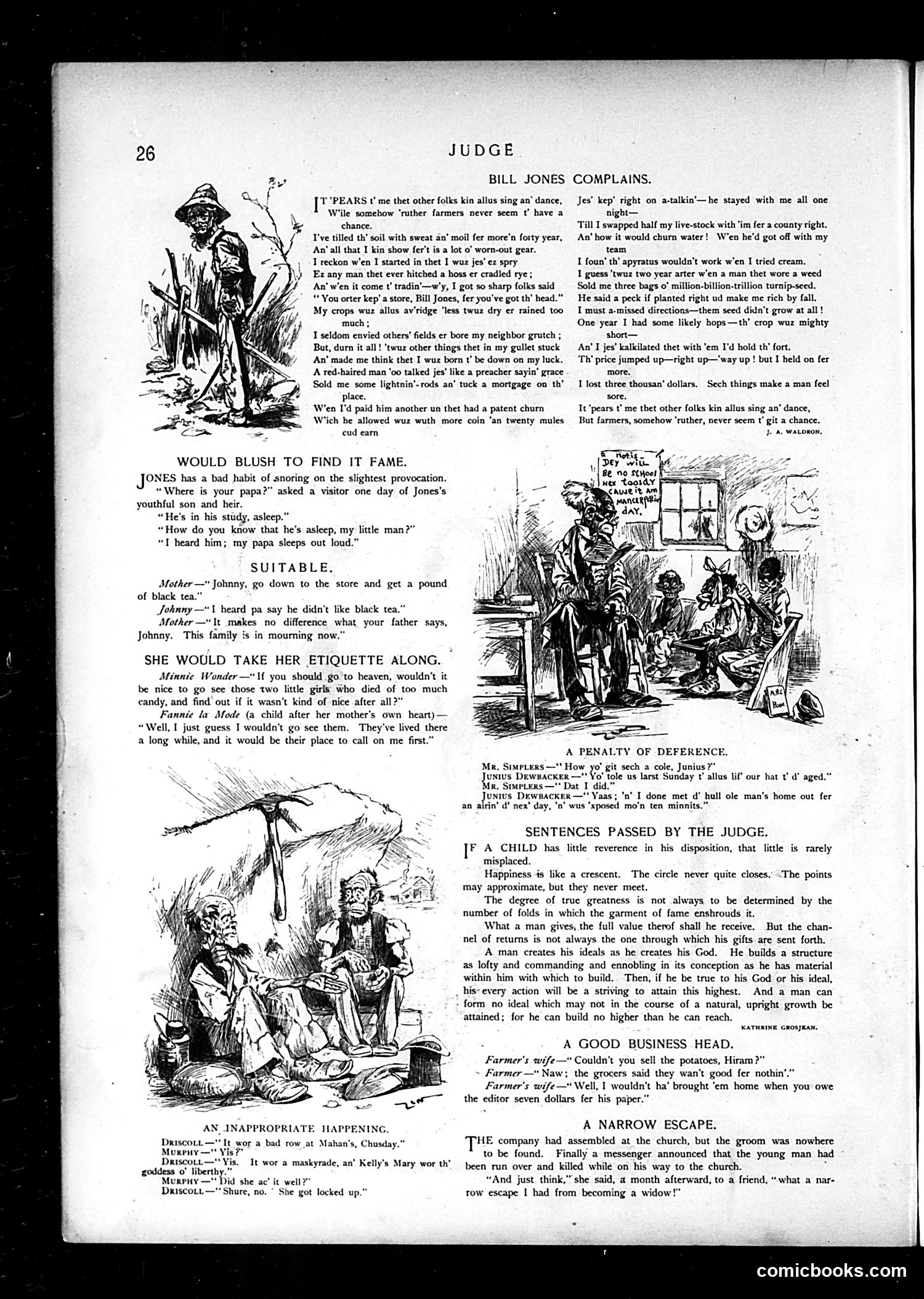
This page from *Judge* presents satirical commentary on rural American life through the character "Bill Jones," a farmer who complains about his persistent bad luck and exploitation. **Main Cartoon/Story**: "Bill Jones Complains" depicts a stereotypical farmer—characterized by rural dialect and dress—lamenting forty years of agricultural struggle. The satire targets con artists and schemes that prey on farmers: a lightning-rod salesman, a patent-churn vendor, and a seed hawker all defraud Jones through smooth talk and false promises, leaving him bankrupt. **Social Context**: This reflects late-19th-century anxieties about rural America's economic vulnerability. Farmers faced actual exploitation from traveling salesmen, patent medicine dealers, and agricultural schemes. Jones's repeated victimization satirizes both farmer naïveté and predatory capitalism. **Additional Humor**: Side pieces mock children's literal-mindedness, loud snoring, and social pretension—typical *Judge* fare mixing domestic comedy with social observation. The page suggests *Judge's* sympathetic but somewhat condescending view of rural America's struggles against modernization and commercial exploitation.
📄 Transcribed text from this page (OCR, searchable)
Machine-transcribed from the original scan — historical spelling and the odd misread are preserved.
JUDGE BILL JONES COMPLAINS. T'PEARS ¢’ me thet other folks kin allus sing an’ dance, Wiile somehow ‘ruther farmers never seem t’ have a chance. I've tilled th’ soil with sweat an’ moil fer more’n forty year, ‘An’ all that I kin show fer't is a lot o' worn-out gear. I reckon wen I started in thet I wuz jes’ ez spry Ez any man thet ever hitched a hoss er cradled rye; ‘An’ w'en it come t’ tradin’—w’y, I got so sharp folks said “You orter kep’ a store, Bill Jones, fer you've got th’ head.” My crops wuz allus av'ridge ‘less twuz dry er rained too much ; I seldom envied others’ fields er bore my neighbor grutch ; But, dun it all ! ‘twuz other things thet in my gullet stuck An’ made me think thet I wuz born t’ be down on my luck. A red-haired man ‘oo talked jes’ like a preacher sayin’ grace Sold me some lightnin'-rods an’ tuck a mortgage on th’ place. W'en I'd paid him another un thet had a patent churn Wich he allowed wuz wuth more coin ‘an twenty mules Jes’ kep’ right on a-talkin’—he stayed with me all one night— Till I swapped half my live-stock with ‘im fer a county right. An’ how it would churn water! W'en he'd got off with my team I foun’ th’ apyratus wouldn't work w'en I tried cream. I guess ‘twuz two year arter w'en a man thet wore a weed Sold me three bags o' million-billion-trillion turnip-seed. He said a peck if planted right ud make me rich by fall. I must a-missed directions—them seed didn’t grow at all ! One year I had some likely hops—th’ crop wuz mighty short— An’ I jes’ kalkilated thet with ‘em I'd hold th’ fort. Th’ price jumped up—right up—way up ! but I held on fer more. I lost three thousan’ dollars. Sech things make a man feel sore, It'pears t' me thet other folks kin allus sing an’ dance, But farmers, somehow ‘ruther, never seem t’ git a chance. cud earn WOULD BLUSH TO FIND IT FAME. JONE has a bad habit of snoring on the slightest provocation. “Where is your papa?” asked a visitor one day of Jones's youthful son and heir. “He's in his study, asleep.” “How do you know that he’s asleep, my little man?” “T heard him; my papa sleeps out loud.” SUITABLE. Mother —" Johnny, go down to the store and get a pound of black tea.” Johnny —"\ heard pa say he didn’t like black tea.” ‘Mother —"It makes no difference what your father says, Johnny. This family is in mourning now. SHE WOULD TAKE HER ETIQUETTE ALONG. Minnie Wonder —“\f you should goto heaven, wouldn't it be nice to go see those two little girls who died of too much candy, and find’ out if it wasn’t kind of nice after all?” Fannie la Mode (a child after her mother's own heart) — “Well, I just guess I wouldn't go see them. They've lived there a long while, and it would be their place to call on me first.” jit sech a cole, Junius?” BACKER —"' Yo' tole us larst Sunday t’ allus lif’ our hat t' d’ aged.” —"Dat I did.” vBACKER —" Yaas ; ‘n' I done met d’ hull ole man's home out fer an airin' d’ nex’ day, 'n’ wus ‘xposed mo'n ten minnits.” SENTENCES PASSED BY THE JUDGE. F A CHILD has little reverence in his disposition, that little is rarely misplaced. Happiness #s like a crescent. The circle never quite closes.” ~The points may approximate, but they never meet. The degree of true greatness is not always to be determined by the number of folds in which the garment of fame enshrouds it. What a man gives, the full value therof shall he receive. But the chan- nel of returns is not always the one through which his gifts are sent forth. A man creates his ideals as he creates his God. He builds a structure as lofty and commanding and ennobling in its conception as he has material within him with which to build. Then, if he be true to his God or his ideal, his- every action will be a striving to attain this highest. And a man can > form no ideal which may not in the course of a natural, upright growth be attained; for he can build no higher than he can reach. KATHRINE GROSJRAN. A GOOD BUSINESS HEAD. Farmer's wife—* Couldn't you sell the potatoes, Hiram ?” Farmer —" Naw; the grocers said they wan't good fer nothin’.” Farmer's wife—*Well, | wouldn't ha’ brought ‘em home when you owe the editor seven dollars fer his paper.” A NARROW ESCAPE. THE company had assembled at the church, but the groom was nowhere to be found. Finally a messenger announced that the young man had been run over and killed while on his way to the church. : “And just think,” she said, a month afterward, to a friend, “what a nar- row escape I had from becoming a widow!” Driscor Murrny — Driscou.—"* goddess o° libert Merri Did she ac’ it well?" DxiscoLt—"* Shure, no. “ She got locked up.” It wor a maskyrade, an’ Kelly's Mary wor th’ comicbooks.com