
A complete issue · 16 pages · 1890
Judge — August 16, 1890
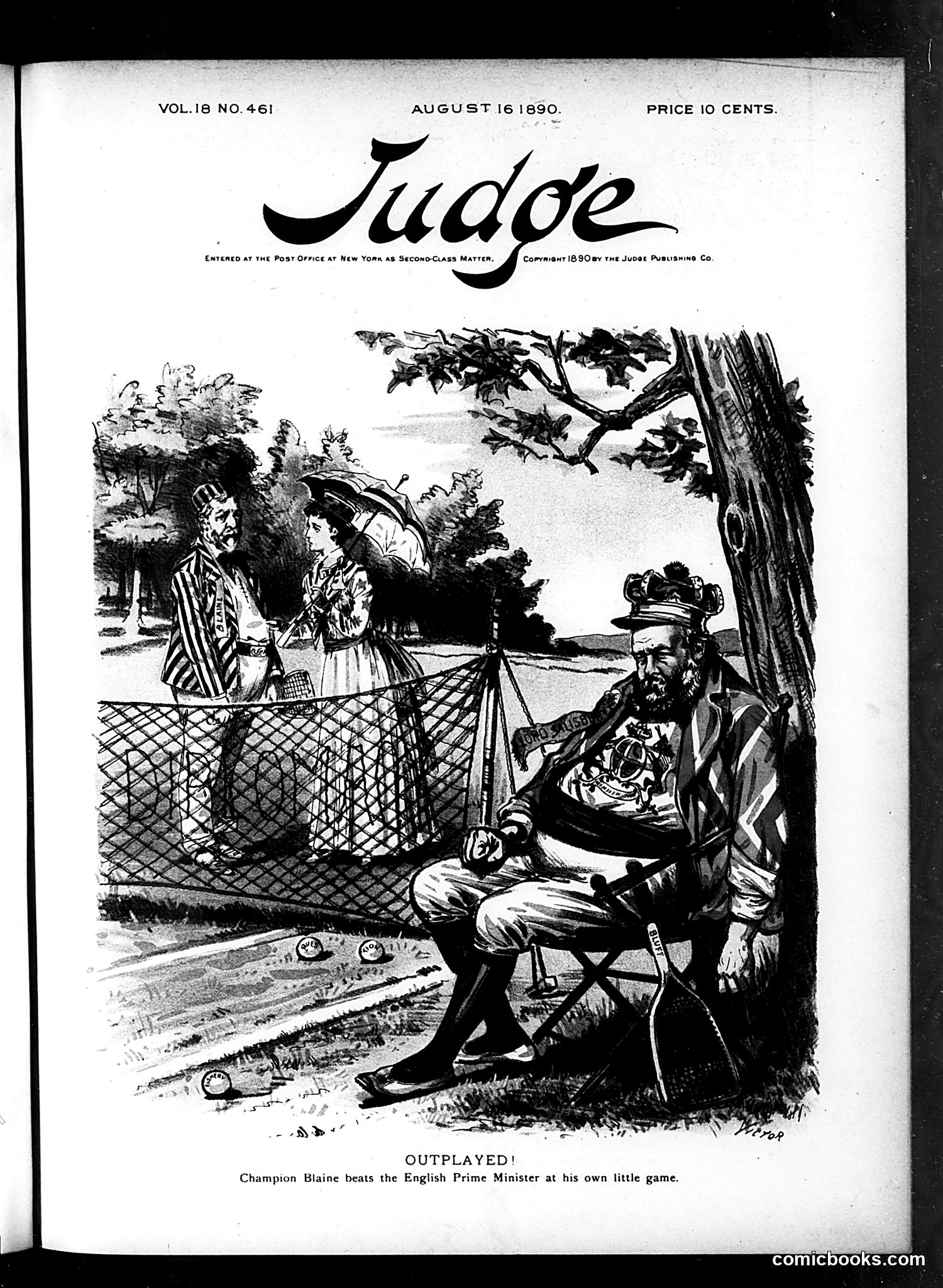
This political cartoon depicts **Champion Blaine** (likely James G. Blaine, the prominent American politician) seated and relaxed, having apparently defeated the **English Prime Minister** at some unspecified game. Two well-dressed figures observe from behind a fence in the background. The satire plays on the phrase "outplayed"—Blaine has literally beaten the British leader at what appears to be a recreational game, but the cartoon likely references broader diplomatic or political maneuvering between the United States and Britain during this period. The casual, confident posture of Blaine versus the formal setting suggests American shrewdness triumphing over British formality. The specific political dispute referenced remains unclear without additional historical context from this 1890 issue.
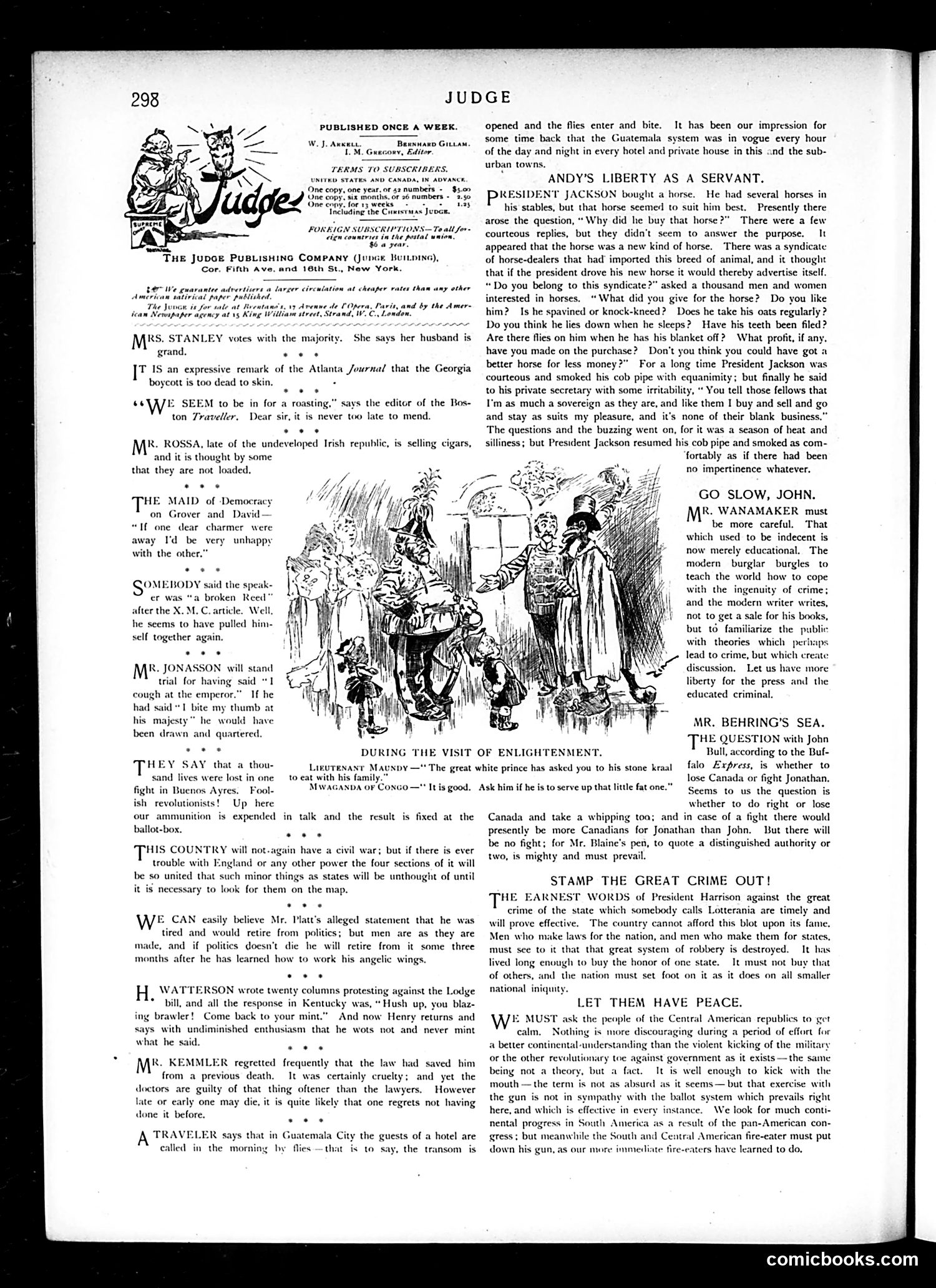
The central illustration depicts "During the Visit of Enlightenment," showing what appears to be a caricatured official or authority figure (possibly representing a government representative) surrounded by common people in a crowded, chaotic scene. The cartoon satirizes the contrast between official rhetoric about "enlightenment" and messy democratic reality. The surrounding editorial commentary addresses various political topics including President Jackson's handling of horse purchases, press freedom concerns, and Central American political instability. One section titled "Stamp the Great Crime Out!" discusses crime legislation. The overall tone suggests Judge is critiquing government inefficiency, official hypocrisy, and the gap between grand political gestures and practical governance—characteristic of 19th-century American political satire targeting both domestic policy failures and international interventionism.
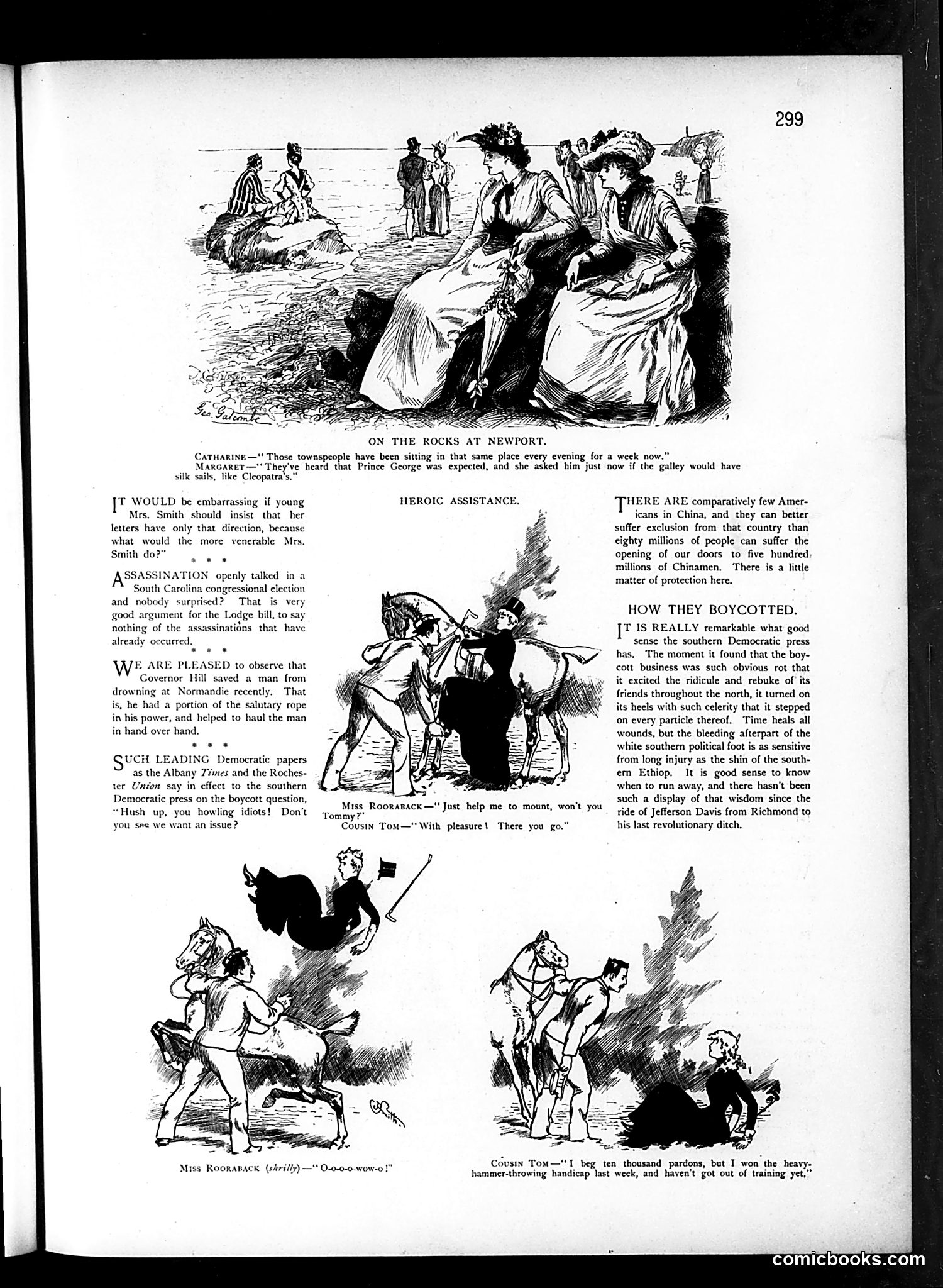
This page satirizes late 19th-century American political and social issues through several cartoons and commentary sections. **"On the Rocks at Newport"** depicts wealthy socialites gossiping, with Catharine mentioning Prince George's expected visit and concerns about proper seating arrangements—mocking upper-class preoccupations. The text sections address contemporary controversies: assassination politics in South Carolina congressional elections, a governor saving a man from drowning (positioning himself as heroic), and Democratic newspaper attacks on the Lodge bill regarding Southern Democratic boycotts. **The equestrian cartoons** featuring "Miss Roorback" appear to mock a specific political figure or scandal (likely related to the "Roorback" term, historically used for political falsehoods), showing her riding mishaps with humorous captions about training and competition. The overall page reflects Gilded Age class divisions and partisan political tensions.
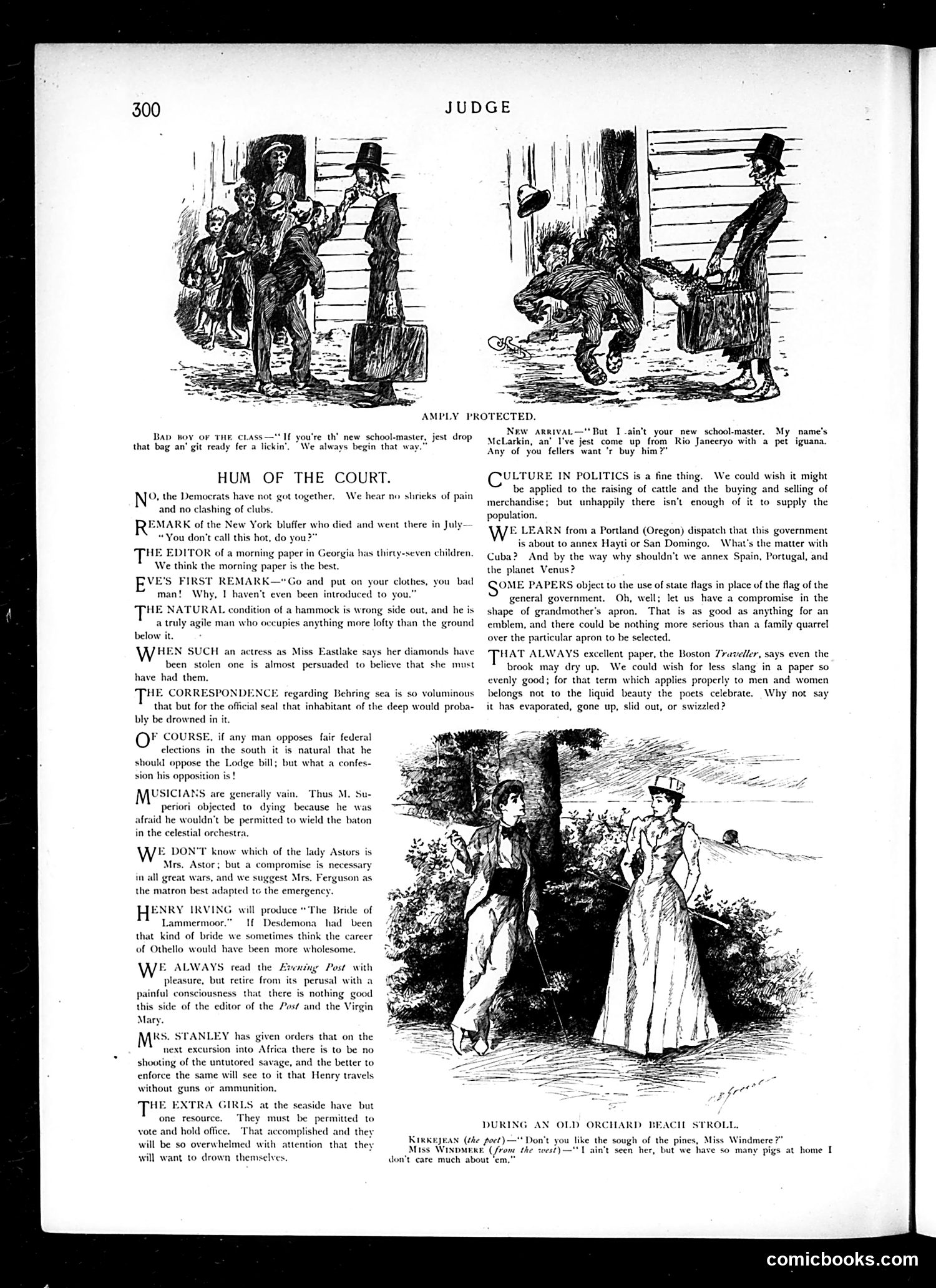
This page from Judge magazine contains satirical commentary on various contemporary topics, arranged as short humorous observations rather than cohesive political cartoons. The three illustrations show: (1) a new schoolmaster arriving with a bag, greeted by students expecting punishment; (2) a child with an iguana being introduced as the "new schoolmaster" from Rio Janeiro; and (3) a couple strolling in an orchard. The text satirizes diverse subjects: Democratic Party disunity, a Georgia newspaper editor with many children, the Lodge bill (federal election protection), Henry Irving's theatrical productions, the Astor family, Stanley's African expeditions, and women's suffrage at seaside resorts. The commentary mocks contemporary politics, social pretensions, and cultural figures. References to annexing Haiti, San Domingo, and Spain appear to critique American imperialist ambitions of the era. Overall, this represents typical Judge-style social and political satire—brief, caustic observations on 1880s-1890s American life and politics, relying on readers' familiarity with current events and public figures.
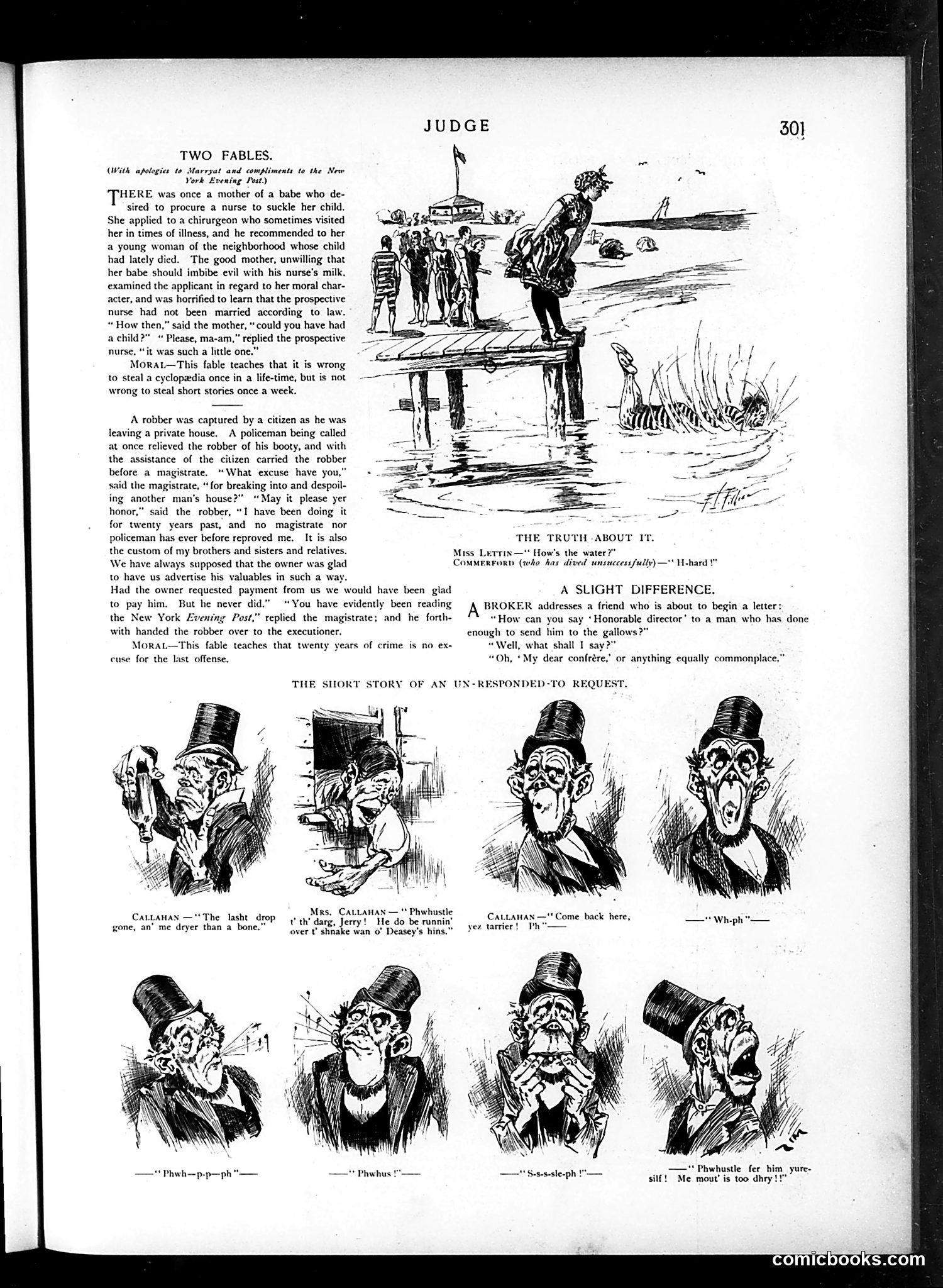
This page contains three satirical pieces mocking the New York Evening Post newspaper: **"Two Fables"** uses Aesop's fable format to ridicule the Post's editorial standards. The first fable mocks the Post's hypocrisy: condemning moral lapses (an unmarried nurse) while itself committing ethical breaches. The second fable directly attacks the Post's defense of a criminal—likely referencing a specific recent case where the Post had editorially justified or minimized a robbery. The "moral" declares such justifications unacceptable. **"A Slight Difference"** is a brief joke about a broker addressing corrupt language: calling a criminal a "director" versus "confrère" (colleague)—both equally euphemistic for wrongdoing. **"The Short Story of an Un-Responded-to Request"** depicts a working-class Irish man (Callahan) repeatedly trying unsuccessfully to communicate with a deaf or inattentive companion—a visual gag using exaggerated Irish dialect that was common period humor. The page primarily targets Post editorial practices through fable-based satire.
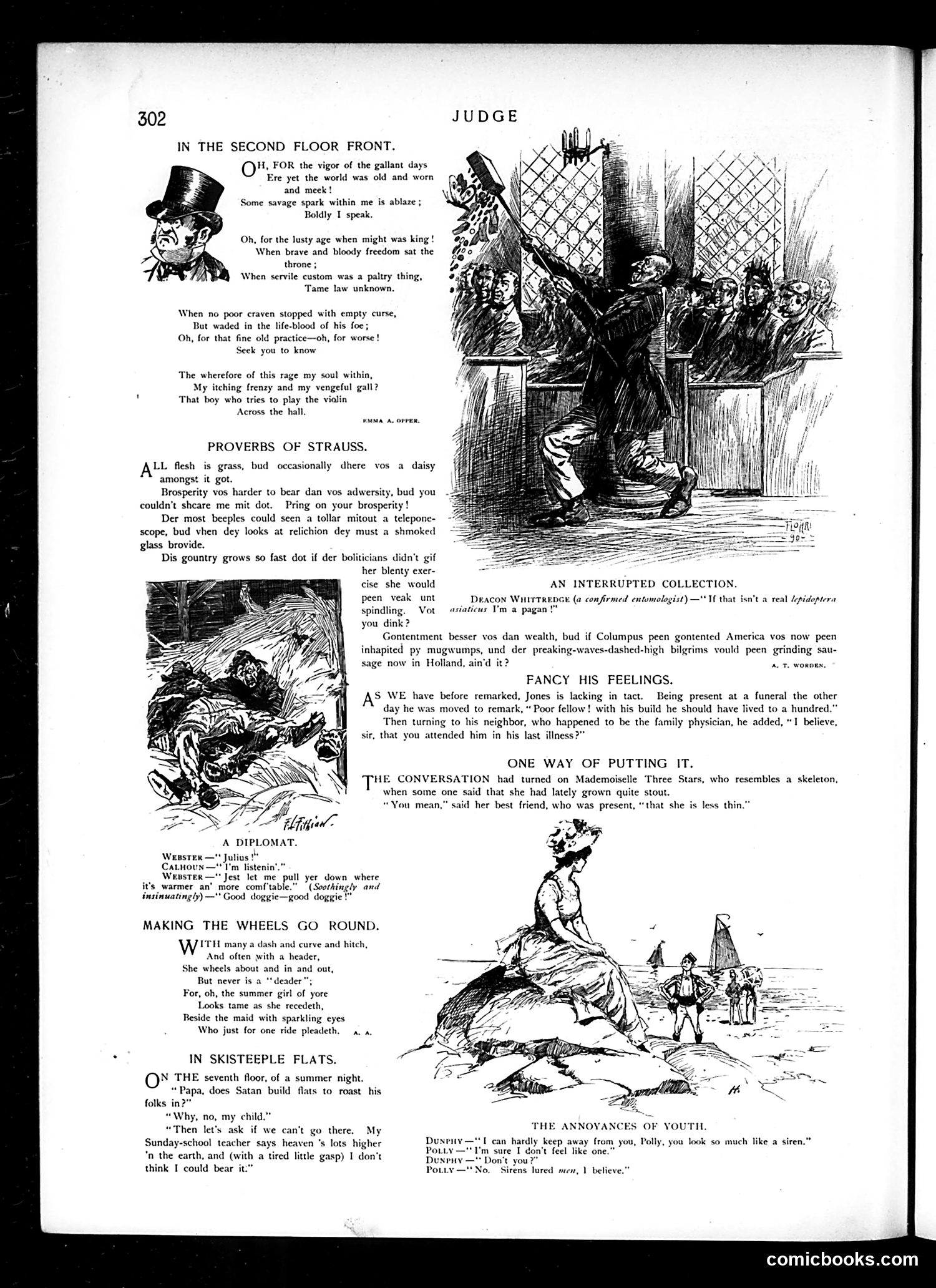
This page collects several satirical pieces typical of Judge's humor: **"In the Second Floor Front"** mocks a tenant's overwrought rage—blaming his fury on a neighbor boy practicing violin badly. The joke is hyperbolic: he romanticizes "lusty ages" of violence while actually annoyed by mundane noise. **"Proverbs of Strauss"** features a Jewish immigrant character (indicated by phonetic dialect spelling: "vos," "brosperity") dispensing folk wisdom. This was common Judge fare—ethnic humor based on accent and perspective. **Other brief pieces** ("Fancy His Feelings," "One Way of Putting It," "Making the Wheels Go Round") are light social satire about tactlessness, body image, and young women's bicycle-riding fashions. **"In Skisteeple Flats"** jokes about tenement living conditions, with a child's innocent question about hell reflecting real concerns about overcrowded, poorly-ventilated apartment buildings. The cartoons throughout use exaggerated illustrations typical of period satire. The overall tone is gentle mockery of middle/working-class American life and manners.
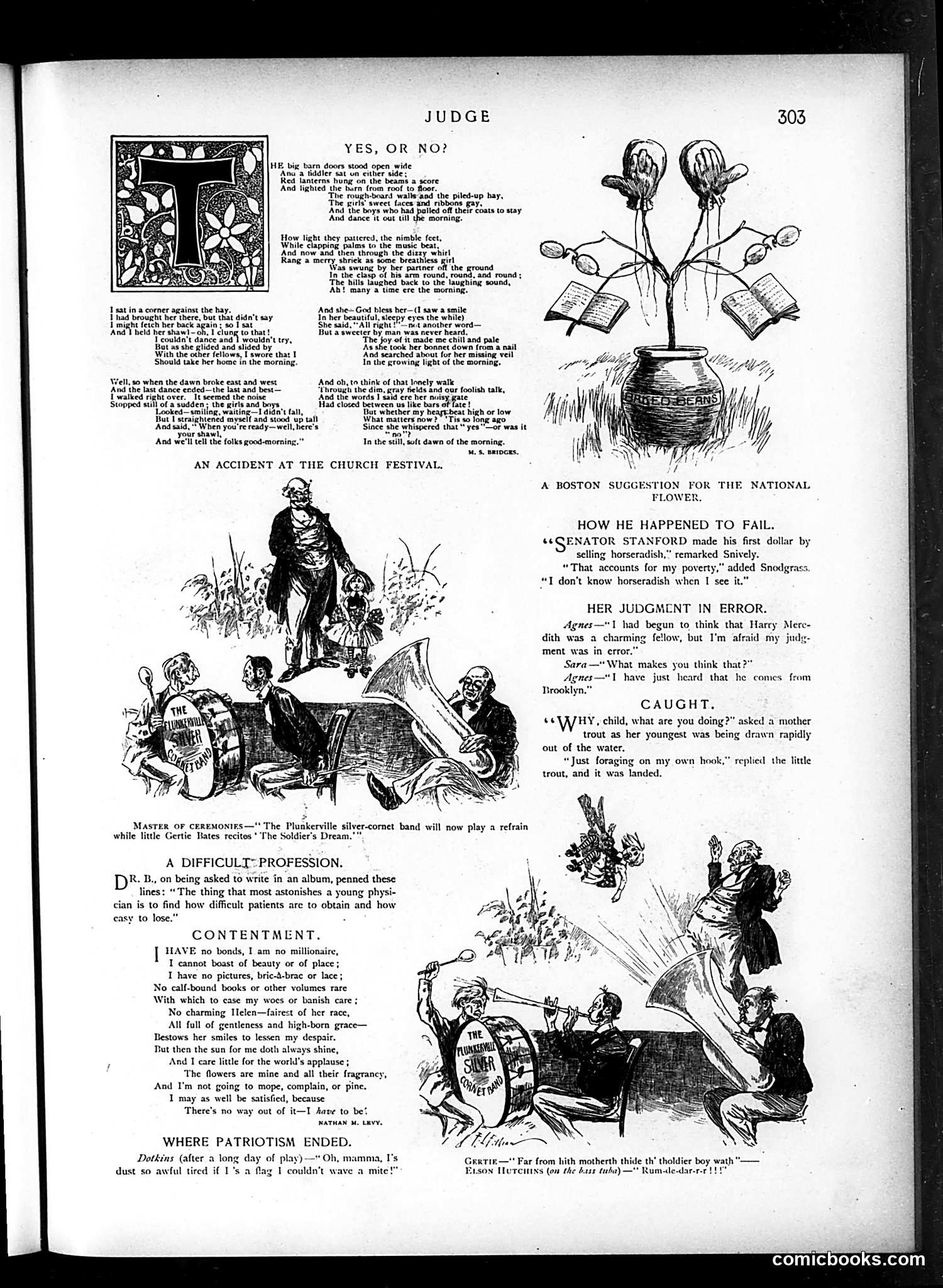
This page from the satirical magazine *Judge* contains several brief humorous pieces typical of late 19th/early 20th-century American wit: **"Yes, or No?"** is a sentimental poem about a young man proposing to his sweetheart at a barn dance, capturing the nervousness and joy of courtship. **Social commentary pieces** mock contemporary figures: Senator Stanford (a real wealthy industrialist) and the prejudice against Brooklyn residents ("Her Judgment in Error"). **"Caught"** is a pun-based joke playing on the phrase "foraging on my own hook" used by a young fish being caught. **"A Difficult Profession"** humorously notes physicians' professional challenges. The illustrations—particularly the church festival scene—are generic Victorian/Edwardian social vignettes rather than pointed political satire. The "Boston Suggestion for the National Flower" features a potted plant, though its specific meaning isn't clear from the image alone. Overall, this represents *Judge*'s lighter content: domestic humor, gentle social observation, and wordplay rather than hard-hitting political satire.
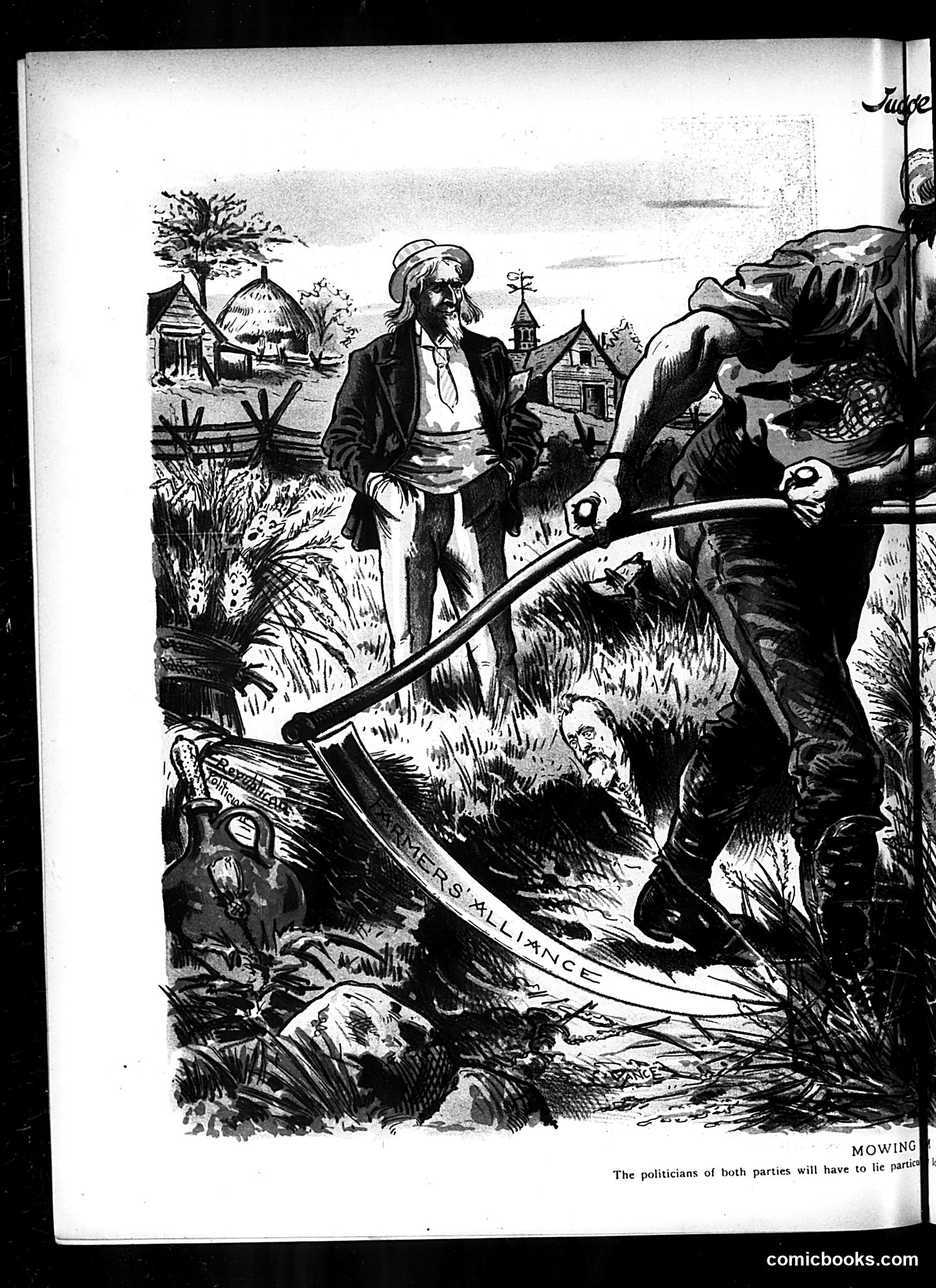
This satirical cartoon depicts a rural scene where a man in formal attire stands observing two figures working with scythes in a grass field. A banner visible in the image reads "ALLIANCE." The caption states: "The politicians of both parties will have to lie part[ie]" — a pun on "lie" and "part" suggesting politicians must partition or divide themselves. The "mowing" title and scythe imagery appear to reference political alliance-building or compromise, where politicians from opposing parties must work together in the grassroots (literal grass shown). The rural setting emphasizes common ground between parties, while the formal-dressed observer suggests a detached political elite watching working-class cooperation. The incomplete caption text limits definitive interpretation, but the cartoon likely satirizes the necessity—or hypocrisy—of cross-party political alliances.
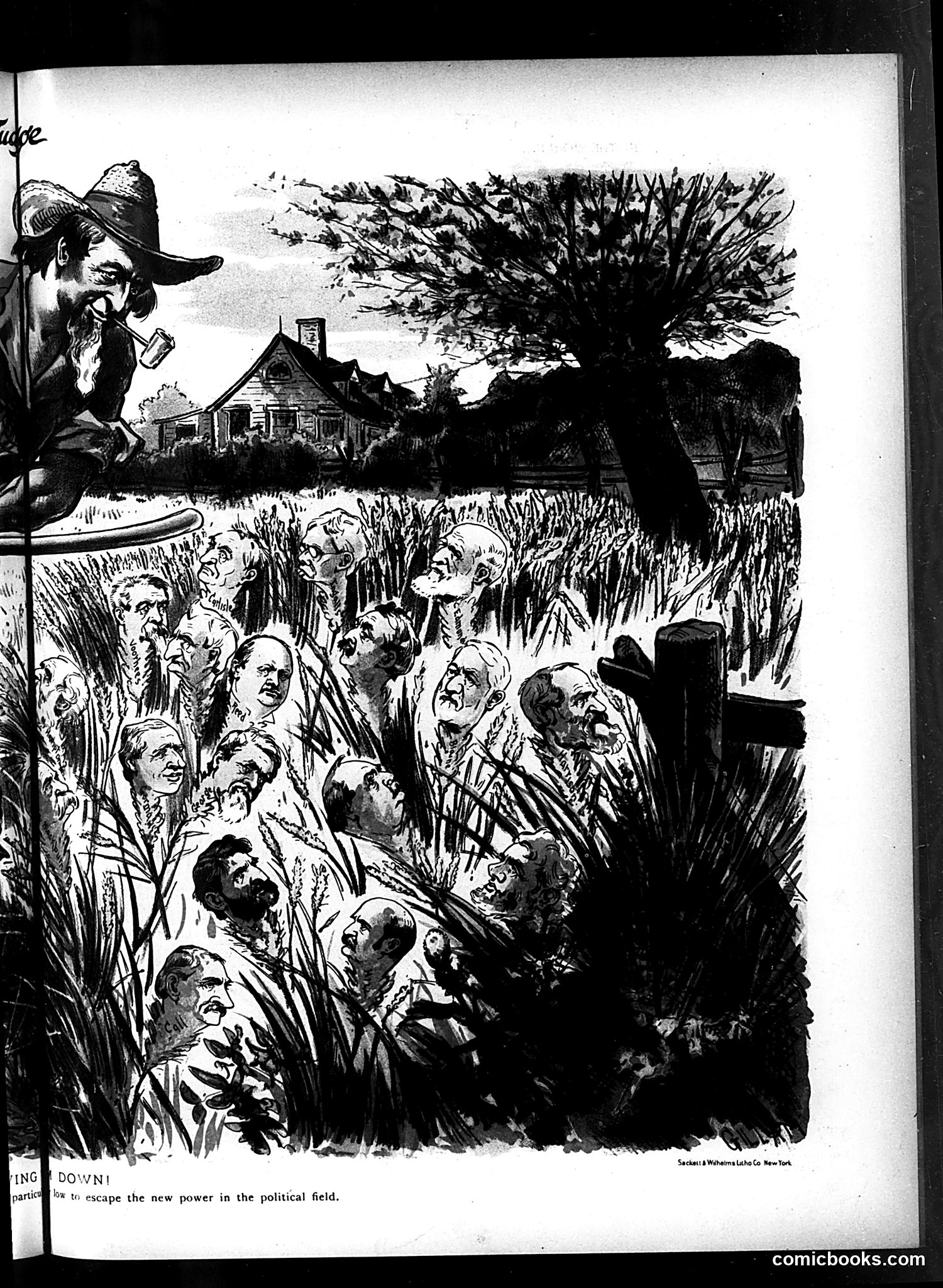
This satirical cartoon depicts a field of human heads sprouting from the ground like crops, with a sinister figure looming in the upper left. The caption reads: "DOWN! Be to escape the new power in the political field." The image appears to be commentary on emerging political power consolidating control, with the harvested heads suggesting oppression, loss of individual identity, or mass manipulation. The farmer-like figure at left may represent a political leader or authoritarian force literally "reaping" the population. The surreal, grotesque imagery—treating people as cultivated crops—emphasizes the satirist's alarm about dehumanization within the political system. Without a specific date visible, the exact historical reference remains unclear, though this style suggests early-to-mid 20th century American political anxieties about authoritarianism.
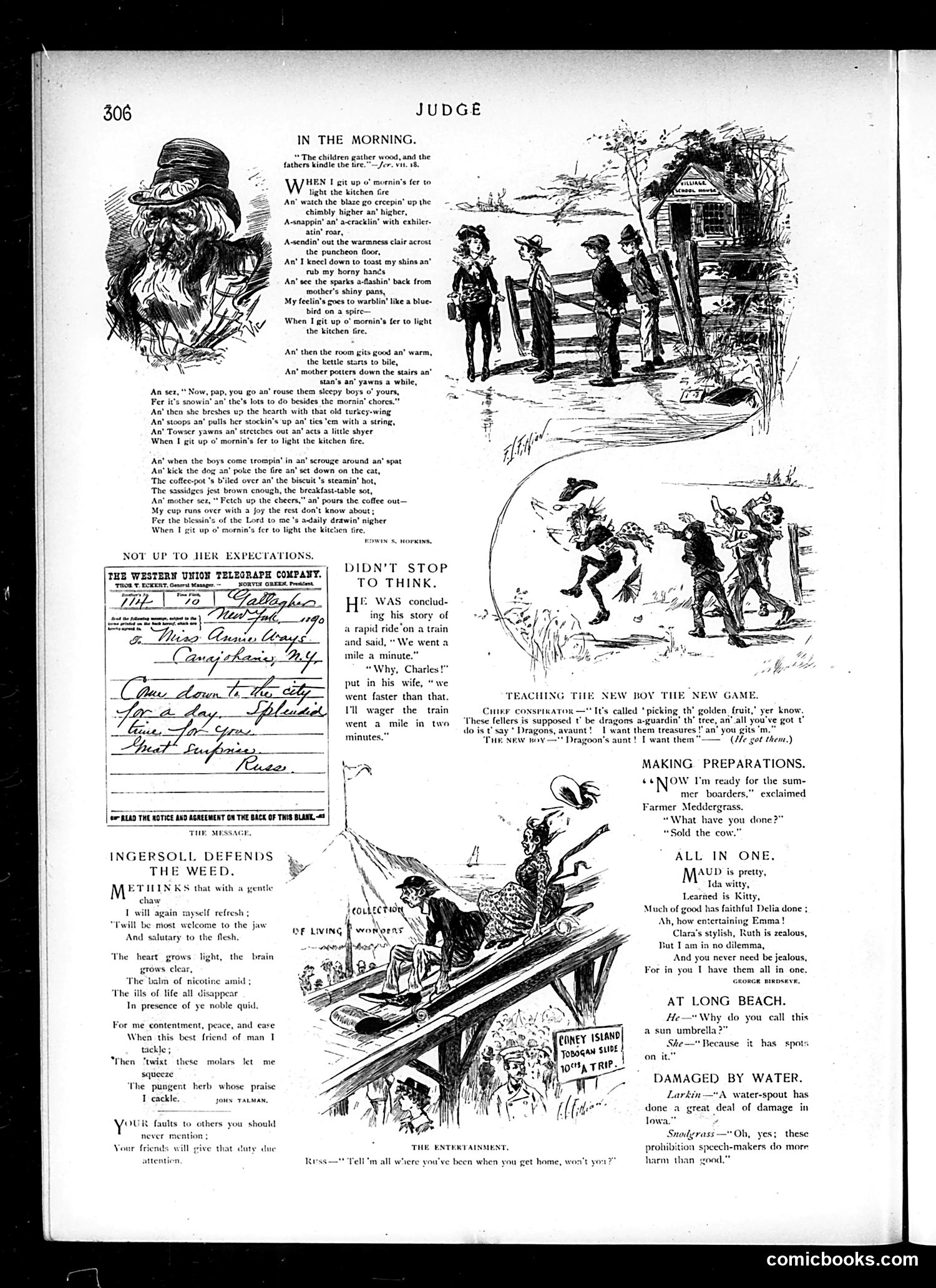
This page from Judge magazine contains several satirical pieces reflecting turn-of-the-century American life and attitudes: **"In the Morning"** is a sentimental rural poem celebrating a farm boy lighting the kitchen fire—straightforward nostalgia rather than satire. **"Didn't Stop to Think"** mocks a husband's exaggeration about train speed, with his wife correcting him—gentle domestic humor about marital contradiction. **"Ingersoll Defends the Weed"** appears to reference Robert G. Ingersoll (a prominent 19th-century freethinker) defending tobacco/smoking against moral criticism, using philosophical language to justify the habit. The smaller items—"Making Preparations" (farmer selling his cow to prepare for summer boarders), "Teaching the New Boy the New Game" (a children's joke about dragons and treasure), and brief dialogues like "At Long Beach" and "Damaged by Water"—are quick gags typical of the magazine's miscellaneous humor section. The telegraph company notice is likely an actual advertisement inserted into editorial content.
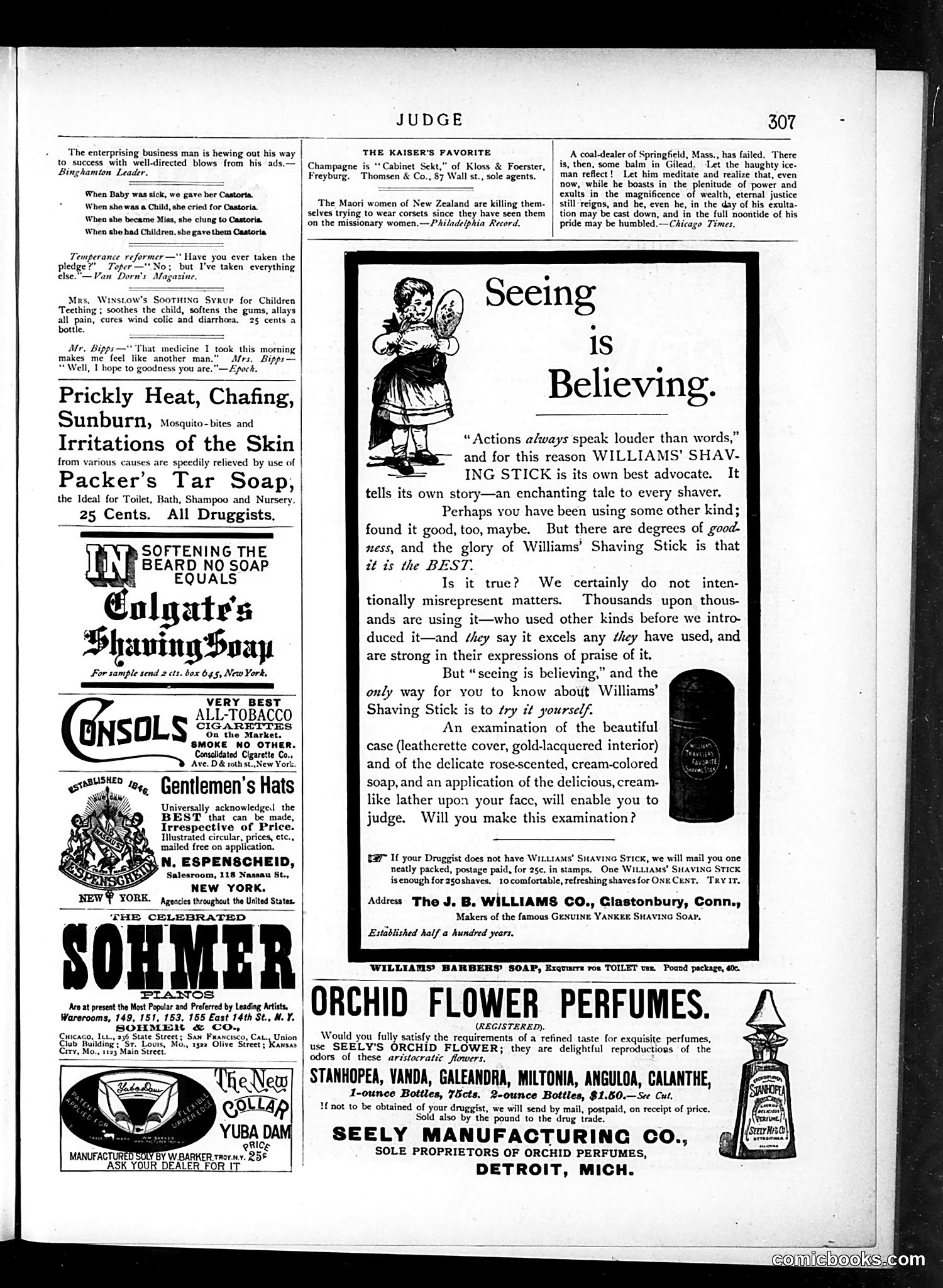
This is primarily an **advertising page** from Judge magazine, dominated by product promotions for late 19th/early 20th-century goods (shaving products, hats, pianos, perfumes). The page includes brief **satirical snippets and jokes** rather than a cartoon: - A quip about a coal dealer's bankruptcy ("some balm in Gilead") mocking the "haughty ice-man"—contrasting seasonal tradesmen - A temperance joke playing on "taking the pledge" vs. drinking alcohol - A marital joke about a man feeling "like another man" after medicine, with the wife's skeptical reply **Notable reference**: "The Kaiser's Favorite" mentions German champagne, likely alluding to Kaiser Wilhelm II—potentially reflecting American attitudes toward Germany during the pre-WWI era. The page reflects Judge's formula: mixing advertisements with short humorous commentary on contemporary social types (temperance reformers, coal dealers) and commercial rivalry. The satire is mild and consumer-focused rather than political.
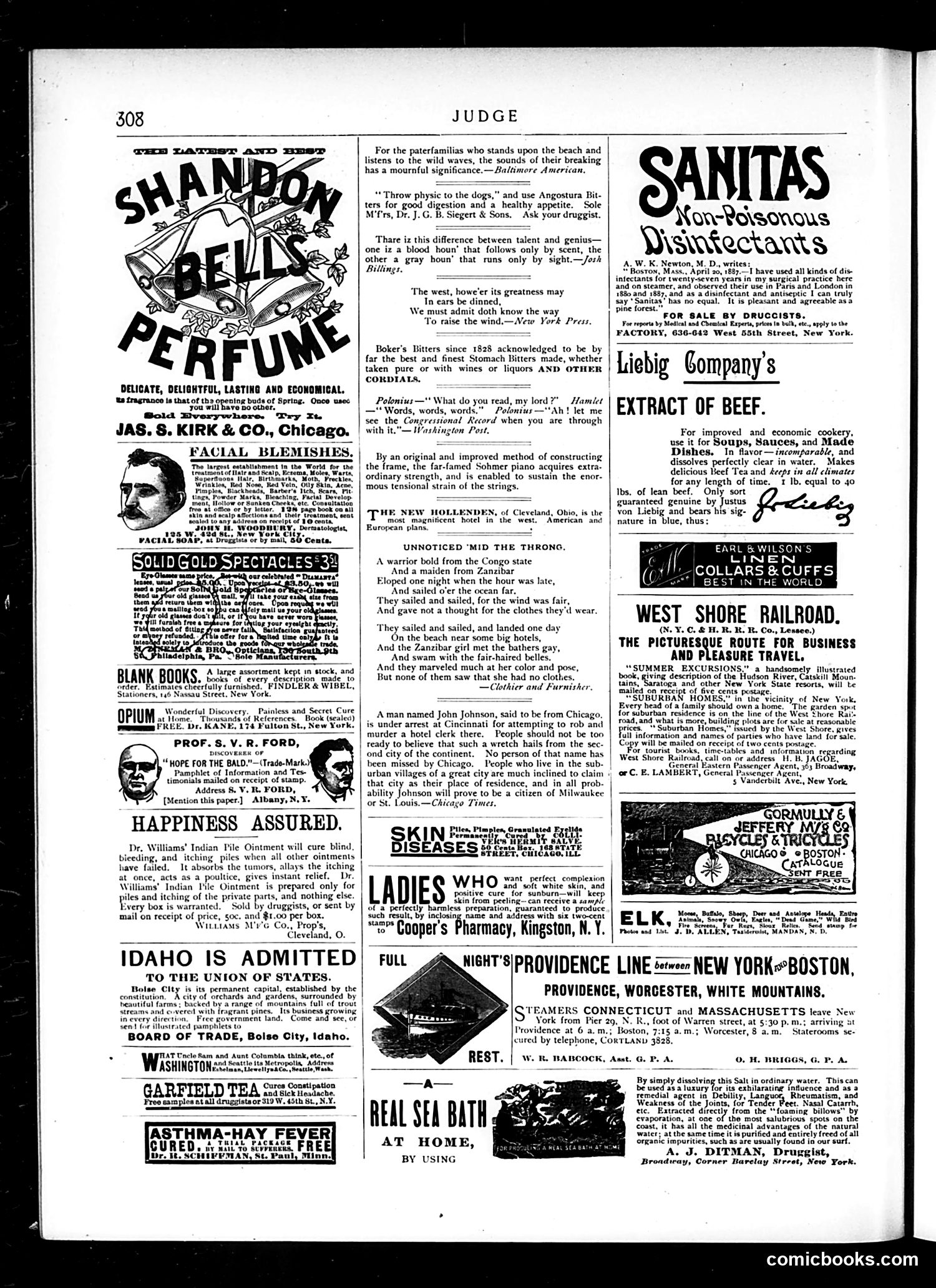
This is primarily an **advertising page** from Judge magazine, not a satirical cartoon page. It contains dozens of vintage advertisements for patent medicines, household products, and services typical of the late 19th century. Notable ads include: - **Facial blemish treatments** and hair-loss remedies - **Medical cure-alls**: Indian Pile Ointment, Angostura Bitters (marketed as digestive aids) - **Sohmer pianos** and other consumer goods The page includes brief **humorous quotes** (from Josh Billings, Washington Post) about talent, genius, and raising money—typical Judge magazine filler between ads. One substantive item: Idaho's admission to the Union is promoted by the Boise City Board of Trade, highlighting orchards, mountains, and available government land. The advertisements reflect both the commercial nature of 1890s magazines and the era's unregulated patent medicine industry—many products made dubious health claims that would be illegal today.
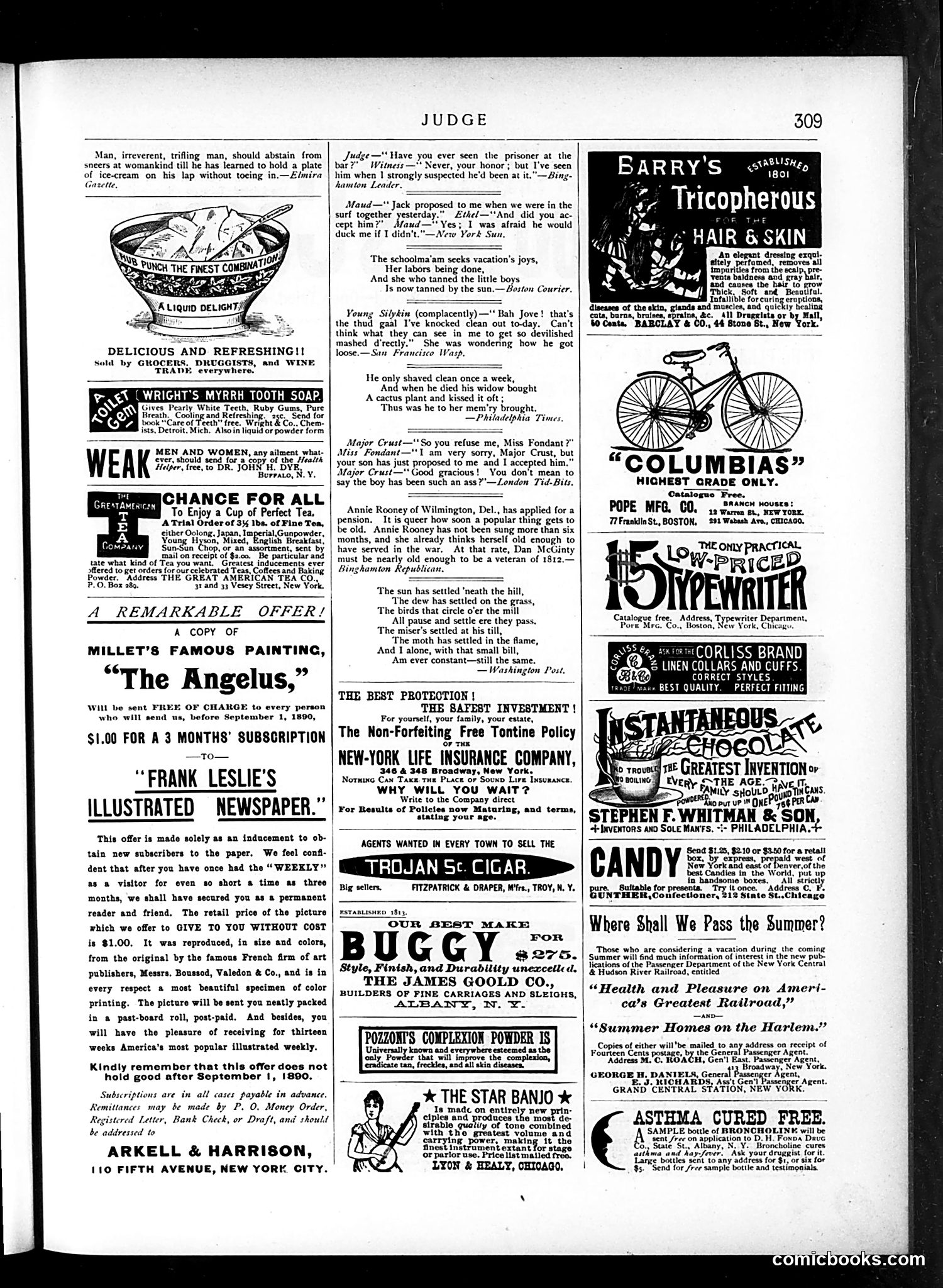
This is primarily an **advertising page** from Judge magazine (circa 1890, based on the Frank Leslie subscription offer deadline of September 1, 1890). The page contains minimal editorial content. The few **joke items** scattered among advertisements are typical period humor: - A courtroom joke about a witness claiming to have "seen" the prisoner "at" the bar (pun on drinking) - A proposal joke where a man threatens to "duck" his fiancée if she refuses - A schoolteacher pun about being "tanned by the sun" after tanning students - A widow's devotion joke involving a cactus plant These are **lightweight, family-friendly wordplay jokes** - not political satire. They rely on puns and double meanings rather than commentary on current events or social issues. The page is dominated by period **product advertisements**: tea companies, tooth soap, life insurance, bicycles, typewriters, and patent medicines - reflecting Judge's role as a profitable advertising vehicle for manufacturers and merchants.
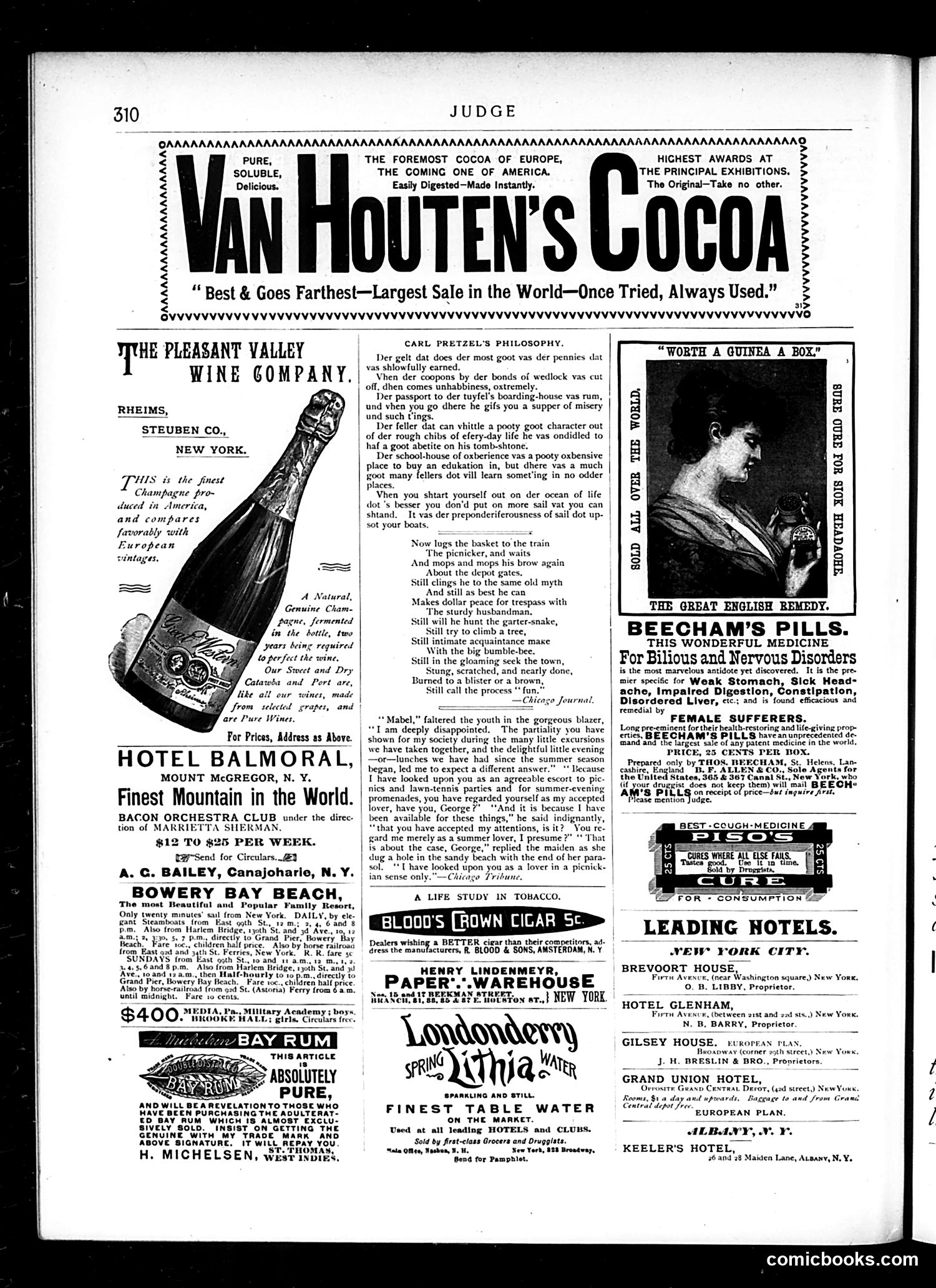
This page is primarily **advertising**, not political satire. It's from *Judge* magazine but contains no political cartoons or satirical commentary. The advertisements feature late 19th-century consumer products: Van Houten's Cocoa, Pleasant Valley Wine, Hotel Balmoral, Beecham's Pills (a patent medicine), and Londonderry Spring Water. The only editorial content is "Carl Pretzel's Philosophy"—a humorous column written in exaggerated German-immigrant dialect. Pretzel offers folksy wisdom about earning money slowly, marriage troubles, rum's dangers, and education. The style reflects period humor that relied on ethnic stereotypes and heavy accent-writing for comedy. Below that is a lighthearted story about a rejected suitor whose romantic expectations weren't met during summer picnics and tennis outings. No political figures, elections, or social reform movements are referenced. This is a standard late-1800s magazine page mixing ads with light entertainment.
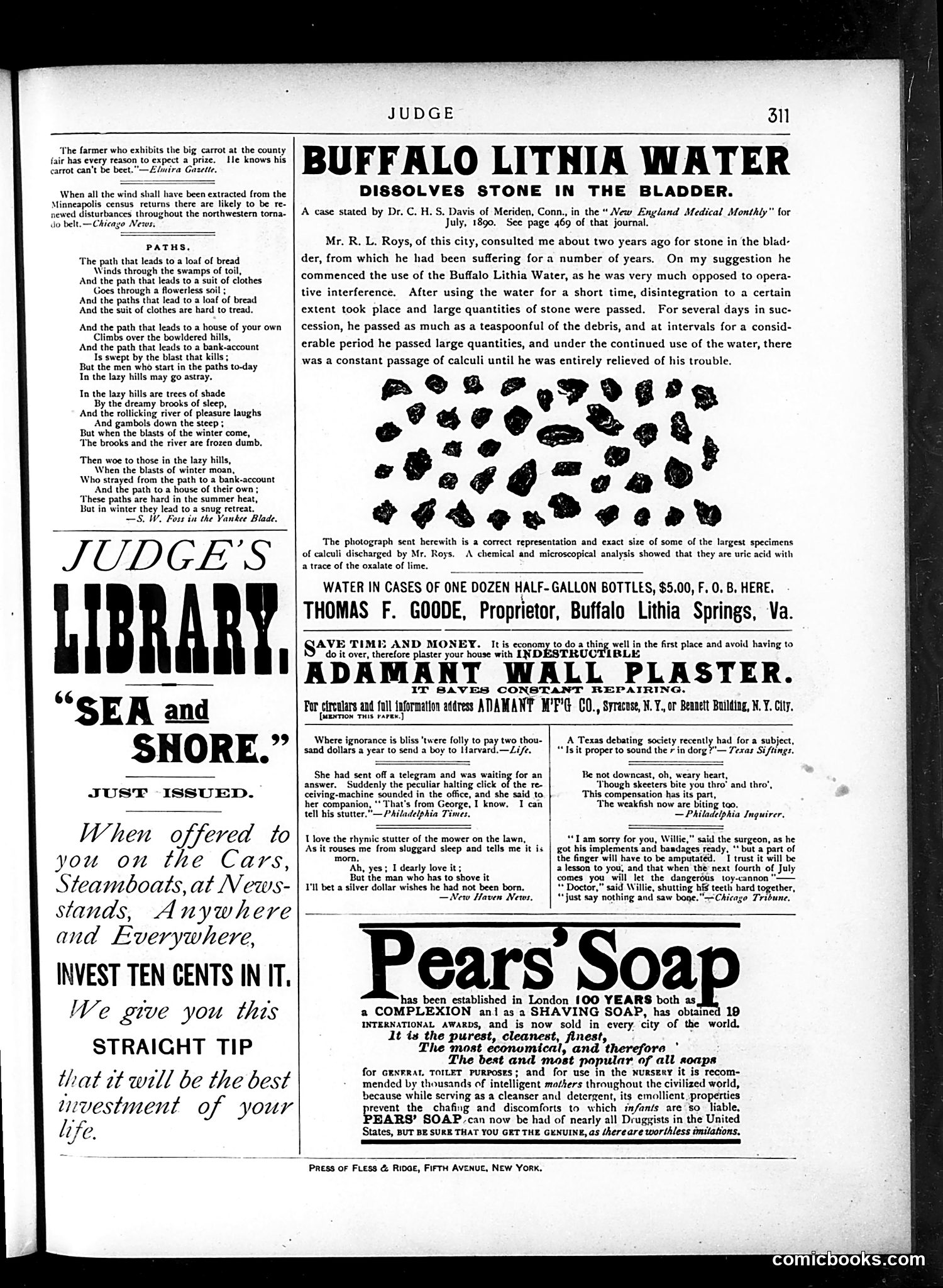
This page is primarily **advertising and light humor**, not political satire. The main content includes: **Medical Advertisement**: Buffalo Lithia Water claims to dissolve bladder stones. A doctor's case study describes a patient who passed stone fragments after using the water—the accompanying photograph shows actual calculi specimens as "proof." **Humorous Verses**: A poem titled "Paths" uses metaphorical language about life's difficult roads (toil, struggle) versus lazy shortcuts that fail in hardship—a moralizing piece common to the era about thrift and hard work. **Short Jokes**: Includes puns ("carrot can't be beet") and brief satirical quips about census-taking and Harvard education costs. **Product Plugs**: Adamant Wall Plaster and Pears' Soap advertisements emphasize durability and purity. **Historical Context**: This reflects 1890s patent medicine marketing, where dubious health claims were legally advertised. The "scientific" presentation (doctor's testimony, chemical analysis) was typical marketing strategy for such products. No significant political figures or events are referenced on this page.
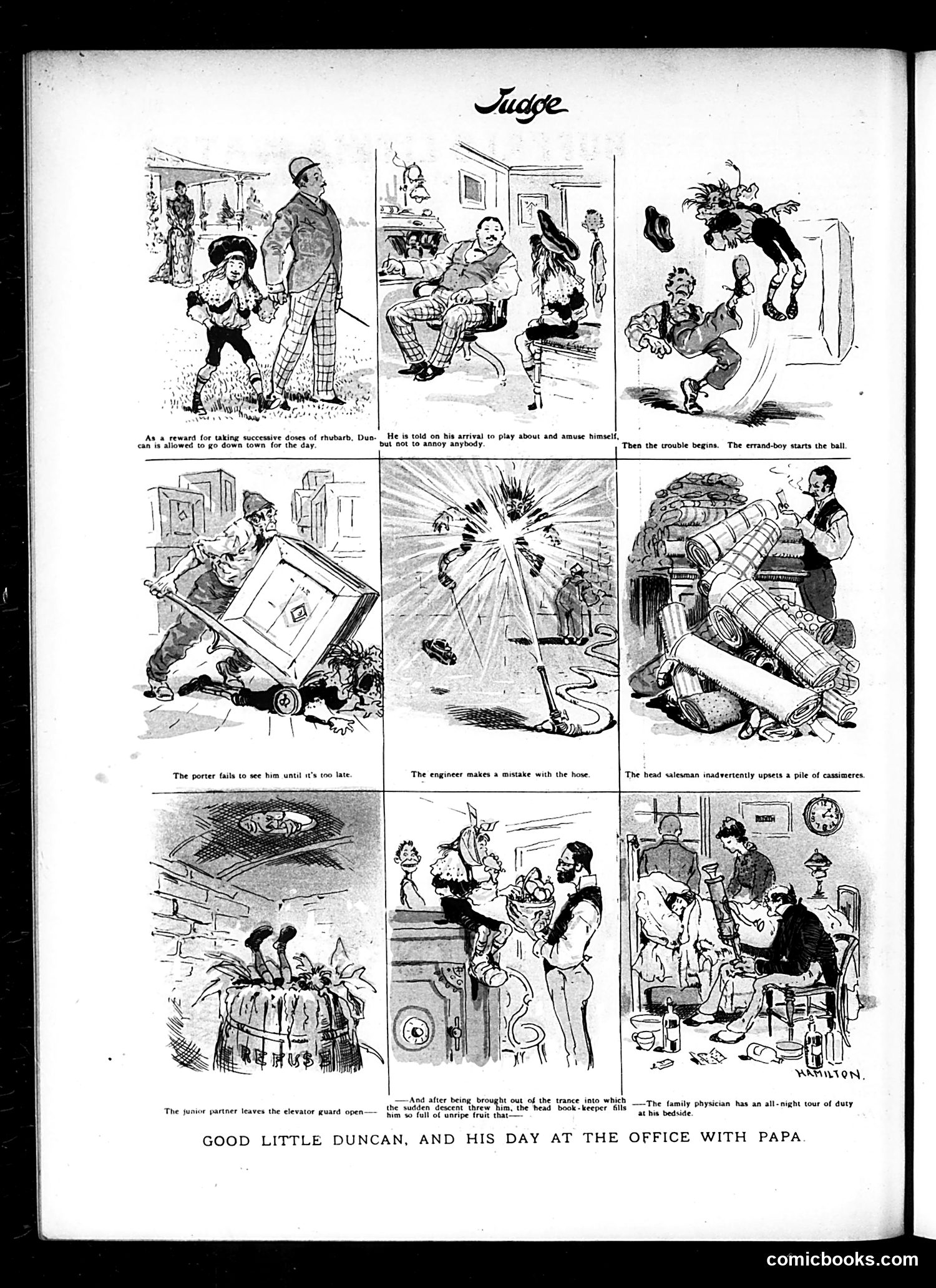
This is a humorous comic strip titled "Good Little Duncan, and His Day at the Office with Papa," depicting a child's chaotic visit to his father's workplace. The narrative shows young Duncan causing escalating mayhem: he's rewarded for good behavior with office access, then proceeds to disrupt operations—starting a ball that causes collisions, accidentally triggering machinery, toppling stacks of items, and creating general havoc throughout the office building, culminating in the family physician making an emergency house call. The satire mocks both child management and workplace safety. It's a period piece reflecting early 20th-century office culture, where taking children to work was apparently possible, and chaotic outcomes were treated as comedic inevitability rather than institutional failure. The joke assumes readers would find children's destructive capability amusing rather than concerning.