
Judge, 1890-08-16 · page 5 of 16
Judge — August 16, 1890 — page 5: what you’re looking at
What you’re looking at
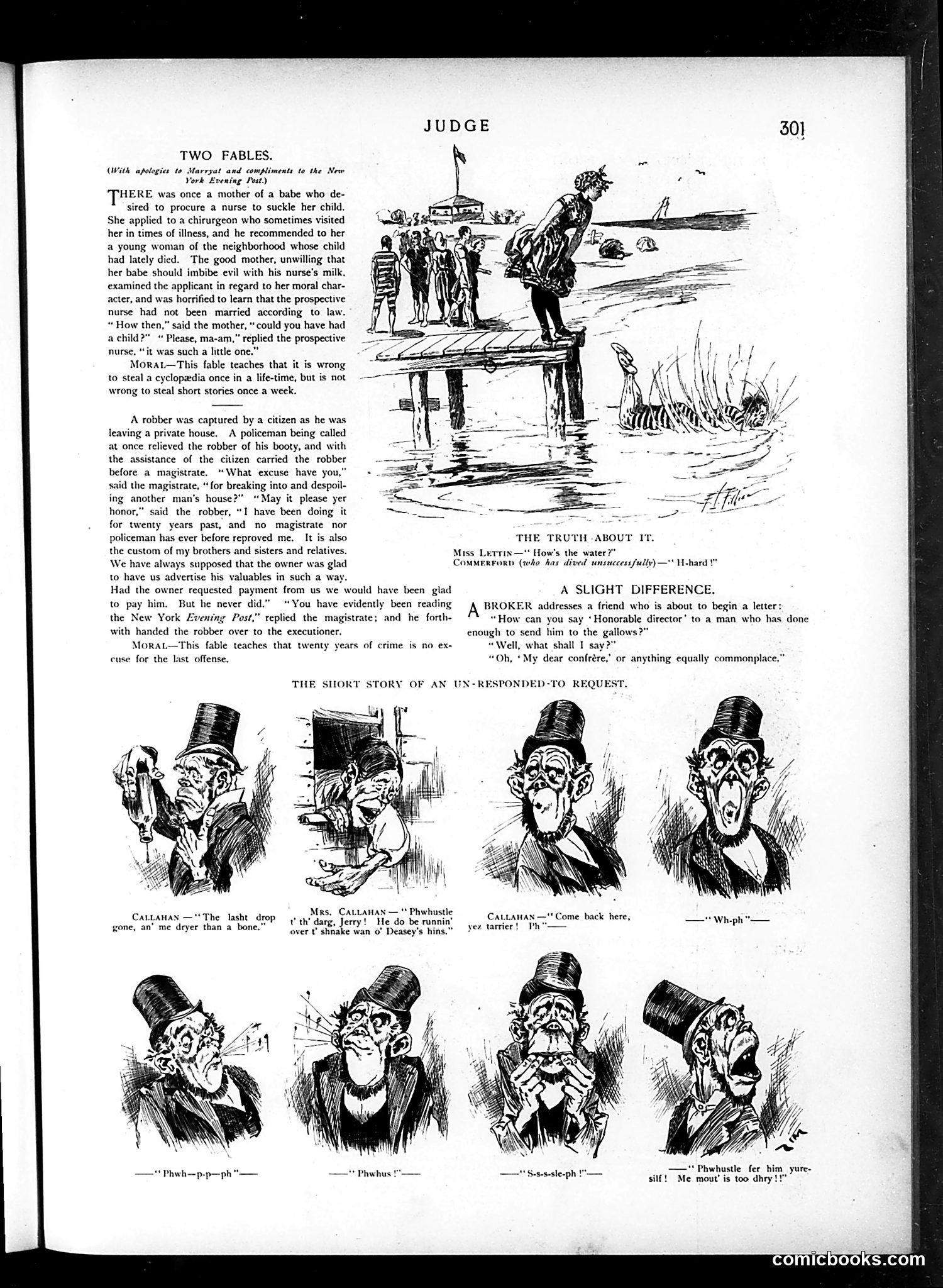
This page contains three satirical pieces mocking the New York Evening Post newspaper: **"Two Fables"** uses Aesop's fable format to ridicule the Post's editorial standards. The first fable mocks the Post's hypocrisy: condemning moral lapses (an unmarried nurse) while itself committing ethical breaches. The second fable directly attacks the Post's defense of a criminal—likely referencing a specific recent case where the Post had editorially justified or minimized a robbery. The "moral" declares such justifications unacceptable. **"A Slight Difference"** is a brief joke about a broker addressing corrupt language: calling a criminal a "director" versus "confrère" (colleague)—both equally euphemistic for wrongdoing. **"The Short Story of an Un-Responded-to Request"** depicts a working-class Irish man (Callahan) repeatedly trying unsuccessfully to communicate with a deaf or inattentive companion—a visual gag using exaggerated Irish dialect that was common period humor. The page primarily targets Post editorial practices through fable-based satire.
📄 Transcribed text from this page (OCR, searchable)
Machine-transcribed from the original scan — historical spelling and the odd misread are preserved.
TWO FABLES. (With apologies to Marryat and compliments (0 the New York Evening Post.) HERE was once a mother of a babe who de- sired to procure a nurse to suckle her child. She applied to a chirurgeon who sometimes visited her in times of illness, and he recommended to her a young womian of the neighborhood whose child had lately died. The good mother, unwilling that her babe should imbibe evil with his nurse's milk. examined the applicant in regard to her moral char- acter, and was horrified to learn that the prospective nurse had not been married according to law. “ How then,” said the mother, “could you have had achild?” “ Please, ma-am,” replied the prospective nurse, “it was such a little one.” Morat—This fable teaches that it is wrong to steal a cyclopzedia once in a life-time, but is not wrong to steal short stories once a week. ‘A robber was captured by a citizen as he was leaving a private house. A policeman being called at once relieved the robber of his booty, and with the assistance of the citizen carried the robber before a magistrate. “What excuse have you,” said the magistrate, “for breaking into and despoil- ing another man’s house?” “May it please yer honor,” said the robber, “I have been doing it for twenty years past, and no magistrate nor policeman has ever before reproved me. It is also the custom of my brothers and sisters and relatives. We have always supposed that the owner was glad to have us advertise his valuables in such a way. Had the owner requested payment from us we would have been glad to pay him. But he never did.” “You have evidently been reading the New York Evening Post,” replied the magistrate; and he forth- with handed the robber over to the executioner. MORAL—This fable teaches that twenty years of crime is no ex- cuse for the last offense. THE TRUTH ABOUT IT. 3 Letrin—"* How's the water?” MERFORD (tho has dived unsuccessfully) —* W-hard 1" A SLIGHT DIFFERENCE, A BROKER addresses a friend who is about to begin a letter: “How can you say ‘Honorable director’ to a man who has done enough to send him to the gallows?” “Well, what shall I say?” “Oh, ‘My dear confrére,’ or anything equally commonplace.” THE SHORT STORY OF AN UN-RESPONDED-TO REQUEST. Mrs. CALLAHay — “ Phwh v' th’ darg, Jerry! He do be runnin’ over t’ shnake wan o' Deasey’s hins.”” CALLAHAN — "The lasht drop gone, an’ me dryer than a bone.” —"* Phwh—p-p—ph "— —"" Phwhus 1 CALLANAN —'* Come back here, yer tarrier ! Ph "—— —'"'Phwhustle fer his i eee Phe Me mout’ is too dhry