
A complete issue · 16 pages · 1890
Judge — March 22, 1890
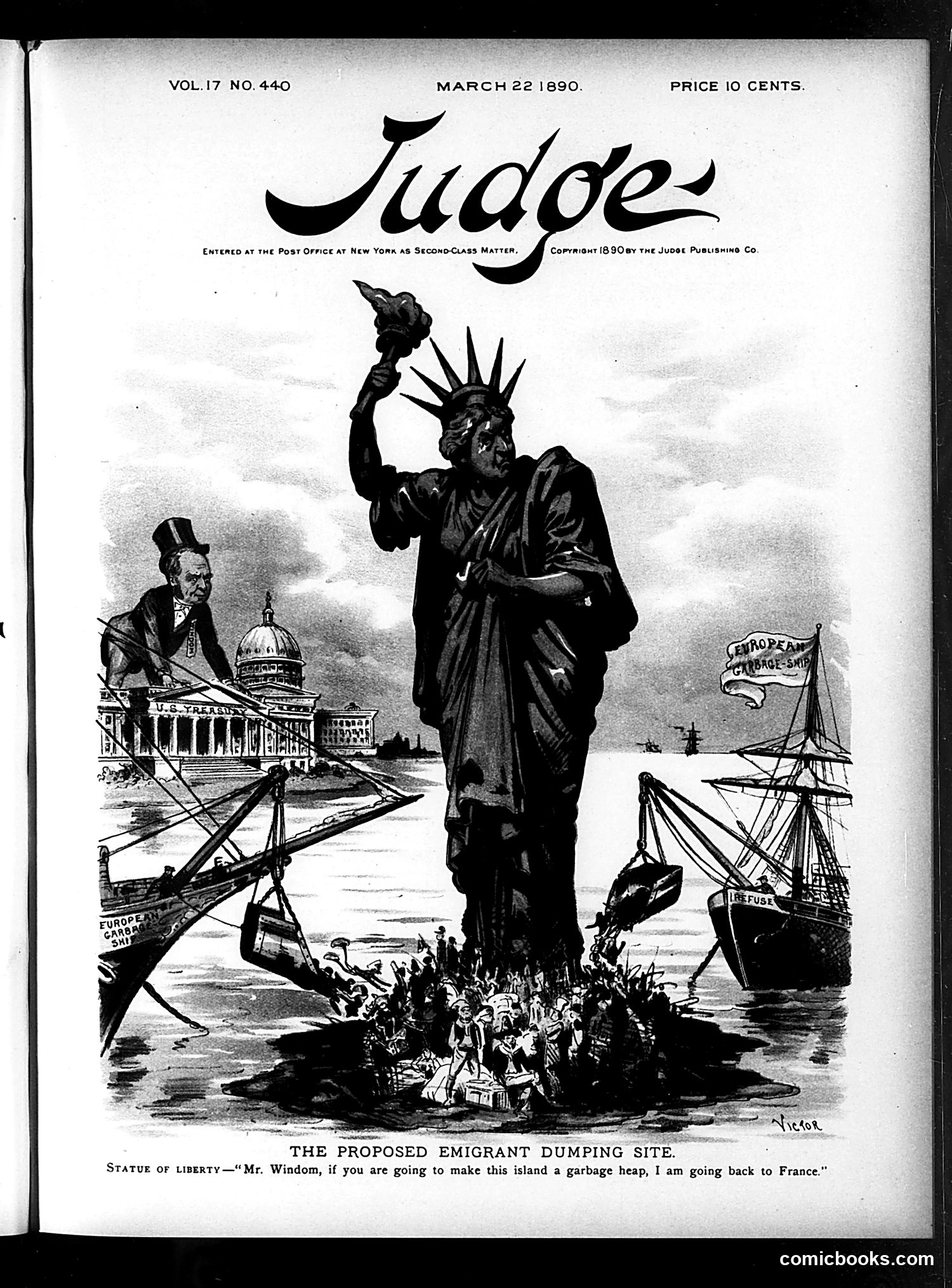
This Judge magazine cover from March 22, 1890 satirizes American attitudes toward European immigration. The Statue of Liberty, holding a torch and appearing dismayed, towers over a garbage heap of immigrants at her base. Ships labeled "European Garbage" arrive at harbor while a caricatured figure (likely representing a politician or wealthy American, labeled "Mr. Windom") declares he'll convert the island into a "garbage heap" and return to France. The cartoon expresses nativist sentiment—the fear that immigrants were unwanted refuse rather than potential citizens. It mocks both those advocating restriction and the irony of Lady Liberty presiding over such xenophobic proposals. The satire critiques America's conflicted relationship with immigration during this period of rising anti-immigrant political movements.
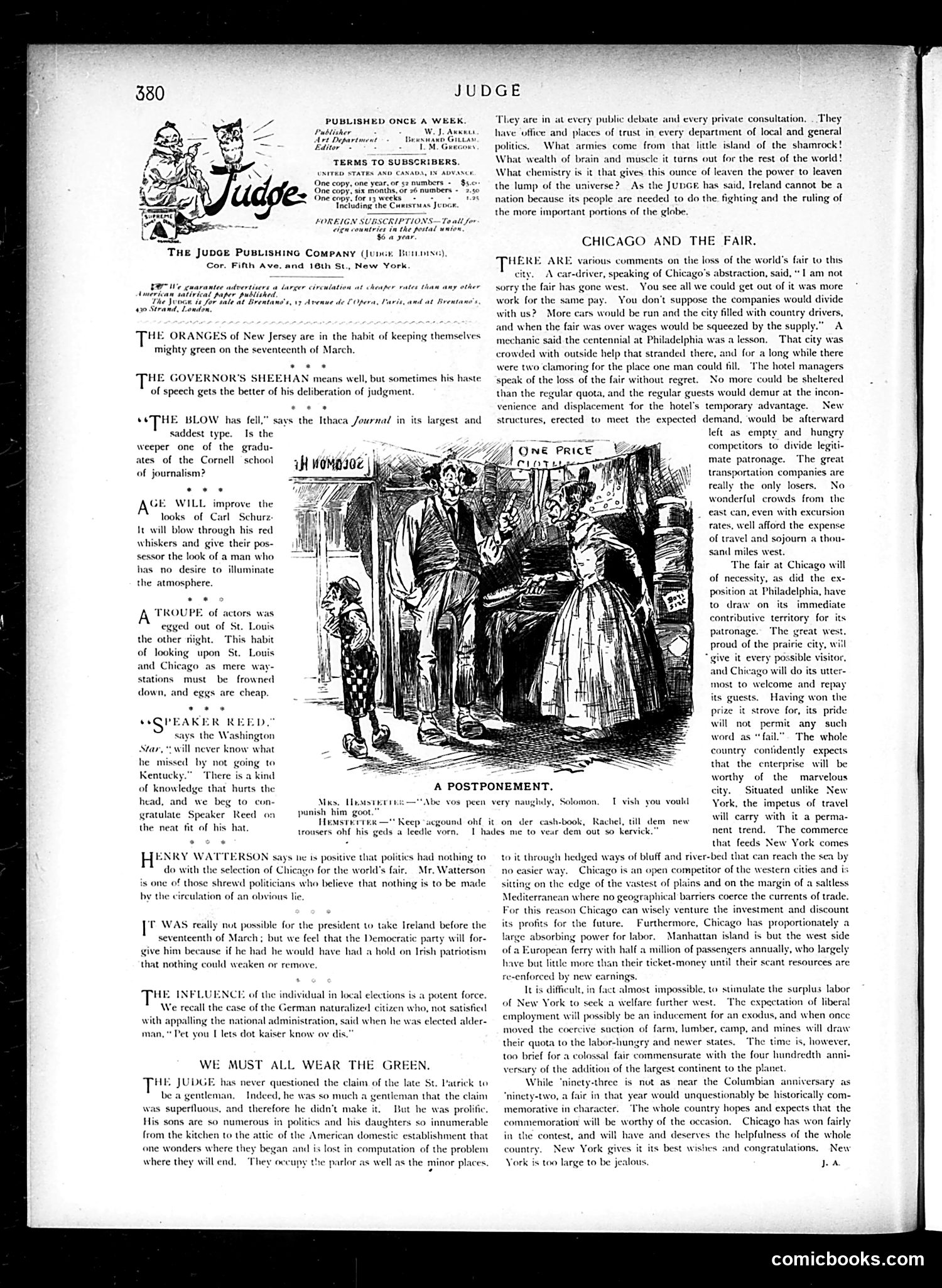
This cartoon depicts a domestic scene where a woman (Mrs. Hemstetler) confronts a man (presumably her husband) about financial matters. She demands he stop postponing payment of debts, saying "Keep aysound off it on der cash-book, Rachel, till dem new resources shtrike our gold a bondle." The satire targets financial irresponsibility and avoidance of obligations—likely reflecting broader anxieties about personal debt and accounting practices in the Gilded Age. The couple's apparent German-immigrant dialect (suggested by spellings like "aysound" and "shtrike") may indicate Judge's commentary on immigrant communities' financial management or stereotyping of German-Americans. The cartoon's title emphasizes the husband's habit of postponing—delaying rather than resolving problems.
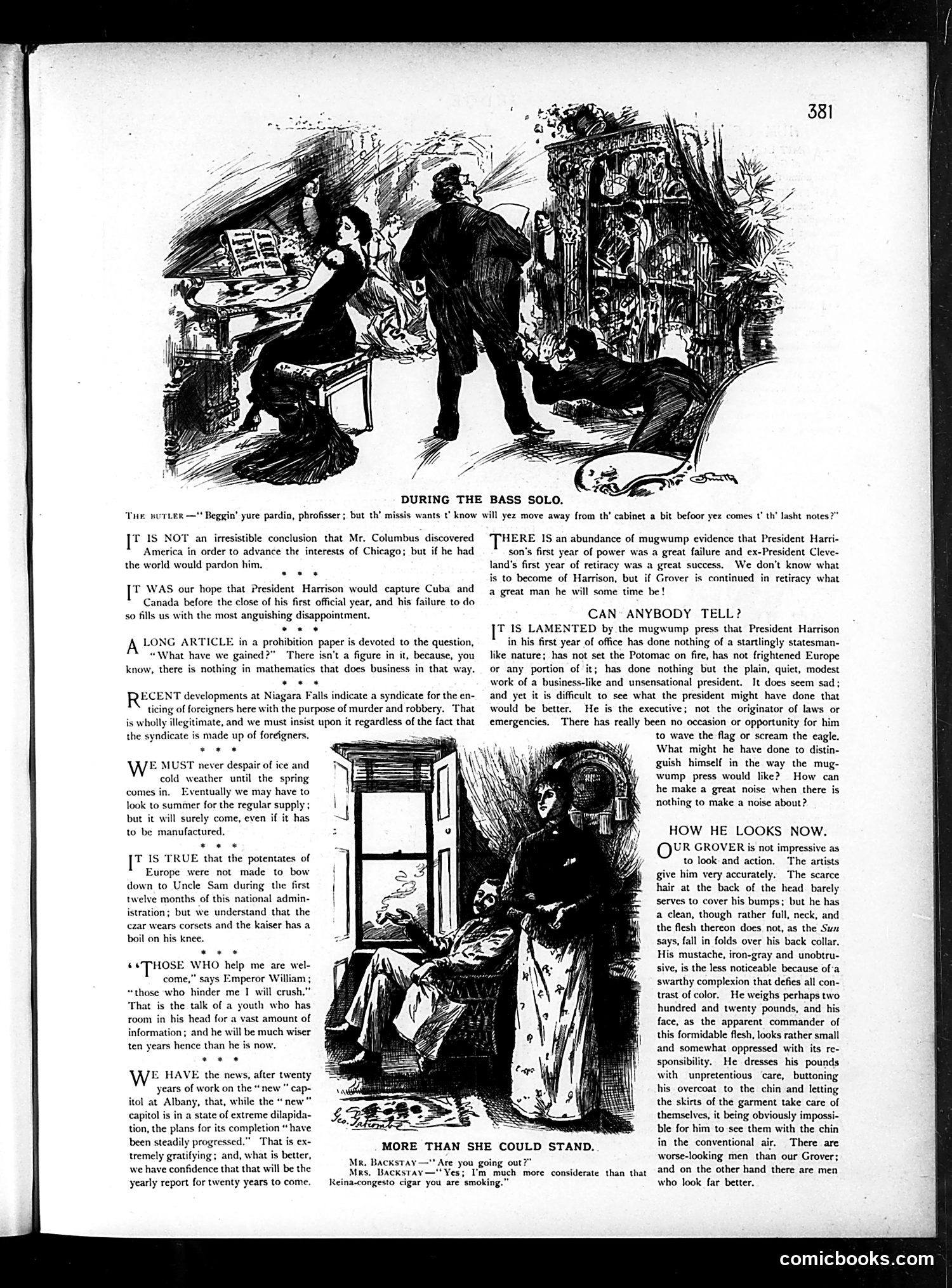
This page satirizes President **Benjamin Harrison's first year in office**, which the text claims was unsuccessful despite hopes he'd achieve major goals like capturing Cuba and Canada. The political commentary criticizes Harrison as an ineffectual executive—compared unfavorably to his predecessor **Grover Cleveland**, whom the text suggests was more impressive. The top cartoon, "During the Bass Solo," depicts a butler interrupting a musical performance, humorously suggesting even entertainment can't escape household disruptions—likely a lighter comic interlude. The bottom illustration, "More Than She Could Stand," shows a woman confronting a man about smoking, reflecting contemporary debates about indoor smoking etiquette. The overall page blends political critique with social humor typical of Judge's satirical approach to 1890s American life.
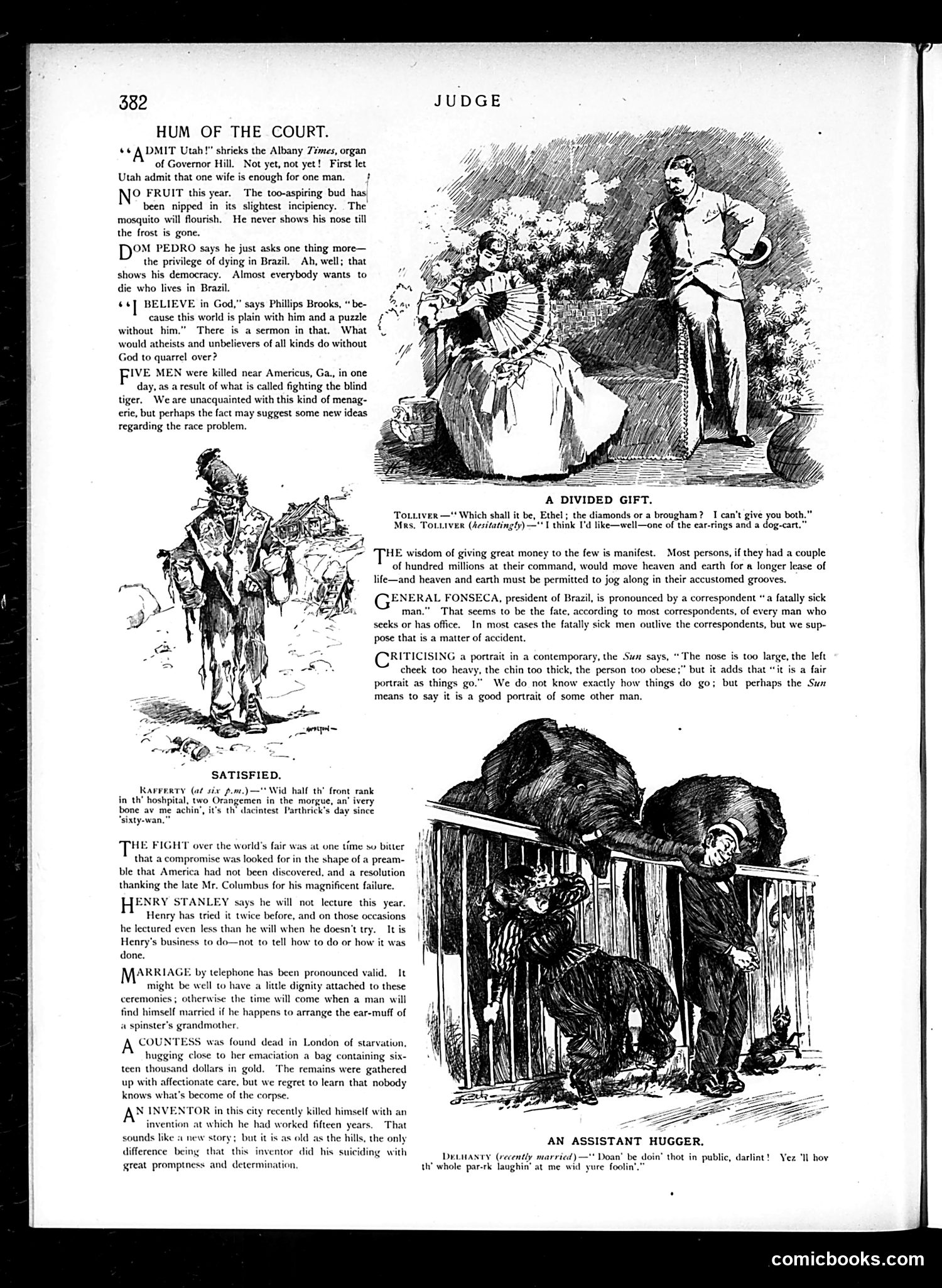
This page from Judge combines brief satirical commentaries with cartoons mocking contemporary issues (circa 1880s-90s). **Top cartoon** ("A Divided Gift"): A wealthy man (Tolliver) offers his wife either diamonds or a carriage; she requests an earring and dog-cart instead. The joke satirizes women's materialism and indecision among luxury goods. **Bottom cartoon** ("An Assistant Hugger"): A recently married woman scolds her husband for public affection, suggesting strict Victorian propriety even among newlyweds. **Text commentary** covers: Utah polygamy (statehood debate), Dom Pedro of Brazil, cleric Phillips Brooks, violence in Georgia, Brazilian president Fonseca, and Henry Morton Stanley's lecture refusals. The "Satisfied" item mocks an Irishman finding St. Patrick's Day violent—a crude ethnic stereotype. The page reflects Judge's typical approach: mixing social observation with class-conscious humor and period prejudices.
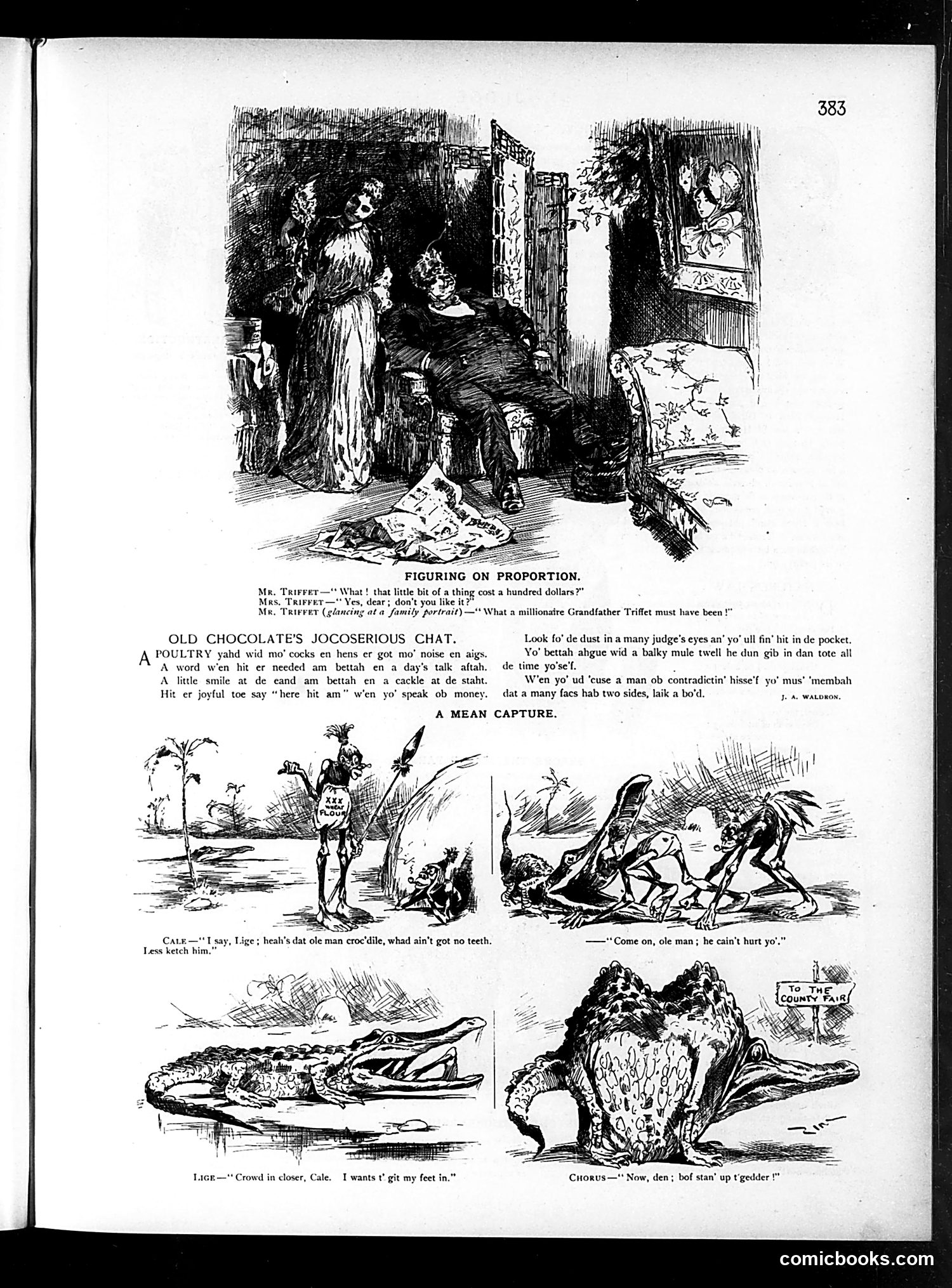
**"Figuring on Proportion"** satirizes wealthy pretension. A wife defends an expensive small object; the husband, seeing a family portrait, assumes their ancestor must have been vastly wealthy to afford such proportionally expensive items. The joke mocks how the nouveau riche misjudge value and ancestry. **"Old Chocolate's Jocoserous Chat"** appears to be dialect humor featuring an African American character dispensing folk wisdom—common in this era's publications, though employing offensive stereotypes. The advice concerns practical judgment and compromise. **"A Mean Capture"** depicts a comic scenario where boys attempt to catch a toothless crocodile. The humor relies on the creature's harmlessness and the boys' competitive eagerness to get their feet into the action, suggesting foolish bravado over an ineffectual threat. The page combines domestic satire, folk wisdom, and animal comedy typical of Judge's mixed content.
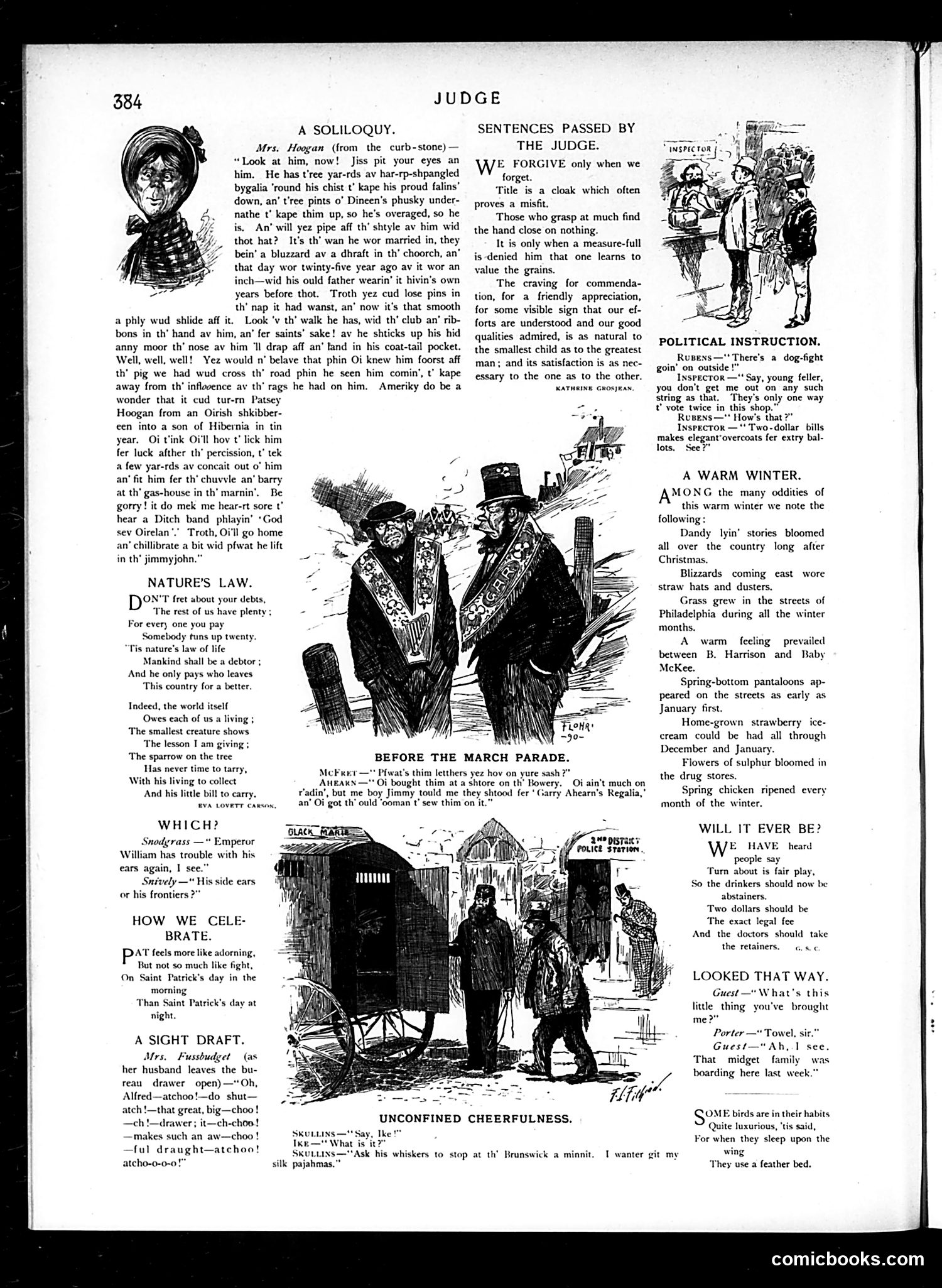
This page from the satirical magazine **Judge** contains several pieces mocking Irish-American immigrants and urban life circa early 1900s. **"A Soliloquy"** features Mrs. Hogan, an Irish immigrant woman, mocking her husband's pretentious behavior after joining a fraternal organization (likely the Ancient Order of Hibernians, given "Garry Ahearn's Regalia" reference). She ridicules his ceremonial regalia, top hat, and newfound pride—contrasting his current pomposity with his humble past. The satire targets immigrant social climbing and fraternal lodge culture. **Other pieces** include light humor about marital life ("A Sight Draft"), ethnic stereotypes ("How We Celebrate" about St. Patrick's Day), and political humor ("Political Instruction") about election fraud. The thick Irish dialect throughout reflects period stereotyping. While crude by modern standards, this represents typical **Judge** content: punching at working-class immigrant communities, their social aspirations, and urban political corruption—all standard targets for American satirical magazines of this era.
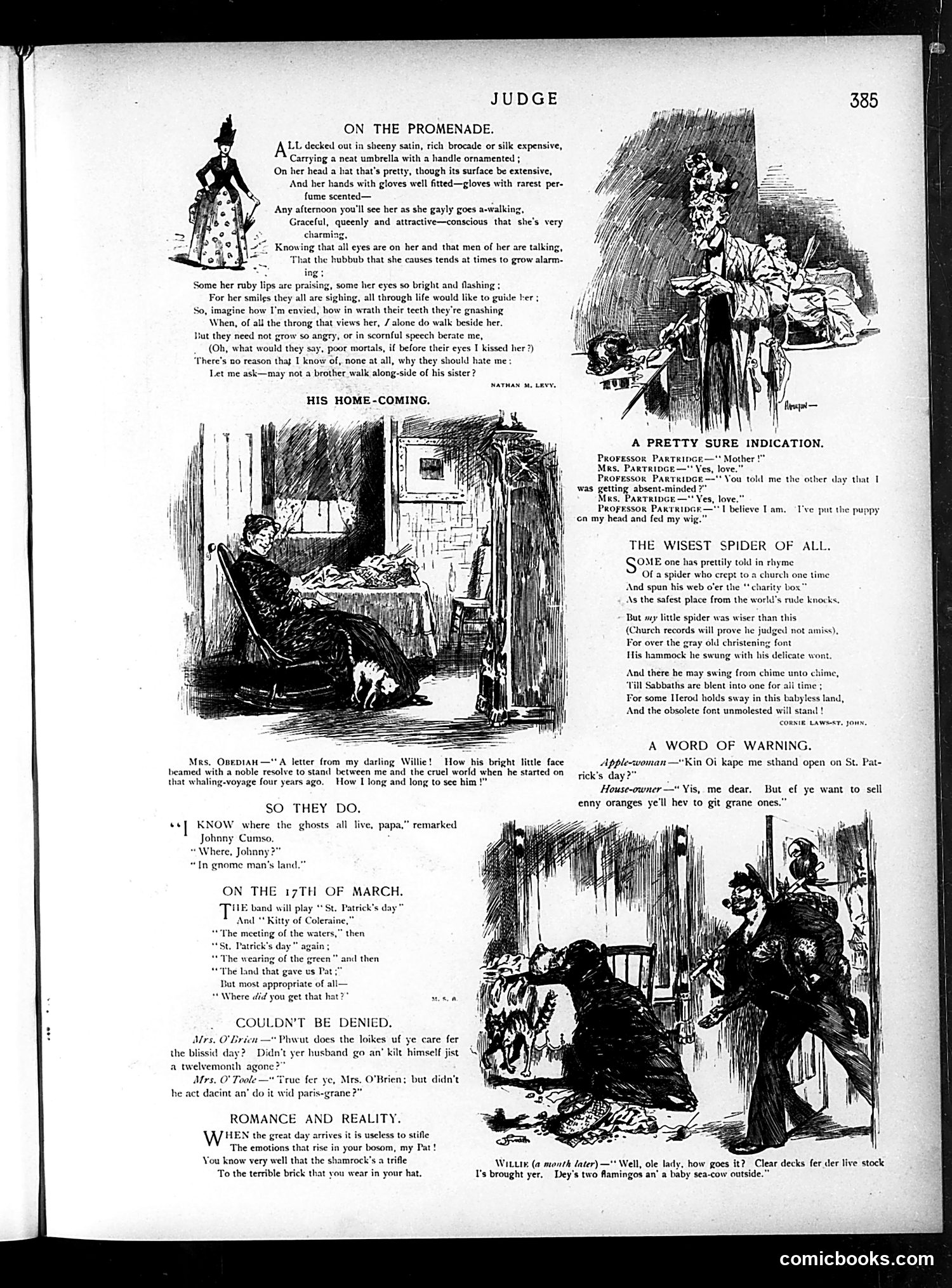
This page contains multiple short humorous pieces typical of Judge's satirical style: **"On the Promenade"** (top left): A poem satirizing vanity and social pretension. A man boasts about walking with an elegantly dressed woman, implying romantic conquest—the punchline reveals she's his sister, deflating his self-importance. **"His Home-Coming"** (center): A domestic joke where an absent-minded professor puts his puppy on his head instead of his hat, discovering his mental decline through this mishap. **"The Wisest Spider"** and other brief pieces use clever wordplay and situational humor rather than political satire. The Irish-dialect pieces ("A Word of Warning," "Couldn't Be Denied," "Romance and Reality") employ period-typical ethnic stereotyping, featuring working-class Irish characters speaking in exaggerated brogue—common in Judge during this era. **Overall**: This page demonstrates Judge's mix of social satire, domestic comedy, and ethnic humor typical of early 20th-century American magazines, with relatively light satirical targets rather than hard political commentary.
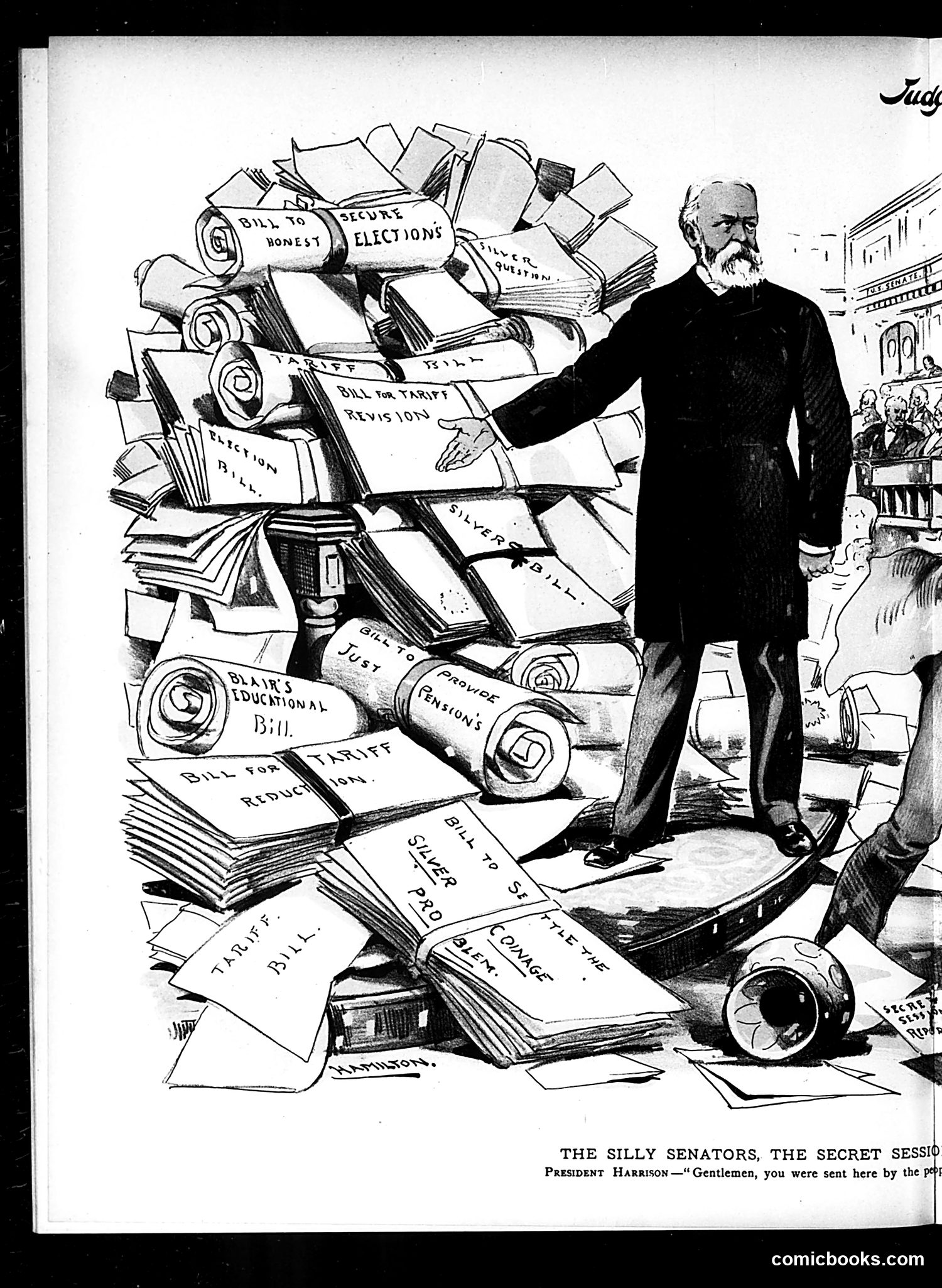
This Judge magazine cartoon satirizes President Harrison and Congress during a "secret session." The central figure—an elderly bearded man representing President Harrison—gestures helplessly at an enormous pile of legislation: bills for tariffs, silver, elections, education, and other matters, depicted as scrolls and documents towering chaotically around him. The satire criticizes congressional inefficiency and legislative gridlock. The "silly senators" are overwhelmed by their own agenda, unable to manage or prioritize the nation's business. The title's emphasis on "secret session" likely mocks closed-door proceedings that kept important debates hidden from public view. The cartoon suggests that despite their mandate to govern, senators are paralyzed by legislative clutter—a timeless critique of political dysfunction.
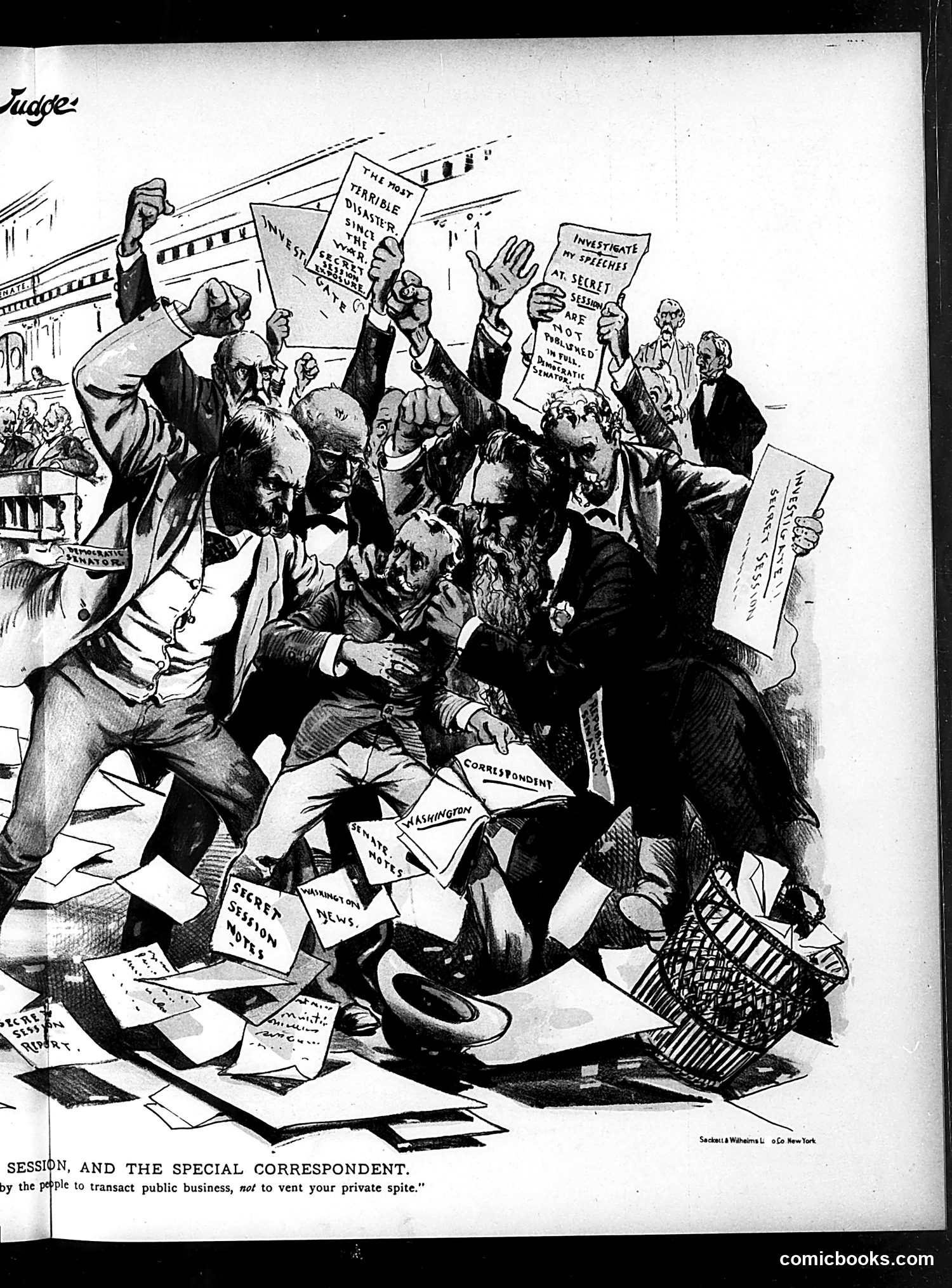
This Judge cartoon satirizes Congressional leaks and partisan behavior. A crowd of politicians and officials surround scattered documents labeled "Secret," "Washington," and "Confidential," while holding signs demanding investigations. The figures appear to be engaged in chaotic squabbling over classified information rather than conducting serious business. The satire targets how members of Congress use "special correspondents" (journalists) to leak sensitive government documents for partisan advantage—ostensibly to "investigate" rivals but actually to damage political opponents. The cartoon criticizes this practice as prioritizing private spite over the public interest, as suggested by the quoted text at bottom. The train departure in the background suggests the corrupt machinery of government in motion.
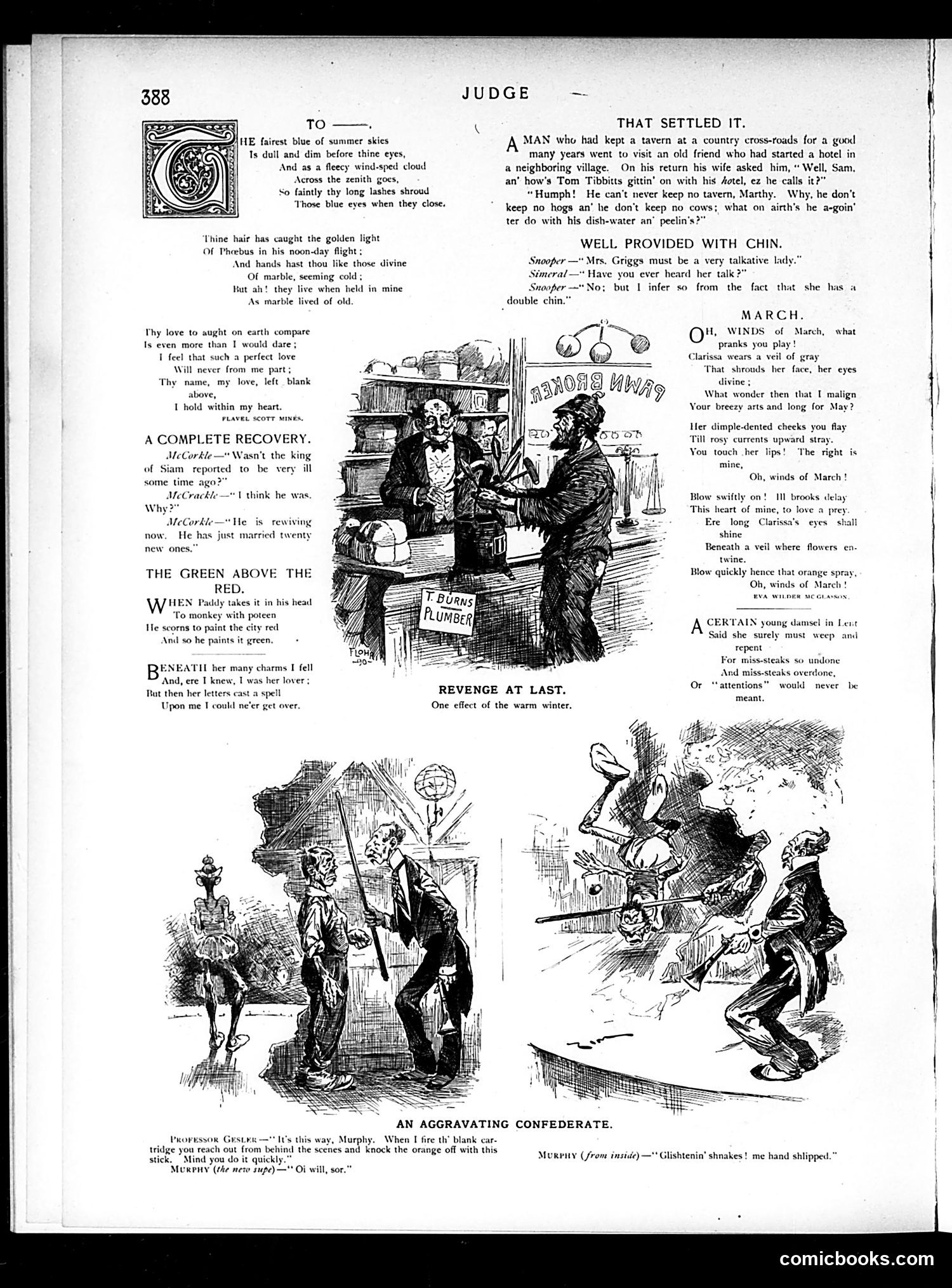
This page collects miscellaneous satirical content typical of Judge magazine's format: **"That Settled It"** mocks rural ignorance through a tavern-keeper's dismissal of a friend's hotel venture. The joke: the keeper assumes a hotel is useless without livestock to provide waste for disposal—revealing absurd frontier logic about waste management. **"Well Provided with Chin"** is a crude visual gag suggesting that a woman's double chin indicates excessive talking, playing on period associations between physical appearance and personality. **"The Green Above the Red"** appears to reference Irish stereotypes, suggesting an Irishman ("Paddy") paints the town green (via drinking) rather than the conventional "painting it red." **"Revenge at Last"** cartoon shows winter's end—children throwing snowballs at adults, depicted as comeuppance for winter's hardships. **"An Aggravating Confederate"** depicts a comedy mishap: a stage worker accidentally hits the wrong target during a performance, with Irish dialect humor in the dialogue. The page also includes sentimental poetry unrelated to satire. Overall, it reflects Judge's mix of satirical commentary, ethnic humor, and vaudeville-style comedic scenarios typical of late 19th/early 20th-century American humor magazines.
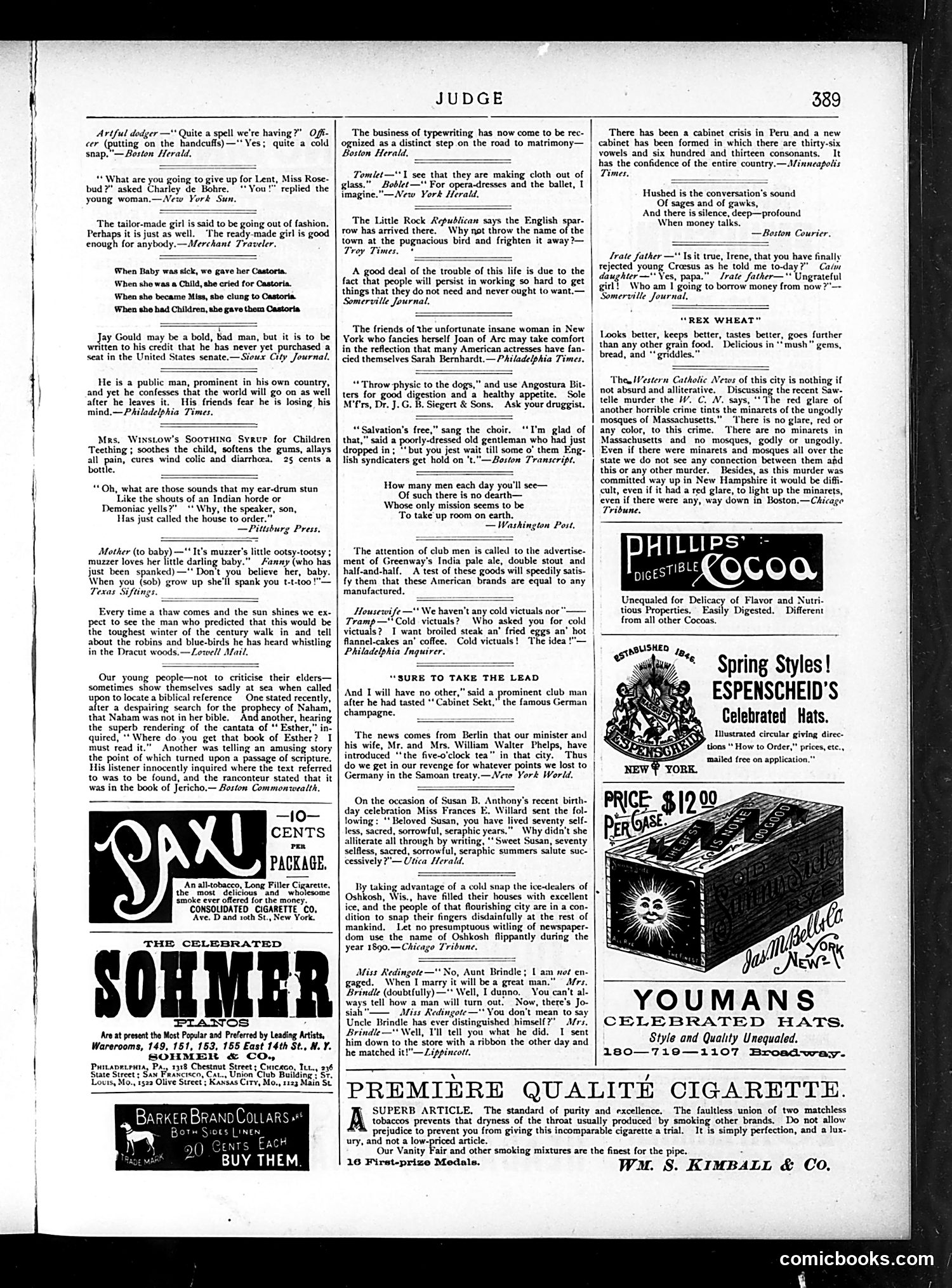
This page is primarily **advertising and miscellaneous short jokes** rather than political cartooning. The actual cartoon content is minimal. The few humor items present include: - A police joke about "artful dodgers" and cold weather - Satire on Jay Gould's character (noting he's never *bought* a Senate seat—backhanded praise) - Biblical illiteracy jokes mocking young people who cannot locate book references - Social commentary on the "ready-made girl" and changing fashion **The advertisements dominate**: cigarettes (Soapy brand, Consolidated), pianos (Sohmer & Co.), hats (Espenscheid's, Youman's), cocoa (Phillips'), and children's products (Mrs. Winslow's Soothing Syrup). The page lacks identifiable political figures or sustained satirical narratives. Instead, it reflects Judge's format of brief quips, ads, and light social observation typical of late-19th-century American humor magazines.
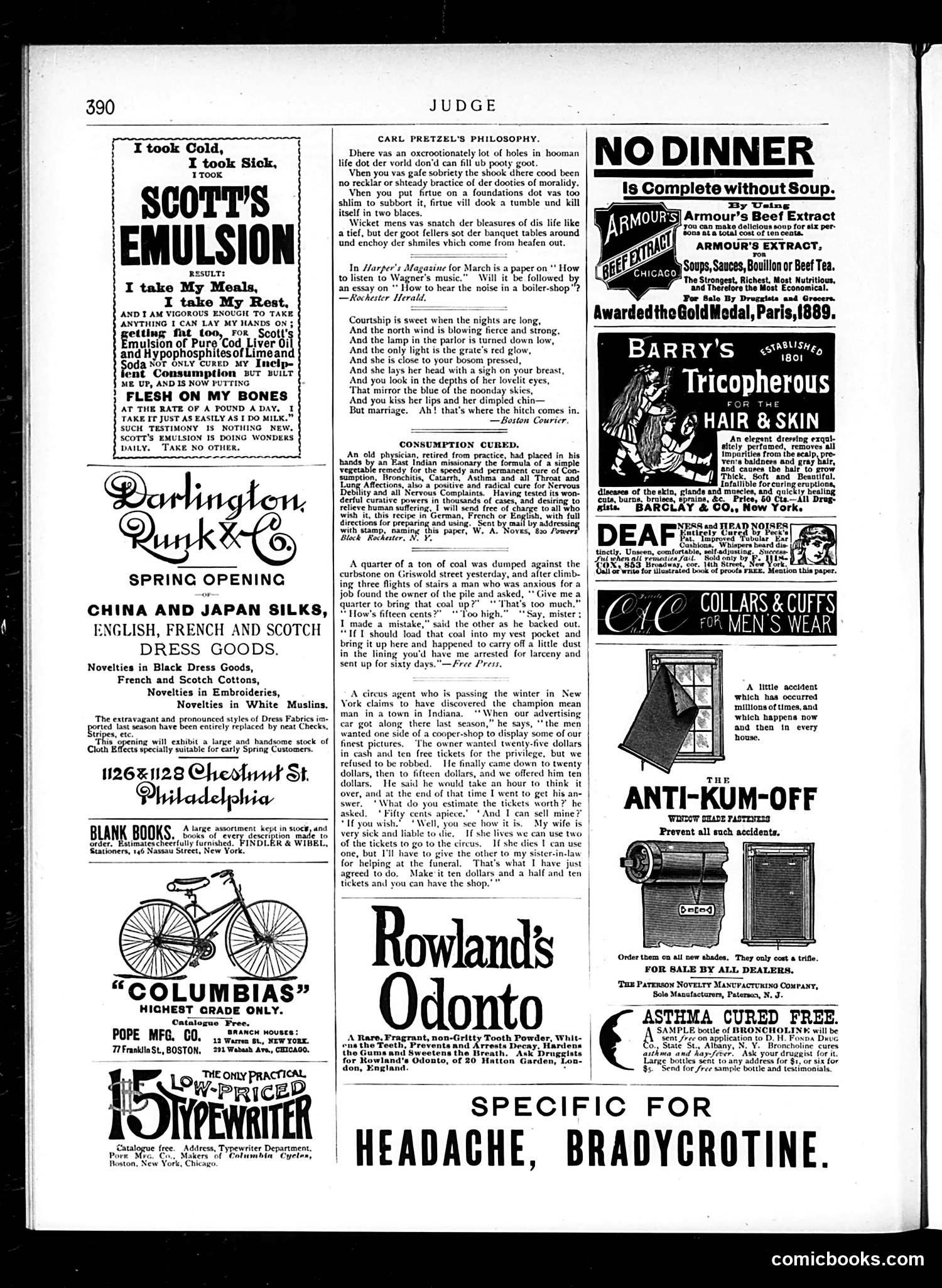
This page is primarily **advertisements and filler content** rather than political satire. The masthead identifies it as "JUDGE," a satirical magazine. The notable text content includes "Carl Pretzel's Philosophy"—a humorous column using German-accented English dialect humor, which was common in late 19th-century American publications. It contains folk wisdom observations about morality, relationships, and courtship, ending with the joke that marriage is where "the hitch comes in." Other brief satirical items mock contemporary topics: a quip about Wagner music instruction, and a dialogue about a coal vendor negotiating a pittance with a job-seeker. The bulk of the page comprises **patent medicine and consumer advertisements** (Scott's Emulsion, Barry's Tricopherous hair tonic, Rowland's Odonto toothpowder, etc.)—typical of period magazines that relied heavily on such advertising. No identifiable political cartoons or caricatures appear. This is largely a commercial page with light humor interspersed.
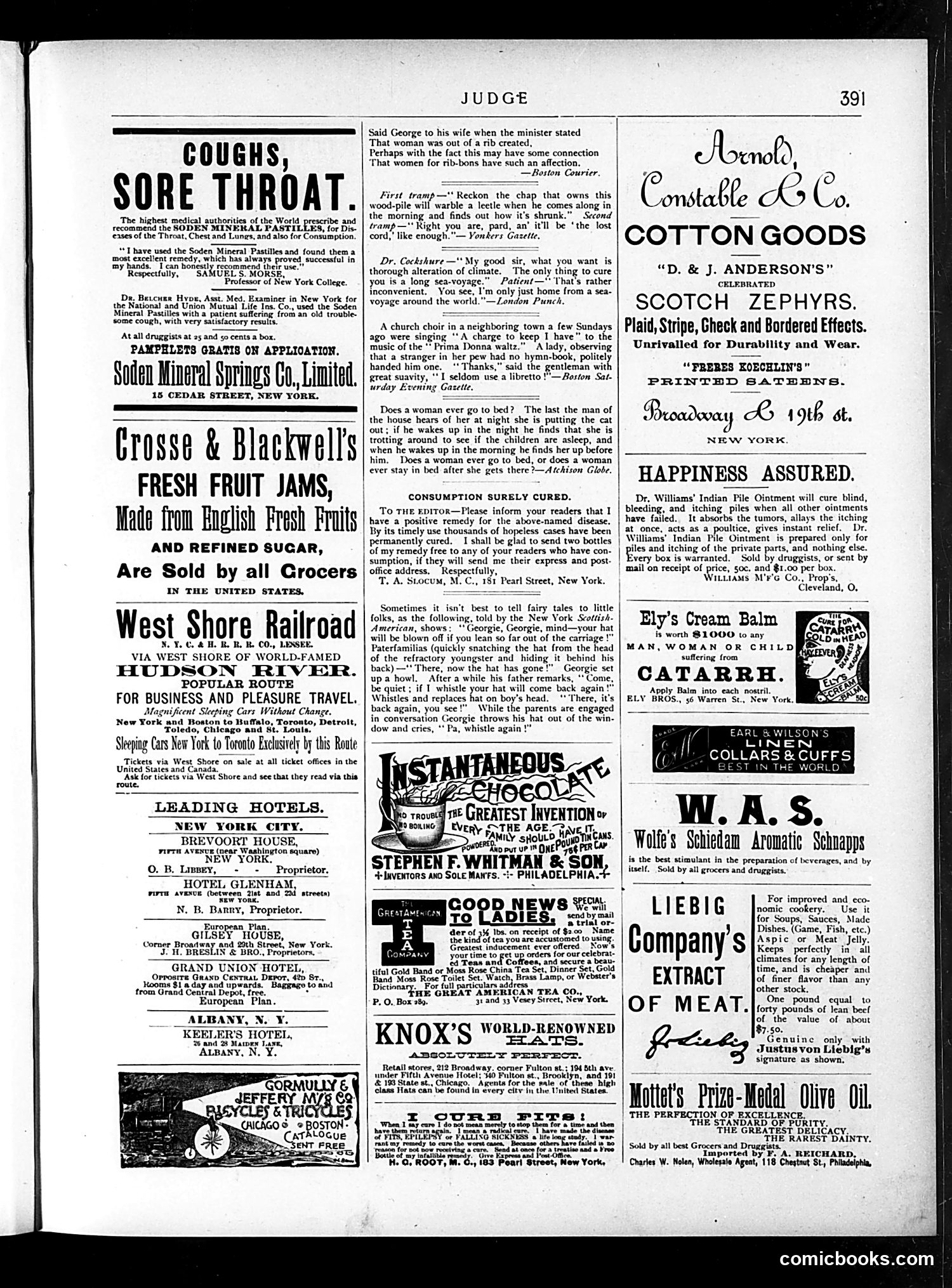
This page is primarily **advertising**, not political satire. It's from Judge magazine (page 391) and consists almost entirely of commercial advertisements for patent medicines, hotels, railroads, and consumer goods popular in the late 19th/early 20th century. The few brief **humorous items** scattered among ads are short jokes about marriage, tramps, doctors, and church choirs—typical light humor of the era. These include puns (a woman's affection for "rib-bons" playing on the Adam's rib creation story) and observations about domestic life. No political figures or events appear to be referenced. The page reflects Judge's business model: entertainment magazine funded by advertising revenue, with advertisements often occupying more space than editorial content.
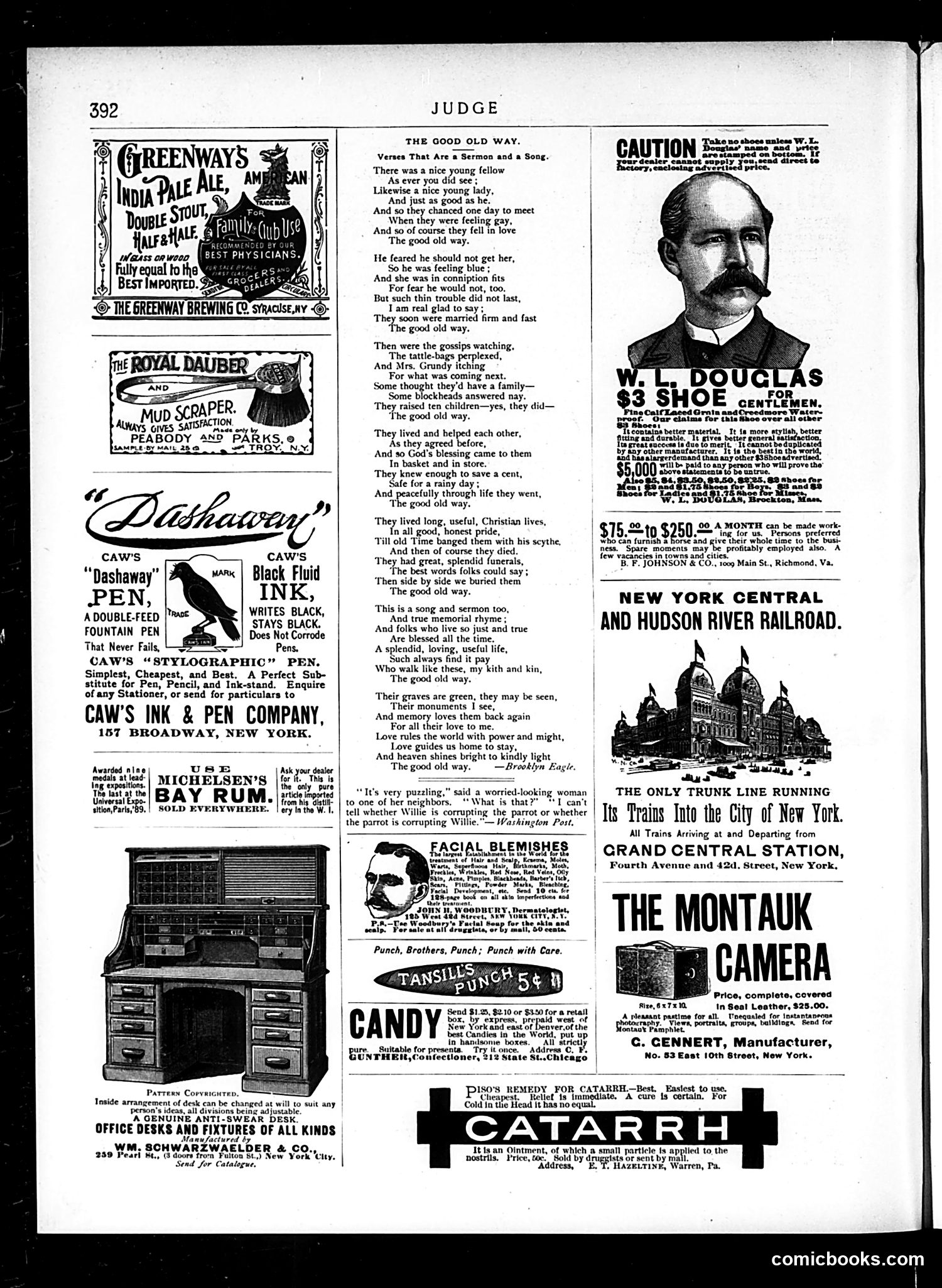
This page is primarily **advertising with one humorous sidebar**. The main content is **"The Good Old Way,"** a sentimental poem celebrating traditional courtship and marriage—a young couple meeting, falling in love "the good old way," marrying, raising ten children, living virtuously, and dying respected. It's nostalgic moralizing typical of 19th-century periodicals. The only satirical element is a brief **caption dialogue** at bottom: a woman asks her neighbor whether "Willie is corrupting the parrot or whether the parrot is corrupting Willie," referencing a *Washington Post* item. The joke plays on anxieties about corrupting influences on youth—here absurdly applied to whether a child or pet is the bad influence on the other. The remainder consists of advertisements for pens, ink, furniture, patent medicines, railroads, and shoes—typical Judge magazine filler. Most of the page is **commercial rather than editorial content**, making satire minimal here.
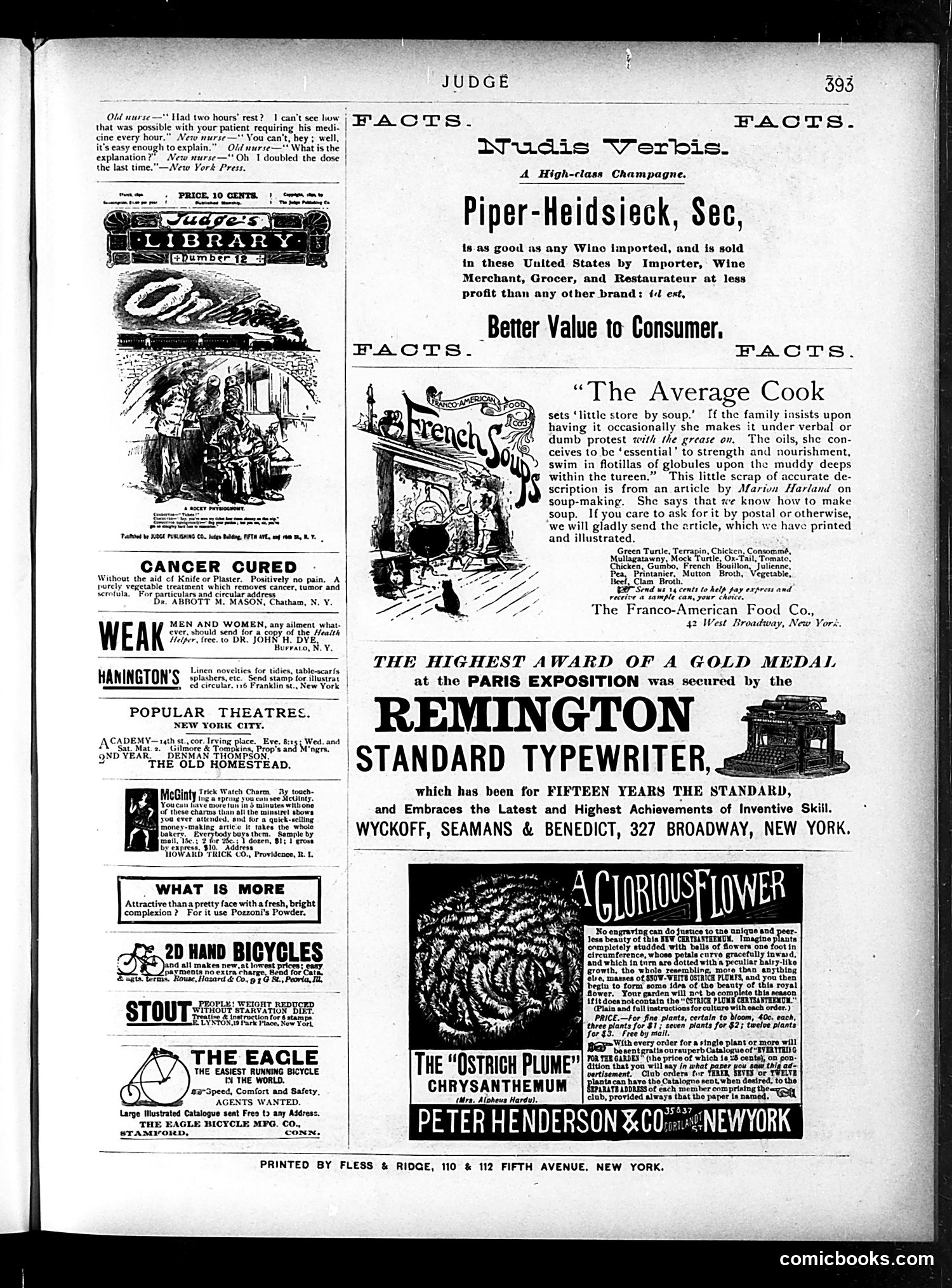
This page is primarily **advertising**, not political satire. At the top is a brief humorous anecdote about nursing practices: an old nurse questions how a new nurse got her patient to rest while requiring hourly medication. The new nurse's punch line—she "doubled the dose"—is dark comedy about over-medication, likely satirizing either inadequate medical training or dangerous patent medicine practices common in the era. The remainder of the page consists entirely of period advertisements for various products: patent medicines (cancer cures, weight reduction), bicycles, theaters, cosmetics, typewriters, champagne, and seeds. The Remington Typewriter ad notably claims a "gold medal" at the Paris Exposition, while plant and food company ads tout their wares. No identifiable political figures or events appear. The page reflects late 19th/early 20th-century consumer culture and the prevalence of dubious medical claims in advertising.
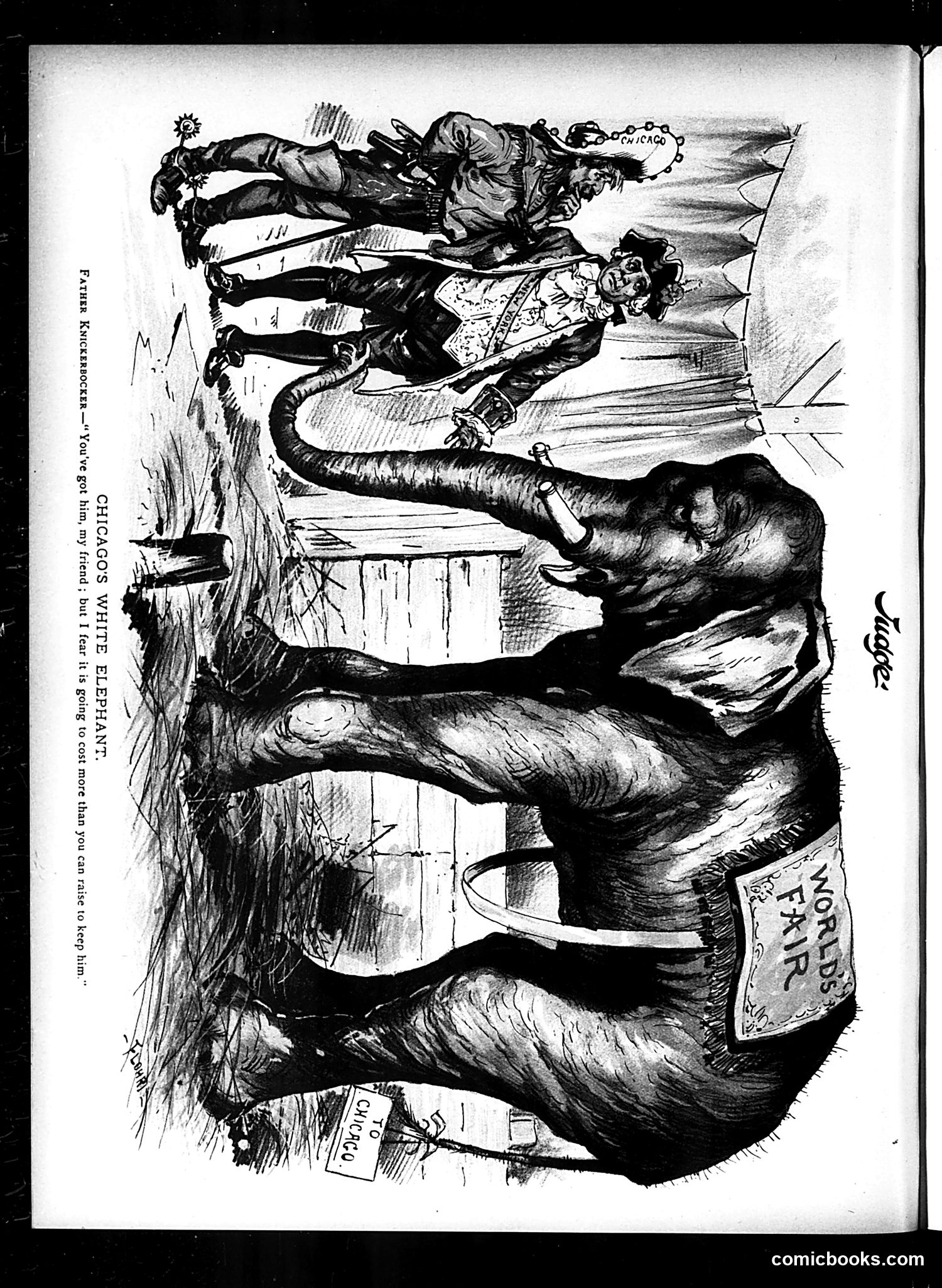
This appears to be a Judge magazine satirical cartoon critiquing Chicago's political corruption or governance. The image depicts an elephant (representing the Republican Party) being ridden or controlled by well-dressed figures, with "Chicago" marked on a signpost above. The elephant wears a collar labeled "Norwood's Fair," suggesting connection to a specific political figure or event. The satire suggests that Chicago's political establishment was manipulating or "riding" Republican interests for their own purposes. The fire in the background may reference urban decay or political turmoil. The caption text is largely illegible in the OCR, but the visual metaphor—using the elephant as a mount for politicians—indicates criticism of political control or corruption in the Gilded Age or Progressive Era Chicago politics. The exact historical event or figures remain unclear without legible text.