
A complete issue · 16 pages · 1890
Judge — March 15, 1890
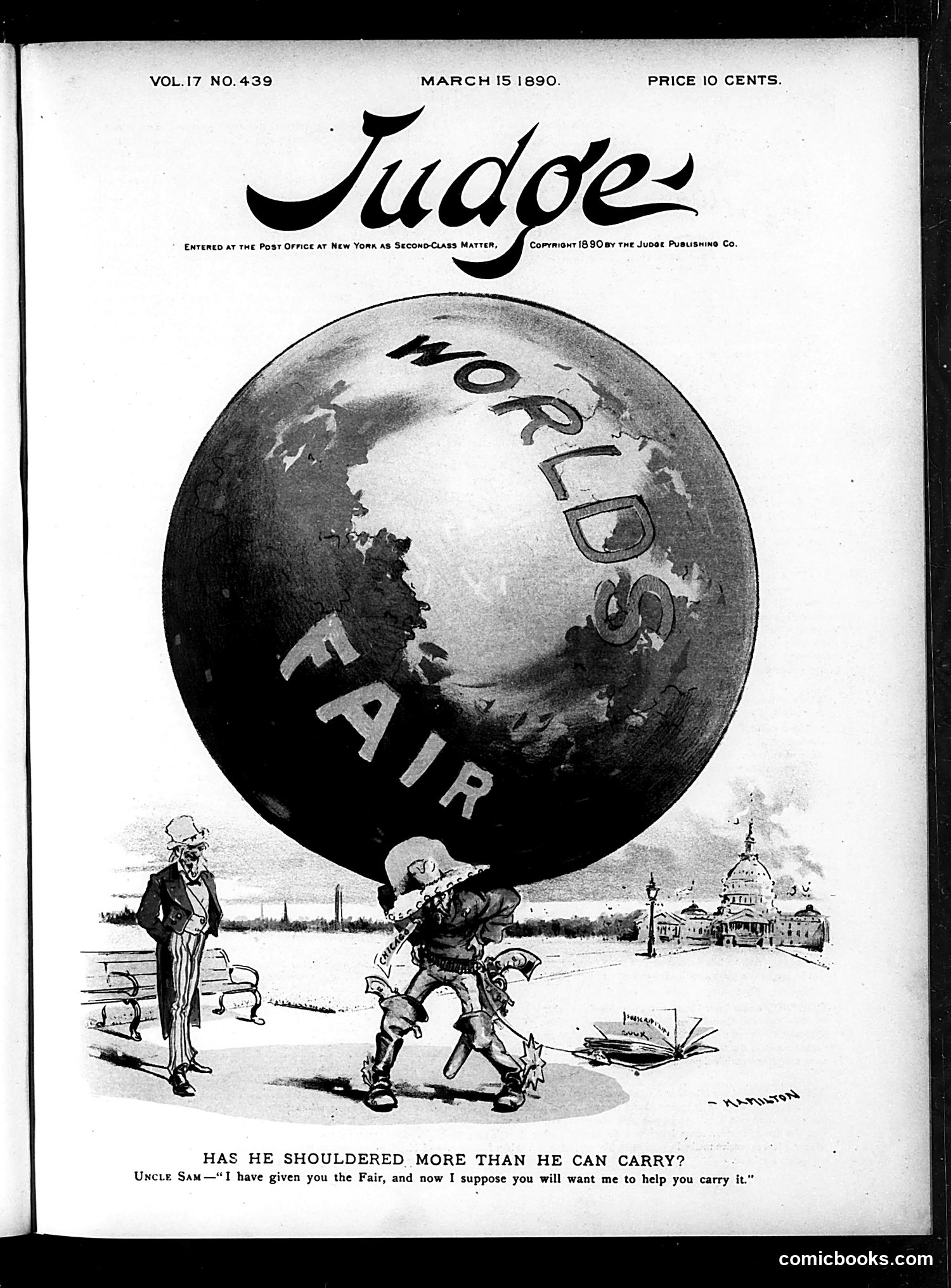
This political cartoon depicts **Uncle Sam** (left, in patriotic attire) offering to help carry a massive globe labeled "WORLD'S FAIR" and "CHICAGO." A figure representing **Chicago** (right, struggling under the weight) appears to be buckling under the burden. The satire addresses concerns about whether Chicago could successfully host the 1893 World's Columbian Exposition. Uncle Sam's offer to "help" suggests the federal government's involvement would be necessary for the fair's success—implying skepticism about Chicago's independent capacity. The cartoon reflects late-19th-century regional tensions and questions about whether an inland city could manage such an ambitious international event. The joke hinges on the disparity between Chicago's ambitions and its apparent ability to execute them.
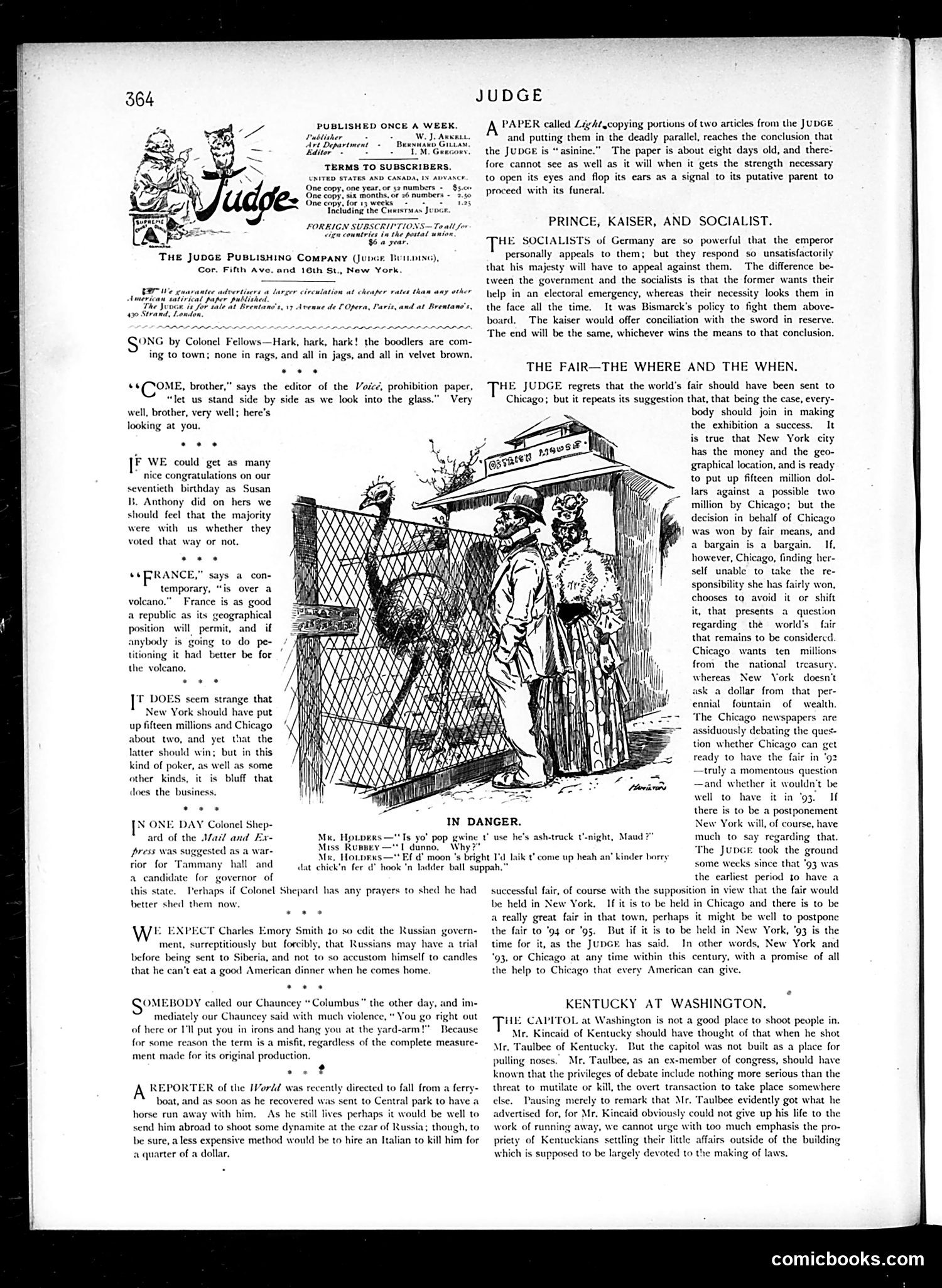
This page contains several brief political commentaries typical of Judge's satirical style, along with one cartoon illustration showing what appears to be two figures at a gate or fence. The main cartoon (titled "IN DANGER") depicts figures in period dress at an ornate gate, likely satirizing a political or social situation, though the specific reference is unclear from the image alone. The text sections mock various political figures and situations: Kaiser Wilhelm's appeal to German socialists, debate over hosting the 1893 World's Fair (Chicago vs. New York), and criticism of Senator Taubee of Kentucky regarding decorum in Congress. The overall tone is typical Judge satire—mocking political incompetence, regional rivalries, and institutional failings through brief, sharp commentary rather than detailed explanation, assuming readers followed current events.
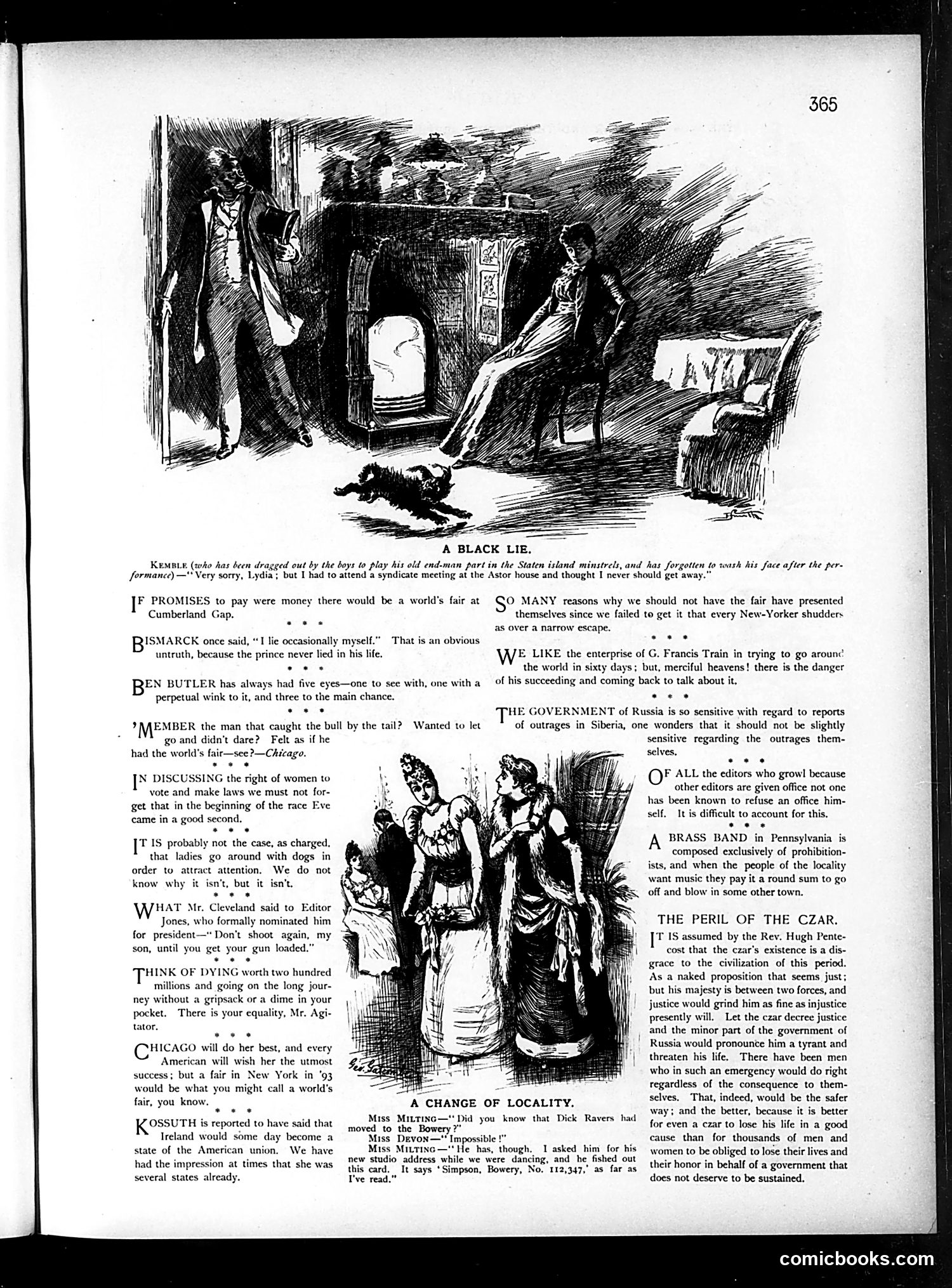
The page contains several brief satirical commentary pieces rather than a single cartoon. The main illustration titled "A Black Lie" depicts what appears to be a domestic scene with figures in formal dress. The text pieces mock various public figures and events: references to promises about world's fairs at Cumberland Gap, Prince Bismarck's dishonesty, Ben Butler's character flaws, and editorial practices. One section discusses Russian government sensitivity about reports of Siberian outrages—likely referencing Tsarist suppression of dissent. "A Change of Locality" appears to be a brief humorous exchange about someone named Dick Ravers moving to the Bowery. Without clearer image resolution of the main illustration or more specific datelines, precise identification of which events or individuals are targeted remains difficult, though the tone is characteristic of Judge's 19th-century political satire.
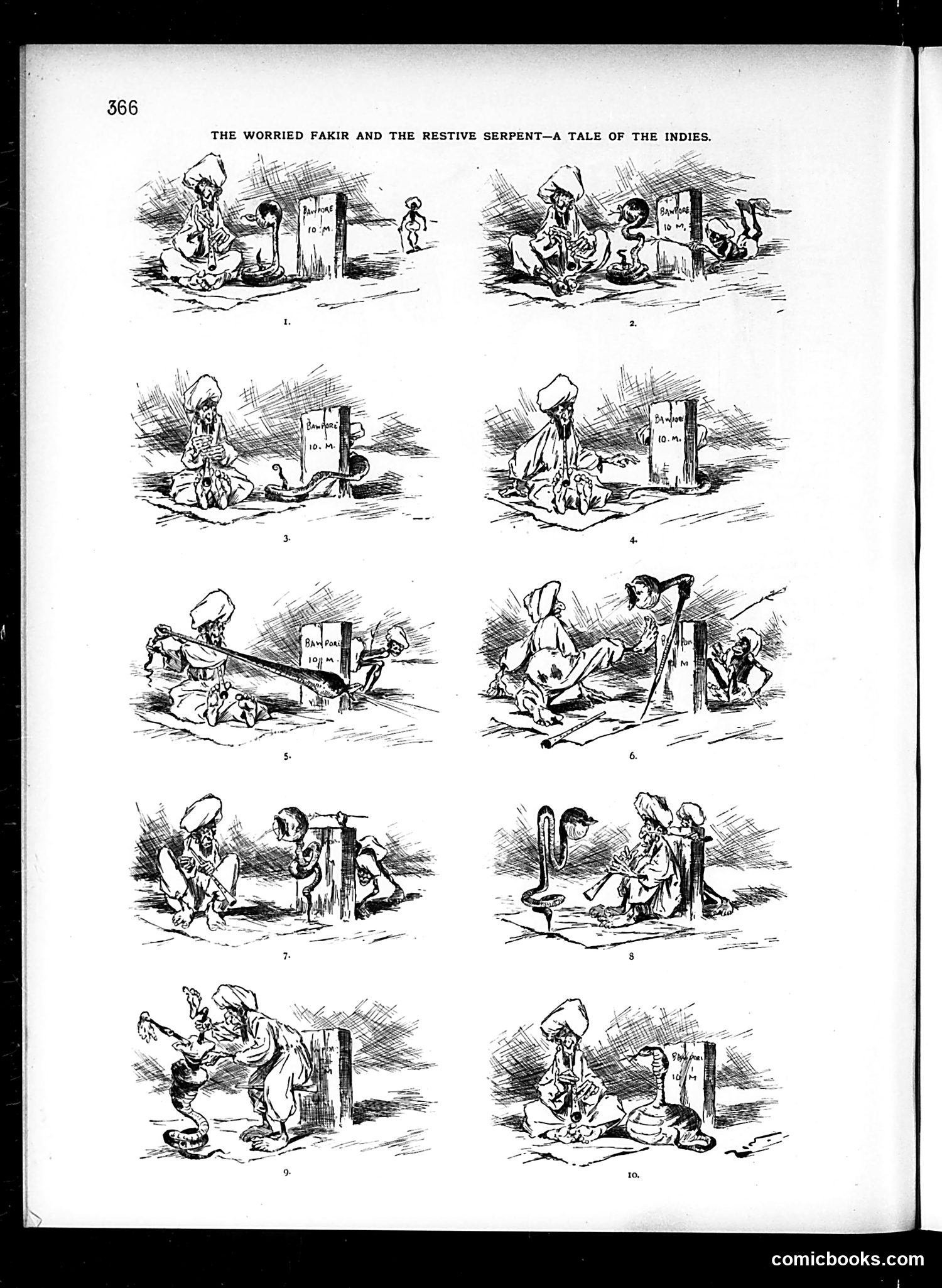
This ten-panel sequential narrative depicts a Indian fakir (holy man) attempting to charm a cobra through a basket, a traditional "snake charmer" act. The progression shows the fakir's growing distress as the serpent becomes increasingly uncooperative and aggressive, culminating in what appears to be the fakir fleeing or being attacked. The satire likely uses this scenario as a political allegory about British colonial rule in India (the "Indies"). The fakir represents India or Indian resistance, while the serpent may symbolize British imperial power—ostensibly controllable through traditional means (charm/diplomacy) but ultimately "restive" and dangerous. The joke suggests Indian attempts to manage or appease colonial authority were futile and increasingly perilous. This reflects late-19th-century American attitudes toward colonialism and racial stereotypes of Indian culture.
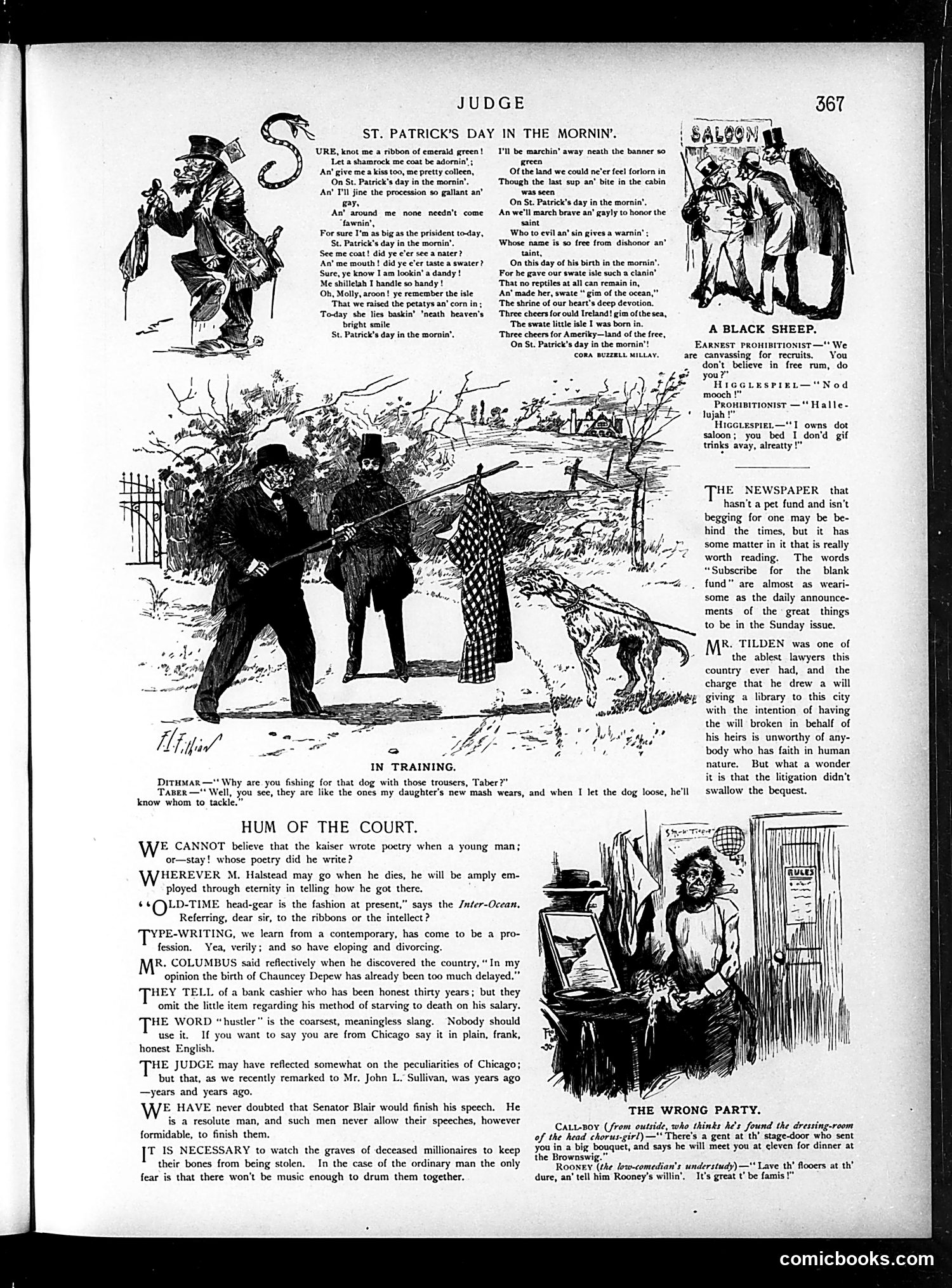
This page mixes Irish-American humor with satirical commentary on American life circa the Gilded Age. **"St. Patrick's Day in the Mornin'"** is a sentimental poem celebrating Irish immigration and St. Patrick's Day, depicting Irish-Americans as proud yet nostalgic for their homeland. The accompanying illustrations show stereotypical Irish characters in period dress. **"In Training"** jokes about a man using trousers to fish for a dog—playing on Irish stereotypes about both dogs and fashion. **"Hum of the Court"** contains brief satirical jabs at contemporary figures: the Kaiser's poetry, M. Halstead's afterlife, typewriter culture, Columbus/Chauncey Depew, bank cashiers' poverty wages, and Chicago's character. These are insider jokes referencing late-19th-century public figures and debates. **"A Black Sheep"** and **"The Wrong Party"** are brief social comedy sketches mocking prohibitionists and salon-keepers with exaggerated ethnic accents. The page reflects Judge's satirical approach: mixing sentiment with mockery, often targeting immigrants, reformers, and political figures through caricature and wordplay.
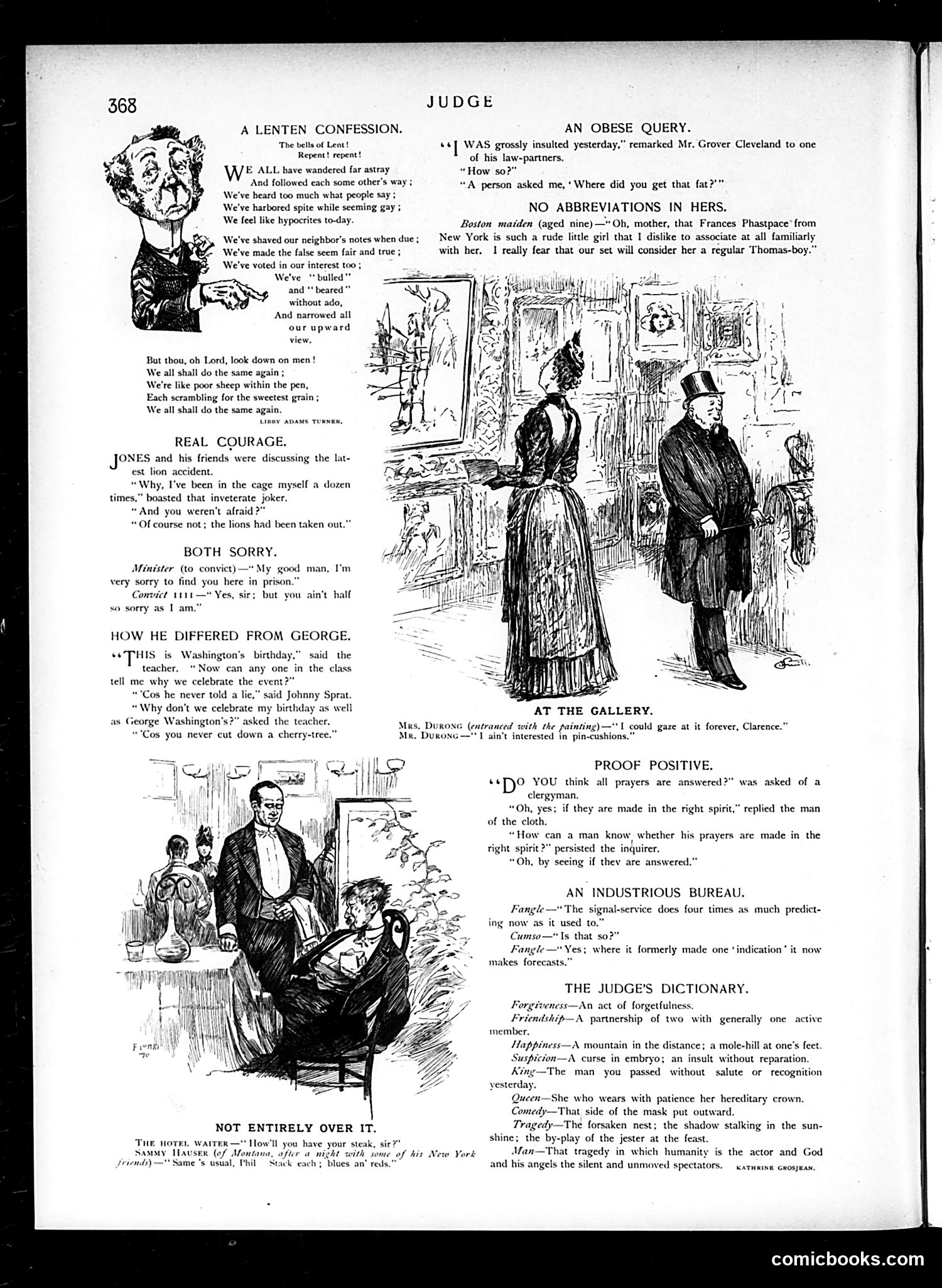
This page from *Judge* (circa 1880s-90s) contains multiple satirical pieces targeting contemporary American figures and social hypocrisy: **"An Obese Query"** mocks Grover Cleveland, the U.S. President, for his well-known weight. A law partner allegedly insulted him about his size—topical humor exploiting Cleveland's distinctive appearance. **"No Abbreviations in Hers"** ridicules verbose speech among Boston's upper-class youth, satirizing affected pretension through a nine-year-old girl's overwrought vocabulary and snobbery. The remaining sketches are general social satire: politicians' hypocrisy during Lent, a coward's false bravery, children's selective honesty about national holidays, gallery-goers' shallow aesthetics, and clergy's circular logic about answered prayers. **The humor relies on** exposing gaps between public morality and private behavior, class affectation, and logical absurdity—typical of *Judge*'s approach mocking American society's pretenses.
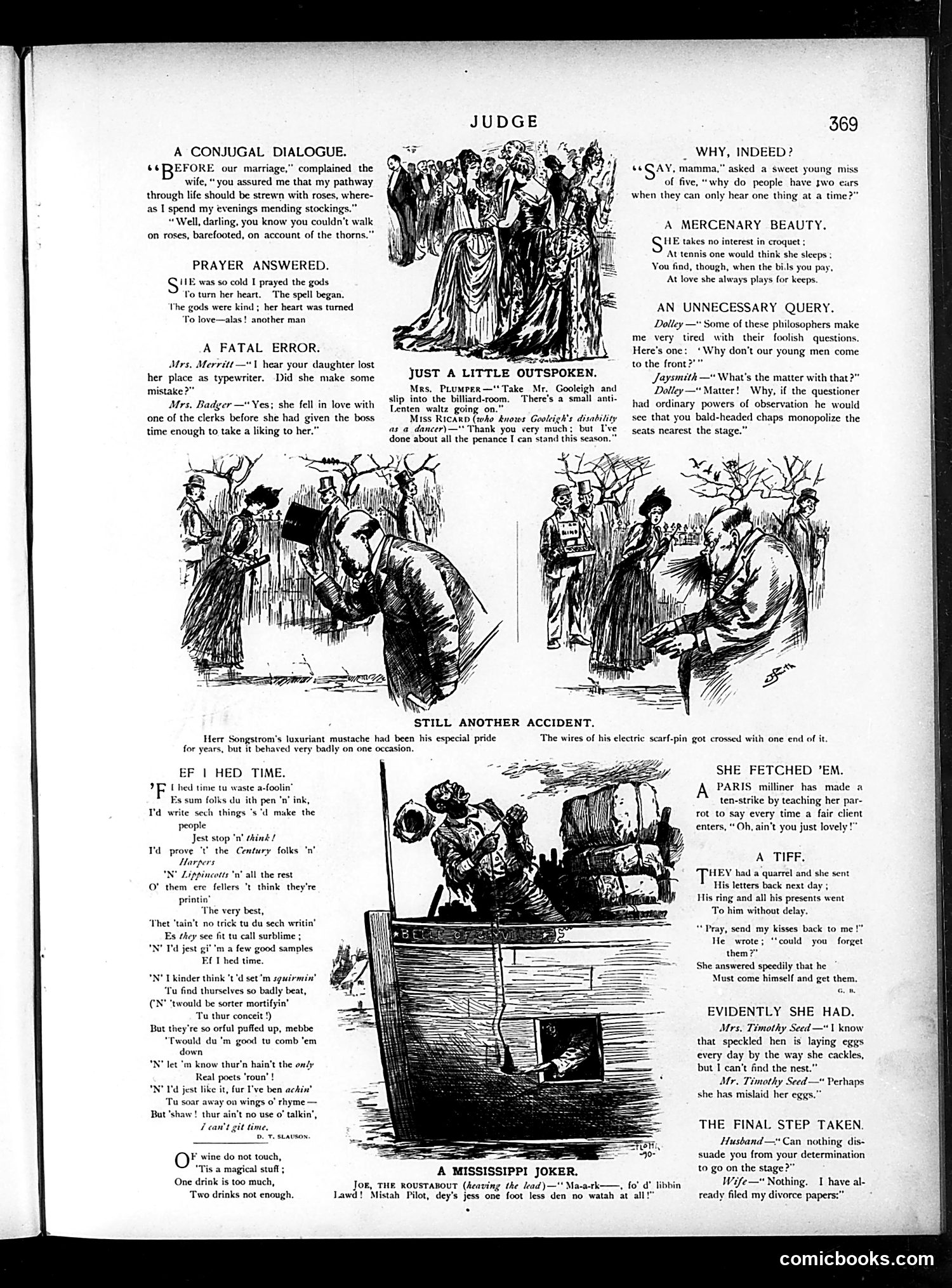
This page collects humorous short jokes and satirical vignettes typical of Judge's satirical style. The content mocks social conventions and contemporary foibles: **Key themes:** - **Marriage and romance**: Multiple jokes cynically depict courtship and matrimony as transactional or disappointing (the wife's "roses" complaint; the typist who lost her job by loving the wrong man). - **Class and pretension**: "A Little Outspoken" ridicules social etiquette; "Still Another Accident" mocks vanity (a man's prized mustache); "A Mercenary Beauty" lampoons materialistic women. - **Gender stereotypes**: Women are portrayed as either mercenary, illogical, or obsessed with appearance. - **Dialect humor**: The "If I Hed Time" poem and "Mississippi Joker" use exaggerated rural/dialect speech for comedic effect—common in this era but reflecting period prejudices. The illustrations by various cartoonists reinforce these satirical points through caricature. The overall message: society's pretensions, romantic ideals, and gender relations are fundamentally absurd.
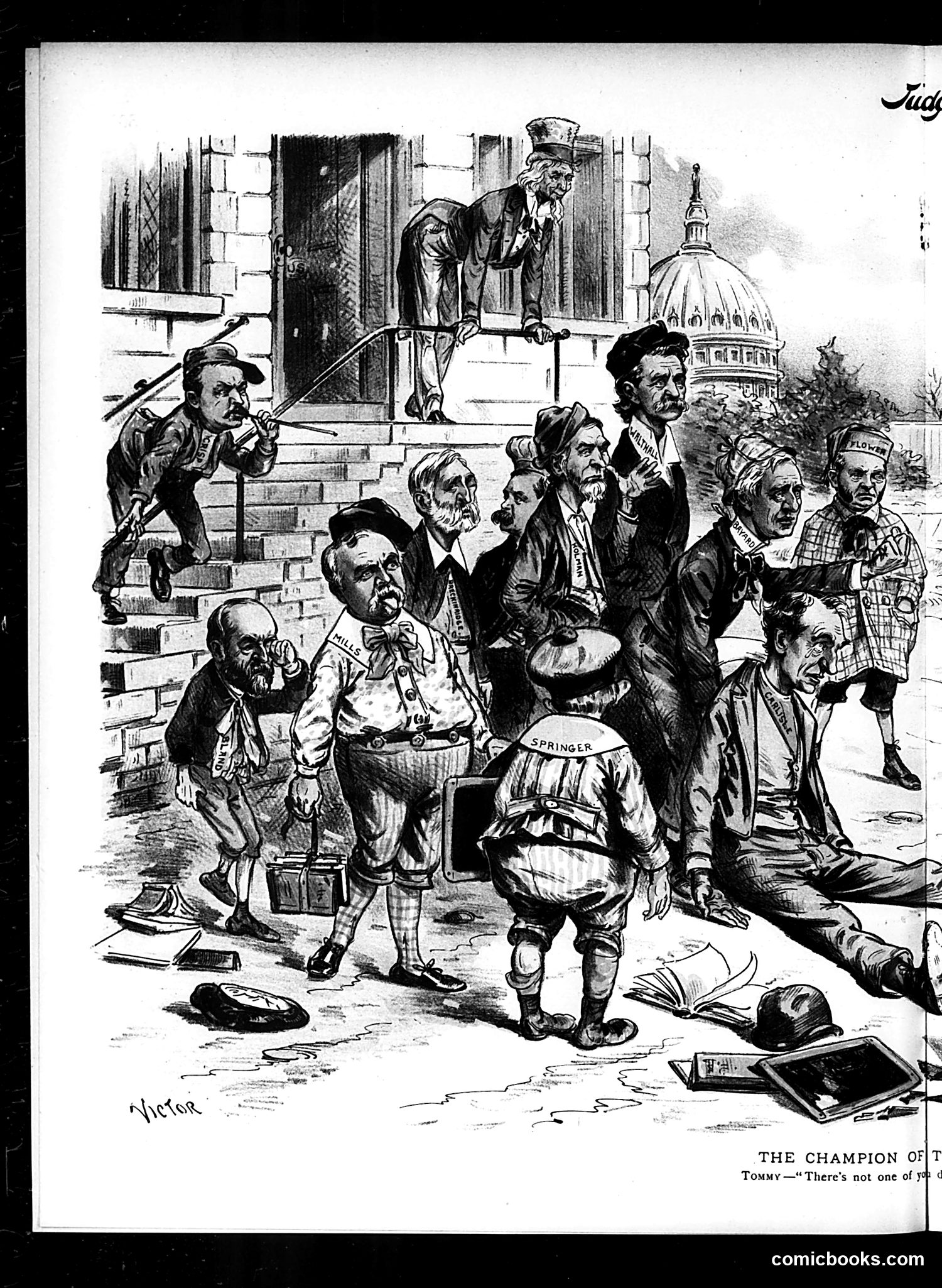
This appears to be an incomplete political cartoon from *Judge* magazine. The visible title reads "The Champion of T" (likely cut off), with a caption beginning "Tommy—'There's not one of yo[u]...'" The scene depicts a group of caricatured men in various states of distress or conflict outside what appears to be the Capitol building. One figure stands elevated on a railing, while others gather below in an agitated manner. A figure labeled "SPRINGER" is visible among them. **What's unclear:** Without the complete caption and date, the specific political situation and identities of most figures cannot be determined with certainty. The cartoon likely satirizes congressional conflict or political infighting, but the precise context and point of satire require additional information.
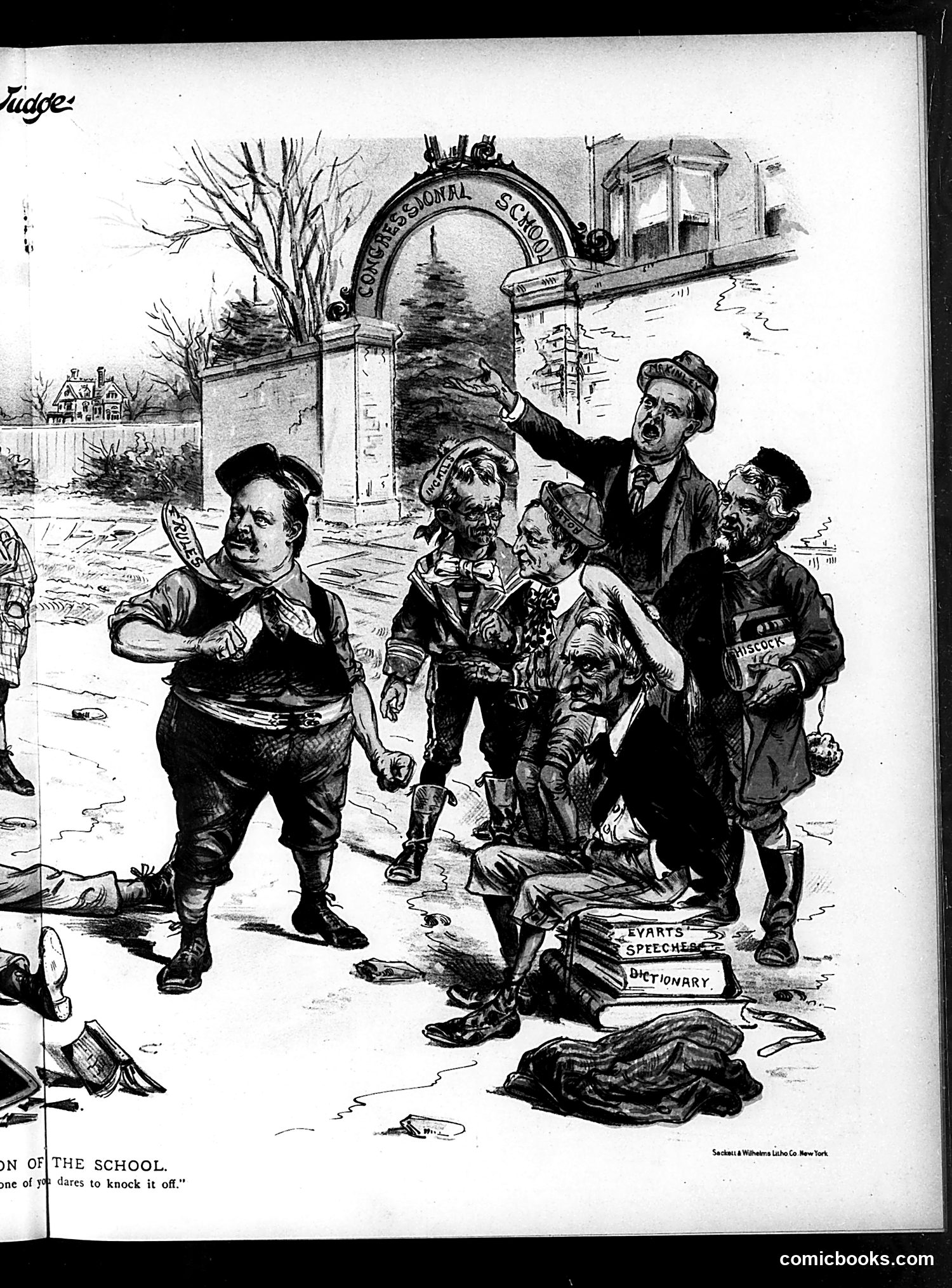
This satirical cartoon depicts a confrontation at "Grayson School" (visible on the arch). A stern authority figure (likely a school official or politician) points accusingly at a group of caricatured men who appear to be intellectuals or reformers, with visible labels including "Evarts' Speeches" and a "Dictionary," suggesting they represent educated critics or agitators. The caption fragment "dares to knock it off" suggests the cartoon mocks attempts to challenge or criticize the school's authority or educational practices. The aggressive posturing and dehumanizing caricatures are typical of Judge magazine's satirical approach to contemporary debates over education reform, likely positioning the reformers as threatening troublemakers rather than legitimate critics. Without the full date and context, the specific controversy remains unclear.
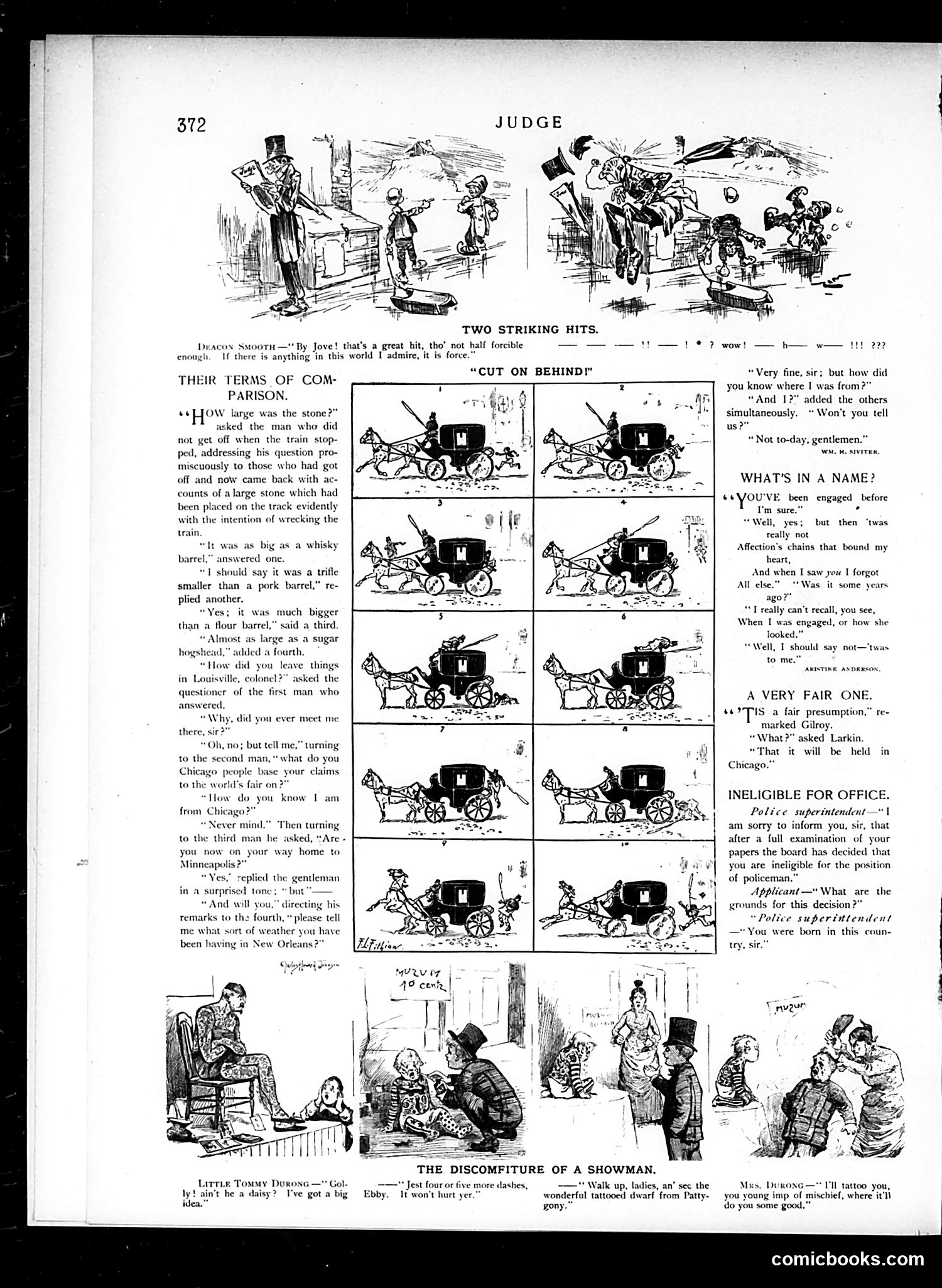
This page contains multiple satirical pieces typical of Judge magazine's humor: **"Their Terms of Comparison"**: A man who missed a derailment asks those who witnessed it to describe a large stone on the tracks. Each witness compares it to different objects (whiskey barrel, pork barrel, flour barrel, sugar barrel)—absurdly inconsistent measurements. The man then reveals he *knew* their origins (Chicago, Minneapolis, New Orleans) all along, implying regional characteristics make people unreliable or boastful about local knowledge. **"Cut on Behind!"**: An eight-panel wordless comic showing what appears to be someone repeatedly cutting something attached to a carriage or vehicle, with escalating chaos—slapstick humor. **Lower section**: Brief humorous dialogues about engagements, fair presumptions, and an applicant deemed ineligible for police work because he was born in the country (likely satirizing civil service requirements or anti-rural bias). The page exemplifies Judge's blend of observational humor about American life, regional stereotypes, and domestic situations typical of late 19th/early 20th-century satirical magazines.
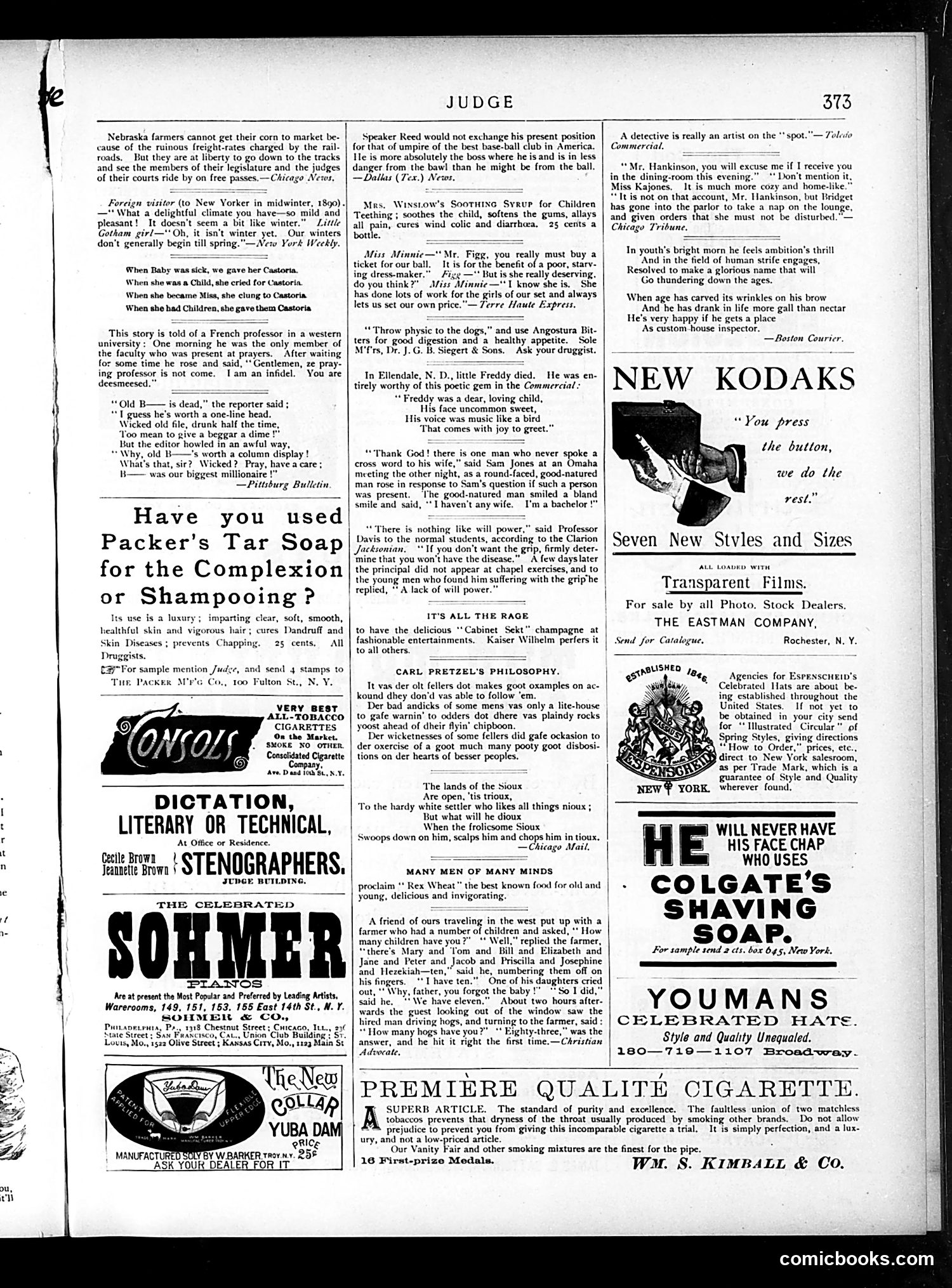
This page is primarily **advertising and light satirical commentary** rather than political cartoons. The satirical pieces are brief anecdotes mocking contemporary social issues: 1. **Railroad corruption**: A Nebraska farmer's complaint that legislators and judges ride free on railroad passes while farmers suffer ruinous freight rates—satirizing the cozy relationship between railways and government. 2. **Speaker Reed joke**: A quip comparing Speaker of the House Thomas B. Reed's absolute political control to a baseball umpire, suggesting he's safer from criticism in politics than in sports. 3. **Minor social satire**: Small pieces mocking French academics, newspaper editors valuing wealthy subjects over honest ones, and the hypocrisy of charity balls benefiting workers. The rest is **period advertisements** for soap, pianos, stenographers, and cigarettes—typical for Judge magazine's revenue model. No major political figures are caricatured here; the satire targets systems (railroads, newspapers) rather than individuals.
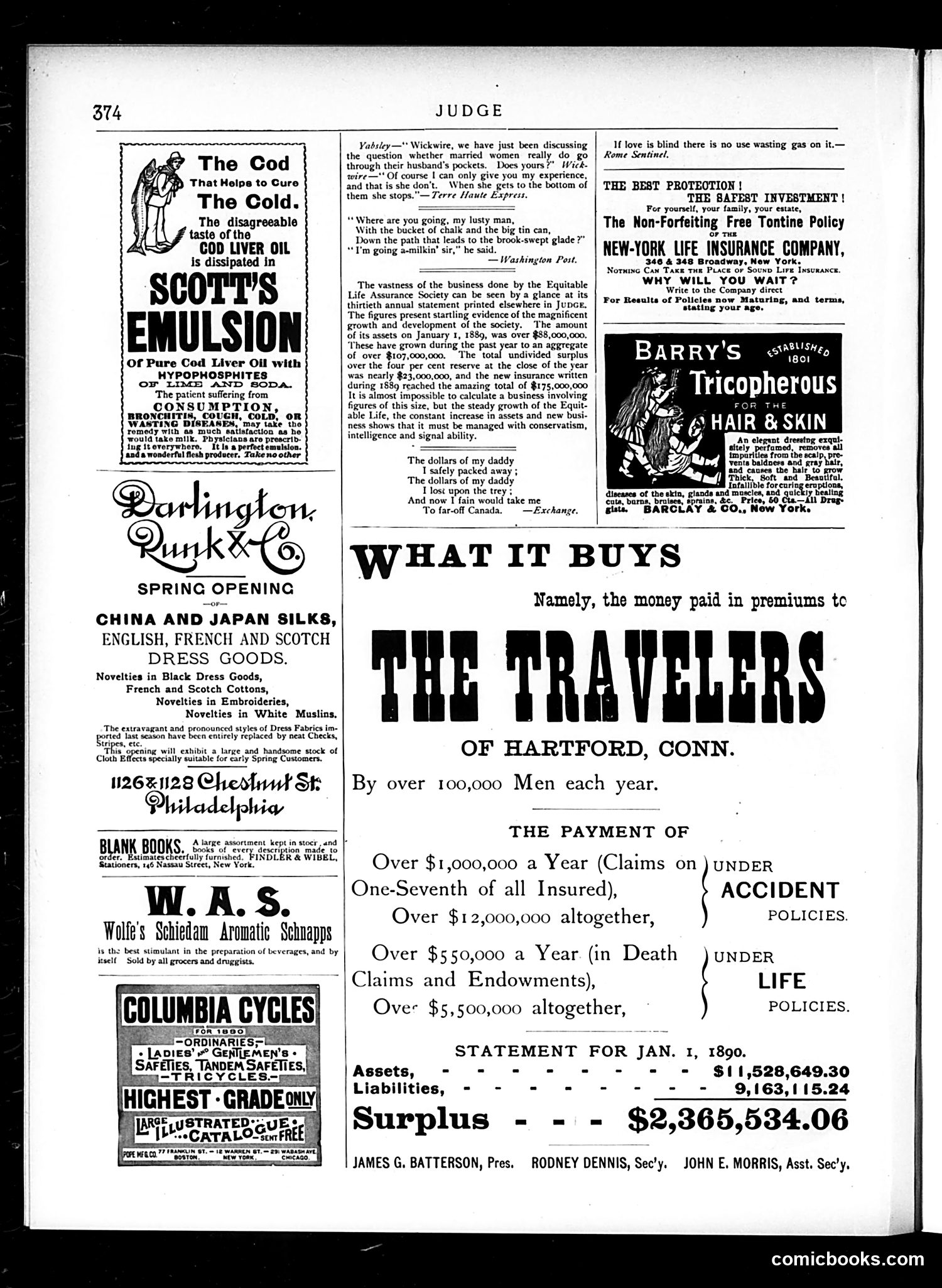
This page is primarily **advertising**, typical of Judge's revenue model. Key content includes: **Comic humor:** Three brief jokes—one about wives searching husbands' pockets (implying marital suspicion/financial control), one about a man with chalk and tin can (a rural milking scene with wordplay), and one about a man who gambled away his inheritance and fled to Canada. **Insurance advertising dominates:** The Travelers Insurance Company of Hartford and New York Life Insurance feature prominently, showcasing claims payments ($1+ million yearly). This reflects the emerging American insurance industry of the 1890s, when life and accident insurance were relatively new products being marketed to middle-class men. **Patent medicines:** Scott's Emulsion (cod liver oil for consumption/coughs) and Barry's Tricopherous (hair tonic) represent typical era remedies, often of dubious efficacy. **Fashion advertising:** Darlington, Runk & Co. announces spring silks and dress goods—reflecting seasonal retail cycles. The page reflects 1890 concerns: industrial accidents, mortality, male financial responsibility, and commercial growth.
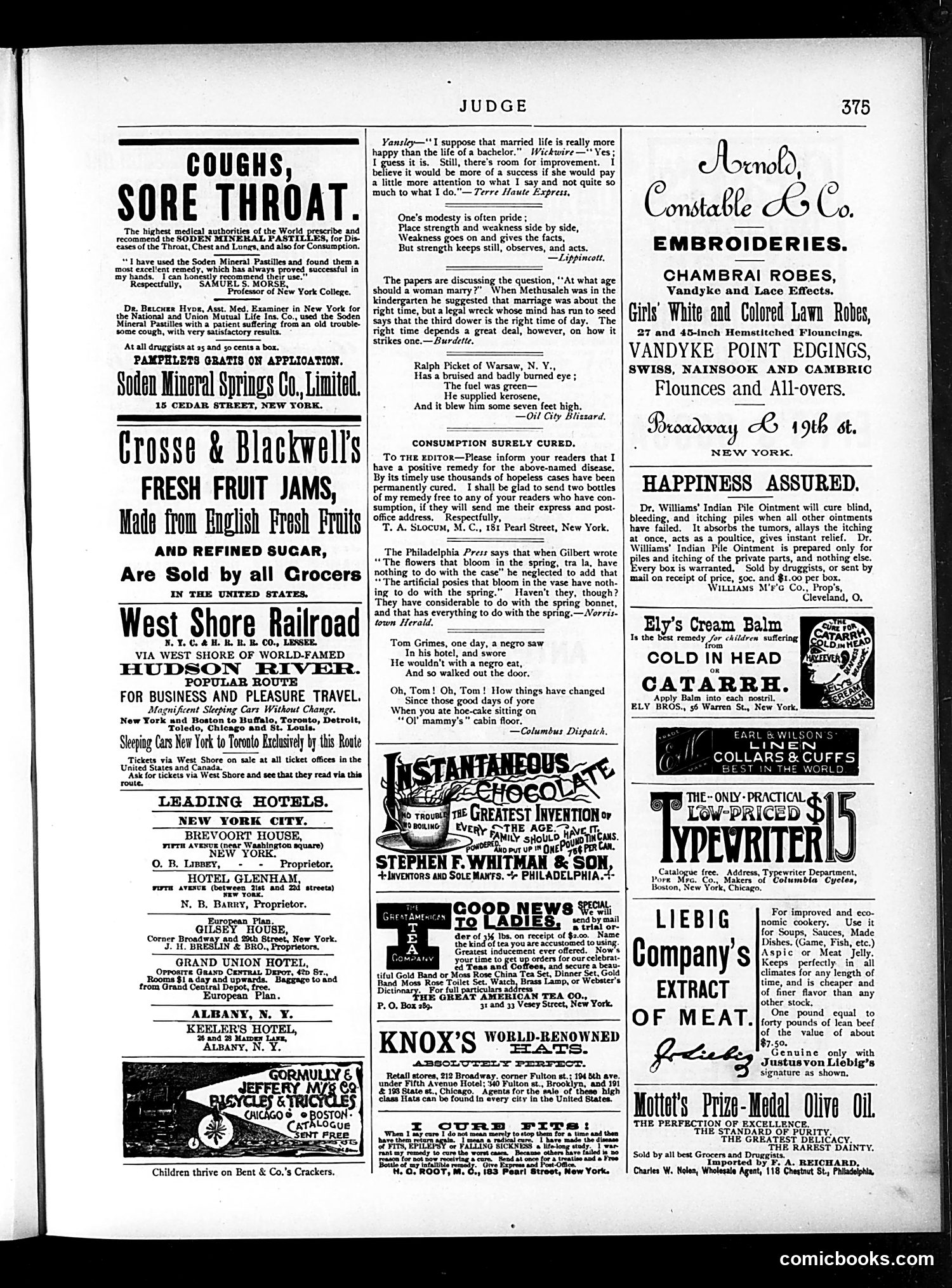
This page is primarily **advertising with minimal editorial content**. The few jokes present are brief, generic humor pieces typical of the era: **Notable content:** - A joke about married life vs. bachelorhood (Yansley/Wickwire exchange) — mild domestic humor about wives not listening to husbands - A brief poem on modesty and strength - A question-and-answer joke about appropriate marriage age, referencing Methuselah - A brief humorous accident report about kerosene fuel **The page is dominated by advertisements** for: - Soden Mineral Pastilles (throat/lung remedy) - Crosse & Blackwell jams - Patent medicines (consumption cure, Indian Pile Ointment, Dr. Williams' products) - Hotels and railroads - The West Shore Railroad - Liebig's Extract of Meat There are **no political cartoons or social satire** of significance on this page. It represents typical late-19th/early-20th century magazine advertising mixed with light, non-topical humor.
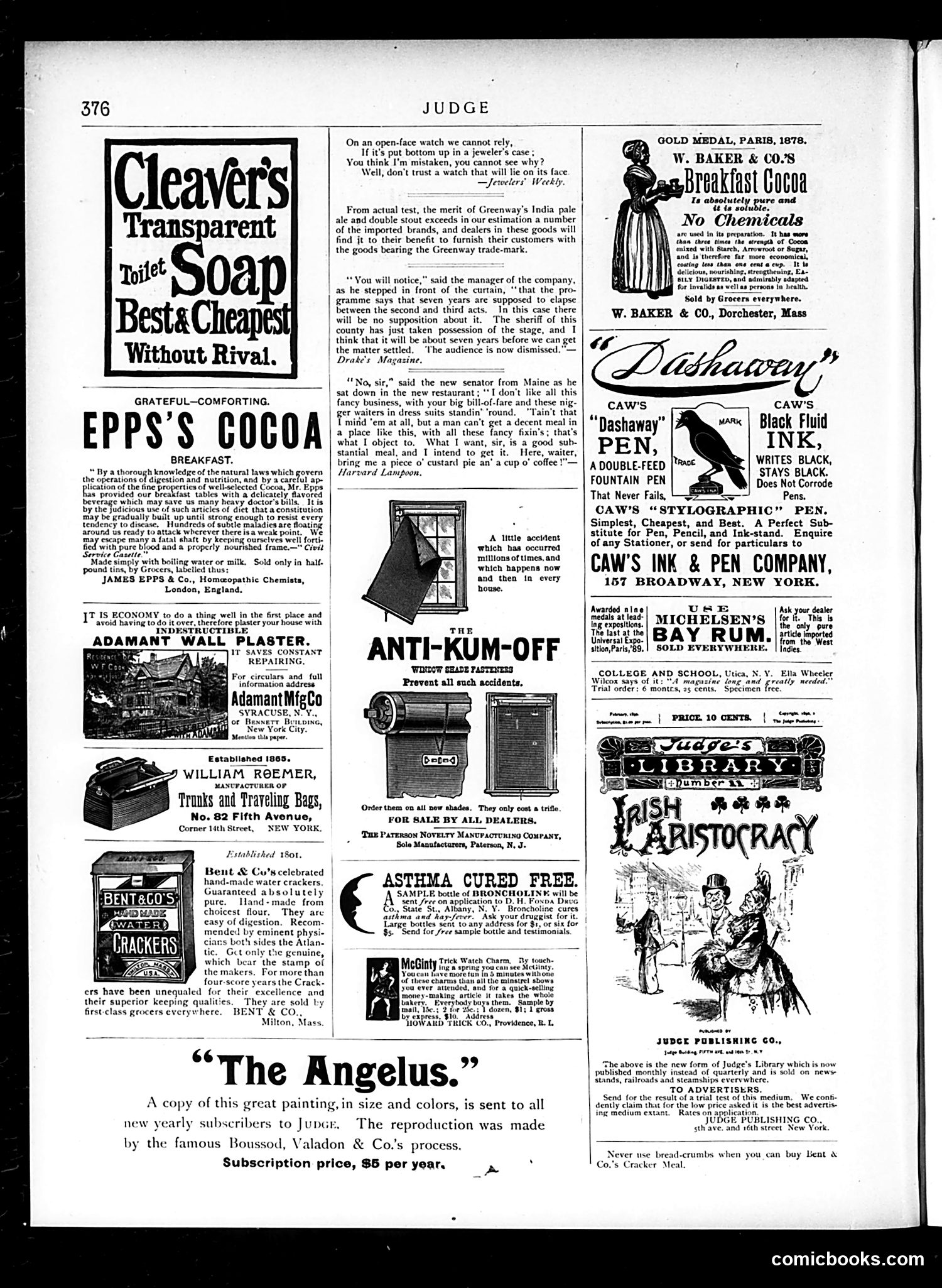
This page is primarily **advertisements and filler content** typical of Judge magazine's revenue model, with only one identifiable cartoon/satirical piece. The main humor piece involves **a newly elected senator from Maine** who sits in a fancy restaurant and complains about pretentious service. He demands "a good substantial meal"—requesting custard pie and coffee instead of the elaborate menu. The joke satirizes **rural/working-class politicians' discomfort with urban sophistication** and their deliberate rejection of fancy culture, presenting this as authentic "common sense" versus affected pretension. The rest of the page consists almost entirely of **period advertisements**: Cleaver's soap, Epps's cocoa, Baker's cocoa, fountain pens, window shade fasteners, and crackers. The repeated cocoa ads (three different brands) suggest this was a lucrative advertising market. The page includes a small note about "The Angelus" painting being sent to new yearly subscribers—Judge's circulation incentive. This reflects how **19th-century humor magazines survived financially**: satirical content occupied maybe 10% of pages; advertising filled the remainder.
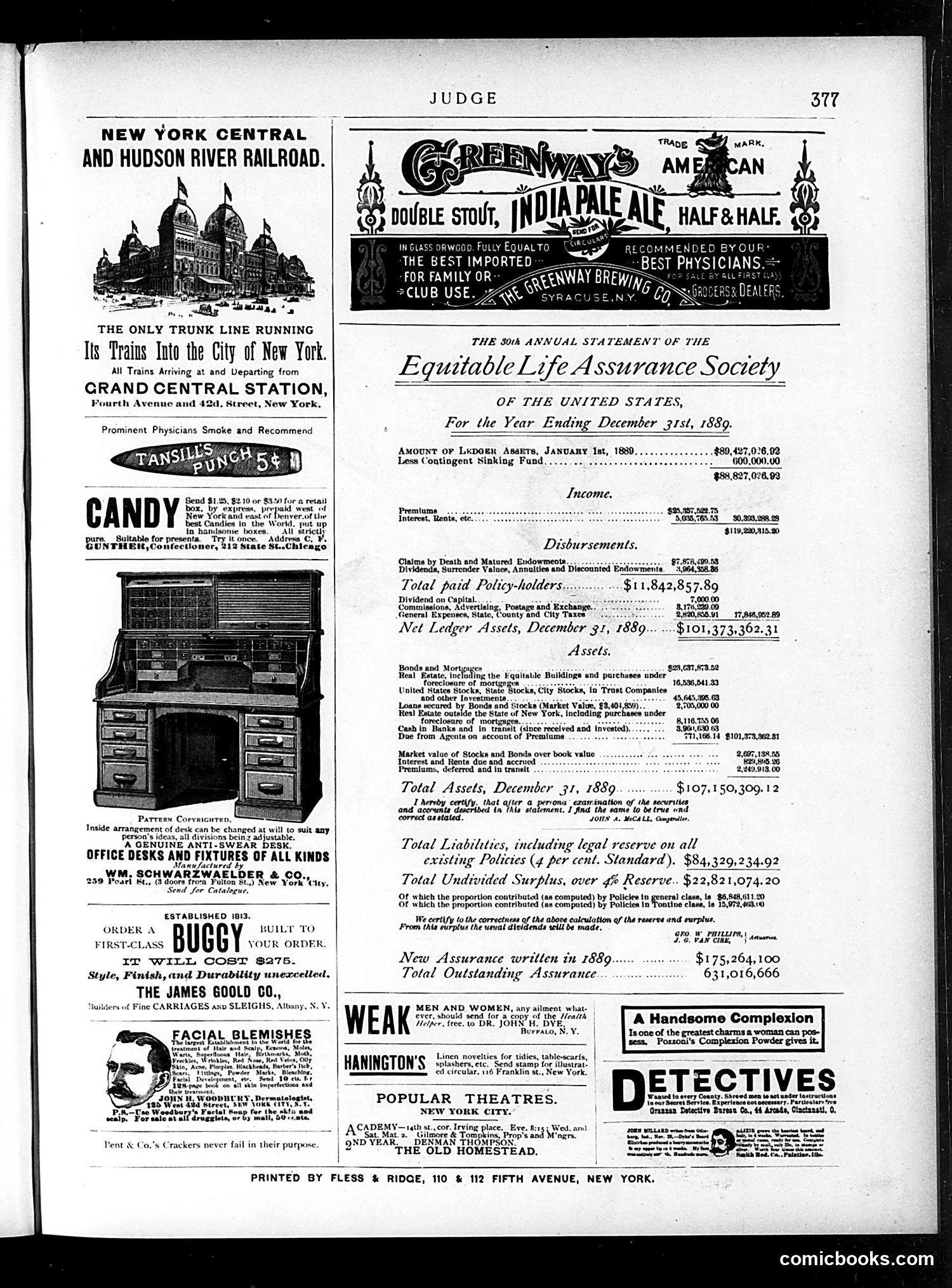
This page is primarily **advertising and financial statements**, not satirical content. The dominant feature is the 30th annual statement of the Equitable Life Assurance Society, presenting 1889 financial data—assets, liabilities, disbursements, and new policies written. The surrounding advertisements are typical of the era: railroad and carriage services, candy, office furniture, facial treatments for "blemishes," and theatrical listings. One ad promotes a product for "weak" men and women, promising health restoration. The only potentially satirical element is **Greenway's ale advertisement**, which claims endorsement by physicians and recommends it as "the best imported for family or club use"—a common marketing tactic of the period that would become increasingly questioned as medical understanding evolved. The page reflects late-19th-century American commercial life: financial institutions advertising stability, medical quackery marketed openly, and railroads promoting urban connectivity. There is no coherent political cartoon or satirical commentary visible.
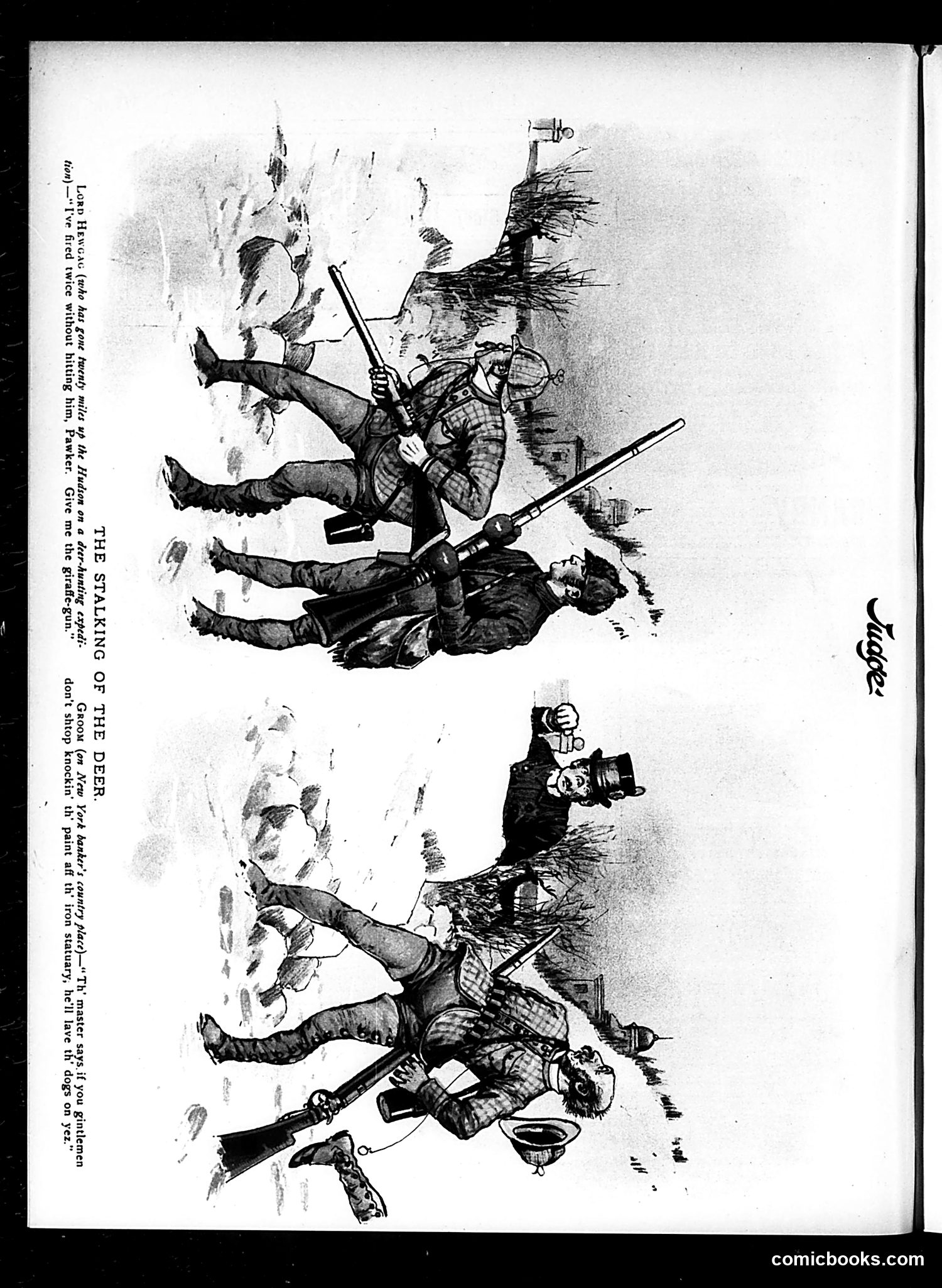
This is a two-panel satirical cartoon mocking wealthy New York elites on hunting expeditions. The top panel depicts "Lord Newgate" (a caricatured nobleman) on a Hudson River hunting trip, comically unable to hit a deer despite firing twice, requesting a "giraffe-gun"—the exaggeration suggesting incompetence and absurd pretension. The bottom panel shows a groundskeeper warning well-dressed gentlemen about damaging decorative iron statuary on a banker's country estate, with the threat of unleashing dogs. The satire targets the leisure activities and pretensions of the wealthy: their amateur hunting skills, their gaudy estates with affected decorations, and the class dynamics between aristocratic visitors and working servants. The humor relies on depicting the upper classes as simultaneously buffoonish and tyrannical.