
A complete issue · 16 pages · 1890
Judge — January 25, 1890
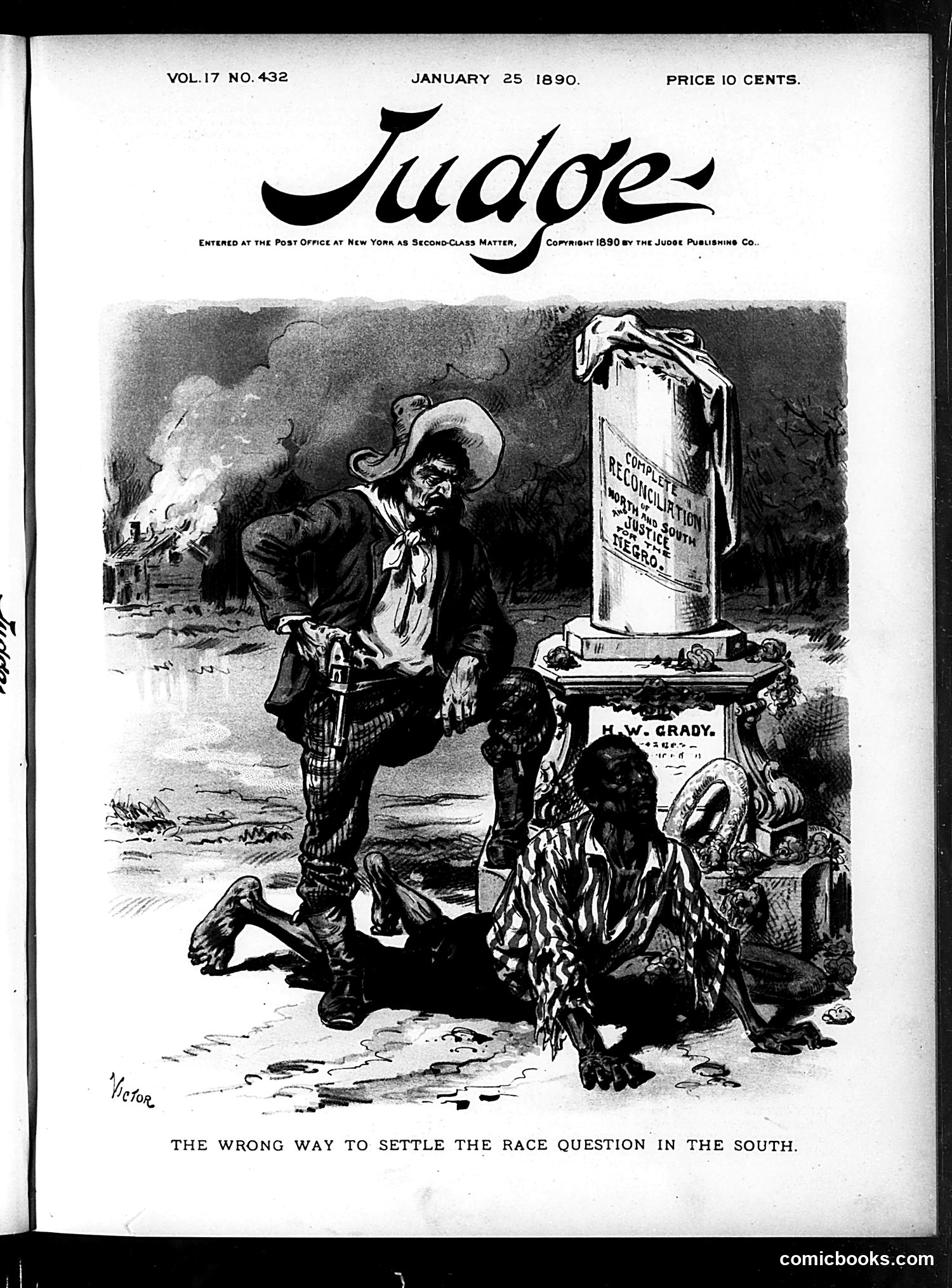
This 1890 *Judge* magazine cartoon satirizes efforts to resolve racial conflict in the post-Reconstruction South. The title "THE WRONG WAY TO SETTLE THE RACE QUESTION IN THE SOUTH" condemns violent solutions. The central figure appears to be a cowboy or Southern character standing over what looks like a demon or devil creature emerging from flames. A large bottle labeled "RECONCILIATION" and "JUSTICE" sits nearby, with a sign reading "H.W. GRADY" visible—likely Henry W. Grady, a prominent Georgia journalist advocating for the "New South." The cartoon criticizes that Grady's reconciliation rhetoric and calls for "justice" ring hollow when accompanied by violence (the burning building in background suggests racial violence or lynching). The demon figure represents the brutality underlying these claimed peaceful solutions to racial tensions.
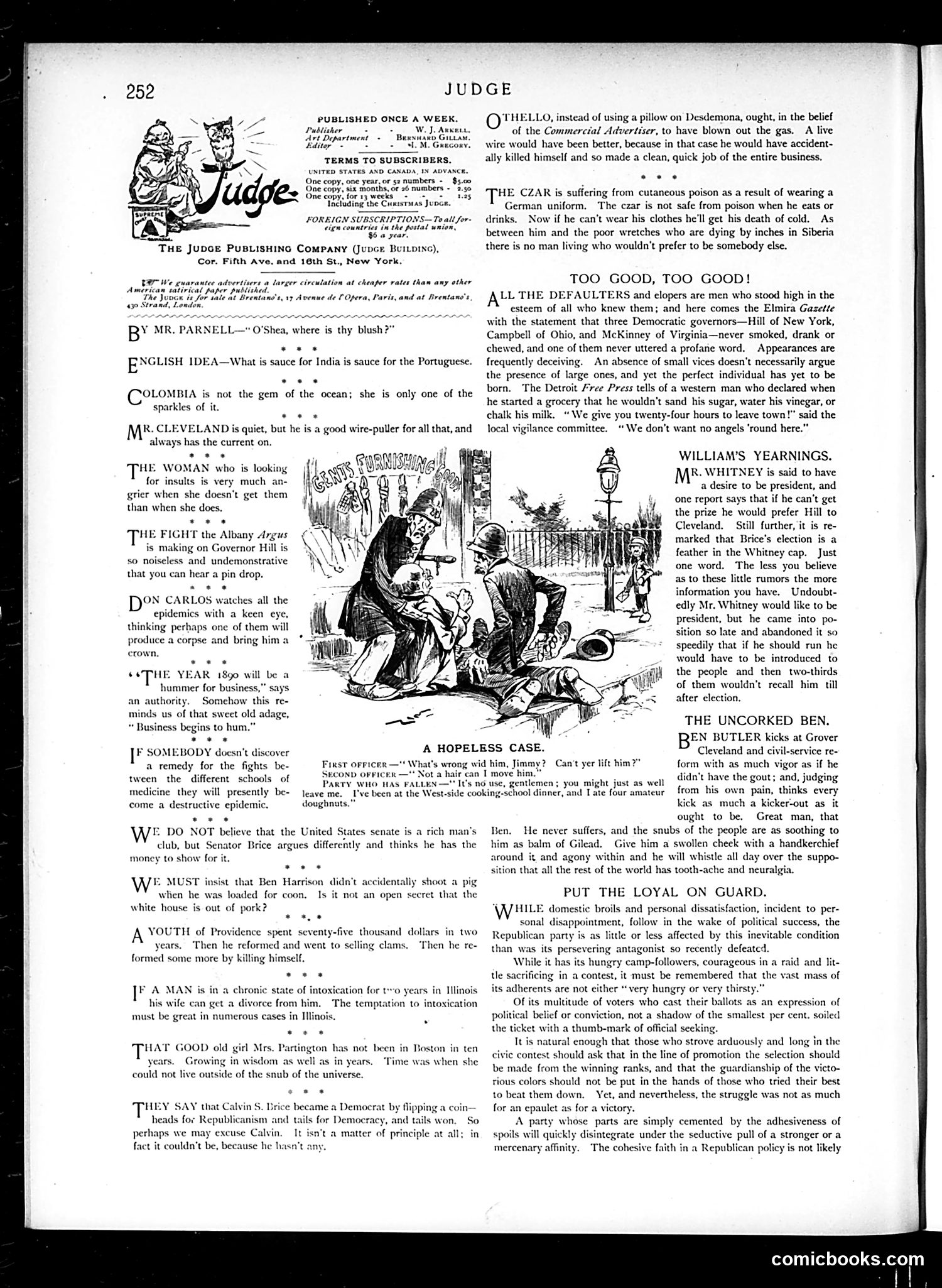
This cartoon depicts two figures in what appears to be a police or institutional setting. The caption reads: "First Officer: 'What's wrong with him, Jimmy? Can't yer lift him?' Second Officer's Reply: 'It's no use, gentlemen; you might just as well leave me. I've been in the West-side cooking-school dinner, and I can't find another.'" The joke appears to satirize either a drunk person or someone incapacitated, with the humor hinging on a self-deprecating reference to "West-side cooking-school dinner"—likely implying the officer ate something indigestible that has weakened him. The satire targets working-class conditions or institutional food quality, using physical comedy to mock urban social conditions of the era.
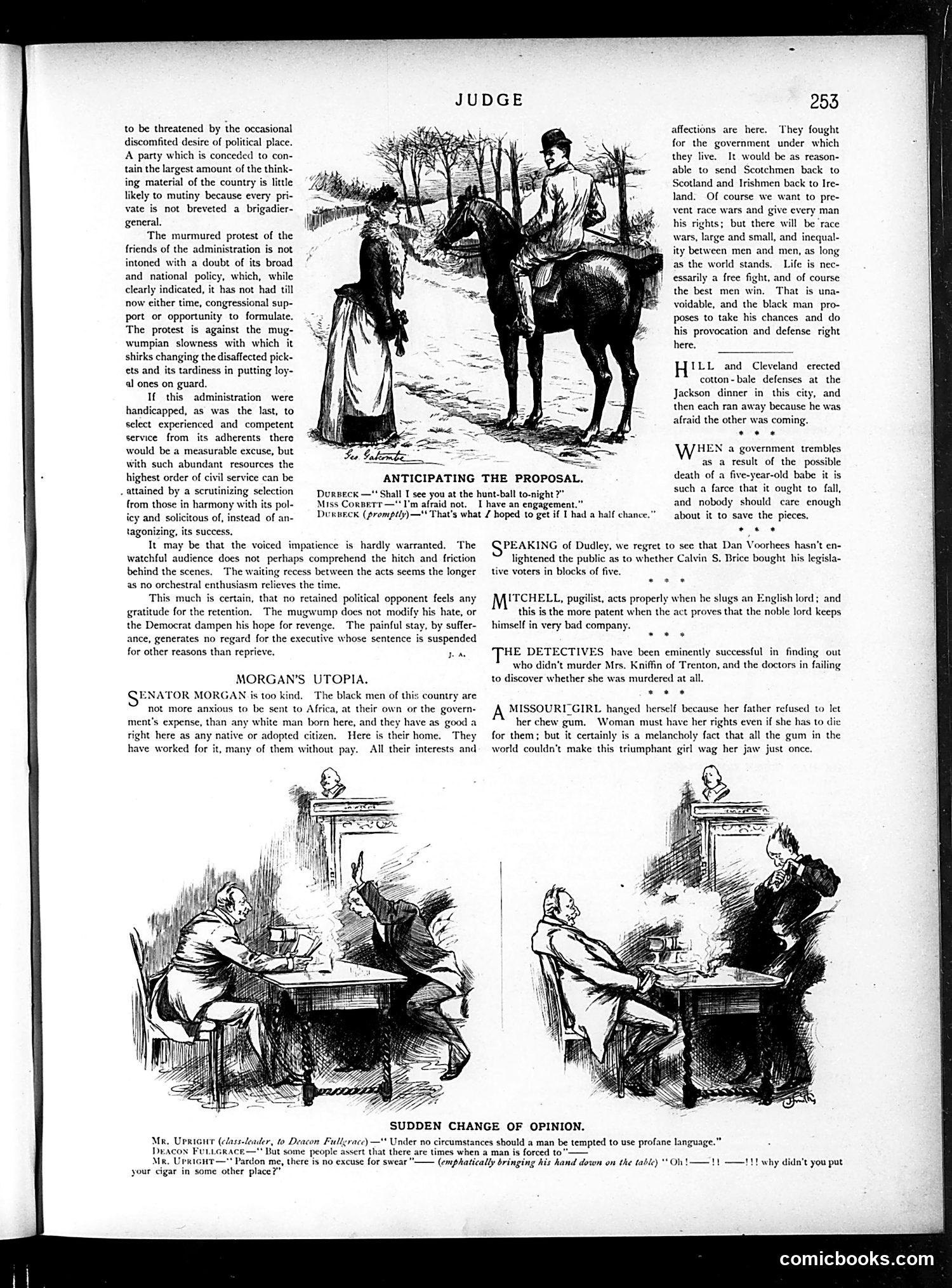
The page contains several political commentaries typical of Judge's satirical style. The main illustration, "Anticipating the Proposal," depicts a woman refusing a man's marriage proposal, with dialogue suggesting hesitation about commitment. The text sections comment on contemporary political issues, including critiques of the Cleveland administration's patronage practices and Senator Morgan's views on African colonization. References to "Calvin S. Price" and legislative voter blocks suggest specific contemporary political debates. The bottom cartoon, "Sudden Change of Opinion," shows two men in conversation, satirizing how people's principles shift conveniently when circumstances favor profanity—a commentary on hypocrisy and moral flexibility among the era's public figures. Without clearer dating or additional context, the specific political figures targeted remain uncertain beyond these general satirical themes.
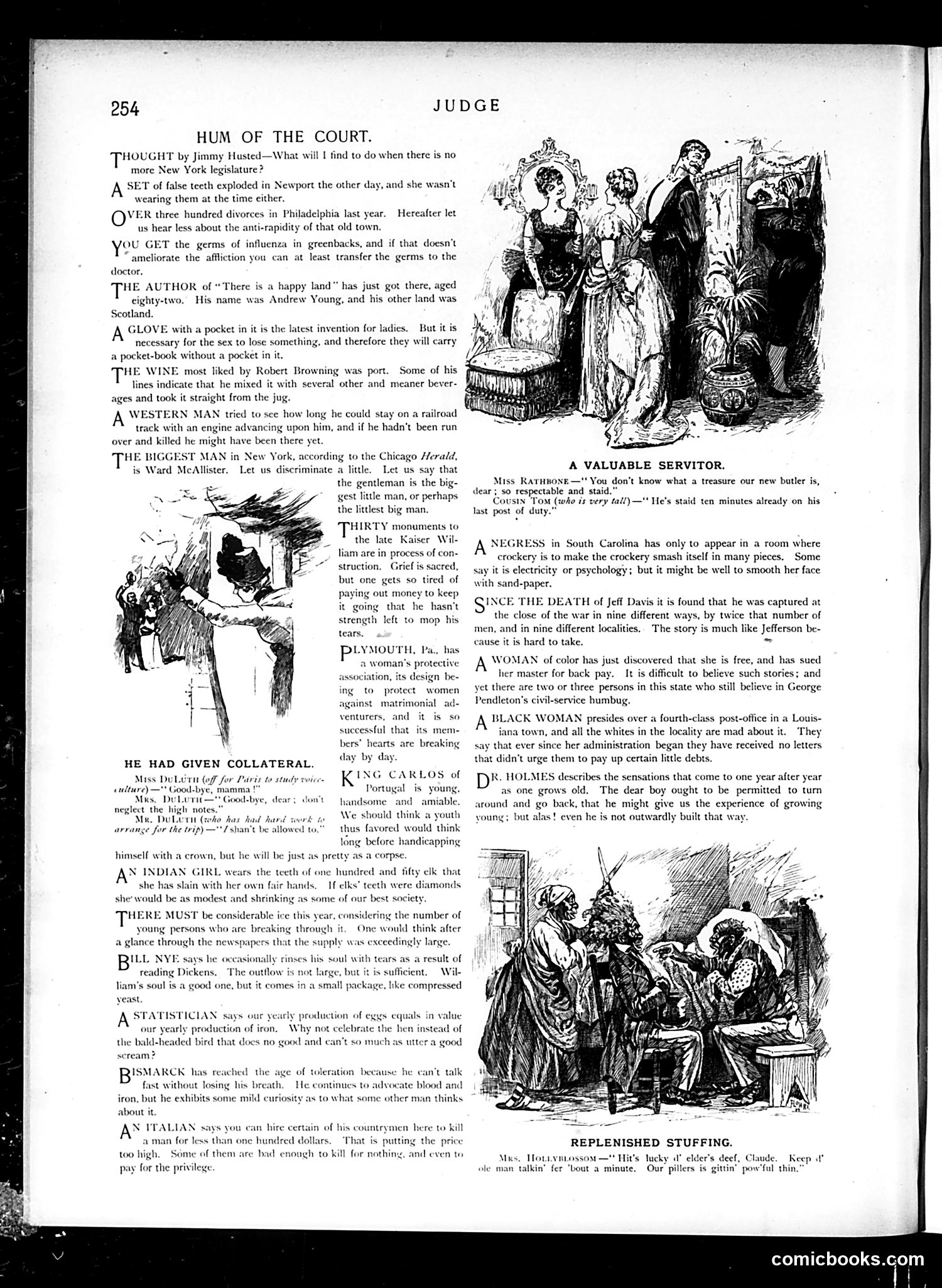
This page collects brief satirical social observations—the magazine's signature format. Key targets include: **Divorce and morality**: Mocking Philadelphia's high divorce rate and Newport's affectations (exploding false teeth). **Gender and consumerism**: Joking that women need pockets in gloves because they'll inevitably lose something, yet won't carry pocket-books with pockets. **Notable figures**: Ward McAllister (New York society arbiter) ridiculed as simultaneously the "biggest little man" and "littlest big man"—satirizing his outsized social influence despite physical insignificance. **Political commentary**: References to Kaiser Wilhelm monuments as excessive grief-spending, and Portuguese King Carlos as attractive but destined for crown-wearing troubles. **Period prejudices**: Crude jokes about Indian women, Black servants, and Italian immigrant criminality reflect common contemporary stereotypes. The bottom cartoons depict domestic scenes: a daughter departing for Paris, and a servant praised for reliability. These humorously capture class and family dynamics of the era.
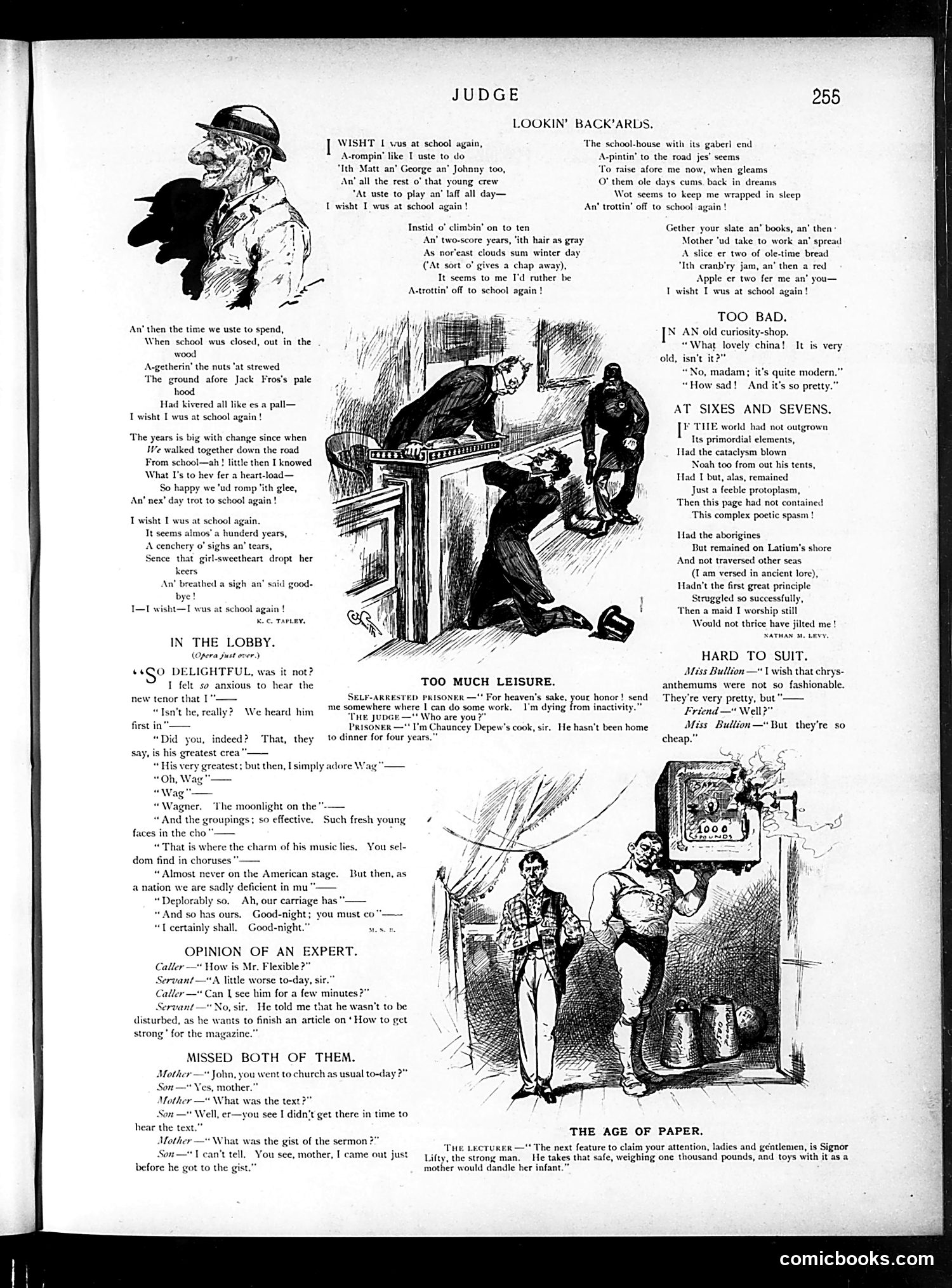
This page from *Judge* magazine contains several short humorous pieces typical of late-19th-century American satire: **"Lookin' Backwards"** is a sentimental poem about nostalgia for childhood and school, written in dialect verse—a popular literary form of the era. **"In the Lobby"** satirizes opera-goers' pretentious discussion of Wagner, mocking their affected sophistication and shallow cultural commentary. **"Too Much Leisure"** jokes about a self-imprisoned prisoner who is Chauncey Depew's (a famous railroad executive and politician) cook—implying Depew is so neglectful that his employee hasn't been home in four years, suggesting wealthy industrialists' indifference to workers' welfare. **"Hard to Suit"** mocks wealthy women's snobbish complaints about cheap fashionable items. Other brief pieces satirize clergy's inattentiveness, magazine experts, and curiosity-shop pretension. The cartoons and poems collectively target affectation, hypocrisy, and class-consciousness in Gilded Age society.
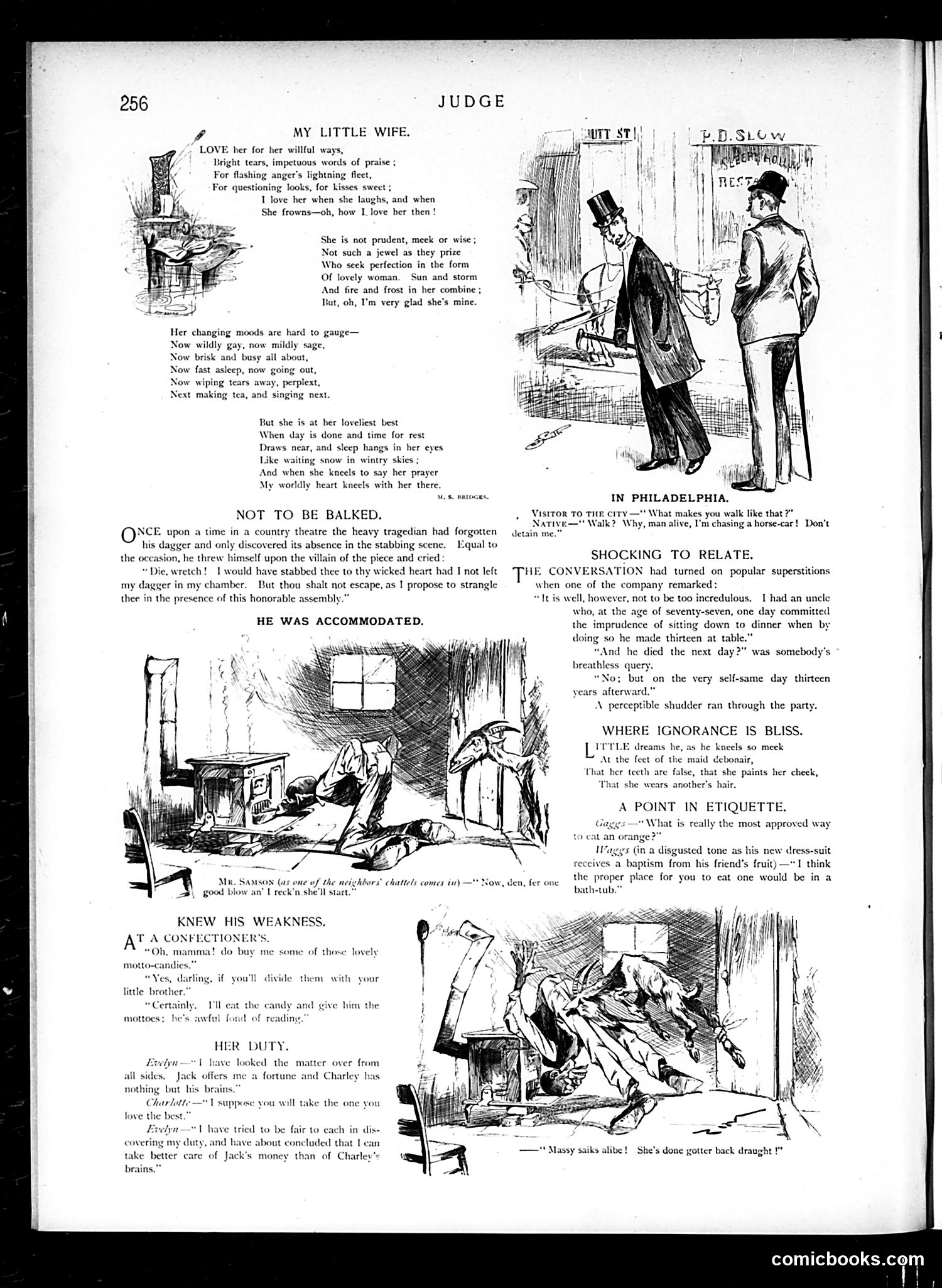
This page contains multiple short humorous pieces typical of late 19th-century satirical magazines: **"My Little Wife"** is a sentimental poem celebrating a wife's passionate, unpredictable nature—valued precisely for her emotional volatility rather than meek perfection. **"Not to Be Balked"** recounts a theater anecdote where an actor, lacking a prop dagger, improvises by threatening to strangle his stage villain instead—humor derived from theatrical desperation. **"Shocking to Relate"** jokes about superstition: a man survived sitting as the 13th dinner guest, but died *thirteen years later*—satirizing how people retrofit causality onto superstitious beliefs. **"Where Ignorance is Bliss"** presents ironic poetry about a man courting a woman unaware her beauty is entirely artificial (false teeth, makeup, borrowed hair). The remaining items offer quick comedic vignettes about etiquette, parenting, and marriage decisions. The sketches throughout depict Victorian-era social situations. Overall, the page represents Judge's typical format: light satirical commentary on contemporary social customs and human follies, with particular focus on gender dynamics and romantic relationships.
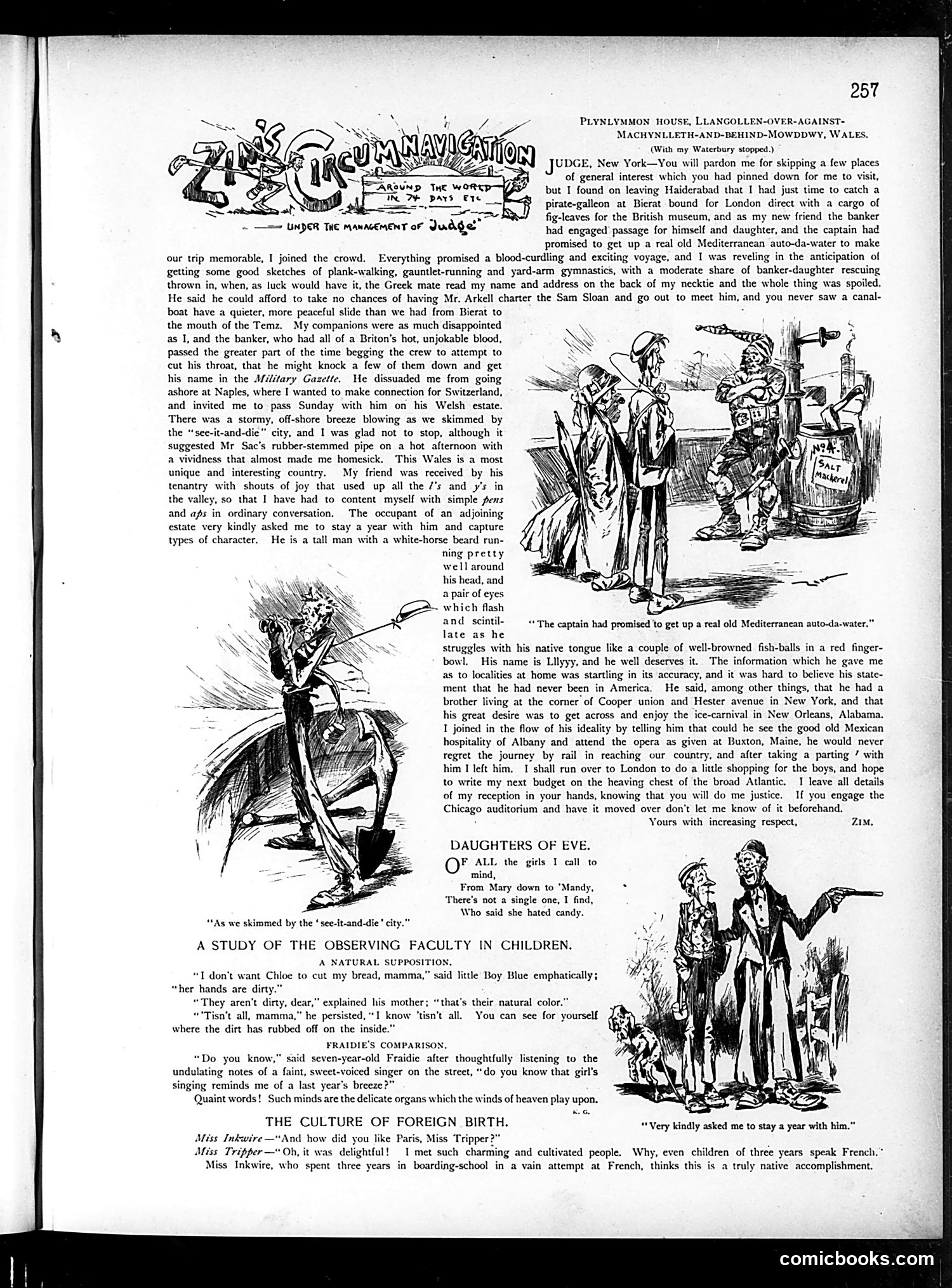
This travel narrative uses absurdist humor to mock both travel writing conventions and Anglo-Welsh stereotypes. The author describes impossibly ridiculous encounters—a "pirate-galleon" carrying fig-leaves, a banker eager to be attacked for military glory, and a Welsh gentleman named "Lllyyy" who speaks only in Welsh consonants. The satire targets: 1. **Orientalism & travel literature**: The opening references Hyderabad and Mediterranean exoticism, mocking romanticized travel accounts. 2. **Welsh caricature**: The character Lllyyy embodies period stereotypes—incomprehensible speech filled with Welsh letters (y's and l's), yet impossibly knowledgeable about obscure American locations, revealing the absurdity of such characterizations. 3. **Editorial pretension**: Judge's editor Arkell is name-checked, self-referentially satirizing the magazine's own self-importance. The cartoons accompanying the text depict rough sketches of the voyage's chaos, reinforcing the deliberately chaotic, exaggerated tone. Judge used this style to ridicule both travel writers' pretensions and ethnic stereotyping.
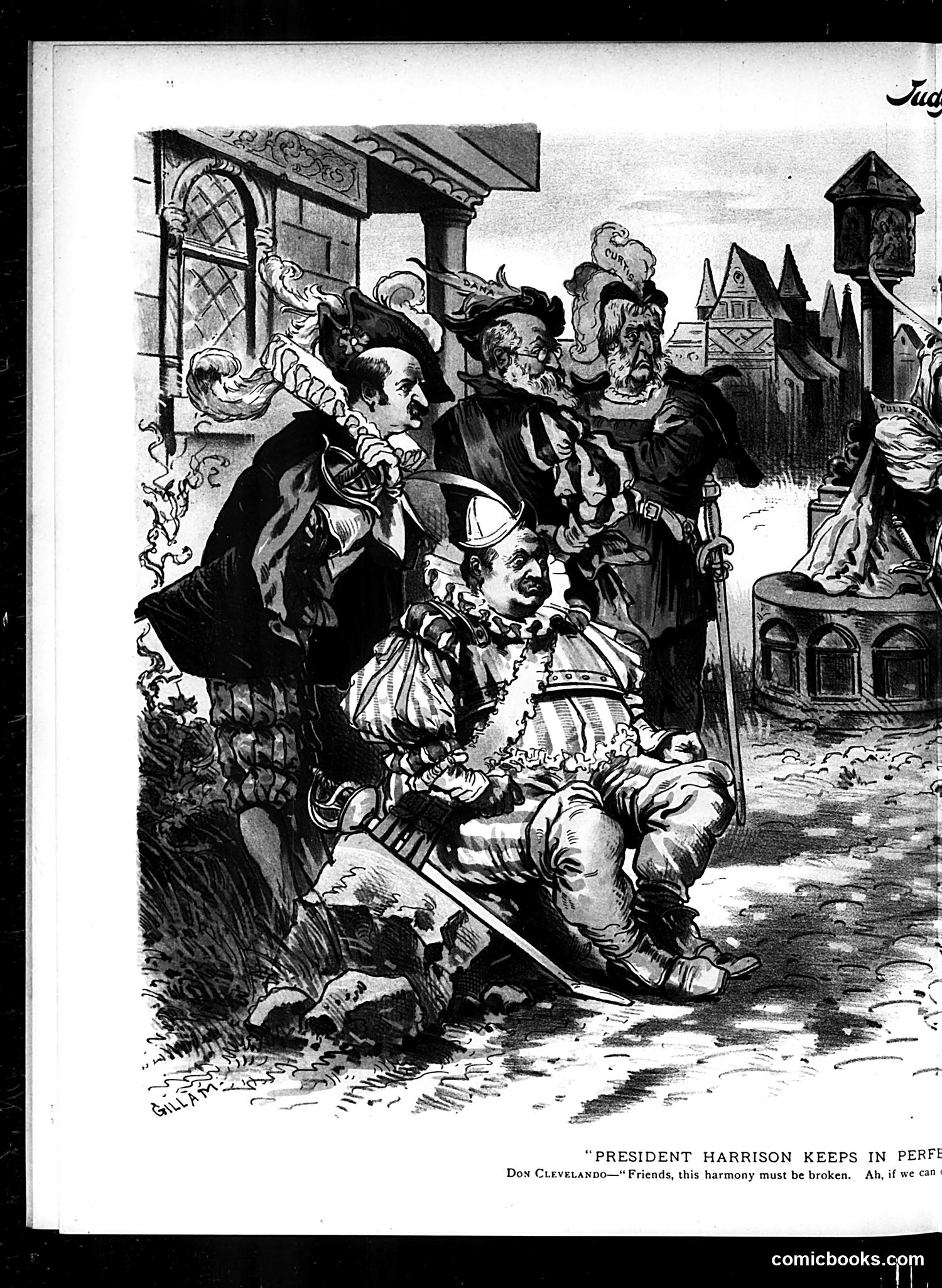
This appears to be a satirical cartoon from Judge magazine depicting a conflict between President Harrison and Don Cleveland (likely former President Grover Cleveland). The central figure in military/ornate dress is presumably President Harrison, shown in a position of power or authority. Cleveland, addressing him as "Don," urges that "this harmony must be broken," suggesting political discord or rivalry between the two leaders. The cartoon satirizes their relationship, presenting what may have been publicly harmonious relations as artificially maintained. The elaborate dress and theatrical setting suggest the cartoon mocks the formality or pretense of their political interaction. Without the complete caption visible, the exact historical context remains unclear, but it likely references tensions during or between their presidencies (Harrison served 1889-1893; Cleveland served non-consecutive terms).
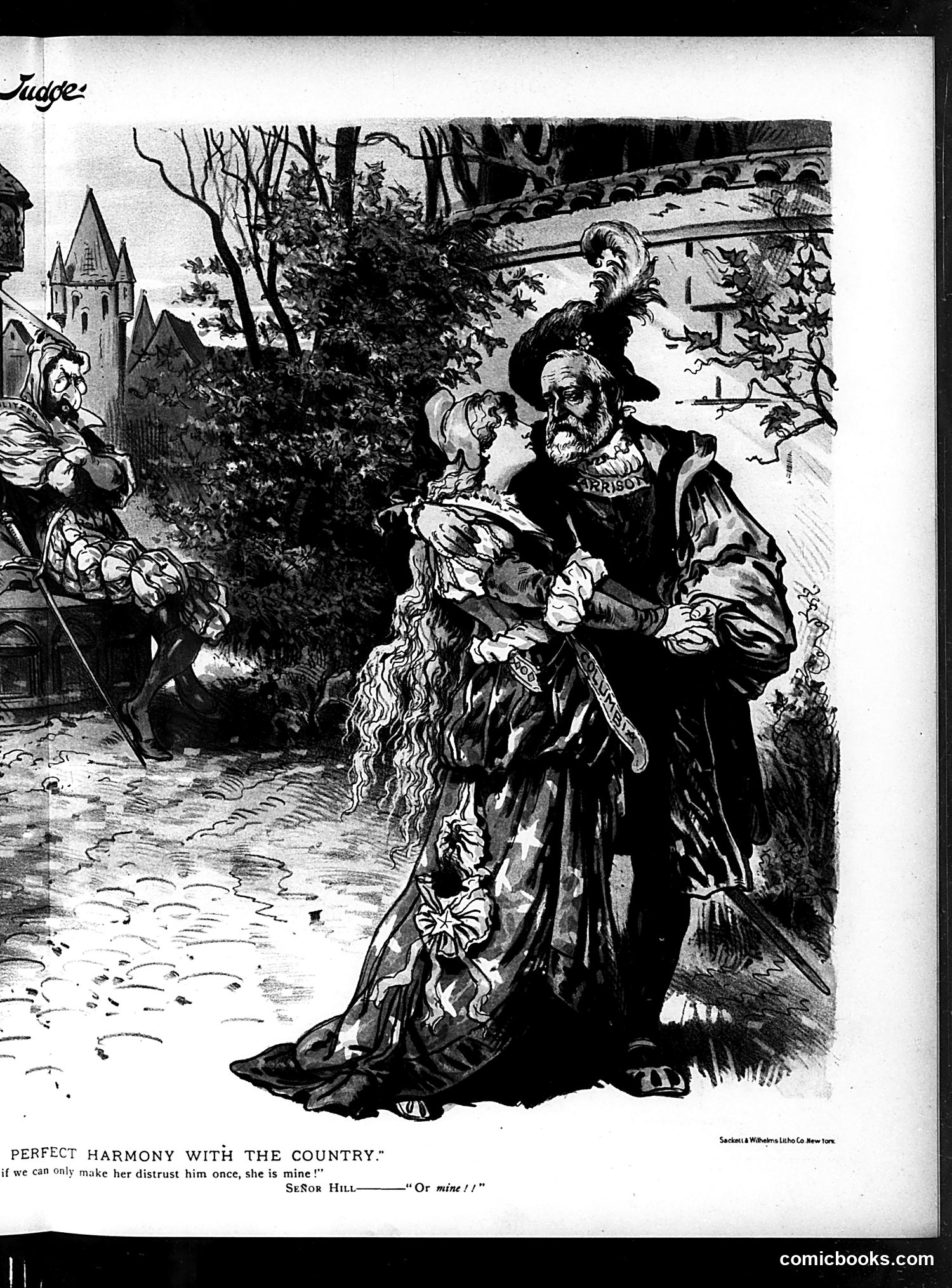
This satirical cartoon depicts a romantic/political triangle. A woman in elaborate dress is courted by two men—one labeled "PRISON" (appearing rough and menacing) and another figure (likely representing a political rival or alternative suitor). The caption reveals the darker intent: the speakers plot to turn the woman against her current partner to claim her for themselves. The woman represents a nation or territory being contested between competing political forces. The satire criticizes how political opponents use distrust and manipulation rather than merit to gain power. The "prison" label suggests one suitor represents authoritarian or corrupt governance, while his rival employs similar underhanded tactics. The cartoon likely comments on early 20th-century political maneuvering, though without a date visible, the specific historical context remains unclear.
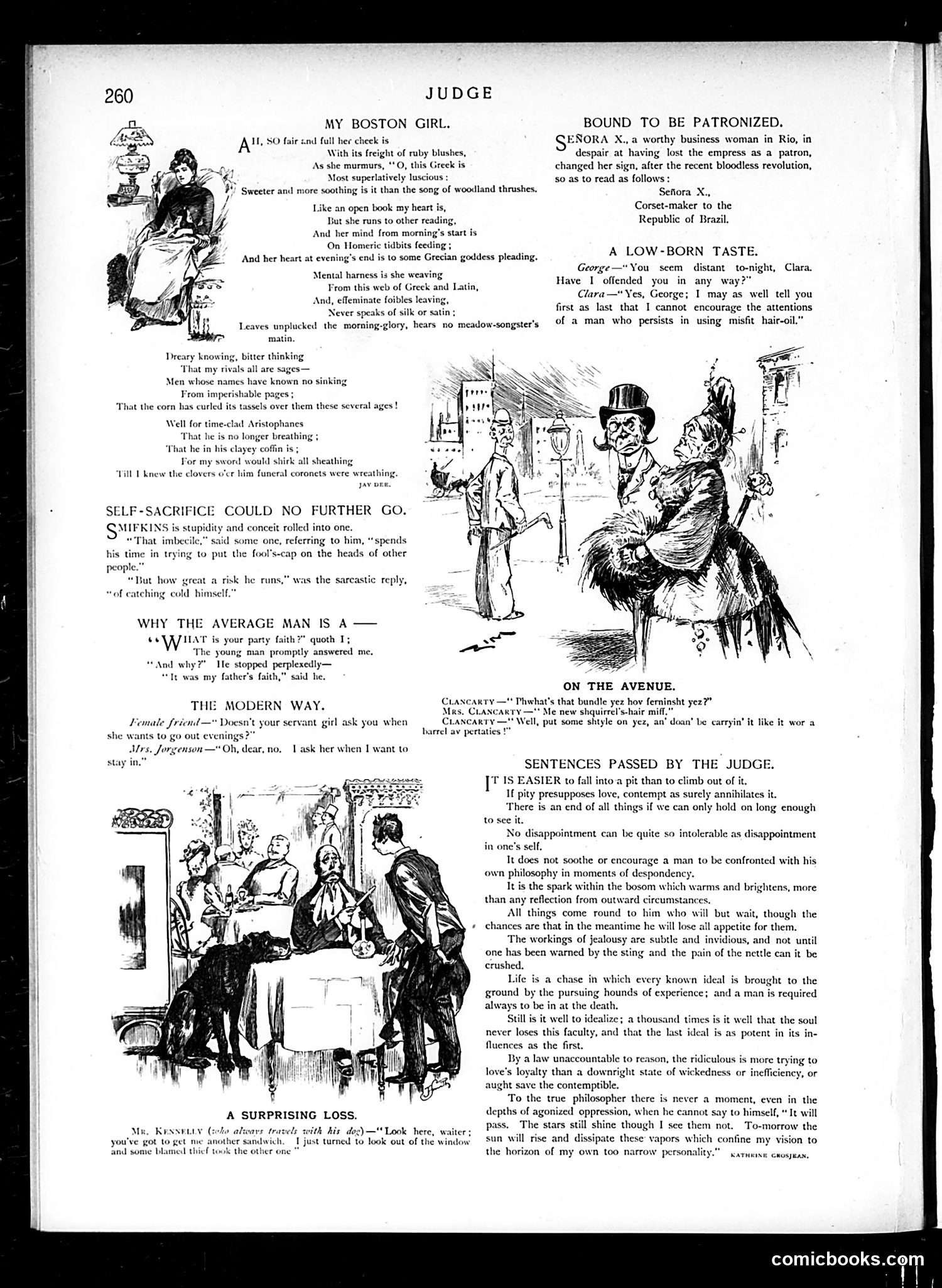
This page from *Judge* contains several brief satirical pieces typical of late-19th-century American humor: **"My Boston Girl"** mocks intellectual pretension—a young woman obsessed with Greek and Latin classics to the exclusion of traditional femininity, leaving the male narrator frustrated. **"Bound to be Patronized"** jokes about Brazilian politics: after the "recent bloodless revolution," a Rio corset-maker changes her business sign from serving "the Empress" to serving "the Republic of Brazil," adapting quickly to political change. **"A Low-Born Taste"** satirizes class consciousness: a woman rejects her suitor because he uses cheap ("misfit") hair oil—suggesting working-class vulgarity disqualifies him. **"Self-Sacrifice Could No Further Go"** is a brief quip about a conceited fool risking catching cold while placing dunce caps on others' heads. **"Why the Average Man Is a [Soimoniatt]"** mocks inherited political beliefs—a young man blindly follows his father's party without understanding why. The page includes philosophical epigrams at bottom and sketches throughout, characteristic of *Judge's* mix of jokes, social commentary, and illustrations.
This page is primarily **advertising with some humorous filler content**, typical of Judge magazine's format. The main content includes: **Humorous pieces** (short jokes/verses): - Brief gags mocking Harvard graduates, railroad etiquette, and childhood behavior - A sentimental rural poem about lost love with "Squire Martin's daughter Jane"—nostalgic Americana typical of period magazines **No clear political cartoons** are visible on this page. **Advertisements dominate**, including: - Sealskin fur garments (C.C. Shayne) - Madison-Square Garden bonds - Piano manufacturer (Sohmer) - Various tobacco and consumer products The only potentially satirical element is a brief jab at Harvard education ("Yer can't play foot-ball...all yer can do is to get an education"), which is gentle mockery of privileged college culture rather than serious social commentary. This appears to be a **regular editorial/advertisement page** rather than a satirical centerpiece, showing how 19th-century humor magazines filled space with diverse content.
This page is primarily **advertisements with minimal editorial content**. The main cartoon/article is "The Tailor-Made Girl," a satirical poem lamenting the decline of the "Gibson Girl" aesthetic—athletic, broad-shouldered women in practical tailored clothing. The poem humorously notes that fashion has moved away from this ideal, leaving sculptors sad and artists struggling to paint Venus with a "waist of the tailor-made girl." The tailor-made look represented New Woman independence and physical activity; its decline suggests shifting fashion values. The page's numerous ads—for Scott's Emulsion, asthma cures, morphine, chocolate, and bleach creams—reveal period medical quackery and social anxieties (children's health, skin tone, consumption). The brief "Interesting for Both" anecdote stereotypes Black women through dialect humor, typical of the era's casual racism. Overall, this reflects 1890s-1900s American magazine culture: fashion commentary alongside dubious patent medicines and period prejudices.
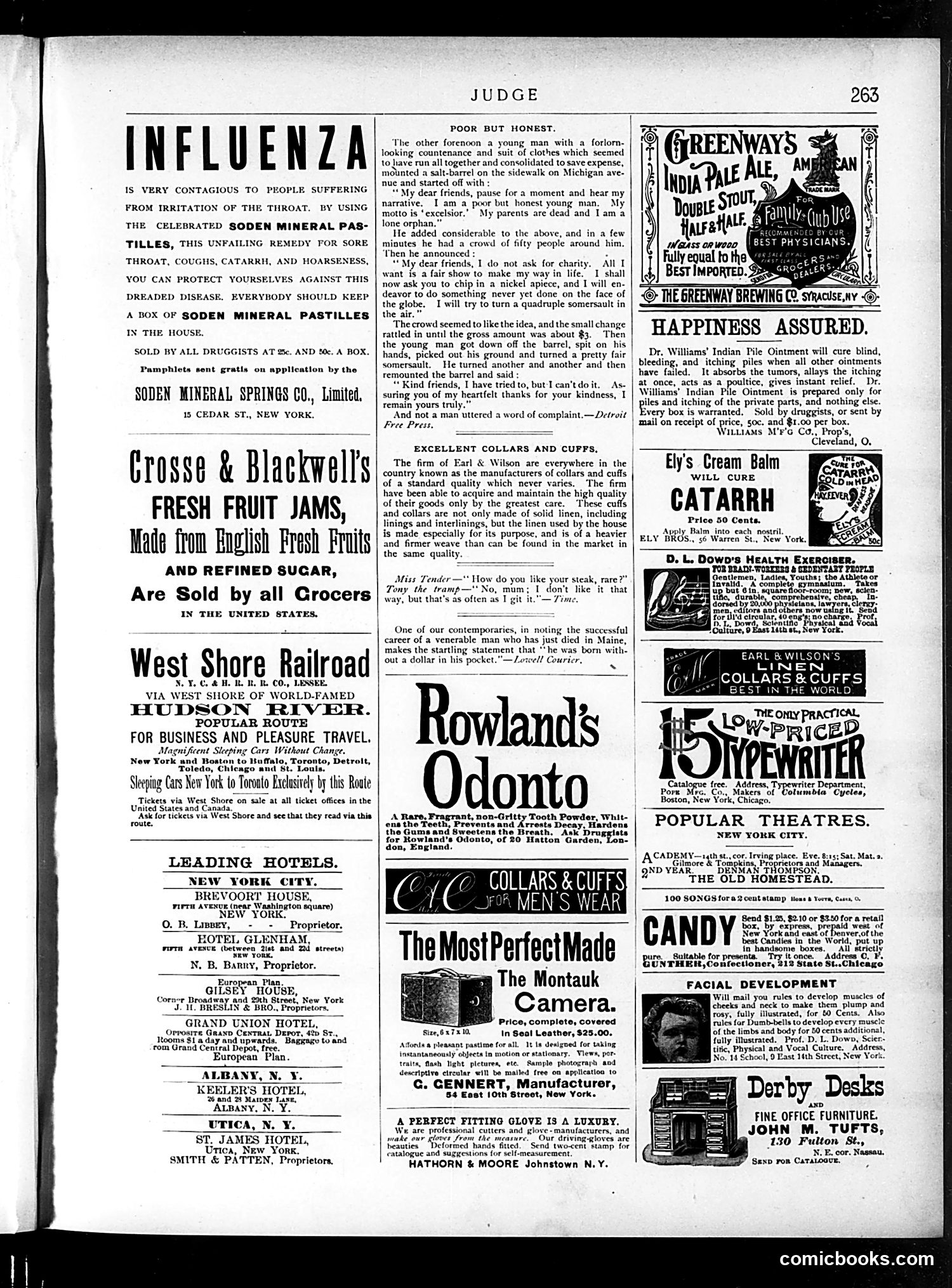
This page is primarily **advertising with one satirical narrative**. The main editorial content is "Poor But Honest," a short story mocking street con artists. It describes a shabby young man who solicits donations from passersby on Michigan Avenue by claiming to be a poor orphan willing to work. He promises to perform an unprecedented quadruple somersault if given nickels—collecting about $3. He then performs only three somersaults, admits failure with feigned regret, and vanishes with the money. The satire targets both the con man's transparent deception and the gullible crowd's naive willingness to fund obvious fraud. The remainder of the page consists entirely of **period advertisements** for hotels, railroads, patent medicines (including Soden Mineral Pastilles for influenza prevention), jams, collars, and other products—typical Judge magazine filler from this era. No political cartoons or illustrations accompany the text shown.
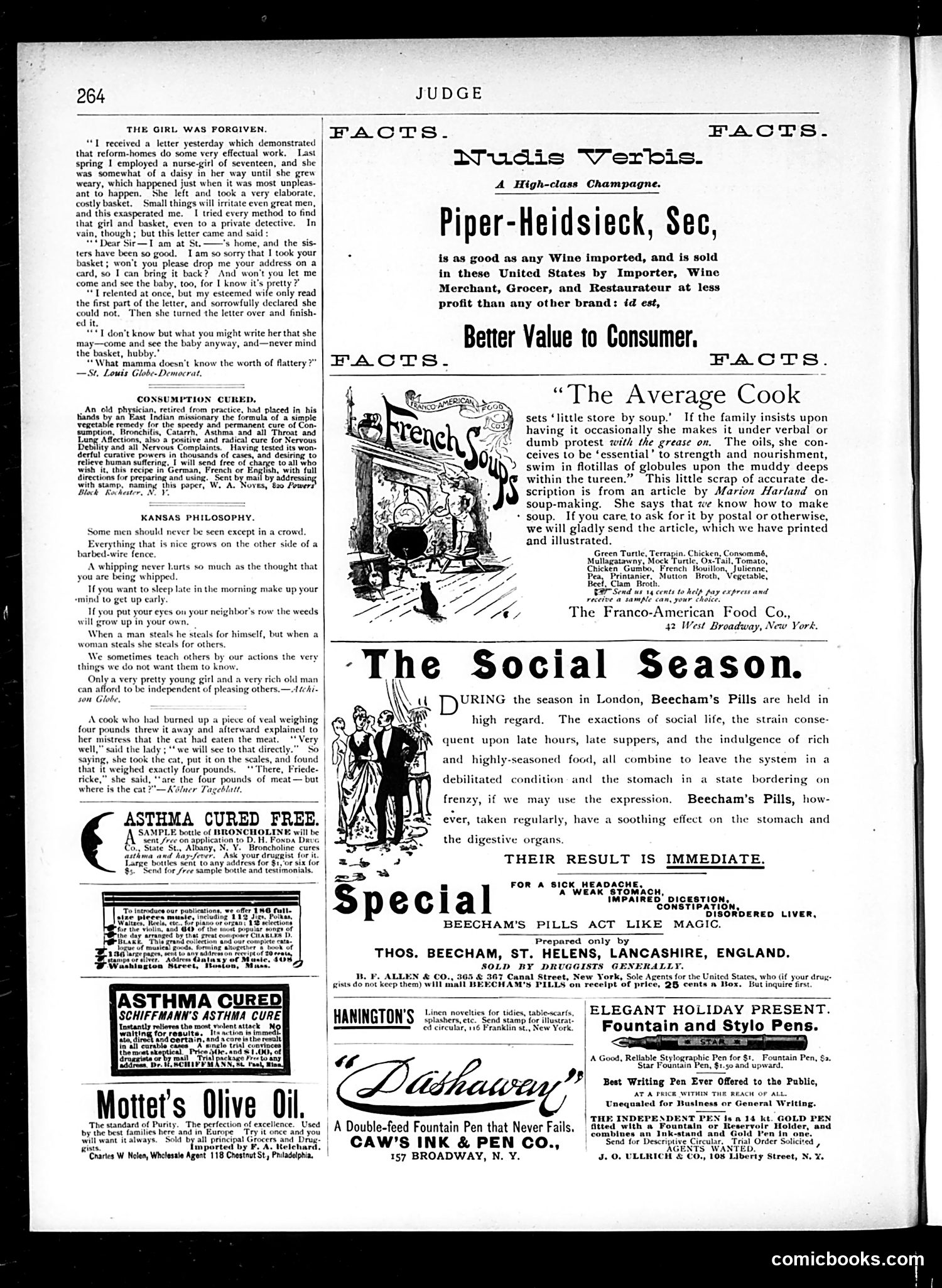
This page is primarily **advertisements and filler content** rather than political satire. The main elements are: **"The Girl Was Forgiven"** (top left): A anecdotal story about a servant girl who stole a basket but reformed at a convent home. The humor relies on the domestic irony that the employer's wife only read the apologetic first part of the letter, missing the postscript revealing the girl had a baby—suggesting premarital pregnancy. The satire is gentle morality-tale stuff about redemption through institutions. **"Kansas Philosophy"** (middle left): Rural aphorisms poking fun at frontier logic ("Everything nice grows on the other side of a barbed-wire fence"). **The rest**: Advertisements for champagne, French soup products, Beecham's Pills (a patent medicine), fountain pens, and asthma cures—typical period magazine filler promoting consumer goods to middle-class readers. No significant political figures or events are referenced. This appears to be a lighter issue focused on domestic humor and advertising revenue.
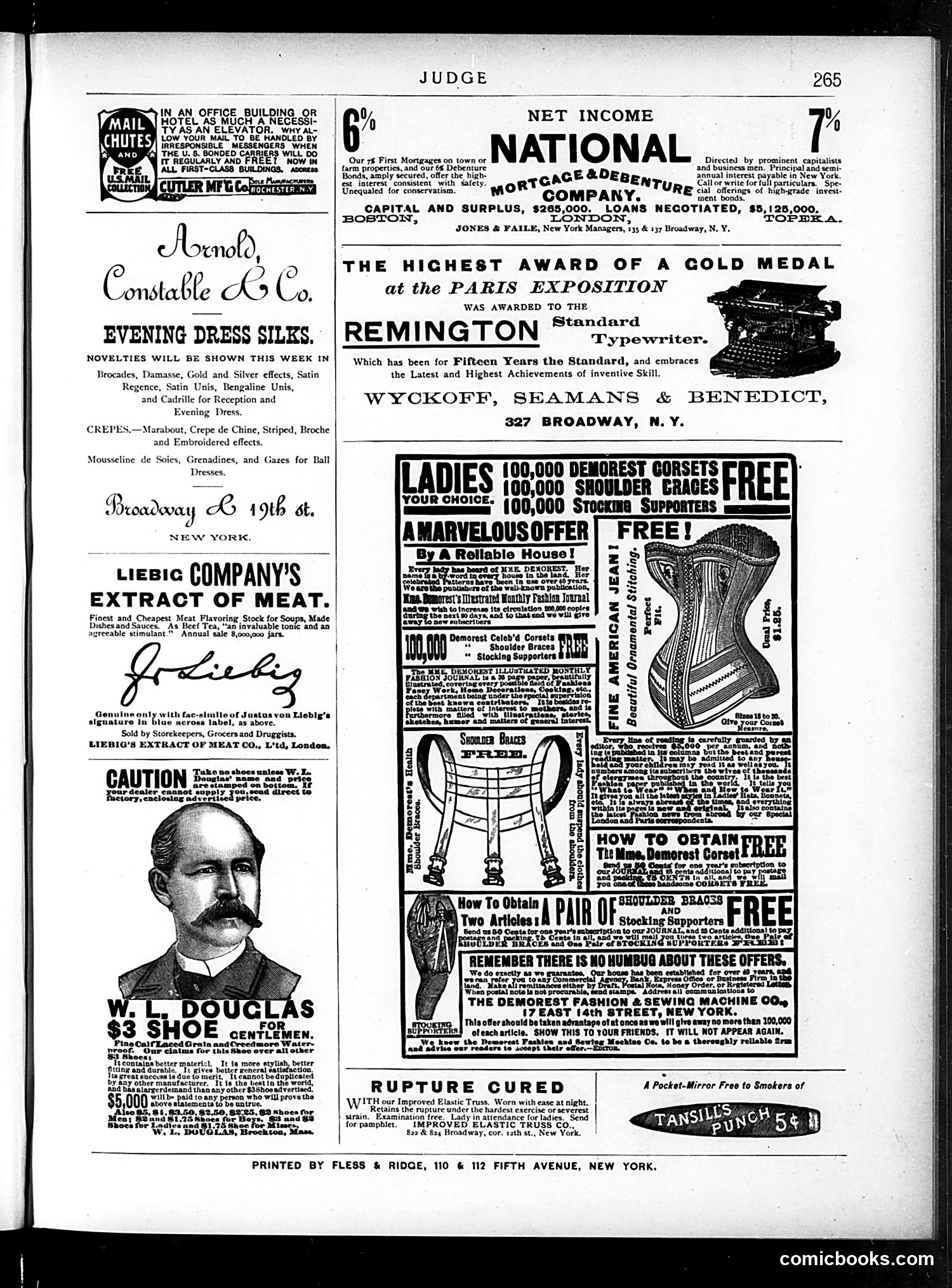
This page is **primarily advertising**, not satire or political commentary. It's a typical late 19th-century magazine layout mixing commercial advertisements with minimal editorial content. Key advertisements include: - **Arnold, Constable & Co.**: Evening dress silks and fabrics - **Liebig's Extract of Meat**: A meat flavoring product - **W.L. Douglas Shoes**: A $3 shoe brand claiming superiority - **National Mortgage & Debenture Company**: Financial investment services - **Remington Typewriter**: Promoted as the 15-year standard winner of a Paris Exposition gold medal - **Demorest Fashion Magazine**: Offering free corsets and stocking supporters to subscribers - **Improved Elastic Truss Company**: Medical device for rupture treatment The single editorial element—a caution about W.L. Douglas shoes—is actually advertising copy defending the product against counterfeiters. There are no political cartoons or satirical commentary visible on this page.
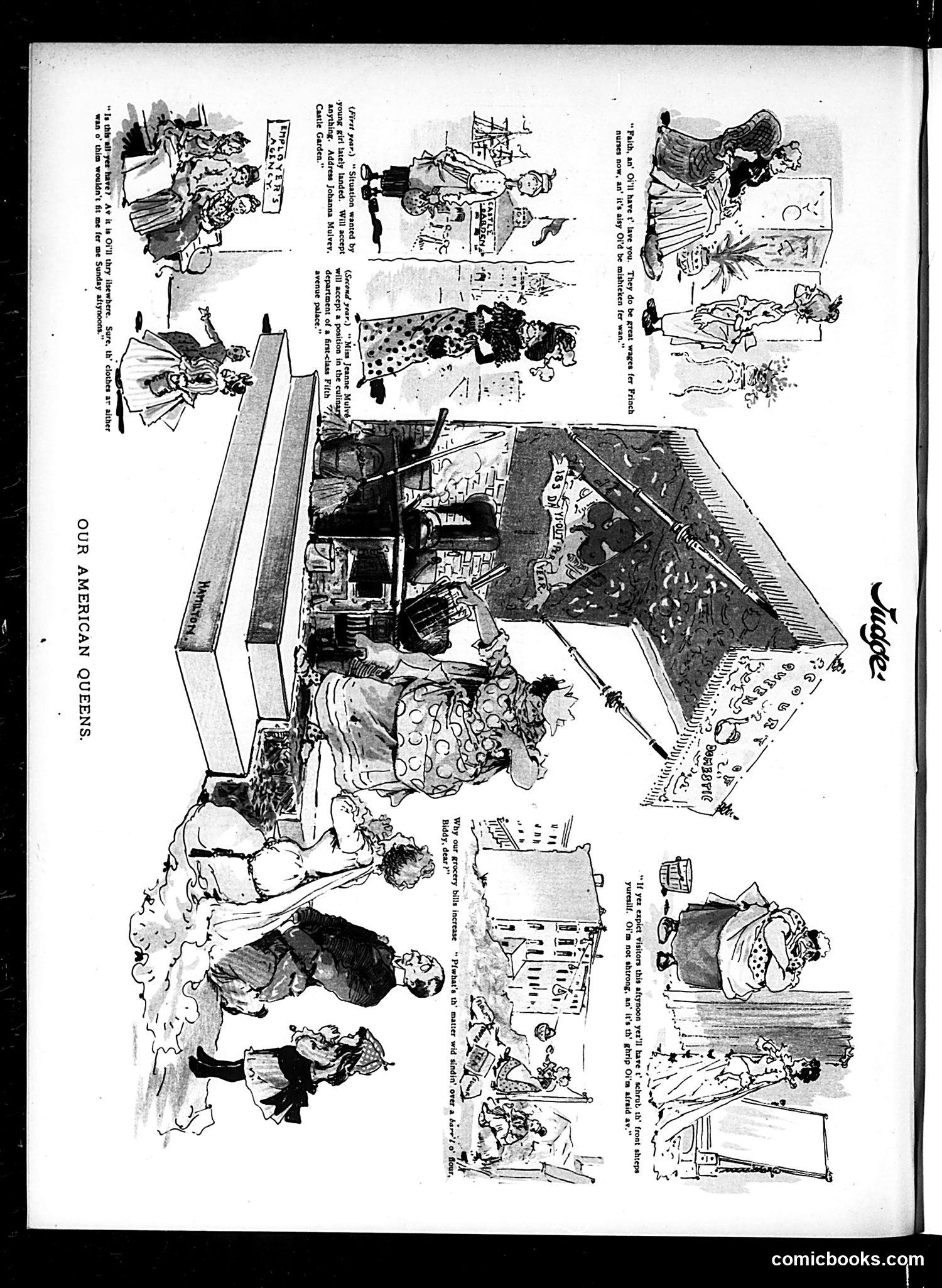
This page from *Judge* satirizes American working-class life, specifically targeting grocery prices and immigrant communities. The main cartoon, "Why Our Grocery Bills Increase," depicts an Irish immigrant woman (indicated by the phonetic dialect "Biddy," "Oi'll," "thim") haggling with a grocer over prices. The satire suggests that grocery inflation results from customers' unreasonable demands and complaints rather than actual market forces or merchant greed. "Our American Queens" appears to be a series mocking women of various social classes—likely contrasting idealized "queens" with reality. The Irish immigrant woman serves as a comedic "queen" figure, using stereotypical dialect humor common in late 19th/early 20th-century satire. The cartoons mock both consumer behavior and immigrant working-class culture simultaneously.