
A complete issue · 16 pages · 1889
Judge — November 16, 1889
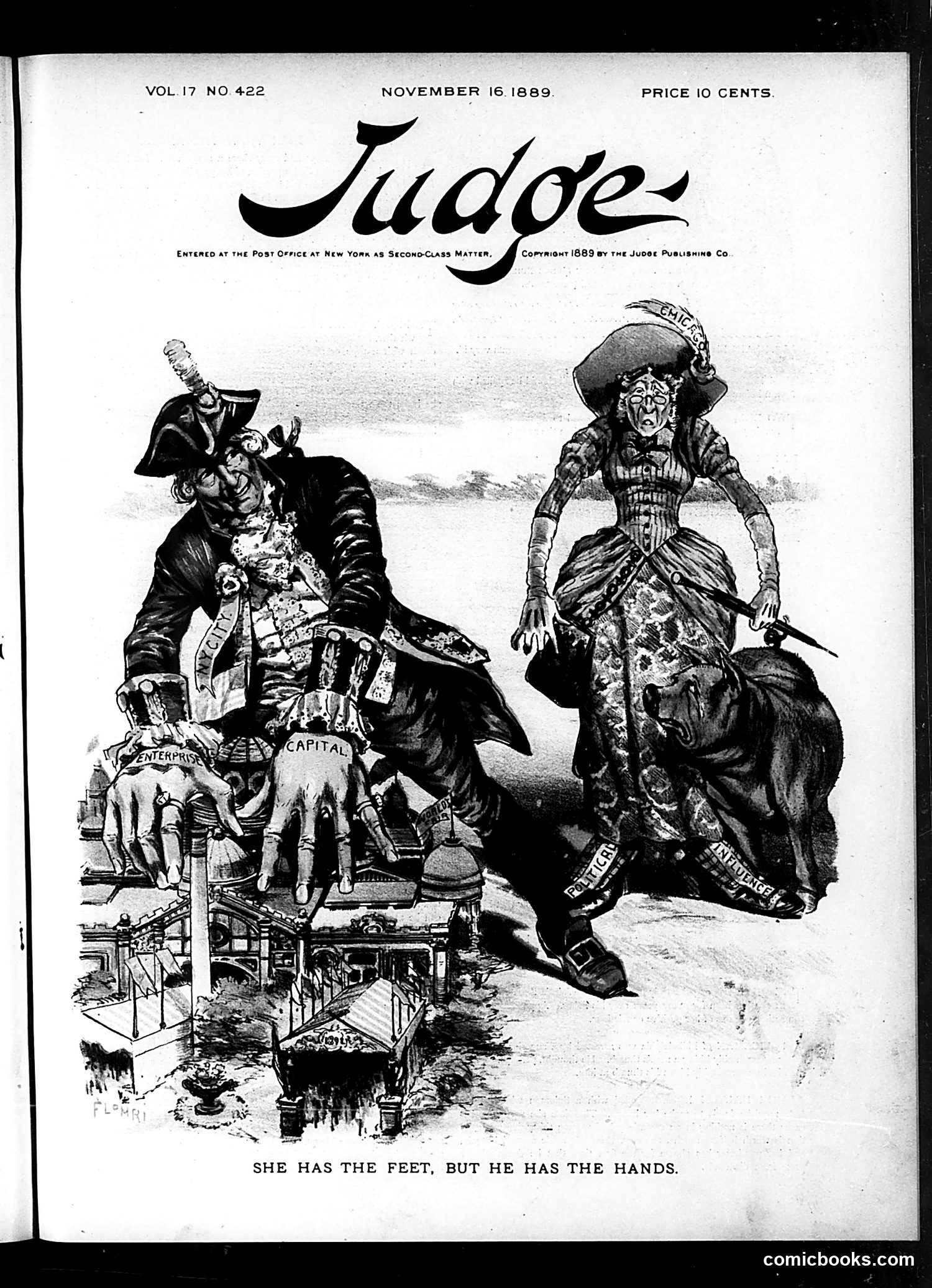
This 1889 *Judge* cartoon employs gendered symbolism to critique political power dynamics. The figure on the right—labeled with what appears to be female attributes and wearing a dress—represents a woman or feminine political force with "feet" (suggesting movement, agency, or electoral power). The left figure, depicted as a military or government authority with "hands," controls the machinery of state power shown below. The satire suggests that despite women possessing popular support or ability to effect change, actual governmental control remains firmly in male hands. The industrial/governmental infrastructure illustrated below emphasizes this imbalance. This likely comments on women's suffrage debates or political participation limitations during the Gilded Age.
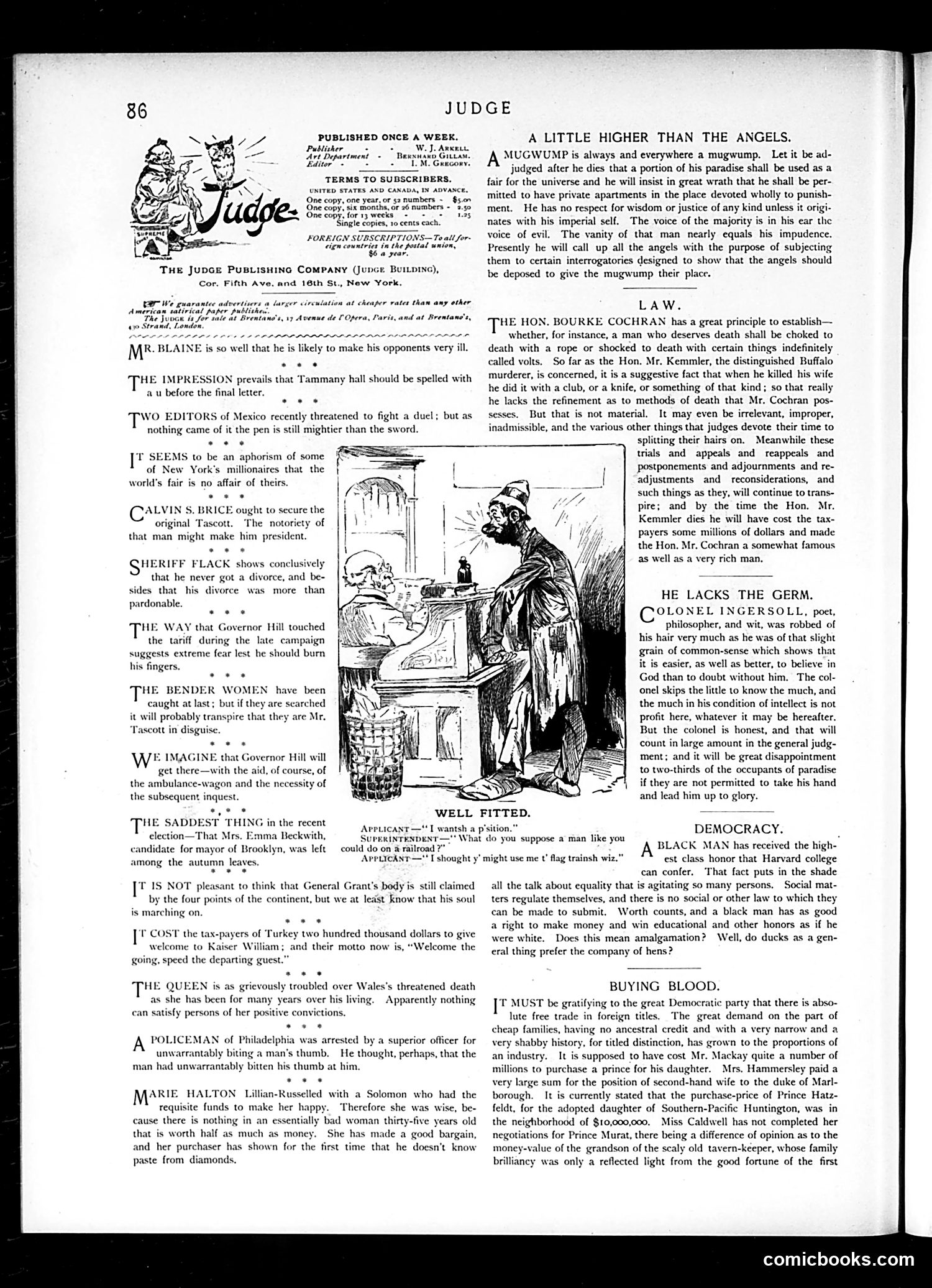
The main cartoon "Well Fitted" depicts a beggar or poor man in tattered clothes approaching what appears to be a wealthy woman or society figure. The satire likely mocks the contrast between rich and poor, or critiques social charity as superficial. The applicant's request for a position and the woman's response about railroad work suggests commentary on employment disparities or class exploitation. The page also contains brief satirical commentary items about contemporary figures including references to Governor Hill, General Grant, and various political/social situations. These short paragraphs employ sarcasm to mock politicians, military figures, and social pretensions of the era. The overall tone targets inequality, political hypocrisy, and social contradictions of Gilded Age America, though specific historical references require additional context to fully interpret.
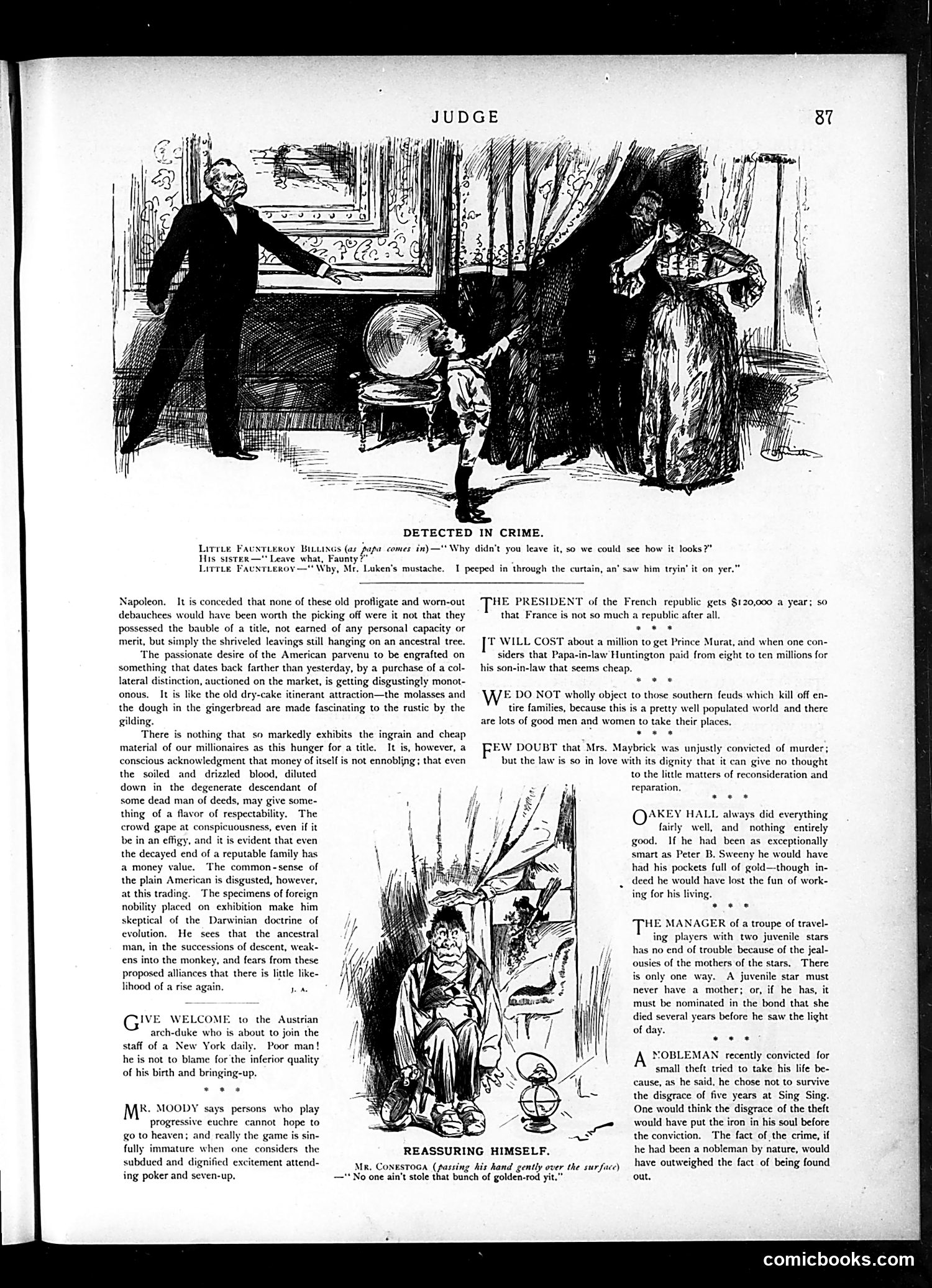
This page contains multiple short satirical commentaries typical of Judge's format. The main cartoon, "Detected in Crime," shows a child caught trying on a man's mustache—a simple domestic humor piece about childhood mischief. The surrounding text satirizes American social pretensions, particularly wealthy Americans' obsession with purchasing European nobility titles and marrying into aristocracy. Judge mocks this as hollow status-seeking by the newly rich ("parvenu"), arguing that inherited titles from "worn-out debauchees" have no real merit. The satire extends to an Austrian arch-duke joining a New York newspaper's staff—presented as an absurd example of Americans elevating foreign nobility. Additional brief commentaries mock French republicanism (the president's high salary), the costs of marrying wealthy heiresses, and nobility's hypocrisy (a nobleman's suicide over prison "disgrace" after committing theft). The overall message: American wealth cannot buy genuine respectability or moral character.
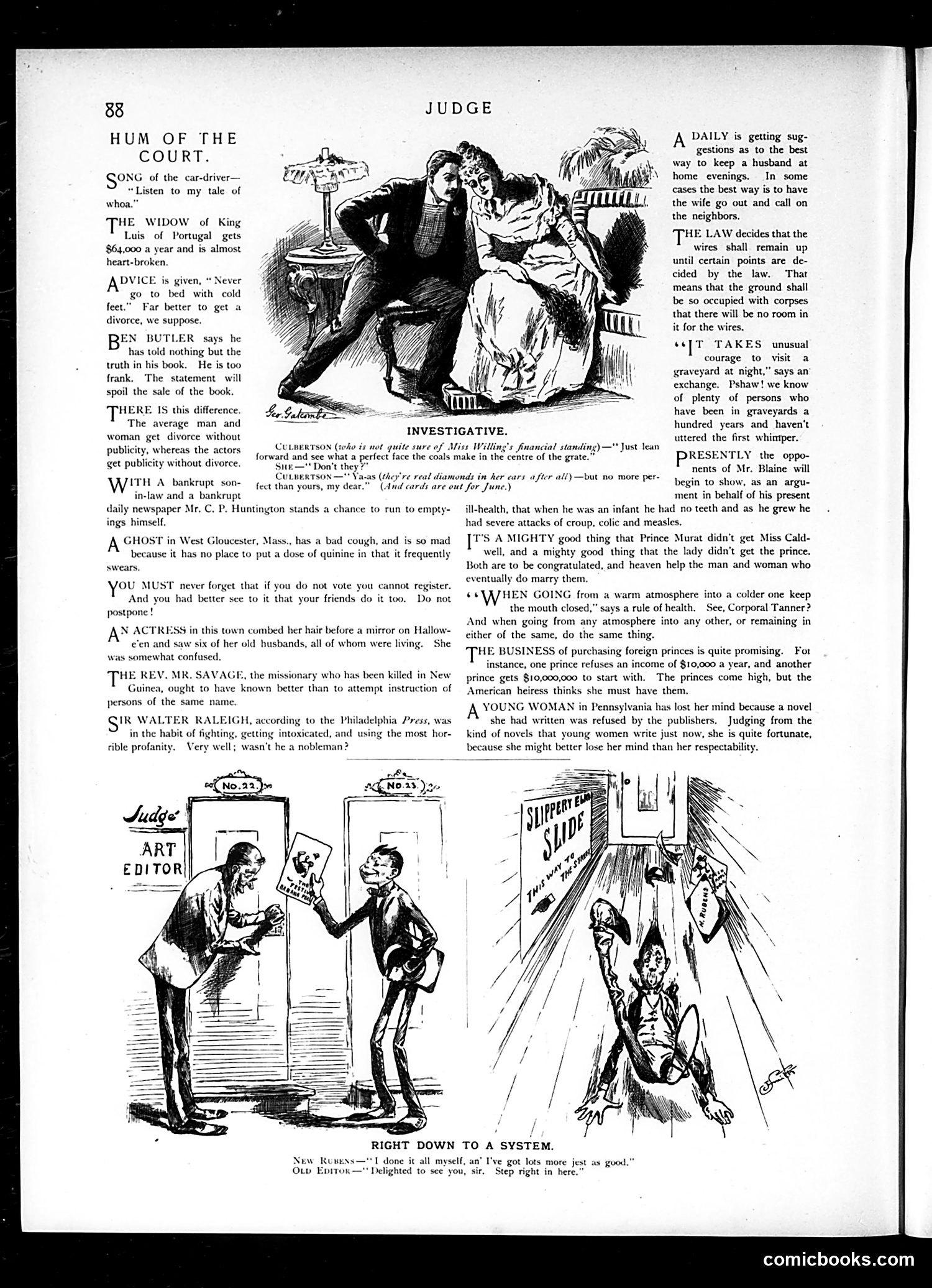
This page from Judge magazine contains brief satirical commentary on contemporary social and political issues, circa late 19th century. **Key satirical items:** - **King Luis of Portugal's widow**: Mocks the wealthy widow receiving a substantial pension ($64,000 yearly) while claiming emotional distress—commentary on unearned aristocratic privilege. - **Sir Walter Raleigh**: References a historical figure allegedly known for drunken behavior and profanity, using him as a type for misbehaving gentlemen. - **Prince Murat and Miss Caldwell**: Satirizes the American heiress phenomenon—wealthy young American women marrying European nobility. The joke suggests both parties are better off *not* marrying. - **Bottom cartoon ("Right Down to a System")**: Shows an art editor interviewing a new artist. The exchange mocks both pretentious editorial gatekeeping and an artist claiming originality while obviously copying predecessors ("I done it all myself"). The cartoons consistently target wealth, pretension, and social hypocrisy of the Gilded Age.
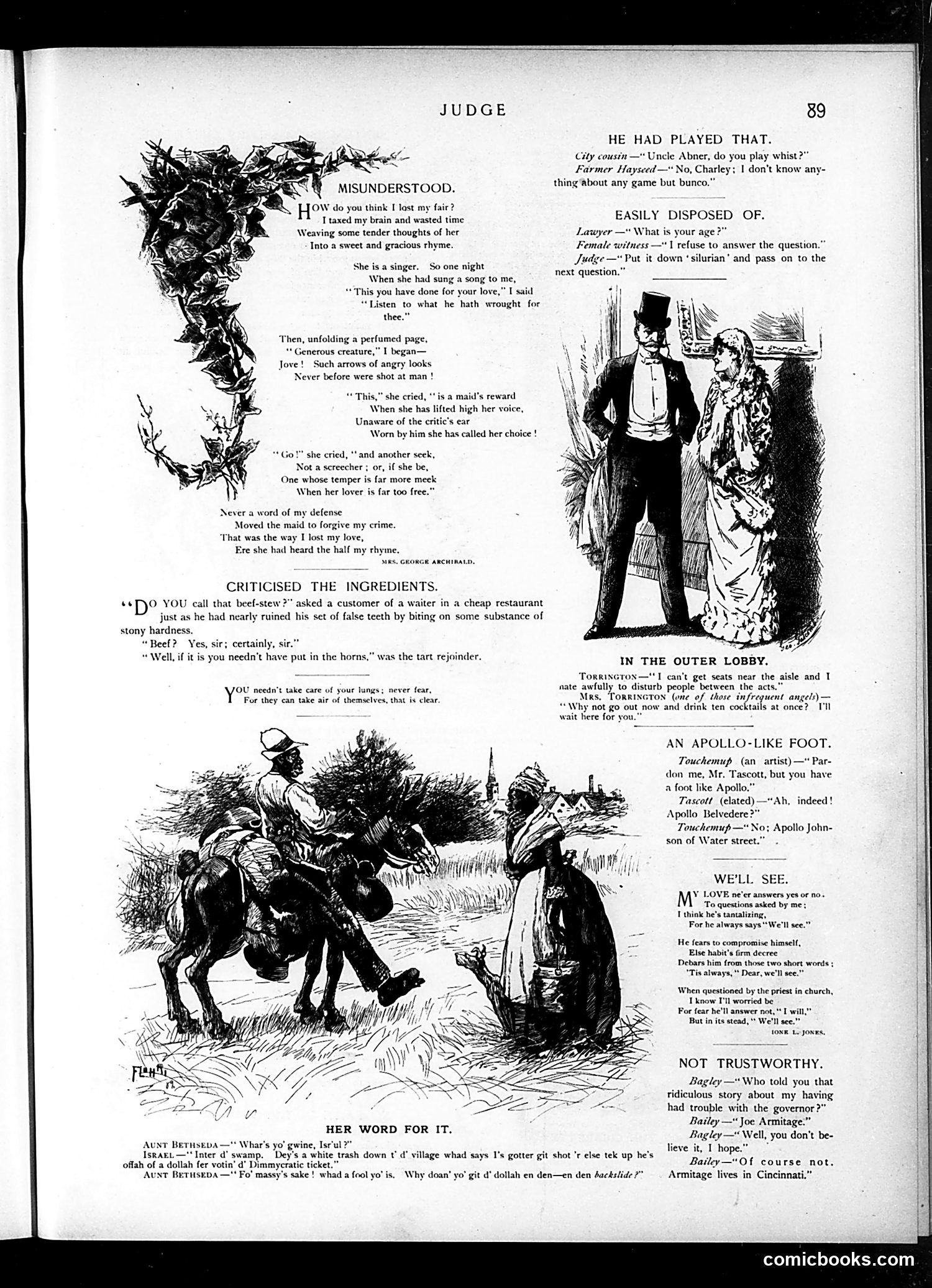
This page contains several brief satirical jokes typical of late 19th/early 20th-century American humor: **"Criticised the Ingredients"** mocks cheap restaurants, where a customer bites something hard in beef stew and sarcastically notes the cook "needn't have put in the horns"—implying the stew contains inedible animal parts. **"Her Word for It"** uses racist dialect humor (then common in Judge) about an African American man being offered money to vote Democratic, with his aunt ironically suggesting he take the money then "backslide" (renege). **"She Lost My Love"** is a romantic poem about a man whose love interest rejects his written poetry, finding it presumptuous. The remaining items are brief one-liners: a city/country contrast joke about card games, a judge aging a woman witness as "Silurian" (geological humor), and various society/courtship jokes. The page reflects period attitudes: casual racism, class-based humor about poor dining, and gentle mockery of romance and social pretension.
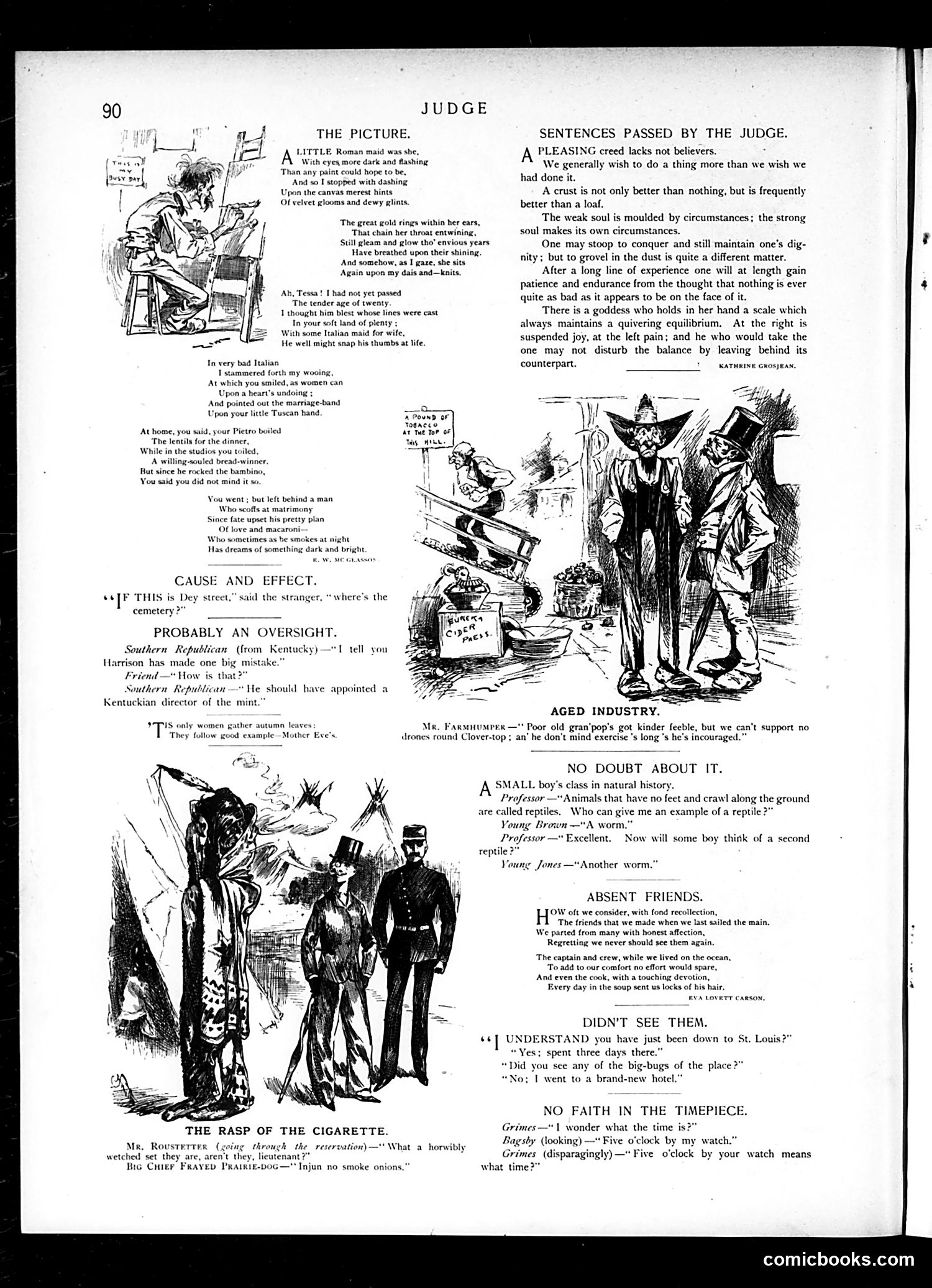
This page from *Judge* contains several satirical pieces typical of late 19th-century American humor: **"The Picture"** is a sentimental poem about an artist pining for a young Italian woman (Tessa) he once loved, who chose marriage to Pietro instead. The satire mocks romantic idealization and artistic nostalgia. **"Cause and Effect"** jokes about a Southern Republican politician complaining that President Harrison didn't appoint a Kentuckian as mint director—a petty political grievance presented as absurdly self-interested. **"Probably an Oversight"** appears to be a similar political jab. The bottom section contains lighter humor: a natural history class where students give circular answers (defining "reptile" as "worm"), a poem about absent seafaring friends with a punchline about the cook's hygiene, and conversational snippets about St. Louis and timepieces. The cartoons feature period illustrations of romantic, political, and domestic scenes. Overall, the page mixes political satire with genteel humor about romance, bureaucracy, and everyday absurdities.
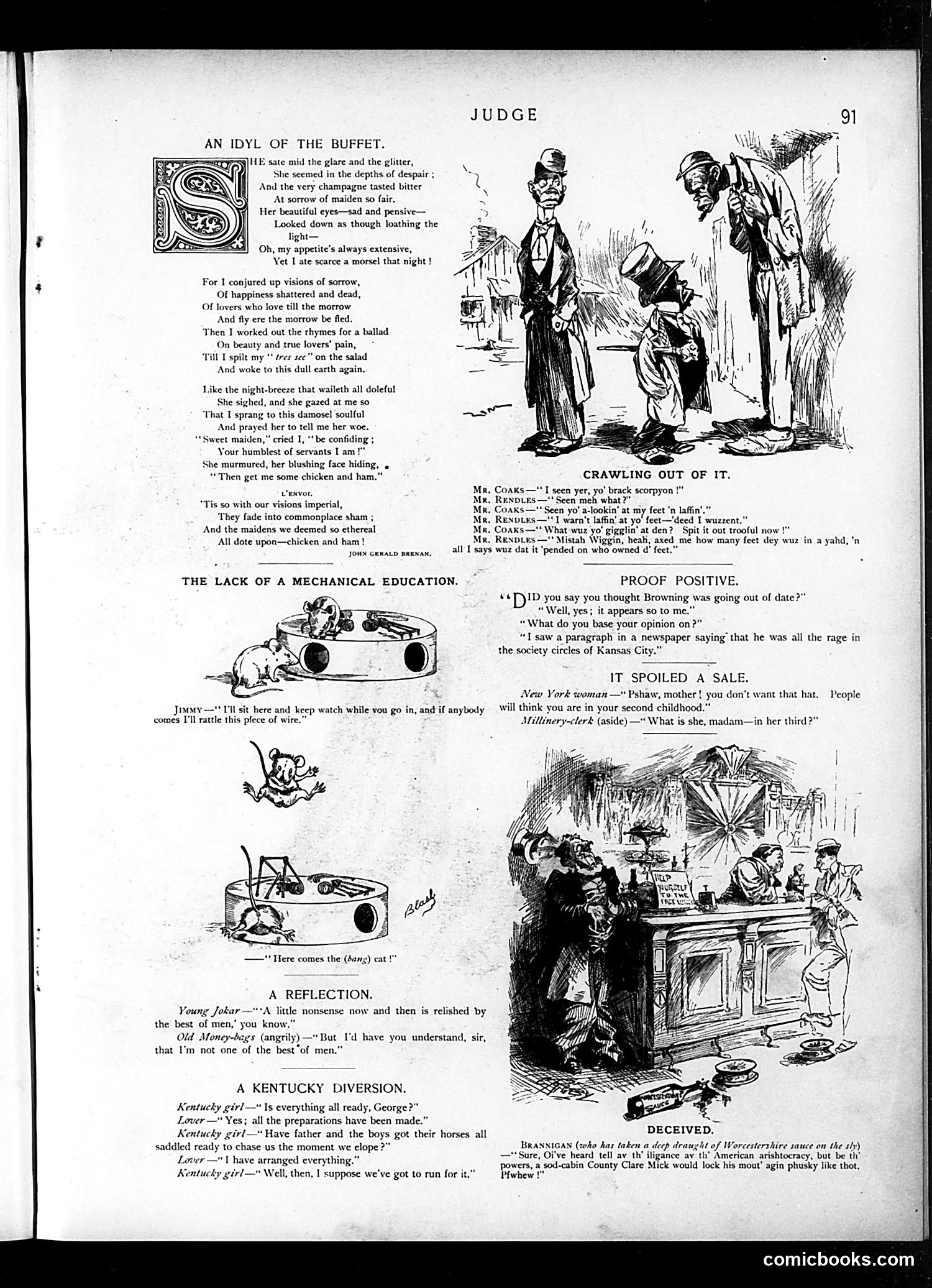
This page contains several brief satirical sketches typical of late 19th-century humor: **"An Idyl of the Buffet"** mocks romantic pretension. A man at a fancy dinner constructs elaborate poetic fantasies about a melancholy woman, imagining her deep sorrows—only to learn she simply wants chicken and ham. The satire targets excessive sentimentality and the gap between male romantic idealization and female practicality. **"A Kentucky Diversion"** jokes about frontier courtship customs: a couple must elope with the girl's father and brothers literally chasing them on horseback—suggesting this is routine, expected behavior rather than scandal. **"Crawling Out of It"** and **"Deceived"** are dialect humor featuring working-class or immigrant characters in comic situations involving misunderstandings. **"Proof Positive"** gently ridicules cultural snobbery: a woman dismisses poet Robert Browning as dated, then contradicts herself by citing his popularity in Kansas City society—implying provincial tastes determine literary merit. The cartoons employ visual caricature alongside text to amplify the humor, typical of Judge's satirical approach to contemporary social manners and pretension.
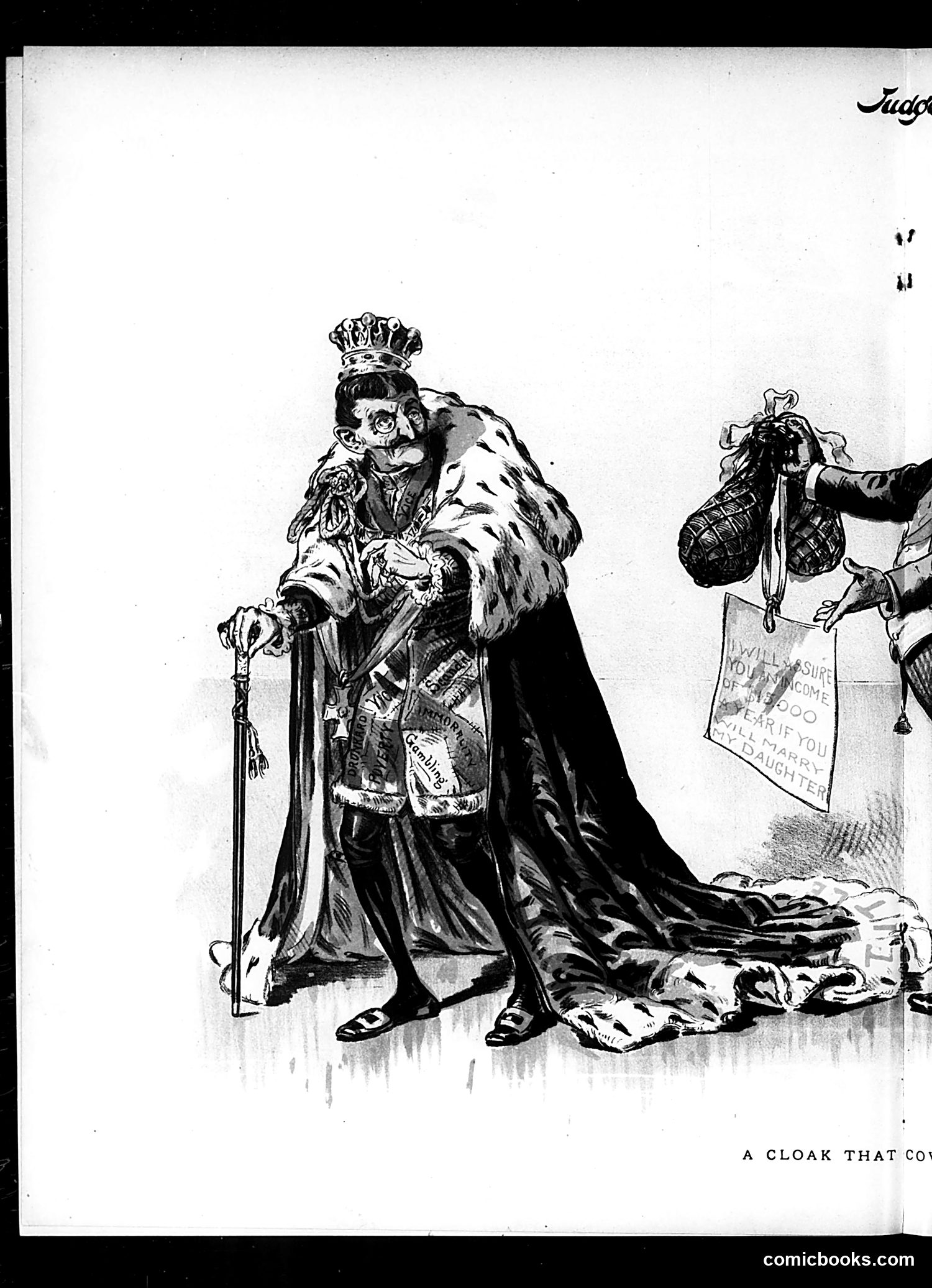
This appears to be a satirical illustration from *Judge* magazine depicting a figure in royal regalia (crown, ermine-trimmed cloak) wielding a sword. The character appears grotesque or exaggerated, suggesting mockery of authority or power. On the right, another figure holds what appears to be a document or notice. The partial caption reads "A CLOAK THAT COO[L]" but is cut off, making the complete meaning unclear. Without the full caption and given the OCR limitations, I cannot definitively identify which political figure or event this satirizes. The imagery suggests commentary on corruption, hypocrisy, or abuse of power by someone in high office, but the specific historical reference remains uncertain from the visible text alone.
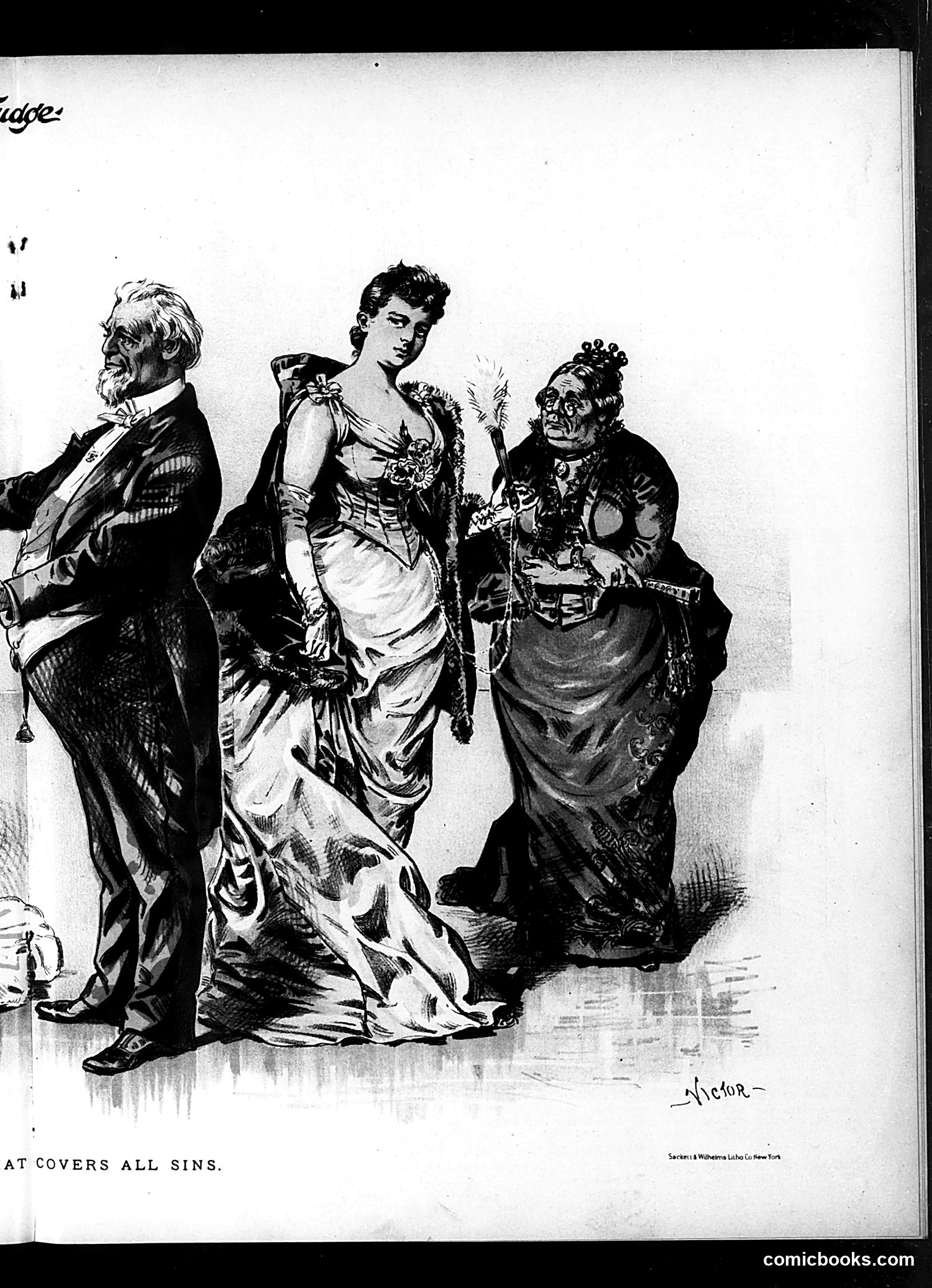
This cartoon illustrates the caption "Charity at Covers All Sins," a reference to the Biblical concept that charity/generosity can atone for wrongdoing. The sketch depicts four figures in formal Victorian dress: an elderly gentleman, a young woman in an elegant gown, and two older women in dark clothing. The satire likely critiques wealthy individuals who use ostentatious charitable giving or fashionable social participation to mask moral failings or unethical behavior. The well-dressed central figures contrast with the caricatured elderly women, suggesting class dynamics in charitable work. This reflects Gilded Age commentary on how the wealthy deployed visible philanthropy to maintain social respectability despite questionable business or personal conduct—a common Judge magazine theme mocking hypocrisy among the wealthy.
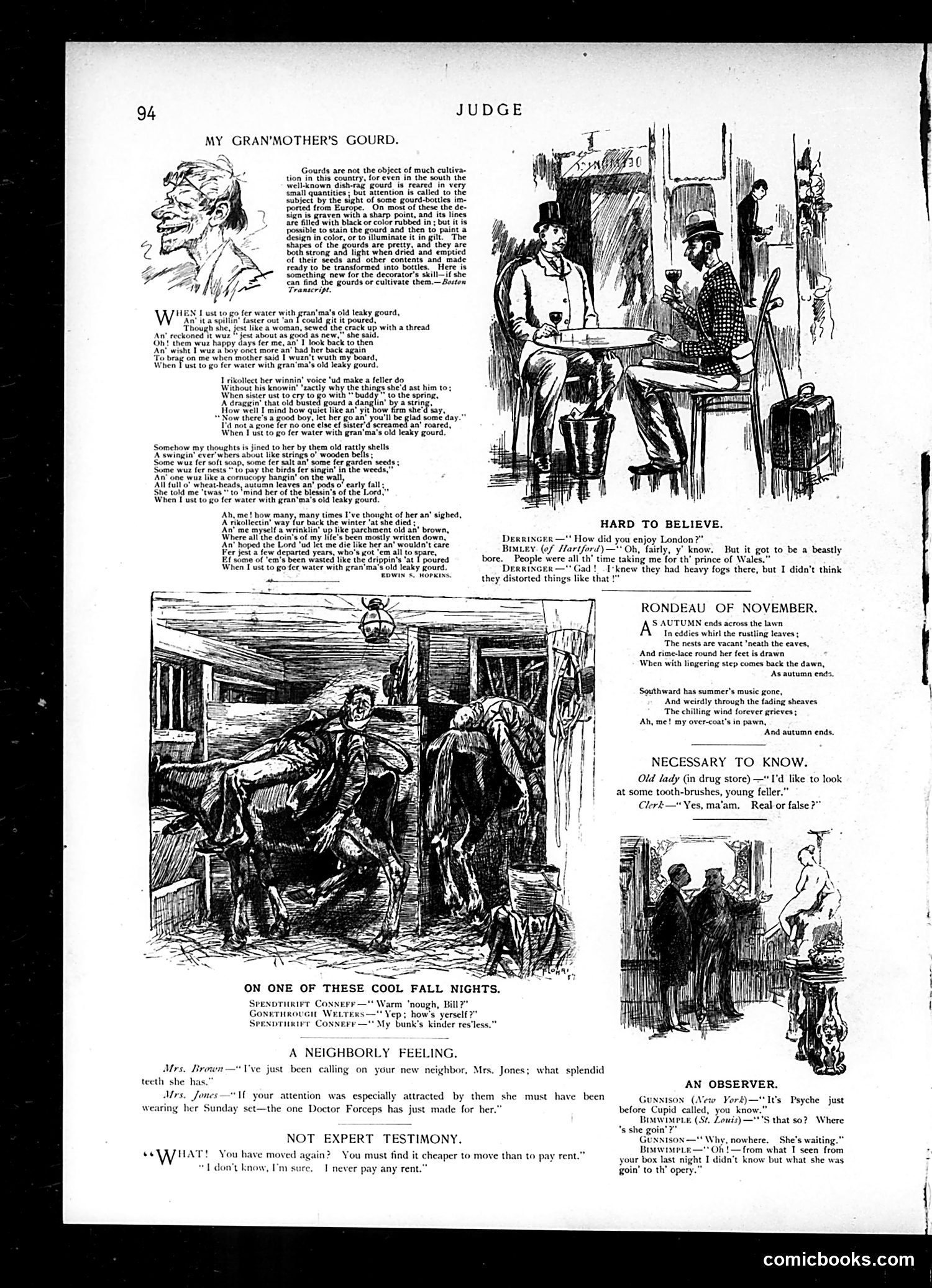
This page from *Judge* contains several satirical pieces reflecting late 19th-century American humor: **"My Gran'mother's Gourd"** is a nostalgic poem accompanied by an illustration showing an elderly woman. The piece is sentimental rather than satirical, celebrating childhood memories of fetching water with a leaky gourd. **"Hard to Believe"** is a brief joke: an American visitor to London claims people mistook him for the Prince of Wales, which his friend finds implausible given London's famous fogs—implying the fog was so thick it distorted his appearance unrecognizably. **"Rondeau of November"** is a short autumn poem with conventional seasonal imagery. **"Necessary to Know"** is a pharmacy joke where a clerk asks an elderly customer whether she wants real or false toothbrushes—a straightforward gag playing on the common practice of denture-wearing among older people. The page mixes nostalgic verse with light social humor typical of *Judge*'s content, with no evident political satire present.
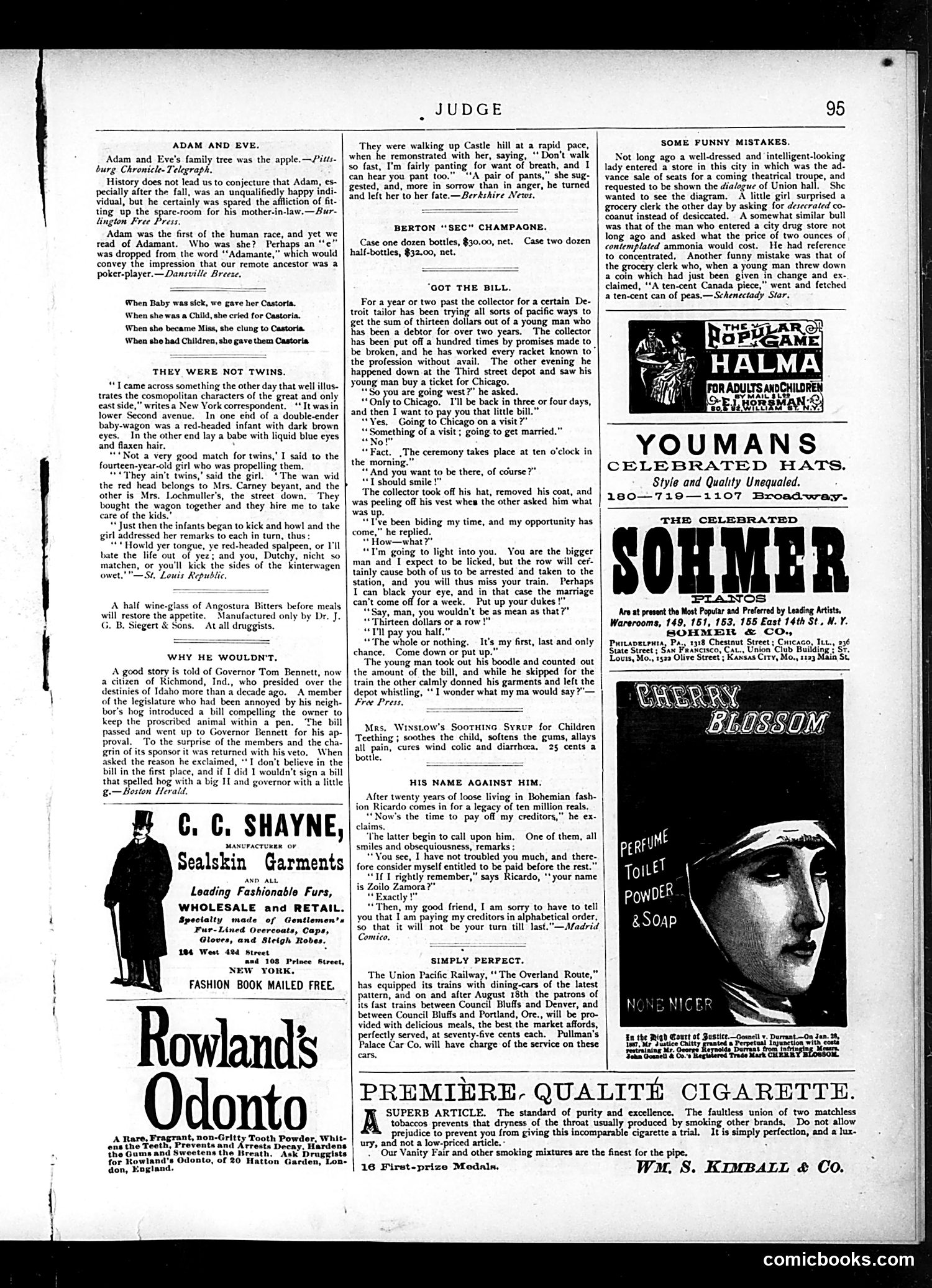
This page is primarily **humor and advertising**, with minimal political cartoons. The content consists of several brief satirical anecdotes: **"Adam and Eve"** — Various newspapers offer tongue-in-cheek commentary on Adam, including jokes about him avoiding mother-in-law troubles and speculation that "Adamant" (a female figure) suggests Adam was a poker player. **"They Were Not Twins"** — A humorous sketch about a Lower East Side girl minding two unrelated babies in a shared wagon, using ethnic stereotypes (calling one child "Dutchy" and threatening them in exaggerated Irish dialect). **"Why He Wouldn't"** — Anecdote about Idaho Governor Tom Bennett vetoing a hog-confinement bill because it spelled "hog" with a capital H while spelling "governor" lowercase—a petty joke about standards. The page also contains **period advertisements** for Castoria (a patent medicine), sealskin garments, dental powder, and champagne. The humor relies on contemporary ethnic stereotypes and wordplay familiar to 1890s readers but dated today.
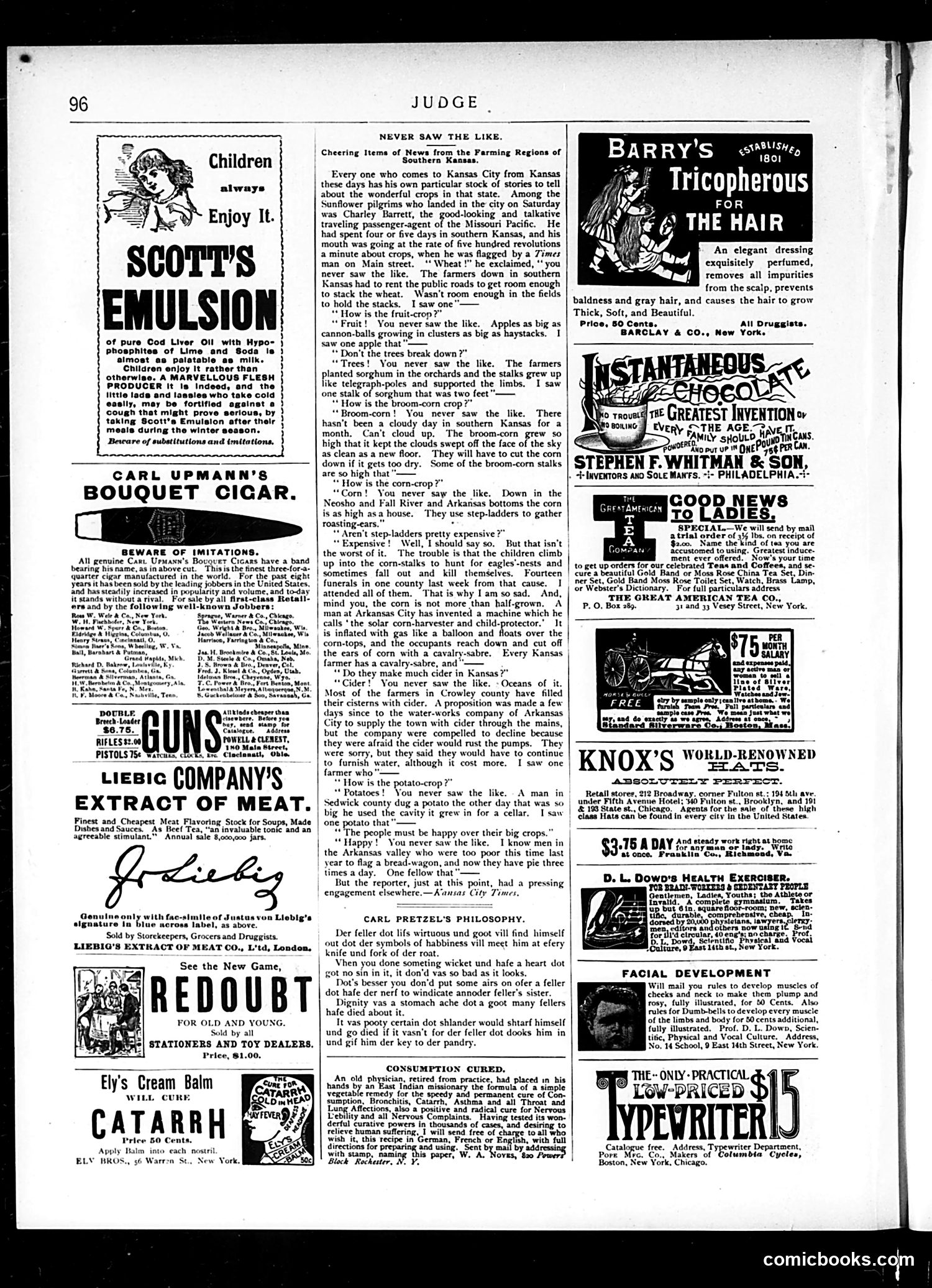
This page features a satirical article mocking the exaggerated boasting of Kansas farmers and railroad promoters. The unnamed protagonist—a Missouri Pacific railroad passenger agent named Charley Barrett—delivers increasingly absurd claims about southern Kansas crops: wheat so abundant it overflows fields, apples "as big as cannon-balls," corn stalks requiring step-ladders to harvest, and broom-corn so tall it prevents cloud formation. The humor lies in the escalating hyperbole and the narrator's relentless repetition of "You never saw the like," which becomes comedic through sheer excess. The satire likely targets the exaggerated promotional literature used to attract settlers and investors to Kansas during the agricultural boom period. This was common practice in late 19th-century American journalism—mocking the inflated claims made by regional boosters and transportation companies seeking economic development. The rest of the page contains period advertisements for patent medicines, cigars, and household products typical of Judge magazine.
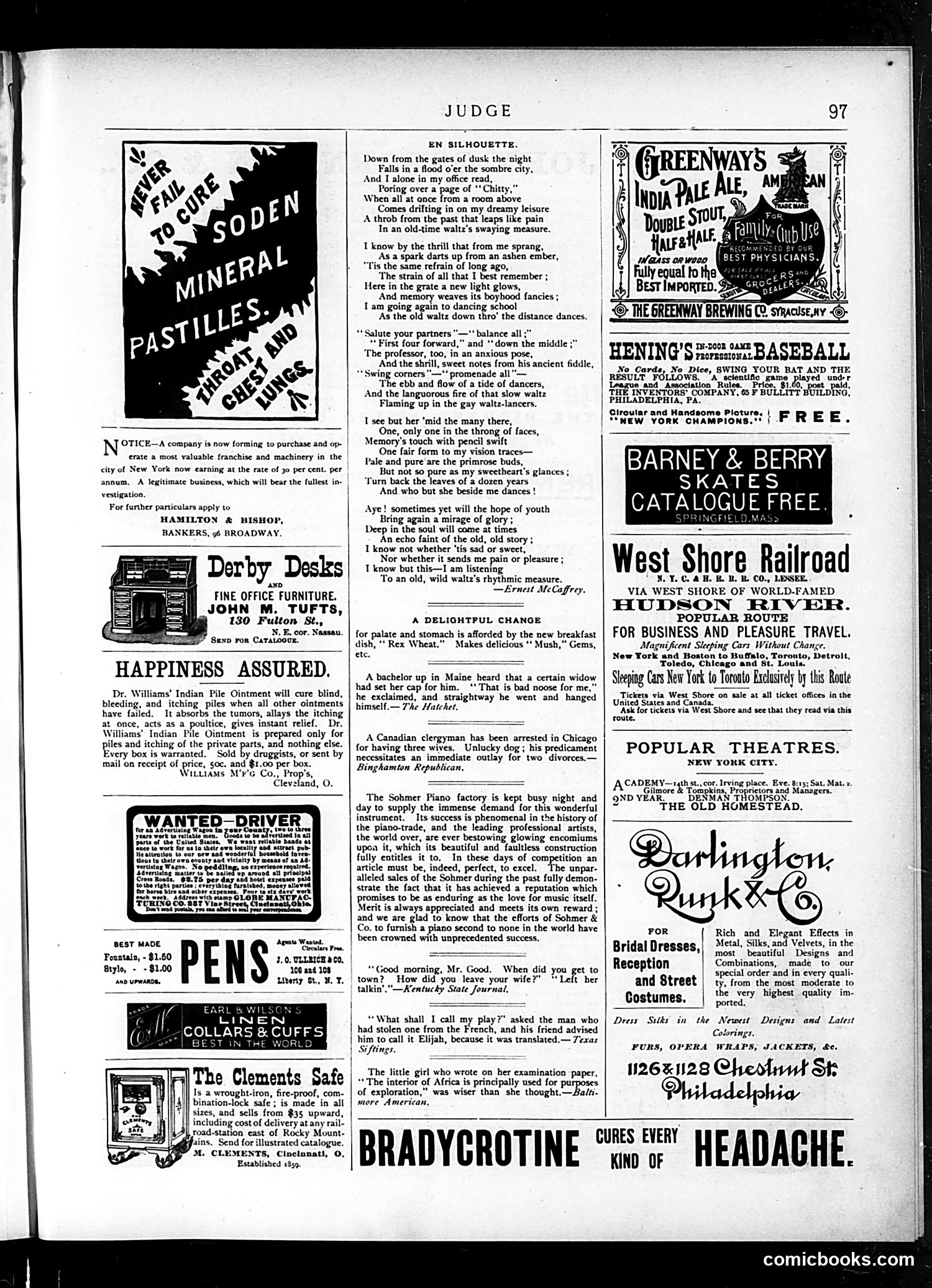
This page is primarily **advertising and literary content** rather than political satire. The dominant elements are: **Literary Content:** A romantic poem titled "En Silhouette" by Ernest McCaffrey describes a man nostalgically recalling a waltz and a youthful sweetheart from dancing school, triggered by hearing the same music years later. **Advertisements:** The page features typical late-19th-century product ads: furniture (Derby Desks), patent medicines (Dr. Williams' Indian Pile Ointment), office supplies (pens), and safes (M. Clements). These ads reflect common commercial practices of the era. **Humor Snippets:** Small jokes appear, including one about a bachelor in Maine and another about a Canadian clergyman with multiple wives—light, cynical humor typical of Judge's style. The page contains **no identifiable political cartoons or caricatures**. It represents Judge functioning as a general-interest satirical magazine mixing literature, advertising, and miscellaneous humor rather than focused political commentary.
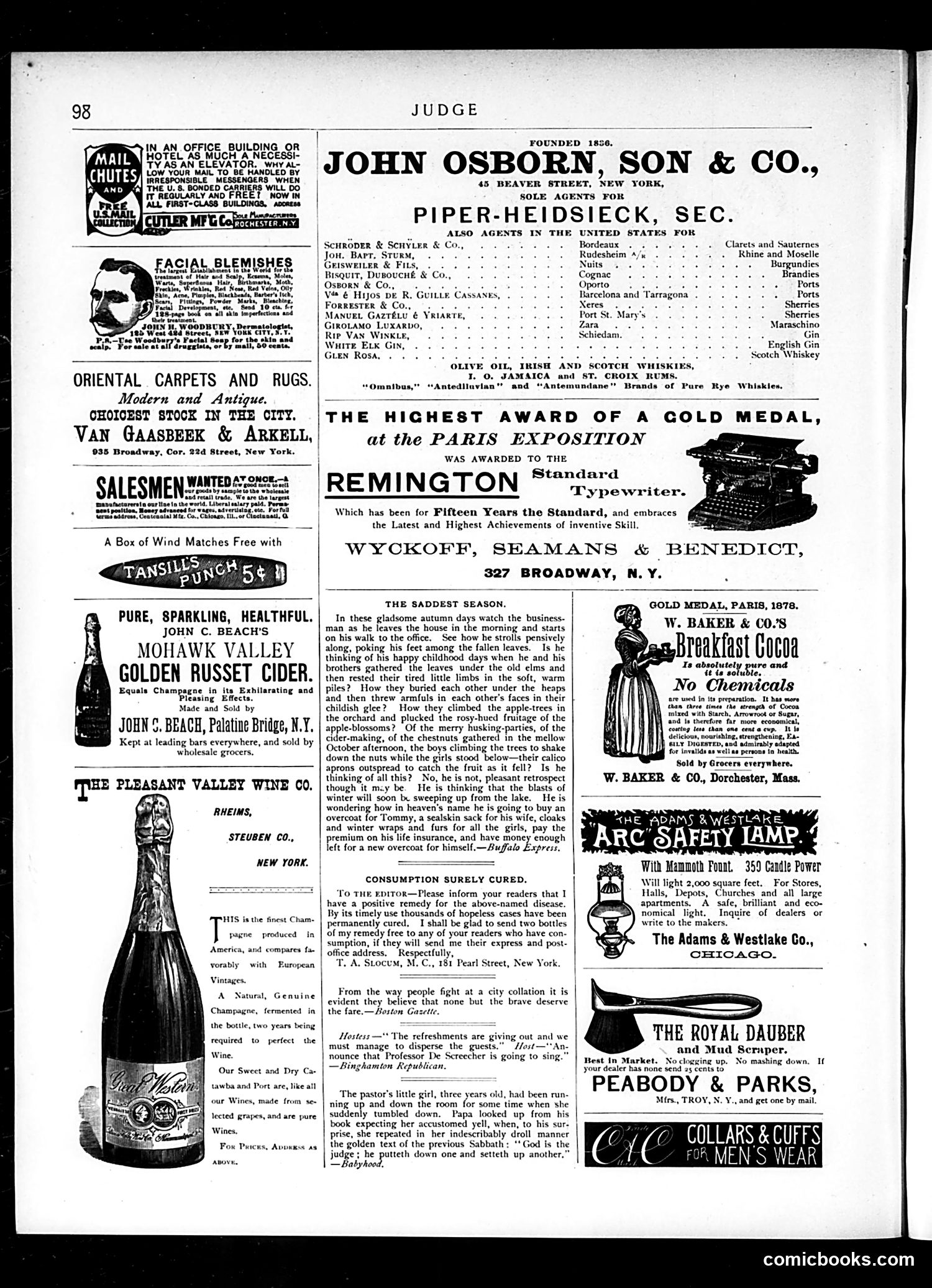
This page is primarily **advertising**, not editorial content or political satire. It showcases various commercial products and services typical of 1880s America. The only substantial text article—"The Saddest Season"—is nostalgic commentary on autumn, contrasting a businessman's melancholy walk to work with memories of carefree childhood (gathering leaves, climbing apple trees, cider-making). The piece satirizes the loss of innocence and joy that comes with adult responsibilities, a common theme in period literature. The majority of the page features ads for luxury goods (wines, spirits, carpets, typewriters, cocoa) targeting affluent readers. Notable products include Remington typewriters (marketed as award-winning), W. Baker & Co's breakfast cocoa, and various imported European wines and liquors—reflecting late-19th-century consumer culture and American fascination with European sophistication. The "Mail Chutes" advertisement at top-left references a practical urban innovation for apartment buildings.
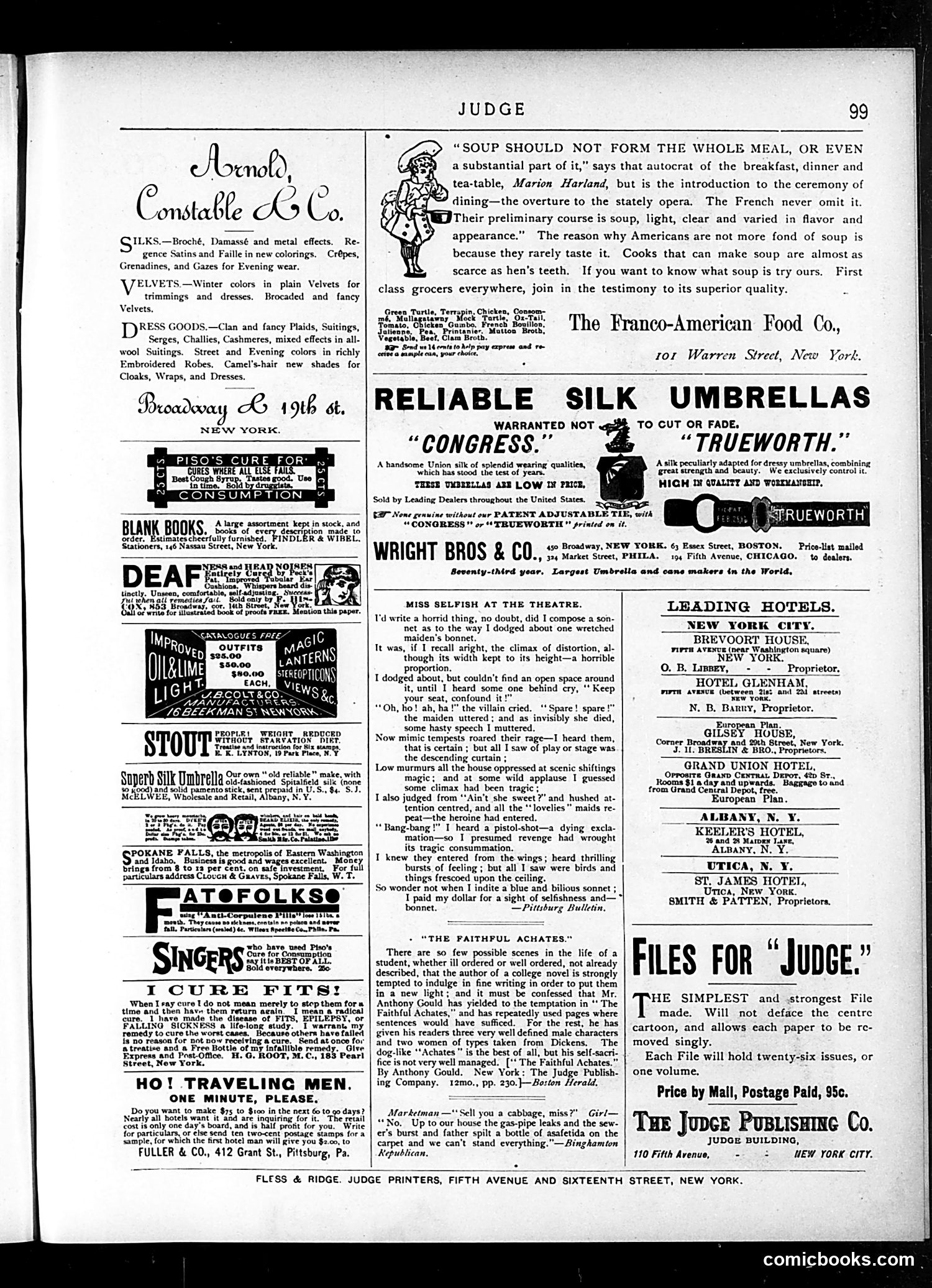
This page is primarily **advertising and filler content**, not political satire or editorial cartoons. The page contains mostly commercial advertisements for textiles (Arnold, Constable & Co.), blank books, umbrellas, patent medicines ("cure fits"), hotels, and food products. The most substantial editorial content is a **food column** praising Franco-American soup, citing Marion Harland (a 19th-century domestic authority) arguing soup should open meals—a French custom Americans allegedly neglect because good soup-makers are scarce. There is also a brief theatrical anecdote titled "Miss Selfish at the Theatre" describing a woman's disruptive behavior at an opera performance, followed by a book review of "The Faithful Achates" by Anthony Gould. No political figures, cartoons, or satirical commentary are visible on this page. It appears to be a typical Judge magazine back page combining advertising with light cultural commentary.
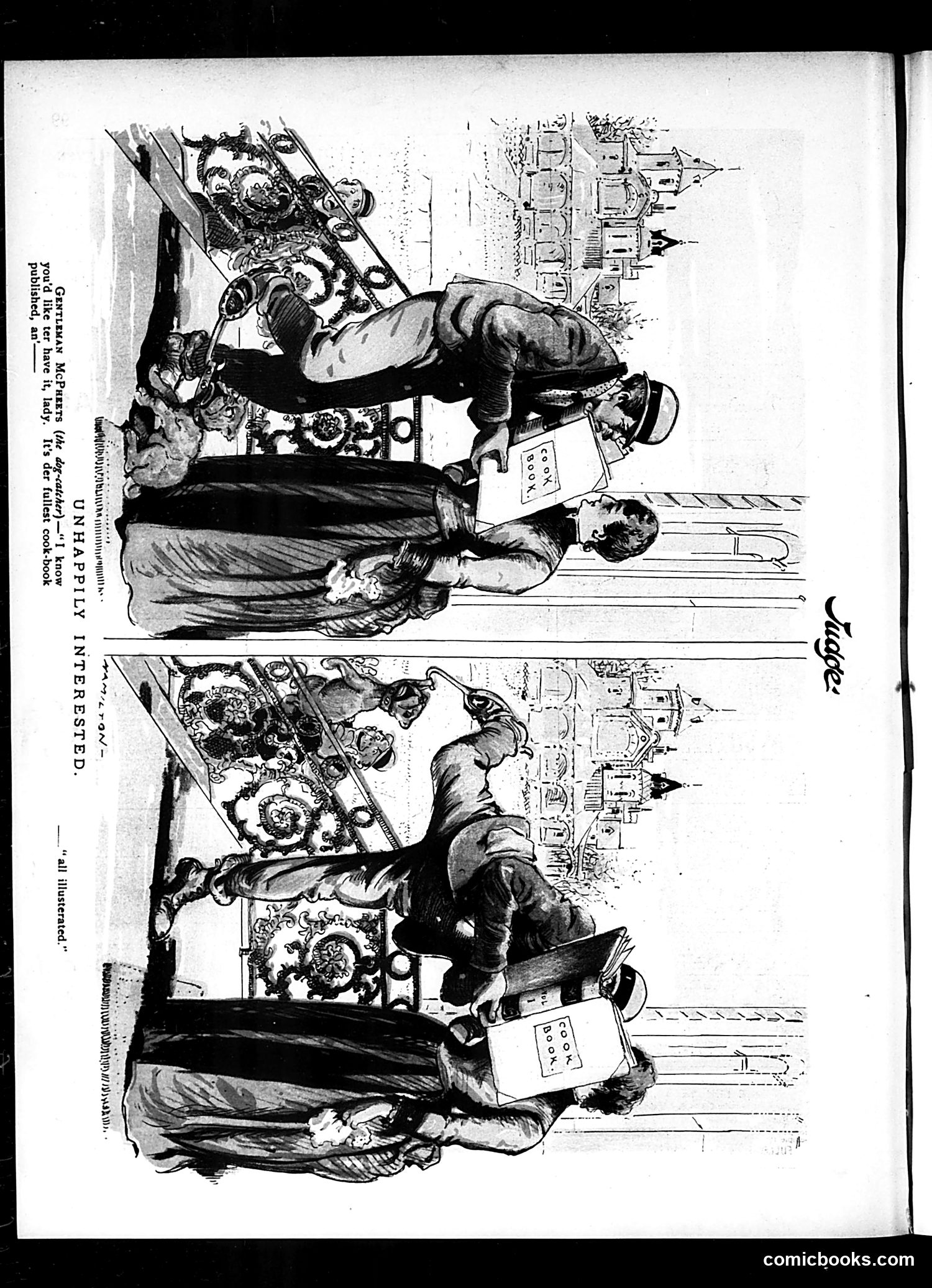
This Judge magazine cartoon satirizes class dynamics through a domestic scene. A well-dressed lady appears to be interested in acquiring something from a man identified as "McPurers (the dog-catcher)." The humor relies on social incongruity: a lowly dog-catcher is pitching what he claims is "the fullest cook-book published" to an upper-class woman. The satire likely mocks either: 1. **Presumptuous salesmanship** — an working-class man inappropriately trying to sell luxury goods to someone above his station 2. **Class assumptions** — the idea that even wealthy households need basic cooking instruction The caption "Unhappily Interested" suggests the woman is reluctantly engaged with this unwelcome interaction. The cartoon reflects Gilded Age anxieties about class boundaries and the behavior of service workers toward their betters.