
A complete issue · 16 pages · 1889
Judge — August 10, 1889
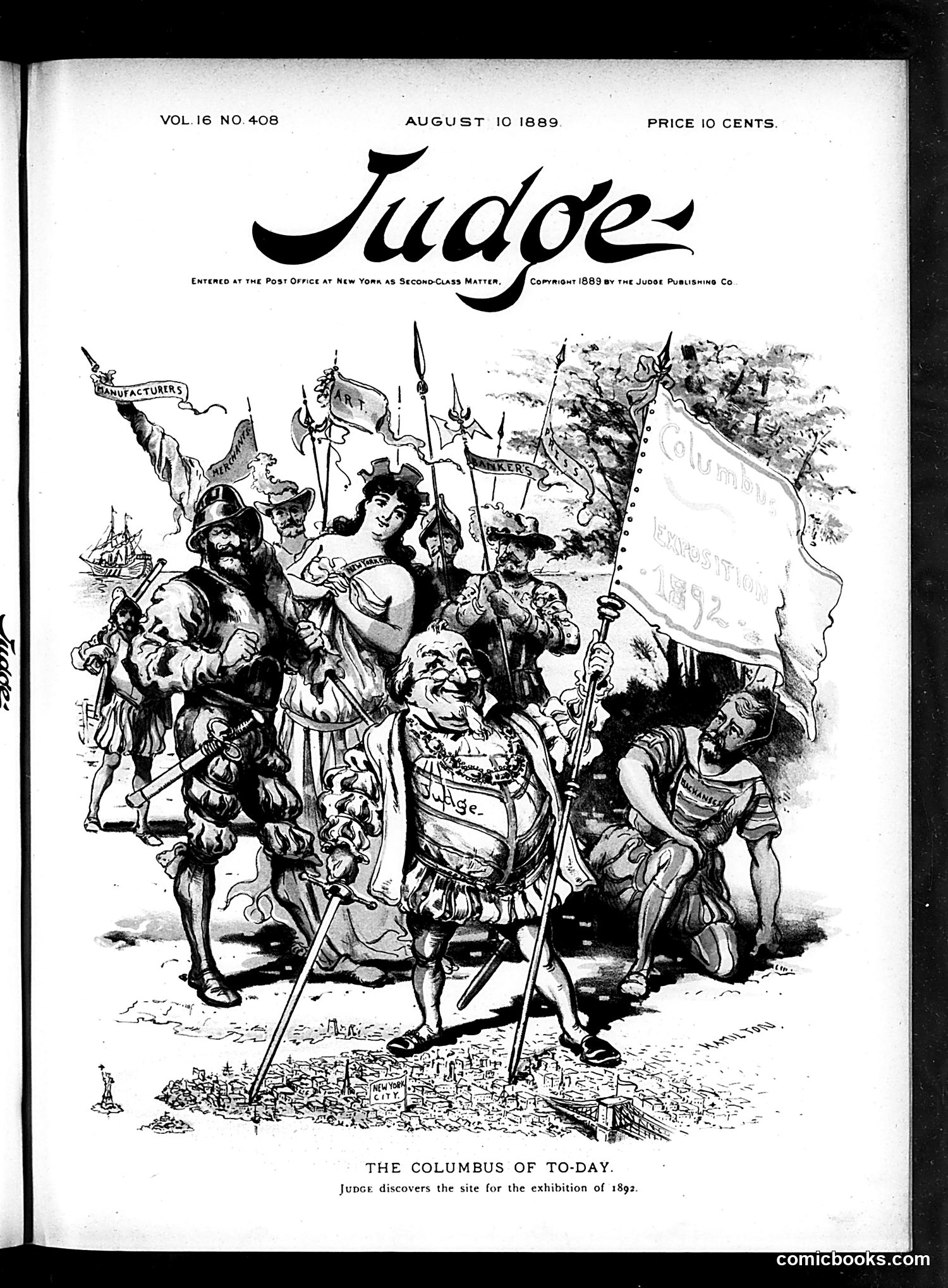
This August 1889 *Judge* cartoon satirizes the selection of a site for the 1892 World's Columbian Exposition. The central figure labeled "Judge" (representing the magazine itself or judicial authority) stands triumphantly, having "discovered" the exhibition site—paralleling Columbus's 1492 voyage. The crowded, chaotic scene depicts various competing interests (labeled "Manufacturers," "Art," and other banners) fighting over the location. The satirical point appears to be that choosing the fair's site involved contentious political and commercial rivalries, making the selection process as momentous and contentious as Columbus's original discovery. The exaggerated, carnival-like imagery mocks how cities and interests battled for hosting rights to this prestigious 1893 Chicago World's Fair.
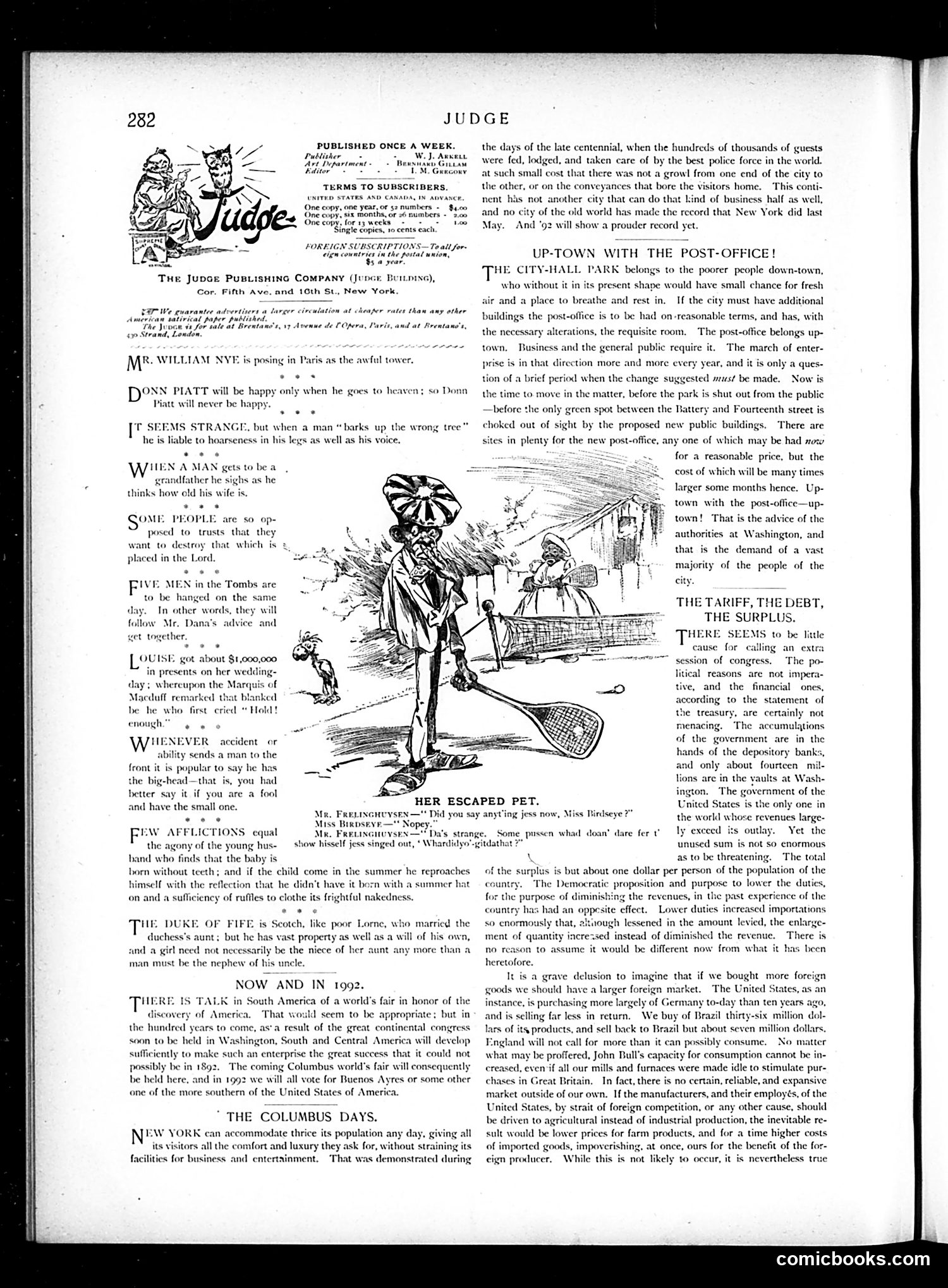
The main cartoon, titled "Her Escaped Pet," depicts a tall, thin man with exaggerated features being walked on a leash by a woman. The caption suggests he is "Miss Robeye's" escaped companion. The humor plays on reversing typical power dynamics—the woman controls the man as one would a pet, implying emasculation or marital dominance. The surrounding text consists primarily of brief satirical quips about contemporary figures and social situations, though most references are unclear without additional historical context. The content appears typical of Judge's style: mockery of wealthy or prominent individuals, social commentary on gender relations, and observations about New York society. The page demonstrates Judge's characteristic approach: visual caricature combined with barbed social commentary.
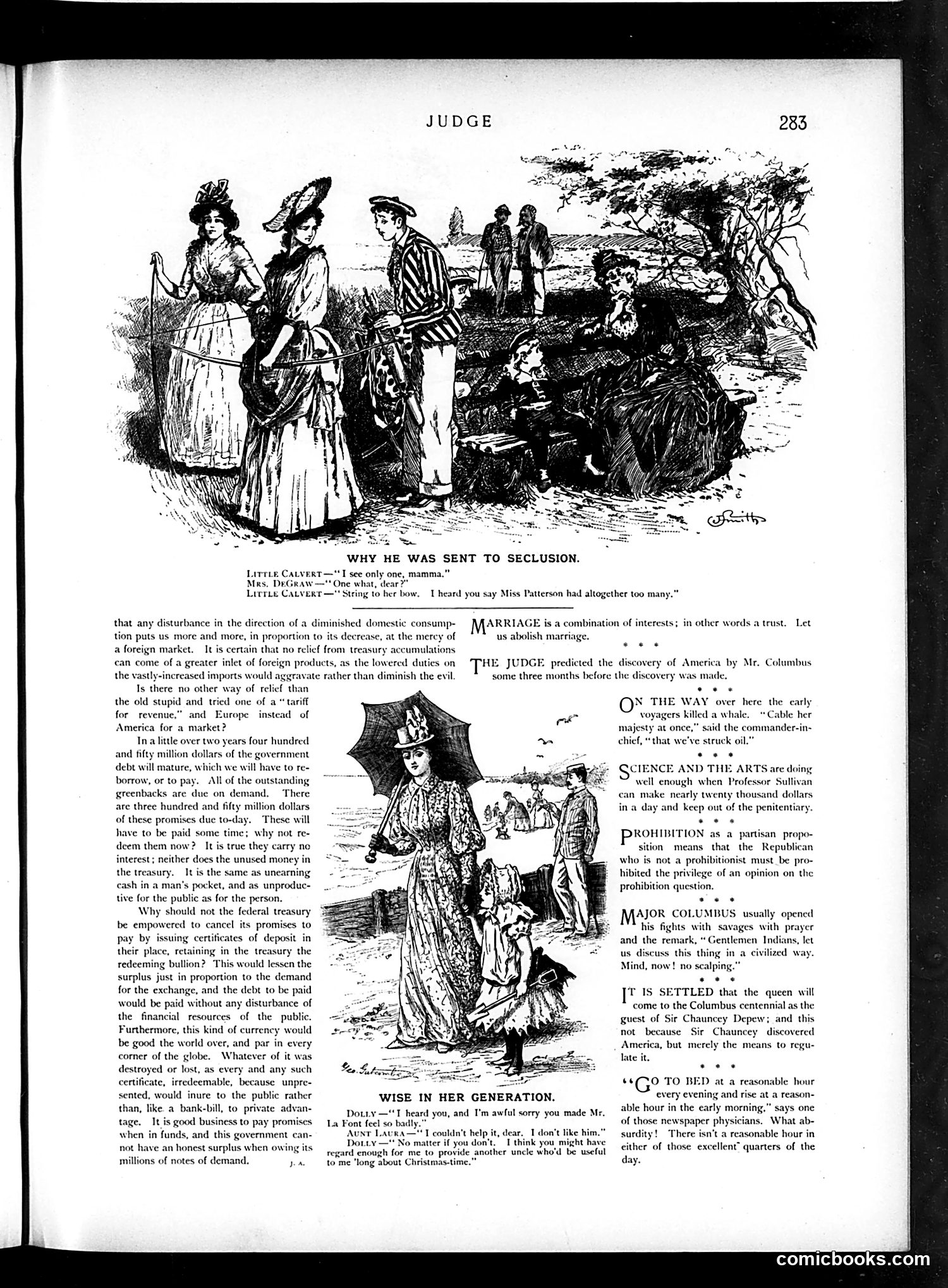
This page contains multiple satirical pieces targeting late 19th-century American issues: **Top Cartoon** ("Why He Was Sent to Seclusion"): A domestic comedy about a young woman removed from society, with dialog suggesting gossip about her romantic prospects—likely satirizing strict Victorian social conventions that isolated unmarried women. **Lower Cartoon** ("Wise in Her Generation"): A young woman (Dotty) manipulates her wealthy uncle through flattery, securing a Christmas gift. This satirizes women's limited economic agency, forcing them to use charm rather than direct means to gain financial security. **Editorial Content**: Mixed commentary on tariffs, currency, prohibition, and marriage as economic contracts. References to "Judge" predicting Columbus's discovery appear self-promotional. **Social Context**: The page reflects Gilded Age anxieties about gender roles, women's dependency, financial instability, and protectionist economic debates—presenting these through humor for educated middle-class readers.
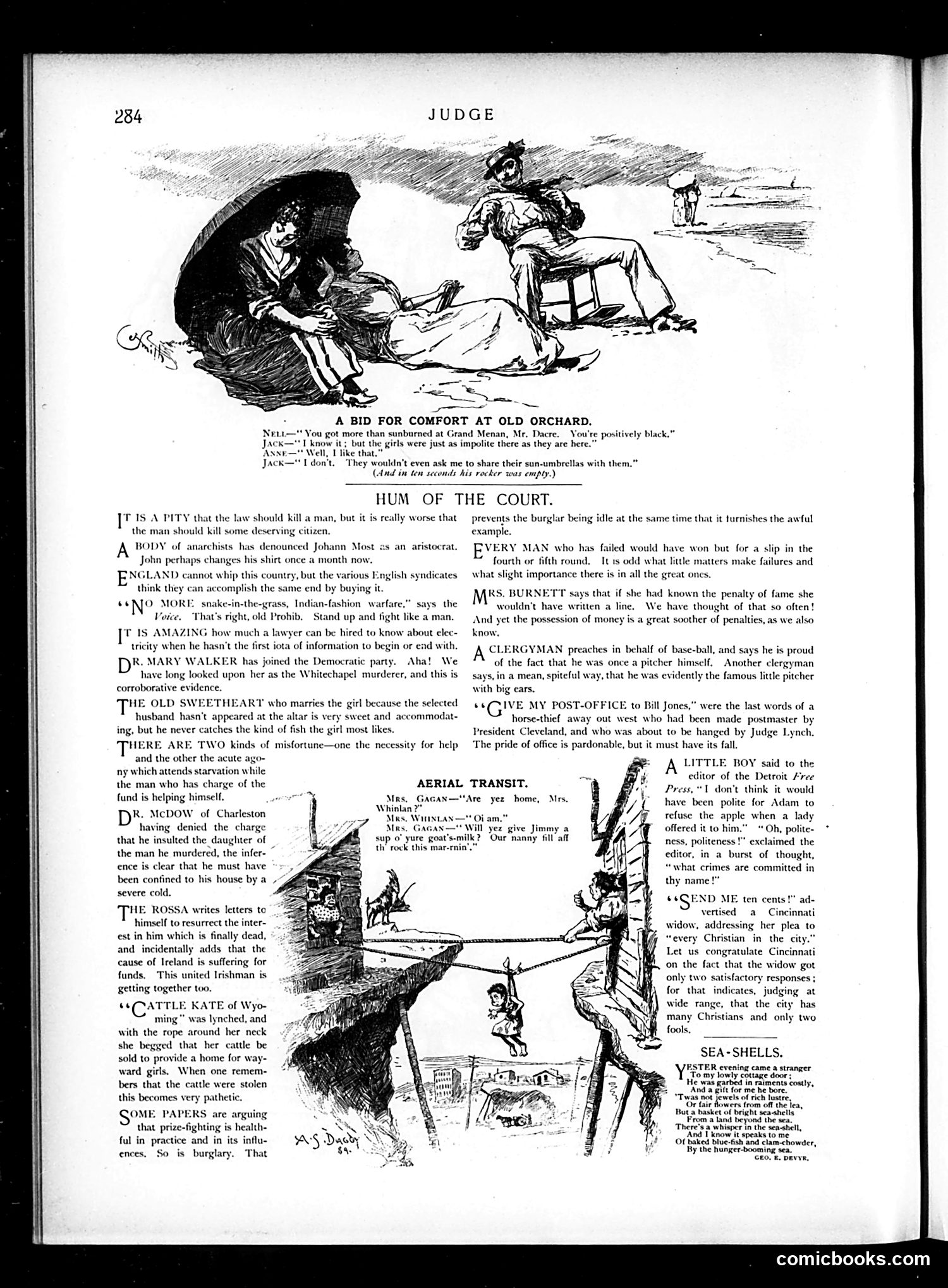
This page from Judge magazine presents satirical short commentary pieces typical of late 19th-century American humor journalism. The top cartoon depicts a beach scene at Old Orchard (a Maine resort) where a sunburned man named Dacre has been rebuffed by women who won't share their umbrellas with him. The joke mocks his romantic prospects ruined by his unfortunate appearance. The "Hum of the Court" section below collects brief satirical jabs at contemporary figures and issues: anarchist Johann Most, English financial interests, Dr. McBow (an apparently infamous murderer), "Battle Kate" of Wyoming (a criminal who was lynched), and references to prize-fighting and burglary. The section on "Aerial Transit" appears to show immigrants or working-class figures discussing domestic matters. The humor relies on topical knowledge—readers would recognize these names and scandals. The satire targets crime, violence, immigration, and social hypocrisy typical of Judge's editorial stance during the Gilded Age.
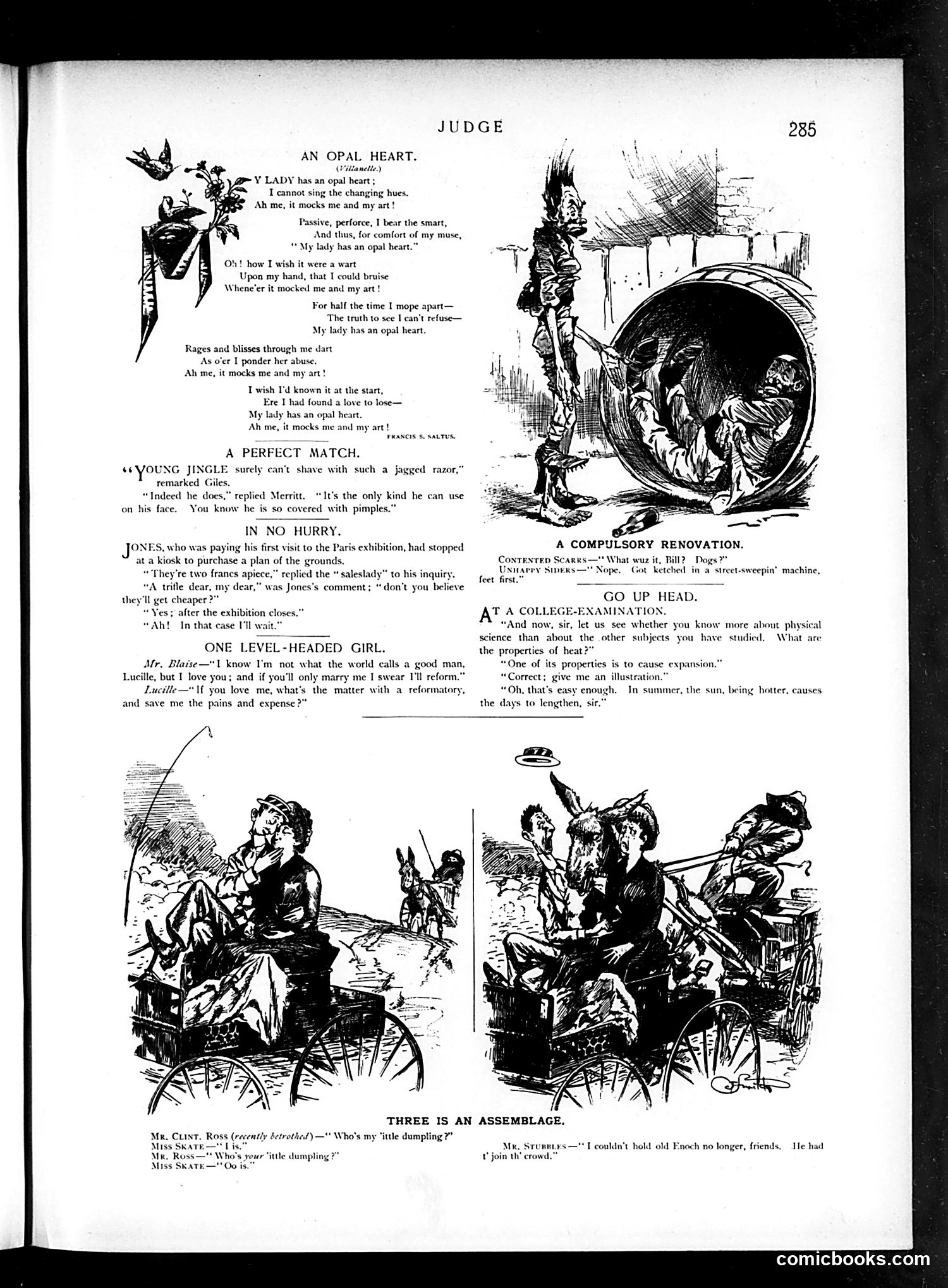
This page from *Judge* magazine contains multiple short satirical pieces typical of late-19th/early-20th-century humor: **"An Opal Heart"** is a sentimental poem mocking romantic melodrama through repetition—a lover complains his lady's changeable moods ("opal heart") mock his artistic sensibilities. **"A Perfect Match"** jokes about a pimply young man whose severe acne makes a jagged razor unnecessary for shaving—dark humor about physical appearance. **"In No Hurry"** presents a tourist at the Paris exhibition buying a guidebook; the vendor predicts prices will drop after the exhibition closes, so he delays purchase—poking fun at penny-pinching tourists. **"One Level-Headed Girl"** satirizes a man offering marriage as reformation; the practical woman suggests a reformatory instead—mocking both romantic clichés and male self-deception. **"Go Up Head"** features a student giving a deliberately absurd answer about heat causing expansion, using summer as "proof"—simple mockery of student foolishness. The page emphasizes social satire, romantic absurdity, and physical humor typical of *Judge's* satirical approach.
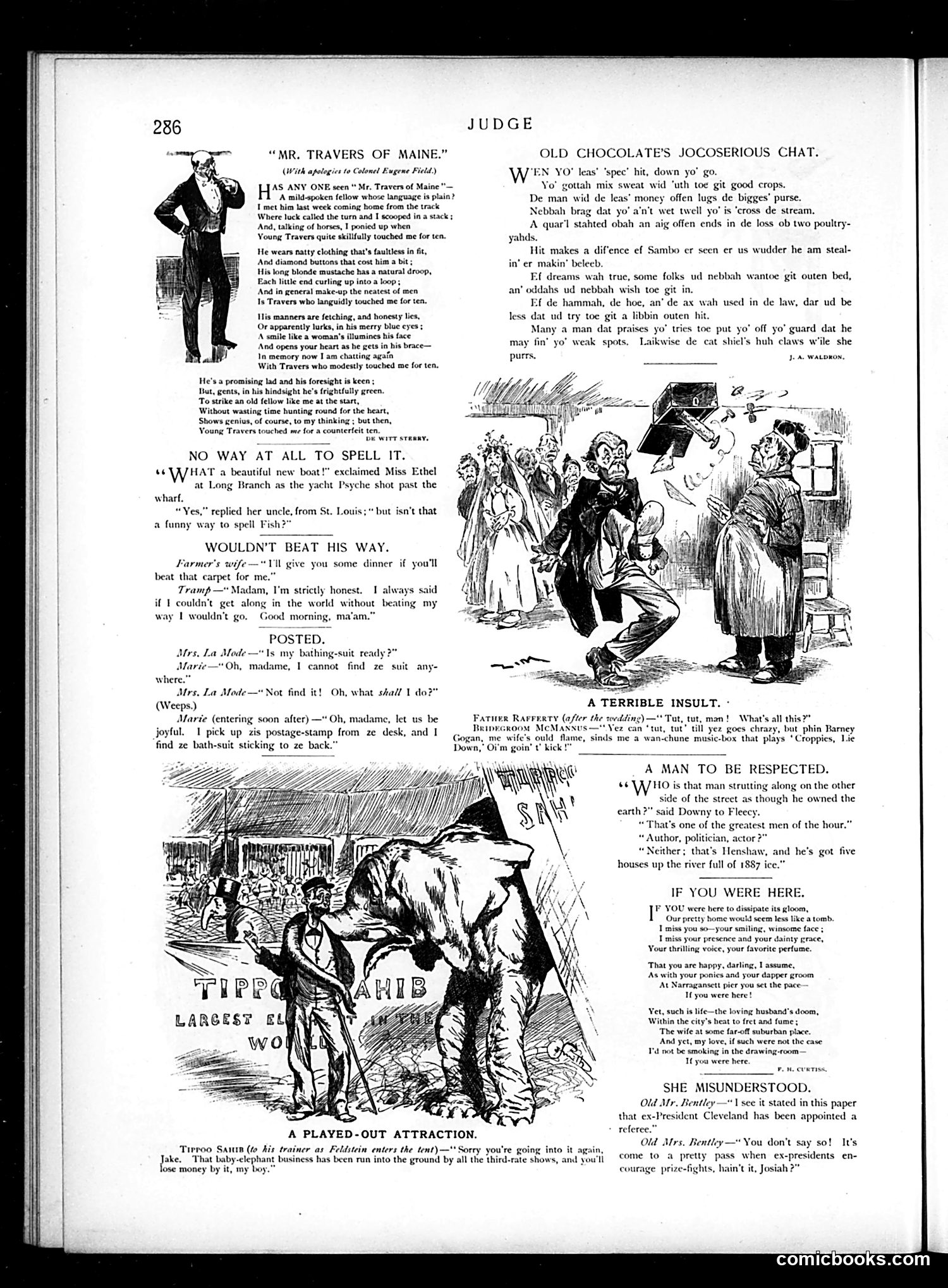
This Judge magazine page contains several satirical pieces: **"Mr. Travers of Maine"** (top left) is a poem mocking a slick con artist who flatters wealthy men into lending him money, exploiting their vanity. The humor lies in Travers's practiced charm and the narrator's self-aware admission of being swindled repeatedly. **"Old Chocolate's Jocose Chat"** (right) features a Black character dispensing folk wisdom in dialect, a common—though now-offensive—comedic device of the era. The humor targeted contemporary readers who found phonetic dialect entertaining. The remaining pieces are brief comedic vignettes: wordplay about spelling "yacht" (Psyche), a tramp's honest refusal to work, a lost bathing suit, and social embarrassments. **Context**: Late 19th-century Judge mixed gentle social satire with ethnic humor and swindler narratives reflecting America's anxieties about con men and class mobility. The dialect humor, offensive today, was mainstream entertainment then.
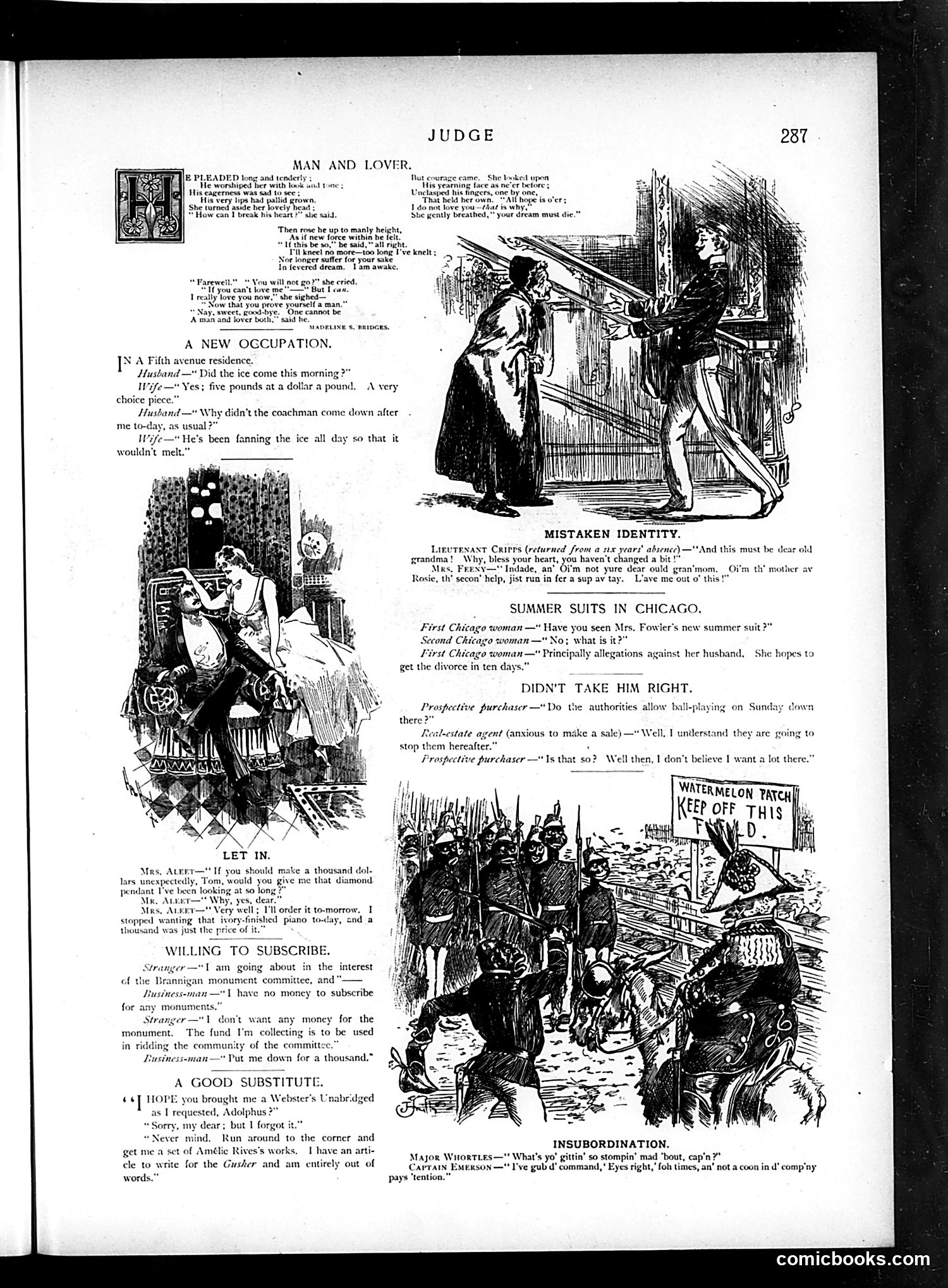
This page contains several satirical sketches typical of late-19th-century American humor: **"A New Occupation"** mocks wealthy Fifth Avenue residents' extravagance—a wife employs a servant to fan melting ice all day rather than replace it, treating waste as a status symbol. **"Mistaken Identity"** plays on Irish immigrant dialect humor (common in period satire), where Lieutenant Cripps mistakes an Irish servant woman for his grandmother after six years abroad. **"Summer Suits in Chicago"** makes dark humor about divorce—a woman's fashionable suit is really "principally allegations against her husband." **"Didn't Take Him Right"** satirizes real estate agents' misleading sales tactics about Sunday restrictions. **"Insubordination"** uses racist caricature (unclear exact military context) depicting Black soldiers as insubordinate. The page reflects Judge's typical blend of domestic comedy, immigrant stereotypes, and social commentary targeting both the wealthy and marginalized groups—standard for Gilded Age satirical magazines.
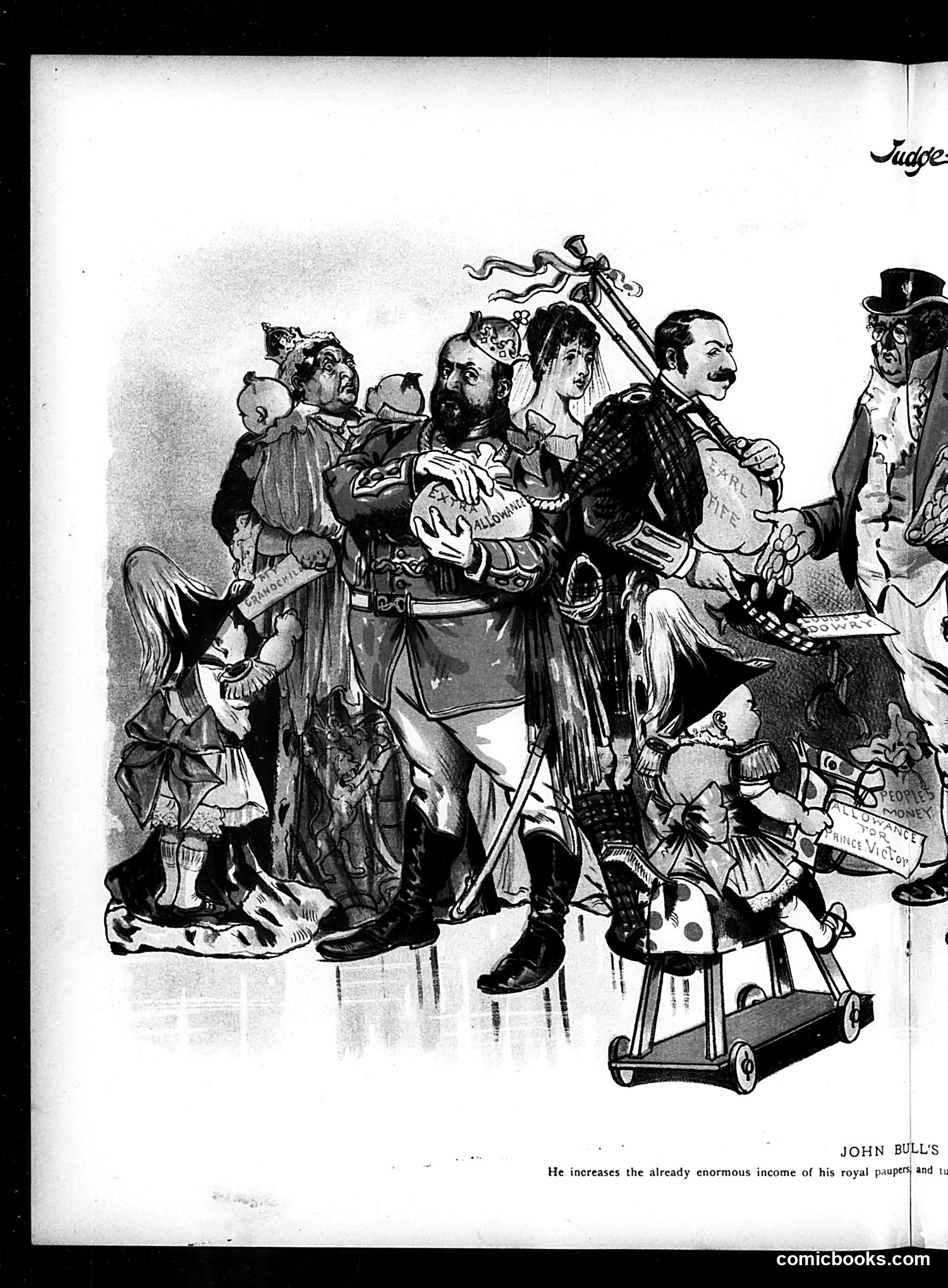
This cartoon satirizes British royal finances under the caption "He increases the already enormous income of his royal paupers and t[o]..." The central figure appears to be a bearded military or royal official (likely representing British authority or royalty), surrounded by characters in various states of dress—some military, some civilian. Small winged cherubs or putti at the bottom suggest divine blessing or favor. The satire criticizes how the British crown increases payments or stipends to royal dependents and hangers-on despite these recipients already receiving substantial income. "John Bull" is the traditional personification of Britain itself, suggesting the critique targets British royal spending practices. The cartoon likely responded to specific 19th-century debates over royal allowances or civil list expenditures—common subjects of American satirical magazines' criticism of British institutions.
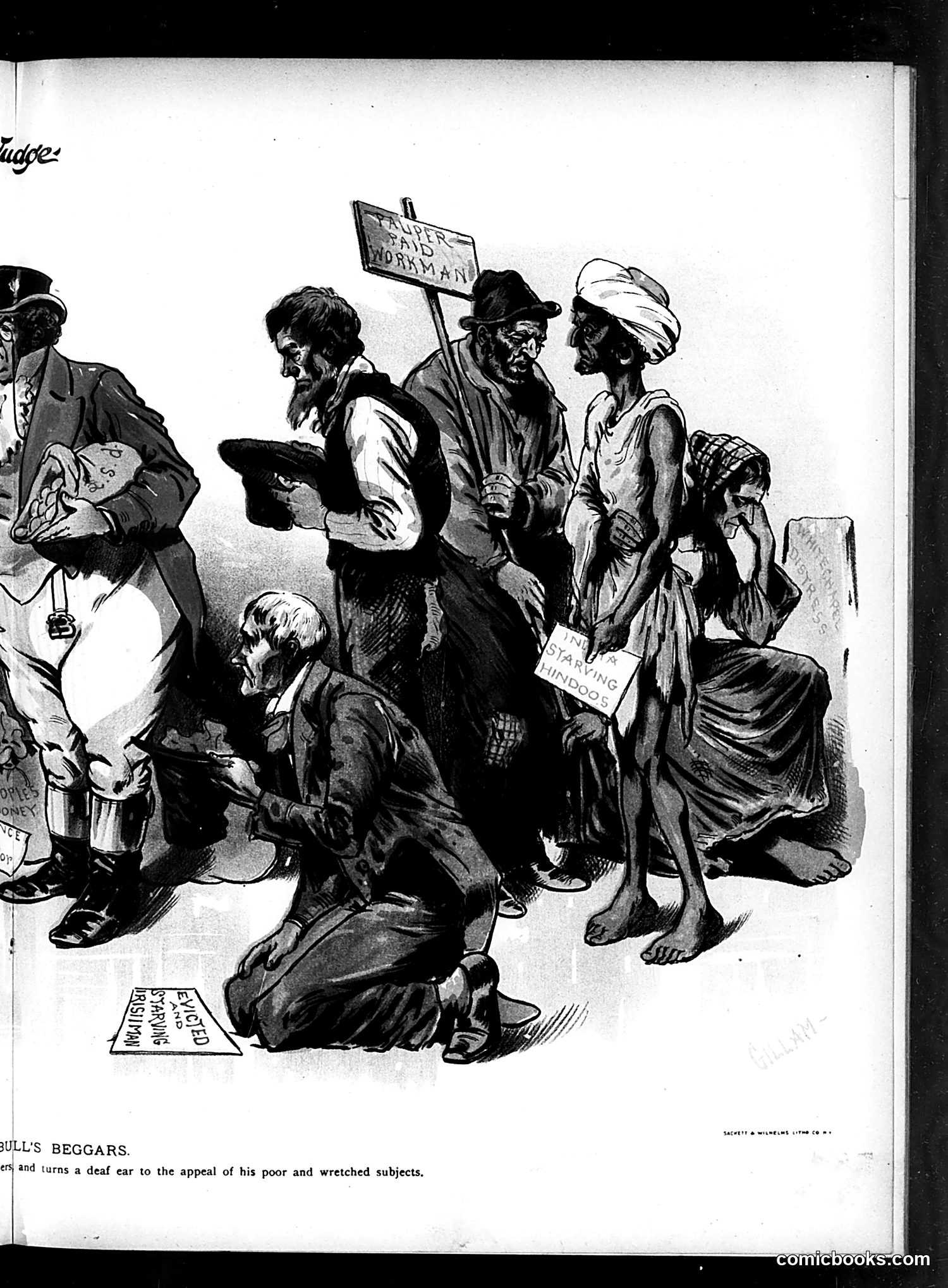
This political cartoon satirizes a ruler (represented by "Bull"—likely Britain, depicted as indifferent) who ignores the pleas of impoverished subjects. The image shows multiple destitute figures with signs—including visible text like "SUPER WORKMAN" and what appears to be poverty-related placards—approaching or surrounding a central authority figure who remains unmoved. The satire critiques governmental neglect of the poor and working classes, suggesting that leadership callously disregards their suffering despite their direct appeals. The various signs held by beggars indicate different circumstances of hardship. This reflects turn-of-the-20th-century concerns about labor conditions, poverty, and social welfare—common targets of *Judge* magazine's political commentary on inequality and governmental responsibility.
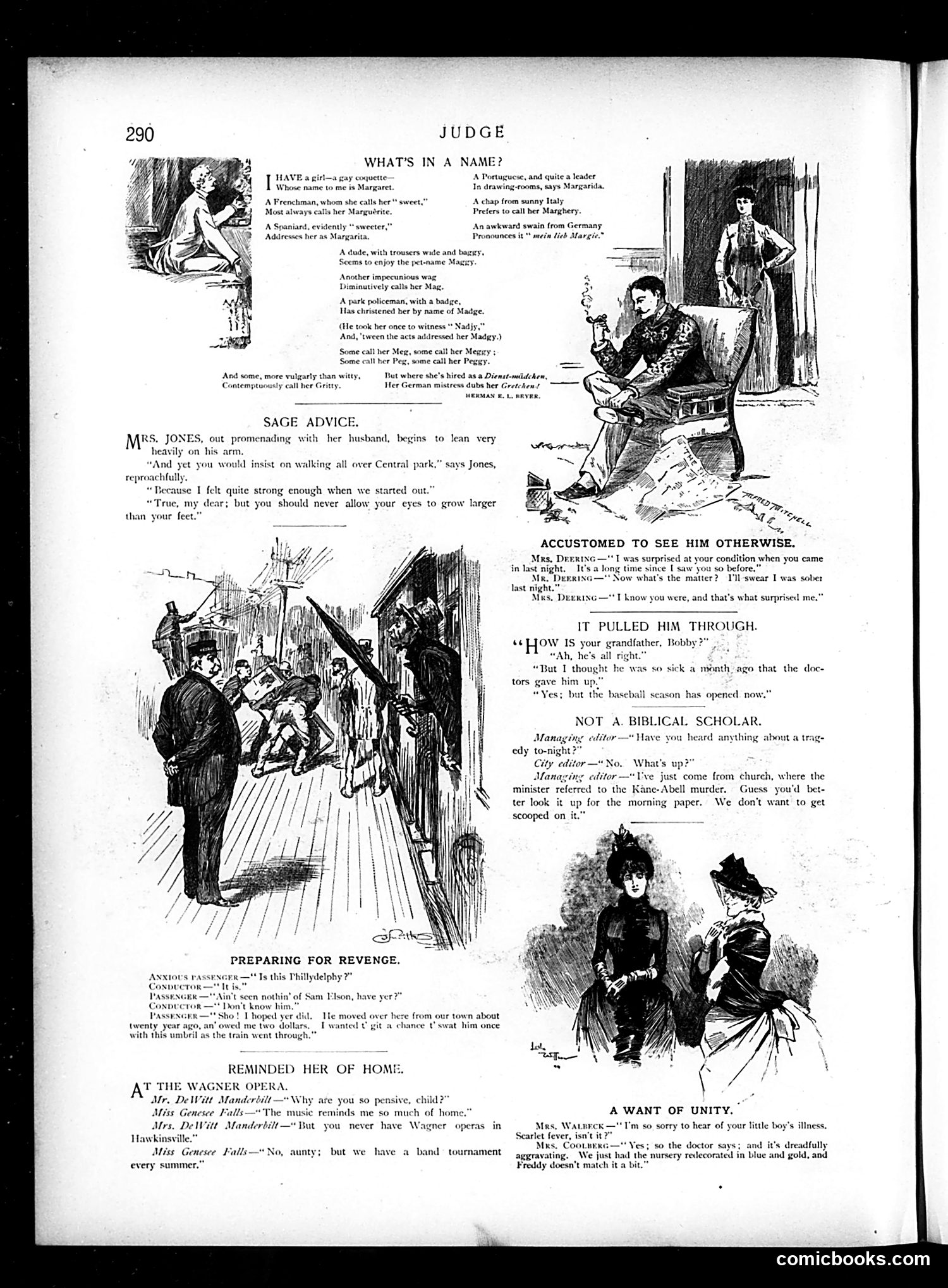
This page contains multiple short satirical pieces typical of Judge's humor: **"What's in a Name?"** mocks how different nationalities and social types give the same woman (Margaret) different pet names reflecting their cultural stereotypes—the German pronounces it "Margie," the Italian calls her "Marghery," the poor man calls her "Mag," the park policeman "Madge," etc. The joke is on ethnic and class-based naming conventions. **"Sage Advice"** jokes about marriage: a wife exhausts herself on a walk; her husband quips she shouldn't let her ambitions exceed her physical capacity—gentle marital ribbing. **"Accustomed to See Him Otherwise"** plays on a wife being shocked her drunk husband came home *sober*—she's so used to his inebriation that sobriety surprises her. **"Not a Biblical Scholar"** satirizes a newspaper editor who doesn't recognize a reference to the "Kane-Abel murder" (biblical Cain and Abel), treating it as a current event needing research. The humor relies on stereotypes, domestic situations, and wordplay typical of early-20th-century American satire.
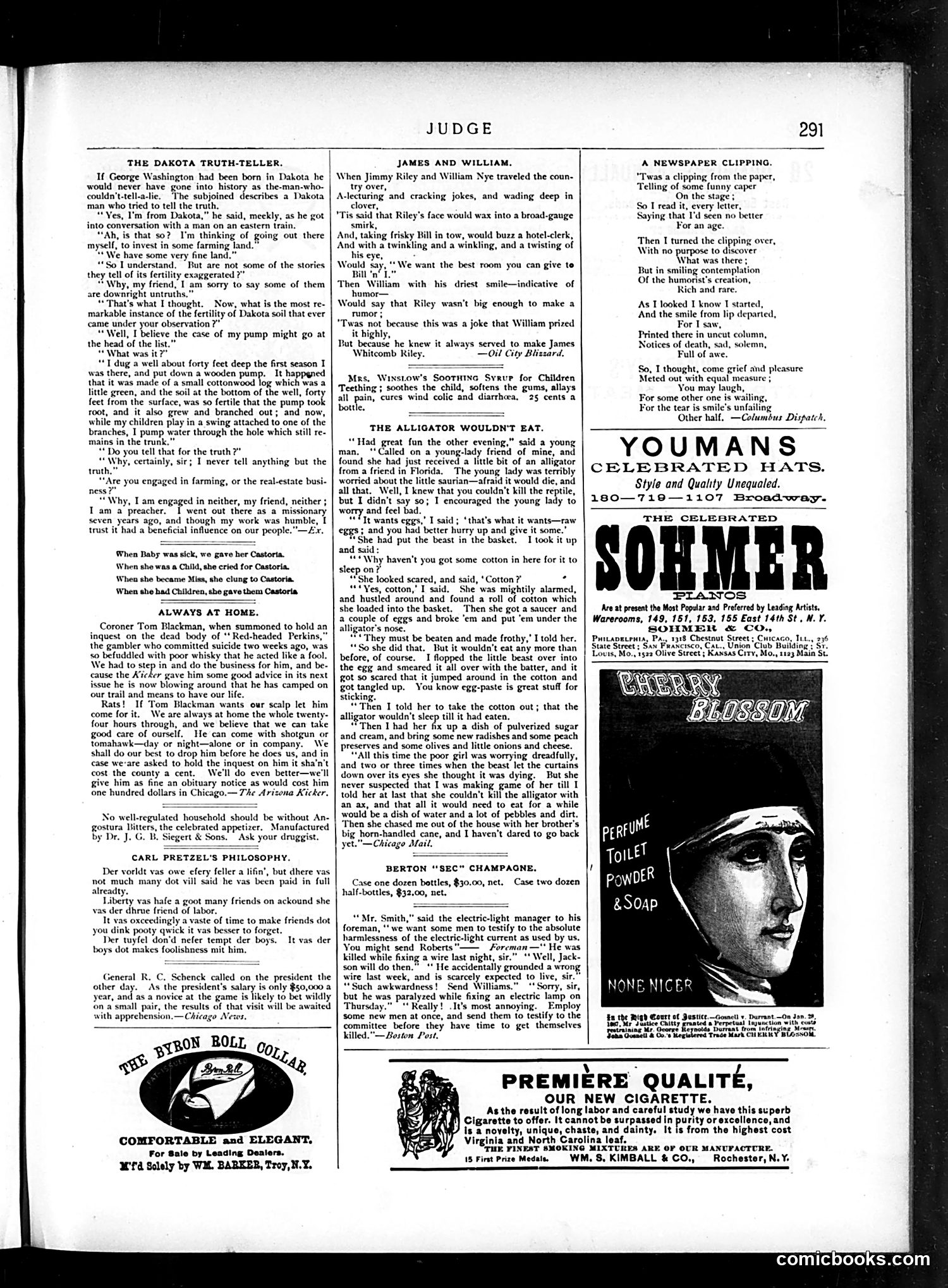
This page contains **primarily humor columns and advertisements**, not political cartoons requiring historical context. The main satirical content includes: **"The Dakota Truth-Teller"** — A tall-tale joke about a Dakota missionary who claims absolute honesty while describing an absurdly exaggerated story (a wooden pump that took root and grew). The satire mocks frontier boosterism and the contradiction between claiming truthfulness while telling obvious lies about Dakota's fertility — a common frontier promotional tactic. **"Always at Home"** — A brief western-newspaper parody where an Arizona editor brags he's always available to fight a rival editor threatening his life. It satirizes the violent, feuding nature of frontier newspaper journalism. **"Carl Pretzel's Philosophy"** — Ethnic humor using a German-dialect character offering folk wisdom in broken English — a standard entertainment format of the era that modern readers would recognize as dated stereotyping. The advertisements (Castoria, Sohmer Pianos, None-Nicer Perfume) occupy significant space, typical of Judge's revenue model.
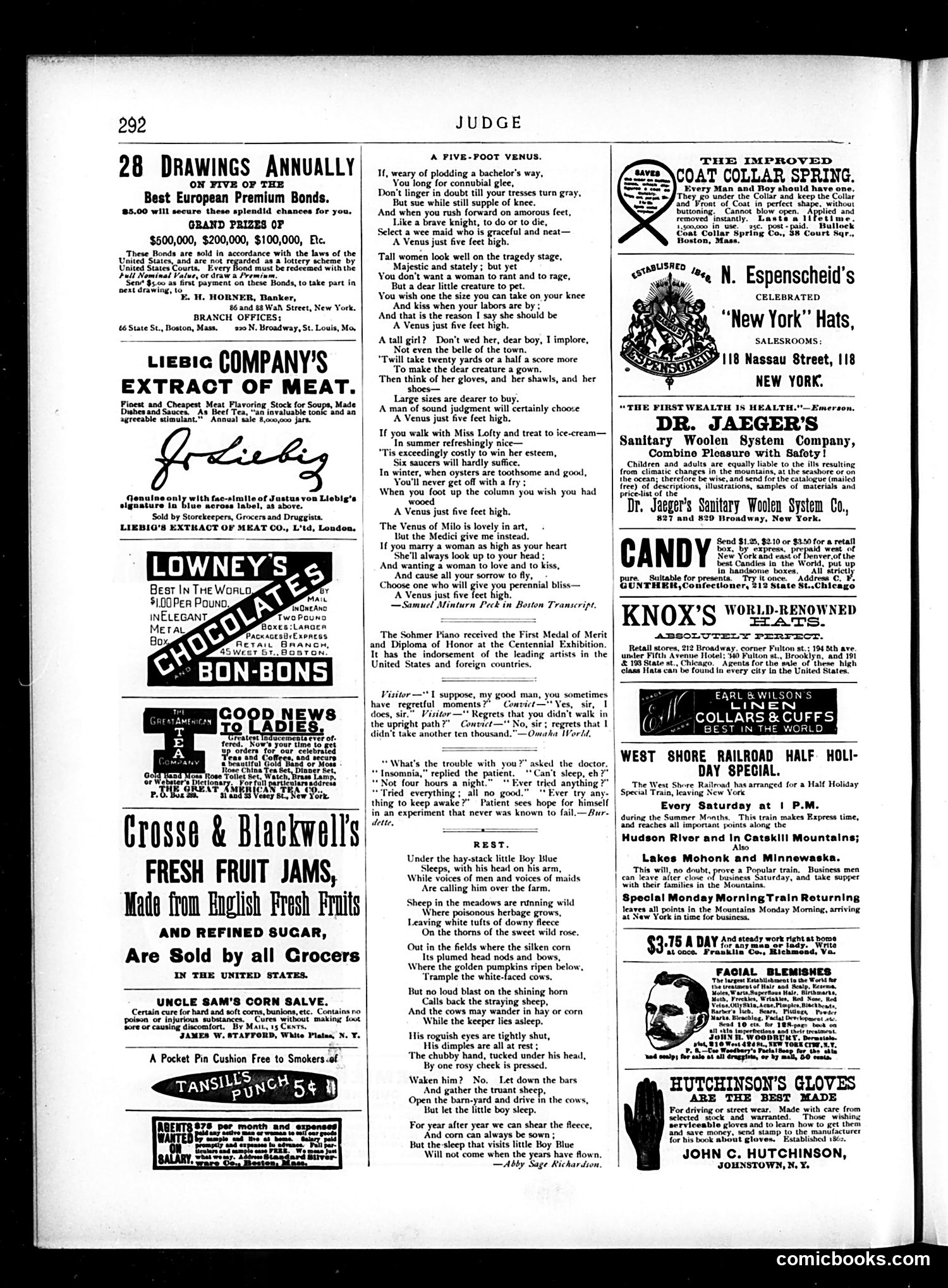
This page is primarily **advertising with one substantial poem** rather than political cartoons. The featured content is "A Five-Foot Venus," a humorous verse satirizing marriage and courtship conventions. The poem advocates marrying short women (five feet tall) over tall ones, using economic arguments: tall women require more fabric for clothing, larger shoe sizes cost more, and treating a tall woman to dinners and ice cream expenses a suitor heavily. The satire mocks materialistic marriage calculations while poking fun at both men's practical concerns and women's fashion costs. The poem's repeated refrain—"A Venus just five feet high"—ironically invokes classical beauty (the Venus de Milo) while reducing marriage selection to practical budgeting. It reflects Victorian-era attitudes about gender, domesticity, and courtship, presenting the appeal of smaller, more "manageable" wives. The remainder of the page contains period product advertisements (meat extract, jams, corn salves, pianos) typical of *Judge* magazine's revenue model.
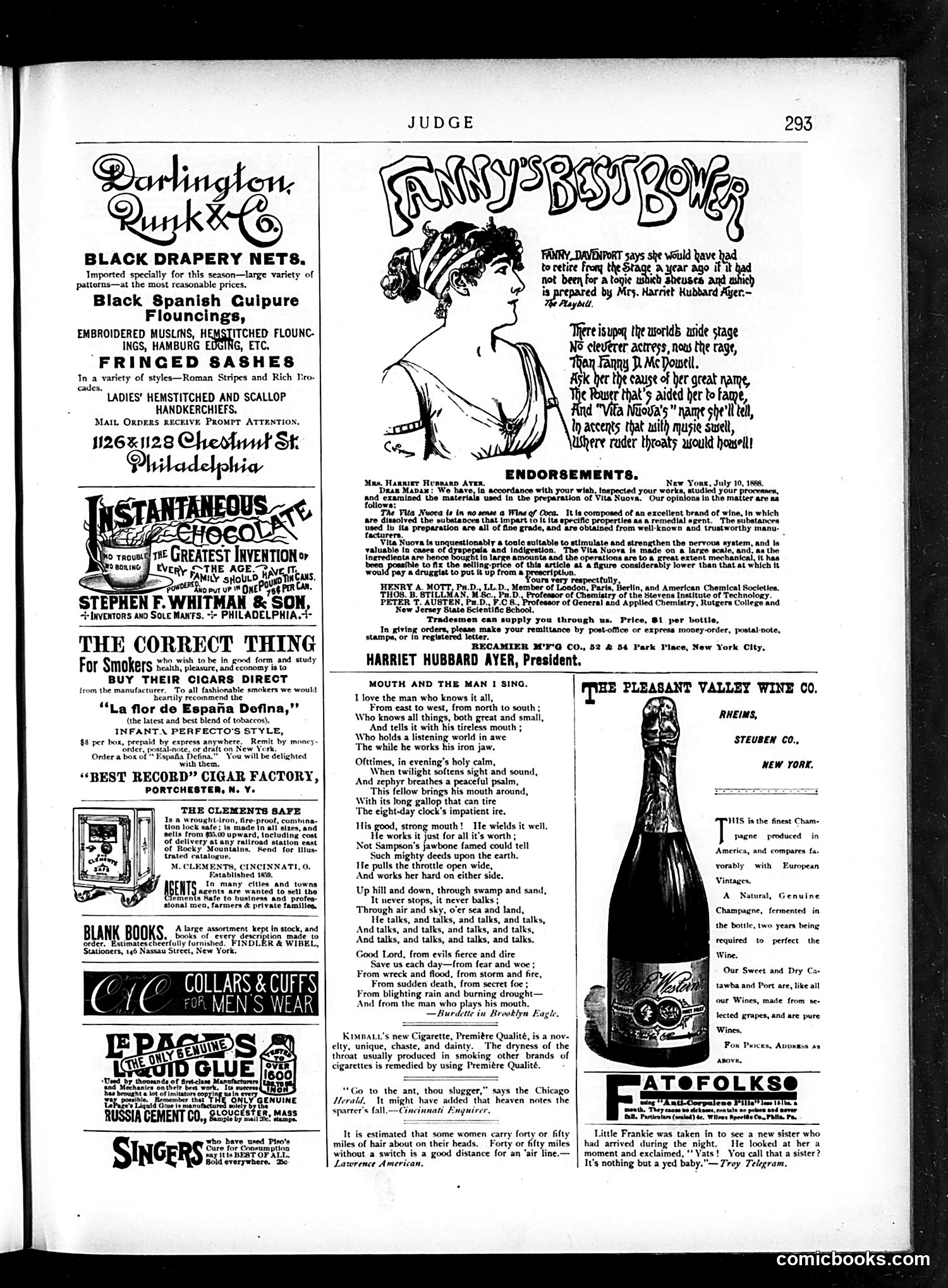
This page is primarily **advertising content** rather than political cartoons. The main non-ad item is a portrait illustration labeled "FANCY DAVENPORT" with an accompanying poem and endorsements for "Vita Nuova," a patent medicine/wine tonic. The "joke" appears to be promotional: actress Fanny Davenport is shown endorsing Vita Nuova, with scientific testimonials from chemists and doctors claiming it's a legitimate health tonic. A subheading notes she would have retired a year ago without this restorative product. This is typical late-19th-century **patent medicine advertising** that used celebrity endorsements and pseudo-scientific credentials to market tonics. The satire (if any) is implicit—Judge magazine was likely mocking such obvious commercial hype disguised as health science, a common target of satirical publications during this era of unregulated medical claims. The remainder of the page contains standard period advertisements for tobacco, safes, office supplies, and men's clothing.
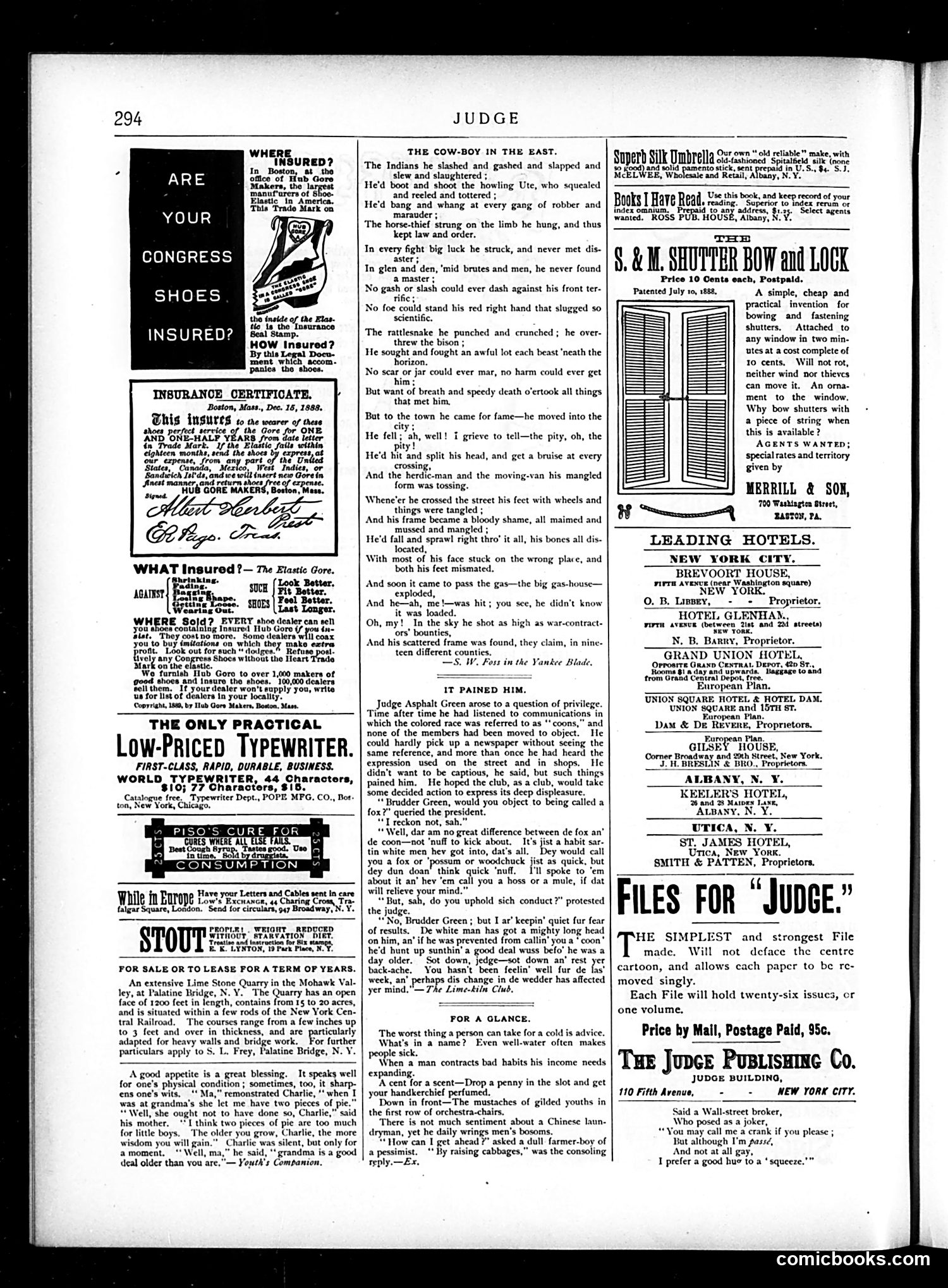
This page is primarily **advertising** interspersed with light humor and verse. The dominant ad promotes **Congress Shoes** with "Gore" elastic inserts, offering an insurance certificate guaranteeing durability for 18 months—a novel sales pitch treating shoe quality like product liability. The poem "The Cow-Boy in the East" satirizes the contrast between **Western frontier mythology and urban reality**. It describes an invincible cowboy who conquers Indians, outlaws, and wild animals through superhuman violence and skill—but then arrives in the city where he apparently fails ("He fell..."). The joke targets American fascination with exaggerated Wild West legends, suggesting such rough-and-tumble prowess becomes irrelevant or comical in civilized society. Other ads include typewriters, medical remedies, and real estate—typical late-19th-century classified content. A brief humorous anecdote about a boy's logic regarding his grandmother concludes the page. The overall effect is **light satirical commentary amid commercial messages**, characteristic of Judge's mix of advertising revenue and social humor.
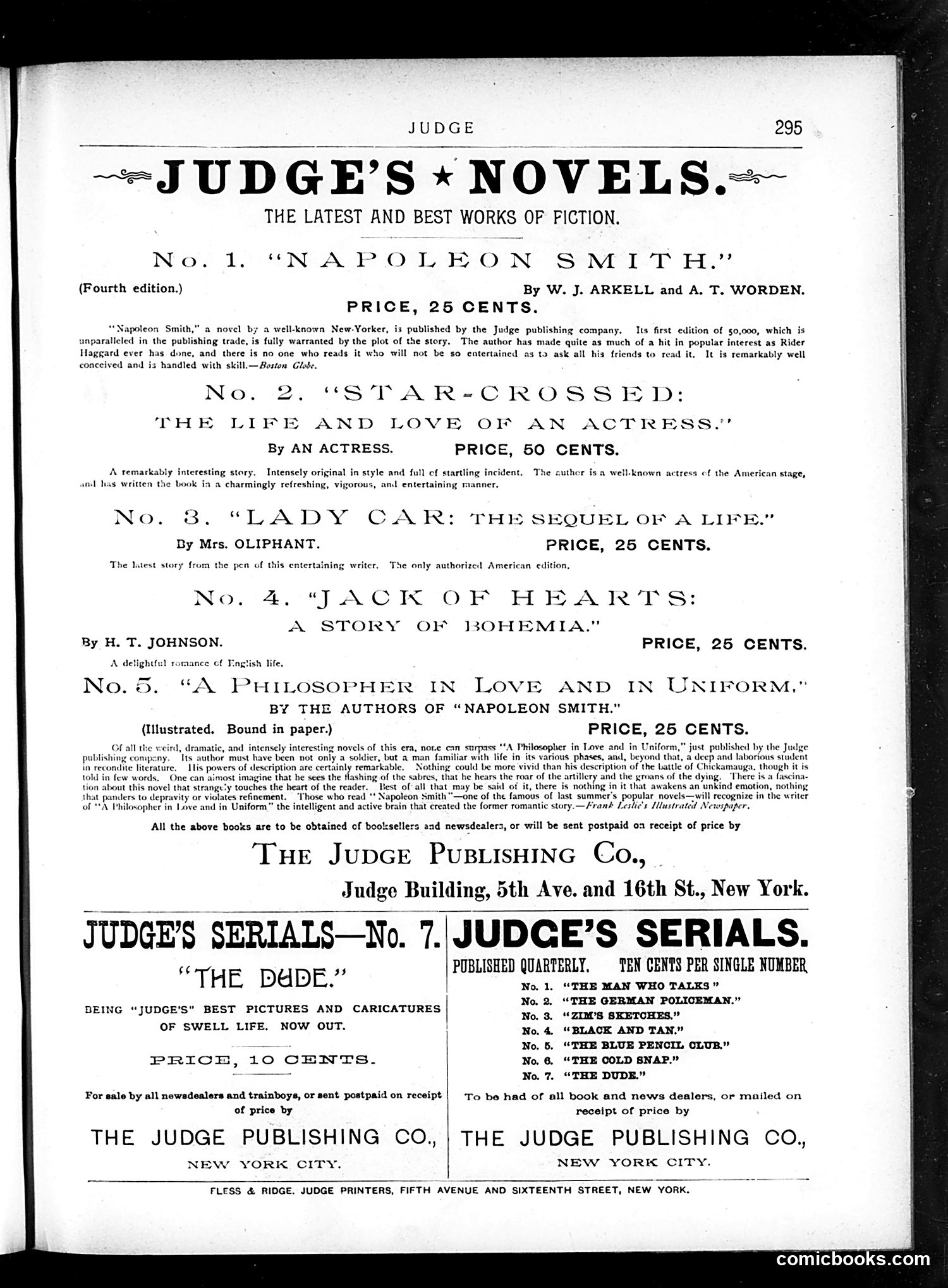
This is primarily a **title/advertising page** rather than a cartoon or satirical content page. It showcases Judge Publishing Company's own literary output—novels and serialized stories marketed to readers. The advertisements emphasize popular fiction of the era: "Napoleon Smith" (a bestseller with 50,000 first edition copies), romantic novels like "Star-Crossed: The Life and Love of an Actress," and adventure stories set in bohemia and English life. Notable is the inclusion of works by established authors like Mrs. Oliphant. The page also promotes "Judge's Serials"—shorter fiction pieces published quarterly at ten cents, including "The Dude," which focuses on satirizing wealthy, fashionable society figures (a recurring Judge target). The overall strategy reveals Judge's business model: leveraging its satirical reputation to sell commercially viable fiction to middle-class readers interested in romance, adventure, and social commentary on contemporary life and manners.
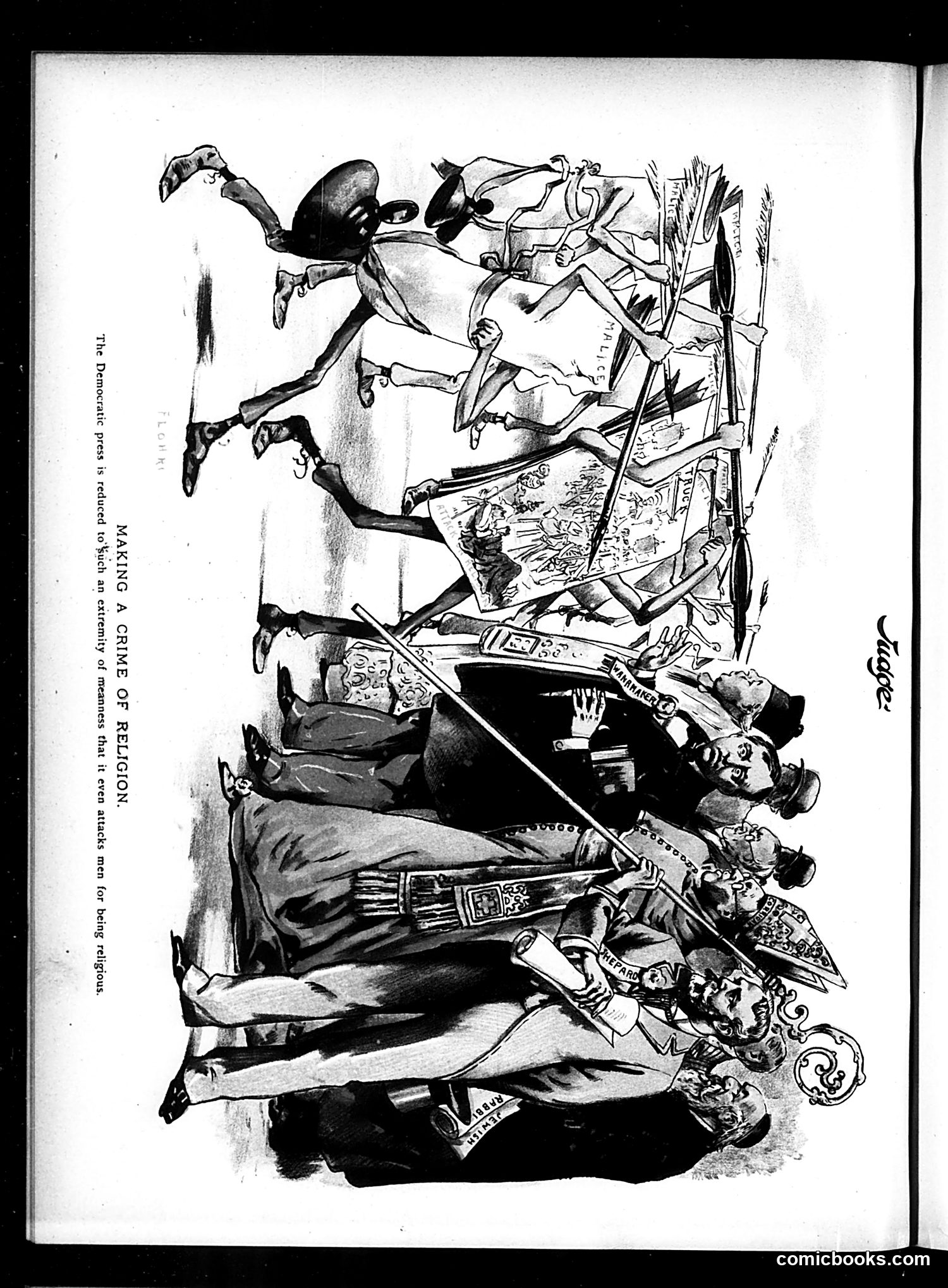
This is a satirical cartoon titled "Making a Crime of Religion" from Judge magazine, criticizing Democratic press attacks on religious figures or politicians. The cartoon depicts what appears to be a chaotic courtroom or public scene where religious and political figures are being prosecuted or persecuted for their faith. The elaborate period dress and ornate decorative elements suggest this references historical religious persecution. The caption argues that Democratic newspapers have become so desperate and malicious that they now attack opponents simply for being religious, rather than on legitimate political grounds. The satire suggests this represents an extreme or absurd form of political opposition—treating religiosity itself as a prosecutable "crime." Without specific dates or figures clearly identified, the exact political controversy remains unclear, but this reflects broader 19th-century American partisan debates about religion's role in public life.