
A complete issue · 16 pages · 1889
Judge — May 18, 1889
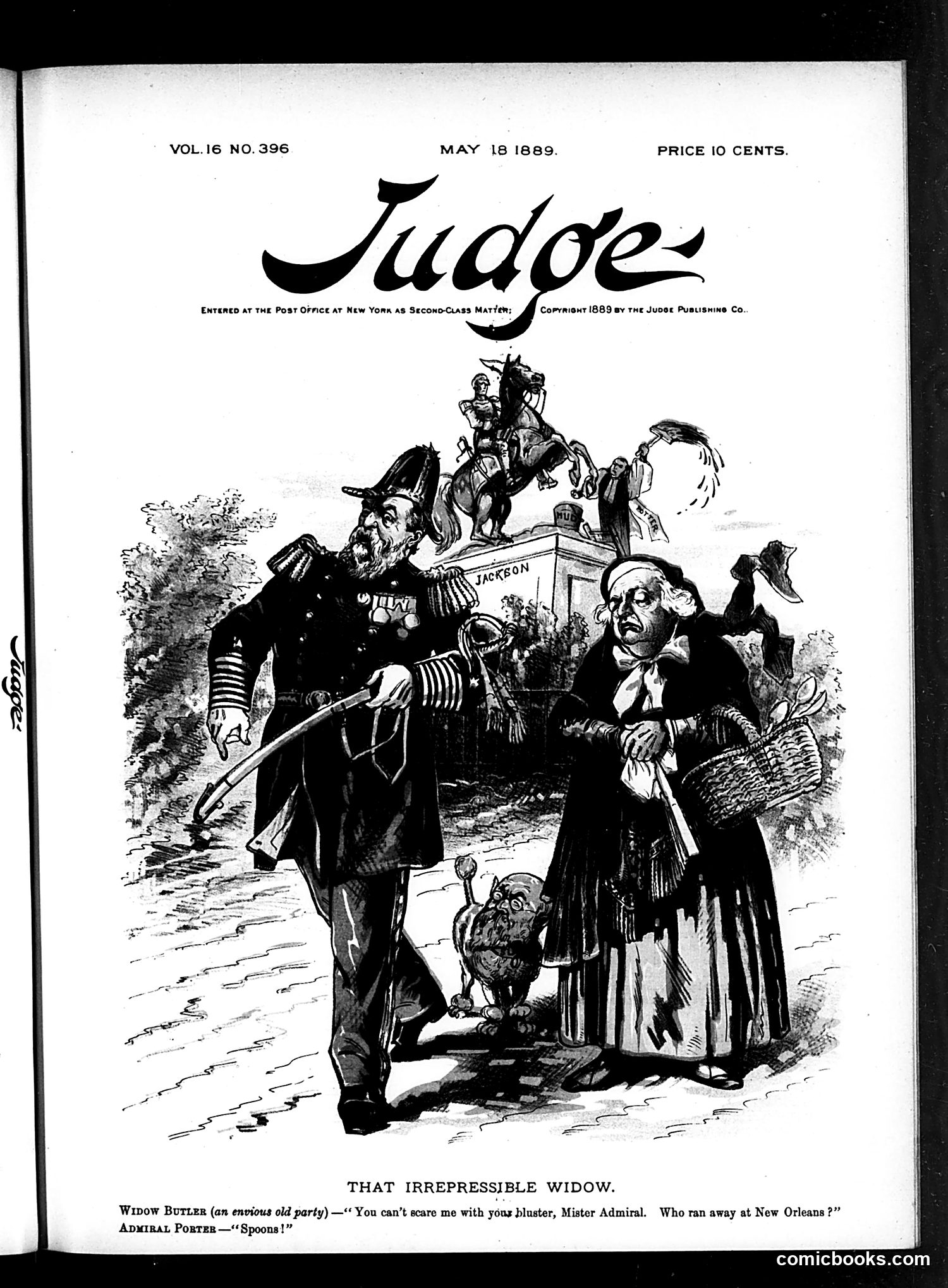
This 1889 *Judge* cartoon satirizes Widow Butler, an "envious old party" whom Admiral Porter accuses of spreading rumors about him at New Orleans. The joke plays on the stereotype of gossiping widows as social nuisances who cannot be intimidated or silenced—hence "irrepressible." The military figure (Admiral Porter) confronts the widow while a statue of Andrew Jackson stands in the background, likely evoking New Orleans' historical significance. The widow carries a basket, suggesting she's a lower-class figure or busybody spreading gossip throughout the community. The satire targets both the widow's presumed meddling and the Admiral's frustration at being unable to control her behavior—a comedic commentary on social class conflicts and the powerlessness of authority figures against determined gossips.
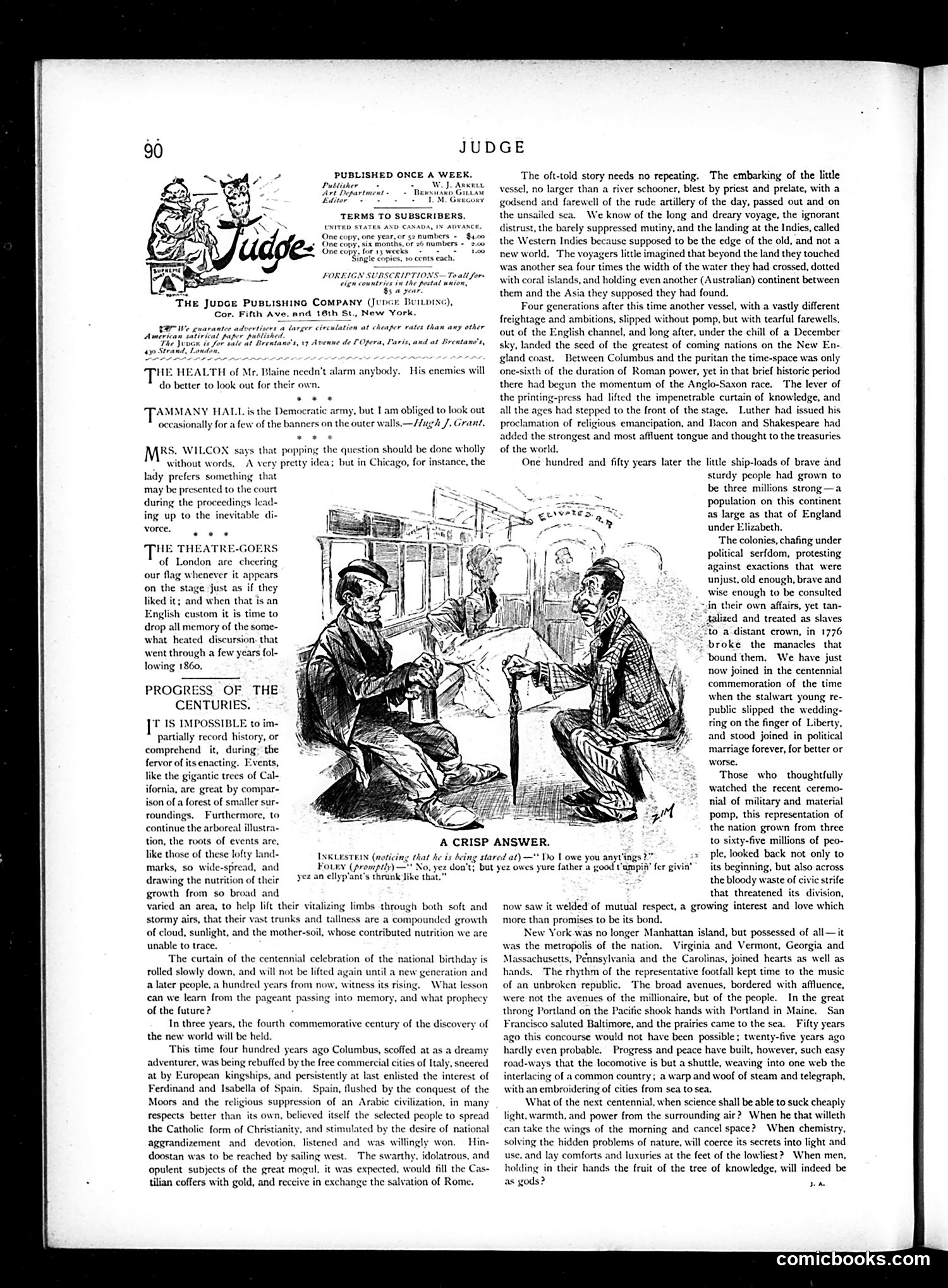
This cartoon depicts two figures in what appears to be a ship's cabin or confined space. The dialogue reads: **Irishman (addressing Port Authority):** "I owe you anything?" **Porter (responding):** "No, yez don't; but yez owes yere father a good 'Cuppin' fer givin' yez a son like that!" The joke plays on Irish immigrant stereotypes common to late 19th-century American satire. The "crisp answer" refers to the porter's witty insult—implying the Irishman is so worthless that his father should have been beaten for producing him. The humor relies on period ethnic caricature and crude insult comedy typical of Judge's satirical approach to immigrant communities.
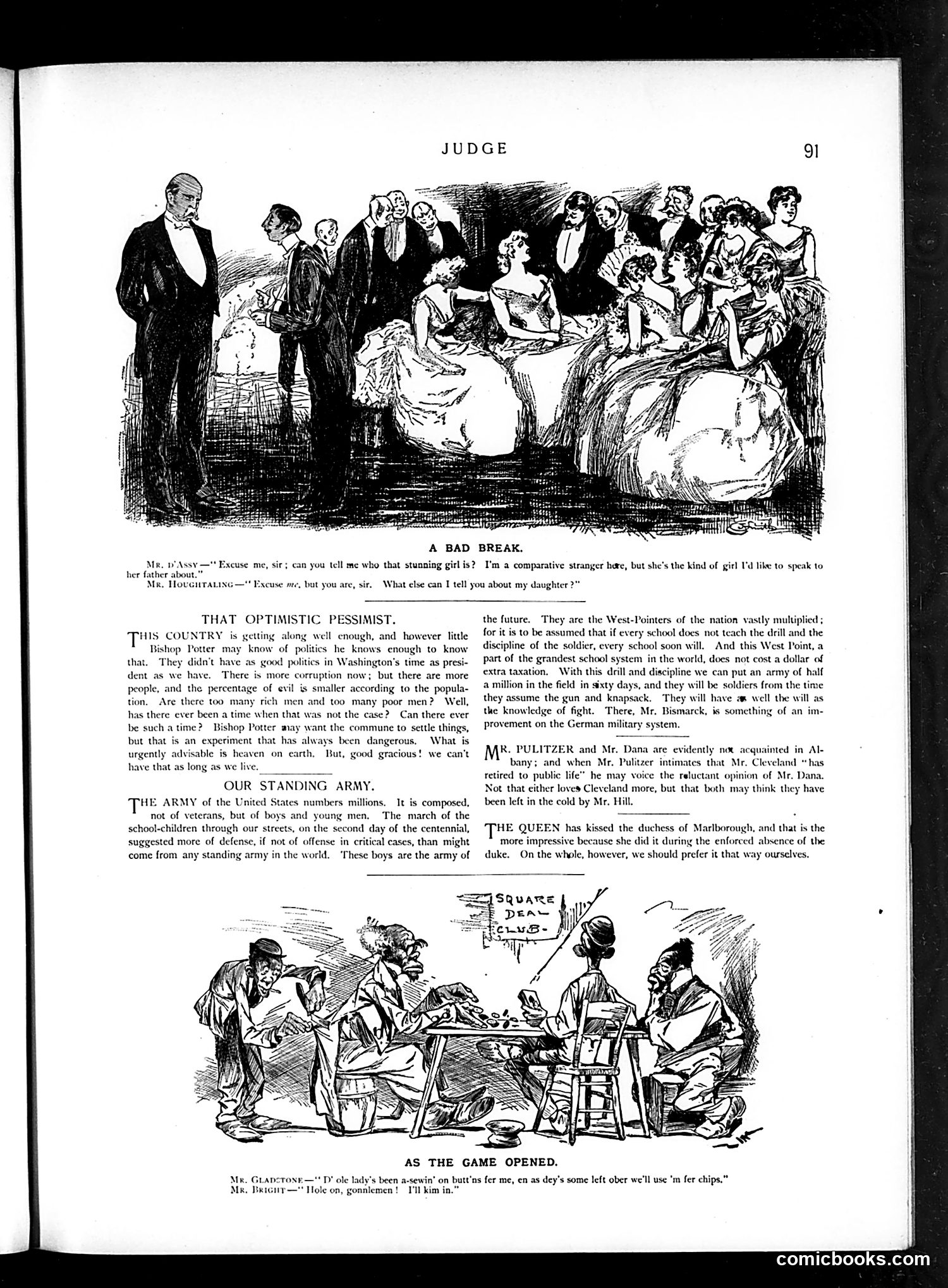
This page from Judge contains three satirical pieces: **"A Bad Break"**: A social comedy about a man complimenting a woman at a party, only to learn she's the host's daughter—an embarrassing faux pas about proper introductions. **"That Optimistic Pessimist"**: Commentary on Bishop Potter's views about American progress. The piece argues that despite corruption, the nation's proportional morality has improved with population growth, and that military readiness through school discipline (referencing the recent centennial celebrations) surpasses standing armies. This reflects 1880s-90s debates about military preparedness. **"Our Standing Army"** and **"As the Game Opened"**: The final cartoon shows poor men playing cards with makeshift chips, depicting working-class leisure. References to Pulitzer, Dana, and Cleveland suggest newspaper rivalry and political maneuvering around New York governor Hill. The overall tone reflects Judge's typical upper-class perspective on social propriety, politics, and labor, with gentle mockery of contemporary figures and debates.
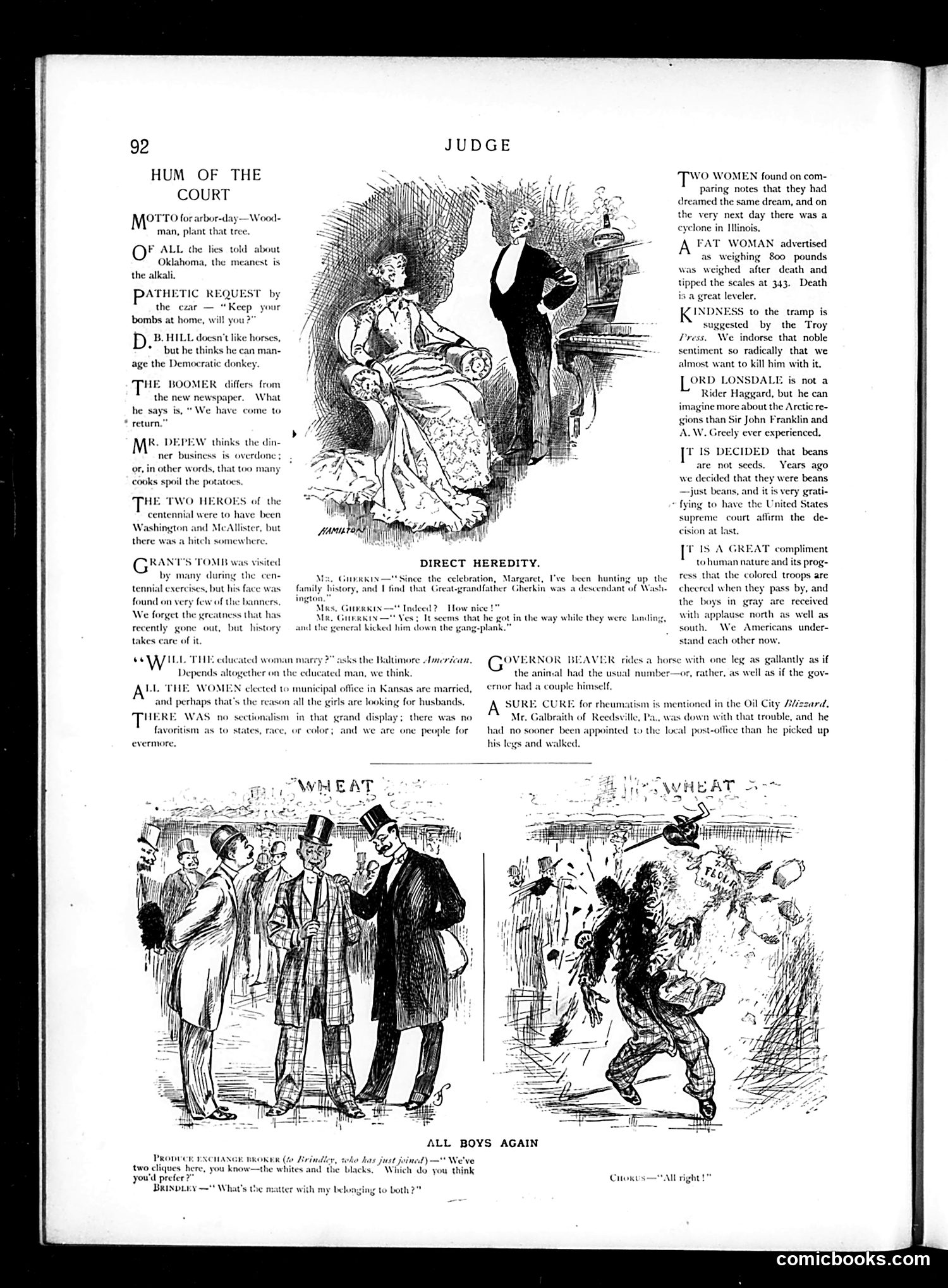
This page collects brief satirical commentary and jokes targeting American politics and society, likely from the 1880s-90s era. **Key references:** - **Oklahoma statehood debate**: Mocking claims about the territory - **Democratic donkey**: Partisan jab at the Democratic Party - **Centennial celebration**: References a major anniversary (possibly 1876 or 1889 World's Fair) - **Grant's Tomb**: Visiting the Civil War general's monument - **Municipal elections for women**: Satirizing women's expanding political participation - **Southern reconciliation**: The final cartoon celebrates "colored troops" and "boys in gray" (Union and Confederate soldiers) being applauded together—commentary on post-Civil War healing **The wheat cartoons** appear to mock commodity speculation and business dealings without clear political figures identified. The page emphasizes Judge's role mocking contemporary politics, women's rights debates, sectional healing, and daily absurdities—typical of Gilded Age satirical magazines.
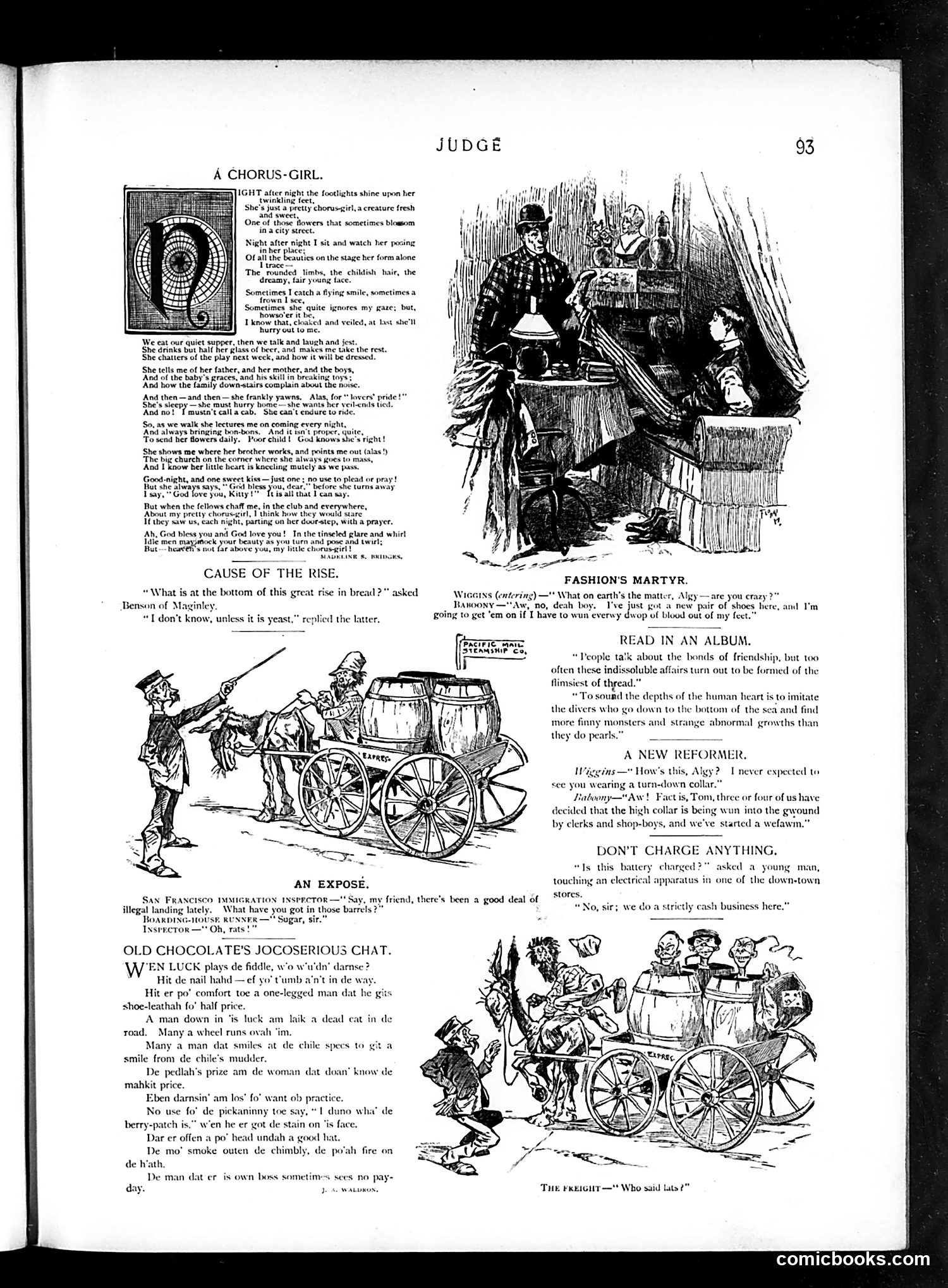
This page contains multiple satirical pieces typical of late 19th/early 20th-century American humor: **"A Chorus-Girl"** is a sentimental poem about a theater dancer—a common cultural figure of the era. The satire lies in the contrast: the narrator romanticizes her as a delicate flower, yet she treats him with casual indifference, demanding bon-bons and flowers while hurrying home exhausted. The joke critiques male sentimentality about working women and the gap between romantic fantasy and reality. **"Cause of the Rise"** jokes about bread prices rising—likely referencing post-WWI inflation concerns. **"Fashion's Martyr"** mocks women suffering in tight corsets for fashion, depicted through exaggerated suffering. **Other brief comedic sketches** include immigration inspector humor, a reformer rejecting high collars as worn by shop-boys, and electrical battery jokes—all reflecting contemporary concerns about immigration, class distinctions, and modern technology. The illustrations are woodcut-style engravings typical of the period's magazine aesthetic.
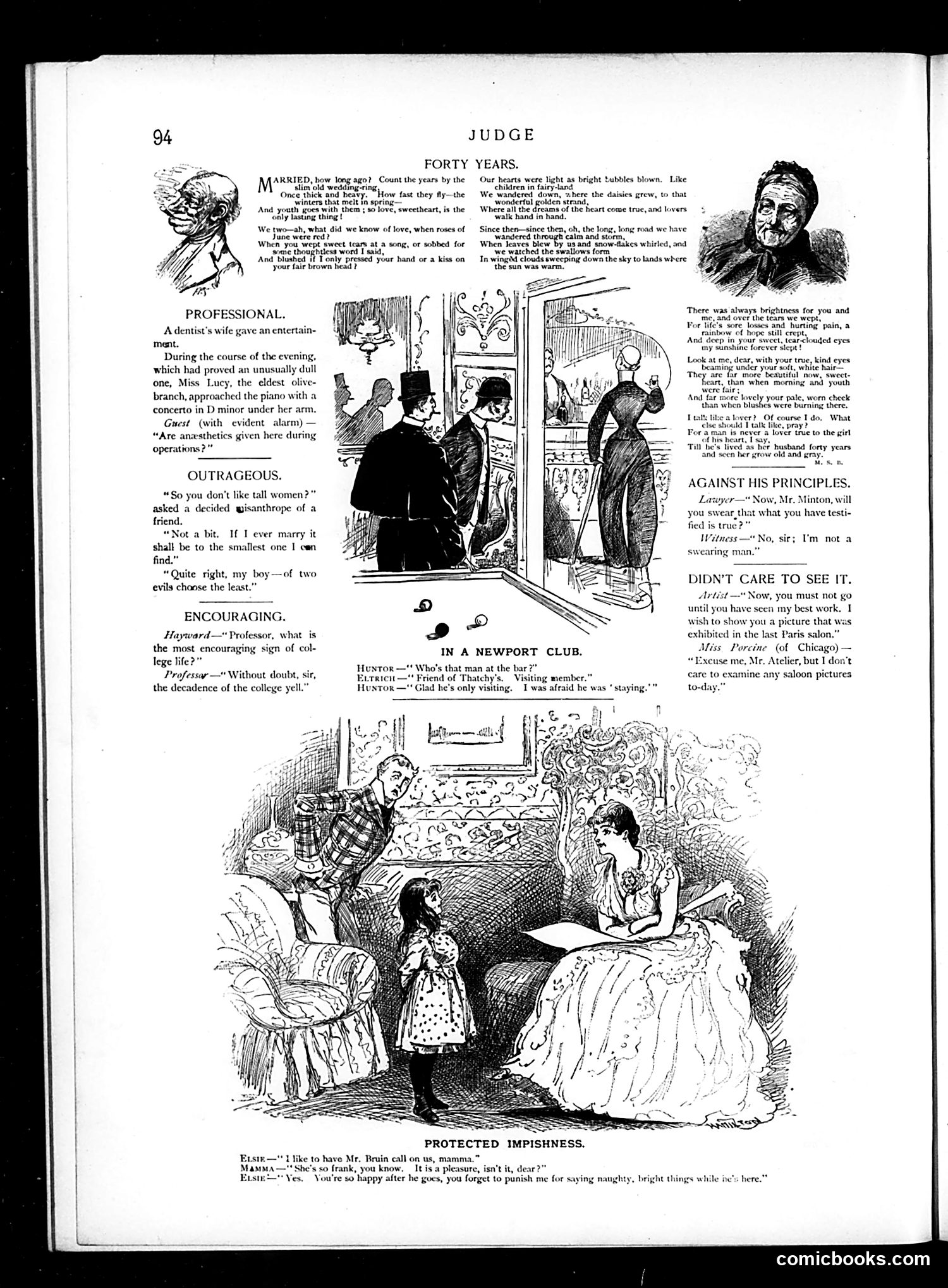
This page from *Judge* contains multiple short satirical pieces typical of the magazine's format: **"Forty Years"** is a sentimental poem about a long marriage, contrasting youthful romance with decades of weathering life's storms together—offering gentle mockery of domestic sentimentality. **"Professional"** jokes about a dentist's wife hosting a dull party where the daughter performs a difficult piano concerto, with a guest sarcastically asking if anesthetics are available—satirizing both tedious social obligations and amateur musical performances. **"In a Newport Club"** contains brief society gossip about visitors to an exclusive Newport social club. **"Against His Principles"** and **"Didn't Care to See It"** are brief conversational gags about hypocrisy and pretension. **"Protected Impishness"** depicts a child manipulating her mother by being charming toward a visitor, then misbehaving once he leaves—satirizing parental inconsistency and childhood cunning. The illustrations support these domestic and social comedy themes. The overall tone targets middle and upper-class manners, pretension, and family dynamics.
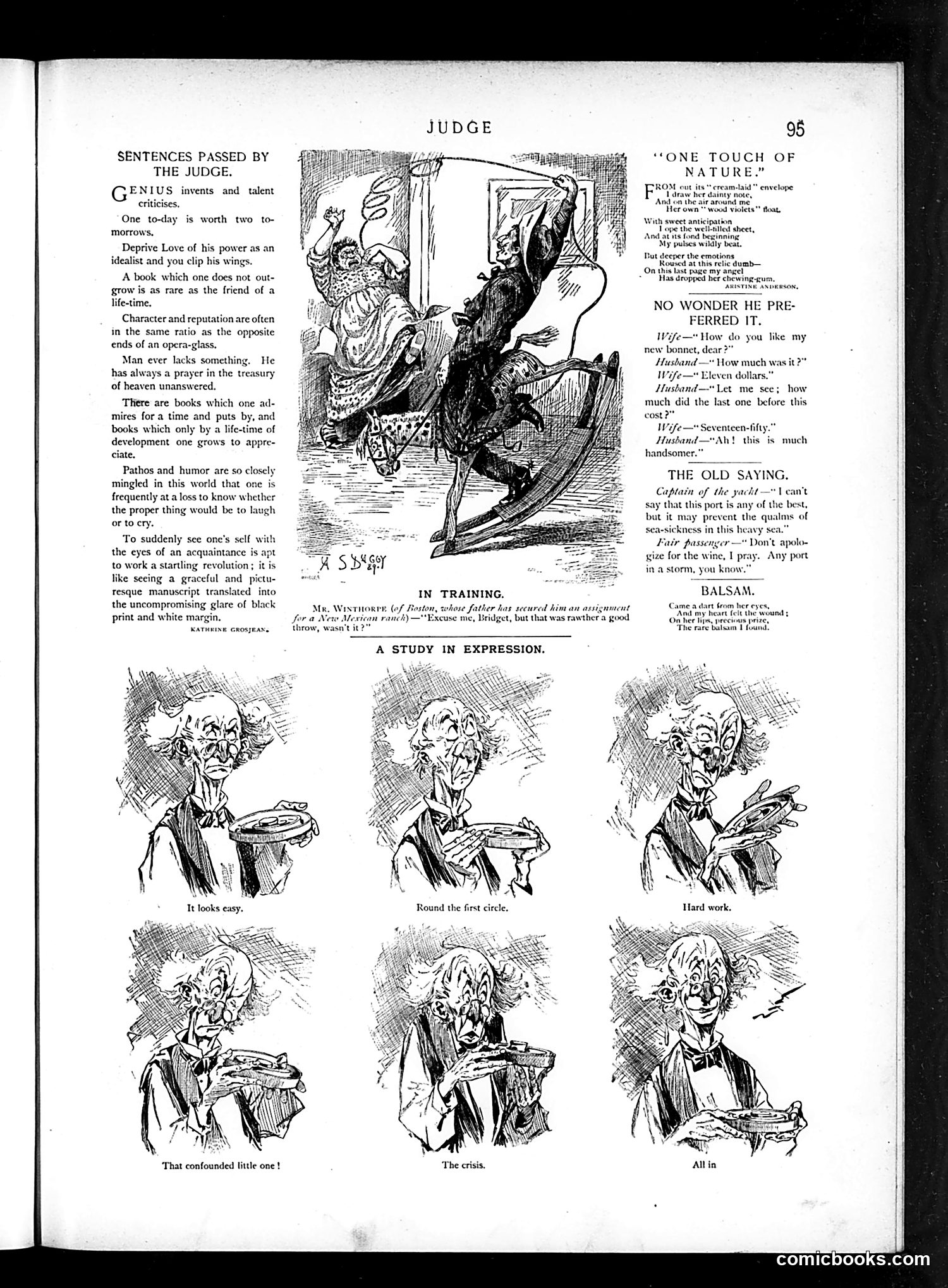
This page contains several satirical pieces typical of Judge's late 19th/early 20th-century humor: **"In Training"** depicts a Mr. Winthorne, apparently a wealthy man whose father secured him a ranch position in Mexico, awkwardly complimenting his servant Bridget on her throwing ability—missing the point that she was angrily hurling a plate at him. The satire mocks both the oblivious privileged class and the incompetence of wealthy sons given unearned positions. **"A Study in Expression"** shows six facial expressions of a man learning to juggle, progressing from "It looks easy" through "The crisis" to "All in," humorously chronicling the gap between confidence and reality. **"No Wonder He Preferred It"** is domestic humor: a wife paid eleven dollars for a new bonnet; the husband notes the previous cost was fifty dollars, so he prefers this one. The joke is that financial prudence (or perhaps the wife's improved appearance at lower cost) makes it preferable. The page emphasizes visual comedy and class-based satire common to Judge's editorial voice.
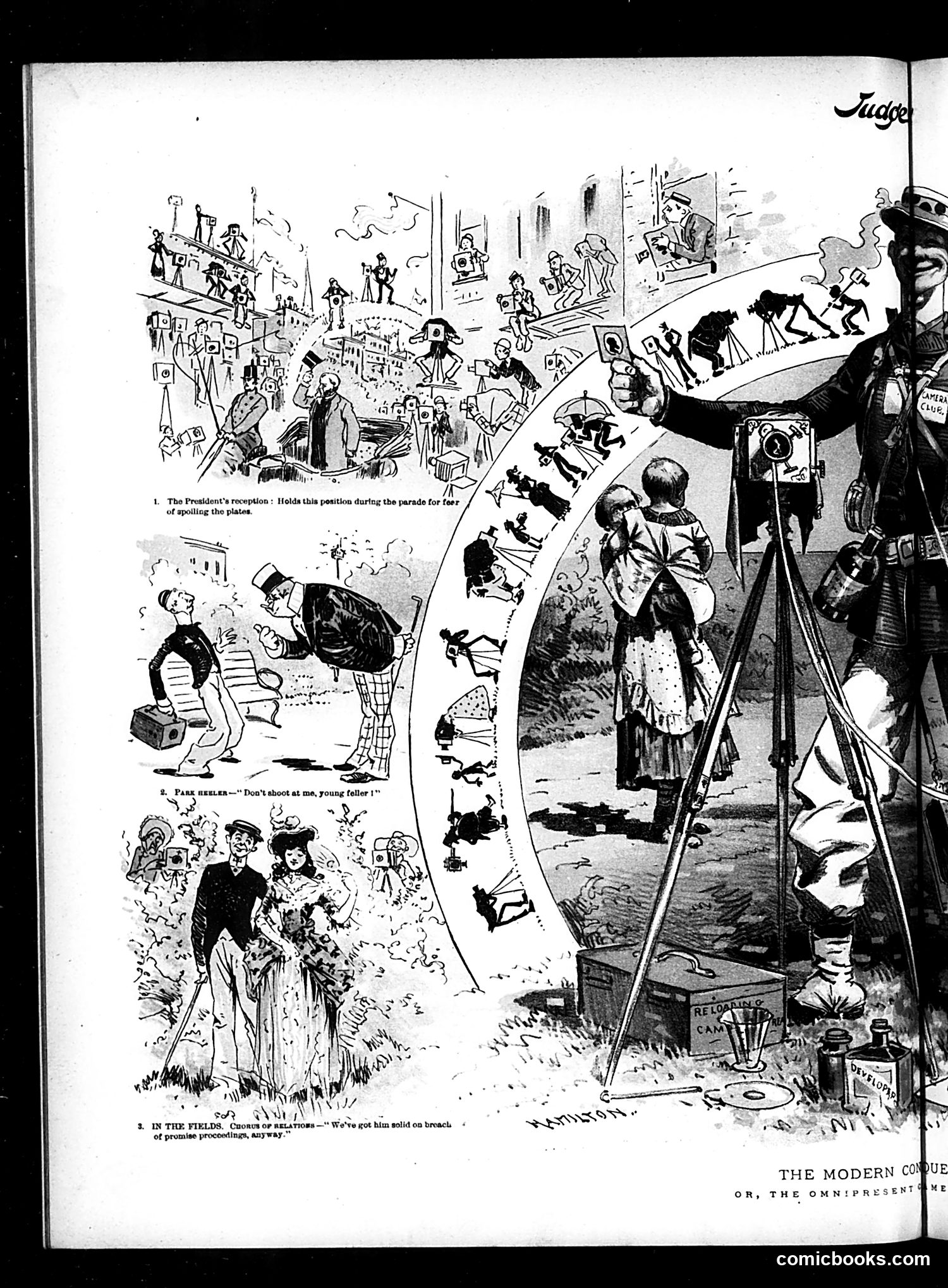
This page satirizes the omnipresence of photography and camera culture in modern life. The title "The Modern Kodak, or The Omnipresent Plate" suggests cameras are inescapable. Panel 1 mocks a President so concerned about being photographed that he awkwardly holds his position during a parade to avoid "spoiling the plates" (photographic negatives). Panel 2 shows a "Park Heckler" warning someone not to shoot (photograph) him. Panel 3 depicts a couple in fields being pursued by photographers documenting their "breach of promise" lawsuit proceedings. The overarching joke: photography and the Kodak camera (newly popular mass-market technology) have become so ubiquitous that they intrude into every aspect of life—from presidential ceremonies to private romantic scandals. The cartoon criticizes both the technology's invasiveness and the public's obsession with capturing and documenting everything.
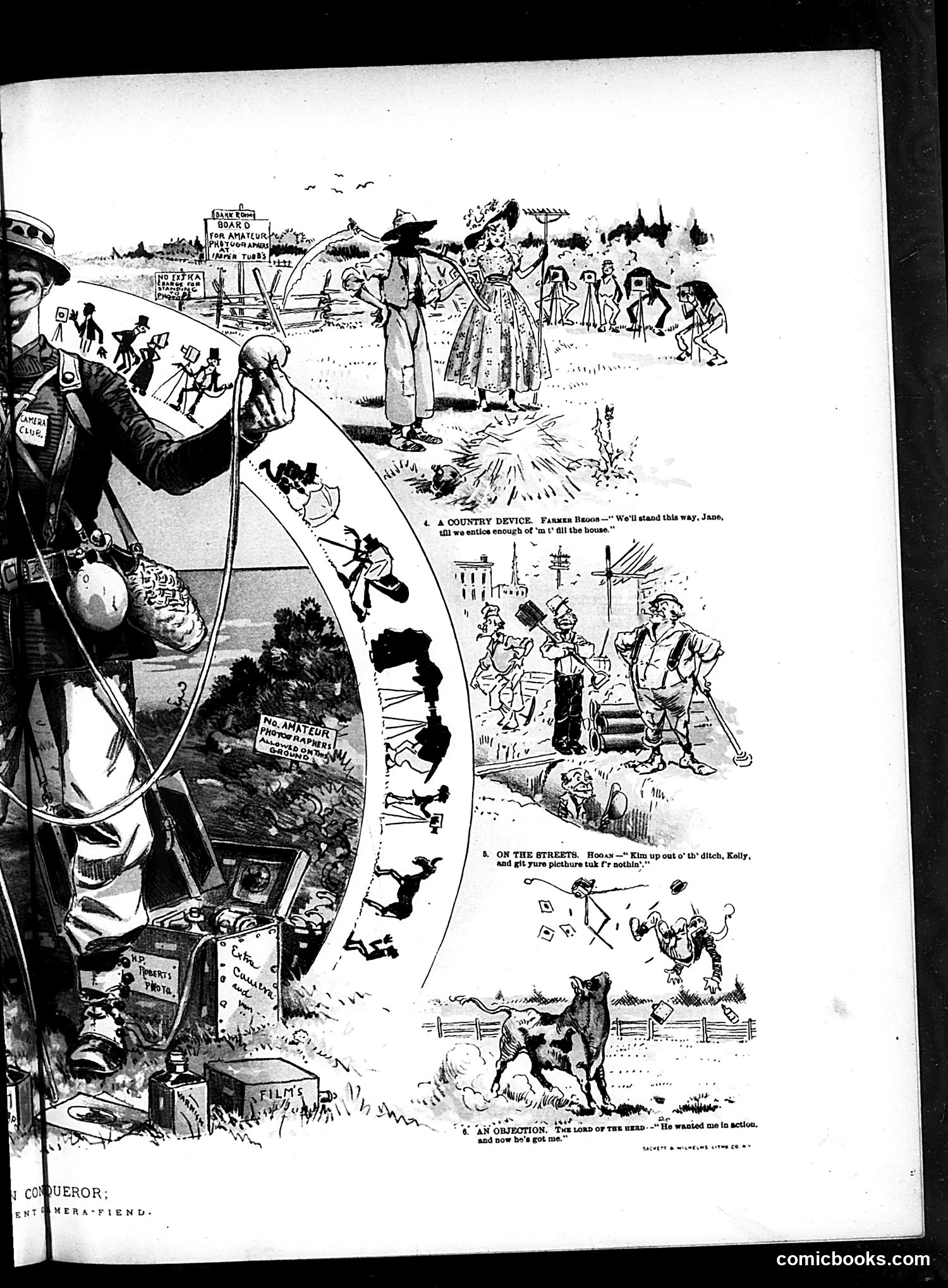
This page contains **three separate satirical vignettes** mocking rural or working-class figures and their schemes: 1. **"A Country Device"**: Two rustic characters (Farmer Beggs and Jane) attempt to lure people into their home using deception—likely satirizing rural con artists or unsophisticated scams. 2. **"On the Streets"**: A character named Hoax propositions people to have their pictures taken for free—a transparent scheme to exploit naive city dwellers, mocking street hustlers and their transparent tricks. 3. **"An Objection"**: Appears to reference someone objecting to a "Lord of the Herd," possibly satirizing rural hierarchy or agricultural pretension. The overall satirical thrust targets **rural or lower-class deception and gullibility**—a common Judge magazine theme mocking unsophisticated Americans. The crude dialect and character names ("Hoax," "Beggs") reinforce class-based stereotypes typical of Gilded Age satire.
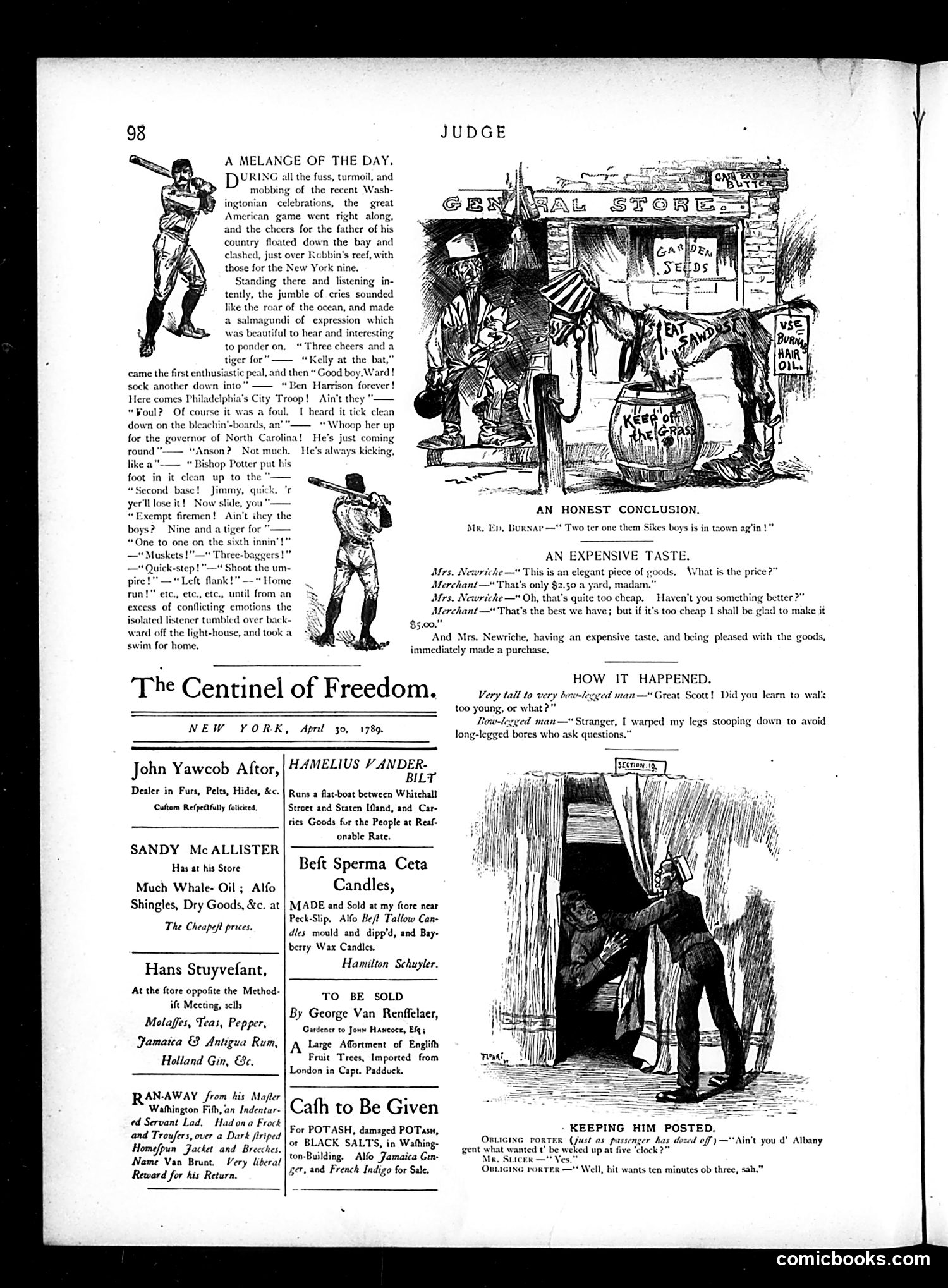
This page contains several satirical pieces and advertisements from early American Judge magazine. **"A Melange of the Day"** satirizes the chaos of competing celebrations in New York—patriotic Washington's birthday festivities clashing with baseball excitement. The humor lies in the jumbled, overlapping cheers for both national heroes and local baseball players (Kelly, Ward, Anson), reducing serious civic pride to comic noise. **"An Honest Conclusion"** and related shorts mock nouveau riche social pretension and physical absurdity through brief comedic exchanges. **"An Expensive Taste"** ridicules Mrs. Newriche (a stock character representing the newly wealthy) whose snobbish assumption that cheap goods must be inferior leads her to pay inflated prices—satirizing vanity-driven consumerism. The remaining content is primarily **period advertisements** for local New York merchants (furs, whale oil, candles, rum, fruit trees) and a runaway servant notice, typical of 1789 newspapers. These serve as historical documents of colonial commerce rather than satire.
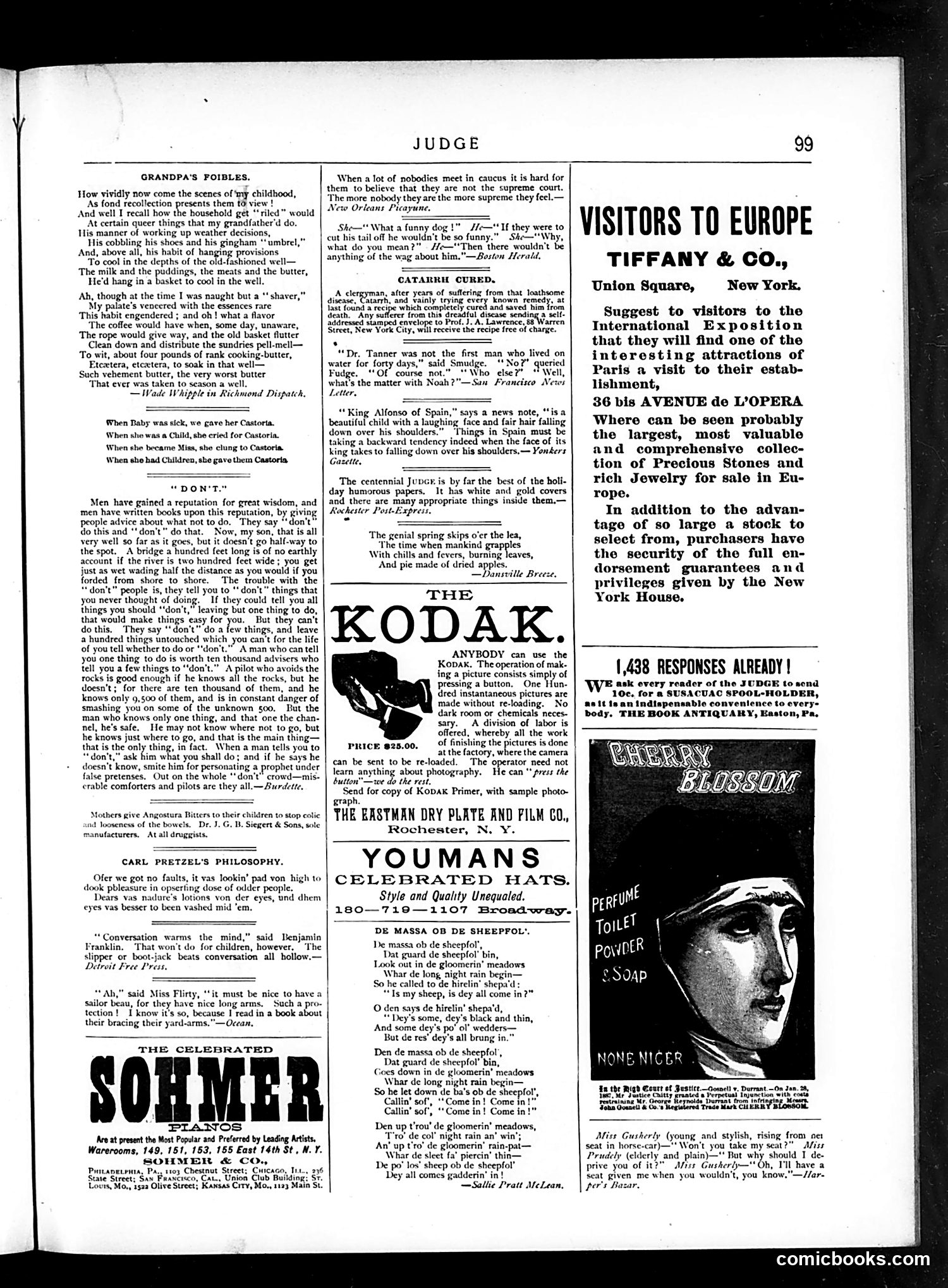
This page is primarily **advertising and filler content** rather than political satire. The main text pieces are humorous columns: "Grandpa's Foibles" recounts a nostalgic anecdote about an elderly relative storing food in a well, mixing butter with water—a lighthearted domestic humor piece. "Don't" is a philosophical essay criticizing advice-givers who tell people what *not* to do rather than what *to* do, using a river-crossing metaphor. "Carl Pretzel's Philosophy" offers dialect humor attributed to a character with a German accent, typical of period comedy. The advertisements dominate: Tiffany & Co. appeals to international exposition visitors, Kodak promotes cameras, Sohmer pianos, and Youmans hats are featured. These reflect the magazine's commercial nature. There are no identifiable political cartoons or caricatures on this page—it's primarily a mix of sentimental/philosophical humor columns and period advertising. The social context is early 20th-century American consumer culture and genteel domesticity.
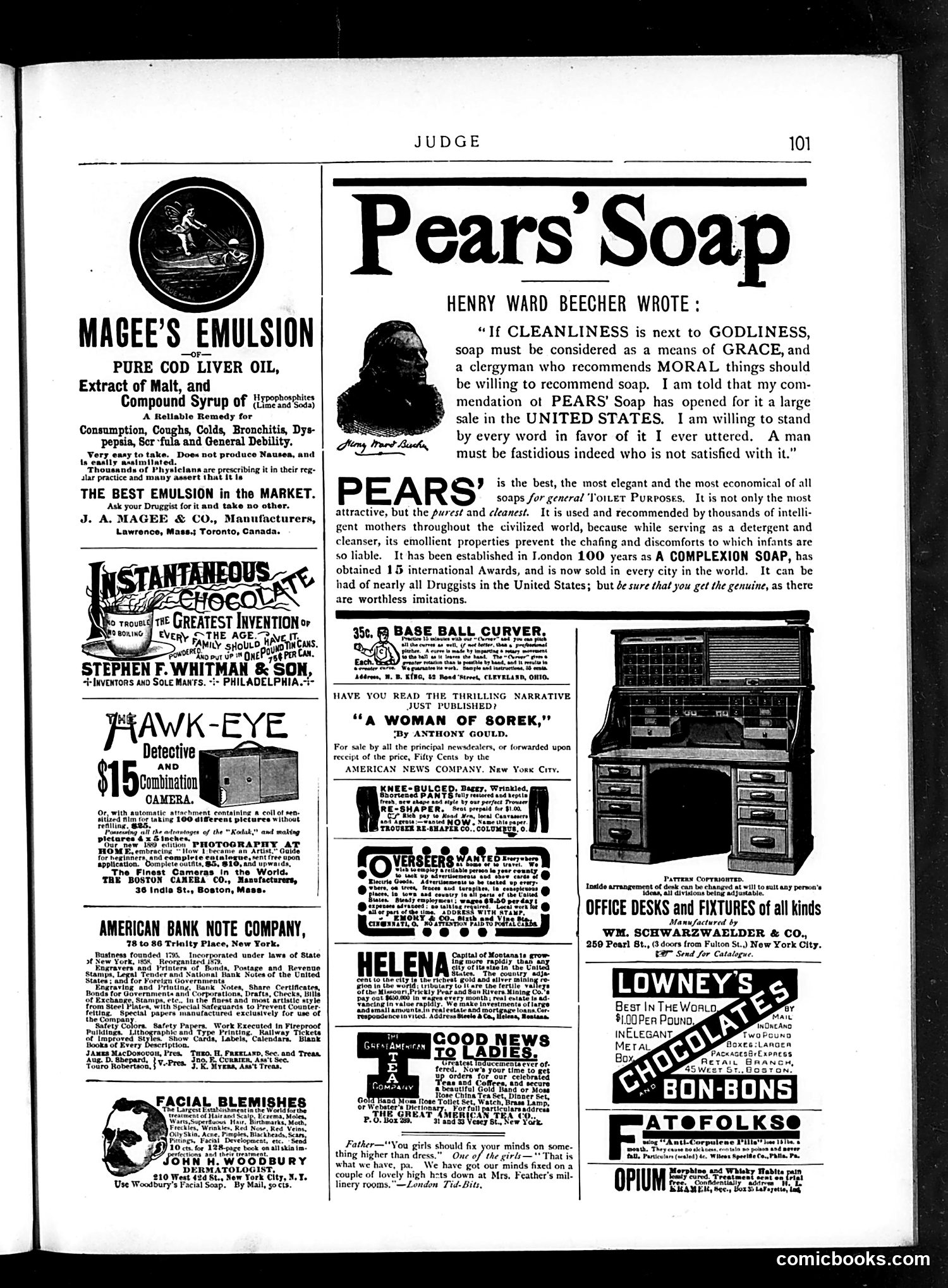
This page is primarily **advertisements** with one small cartoon joke at the bottom. The main content promotes **Pears' Soap**, featuring an endorsement attributed to Henry Ward Beecher (the famous 19th-century clergyman visible in the portrait). The ad connects cleanliness to morality and godliness—a common Victorian marketing strategy. It claims the soap has "15 international Awards" and 100 years of London success. The single cartoon shows a father telling his daughters to focus on "something higher than dress," to which one replies they've set their minds on "lovely high hats" at the milliner's shop. The joke satirizes **Victorian gender expectations**: fathers wanted daughters to cultivate intellectual or moral pursuits, but young women were preoccupied with fashion and appearance—contradicting the era's stated ideals about female education and refinement. Other ads on the page promote cameras, chocolate, bank notes, office furniture, and patent medicines—typical late 19th-century advertising fare.
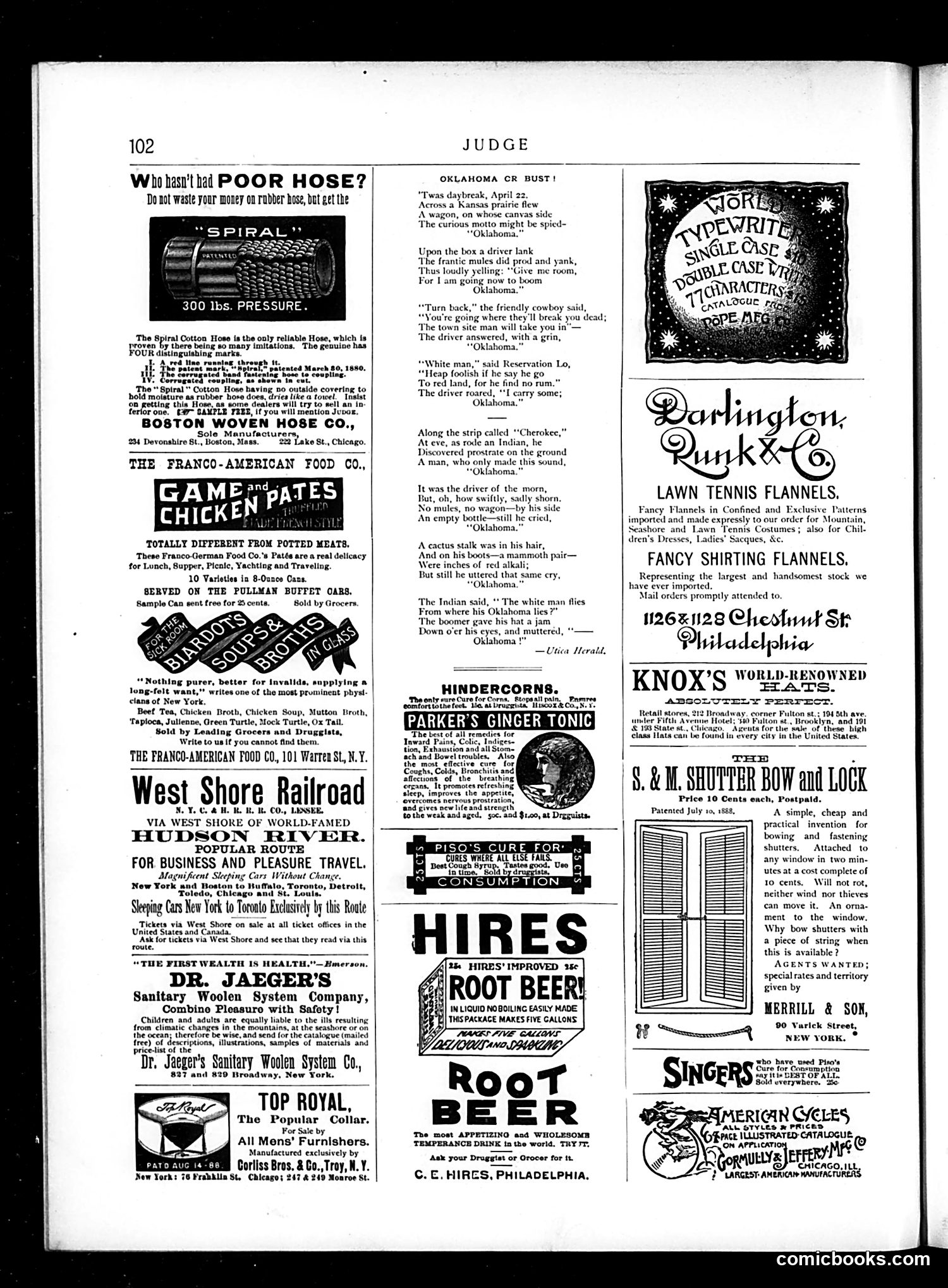
This page features a poem mocking the Oklahoma Land Rush (likely referencing the 1889 opening). The narrative follows an overly optimistic wagon driver heading to "boom Oklahoma," evangelistically shouting the territory's name despite warnings from a cowboy and an Indian that nothing awaits him there. The satire's punch: by story's end, the driver is found drunk and destitute in the desert, still muttering "Oklahoma"—his enthusiasm utterly deflated by harsh reality. The poem ridicules the speculative fever and naive optimism of settlers and "boomers" (land speculators) rushing to Oklahoma, suggesting their dreams of quick wealth would literally evaporate in the red alkali dust. The surrounding page is primarily period advertisements for products like garden hoses, patent medicines, and clothing—typical Judge magazine filler.
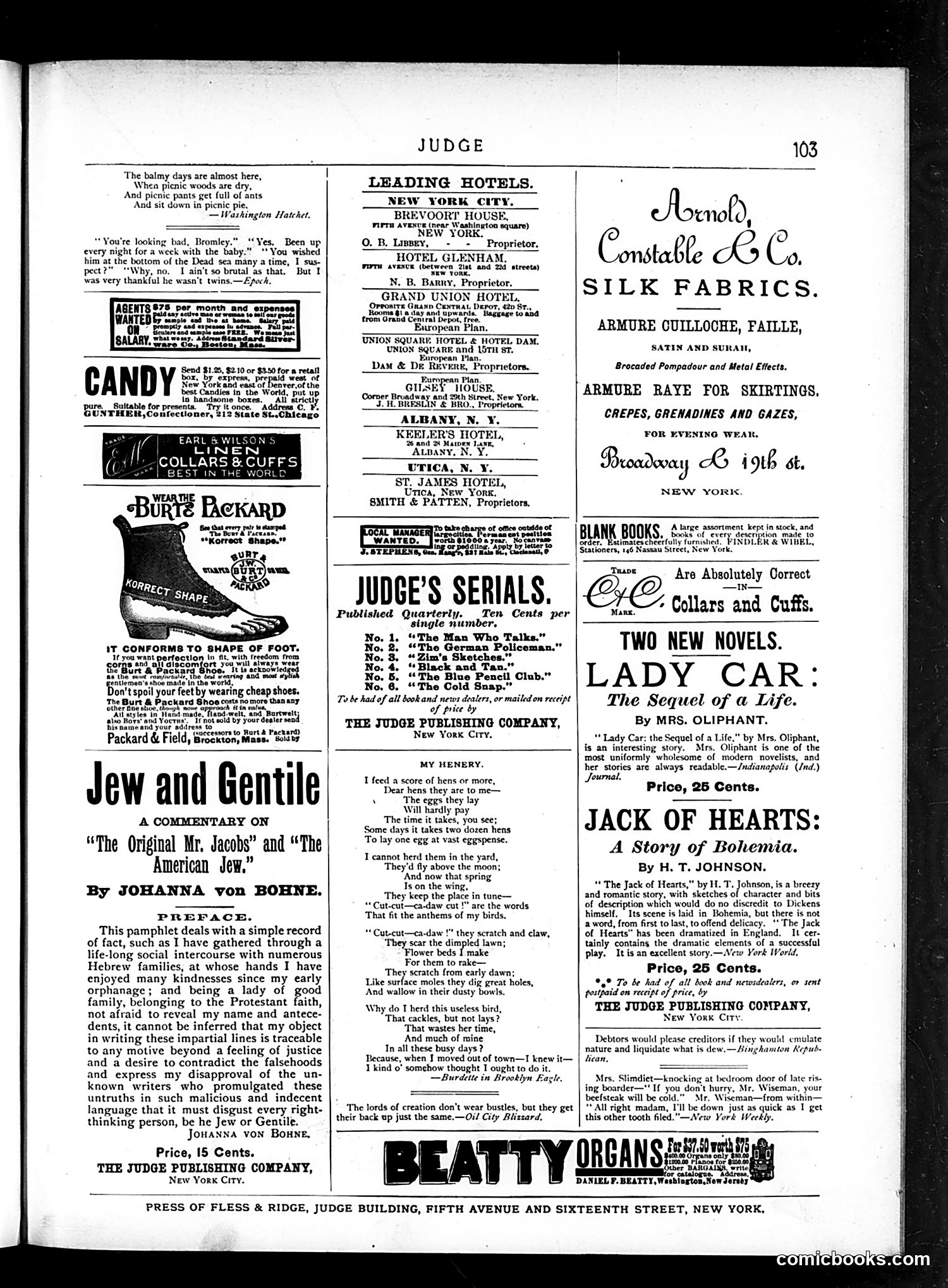
This is primarily an **advertising and literary content page** from Judge, with minimal political satire. The page features: **Main Content:** - Hotel advertisements for New York, Albany, and Utica - Silk fabric promotions (Arnold Constable & Co.) - A serialized story listing ("Judge's Serials") - A pamphlet advertisement: *"Jew and Gentile"* by Johanna von Bohne, commentary on antisemitic writings about Jewish Americans **Notable Element:** The *Jew and Gentile* pamphlet represents **response literature** to contemporary anti-Jewish stereotypes circulating in American publications. Von Bohne's preface emphasizes her Protestant credentials and respectability while defending Jewish families based on personal experience—indicative of period defensive strategies against prejudice. **Humor Content:** A poem "My Henery" about unprofitable chicken-keeping provides mild domestic humor. The page otherwise consists of typical magazine filler: advertisements and literary notices with no significant political cartoon commentary visible.
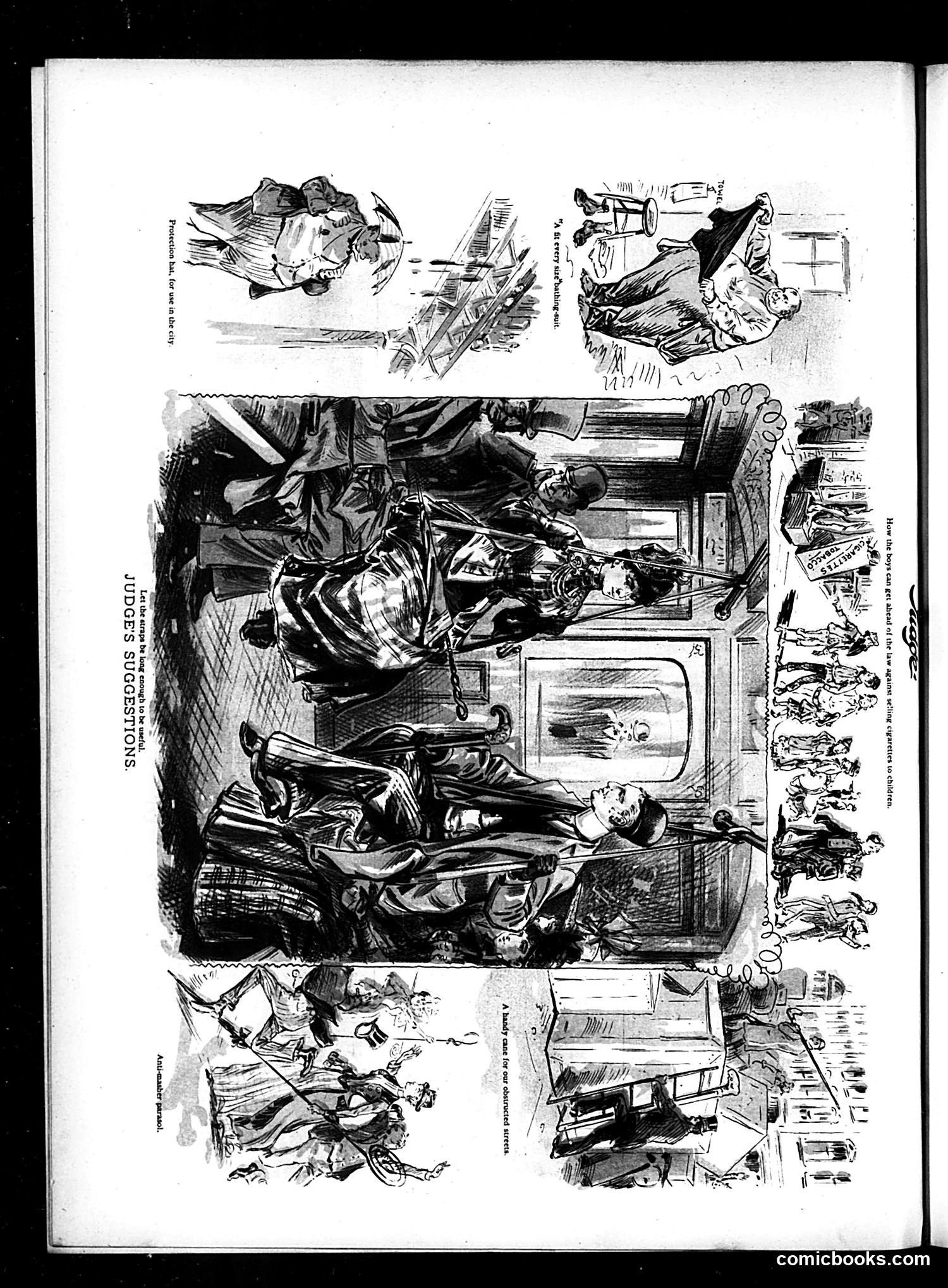
The OCR text is too corrupted to read clearly, and the image is rotated, making definitive identification difficult. However, the page appears to contain **multiple political cartoons** arranged around a central, larger illustration showing what looks like an **interior domestic scene with several figures** watching a television or similar device. The smaller cartoons at the top and sides appear to depict various figures in satirical situations—possibly commentary on contemporary politicians or social figures. Without legible text or clearer orientation, I cannot reliably identify specific individuals, events, or the precise satirical points being made. **I cannot confidently explain the specific political/social references** without risking inaccuracy. The page's theme appears to relate to media, observation, or domestic life during Judge's publication period, but the specific targets and jokes remain unclear from this reproduction.