
Judge, 1889-05-18 · page 2 of 16
Judge — May 18, 1889 — page 2: what you’re looking at
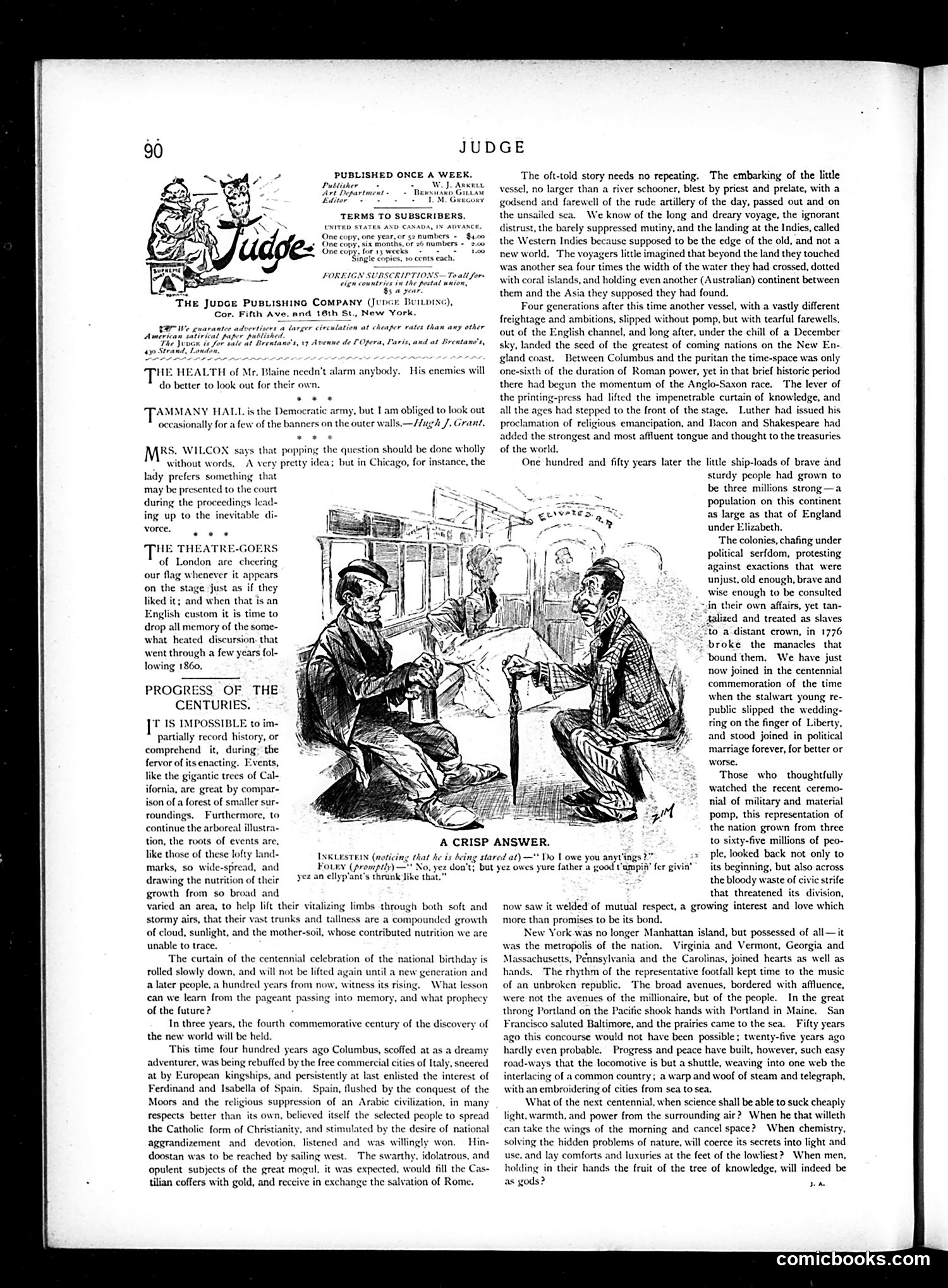
What you’re looking at
This cartoon depicts two figures in what appears to be a ship's cabin or confined space. The dialogue reads: **Irishman (addressing Port Authority):** "I owe you anything?" **Porter (responding):** "No, yez don't; but yez owes yere father a good 'Cuppin' fer givin' yez a son like that!" The joke plays on Irish immigrant stereotypes common to late 19th-century American satire. The "crisp answer" refers to the porter's witty insult—implying the Irishman is so worthless that his father should have been beaten for producing him. The humor relies on period ethnic caricature and crude insult comedy typical of Judge's satirical approach to immigrant communities.
📄 Transcribed text from this page (OCR, searchable)
Machine-transcribed from the original scan — historical spelling and the odd misread are preserved.
JUDGE PUBLISHED ONCE A WEEK. Publisher + W. J. Awsntn Ave Department =~ Dewsnanc Bator 1M. Gane TERMS TO SUBSCRIBERS. rs 2 Seco ents each. FOREIGN SUBSCRIPTIONS Teall for- cign countries 1m the postal union, THE JupcE PuBLisHina Company (Juncr Buitpixc), Cor. Fifth Ave. and 16th St, New York. American satirical paper published Pale at Brenta iter rates than any other v4, 17 Avenue de COpera, Paris, and at Brentano's, HE HEALTH of Mr, Blaine needn't alarm anybody. His enemies will do better to look out for their own. TAMMANY HALL isthe Democratic army, but Tam obliged to look out occasionally for a few of the banners on the outer walls—//ugh J. Grant, MBS. WILCOX says that popping the ques without words. A very pretty id lady prefers something. that may be presented to the court during the proceedings lead- ing up to the inevitable di- vorce. on should be done wholly ‘ago, for instance, the THE THEATR of London are cheering our flag whenever it appears on the stage just as if they liked it; and when that is an English custom it is time to drop all memory of the some- what heated discursion. that went through a few years fol- lowing 1860. PROGRESS OF THE CENTURIES, I" 1S IMPOSSIBLE to im- partially record history, or comprehend. it, during. the fervor of its enacting. Events, like the gigantic trees of Cal- ifornia, are great by compar- ison of a forest of smaller sur- roundings. Furthermore, to continue the arboreal illustra- tion, the roots of events are, like those of these lofty land- marks, so wide-spread, and drawing the nutrition of their growth from so broad and varied an area, to help lift their vitalizing limbs through both soft and stormy airs, that their vast trunks and tallness are a compounded growth of cloud, sunlight, and the mother-soil, whose contributed nutrition we are unable to trace. The curtain of the centennial celebration of the national birthday is rolled slowly down, and will not be lifted a later people, a hundred years from now, witness its rising. can we learn from the pageant passing into memor of the future ? : In three years, the fourth commemorative century of the discovery of the new world will be held. This time four hundred years ago Columbus, scoffed at as a dreamy adventurer, was being rebuffed by the free comme! at by European kingships, and persi Ferdinand and Isabella of Spain. Spain, flushed by the conquest of the Moors and the religious suppression of an Arabic civilization, in many respects better than its own, believed itself the selected people to spread the Catholic form of Christianity, and stimulated by the desire of national aggrandizement and devotion, listened and was willingly won. Hin- doostan was to be reached by sailing west. The swarthy, idolatrous, and opulent subjects of the great mogul. it was expected, would fill the tilian coffers with gold, and reccive in exchange the salvation of Rome. VAP 4 Iw LesTRIN (noticing Fouey (promptly) —"* No, y yez an ellyp'ant’s thrunk Jike that.” in until a new generation and Wha nd what prophecy lesson. cities of Italy, sneered ently at last enlisted the interest of A CRISP ANSWER. hat he is being stared at) —* Do Lowe you anyving: 2 don't; but yez owes yure father a good t'amp The oft-told story needs no repeating. The embarking of the little vessel, no larger than a river schooner, blest by priest and prelate, with a godsend and farewell of the rude artillery of the day, passed out and on the unsailed sca. We know of the long and dreary voyage, the ignorant distrust, the barely suppressed mutiny, and the landing at the Indies, called the Western Indies because supposed to be the edge of the old, and not a new world, The voyagers little imagined that beyond the land they touched was another sea four times the width of the water they had crossed, dotted with coral islands, and holding even another (Australian) continent between them and the Asia they supposed they had found. Four gencrations after this time another vessel, with a vastly different ightage and ambitions, slipped without pomp, but with tearful farewells, out of the English channel, and long after, under the chill of a December sky, landed the seed of the greatest of coming nations on the New En- gland coast. Between Columbus and the puritan the time-space was only one-sixth of the duration of Roman power, yet in that brief historic period there had begun the momentum of the Anglo-Saxon race. The lever of the printing-press had lifted the impenetrable curtain of knowledge, and all the ages had stepped to the front of the stage. Luther had issued his proclamation of religious emancipation, and Bacon and Shakespeare had added the strongest and most affluent tongue and thought to the treasuries of the world. One hundred and fifty years later the little ship-loads of brave and sturdy people had grown to be three millions strong—a population on this continent as large as that of England under Elizabeth. The colonies, chafing under political serfdom, protesting against exactions that were unjust, old enough, brave and wise enough to be consulted ~,in their own affairs, yet tan- ‘alized and treated as slaves to a distant crown, in 1776 broke the manacles that bound them. We have just now joined in the centennial commemoration of the time when the stalwart young re- public slipped the wedding- ring on the finger of Liberty, and stood joined in political marriage forever, for better or worse. Those who thoughtfully watched the recent ceremo- nial of military and material pomp, this representation of the nation grown from three to sixty-five millions of peo- ple, looked back not only to its beginning, but also across the bloody waste of civie strife : that threatened its division, now saw it welded of mutual respect, a growing interest and love which more than promises to be its bond. New York.was no longer Manhattan island, but possessed of all—it was the metropolis of the nation, Virginia and Vermont, Georgia and Massachusetts, Pennsylvania and the Carolinas, joined hearts as well as hands. The rhythm of the representative footfall kept time to the music of an unbroken republic, The broad avenues, bordered with affluence, were not the avenues of the millionaire, but of the people. In the great throng Portland on the Pacitic shook hands with Portland in Maine. San Francisco saluted Baltimore, and the prairies came to the sea. Fifty years ago this concourse would not have been possible; twenty-five years ago hardly even probable. Progress and peace have built, however, such easy road-ways that the locomotive is but a shuttle, weaving into one web the interlacing of a common country; a warp and woof of steam and telegraph, with an embroidering of cities from sea to sea. What of the next centennial, when science shall be able to suck cheaply light, warmth, and power from the surrounding air? When he that willeth can take the wings of the morning and cancel space? When chemistry, solving the hidden problems of nature, will coerce its secrets into light and use, and lay comforts and luxuries at the feet of the lowliest?- When men, holding in their hands the fruit of the tree of knowledge, will indeed be as gods? Behe fe eervrred. fer givin’ comicbooks.com