
A complete issue · 16 pages · 1889
Judge — January 19, 1889
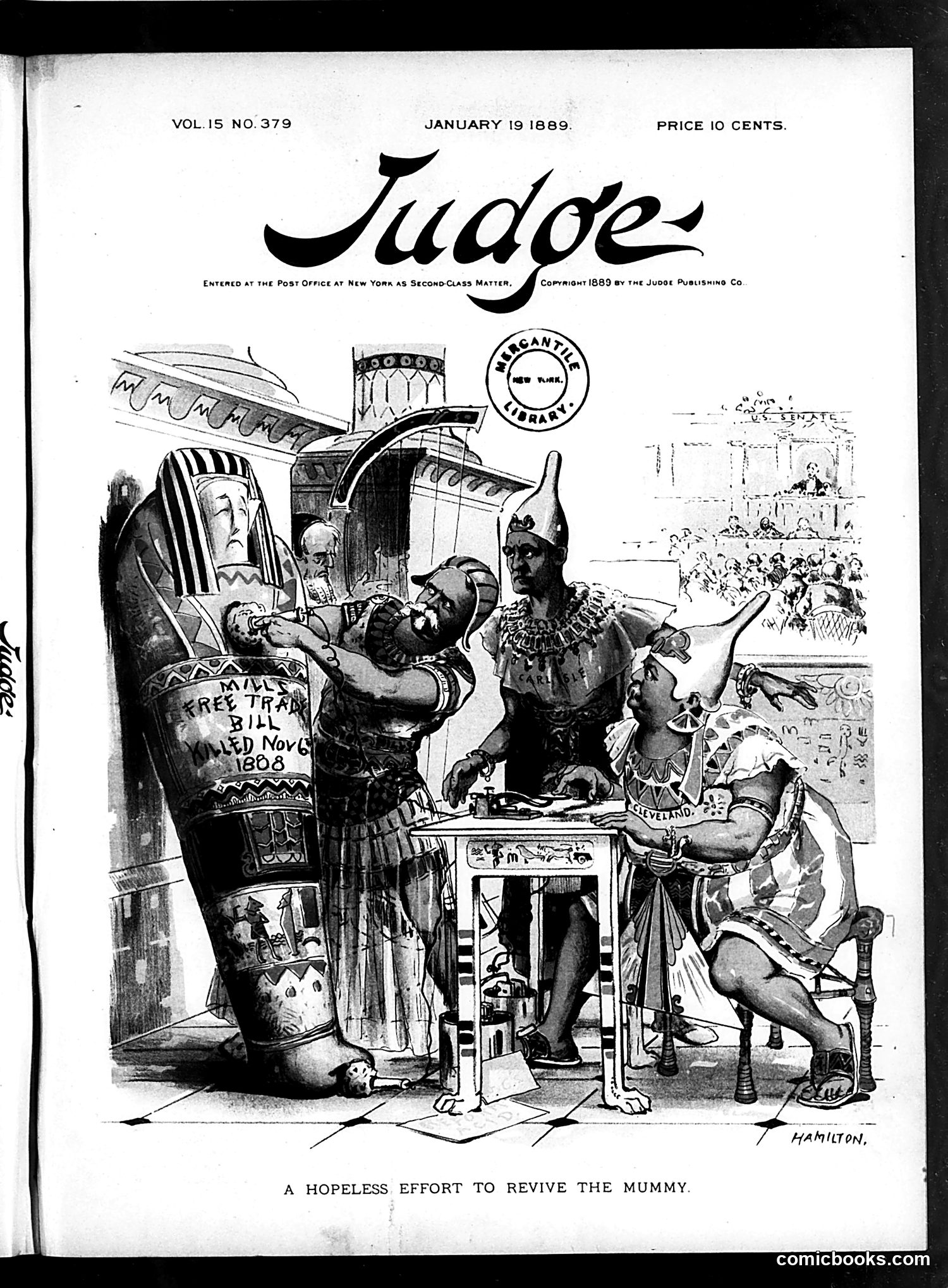
This political cartoon from Judge (January 19, 1889) uses Egyptian mummy imagery as satire. The label "FREE TRADE KILLED NOV 1888" on the mummy indicates the cartoon concerns American free trade policy, apparently defeated in November 1888 elections. The figures attempting to revive the "dead" free trade policy appear to be political advocates or Democratic politicians (free trade was traditionally the Democratic position). The Egyptian setting—with the sarcophagus, hieroglyphics, and costumed figures—suggests these revival efforts are ancient history, futile, and absurd. The cartoonist argues that free trade's electoral defeat was decisive and permanent, making attempts to resurrect the policy ridiculous and doomed. The Republican victory in 1888 favored protective tariffs over free trade.
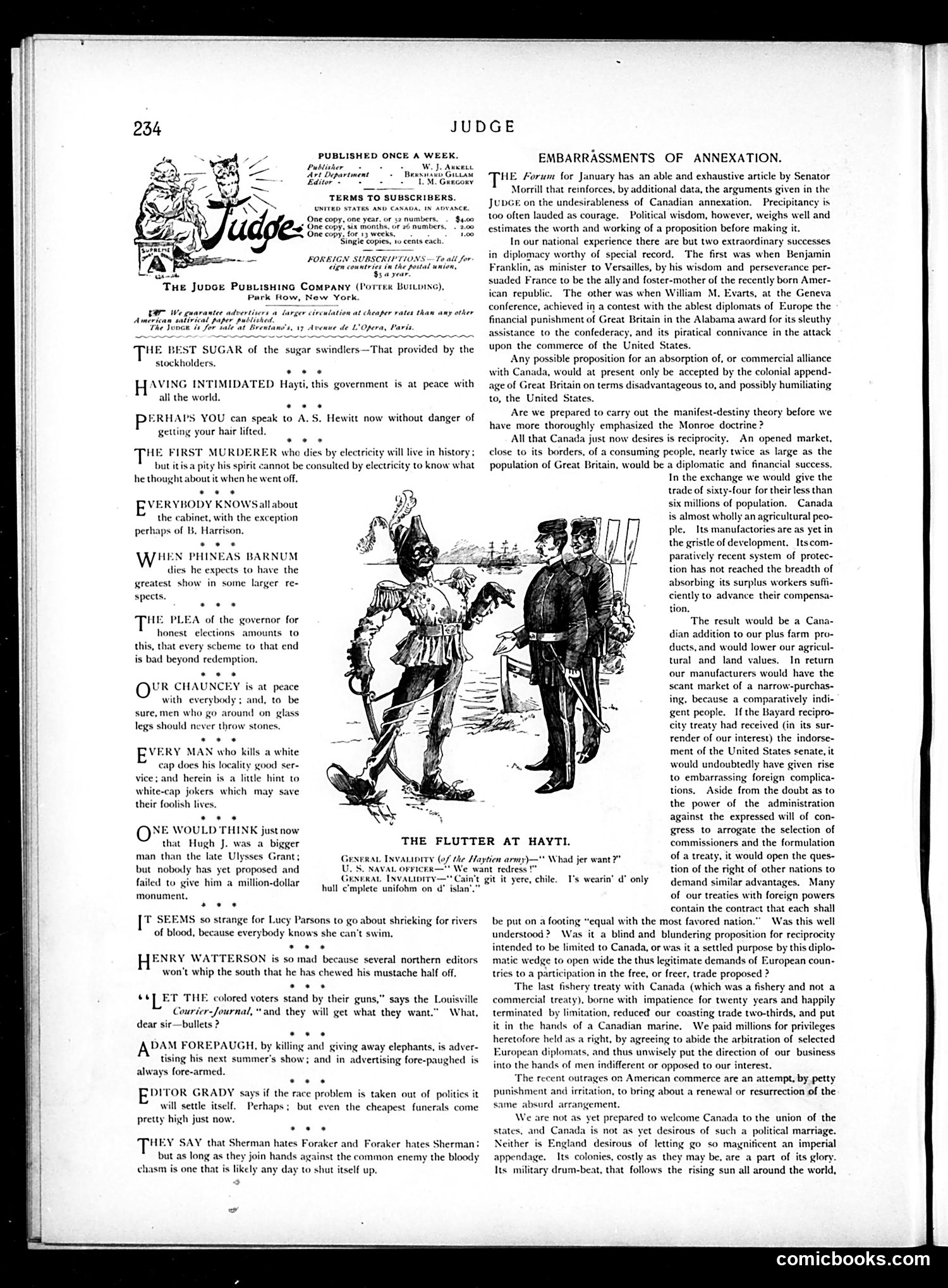
This cartoon satirizes American diplomatic tensions regarding Haiti. The caption quotes a general asking "What per wont?" in response to another officer's complaint about wanting "redress." The image depicts two military figures—one wearing a plumed hat (appearing to represent a foreign general or dignitary) confronting an American officer. The cartoon likely mocks confused or contradictory American military/diplomatic positions regarding Haiti, possibly referencing U.S. intervention or negotiations. The accompanying article "Embarrassments of Annexation" discusses proposed Canadian annexation to the U.S., arguing it would damage American agricultural interests and lower land values. The piece critiques American expansionist ambitions while questioning whether such territorial acquisitions serve national interests. Both items satirize American foreign policy overreach during this period.
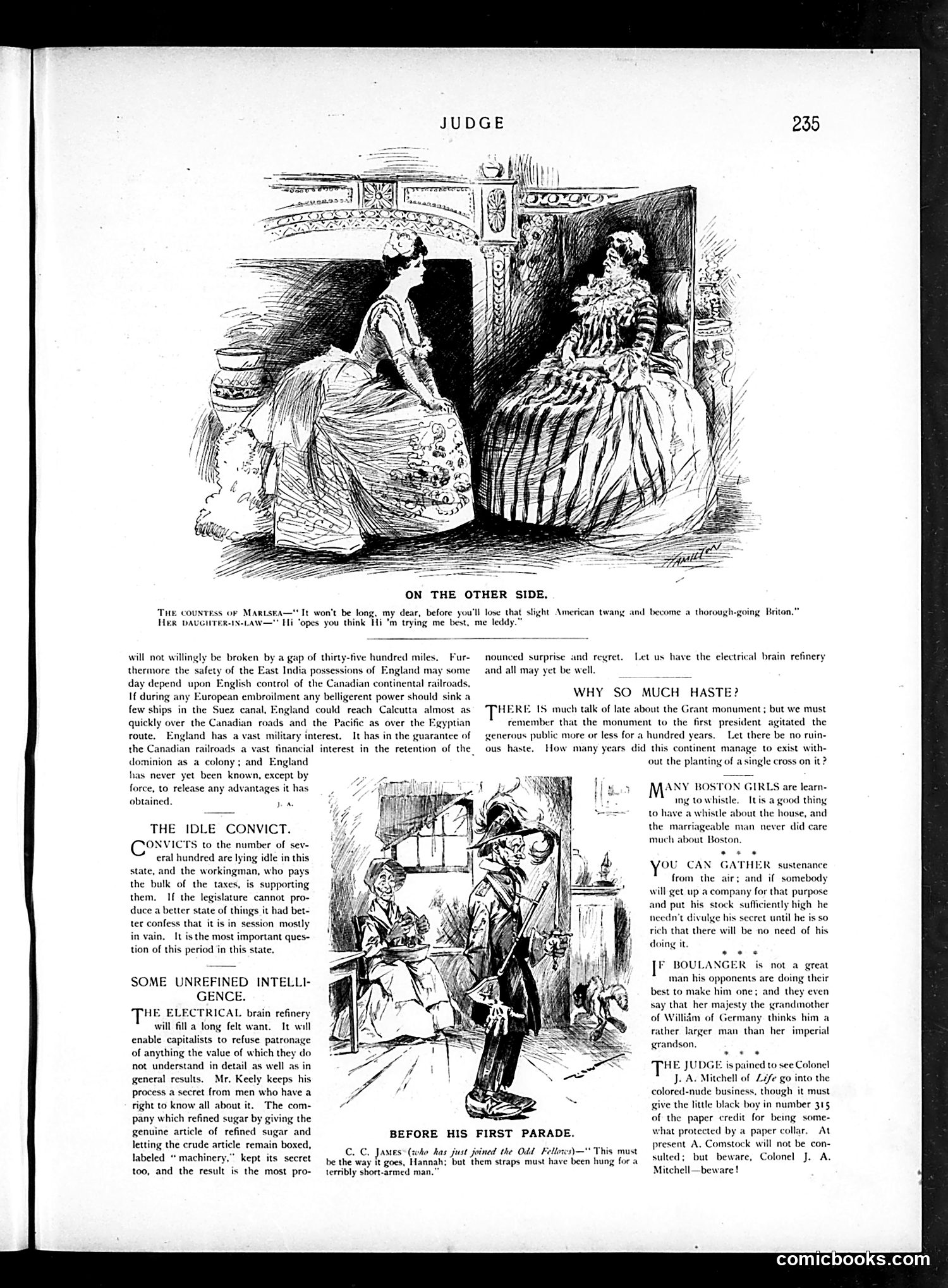
This page contains several distinct satirical pieces: **"On the Other Side"**: A cartoon mocking Anglo-American marriages. A British countess tells her American daughter-in-law she'll lose her American accent and become "a thorough-going Briton"—satire on how British society absorbed wealthy American heiresses through marriage, a common phenomenon of the Gilded Age. **"The Idle Convict"**: Editorial commentary criticizing the state legislature for inadequately managing convicts, forcing taxpayers to support idle prisoners—standard Progressive-era prison reform criticism. **"Some Unrefined Intelligence"**: Mockery of an "electrical brain refinery" (likely a dubious invention/patent scam), comparing it to fraudulent sugar-refining schemes. Satirizes gullible capitalists and secretive, unproven technologies. **"Before His First Parade"**: A humorous scene of a new Odd Fellows lodge member struggling with ceremonial regalia straps. The page also contains brief satirical notes on topics like the Grant Monument, Boston women, and General Boulanger—typical of Judge's miscellaneous social commentary.
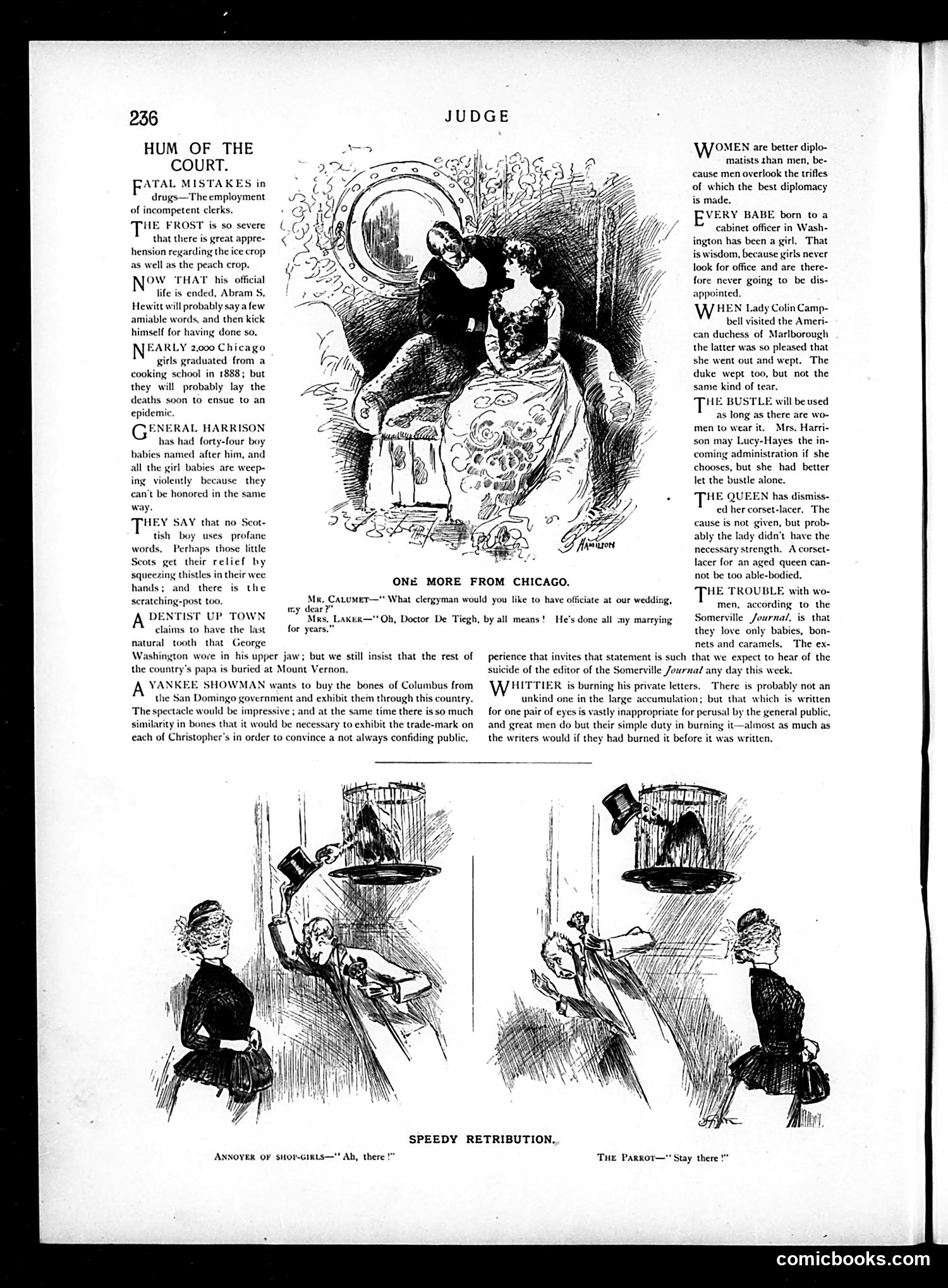
This page contains brief satirical commentary ("Hum of the Court") mixed with two illustrated cartoons at the bottom. **The Commentary:** Short jokes targeting contemporary figures and issues—General Harrison (likely President Benjamin Harrison), Chicago cooking schools, Scottish boys, and Lady Colin Campbell's visit to an American duchess. Most references are topical jabs at 1880s society rather than sustained political satire. **The Cartoons ("Speedy Retribution"):** Two matching panels show a woman accosting shop girls on the street with unwanted advances ("Ah, there!"), only to be attacked by a parrot the girl carries ("Stay there!"). The satire mocks men who harass young working women in public, suggesting swift comeuppance through the parrot's intervention. **Overall Tone:** Light social humor aimed at upper-class readers, poking fun at politicians, women's fashions (bustles, corsets), and contemporary manners rather than serious political critique.
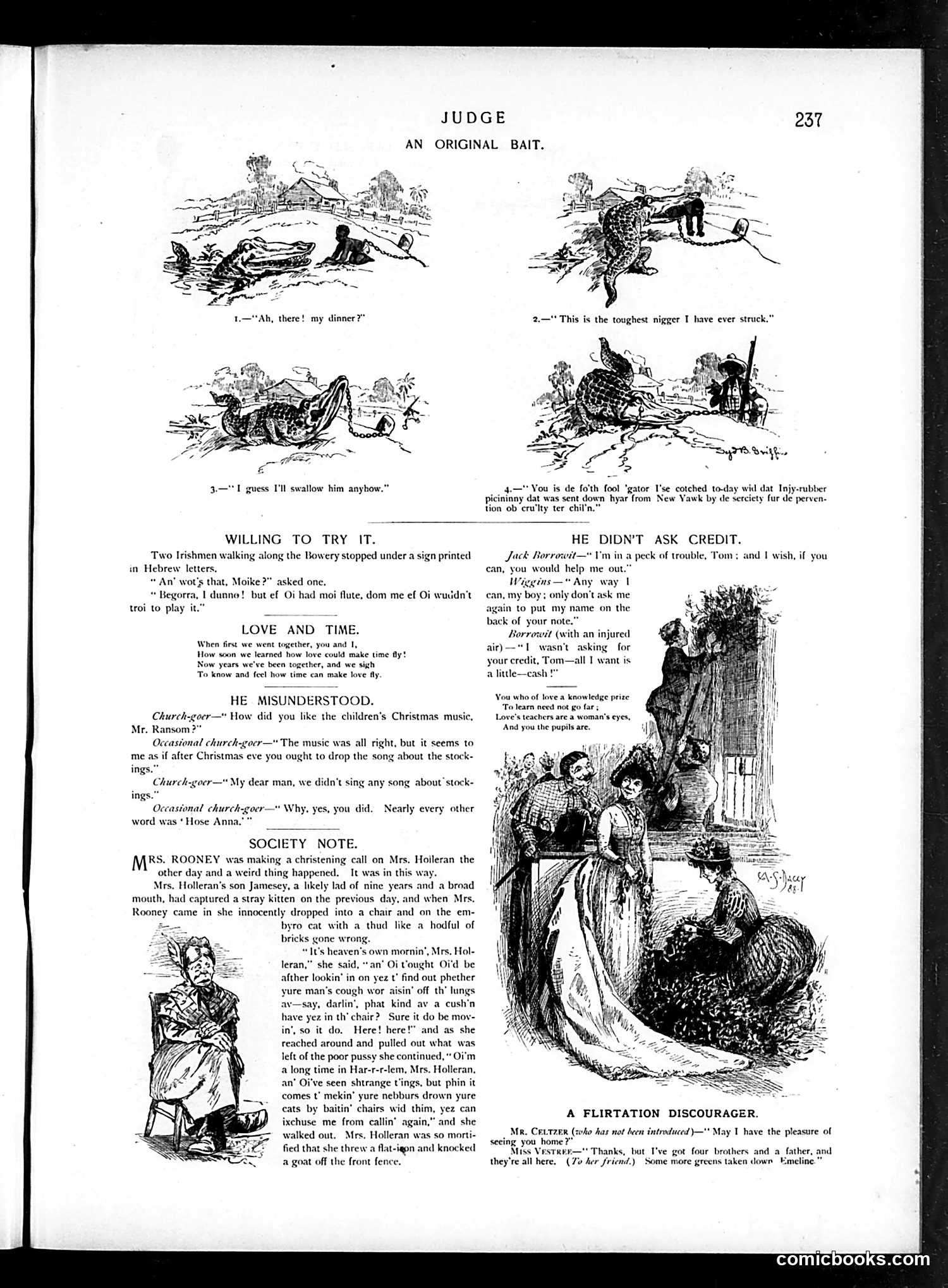
This page contains multiple short humor pieces typical of Judge's satirical style: **"An Original Bait"** depicts a series of panels showing an alligator being tricked into swallowing increasingly larger objects, culminating in a rubber doll from a New York animal cruelty prevention society—satirizing both the alligator's gullibility and possibly the ineffectiveness of such societies. **The Irish dialect humor** ("Willing to Try It," "Society Note") reflects period stereotypes common to Judge, featuring working-class Irish characters speaking in exaggerated brogues. These are ethnic comedies rather than political satire. **"He Didn't Ask Credit"** jokes about a borrower seeking cash instead of credit—commentary on financial responsibility and lending practices. **"He Misunderstood"** plays on mishearing "Hosanna" as "hose" during Christmas carols. The page is primarily **light social humor** rather than political cartoons, targeting Irish immigrants, courtship customs, and financial propriety—typical Judge content from the Gilded Age/Progressive era.
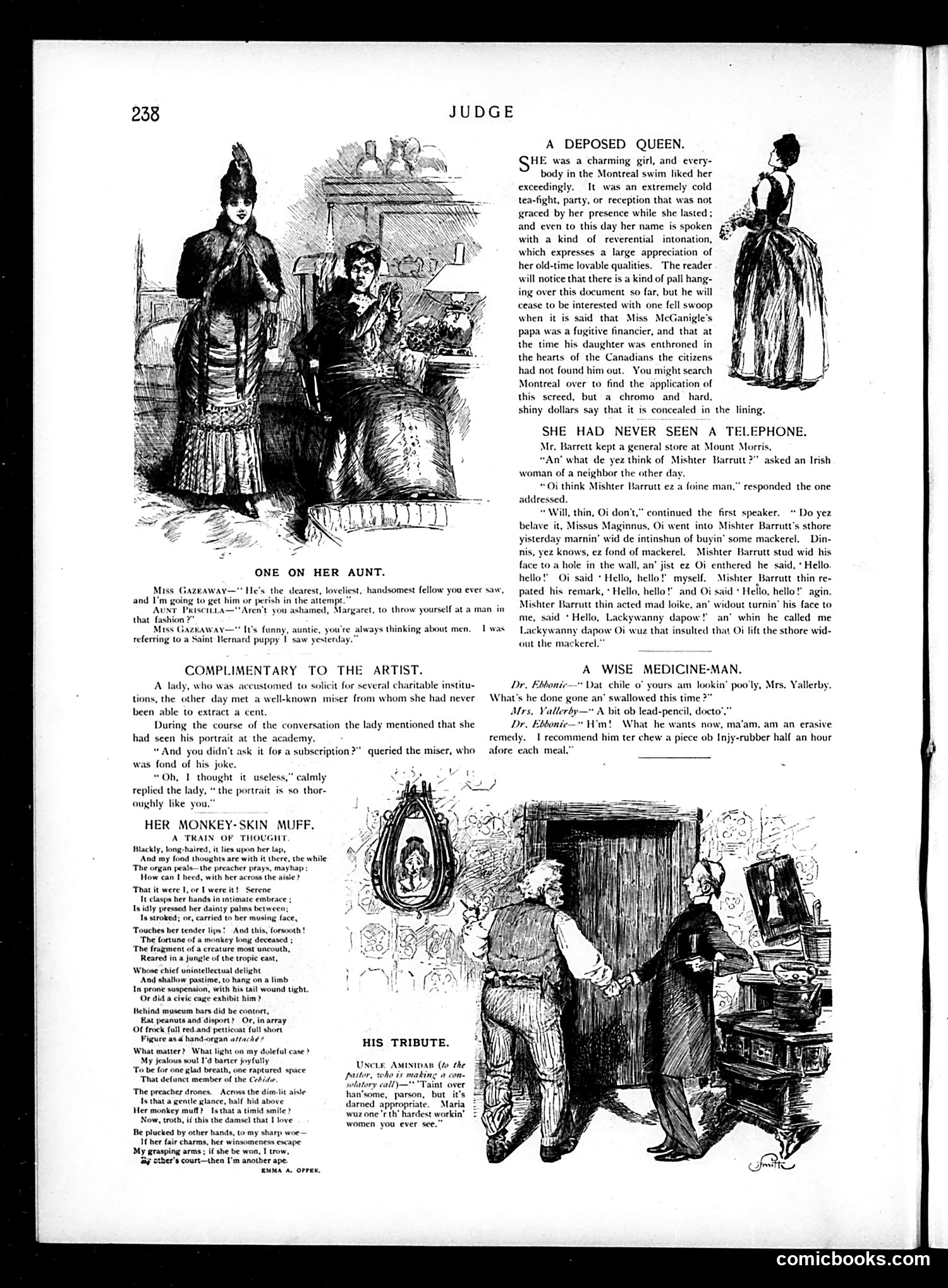
This page contains several satirical pieces mocking social pretension and Irish immigrants' unfamiliarity with modern technology. **"A Deposed Queen"** describes a Montreal socialite whose father was revealed as a fugitive financier, destroying her social standing—satire on how wealth and reputation are fragile among the elite. **"She Had Never Seen a Telephone"** ridicules Irish immigrants through heavy dialect humor. An Irish woman recounts visiting a store where the proprietor repeatedly said "hello" into a telephone, which she misinterprets as his name ("Lackywanny dapow"), creating absurdist comedy from the clash between rural Irish experience and American technology. **"One on Her Aunt"** depicts a young woman's romantic pursuit; her aunt's disapproval is undercut when the niece reveals she meant a Saint Bernard puppy—playing on class assumptions about feminine behavior. The remaining pieces offer mild humor about artists, misers, and medical quackery. The overall tone reflects late-19th-century American satire targeting both wealthy pretense and immigrant "otherness."
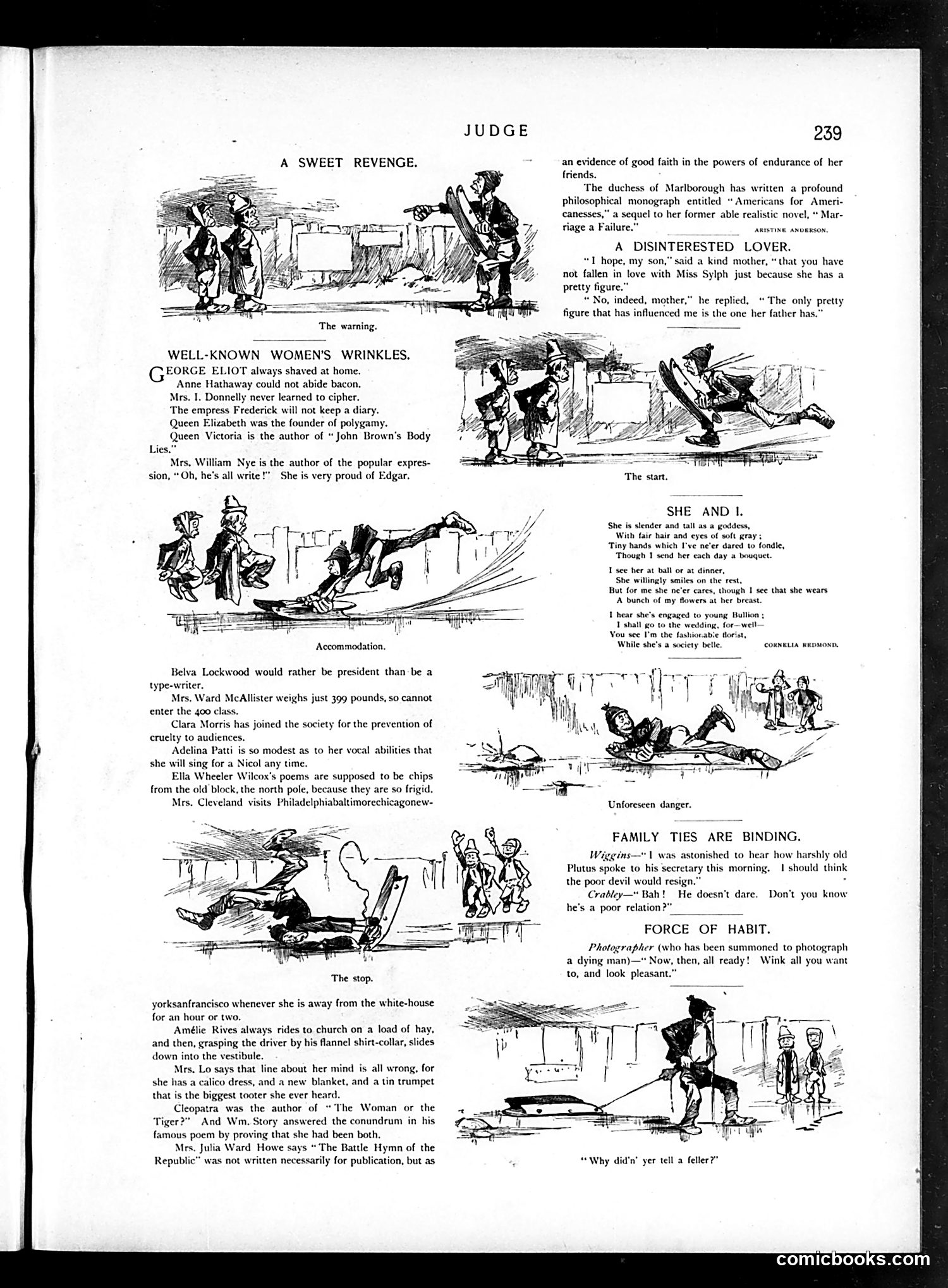
This page contains satirical commentary typical of late 19th-century Judge magazine. The main sections are: **"Well-Known Women's Wrinkles"** presents mock biographical "lies" about famous women—George Eliot, Queen Victoria, Ella Wheeler Wilcox, and others—making humorous jabs at their actual habits or public personas. The humor relies on readers recognizing these celebrities. **"A Sweet Revenge"** and accompanying cartoons depict slapstick scenes of people falling or being thrown from carriages—typical visual humor of the era. **"A Disinterested Lover"** jokes about a young man interested in a woman only for her wealthy father's money. **"She and I"** is a romantic poem about unrequited love, where the narrator—a florist—attends his beloved's wedding to a wealthy man primarily to maintain business. **"Family Ties Are Binding"** quips that a secretary won't quit despite harsh treatment because he's a poor relation dependent on his employer. **"Force of Habit"** shows a photographer instructing a dying man to "look pleasant" for his photo—dark humor about professional habit overriding sensitivity. The page blends social satire, celebrity mockery, and slapstick visual comedy.
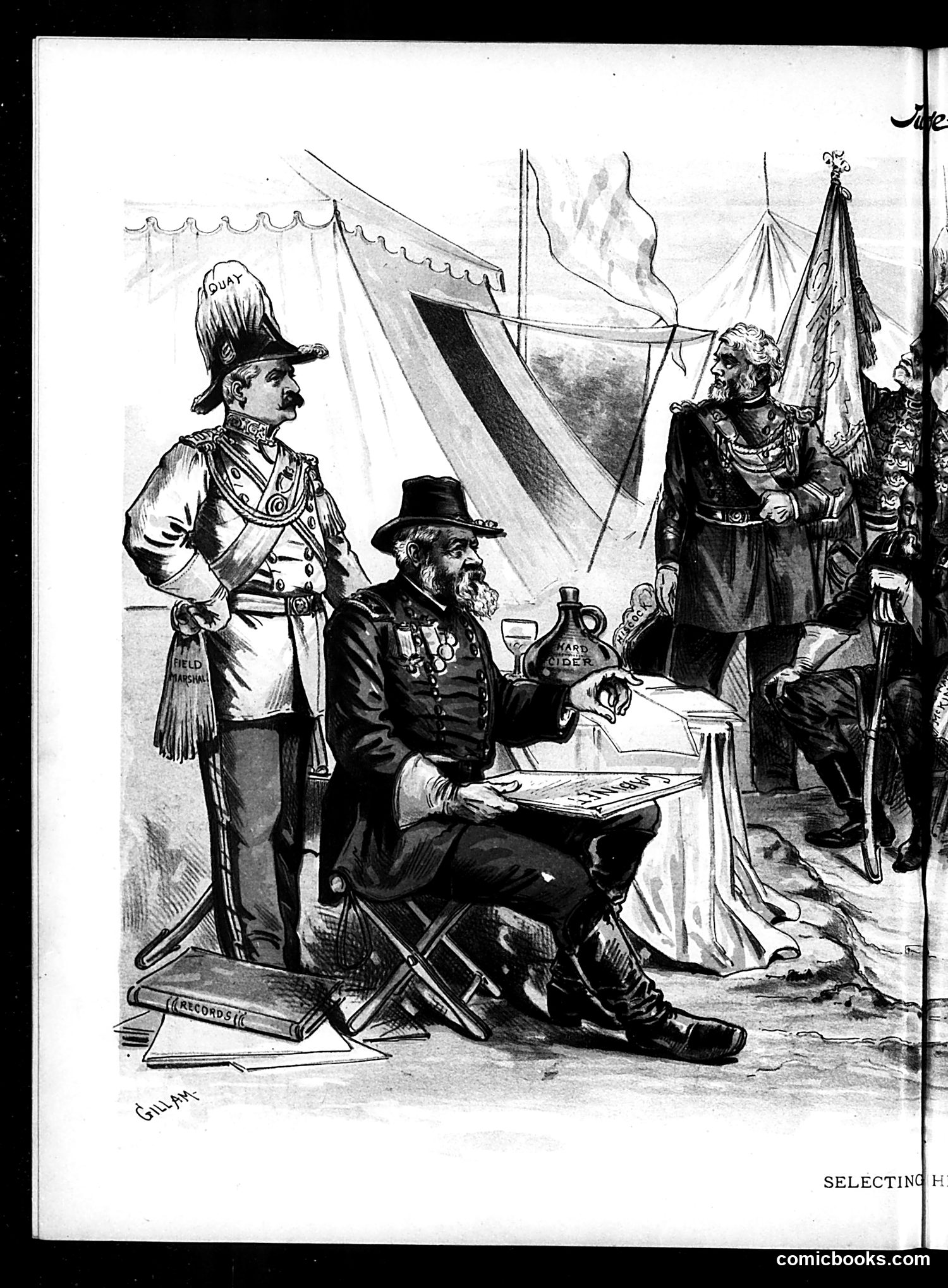
This political cartoon depicts a military scene in a tent, showing officers in formal dress uniforms. The figure seated at a desk appears to be selecting or reviewing something (likely military appointments or strategy), while standing officers observe. The German text "GILAM" is visible at bottom left. The cartoon likely satirizes **military leadership selection or promotion decisions** during a period of conflict, possibly referencing late 19th or early 20th-century European military affairs. The formal uniforms and tent setting suggest wartime conditions. However, **without the complete caption or publication date**, I cannot definitively identify the specific historical event, political figures involved, or the precise satirical point being made. The incomplete OCR text ("SELECTING H...") also limits interpretation of the intended message.
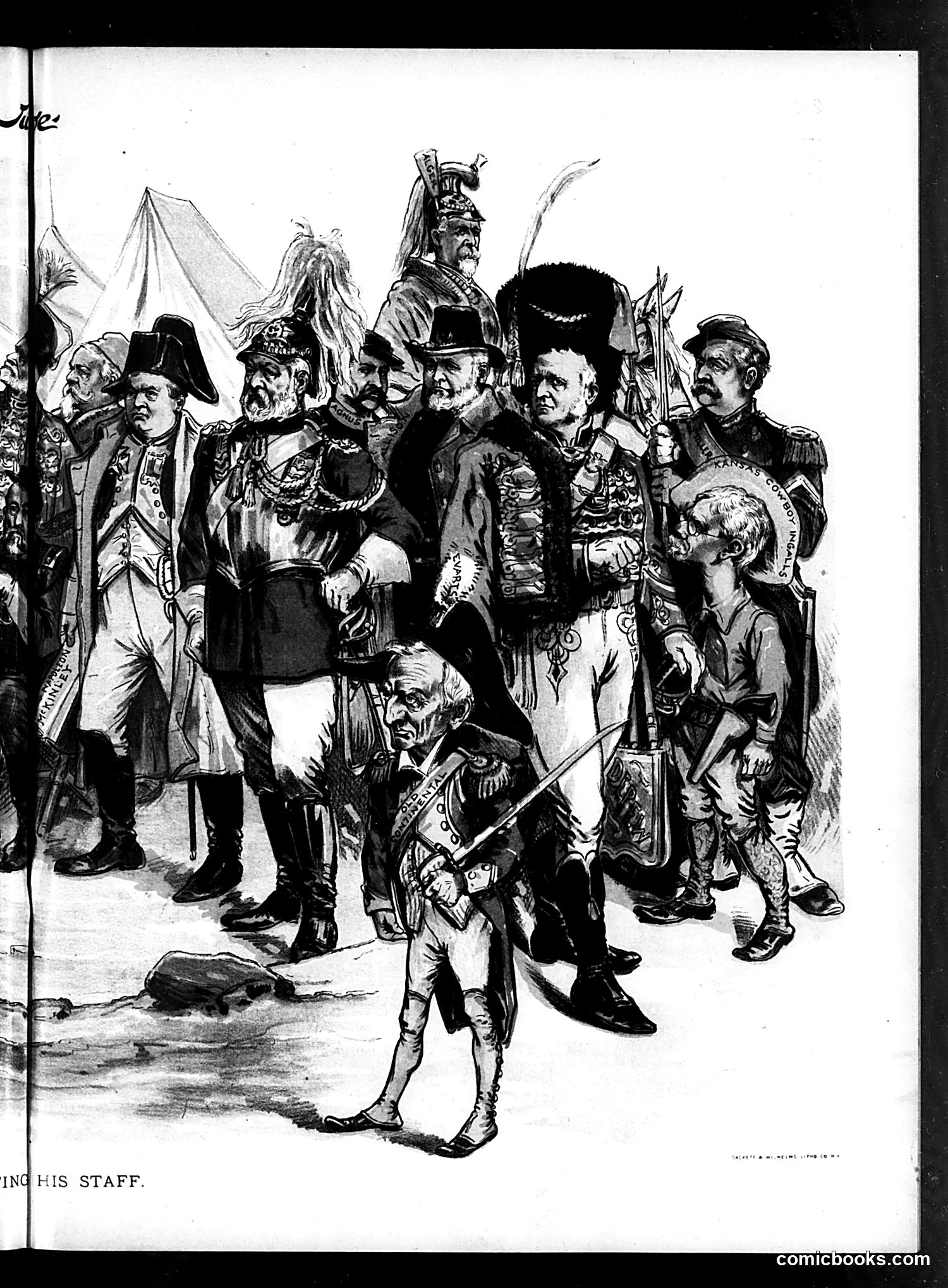
The visible text fragment "ING HIS STAFF" suggests this depicts a military or political leader with their assembled advisors or officers. The illustration shows a central commanding figure surrounded by multiple uniformed men wearing decorative military dress, medals, and various styles of hats and headgear—suggesting different nations or military branches. This appears to be satirical commentary on militarism, possibly mocking the proliferation of uniformed officials or an alliance of military powers. The elaborate costumes and formal gathering suggest pomposity or absurdity in military hierarchy. However, without the complete title or publication date visible, I cannot definitively identify which specific historical leader, military conflict, or geopolitical situation this references. The style suggests late 19th or early 20th century European affairs.
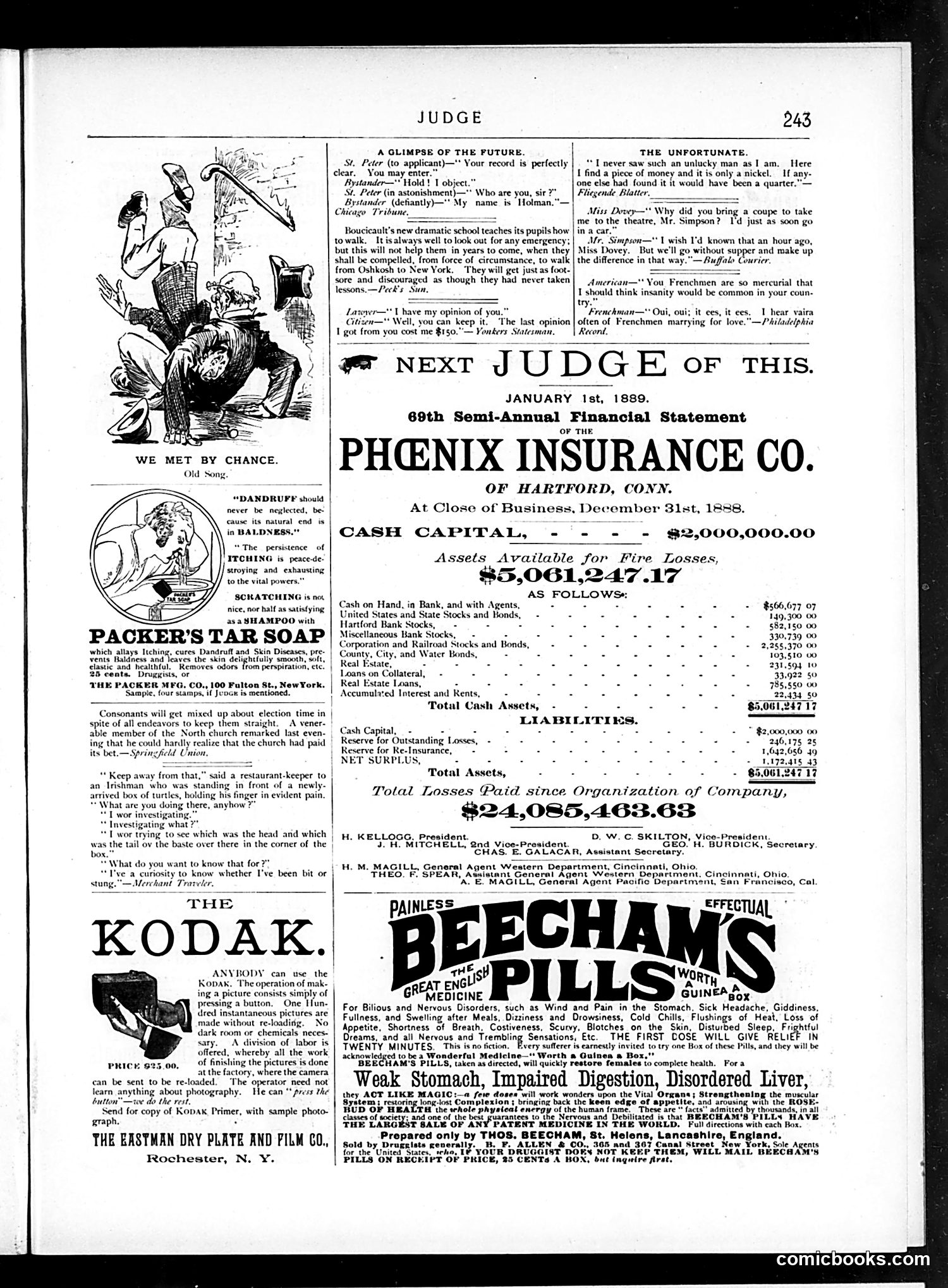
This is primarily an **advertising and financial statement page** rather than editorial content. The page features: **Main Content:** - A financial statement for Phoenix Insurance Company of Hartford, Connecticut (dated December 31, 1888), showing assets of $5,061,247.17 and capital of $2,000,000 **Advertisements:** - **Packer's Tar Soap**: Promises to cure dandruff and baldness through shampooing - **Kodak cameras** ($25): Revolutionary new technology allowing anyone to "press the button"—the factory does the rest - **Beecham's Pills**: Patent medicine claiming to cure digestive issues, fatigue, and various ailments **Humor Items:** Small comic anecdotes about Irish immigrants, church betting pools, and marital disagreements—typical Judge magazine filler content. The page reflects **1880s consumer culture**: emerging photography technology, patent medicines with broad therapeutic claims, and financial institutions advertising stability to potential customers. The advertising dominates the editorial space, indicating this was a commercially-driven publication.
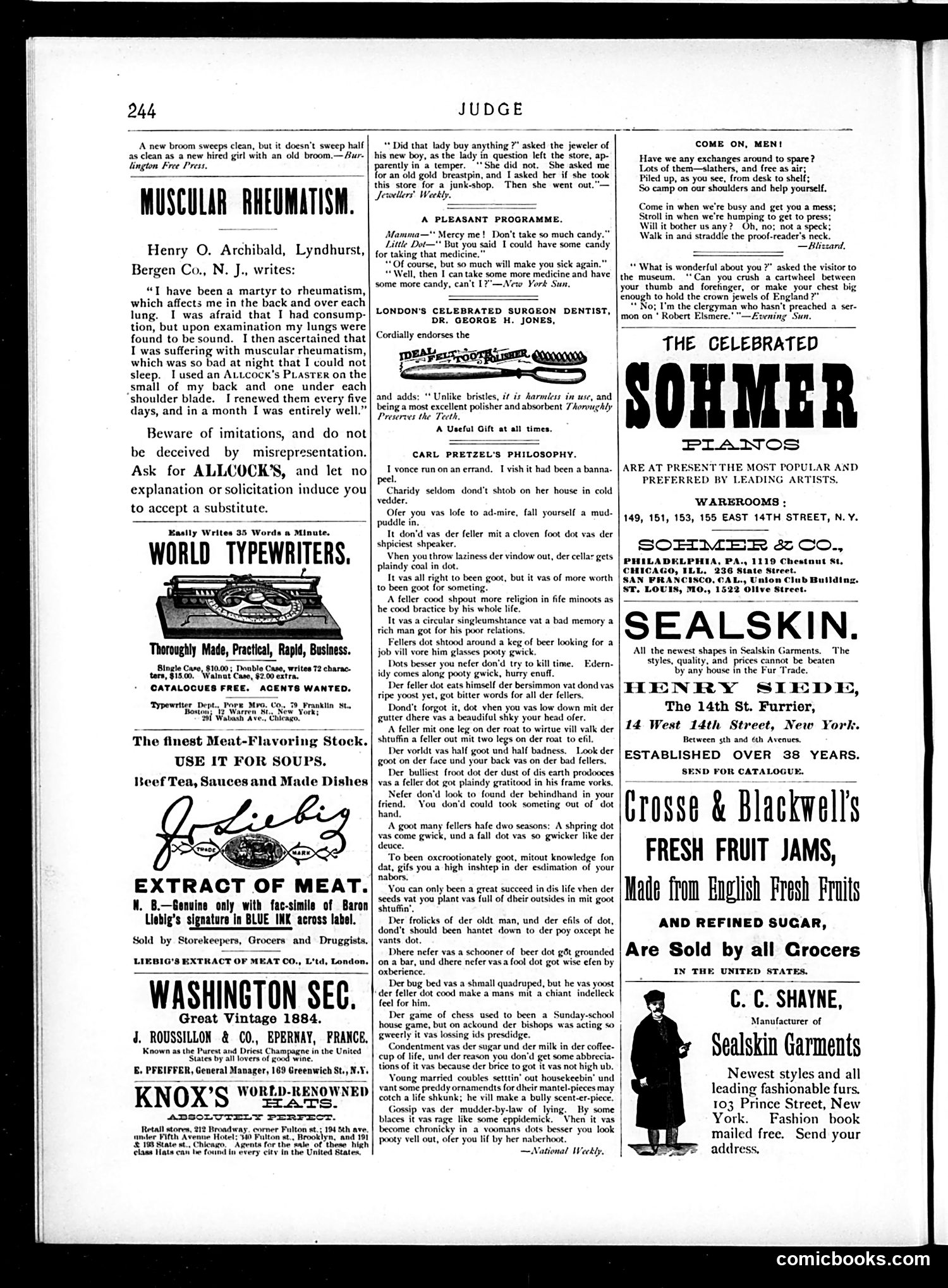
This page is primarily **advertisements and humor columns** rather than political cartoons. The content reflects late 19th-century American consumer culture and social attitudes. ## Key Content: **"Muscular Rheumatism"** features a testimonial for Allcock's Plasters—a patent medicine treatment, reflecting the era's heavy reliance on such remedies. **"Carl Pretzel's Philosophy"** presents ethnic humor through a German-accented character offering folk wisdom in broken English ("Charidy seldom dond't shtob on her house in cold vedder"). This represents common period stereotyping of German immigrants for comedic effect. The remaining brief jokes mock consumer interactions (a jeweler insulting a customer) and parental authority (a child's logic about medicine and candy). **The advertisements** promote luxury goods (champagne, typewriters, fancy hats) and patent medicines—typical Judge magazine content targeting middle and upper-class readers. There are **no significant political cartoons** on this page. The humor is domestic, consumer-focused, and relies on ethnic stereotyping typical of 1880s-90s American humor magazines.
This page is primarily **advertising**, typical of late 19th-century magazines. The bulk of the content consists of product advertisements for patent medicines, toiletries, and services—Scott's Emulsion (cod liver oil), Barry's Tricopherous (hair product), Crystal Gelatine, candy, and remedies for opium addiction and deafness. The small editorial content includes two brief items: a sentimental poem ("A Memory") about moonlight and romance that concludes with a surprise twist (the woman is the narrator's sister), and a short joke about a tramp claiming to have a large family, used to elicit sympathy from a woman who refuses to help him. These pieces reflect common late-Victorian humor and sentimentality but contain no clear political satire or social commentary requiring specialized historical knowledge. The page functions primarily as a revenue vehicle through advertisements rather than as a platform for the magazine's satirical mission.
This is primarily an **advertising page**, not a political cartoon. Judge magazine (a satirical weekly) filled its interior pages with paid advertisements for contemporary products. The ads reflect late-19th-century consumer culture and reveal period attitudes: Pears' Soap's prominent placement promises "fair white hands" and "bright clear complexion"—language reflecting racial and class anxieties about appearance that would be considered offensive today. Multiple ads promote patent medicines (Piso's Cure, Opium pills, Brandioli) now recognized as quack remedies or dangerous drugs, yet marketed as cures for serious ailments like consumption and bronchitis. Other ads include hats, bank notes, printing services, and a Sohmer piano—typical commercial products. The "Monon Route" and "West Shore Railroad" ads promote rail travel as leisure. One small joke appears: "The Brilliant Afterthought" cynically observes our tendency to think of witty replies *after* the moment has passed—social commentary disguised as filler content. The page demonstrates how magazines monetized space and what 1880s consumers—and their anxieties—valued.
This page is primarily advertising, with no significant political cartoons or satire visible. The page features commercial advertisements for late-19th/early-20th century products and services: W.L. Douglas shoes ($3), a Star fountain pen, Lyons Silks from New York, and hotels. There are two book promotions—"Natural Gas" (Judge Publishing's humor annual, priced 25 cents) and "Star-Crossed: The Life and Love of an Actress" (50 cents), a novel by an unnamed actress depicting theatrical life. The "Star-Crossed" reviews emphasize that the book offers genuine insider perspective on stage life, portraying both romance and hardship for aspiring actresses—presenting it as educational rather than mere entertainment. The page is essentially a commercial vehicle with no clear political satire or commentary. The "Natural Gas" and "Star-Crossed" promotions are the primary editorial content, functioning more as product placement than satirical commentary.
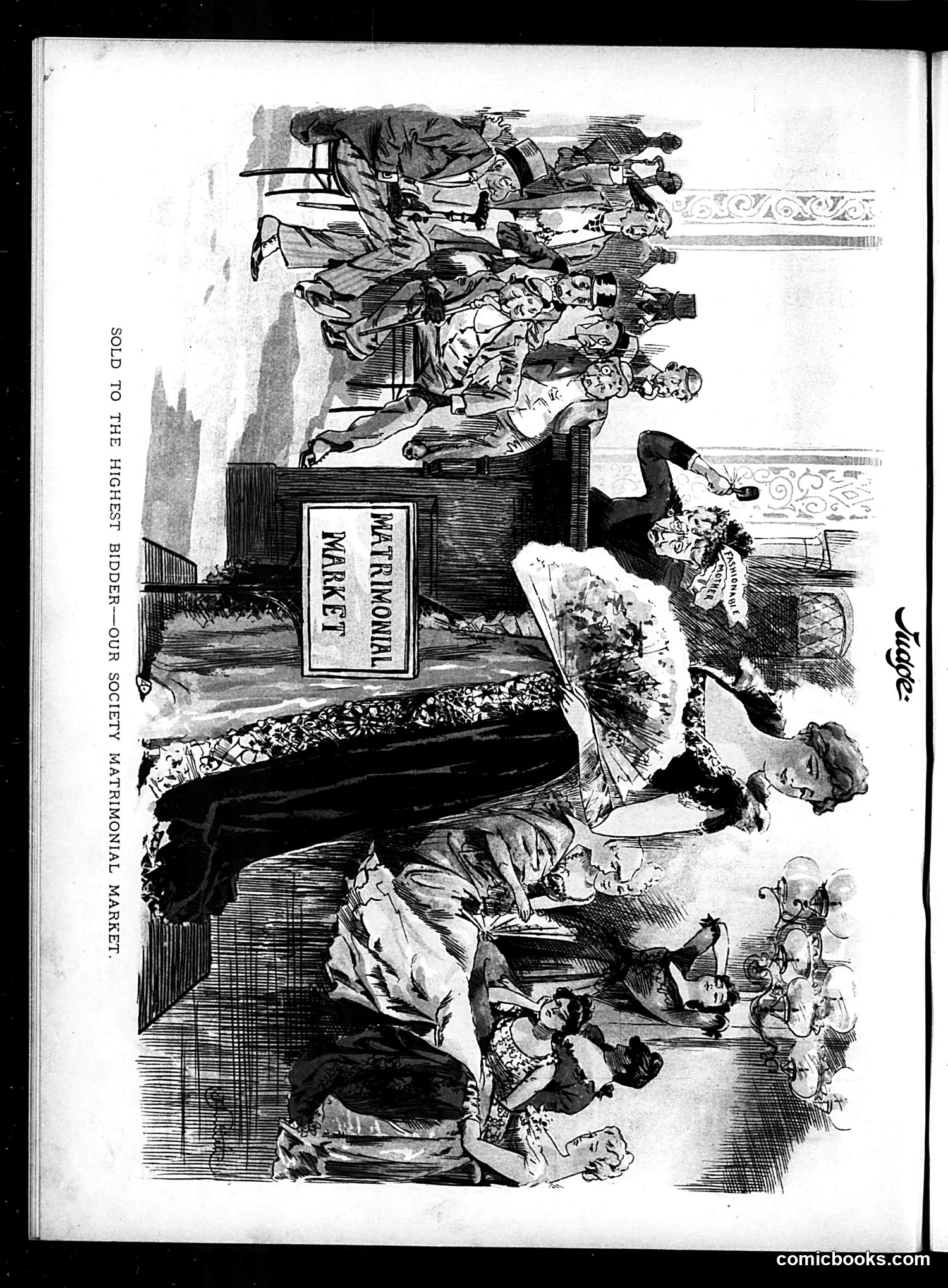
This satirical cartoon critiques wealthy American high society's approach to marriage as a commercial transaction rather than a romantic union. The central image shows an auctioneer's block labeled "Matrimonial Market" with well-dressed society women and men being literally auctioned off to the highest bidder. The satire suggests that among the elite classes, marriages were arranged based on financial considerations and social status rather than love or compatibility. The "sold to the highest bidder" language emphasizes how marriages functioned as business deals, with wealthy families essentially commodifying their daughters and sons in the marriage market. This reflects late 19th/early 20th-century anxieties about wealth inequality and the perceived moral corruption of high society.