
Judge, 1889-01-19 · page 2 of 16
Judge — January 19, 1889 — page 2: what you’re looking at
What you’re looking at
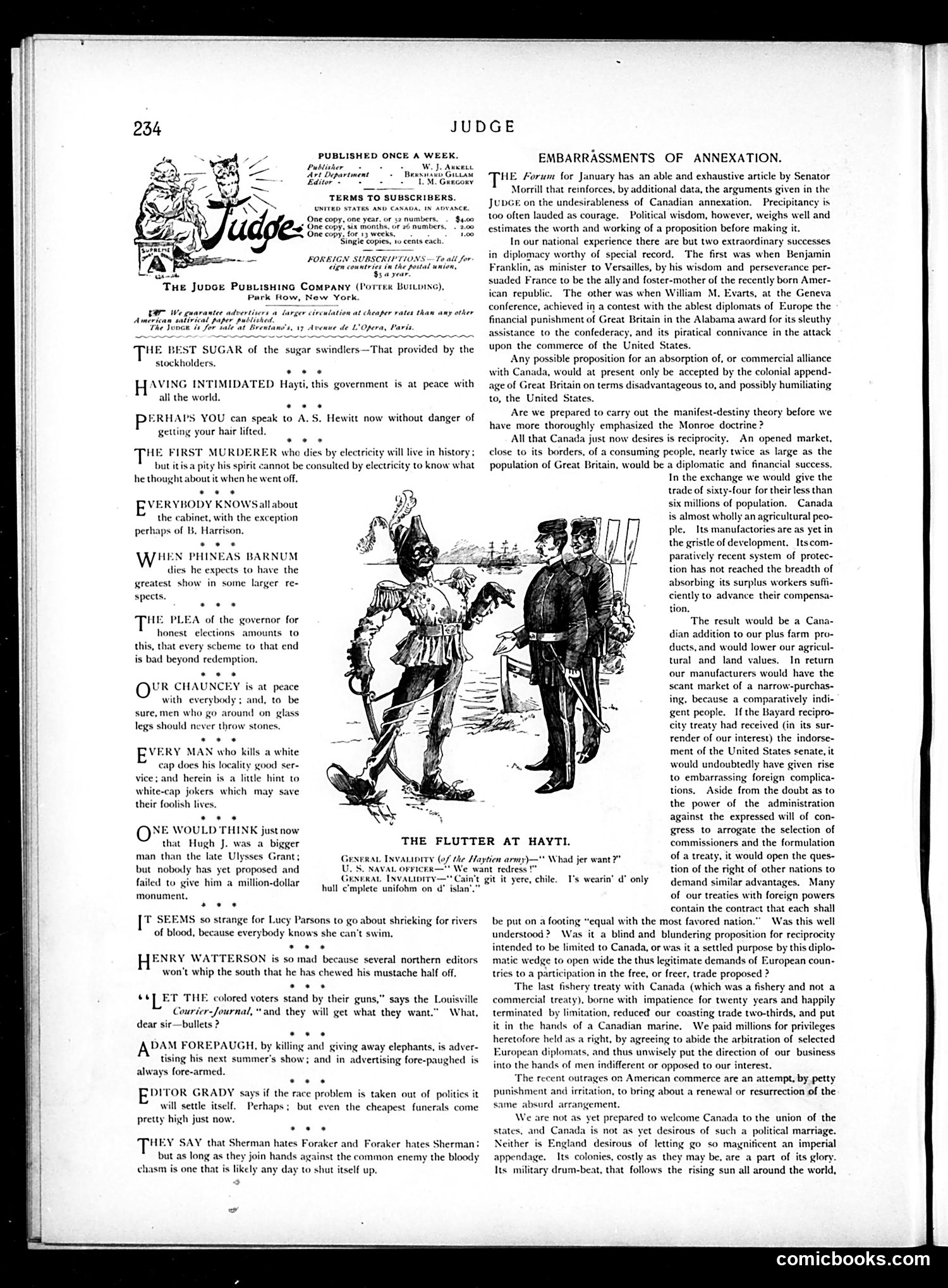
This cartoon satirizes American diplomatic tensions regarding Haiti. The caption quotes a general asking "What per wont?" in response to another officer's complaint about wanting "redress." The image depicts two military figures—one wearing a plumed hat (appearing to represent a foreign general or dignitary) confronting an American officer. The cartoon likely mocks confused or contradictory American military/diplomatic positions regarding Haiti, possibly referencing U.S. intervention or negotiations. The accompanying article "Embarrassments of Annexation" discusses proposed Canadian annexation to the U.S., arguing it would damage American agricultural interests and lower land values. The piece critiques American expansionist ambitions while questioning whether such territorial acquisitions serve national interests. Both items satirize American foreign policy overreach during this period.
📄 Transcribed text from this page (OCR, searchable)
Machine-transcribed from the original scan — historical spelling and the odd misread are preserved.
JUDGE PUBLISHED ONCE A WEEK. Publisher o W. J. Ameen Brxssico Giteast TM. Guecory TERMS TO SUBSCRIBERS. UNITED STATES AND CANADA, IN ADVANCE. $4.00 ‘six months, or 26 numbers, 2.00 for 13 weeks, 1.00 cents each. one year. of s2 numbers, UBSCRIVIIONS— To all for countries in the postal union, $5 4 year. Tue Jupoe Pusrisuina Company (lorrex Buttoinc), Park Row, New York. {97 We guarantee advertisers a larger circulation at cheaper rates than any other American if paper published. The Junce is for tale at Brent HE BEST SUGAR of the sugar swindlers—That provided by the stockholders. ty Avenue de L'Opera, Paris. eee AVING INTIMIDATED Hayti, this government is at peace with all the world. ERHAPS YOU can speak to A. S, Hewitt now without danger of getting your hair lifted. HE FIRST MURDERER who dies by electricity will live in history: but itisa pity his spirit cannot be consulted by electricity to know what he thought about it when he went off. EVERYBODY KNOWSallabout the cabinet, with the exception perhaps of 8, Harrison, ‘ PHINEAS BARNUM ¢ the greatest show in some larger re= spects. HE dies he expects to h: HE PLEA of the governor for honest elections amounts. to this, that every scheme to that end is bad beyond redemption. UR CHAUNCEY with ev is at peace nd, to. be sure, men who go around on glass legs should never throw stones. EVERY MAN who kills a white cap does his locality good ser- vice; and herein is a little hint to white-cap jokers which may save their foolish lives. NE WOULD THINK just now that Hugh J. was a bigger man than the late Ulysses Grant; but nobody has yet proposed and failed to give him a million-dollar monument. bod) Genera In S. NAVAL Gexerat. Iyvauiprry— hull c’'mplete unifohm on d ALADITY (¢ [T SEEMS so strange for Lucy Parsons to go about shrieking for rivers of blood, because everybody knows she can’t swim, ENRY WATTERSON is so mad because several northern editors won't whip the south that he has chewed his mustache half off. $6] ET THE colored voters stand by their guns,” says the Louisville Courier-Journal, “and they will get what they want.” What, dear sir—bullets ? ng and § and ing away elephants, is adver- advertising fore-paughed is ADAM FOREPAUGH, by kil tising his next summer's show always fore-armed. DITOR GRADY will settle itself. pretty high just now, ays if the race problem is taken out of politics it Perhaps; but even the cheapest funerals come HEY SAY that Sherman hates Foraker and Foraker hates Sherman: but as long as they join hands against the common enemy the bloody chasm is one that is likely any day to shut itself up. THE FLUTTER AT HAYTI. the Haxtien army)—* Whad jer want?" want redress !" 't git it yere, chile. EMBARRASSMENTS OF ANNEXATION. HE. Forum for January has an able and exhaustive article by Senator Morrill that reinforces, by additional data, the arguments given in the JUDGE on the undesirableness of Canadian annexation. Precipitancy is too often lauded as courage. Political wisdom, however, weighs well and estimates the worth and working of a proposition before making it. In our national experience there are but two extraordinary successes in diplomacy worthy of special record, The first was when Benjamin Franklin, as minister to Versailles, by his wisdom and perseverance per- suaded France to be the ally and foster-mother of the recently born Amer- ican republic. The other was when William M. Evarts, at the Geneva conference, achieved in a contest with the ablest diplomats of Europe the financial punishment of Great Britain in the Alabama award for its sleuthy assistance to the confederacy, and its piratical connivance in the attack upon the commerce of the United States. Any possible proposition for an absorption of, or commercial alliance with Canada, would at present only be accepted by the colonial append- age of Great Britain on terms disadvantageous to, and possibly humiliating to, the United States. Are we prepared to carry out the manifest-destiny theory before we have more thoroughly emphasized the Monroe doctrine ? All that Canada just now desires is reciprocity, An opened market, close to its borders, of a consuming people, nearly twice as large as the population of Great Britain, would be a diplomatic and financial success. In the exchange we would give the trade of sixty-four for their less than six millions of population. Canada is almost wholly an agricultural peo- ple. Its manufactories are as yet in the gristle of development. Itscom- paratively recent system of protec- tion has not reached the breadth of absorbing its surplus workers sufii- ciently to advance their compens tion, The result would be a Cana- dian addition to our plus farm pro- ducts, and would lower our agricul- tural and land values. In return our manufacturers would have the scant market of a narrow-purchas- ing, because a comparatively indi- gent people. If the Bayard recipro- city treaty had received (in its sur- render of our interest) the indorse- ment of the United States senate, it would undoubtedly have given rise to embarrassing foreign complica- tions, Aside from the doubt as to the power of the administration against the expressed will of con- gress to arrogate the selection of commissioners and the formulation of a treaty, it would open the ques- tion of the right of other nations to demand similar advantages. Many of our treaties with foreign powers contain the contract that each shall be put on a footing “equal with the most favored nation.” Was this well understood? Was it a blind and blundering proposition for reciprocity intended to be limited to Canada, or was it a settled purpose by this diplo- matic wedge to open wide the thus legitimate demands of European coun- tries to a participation in the free, or freer, trade proposed ? The last fishery treaty with Canada (which was a fishery and not a commercial treaty), borne with impatience for twenty years and happily terminated by limitation, reduced our coasting trade two-thirds, and put it in the hands of a Canadian marine. We paid millions for privileges heretofore held as a right, by agreeing to abide the arbitration of selected European diplomats, and thus unwisely put the direction of our business into the hands of men indifferent or opposed to our interest. The recent outrages on American commerce are an attempt, by petty punishment and irritation, to bring about a renewal or resurrection of the same absurd arrangement. We are not as yet prepared to welcome Canada to the union of the states, and ous of such a political marriage. Neither is England desirous of letting go so magnificent an imperial appendage. Its colonies, costly as they may be, are a part of its glory. Its military drum-beat, that follows the rising sun all around the world, T's wearin’ d’ only a is not as yet de comicbooks.com