
A complete issue · 19 pages · 1888
Judge — December 29, 1888
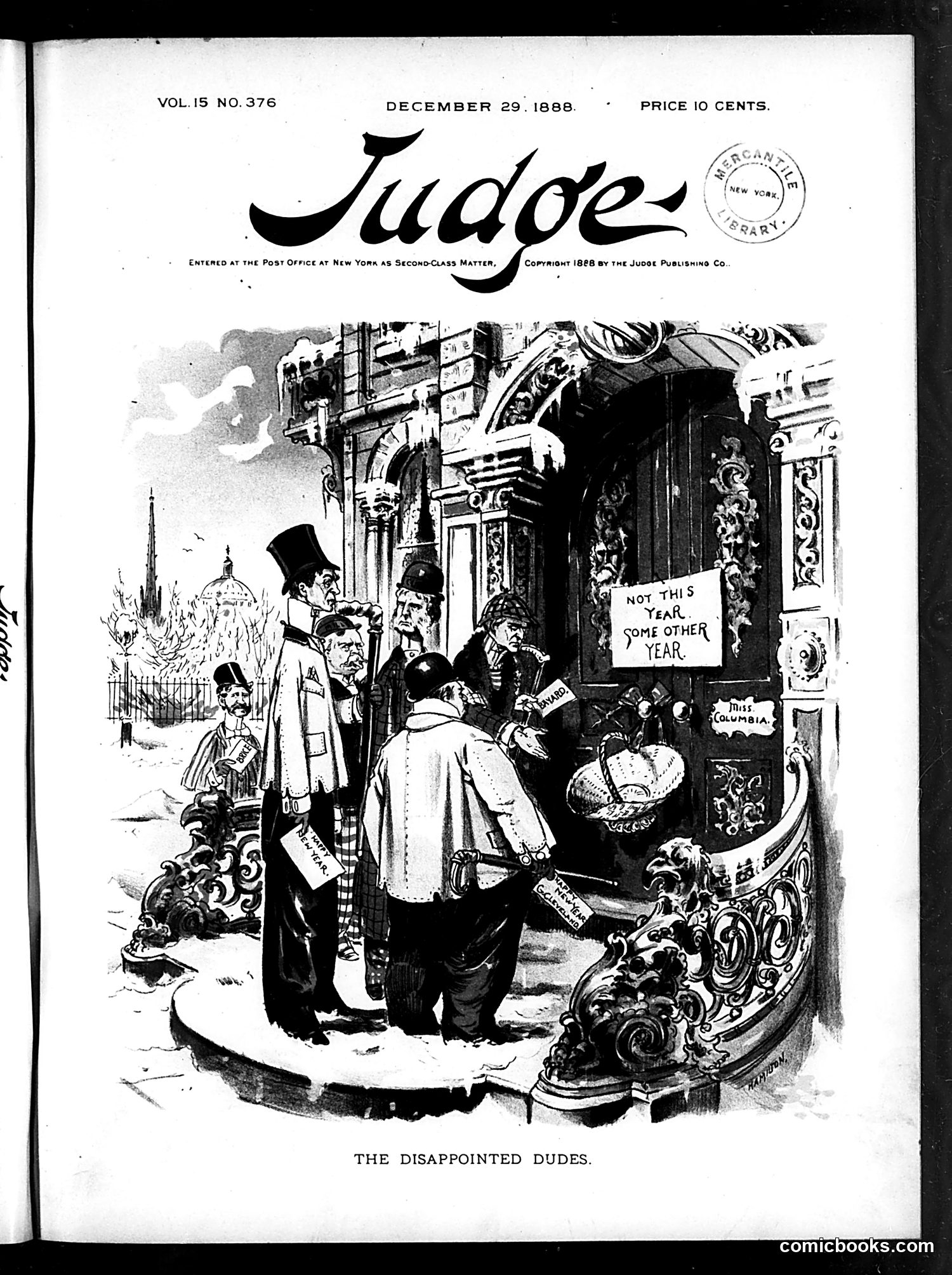
This December 1888 cartoon satirizes wealthy, fashionable men ("dudes"—a contemporary term for dandified gentlemen) gathered at an ornate building's entrance. A doorman or attendant holds a sign reading "NOT THIS YEAR / SOME OTHER YEAR," apparently refusing them entry to a social event or venue. The figures' elaborate clothing—top hats, formal coats—emphasizes their pretension. The architectural grandeur and decorative details underscore the exclusivity they're denied. The joke appears to target the fashionable set's disappointment at being denied access to exclusive society events, possibly mocking their social climbing or the arbitrary nature of elite admissions. The specific event referenced remains unclear from the image alone, but the satire targets vanity and social aspiration among the wealthy.
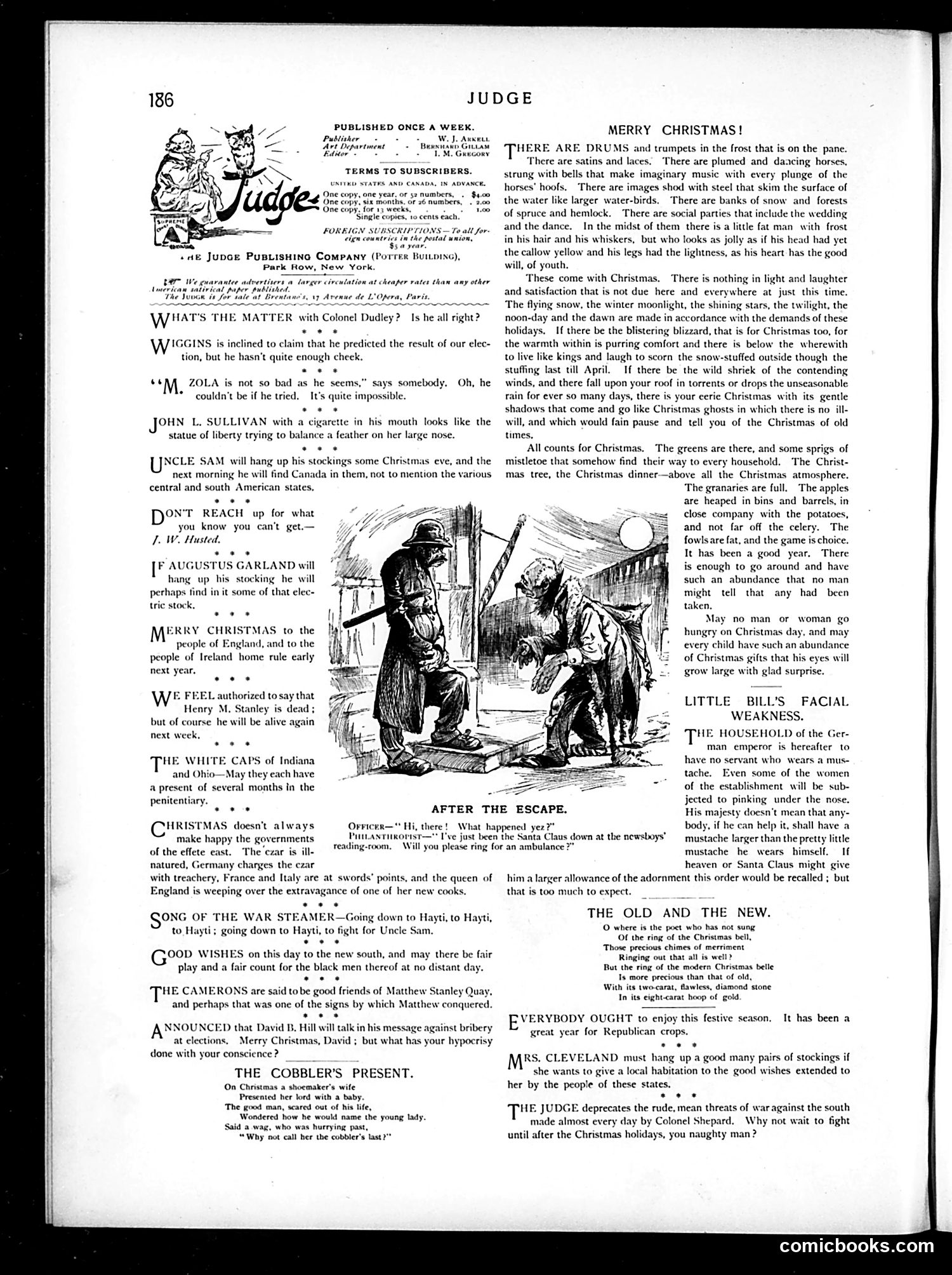
The main cartoon depicts two figures—one appears to be a police officer or authority figure, the other a disheveled prisoner or escapee. The caption reads: "Officer—'Hi there! What happened sir?' 'Th[e] patient...I've just come from the newsboys' reading-room. Will you please ring for an ambulance?'" This is satirical commentary on newspaper conditions or the chaotic environment of newsboys' spaces. The joke suggests that merely being in a newsroom is so distressing that the person requires medical attention—likely mocking either the sensationalism of contemporary journalism or the rowdy, unsanitary conditions newsboys endured. The cartoon's humor relies on exaggerating journalism's chaos as literally injurious to one's health.
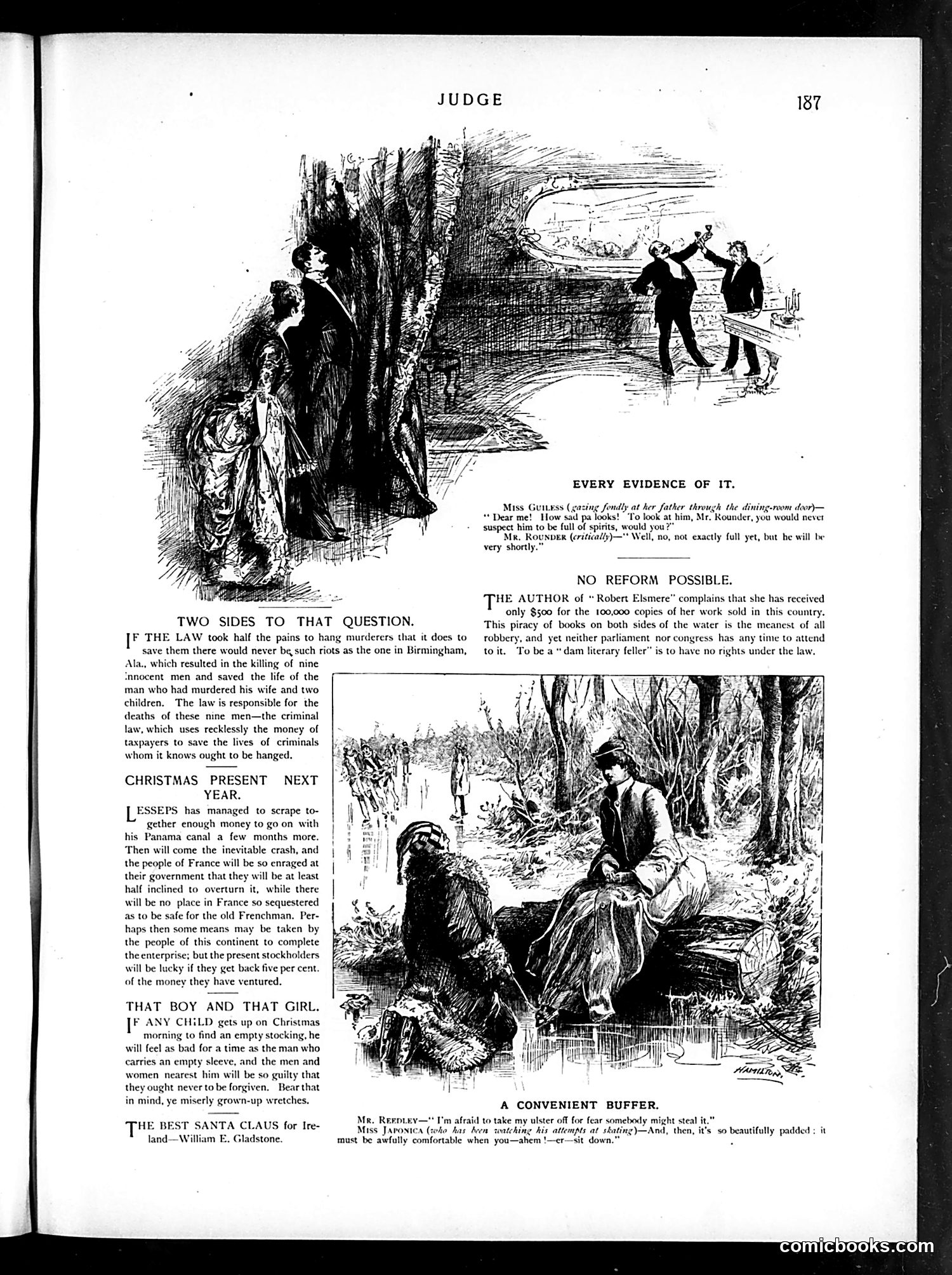
This page from Judge contains several satirical pieces mocking contemporary issues: **"Two Sides to That Question"** critiques the legal system's inconsistency: while courts spend resources defending murderers on appeal, a lynch mob in Birmingham, Alabama killed nine people. The satire targets legal delays that enable criminals to escape justice. **"Every Evidence of It"** is a drinking joke: Miss Gutless notes her father looks sad "full of spirits," while Mr. Rounder quips he'll soon be actually drunk—playing on "spirits" (liquor) versus emotional state. **"No Reform Possible"** complains that author Mary Darmesteter received only $500 for 100,000 copies sold due to book piracy on both sides of the Atlantic, yet Congress/Parliament ignore literary theft. **"Christmas Present Next Year"** satirizes Ferdinand de Lesseps' failing Panama Canal venture, predicting French investors will lose money when it collapses. The remaining items mock miserly parents withholding Christmas gifts and suggest William Gladstone as "Santa Claus for Ireland" (unclear reference).
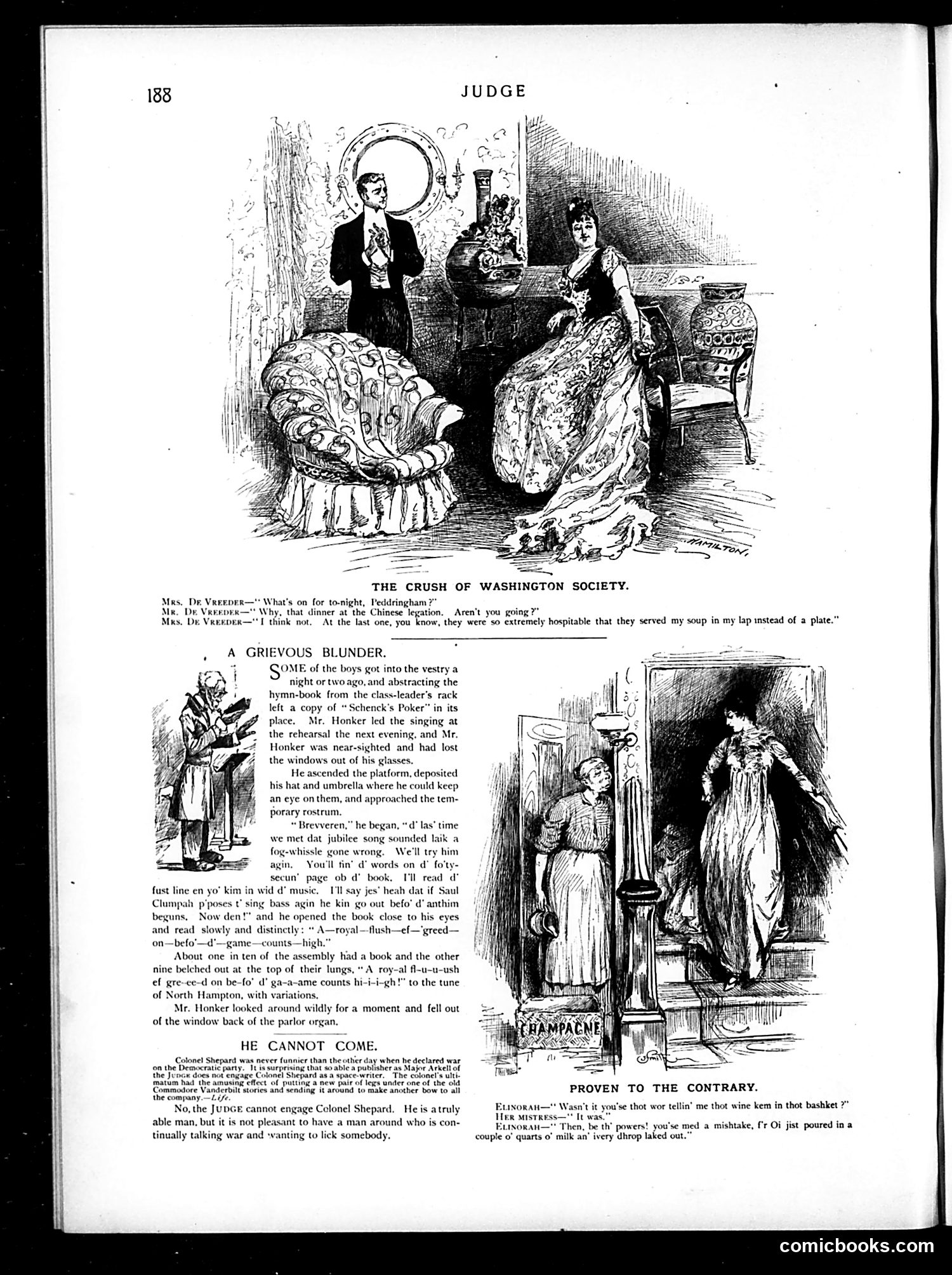
**"The Crush of Washington Society"** satirizes the pretensions of Washington's elite social circles. Mrs. De Vreeper complains about a Chinese embassy dinner where guests were served so carelessly that soup was spilled in her lap rather than properly plated—a joke mocking both the supposed sophistication of diplomatic functions and the implied clumsiness of Chinese hosts (reflecting period racial stereotypes). **"A Grievous Blunder"** depicts a church choir mishap: pranksters swap a hymn-book for a poker guide. The near-sighted choir leader Mr. Honker unknowingly reads nonsensical text ("royal-flush-ef-greed") aloud while the congregation sings gibberish to the tune of "North Hampton," creating comic chaos. **"He Cannot Come"** references Colonel Shepard (likely a Democratic politician), noting Judge magazine won't hire him as a writer despite his abilities, because he's perpetually aggressive about wanting conflict. **"Proven to the Contrary"** shows Irish servants discussing a wine basket—the punchline being milk was poured into it instead, undermining any claims of sophistication.
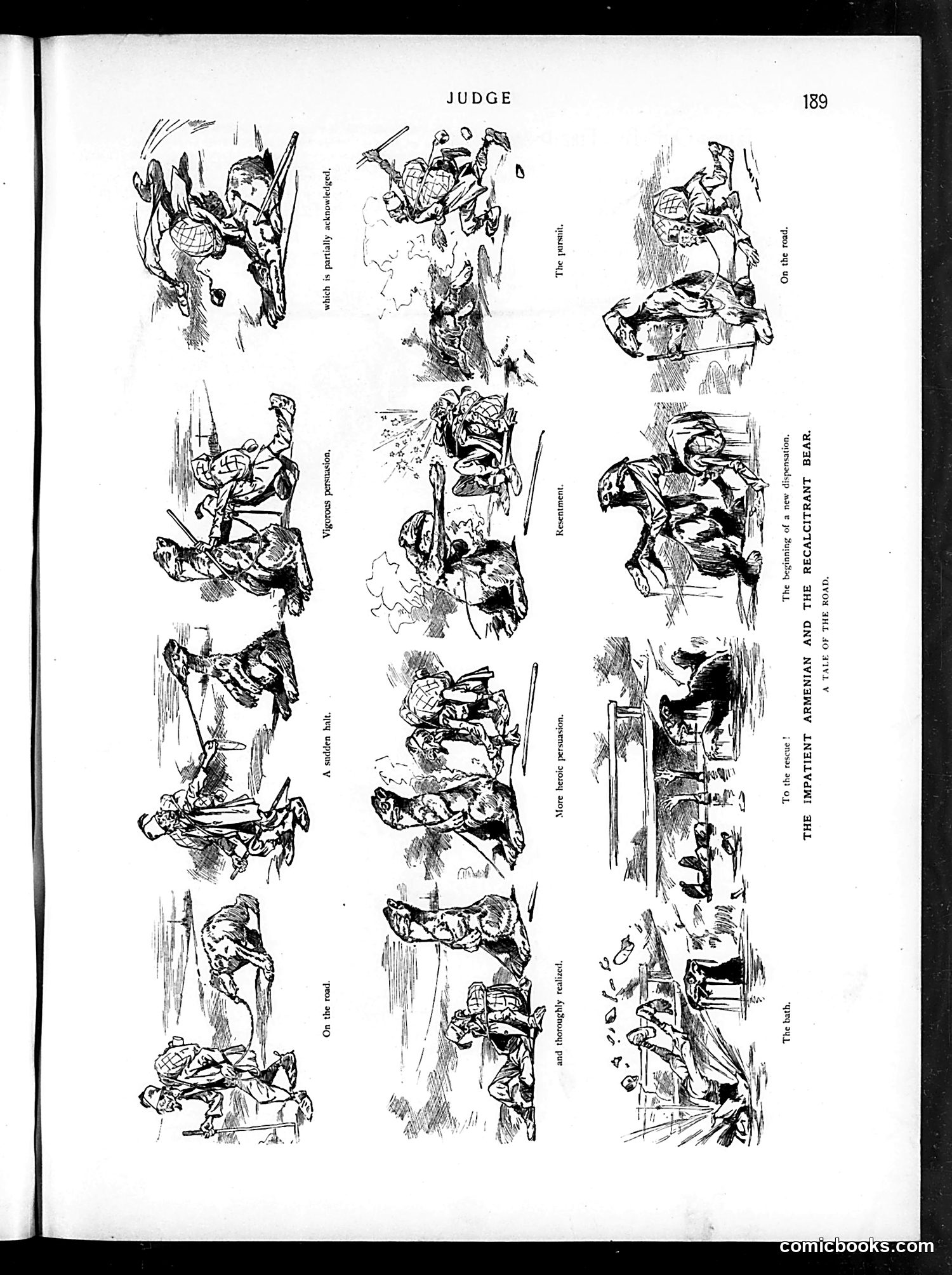
I cannot reliably interpret this page. The OCR text appears heavily corrupted or inverted, making it unreadable. While the image shows multiple sketch-style cartoon panels arranged vertically in three columns—typical of Judge magazine's format—the degraded text labels prevent me from identifying specific figures, historical references, or the satirical points being made. To properly explain this content to a modern reader, I would need legible captions or text. Without them, I can only note this appears to be political or social satire from Judge's publication period, but cannot assert specific identifications or meanings.
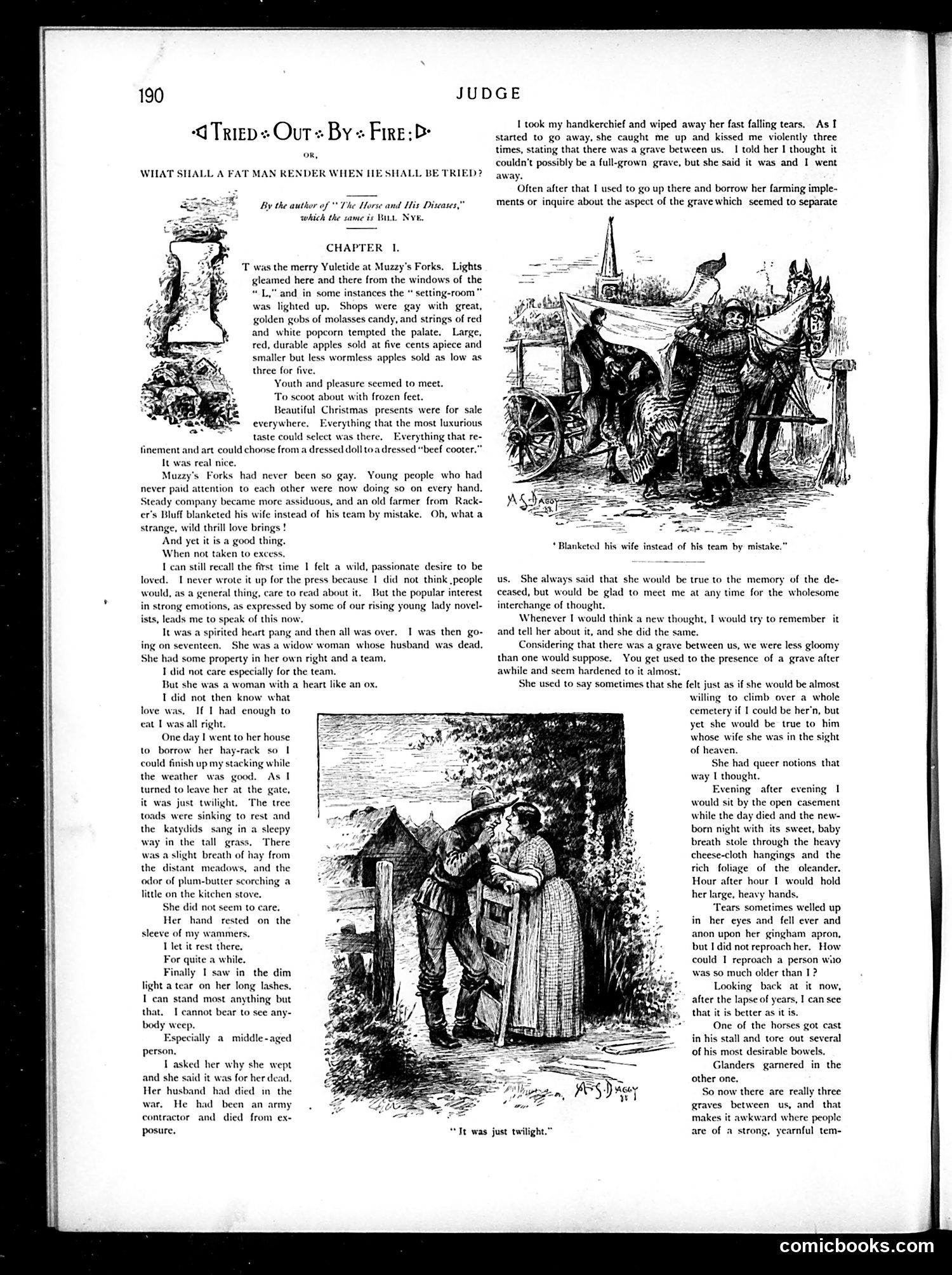
This page contains the opening of a serialized humorous story by Bill Nye (credited as author of "The Horse and His Diseases"), a popular 19th-century American humorist. The title's pun—"What Shall a Fat Man Render When He Shall Be Tried?"—plays on legal/biblical language. The narrative is a sentimental-comedic romance set at "Muzzy's Forks" during Christmas. The unnamed narrator describes falling in love with a widow woman whose deceased husband (killed in war) creates a metaphorical "grave between us." The humor derives from Nye's deadpan, folksy narrative voice describing rural courtship—mixing genuine pathos (her grief, his awkward tenderness) with absurd details (the farmer blanketing his wife instead of his team, the specific apple prices). The accompanying illustrations depict rural Victorian scenes. This is literary humor typical of Judge's content: sentimental Americana filtered through comedic exaggeration and the author's distinctive vernacular voice.
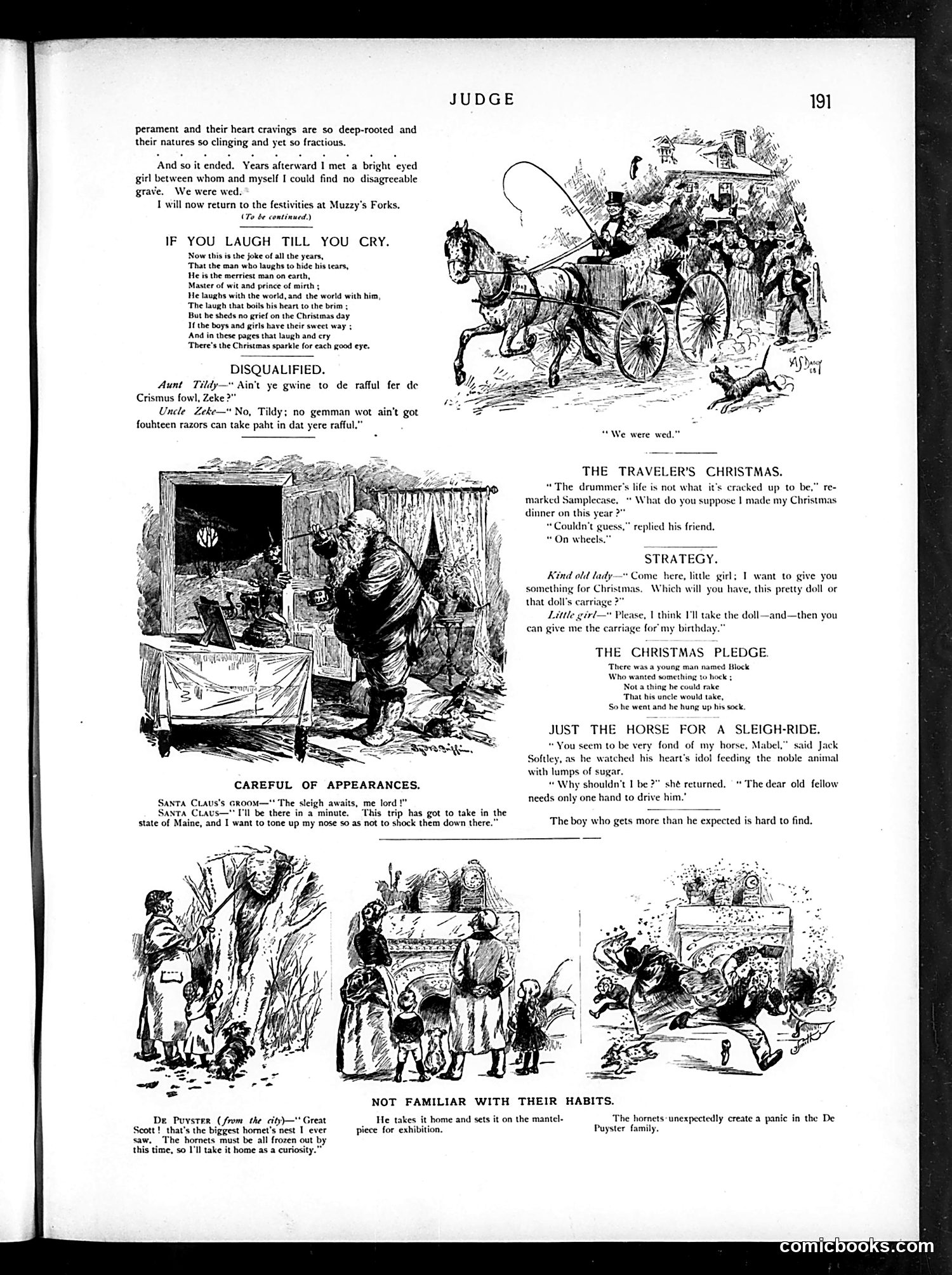
This page contains multiple brief Christmas-themed jokes and satirical sketches typical of late 19th-century American humor. **"Disqualified"** mocks rural African American dialect, portraying stereotyped characters discussing a raffle requiring "fourteen razors"—a racist trope associating Black men with violence. **"The Traveler's Christmas"** jokes about a traveling salesman eating meals "on wheels" (train travel), mocking the itinerant lifestyle. **"Strategy"** depicts a child's cunning: accepting a doll as a Christmas gift, then demanding a carriage for her birthday—satirizing childhood manipulation and gift-seeking behavior. **"Just the Horse for a Sleigh-Ride"** romanticizes courtship, with a young woman bonding with her suitor's horse through affection. **"Not Familiar with Their Habits"** shows a city dweller naively collecting a hornet's nest as a "curiosity," causing panic when brought indoors—mocking urban ignorance of rural/natural dangers. The page is primarily entertainment content rather than political commentary, reflecting Judge's focus on social satire and domestic humor.
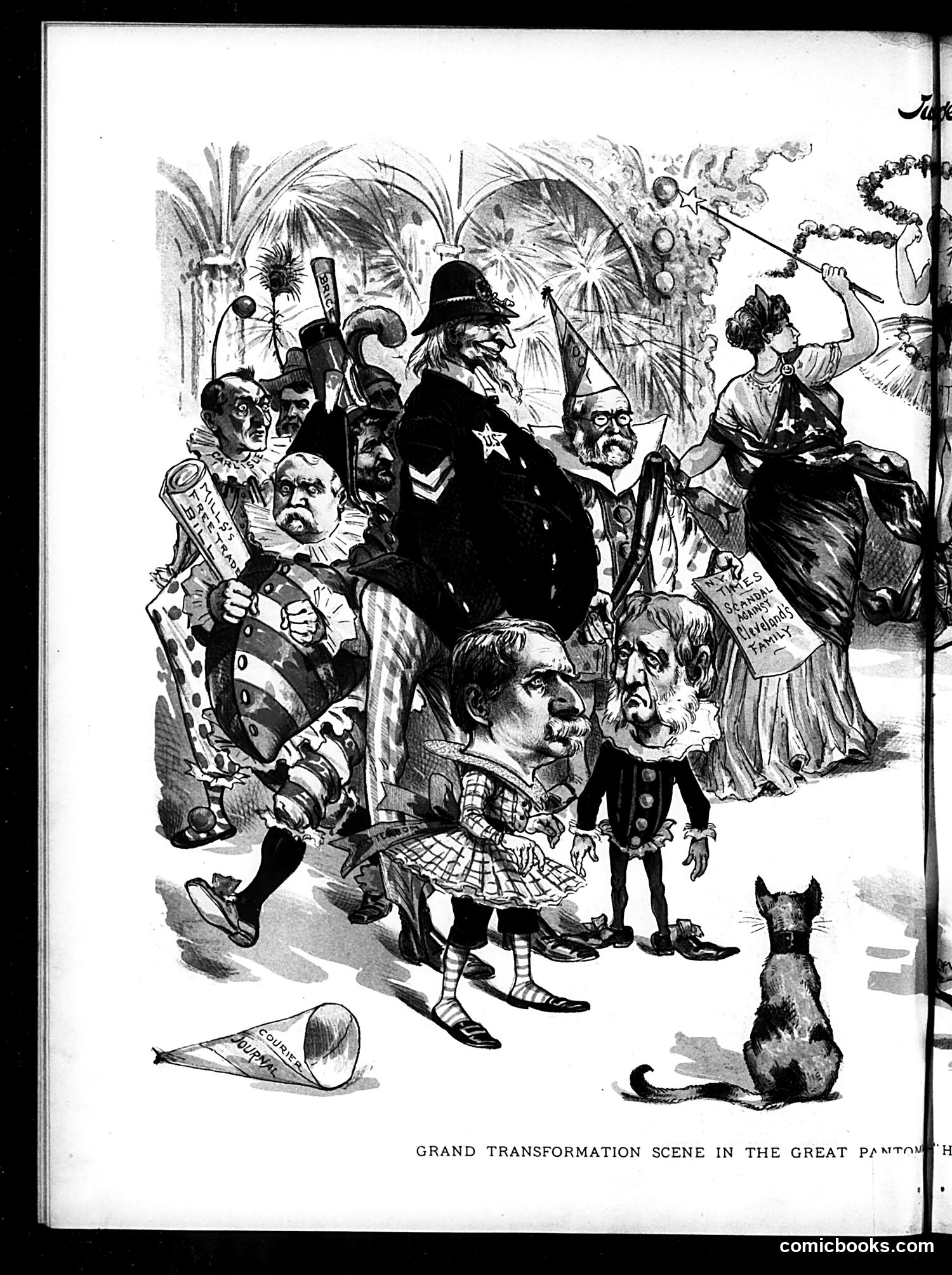
This satirical cartoon depicts a theatrical "transformation scene" (a pantomime staple) populated by exaggerated political figures in costume. The central tall figure wearing a star and military attire appears to be the primary target of mockery, surrounded by various caricatured politicians and dignitaries in theatrical dress. A dog observes the spectacle at bottom right. The cartoon satirizes political leadership as theatrical performance—suggesting politicians are actors in a grand show rather than serious statesmen. The pantomime framing implies their actions are fantastical and unreal. Without the magazine's date and publication context, specific identities remain unclear, but the satire targets the performative, absurd nature of contemporary politics and government pretense.
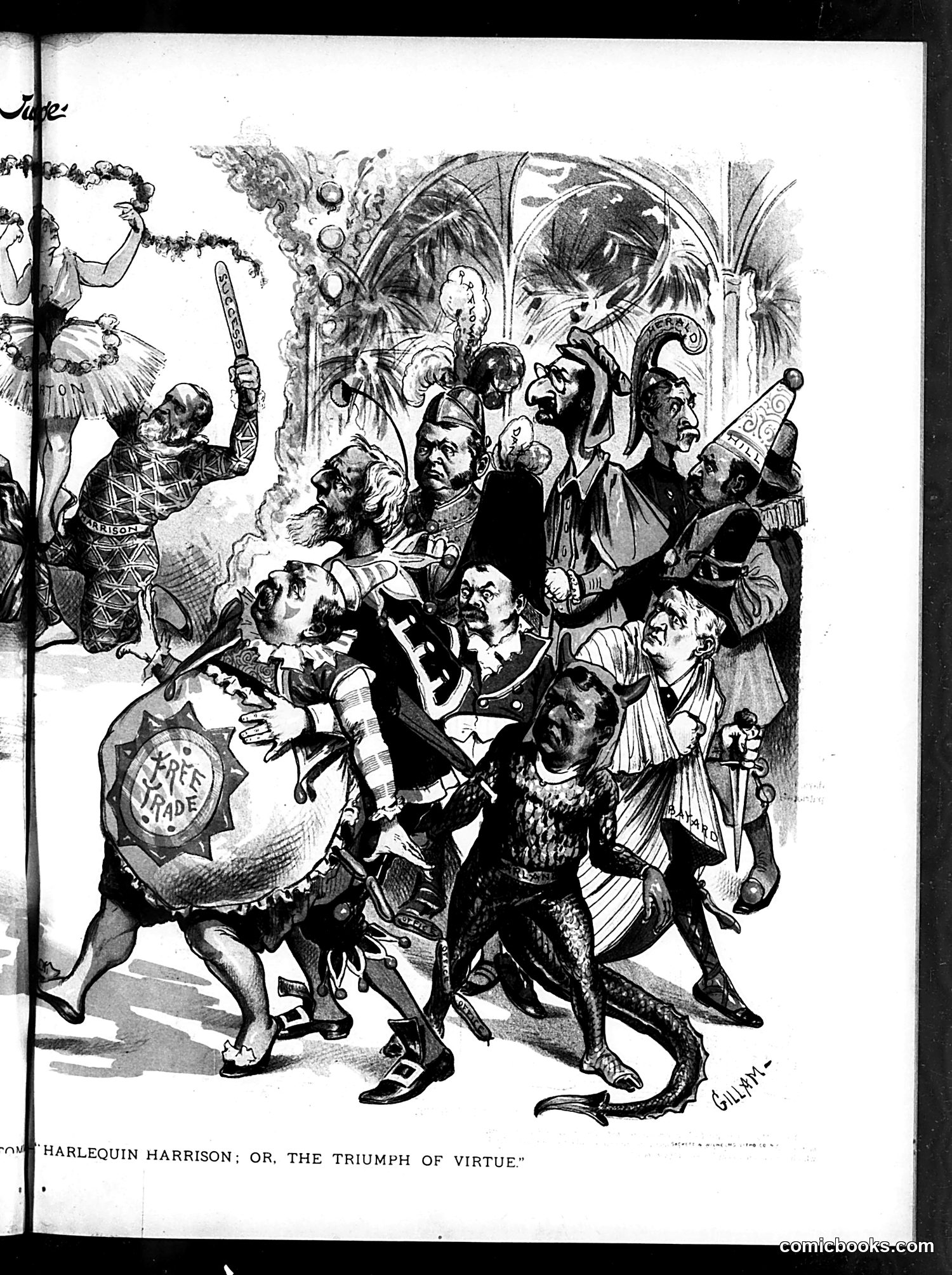
This political cartoon satirizes William Henry Harrison, likely from his 1840 presidential campaign. The title's reference to "Harlequin" (a comic character known for deception) suggests Harrison is being mocked as a theatrical performer rather than a serious statesman. The central figure appears to be Harrison surrounded by supporters in elaborate costumes and military dress. The drum marked "FREE TRADE" indicates economic policy was at issue. The chaotic, carnival-like scene—complete with performers and celebration—implies Harrison's campaign relied on spectacle and showmanship rather than substantive governance. The ironic subtitle "Triumph of Virtue" suggests the opposite: that his victory would represent the triumph of deception and political theater over genuine leadership.
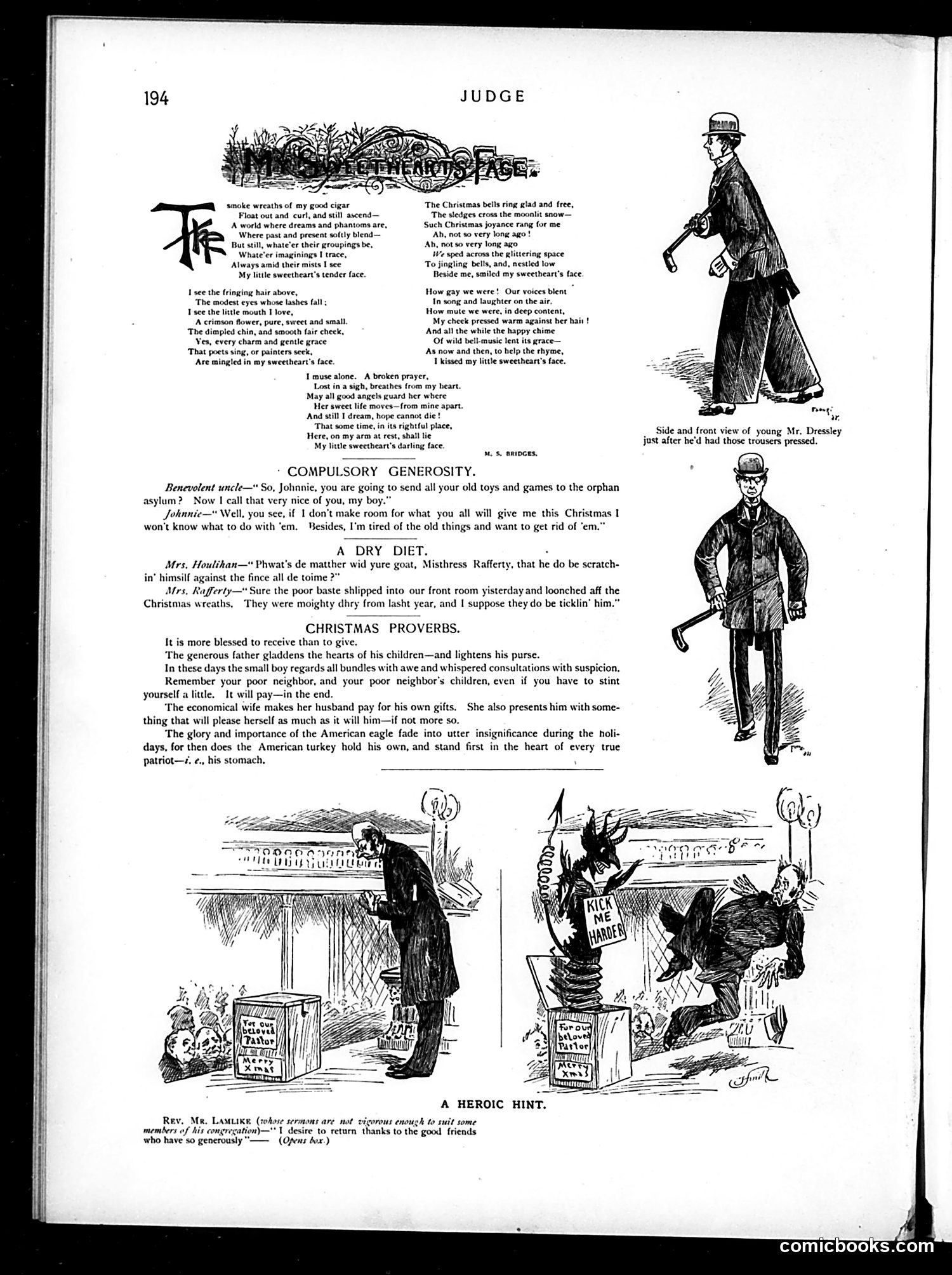
This page contains several humorous Christmas-themed pieces typical of early 20th-century American satire: **"Compulsory Generosity"** mocks children's self-interest: a boy claims he's donating toys to orphans, but actually wants room for new Christmas gifts and is tired of old things—exposing the hollow virtue of forced charity. **"A Dry Diet"** jokes about a goat eating dried Christmas wreaths from the previous year, scratching itself uncomfortably afterward—poking fun at thrifty (or cheap) households. **"Christmas Proverbs"** sarcastically inverts moral teachings: "It is more blessed to receive than to give," and notes how wives give husbands gifts they actually want for themselves. The final jab suggests Americans care more about eating turkey than patriotism. **"A Heroic Hint"** (bottom) appears incomplete in this OCR but likely involves the tailored suit illustrations of "Mr. Dressley" shown above—probably satirizing fashion or masculine vanity. The sentimental poem about a sweetheart provides tonal contrast to the satirical humor.
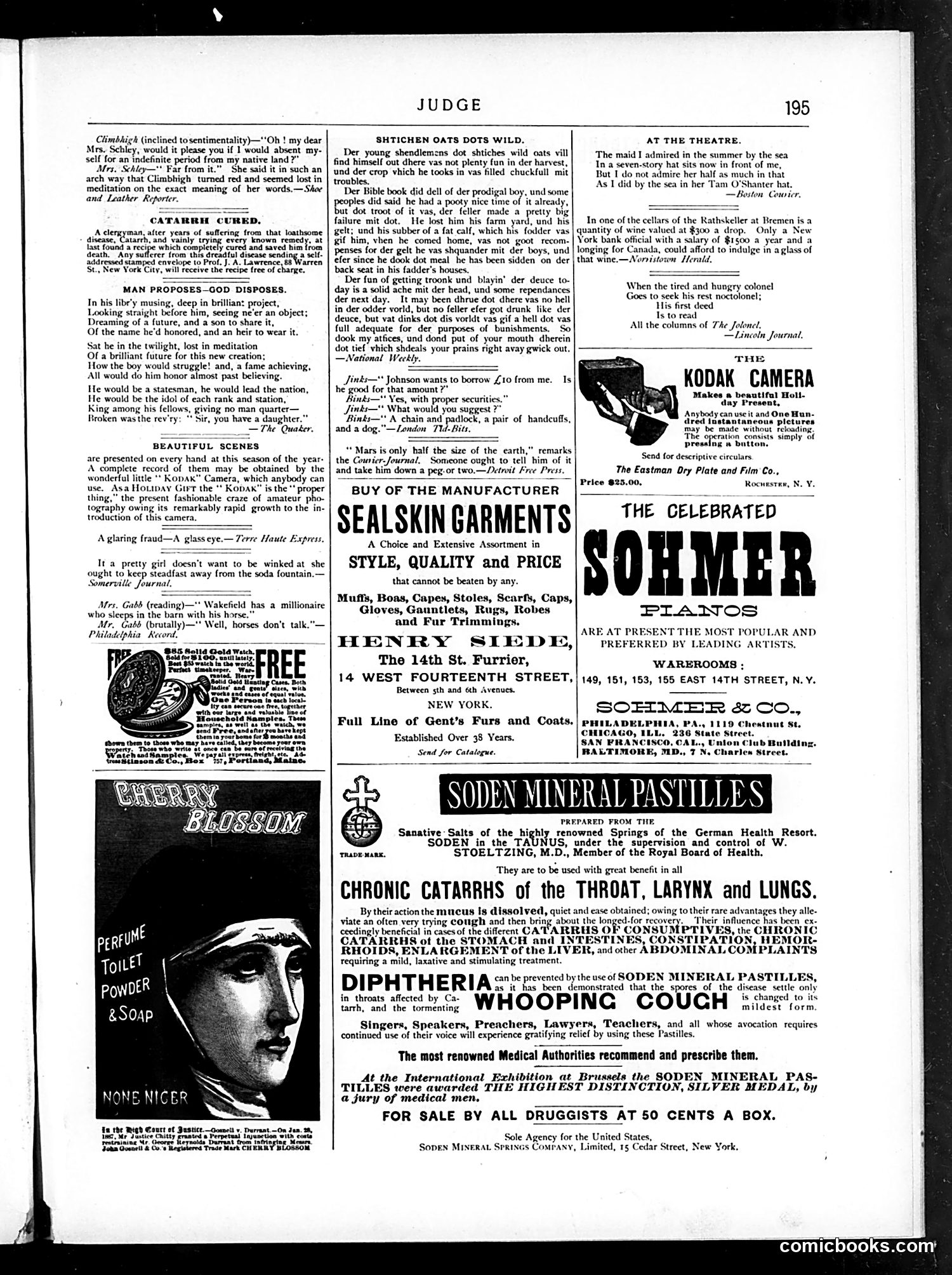
This page is primarily **advertisements and humor columns** rather than political cartoons. The main satirical content includes: **"Kitchen Oats Dots Wild"** — A dialect humor piece mocking German immigrants. It's a moralizing story about wild oats and sin, written in exaggerated German-accented English. The humor relies on stereotypical speech patterns ("der," "vhich," "vorldt") and was common period entertainment, though now considered offensive ethnic stereotyping. **"Man Proposes—God Disposes"** — A sentimental poem about a man dreaming of a son to carry on his name, only to learn his wife had a daughter instead. This reflects late-19th-century gender disappointment. **Minor quips** mock women at soda fountains and a man sleeping with horses. The bulk of the page consists of **product advertisements**: Sohmer pianos, Sealskin garments, Kodak cameras, and Soden mineral pastilles (a medical cure-all). This reflects Judge magazine's revenue model through advertising.
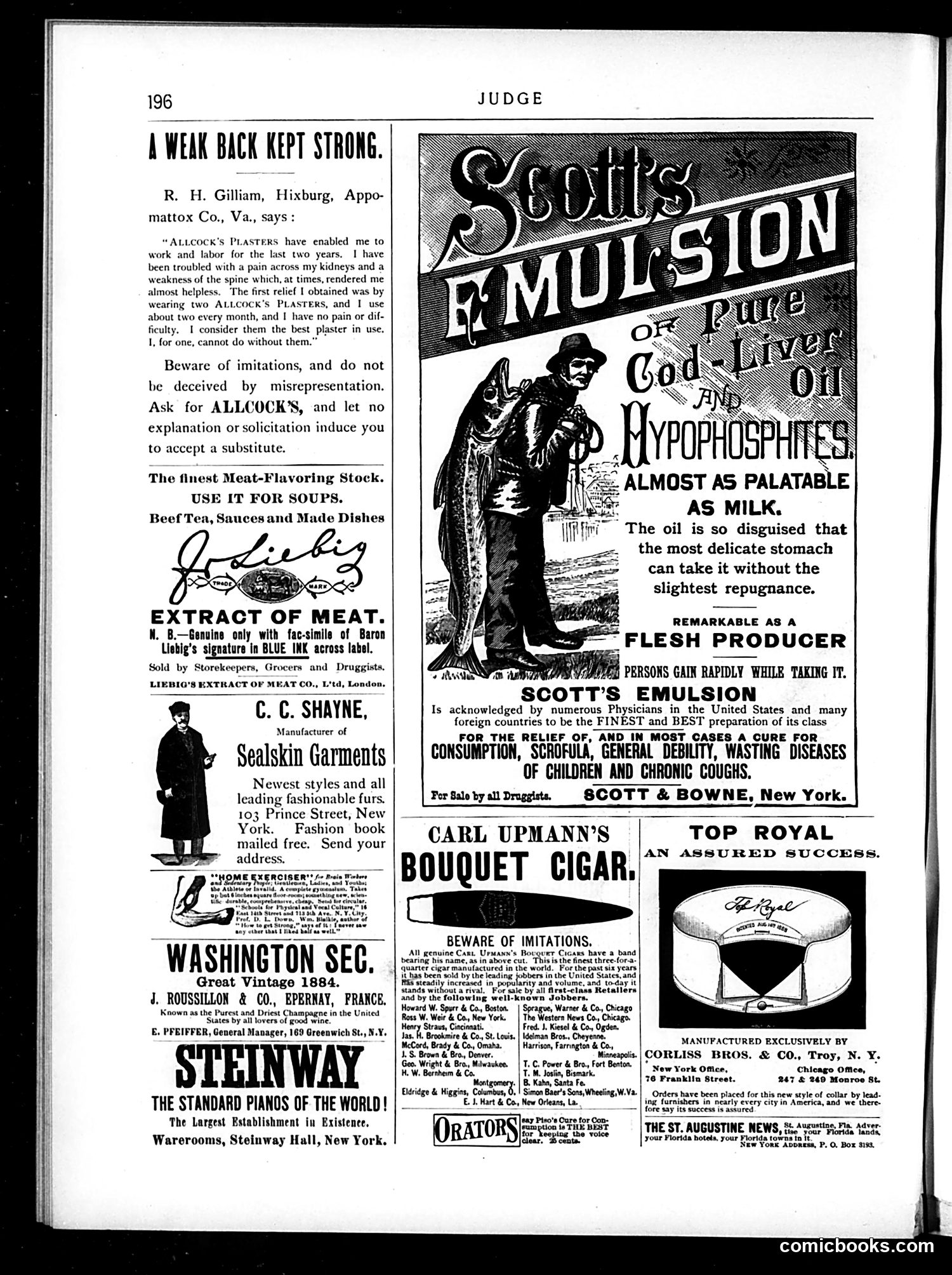
This page is primarily **advertisements**, not editorial content or satire. It showcases patent medicines and consumer products typical of the 1880s-90s era. Notable ads include: - **Allcock's Plasters**: A testimonial claiming relief for back pain and kidney weakness—representative of the era's unregulated medical device marketing - **Scott's Emulsion**: Cod liver oil presented as a "flesh producer" for consumption, scrofula, and wasting diseases in children—examples of dubious health claims common then - **Liebig's Extract of Meat**: Marketed as meat-flavoring stock - **Sealskin Garments** by C.C. Shayne - **Steinway Pianos**: "Standard pianos of the world" - **Carl Upmann's Bouquet Cigars**: Warning against imitations The repeated warnings against counterfeits ("Beware of imitations") reflect widespread consumer fraud of the period. These ads reveal how unregulated patent medicines and dubious health products dominated late-Victorian advertising, before the FDA's establishment in 1906.
This page is primarily **advertising**, not political satire. It's a typical late-19th-century magazine advertisement section featuring various commercial products and services. Notable ads include: - **Pears' Soap** (prominent): A British soap marketed with racist undertones, promising "fair white hands" and "bright clear complexion"—reflecting period beauty standards that privileged whiteness - **Transportation**: Iron Mountain Route, Monon Route, and West Shore Railroad ads promoting travel to western US and Hudson River routes - **Consumer goods**: Steam engines, pianos, cameras, patent medicines (including opium treatment) - **Publishing**: A novel titled *Star-Crossed* about an actress's life The page includes a brief poem by "Carl Pretzel" about a fight between "Shack" and "Shill"—possibly ethnic caricature humor, though the dialect spelling suggests German or similar immigrant stereotyping. This reflects Judge's era: while known for political cartoons, pages like this reveal how mainstream publications monetized period prejudices through advertising.
This is primarily an **advertising and promotional page**, not a satirical cartoon page. The dominant content is ads for hotels, pens, patent medicines, and the Christmas issue of Judge magazine itself. The one visible **joke/cartoon** appears midway down: a brief dialogue where a man points out a wealthy well-dressed gentleman, claiming "thirteen years ago that man hadn't enough money to pay his board; to-day he is worth two millions of dollars." When asked how he made it, the answer is blunt: "He didn't make it; he stole it; but he's got it just the same." **The satire**: This is social commentary on **Gilded Age wealth accumulation**, suggesting that conspicuous riches often come through dishonest means rather than honest labor—a common Progressive-era critique of robber barons and industrial titans. The joke's punch lies in the casual admission of criminality masked by respectability and fine clothing. The page otherwise showcases advertisements typical of late-19th-century American magazines: luxury hotels, writing implements, and medicinal tonics.
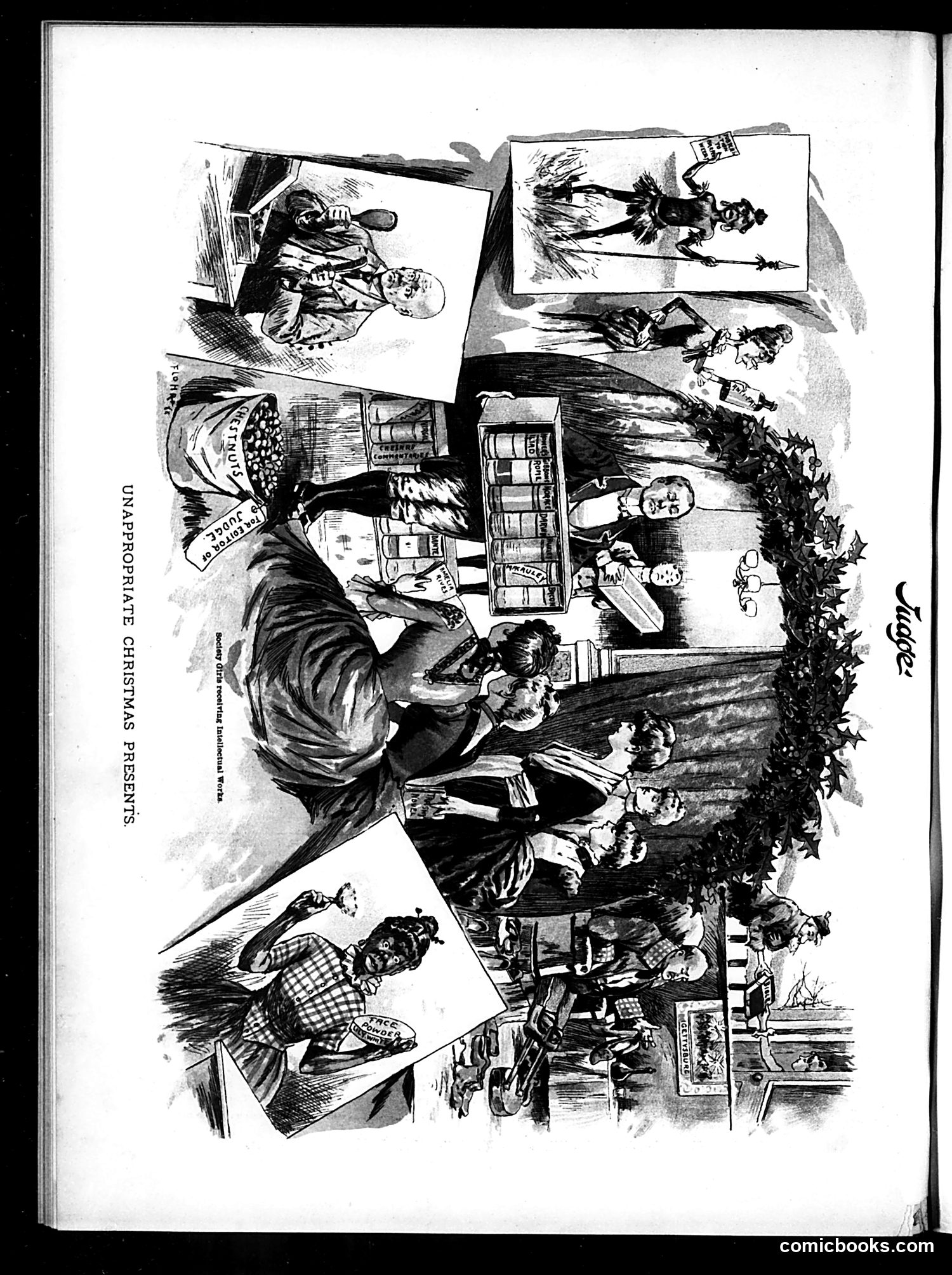
This Judge cartoon satirizes the gap between what wealthy adults gift to poor children during Christmas. The central figure appears to be a well-dressed gentleman selecting gifts from an upscale shop. The surrounding vignettes show the contrasting outcomes: wealthy children receive toys, dolls, and fine goods, while poor children receive practical but dreary items like coal, work clothes, and basic necessities. The satire critiques class inequality and hypocrisy in holiday charity—the notion that Christmas generosity is shaped entirely by social status rather than genuine goodwill. The title emphasizes this irony: what counts as "inappropriate" depends wholly on the recipient's wealth. This reflects Gilded Age social commentary on inadequate welfare and the patronizing nature of class-based gift-giving.
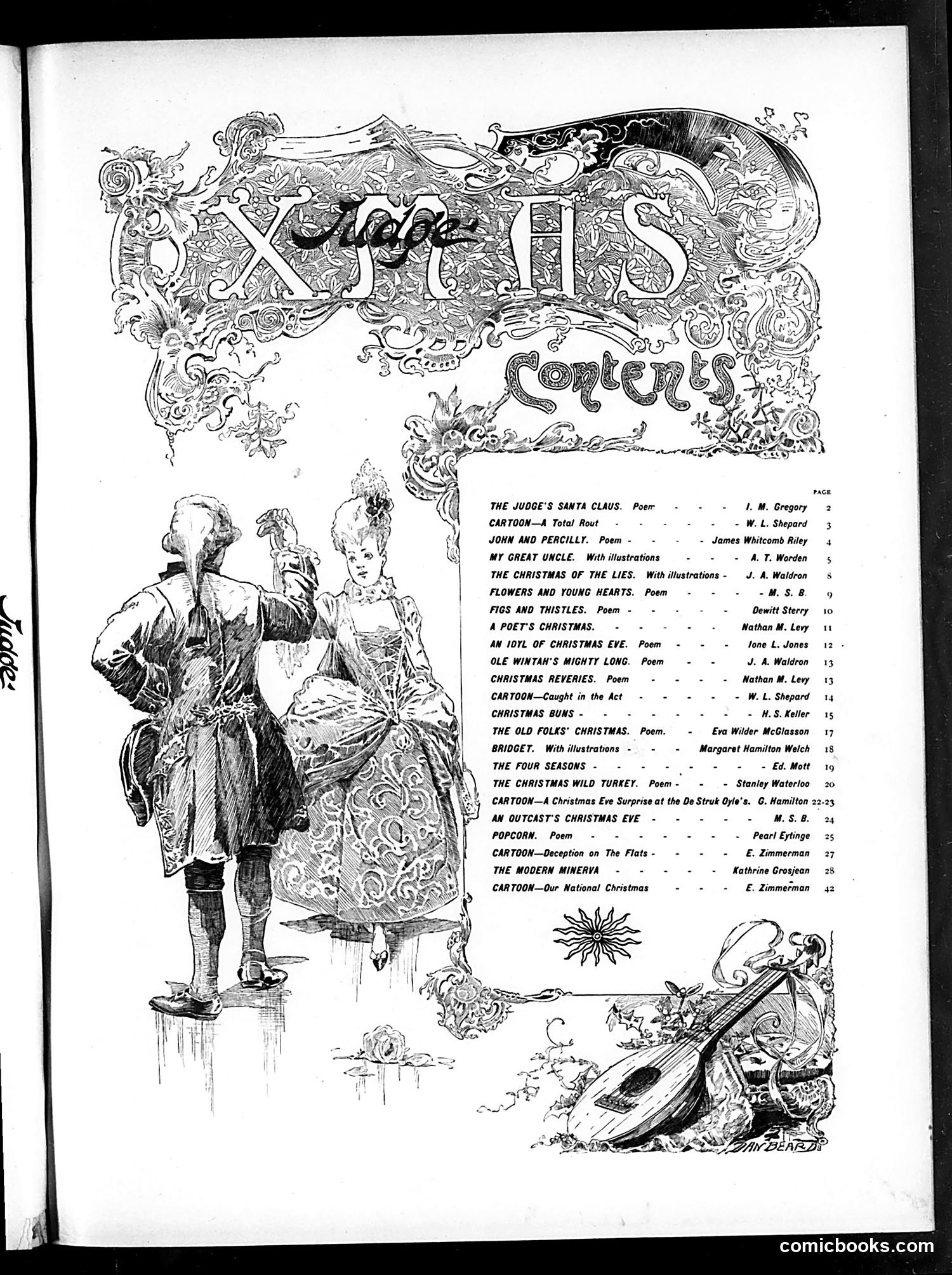
This is a **table of contents page** for a Christmas-themed issue of Judge magazine, not a satirical cartoon itself. The decorative header reading "XMAS CAROLS" features ornate Victorian flourishes typical of the era's design. The page lists holiday-themed poetry, prose, and cartoons contributed by various writers and illustrators. Notable among them is **James Whitcomb Riley**, a celebrated American poet, contributing "John and Percilly." The cartoons by **W.L. Shepard** and **E. Zimmerman** address social themes—"A Total Rout," "Caught in the Act," and "Deception on The Flats"—suggesting satirical commentary on contemporary society, though the specific subjects aren't visible without the actual cartoon images. The illustration shows two well-dressed Victorian-era figures, likely representing the magazine's audience or seasonal themes.
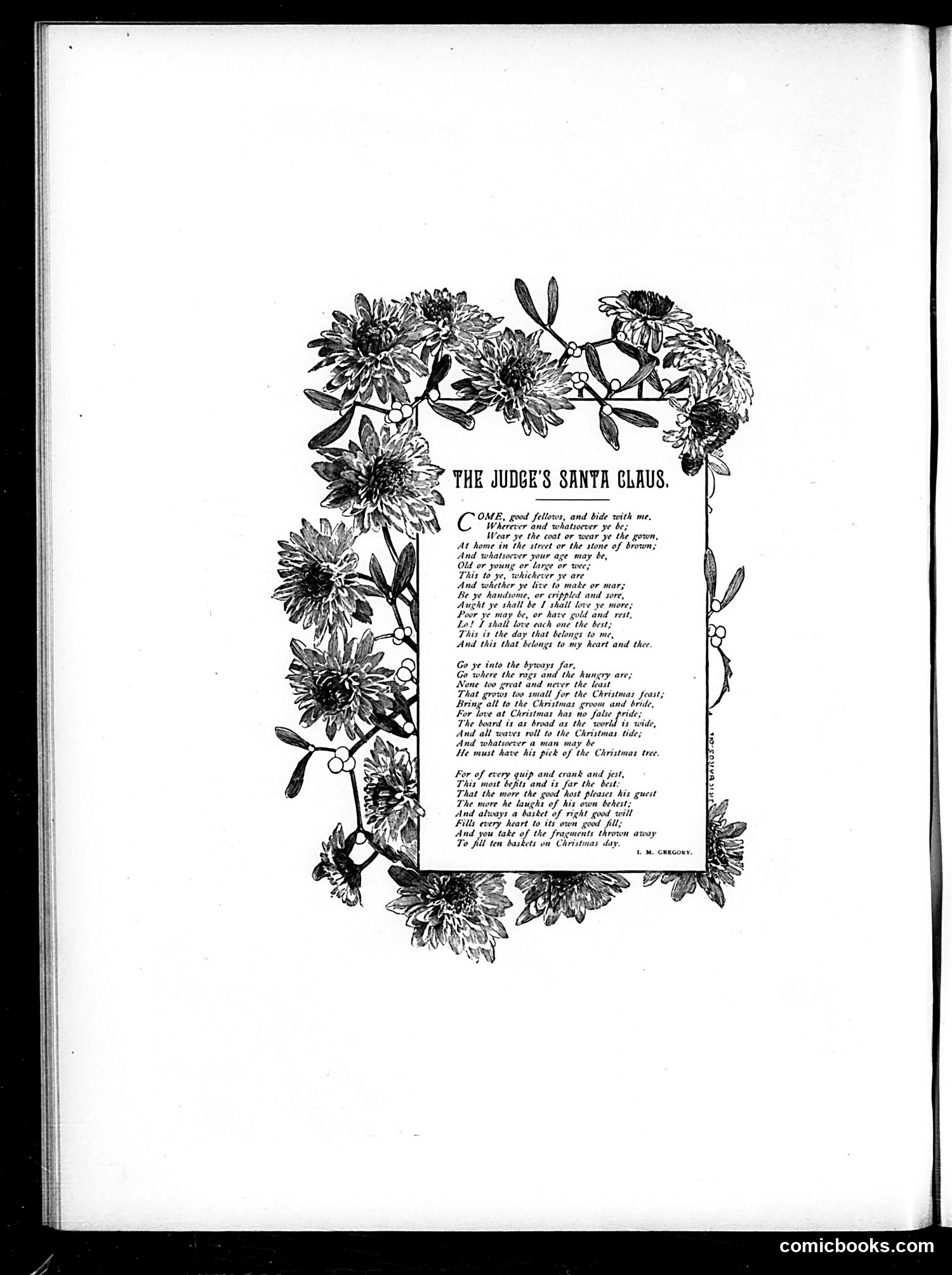
This is a poem by I. M. Gregory presented as an illustrated page in *Judge* magazine. The decorative border of detailed flowers frames an inclusive Christmas message rather than political satire. The poem's central argument is that Christmas generosity should transcend all social boundaries—it addresses people regardless of class ("coat or gown"), appearance ("handsome, or crippled and sore"), or economic status ("poor...or have gold"). The speaker (representing an idealized Christmas spirit) commands readers to seek out the marginalized ("byways...rags and hungry are") and bring them to the feast. The final stanza employs biblical language (the "fragments thrown away" recalls Jesus feeding multitudes) to suggest that Christmas charity should be abundant and inclusive enough to satisfy everyone. Rather than attacking specific figures or policies, this page presents aspirational social messaging—essentially arguing that Christmas should inspire generosity toward society's poorest members, a message that would resonate with *Judge's* middle-class readership.
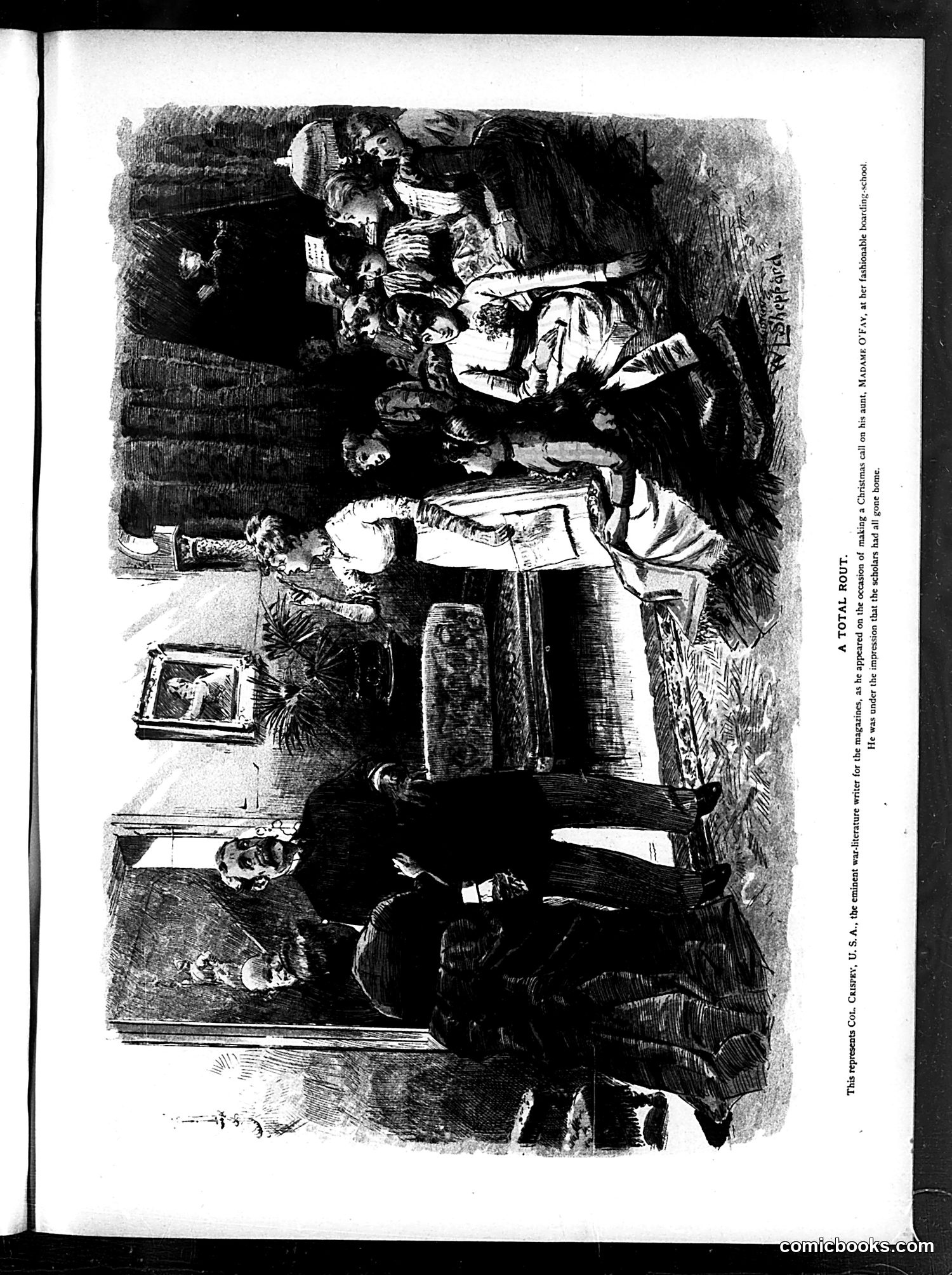
The OCR text is heavily corrupted and unreadable. However, the image shows an etching-style illustration titled "A DUEL" depicting what appears to be a confrontation between two figures in period dress (likely 19th century based on the clothing). One figure appears to be standing or leaning over another in what looks like a dramatic moment. Without legible text identifying the specific figures or political context, I cannot confidently explain which public figures or events this satire references. The artistic style suggests it's mocking a contemporary political or social conflict, but determining the precise target—whether involving politicians, public figures, or social movements—requires clearer source material than the corrupted OCR provides.