
Judge, 1888-12-29 · page 6 of 19
Judge — December 29, 1888 — page 6: what you’re looking at
What you’re looking at
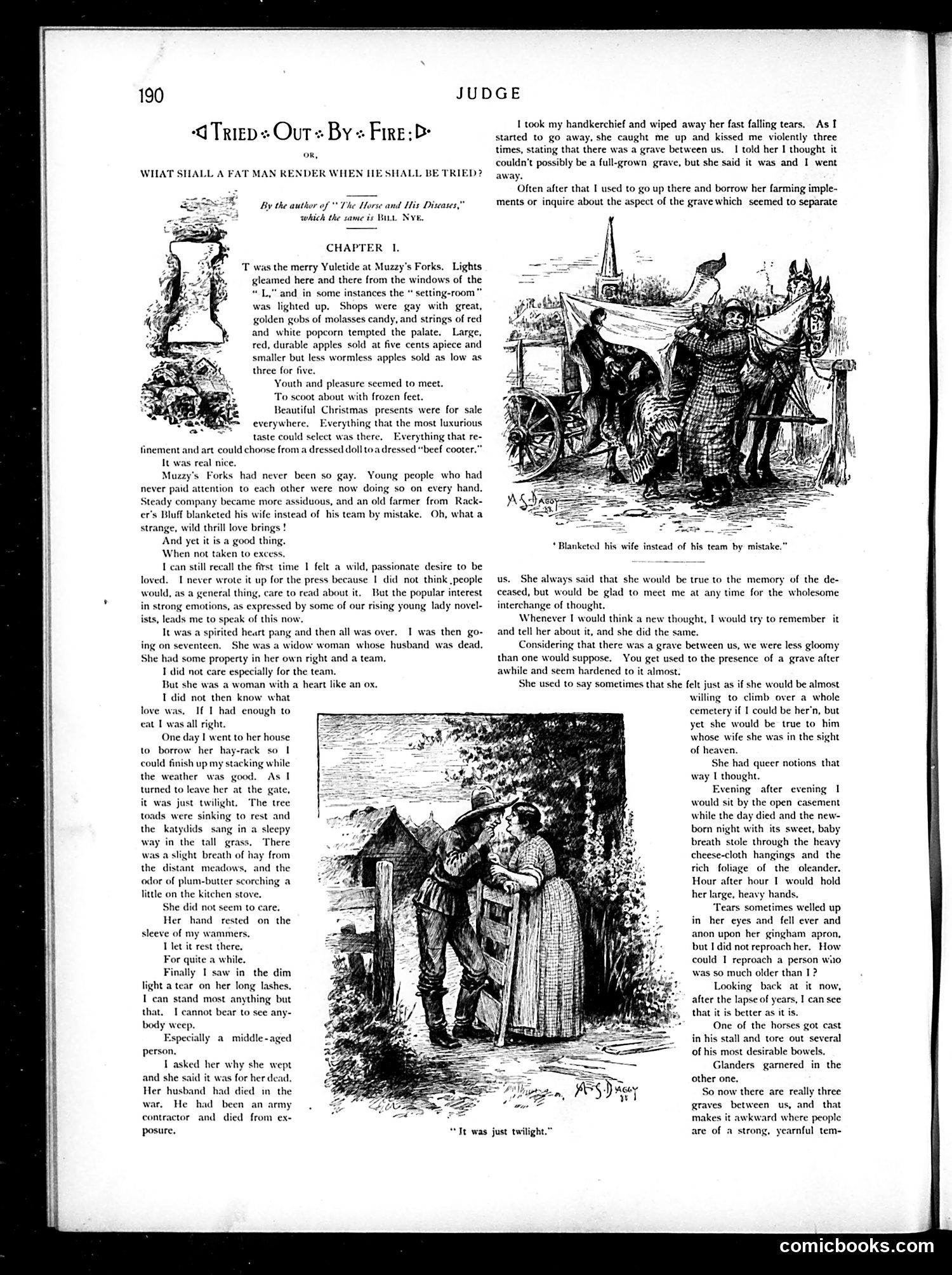
This page contains the opening of a serialized humorous story by Bill Nye (credited as author of "The Horse and His Diseases"), a popular 19th-century American humorist. The title's pun—"What Shall a Fat Man Render When He Shall Be Tried?"—plays on legal/biblical language. The narrative is a sentimental-comedic romance set at "Muzzy's Forks" during Christmas. The unnamed narrator describes falling in love with a widow woman whose deceased husband (killed in war) creates a metaphorical "grave between us." The humor derives from Nye's deadpan, folksy narrative voice describing rural courtship—mixing genuine pathos (her grief, his awkward tenderness) with absurd details (the farmer blanketing his wife instead of his team, the specific apple prices). The accompanying illustrations depict rural Victorian scenes. This is literary humor typical of Judge's content: sentimental Americana filtered through comedic exaggeration and the author's distinctive vernacular voice.
📄 Transcribed text from this page (OCR, searchable)
Machine-transcribed from the original scan — historical spelling and the odd misread are preserved.
JUDGE “<0 Triep = Our = By = Fire:D or, WHAT SHALL A FAT MAN RENDER WHEN HE SHALL BE TRIED? By the author of * The Horse and His Diseases,” which the same is Bur. NYE, CHAPT 1. T was the merry Yuletide at Muzzy's Forks. Lights ned here and there from the windows of the "and in some instances the “ setting-room” was lighted up. Shops were gay with great, golden gobs of molasses candy, and strings of red and white popcorn tempted the palate. Large, red, durable apples sold at five cents apiece and smaller but less wormless apples sold as low as three for five. Youth and pleasure seemed to meet. To scoot about with frozen feet. Beautiful Christmas presents were for sale everywhere, Everything that the most luxurious taste could select was ther erything that re- finement and art could choose from a dressed doll toa dressed “beef cooter.” It was real nice. Muzzy’s Forks had never been so gay. Young people who had never paid attention to each other were now doing so on every hand. Steady company became more assiduous, and an old farmer from Rack- er's Bluff blanketed his wife instead of his team by mistake. Oh, what a strange, wild thrill love brings ! And yet it is a good thing. When not taken to excess, I can still recall the first time 1 felt a wild, passionate desire to be loved. I never wrote it up for the press because I did not think people would, as a general thing, care to read about it. But the popular interest in strong emotions, as expressed by some of our rising young lady novel- ists, leads me to speak of this now. It was a spirited heart pang and then all was over. 1 was then go- ing on seventeen. She was a widow woman whose husband was dead. She had some property in her own right and a team, 1 did not care especially for the team. But she was a woman with a heart like an ox. T did not then know what love was, If 1 had enough to eat Twas all ri One day I went to her house to borrow her hay-rack so I could fi the weather was good. turned to leave her at the it was just twilight, The tree toads were sinking to rest and the katydids sang in a sleepy in the tall grass, There aslight breath of hay from the distant meadows, and the odor of plum-butter scorching a little on the kitchen stove. She did not seem to care. Her hand rested on the sleeve of my wammers. Tet it rest there. For quite a while. Finally 1 saw in the dim light a tear on her long lashes. T-can stand most anything but that. I cannot bear to see any- body weep. Espe person. T asked her why she wept and she said it wa Her husband had died in the war. He had been an army tor and died from ex sh up my stacking while Ast ly a middle-aged for her dead, “Tt was just twilight.” I took my handkerchief and wiped away her fast falling tears. As I started to go away, she caught me up and kissed me violently three times, stating that there was a grave between us. | told her I thought it couldn't possibly be a full-grown grave, but she said it was and I went away. Often after that I used to go up there and borrow her farming imple~ ments or inquire about the aspect of the grave which seemed to separate *Blanketed his wife instead of his team by mistake.” ys said that she would be true to the memory of the de- ceased, but would be glad to meet me at any time for the wholesome interchange of thought. Whenever I would think a new thought, I would try to remember it and tell her about it, and she did the same. Considering that there was a grave between us, we were less gloomy than one would suppose. You get used to the presence of a grave after awhile and seem hardened to it almost. She used to say sometimes that she felt just as if she would be almost willing to climb over a whole cemetery if I could be her'n, but yet she would be true to him whose wife she was in the sight of heaven. She had queer notions that way I thought. Evening after evening 1 would sit by the open casement while the day died and the new- born night with its sweet, baby breath stole through the heavy cheese-cloth hangings and the rich foliage of the oleander, Hour after hour I would hold her large, heavy hands, Tears sometimes welled up in her eyes and fell ever and anon upon her gingham apron, but I did not reproach her. How could I reproach a person wiio was so much older than I? Looking back at it now, after the lapse of years, I can see that it is better as it is. One of the horses got cast in his stall and tore out several of his most desirable bowels. Glanders garnered in the other one. So now there are really three graves between us, and that makes it awkward where people are of a strong, yearnful tem- comicbooks.com