
A complete issue · 18 pages · 1888
Judge — December 22, 1888
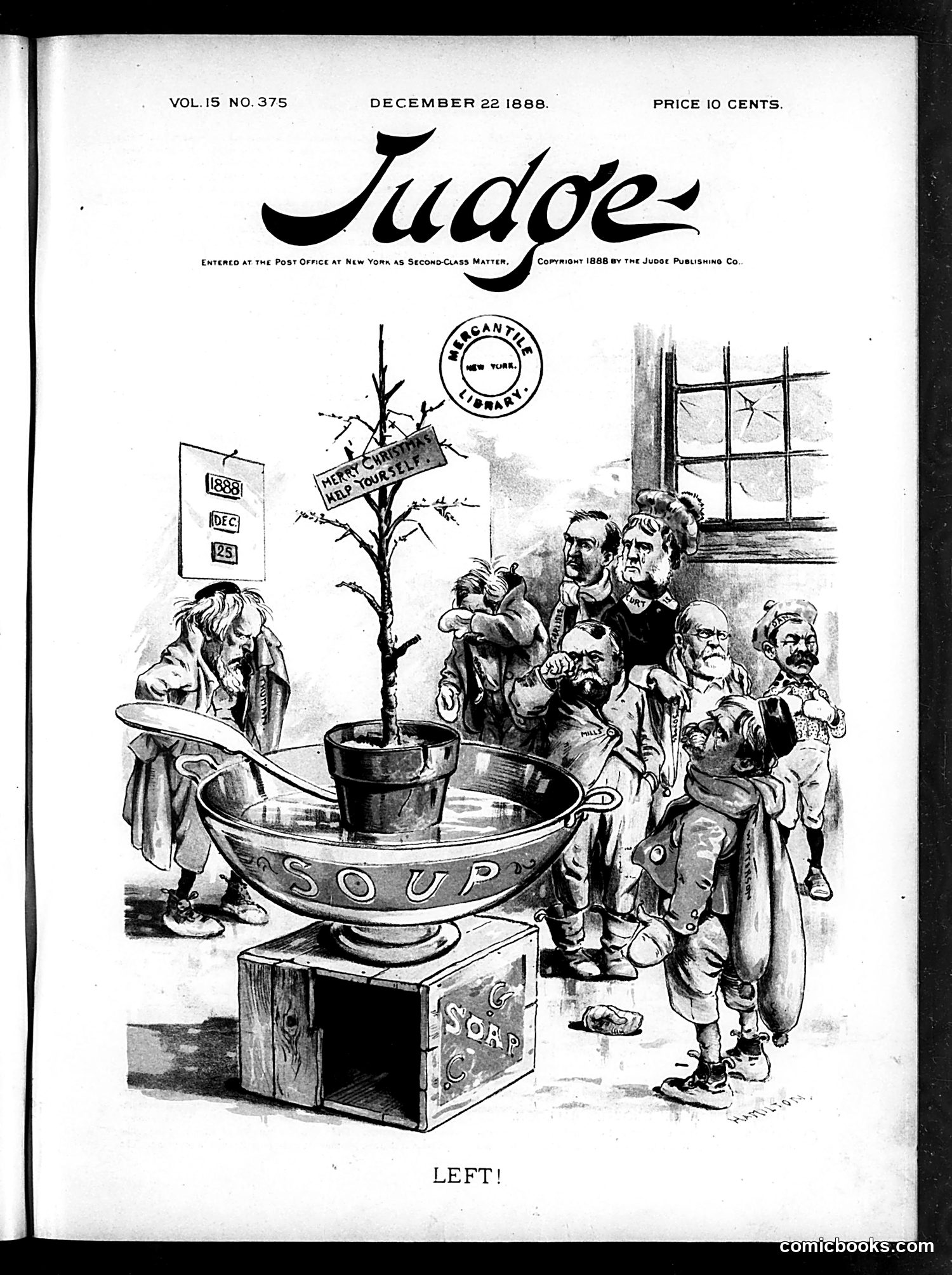
This political cartoon satirizes charity and charitable organizations of the 1880s. The central image shows a withered tree growing from a large soap bowl, surrounded by figures representing various charitable organizations and reformers. The word "SOUP" appears on the base. The title "LEFT!" suggests the satire targets the inadequacy or failure of charitable efforts. The dried-up tree symbolizes charitable work that produces little real growth or improvement despite significant effort and resources. The soap reference likely mocks superficial or performative charity—cleaning up surface problems without addressing root causes. The gathered figures represent different charitable and reform movements, all apparently ineffectual at creating meaningful change. This reflects 1880s skepticism about whether institutional charity actually helped the poor or merely provided moral satisfaction to donors.
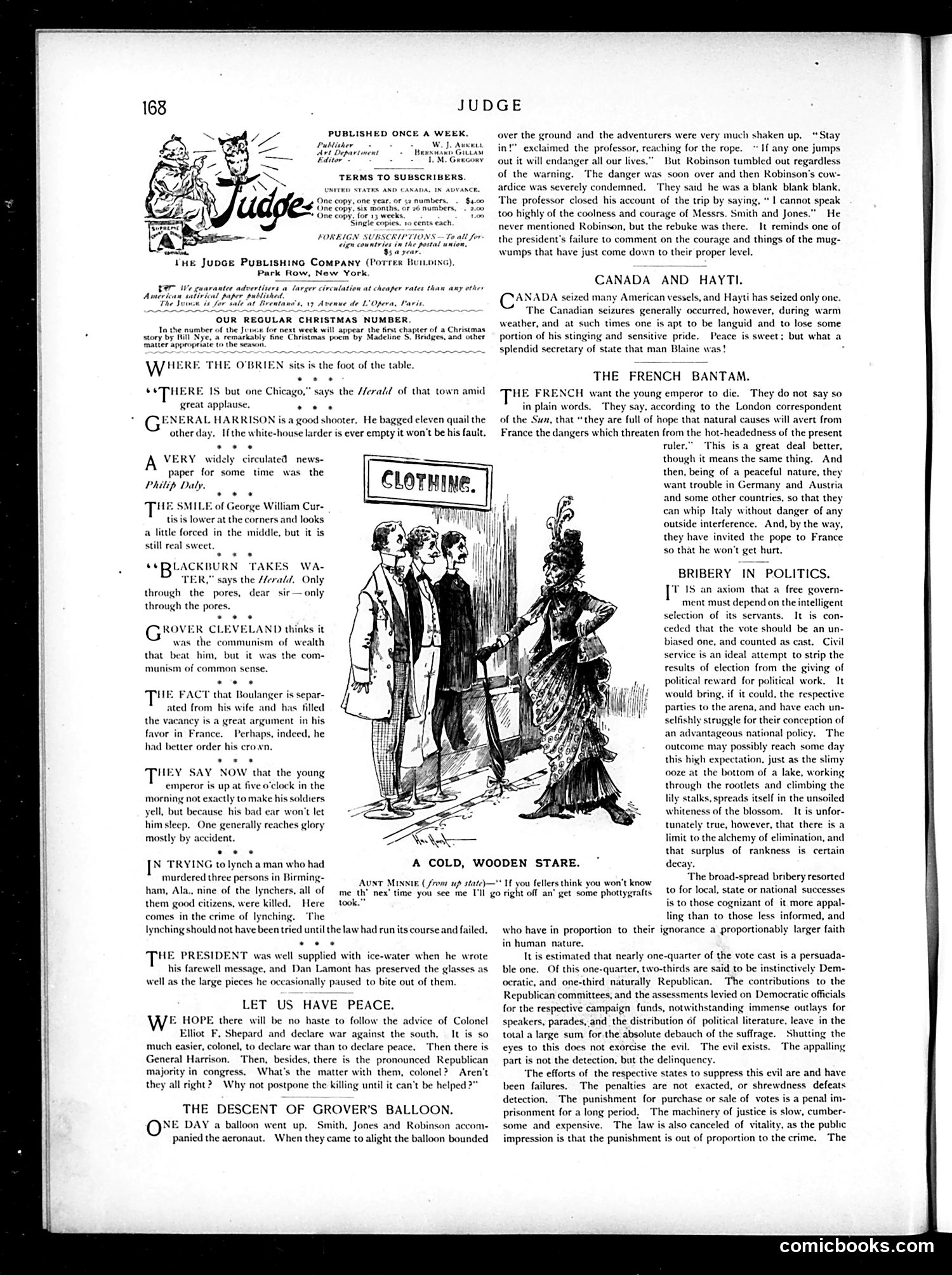
This cartoon depicts three well-dressed men confronting a woman in tattered clothing labeled "CLOTHING." The caption references Aunt Minnie's warning about going right on an errand. The satire appears to critique economic inequality or labor conditions related to the clothing industry. The woman's ragged appearance contrasts sharply with the gentlemen's fine dress, likely commenting on exploitation within the garment trade—a notorious industry for poor working conditions and low wages in this era. The "cold, wooden stare" of the title suggests the indifference of wealthy businessmen or politicians toward workers' suffering. The cartoon uses visual irony: those who profit from clothing remain well-dressed while those who produce it remain impoverished, a common Progressive-era critique of industrial capitalism.
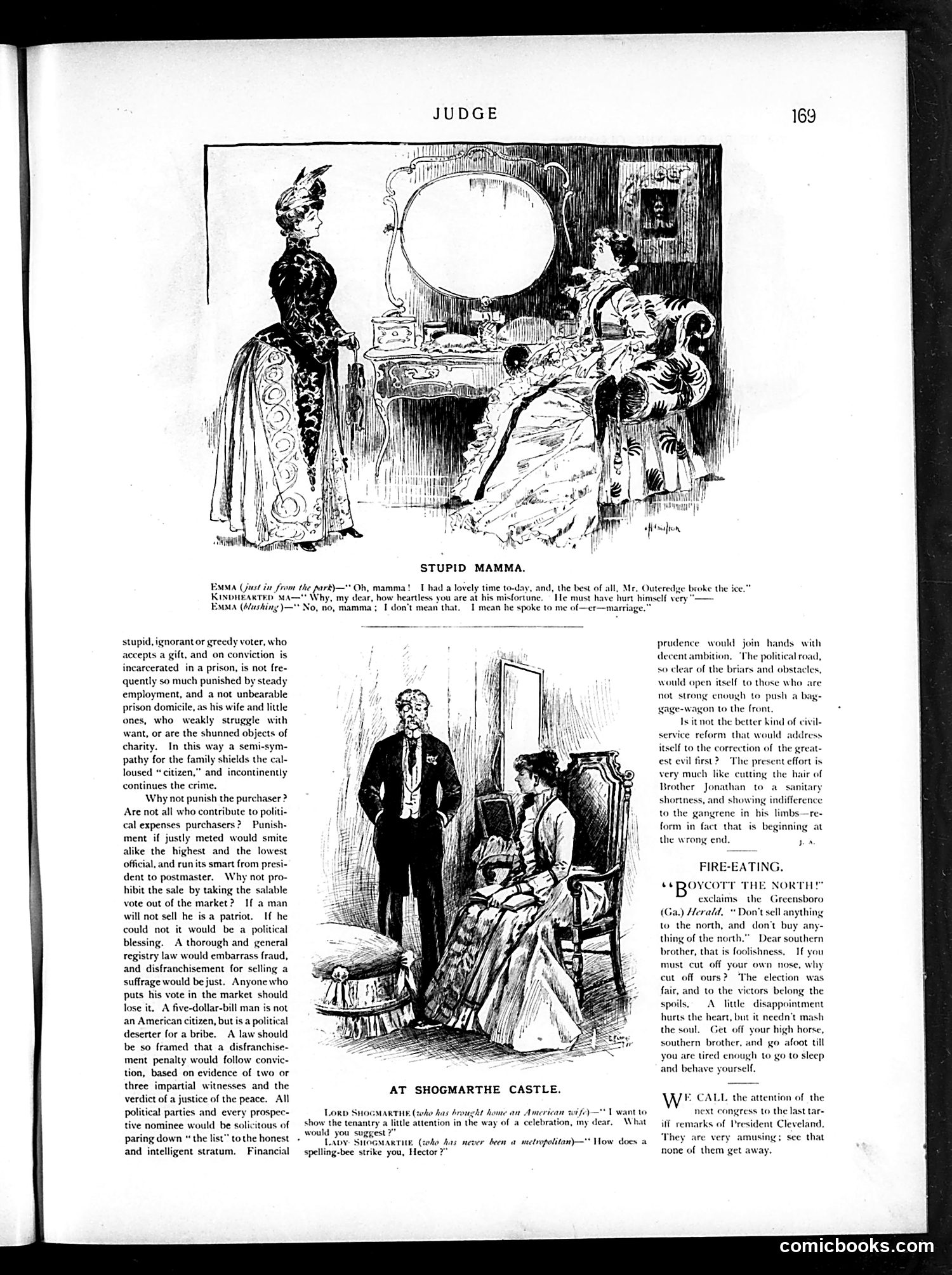
This page contains three satirical pieces: **"Stupid Mamma"** (top cartoon): A young woman tells her mother about a suitor's attentions, but the mother dismisses him as "heartless" and "at his misfortune." The satire mocks mothers who reject suitable matches based on superficial judgments rather than actual character. **"At Shogmarthe Castle"** (middle cartoon): A British lord asks his American wife to suggest entertainment for tenants. She proposes a "spelling-bee"—a distinctly American middle-class activity. The joke satirizes American cultural practices as crude or out-of-place in aristocratic British settings, playing on transatlantic class differences. **"Boycott the North!"** (text section): Judge criticizes a Georgia newspaper's call for economic boycotts against Northern states post-election. The editorial argues such regional hostility is foolish and that the South should accept democratic results gracefully rather than nurse grievances. The page's primary focus is post-Civil War sectional tensions and the persistence of North-South antagonism.
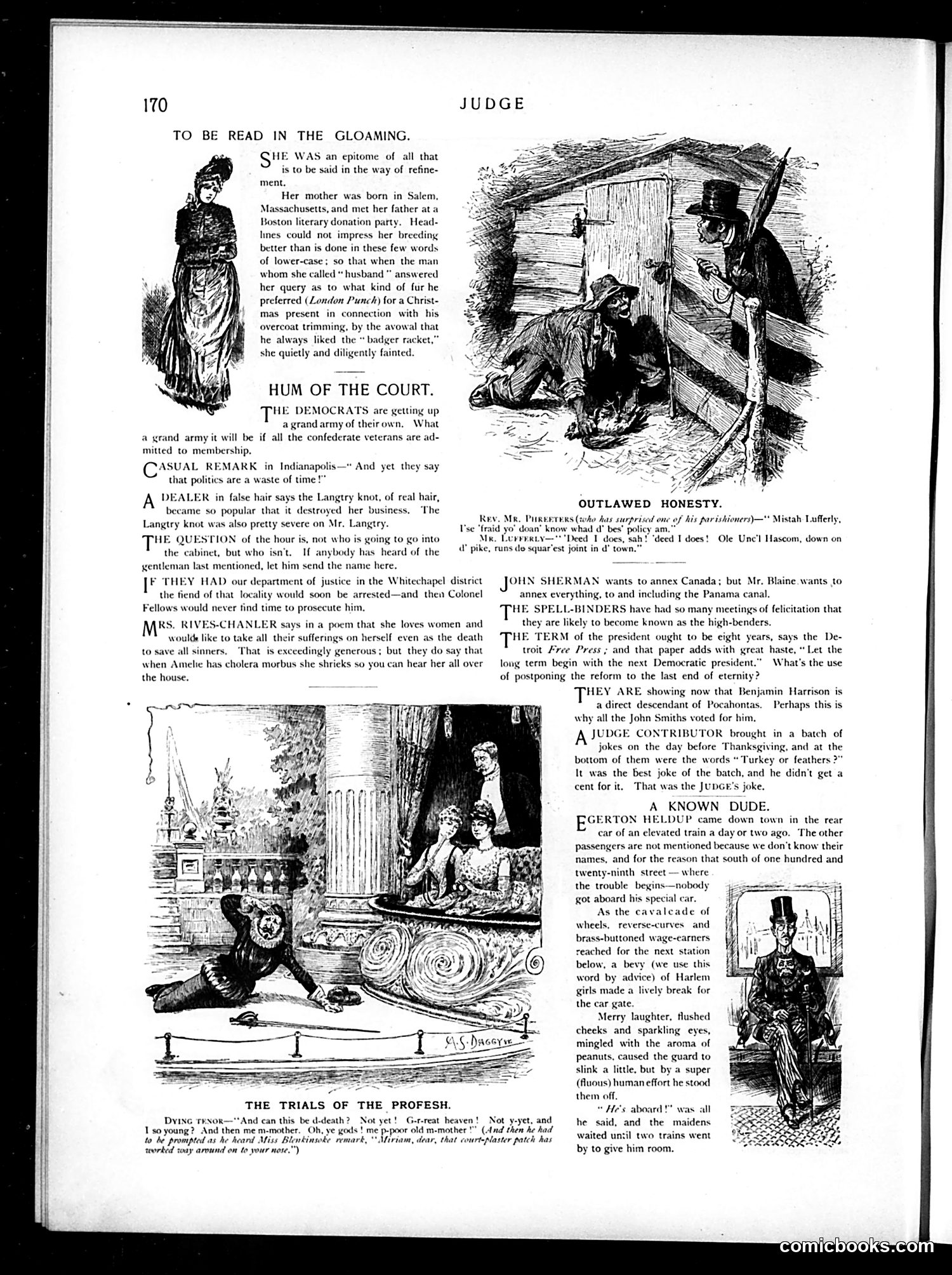
This page contains several short political and social satirical pieces typical of Judge magazine's format: **"To Be Read in the Gloaming"** mocks upper-class pretension—a refined woman faints upon hearing her husband prefers "badger racket" (cheap fur trimming), suggesting her gentility is performative rather than genuine. **"Hum of the Court"** offers brief political jabs: Democrats recruiting Confederate veterans; a reference to actress Lillie Langtry's "Langtry knot" hairstyle becoming so popular it ruined wigmakers' business; and commentary on James Blaine's expansionist ambitions (annexing Canada and the Panama Canal). **"Outlawed Honesty"** depicts a Black dialect joke about a church pastor discovering his parishioner runs an illegal numbers game ("policy"), appearing to mock both religious hypocrisy and the "numbers racket." **"A Known Dude"** recounts an elevated-train incident where a fashionable passenger's behavior changes when working-class Harlem girls board. The page reflects Gilded Age attitudes toward class, race, and contemporary political figures like Sherman and Blaine.
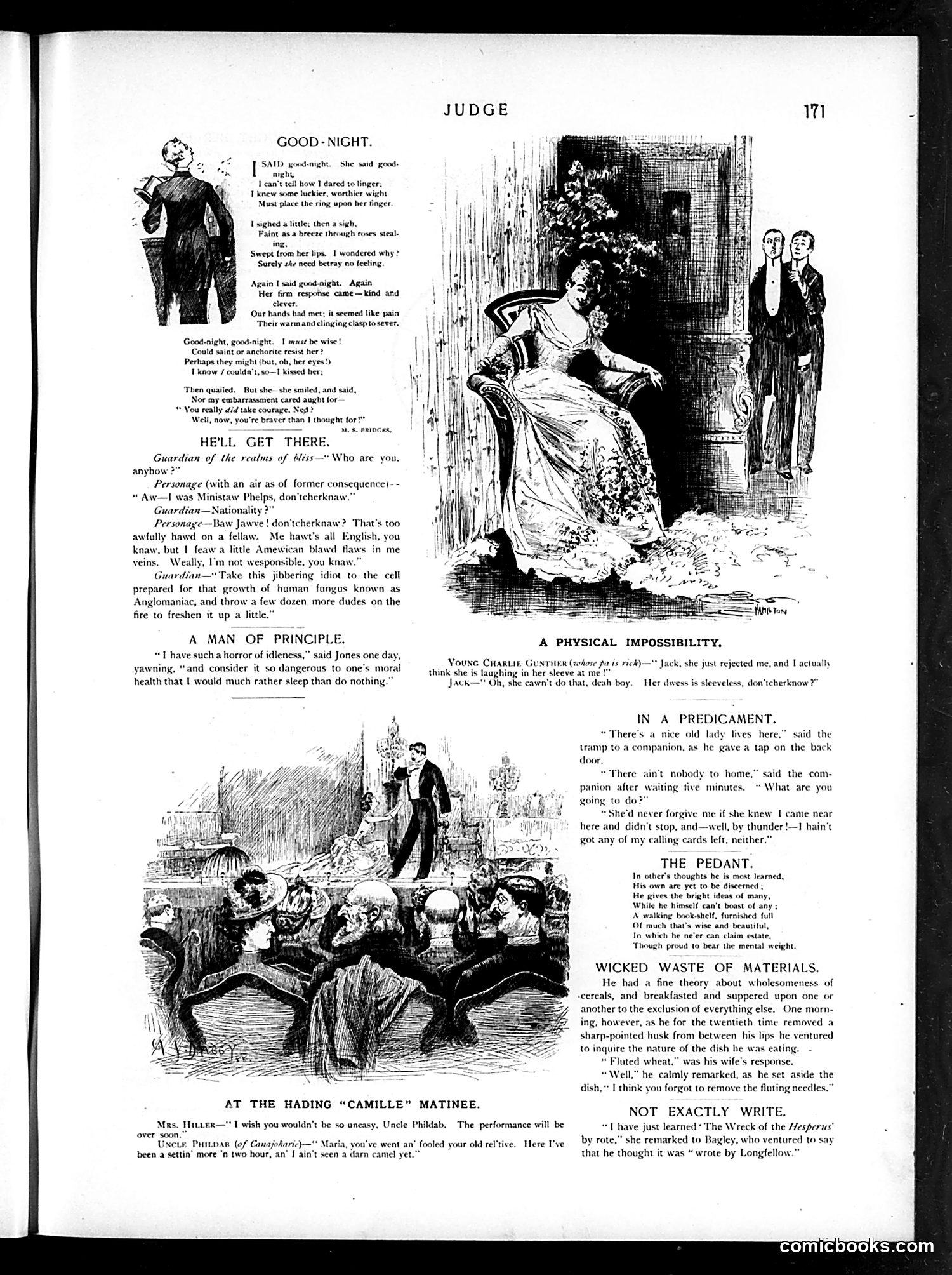
This page contains several satirical pieces mocking Victorian social pretensions and affectation: **"Good-Night"** is sentimental romantic poetry—the satire lies in its overwrought emotion about hesitantly kissing a woman goodnight. **"He'll Get There"** mocks an Anglophile American (likely referencing a specific political figure named Phelps based on the dialogue). The joke: a pretentious American imitating English mannerisms and speech patterns ("Baw Jawve!") is condemned to Hell, treated as a ridiculous "fungus"—satirizing Americans who affectedly imitate British culture. **"A Man of Principle"** is a brief joke about Jones's hypocrisy: he claims to hate idleness yet prefers sleeping to doing nothing. **Other items** ("Physical Impossibility," "In a Predicament," "The Pedant," "Wicked Waste of Materials," "Not Exactly Write") are quick satirical vignettes about social foibles—vanity, pretension, pedantry, and marital absurdities typical of Judge's humor. The page exemplifies *Judge*'s target: mocking Victorian-era American social pretense and affected behavior.
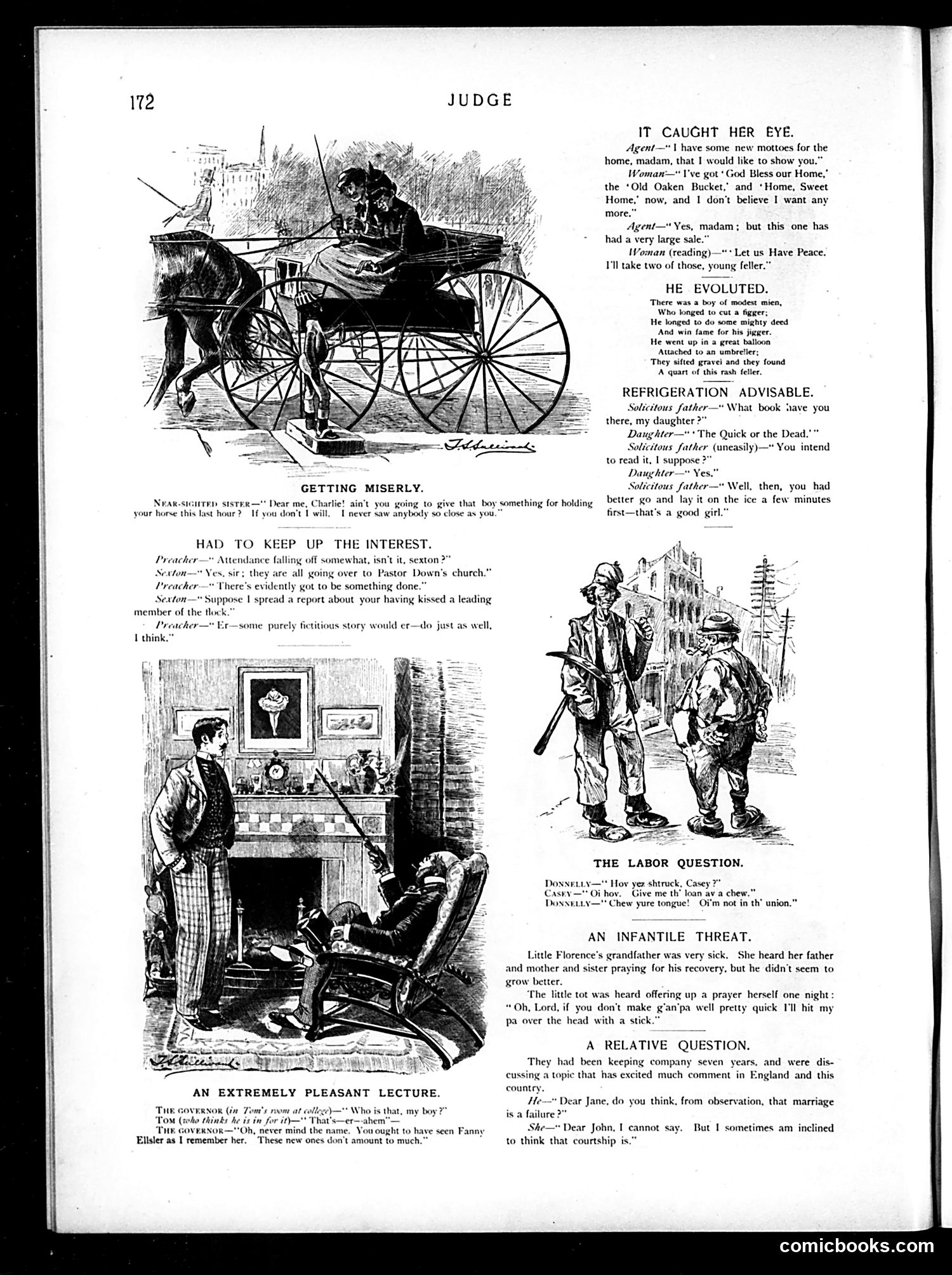
This page contains multiple brief satirical sketches typical of Judge's humor: **"It Caught Her Eye"**: A sales agent pitches home mottos to a woman unimpressed with traditional ones ("God Bless our Home"). She eagerly buys "Let us Have Peace"—likely referencing General Ulysses S. Grant's famous phrase, satirizing how political slogans become commercialized home décor. **"He Evoluted"**: Mocks Darwin's evolution theory through a cautionary tale of a boy attempting daring deeds (balloon flight with umbrella), ending in death. The crude rhyme and absurd outcome ridicule public misunderstanding of scientific progress. **"The Labor Question"**: An Irish immigrant refuses to share chewing tobacco because it's "not in th' union"—satirizing rigid union rules as absurdly applied to trivial matters, reflecting contemporary labor movement tensions. **Other sketches** humorously address courtship, parental concerns about reading material ("The Quick or the Dead"), and clerical desperation for attendance through gossip. The satire targets emerging commercial culture, pseudoscientific popularization, labor rigidity, and Victorian morality.
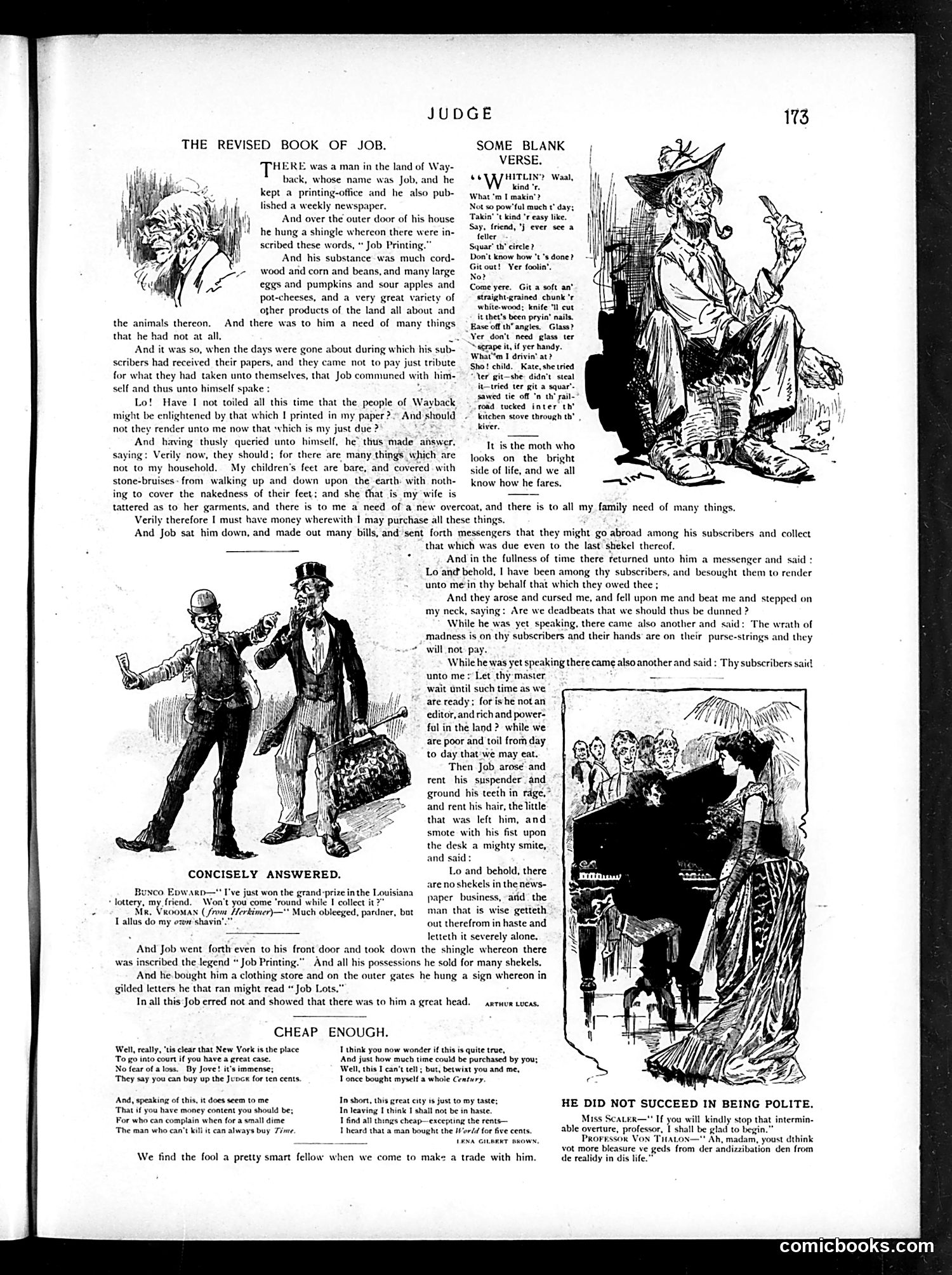
This page parodies the biblical Book of Job by reimagining the patient, suffering Job as a struggling newspaper publisher and printer in "Wayback" (a rural American town). The satire mocks the plight of small-town publishers who cannot collect payment from subscribers—a real economic problem of the era. Job sends messengers to collect debts, but subscribers respond with excuses and curses: they claim poverty, suggest the editor is wealthy, or simply refuse to pay. The crude, dialect-heavy poem in the right column reinforces the rural setting and working-class perspective. The cartoon's point: rural publishers were chronically unpaid by readers who consumed their product without compensation, treating them as charitable institutions. The biblical parallel elevates this mundane business problem into mock-tragic territory, suggesting publishers faced Job-like suffering and patience. The satire likely reflected Judge magazine's own frustrations with circulation and payment practices during the late 19th/early 20th century.
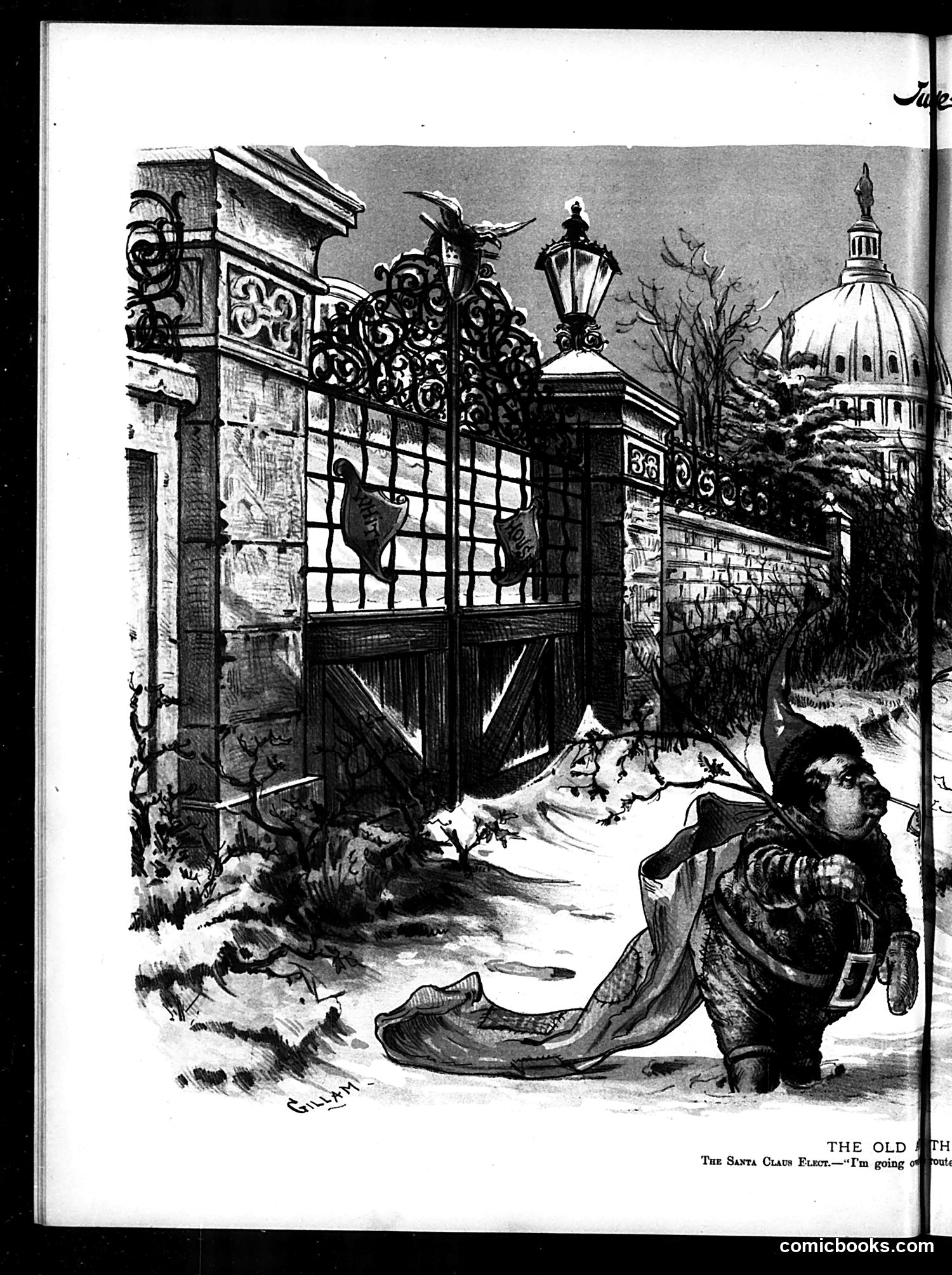
This appears to be a political cartoon titled "The Old Path," with a caption beginning "The Santa Claus Election.—'I'm going o[ff]..." The image shows a figure in winter clothing trudging away from an ornate gate (likely representing government or institutional power) in a snowy landscape, with a Capitol dome visible in the distance. The "Santa Claus Election" reference suggests commentary on politicians promising unrealistic gifts or benefits to voters—a common 19th-century satirical critique of campaign promises. The figure's dejected posture suggests disillusionment or defeat, likely criticizing either the failed election of a candidate promising such benefits, or mocking the naive electorate who believed such promises. The "old path" title reinforces themes of returning to traditional or disappointed expectations.
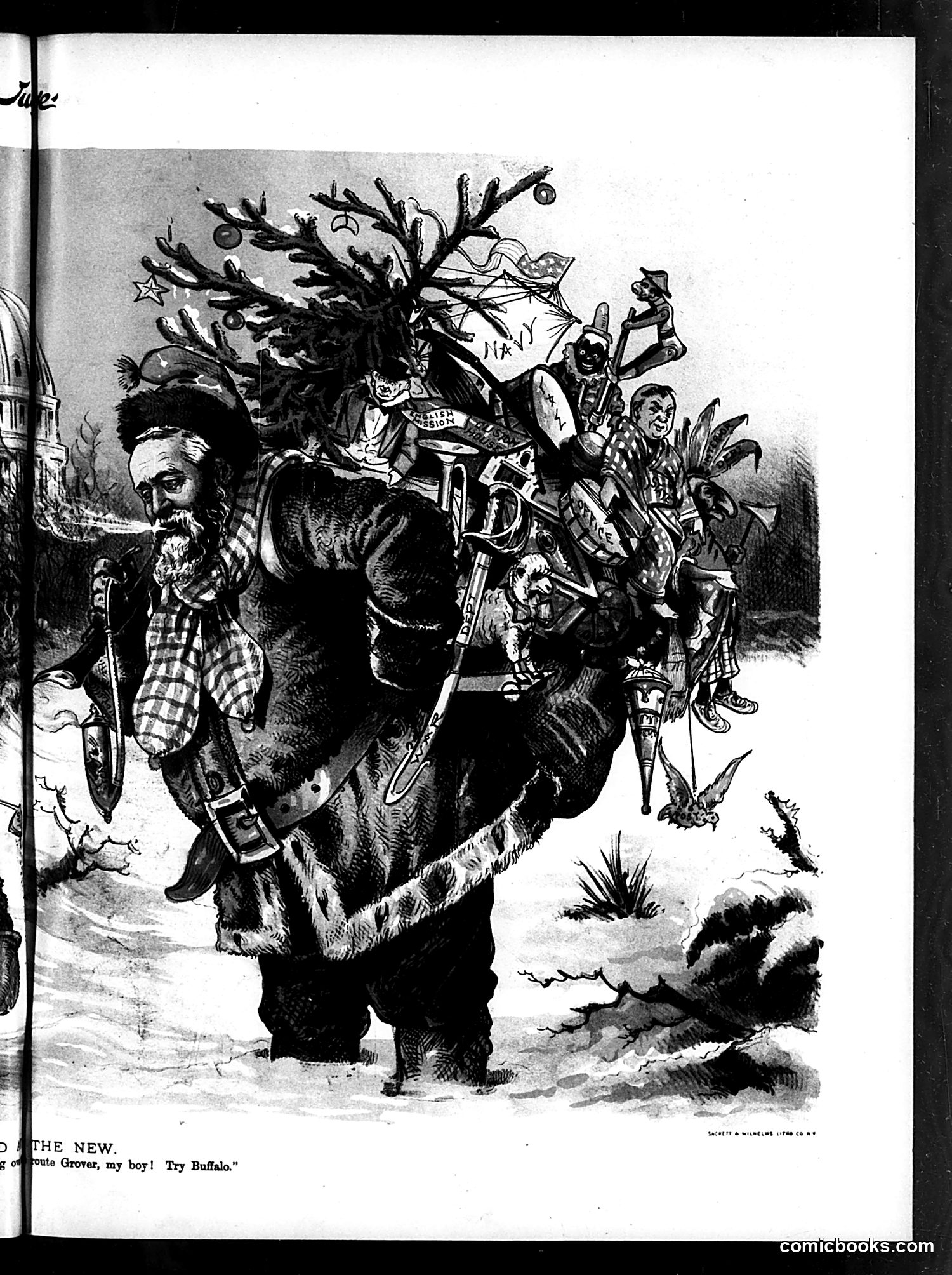
This appears to be a satirical cartoon from *Judge* magazine mocking a political figure—likely President Grover Cleveland, based on the text reference "cute Grover, my boy! Try Buffalo." The central figure is a large, bearded man (caricatured in exaggerated style) carrying various smaller figures, political symbols, and what appear to be controversial policies or scandals on his back like baggage or a Christmas tree. The cartoon satirizes Cleveland's political burden—the accumulated problems, controversies, and political hangers-on he carries. The reference to Buffalo (Cleveland's former city) and the phrase "Try Buffalo" suggests mockery of his political prospects or abilities. The grotesque artistic style and crowded composition emphasize the chaotic nature of his political situation and the weight of his office.
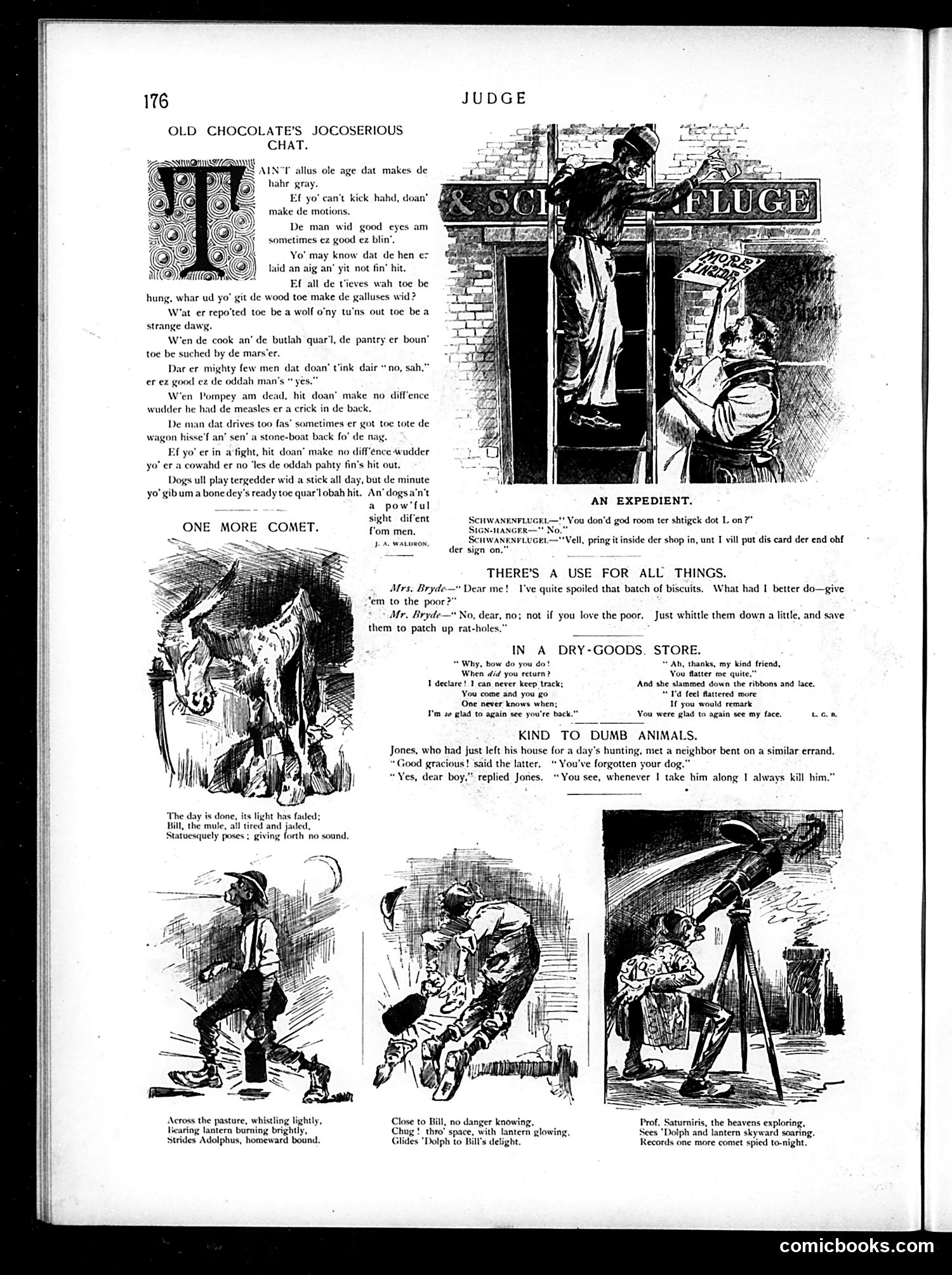
This page from *Judge* contains several satirical pieces typical of late 19th-century American humor: **"Old Chocolate's Jocose Chat"** presents dialect humor featuring an African American character dispensing folksy wisdom—a common (if problematic by modern standards) feature of period humor magazines. **"An Expedient"** shows a shopkeeper struggling to fit a sign, with dialogue suggesting practical problem-solving through compromise. **"There's a Use for All Things"** satirizes domestic waste, with a housewife suggesting ruined biscuits be repurposed for patching rat-holes—mocking both household economy and class concerns about poverty. **"Kind to Dumb Animals"** is a brief joke about a hunter who kills his dog on hunting trips, presenting this as a dark punchline about absurd logic. **"One More Comet"** features a multi-panel visual gag: a man named Adolphus walks home with a lantern at night, creating an optical illusion that an astronomer observes and records as a "comet"—satirizing both naive observation and scientific pretension. The humor reflects period preoccupations with class, domestic management, and scientific authority.
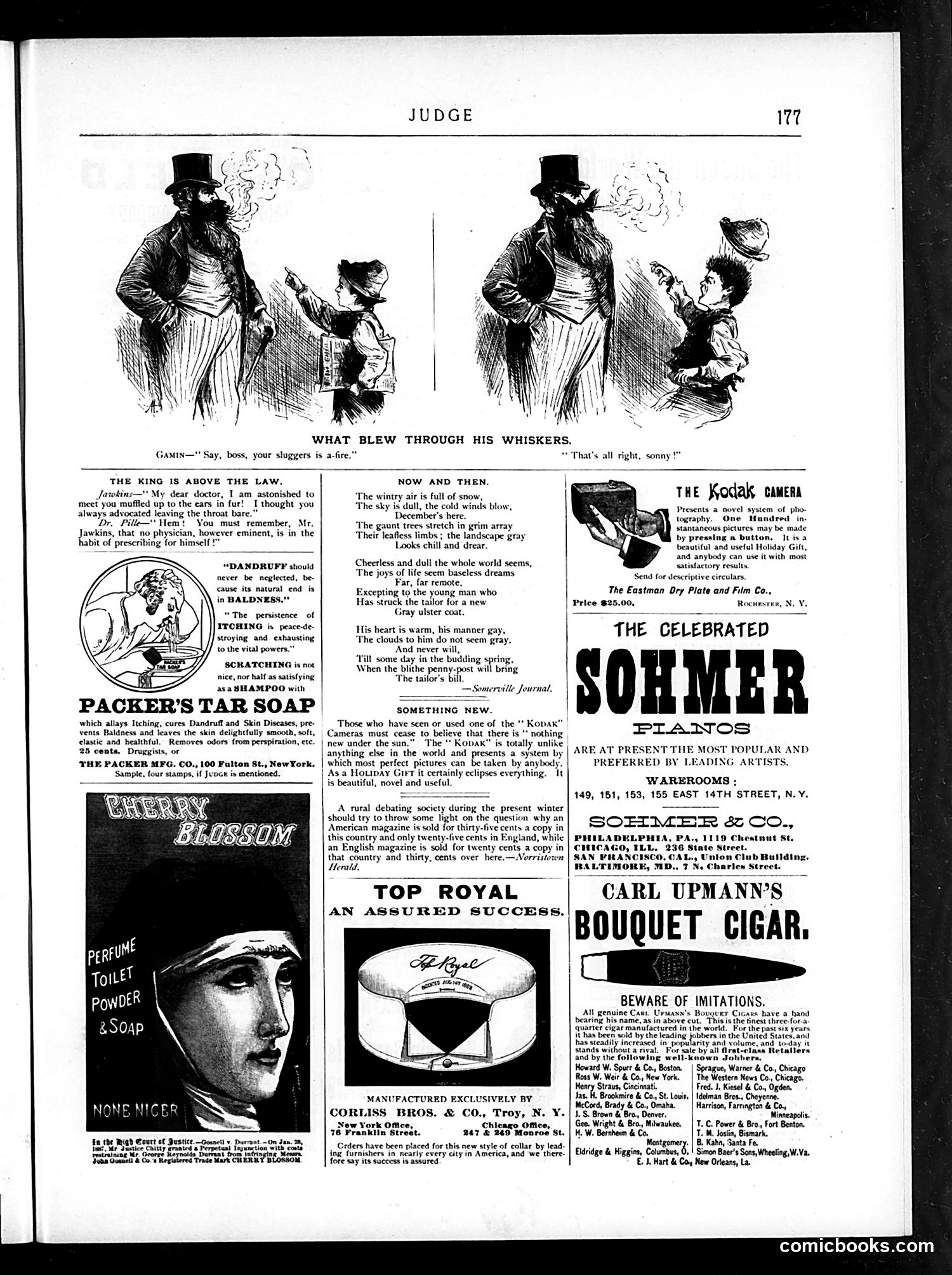
This page contains two cartoons and extensive advertising typical of Judge magazine from the 1890s. **Top cartoon ("What Blew Through His Whiskers"):** A humorous domestic scene where a man scolds a boy for having "sluggers in a fire." The joke plays on the double meaning of "sluggers" (either fighting fists or perhaps lazy workers) causing mischief. **Middle cartoon ("The King Is Above the Law"):** Dr. Pille is muffled in fur despite advocating bare throats for health. When questioned about this contradiction, he quips that "no physician, however eminent, is in the habit of prescribing for himself"—a satirical jab at doctors who don't follow their own medical advice, a timeless theme. **"Now and Then" poem:** A sentimental contrast: winter is cheerless *except* for young men with new overcoats from tailors—until the bill arrives in spring. The remainder consists of period advertisements: Packer's Tar Soap, Kodak cameras, Sohmer pianos, Carl Upmann cigars, and other consumer goods typical of the 1890s marketplace.
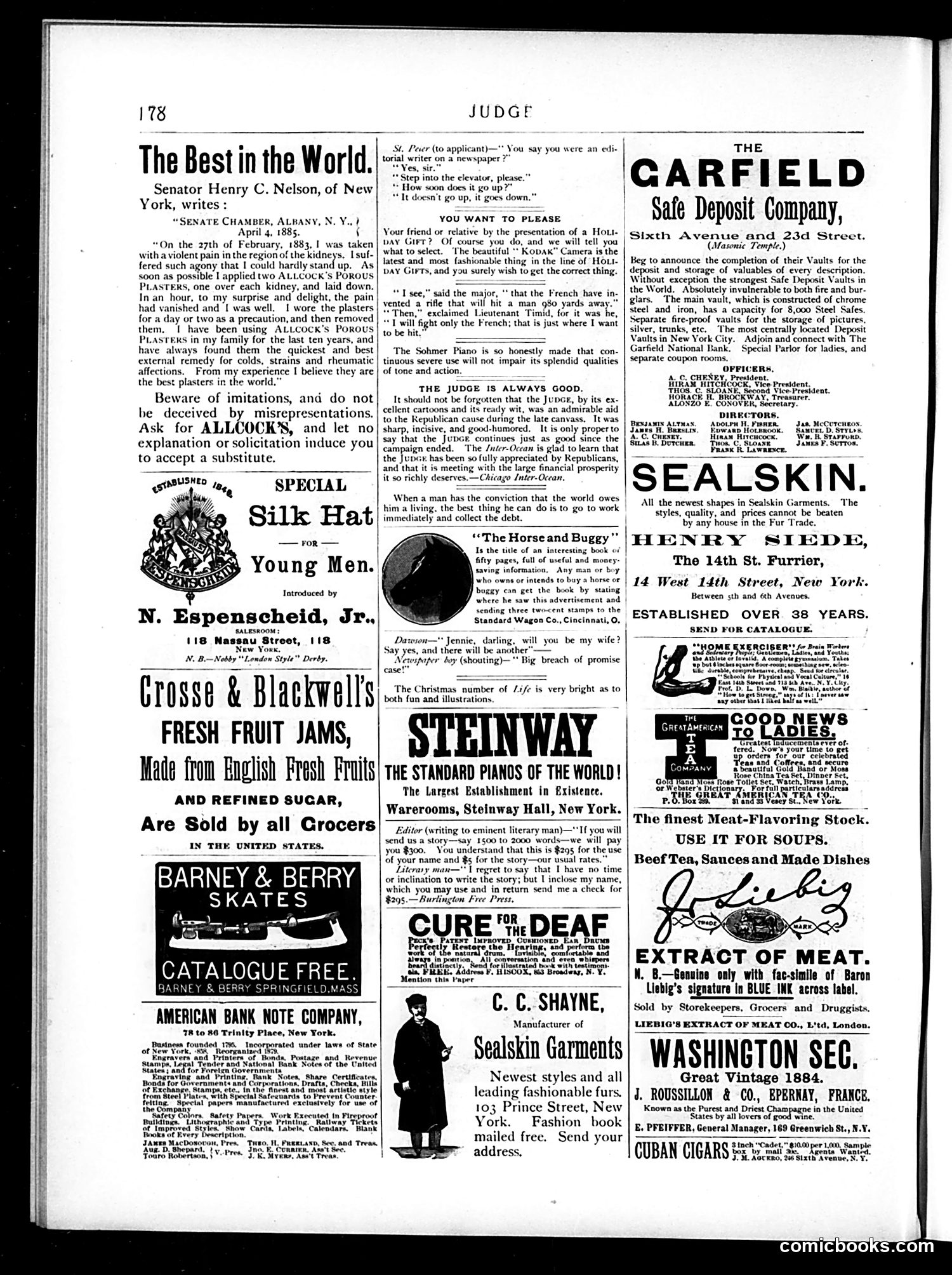
This page is primarily **advertisements and filler content**, not political cartoons. However, there are two brief satirical jokes: 1. **"St. Peter" joke**: A applicant claims newspaper editorial experience; St. Peter directs him to an elevator going *down* rather than up. This mocks newspaper editors as morally corrupt or unethical—a common Victorian-era jab at journalism. 2. **"Major and Lieutenant Timid" joke**: A French rifle can hit targets 980 yards away; the cowardly officer says he'll only fight the French because "that is just where I want to be hit"—meaning far away. This ridicules military cowardice using the new military technology as setup. The rest is product advertising (Allcock's Plasters, pianos, skates, jams, bank notes) and publisher praise from the *Chicago Inter-Ocean*, commending *Judge's* Republican political cartoons during the recent election campaign. The page demonstrates *Judge's* mix of satire and advertising typical of 1880s magazines.
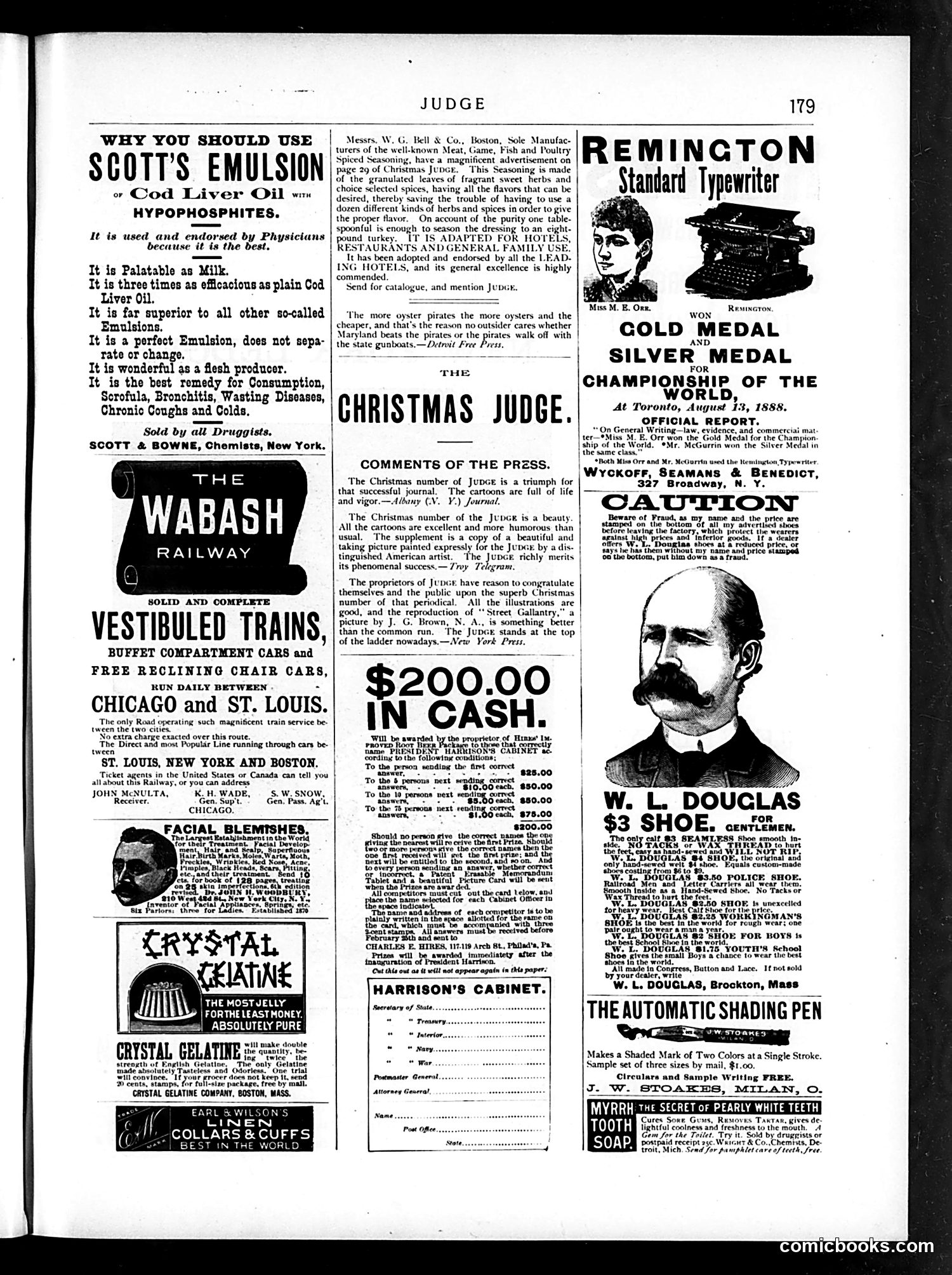
This is primarily an **advertising page** from Judge magazine's Christmas issue, with minimal editorial cartoon content. The page showcases various consumer products typical of the 1880s: Scott's Emulsion (cod liver oil), the Wabash Railway, Crystal Gelatine, and W.L. Douglas shoes. The only satirical content appears in the brief quoted text about "oyster pirates" — a reference to illegal oyster harvesting in Maryland waters, where the joke suggests that increasing piracy paradoxically benefits consumers through lower prices, and that no one outside the oyster industry cares who wins the conflict. The page is dominated by **commercial advertisements** and reprinted press praise for Judge's Christmas issue itself. There are no identifiable political figures or substantive cartoons to analyze. This appears to be a revenue-generating advertising page rather than editorial content.
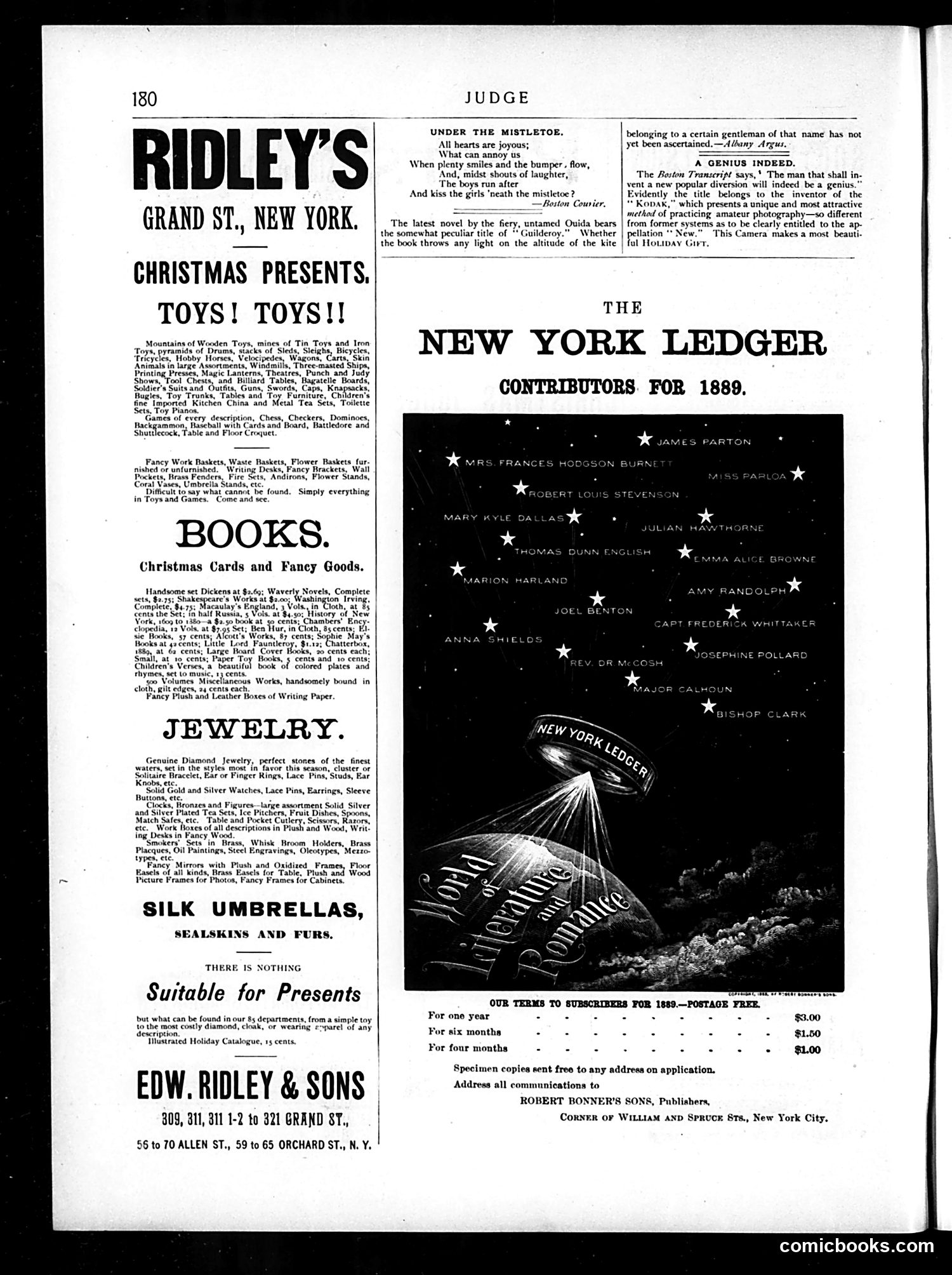
This page is primarily **advertising and masthead content**, not satirical cartoon material. The left column features advertisements for **Ridley's toy and book store** on Grand Street in New York, promoting Christmas gifts including wooden toys, books, jewelry, silk umbrellas, and furs. The right side displays **The New York Ledger's 1889 contributors list**—a roster of prominent writers whose names appear as stars scattered across a dramatic illustration of the publication itself shining like a beacon. Contributors include James Parton, Robert Louis Stevenson, Mary Kyle Dallas, and others—establishing the magazine's literary prestige. Below are subscription rates ($3 annually, $1.50 for six months). This appears to be a **mid-1880s issue of Judge magazine** functioning as both advertisement space and masthead identification rather than containing political satire or humor cartoons.
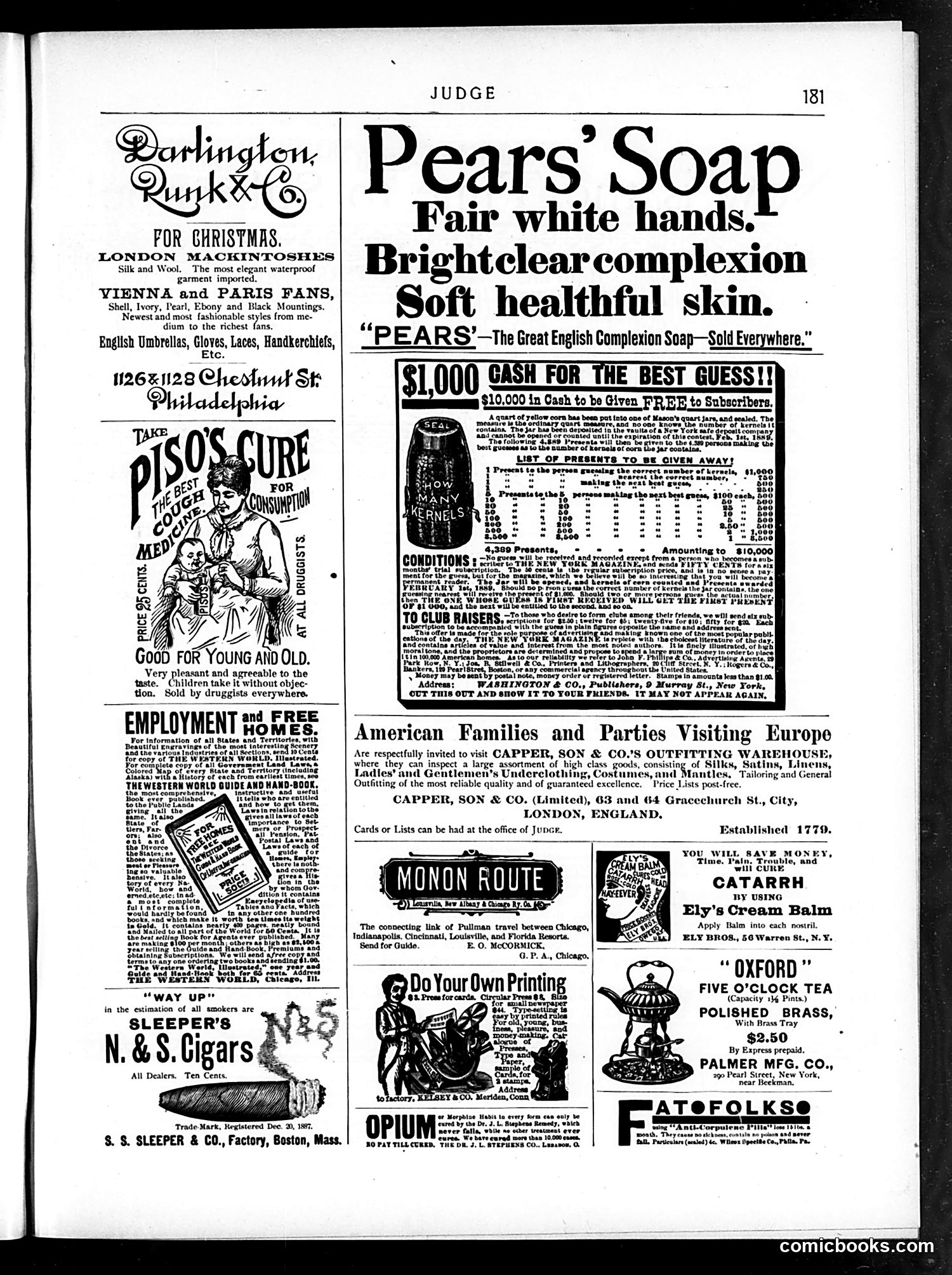
This is primarily an **advertising page** from Judge magazine, not a satirical cartoon page. The content consists almost entirely of product advertisements typical of late 19th-century American publications. The ads include luxury goods marketed to affluent readers: London Mackintoshes (raincoats), imported fans, Pears' Soap (emphasizing "fair white hands" and "bright clear complexion"—reflecting period beauty standards), and a major contest offering $1,000 and $20,000 in prizes for guessing the number of corn kernels in a jar. Notable is a **Piso's Cure advertisement** for consumption (tuberculosis), depicting a mother with children—reflecting the era's common patent medicine marketing before FDA regulation. Another ad targets "American Families and Parties Visiting Europe," suggesting Judge's readership was wealthy travelers. The **Sleeper's Cigars** ad appears at bottom left. Overall, the page reflects Gilded Age consumer culture and the medical/advertising practices of the 1880s-90s, with no discernible political satire.
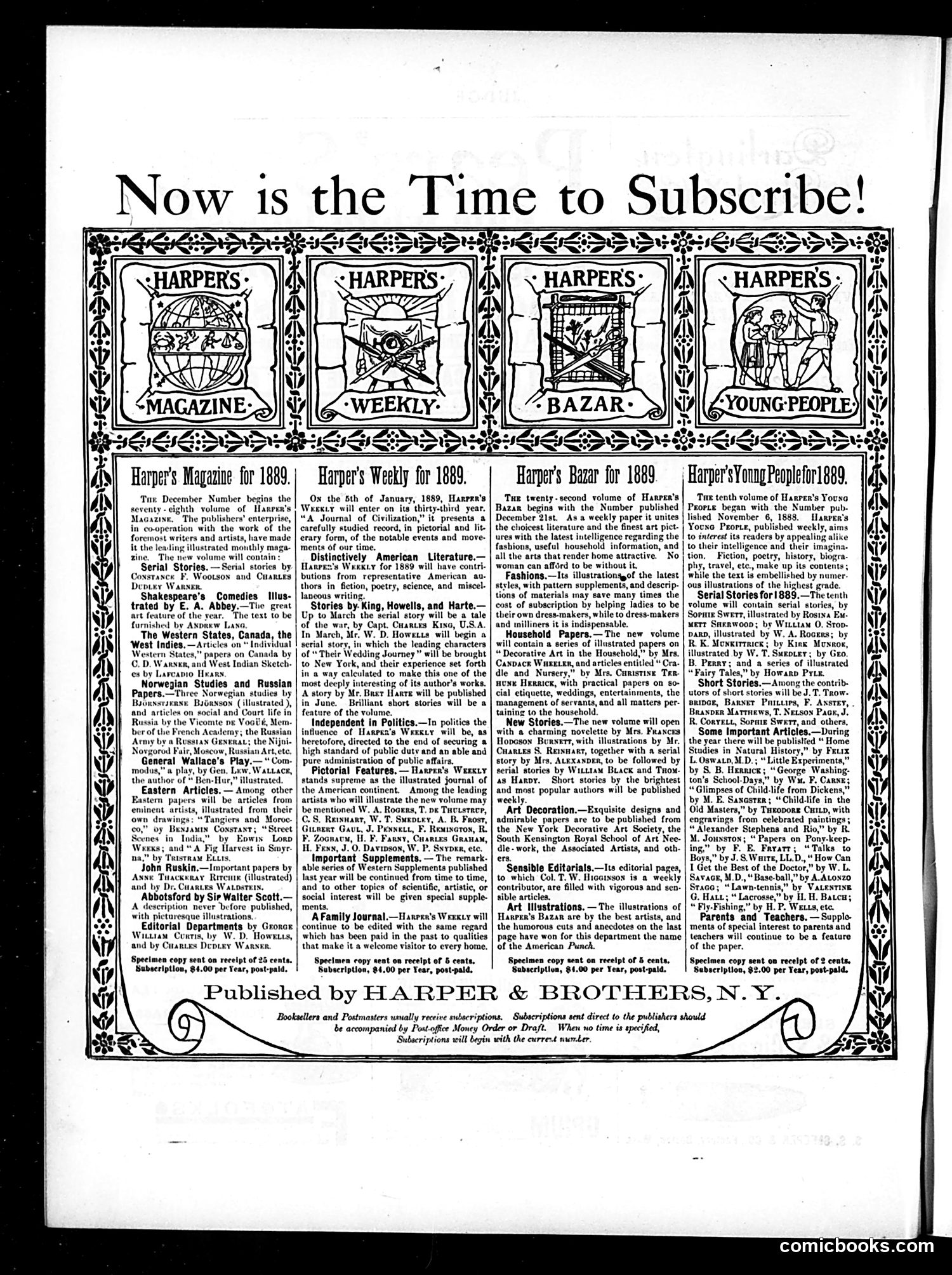
This is not a political cartoon but rather a **promotional advertisement** for Harper & Brothers' four major publications for 1889. The page presents subscription pitches for: - **Harper's Magazine** (general literature and arts) - **Harper's Weekly** (news and current affairs, emphasizing American independence in politics) - **Harper's Bazar** (fashion and household topics) - **Harper's Young People** (children's content) The ornate decorative border and four illustrated vignettes showcase each publication's scope. Rather than satire, this represents **commercial marketing** typical of late-19th-century magazine promotion, highlighting prestigious contributors (Bret Harte, W.D. Howells, E.A. Abbey) and diverse content to appeal to educated, middle-class households. The emphasis on Harper's Weekly being "independent in politics" reflects the magazine's mid-century reputation for editorial integrity during the Civil War era—a selling point for readers seeking trustworthy news.
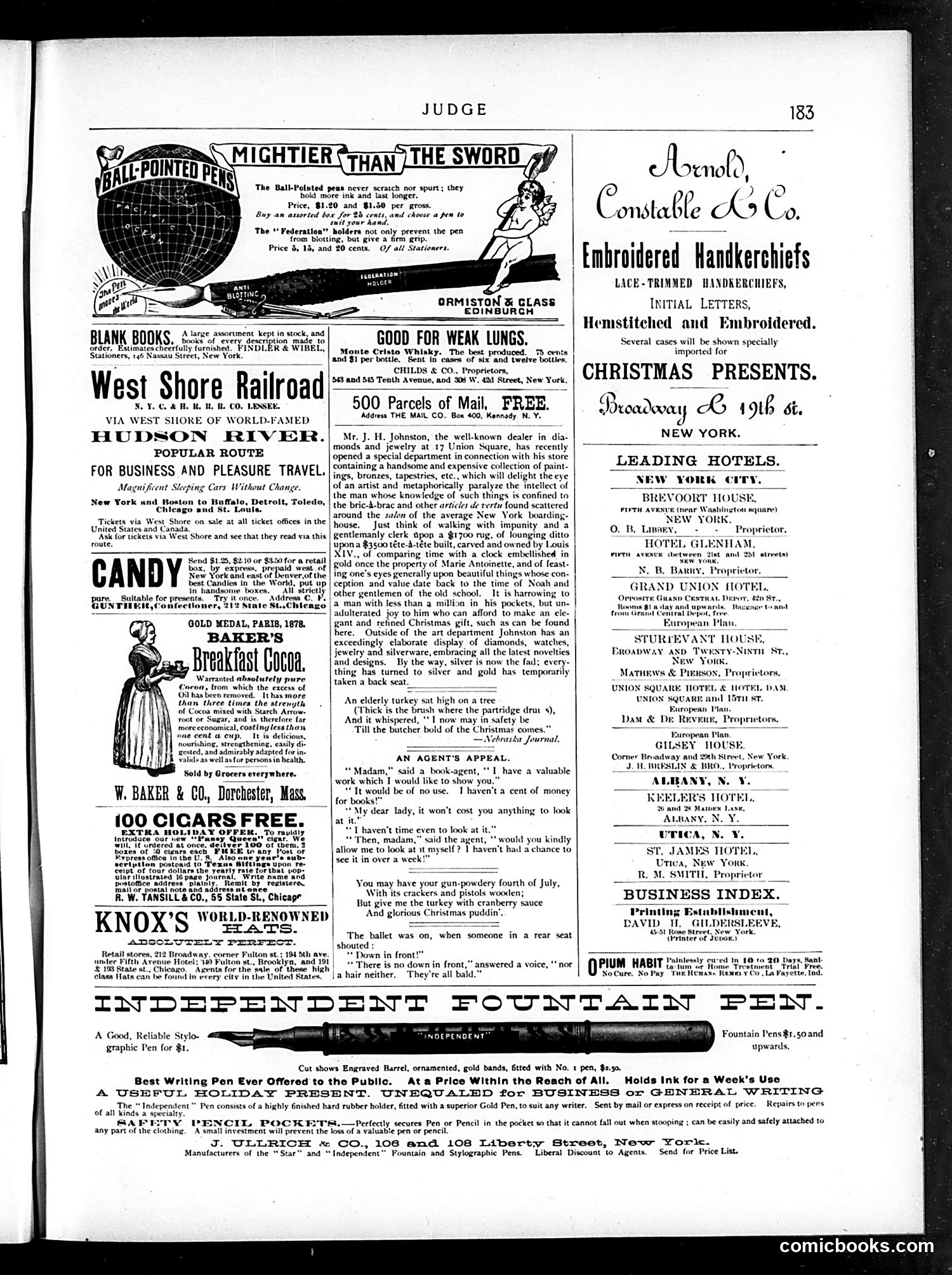
This page is primarily **advertising content** rather than political satire. The dominant feature is a large advertisement at the top for "Ball-Pointed Pens" — a product claiming superiority over traditional writing implements, using the phrase "Mightier Than The Sword" as its slogan. The page contains numerous commercial advertisements for period products: railroad travel, blank books, candy, cocoa, cigars, hats, whiskey, and jewelry. There is one brief humorous item titled "An Agent's Appeal" — a comedic dialogue about a bookkeeper requesting a loan, typical of Judge's light humor. The jewelry store notice for J.H. Johnston mentions his new art collection, which allows the magazine to satirize wealthy New Yorkers and their pretensions about possessing fine art and antiques. **No significant political cartoons or social commentary appears on this page.** It represents Judge functioning as a general-interest magazine with substantial advertising revenue alongside light entertainment.
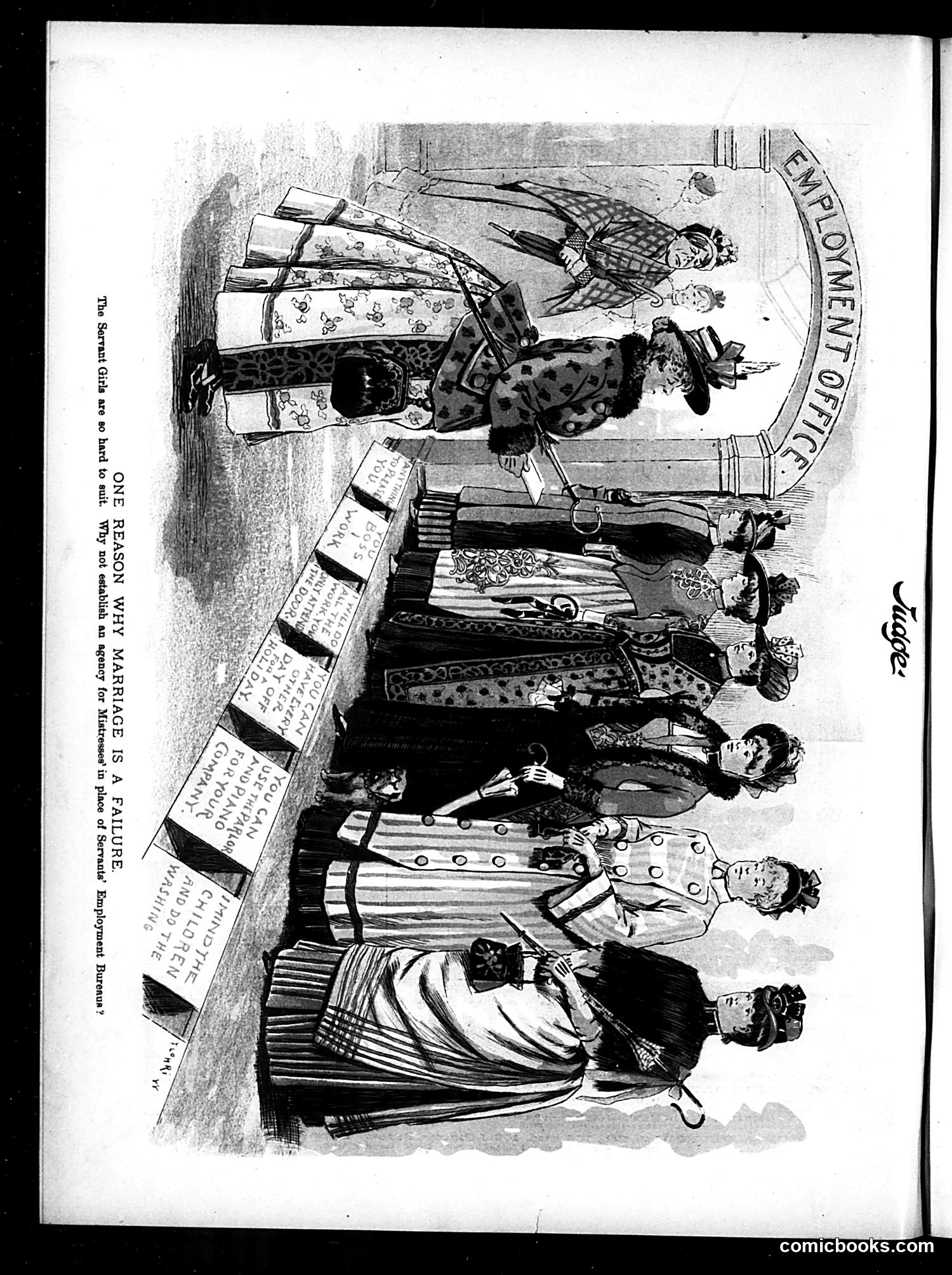
This Judge magazine cartoon satirizes the difficulty of hiring domestic servants in the late 19th/early 20th century. The image shows multiple women (likely representing different servant girls or "types") displayed as if in an employment agency or marketplace. The caption's ironic suggestion—establishing an "agency for Mistresses" instead of servants—implies that finding suitable household help was so problematic that it was easier to replace servants than to manage them properly. The joke blames servants' pickiness ("so hard to suit") for marriage failures, suggesting that poor domestic service disrupted household harmony. This reflects period anxieties about the "servant problem"—the growing difficulty wealthy households faced hiring and retaining domestic workers as labor became more available and working conditions elsewhere improved. The cartoon mocks employers' frustration while exposing class tensions underlying domestic labor dynamics.