
A complete issue · 16 pages · 1888
Judge — November 24, 1888
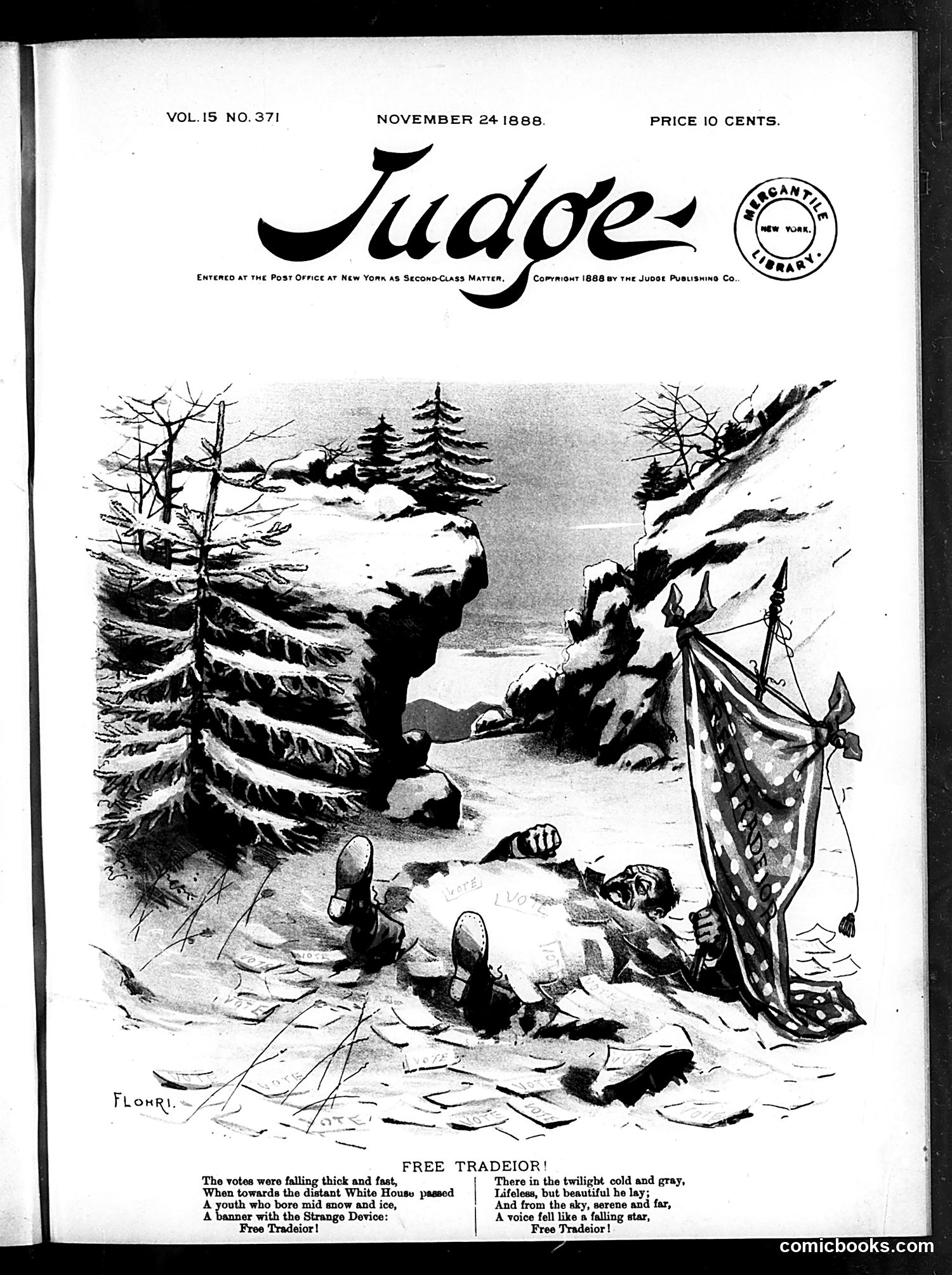
This cartoon depicts a winter scene with a figure lying in snow, appearing to be freezing or dying. The poem "Free Tradelor!" accompanies the image, with lines referencing votes "falling thick and fast" toward "the distant White House" and a youth who "bore mid snow and ice, / A banner with the Strange Device: / Free Tradelor!" This appears to satirize the 1888 presidential election, likely mocking the Democratic candidate Grover Cleveland's free-trade platform. The dying figure in snow suggests the cartoon's creator (Judge magazine being Republican-leaning) viewed free trade as economically fatal—a harsh criticism of Democratic trade policy. The reference to "Strange Device" may echo Longfellow's "Excelsior," inverting its inspirational message into one of folly and doom.
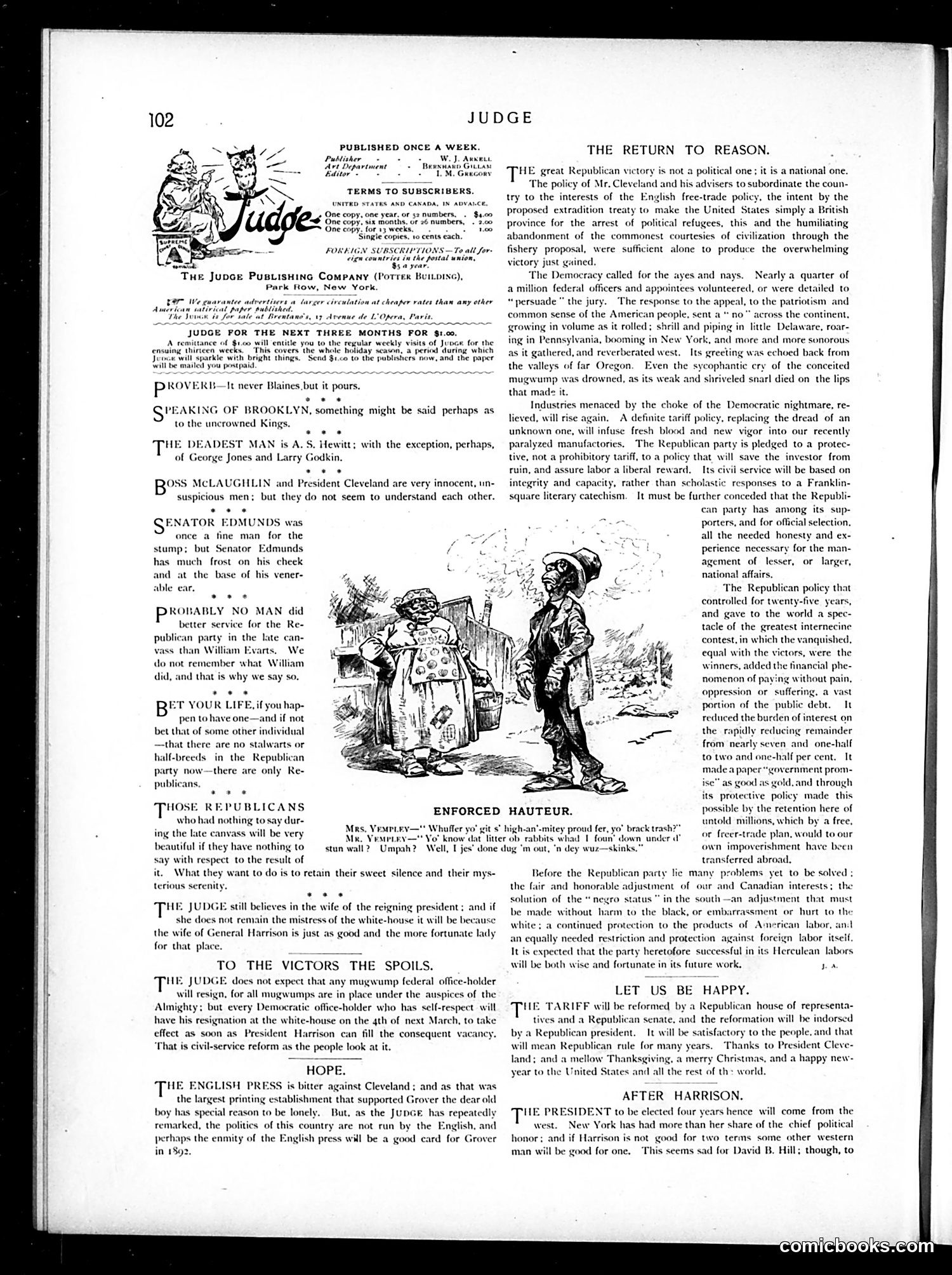
This cartoon depicts a confrontation between two figures labeled "Mrs. Vemplcy" and "Mrs. Vemplcy's Friend." The dialogue references "black trash" and "high-nity proud fer," suggesting a satirical commentary on class pretension and social snobbery among wealthy women during the Gilded Age. The cartoon mocks artificial class distinctions and affected superiority—a common Judge theme. The "enforced hauteur" (forced haughtiness) of the title suggests these women are performing social superiority rather than possessing genuine refinement. The specific "black trash" reference likely critiques racial and class-based prejudice among the Republican elite, connecting to the broader page's themes about Republican party management and social issues during the post-Civil War era.
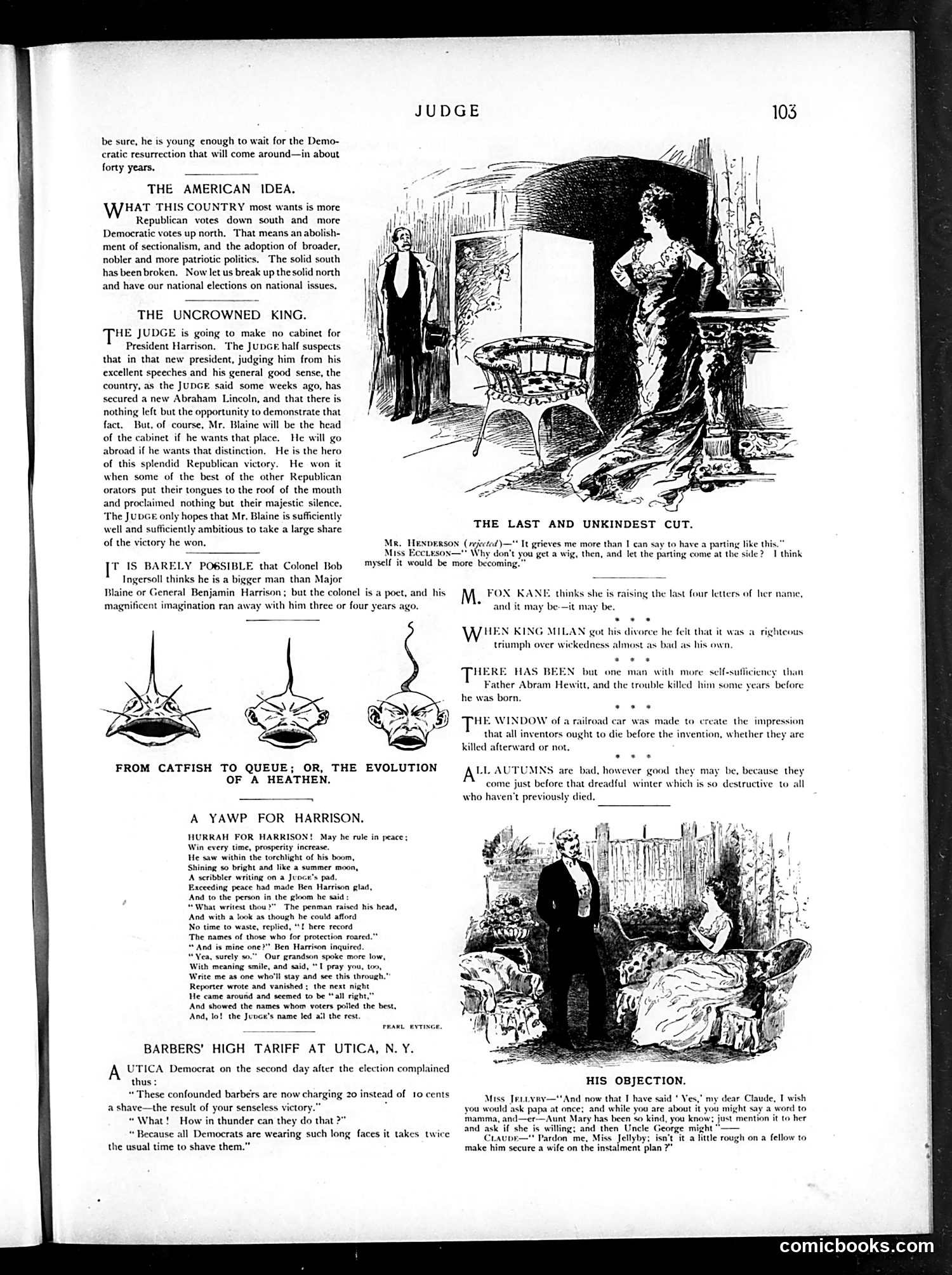
This page celebrates Republican Benjamin Harrison's 1888 presidential victory over Democrat Grover Cleveland. The content mocks Democratic losses while praising Harrison and fellow Republican James G. Blaine. **Key figures:** - **Harrison** (president-elect): portrayed as a new "Abraham Lincoln" - **Blaine**: celebrated as the Republican hero who won the election through rousing speeches - **Ingersoll and Benjamin Harrison**: compared (the Judge suggests Colonel Ingersoll falsely inflates his own importance) **Satirical points:** The cartoons and text mock Democrats for: complaining about barber price increases (blamed on Republican tariff policy), losing sectional control, and general incompetence. The "Last and Unkindest Cut" cartoon jokes about female vanity regarding hairlines. "From Catfish to Queue" appears to mock Asian immigrants through crude evolutionary imagery. The overall message promotes Republican economic policies and celebrates their electoral dominance, while ridiculing Democratic grievances as petty.
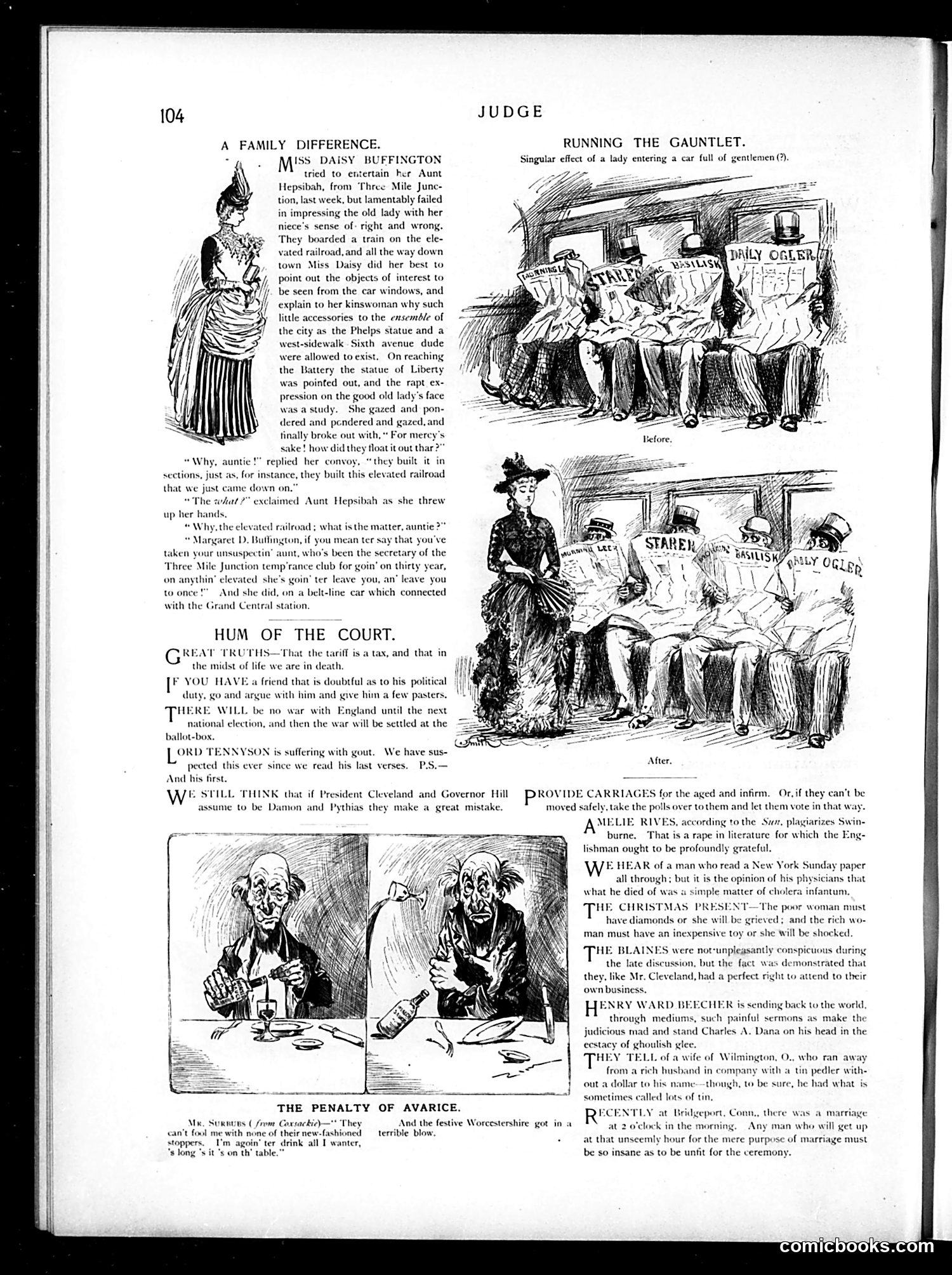
This page contains several satirical pieces typical of 1880s-90s American humor: **"A Family Difference"** mocks rural unsophistication through Aunt Hepsibah, who mistakes the Statue of Liberty for something that "floated" there and angrily abandons her niece for taking her on an "elevated" train, misunderstanding the term as morally improper. **"Running the Gauntlet"** shows a woman's entrance into a car full of gentlemen causing discomfort—satirizing Victorian-era gender anxieties about propriety. **"The Penalty of Avarice"** depicts two men drinking, mocking greed and excess. The page also includes brief political commentary: references to Cleveland and Hill (contemporary politicians), criticism of tariffs, and jokes about literary plagiarism by Amelie Rives. The overall tone reflects Judge's reliably conservative, establishment-friendly satire targeting rural folks, social climbers, and occasional political figures.
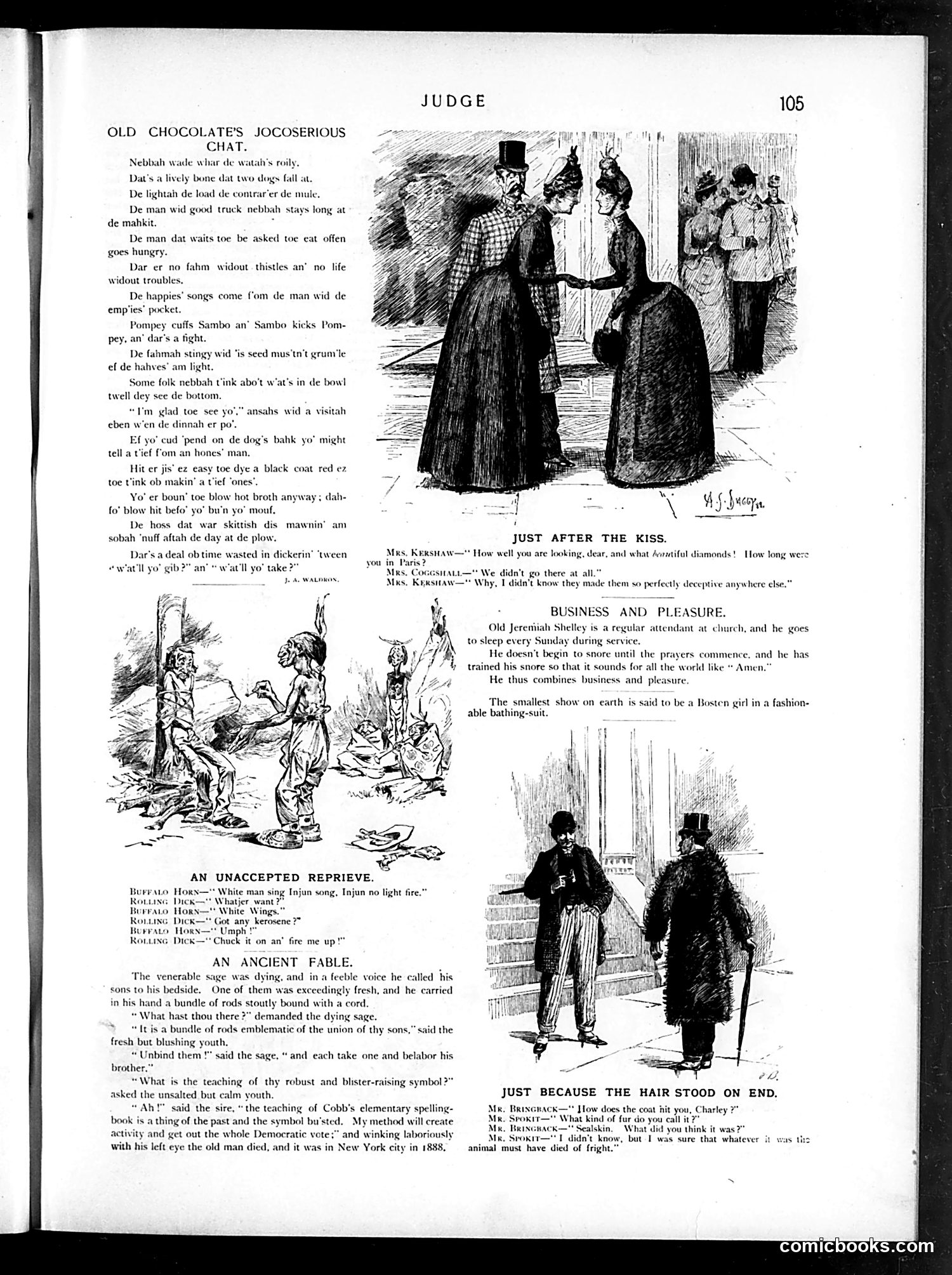
This page contains several satirical pieces typical of late-19th-century American humor: **"Old Chocolate's Jocoserious Chat"** presents dialect humor featuring a Black character dispensing folksy wisdom in exaggerated African American vernacular—a common (though now offensive) comedic format of the era. The sayings are rural proverbs about farming, honesty, and human nature. **"Just After the Kiss"** satirizes wealthy society women, mocking their pretense: a woman lies about Paris travel, and another admires her "diamonds" (implied to be fake), praising their "deceptive" quality. **"Business and Pleasure"** jokes about a churchgoer who trained himself to snore in a way that sounds like "Amen"—combining religious duty with napping. **"An Ancient Fable"** uses classical fable structure to mock Democratic Party unity, suggesting the party's cohesion is as fragile as bundled rods—a topical reference to 1888 politics. The cartoons use period-appropriate caricature and social commentary to appeal to Judge's affluent readership.
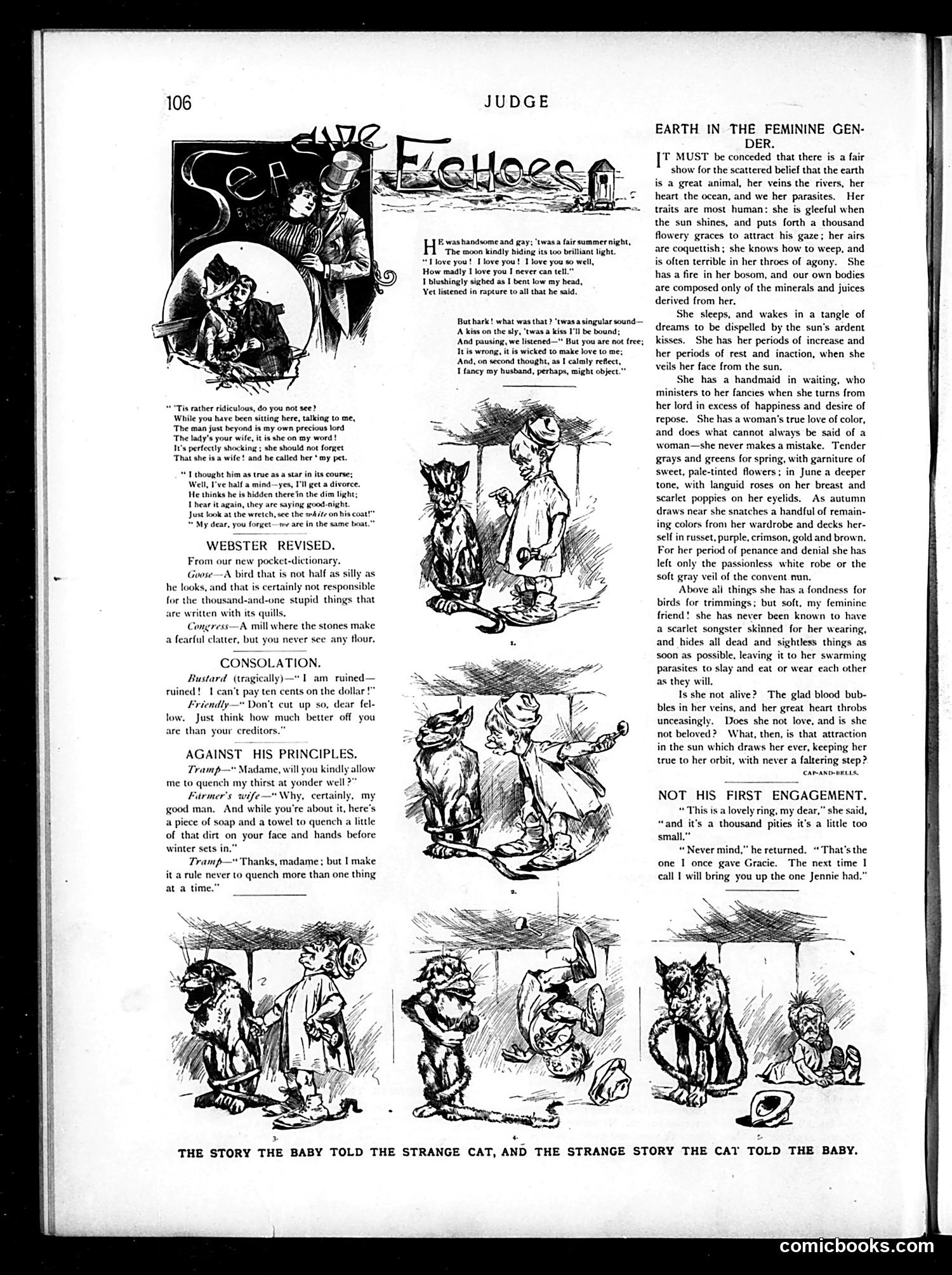
This page contains multiple unrelated satirical pieces typical of late 19th-century humor magazines: **Main cartoon**: "Earth in the Feminine Gender" presents a lengthy poetic meditation personifying Earth as a woman—romantically devoted to the sun, using nature's cycles as metaphors for female moods and appearance. The satire gently mocks sentimental Victorian nature writing and contemporary ideas about feminine nature. **Other humor sections** include: - A scene of mistaken identity where two people discover their spouses flirting, ending with the punchline that both are equally culpable - Dictionary definitions mocking Congress as a noisy mill producing nothing, and geese as less foolish than credited - A tramp refusing charity (soap and towel) because accepting would violate his principle of "quenching one thing at a time" The bottom illustrations show a baby and cat exchanging stories—likely whimsical nonsense humor. The overall tone reflects Judge's blend of social observation, wordplay, and gentle cynicism about marriage, politics, and human nature.
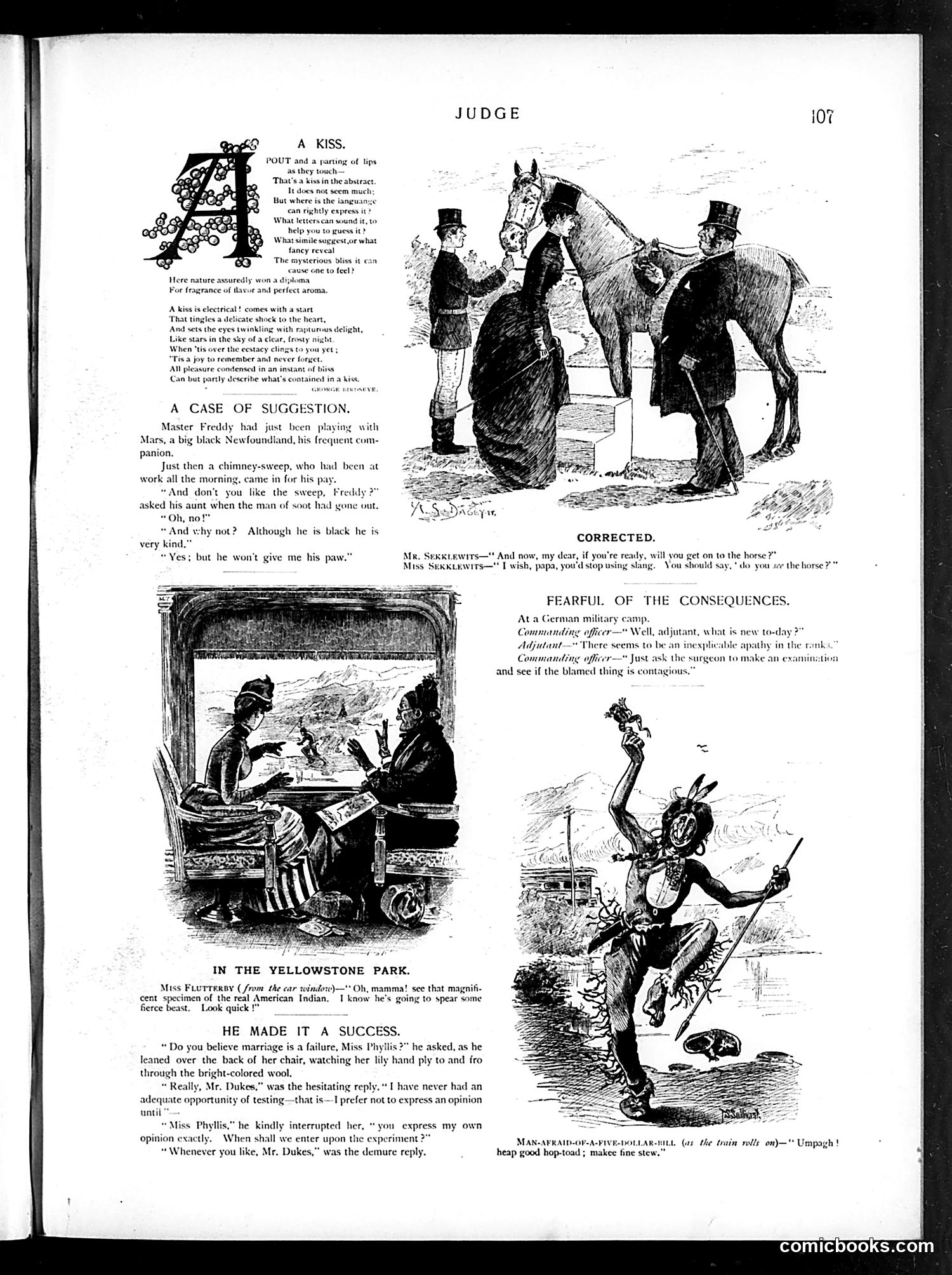
This page contains several satirical sketches typical of late 19th-century American humor: **"A Kiss"** is sentimental poetry about romantic kissing—not satirical, but filler content. **"A Case of Suggestion"** mocks a child's logic: young Freddy, after playing with a black Newfoundland dog, dislikes the black chimney sweep, suggesting the child associates blackness with the animal rather than seeing the man's humanity. This reflects period racial attitudes presented as childish ignorance. **"Corrected"** satirizes upper-class speech affectations—a father corrects his daughter's use of slang ("get on to the horse") to proper diction ("do you see the horse?"). **"Fearful of the Consequences"** jokes about military incompetence: a German commanding officer suspects an outbreak of apathy among troops might be contagious and orders medical examination. **"In the Yellowstone Park"** ridicules tourist expectations—a visitor expects to witness Native Americans spearing beasts, revealing stereotypical and sensationalized views. **"He Made It a Success"** presents mild romantic humor about marriage proposal timing.
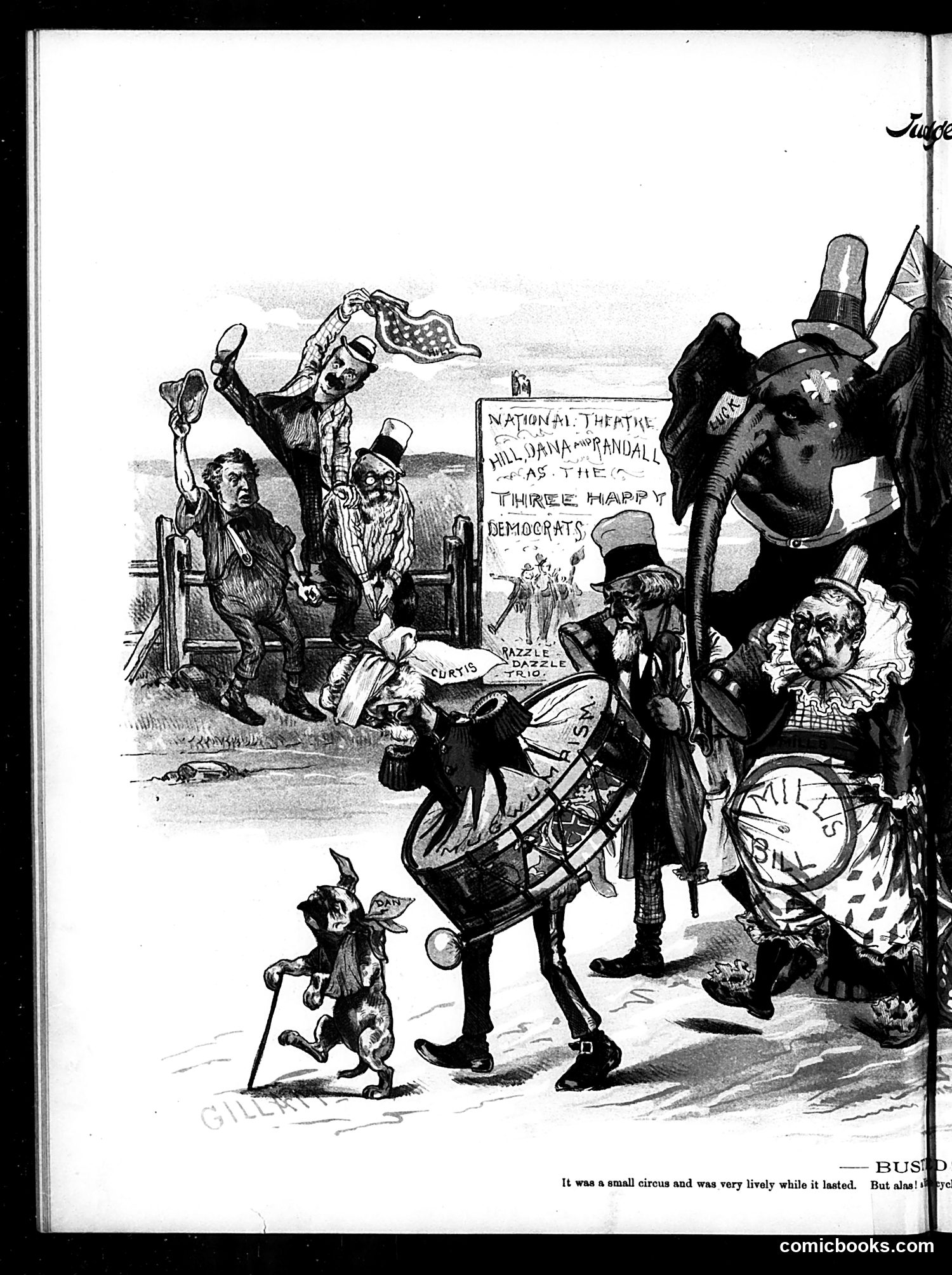
This Judge magazine cartoon satirizes Democratic Party leadership as a chaotic circus. The sign reads "National Theatre: Hill, Dana and Randall as the Three Happy Democrats," referencing Democratic figures (likely from the late 1800s or early 1900s). The image depicts a small circus performance with various performers and a large elephant—a symbol of the Republican Party. The Democratic leaders are portrayed as incompetent circus performers creating disorder and confusion. The caption "It was a small circus and was very lively while it lasted. But alas!" suggests the Democrats' brief, disorganized tenure lacks substance and stability. The satire mocks Democratic Party management and leadership effectiveness during this period.
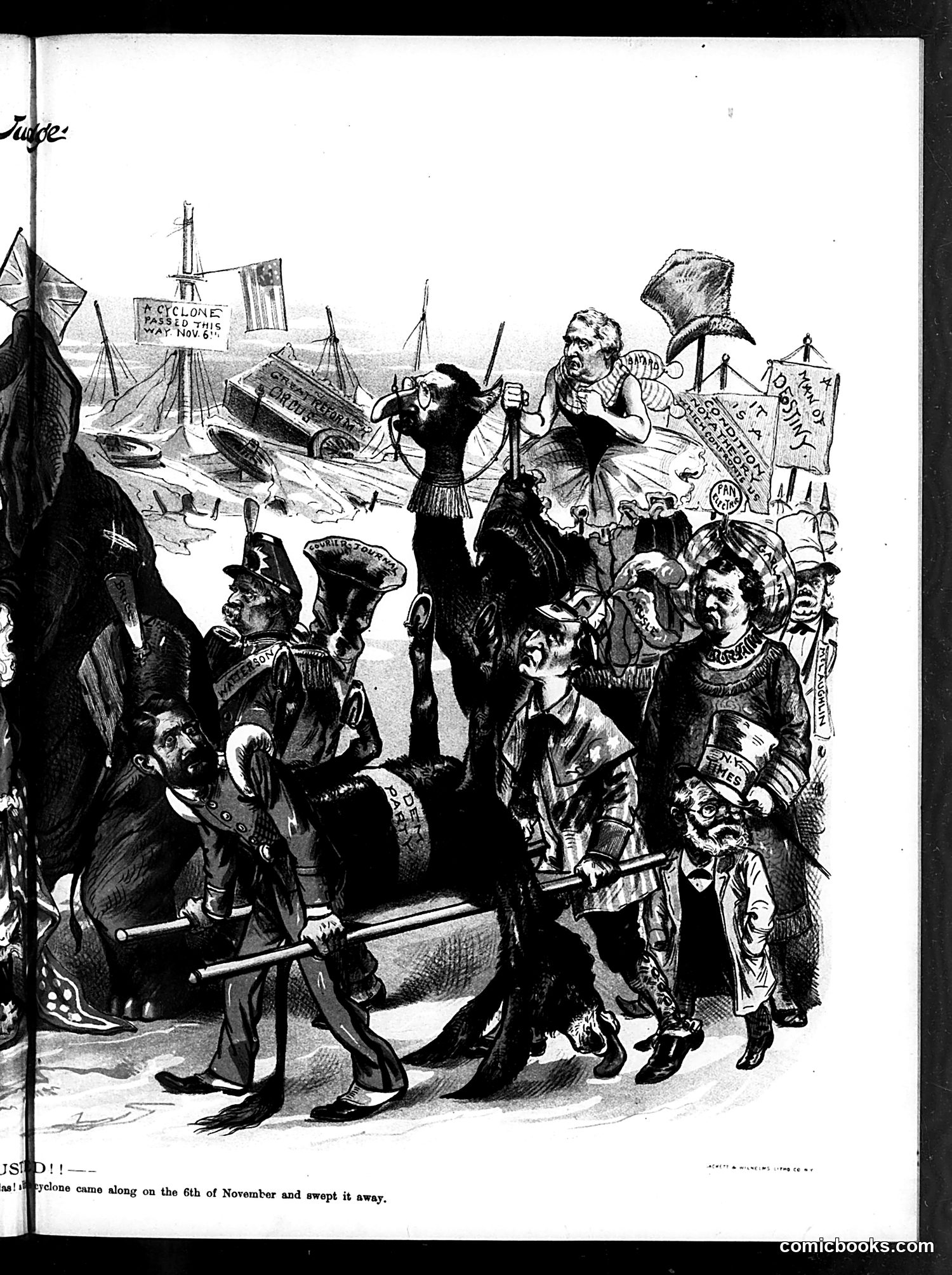
This political cartoon depicts a cyclone/hurricane striking a coastal scene with military and naval figures. The caption references November 6th and something being "swept away." The visible signs on ships include text mentioning "CYCLONE" and what appears to be references to political positions or appointments. The assembled military officers and dignitaries suggest this represents a significant political upheaval or change in government. However, without knowing the specific publication date, I cannot definitively identify which historical event or political figures this satirizes. The cartoon likely comments on an election or sudden governmental shift occurring around November 6th, with the cyclone serving as metaphor for the dramatic political change that "swept away" the previous administration or policies. The exact historical context—which election, which officials—remains unclear from the image alone.
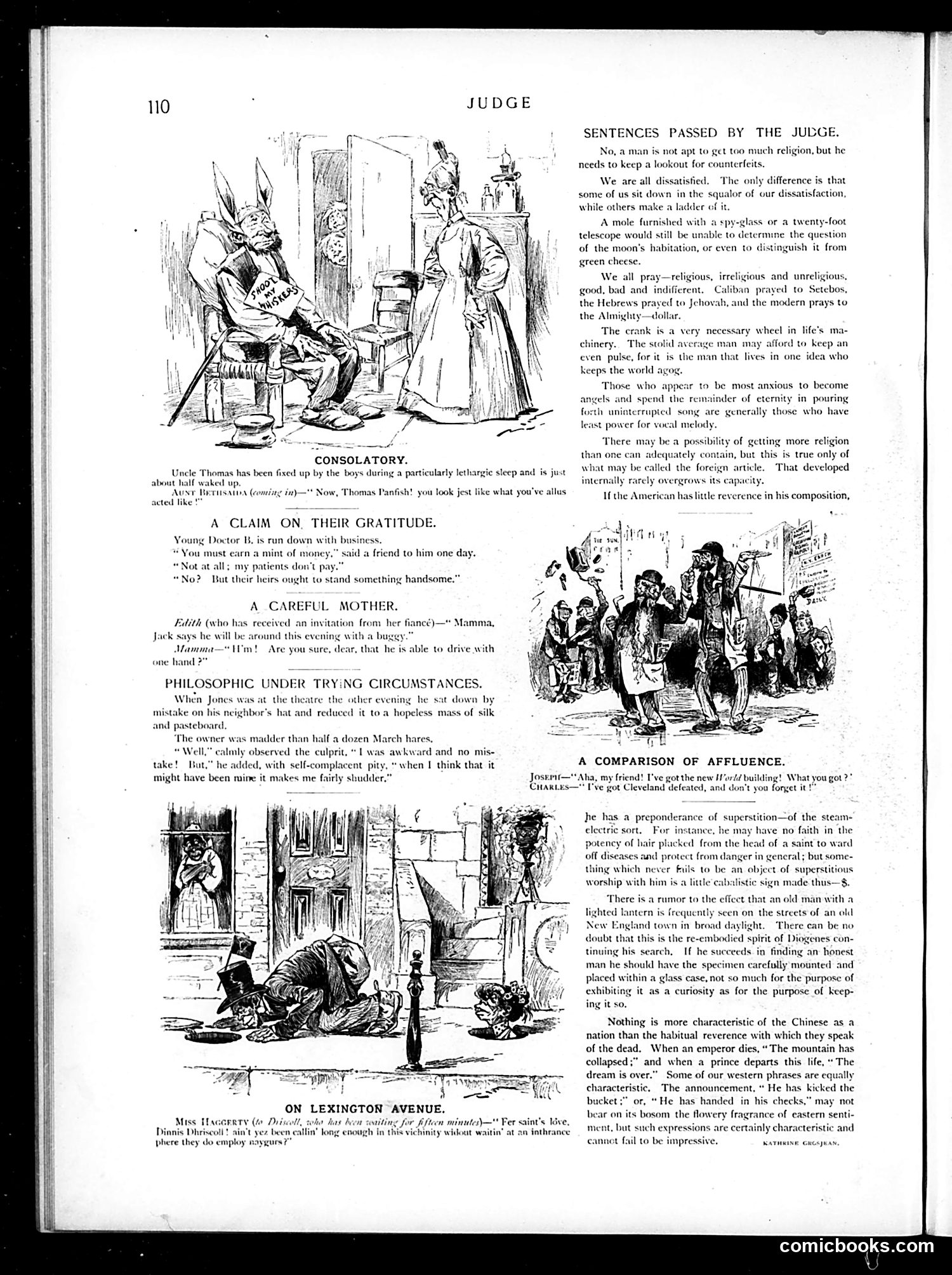
This page contains multiple short satirical pieces typical of late-19th-century American humor: **"Consolatory"** mocks a drunk man ("Uncle Thomas") whom boys have dressed up, with a friend remarking he now looks like "what you've always acted like"—suggesting habitual drunkenness. **"A Claim on Their Gratitude"** jokes about a busy doctor whose patients don't pay, but whose heirs should "stand something handsome"—dark humor about profiting from death. **"A Careful Mother"** plays on propriety: a fiancé visiting with a buggy prompts the mother's concern he can't drive "with one hand"—implying improper physical contact during courtship. **"Sentences Passed by the Judge"** offers philosophical observations on religion, ambition, and American character, suggesting Americans worship money ("$") superstiously rather than God. **"A Comparison of Affluence"** contrasts a new building with defeating Cleveland (the President)—suggesting political victory as status symbol comparable to real estate. The cartoons use exaggerated illustrations of working-class and immigrant figures, typical of period satire.
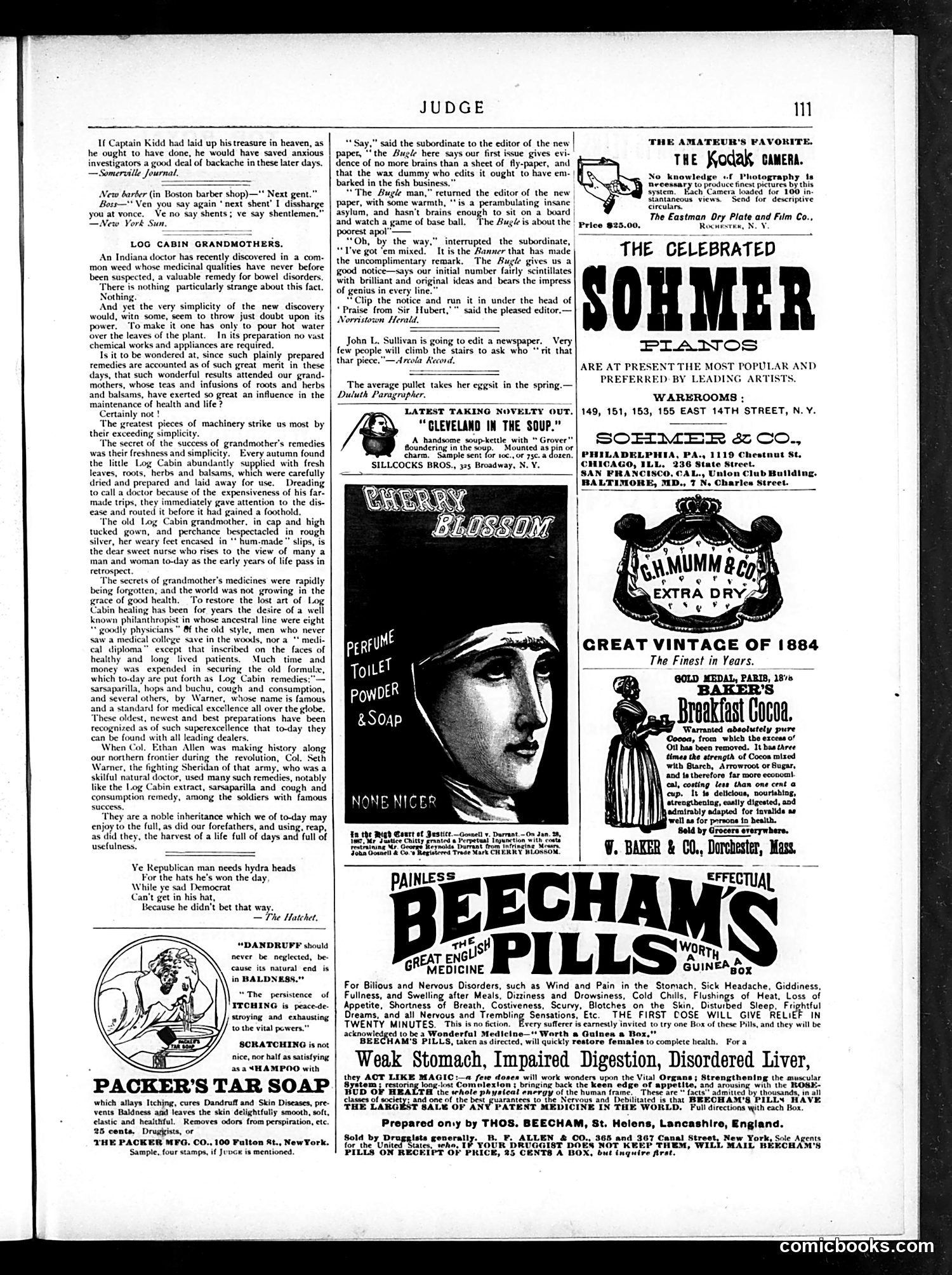
This page is primarily **advertising disguised as editorial content**. The top section presents humorous short items (quips about Captain Kidd's treasure, Boston dialect humor), but the dominant content is a lengthy advertisement for **Log Cabin remedies**, framed as a nostalgic article about frontier medicine. The "Log Cabin Grandmothers" piece promotes patent medicines by invoking 19th-century American mythology: the frontier grandmother's simple herbal cures were more effective than modern doctors. It credits a "philanthropist" (clearly **H.H. Warner**, named explicitly) with "restoring" these folk remedies—a marketing strategy that legitimized patent medicines by linking them to American pioneer heritage and supposed ancestral wisdom. The page also includes advertisements for **Sohmer Pianos**, **Beecham's Pills** (a famous British patent medicine), **Packer's Tar Soap**, and cocoa—typical late 1800s advertising fare. A brief political joke at the bottom references Republican and Democratic hats, likely alluding to electoral success, but remains opaque without more context. The page reflects Judge's dual nature: satirical commentary mixed with lucrative advertising revenue.
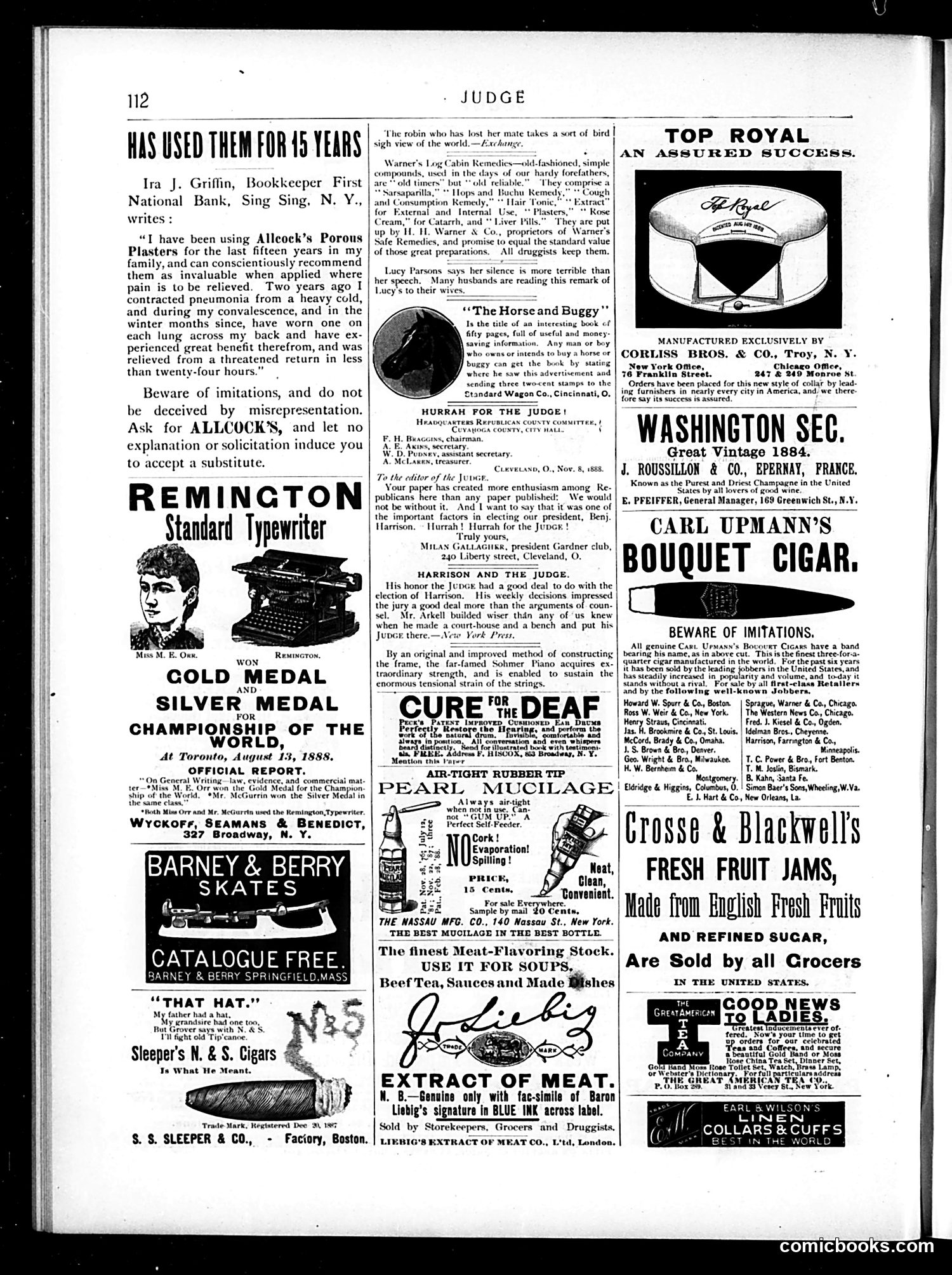
This page is primarily **advertisements and testimonials**, not political cartoons. The notable content includes: A satirical **quote about Lucy Parsons** (likely the anarchist widow of Haymarket defendant Albert Parsons), suggesting her silence is more "terrible" than her speech—a jab at radical women activists. A **testimonial praising Judge magazine for Harrison's 1888 election victory**, explicitly crediting the magazine's influence on readers as decisive in electing Republican Benjamin Harrison. This reflects Judge's partisan Republican stance and its self-promotion as a politically consequential publication. The remaining content is **product advertising**: Allcock's plasters, Remington typewriters, Pearl Mucilage, skates, cigars, and other goods typical of late-1880s magazines. This advertising was Judge's primary revenue source. The page demonstrates how 19th-century satirical magazines mixed political commentary with commercial content, while maintaining clear partisan allegiances.
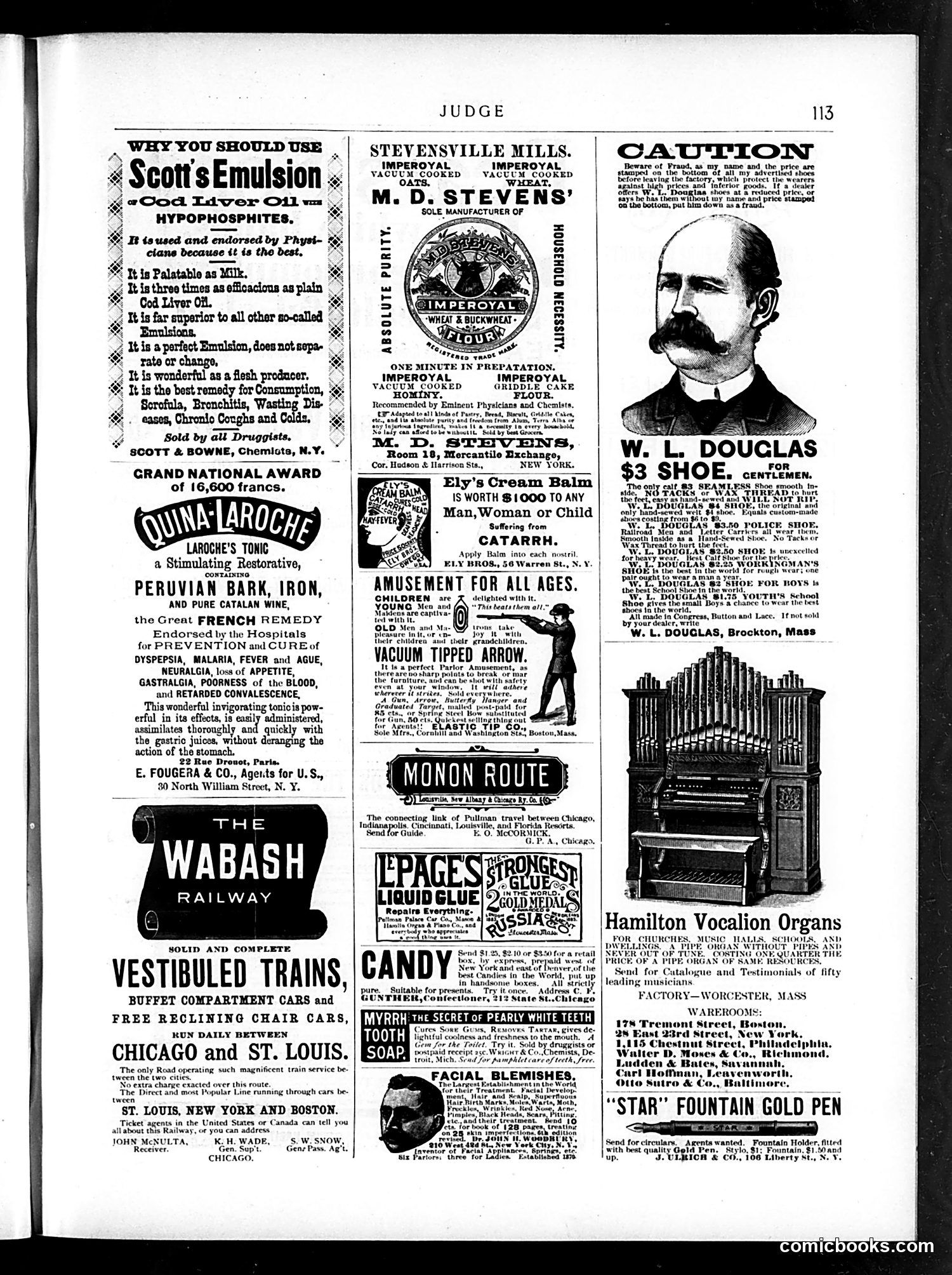
This is primarily an **advertising page** from Judge magazine, not a satirical cartoon. The page contains various commercial advertisements typical of the late 19th/early 20th century. Notable ads include Scott's Emulsion (cod liver oil tonic), Laroche's Tonic (a French patent medicine), the Wabash Railway, and various other products ranging from food items to shoes. There's also a portrait photograph of **W. L. Douglas**, a shoe manufacturer, who warns consumers against counterfeits—he claims to stamp his shoes with a price mark to protect buyers from fraud. The page includes a warning about fake Douglas shoes being sold at reduced prices, suggesting brand counterfeiting was already a consumer problem of that era. No political satire or editorial cartoons are visible here—this is straightforward commercial advertising that filled Judge's pages to generate revenue.
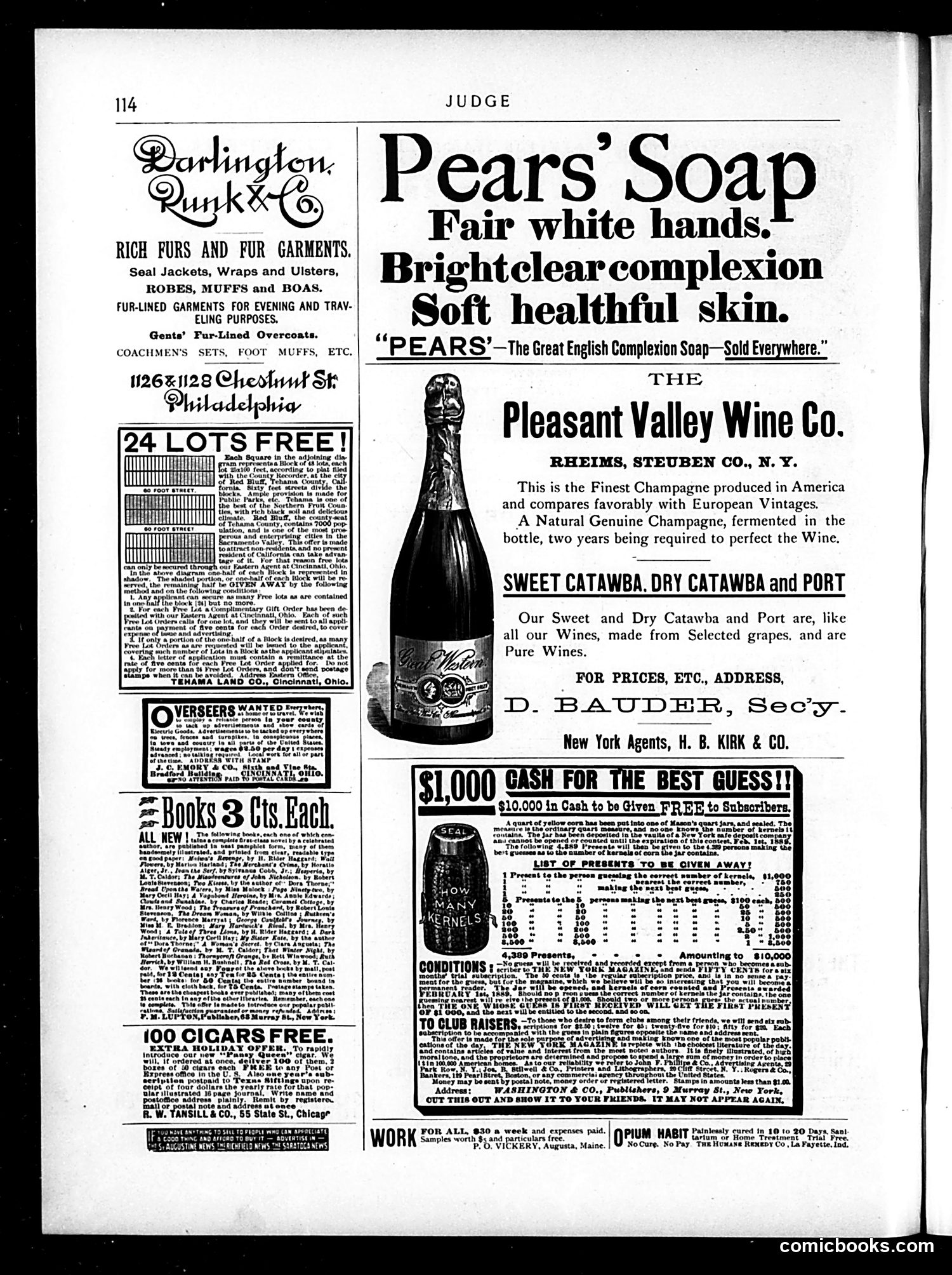
This page is predominantly **advertisements and promotional content**, not political satire or editorial cartoons. The layout features: **Main advertisements:** - Darlington, Funk & Co.: fur garments and clothing - Pears' Soap: emphasizing "fair white hands" and "bright clear complexion"—reflecting period beauty standards and racial attitudes - Pleasant Valley Wine Co.: champagne and wines from New York - A "$1,000 cash giveaway" contest offering prizes to magazine subscribers - Various smaller ads for cigars, books, employment, and medical treatments **Historical context for modern readers:** The Pears' Soap ad's emphasis on whiteness and "bright" complexion reflects Victorian-era beauty standards and unfortunate racial biases of the period. The wine advertisements and contests represent typical late 19th-century magazine monetization strategies. There are no visible political cartoons on this page—it's a commercial section demonstrating how satirical magazines funded themselves through advertising.
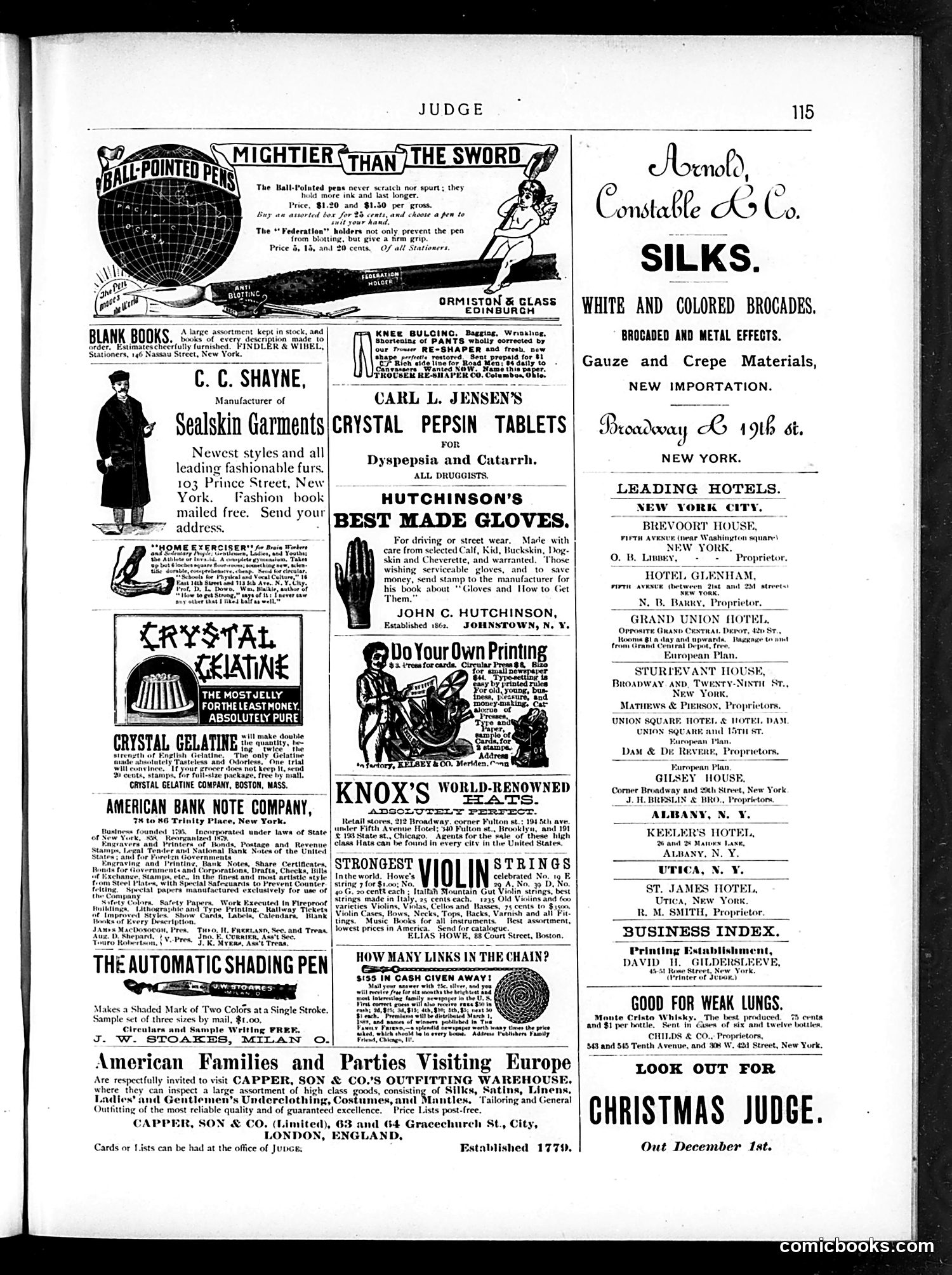
This is primarily an **advertising page** with no political cartoons or satirical content to analyze. The page contains roughly two dozen advertisements for consumer products and services typical of late 19th-century America, including: - Writing instruments (Ball-Pointed Pens, Automatic Shading Pen) - Clothing (Sealskin Garments, Gloves, Underclothing) - Food/health products (Crystal Pepsin Tablets for dyspepsia, Monte Cristo Whisky for weak lungs) - Printing services and blank books - Hotel listings in New York City and Albany - Silk and fabric importers The only editorial content is a small promotion for the "Christmas Judge" issue coming December 1st. The page serves as a revenue source for the magazine rather than delivering satire or social commentary.
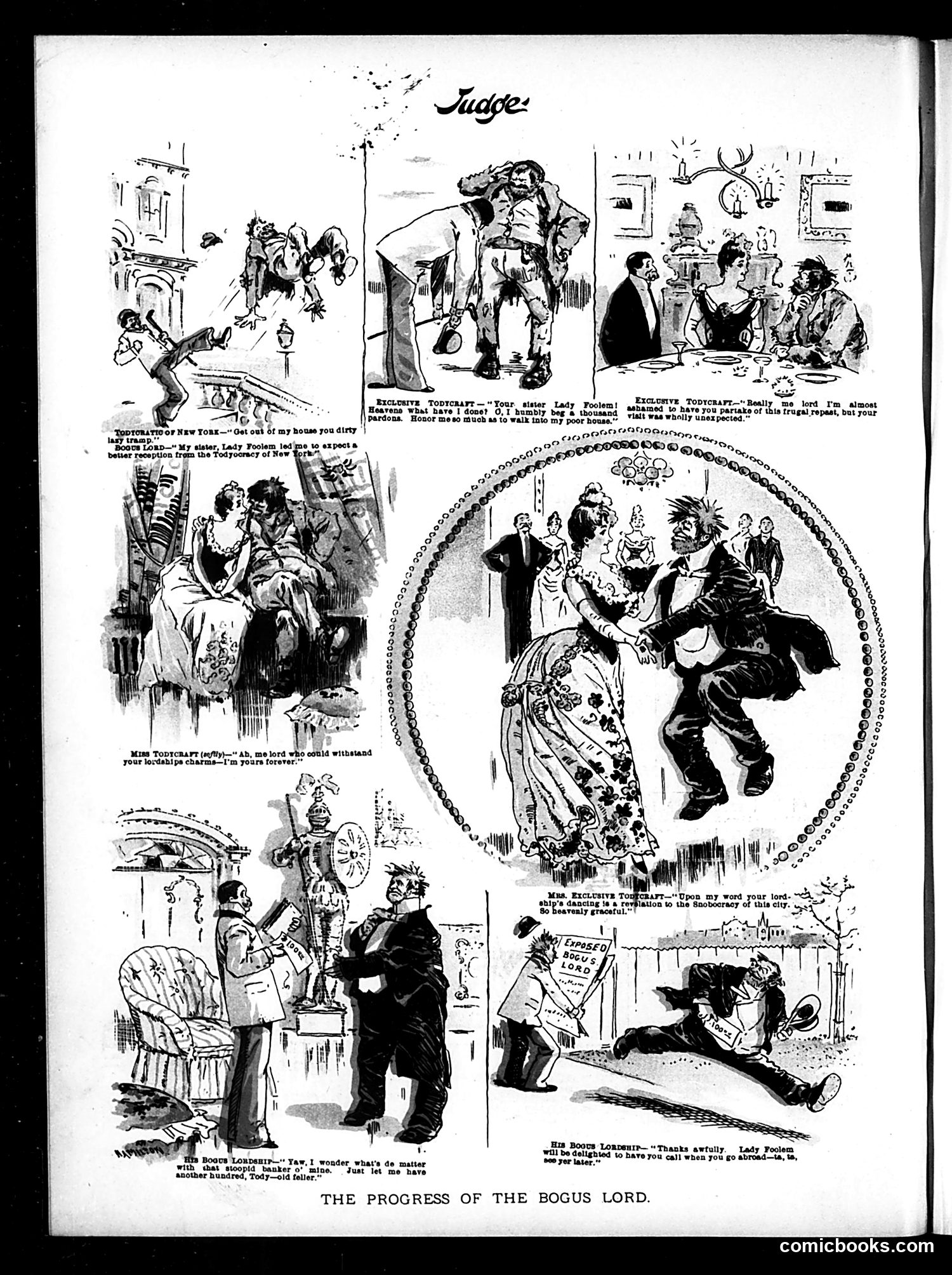
This satirical series mocks a con artist posing as British nobility ("His Bogus Lordship") who exploits New York's wealthy social climbers. The sequence shows his manipulative scheme: he charms women of the elite "Todyocracy" (apparently a Judge term for pretentious New York society) with flattery, gains access to their homes and fortunes, and repeatedly extracts money through deception. The satire targets both the fraudster's shameless opportunism and the gullibility of status-obsessed Americans who eagerly accept any claimant to aristocracy. References to "Lady Foolem" and "Miss Todycraft" underscore the critique—these women are portrayed as foolish for being seduced by fake titles and Old World charm. The cartoon ridicules American social snobbery and the vulnerability of the wealthy to con artists exploiting their desire for European prestige and romance.