
A complete issue · 16 pages · 1888
Judge — October 13, 1888
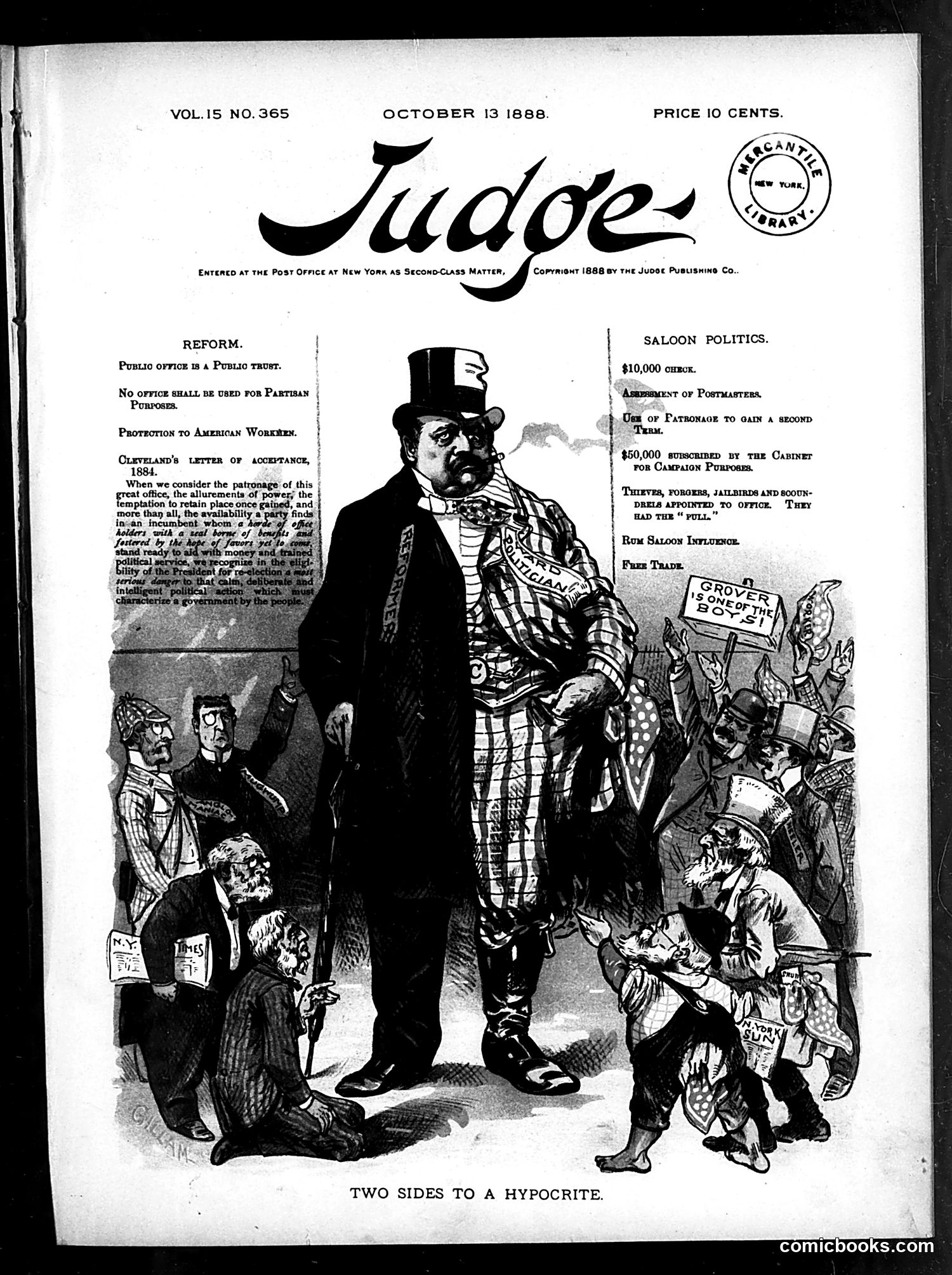
This October 1888 *Judge* cartoon satirizes political hypocrisy during the 1888 presidential campaign. The large central figure appears to represent a politician—likely President Grover Cleveland based on the "Grover Box of Tricks" label visible on the right side. The cartoon depicts Cleveland presenting himself differently to different audiences: respectably dressed on one side, surrounded by working people and reform advocates on the left, while simultaneously associated with saloon politics and corruption (indicated by the "Saloon Politics" heading and the caricatured figures on the right). The title emphasizes the contradiction between Cleveland's public reform rhetoric and his actual political alliances with machine politics and saloon interests—a common critique of politicians who claim virtue while enabling vice.
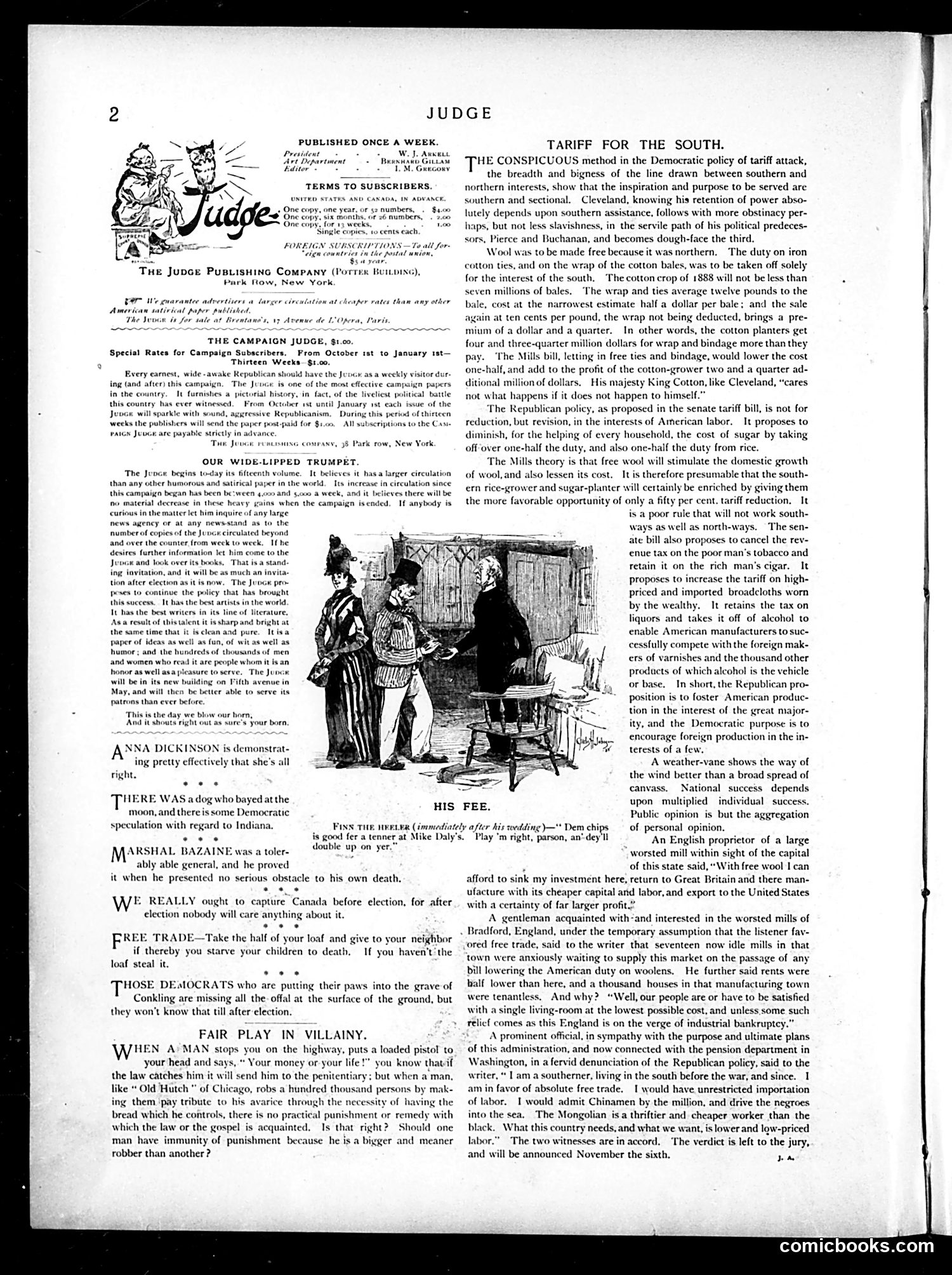
The main cartoon, titled "HIS FEE," depicts a poorly-dressed person entering what appears to be a lawyer's or doctor's office. The caption references "Fins the heeler" making demands "immediately after his wedding"—suggesting a working-class man seeking professional services but lacking funds. The surrounding text discusses tariff policy, free trade, and Democratic versus Republican economic approaches. Articles mock Democratic positions on trade and social welfare while defending Republican protectionist policies. The cartoon likely satirizes working-class struggles during a period of economic debate, showing the gap between ordinary people's financial desperation and professional service fees. Without clearer identification of the specific figures, the exact political target remains somewhat unclear, though the page's broader context emphasizes economic class tensions.
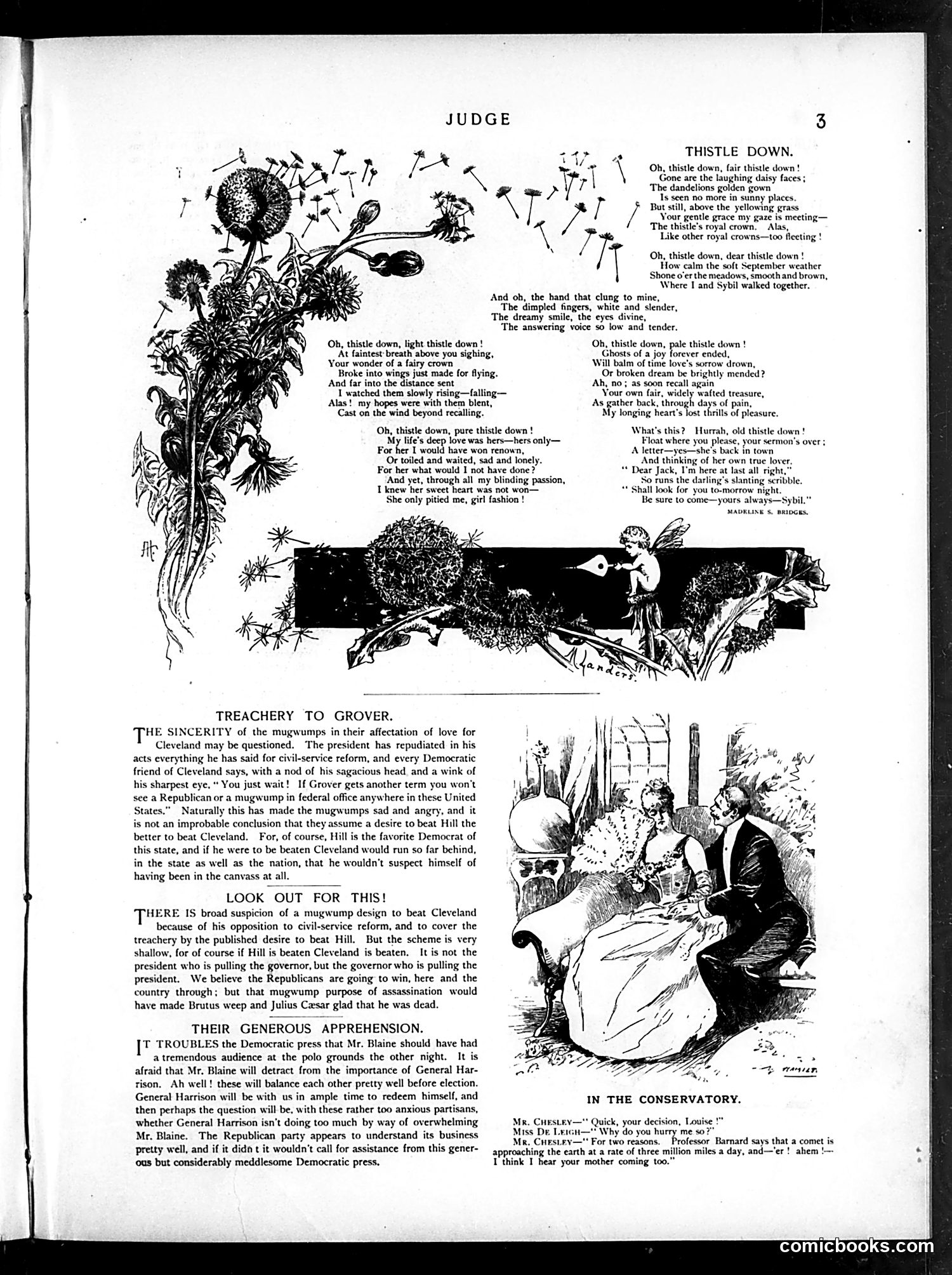
This page contains political commentary on 1880s American politics, specifically addressing Democratic Party internal conflicts. **"Treachery to Grover"** criticizes "mugwumps" (Republican-leaning independents) who claim to support President Cleveland for civil-service reform while allegedly plotting to defeat him. The article suggests their true target is David B. Hill, a New York Democrat, hoping Cleveland's defeat in the state will damage him nationally. The satire warns this assassination scheme would make even historical traitors "weep." **"Look Out For This!"** expands on the conspiracy theory, claiming Republicans orchestrated the mugwump strategy. **"Their Generous Apprehension"** mocks Democratic newspapers' anxiety that James G. Blaine's recent polo-ground appearance overshadows General Benjamin Harrison's campaign importance. The tone suggests both Republican figures will adequately represent their ticket before election day. The page's poetry, "Thistle Down," appears unrelated politically—a sentimental romantic ballad about lost love.
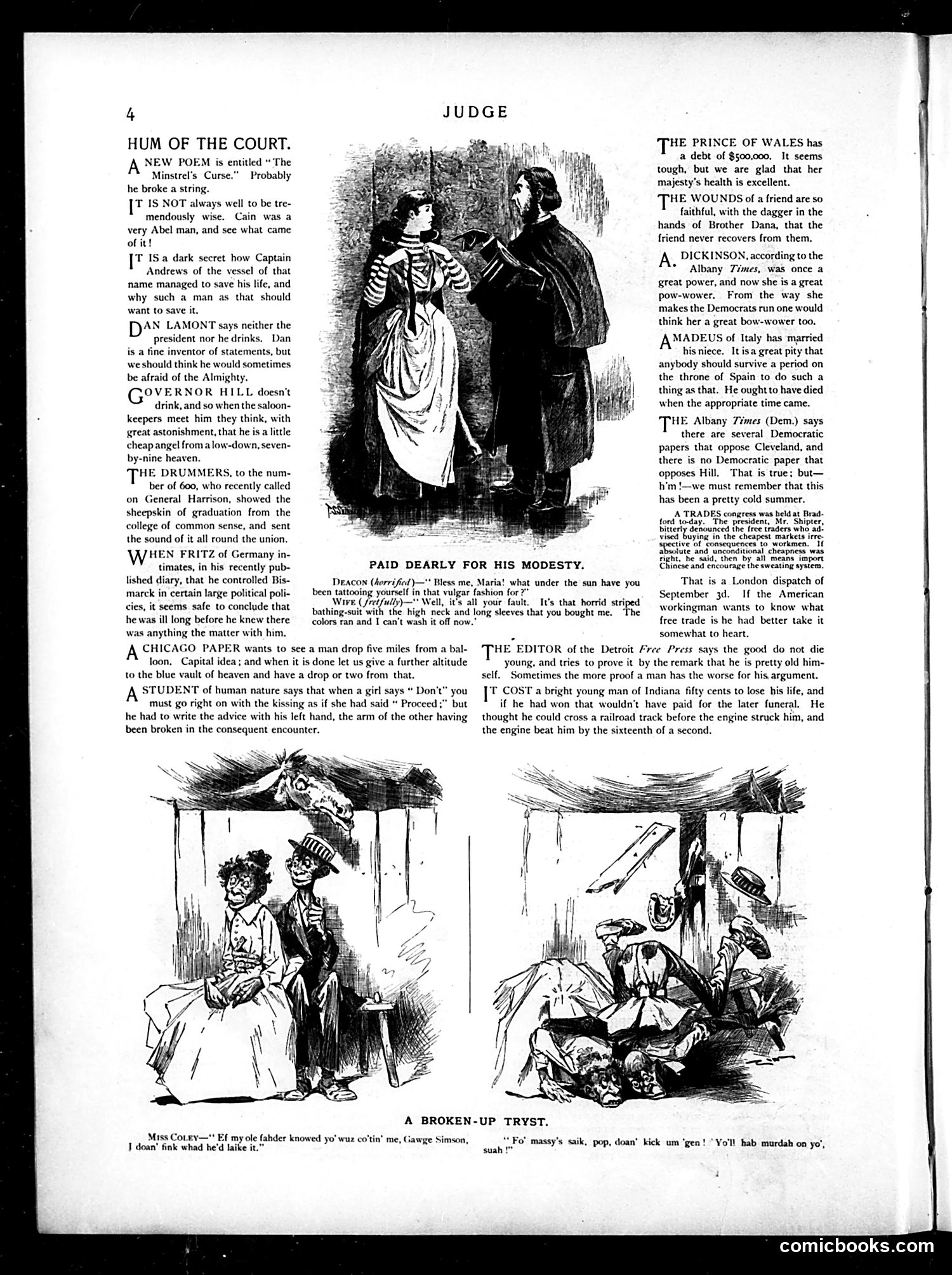
This page from *Judge* contains mostly brief satirical commentary on contemporary political figures and social issues, circa 1880s-90s. The main cartoon, "Paid Dearly for His Modesty," depicts a deacon confronting his wife about wearing a immodest bathing suit. The satire suggests that excessive modesty (her high-necked, long-sleeved garment) defeats its own purpose by drawing attention through its conspicuous prudishness. The text snippets mock various figures: Governor Hill for his temperance claims; Dan Lamont for dishonest statements; the Prince of Wales's debt; and Democratic political rivalries in New York (Hill vs. Cleveland). One note attacks free trade advocates who import cheap Chinese goods, undercutting American workers—reflecting 1880s-90s protectionist sentiment and anti-Chinese labor anxiety. The "Broken-Up Tryst" cartoon below shows working-class domestic discord. Overall, the page blends political commentary with domestic humor typical of *Judge's* satirical approach.
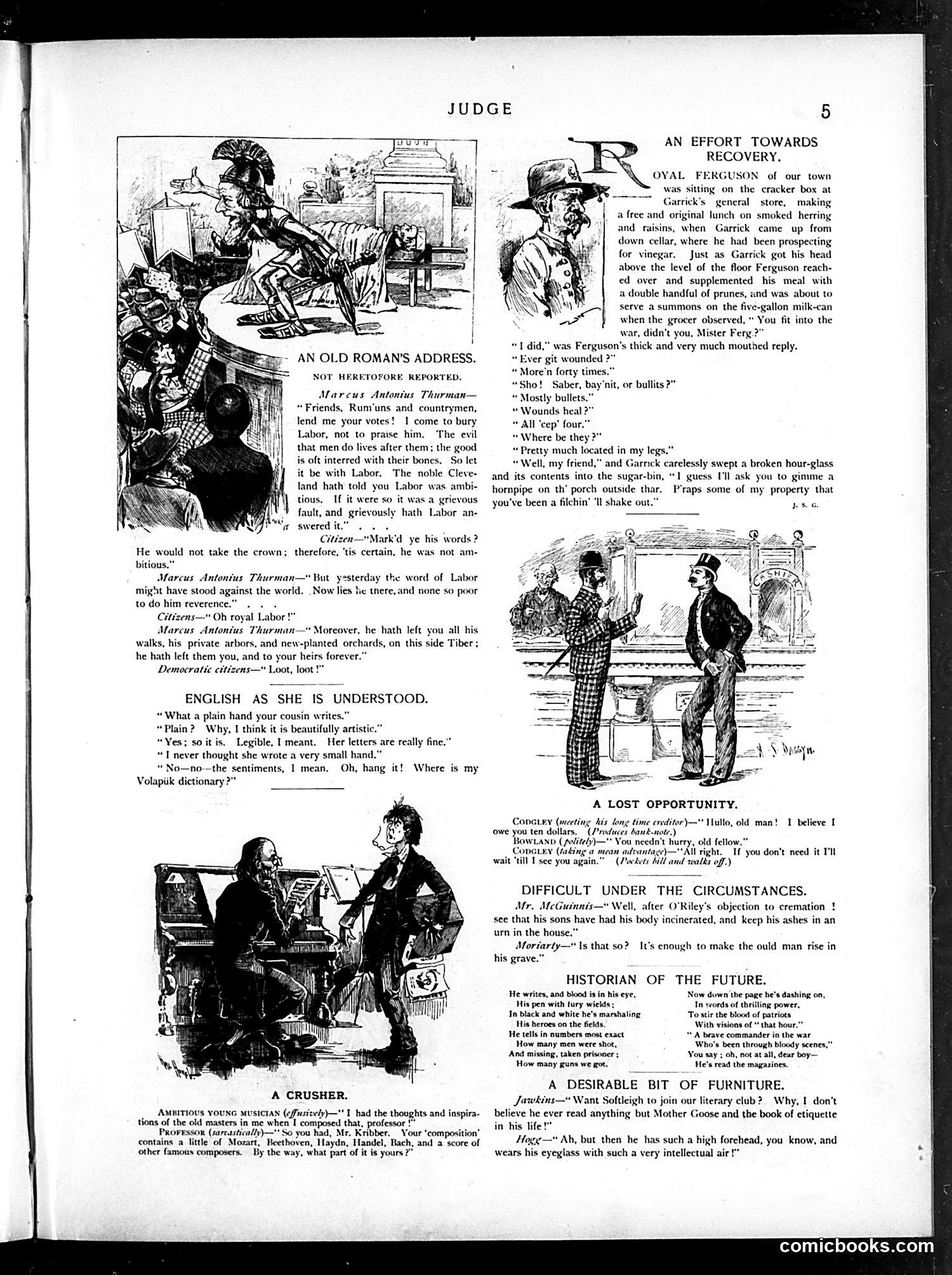
This page contains several satirical pieces mocking American politics and society. **"An Old Roman's Address"** parodies Mark Antony's funeral oration from Shakespeare's *Julius Caesar*, applying it to "Labor" and referencing "Cleveland" (likely President Grover Cleveland). The satire suggests politicians cynically exploit working-class concerns while dismantling labor protections—the ironic "Democratic citizens" crying "Loot, loot!" underscores the critique. **"An Effort Towards Recovery"** depicts a working-class veteran casually mentioning wounds from war, humorously suggesting post-war adjustment difficulties. **Other sketches** mock pretension: an aspiring composer claimed originality while plagiarizing famous composers; a man misuses "artistic" versus "legible"; and a creditor loses his chance for repayment through false courtesy. The overall tone reflects Judge's satirical commentary on Gilded Age politics, labor disputes, and middle-class affectations.
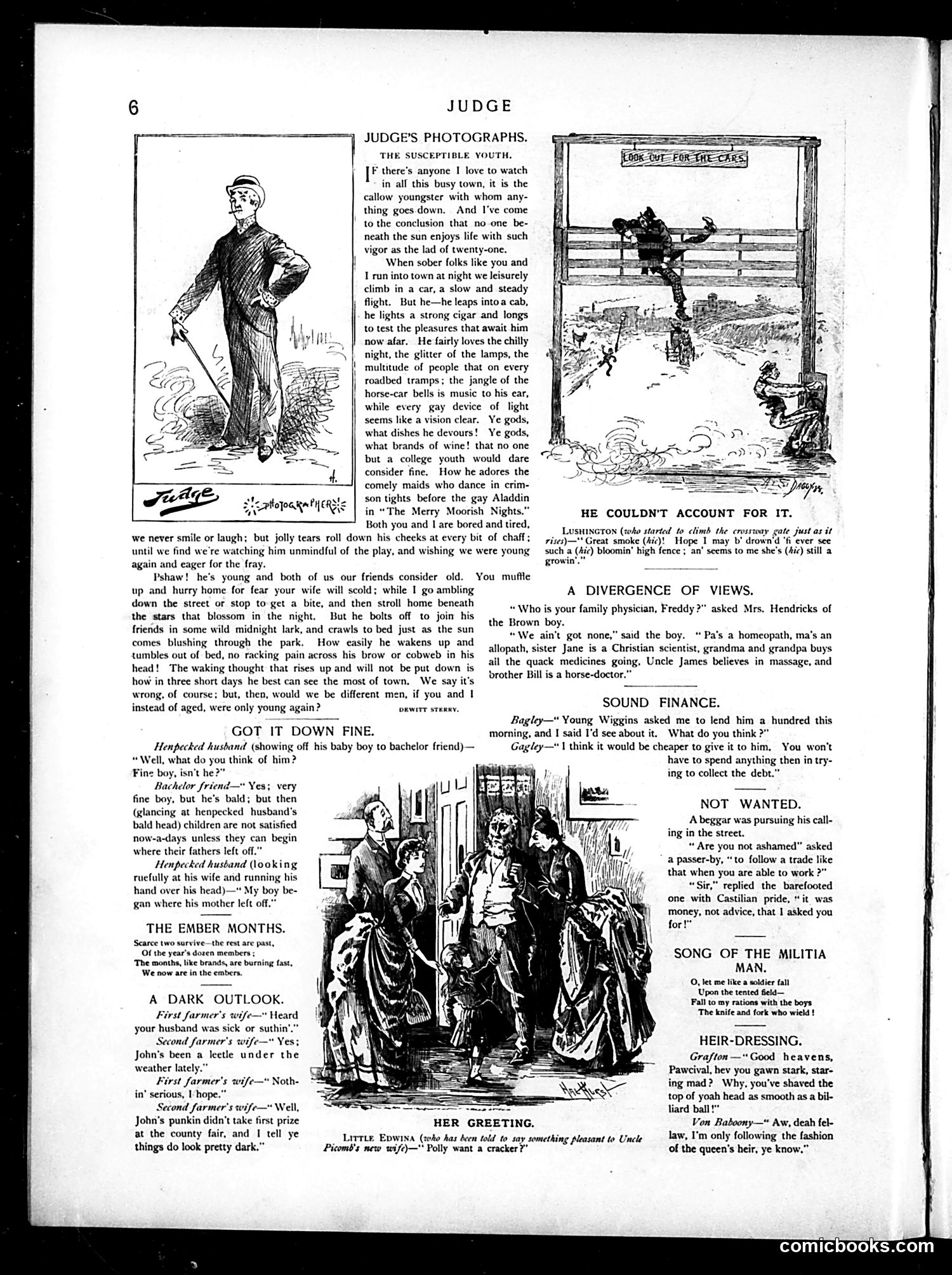
This page from Judge satirizes youth culture and contains several comic sketches typical of early 20th-century American humor. **"Judge's Photographs: The Susceptible Youth"** is the main feature—a lengthy poem praising young men's zest for life. It contrasts the exuberance of 20-year-olds (who leap into cabs, enjoy nightlife and theater like "The Merry Moorish Nights," and find joy everywhere) with the dull, tired existence of older adults. The satire cuts both ways: celebrating youthful energy while gently mocking its recklessness and excess. The accompanying sketches use domestic humor: "Got It Down Fine" jokes about baldness passing from father to son; "A Dark Outlook" features farmers worried about failed pumpkins at county fairs; "A Divergence of Views" satirizes conflicting medical philosophies (homeopathy, allopathy, Christian Science, quackery, massage). The humor relies on period-specific references (trolley cars, vaudeville theaters, county fairs, various medical fads) and celebrates genteel mockery of everyday American life—typical of Judge's approach before WWII.
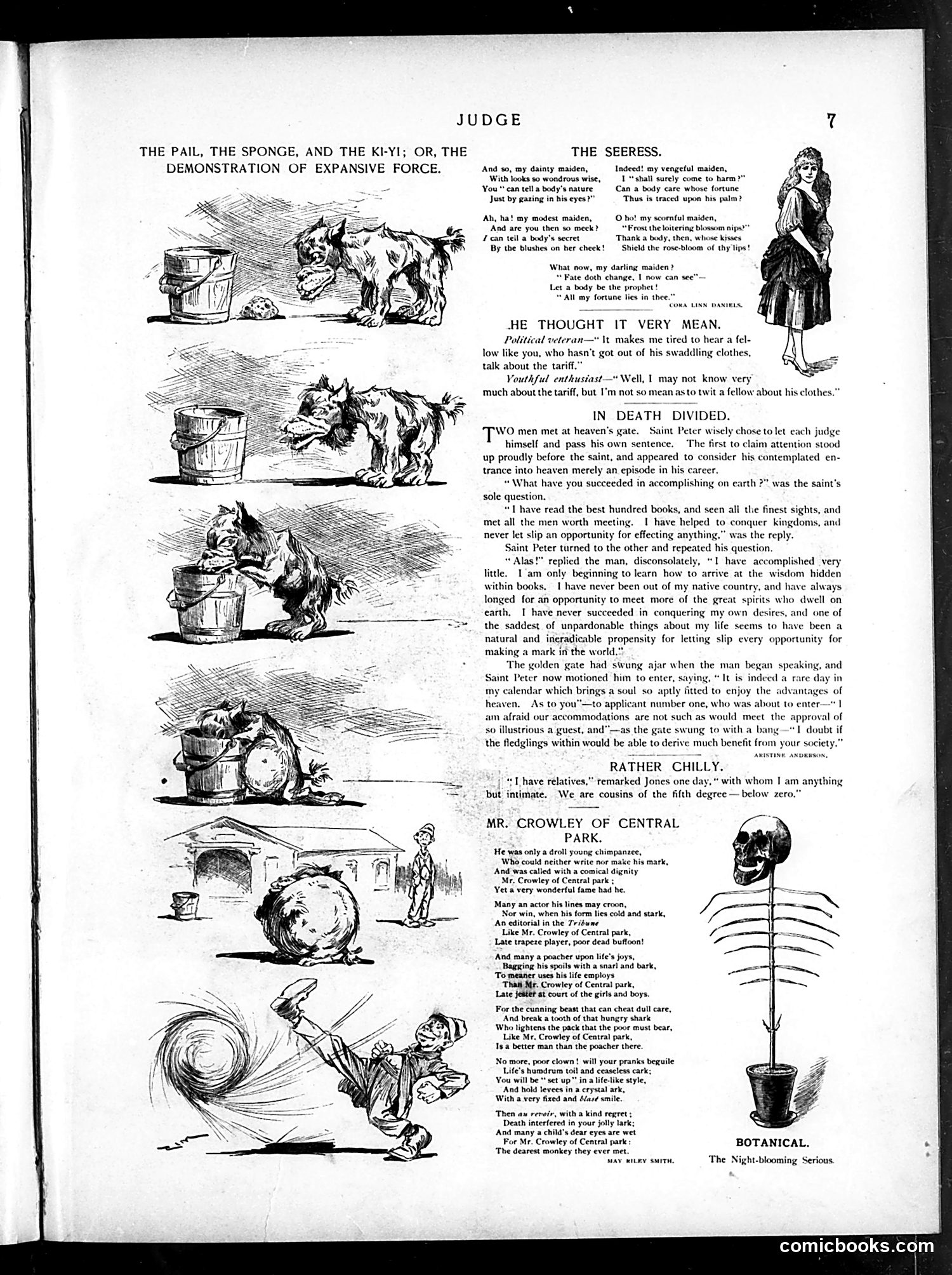
**The Pail, the Sponge, and the Ki-Yi**: The sequential illustrations appear to demonstrate "expansive force"—likely a physics joke showing a dog repeatedly expanding from or interacting with a pail, with increasing comic effect. **The Seeress**: A flirtation poem where a maiden claims fortune-telling abilities, reading a young man's future "in his eyes" and palm—typical Victorian romantic banter satirizing fortune-telling pretense. **He Thought It Very Mean**: A generational political debate. An older "political veteran" dismisses a young man's tariff opinions as naive; the youth responds that at least he won't mock someone's appearance—a dig at the elder's rudeness. **In Death Divided**: Saint Peter admits the humble, self-doubting man to heaven while rejecting the accomplished, prideful one. The satire critiques materialistic achievement and worldly success as spiritually hollow—a moralistic commentary on Gilded Age ambition. **Minor pieces** include a joke about distant relatives and a eulogy for "Mr. Crowley," apparently a deceased circus chimp, satirizing excessive press attention given to celebrities versus ordinary people.
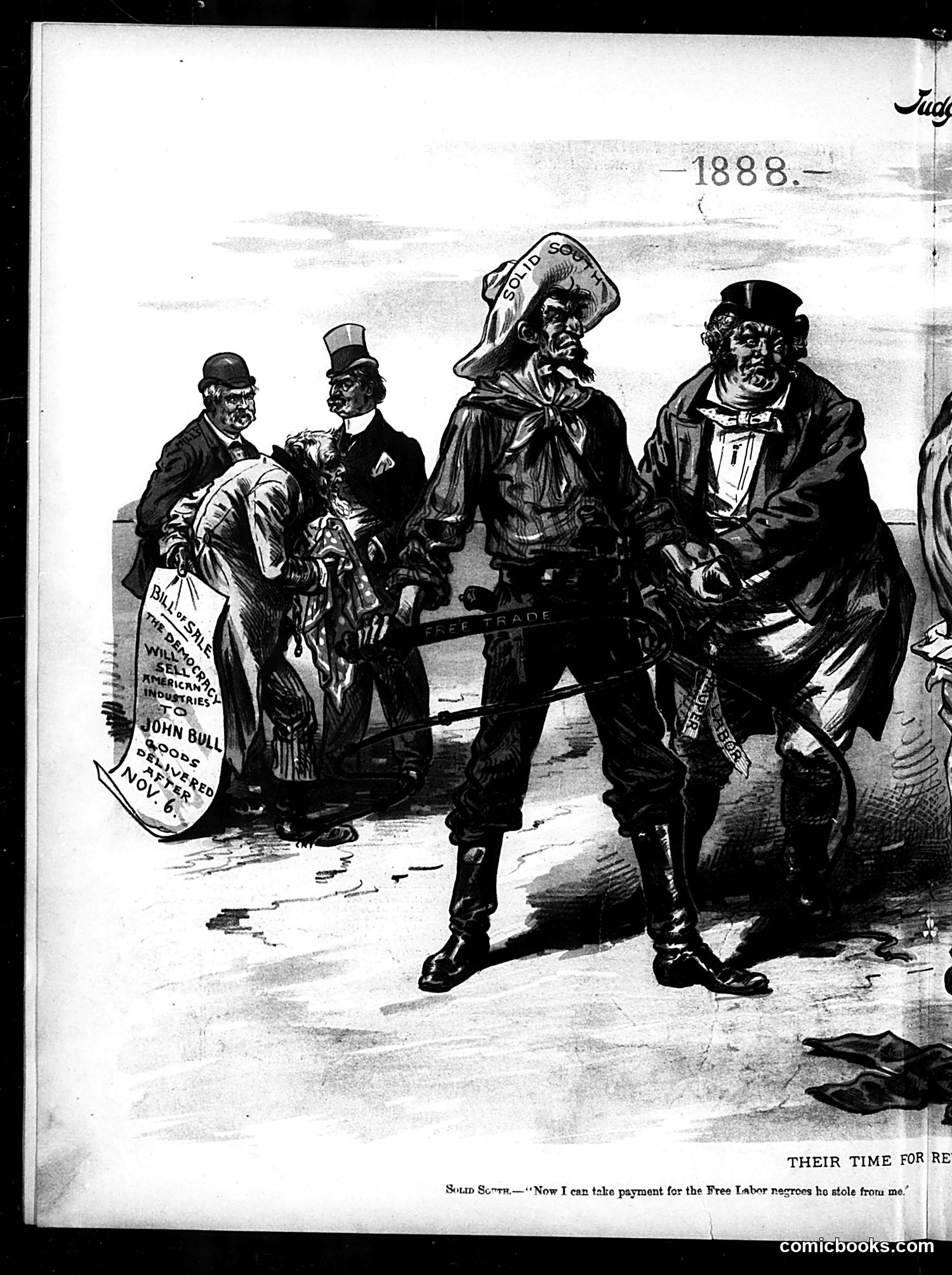
This political cartoon depicts the post-Reconstruction South during the 1888 election cycle. The central figure appears to be a Southern politician or businessman claiming he can now "take payment for the Free Labor negroes he stole from me"—referring to formerly enslaved people. The cartoon satirizes Southern Democrats' attempt to reverse Reconstruction gains and reassert economic control over freed African Americans. The figures in formal dress likely represent Northern Republican politicians being confronted by a Southern representative demanding compensation or restored labor control. The title "Their Time for Reckoning" suggests Judge magazine is mocking Southern political demands for financial restitution or the restoration of racial subjugation, presenting this as absurd and contemptible. The cartoon criticizes post-Reconstruction Southern politics attempting to undo emancipation's economic consequences.
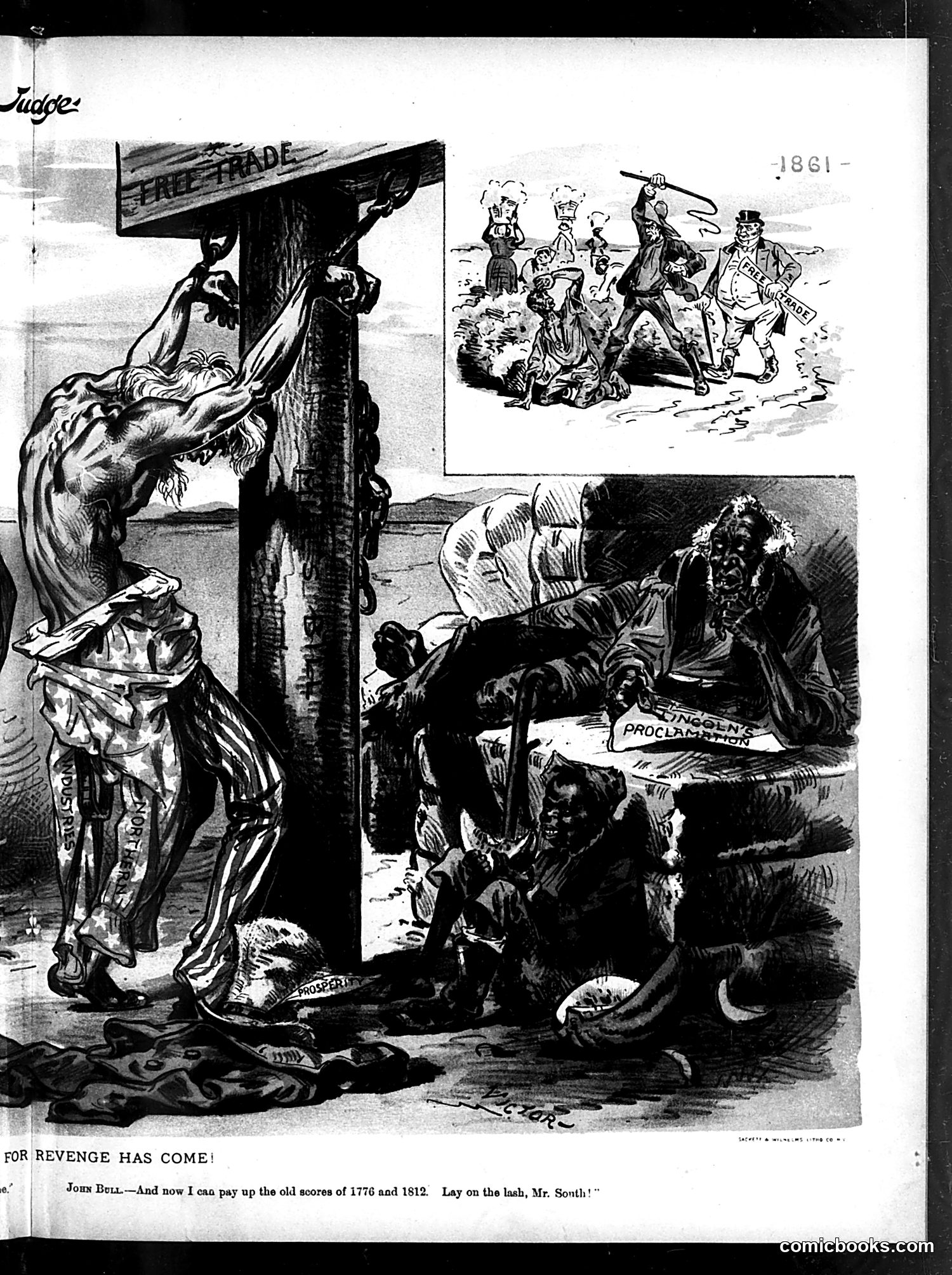
This cartoon depicts **John Bull** (personification of Britain) being whipped by a figure labeled "South," referencing the American Civil War's outbreak. The satire suggests Britain opportunistically seeks revenge for past American conflicts—the **Revolutionary War (1776)** and **War of 1812**—by supporting the Confederate South. The smaller inset cartoon (top right, dated 1861) shows figures celebrating or marching, likely representing Confederate supporters or British interventionists. The larger main image's grotesque imagery emphasizes Judge magazine's anti-British, pro-Union stance. The cartoon warns that Britain's potential support for Southern secession represents cynical revenge-seeking rather than principled foreign policy. The "lash" symbolizes the violence of the war itself, positioning Britain as complicit in American bloodshed.
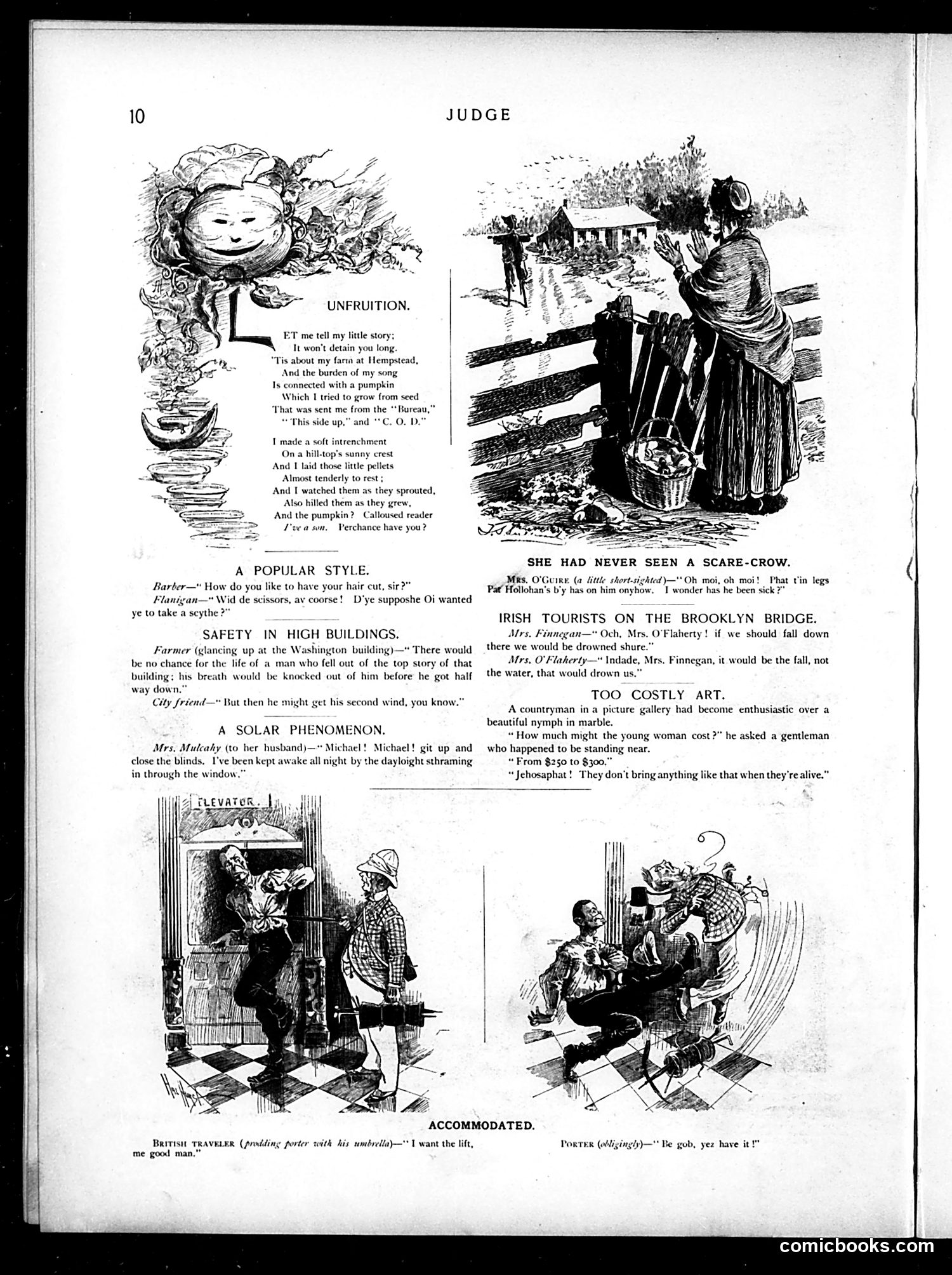
This page collects humorous anecdotes and visual gags typical of late-19th/early-20th century American satire. The primary targets are Irish immigrants and rural/working-class Americans. **Key content:** - "Unfruition": A farmer's complaint about failed pumpkin-growing, mocking agricultural incompetence - "Popular Style": Barber joke about crude haircuts - "Safety in High Buildings": Urban development humor - **Irish stereotype material** dominates: Mrs. O'Flaherty and Mrs. Finnegan on Brooklyn Bridge making illogical observations; an Irish woman mistaking a scarecrow for a person; Irish porter wordplay The satire relies heavily on **Irish dialect caricature** ("Phat t'in legs," "oiligingly," "Be gob"), presenting Irish immigrants as comically ignorant or dim-witted. Visual illustrations reinforce these ethnic stereotypes through exaggerated features and positioning. The page reflects Judge's editorial approach: punching down at working-class and immigrant populations while entertaining middle-class readers. This type of casual ethnic mockery was standard American humor of the period.
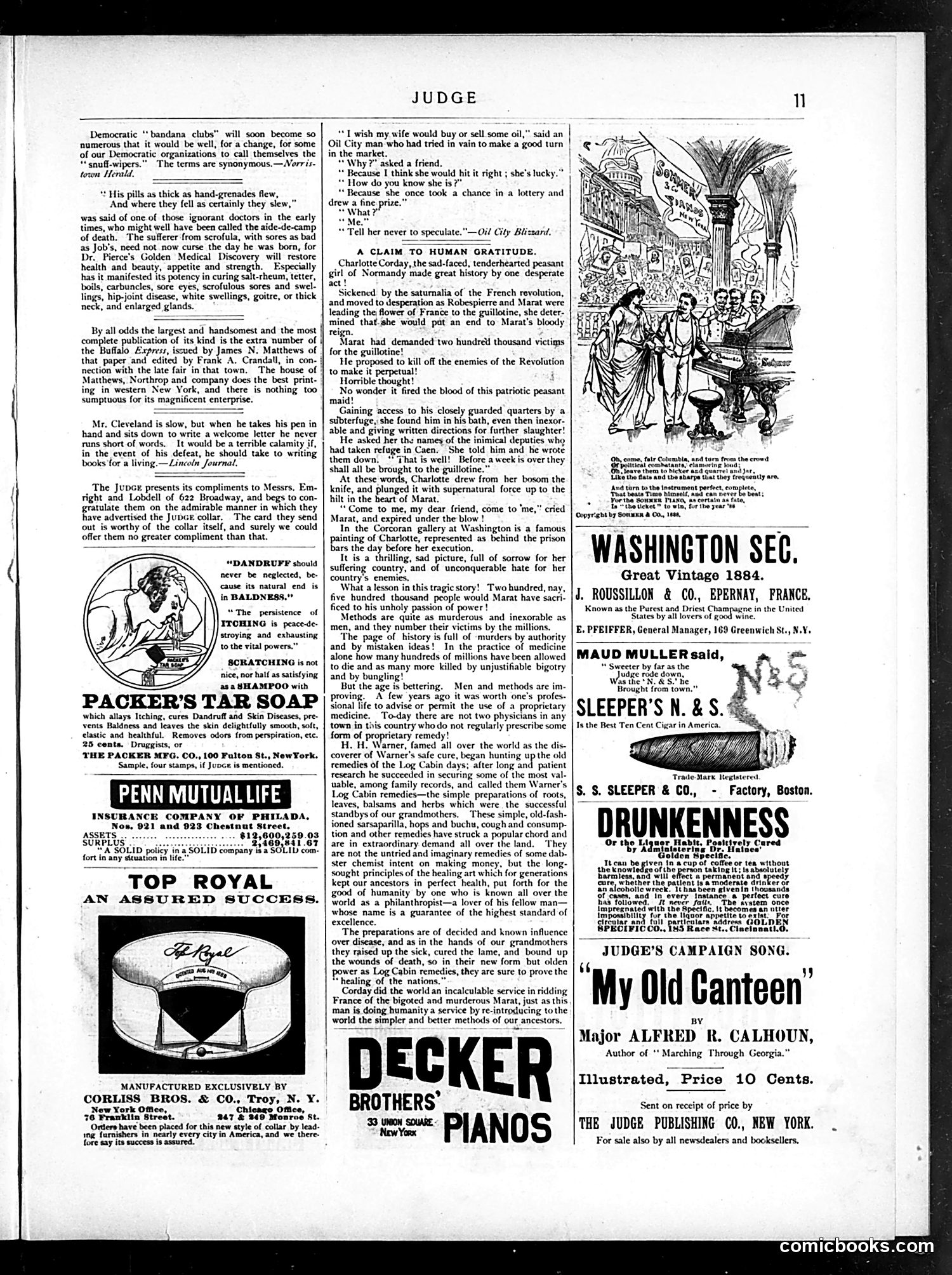
This page from Judge magazine (dated 1884) is primarily **advertising**, with brief editorial commentary at the top. The visible editorial content includes a political jab at Democrats, calling their "bandana clubs" equivalent to Republican organizations—a period insult suggesting Democratic grassroots groups were disorganized or corrupt. The page's main content consists of **patent medicine and product advertisements** typical of 1880s publications: Packer's Tar Soap (for dandruff/baldness), Penn Mutual Life Insurance, Pierce's Golden Medical Discovery (for scrofulous skin conditions), and Decker Brothers Pianos. There is a brief historical reference to **Charlotte Corday**, the French Revolutionary who assassinated Marat—presented as an example of "human gratitude" for eliminating a tyrant. This reflects 19th-century American ambivalence toward revolutionary violence. The page lacks a prominent political cartoon; instead it showcases the commercial advertising that funded Judge's operations.
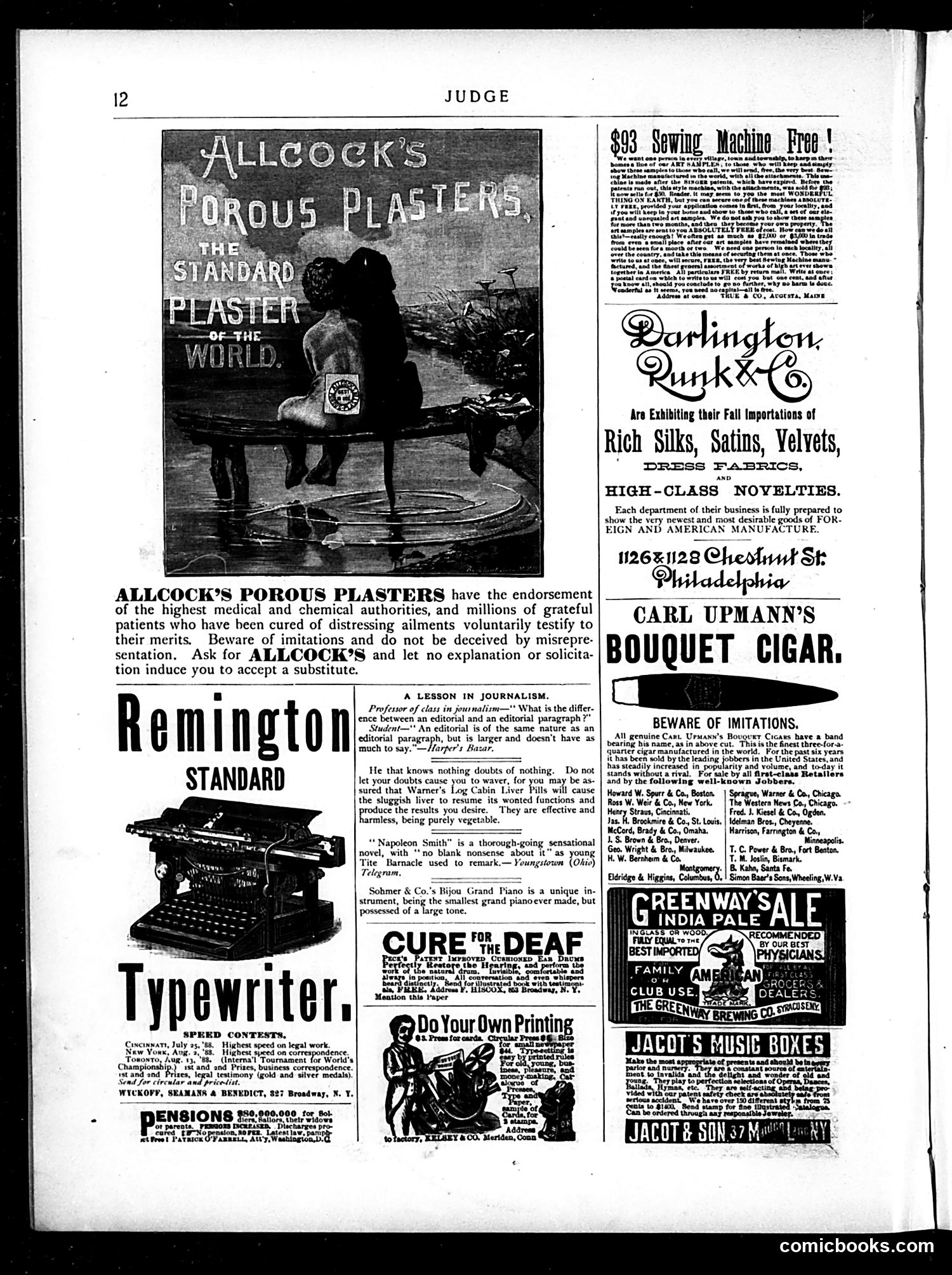
This is primarily an **advertising page** with minimal editorial content. The page features various commercial advertisements typical of late 19th-century American magazines, including medical plasters, typewriters, cigars, and fabrics. The only identifiable satirical content is a brief **journalism joke** (credited to Harper's Bazar) mocking student journalists who confuse editorials with editorial paragraphs—a lighthearted jab at editorial pretension and confused thinking. The remaining material consists of product endorsements and advertisements, including Allcock's Porous Plasters (a medical product), Remington typewriters (emphasizing speed records), and Carl Upmann's Bouquet Cigars (with warnings against counterfeits). This page demonstrates Judge's business model: mixing satirical humor with profitable advertising space, which subsidized the magazine's editorial content. The ads themselves—making inflated health and quality claims—are ironically the sort of promotional exaggeration that satirical publications might normally mock.
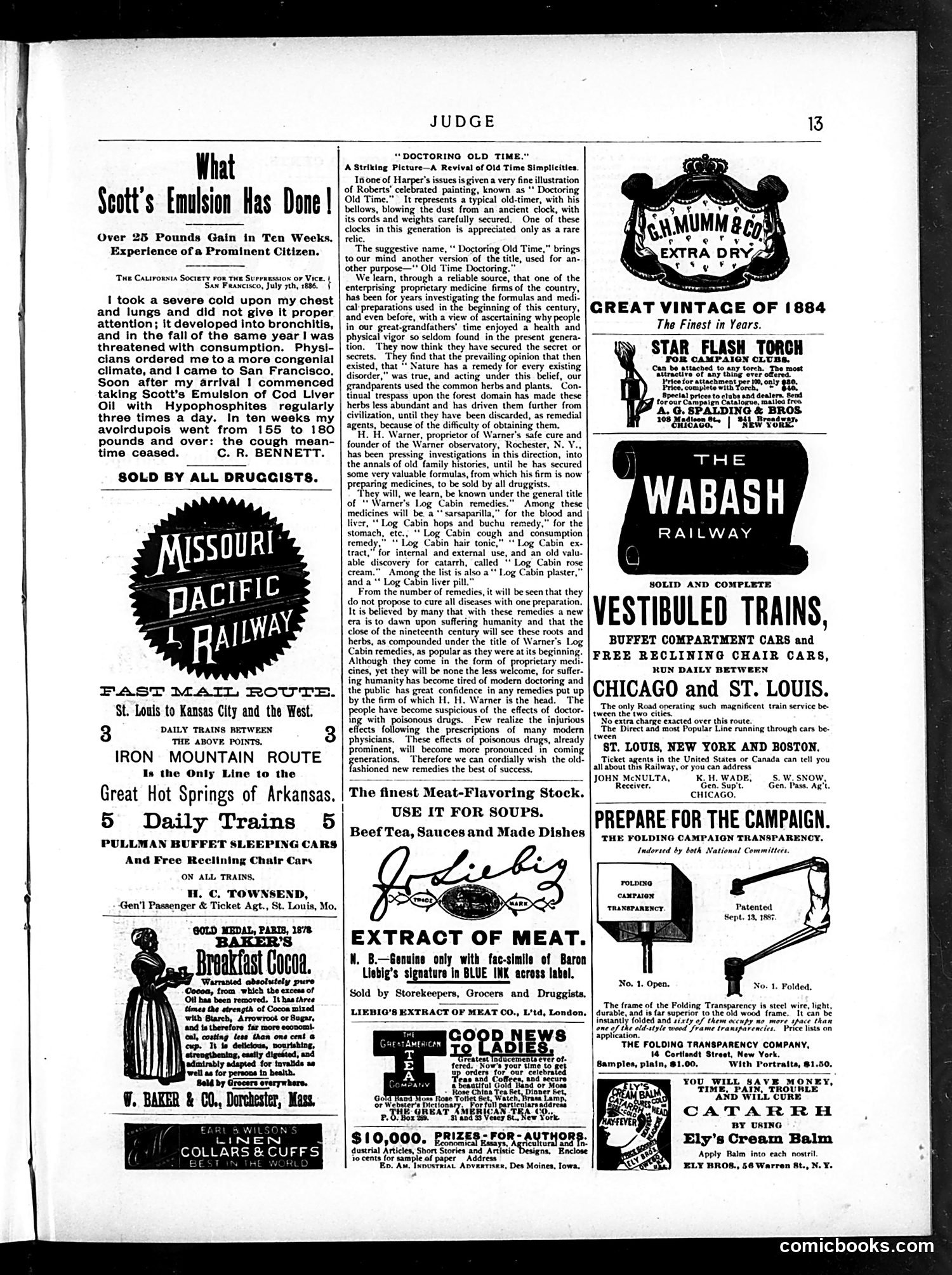
This page is primarily **advertisements** from an 1886 issue of *Judge* magazine, with minimal satirical content. The main article, "Doctoring Old Time," describes a patent medicine company (H.H. Warner's) marketing "Log Cabin remedies"—products supposedly based on 19th-century folk formulas. The satire is gentle: the piece mocks the nostalgic trend of marketing "old-time" cures as superior to modern medicine, playing on period anxieties about whether industrial progress had harmed public health. The accompanying testimonial about Scott's Emulsion (cod liver oil) exemplifies the era's widespread use of unregulated patent medicines making health claims without scientific evidence. These advertisements—promoting everything from breakfast cocoa to railway services—reflect how *Judge* funded itself while also subtly critiquing consumer culture and dubious medical claims. The humor is implicit rather than explicit: readers would recognize the absurdity of marketing ancient remedies in modern commerce.
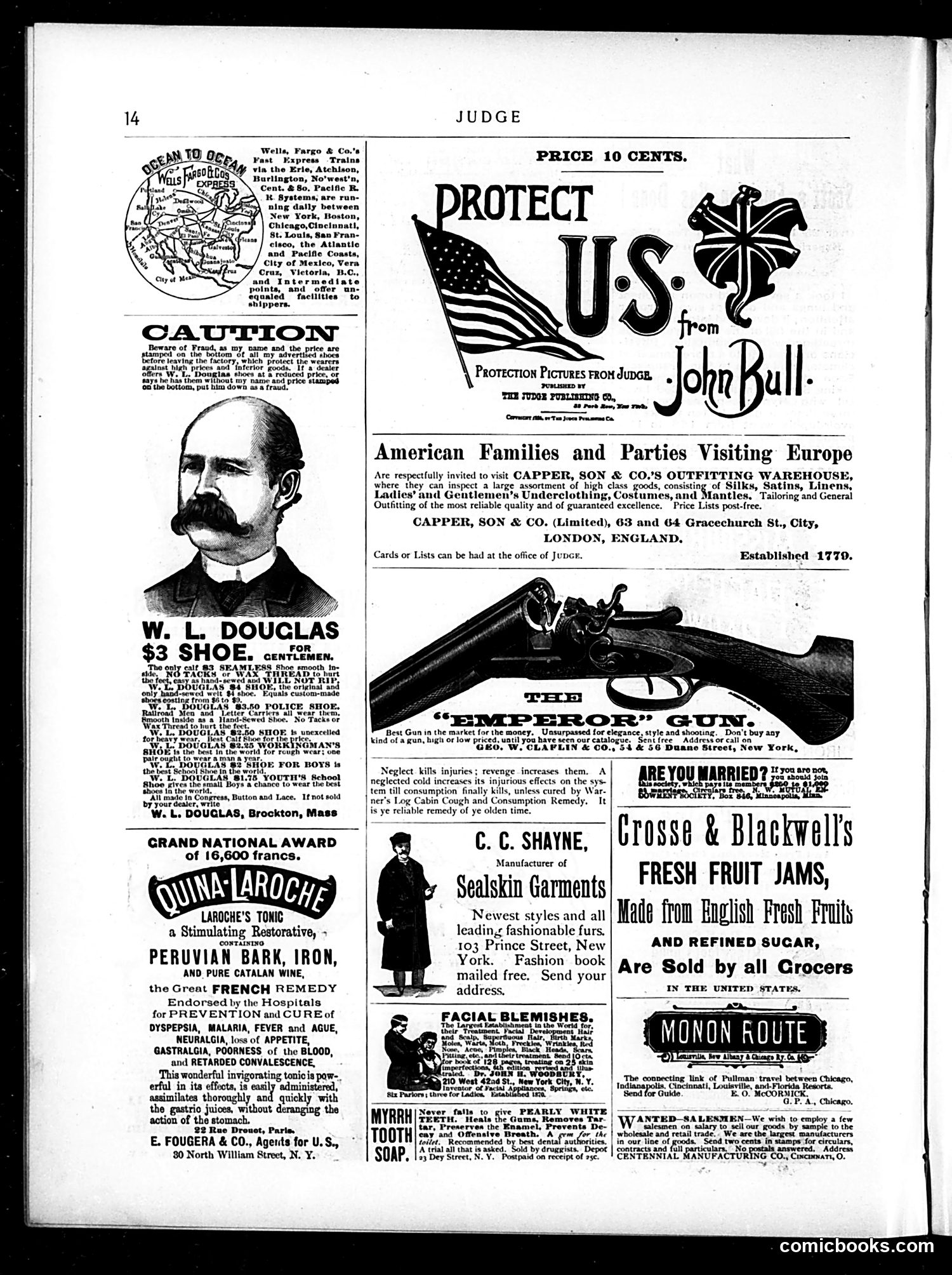
This is primarily an **advertising page** from Judge magazine, with no significant political cartoons or satirical content. The page features commercial advertisements typical of late 19th-century American publications: W.L. Douglas shoes, Laroche's Tonic (a patent medicine containing iron and Peruvian bark), European outfitting services for traveling Americans, firearms, and various consumer goods. The only non-advertisement content is a cautionary notice from W.L. Douglas warning against counterfeit shoes—a common problem when popular branded goods were frequently imitated. The single illustrated portrait appears to be W.L. Douglas himself, the shoe manufacturer, used to authenticate his products. This reflects Judge's dual purpose: satirical commentary combined with revenue-generating advertisements that subsidized the magazine's publication during this period.
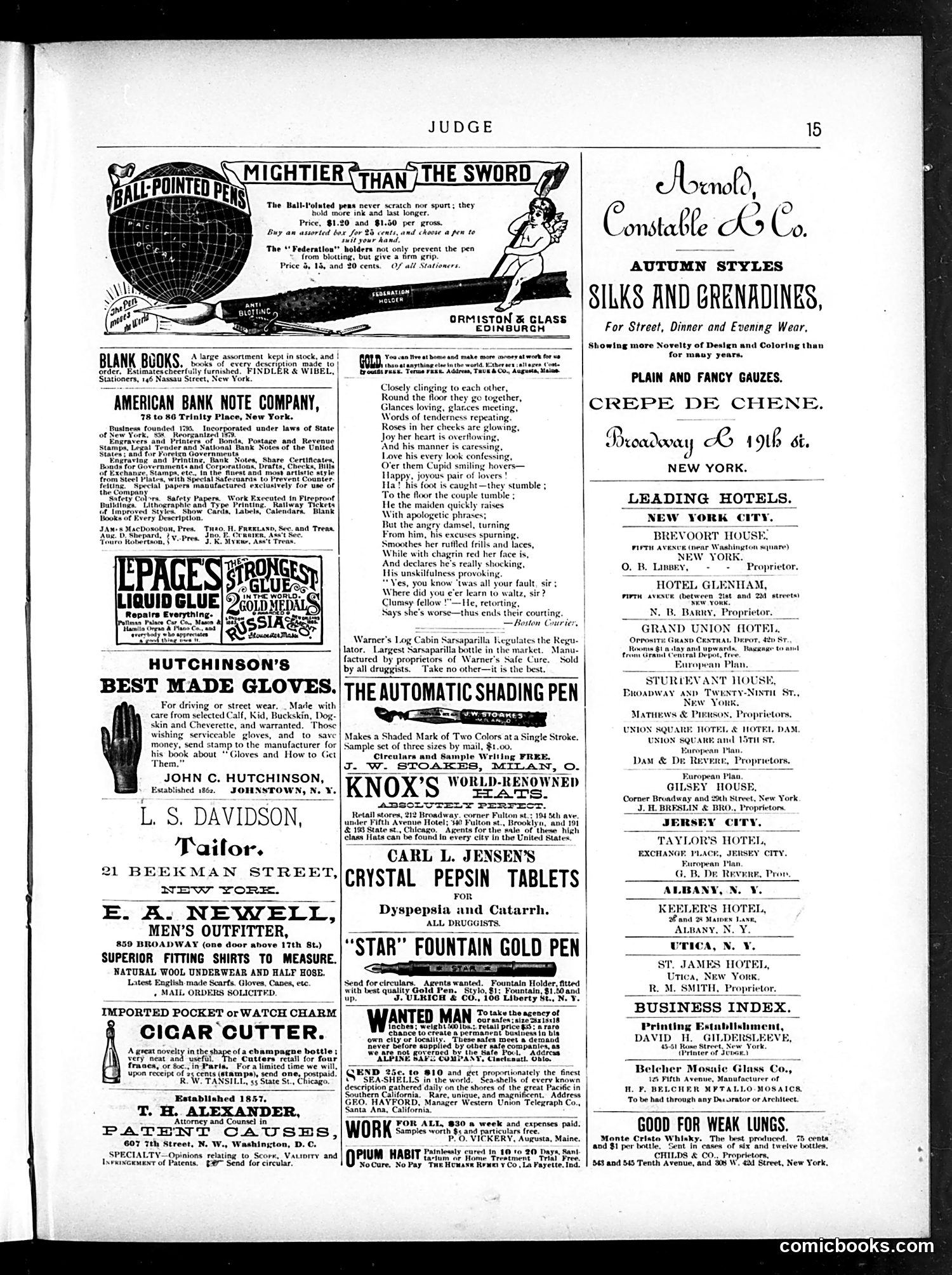
This page is primarily **advertising**, not political satire. The bulk of the content consists of late 19th-century commercial advertisements for products like bank notes, gloves, fountain pens, and patent medicines. The only narrative content is a poem titled **"Mightier Than the Sword"** (positioned above the ads), which tells a humorous domestic story: a dancing couple stumbles during a waltz, the man helps the woman up apologetically, but she angrily blames *him* for the mishap and insults his dancing ability, ending their courtship. The moral—that a woman's sharp words ("the sword") are more powerful than a man's physical efforts—is a gentle gender-based joke typical of period humor. The page's title reference to "mightier than the sword" appears to invoke the famous phrase about the pen, though the actual application here is simply relationship dynamics and female criticism of male clumsiness.
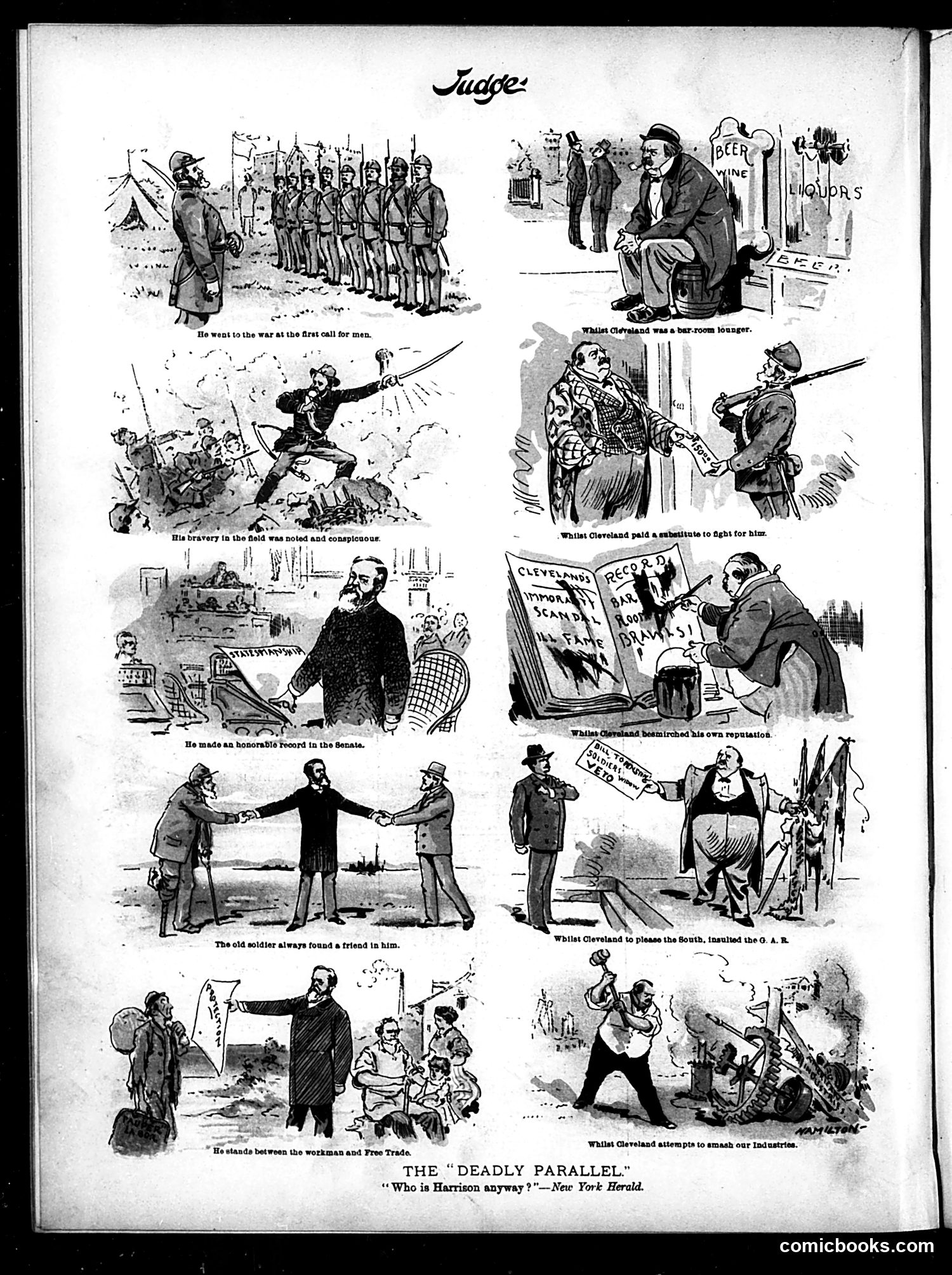
This Judge page satirizes President Grover Cleveland (shown repeatedly in various scenarios) by comparing his actions to those of a soldier or military leader. The captions and scenes suggest Cleveland's policies—particularly regarding tariffs and trade—are portrayed as destructive to American industry and workers. The recurring figure "Whilst Cleveland" appears attempting various harmful actions: fighting for protectionism, ruining his own reputation, and standing between workmen and free trade. The bottom caption, "He stands between the workman and Free Trade," indicates the cartoon criticizes Cleveland for blocking free trade policies that the cartoonist believed would benefit workers. The quote "Who is Harrison anyway?" references a political rival, likely William Henry Harrison or Benjamin Harrison, suggesting Cleveland's opponents offered better alternatives. The overall message attacks Cleveland's economic policies as harmful to American labor and industry.