
Judge, 1888-10-13 · page 2 of 16
Judge — October 13, 1888 — page 2: what you’re looking at
What you’re looking at
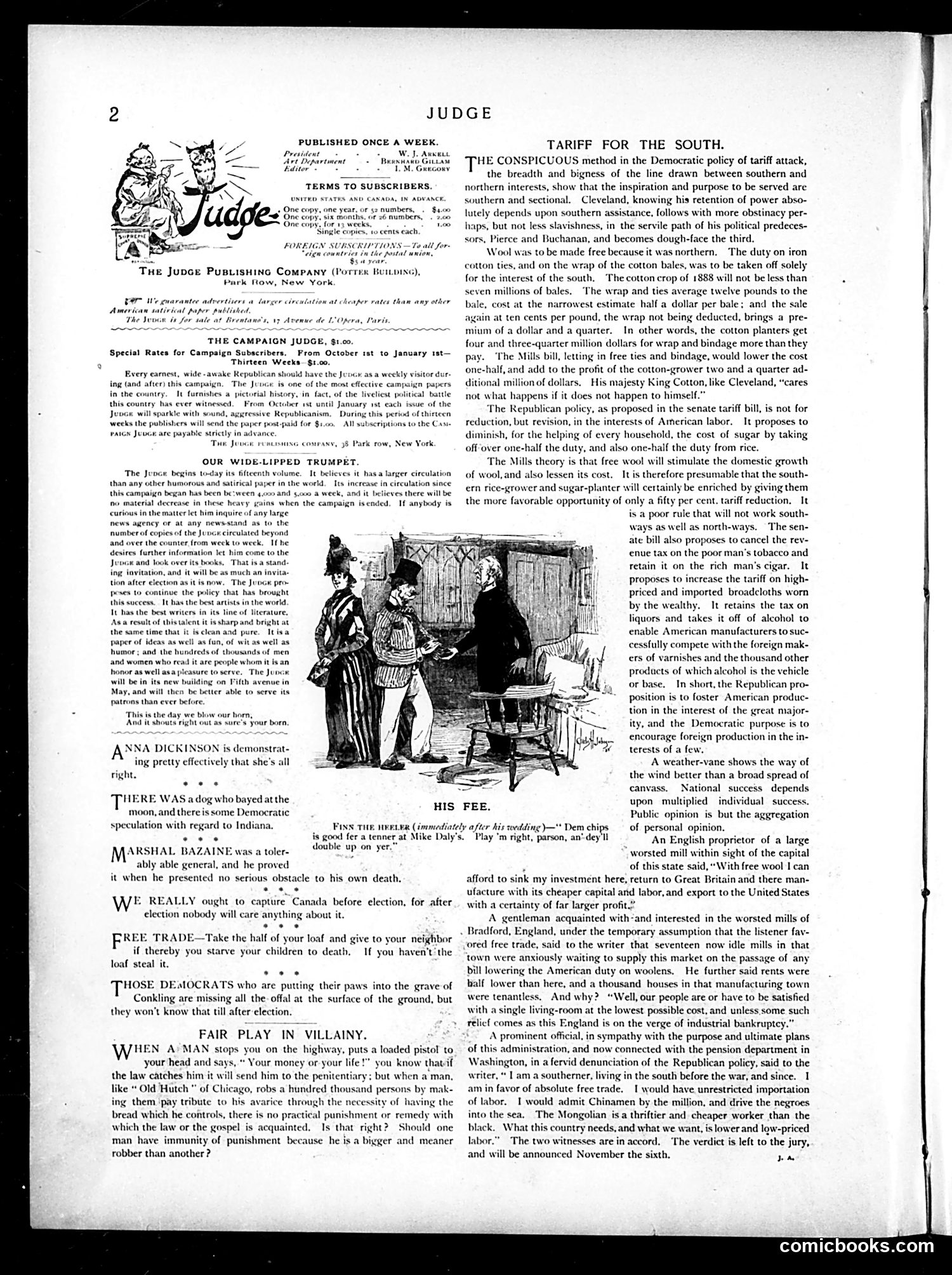
The main cartoon, titled "HIS FEE," depicts a poorly-dressed person entering what appears to be a lawyer's or doctor's office. The caption references "Fins the heeler" making demands "immediately after his wedding"—suggesting a working-class man seeking professional services but lacking funds. The surrounding text discusses tariff policy, free trade, and Democratic versus Republican economic approaches. Articles mock Democratic positions on trade and social welfare while defending Republican protectionist policies. The cartoon likely satirizes working-class struggles during a period of economic debate, showing the gap between ordinary people's financial desperation and professional service fees. Without clearer identification of the specific figures, the exact political target remains somewhat unclear, though the page's broader context emphasizes economic class tensions.
📄 Transcribed text from this page (OCR, searchable)
Machine-transcribed from the original scan — historical spelling and the odd misread are preserved.
JUDGE PUBLISHED ONCE A WEEK. Ww. J. Brxnnano 1M. Gu Eatior”* . TERMS TO SUBSCRIBERS. six months. or 26 numbers, for 15 weeks, ‘o cents €ach, FOREIGN SUBSCRIPTIONS —To all for- “cig countries in the postal union, $sue year! Tue Jupce PusBiisHinc Company (Vorrex BuiLpinc), Park Row, New York $e 97 We enaranter American satirical paper publi The Seoun tt le a Avenue de L’Opera, Paris THE CAMPAIGN JUDGE, $1.00. Special Rates for Campaign Subscribers, Prom October 1st to January 1st— Thirteen Weeks. $1.00. Every earnest, wide -awake Republican should have the Jeocy as a weekly visitor dur- ing (and after) this campaign, The Jvoce is one of the most effective can papers in the country. It furnishes a pictorial history, in fact, of the liveliest political battle this country has ever witnessed. From October st until January ist each issue of the Jvvax will sparkle with sound, aggressive Republicanism, During this period of thi weeks the publishers will send the paper post-paid for $4.00. All $ to the Cans -aicw Juber are payable strictly in advance. ertivers a larger cérem ed. Brentane's, ation at cheaper rates than any other script Tie Juvce reALISUNG COMPANY, 38 Park row, New York. OUR WIDE-LIPPED TRUMPET The Jocx begins today its fifteenth volume. It believes it hasa larger circulation than any other humorous and satirical paper in the world. Its increase in circulation since this campaign began has been be:ween 4,000 and s.oo0 a week, and it believes there will be ‘po material decrease in these heavy gaiins when the campaign isended, If anybody is curious in the matter let him inquire of any large news agency oF at any newsstand as to the number of copies of the Juncx circulated beyond and over the counter from week to week, If desires further information let him come to the Joven and look over its books, That is a stand- ing invitation, and it will be as much an invit tion after election as it is now. The Juocx pro- > continue the policy that has brought this success. It has the best artists in the world. It has the best writers in its line of literature, Asa result of this talent it is sharp and bright at the same time that it is clean and pure. Itisa paper of ideas as well as fun, of wit as well as. humor; and the hundreds of thousands of men and women who read it are people whom it Is an honor as well asa pleasure to serve. The Juvcx will be in its new building on Fifth avenue in May, and will then be better able to serve its patrons than ever before. This is the day we blow our horn, And it shouts right outas sure’s your born, NNA DICKINSON is demonstrat- ing pretty effectively that she’s all right. HERE WAS a dog who bayed at the moon, and there is some Democratic speculation with regard to Indiana. MARSHAL Bazan ably able general, and he proved it when he presented no serious obstacle to his own death, is good fer a tenner at Mike Daly double up on yer.” = was a toler- pony E REALLY ought to capture Canada before election, for after election nobody will care anything about it. FREE TRADE—Take the half of your loaf and give to your neighbor if thereby you starve your children to death. If you haven't the loaf steal it. HOSE DEMOCRATS who are putting their paws into the grave of Conkling are missing all the: offal at the surface of the ground, but they won't know that till after election. FAIR PLAY IN VILLAINY. EN A‘MAN stops you on the highway, puts a loaded pistol to your head and says, "" Your money or your life!” you know thatit the law catches him it will send him to the penitentiary; but when aman, like “ Old Hutch " of Chicago, robs a hundred thousand persons by mak- ing them (pay tribute to his avarice through the necessity of having the bread which he controls, there is no practical punishment or remedy with which the law or the gospel is acquainted, Is that right? Should one man have immunity of punishment because he is a bigger and meaner robber than another ? W'! HIS FEE. FINN THE HERLER (immediately after his wedding) —* Dem chi TARIFF FOR THE SOUTH. HE CONSPICUOUS method in the Democratic policy of tariff attack, the breadth and bigness of the line drawn between southern and northern interests, show that the inspiration and purpose to be served are southern and sectional. Cleveland, knowing his retention of power abso- lutely depends upon southern assistance, follows with more obstinacy per- haps, but not less slavishness, in the servile path of his political predeces- nd Buchanan, and becomes dough-face the third. Wool was to be made free because it was northern, The duty on iron cotton ties, and on the wrap of the cotton bales, was to be taken off solely for the interest of the south, ‘The cotton crop of 1888 will not be less than ‘The wrap and ties average twelve pounds to the cost at the narrowest estimate half a dollar per bale; and the sale ain at ten cents per pound, the wrap not being deducted, brings a pre- a dollar and a quarter. In other words, the cotton planters get nd three-quarter million dollars for wrap and bindage more than they ‘The Mills bill, letting in free ties and bindage, would lower the cost one-half, and add to the profit of the cotton-grower two and a quarter ad- ditional million of dollars. His majesty King Cotton, like Cleveland, “cares not what happens if it does not happen to himself.” The Republican policy, as proposed in the senate tariff bill, is not for reduction, but revision, in the interests of American labor. It proposes to diminish, for the helping of every household, the cost of sugar by taking off‘over one-half the duty, and also one-half the duty from rice. ‘The Mills theory is that free wool will stimulate the domestic growth of wool, and also lessen its cost. It is therefore presumable that the south- ern rice-grower and sugar-planter will certainly be enriched by giving them the more favorable opportunity of only a fifty per cent. tariff reduction. It is a poor rule that will not work south- ways as well as north-ways. ‘The sen- ate bill also proposes to cancel the rev enue tax on the poor man’s tobacco and retain it on the rich man’s cigar. It proposes to increase the tariff on high- priced and imported broadcloths worn by the wealthy, It retains the tax on liquors and takes it off of alcohol to enable American manufacturers to suc~ cessfully compete with the foreign mak- ers of varnishes and the thousand other prodacts of which alcohol is the vehicle or base, In short, the Republican pro- position is to foster American produc- tion in the interest of the great major- ind the Democratic purpose is to encourage foreign production in the in~ terests of a few, sors, P seven millions of bales. bal mium ane shows the way of the wind better than a broad spread of canvass, National success depends upon multiplied individual success. Public opinion is but the aggregation of personal opinion. An English proprietor of a large worsted mill within sight of the capital F of this state said, “With free wool I can afford to sink my investment here, return to Great Britain and there man- ufacture with its cheaper capital and labor, and export to the United States with a certainty of far larger profit? A gentleman acquainted with-and interested in the worsted mills of Play ‘m right, parson, an‘ dey'Il . Bradford, England, under the temporary assumption that the listener fav- ored free trade, said to the writer that seventeen now idle mills in that town were anxiously waiting to supply this market on the passage of any bill lowering the American duty on woolens. He further said rents were balf lower than here, and a thousand houses in that manufacturing town were tenantless. And why? “Well, our people are or have to be satisfied with a single living-room at the lowest possible cost, and unless. some such relief comes as this England is on the verge of industrial bankruptcy.” A prominent official, in sympathy with the purpose and ultimate plans of this administration, and now connected with the pension department in Washington, in a fervid denunciation of the Republican policy, said to the writer, “ Lam a southerner, living in the south before the war, and since. I am in favor of absolute free trade. I would have unrestricted importation of labor, I would admit Chinamen by the million, and drive the negroes into the sea, The Mongolian isa thriftier and cheaper worker than the black. What this country needs, and what we want, is lower and low-priced labor.” ‘The two witnesses are in accord, ‘The verdict is left to the jury, and will be announced November the sixth. as comicbooks.com