
A complete issue · 16 pages · 1888
Judge — September 1, 1888
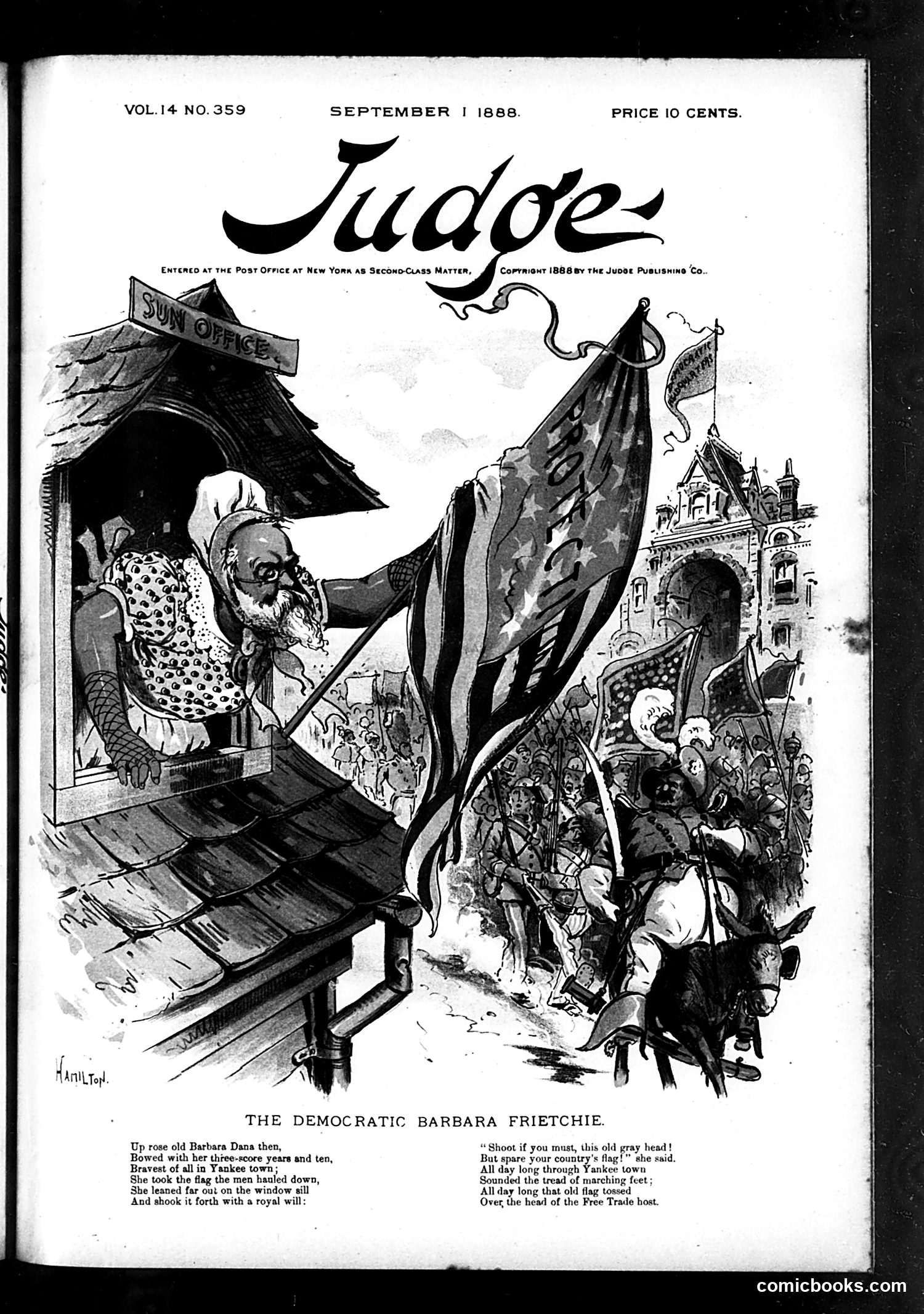
This 1888 satirical cartoon references Barbara Fritchie, a Civil War legend (immortalized in Whittier's 1863 poem) who allegedly waved the American flag defiantly at Confederate troops. The cartoon depicts an elderly woman at a "Sun Office" (likely a newspaper) waving what appears to be a Free Trade flag at a crowd below. The satire suggests Democrats are using the Free Trade issue with the same theatrical patriotism that Barbara Fritchie used the American flag—wrapping a controversial political position in nationalist symbolism. The accompanying verse reinforces this: Democrats claim their Free Trade position represents patriotic sacrifice for the country, even as Republicans march with opposing flags below. The cartoon mocks Democratic rhetorical strategy during the 1888 election, when Free Trade was a major party issue.
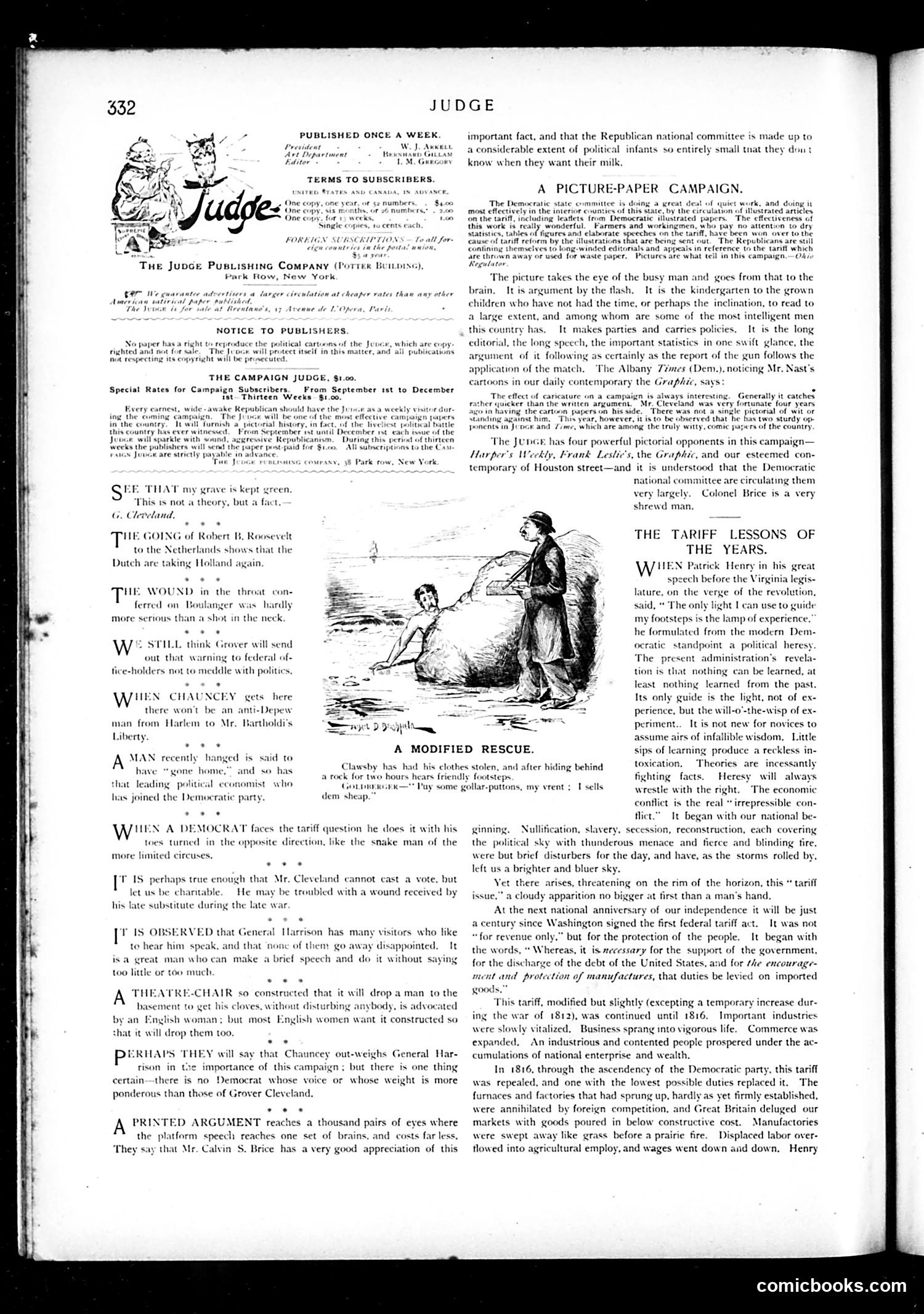
This cartoon satirizes political hypocrisy during a campaign period (the text references a "picture-paper campaign"). The image shows a well-dressed man rescuing another from water—a classical heroic pose. However, the caption reveals the darker reality: the rescued man is a tramp who had his clothes stolen, and now the "rescuer" is extracting payment ("Pay some gold-rations, my street; I sells dem cheap"). The satire mocks politicians who present themselves as public benefactors while actually exploiting the poor for personal gain. Rather than genuine rescue, it depicts opportunistic extraction—the rescuer profiting from the rescued man's desperation. This reflects broader Judge magazine criticism of campaign rhetoric versus actual political conduct toward working-class voters.
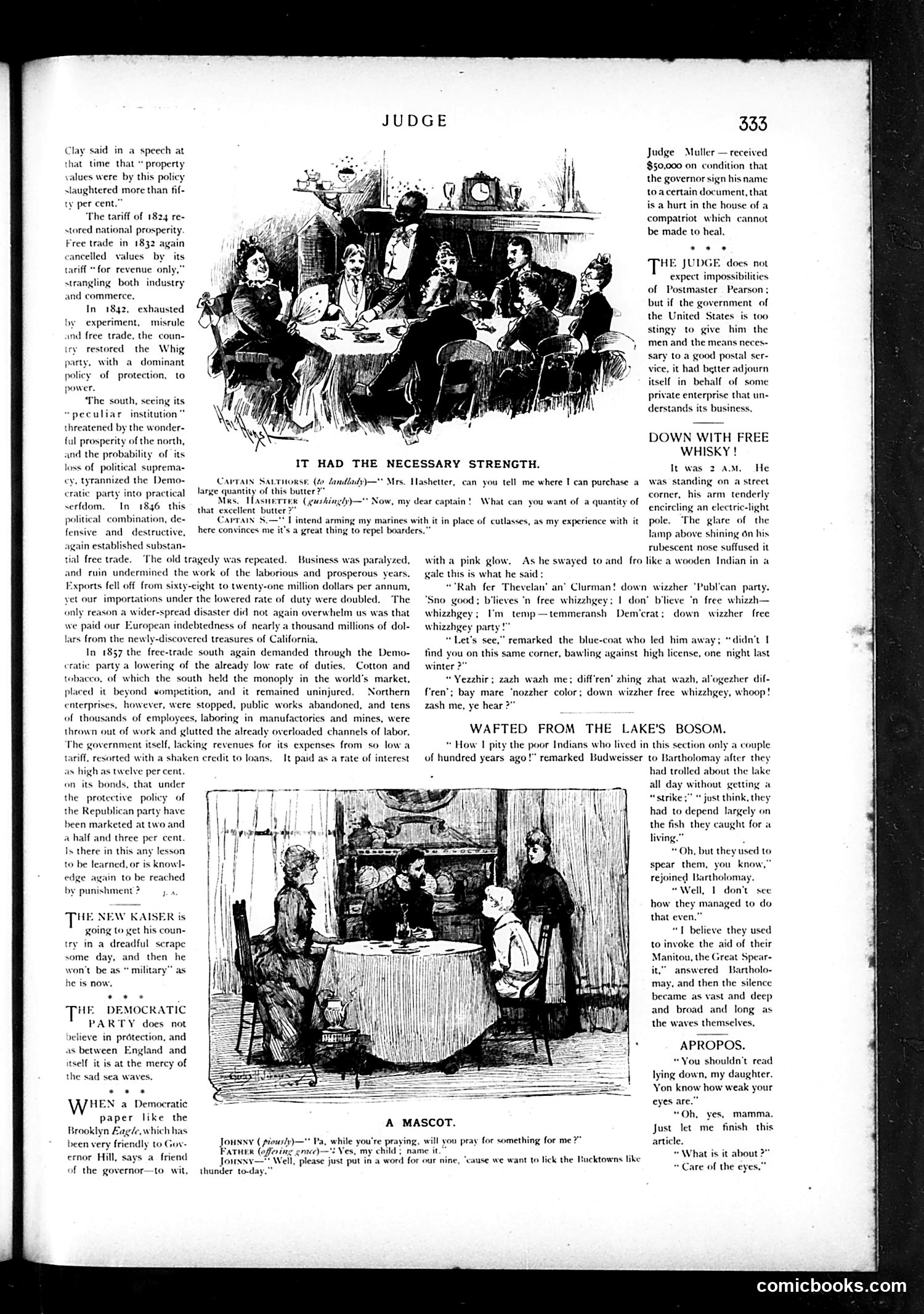
This page contains multiple satirical pieces attacking free-trade Democrats and praising protective tariffs (a Republican position). The main editorial text argues that free trade has repeatedly damaged American prosperity—citing the 1832 tariff reduction and the 1846 Democratic policy as economic disasters that paralyzed industry and commerce, while protective Republican tariffs restored prosperity. The author contrasts low bond-interest rates under Republican protection versus high rates under Democratic free trade. The cartoons appear to be: - "It Had the Necessary Strength": A captain proposing to arm sailors with butter as a weapon—likely mocking some absurd Democratic proposal - "A Mascot": A domestic scene (unclear exact reference) - "Down with Free Whisky": A drunk man at night, seemingly satirizing the effects of Democratic policy on working people The page reflects late-19th-century partisan economic debate, with Judge magazine taking the Republican protectionist side against Democratic free-trade policies.
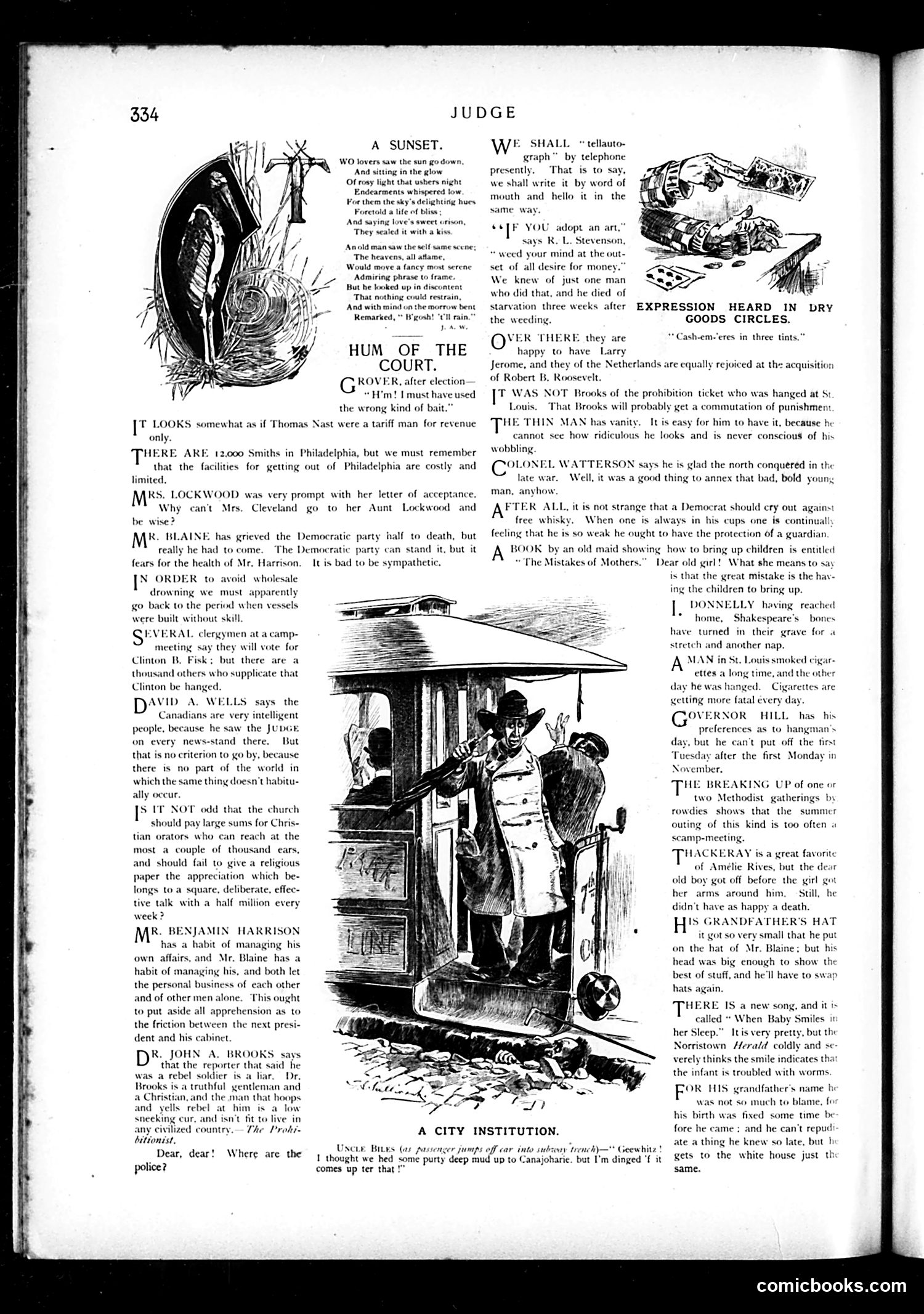
This is a page from *Judge* magazine containing political humor and social commentary from the 1880s era. The main items include: **"Hum of the Court"** satirizes contemporary political figures and events. References include: - James G. Blaine's role in the presidential election and his grief over the Democratic party - Benjamin Harrison and his relationship with Blaine - A prohibition candidate (unnamed) hanged at St. Louis - Henry Watterson commenting on the Civil War's outcome **"A City Institution"** (bottom cartoon) shows a passenger falling into a subway trench, with Uncle Biles comparing it to mud back in Canajoharie—satirizing the rough conditions of early subway construction. Other brief items mock social absurdities: lovers viewing a sunset romantically while an old man complains of rain; the difficulty of escaping Philadelphia; and churches paying ministers while undervaluing religious journalism. The satire targets political hypocrisy, incompetence in public works, and social pretension typical of Gilded Age America.
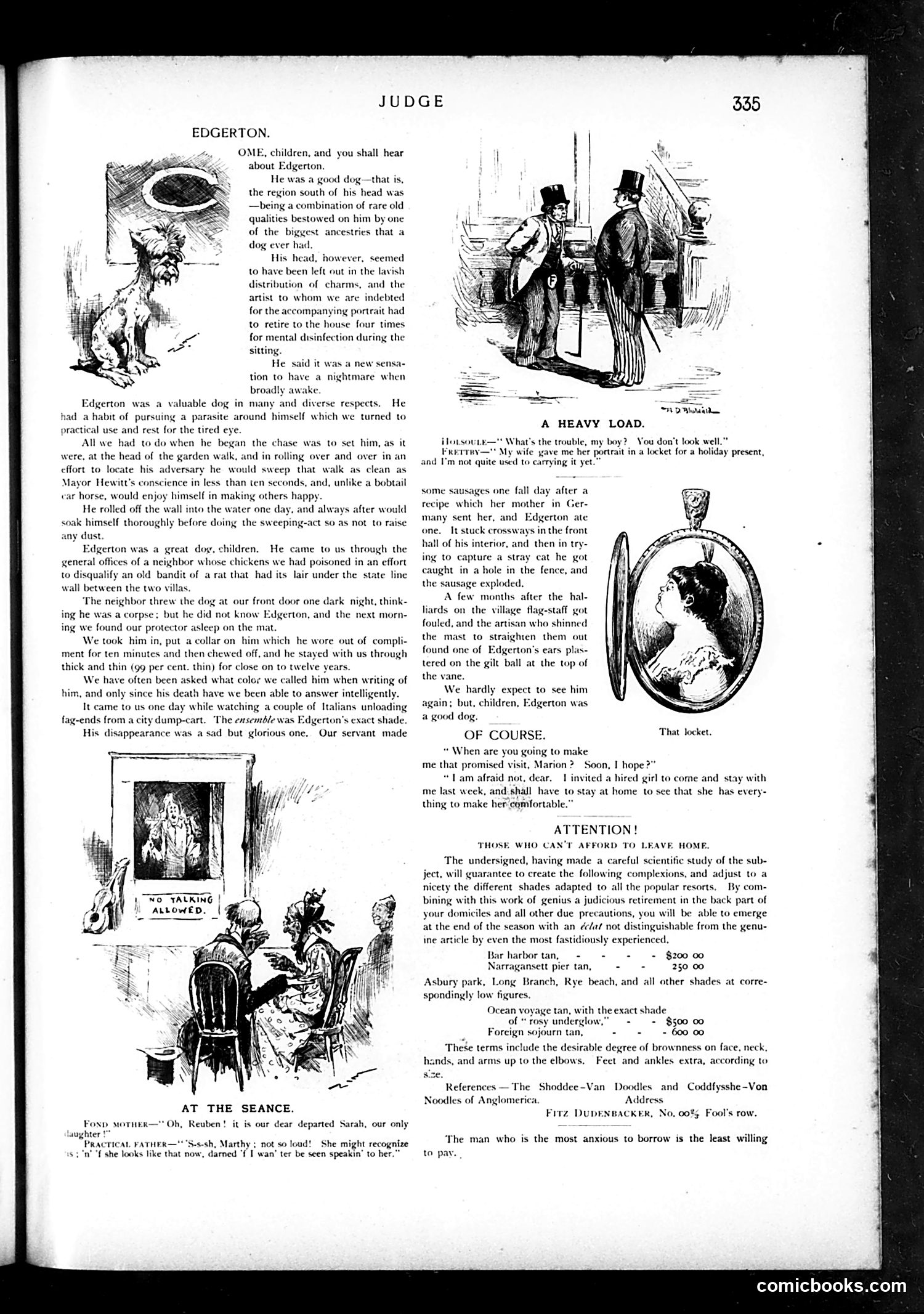
This page contains multiple satirical pieces typical of Judge magazine's humor: **"Edgerton"** is a mock-serious tribute to a dog presented as an ancestral specimen. The satire mocks both pretentious dog-breeding culture and the exaggerated reverence shown to pets by the wealthy. The dog's ugliness (requiring the artist to leave for "mental disinfection") contrasts absurdly with claims of noble ancestry—likely satirizing class pretensions of the era. **"A Heavy Load"** mocks sentimental gift-giving: a husband complains his wife's portrait locket is too heavy to carry, suggesting the burden of marital obligation disguised as romance. **"At the Séance"** satirizes spiritualism fads popular in the period, with the practical father warning against being too loud lest the "departed" recognize them—implying séances were fraudulent. **"Of Course"** presents domestic servitude humor: a woman must stay home supervising her hired girl rather than visit friends, reflecting class anxieties about household help. The "Attention!" section appears to be an advertisement promising tanning/cosmetic services for those unable to travel.
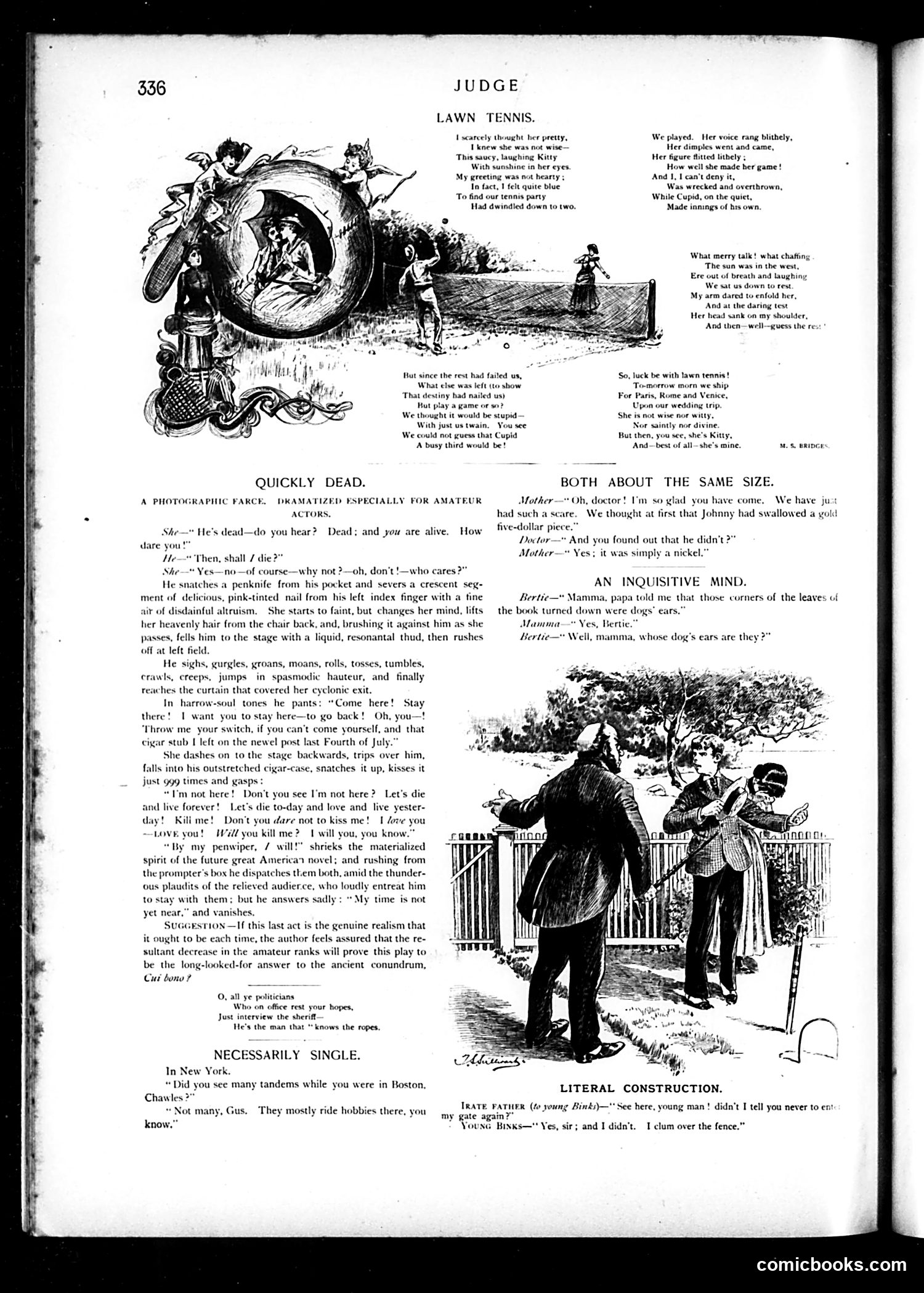
This page from *Judge* contains several humorous short pieces satirizing American social customs and domestic life: **"Lawn Tennis"** (top): A romantic poem about young people meeting at tennis, culminating in marriage. It gently mocks the sentimentality of courtship narratives popular in the era. **"Quickly Dead"** (center-left): A theatrical farce script mocking amateur dramatic productions and overwrought melodrama. The absurdist humor lies in the exaggerated death scene and the woman's violent response—satirizing both bad amateur acting and the melodramatic conventions of contemporary theater. **"Both About the Same Size"** (right): A brief joke about a mother confusing a gold five-dollar piece with a nickel her son supposedly swallowed—mocking parental anxiety and confusion. **"An Inquisitive Mind"** (bottom-right): A child's literal interpretation of "dog-eared pages" in books—a play on words humor typical of the era. These pieces collectively satirize Victorian-era domestic life, courtship, amateur theater culture, and parental concerns through lighthearted comedy rather than sharp political commentary.
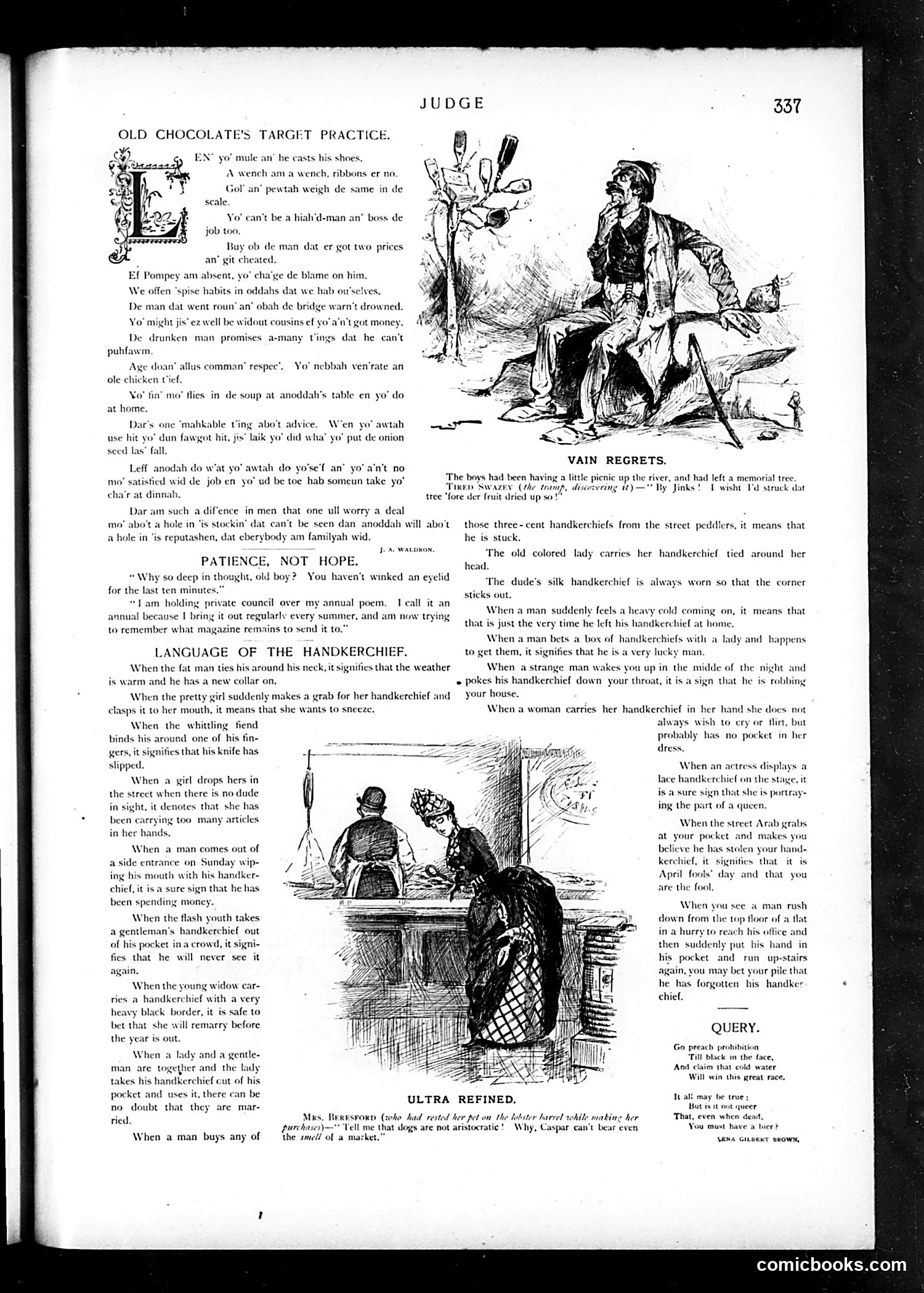
This page contains satirical humor typical of Judge magazine's style. The main content includes: **"Old Chocolate's Target Practice"**: Racist dialect humor featuring a Black character named Pompey dispensing folk wisdom in exaggerated vernacular. The satire targets working-class stereotypes rather than any specific political figure. **"Patience, Not Hope"**: A brief joke about a writer recycling an annual poem, poking fun at literary magazines' predictability. **"Language of the Handkerchief"**: Social satire using handkerchief placement/condition as coded indicators of class status, romantic relationships, and behavior—mocking Victorian social conventions and their supposed "tells." **"Vain Regrets"**: A tramp regrets not stealing a memorial tree before its fruit dried, crude humor about poverty and petty theft. **"Ultra Refined"**: Brief snippet mocking aristocratic pretension regarding dogs. The page reflects late-19th/early-20th century attitudes, mixing class-based humor with racist stereotyping. The handkerchief piece is the most sophisticated satire here, critiquing social performance and class anxiety.
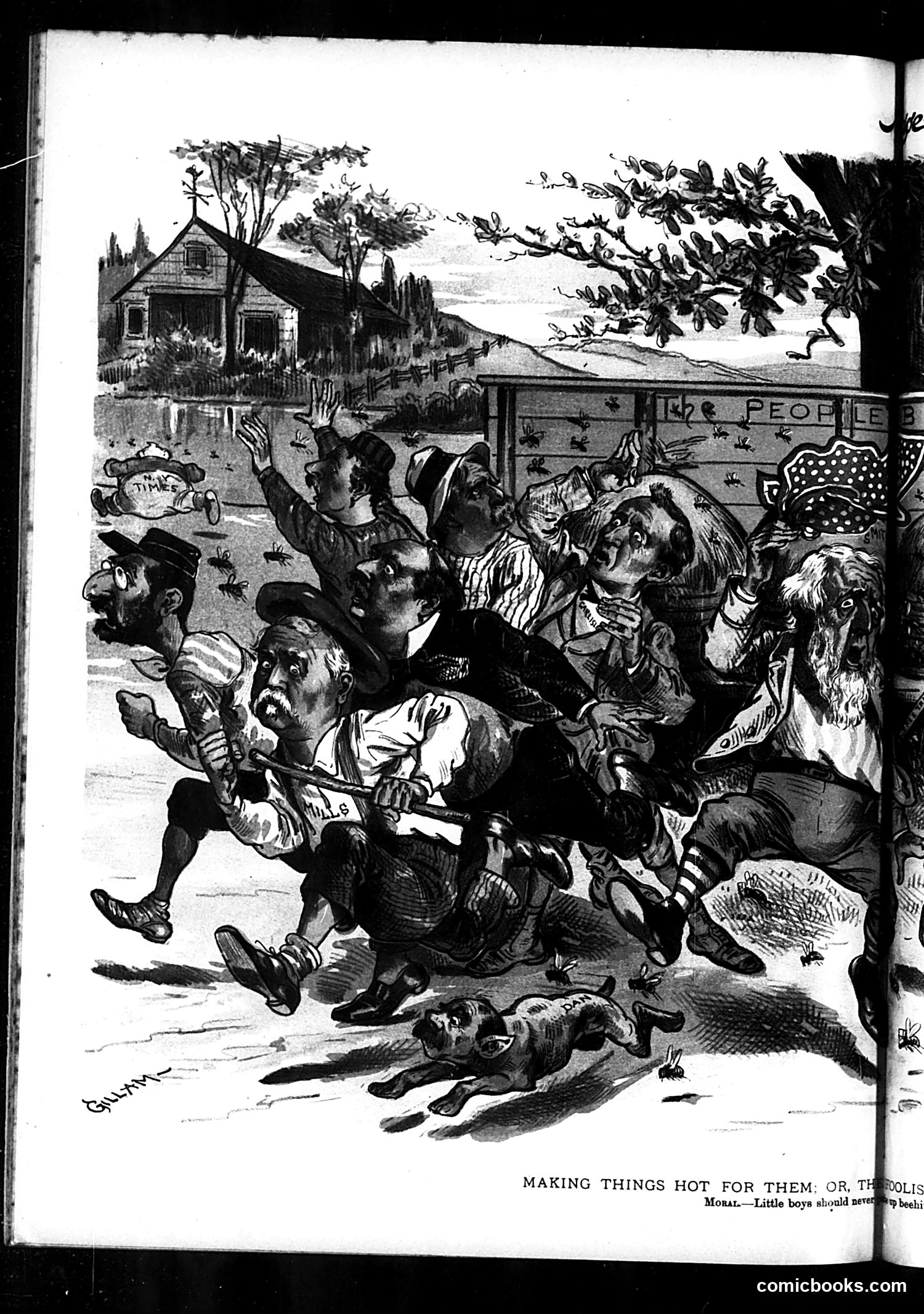
This appears to be a satirical cartoon from *Judge* magazine depicting a chaotic scene with multiple figures being chased or attacked by what looks like insects or wasps. The title "Making Things Hot for Them" suggests consequences or retribution. The partially visible moral ("Little boys should never...") indicates this is likely a cautionary tale about misbehavior. The exaggerated expressions and caricatured faces of the fleeing figures convey panic and discomfort—"things being hot" for them literally shown through their distress. Without seeing the complete caption or having full context about the historical moment, the exact political or social reference remains unclear. However, the format suggests it's either satirizing specific contemporary figures or illustrating a moral lesson through humorous exaggeration, typical of *Judge's* satirical approach during the late 19th/early 20th century.
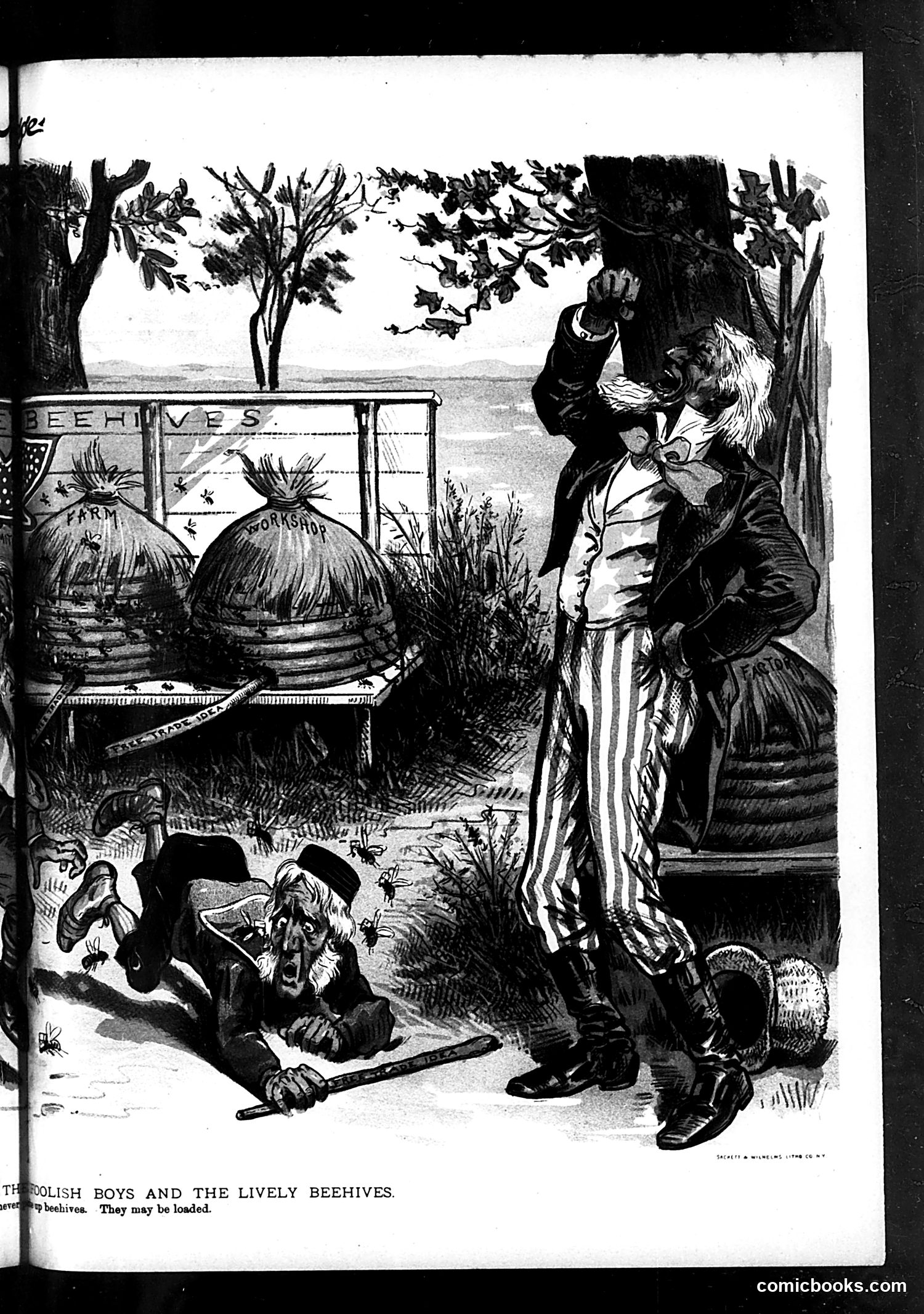
This cartoon satirizes naive or reckless behavior toward beehives. Two well-dressed gentlemen in formal attire observe beehives labeled "BEEHIVES" and "FARM WORKSHOP" behind a fence. One figure appears to be reaching toward or disturbing the hives while the other gestures in alarm. The caption warns that these "beehives...may be loaded"—a double meaning suggesting the hives are full of aggressive bees ready to attack. The "foolish boys" are the men depicted, mocked for their ignorance or carelessness in provoking something dangerous. This likely functions as political allegory, with the beehives representing an irritable group or institution (possibly labor movements or a volatile political faction) that foolish politicians risk angering through provocation. The humor depends on the era's readers understanding what contemporary "beehive" the cartoonist referenced.
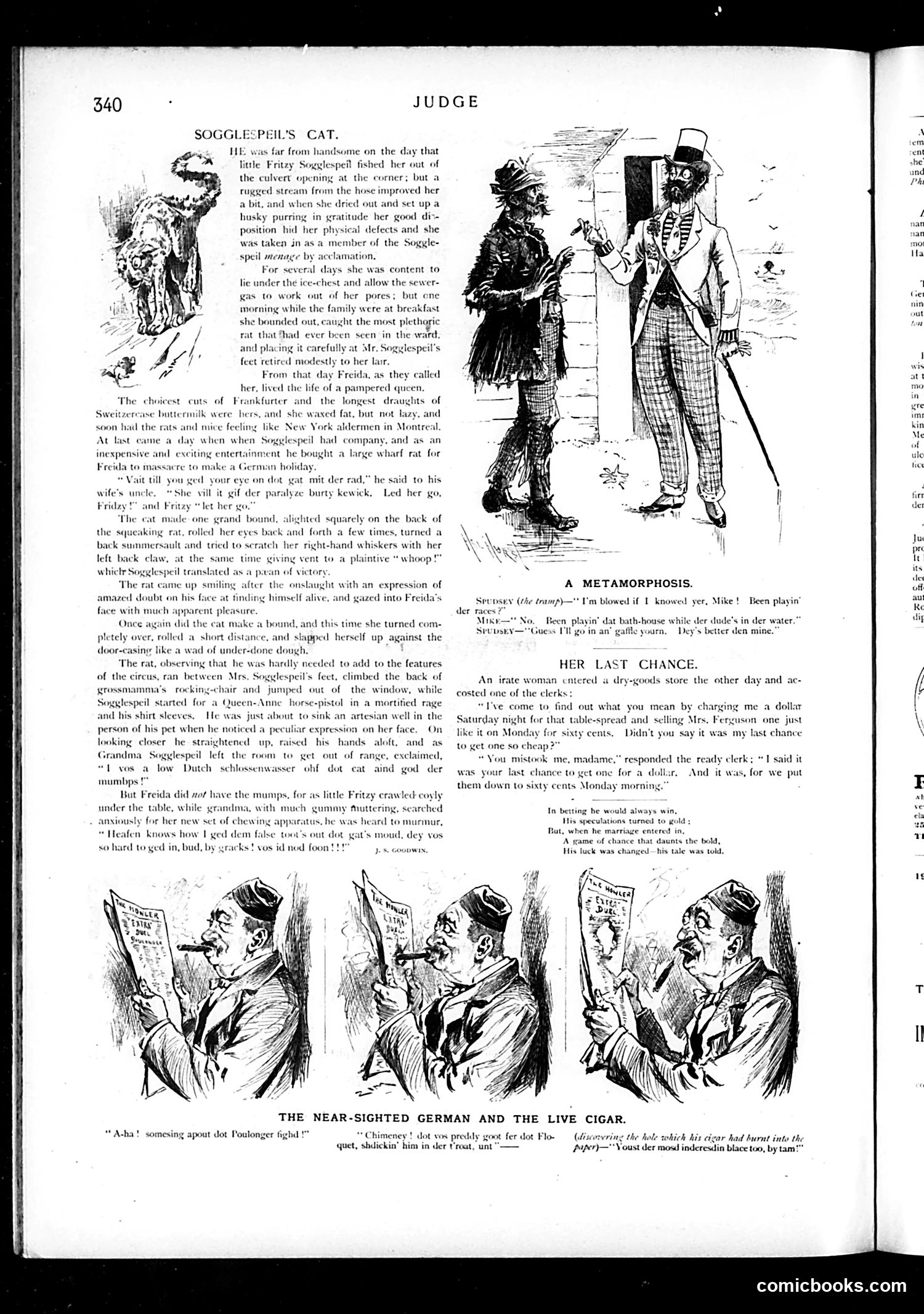
This page contains three satirical pieces typical of early Judge magazine: **"Sogglespeil's Cat"** is a humorous narrative mocking German-American immigrants through exaggerated dialect and the character of Mr. Sogglespeil. The story plays on ethnic stereotypes—the family's broken English, their rough manners, and their entertainment choices. The joke culminates when Sogglespeil's prized cat loses her teeth fighting a rat he brought home, and he falsely blames the mishap on "mumps" rather than admitting his scheme backfired. **"A Metamorphosis"** is a brief two-panel joke about homeless men ("tramp" and "dude") stealing from bathhouses—social commentary on poverty and petty crime. **"Her Last Chance"** satirizes retail dishonesty: a customer confronts a clerk about price discrimination on identical items, revealing stores charged different customers different amounts. The clerk's implied response suggests she won't get another opportunity to shop there. All three pieces employ satire targeting working-class and immigrant communities, commercial fraud, and urban social problems characteristic of Judge's editorial voice.
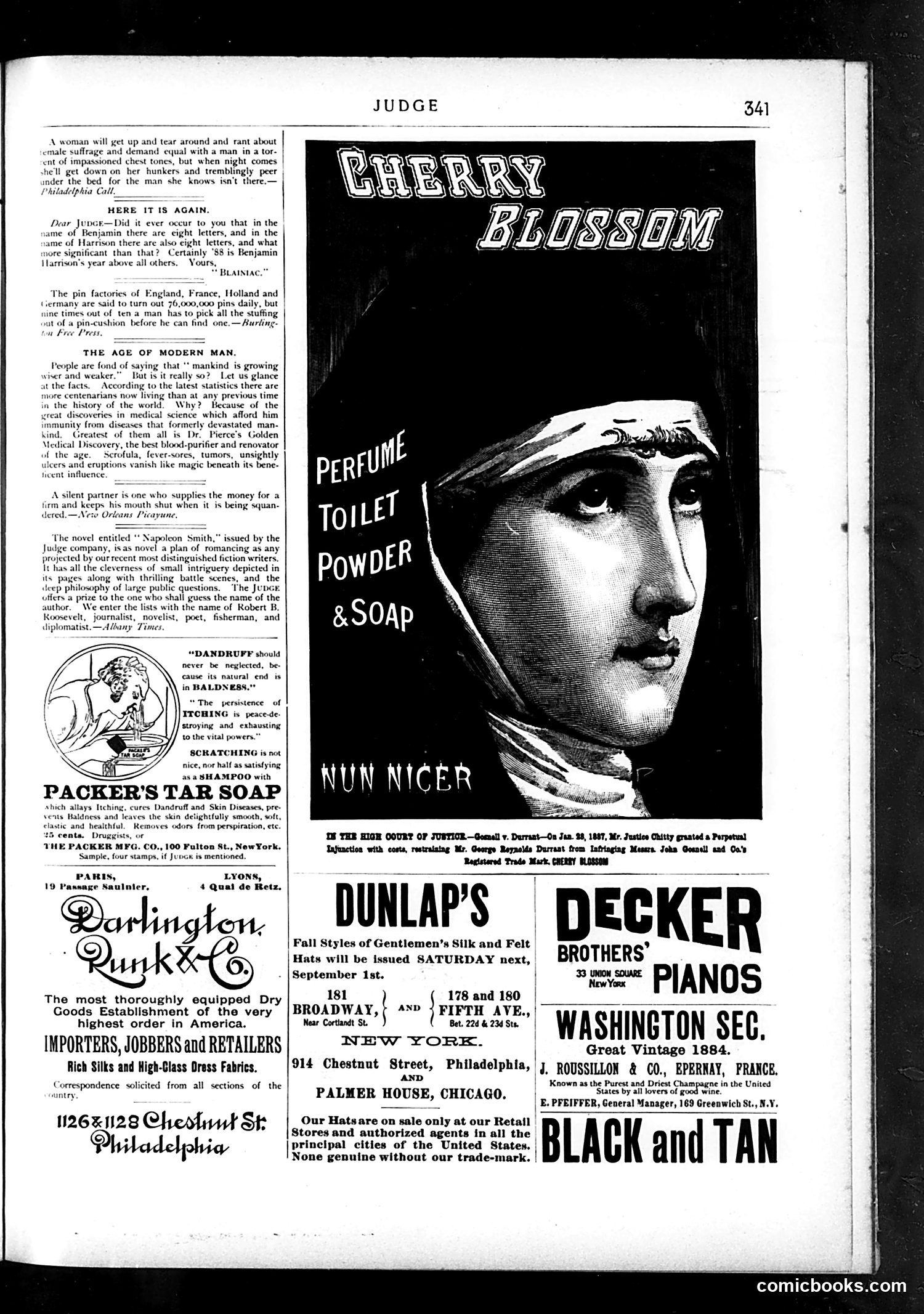
This page is primarily **advertising and miscellaneous humor pieces**, not a political cartoon. The largest image shows a classical female profile advertising "Cherry Blossom" perfume and toiletries—a commercial product advertisement referencing a British court case (1887) protecting the trademark. The text snippets are brief satirical observations on contemporary life: - **Gender humor** mocking feminist demands for suffrage while stereotyping women's domestic anxieties - **"Benjamin/Harrison" observation**: wordplay-based prediction that Benjamin Harrison will win the 1888 election (he did) - **Health claims** promoting Dr. Pierce's medical products as proof of modern progress - **Dandruff warnings** from Packer's Tar Soap The remainder is standard classified advertising for clothing retailers, pianos, and dry goods establishments. **For modern readers**: This reflects late-1880s consumer culture and period attitudes toward women's rights (dismissive), medical products (exaggerated claims), and fashion. The "political" content is minimal and mostly playful rather than serious commentary.
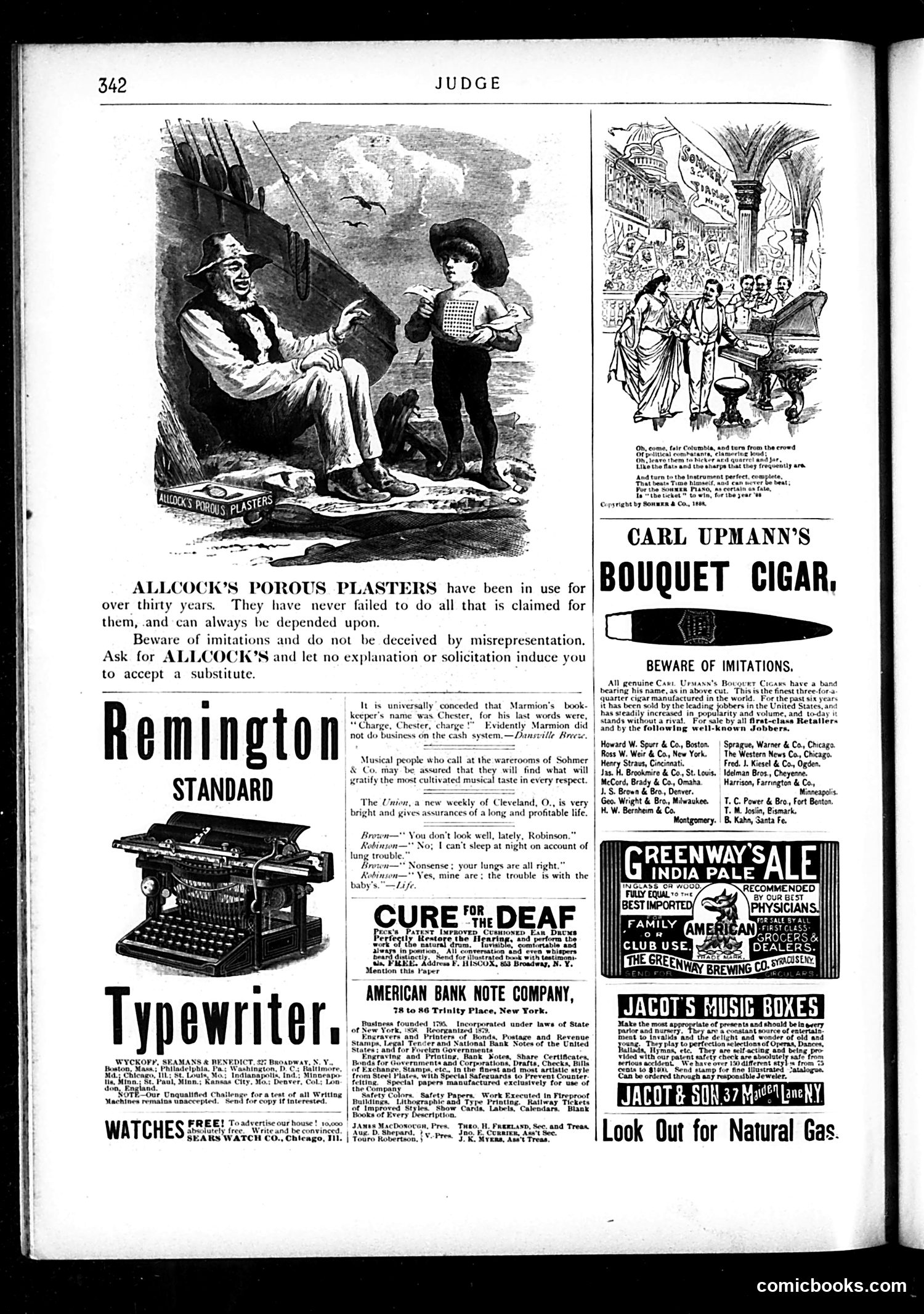
This page is primarily **advertising**, with two notable illustrated advertisements at the top: **Left cartoon**: Shows a man sitting by water with a child, advertising Allcock's Porous Plasters (a medical product). The image illustrates domestic comfort and care—the plasters are promoted as reliable remedies used for thirty years. **Right illustration**: Depicts an indoor scene promoting Carl Upmann's Bouquet Cigars, warning against counterfeits. The ad emphasizes authenticity and lists numerous legitimate jobbers across America. The remainder consists of small advertisements for various products: typewriters (Remington Standard), watches, a "cure for deafness," bank notes, music boxes, and ale. **Notable small item**: A humorous exchange about insomnia—a man blames his inability to sleep on his baby's lungs rather than his own health. The page reflects late 19th-century consumer culture, mixing medical quackery claims with legitimate products, and emphasizing brand authentication against widespread counterfeiting.
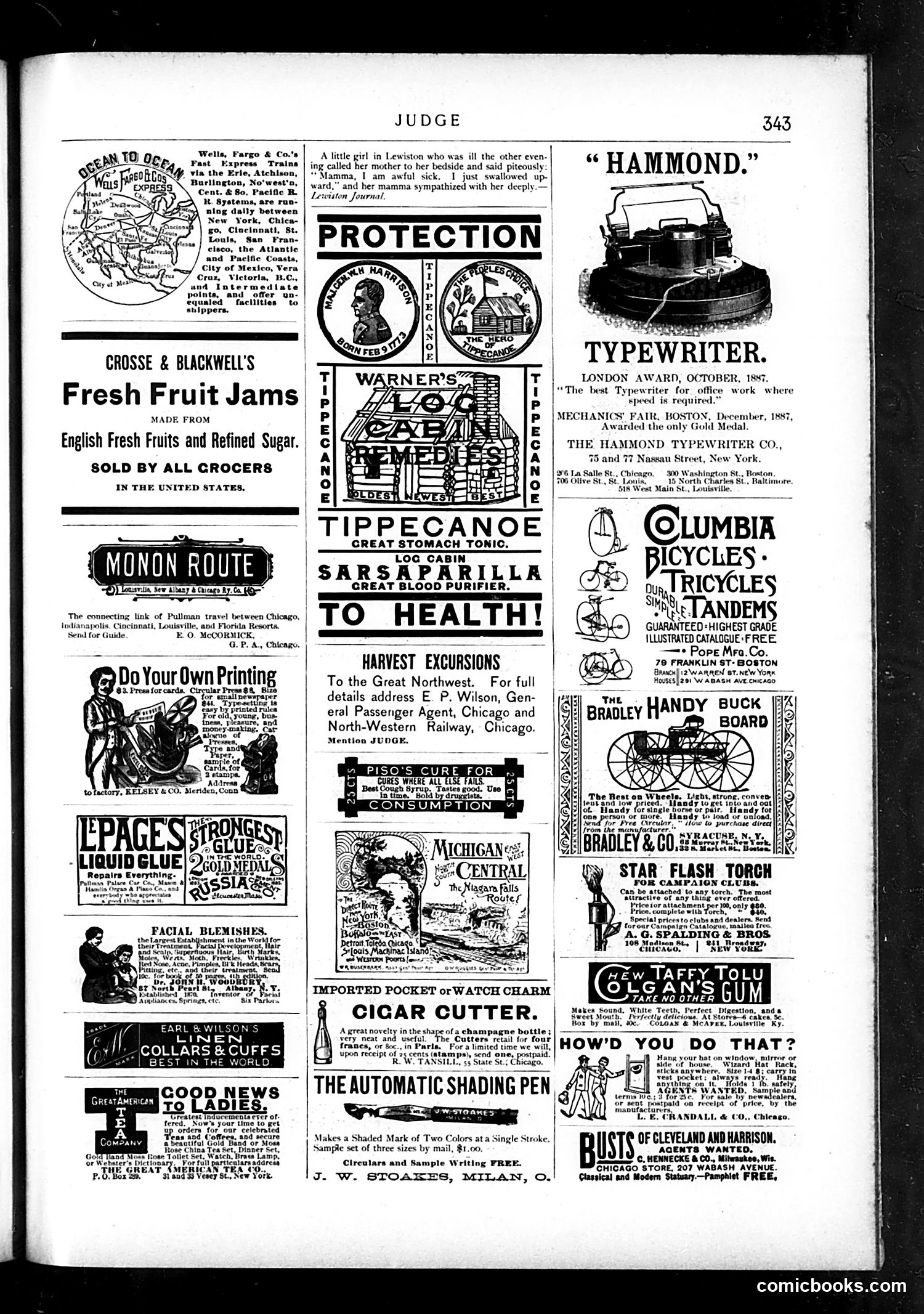
This page is primarily **advertising**, typical of late-19th-century magazines. The notable content includes: **The Only Potential Cartoon/Satire:** The small anecdote about "A little girl in Lewiston" complaining she's "awful sick" and "swallowed upward" appears to be a **mild joke about childhood malapropisms**—the girl likely meant "swallowed" something bad, with humorous innocent phrasing. **Advertisements Featured:** The bulk consists of period product ads: Hammond typewriters (promoted as superior), Columbia bicycles and tricycles, cigar cutters, patent medicines (Tippecanoe stomach tonic, Piso's cough cure), shading pens, and busts/statuary. These reflect 1880s consumer goods and the era's unregulated medical product industry. **Historical Context for Modern Readers:** The "Protection" banner imagery references tariff politics of the era. Most striking to modern eyes: the aggressive marketing of patent medicines with unsubstantiated health claims now recognized as dangerous. The page demonstrates how 19th-century magazines monetized space through dense advertising rather than editorial satire.
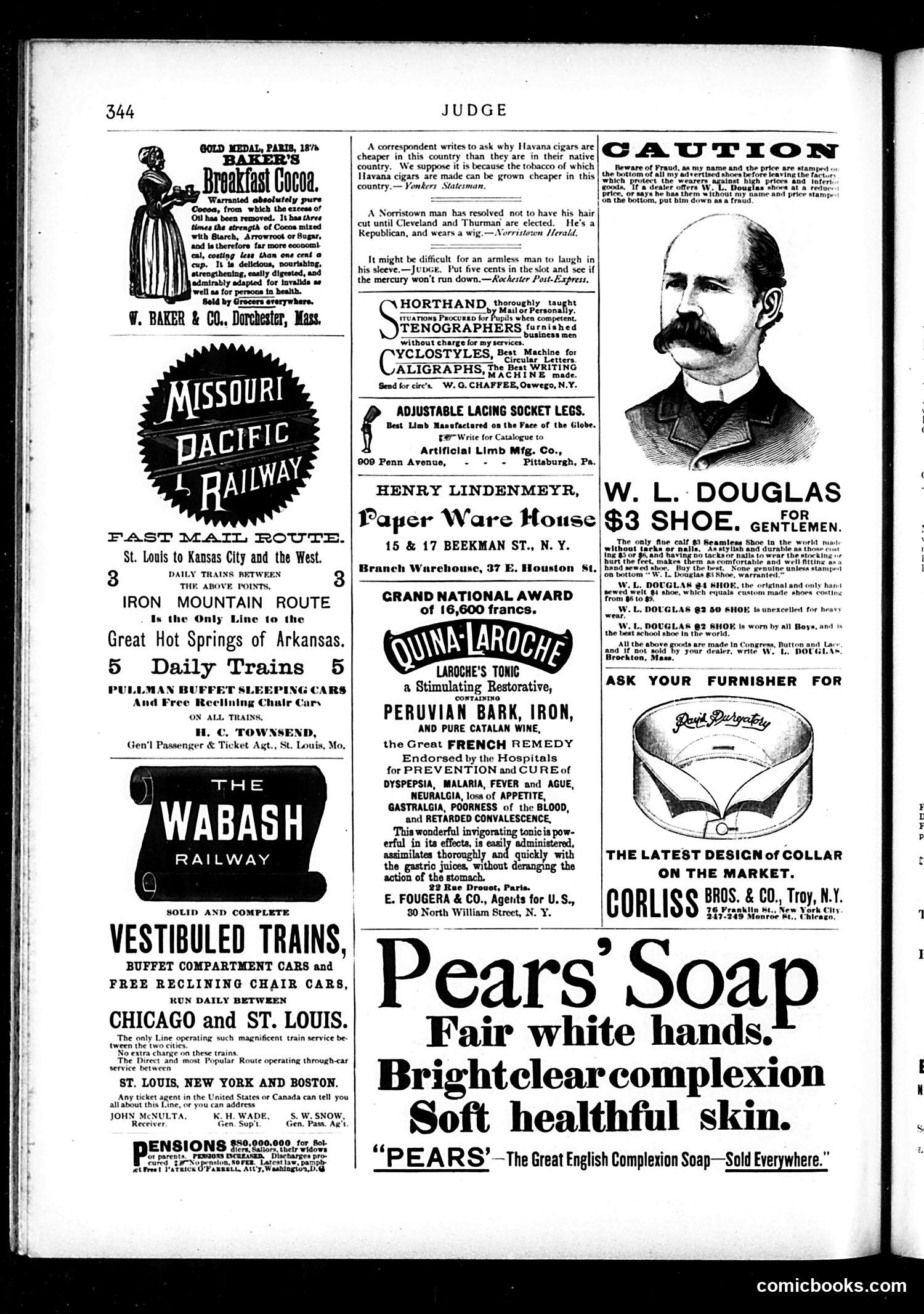
This is primarily an **advertising page** with minimal editorial content. The few text items at the top are brief satirical notes typical of Judge's style: 1. **Havana cigars joke**: Mocks economic confusion—why Cuban cigars cost less in America than Cuba. The satirical "answer" suggests cigars are actually grown cheaper in the U.S., which is absurd. 2. **Cleveland/Thurman reference**: A Norristown Republican refuses haircuts until Democratic candidates Grover Cleveland and Allen Thurman win the 1884 election. The joke: he'll wear a wig rather than accept their victory—partisan stubbornness. 3. **Armless man thermometer gag**: Dark humor about inserting coins into a thermometer slot to make mercury rise. The page is dominated by **period advertisements** for railways, patent medicines (Quina Laroche tonic), artificial limbs, shoes (W.L. Douglas), and Pears' Soap. These ads reflect 1880s consumer culture and product marketing conventions. No significant political cartoons appear on this page.
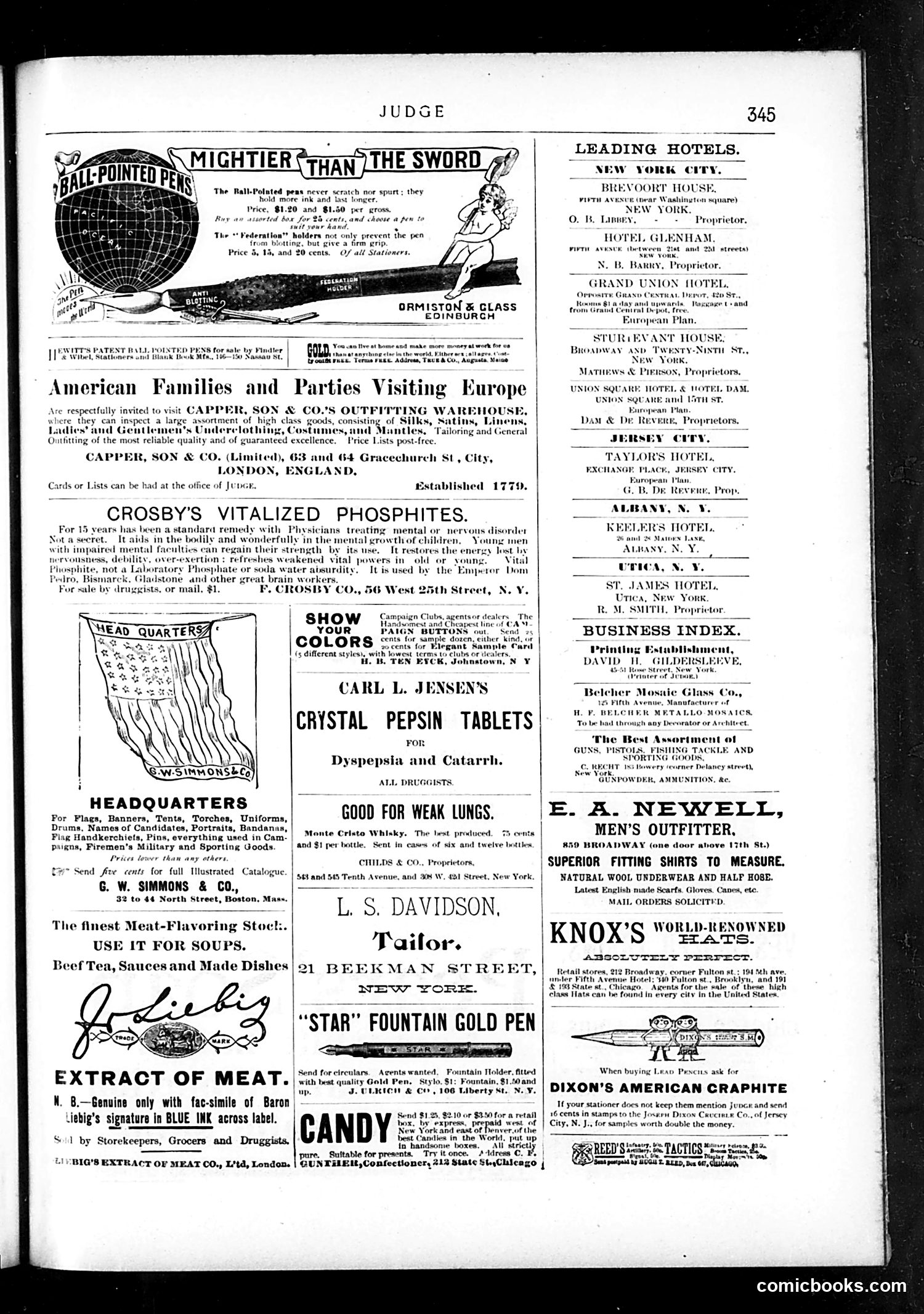
This page is primarily **advertising**, not political satire. It's page 345 from *Judge*, a late 19th-century humor magazine, dominated by commercial notices for hotels, clothing, pens, food products, and medicines. The only cartoon visible is a small illustration at the top advertising **"Ball-Pointed Pens"** by Ormiston & Glass (Edinburgh), showing a figure wielding a pen "Mightier Than The Sword"—a standard commercial claim comparing writing instruments to weapons, playing on the famous phrase about pen versus sword. The rest of the page contains hotel listings (Brevoort House, Grand Union Hotel, etc.), business advertisements for men's clothing, fountain pens, meat extract, pepsin tablets, whisky, and other merchandise typical of the era. There is **no apparent political or social satire** on this particular page—it functions as a classified advertising section within the magazine.
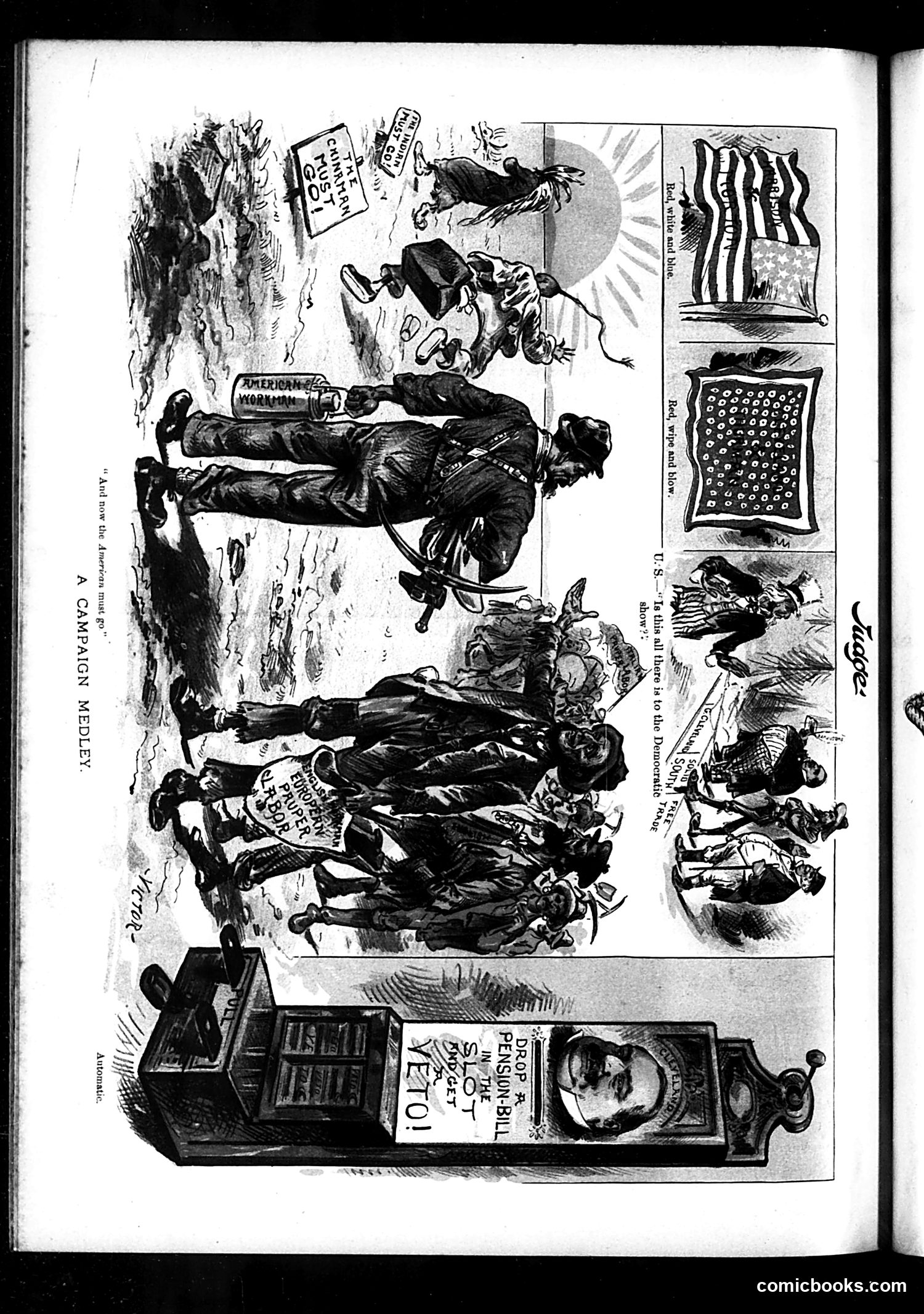
This page contains a political cartoon titled "A Campaign Medley" showing what appears to be a chaotic campaign scene with multiple figures in period dress. The cartoon depicts people engaged in political activity, with references to "American Morning" visible on a bottle or container. The right side includes smaller illustrated panels showing various symbolic imagery—including what appears to be an American flag, a patriotic shield or emblem, and other campaign-related iconography. However, without a clear date visible on this page and with partially obscured OCR text, I cannot definitively identify which specific election or political figures are being satirized. The overall theme appears to mock the disorder or absurdity of American political campaigning, a common subject for Judge magazine's satire. A complete date and clearer text would be necessary for precise historical attribution.