
A complete issue · 16 pages · 1888
Judge — August 11, 1888
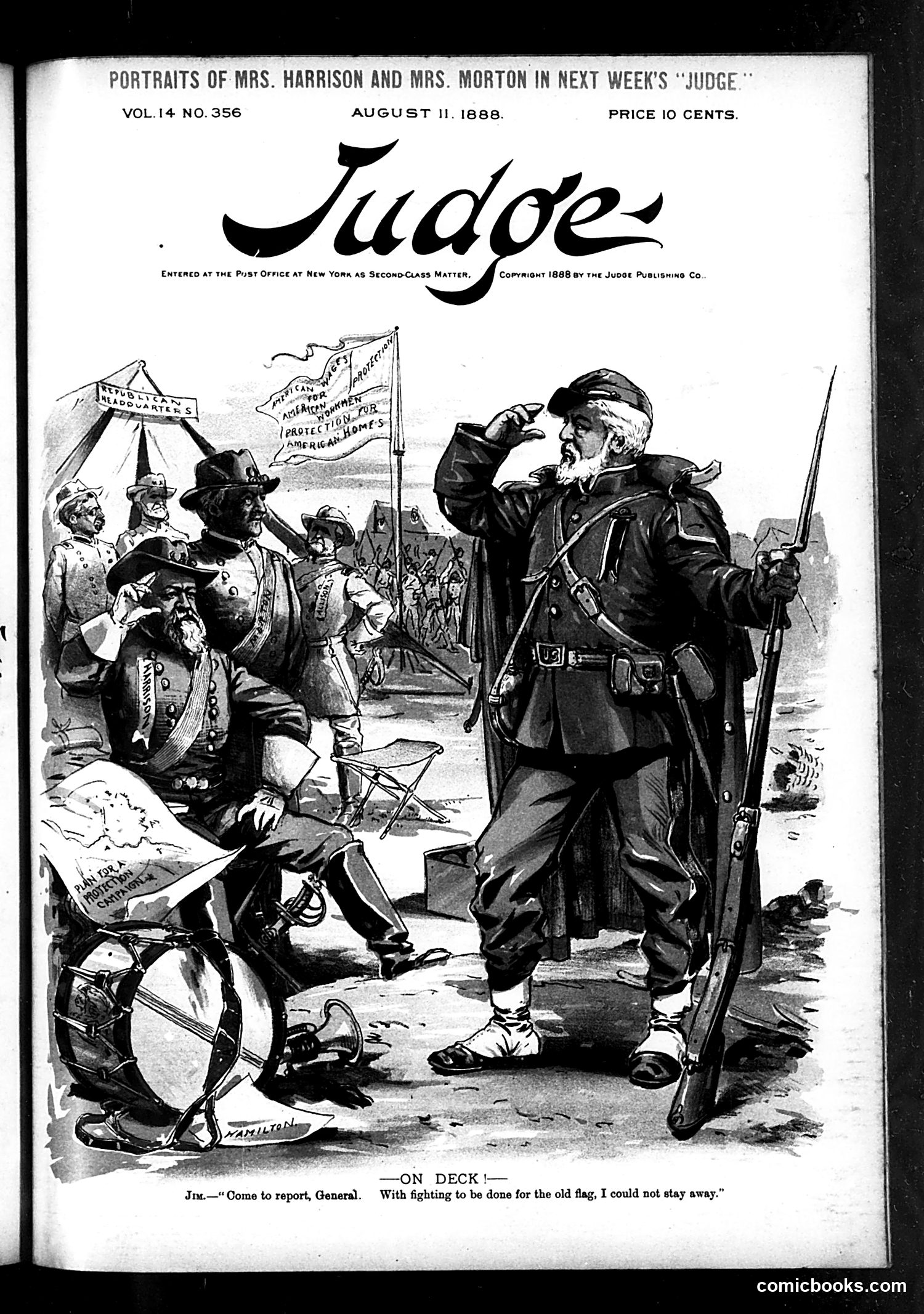
This political cartoon depicts a military scene titled "On Deck!" The caption reads: "Come to report, General. With fighting to be done for the old flag, I could not stay away." The illustration shows a uniformed soldier (right) reporting to military officers (left), with visible flags and tent in background. The figure appears to represent someone returning to military duty. Visible text on documents includes references to "Protection for American Homes," suggesting this relates to 1888 political debates about tariffs and American commerce. **Without additional historical context**, the exact identity of the "General" and the specific military or political situation referenced remains unclear. The satire appears to critique contemporary political positions on protectionism and national defense, but the precise figures and event require further historical documentation to identify with certainty.
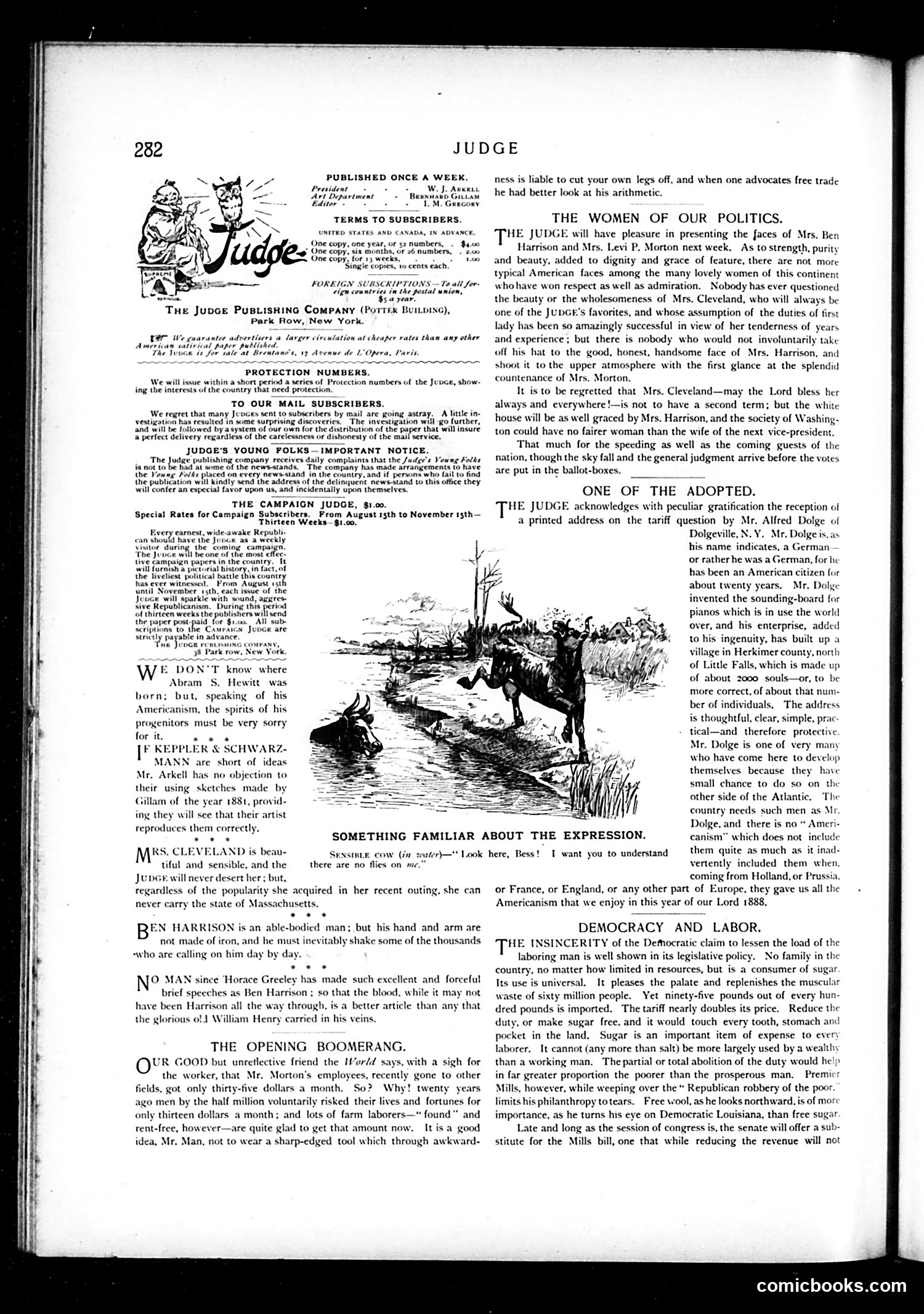
This page contains several brief political commentary pieces rather than full cartoons. The main illustrated section, titled "SOMETHING FAMILIAR ABOUT THE EXPRESSION," depicts a cow and appears to satirize recent political touring or campaigning, suggesting a political figure's expression resembles a cow's. Other sections briefly critique public figures: Mrs. Cleveland is praised for her dignity; Ben Harrison is described as "able-bodied" but unlikely to "shake" supporters; and Abraham S. Hewitt is commended for his Americanism. The "DEMOCRACY AND LABOR" section discusses sugar tariffs and their impact on laborers versus wealthy mill owners—a common Progressive-era debate about whether protective tariffs help or harm working people. The content reflects late-19th-century political disputes over trade policy and labor conditions.
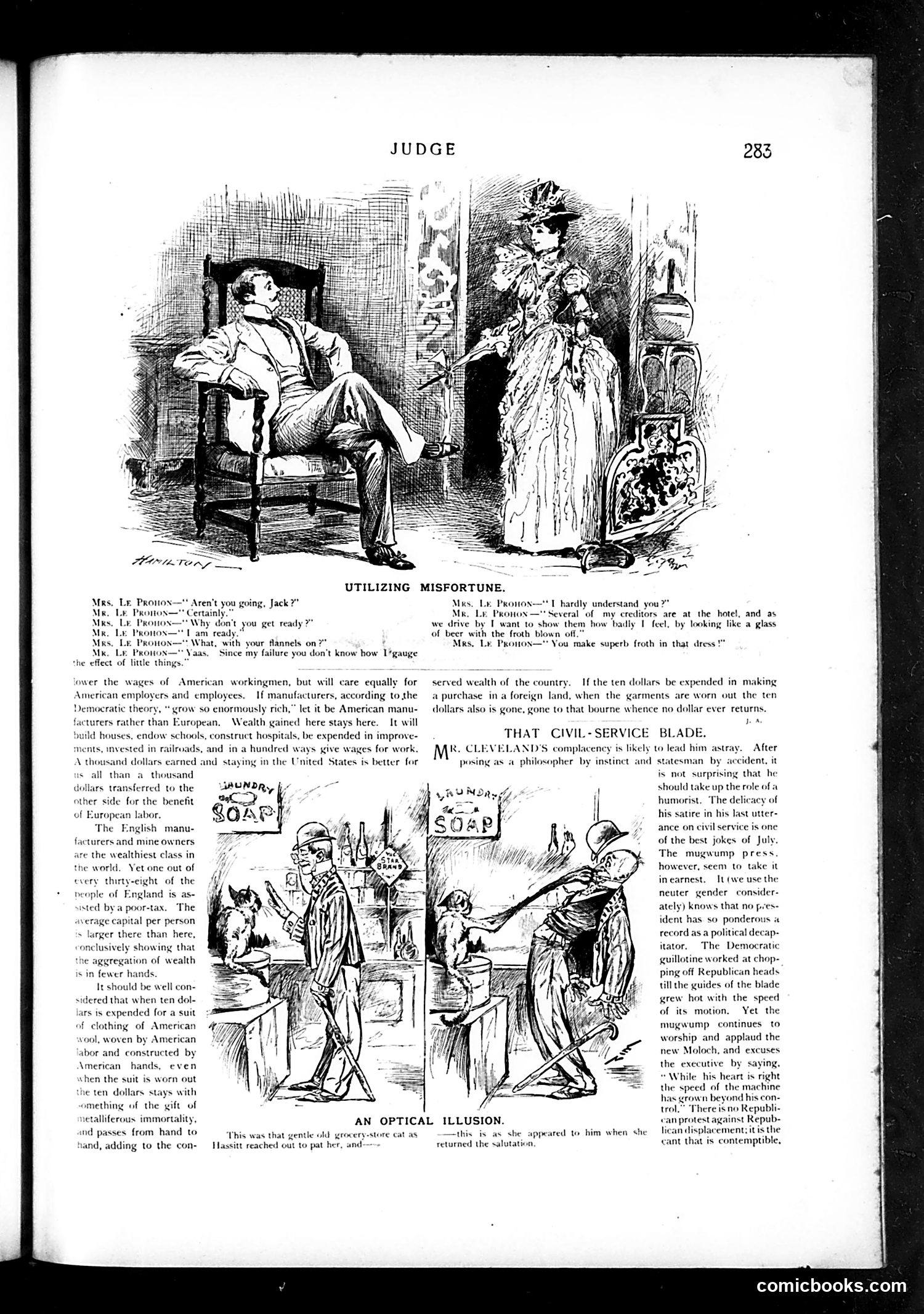
**Top Cartoon - "Utilizing Misfortune":** A man sits in casual flannel clothes while his well-dressed wife questions why he's not ready. His response: since his financial failure, he no longer understands "the effect of little things." The satire mocks how financial disaster has made him indifferent to social propriety. **Middle Section - Economic Argument:** Extended text argues for American protectionism: money spent on American-made goods stays in the country, benefiting workers and economy, unlike foreign purchases. This appears to advocate against free trade policies. **Bottom Cartoon - "An Optical Illusion":** Mr. Le Proton tells his wife he'll fake misery (looking "like a glass of beer with the froth blown off") to impress creditors at their hotel. The joke: his wife says he makes "superb froth" in his dress—his appearance is already pathetically disheveled. **"That Civil-Service Blade":** Critique of President Cleveland, calling him a "political decapitator" for firing Republican office-holders despite mugwump (reform-minded) praise. The satire questions hypocritical liberal support for partisan removals.
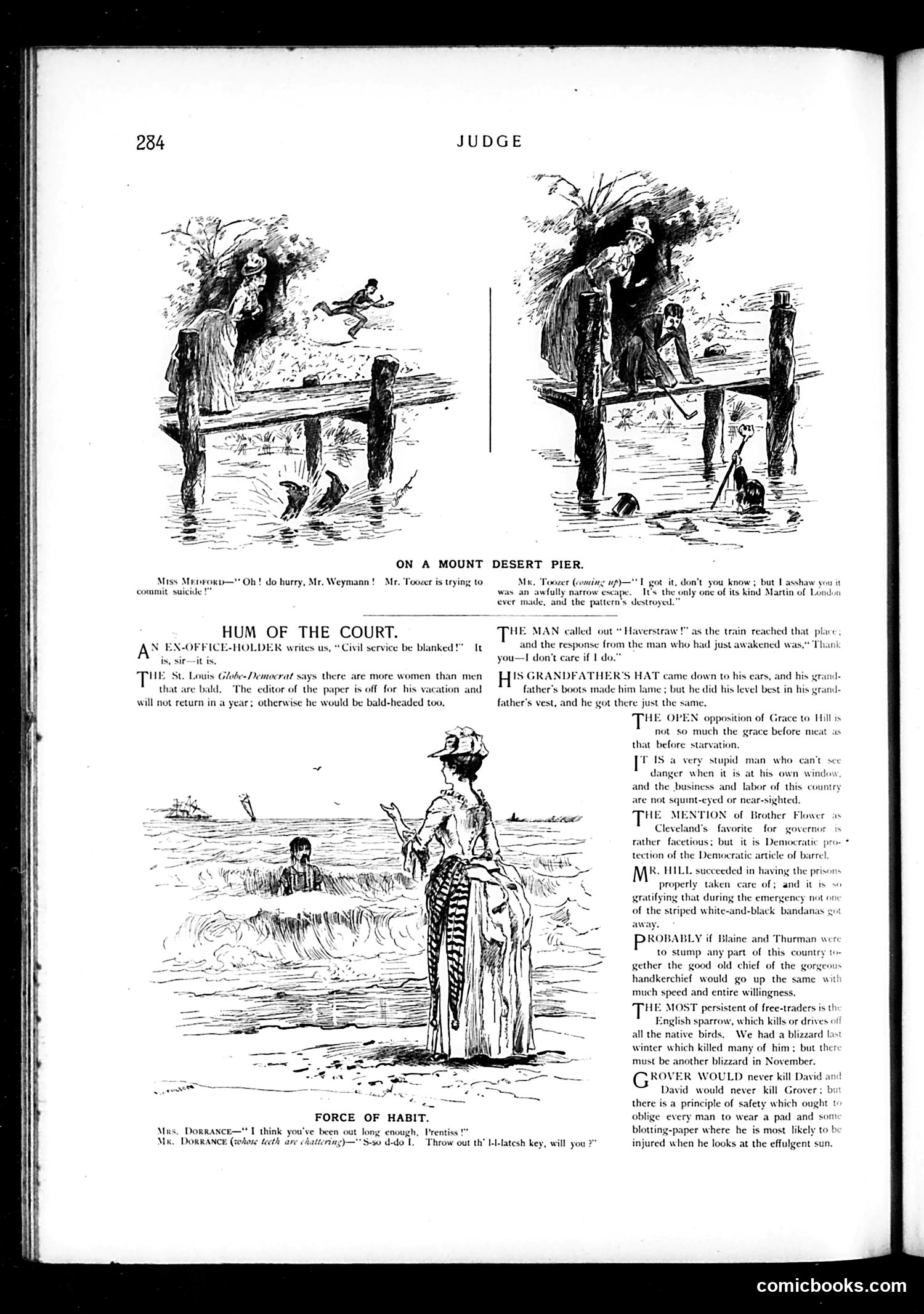
This page contains several brief satirical items typical of Judge's format. The main cartoons depict: **"On a Mount Desert Pier"**: Shows a woman urging Mr. Weymann to hurry while Mr. Tozer attempts suicide—likely satirizing melodramatic behavior or a specific contemporary scandal. **"Force of Habit"**: A man with chattering teeth asks his companion to throw out the "latest key," implying habitual behavior persists despite changed circumstances. **"Hum of the Court"**: A collection of brief editorial quips mocking political figures and social conventions—including jabs at civil service, women's baldness, and Cleveland administration figures (Grace, Hill, Blaine, Thurman, Grover). References suggest 1880s-90s Democratic politics, though specific identities of some figures remain unclear without additional historical context. The humor relies on contemporary political awareness and social observation now largely obscured by time.
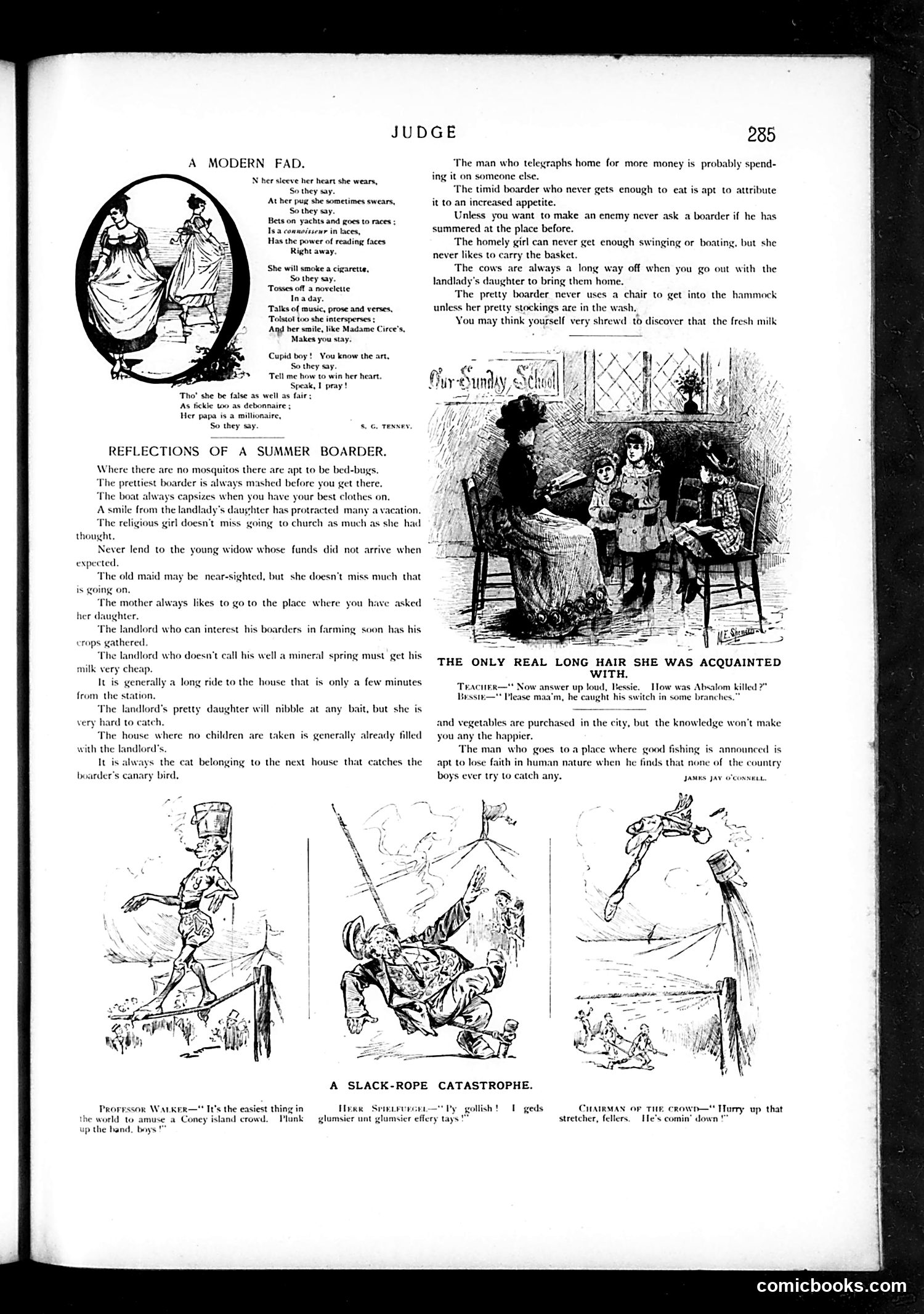
This page contains three distinct satirical pieces typical of early 1900s American humor: **"A Modern Fad"** mocks the "New Woman"—a contemporary social type who smokes, reads literature, attends races, and affects intellectual sophistication. The poem satirizes her contradictions: she's simultaneously cultured and frivolous, independent yet marriage-focused. The punchline reveals the real "fad" is pursuing wealthy women, with the millionaire father as the actual prize. **"Reflections of a Summer Boarder"** offers dry observations about rural vacation accommodations—a popular American leisure trend. These aphorisms mock boardinghouse proprietors' deceptions (calling wells "mineral springs"), guests' pretensions, and the predictable romantic entanglements that occur. **"A Slack-Rope Catastrophe"** depicts a sideshow accident, with a professor's tightrope stunt literally backfiring. The humor relies on physical comedy and dialect humor typical of the era. All three pieces target emerging middle-class leisure culture, changing gender roles, and rural/urban contrasts—central concerns of early Gilded Age America.
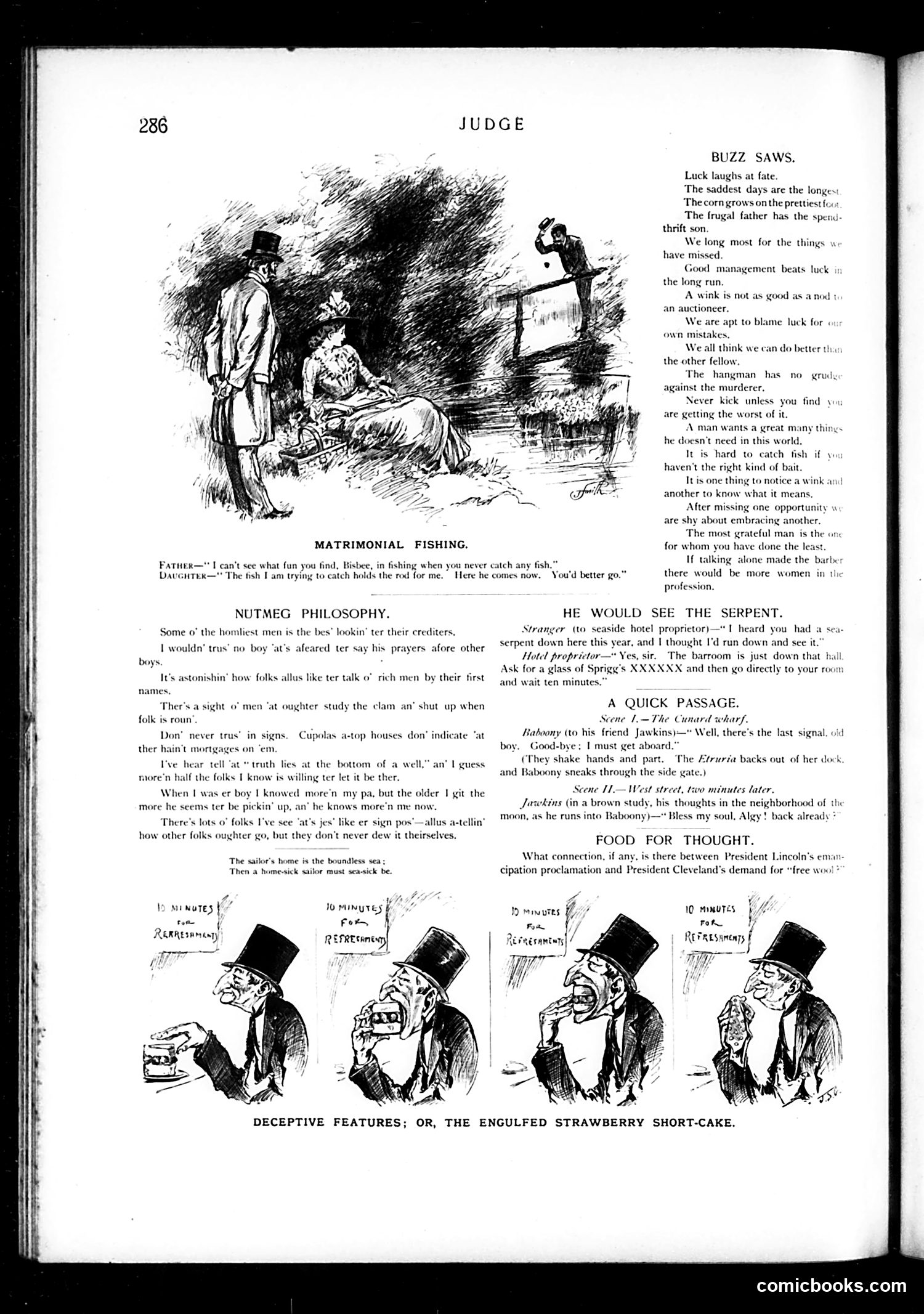
This page contains multiple satirical pieces typical of Judge's social commentary: **"Matrimonial Fishing"** jokes that a husband enjoys fishing because his wife holds the rod—implying marital discord where he welcomes any escape from her company. **"Nutmeg Philosophy"** presents folksy, contradictory aphorisms mocking rural wisdom and class hypocrisy—particularly targeting the wealthy and hypocritical moralism. **"He Would See the Serpent"** satirizes a seaside hotel proprietor who directs a tourist seeking the legendary sea-serpent to order expensive liquor instead, suggesting the "serpent" is a commercial hoax designed to separate tourists from money. **"A Quick Passage"** depicts two friends parting at a ship, with one returning moments later—likely commenting on unreliable travel or failed departures. **The four-panel cartoon** ("Deceptive Features") shows a man's changing reactions to what appears to be a strawberry shortcake, presumably discovering it's something else entirely—a visual gag about false appearances. **"Food for Thought"** poses an unclear political question linking Lincoln's Emancipation Proclamation to Cleveland's "free wool" demand, likely referencing 1880s tariff debates.
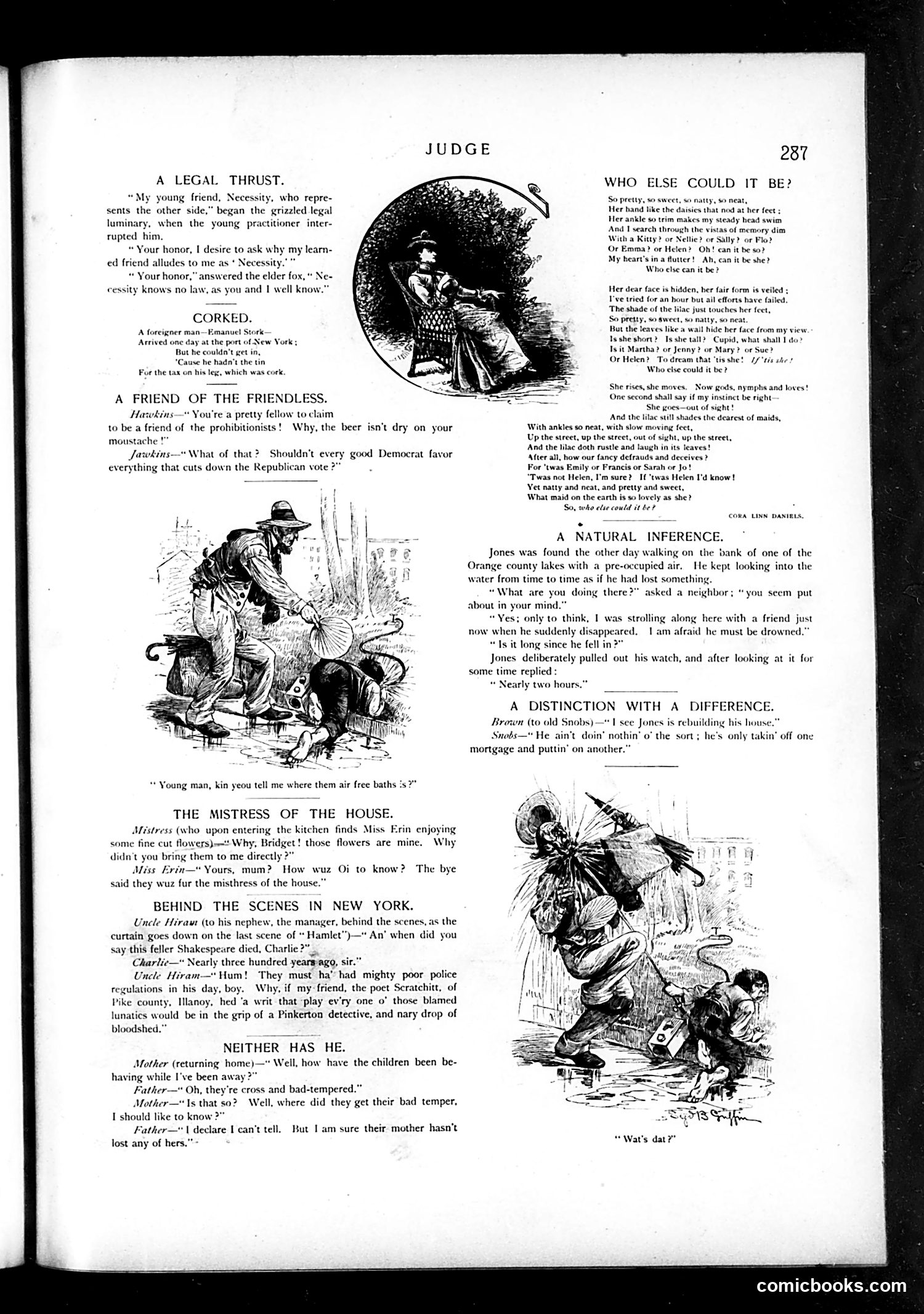
This page contains several brief satirical sketches typical of Judge magazine's humor: **"A Legal Thrust"** mocks pretentious legal arguments—a lawyer accuses his opponent of being "Necessity" (invoking the phrase "necessity knows no law"), reducing high-minded legal debate to wordplay. **"Corked"** jokes about immigration restrictions, likely referencing late 19th-century taxes or duties on foreign goods or people arriving at ports. **"A Friend of the Friendless"** satirizes political hypocrisy: a self-proclaimed prohibitionist (anti-alcohol advocate) is caught with beer on his mustache, exposing the gap between public morality and private behavior. **"The Mistress of the House"** plays on class confusion—an Irish servant girl (Miss Erin) misunderstands who the "mistress" is, suggesting social ambiguity. **"Behind the Scenes in New York"** depicts a rustic uncle's ignorance of Shakespeare, suggesting rural Americans' disconnect from high culture while ironically proposing violent solutions to literary problems. The remaining pieces offer light romantic and domestic humor.
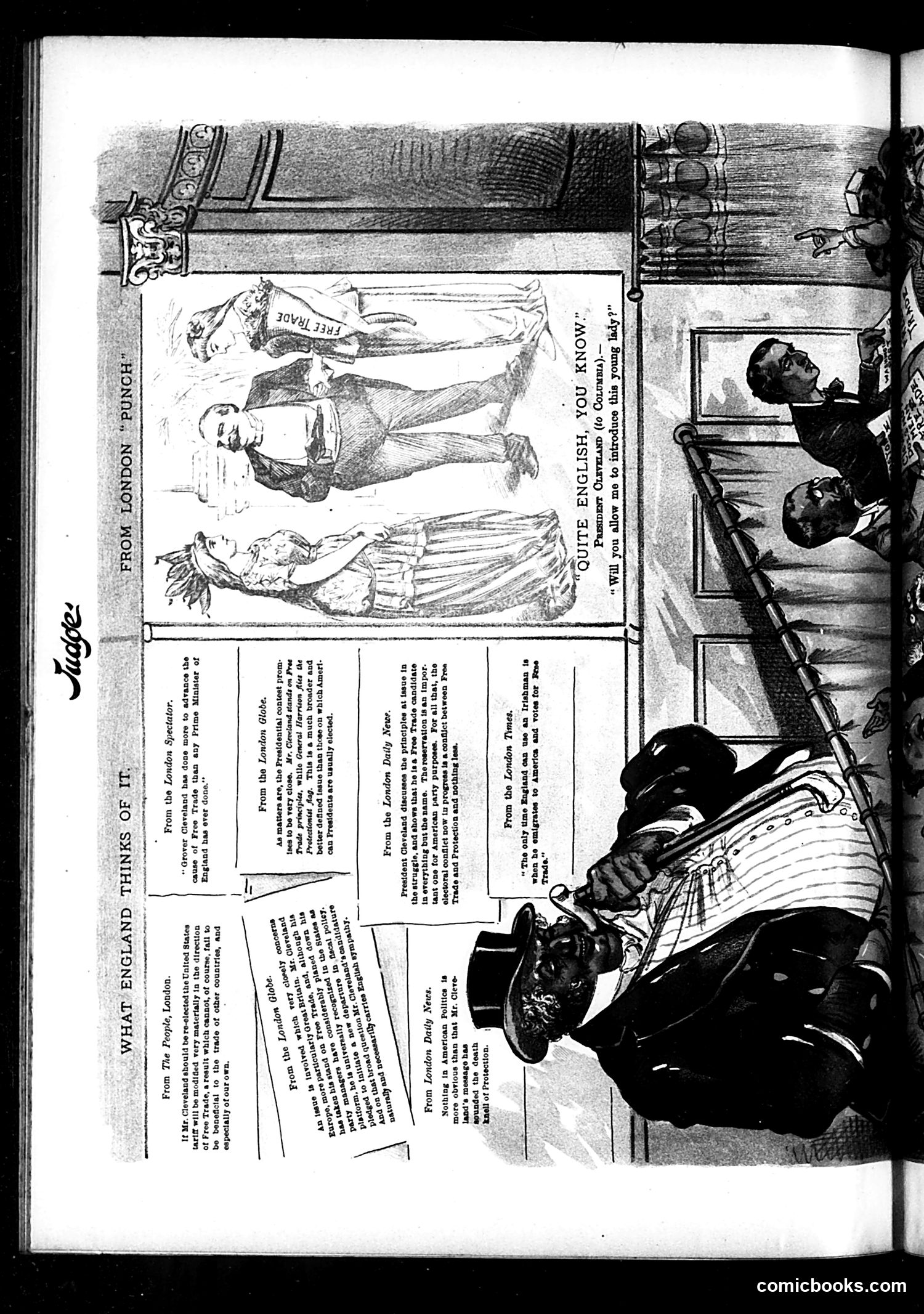
This page from *Judge* magazine appears heavily degraded, making reliable OCR difficult. The visible content shows: **Top section**: A cartoon titled "WHAT ENGLAND THINKS OF IT" depicting two figures in Victorian dress - appears to be British commentary on an American subject (likely political). The sketch shows caricatured figures in period clothing. **Bottom section**: An illustration labeled "OUTLINE ENGLISH KNOW" showing what appears to be a man climbing a ladder, suggesting satirical commentary on English knowledge or understanding of something American. The OCR text is largely corrupted and illegible, preventing accurate identification of the specific political figures, events, or satirical targets. Without clear text or sharper image quality, I cannot reliably identify which American political situation or figures are being mocked, or what the English perspective critique entails. The page likely comments on Anglo-American relations or differing national perspectives on a contemporary issue, but specifics remain unclear.
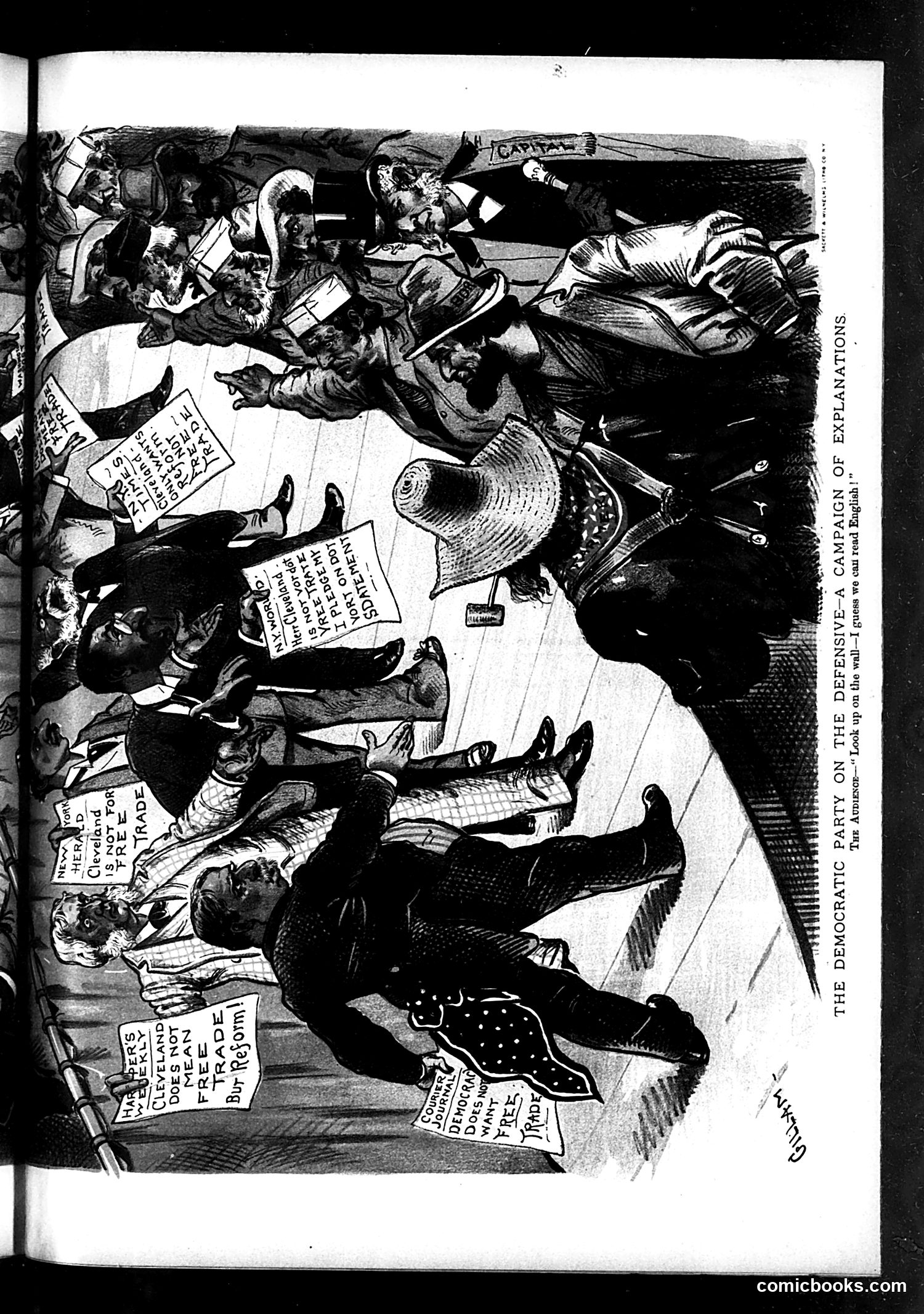
I cannot reliably read the OCR text on this page due to significant corruption and reversal. However, the image itself shows a political cartoon titled "The Democratic Party on the Defensive: A Campaign of Exaggerations" (visible on the right margin). The cartoon depicts multiple figures labeled with various signs/placards appearing to be in chaotic motion or falling. The style and composition suggest this is satirizing Democratic Party messaging or campaign tactics—likely portraying their arguments as exaggerated, unstable, or collapsing. Without clearer text or clearer identification of specific caricatured figures, I cannot definitively identify which political figures or specific issues are being targeted, though the date and Judge magazine's Republican-leaning editorial stance suggest this critiques a Democratic campaign, possibly from the early 20th century.
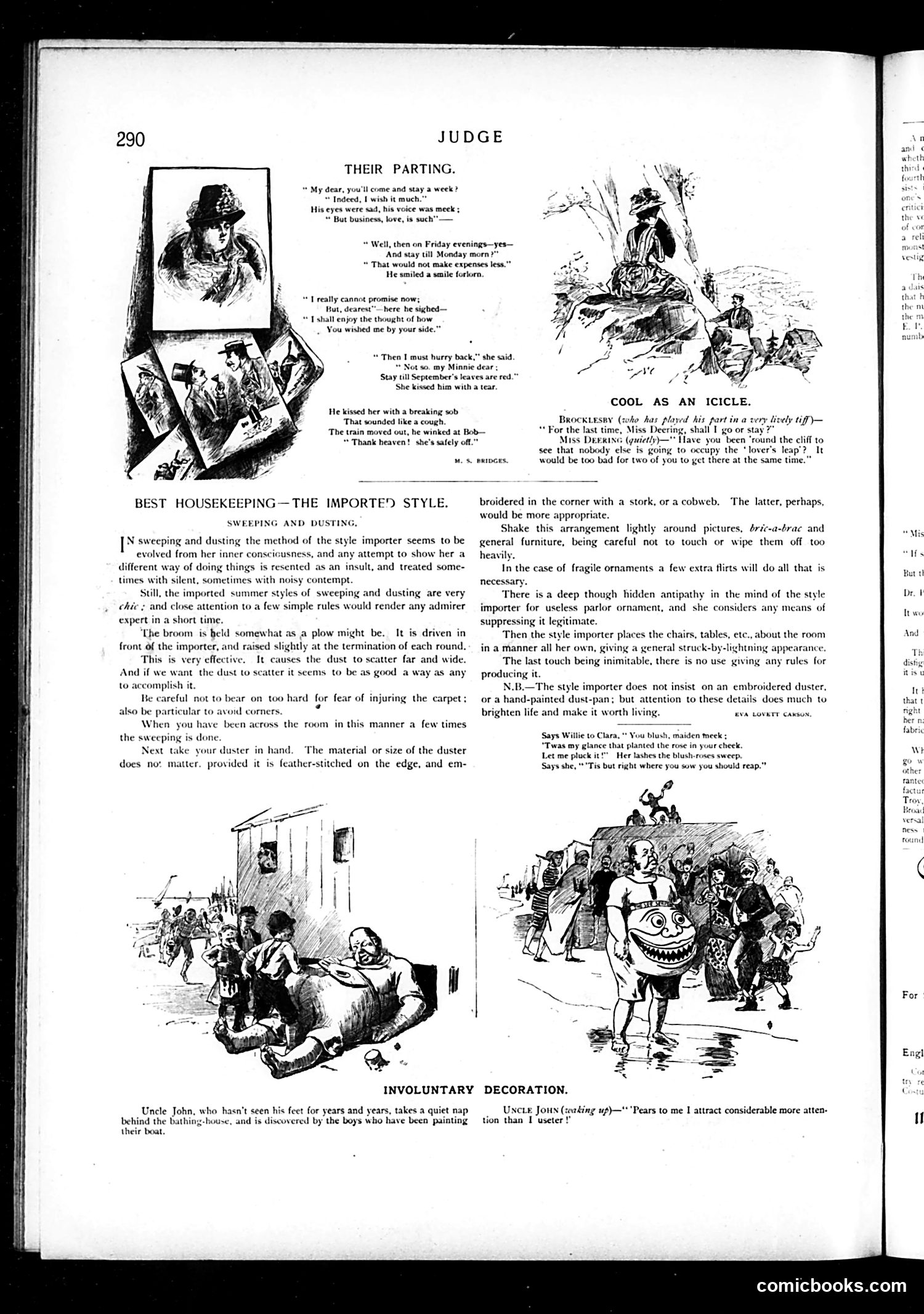
This page contains three distinct satirical pieces mocking social pretense and romantic dishonesty: **"Their Parting":** A couple exchanges tearful goodbyes—she begs him to stay, he claims business obligations prevent it. The dark joke: immediately after she leaves, he "winked at Bob" and thanks heaven "she's safely off," revealing the entire emotional display was performance. The satire targets insincere romantic sentiment and domestic discord masked by false affection. **"Best Housekeeping—The Imported Style":** Mocks wealthy women who adopt affected European cleaning methods—holding brooms like plows, scattering dust everywhere, arranging furniture haphazardly—while obsessing over decorative details like embroidered dustpans. The satire targets pretentious "imported" affectation and incompetent domesticity among the affluent. **"Involuntary Decoration":** Uncle John, too overweight to see his feet, naps and gets painted by boys, becoming accidentally decorated. Simple slapstick humor about vanity and physical decline.
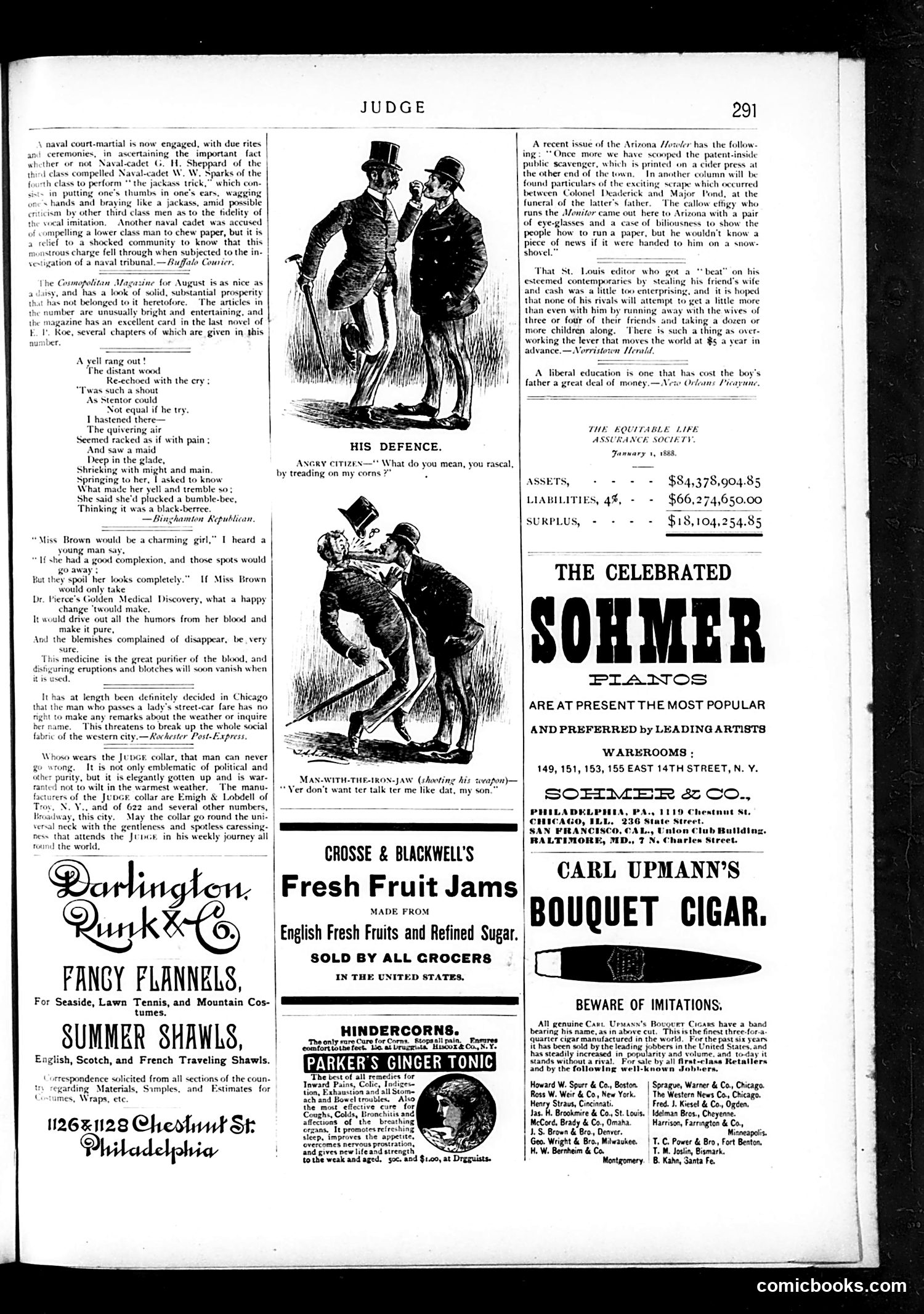
This page contains two political cartoons satirizing social rudeness and class behavior. **"His Defence"** depicts a working-class man with a prominent jaw defending himself after stepping on a citizen's foot. The humor relies on physical caricature—his exaggerated "iron jaw" suggests he's a lower-class laborer or criminal type, making his aggressive response ("Yer don't want ter talk ter me like dat, my son") seem characteristically crude and threatening. **The upper cartoon** (titled "His Defence") shows two well-dressed men, likely gentlemen, in conversation. It satirizes social pretense and the absurdity of manufactured excuses for bad behavior. Both cartoons reflect Judge magazine's typical satirical target: class divisions and the often-ridiculous justifications working-class people supposedly offered for uncouth conduct. The satire assumes readers share middle-class sensibilities about proper behavior and will find lower-class resistance to social norms inherently laughable. The page is primarily advertisements otherwise.
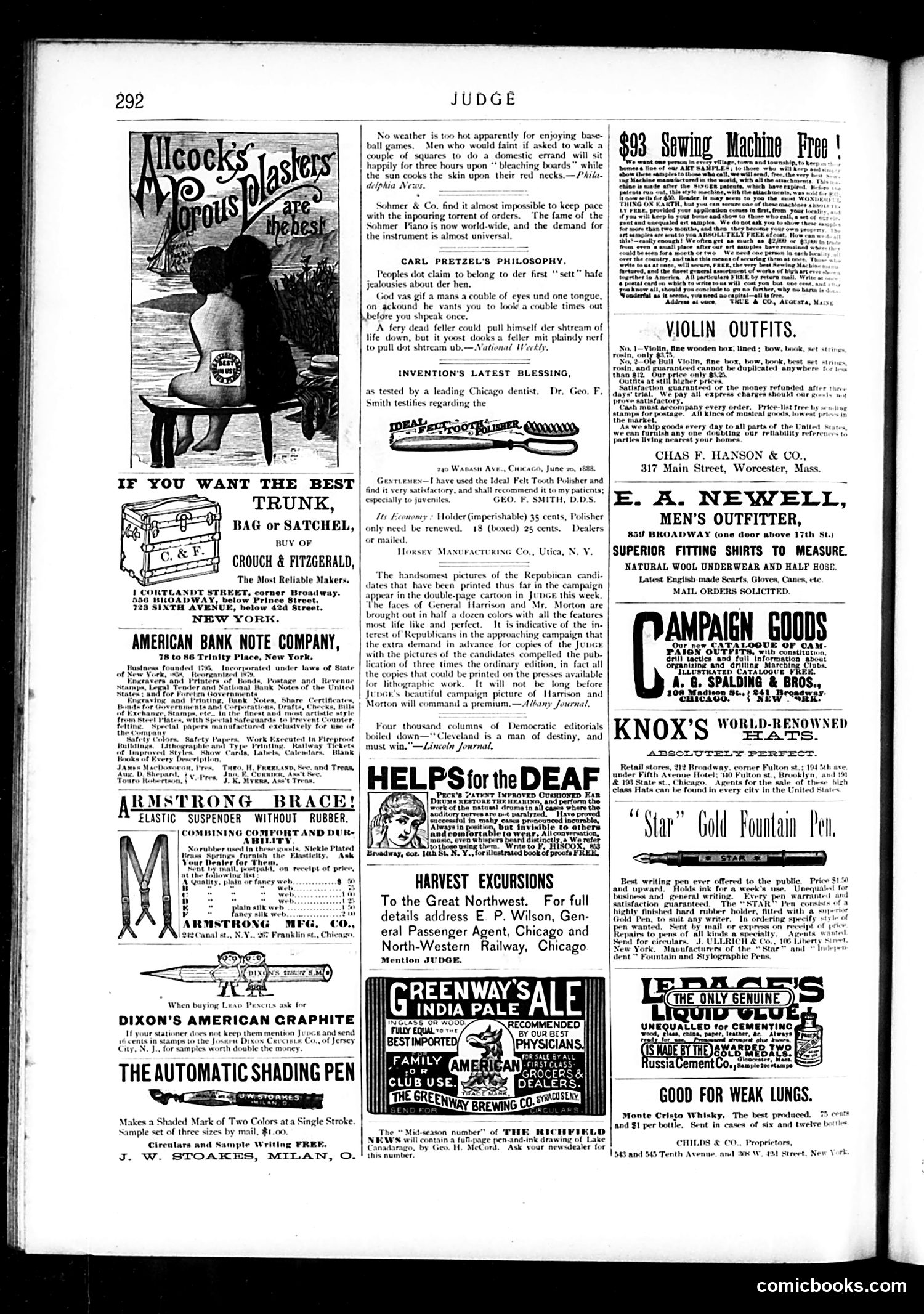
This page is primarily **advertising**, with two notable editorial pieces: **"Carl Pretzel's Philosophy"** is a dialect humor column featuring an immigrant character speaking in exaggerated German-accented English ("der first 'sett' hafe"). This was typical 1880s comic fodder—ethnic stereotyping presented as folksy wisdom about life and human nature. **The Republican Campaign Reference**: Text mentions a double-page cartoon in that week's *Judge* featuring Republican candidates Harrison and Morton, noting the "extra demand" forced three printings. This suggests the 1888 presidential election context, when *Judge* was actively promoting Republican candidates through imagery and editorial content. **Baseball commentary** mocks men who won't walk a few blocks but happily sit in the hot sun watching baseball—social observation rather than political satire. The rest consists of period product advertisements (sewing machines, trunks, pens, dental equipment) typical of magazine content that subsidized publication.
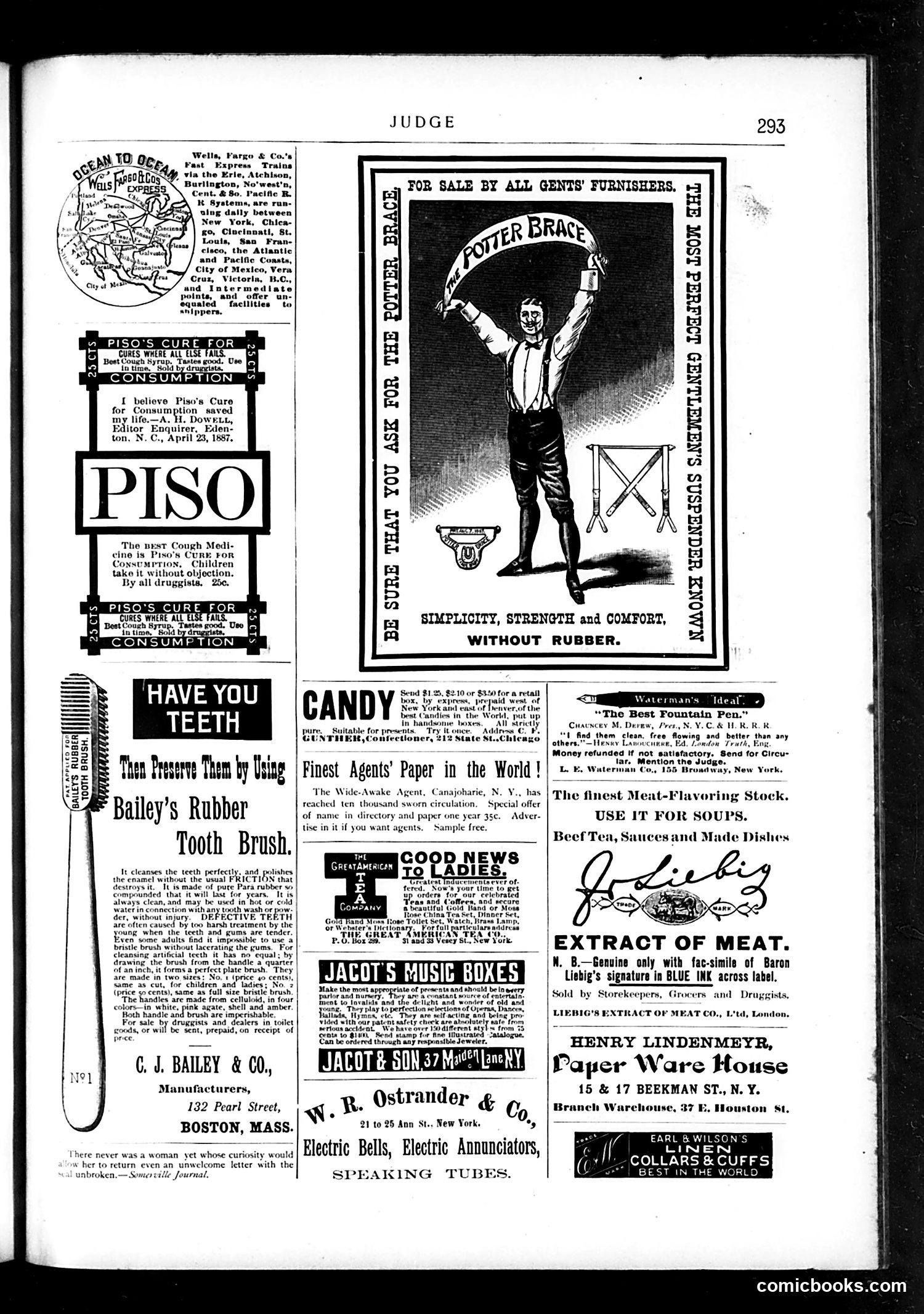
This page is predominantly **commercial advertisements** rather than satirical editorial content. The masthead indicates it's from *Judge*, the American satirical magazine, but page 293 consists almost entirely of period product ads. Notable advertisements include: - **Piso's Cure for Consumption** (tuberculosis medicine) - **Bailey's Rubber Tooth Brush** (dental hygiene) - **Potter Brace** corset (center image showing a man holding the product) - **Liebig's Extract of Meat** (meat flavoring for cooking) - Various other patent medicines and commercial goods The single non-advertising element is a quote at bottom-left mocking women's curiosity about mail. The page reflects late-19th-century magazine publishing: *Judge* depended heavily on advertising revenue, so editorial space was minimal. The ads themselves—particularly the medical products—represent the era's patent medicine industry, largely unregulated and making dubious health claims typical of the period.
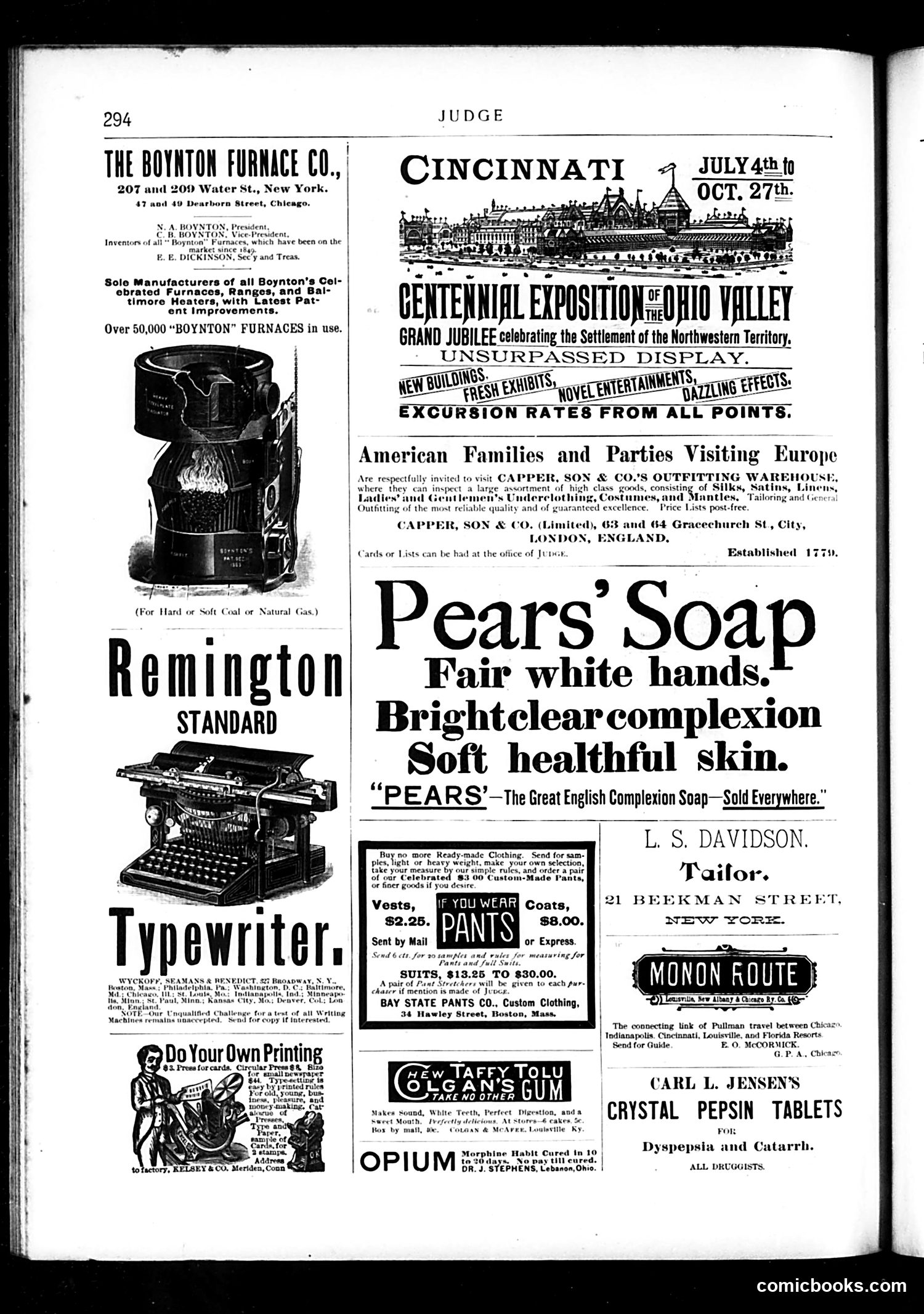
This page is **primarily advertisements** with minimal editorial content. The main feature is a large announcement for Cincinnati's Centennial Exposition (July 4–October 27), celebrating the settlement of the Northwestern Territory—a significant historical commemoration of westward expansion. The advertisements reflect late-19th-century consumer products and services: furnaces, typewriters, soap, custom clothing, printing services, and patent medicines (notably "Opium" for morphine addiction treatment, reflecting the era's unregulated pharmaceutical market). The Pears' Soap ad promotes racial hierarchies through skin-whitening claims—a common and revealing aspect of period advertising. The "Do Your Own Printing" section suggests DIY entrepreneurship. No political cartoons or satirical commentary are visible on this page. It functions as a commercial publication support page, typical of how *Judge* financed its satirical content through paid advertisements.
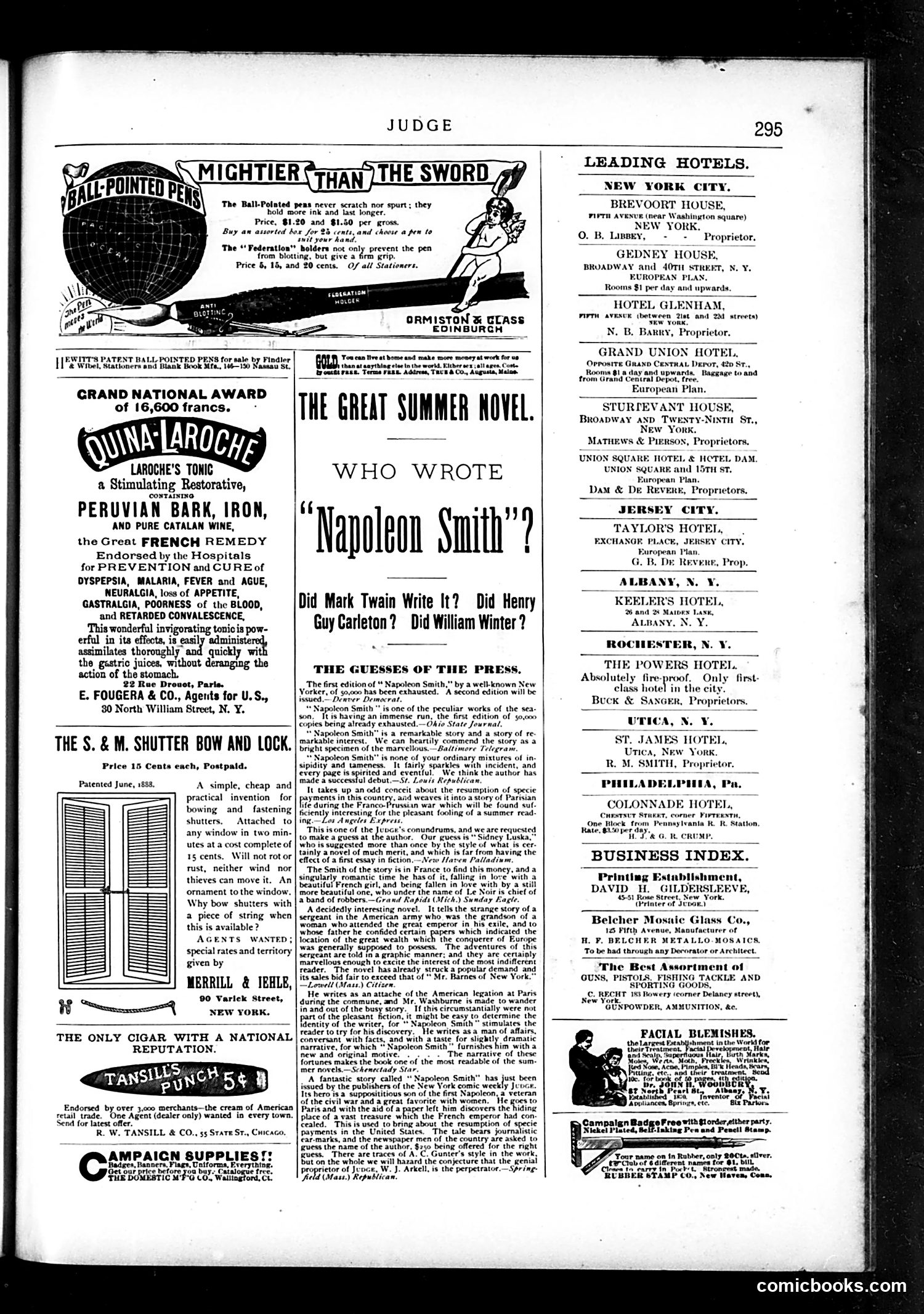
This page is primarily **advertising for a bestselling mystery novel** titled "Napoleon Smith," whose authorship the publisher deliberately keeps secret as a marketing gimmick. The central content features quotations from various newspapers (Denver Democrat, Ohio State Journal, Baltimore Telegram, etc.) praising the novel's success—claiming 50,000 copies of the first edition sold—and its "odd conceit" involving a plot about resumption of specie payments during the Franco-Prussian War, set in Paris. **The satire/hook:** The publisher invites readers to guess who wrote it, listing famous authors like Mark Twain, Henry Guy Carleton, and William Winter as possibilities. One critic suggests "Sidney Luska" based on writing style. This was a common **Victorian-era marketing strategy**: creating mystery and reader engagement through anonymity or pseudonymity. The page's surrounding advertisements (for pens, tonics, cigars, campaign supplies) are typical Judge magazine filler. The joke for contemporary Judge readers was likely the absurdity of the hype and the contrived "guessing game" around an otherwise unremarkable novel.
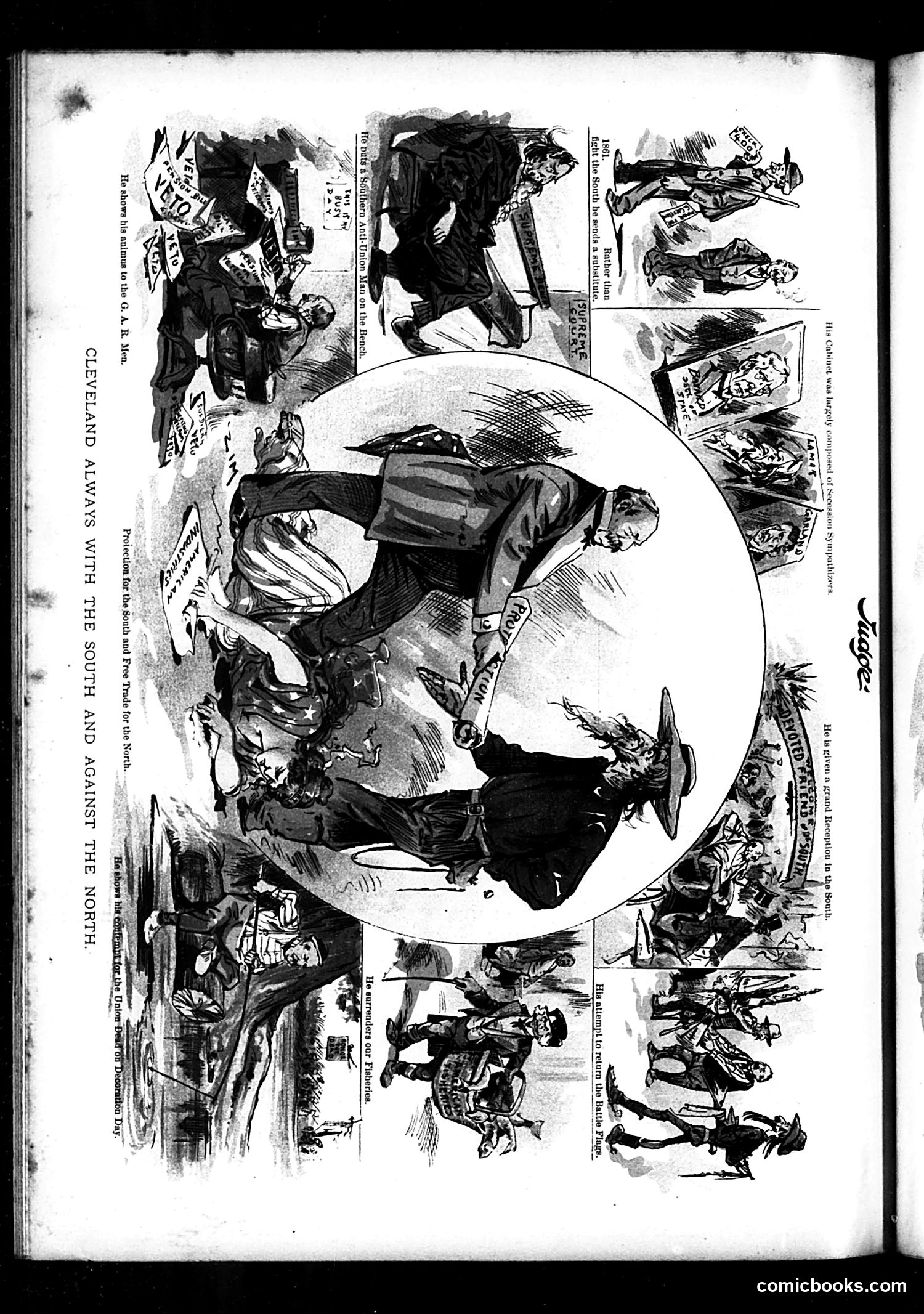
This appears to be a satirical cartoon criticizing a political figure's handling of diplomatic negotiations, likely from the late 19th century based on the style. The central image shows a man in formal dress appearing to surrender or capitulate. Surrounding vignettes reference specific controversies: "His attempt to return the Battle Flags" and "He surrenders our Fisheries" suggest criticism of concessions made in international disputes, possibly involving Canada or Britain regarding fishing rights and Civil War battle flags. The cartoon's point is clear: the central figure is being mocked for weakness in negotiations, portrayed as literally surrendering American interests. Without visible date or attribution, the specific political context remains unclear, but the satire condemns what the cartoonist viewed as unpatriotic capitulation to foreign powers.