
A complete issue · 16 pages · 1888
Judge — July 14, 1888
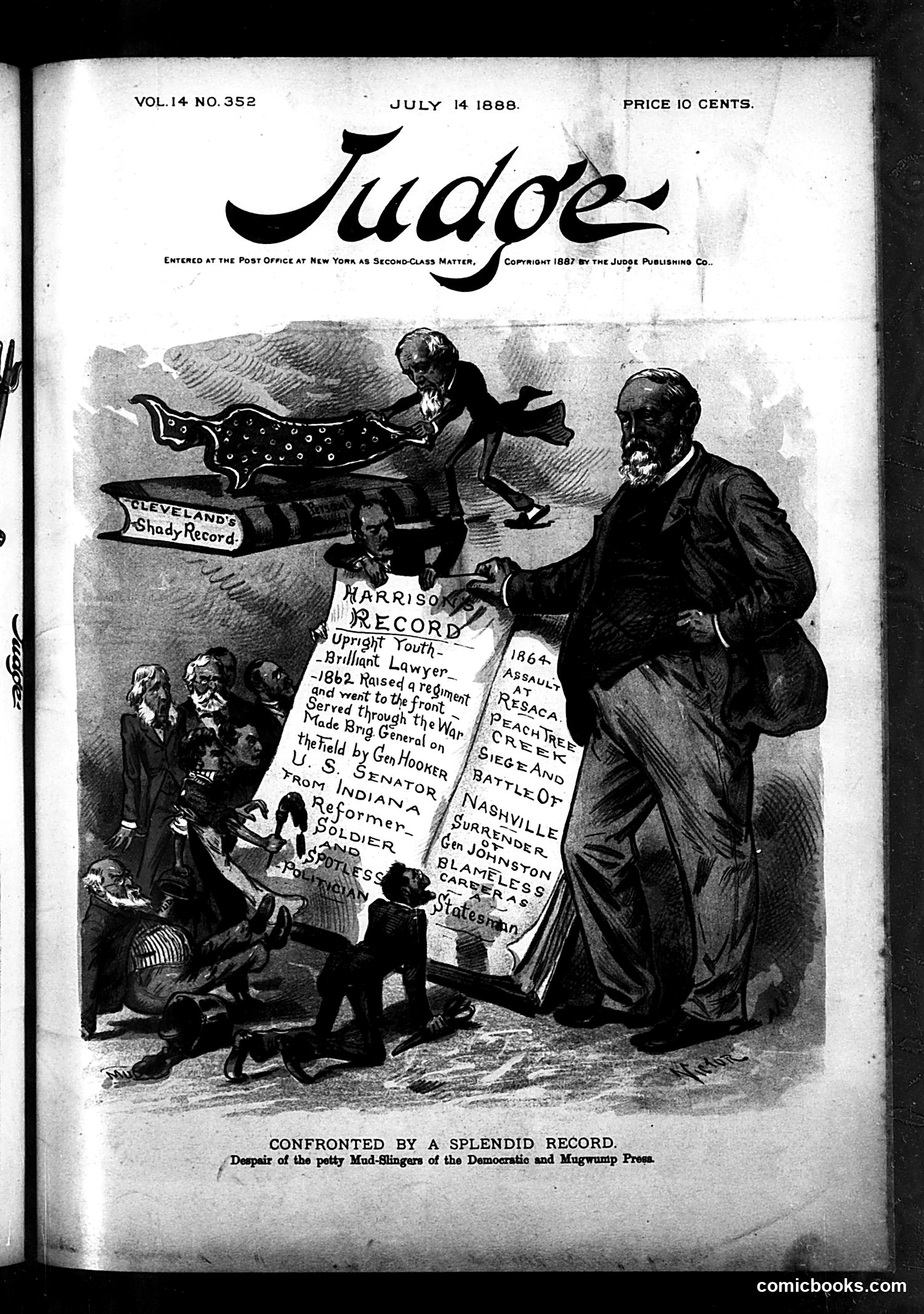
This political cartoon satirizes the 1888 presidential campaign, depicting Democratic and "Mugwump Press" figures confronted by Harrison's military record. The central monument displays Harrison's accomplishments: Civil War service, raising a regiment, commanding under General Hooker, and serving as U.S. Senator from Indiana. The cartoon mocks Democratic critics as "petty mud-slingers" unable to match Harrison's substantial resume. "Cleveland's Shady Record" appears at top-left, suggesting the incumbent president's vulnerabilities. The grotesque figures surrounding the monument represent hostile press elements attempting to undermine Harrison through personal attacks rather than substantive policy debate. The satire defends Republican Benjamin Harrison by contrasting his legitimate credentials against what Judge portrayed as Democratic mudslinging tactics.
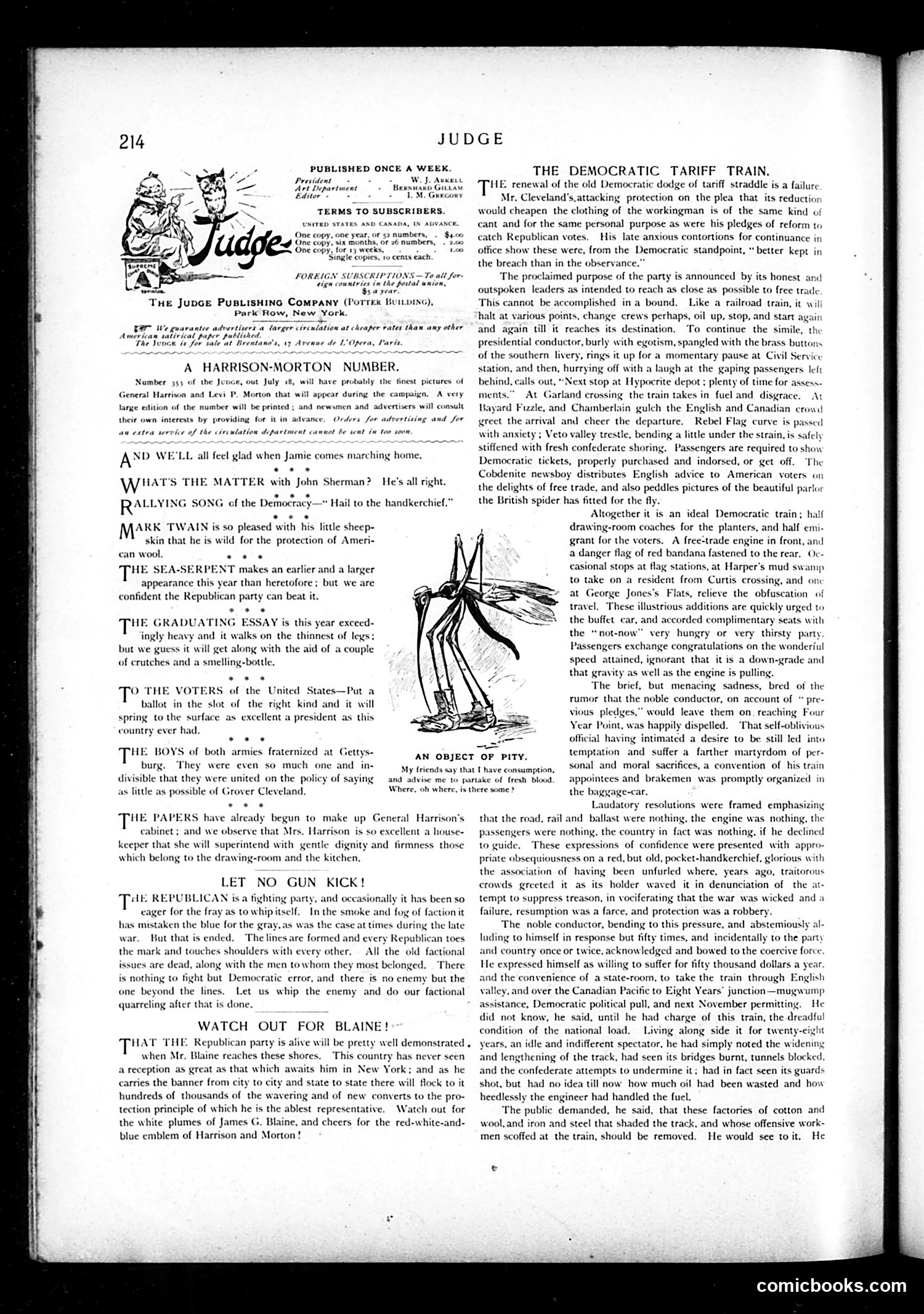
This satirical piece mocks Cleveland's Democratic tariff reduction policies. The text describes an idealized "Democratic tariff train" that would benefit workers and farmers through free trade, but the accompanying illustration—a skeletal, grotesque creature pulling the train—suggests the actual result is death and destruction rather than prosperity. The satire targets Cleveland's claim that tariff reduction would help common Americans. Instead, Judge argues the policy will devastate American industries, workers, and the economy. The skeleton imagery emphasizes the Republicans' view that Democratic free-trade policies amount to economic suicide for the nation. This reflects the bitter tariff debate of the 1880s-90s, when protectionist Republicans opposed Democratic efforts to lower trade barriers.
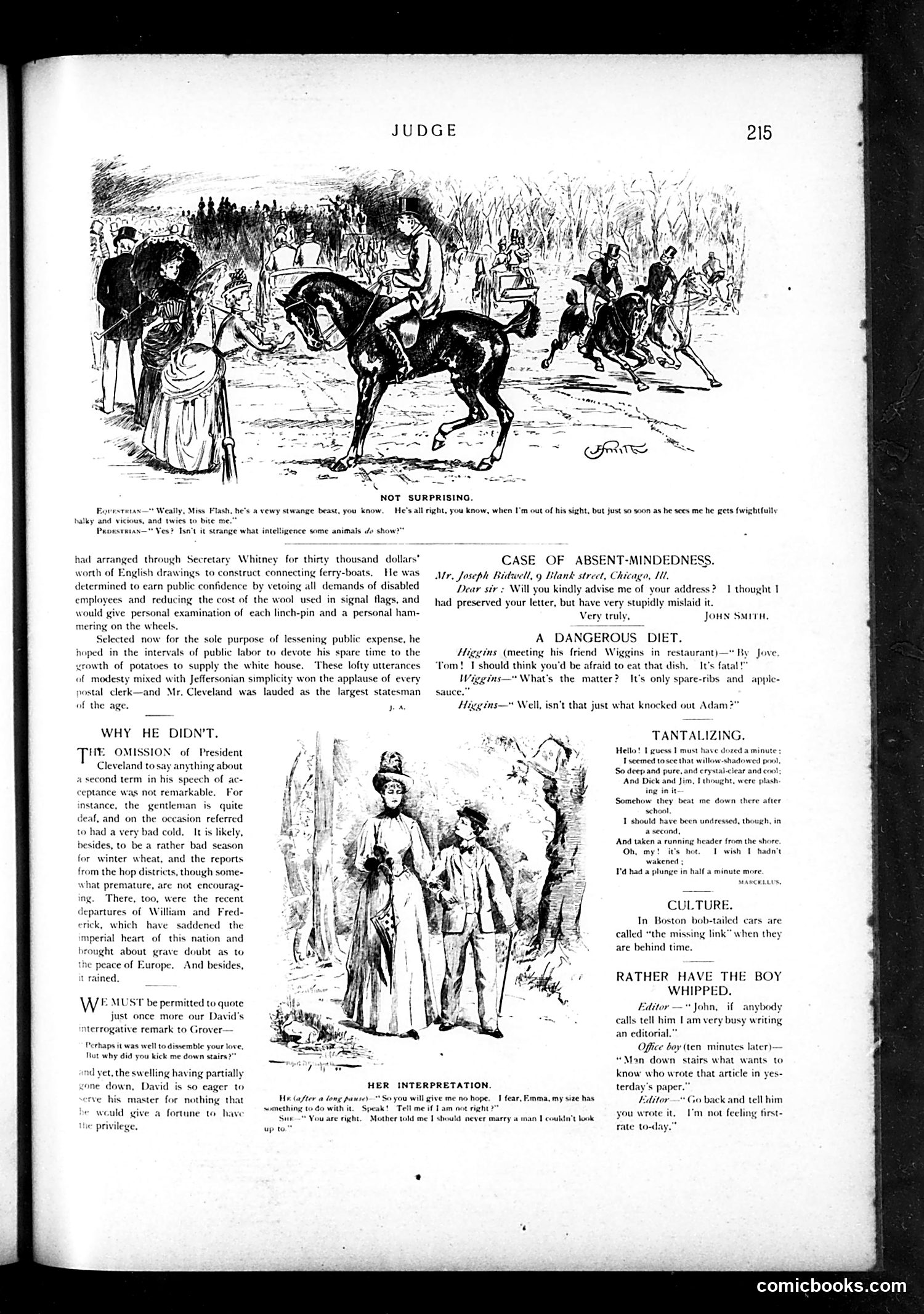
This page from *Judge* contains several unrelated satirical items typical of the magazine's format. The top cartoon, "Not Surprising," depicts a society woman discussing a vicious horse with a visitor—the joke being that she attributes the animal's intelligence to its bad behavior, a sardonic comment on human nature. The text pieces reference **President Cleveland**, appearing to critique his administrative decisions and public statements. One section mocks his silence about seeking a second term, sarcastically listing excuses (deafness, a cold, wheat concerns). Another discusses his cost-cutting measures regarding ferry-boat construction and signal flags—suggesting cynicism about his claimed frugality and Jeffersonian simplicity. The remaining items are brief humorous sketches: a letter-writing mix-up, a joke about spare ribs and Adam, a daydream about swimming, and editorial office humor. The illustration showing a woman and child likely accompanies one of these pieces, though the specific connection is unclear from the OCR text provided.
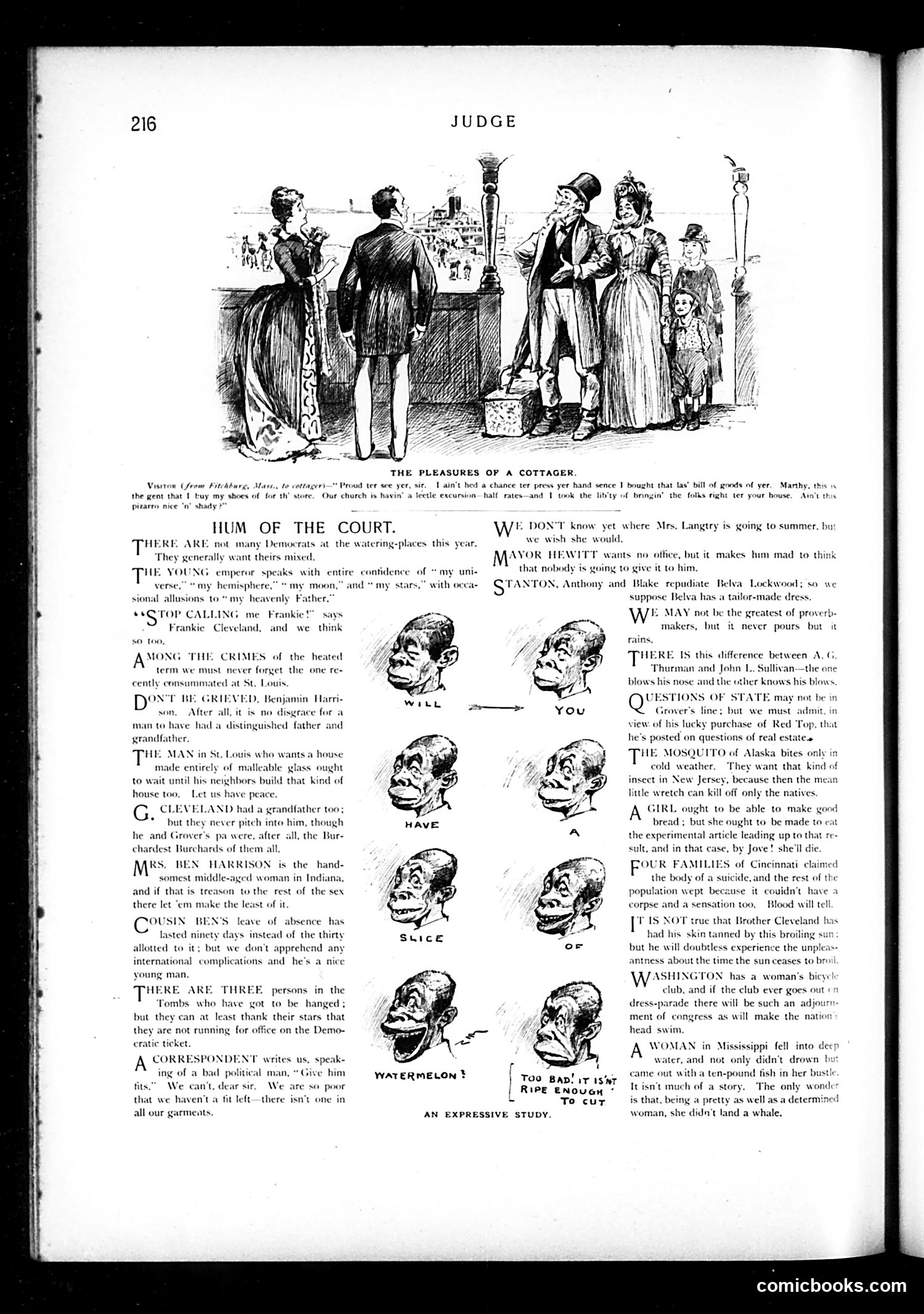
This page contains multiple brief satirical commentaries typical of Judge magazine's format. The top illustration shows a rural visitor from Massachusetts pestering a wealthy shoe merchant with unwanted familiarity and church excursion plans—mocking social climbing and commercial opportunism. The "Hum of the Court" section offers quick political jabs: references to actress Lillie Langtry (a contemporary celebrity), Democrat electoral struggles, Mayor Gould Hewitt's political ambitions, and figures like Anthony Stanton and Belva Lockwood (early women's suffrage advocates, apparently mocked for their dress choices). The crude caricature studies labeled "An Expressive Study" appear to exaggerate facial features, though their specific targets aren't identified in the text. Other items satirize President Benjamin Harrison's family legacy, Grover Cleveland's "tanning," and various social absurdities of the era (Alaskan mosquitoes, Cincinnati suicides). The humor relies heavily on era-specific references now requiring historical context to decode fully.
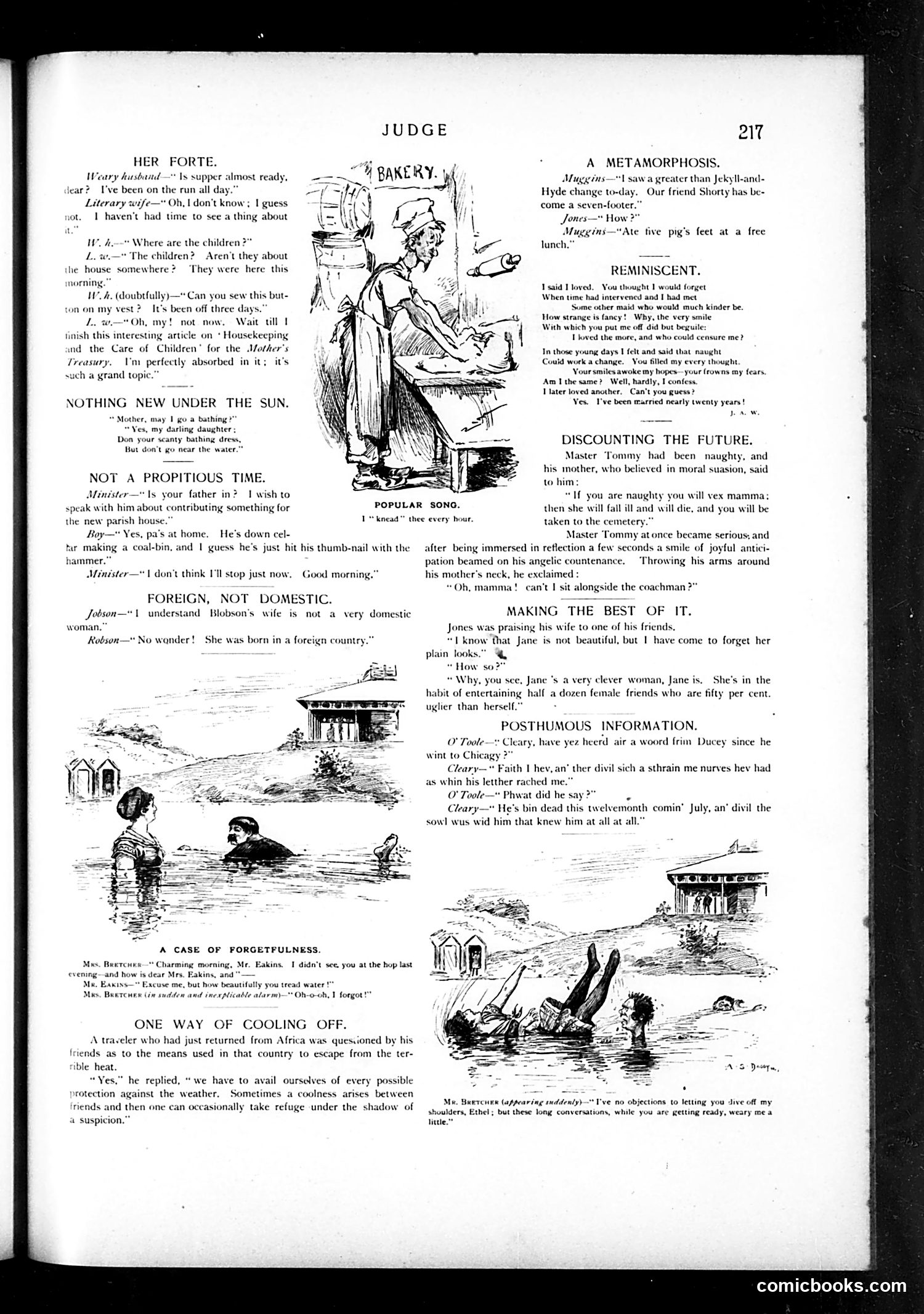
This page collects brief humorous sketches mocking Victorian social conventions. "Her Forte" ridicules wives absorbed in intellectual pursuits (reading about housekeeping) while neglecting domestic duties—a common satirical target. "Nothing New Under the Sun" uses absurdist humor: a mother allows her daughter to bathe but forbids approaching water. "Not a Propitious Time" plays on unfortunate timing when a minister seeks charitable donations. "Foreign, Not Domestic" suggests that foreign-born women make poor housekeepers—a xenophobic stereotype of the era. "A Case of Forgetfulness" depicts social embarrassment at a swimming party. "Discounting the Future" shows dark humor: a mother threatens her son with her death to discourage misbehavior; he cheerfully anticipates inheriting access to the family carriage. Other sketches mock marital dynamics, aging, memory, and class pretensions. The cartoons feature simple line drawings illustrating these brief comedic scenarios—typical of Judge's lighthearted social commentary targeting middle-class anxieties and domestic life.
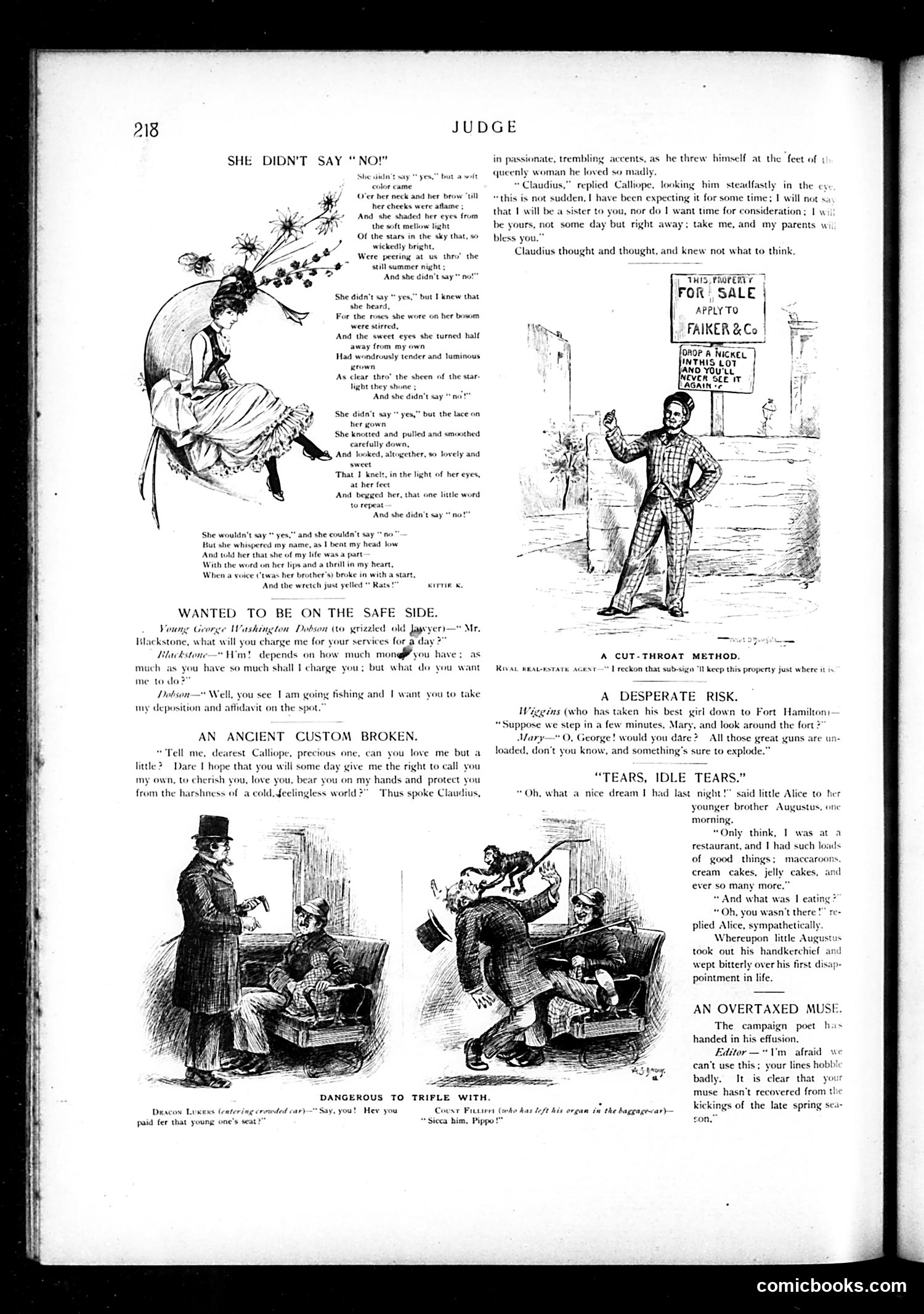
This page contains several satirical sketches typical of late-19th-century American humor: **"Wanted to Be on the Safe Side"**: A young man (George Washington Dobson) hires a lawyer for a fishing trip, wanting the lawyer to prepare legal documents in advance—a joke about excessive legal caution and paranoia. **"An Ancient Custom Broken"**: A romantic scene where a man (Claudius) proposes to Calliope, who immediately accepts without hesitation. The satire targets both romantic conventions and women's changing social roles—she rejects the traditional "playing hard to get" script. **"A Cut-Throat Method"** and **"Dangerous to Trifle With"**: Real estate and domestic comedy sketches. **"Tears, Idle Tears"**: Children's dialogue mocking sentimental Victorian storytelling—a child describes eating fancy desserts, making her brother cry from disappointment. **"An Overtaxed Muse"**: An editor rejects a campaign poet's work as poorly written, suggesting political verse quality suffers during election season. The overall tone reflects Judge's satirical approach to American social pretensions, legal absurdity, and sentimental culture.
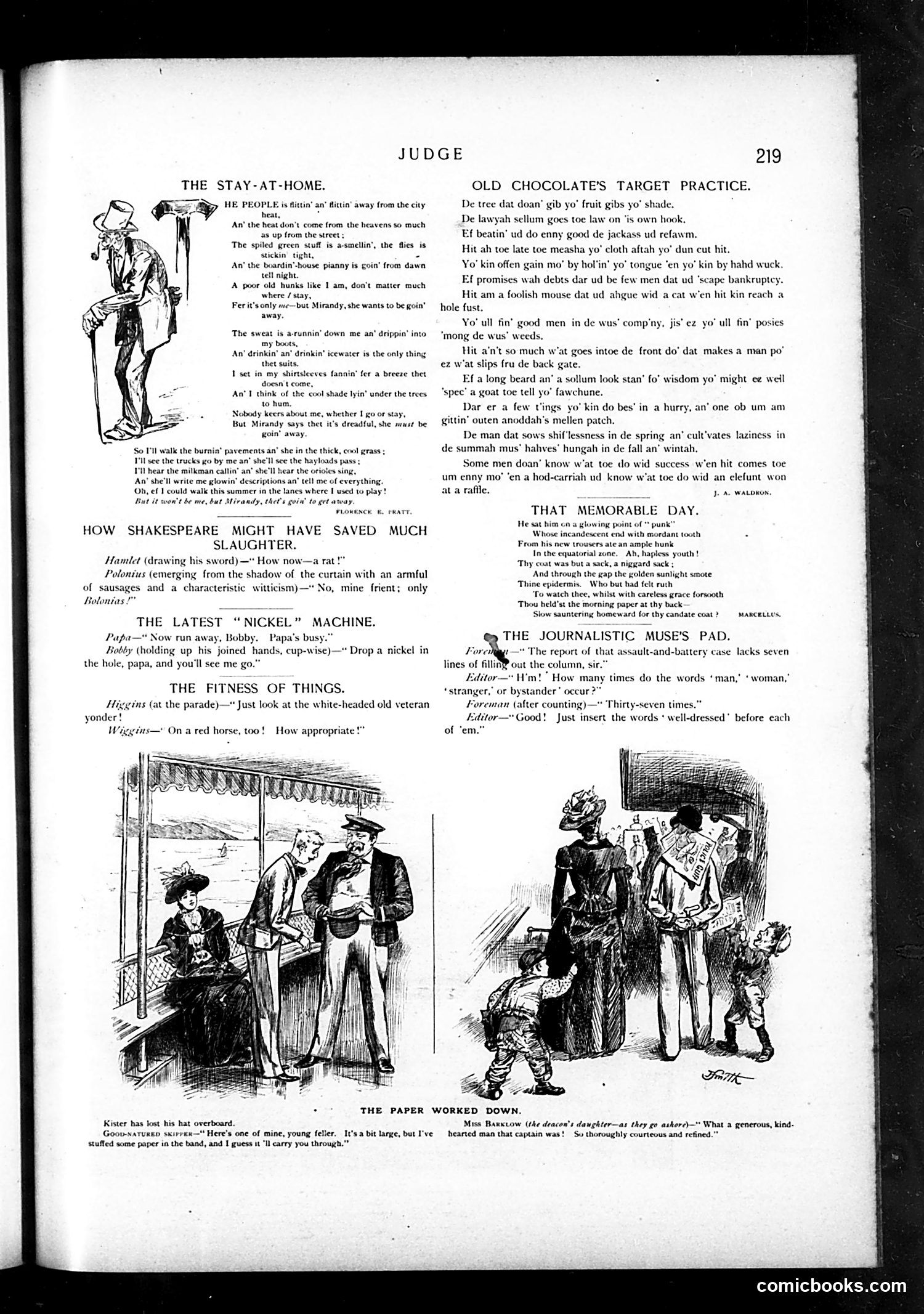
This page from *Judge* contains several humorous pieces targeting different subjects: **"The Stay-at-Home"** is a dialect poem about a working-class man who must remain in the sweltering city while his wife Mirandy escapes to the countryside—a common summer complaint among urban laborers without vacation privileges. **"Old Chocolate's Target Practice"** presents folk wisdom attributed to a Black character using heavy dialect. This represents period racism; such "plantation philosophy" pieces were common in 19th-century publications, presenting stereotyped Black speech as a source of homespun humor. **The other short pieces** ("How Shakespeare Might Have Saved Much Slaughter," "The Latest 'Nickel' Machine," "The Fitness of Things," "That Memorable Day," and "The Journalistic Muse's Pad") are brief satirical quips targeting Shakespeare adaptations, children's behavior, old soldiers, sunburned office workers, and newspaper editing—typical light satirical fare of the era. The cartoons illustrate these pieces with period sketches showing domestic and social scenes.
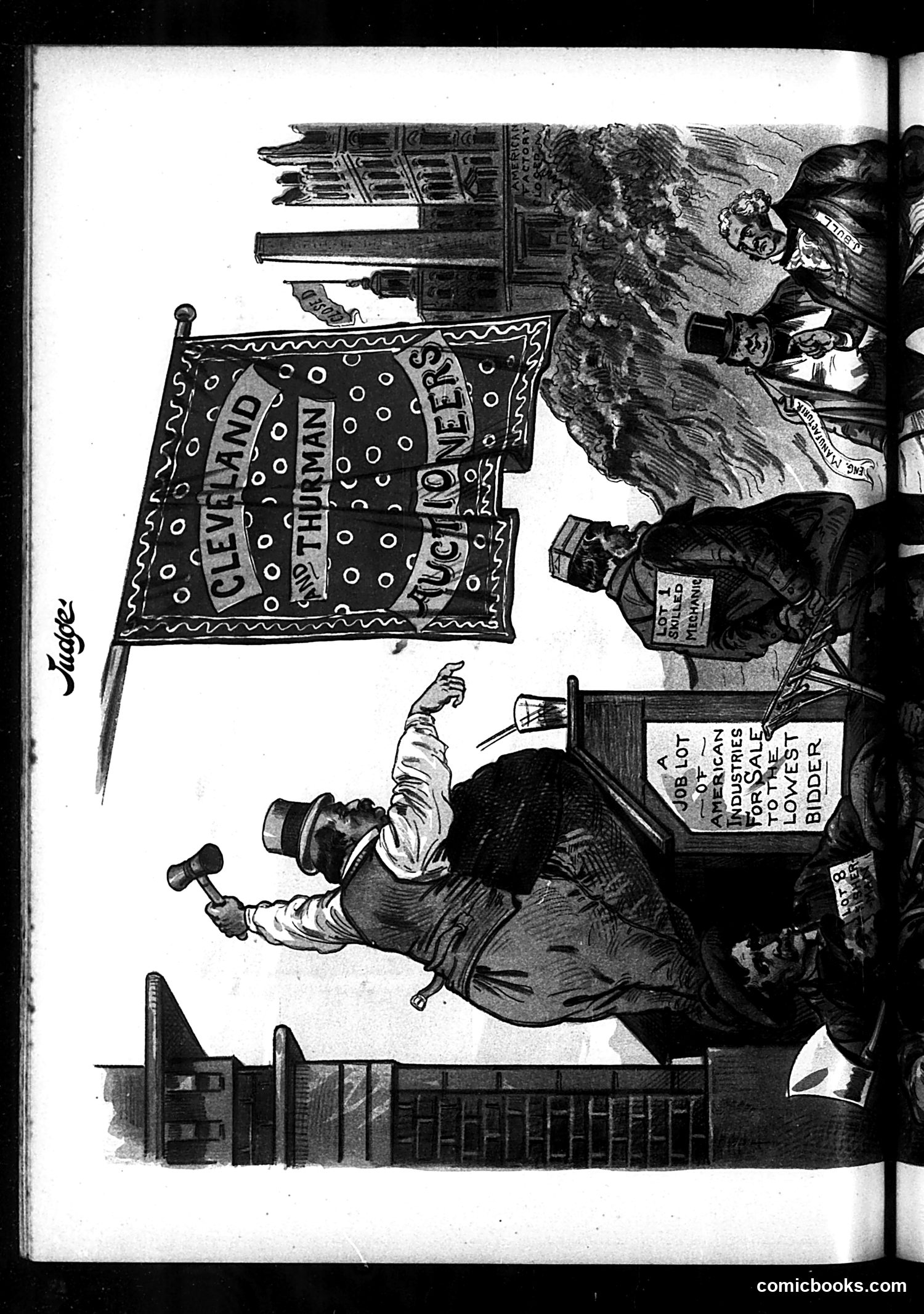
This appears to be a Judge magazine political cartoon, though the OCR text is largely illegible. The image shows a caricatured figure in formal dress holding a gavel, standing before a banner reading "CLEVELAND" and "SHERMAN" (likely referring to Grover Cleveland and running mate Adlai Stevenson's 1892 campaign). The figure appears to be an auctioneer or official conducting some kind of transaction or bidding process, with labels visible including "A PUBLIC LOT" and "AMERICAN TARIFF DUTIES." The cartoon likely satirizes either the Cleveland administration's tariff policies or the 1892 election campaign, using auction imagery to criticize how political positions or policies were being "sold" to the American public. Without clearer text, the specific satirical target remains somewhat unclear.
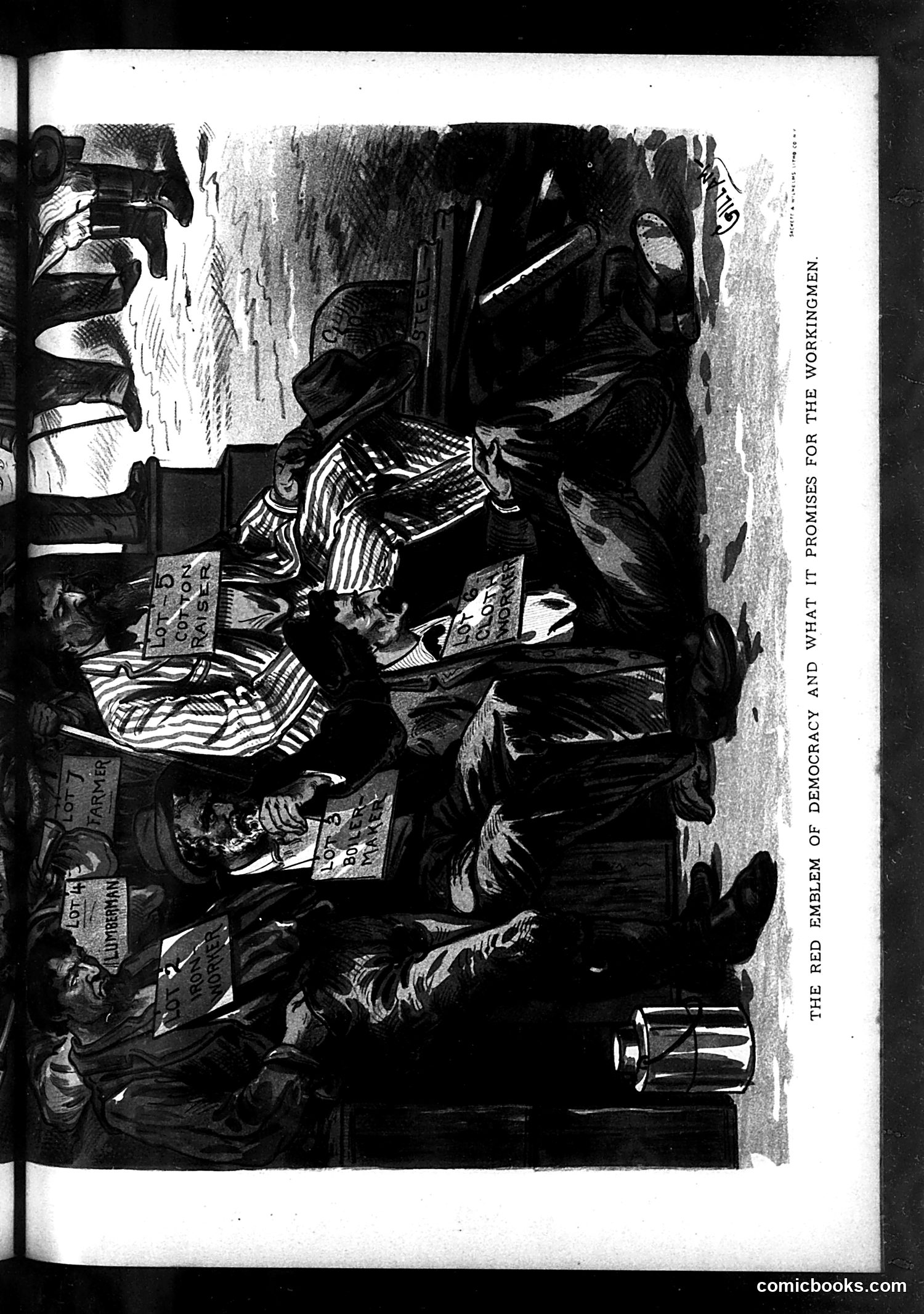
This political cartoon depicts workers or laborers gathered around documents labeled with what appears to be socialist or communist rhetoric (the "red pamphlet" reference). The figures are shown in dark, shadowy rendering, examining or discussing these materials with apparent skepticism or concern. The satire appears to critique socialist or communist organizing among working-class Americans—suggesting that radical political promises made to workers in propaganda materials were misleading or empty. Judge magazine, a Republican-leaning publication, frequently mocked labor radicalism and left-wing politics during the early-to-mid 20th century. The dark artistic treatment emphasizes the danger or seediness the cartoonist associates with such political movements and their appeal to working people.
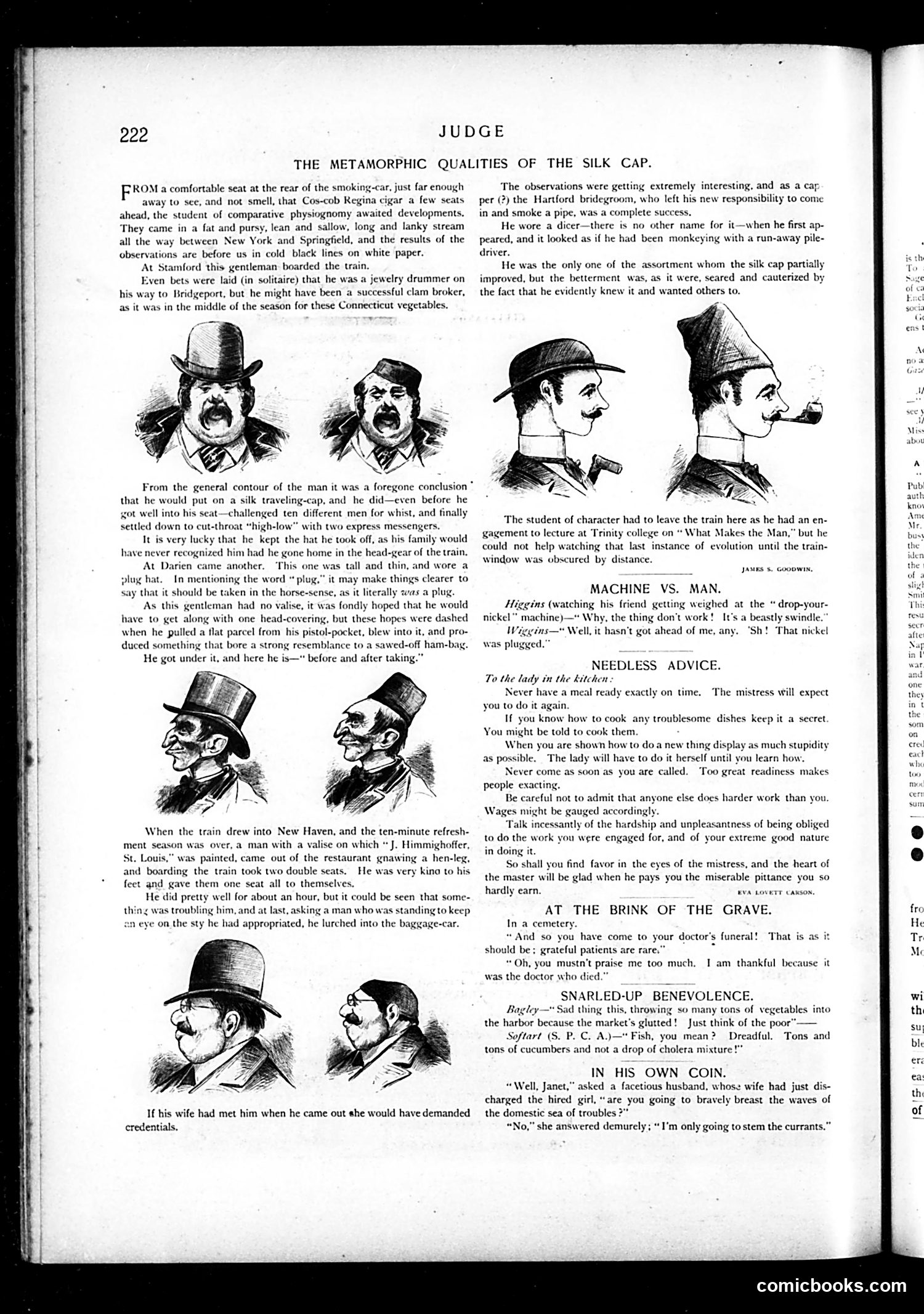
This satirical article uses observational humor to mock the pretensions of traveling salesmen on a train journey from New York to Springfield. The "silk cap" serves as the article's central metaphor—a humble traveling hat that transforms ordinary men's appearances and behavior, revealing their vanity and self-importance. The cartoonist sketches four passengers whose personalities supposedly change when donning this cap: a jewelry drummer becomes unrecognizable, a man exchanges his dignified plug hat for a makeshift fabric cap, a St. Louis merchant named Himmighoffer becomes comically bloated and self-absorbed, and a Hartford bridegroom appears slightly ridiculous and aware of it. The satire targets the era's traveling salesmen—common subjects of ridicule in Gilded Age humor—depicting them as vain, pretentious, and fundamentally transformed by superficial accessories. The page's bottom sections offer unrelated satirical pieces on machines versus workers and domestic servant advice, typical of Judge's format mixing social commentary with lighthearted mockery of class differences and gender dynamics.
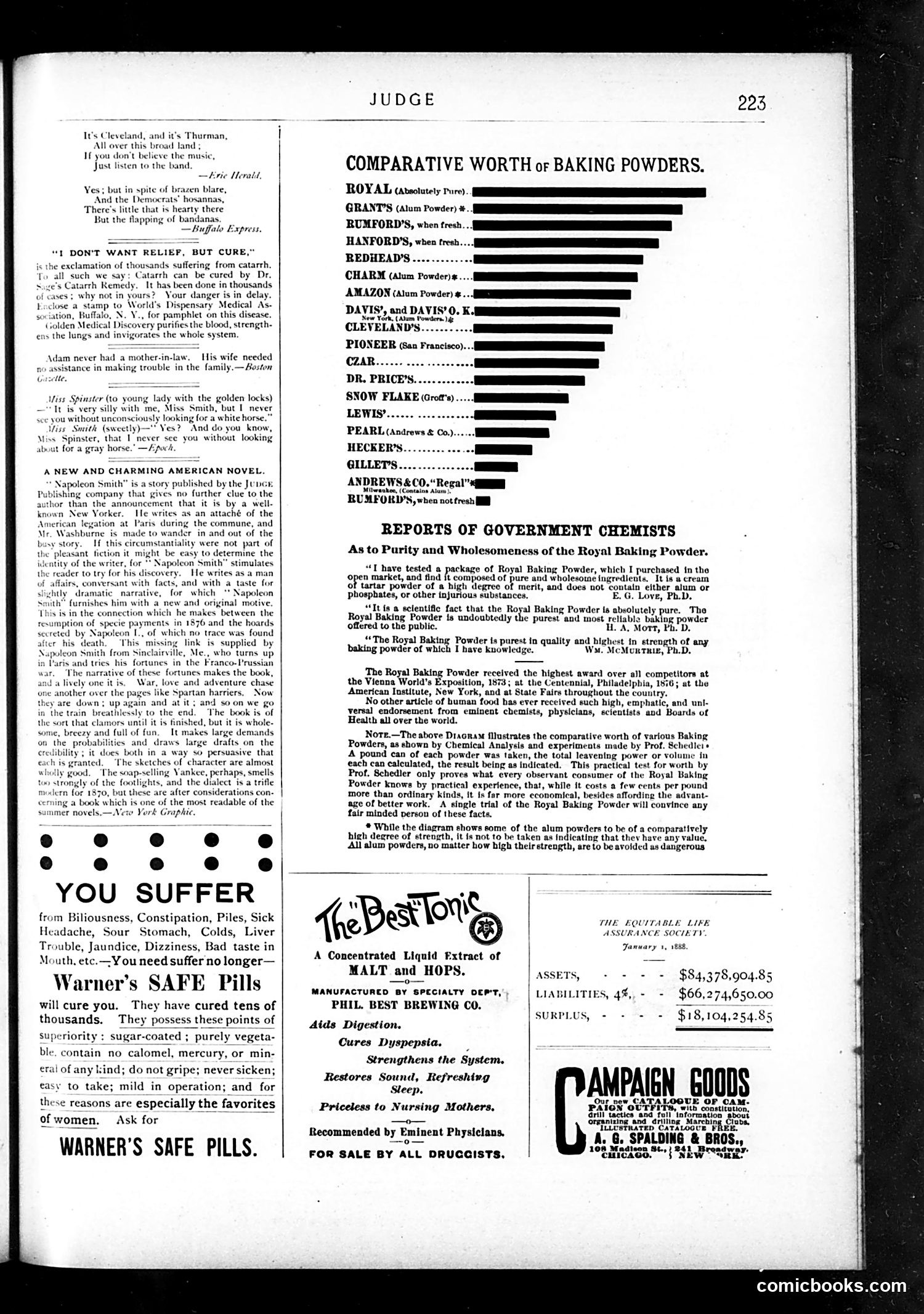
This page is primarily **advertising and product reviews** rather than political satire. The main content features: **"Comparative Worth of Baking Powders"** — a bar chart comparing the relative strength of various baking powder brands. Royal Baking Powder appears longest, suggesting superiority. The chart includes a critical note warning against aluminum-based powders (Grant's, Amazon, Charm) as "dangerous," reflecting contemporary health concerns about alum additives. **Government chemists' reports** endorsing Royal Baking Powder's purity appear below the chart, lending scientific authority to the product claims. The page also includes advertisements for Warner's Safe Pills, Dr. Sage's Catarrh Remedy, and Best Tonic malt extract. Brief literary content discusses a novel called "Napoleon Smith" and includes humorous verse about Cleveland and Thurman (likely referencing the 1884 presidential campaign), but these are minor elements. This is essentially a **product-focused advertising page** with minimal satirical content.
This is primarily an **advertising page** from Judge magazine, with minimal political cartoon content. The page is dominated by period product ads—Allcock's Porous Plasters (medicated patches), Knox's hats, Jacot's music boxes, dental equipment, and other consumer goods. The only identifiable satirical element is "**Don't be a Clam**"—a small headline with unclear context. Without additional visual material, it's difficult to determine what social criticism this references. It may allude to someone being silent or uncommunicative, possibly a contemporary political figure or social type, but the text provided doesn't clarify the target. The page reflects the **Victorian-era advertising aesthetic** more than political satire. Most content celebrates commercial products with pseudo-scientific endorsements, particularly medical devices popular in the 1880s–90s.
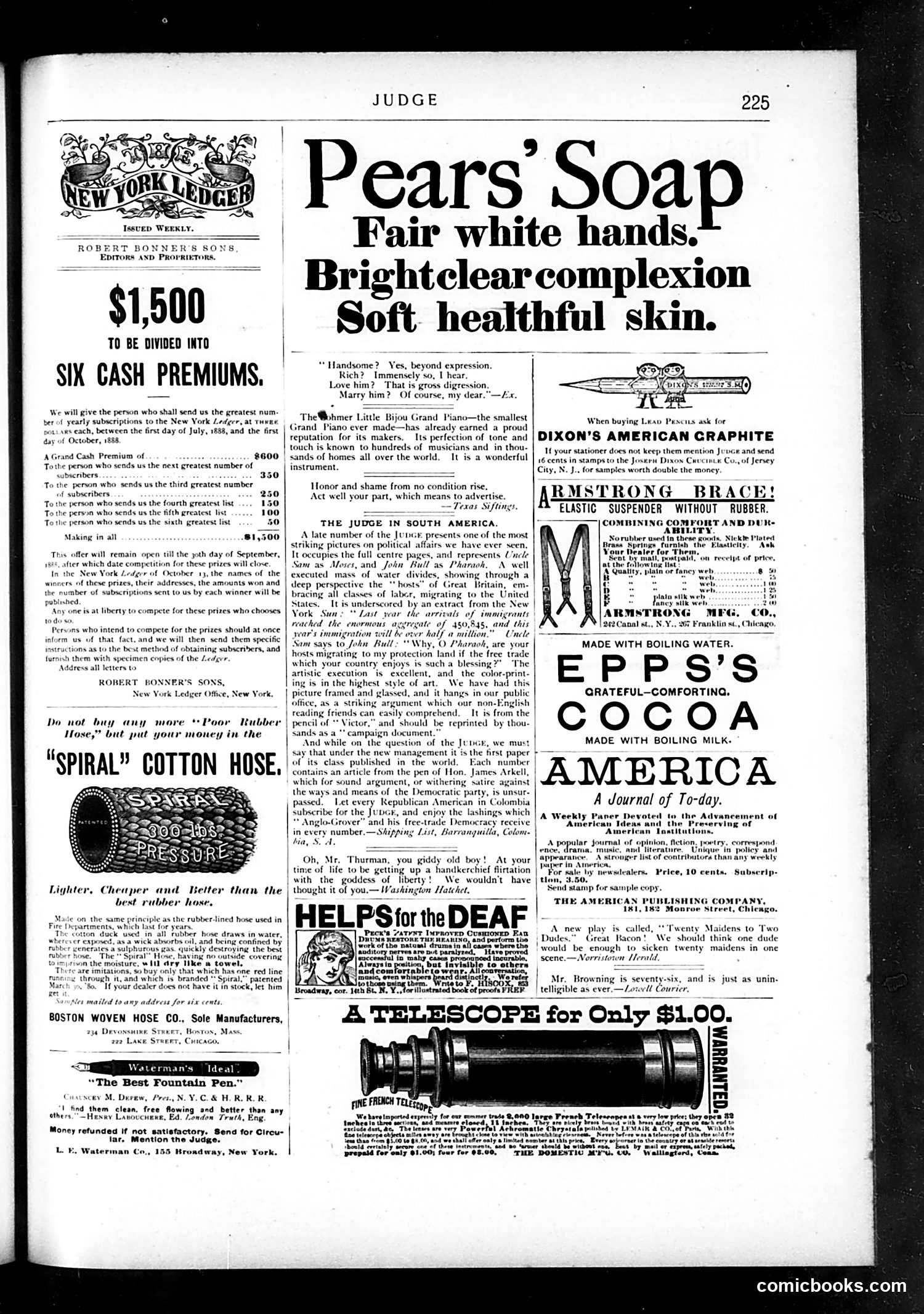
This page is primarily **advertising**, with limited editorial content. The main elements are: **The Central Cartoon/Editorial Reference:** "The Judge in South America" discusses a full-page political cartoon from Judge depicting Uncle Sam as Moses and John Bull (Britain) as Pharaoh, with British immigrants crossing water to America. It references 450,000+ immigrants arriving annually, satirizing British emigration to the U.S. during the late 1880s. **Advertisements:** The page is dominated by period product ads: Pears' Soap (emphasizing "fair white hands" and "bright clear complexion"—reflecting Victorian beauty standards), Spiral Cotton Hose, Ellis Cocoa, Armstrong Braces, a telescope, and various other goods. **Context for Modern Readers:** The cartoon satirizes late-19th-century immigration anxiety by inverting the typical narrative—instead of celebrating American immigration, Judge suggests Britain is losing its population to America, positioning the U.S. as the promised land attracting British workers.
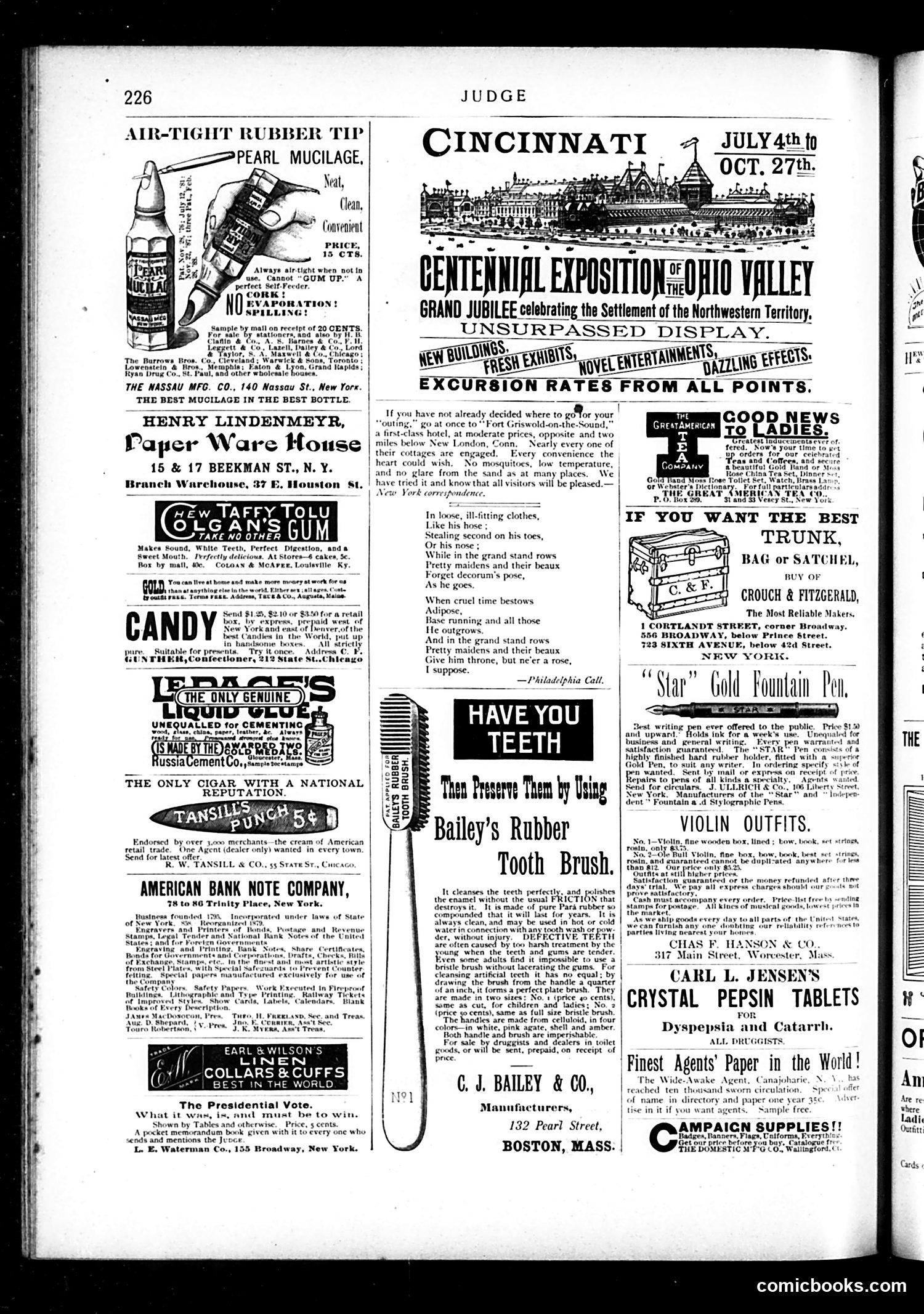
This page is primarily **advertisements with minimal editorial content**. The dominant feature is a large Cincinnati Centennial Exposition advertisement (center-right) promoting a fair celebrating settlement of the Northwestern Territory, July 4–October 27. The only identifiable satirical content appears to be a **baseball poem** (center), likely from the *Philadelphia Call*, mocking a player's athletic decline. It describes a young base-stealer admired by women in grandstands, contrasting with his aging self—now overweight ("adipose")—who receives "throne" but "ne'er a rose" from admirers. The satire targets the fleeting nature of athletic fame and masculine attractiveness. The remainder consists of period commercial advertisements for mucilage, candy, cigars, tooth brushes, collars, bank notes, and other products typical of late 19th-century American magazines. No major political figures or events are referenced on this particular page.
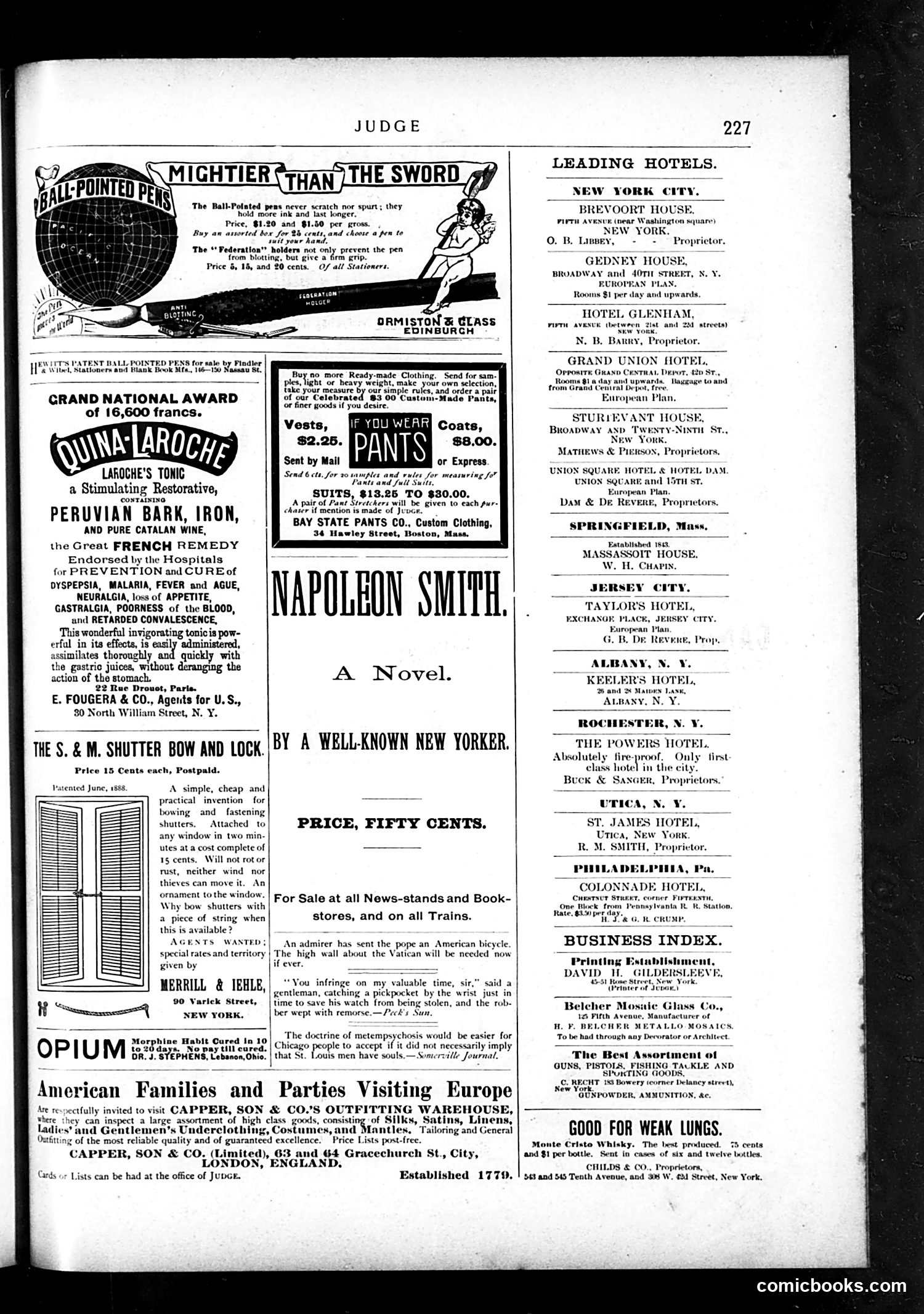
This page is primarily **advertising and filler content** rather than political satire. The main feature is an announcement for a novel titled "Napoleon Smith" by an unnamed "well-known New Yorker," priced at fifty cents. The only cartoon of note is a brief joke about **Pope Leo XIII receiving an American bicycle**—the caption suggests the Vatican's "high wall" will now be necessary "if ever" he tries to ride it, implying ridicule of either the Pope's age or the absurdity of papal bicycle-riding. Otherwise, the page consists of hotel listings and product advertisements (pens, clothing, patent locks, tonics, etc.) typical of late 19th-century American magazines. There is **no clear political content or substantial satire** visible in the image or text provided.
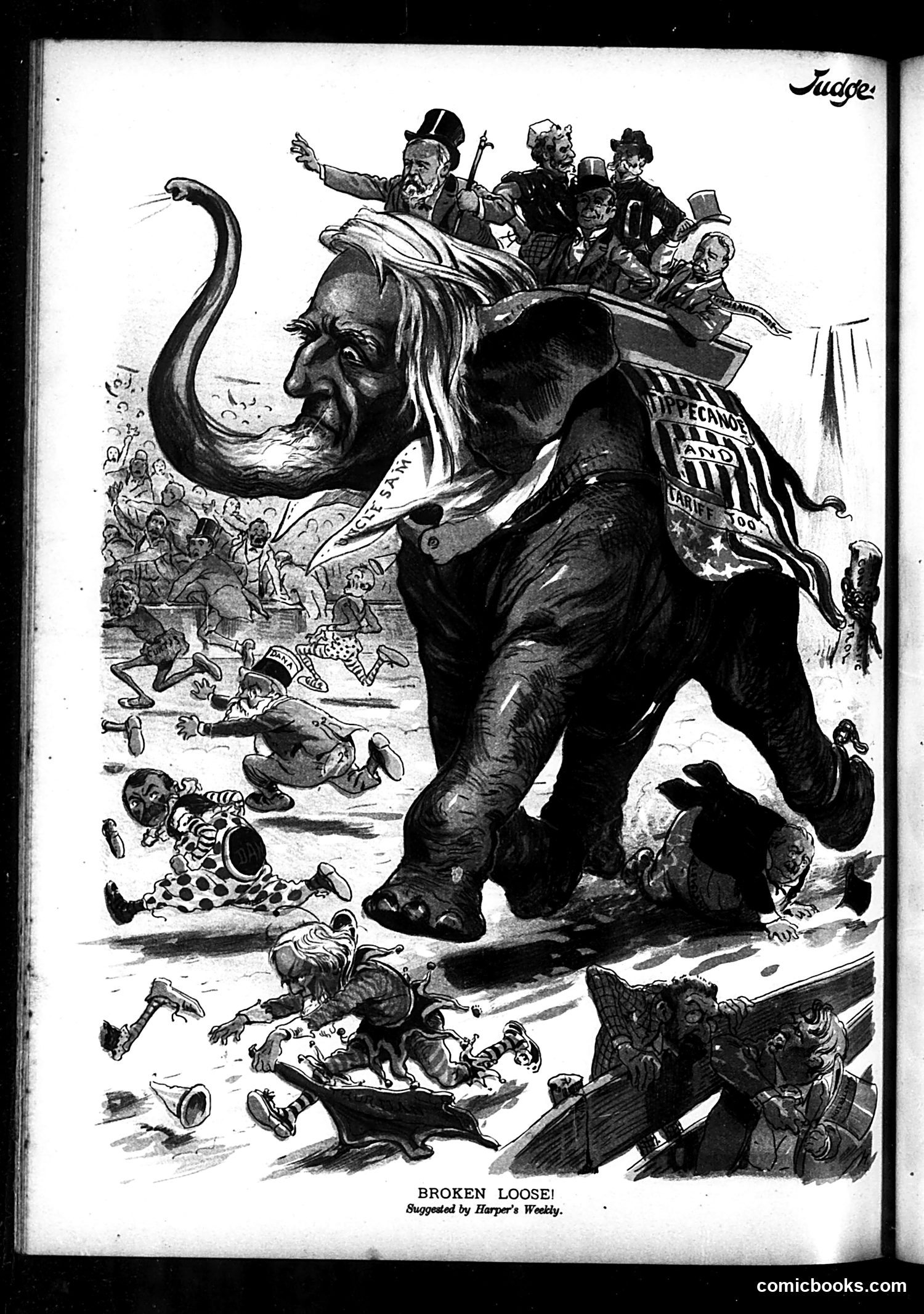
This political cartoon depicts a large elephant—the Republican Party symbol—rampaging destructively, trampling small human figures beneath its feet. Riders atop the elephant (appearing to be Republican politicians or leaders) gesture wildly, seemingly unable to control the beast. The caption "Broken Loose!" suggests the Republican Party has spiraled beyond its leadership's control. The cartoon critiques Republican mismanagement or internal chaos, portraying the party as a dangerous, uncontrollable force causing collateral damage to ordinary citizens below. The attribution to "Harper's Weekly" indicates Judge is referencing or responding to another publication's political commentary. Without the specific date, the exact historical context remains unclear, though this reflects late-19th or early-20th-century partisan political satire common to the era.