
A complete issue · 16 pages · 1888
Judge — July 7, 1888
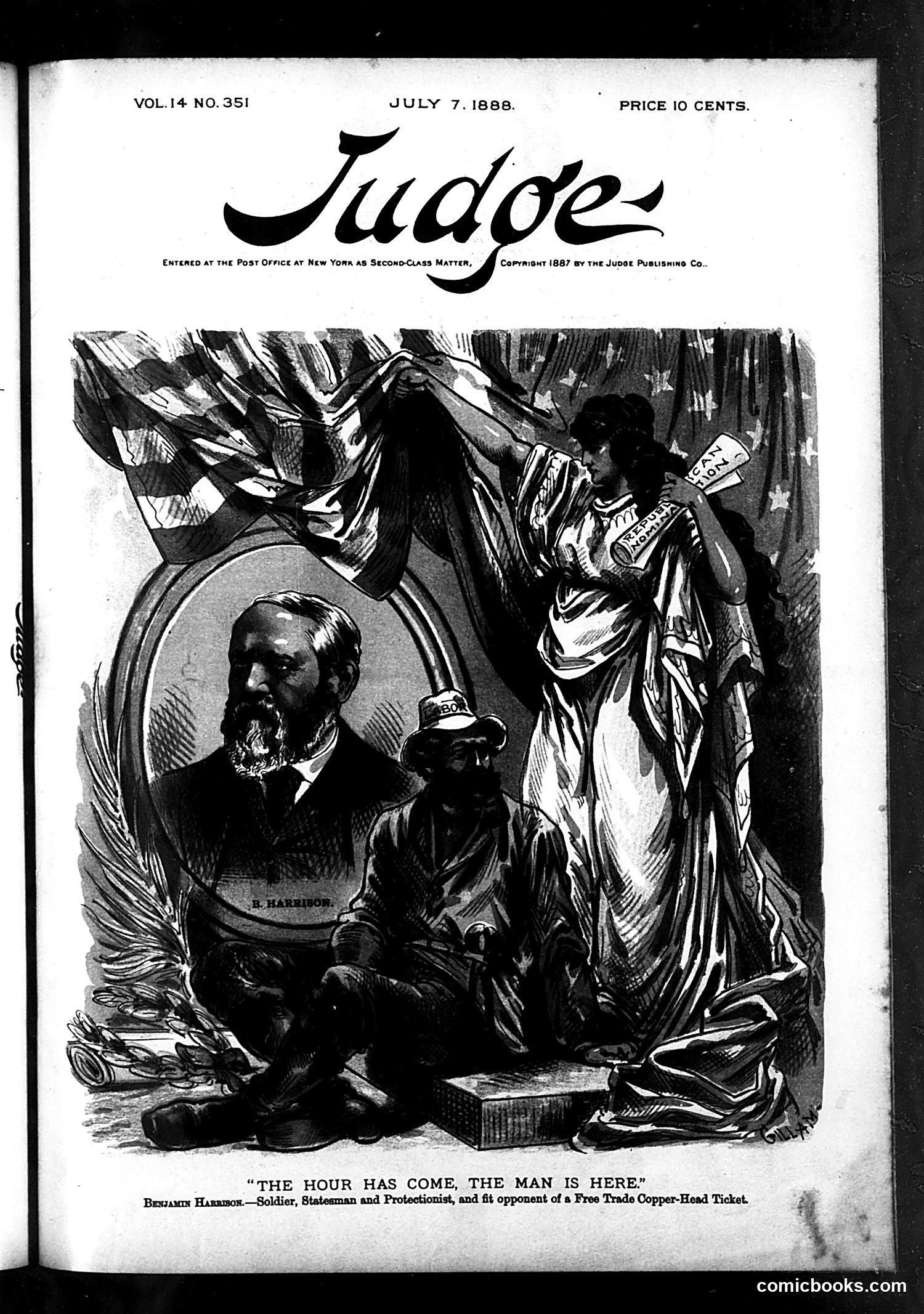
This cartoon depicts **Benjamin Harrison** (identified in the caption and portrait medallion), shown as a soldier/statesman figure. The allegorical female figures surrounding him—appearing to represent concepts like Protection and Protectionism—present him as "the man" whose hour has come, suggesting his emergence as a political force. The caption references Harrison as a "Soldier, Statesman and Protectionist, and an opponent of a Free Trade Copper-Head Ticket," indicating this was created during the 1888 presidential campaign. The imagery celebrates Harrison's candidacy, particularly emphasizing his protectionist economic position versus free-trade advocates ("Copper-Heads," a Civil War-era derogatory term). The satirical tone appears supportive of Harrison's protectionist stance.
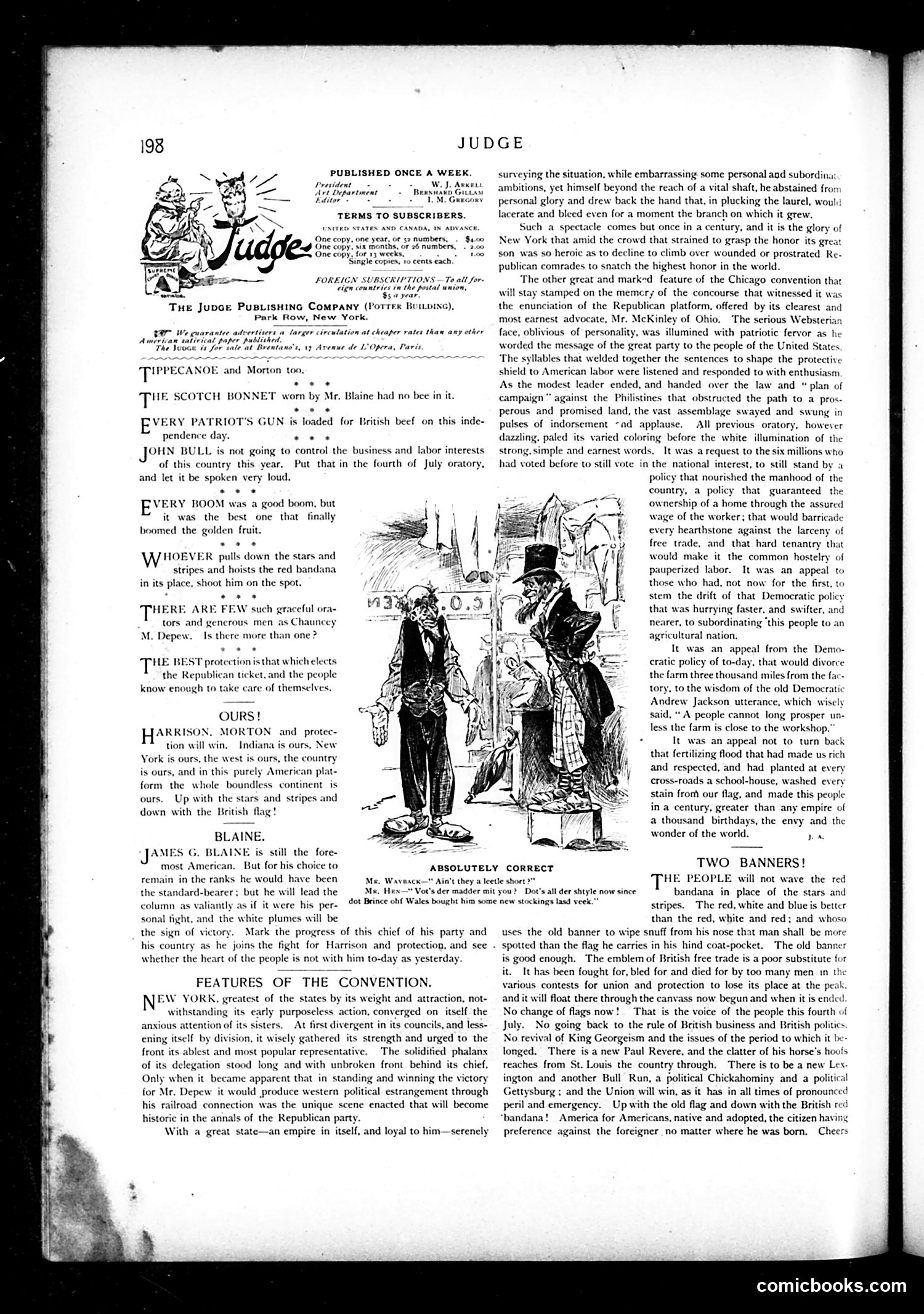
This page contains political editorial content from Judge magazine regarding the 1904 Republican National Convention. The text discusses praise for the GOP platform and candidates, specifically referencing **Harrison, Morton, and James G. Blaine** as Republican leaders. The central cartoon depicts two figures in formal dress, apparently debating or discussing politics. One figure appears to be wearing a top hat, typical of late-19th-century political caricature style. The editorial celebrates Republican achievements while criticizing Democratic agricultural policy. It advocates for protective tariffs and labor interests, opposing what it views as the Democratic drift toward agrarian concerns. The page represents Judge's staunch **Republican editorial stance** during this era, using both written argument and visual satire to promote GOP positions against Democratic rivals.
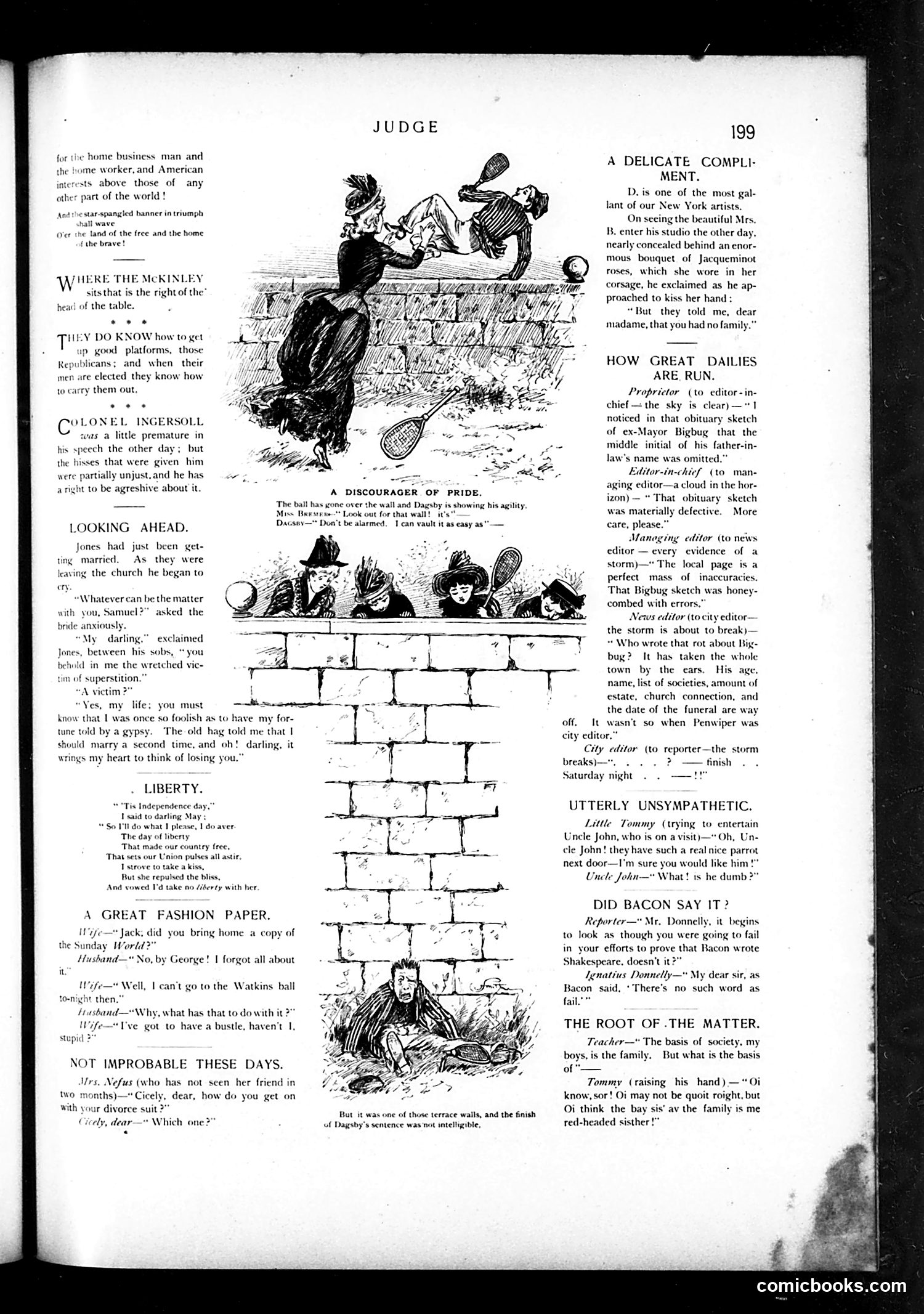
This page contains several satirical vignettes mocking American social and professional life around the turn of the 20th century. **"A Discourager of Pride"** shows a man attempting to vault a wall while his companion watches—the joke being his boastful prediction is cut short by the wall's interference, deflating his pride. **"How Great Dailies Are Run"** satirizes newspaper hierarchies through a chain-reaction scene where a minor obituary error (a missing initial) gets amplified as it passes down from proprietor through editors to reporters, illustrating how trivial corrections become exaggerated through organizational layers. Other brief humor pieces mock superstition (a groom blaming a gypsy's curse), marital dynamics, fashion obsession, and social awkwardness. The drawings emphasize physical comedy and exaggerated expressions typical of Judge's style. The overall theme critiques American vanity, organizational inefficiency, and social pretension through quick, accessible jokes rather than partisan political satire.
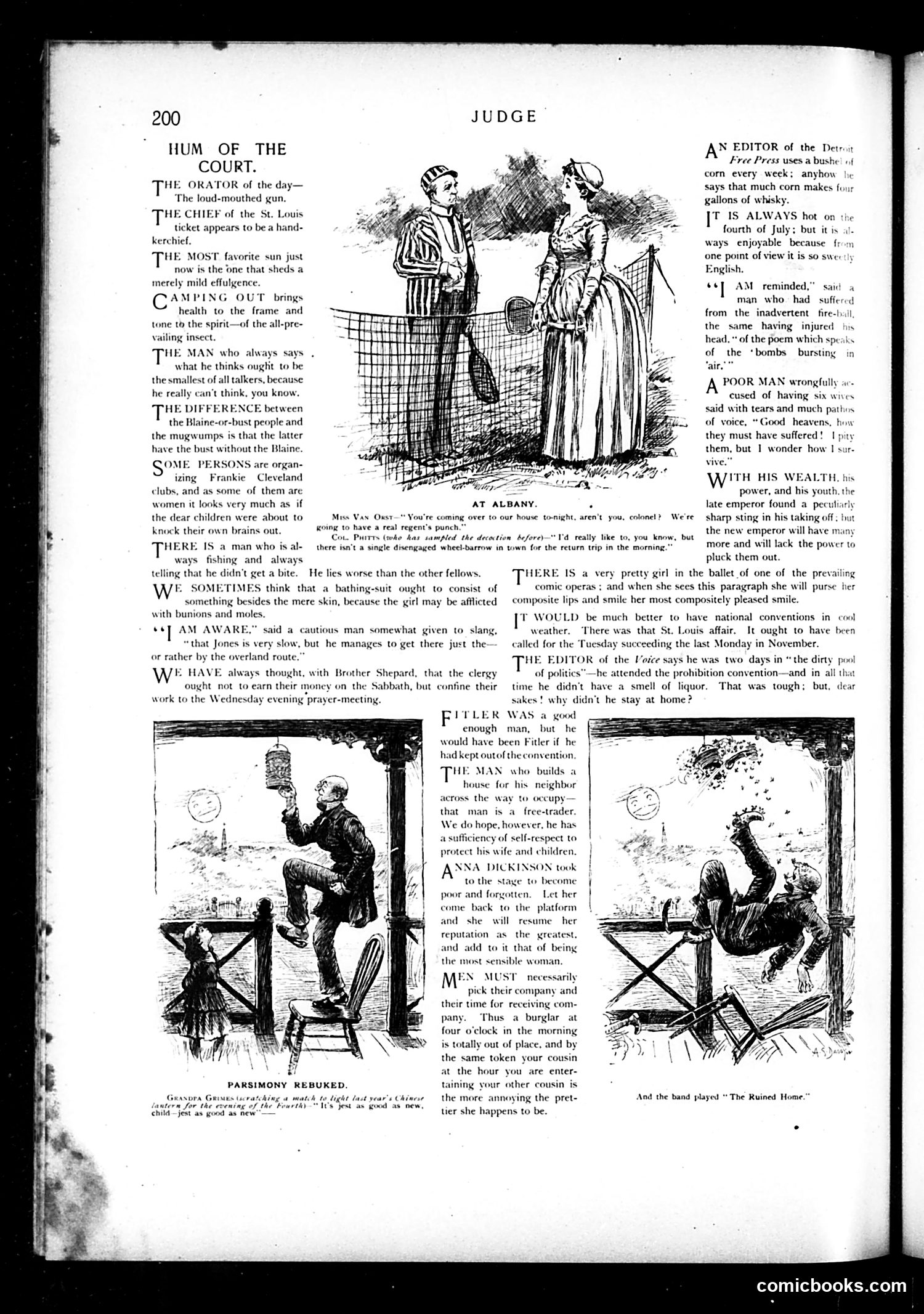
This page from Judge contains brief satirical quips ("Hum of the Court") mocking contemporary figures and social conventions, plus two illustrated cartoons. **Top cartoon ("At Albany"):** A man and woman discuss attending a party. The colonel declines because there's "not a single disengaged wheelbarrow in town for the return trip in the morning"—satirizing either his drunkenness or the state of Albany's transportation/infrastructure. **Bottom cartoon ("Parsimony Rebuked"):** A man economically reuses a Chinese lantern from the previous year's Fourth of July celebration. The caption mocks his stinginess. The text snippets mock various targets: clergy who only attend prayer meetings, the 1884 presidential race (references to "Blaine-or-bust" Republicans and reform-minded "mugwumps"), Frankie Cleveland (wife of President Cleveland), and contemporary social absurdities. The satire is gentle, focusing on human folly rather than hard political critique—typical of Judge's humorous tone during this Gilded Age period.
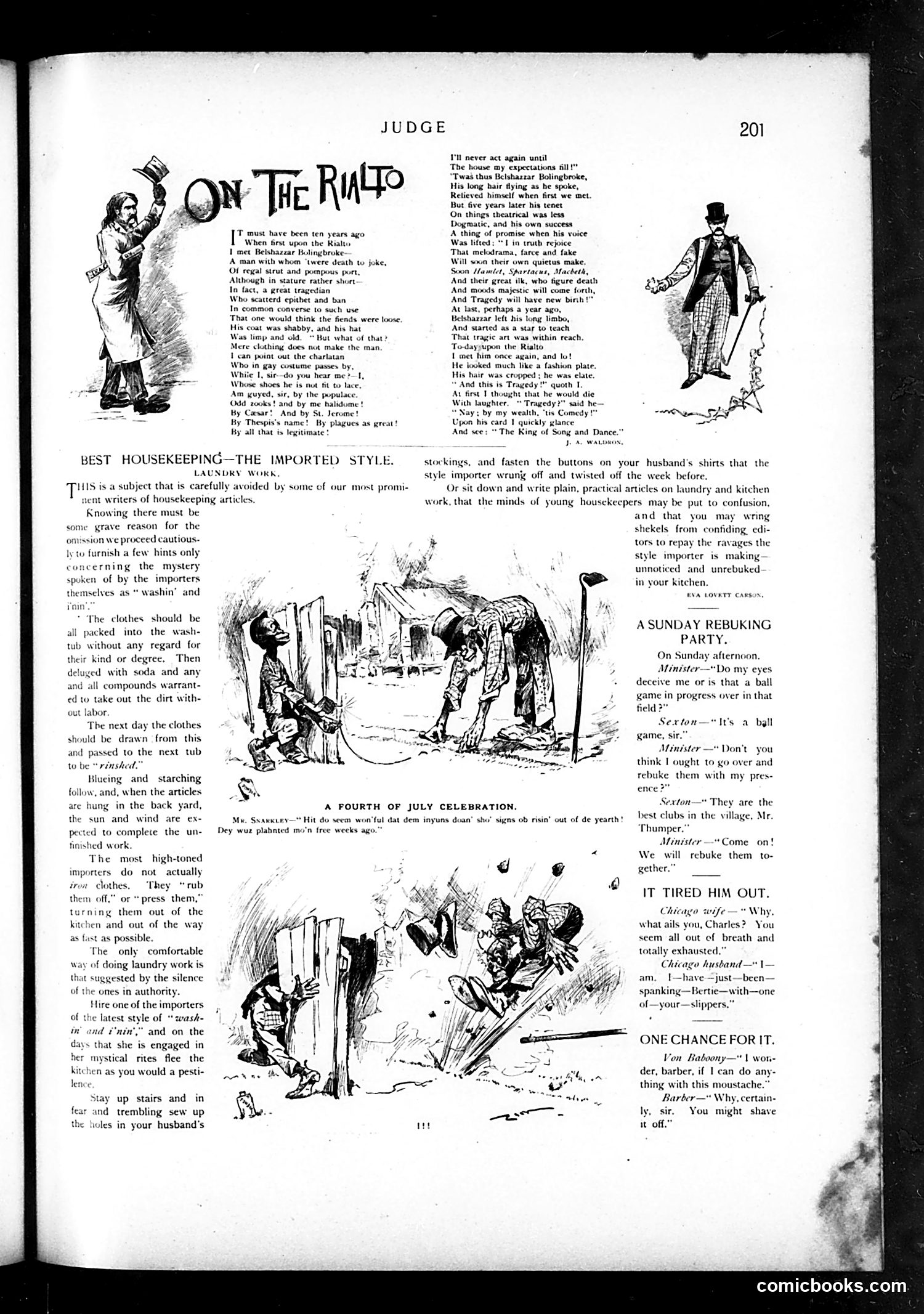
**"On the Rialto"** (left): This poem satirizes a pretentious, struggling actor named Belshazzar Bolingbroke. He initially pontificates grandly about theatrical art despite shabby clothing, later predicts the triumph of serious drama over melodrama, but eventually becomes a vaudeville performer ("King of Song and Dance"). The joke: his grandiose artistic ambitions collapsed into lowbrow entertainment—he became exactly what he once scorned. **"Best Housekeeping—The Imported Style"** (center/right): This satirizes wealthy European-influenced domestic advice that advocates hiring servants to handle laundry while ladies remain aloof. The satire mocks both the impracticality and snobbery of "imported" (European) housekeeping fashions that encourage idleness over actual household competence. **"A Fourth of July Celebration"** (bottom): A brief dialect-heavy joke about Native Americans and Independence Day—typical of period racism, though the specific reference is unclear without more context. The page critiques affectation and pretense across social classes.
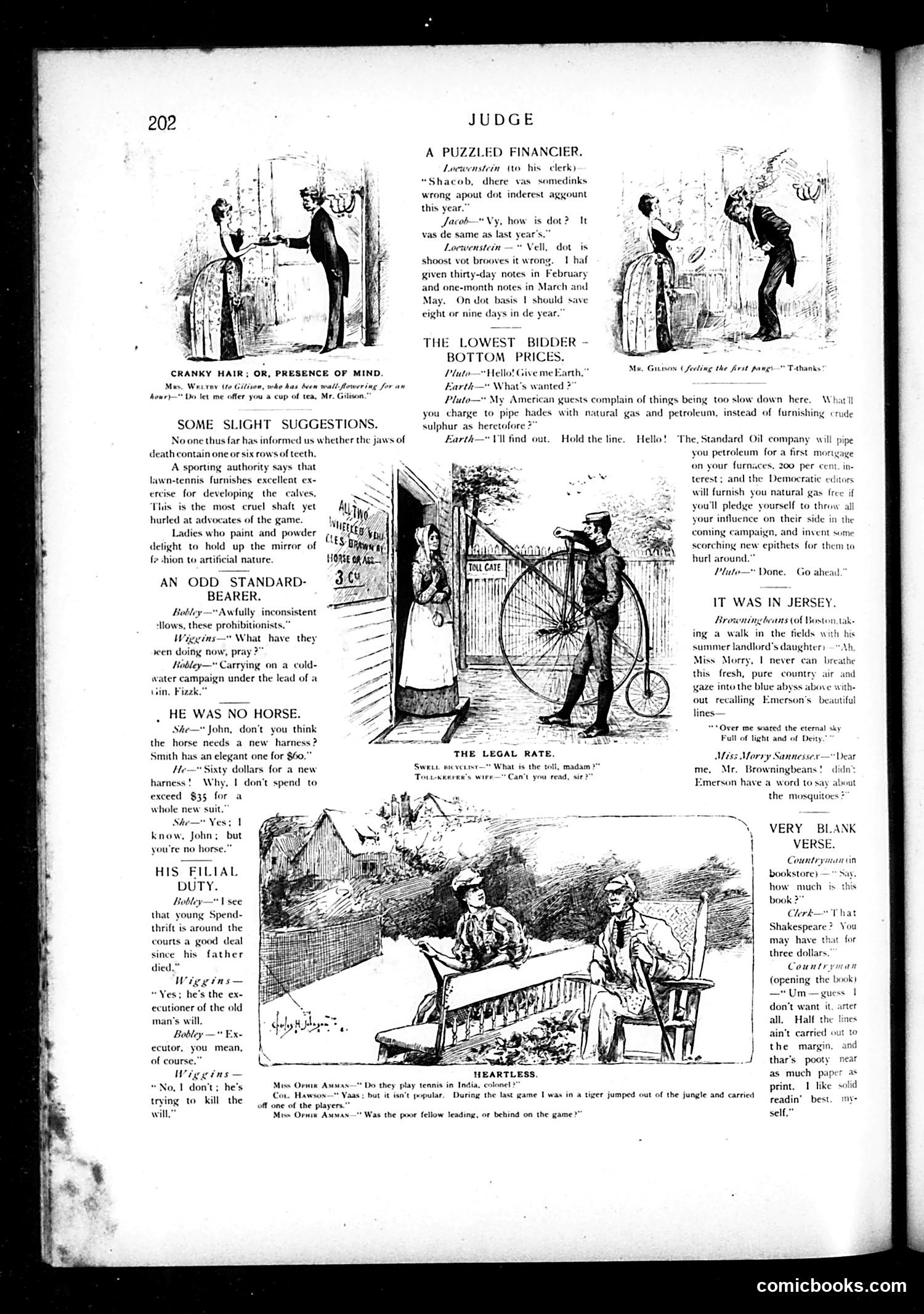
This page contains several satirical humor pieces typical of Judge magazine's social commentary: **"A Puzzled Financier"** mocks Jewish financiers (note the Yiddish dialect), specifically someone named Loewenstein confused about interest calculations—satirizing perceived Jewish business practices as overly complex or manipulative. **"The Lowest Bidder"** jokes about Standard Oil's monopolistic practices, with the company offering to pipe natural gas to Hell in exchange for political influence—critiquing corporate corruption of democracy. **"It Was in Jersey"** gently satirizes romantic literary pretension: a Boston man quoting Emerson while walking with a girl is interrupted by practical concerns (mosquitoes), deflating his poetic aspirations. **"Very Blank Verse"** ridicules Shakespeare's high prices and poor readability—a customer finds the print margins too narrow and complains the book isn't worth three dollars. The page reflects late-19th-century anxieties: ethnic stereotyping, corporate power, and cultural snobbery about literature and romanticism. The humor relies on period-specific class consciousness and immigrant caricatures now recognized as offensive.
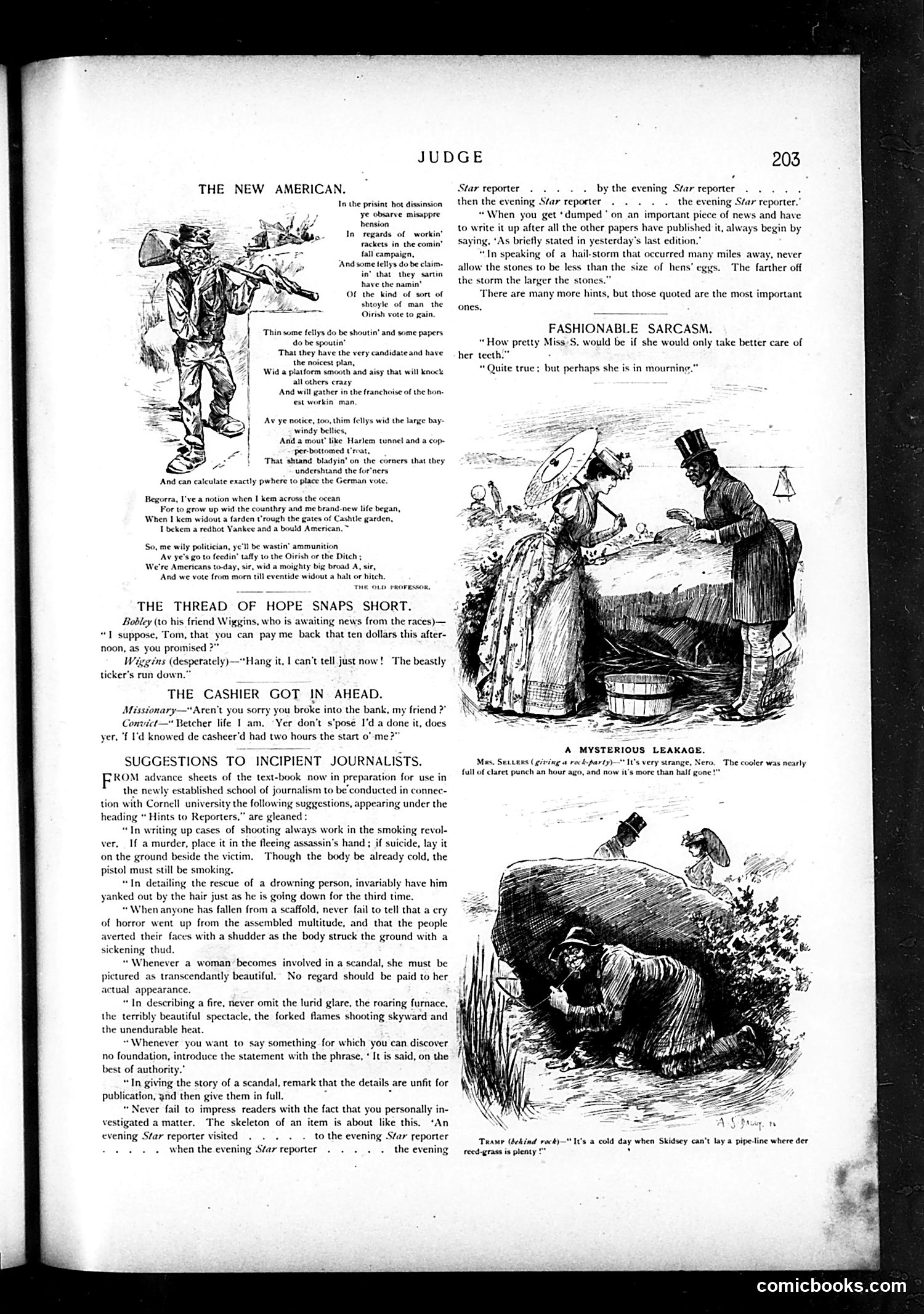
This page contains multiple satirical pieces mocking American journalism and politics circa the Gilded Age. **"The New American"** lampoons Irish-American political participation. Using exaggerated Irish dialect, it satirizes both corrupt politicians who manipulate immigrant voters and the immigrants themselves—depicting them as naive tools exploited for their voting bloc, particularly the "German vote." The underlying tension reflects nativist anxiety about non-Anglo-Saxon political power. **"Suggestions to Incipient Journalists"** ridicules sensationalist newspaper reporting practices: always including smoking pistols at crime scenes, exaggerating emotional reactions to tragedies, and idealizing women involved in scandals regardless of truth. It's satire of yellow journalism's disregard for accuracy. The shorter jokes mock gambling losses and crime, while "Fashionable Sarcasm" satirizes polite society's backhanded compliments. The cartoons and text together critique corrupt journalism, immigrant political manipulation, and Victorian hypocrisy—all targets of Judge's satirical mission during this period.
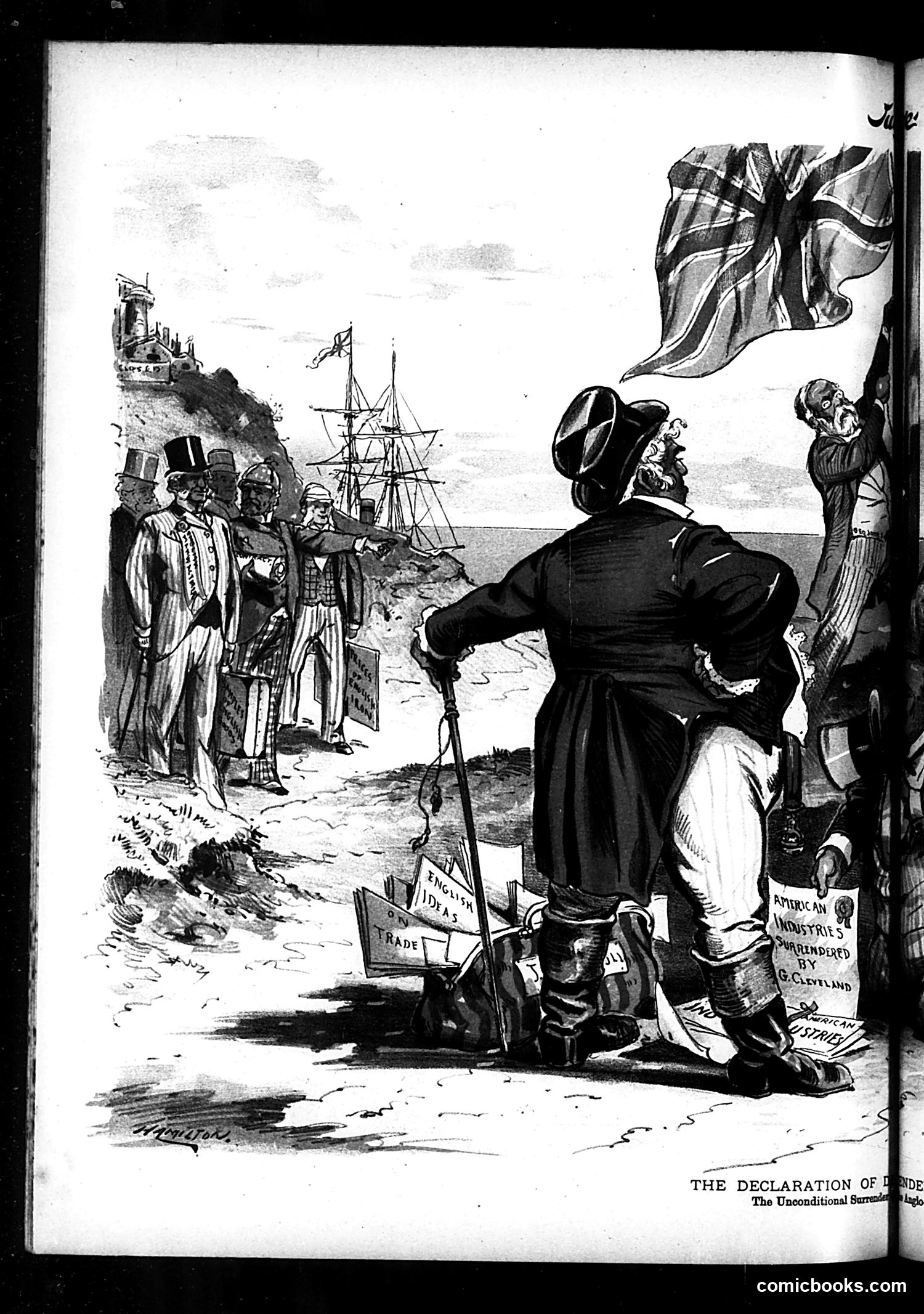
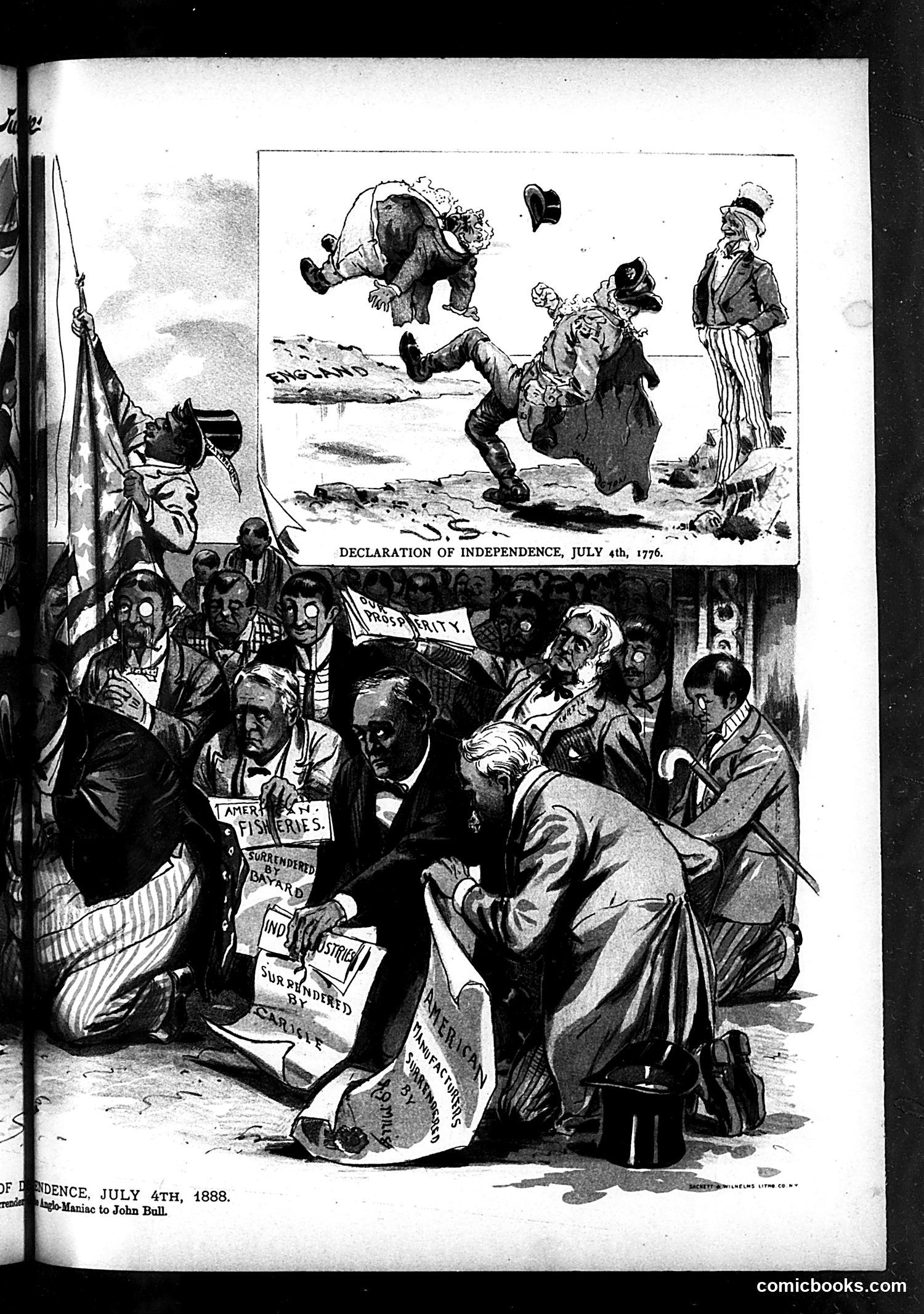
This *Judge* magazine page (1888) contrasts two scenes of American independence. The top panel shows the original Declaration signing in 1776 as a dignified moment. The bottom panel, labeled "1888," sarcastically depicts the same event as chaos—men in top hats tumble and scramble, their papers scattered. The reference to "John Bull" (Britain) suggests the cartoon mocks American political dysfunction on the centennial of independence. The message appears to be: while Americans celebrated their founding principles a century earlier, by 1888 the nation's political system had devolved into absurd disorder. The exaggerated, frantic poses emphasize this deterioration from noble ideals to corrupt or incompetent governance.
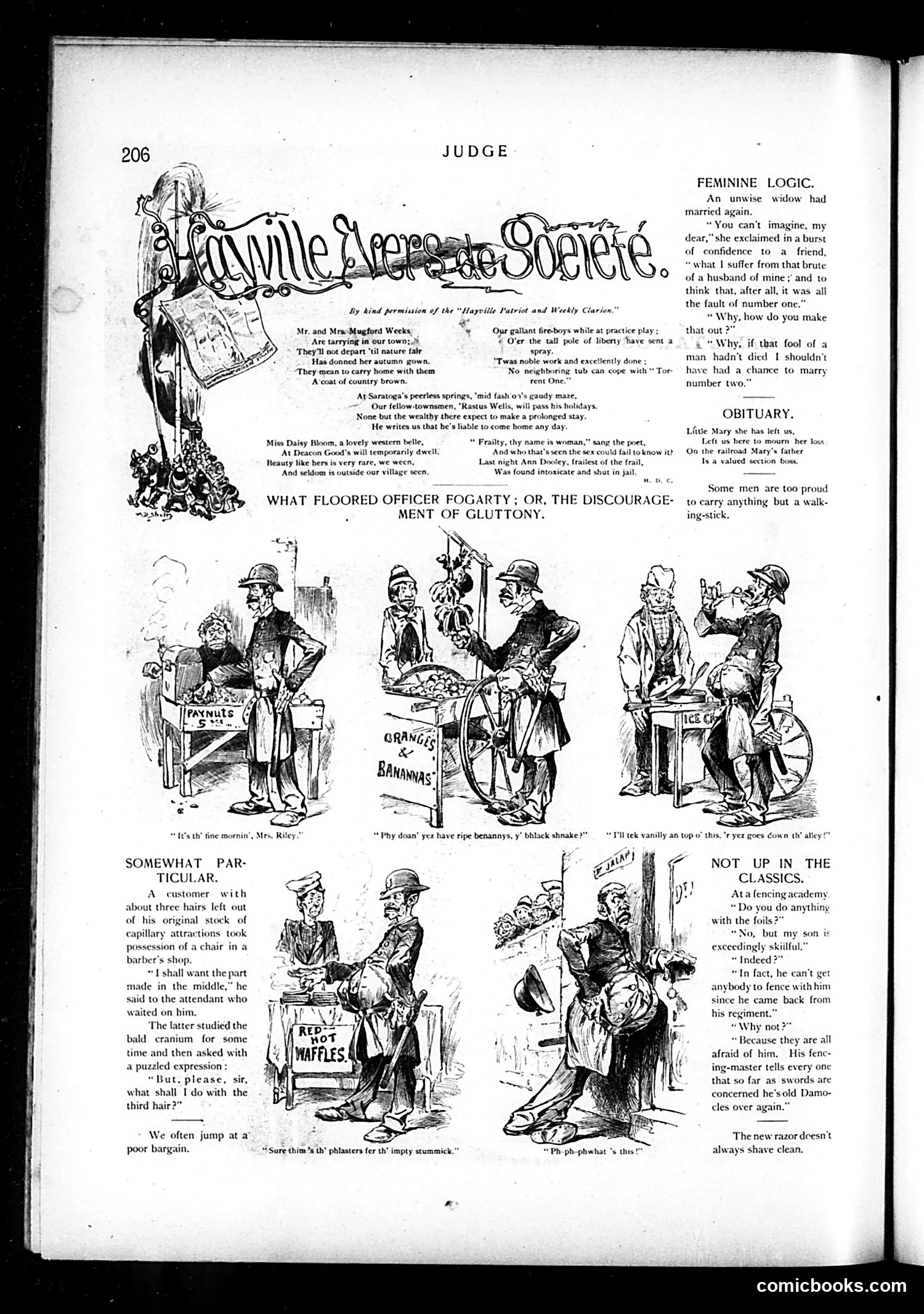
This page contains multiple satirical humor pieces typical of late 19th-century American comedy: **Main cartoons depict:** 1. **"What Floored Officer Fogarty"** — Irish police officer (identifiable by dialect: "Phy doan' yez have ripe benannys") encountering street vendors selling produce and other goods. The humor appears to rest on physical comedy and lower-class urban interactions. 2. **"Somewhat Particular"** — A barber shop joke where a nearly bald customer demands a precise middle part, prompting the barber's exasperated question about what to do with his "third hair." 3. **"Not Up in the Classics"** — A dialogue mocking a fencing academy student whose son has become so skilled he frightens away all opponents, rendering classical fencing knowledge useless. **Additional content** includes period gossip-column items about local townspeople, an "Obituary" making dark jokes about remarriage, and observations on human nature (pride, vanity). The satire targets working-class Irish immigrants, vanity, and educated pretension—typical Judge magazine fare.
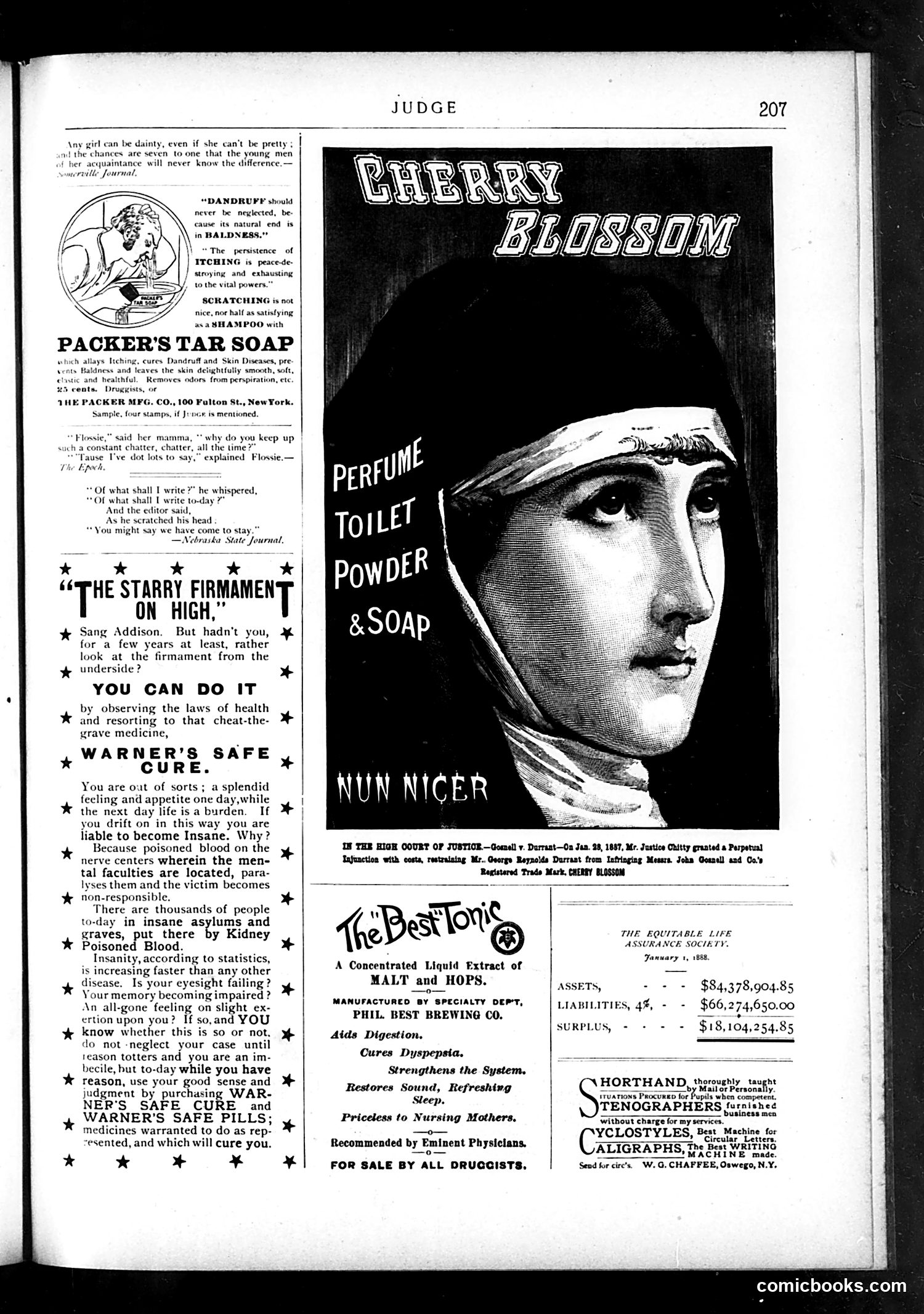
This page is primarily **advertising**, not political satire. It's from Judge's January 1, 1888 issue and contains multiple product advertisements interspersed with brief humorous quotes. The main visual element is a large advertisement for **Cherry Blossom Perfume, Toilet Powder & Soap**, featuring an illustration of a woman's profile. Below it is a legal notice about a trademark infringement case (Gosnell v. Durrant, 1887), indicating this was a recognized, protected brand. Surrounding this are ads for various patent medicines and products: Packer's Tar Soap (for dandruff/baldness), Warner's Safe Cure (claiming to prevent insanity caused by "poisoned blood"), Phil. Best Brewing Company's malt extract, and insurance/stenography services. The small quotes scattered throughout are generic social humor about letter-writing and feminine vanity—typical period filler content rather than topical satire. **For modern readers:** This reflects Victorian anxieties about health, hygiene, and dubious medical claims that were standard advertising practice before FDA regulation.
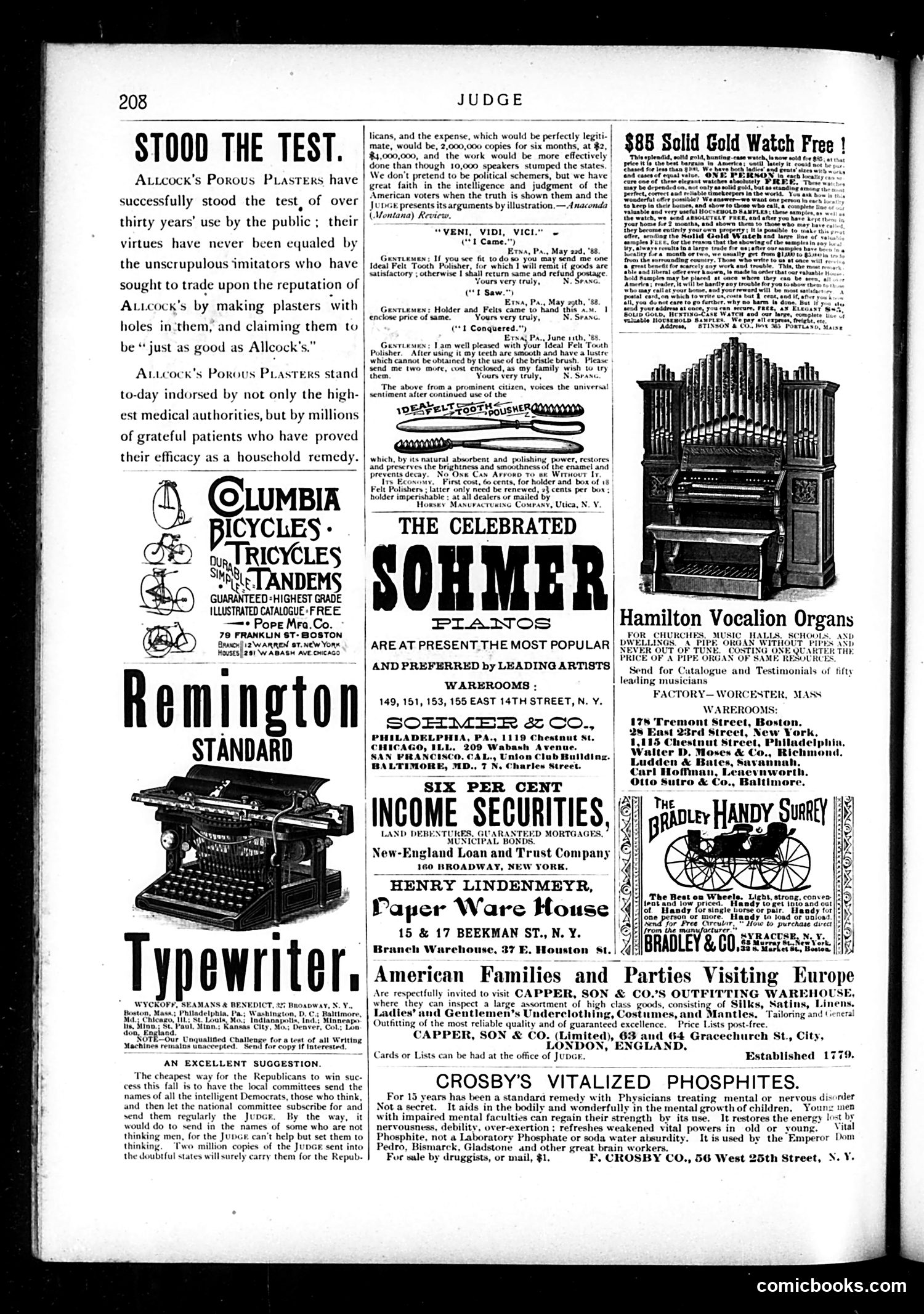
This page's main satirical content is the boxed section titled "An Excellent Suggestion." It presents a tongue-in-cheek Republican campaign strategy: rather than spending money on speakers to stumble across states, the GOP should send 2,000,000 copies of Judge magazine to "intelligent Democrats, those who think" for six months. The satire works on multiple levels. Judge claims its "arguments by illustration" (political cartoons) are more persuasive than traditional campaigning. The joke assumes Republicans believe Democrats lack intelligence and need visual propaganda to understand Republican positions. It's also self-promotion disguised as political strategy—Judge brazenly suggests the Republican party buy advertising space to convert opposition voters. The page is otherwise filled with period advertisements for typewriters, pianos, bicycles, and patent medicines, typical of 1880s magazine content.
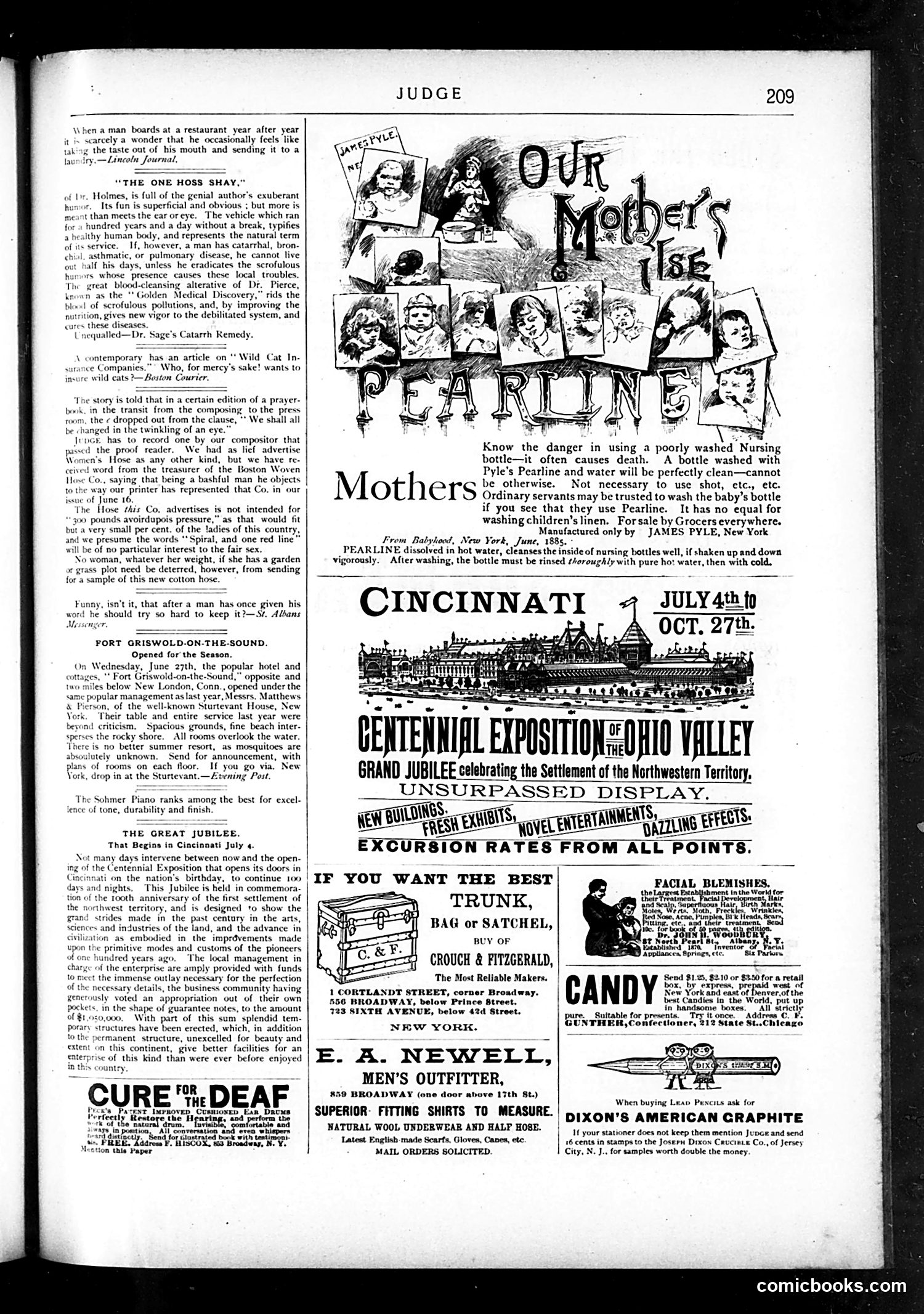
This page is primarily **advertising and promotional content** rather than political satire. The dominant feature is "Our Mothers' Vise," an illustrated advertisement for Pearline cleaning product, showing multiple photographs of mothers and children. The small editorial snippets are mild humor pieces: - A joke about restaurant boarding affecting one's taste - Commentary on Holmes's "One Hoss Shay" poem, used to promote Dr. Pierce's medical tonic - An anecdote about a printing error in the Boston Woven Hose Company advertisement The substantial portion below features announcements for the Cincinnati Centennial Exposition (opening July 4th, 1888) celebrating Ohio Valley settlement, plus various advertisements for trunks, men's clothing, piano, and other goods. **The satire is minimal here**—mostly mild observations about daily life rather than political commentary. The Pearline ad's emphasis on mothers and housework reflects Victorian domesticity assumptions typical of the era's advertising.
This page is **primarily advertising**, typical of late 19th-century magazines. It contains no political cartoons or satirical commentary—just commercial advertisements from the 1880s. The ads reveal period products and concerns: **Pears' Soap** prominently promises "fair white hands" and "bright clear complexion"—reflecting era anxieties about visible markers of class and racial identity. **Epps's Cocoa** and other food/beverage ads were common. Notable are remedies for "dyspepsia" (indigestion) and "rheumatism," suggesting common health complaints of the time. The **Hammond Typewriter** won awards in 1887, representing emerging office technology. A tailor's advertisement, **fountain pens**, **music boxes**, and **cigars** round out consumer goods marketed to the magazine's middle-class readership. The **Missouri Pacific Railway** ad promotes travel to Kansas City and "Great Hot Springs of Arkansas"—reflecting the era's expansion westward and leisure travel. This is a **commercial page**, not editorial content, offering historians insight into what products and health concerns preoccupied 1880s American consumers.
This page is primarily **advertising and business listings** rather than editorial content or political cartoons. The top portion contains various commercial advertisements for writing pens, patent medicines (Laroche's Tonic, containing "Peruvian Bark, Iron, and Pure Catalan Wine"), railway services (Wabash Railway), hats (Knox's), and hotels. The right column lists "Leading Hotels" in major American cities—New York, Springfield, Jersey City, Albany, Rochester, and Utica—typical directory content for a late 19th-century periodical. There is a novel advertisement for "**Napoleon Smith**: A Novel by a Well-Known New Yorker" priced at fifty cents, but no visible satire or political commentary about the actual Napoleon. The page appears to be from a back section of *Judge* devoted to commercial notices rather than the magazine's satirical editorial material. **No substantive political or social satire is evident on this particular page.**
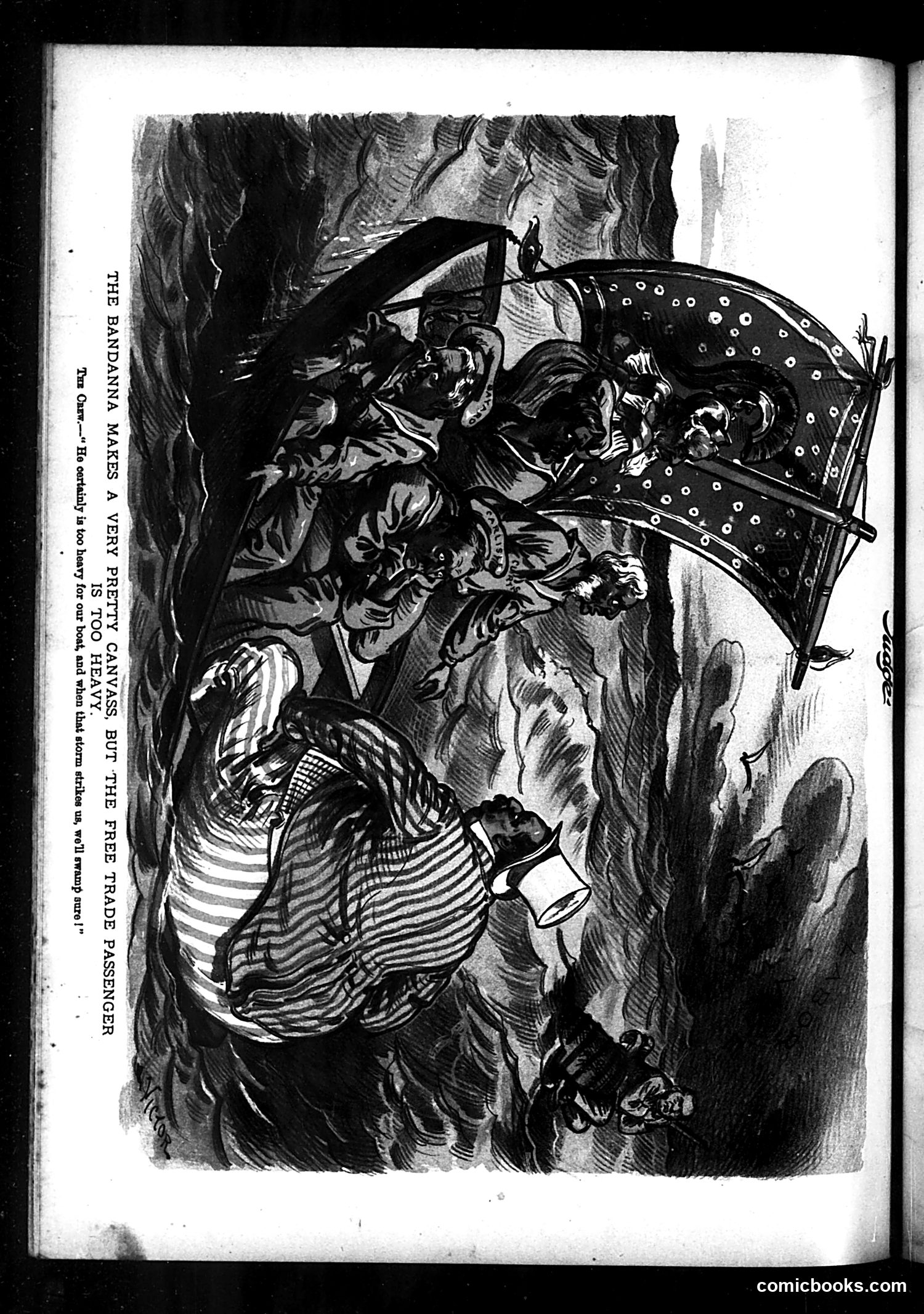
This political cartoon critiques the Free Trade movement, likely from the late 19th century. The "bandanna" (a decorative sail) represents Free Trade as visually appealing but impractical. The boat, labeled with what appears to be a Democratic or Free Trade vessel, is overloaded with a heavy "Free Trade Passenger"—presumably representing the economic burden or risk of free trade policies. The sailors' dialogue warns that this cargo is dangerously heavy and will capsize the boat when "that storm strikes"—suggesting free trade policies are financially unsound and will wreck the economy during economic downturns or crises. The cartoon satirizes Free Trade advocates as naive, prioritizing attractive ideology over practical economic stability. This reflects protectionist arguments common in Gilded Age American politics.